
The background of the anchoring image features the
EM
Published · 6 slides · 0 views

1 / 1
Description
The background of the anchoring image features the silhouetted landscape of New York, with billowing clouds and emanating smoke. There is a subtle allusions to dystopian tales including The Man in the High Castle (which re-imagines New
Related Topics
Share
Embed code
Download this presentation From Below
"The background of the anchoring image features the" is the property of its rightful owner. Permission is granted to download and print the materials on this website for personal, non-commercial use only, and to display it on your personal computer provided you do not modify the materials and that you retain all copyright notices contained in the materials. By downloading content from our website, you accept the terms of this agreement.
Presentation Transcript
01
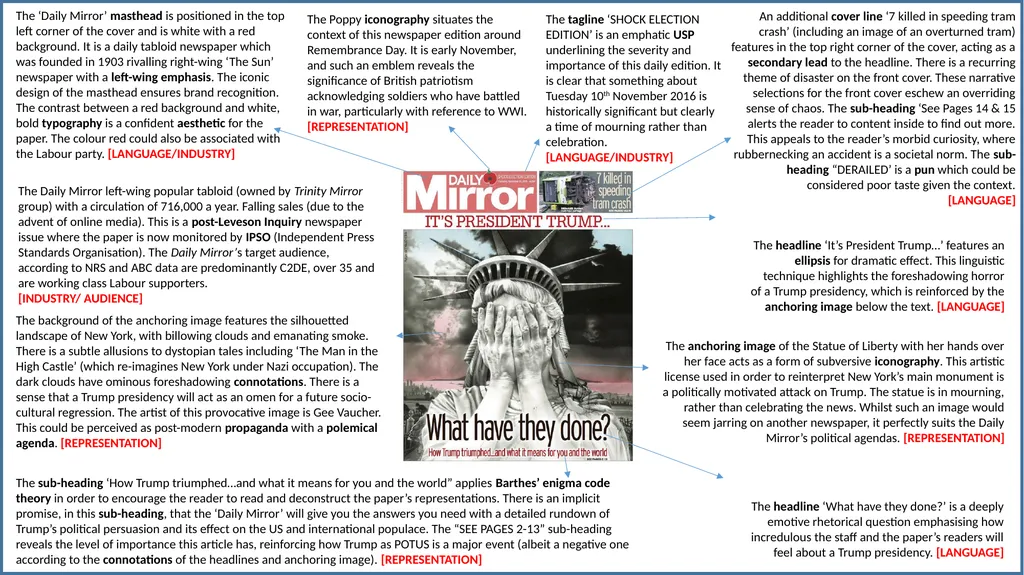
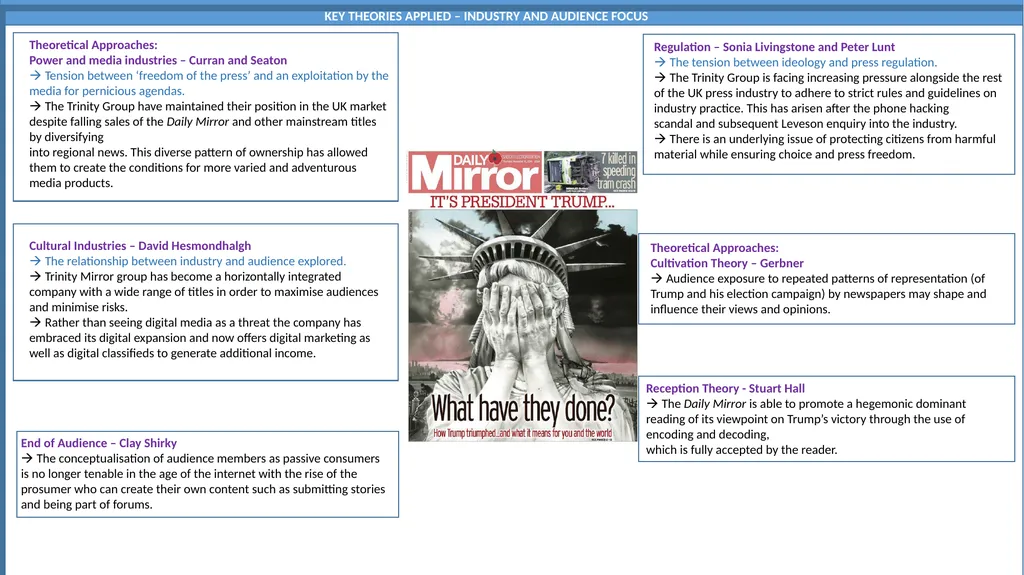
The background of the anchoring image features the silhouetted landscape of New York, with billowing clouds and emanating smoke. There is a subtle allusions to dystopian tales including ‘The Man in the High Castle’ (which re-imagines New York under Nazi occupation). The dark clouds have ominous foreshadowing connotations. There is a sense that a Trump presidency will act as an omen for a future socio-cultural regression. The artist of this provocative image is Gee Vaucher. This could be perceived as post-modern propaganda with a polemical agenda. [REPRESENTATION] The sub-heading ‘How Trump triumphed…and what it means for you and the world” applies Barthes’ enigma code theory in order to encourage the reader to read and deconstruct the paper’s representations. There is an implicit promise, in this sub-heading, that the ‘Daily Mirror’ will give you the answers you need with a detailed rundown of Trump’s political persuasion and its effect on the US and international populace. The “SEE PAGES 2-13” sub-heading reveals the level of importance this article has, reinforcing how Trump as POTUS is a major event (albeit a negative one according to the connotations of the headlines and anchoring image). [REPRESENTATION] The headline ‘What have they done?’ is a deeply emotive rhetorical question emphasising how incredulous the staff and the paper’s readers will feel about a Trump presidency. [LANGUAGE] The anchoring image of the Statue of Liberty with her hands over her face acts as a form of subversive iconography. This artistic license used in order to reinterpret New York’s main monument is a politically motivated attack on Trump. The statue is in mourning, rather than celebrating the news. Whilst such an image would seem jarring on another newspaper, it perfectly suits the Daily Mirror’s political agendas. [REPRESENTATION] The headline ‘It’s President Trump…’ features an ellipsis for dramatic effect. This linguistic technique highlights the foreshadowing horror of a Trump presidency, which is reinforced by the anchoring image below the text. [LANGUAGE] The Poppy iconography situates the context of this newspaper edition around Remembrance Day. It is early November, and such an emblem reveals the significance of British patriotism acknowledging soldiers who have battled in war, particularly with reference to WWI.
[REPRESENTATION] An additional cover line ‘7 killed in speeding tram crash’ (including an image of an overturned tram) features in the top right corner of the cover, acting as a secondary lead to the headline. There is a recurring theme of disaster on the front cover. These narrative selections for the front cover eschew an overriding sense of chaos. The sub-heading ‘See Pages 14 & 15 alerts the reader to content inside to find out more. This appeals to the reader’s morbid curiosity, where rubbernecking an accident is a societal norm. The sub-heading “DERAILED’ is a pun which could be considered poor taste given the context.
[LANGUAGE] The tagline ‘SHOCK ELECTION EDITION’ is an emphatic USP underlining the severity and importance of this daily edition. It is clear that something about Tuesday 10th November 2016 is historically significant but clearly a time of mourning rather than celebration. [LANGUAGE/INDUSTRY] The ‘Daily Mirror’ masthead is positioned in the top left corner of the cover and is white with a red background. It is a daily tabloid newspaper which was founded in 1903 rivalling right-wing ‘The Sun’ newspaper with a left-wing emphasis. The iconic design of the masthead ensures brand recognition. The contrast between a red background and white, bold typography is a confident aesthetic for the paper. The colour red could also be associated with the Labour party. [LANGUAGE/INDUSTRY] The Daily Mirror left-wing popular tabloid (owned by Trinity Mirror group) with a circulation of 716,000 a year. Falling sales (due to the advent of online media). This is a post-Leveson Inquiry newspaper issue where the paper is now monitored by IPSO (Independent Press Standards Organisation). The Daily Mirror’s target audience, according to NRS and ABC data are predominantly C2DE, over 35 and are working class Labour supporters.
[INDUSTRY/ AUDIENCE]<br>
02
KEY THEORIES APPLIED – INDUSTRY AND AUDIENCE FOCUS Theoretical Approaches:
Power and media industries – Curran and Seaton
Tension between ‘freedom of the press’ and an exploitation by the media for pernicious agendas.
The Trinity Group have maintained their position in the UK market despite falling sales of the Daily Mirror and other mainstream titles by diversifying
into regional news. This diverse pattern of ownership has allowed them to create the conditions for more varied and adventurous media products. Regulation – Sonia Livingstone and Peter Lunt
The tension between ideology and press regulation.
The Trinity Group is facing increasing pressure alongside the rest of the UK press industry to adhere to strict rules and guidelines on industry practice. This has arisen after the phone hacking
scandal and subsequent Leveson enquiry into the industry. There is an underlying issue of protecting citizens from harmful material while ensuring choice and press freedom. Cultural Industries – David Hesmondhalgh
The relationship between industry and audience explored.
Trinity Mirror group has become a horizontally integrated company with a wide range of titles in order to maximise audiences and minimise risks.
Rather than seeing digital media as a threat the company has embraced its digital expansion and now offers digital marketing as well as digital classifieds to generate additional income. Theoretical Approaches:
Cultivation Theory – Gerbner
Audience exposure to repeated patterns of representation (of Trump and his election campaign) by newspapers may shape and influence their views and opinions. End of Audience – Clay Shirky
The conceptualisation of audience members as passive consumers is no longer tenable in the age of the internet with the rise of the prosumer who can create their own content such as submitting stories and being part of forums. Reception Theory - Stuart Hall
The Daily Mirror is able to promote a hegemonic dominant reading of its viewpoint on Trump’s victory through the use of encoding and decoding,
which is fully accepted by the reader.<br>
03
Component 1
Media Products, Industries
and Audiences – Newspapers Focus Areas:
Media language
Representation
Media industries
Audiences
Media contexts Daily Mirror –
American Election
(2016) Product Context
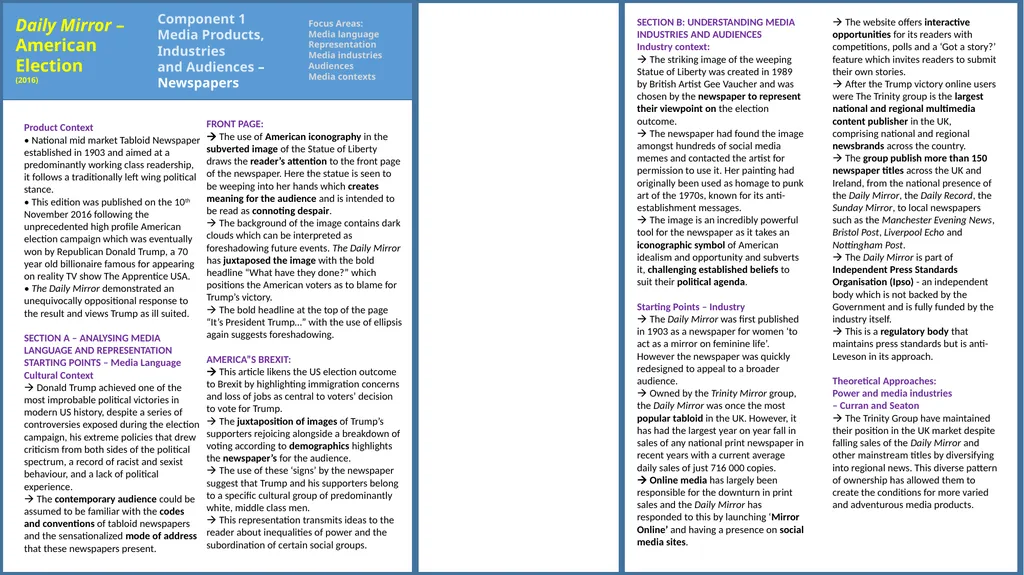
• National mid market Tabloid Newspaper established in 1903 and aimed at a predominantly working class readership, it follows a traditionally left wing political stance.
• This edition was published on the 10th November 2016 following the unprecedented high profile American election campaign which was eventually won by Republican Donald Trump, a 70 year old billionaire famous for appearing on reality TV show The Apprentice USA.
• The Daily Mirror demonstrated an unequivocally oppositional response to the result and views Trump as ill suited.
SECTION A – ANALYSING MEDIA
LANGUAGE AND REPRESENTATION
STARTING POINTS – Media Language
Cultural Context
Donald Trump achieved one of the most improbable political victories in modern US history, despite a series of controversies exposed during the election campaign, his extreme policies that drew criticism from both sides of the political spectrum, a record of racist and sexist behaviour, and a lack of political experience.
The contemporary audience could be assumed to be familiar with the codes and conventions of tabloid newspapers and the sensationalized mode of address that these newspapers present. FRONT PAGE: The use of American iconography in the subverted image of the Statue of Liberty draws the reader’s attention to the front page of the newspaper. Here the statue is seen to be weeping into her hands which creates meaning for the audience and is intended to be read as connoting despair. The background of the image contains dark clouds which can be interpreted as foreshadowing future events. The Daily Mirror has juxtaposed the image with the bold headline “What have they done?” which positions the American voters as to blame for Trump’s victory. The bold headline at the top of the page “It’s President Trump…” with the use of ellipsis again suggests foreshadowing.
AMERICA”S BREXIT: This article likens the US election outcome to Brexit by highlighting immigration concerns and loss of jobs as central to voters’ decision to vote for Trump. The juxtaposition of images of Trump’s supporters rejoicing alongside a breakdown of voting according to demographics highlights the newspaper’s for the audience. The use of these ‘signs’ by the newspaper suggest that Trump and his supporters belong to a specific cultural group of predominantly white, middle class men. This representation transmits ideas to the reader about inequalities of power and the subordination of certain social groups. SECTION B: UNDERSTANDING MEDIA
INDUSTRIES AND AUDIENCES
Industry context:
The striking image of the weeping Statue of Liberty was created in 1989 by British Artist Gee Vaucher and was chosen by the newspaper to represent their viewpoint on the election outcome. The newspaper had found the image amongst hundreds of social media memes and contacted the artist for
permission to use it. Her painting had originally been used as homage to punk art of the 1970s, known for its anti-establishment messages.
The image is an incredibly powerful tool for the newspaper as it takes an iconographic symbol of American idealism and opportunity and subverts it, challenging established beliefs to suit their political agenda.
Starting Points – Industry
The Daily Mirror was first published in 1903 as a newspaper for women ‘to act as a mirror on feminine life’. However the newspaper was quickly redesigned to appeal to a broader audience.
Owned by the Trinity Mirror group, the Daily Mirror was once the most popular tabloid in the UK. However, it has had the largest year on year fall in sales of any national print newspaper in recent years with a current average daily sales of just 716 000 copies.
Online media has largely been responsible for the downturn in print sales and the Daily Mirror has responded to this by launching ‘Mirror Online’ and having a presence on social media sites. The website offers interactive opportunities for its readers with competitions, polls and a ‘Got a story?’ feature which invites readers to submit their own stories. After the Trump victory online users were The Trinity group is the largest national and regional multimedia content publisher in the UK, comprising national and regional newsbrands across the country.
The group publish more than 150 newspaper titles across the UK and Ireland, from the national presence of the Daily Mirror, the Daily Record, the Sunday Mirror, to local newspapers such as the Manchester Evening News, Bristol Post, Liverpool Echo and Nottingham Post.
The Daily Mirror is part of Independent Press Standards Organisation (Ipso) - an independent
body which is not backed by the Government and is fully funded by the industry itself. This is a regulatory body that maintains press standards but is anti-Leveson in its approach.
Theoretical Approaches:
Power and media industries
– Curran and Seaton
The Trinity Group have maintained their position in the UK market despite falling sales of the Daily Mirror and other mainstream titles by diversifying
into regional news. This diverse pattern of ownership has allowed them to create the conditions for more varied and adventurous media products.<br>
04
Regulation – Sonia Livingstone
and Peter Lunt
The Trinity Group is facing increasing pressure alongside the rest of the UK press industry to adhere to strict rules and guidelines on industry practice. This has arisen after the phone hacking
scandal and subsequent Leveson enquiry into the industry. There is an underlying issue of protecting citizens from harmful material while ensuring choice and press freedom.
Cultural Industries – David Hesmondhalgh
Trinity Mirror group has become a horizontally integrated company with a wide range of titles in order to maximise audiences and minimise risks.
Rather than seeing digital media as a threat the company has embraced its digital expansion and now offers digital marketing as well as digital classifieds to generate additional income.
Starting Points: Audience
How are audiences grouped and categorised?
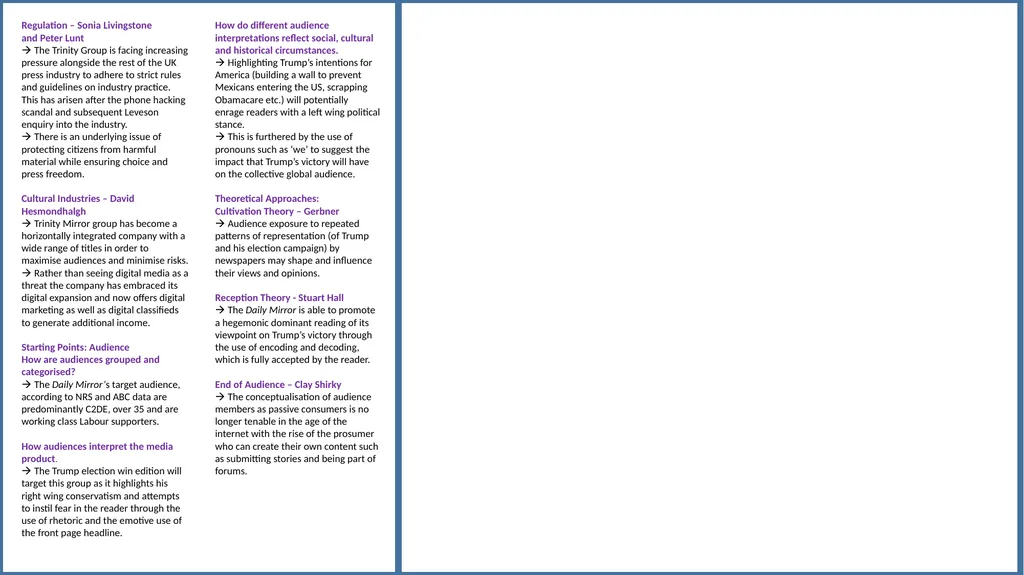
The Daily Mirror’s target audience, according to NRS and ABC data are predominantly C2DE, over 35 and are working class Labour supporters.
How audiences interpret the media product.
The Trump election win edition will target this group as it highlights his right wing conservatism and attempts to instil fear in the reader through the use of rhetoric and the emotive use of the front page headline. How do different audience interpretations reflect social, cultural and historical circumstances.
Highlighting Trump’s intentions for America (building a wall to prevent Mexicans entering the US, scrapping Obamacare etc.) will potentially
enrage readers with a left wing political stance.
This is furthered by the use of pronouns such as ‘we’ to suggest the impact that Trump’s victory will have on the collective global audience.
Theoretical Approaches:
Cultivation Theory – Gerbner
Audience exposure to repeated patterns of representation (of Trump and his election campaign) by newspapers may shape and influence their views and opinions.
Reception Theory - Stuart Hall
The Daily Mirror is able to promote a hegemonic dominant reading of its viewpoint on Trump’s victory through the use of encoding and decoding,
which is fully accepted by the reader.
End of Audience – Clay Shirky
The conceptualisation of audience members as passive consumers is no longer tenable in the age of the internet with the rise of the prosumer who can create their own content such as submitting stories and being part of forums.<br>
05
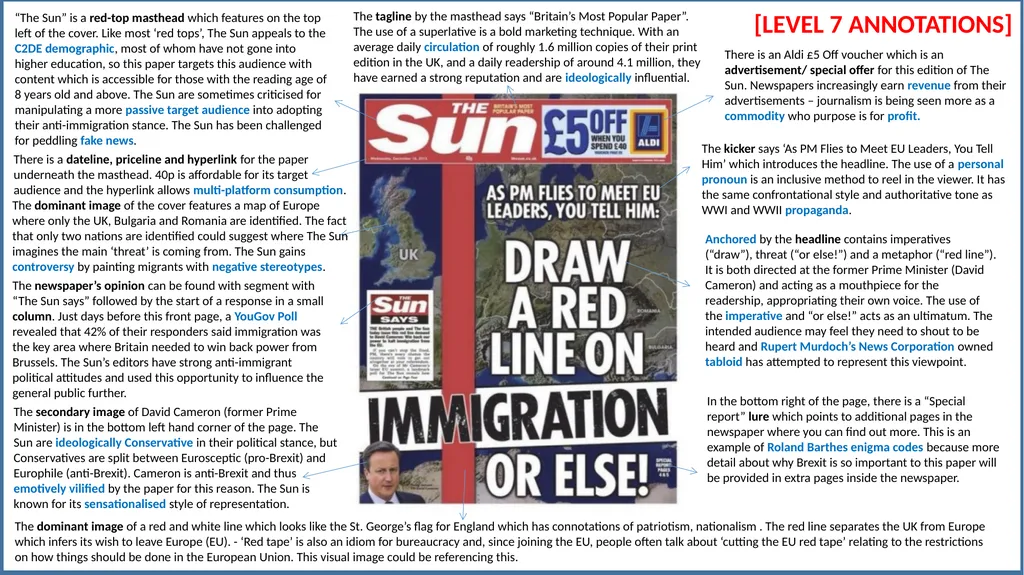
“The Sun” is a red-top masthead which features on the top left of the cover. Like most ‘red tops’, The Sun appeals to the C2DE demographic, most of whom have not gone into higher education, so this paper targets this audience with content which is accessible for those with the reading age of 8 years old and above. The Sun are sometimes criticised for manipulating a more passive target audience into adopting their anti-immigration stance. The Sun has been challenged for peddling fake news. The tagline by the masthead says “Britain’s Most Popular Paper”. The use of a superlative is a bold marketing technique. With an average daily circulation of roughly 1.6 million copies of their print edition in the UK, and a daily readership of around 4.1 million, they have earned a strong reputation and are ideologically influential. There is an Aldi £5 Off voucher which is an advertisement/ special offer for this edition of The Sun. Newspapers increasingly earn revenue from their advertisements – journalism is being seen more as a commodity who purpose is for profit. Anchored by the headline contains imperatives (“draw”), threat (“or else!”) and a metaphor (“red line”). It is both directed at the former Prime Minister (David Cameron) and acting as a mouthpiece for the readership, appropriating their own voice. The use of the imperative and “or else!” acts as an ultimatum. The intended audience may feel they need to shout to be heard and Rupert Murdoch’s News Corporation owned tabloid has attempted to represent this viewpoint. The dominant image of a red and white line which looks like the St. George’s flag for England which has connotations of patriotism, nationalism . The red line separates the UK from Europe which infers its wish to leave Europe (EU). - ‘Red tape’ is also an idiom for bureaucracy and, since joining the EU, people often talk about ‘cutting the EU red tape’ relating to the restrictions on how things should be done in the European Union. This visual image could be referencing this. The secondary image of David Cameron (former Prime Minister) is in the bottom left hand corner of the page. The Sun are ideologically Conservative in their political stance, but Conservatives are split between Eurosceptic (pro-Brexit) and Europhile (anti-Brexit). Cameron is anti-Brexit and thus emotively vilified by the paper for this reason. The Sun is known for its sensationalised style of representation. The dominant image of the cover features a map of Europe where only the UK, Bulgaria and Romania are identified. The fact that only two nations are identified could suggest where The Sun imagines the main ‘threat’ is coming from. The Sun gains controversy by painting migrants with negative stereotypes. There is a dateline, priceline and hyperlink for the paper underneath the masthead. 40p is affordable for its target audience and the hyperlink allows multi-platform consumption. The newspaper’s opinion can be found with segment with “The Sun says” followed by the start of a response in a small column. Just days before this front page, a YouGov Poll revealed that 42% of their responders said immigration was the key area where Britain needed to win back power from Brussels. The Sun’s editors have strong anti-immigrant political attitudes and used this opportunity to influence the general public further. The kicker says ‘As PM Flies to Meet EU Leaders, You Tell Him’ which introduces the headline. The use of a personal pronoun is an inclusive method to reel in the viewer. It has the same confrontational style and authoritative tone as WWI and WWII propaganda. In the bottom right of the page, there is a “Special report” lure which points to additional pages in the newspaper where you can find out more. This is an example of Roland Barthes enigma codes because more detail about why Brexit is so important to this paper will be provided in extra pages inside the newspaper. [LEVEL 7 ANNOTATIONS]<br>
06
MINI GLOSSARY OF TERMS<br>