
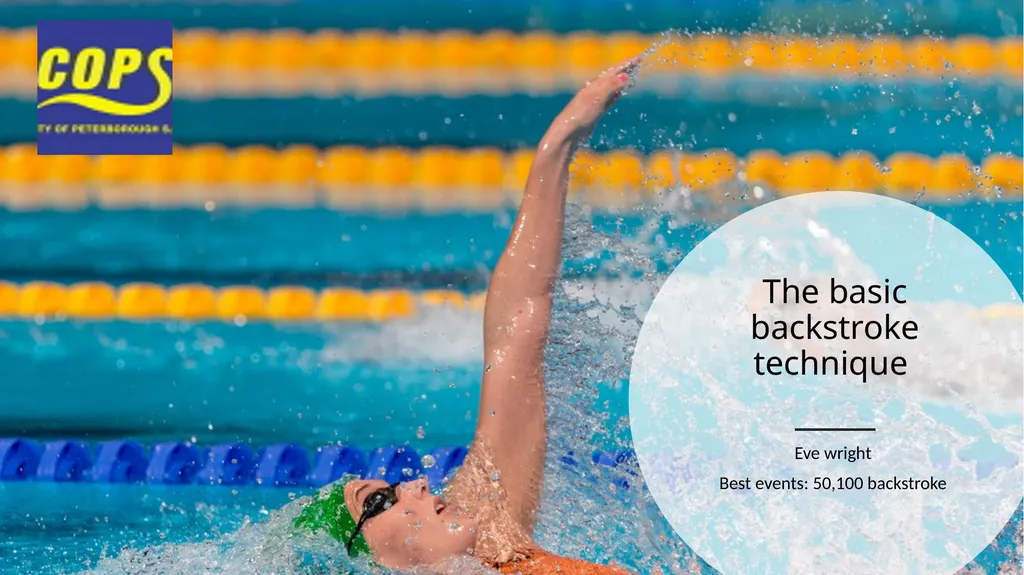
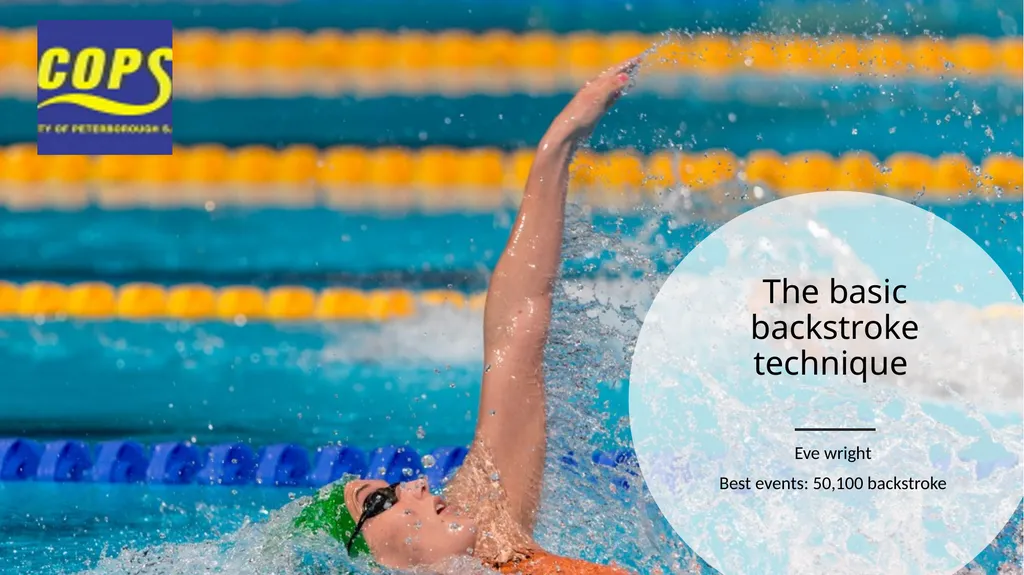
The basic backstroke technique Eve wright Best
Description: The basic backstroke technique Eve wright Best events: 50,100 backstroke But before we start Body position Horizontal and flat in the water Head relaxed and still The hips and shoulders remain at or near the water surface but roll with the
Related Topics
Download Presentation
"The basic backstroke technique Eve wright Best" is the property of its rightful owner. Permission is granted to download and print the materials on this website for personal, non-commercial use only, and to display it on your personal computer provided you do not modify the materials and that you retain all copyright notices contained in the materials. By downloading content from our website, you accept the terms of this agreement.
Presentation Transcript
slide1. The basic backstroke technique Eve wright
Best events: 50,100 backstroke<br>
slide2. But before we start<br>
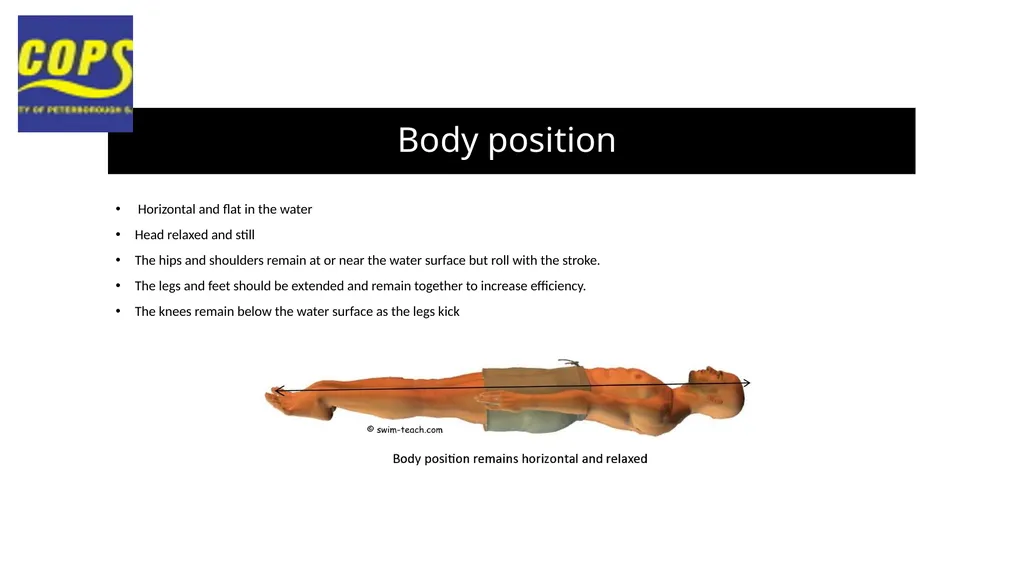
slide3. Body position Horizontal and flat in the water
Head relaxed and still
The hips and shoulders remain at or near the water surface but roll with the stroke.
The legs and feet should be extended and remain together to increase efficiency.
The knees remain below the water surface as the legs kick<br>
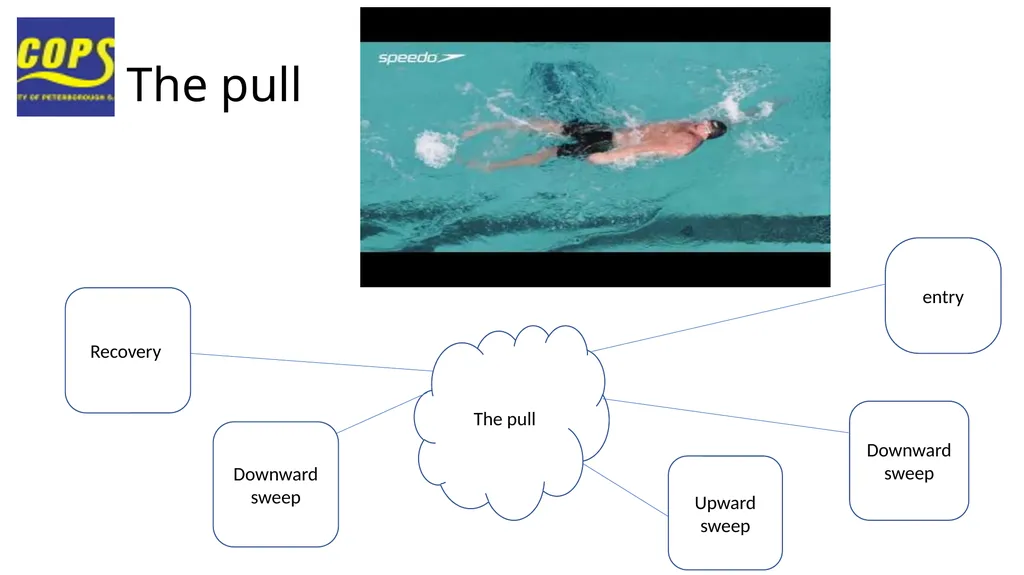
slide4. The pull The pull Recovery Downward sweep Upward sweep Downward sweep entry<br>
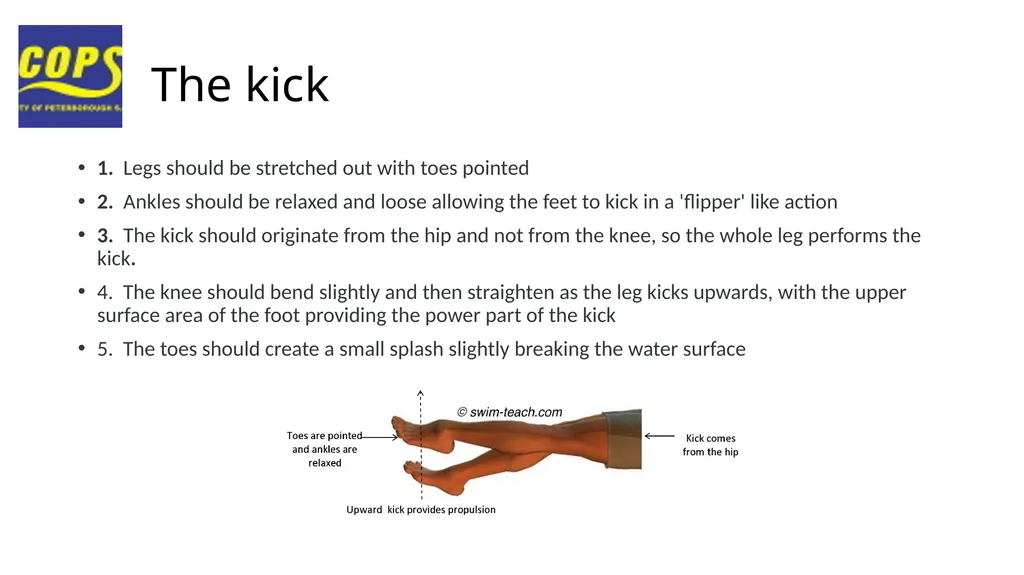
slide5. The kick 1. Legs should be stretched out with toes pointed
2. Ankles should be relaxed and loose allowing the feet to kick in a 'flipper' like action
3. The kick should originate from the hip and not from the knee, so the whole leg performs the kick.
4. The knee should bend slightly and then straighten as the leg kicks upwards, with the upper surface area of the foot providing the power part of the kick
5. The toes should create a small splash slightly breaking the water surface<br>
slide6. Backstroke stroke efficiency Luke Ruggles
Best events: 200 back and 200 breast<br>
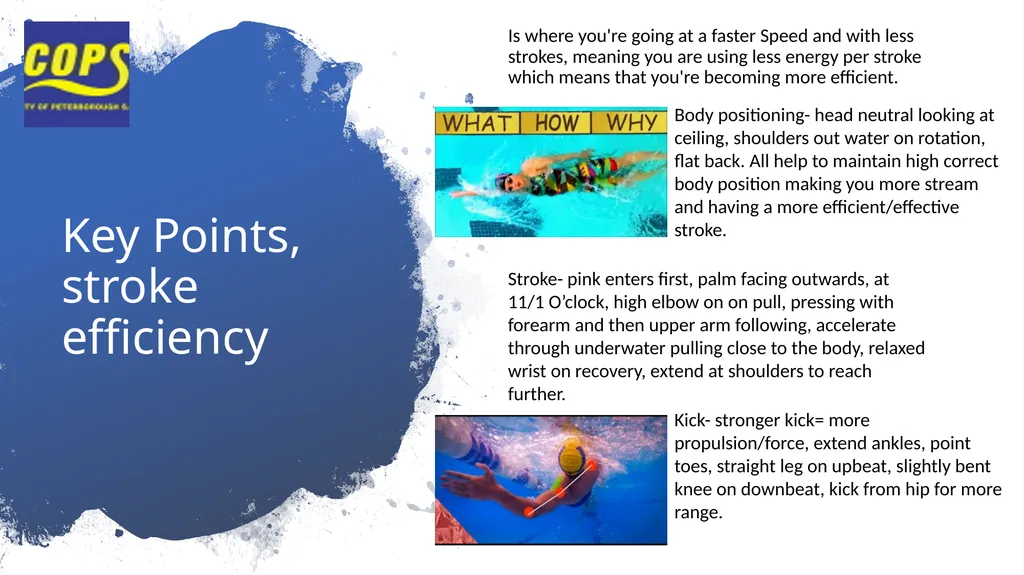
slide7. Key Points, stroke efficiency Is where you're going at a faster Speed and with less strokes, meaning you are using less energy per stroke which means that you're becoming more efficient. Body positioning- head neutral looking at ceiling, shoulders out water on rotation, flat back. All help to maintain high correct body position making you more stream and having a more efficient/effective stroke. Stroke- pink enters first, palm facing outwards, at 11/1 O’clock, high elbow on on pull, pressing with forearm and then upper arm following, accelerate through underwater pulling close to the body, relaxed wrist on recovery, extend at shoulders to reach further. Kick- stronger kick= more propulsion/force, extend ankles, point toes, straight leg on upbeat, slightly bent knee on downbeat, kick from hip for more range.<br>
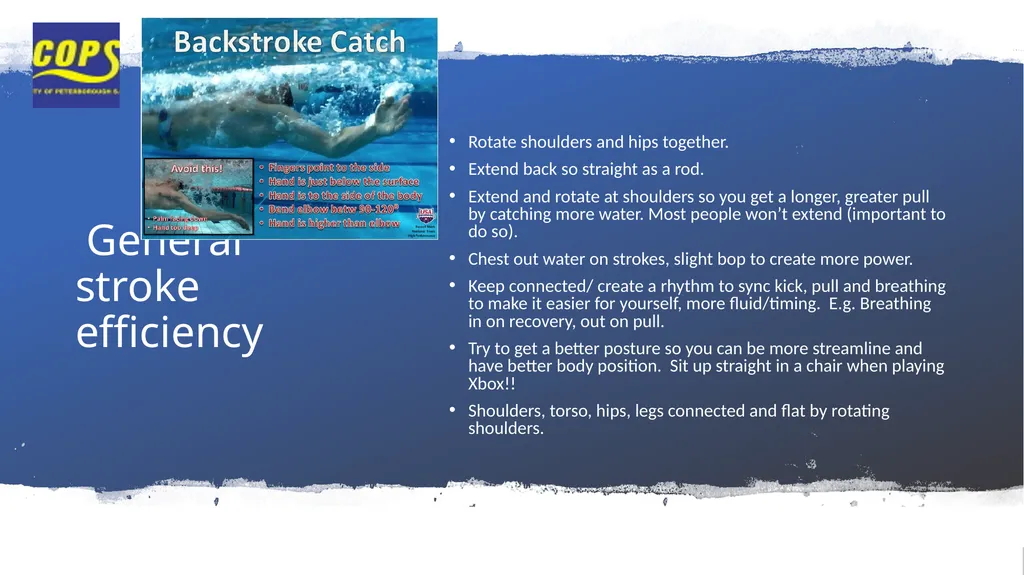
slide8. General stroke efficiency Rotate shoulders and hips together.
Extend back so straight as a rod.
Extend and rotate at shoulders so you get a longer, greater pull by catching more water. Most people won’t extend (important to do so).
Chest out water on strokes, slight bop to create more power.
Keep connected/ create a rhythm to sync kick, pull and breathing to make it easier for yourself, more fluid/timing. E.g. Breathing in on recovery, out on pull.
Try to get a better posture so you can be more streamline and have better body position. Sit up straight in a chair when playing Xbox!!
Shoulders, torso, hips, legs connected and flat by rotating shoulders.<br>
slide9. Common mistakes/errors Knees popping put out water on kick= less water moved and energy wasted.
Not rotating at shoulders= not be able to extend to get a longer catch, more drag.
Over rotating= more energy used by correcting arm also wasting time.
Under rotating= more drag from shoulder and arm trapping water, not close to body .<br>
slide10. Ways to improve Use fins to strengthen legs and increase mobility to get a more effective kick, creates more power.
Use hand/finger paddles to help with hand positioning, promoting better entry and control.
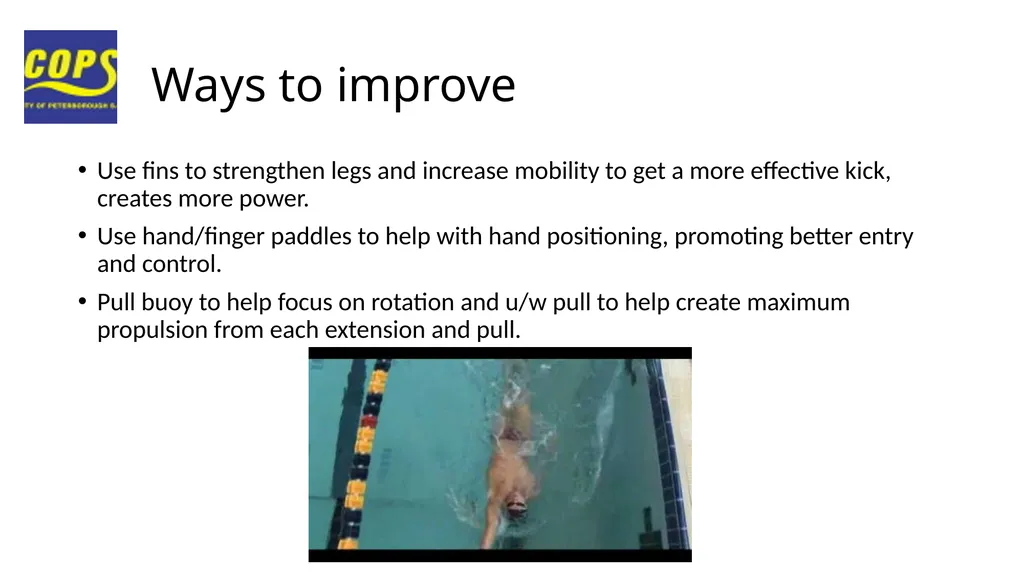
Pull buoy to help focus on rotation and u/w pull to help create maximum propulsion from each extension and pull.<br>
slide11. Benefits/ how can it help Through keeping a good flat back with good posture it can make you more streamline, meaning you use less energy to propel yourself forward by creating less resistance.
Helps to minimize muscle and joint injury in the future through promoting good posture and using muscles properly to their benefit and not pulling them in bad ways.
By having a relaxed wrist on recovery and stiff on pull helps to relieve stress on the wrist so can create a better catch and pull of the water by not straining and tiring it.
Extending at the shoulders (more in 100 and 200 back), can be forgotten about but by extending at shoulders and reaching further you can create a better catch and longer pull by catching more water which makes you create more power per stroke with less energy.<br>
slide12. The underwater phase Hannah Willis
Best events: 100, 200 back and 200 fly<br>
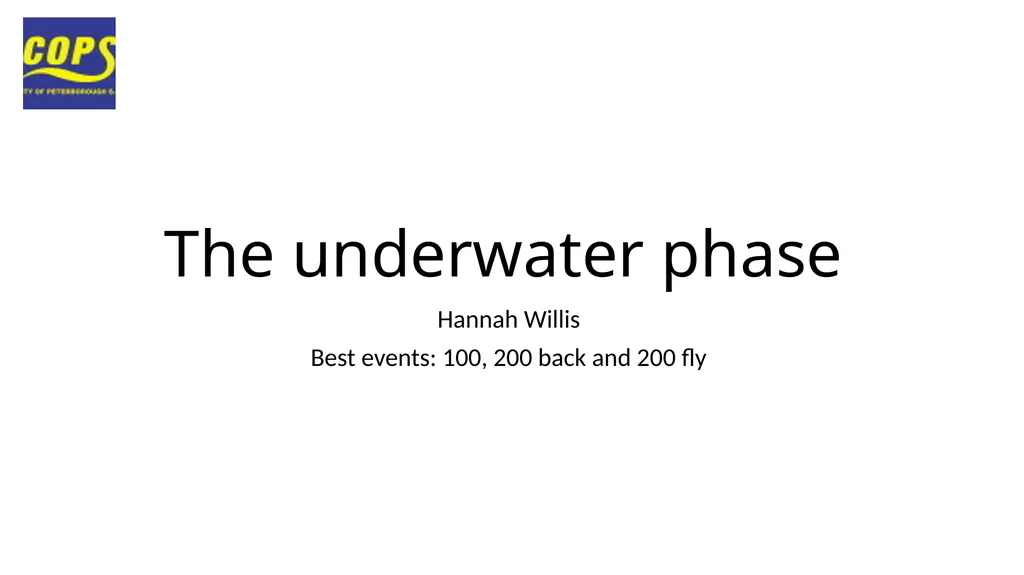
slide13. The Effect of Great Underwaters:
Swimmers go faster underwater than on the surface
A swimmer with a skilled underwater goes faster than the top speed reached by a 50m free swimmer
The turn/start can determine whether you win or lose But how do you achieve a great underwater?<br>
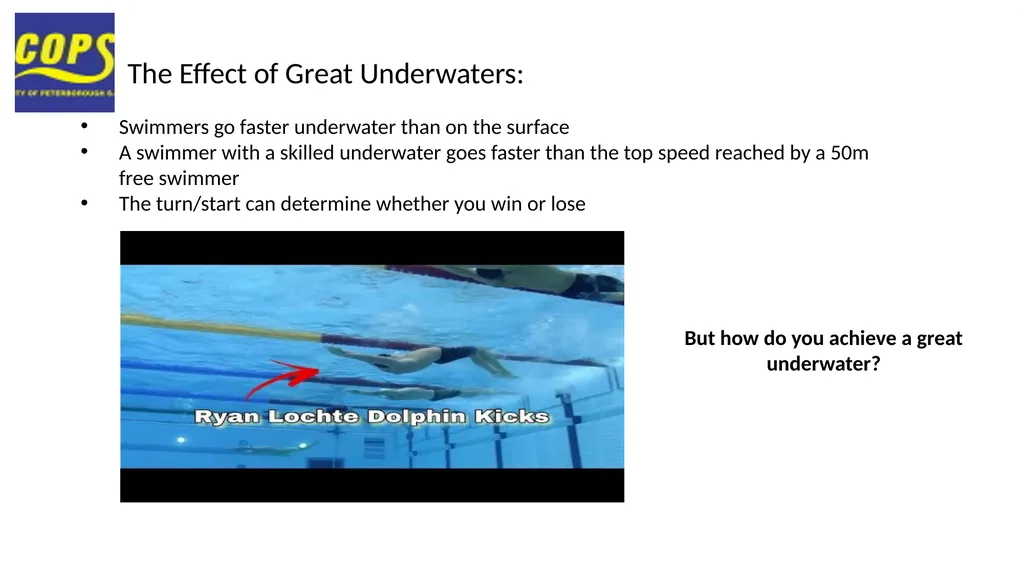
slide14. Push + Line: The squat used in s&c should be the position you plant your feet on the wall- a right angle
Use the power you would create in a squat jump on land and transfer this to the pool, the push off
Line should be held for no more than 2 seconds
Tight streamline
Trajectory off the wall should be slightly up towards the surface<br>
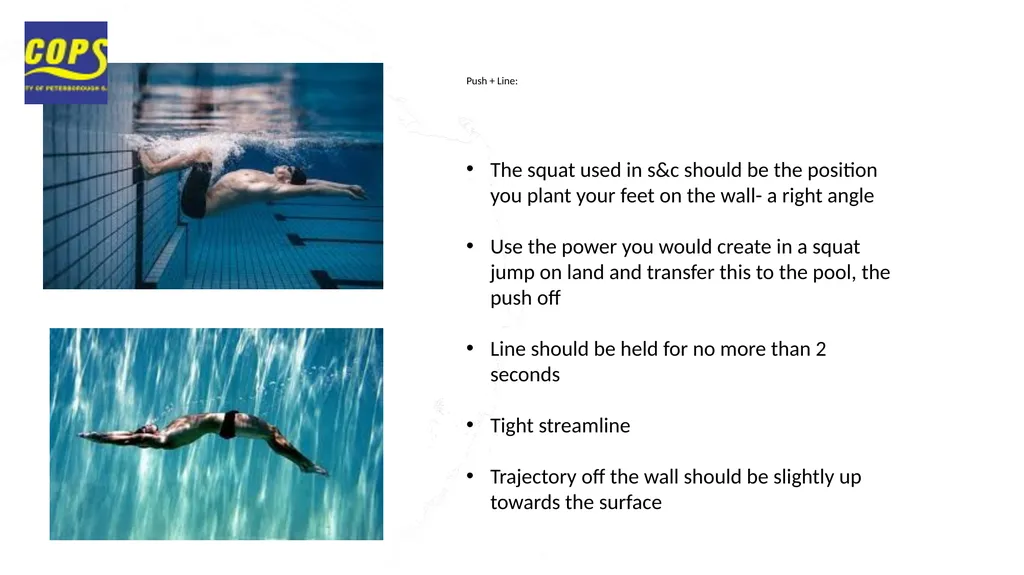
slide15. Underwater technique: Key points:
Keep the upper body still- from fingertips when in streamline to your core
Flow and move as one
Tight body position
Amplitude of the kick-size<br>
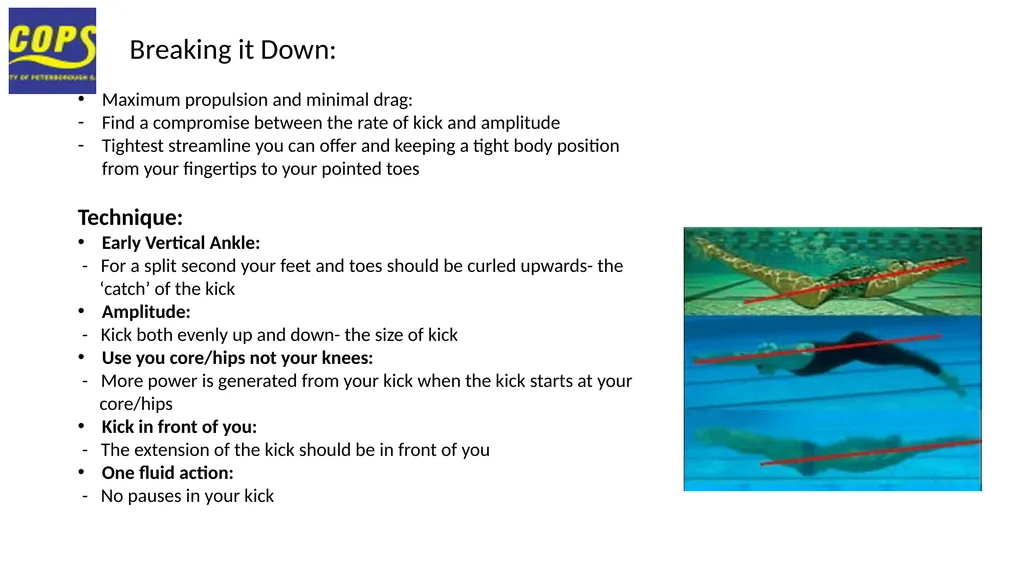
slide16. Breaking it Down: Maximum propulsion and minimal drag:
Find a compromise between the rate of kick and amplitude
Tightest streamline you can offer and keeping a tight body position from your fingertips to your pointed toes
Technique:
Early Vertical Ankle:
- For a split second your feet and toes should be curled upwards- the
‘catch’ of the kick
Amplitude:
- Kick both evenly up and down- the size of kick
Use you core/hips not your knees:
- More power is generated from your kick when the kick starts at your
core/hips
Kick in front of you:
- The extension of the kick should be in front of you
One fluid action:
- No pauses in your kick<br>
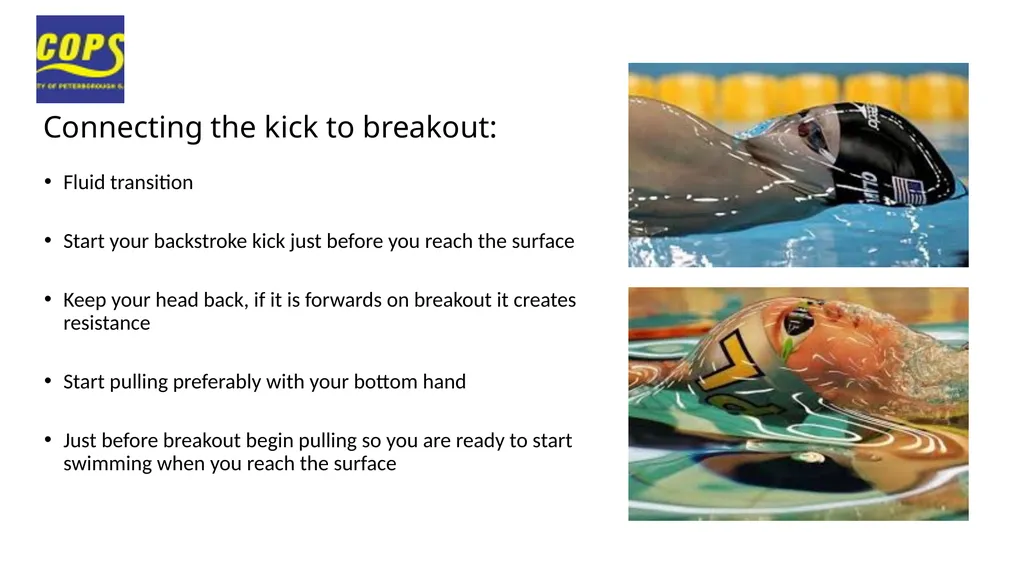
slide17. Connecting the kick to breakout: Fluid transition
Start your backstroke kick just before you reach the surface
Keep your head back, if it is forwards on breakout it creates resistance
Start pulling preferably with your bottom hand
Just before breakout begin pulling so you are ready to start swimming when you reach the surface<br>
slide18. Ways to help improve your underwaters: Mobility work for greater range of motion- its been found that most swimmers with great underwaters have a great ankle flexibility. Exercises to do daily to help with this are:
Foam roll calf
Ankle rotations
Wall Lean stretch
Ankles rocks and rolls
World class athletes who have great underwaters have very powerful legs. Exercises you can easily do at home daily are:
Sprints
Box jumps
Squat Jumps
And if you are at a gym then deadlifts
However a simple way to work on your underwaters are in training and it can be as simple a being disciplined enough to deliver your tightest streamline off every wall or constantly reminding yourself of them 5 points: early vertical ankle, amplitude, use your core/hips not your knees, kick in front of you and in one fluid action.<br>
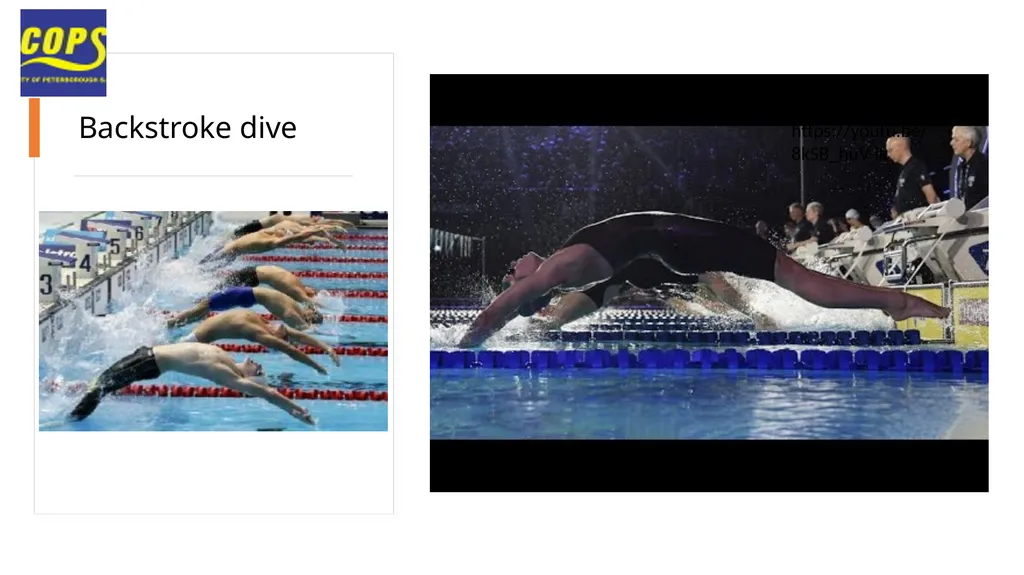
slide19. Backstroke dive https://youtu.be/8kSB_huV-ik<br>
slide20. Drills to improve your technique... Bum first dive
Penguin dive
Using a woggle behind your back
Diving from an underwater squat over the lane rope
Diving from steps as a raised platform
https://youtu.be/nezATXeXbIc<br>
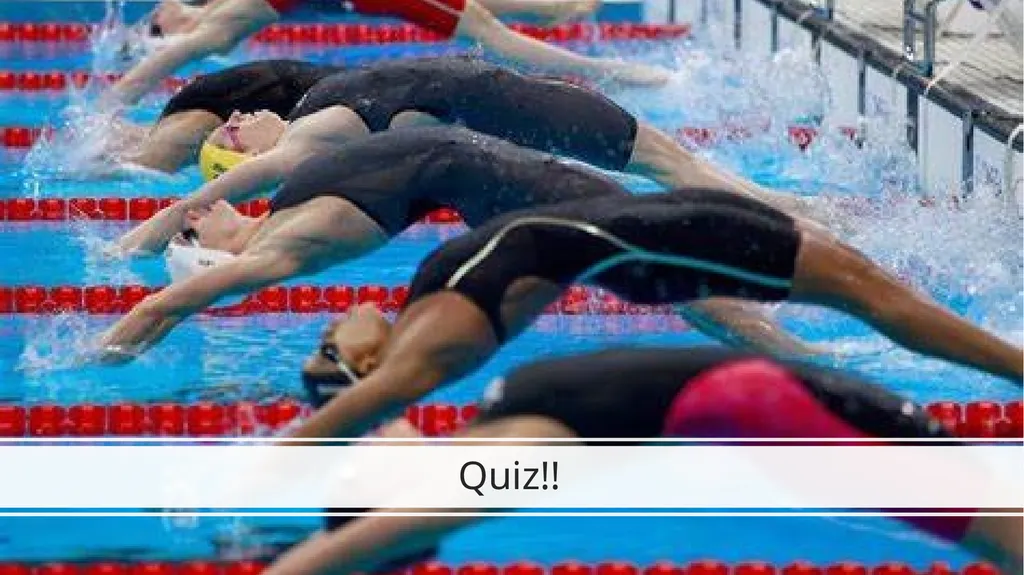
slide21. Quiz!!<br>
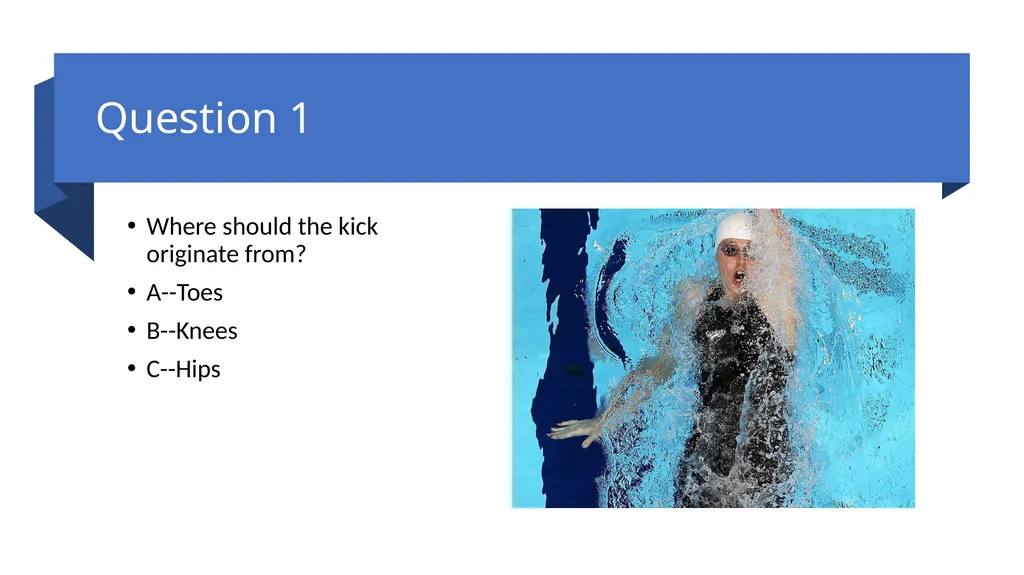
slide22. Question 1 Where should the kick originate from?
A--Toes
B--Knees
C--Hips<br>
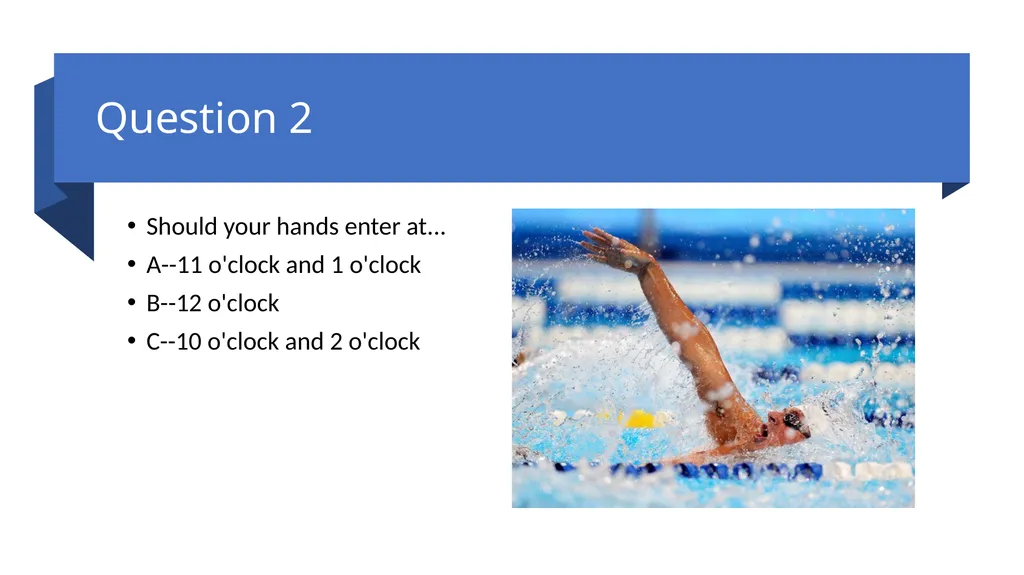
slide23. Question 2 Should your hands enter at...
A--11 o'clock and 1 o'clock
B--12 o'clock
C--10 o'clock and 2 o'clock<br>
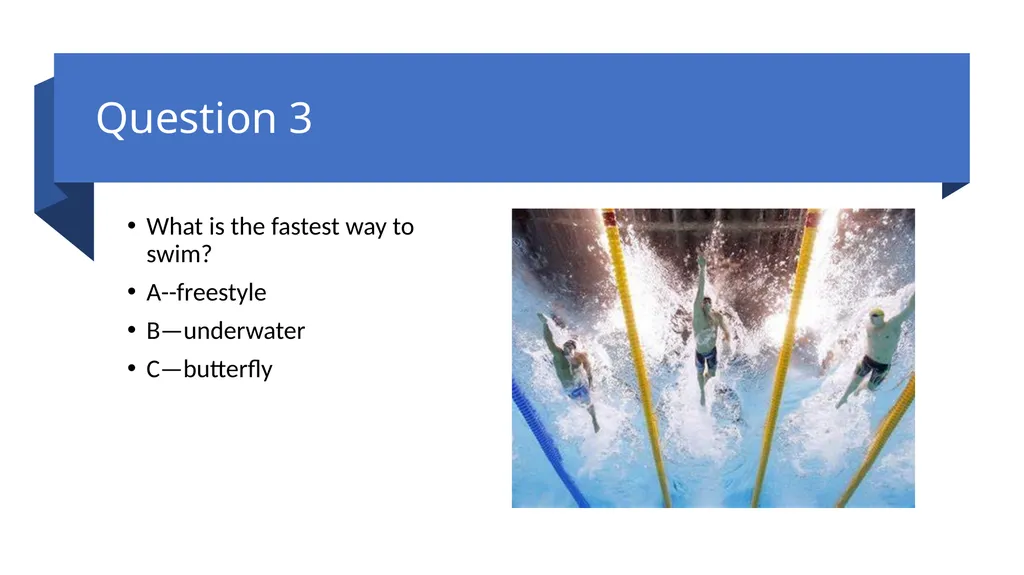
slide24. Question 3 What is the fastest way to swim?
A--freestyle
B—underwater
C—butterfly<br>
Best events: 50,100 backstroke<br>
slide2. But before we start<br>
slide3. Body position Horizontal and flat in the water
Head relaxed and still
The hips and shoulders remain at or near the water surface but roll with the stroke.
The legs and feet should be extended and remain together to increase efficiency.
The knees remain below the water surface as the legs kick<br>
slide4. The pull The pull Recovery Downward sweep Upward sweep Downward sweep entry<br>
slide5. The kick 1. Legs should be stretched out with toes pointed
2. Ankles should be relaxed and loose allowing the feet to kick in a 'flipper' like action
3. The kick should originate from the hip and not from the knee, so the whole leg performs the kick.
4. The knee should bend slightly and then straighten as the leg kicks upwards, with the upper surface area of the foot providing the power part of the kick
5. The toes should create a small splash slightly breaking the water surface<br>
slide6. Backstroke stroke efficiency Luke Ruggles
Best events: 200 back and 200 breast<br>
slide7. Key Points, stroke efficiency Is where you're going at a faster Speed and with less strokes, meaning you are using less energy per stroke which means that you're becoming more efficient. Body positioning- head neutral looking at ceiling, shoulders out water on rotation, flat back. All help to maintain high correct body position making you more stream and having a more efficient/effective stroke. Stroke- pink enters first, palm facing outwards, at 11/1 O’clock, high elbow on on pull, pressing with forearm and then upper arm following, accelerate through underwater pulling close to the body, relaxed wrist on recovery, extend at shoulders to reach further. Kick- stronger kick= more propulsion/force, extend ankles, point toes, straight leg on upbeat, slightly bent knee on downbeat, kick from hip for more range.<br>
slide8. General stroke efficiency Rotate shoulders and hips together.
Extend back so straight as a rod.
Extend and rotate at shoulders so you get a longer, greater pull by catching more water. Most people won’t extend (important to do so).
Chest out water on strokes, slight bop to create more power.
Keep connected/ create a rhythm to sync kick, pull and breathing to make it easier for yourself, more fluid/timing. E.g. Breathing in on recovery, out on pull.
Try to get a better posture so you can be more streamline and have better body position. Sit up straight in a chair when playing Xbox!!
Shoulders, torso, hips, legs connected and flat by rotating shoulders.<br>
slide9. Common mistakes/errors Knees popping put out water on kick= less water moved and energy wasted.
Not rotating at shoulders= not be able to extend to get a longer catch, more drag.
Over rotating= more energy used by correcting arm also wasting time.
Under rotating= more drag from shoulder and arm trapping water, not close to body .<br>
slide10. Ways to improve Use fins to strengthen legs and increase mobility to get a more effective kick, creates more power.
Use hand/finger paddles to help with hand positioning, promoting better entry and control.
Pull buoy to help focus on rotation and u/w pull to help create maximum propulsion from each extension and pull.<br>
slide11. Benefits/ how can it help Through keeping a good flat back with good posture it can make you more streamline, meaning you use less energy to propel yourself forward by creating less resistance.
Helps to minimize muscle and joint injury in the future through promoting good posture and using muscles properly to their benefit and not pulling them in bad ways.
By having a relaxed wrist on recovery and stiff on pull helps to relieve stress on the wrist so can create a better catch and pull of the water by not straining and tiring it.
Extending at the shoulders (more in 100 and 200 back), can be forgotten about but by extending at shoulders and reaching further you can create a better catch and longer pull by catching more water which makes you create more power per stroke with less energy.<br>
slide12. The underwater phase Hannah Willis
Best events: 100, 200 back and 200 fly<br>
slide13. The Effect of Great Underwaters:
Swimmers go faster underwater than on the surface
A swimmer with a skilled underwater goes faster than the top speed reached by a 50m free swimmer
The turn/start can determine whether you win or lose But how do you achieve a great underwater?<br>
slide14. Push + Line: The squat used in s&c should be the position you plant your feet on the wall- a right angle
Use the power you would create in a squat jump on land and transfer this to the pool, the push off
Line should be held for no more than 2 seconds
Tight streamline
Trajectory off the wall should be slightly up towards the surface<br>
slide15. Underwater technique: Key points:
Keep the upper body still- from fingertips when in streamline to your core
Flow and move as one
Tight body position
Amplitude of the kick-size<br>
slide16. Breaking it Down: Maximum propulsion and minimal drag:
Find a compromise between the rate of kick and amplitude
Tightest streamline you can offer and keeping a tight body position from your fingertips to your pointed toes
Technique:
Early Vertical Ankle:
- For a split second your feet and toes should be curled upwards- the
‘catch’ of the kick
Amplitude:
- Kick both evenly up and down- the size of kick
Use you core/hips not your knees:
- More power is generated from your kick when the kick starts at your
core/hips
Kick in front of you:
- The extension of the kick should be in front of you
One fluid action:
- No pauses in your kick<br>
slide17. Connecting the kick to breakout: Fluid transition
Start your backstroke kick just before you reach the surface
Keep your head back, if it is forwards on breakout it creates resistance
Start pulling preferably with your bottom hand
Just before breakout begin pulling so you are ready to start swimming when you reach the surface<br>
slide18. Ways to help improve your underwaters: Mobility work for greater range of motion- its been found that most swimmers with great underwaters have a great ankle flexibility. Exercises to do daily to help with this are:
Foam roll calf
Ankle rotations
Wall Lean stretch
Ankles rocks and rolls
World class athletes who have great underwaters have very powerful legs. Exercises you can easily do at home daily are:
Sprints
Box jumps
Squat Jumps
And if you are at a gym then deadlifts
However a simple way to work on your underwaters are in training and it can be as simple a being disciplined enough to deliver your tightest streamline off every wall or constantly reminding yourself of them 5 points: early vertical ankle, amplitude, use your core/hips not your knees, kick in front of you and in one fluid action.<br>
slide19. Backstroke dive https://youtu.be/8kSB_huV-ik<br>
slide20. Drills to improve your technique... Bum first dive
Penguin dive
Using a woggle behind your back
Diving from an underwater squat over the lane rope
Diving from steps as a raised platform
https://youtu.be/nezATXeXbIc<br>
slide21. Quiz!!<br>
slide22. Question 1 Where should the kick originate from?
A--Toes
B--Knees
C--Hips<br>
slide23. Question 2 Should your hands enter at...
A--11 o'clock and 1 o'clock
B--12 o'clock
C--10 o'clock and 2 o'clock<br>
slide24. Question 3 What is the fastest way to swim?
A--freestyle
B—underwater
C—butterfly<br>