
The Battelle Developmental Inventory 2nd Edition
GB
Published · 23 slides · 0 views
1 / 1

Description
The Battelle Developmental Inventory 2nd Edition Mary Stewart Anderson EDSP 5335: Growth Abnormalities Identification and Evaluation in Early Childhood Dr. Woodbury Houston Baptist University Overview Summary of Instrument Applications
Related Topics
Download this presentation From Below
"The Battelle Developmental Inventory 2nd Edition" is the property of its rightful owner. Permission is granted to download and print the materials on this website for personal, non-commercial use only, and to display it on your personal computer provided you do not modify the materials and that you retain all copyright notices contained in the materials. By downloading content from our website, you accept the terms of this agreement.
Share
Embed code
Presentation Transcript
01
The Battelle Developmental Inventory
2nd Edition Mary Stewart Anderson
EDSP 5335: Growth Abnormalities Identification and Evaluation in Early Childhood
Dr. Woodbury
Houston Baptist University<br>
EDSP 5335: Growth Abnormalities Identification and Evaluation in Early Childhood
Dr. Woodbury
Houston Baptist University<br>
02
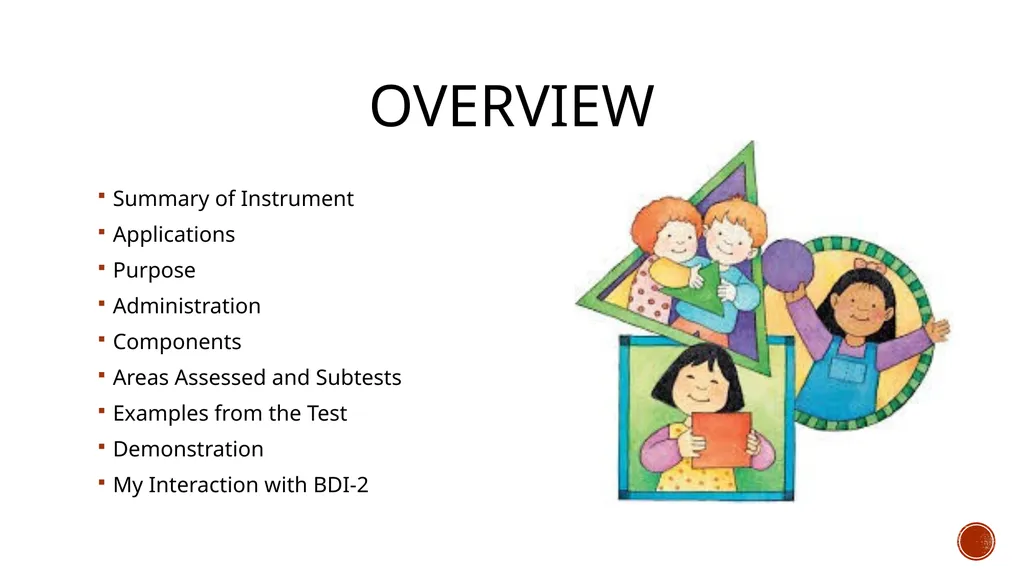
Overview Summary of Instrument
Applications
Purpose
Administration
Components
Areas Assessed and Subtests
Examples from the Test
Demonstration
My Interaction with BDI-2<br>
Applications
Purpose
Administration
Components
Areas Assessed and Subtests
Examples from the Test
Demonstration
My Interaction with BDI-2<br>
03
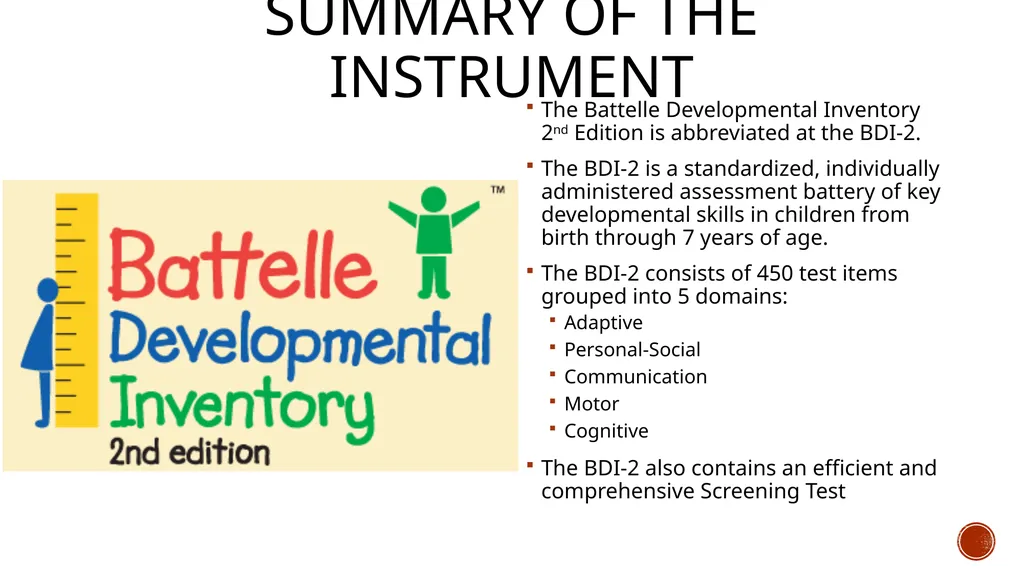
Summary of the Instrument The Battelle Developmental Inventory 2nd Edition is abbreviated at the BDI-2.
The BDI-2 is a standardized, individually administered assessment battery of key developmental skills in children from birth through 7 years of age.
The BDI-2 consists of 450 test items grouped into 5 domains:
Adaptive
Personal-Social
Communication
Motor
Cognitive
The BDI-2 also contains an efficient and comprehensive Screening Test<br>
The BDI-2 is a standardized, individually administered assessment battery of key developmental skills in children from birth through 7 years of age.
The BDI-2 consists of 450 test items grouped into 5 domains:
Adaptive
Personal-Social
Communication
Motor
Cognitive
The BDI-2 also contains an efficient and comprehensive Screening Test<br>
04
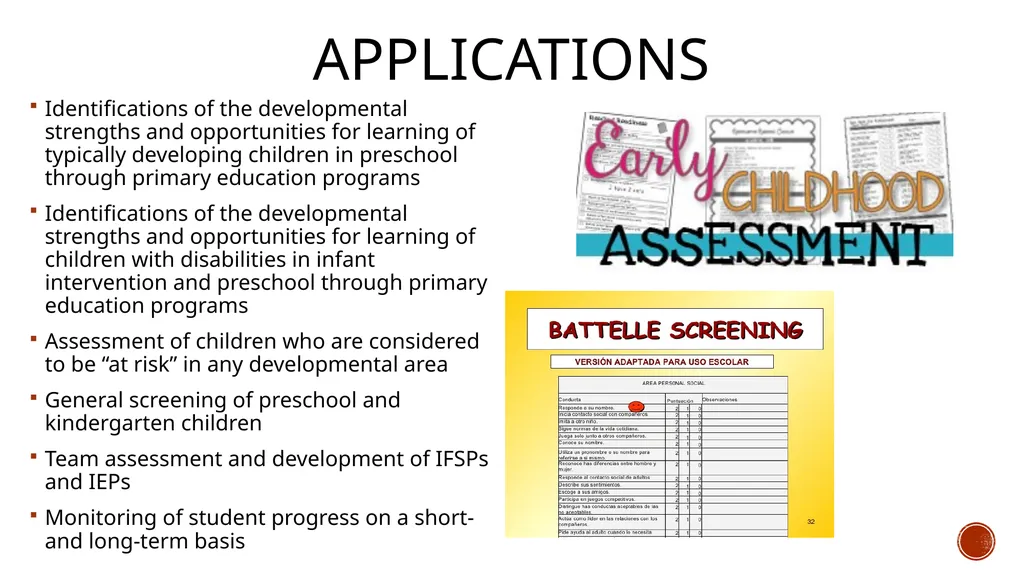
Applications Identifications of the developmental strengths and opportunities for learning of typically developing children in preschool through primary education programs
Identifications of the developmental strengths and opportunities for learning of children with disabilities in infant intervention and preschool through primary education programs
Assessment of children who are considered to be “at risk” in any developmental area
General screening of preschool and kindergarten children
Team assessment and development of IFSPs and IEPs
Monitoring of student progress on a short- and long-term basis<br>
Identifications of the developmental strengths and opportunities for learning of children with disabilities in infant intervention and preschool through primary education programs
Assessment of children who are considered to be “at risk” in any developmental area
General screening of preschool and kindergarten children
Team assessment and development of IFSPs and IEPs
Monitoring of student progress on a short- and long-term basis<br>
05
Purposes Assessment of the Typically Developing Child
Assessment and Identification of the Child With a Disability of Developmental Delay
Planning and Providing Instruction and Intervention
Evaluating Programs Serving Children<br>
Assessment and Identification of the Child With a Disability of Developmental Delay
Planning and Providing Instruction and Intervention
Evaluating Programs Serving Children<br>
06
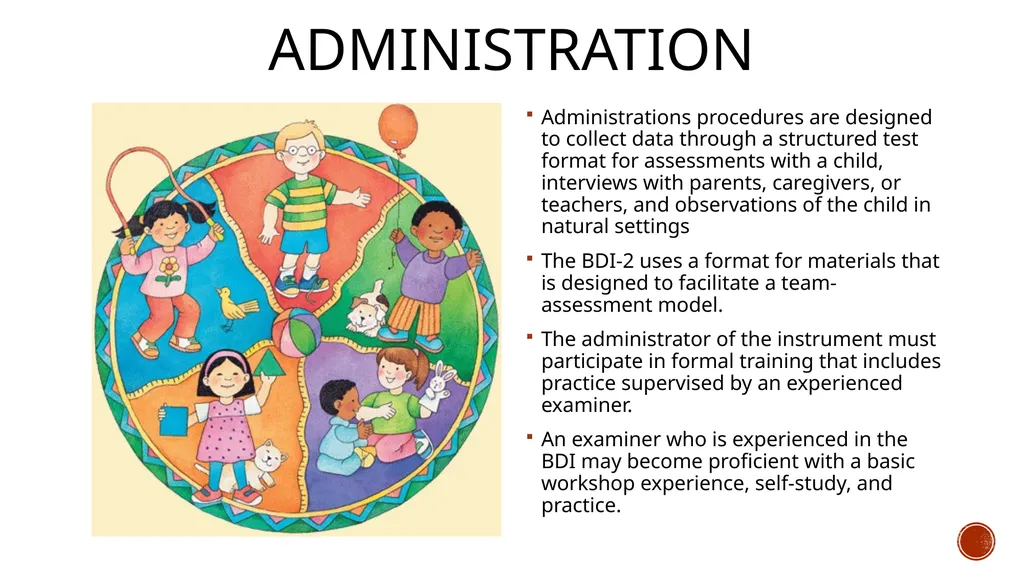
Administration Administrations procedures are designed to collect data through a structured test format for assessments with a child, interviews with parents, caregivers, or teachers, and observations of the child in natural settings
The BDI-2 uses a format for materials that is designed to facilitate a team-assessment model.
The administrator of the instrument must participate in formal training that includes practice supervised by an experienced examiner.
An examiner who is experienced in the BDI may become proficient with a basic workshop experience, self-study, and practice.<br>
The BDI-2 uses a format for materials that is designed to facilitate a team-assessment model.
The administrator of the instrument must participate in formal training that includes practice supervised by an experienced examiner.
An examiner who is experienced in the BDI may become proficient with a basic workshop experience, self-study, and practice.<br>
07
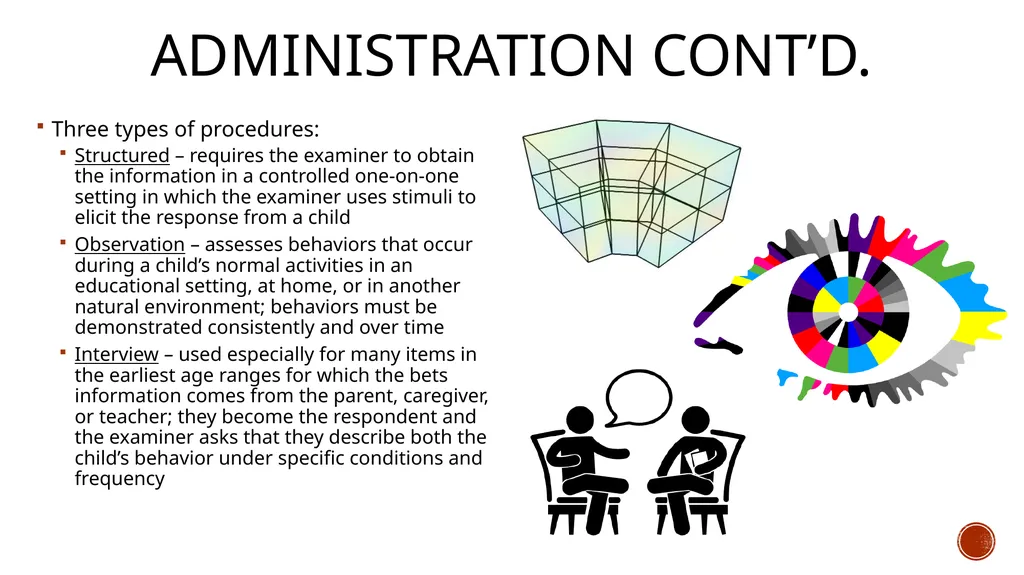
Administration cont’d. Three types of procedures:
Structured – requires the examiner to obtain the information in a controlled one-on-one setting in which the examiner uses stimuli to elicit the response from a child
Observation – assesses behaviors that occur during a child’s normal activities in an educational setting, at home, or in another natural environment; behaviors must be demonstrated consistently and over time
Interview – used especially for many items in the earliest age ranges for which the bets information comes from the parent, caregiver, or teacher; they become the respondent and the examiner asks that they describe both the child’s behavior under specific conditions and frequency<br>
Structured – requires the examiner to obtain the information in a controlled one-on-one setting in which the examiner uses stimuli to elicit the response from a child
Observation – assesses behaviors that occur during a child’s normal activities in an educational setting, at home, or in another natural environment; behaviors must be demonstrated consistently and over time
Interview – used especially for many items in the earliest age ranges for which the bets information comes from the parent, caregiver, or teacher; they become the respondent and the examiner asks that they describe both the child’s behavior under specific conditions and frequency<br>
08
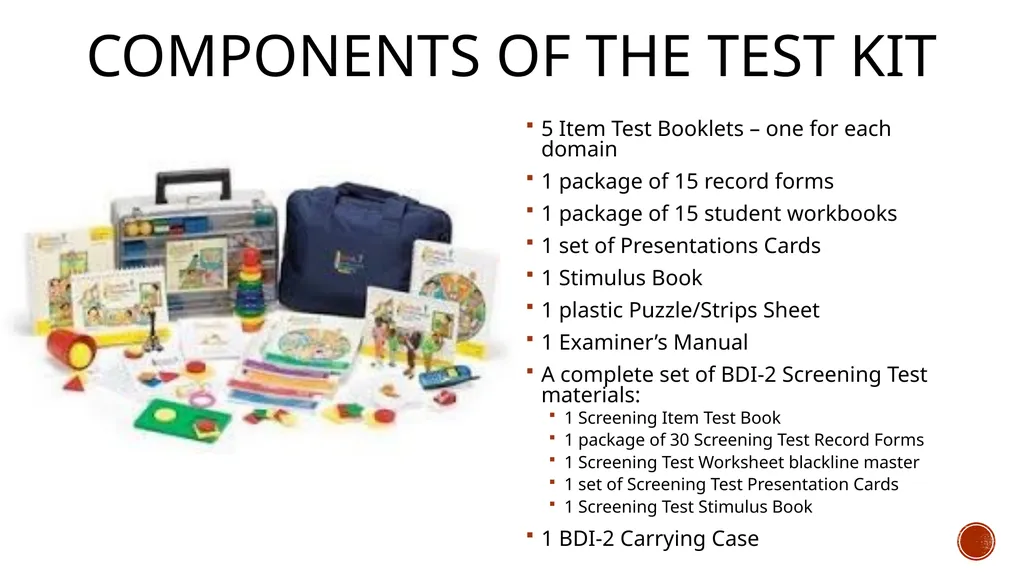
Components of the Test Kit 5 Item Test Booklets – one for each domain
1 package of 15 record forms
1 package of 15 student workbooks
1 set of Presentations Cards
1 Stimulus Book
1 plastic Puzzle/Strips Sheet
1 Examiner’s Manual
A complete set of BDI-2 Screening Test materials:
1 Screening Item Test Book
1 package of 30 Screening Test Record Forms
1 Screening Test Worksheet blackline master
1 set of Screening Test Presentation Cards
1 Screening Test Stimulus Book
1 BDI-2 Carrying Case<br>
1 package of 15 record forms
1 package of 15 student workbooks
1 set of Presentations Cards
1 Stimulus Book
1 plastic Puzzle/Strips Sheet
1 Examiner’s Manual
A complete set of BDI-2 Screening Test materials:
1 Screening Item Test Book
1 package of 30 Screening Test Record Forms
1 Screening Test Worksheet blackline master
1 set of Screening Test Presentation Cards
1 Screening Test Stimulus Book
1 BDI-2 Carrying Case<br>
09
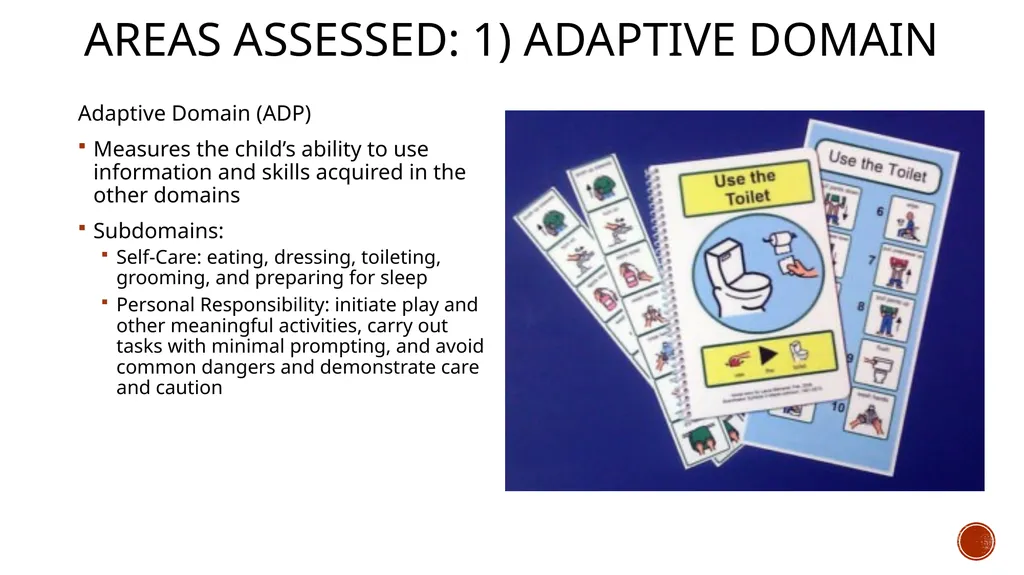
Areas Assessed: 1) Adaptive Domain Adaptive Domain (ADP)
Measures the child’s ability to use information and skills acquired in the other domains
Subdomains:
Self-Care: eating, dressing, toileting, grooming, and preparing for sleep
Personal Responsibility: initiate play and other meaningful activities, carry out tasks with minimal prompting, and avoid common dangers and demonstrate care and caution<br>
Measures the child’s ability to use information and skills acquired in the other domains
Subdomains:
Self-Care: eating, dressing, toileting, grooming, and preparing for sleep
Personal Responsibility: initiate play and other meaningful activities, carry out tasks with minimal prompting, and avoid common dangers and demonstrate care and caution<br>
10
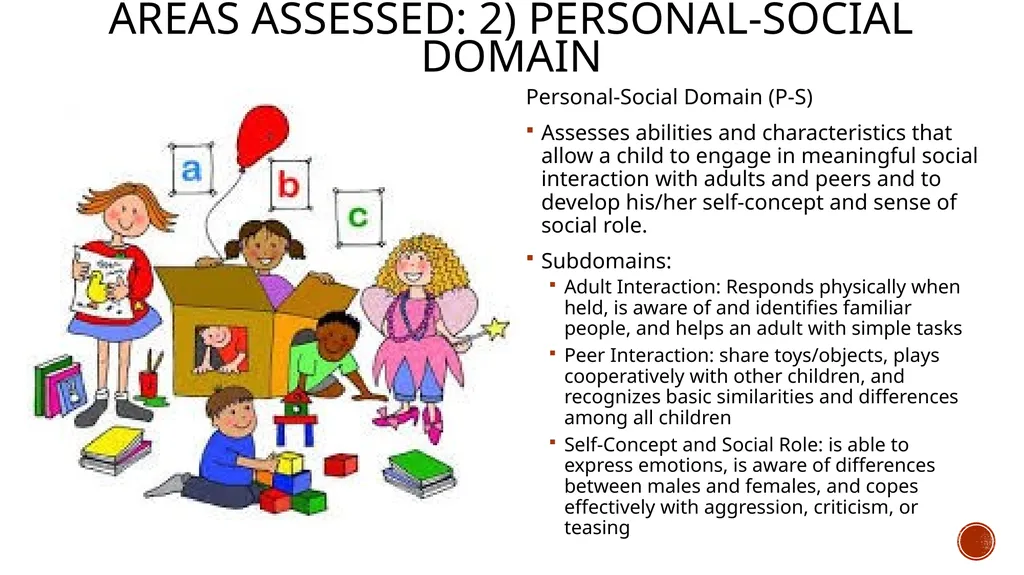
Areas Assessed: 2) Personal-Social Domain Personal-Social Domain (P-S)
Assesses abilities and characteristics that allow a child to engage in meaningful social interaction with adults and peers and to develop his/her self-concept and sense of social role.
Subdomains:
Adult Interaction: Responds physically when held, is aware of and identifies familiar people, and helps an adult with simple tasks
Peer Interaction: share toys/objects, plays cooperatively with other children, and recognizes basic similarities and differences among all children
Self-Concept and Social Role: is able to express emotions, is aware of differences between males and females, and copes effectively with aggression, criticism, or teasing<br>
Assesses abilities and characteristics that allow a child to engage in meaningful social interaction with adults and peers and to develop his/her self-concept and sense of social role.
Subdomains:
Adult Interaction: Responds physically when held, is aware of and identifies familiar people, and helps an adult with simple tasks
Peer Interaction: share toys/objects, plays cooperatively with other children, and recognizes basic similarities and differences among all children
Self-Concept and Social Role: is able to express emotions, is aware of differences between males and females, and copes effectively with aggression, criticism, or teasing<br>
11
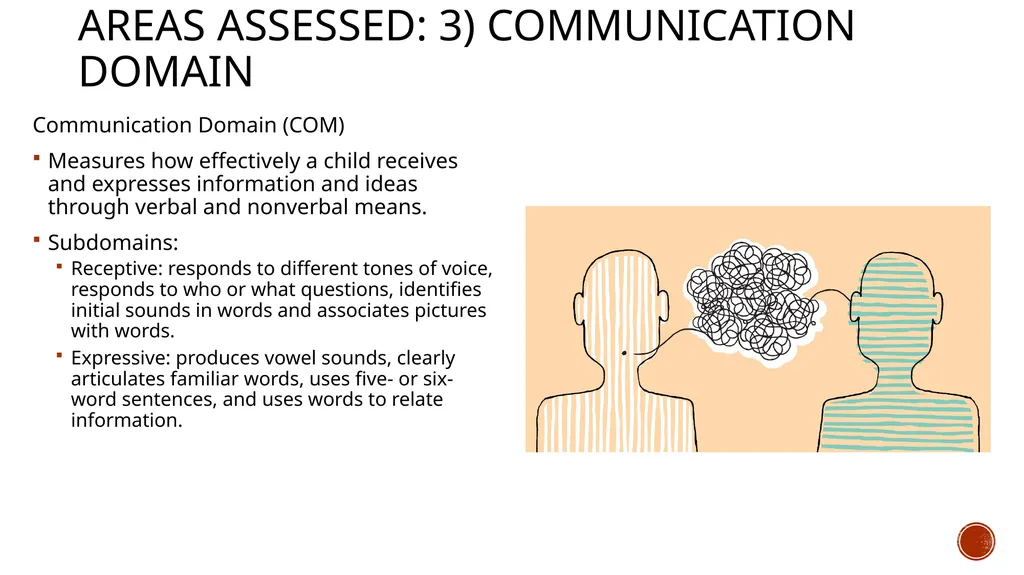
Areas Assessed: 3) Communication Domain Communication Domain (COM)
Measures how effectively a child receives and expresses information and ideas through verbal and nonverbal means.
Subdomains:
Receptive: responds to different tones of voice, responds to who or what questions, identifies initial sounds in words and associates pictures with words.
Expressive: produces vowel sounds, clearly articulates familiar words, uses five- or six-word sentences, and uses words to relate information.<br>
Measures how effectively a child receives and expresses information and ideas through verbal and nonverbal means.
Subdomains:
Receptive: responds to different tones of voice, responds to who or what questions, identifies initial sounds in words and associates pictures with words.
Expressive: produces vowel sounds, clearly articulates familiar words, uses five- or six-word sentences, and uses words to relate information.<br>
12
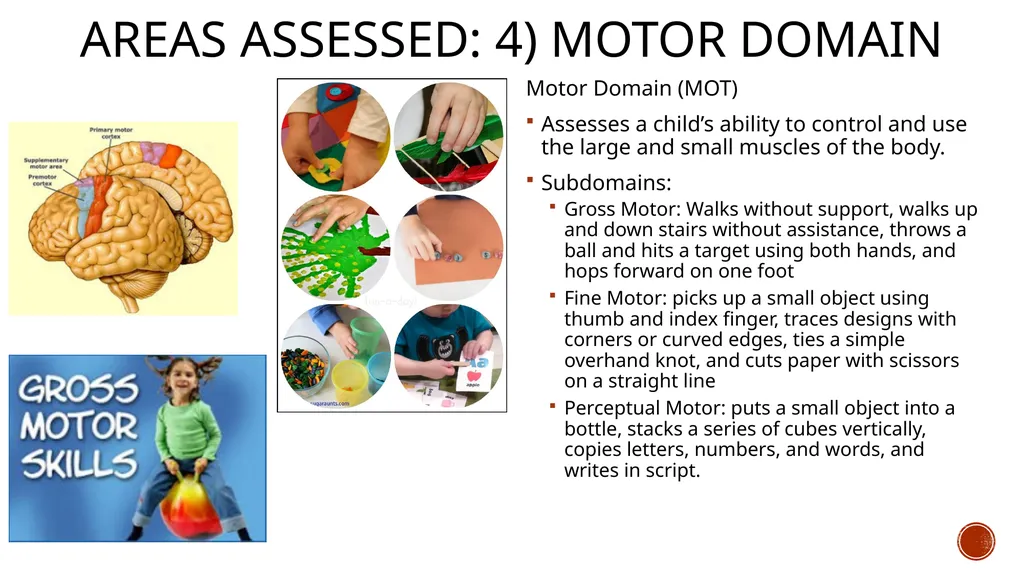
Areas Assessed: 4) Motor Domain Motor Domain (MOT)
Assesses a child’s ability to control and use the large and small muscles of the body.
Subdomains:
Gross Motor: Walks without support, walks up and down stairs without assistance, throws a ball and hits a target using both hands, and hops forward on one foot
Fine Motor: picks up a small object using thumb and index finger, traces designs with corners or curved edges, ties a simple overhand knot, and cuts paper with scissors on a straight line
Perceptual Motor: puts a small object into a bottle, stacks a series of cubes vertically, copies letters, numbers, and words, and writes in script.<br>
Assesses a child’s ability to control and use the large and small muscles of the body.
Subdomains:
Gross Motor: Walks without support, walks up and down stairs without assistance, throws a ball and hits a target using both hands, and hops forward on one foot
Fine Motor: picks up a small object using thumb and index finger, traces designs with corners or curved edges, ties a simple overhand knot, and cuts paper with scissors on a straight line
Perceptual Motor: puts a small object into a bottle, stacks a series of cubes vertically, copies letters, numbers, and words, and writes in script.<br>
13
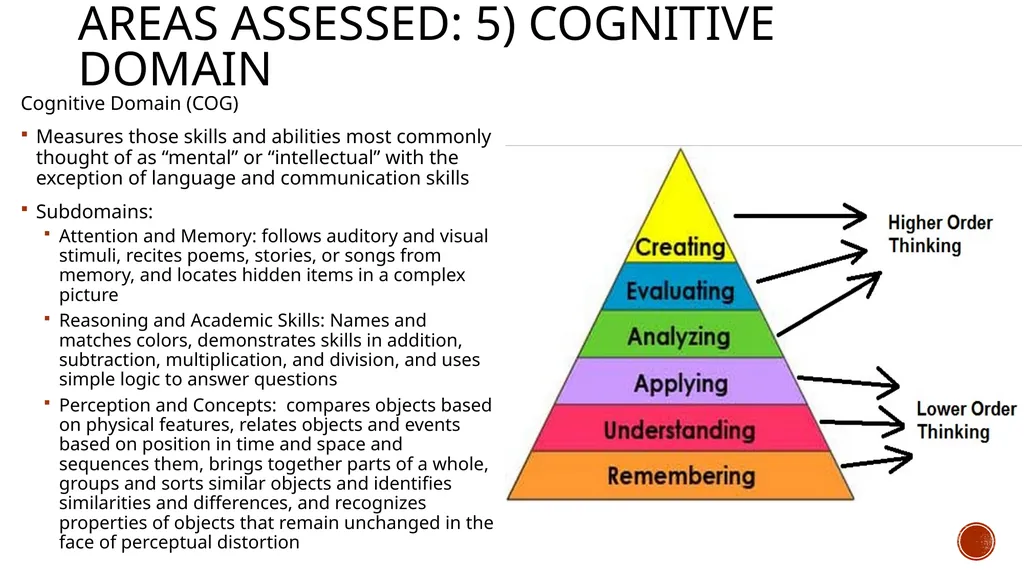
Areas Assessed: 5) Cognitive Domain Cognitive Domain (COG)
Measures those skills and abilities most commonly thought of as “mental” or “intellectual” with the exception of language and communication skills
Subdomains:
Attention and Memory: follows auditory and visual stimuli, recites poems, stories, or songs from memory, and locates hidden items in a complex picture
Reasoning and Academic Skills: Names and matches colors, demonstrates skills in addition, subtraction, multiplication, and division, and uses simple logic to answer questions
Perception and Concepts: compares objects based on physical features, relates objects and events based on position in time and space and sequences them, brings together parts of a whole, groups and sorts similar objects and identifies similarities and differences, and recognizes properties of objects that remain unchanged in the face of perceptual distortion<br>
Measures those skills and abilities most commonly thought of as “mental” or “intellectual” with the exception of language and communication skills
Subdomains:
Attention and Memory: follows auditory and visual stimuli, recites poems, stories, or songs from memory, and locates hidden items in a complex picture
Reasoning and Academic Skills: Names and matches colors, demonstrates skills in addition, subtraction, multiplication, and division, and uses simple logic to answer questions
Perception and Concepts: compares objects based on physical features, relates objects and events based on position in time and space and sequences them, brings together parts of a whole, groups and sorts similar objects and identifies similarities and differences, and recognizes properties of objects that remain unchanged in the face of perceptual distortion<br>
14
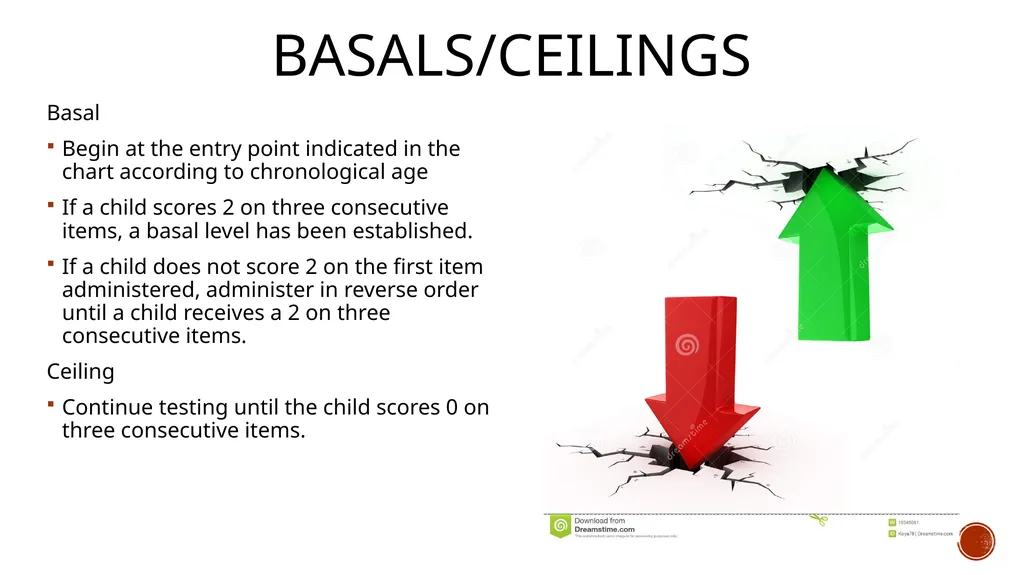
Basals/Ceilings Basal
Begin at the entry point indicated in the chart according to chronological age
If a child scores 2 on three consecutive items, a basal level has been established.
If a child does not score 2 on the first item administered, administer in reverse order until a child receives a 2 on three consecutive items.
Ceiling
Continue testing until the child scores 0 on three consecutive items.<br>
Begin at the entry point indicated in the chart according to chronological age
If a child scores 2 on three consecutive items, a basal level has been established.
If a child does not score 2 on the first item administered, administer in reverse order until a child receives a 2 on three consecutive items.
Ceiling
Continue testing until the child scores 0 on three consecutive items.<br>
15
Examples from the Test
Adaptive Domain Self-Care
12 months through 23 months
SC 8 – Observation, Interview
Behavior:
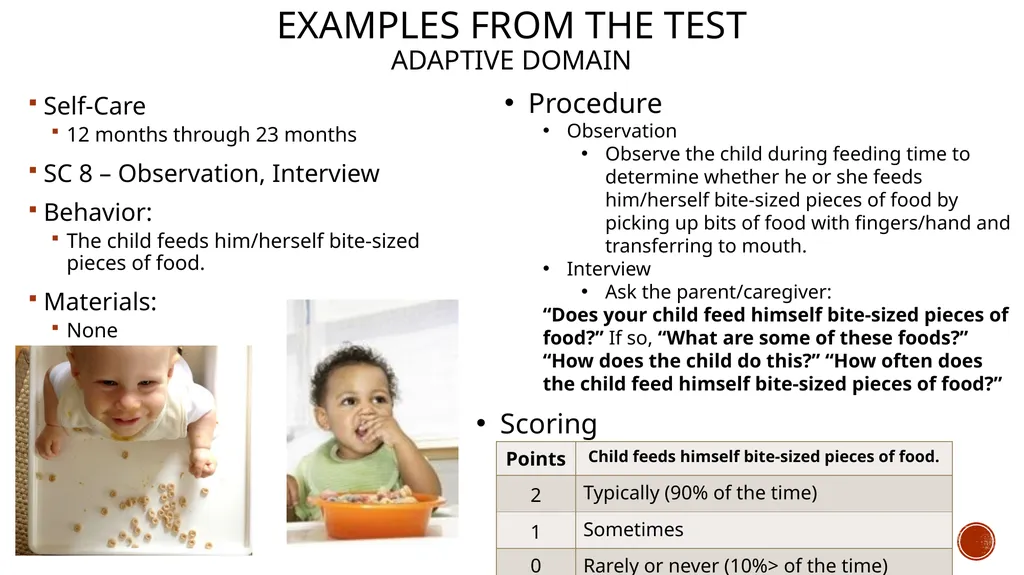
The child feeds him/herself bite-sized pieces of food.
Materials:
None Scoring Procedure
Observation
Observe the child during feeding time to determine whether he or she feeds him/herself bite-sized pieces of food by picking up bits of food with fingers/hand and transferring to mouth.
Interview
Ask the parent/caregiver:
“Does your child feed himself bite-sized pieces of food?” If so, “What are some of these foods?” “How does the child do this?” “How often does the child feed himself bite-sized pieces of food?”<br>
12 months through 23 months
SC 8 – Observation, Interview
Behavior:
The child feeds him/herself bite-sized pieces of food.
Materials:
None Scoring Procedure
Observation
Observe the child during feeding time to determine whether he or she feeds him/herself bite-sized pieces of food by picking up bits of food with fingers/hand and transferring to mouth.
Interview
Ask the parent/caregiver:
“Does your child feed himself bite-sized pieces of food?” If so, “What are some of these foods?” “How does the child do this?” “How often does the child feed himself bite-sized pieces of food?”<br>
16
Examples from the Test
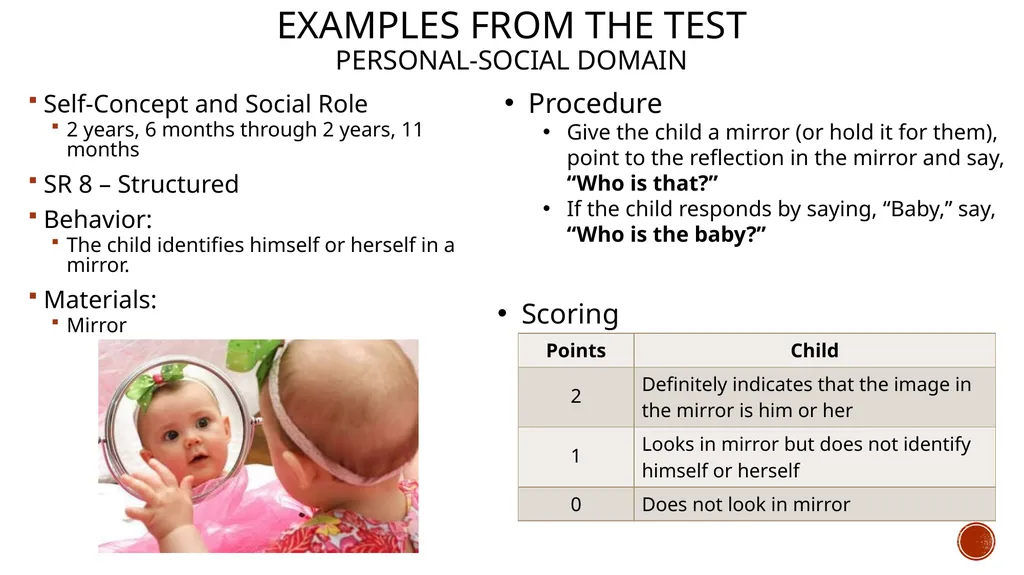
Personal-Social Domain Self-Concept and Social Role
2 years, 6 months through 2 years, 11 months
SR 8 – Structured
Behavior:
The child identifies himself or herself in a mirror.
Materials:
Mirror Scoring Procedure
Give the child a mirror (or hold it for them), point to the reflection in the mirror and say, “Who is that?”
If the child responds by saying, “Baby,” say, “Who is the baby?”<br>
2 years, 6 months through 2 years, 11 months
SR 8 – Structured
Behavior:
The child identifies himself or herself in a mirror.
Materials:
Mirror Scoring Procedure
Give the child a mirror (or hold it for them), point to the reflection in the mirror and say, “Who is that?”
If the child responds by saying, “Baby,” say, “Who is the baby?”<br>
17
Examples from the Test
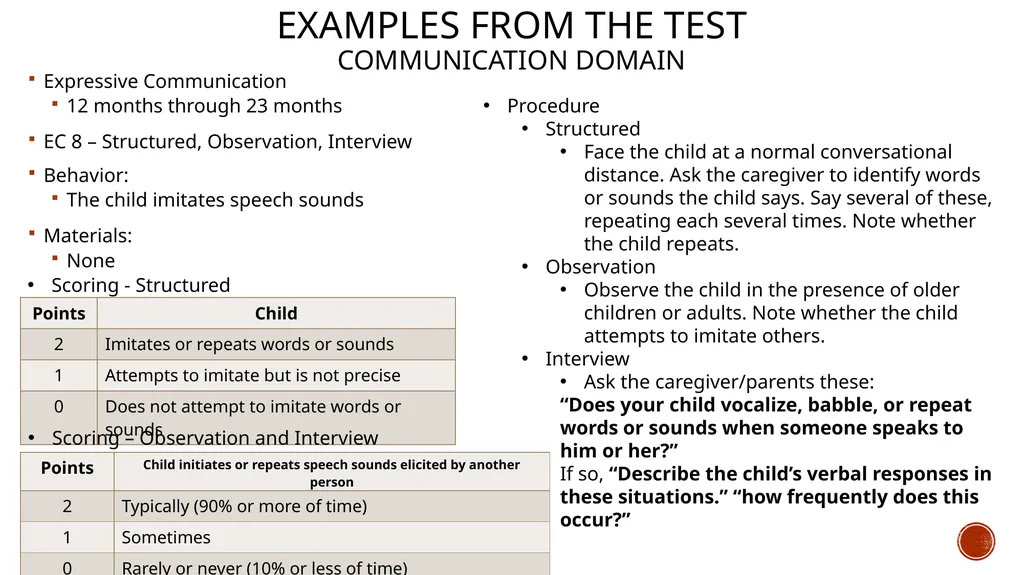
Communication Domain Expressive Communication
12 months through 23 months
EC 8 – Structured, Observation, Interview
Behavior:
The child imitates speech sounds
Materials:
None Scoring - Structured Procedure
Structured
Face the child at a normal conversational distance. Ask the caregiver to identify words or sounds the child says. Say several of these, repeating each several times. Note whether the child repeats.
Observation
Observe the child in the presence of older children or adults. Note whether the child attempts to imitate others.
Interview
Ask the caregiver/parents these:
“Does your child vocalize, babble, or repeat words or sounds when someone speaks to him or her?”
If so, “Describe the child’s verbal responses in these situations.” “how frequently does this occur?” Scoring – Observation and Interview<br>
12 months through 23 months
EC 8 – Structured, Observation, Interview
Behavior:
The child imitates speech sounds
Materials:
None Scoring - Structured Procedure
Structured
Face the child at a normal conversational distance. Ask the caregiver to identify words or sounds the child says. Say several of these, repeating each several times. Note whether the child repeats.
Observation
Observe the child in the presence of older children or adults. Note whether the child attempts to imitate others.
Interview
Ask the caregiver/parents these:
“Does your child vocalize, babble, or repeat words or sounds when someone speaks to him or her?”
If so, “Describe the child’s verbal responses in these situations.” “how frequently does this occur?” Scoring – Observation and Interview<br>
18
Examples from the Test
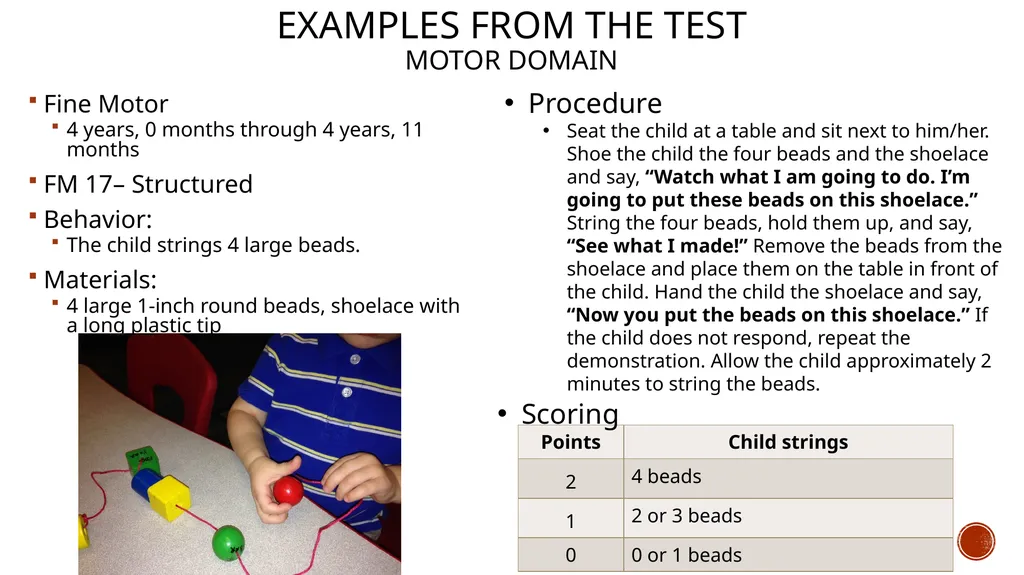
Motor Domain Fine Motor
4 years, 0 months through 4 years, 11 months
FM 17– Structured
Behavior:
The child strings 4 large beads.
Materials:
4 large 1-inch round beads, shoelace with a long plastic tip Scoring Procedure
Seat the child at a table and sit next to him/her. Shoe the child the four beads and the shoelace and say, “Watch what I am going to do. I’m going to put these beads on this shoelace.” String the four beads, hold them up, and say, “See what I made!” Remove the beads from the shoelace and place them on the table in front of the child. Hand the child the shoelace and say, “Now you put the beads on this shoelace.” If the child does not respond, repeat the demonstration. Allow the child approximately 2 minutes to string the beads.<br>
4 years, 0 months through 4 years, 11 months
FM 17– Structured
Behavior:
The child strings 4 large beads.
Materials:
4 large 1-inch round beads, shoelace with a long plastic tip Scoring Procedure
Seat the child at a table and sit next to him/her. Shoe the child the four beads and the shoelace and say, “Watch what I am going to do. I’m going to put these beads on this shoelace.” String the four beads, hold them up, and say, “See what I made!” Remove the beads from the shoelace and place them on the table in front of the child. Hand the child the shoelace and say, “Now you put the beads on this shoelace.” If the child does not respond, repeat the demonstration. Allow the child approximately 2 minutes to string the beads.<br>
19
Examples from the Test
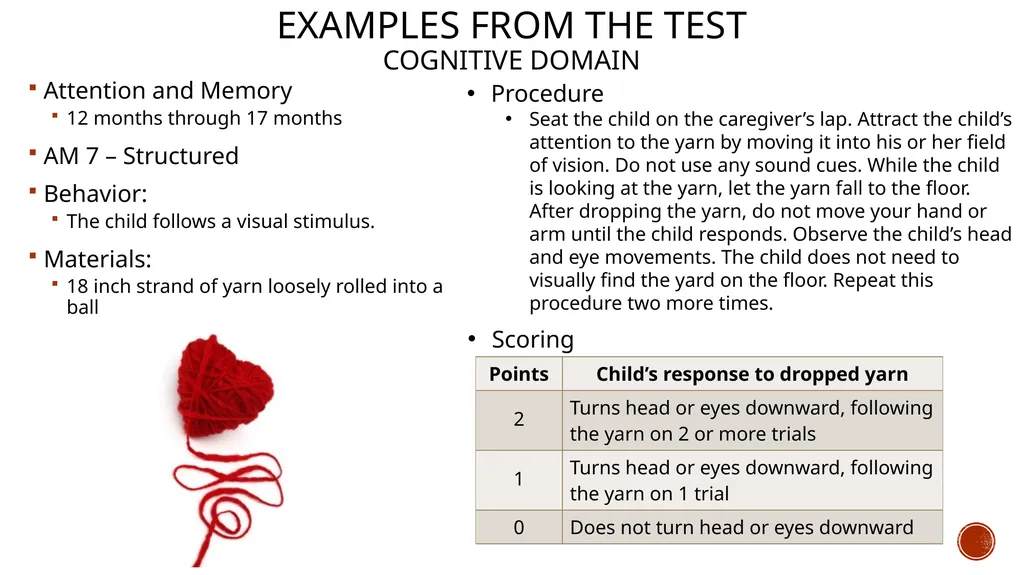
Cognitive Domain Attention and Memory
12 months through 17 months
AM 7 – Structured
Behavior:
The child follows a visual stimulus.
Materials:
18 inch strand of yarn loosely rolled into a ball Scoring Procedure
Seat the child on the caregiver’s lap. Attract the child’s attention to the yarn by moving it into his or her field of vision. Do not use any sound cues. While the child is looking at the yarn, let the yarn fall to the floor. After dropping the yarn, do not move your hand or arm until the child responds. Observe the child’s head and eye movements. The child does not need to visually find the yard on the floor. Repeat this procedure two more times.<br>
12 months through 17 months
AM 7 – Structured
Behavior:
The child follows a visual stimulus.
Materials:
18 inch strand of yarn loosely rolled into a ball Scoring Procedure
Seat the child on the caregiver’s lap. Attract the child’s attention to the yarn by moving it into his or her field of vision. Do not use any sound cues. While the child is looking at the yarn, let the yarn fall to the floor. After dropping the yarn, do not move your hand or arm until the child responds. Observe the child’s head and eye movements. The child does not need to visually find the yard on the floor. Repeat this procedure two more times.<br>
20
Examples from the Test
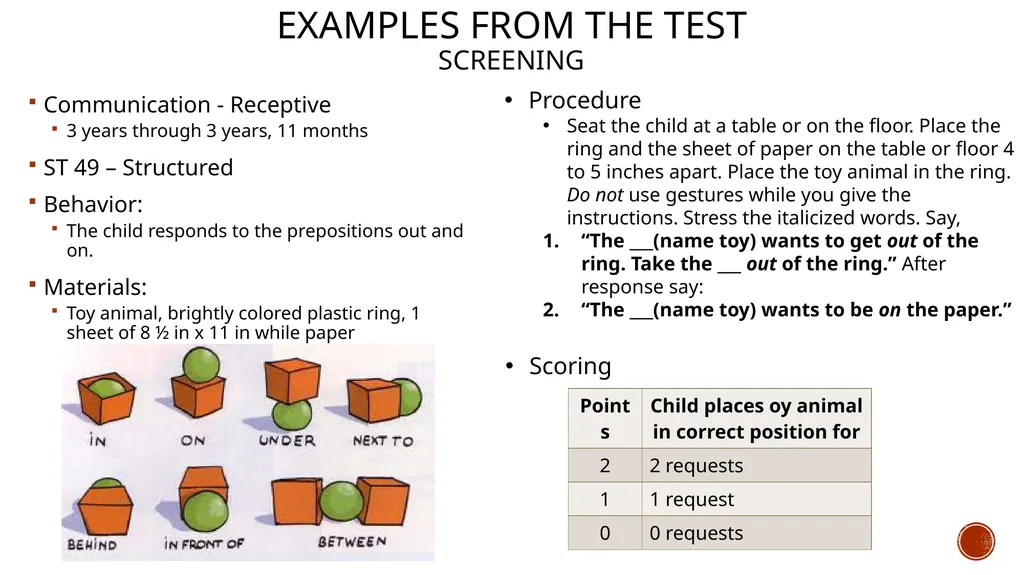
Screening Communication - Receptive
3 years through 3 years, 11 months
ST 49 – Structured
Behavior:
The child responds to the prepositions out and on.
Materials:
Toy animal, brightly colored plastic ring, 1 sheet of 8 ½ in x 11 in while paper Scoring Procedure
Seat the child at a table or on the floor. Place the ring and the sheet of paper on the table or floor 4 to 5 inches apart. Place the toy animal in the ring. Do not use gestures while you give the instructions. Stress the italicized words. Say,
“The ___(name toy) wants to get out of the ring. Take the ___ out of the ring.” After response say:
“The ___(name toy) wants to be on the paper.”<br>
3 years through 3 years, 11 months
ST 49 – Structured
Behavior:
The child responds to the prepositions out and on.
Materials:
Toy animal, brightly colored plastic ring, 1 sheet of 8 ½ in x 11 in while paper Scoring Procedure
Seat the child at a table or on the floor. Place the ring and the sheet of paper on the table or floor 4 to 5 inches apart. Place the toy animal in the ring. Do not use gestures while you give the instructions. Stress the italicized words. Say,
“The ___(name toy) wants to get out of the ring. Take the ___ out of the ring.” After response say:
“The ___(name toy) wants to be on the paper.”<br>
21
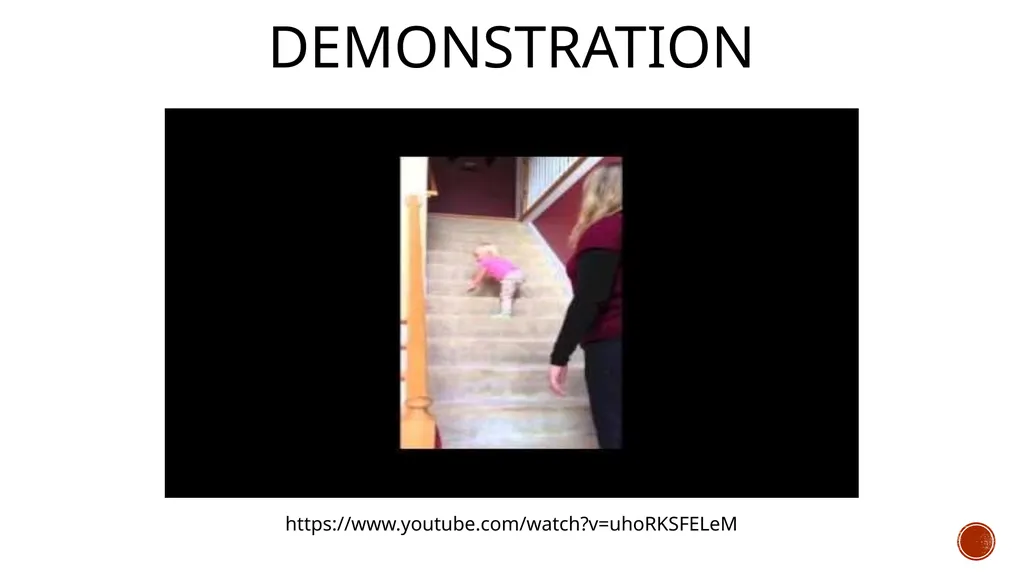
Demonstration https://www.youtube.com/watch?v=uhoRKSFELeM<br>
22
My School I work in a small private school that is not connected to a district.
There is no educational diagnostician connected to the school.
Any assessment that is conducted is contracted outside of our school, so the Battelle is not used at my school.<br>
There is no educational diagnostician connected to the school.
Any assessment that is conducted is contracted outside of our school, so the Battelle is not used at my school.<br>
23
References
Newborg, J. (2005). Battelle Developmental Inventory,
2nd Edition. Rolling Meadows, IL: Riverside.<br>