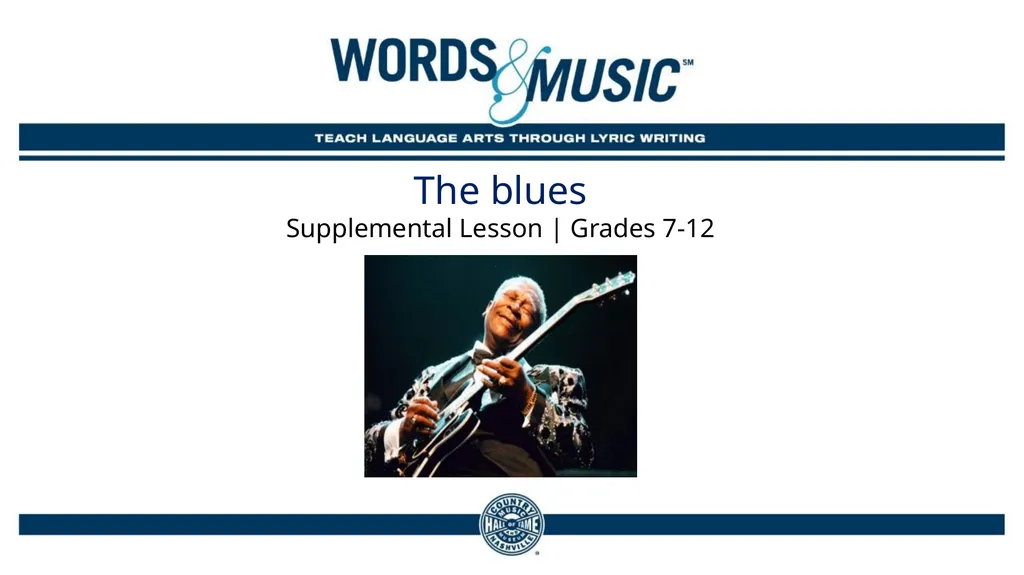
The blues Supplemental Lesson | Grades 7-12
Description: The blues Supplemental Lesson Grades 7-12 BRAINSTORM Think of times when you felt sad, heartbroken, disappointed, or treated unfairly. In your journal, list as many of these experiences as you can. Select one of these experiences and
Related Topics
Download Presentation
"The blues Supplemental Lesson | Grades 7-12" is the property of its rightful owner. Permission is granted to download and print the materials on this website for personal, non-commercial use only, and to display it on your personal computer provided you do not modify the materials and that you retain all copyright notices contained in the materials. By downloading content from our website, you accept the terms of this agreement.
Presentation Transcript
slide1. The blues
Supplemental Lesson | Grades 7-12<br>
slide2. BRAINSTORM
Think of times when you felt sad, heartbroken, disappointed, or treated unfairly.
In your journal, list as many of these experiences as you can. Select one of these experiences and write a detailed account of it.
Describe what happened, the way you felt, the way you dealt with it, and any other details relating to the experience.<br>
slide3. DISCUSS What is the blues?
Who writes blues songs?
Why do people like blues songs?
Are you familiar with any blues artists?
What makes the blues different from other music genres or styles of music?<br>
slide4. Blues History
Blues songs often tell stories of misfortune, regret, and overcoming bad luck.
Roots in African American history.
In the 1800s, enslaved individuals would collectively sing work songs . A song leader would sing a short improvised melody (call), and the workers would answer with a single repeated melody (response).
Enslaved people also sang hollers , which sounded a lot like work songs, but were sang alone, rather than as a group.<br>
slide5. BLUES ACROSS THE UNITED STATES
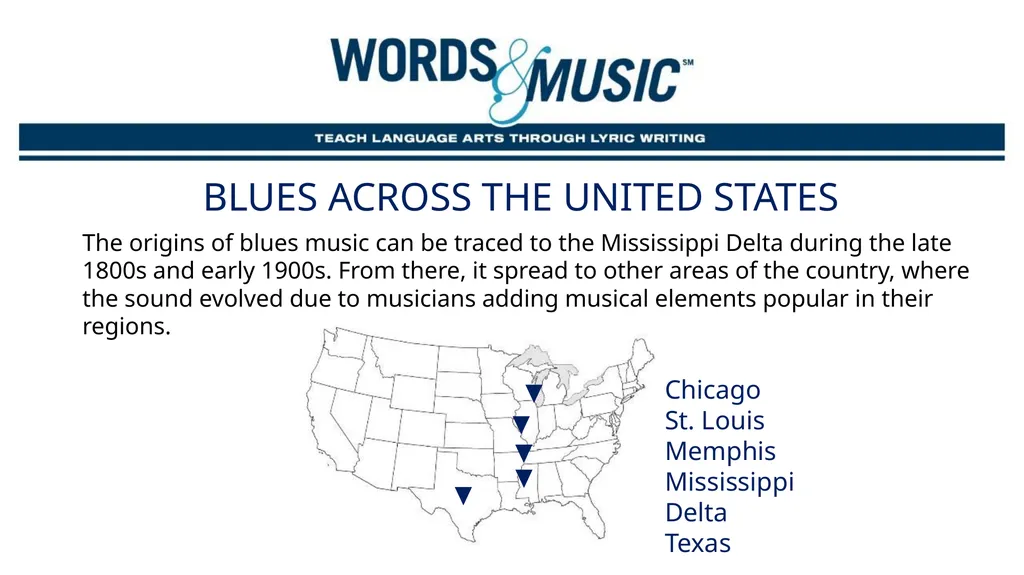
The origins of blues music can be traced to the Mississippi Delta during the late 1800s and early 1900s. From there, it spread to other areas of the country, where the sound evolved due to musicians adding musical elements popular in their regions. Chicago
St. Louis
Memphis
Mississippi Delta
Texas<br>
slide6. MISSISSIPPI DELTA BLUES
Considered the oldest style of blues, originating in the late 1800s and early 1900s.
Singers typically accompanied themselves on guitar, playing a basic repeated musical pattern known as 12-bar blues .
Lyrics typically used an “AAB” line pattern.
Lyrics often about failed relationships, life on the road, and other emotional topics.
Music venues were train stations, street corners, barns, and other informal locations.<br>
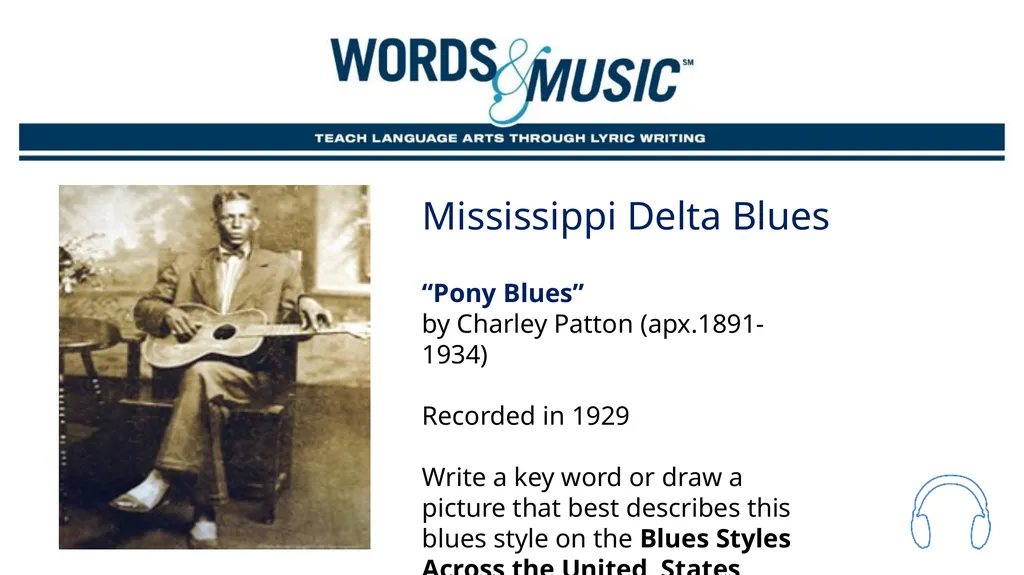
slide7. Mississippi Delta Blues “Pony Blues”
by Charley Patton (apx.1891-1934)
Recorded in 1929
Write a key word or draw a picture that best describes this blues style on the Blues Styles Across the United States Worksheet<br>
slide8. Texas Blues
Combined Delta Blues style (i.e., AAB line pattern and 12-bar blues) with their own folk and spiritual tunes
Singers found a way to accompany long, free form, holler-like melodies with freely strummed guitar chords.
Added musical elements from around the world including Latin rhythms and polkas<br>
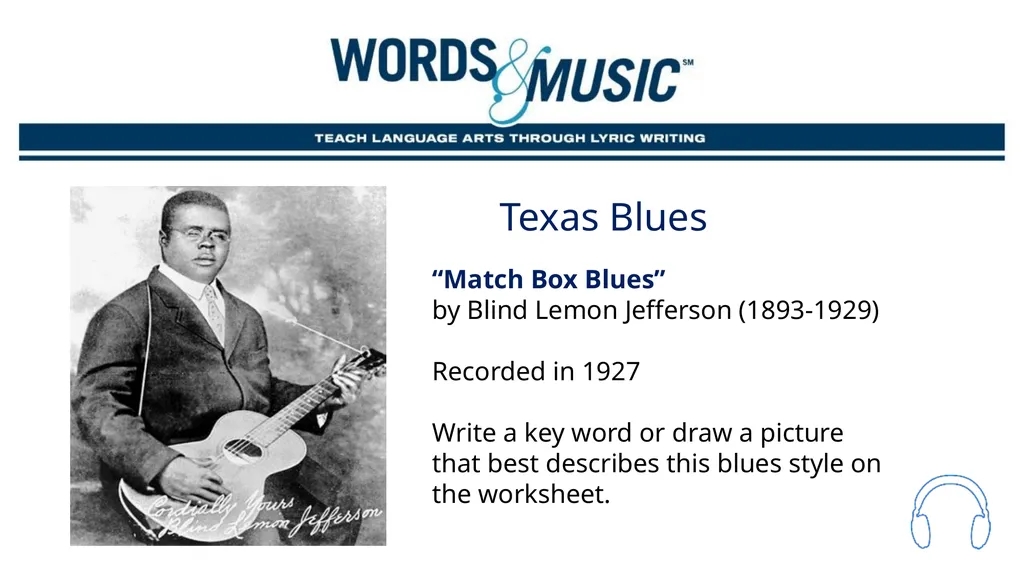
slide9. Texas Blues “Match Box Blues”
by Blind Lemon Jefferson (1893-1929)
Recorded in 1927
Write a key word or draw a picture that best describes this blues style on the worksheet.<br>
slide10. Memphis Blues
Duo artists developed a distinct musical sound where one guitar played high treble chords and melodies while the other played low bass lines—a sound still present today.
Musicians performed at house parties, corner saloons, traveling tent shows, or in jazz bands.<br>
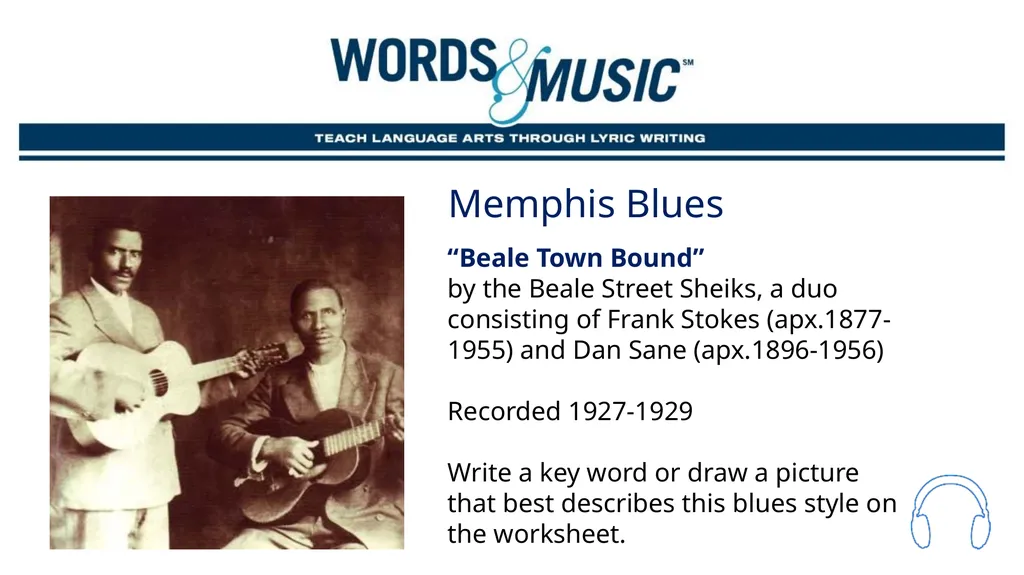
slide11. Memphis Blues “Beale Town Bound”
by the Beale Street Sheiks, a duo consisting of Frank Stokes (apx.1877-1955) and Dan Sane (apx.1896-1956)
Recorded 1927-1929
Write a key word or draw a picture that best describes this blues style on the worksheet.<br>
slide12. St. Louis Blues
Combination of diverse music styles from:
Mississippi Delta
Ragtime from local artist Scott Joplin (composer of “Maple Leaf Rag” and “The Entertainer”)
Jazz influences from New Orleans<br>
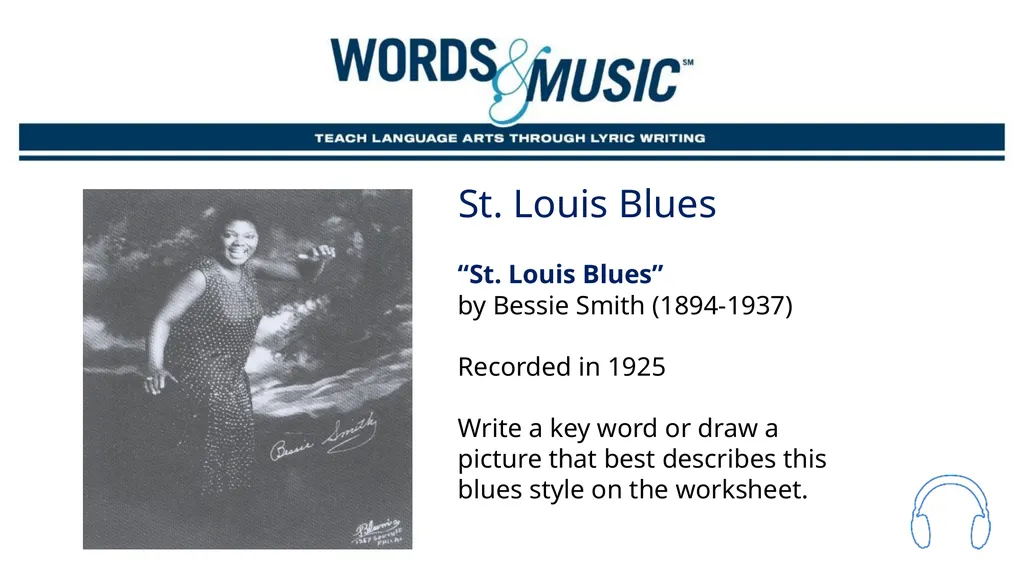
slide13. St. Louis Blues “St. Louis Blues”
by Bessie Smith (1894-1937)
Recorded in 1925
Write a key word or draw a picture that best describes this blues style on the worksheet.<br>
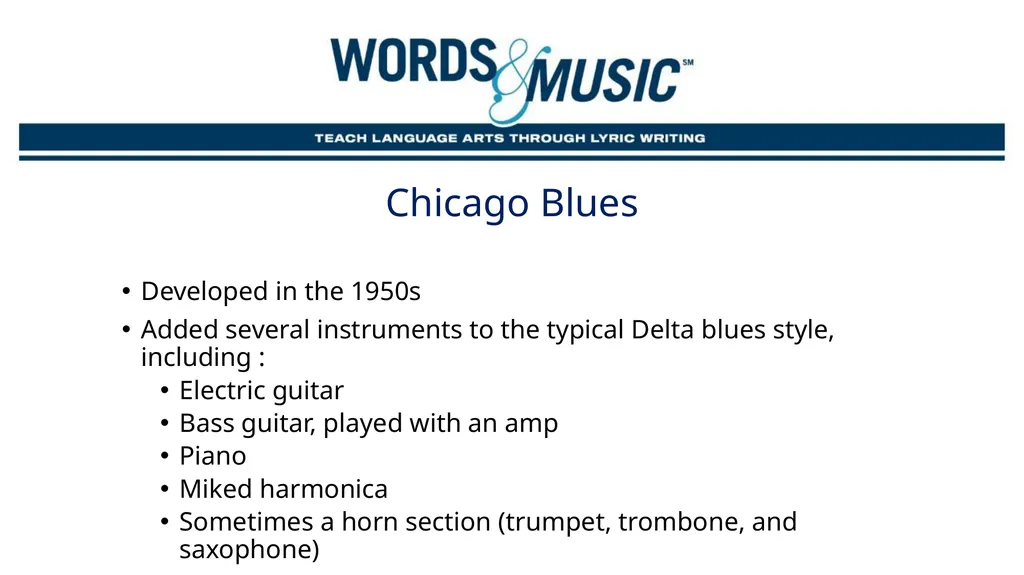
slide14. Chicago Blues
Developed in the 1950s
Added several instruments to the typical Delta blues style, including :
Electric guitar
Bass guitar, played with an amp
Piano
Miked harmonica
Sometimes a horn section (trumpet, trombone, and saxophone)<br>
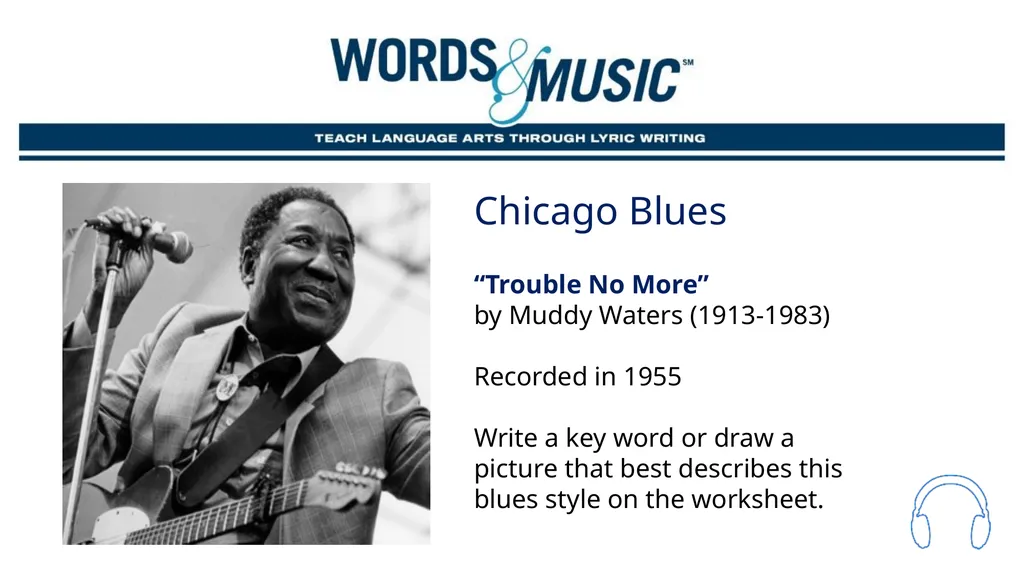
slide15. Chicago Blues “Trouble No More”
by Muddy Waters (1913-1983)
Recorded in 1955
Write a key word or draw a picture that best describes this blues style on the worksheet.<br>
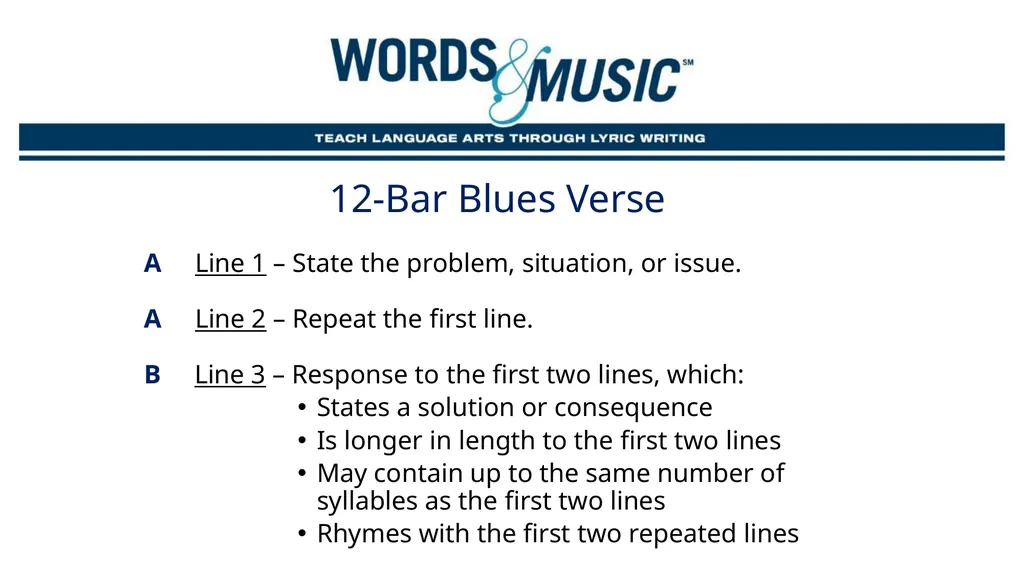
slide16. 12-Bar Blues Verse A Line 1 – State the problem, situation, or issue.
A Line 2 – Repeat the first line.
B Line 3 – Response to the first two lines, which:
States a solution or consequence
Is longer in length to the first two lines
May contain up to the same number of syllables as the first two lines
Rhymes with the first two repeated lines<br>
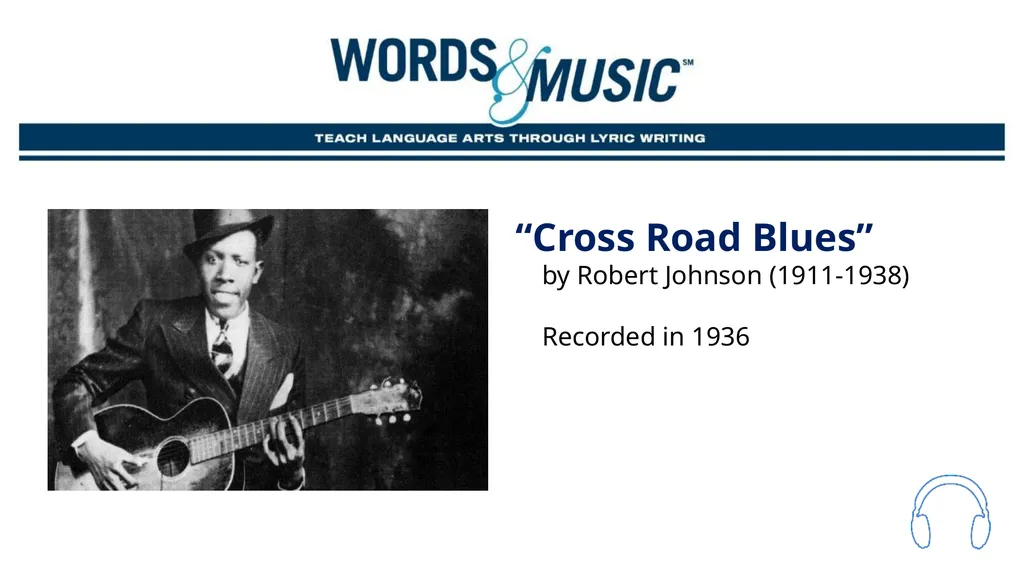
slide17. “Cross Road Blues”
by Robert Johnson (1911-1938)
Recorded in 1936<br>
slide18. “Cross Road Blues”Robert Johnson I went to the crossroad, fell down on my kneesI went to the crossroad, fell down on my kneesAsked the Lord above "have mercy, save poor Bob, if you please"
Mmm, standin' at the crossroad, I tried to flag a rideStandin' at the crossroad, I tried to flag a rideAin’t nobody seem to know me, everybody pass me by
Mmm, the sun goin’ down, boy, dark gon’ catch me here
Ooo-eee, boy, dark gon’ catch me hereI haven’t got no lovin’ sweet woman that love and feel my care
You can run, you can run, tell my friend, boy, Willie BrownYou can run, tell my friend, boy, Willie BrownLord, that I’m standin’ at the crossroad, baby, I believe I’m sinkin’ down<br>
slide19. DISCUSS
What is the theme or main subject of the song?
How are the theme and message reflected in the title?
What do you think the artist means when he refers to “the crossroads?” Is it figurative, literal, or both?
What feeling is conveyed in this song?
What evidence from the song supports your position?
How is the form or structure of this song different than songs you listen to today?<br>
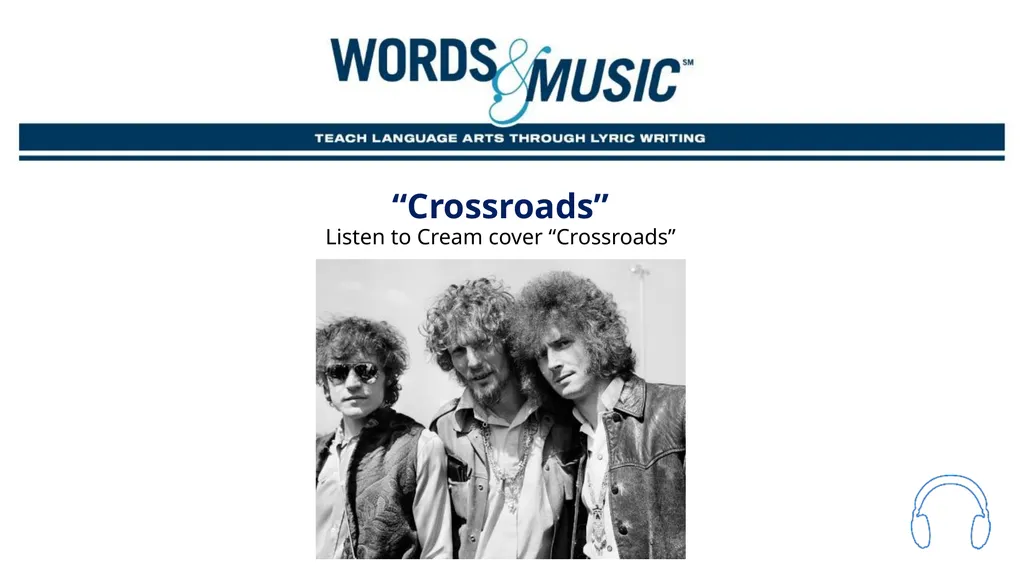
slide20. “Crossroads”
Listen to Cream cover “Crossroads”<br>
slide21. “I Can’t Quit You Baby”
by Willie Dixon (1915-1992)
Recorded in 1970<br>
slide22. “I Can’t Quit You Baby”Willie Dixon Well, I can't quit you babyBut I got to put you down a little whileWell, I can't quit you babyBut I got to put you down a little whileWell, you done made me mess up my happy homeMade me mistreat my only child
Ah, when you hear me moanin' and groanin'Whoa, you know it hurts me way down insideWhoa, when you hear me moanin' and groanin'You know it hurts way down insideOh, when you hear me howlin'Ooh, you know my love will never die, alright Well, when you see me cryin' Don't let my tears fall in vainWell, when you see me cryin, Darlin’, please don't let my tears fall in vainLord, I don't know what to doYou know my heart is filled with pain
Whoa, when you hear me howlin', babyYou know it hurts way down inside<br>
slide23. DISCUSS
How does this style of blues differ from Robert Johnson’s “Cross Road Blues”?
What story is being told and what message is conveyed?
What is the conflict explored in this song?
What specific lines from the song communicate conflict or struggle?<br>
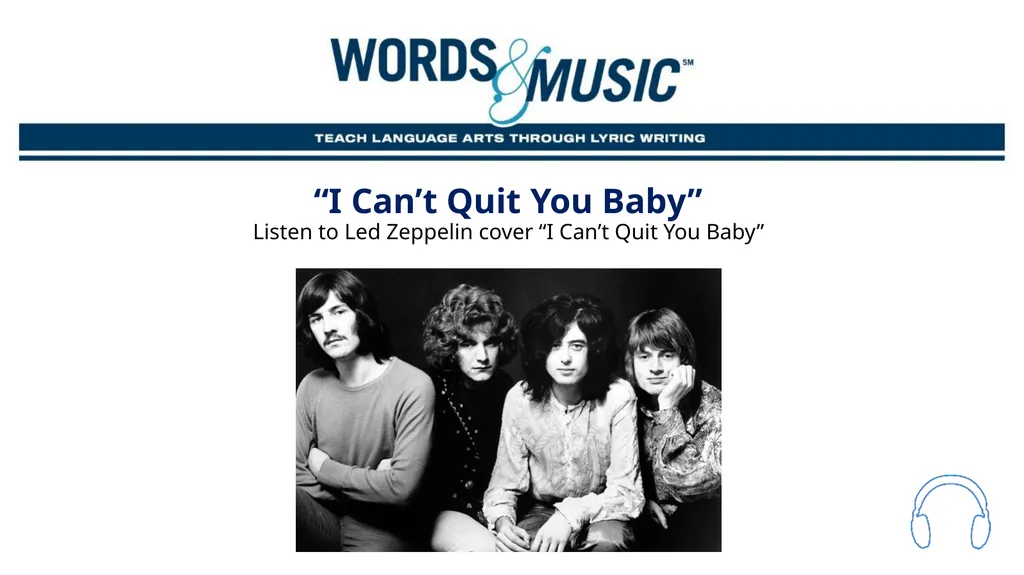
slide24. “I Can’t Quit You Baby”
Listen to Led Zeppelin cover “I Can’t Quit You Baby”<br>

Supplemental Lesson | Grades 7-12<br>
slide2. BRAINSTORM
Think of times when you felt sad, heartbroken, disappointed, or treated unfairly.
In your journal, list as many of these experiences as you can. Select one of these experiences and write a detailed account of it.
Describe what happened, the way you felt, the way you dealt with it, and any other details relating to the experience.<br>
slide3. DISCUSS What is the blues?
Who writes blues songs?
Why do people like blues songs?
Are you familiar with any blues artists?
What makes the blues different from other music genres or styles of music?<br>
slide4. Blues History
Blues songs often tell stories of misfortune, regret, and overcoming bad luck.
Roots in African American history.
In the 1800s, enslaved individuals would collectively sing work songs . A song leader would sing a short improvised melody (call), and the workers would answer with a single repeated melody (response).
Enslaved people also sang hollers , which sounded a lot like work songs, but were sang alone, rather than as a group.<br>
slide5. BLUES ACROSS THE UNITED STATES
The origins of blues music can be traced to the Mississippi Delta during the late 1800s and early 1900s. From there, it spread to other areas of the country, where the sound evolved due to musicians adding musical elements popular in their regions. Chicago
St. Louis
Memphis
Mississippi Delta
Texas<br>
slide6. MISSISSIPPI DELTA BLUES
Considered the oldest style of blues, originating in the late 1800s and early 1900s.
Singers typically accompanied themselves on guitar, playing a basic repeated musical pattern known as 12-bar blues .
Lyrics typically used an “AAB” line pattern.
Lyrics often about failed relationships, life on the road, and other emotional topics.
Music venues were train stations, street corners, barns, and other informal locations.<br>
slide7. Mississippi Delta Blues “Pony Blues”
by Charley Patton (apx.1891-1934)
Recorded in 1929
Write a key word or draw a picture that best describes this blues style on the Blues Styles Across the United States Worksheet<br>
slide8. Texas Blues
Combined Delta Blues style (i.e., AAB line pattern and 12-bar blues) with their own folk and spiritual tunes
Singers found a way to accompany long, free form, holler-like melodies with freely strummed guitar chords.
Added musical elements from around the world including Latin rhythms and polkas<br>
slide9. Texas Blues “Match Box Blues”
by Blind Lemon Jefferson (1893-1929)
Recorded in 1927
Write a key word or draw a picture that best describes this blues style on the worksheet.<br>
slide10. Memphis Blues
Duo artists developed a distinct musical sound where one guitar played high treble chords and melodies while the other played low bass lines—a sound still present today.
Musicians performed at house parties, corner saloons, traveling tent shows, or in jazz bands.<br>
slide11. Memphis Blues “Beale Town Bound”
by the Beale Street Sheiks, a duo consisting of Frank Stokes (apx.1877-1955) and Dan Sane (apx.1896-1956)
Recorded 1927-1929
Write a key word or draw a picture that best describes this blues style on the worksheet.<br>
slide12. St. Louis Blues
Combination of diverse music styles from:
Mississippi Delta
Ragtime from local artist Scott Joplin (composer of “Maple Leaf Rag” and “The Entertainer”)
Jazz influences from New Orleans<br>
slide13. St. Louis Blues “St. Louis Blues”
by Bessie Smith (1894-1937)
Recorded in 1925
Write a key word or draw a picture that best describes this blues style on the worksheet.<br>
slide14. Chicago Blues
Developed in the 1950s
Added several instruments to the typical Delta blues style, including :
Electric guitar
Bass guitar, played with an amp
Piano
Miked harmonica
Sometimes a horn section (trumpet, trombone, and saxophone)<br>
slide15. Chicago Blues “Trouble No More”
by Muddy Waters (1913-1983)
Recorded in 1955
Write a key word or draw a picture that best describes this blues style on the worksheet.<br>
slide16. 12-Bar Blues Verse A Line 1 – State the problem, situation, or issue.
A Line 2 – Repeat the first line.
B Line 3 – Response to the first two lines, which:
States a solution or consequence
Is longer in length to the first two lines
May contain up to the same number of syllables as the first two lines
Rhymes with the first two repeated lines<br>
slide17. “Cross Road Blues”
by Robert Johnson (1911-1938)
Recorded in 1936<br>
slide18. “Cross Road Blues”Robert Johnson I went to the crossroad, fell down on my kneesI went to the crossroad, fell down on my kneesAsked the Lord above "have mercy, save poor Bob, if you please"
Mmm, standin' at the crossroad, I tried to flag a rideStandin' at the crossroad, I tried to flag a rideAin’t nobody seem to know me, everybody pass me by
Mmm, the sun goin’ down, boy, dark gon’ catch me here
Ooo-eee, boy, dark gon’ catch me hereI haven’t got no lovin’ sweet woman that love and feel my care
You can run, you can run, tell my friend, boy, Willie BrownYou can run, tell my friend, boy, Willie BrownLord, that I’m standin’ at the crossroad, baby, I believe I’m sinkin’ down<br>
slide19. DISCUSS
What is the theme or main subject of the song?
How are the theme and message reflected in the title?
What do you think the artist means when he refers to “the crossroads?” Is it figurative, literal, or both?
What feeling is conveyed in this song?
What evidence from the song supports your position?
How is the form or structure of this song different than songs you listen to today?<br>
slide20. “Crossroads”
Listen to Cream cover “Crossroads”<br>
slide21. “I Can’t Quit You Baby”
by Willie Dixon (1915-1992)
Recorded in 1970<br>
slide22. “I Can’t Quit You Baby”Willie Dixon Well, I can't quit you babyBut I got to put you down a little whileWell, I can't quit you babyBut I got to put you down a little whileWell, you done made me mess up my happy homeMade me mistreat my only child
Ah, when you hear me moanin' and groanin'Whoa, you know it hurts me way down insideWhoa, when you hear me moanin' and groanin'You know it hurts way down insideOh, when you hear me howlin'Ooh, you know my love will never die, alright Well, when you see me cryin' Don't let my tears fall in vainWell, when you see me cryin, Darlin’, please don't let my tears fall in vainLord, I don't know what to doYou know my heart is filled with pain
Whoa, when you hear me howlin', babyYou know it hurts way down inside<br>
slide23. DISCUSS
How does this style of blues differ from Robert Johnson’s “Cross Road Blues”?
What story is being told and what message is conveyed?
What is the conflict explored in this song?
What specific lines from the song communicate conflict or struggle?<br>
slide24. “I Can’t Quit You Baby”
Listen to Led Zeppelin cover “I Can’t Quit You Baby”<br>