The Charge of The Light Brigade – fill the gaps

Published  . 0 views
↓ Download
The Charge of The Light Brigade – fill the gaps
1 / 1
The Charge of The Light Brigade – fill the gaps - slide 1 of 36 The Charge of The Light Brigade – fill the gaps - slide 2 of 36 The Charge of The Light Brigade – fill the gaps - slide 3 of 36 The Charge of The Light Brigade – fill the gaps - slide 4 of 36 The Charge of The Light Brigade – fill the gaps - slide 5 of 36 The Charge of The Light Brigade – fill the gaps - slide 6 of 36 The Charge of The Light Brigade – fill the gaps - slide 7 of 36 The Charge of The Light Brigade – fill the gaps - slide 8 of 36 The Charge of The Light Brigade – fill the gaps - slide 9 of 36 The Charge of The Light Brigade – fill the gaps - slide 10 of 36 The Charge of The Light Brigade – fill the gaps - slide 11 of 36 The Charge of The Light Brigade – fill the gaps - slide 12 of 36 The Charge of The Light Brigade – fill the gaps - slide 13 of 36 The Charge of The Light Brigade – fill the gaps - slide 14 of 36 The Charge of The Light Brigade – fill the gaps - slide 15 of 36 The Charge of The Light Brigade – fill the gaps - slide 16 of 36 The Charge of The Light Brigade – fill the gaps - slide 17 of 36 The Charge of The Light Brigade – fill the gaps - slide 18 of 36 The Charge of The Light Brigade – fill the gaps - slide 19 of 36 The Charge of The Light Brigade – fill the gaps - slide 20 of 36 The Charge of The Light Brigade – fill the gaps - slide 21 of 36 The Charge of The Light Brigade – fill the gaps - slide 22 of 36 The Charge of The Light Brigade – fill the gaps - slide 23 of 36 The Charge of The Light Brigade – fill the gaps - slide 24 of 36 The Charge of The Light Brigade – fill the gaps - slide 25 of 36 The Charge of The Light Brigade – fill the gaps - slide 26 of 36 The Charge of The Light Brigade – fill the gaps - slide 27 of 36 The Charge of The Light Brigade – fill the gaps - slide 28 of 36 The Charge of The Light Brigade – fill the gaps - slide 29 of 36 The Charge of The Light Brigade – fill the gaps - slide 30 of 36 The Charge of The Light Brigade – fill the gaps - slide 31 of 36 The Charge of The Light Brigade – fill the gaps - slide 32 of 36 The Charge of The Light Brigade – fill the gaps - slide 33 of 36 The Charge of The Light Brigade – fill the gaps - slide 34 of 36 The Charge of The Light Brigade – fill the gaps - slide 35 of 36 The Charge of The Light Brigade – fill the gaps - slide 36 of 36
Description: The Charge of The Light Brigade fill the gaps Tennyson in his Crimean War poem The Charge of the Light Brigade presents the death of the men as heroic, brave and noble. The men are charging on towards The of

Related Topics

Download Presentation

"The Charge of The Light Brigade – fill the gaps" is the property of its rightful owner. Permission is granted to download and print the materials on this website for personal, non-commercial use only, and to display it on your personal computer provided you do not modify the materials and that you retain all copyright notices contained in the materials. By downloading content from our website, you accept the terms of this agreement.

Presentation Transcript

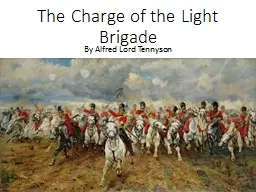
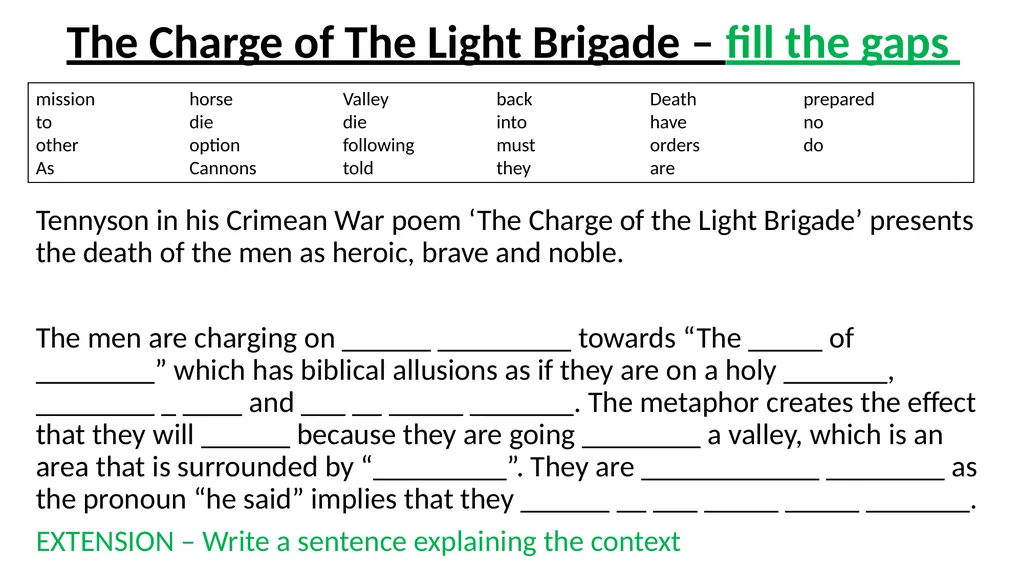
slide1. The Charge of The Light Brigade – fill the gaps Tennyson in his Crimean War poem ‘The Charge of the Light Brigade’ presents the death of the men as heroic, brave and noble.

The men are charging on ______ _________ towards “The _____ of ________” which has biblical allusions as if they are on a holy _______, ________ _ ____ and ___ __ _____ _______. The metaphor creates the effect that they will ______ because they are going ________ a valley, which is an area that is surrounded by “_________”. They are ____________ ________ as the pronoun “he said” implies that they ______ __ ___ _____ _____ _______.
EXTENSION – Write a sentence explaining the context mission horse Valley back Death prepared
to die die into have no
other option following must orders do
As Cannons told they are<br>
slide2. The Charge of The Light Brigade – fill the gaps Tennyson in his Crimean War poem ‘The Charge of the Light Brigade’ presents the death of the men as heroic, brave and noble.

The men are charging on horse back towards “The Valley of Death” which has biblical allusions as if they are on a holy mission, prepared to die and have no other option. The metaphor creates the effect that they will die because they are going into a valley, which is an area that is surrounded by “Cannons”. They are following orders as the pronoun “he said” implies that they must do as they are told. Tennyson, who was poet laureate, wrote the poem after seeing a newspaper report to honour the bravery of the men who fought so bravely, with little chance of survival. mission horse Valley back death prepared
to die die into have no
other option following must orders do
as Cannons told they are<br>
slide3. The Charge of the Light Brigade In your own words, explain what you think the poem is about.<br>
slide4. Wilfred Owen Born in 1893. Enlisted in the army in 1915. He was inspired to enlist after visiting the wounded in hospital. Owen was injured and sent home in 1917. In 1918 he returned to the front line. November 4th, 1918: Owen was killed by machine gun fire. His parents received news of his death the same day that the bells rung out to celebrate the end of the war: November 11th. Owen was 25 when he died. Context:
Exposure<br>
slide5. Exposure – fill the gaps Owen, a famous war poet, who died while fighting at the end of World War One wrote the ______ poem, ‘Exposure’ perhaps to highlight the suffering of the soldiers. He discusses the impact of ____________, the __________ men experienced and what they __________ during the war.

Exposure, by Owen explores how ________ the weather made __________ in the ___________. The “merciless iced East winds that knive” uses __________ to reinforce how horrifically cold, _________ and consistent the terrible weather conditions are. Owen uses _________ of the semantic field of __________ to highlight that it isn’t just war that is making the soldiers suffer horrifically. Owen _______________ war himself; therefore his voice of suffering is authentic. trenches horrific violent conditions violence repetition
suffering endured weather bleak personification experienced<br>
slide6. Exposure – fill the gaps Owen, a famous war poet, who died while fighting at the end of World War One wrote the bleak poem, ‘Exposure’ perhaps to highlight the suffering of the soldiers. He discusses the impact of weather, the suffering men experienced and what they endured during the war.

Exposure, by Owen explores how horrific the weather made conditions in the trenches. The “merciless iced East winds that knive” uses personification to reinforce how horrifically cold, violent and consistent the terrible weather conditions are. Owen uses repetition of the semantic field of violence to highlight that it isn’t just war that is making the soldiers suffer horrifically. Owen experienced war himself; therefore his voice of suffering is authentic. trenches horrific violent conditions violence repetition
suffering endured weather bleak personification experienced<br>
slide7. Exposure – Colour coded. Explain how the paragraphs are written in your own words Owen, a famous war poet, who died while fighting at the end of World War One wrote the bleak poem, ‘Exposure’ perhaps to highlight the suffering of the soldiers. He discusses the (1) impact of weather, (2)the suffering men experienced and (3) what they endured during the war.

Exposure, by Owen explores how horrific the weather made conditions in the trenches. The “merciless iced East winds that knive” uses personification to reinforce how horrifically cold, violent and consistent the terrible weather conditions are. Owen uses repetition of the semantic field of violence to highlight that it isn’t just war that is making the soldiers suffer horrifically. Owen experienced war himself; therefore his voice of suffering is authentic. Bold - Author name
Underlined - Context or Writer’s intentions
(1) (2) (3) - Ideas in the introduction to drive the essay forward
Yellow - analytical verbs
Blue - analysis of meaning/effect
Italics - language or structure techniques<br>
slide8. Introductions - Comparison Structure
The Charge of the Light Brigade compared to Exposure
Compare how the soldiers are presented? Introduction: Author name 1 and poem 1 name and key idea, connective, author name 2 and poem 2 name and key difference or similarity. Three similarities or differences that you will explore (1), (2), (3).

Tennyson’s ‘The Charge of the Light Brigade’ applauds and celebrates the soldiers experience, while Owen’s Exposure depicts a different more realistic experience of what war was like. Both poems discuss what the soldiers did in the war; Tennyson omits what the soldiers felt, while Owen includes this; finally, both discuss death.<br>
slide9. The Charge of the Light Brigade compared to Exposure Compare how the soldiers are presented? fill the gaps Idea 1 - taken from the introduction process
________Tennyson and Owen ______ what the soldiers did in the war. Tennyson explores the ___________charge made in the Crimean War by the British cavalry “Forward the Light Brigade’ and “Honour the Light Brigade’ with the verb and noun before the repetition of their ____________ name indicating that they did exactly what they were told, _________ be remembered and they didn’t flinch or back down from their ______; in spite of the terrible ______ they were entering. Meanwhile, Owen also discusses what the men did as a __________ feat of endurance where men “Wearied we keep awake because the night is silent…” with the ellipsis and connective offering an _________ that the men are tense, worried and sleepless, as they might be waiting for the __________ to commence again. Owen was in a ________ in the war so knew the reality, while Tennyson was __________ from the war and read about it in the papers which might explain their very different perspectives on what the soldiers did. Both battalion trap soldier fighting dreadful
heroic duty indication removed should discuss<br>
slide10. The Charge of the Light Brigade compared to Exposure Compare how the soldiers are presented? fill the gaps Both Tennyson and Owen discuss what the soldiers did in the war. Tennyson explores the heroic charge made in the Crimean War by the British cavalry “Forward the Light Brigade’ and “Honour the Light Brigade’ with the verb and noun before the repetition of their battalion name indicating that they did exactly what they were told, should be remembered and they didn’t flinch or back down from their duty; in spite of the terrible trap they were entering. Meanwhile, Owen also discusses what the men did as a dreadful feat of endurance where men “Wearied we keep awake because the night is silent…” with the ellipsis and connective offering an indication that the men are tense, worried and sleepless, as they might be waiting for the fighting to commence again. Owen was a soldier in the war so knew the reality, while Tennyson was removed from the war and read about it in the papers which might explain their very different perspectives on what the soldiers did. Both battalion trap soldier fighting dreadful
heroic duty indication removed should discuss<br>
slide11. The Charge of the Light Brigade compared to Exposure Compare how the soldiers are presented?
We will work through what the comparison writing process is: Both Tennyson and Owen discuss what the soldiers did in the war. Tennyson explores the heroic charge made in the Crimean War by the British cavalry “Forward the Light Brigade’ and “Honour the Light Brigade’ with the verb and noun before the repetition of their battalion name indicating that they did exactly what they were told, should be remembered and they didn’t flinch or back down from their duty; in spite of the terrible trap they were entering. Meanwhile, Owen also discusses what the men did as a dreadful feat of endurance where men “Wearied we keep awake because the night is silent…” with the ellipsis and connective offering an indication that the men are tense, worried and sleepless, as they might be waiting for the fighting to commence again. Owen was in a soldier in the war so knew the reality, while Tennyson was removed from the war and read about it in the papers which might explain their very different perspectives on what the soldiers did.<br>
slide12. The Charge of the Light Brigade compared to Exposure Compare how the soldiers are presented?
My thinking explained: Focus on the comparison element exploring both poems. Use the author’s name and write about them systematically in the same order as your introduction as this keeps it tightly structured. Embed context as you are analysing as much as possible. Say what the poet did and how the poet did this. This means explaining what you think the first poet is telling you in the evidence that you have selected. Then, include the language or structural terminology. Focus on explaining why your chosen evidence means this and what effect it might have on the reader if you can. Always try to give a reason using a connective (because/due to or to show/to tell us etc). Then, use a comparison connective or a sentence start that explains whether you are going to say what is similar or what is different in both poems. Repeat the poet’s name for poem 2 to signpost to the reader which poem you are writing about and then say what that poem did and how using evidence and embedding the language or structure terminology in the evidence you have selected. Now explain what the evidence from poem 2 means and why and what effect it has and why. Support what you have said at the end with a context point or a writer’s intentions point to summarise what you have said and why you have said it. As you get used to the comparison structure you will be able to start exploring more examples from both poems. This structure is a concurrent one where you do:
Both poems
Poem 1
Use comparison connectives
Poem 2
Summarise with context or writer’s intentions
As you get more confident with comparing you can embed multi-quotations.<br>
slide13. What does this look like in a framework that you can practice with? Both (Poet 1) and (Poet 2) present (KEY IDEA ABOUT BOTH POEMS). In (POET NAME) (POEM NAME) we see “(EVIDENCE)” with the (terminology) indicating (MEANING) to suggest (TRIPLET OF ANALYSIS). This is shown similarly/differently in (POET 2) (POEM 2) with (KEY SIMILARITY OR DIFFERENCE) The “(EVIDENCE)” presented through (terminology) suggests (MEANING) because (triplet of analysis). Perhaps, this shows (POET 1) felt (CONTEXT/INTENT), while (POET 2) felt similarly/differently because (REASON FOR THE DIFFERENCE LINKING TO CONTEXT/INTENT).<br>
slide14. Bayonet Charge compared to Exposure: How are the soldier’s experiences compared?
Using the framework to develop the paragraph: fill in the blanks with what you think works
(I will mark this) - Think Poet, Poem, link to the question, terminology, meaning/effect to embed your ideas Both ________and ________present harrowing __________ soldiers live through. In Hughes’ _____________ we see “Suddenly” “Stumbling” and “Sweating” with the ______ and _________indicating how the soldier feels to suggest he is ___________, hesitant and scared about finding himself in the nightmarish experience of ___________ towards the enemy with just a bayonet for protection. This is shown differently in Owen’s _________with fear being shown but in a way that is reinforced through inaction rather than Hughes’ use of ______. The “Worried by silence, sentries whisper, curious, nervous” presented through the ________of quiet behaviour and the use of ________suggests the fear that these soldiers feel is a nagging one because ___________is happening and the anticipation is getting to them. Perhaps, this shows Hughes felt it was important to use the first person ___________of a soldier during action to enforce the horrific reality of ________warfare, while Owen, a soldier himself felt differently because the silence and ________and terrible ________conditions seem to be what he feels are the horror of war, unlike Hughes’ very vivid __________snapshot.<br>
slide15. Bayonet Charge compared to Exposure: How are the soldier’s experiences compared?
Did you have similar answers? Both Hughes and Owen present harrowing experiences soldiers live through. In Hughes’ Bayonet Charge we see “Suddenly” “Stumbling” and “Sweating” with the adverb and verbs indicating how the soldier feels to suggest he is shocked, hesitant and scared about finding himself in the nightmarish experience of running towards the enemy with just a bayonet for protection. This is shown differently in Owen’s Exposure with fear being shown but in a way that is reinforced through inaction rather than Hughes’ use of action. The “Worried by silence, sentries whisper, curious, nervous” presented through the triplet of quiet behaviour and the use of verbs suggests the fear that these soldiers feel is a nagging one because nothing is happening and the anticipation is getting to them. Perhaps, this shows Hughes felt it was important to use the first person perspective of a soldier during action to enforce the horrific reality of trench warfare, while Owen, a soldier himself felt differently because the silence and inaction and terrible weather conditions seem to be what he feels are the horror of war, unlike Hughes very vivid action snapshot.<br>
slide16. Bayonet Charge compared to Remains: Compare what you think the soldiers feelings are?
Using the framework to develop the paragraph: check your response ___ ______ _________ ________ ________ ________ ________ ______ are definite hints of a stress reaction from the soldiers towards what they are experiencing. T____ i_ s_____ i_Hughes’ poem by the repetition of “sweat” and “Sweating” to show the soldier is having a physical reaction to being in the middle of the action. W_____ i_ A_______’s poem the soldier experiences PTSD with the metaphor “And the drink and the drugs won’t flush him out-” showing that no matter what he tries to do to forget the experience of killing a man, he can’t. _____ _______ show feelings of stress as a result of war and neither poet has been a soldier themselves, therefore their poems could be showing empathy for the situation many soldiers experience. _________ ______ ___________ by stories told in his family, while Armitage is drawing on his experiences of interviewing soldiers for the ‘Not Dead’ series and what happened to them in the Gulf war conflicts.<br>
slide17. Bayonet Charge compared to Remains: Compare what you think the soldiers feelings are?
Using the framework to develop the paragraph: fill in the blanks with what you think works (I will mark this) In Hughes’ Bayonet Charge and Armitage’s Remains there are definite hints of a stress reaction from the soldiers towards what they are experiencing. This is shown in Hughes’ poem by the repetition of “sweat” and “Sweating” to show the soldier is having a physical reaction to being in the middle of the action. While in Armitage’s poem, the soldier experiences PTSD with the metaphor “And the drink and the drugs won’t flush him out-” showing that no matter what he tries to do to forget the experience of killing a man, he can’t. Both poets show feelings of stress as a result of war and neither poet has been a soldier themselves, therefore their poems could be showing empathy for the situation many soldiers experience. Hughes was inspired by stories told in his family, while Armitage is drawing on his experiences of interviewing soldiers for the ‘Not Dead’ series and what happened to them in the Gulf war conflicts.<br>
slide18. Experiences of Soldiers<br>
slide19. Poppies by Jane Weir https://www.youtube.com/watch?v=Wks8jGq701c&t=6s

What is the noun ‘Armistice Day’ and what does the use of it on the first line suggest that the poem might be about? Why?
What do you think the mother (speaker) is feeling towards her son when she uses tactile imagery, ‘I pinned one onto your lapel …’? Why?
Explain what the tactile imagery, ‘Sellotape bandaged around my hand’ makes you think about and why?
Why do you think the mother (speaker) ‘smoothed down your shirt’s upturned collar, steeled the softening of my face’?
Why would a mother want to ‘play at being Eskimos like we did when you were little’ with her son who was going off to war?
What does the use of the verb ‘resisted’ suggest about the way that the mother is feeling towards her son at this specific moment?
Explain why the mother (speaker) might consider herself the abstract noun ‘brave’ at the start of the third stanza.
What does it seem that her son is using the verb ‘intoxicated’ by? Is this presented as a positive or negative (connotations) experience? Why?
Explain what the mother (speaker) might mean when she says in the past tense, first person using a metaphor ‘After you’d gone I went into your bedroom, released a songbird from its cage’?
The mother (speaker) is has been led by a symbolic ‘dove’ to the noun ‘churchyard walls’, listing ‘without a winter coat or reinforcements of scarf, gloves’. What does this suggest about her emotional state at this moment and why?
Is there any sense of hope by the speaker in the final stanza? Why/ why not?
What imagery do you have of the mother (speaker) from the line, with the verb ‘I listened, hoping to hear your playground voice catching on the wind’ creating a ___________ (you decide) tone?
What is your overall feeling towards the mother (speaker) in this poem? Why?<br>
slide20. Compare how experiences of conflict are shown in Poppies and one other poem of your choice. Which poem are you comparing to Poppies?
What happens in Poppies and how is this the same or different in your comparison poem (x 3 ideas)?
1 2 3<br>
slide21. Comparison ideas

We will share these as a class:<br>
slide22. Compare how experiences of conflict are shown in Poppies and one other poem of your choice Introduction framework:
Both (poet 1) in (poem 1) and (poet 2) in (poem 2) explore ideas about (key focus). These are shown in (idea 1); (idea 2); finally, through (idea 3).

Main Paragraph framework:
Both (Poet 1) and (Poet 2) present (KEY IDEA ABOUT BOTH POEMS). In (POET NAME) (POEM NAME) we see “(EVIDENCE)” with the (terminology) indicating (MEANING) to suggest (TRIPLET OF ANALYSIS). This is shown similarly/differently in (POET 2) (POEM 2) with (KEY SIMILARITY OR DIFFERENCE) The “(EVIDENCE)” presented through (terminology) suggests (MEANING) because (triplet of analysis). Perhaps, this shows (POET 1) felt (CONTEXT/INTENT), while (POET 2) felt similarly/differently because (REASON FOR THE DIFFERENCE LINKING TO CONTEXT/INTENT).<br>
slide23. Example - High Level Colour Coded Feedback Both Weir and Tennyson reflect on different perspectives of conflict and how this affects the people involved, whether that is mothers or soldiers. In Weir’s Poppies we are shown tactile imagery continuously throughout the poem to reinforce how this makes her feel close to her son “I pinned one onto your lapel” and “I rounded up as many” both use verbs and the first person pronoun “I” to remind us that the mother is desperate to touch her son in a loving, caring and comforting manner, as if this might be the last time that she sees him. At this point in the poem, stanza 1 and 2 the mother is lost in a memory of before her son went away, perhaps to school or to the war. The ambiguity in the language makes it seem as if she values these memories and wants to cling onto them and reinforces the idea that the mother in the poem could be any mother over time who has lost a child, either in conflict as the time setting of the poem around “Armistice Sunday” suggests or at any other time. Meanwhile, this maternal perspective is not shown in The Charge of the Light Brigade, instead the soldiers are depicted as brave and honourable and almost as if they should die for their country with us remembering their sacrifice but from an impersonal and removed viewpoint. The rhyme scheme mimicking the repetitive sound of the horse hooves beating as they charged into certain death reinforces this impersonal idea. As well as this, the imperative verb in “Forward the Light Brigade! Charge for the guns” he said” makes it sound like the soldiers were very used to following orders, doing what they were told and expected to do this without questioning or reasoning why they were there. This makes the poems perspective seem much more distant as the pronoun “he said” is an unknown commander or officer in charge making it seem very matter of fact and commonplace that the “six hundred” should ride into battle and possibly not make it out again. Weir was imagining herself in the situation of the famous war poet, Wilfred Owen's’ mother and other mothers who have lost their children in conflict and this makes her viewpoint personal, nostalgic and poignant, while Tennyson read a newspaper report and as poet laureate wrote a poem from the perspective of honouring the soldiers who had fought and died so bravely, therefore the impersonal perspective seems reasonable given that he was trying to remind the country to remember their sacrifices. This is unlike Weir who is empathising with mothers in conflict and how they also suffer from loss.
Blue - Comparison Pink - Poet Name Red - Terminology Bold - +WHY to develop the analysis Underlined - analytical verbs<br>
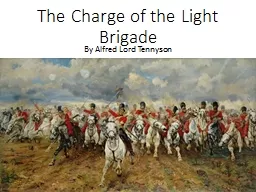
slide24. The story of the poem The Charge of the Light Brigade tells the story of the 600 men who charged into the enemy and their untimely deaths.
Bayonet Charge is about…
Exposure demonstrates...
Remains tells the reader about…
Poppies discusses…
War Photographer explores...<br>
slide25. The story of the poem The Charge of the Light Brigade tells the story of the 600 men who charged into the enemy and their untimely deaths.
Bayonet Charge is about a soldier’s experience of charging towards the enemy and the fear he experiences.
Exposure demonstrates how men felt during the war as a result of the interminable waiting.
Remains tells the reader about the PTSD experienced after shooting a looter in the Iraq war.
Poppies discusses a mother’s feelings over the loss of a son, in an ambiguous way.
War Photographer explores the disconnect between what the photographer experiences and what people at home see.<br>
slide26. Compare how civilians in conflict are presented in War Photographer and one other poem of your choice Introduction framework:
Both Duffy in War Photographer and Weir in Poppies explore ideas about how civilians who experience conflict are affected by this. These are shown in the emotional impact conflict causes; the contrast in PTSD experienced through living in the conflict; finally, through the use of tactile and visual imagery in both poems .

Main Paragraph framework:
Both (Poet 1) and (Poet 2) present (KEY IDEA ABOUT BOTH POEMS). In (POET NAME) (POEM NAME) we see “(EVIDENCE)” with the (terminology) indicating (MEANING) to suggest (TRIPLET OF ANALYSIS). This is shown similarly/differently in (POET 2) (POEM 2) with (KEY SIMILARITY OR DIFFERENCE) The “(EVIDENCE)” presented through (terminology) suggests (MEANING) because (triplet of analysis). Perhaps, this shows (POET 1) felt (CONTEXT/INTENT), while (POET 2) felt similarly/differently because (REASON FOR THE DIFFERENCE LINKING TO CONTEXT/INTENT).<br>
slide27. Compare how honour is presented in Kamikaze and one other poem of your choice Introduction framework:
Both (poet 1) in (poem 1) and (poet 2) in (poem 2) explore ideas about (key focus). These are shown in (idea 1); (idea 2); finally, through (idea 3).

Main Paragraph framework:
Both (Poet 1) and (Poet 2) present (KEY IDEA ABOUT BOTH POEMS). In (POET NAME) (POEM NAME) we see “(EVIDENCE)” with the (terminology) indicating (MEANING) to suggest (TRIPLET OF ANALYSIS). This is shown similarly/differently in (POET 2) (POEM 2) with (KEY SIMILARITY OR DIFFERENCE) The “(EVIDENCE)” presented through (terminology) suggests (MEANING) because (triplet of analysis). Perhaps, this shows (POET 1) felt (CONTEXT/INTENT), while (POET 2) felt similarly/differently because (REASON FOR THE DIFFERENCE LINKING TO CONTEXT/INTENT).<br>
slide28. How do you approach a comparison essay? Things that you could explain:
Explain how to plan
How to write an introduction
How many ideas do you want to cover
What should your main paragraphs include?
What kind of conjunctions/comparison connectives can you use to ensure you are comparing
What is context and why is it important?
How long should you be writing for?
What does your conclusion need to cover?<br>
slide29. How do you approach a comparison essay? Explain how to plan
How to write an introduction
How many ideas do you want to cover
What should your main paragraphs include?
What kind of conjunctions/
comparison connectives can you use to ensure you are comparing
What is context and why is it important?
How long should you be writing for?
What does your conclusion need to cover? My explanation:
To plan - I would look at the question first and decide which poem I want to compare from memory, thinking about the key focus e.g conflict etc. Then, I would annotate the poem quickly selecting key quotations that i could use (just underlining and writing next to them the language). Then, from memory I would thought splurge the ideas about the comparison poem and the context for both onto the paper. I’d only spend 5 minutes doing this.
Next, I would write my introduction - poems/poets and how the key focus is explored and a sentence with three ideas to compare and contrast the poems.
Using the first idea in my introduction I would explain what - how - why the first poem shows the key focus and then use a comparison to link it similarly or differently to the 2nd poem. I’d include evidence/language and structure focus, meaning, effect, connotations of words and the writers’ intentions as I am writing about both poems. I’d also try to cover the context in both poems and how the writer uses this to give a message to the reader. Then, I would repeat this for idea 2 and idea 3 in the poems.
Overall, I’d want to cover as many pieces of evidence as possible and every time I use a piece of evidence I would state what the language is doing (terminology “evidence”) as this shows my understanding of how the writer is expressing their ideas. Connectives can be: However, also, as well as this, conversely, similarly, differently, contrastingly, moreover, likewise, in the same way…
Context is my understanding of what was happening in the world at the time or the importance of why the poet wrote the poem or the way that the poet wanted to present a message about the topic of the poem.
I should be writing for 55 minutes in total with 5 minutes for planning.
My conclusion is a summary of the three ideas and my opinion about the poem and the message. It can be short and simple - 1 - 2 sentences and I don’t need evidence from the poem. I also don’t need to add anything new as I have already analysed my understanding of both the poems.<br>
slide30. Anthology Revision: PLC Focus RAG Rate your confidence with different aspects of the poems:
The Charge of the Light Brigade
Bayonet Charge
Exposure
Remains
Poppies
War Photographer
Kamikaze
The Emigree<br>
slide31. Quote Explosions Choose 2 pieces of evidence from each poem to explode for as much detail as possible: “Suddenly, he awoke and was running” Context
Hughes nature lover
Inspired by stories from his relatives to write about first person war experience Bayonet Charge Language/Structure Terminology
Opening line - Stanza 1
Adverb
Singular
First person perspective
Verb
Present tense
Imagery Meaning
Fear / Intimidation
Ambiguity
Middle of the action
Could be waking physically from sleep and has to immediately spring into action
Could be metaphorically waking up to the reality of the situation Effect
Empathy for the soldier as he is clearly terrified Questioning - why is he there? Who is he? Intentions
To explore the reality of war
To show the terror
To demonstrate that the soldiers were expected to do and die without question<br>
slide32. Quote Explosions - Possible Quotations<br>
slide33. Model - Live Paragraph Success Criteria
What-how-
why
Link to question about both poems
Terminology
Meaning
Why
Effect
Why
Intent/
Context
Comparison
Repeat analysis as above
Summarise comparison point<br>
slide34. Planning My planning example on board:

Compare the presentation of conflict endured by soldiers’ in Bayonet Charge and one other poem of your choice.

Your planning question to use:

Compare the presentation of personal responses to conflict in Remains and one other poem of your choice.<br>
slide35. Live Introduction (5 mins max) Compare the presentation of conflict endured by soldiers’ in Bayonet Charge and one other poem of your choice.

Success - Poem names/poet names, Key focus of question with idea. 3 comparison points similarities and/or differences.<br>
slide36. Live Conclusion (5 mins max) Compare the presentation of conflict endured by soldiers’ in Bayonet Charge and one other poem of your choice.

Success - Poem names/poet names, link back to Key focus of question with summary of your idea. Summary of my 3 comparison points similarities and/or differences.<br>