
The Classy and the Dapper: Congressional Debate



Description: The Classy and the Dapper: Congressional Debate Moving from Point A to Infinity and Beyond Agenda Whats going on at least for the next 40 minutes: Recap Event and Structure Review Terms Analyze Legislation Prepare Speeches Refutation
Related Topics
Download Presentation
"The Classy and the Dapper: Congressional Debate" is the property of its rightful owner. Permission is granted to download and print the materials on this website for personal, non-commercial use only, and to display it on your personal computer provided you do not modify the materials and that you retain all copyright notices contained in the materials. By downloading content from our website, you accept the terms of this agreement.
Presentation Transcript
slide1. The Classy and the Dapper:
Congressional Debate Moving from “Point A” to “Infinity and Beyond”<br>
slide2. Agenda What’s going on [at least for the next 40 minutes]:
Recap Event and Structure
Review Terms
Analyze Legislation
Prepare Speeches
Refutation
Refocus Presentation [in speeches]
Strategy<br>
slide3. Objectives By the end of this ‘webinar’, I will be able to:
Recall common terms used in Congress
Outline the structure of a session
Delineate arguments from legislation
Draft a speech [outline]
Deliver a speech<br>
slide4. Overview: Event Structure What is it?
Simulation of the United States Congress (both chambers)
What happens?
Discuss/Debate “Legislation”
Affirmative/Negative- questions
For how long?
2-3 hours<br>
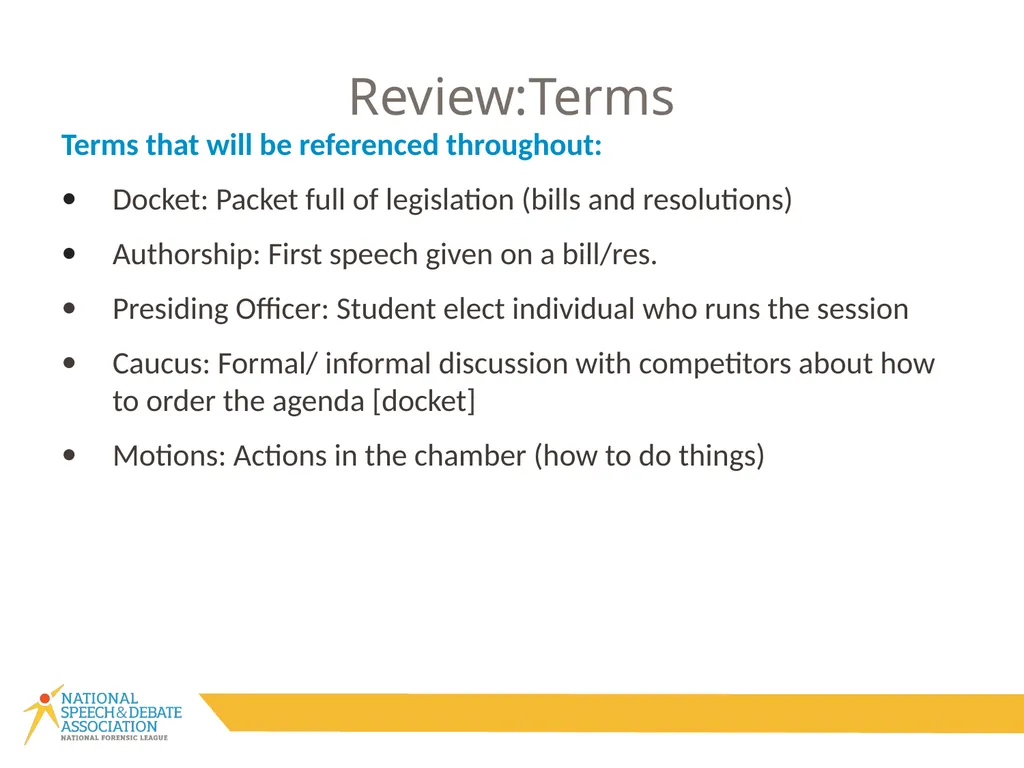
slide5. Review:Terms Terms that will be referenced throughout:
Docket: Packet full of legislation (bills and resolutions)
Authorship: First speech given on a bill/res.
Presiding Officer: Student elect individual who runs the session
Caucus: Formal/ informal discussion with competitors about how to order the agenda [docket]
Motions: Actions in the chamber (how to do things)<br>
slide6. Delineate Arguments
From Legislation Text<br>
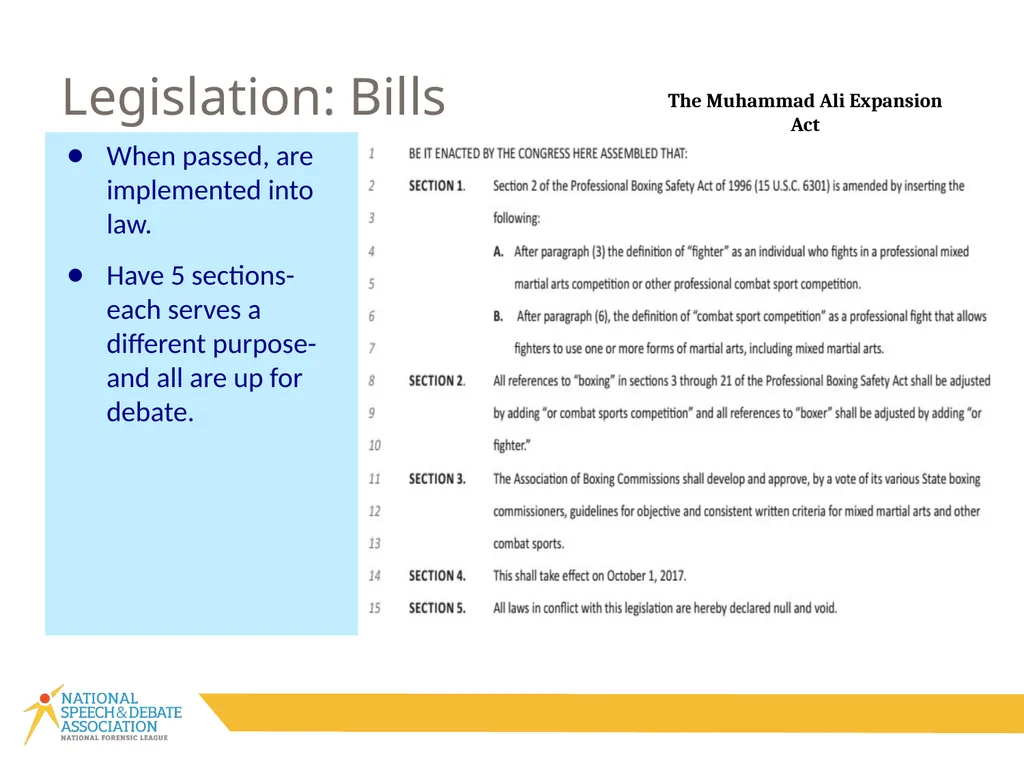
slide7. Legislation: Bills When passed, are implemented into law.
Have 5 sections- each serves a different purpose- and all are up for debate. The Muhammad Ali Expansion Act<br>
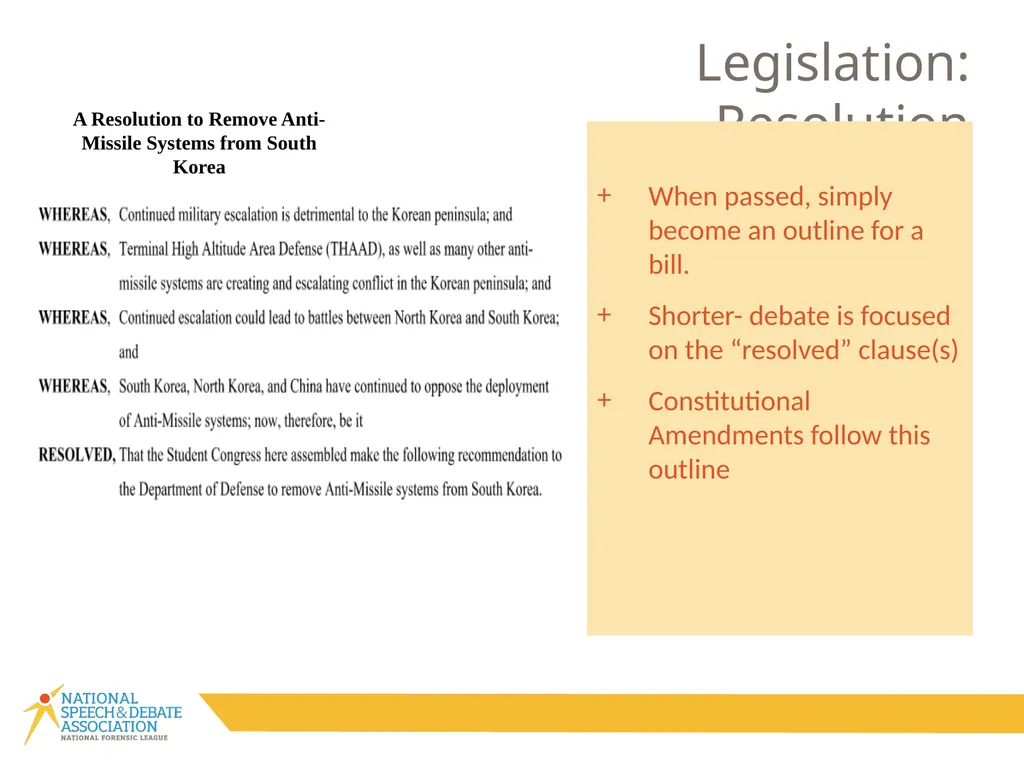
slide8. Legislation: Resolution When passed, simply become an outline for a bill.
Shorter- debate is focused on the “resolved” clause(s)
Constitutional Amendments follow this outline A Resolution to Remove Anti-Missile Systems from South Korea<br>
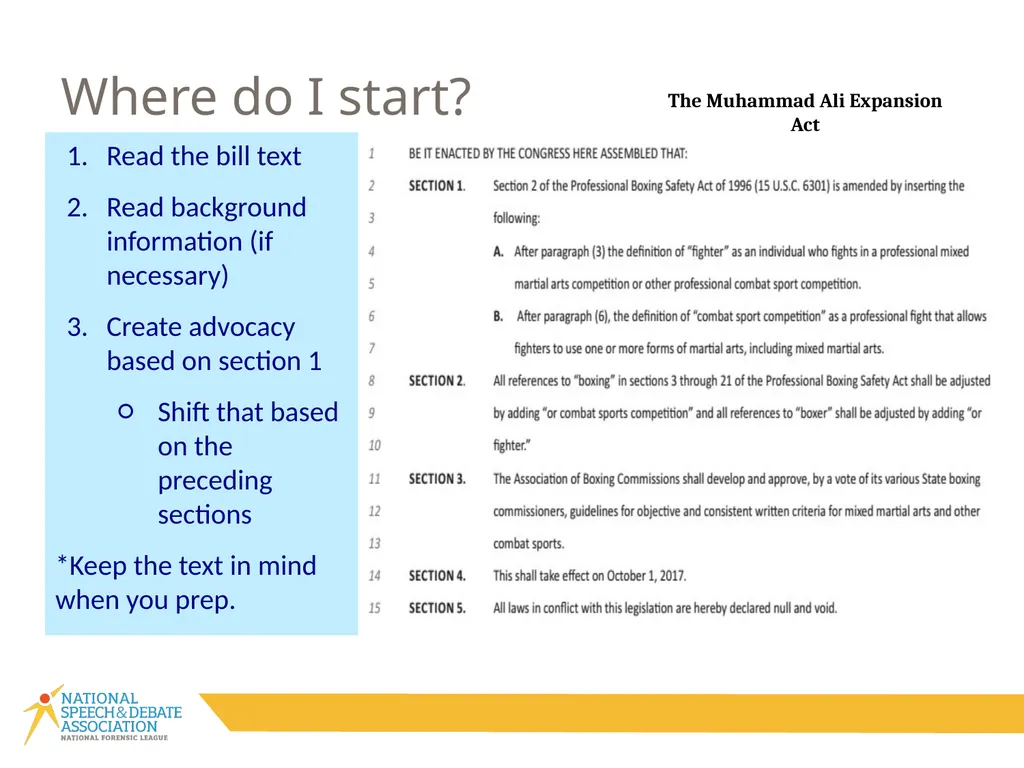
slide9. Where do I start? Read the bill text
Read background information (if necessary)
Create advocacy based on section 1
Shift that based on the preceding sections
*Keep the text in mind when you prep. The Muhammad Ali Expansion Act<br>
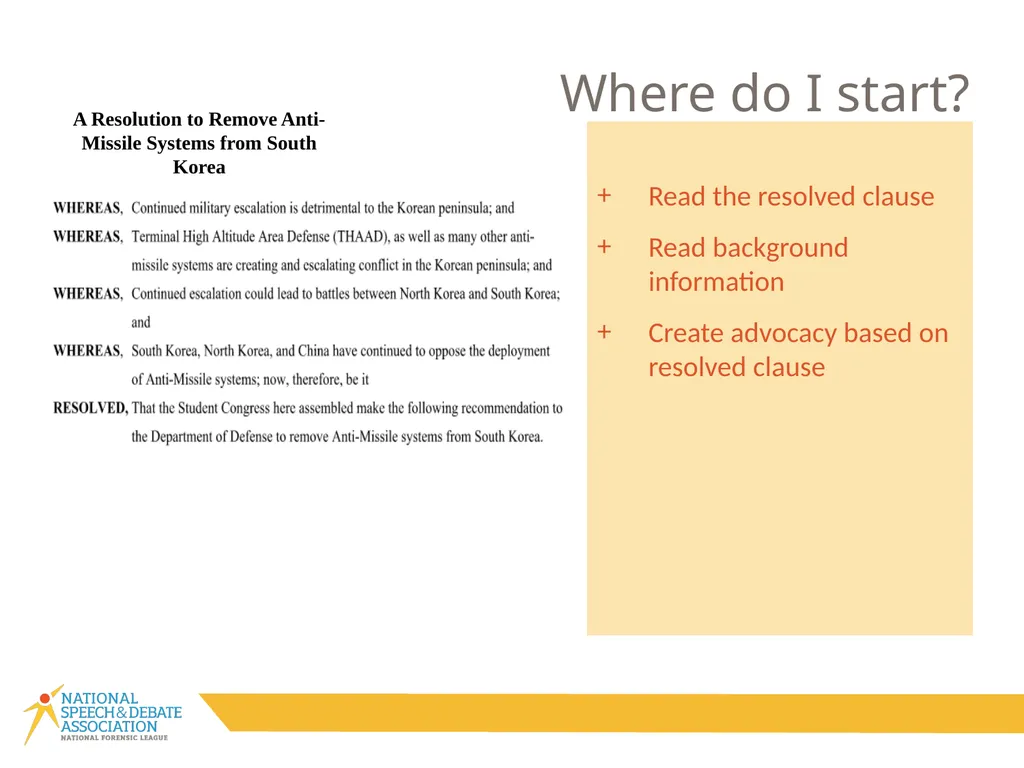
slide10. Where do I start? Read the resolved clause
Read background information
Create advocacy based on resolved clause A Resolution to Remove Anti-Missile Systems from South Korea<br>
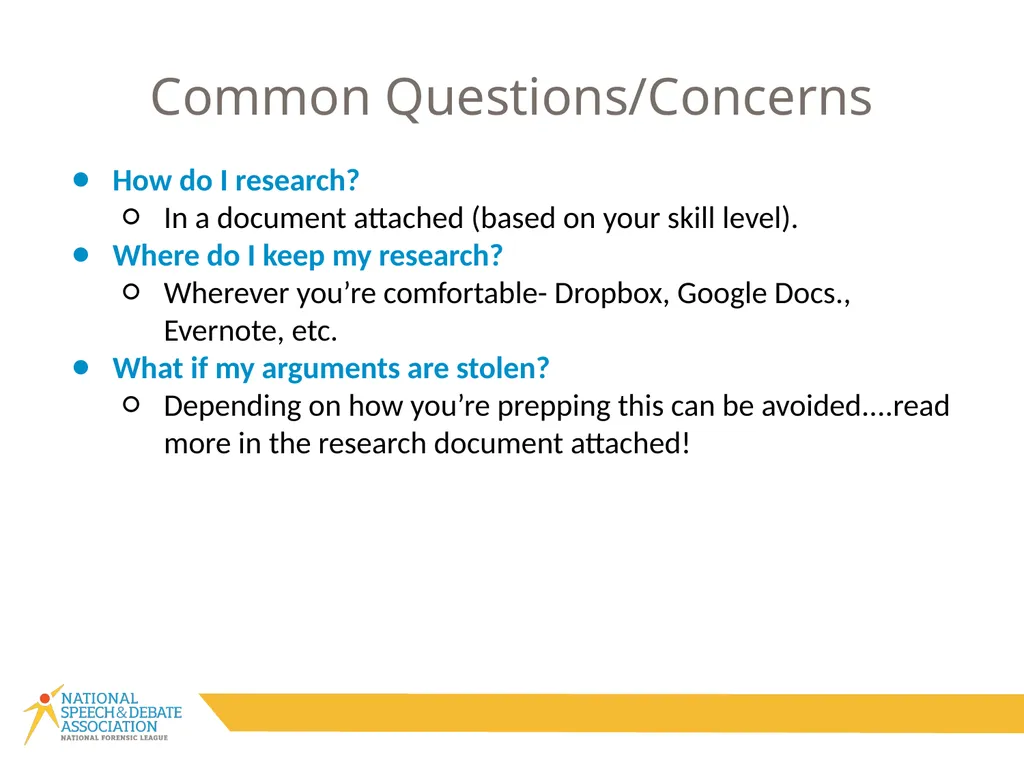
slide11. Common Questions/Concerns How do I research?
In a document attached (based on your skill level).
Where do I keep my research?
Wherever you’re comfortable- Dropbox, Google Docs., Evernote, etc.
What if my arguments are stolen?
Depending on how you’re prepping this can be avoided....read more in the research document attached!<br>
slide12. Speech Structure
Reminder: Speeches are 3 minutes<br>
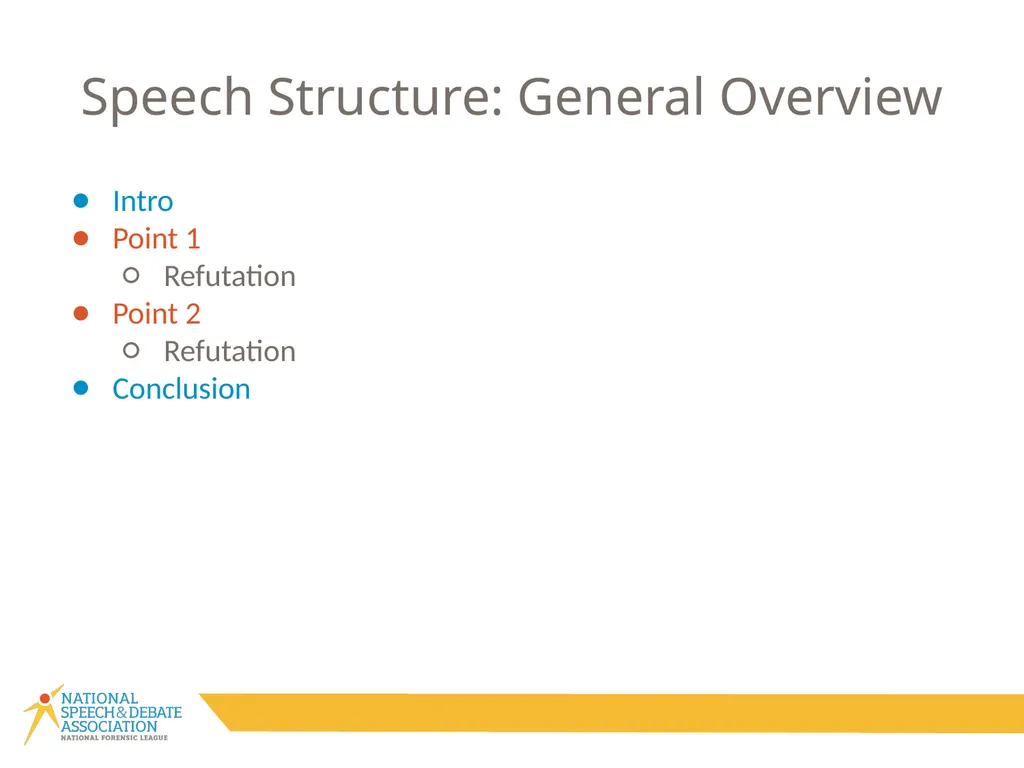
slide13. Speech Structure: General Overview Intro
Point 1
Refutation
Point 2
Refutation
Conclusion<br>
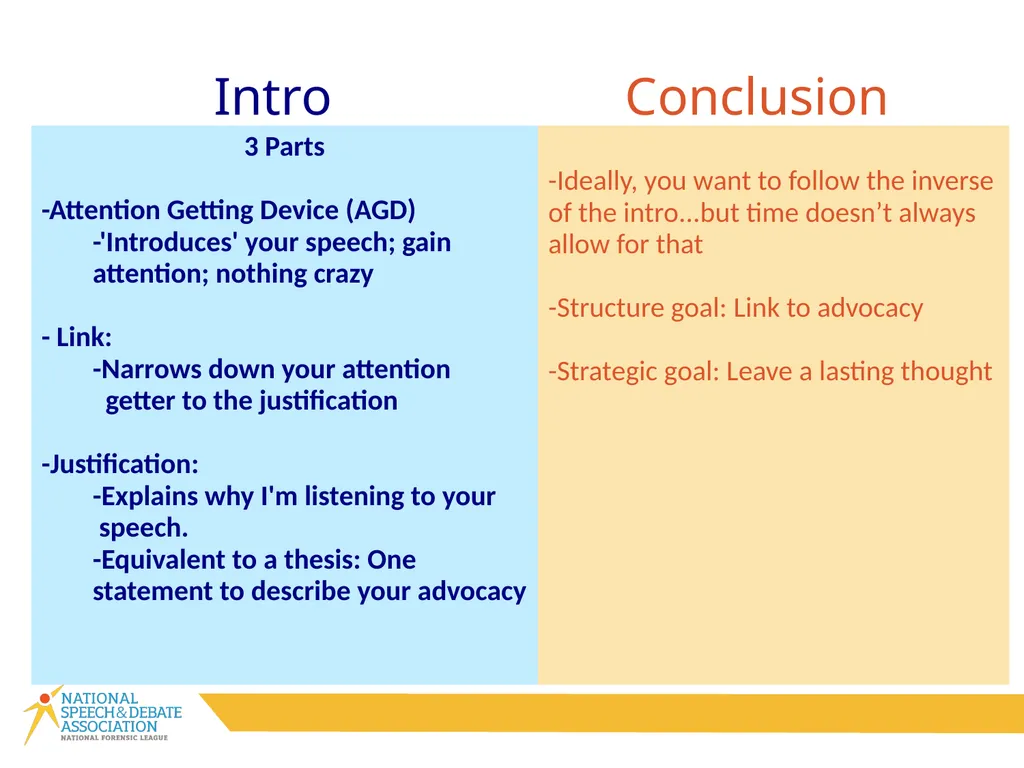
slide14. Intro Conclusion 3 Parts
-Attention Getting Device (AGD)
-'Introduces' your speech; gain attention; nothing crazy
- Link:
-Narrows down your attention
getter to the justification
-Justification:
-Explains why I'm listening to your
speech.
-Equivalent to a thesis: One statement to describe your advocacy -Ideally, you want to follow the inverse of the intro...but time doesn’t always allow for that
-Structure goal: Link to advocacy
-Strategic goal: Leave a lasting thought<br>
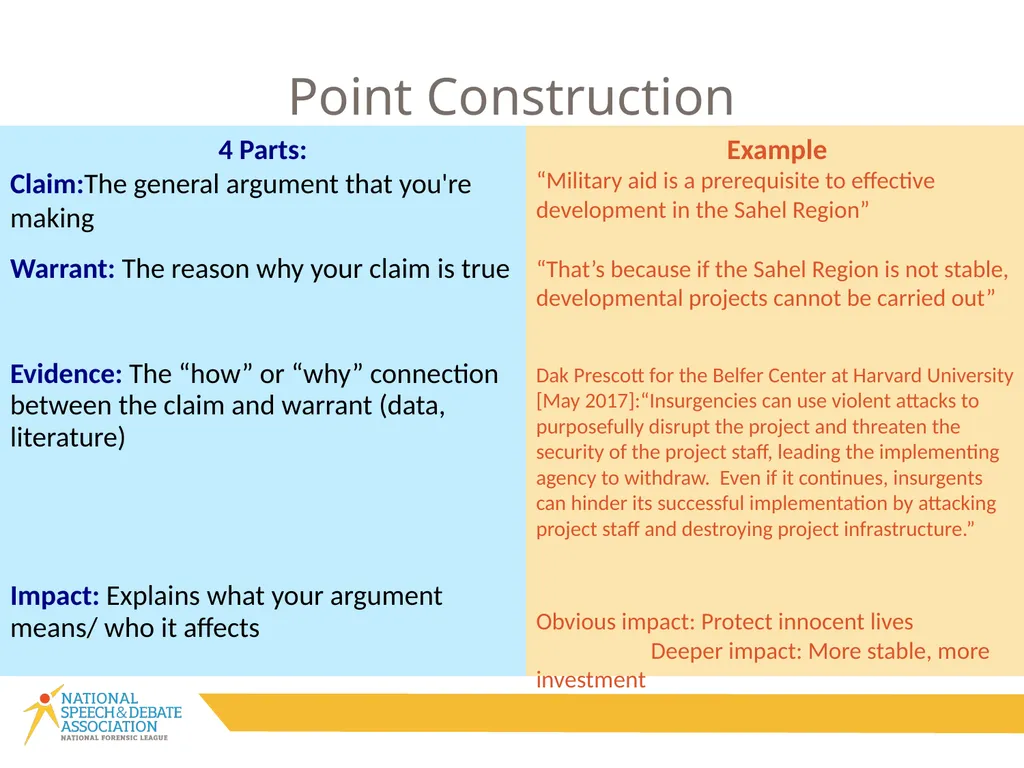
slide15. Point Construction 4 Parts:
Claim:The general argument that you're making
Warrant: The reason why your claim is true
Evidence: The “how” or “why” connection between the claim and warrant (data, literature)
Impact: Explains what your argument means/ who it affects Example
“Military aid is a prerequisite to effective development in the Sahel Region”
“That’s because if the Sahel Region is not stable, developmental projects cannot be carried out”
Dak Prescott for the Belfer Center at Harvard University [May 2017]:“Insurgencies can use violent attacks to purposefully disrupt the project and threaten the security of the project staff, leading the implementing agency to withdraw. Even if it continues, insurgents can hinder its successful implementation by attacking project staff and destroying project infrastructure.”
Obvious impact: Protect innocent lives Deeper impact: More stable, more investment<br>
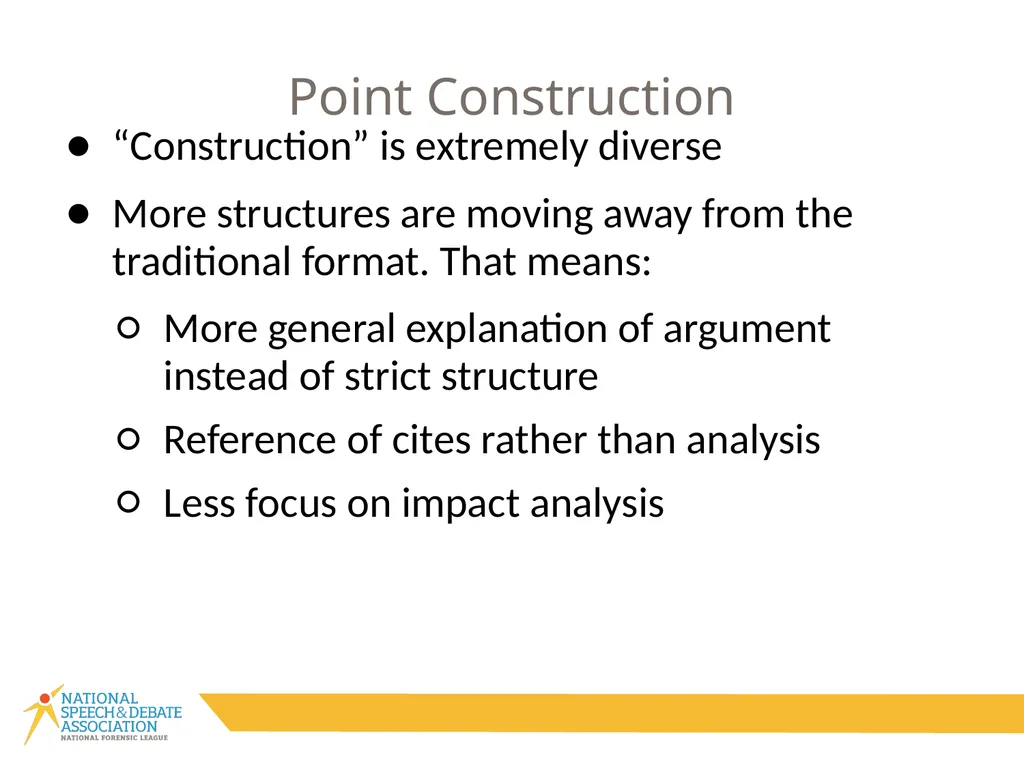
slide16. Point Construction “Construction” is extremely diverse
More structures are moving away from the traditional format. That means:
More general explanation of argument instead of strict structure
Reference of cites rather than analysis
Less focus on impact analysis<br>
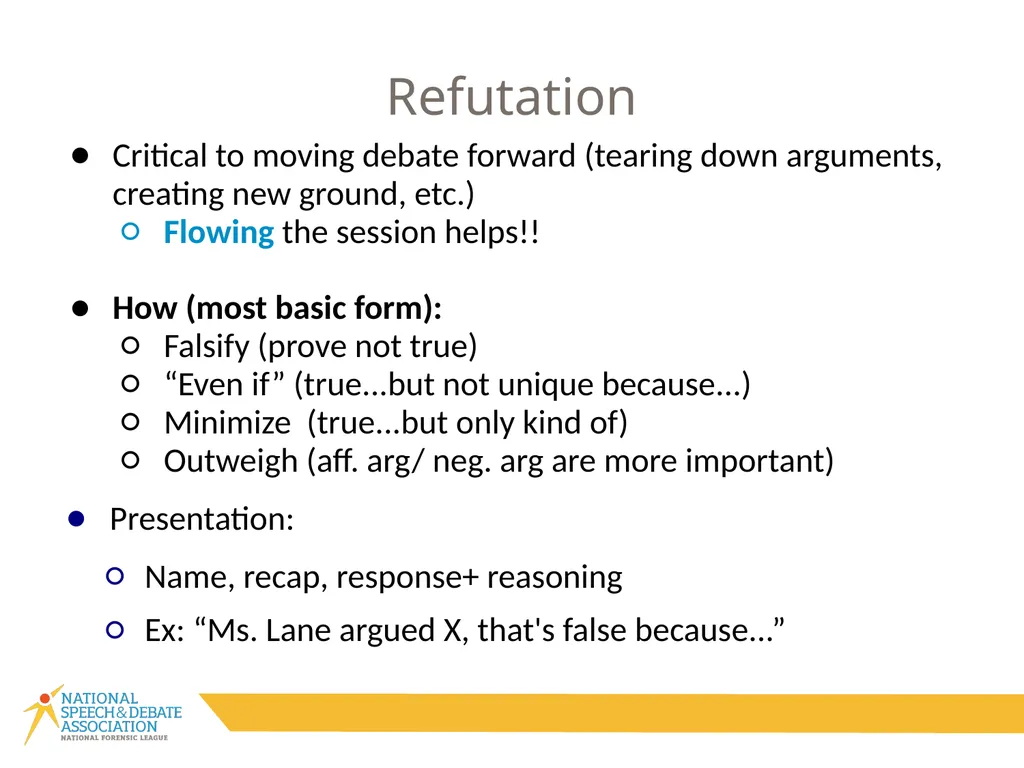
slide17. Refutation Critical to moving debate forward (tearing down arguments, creating new ground, etc.)
Flowing the session helps!!
How (most basic form):
Falsify (prove not true)
“Even if” (true...but not unique because...)
Minimize (true...but only kind of)
Outweigh (aff. arg/ neg. arg are more important)
Presentation:
Name, recap, response+ reasoning
Ex: “Ms. Lane argued X, that's false because...”<br>
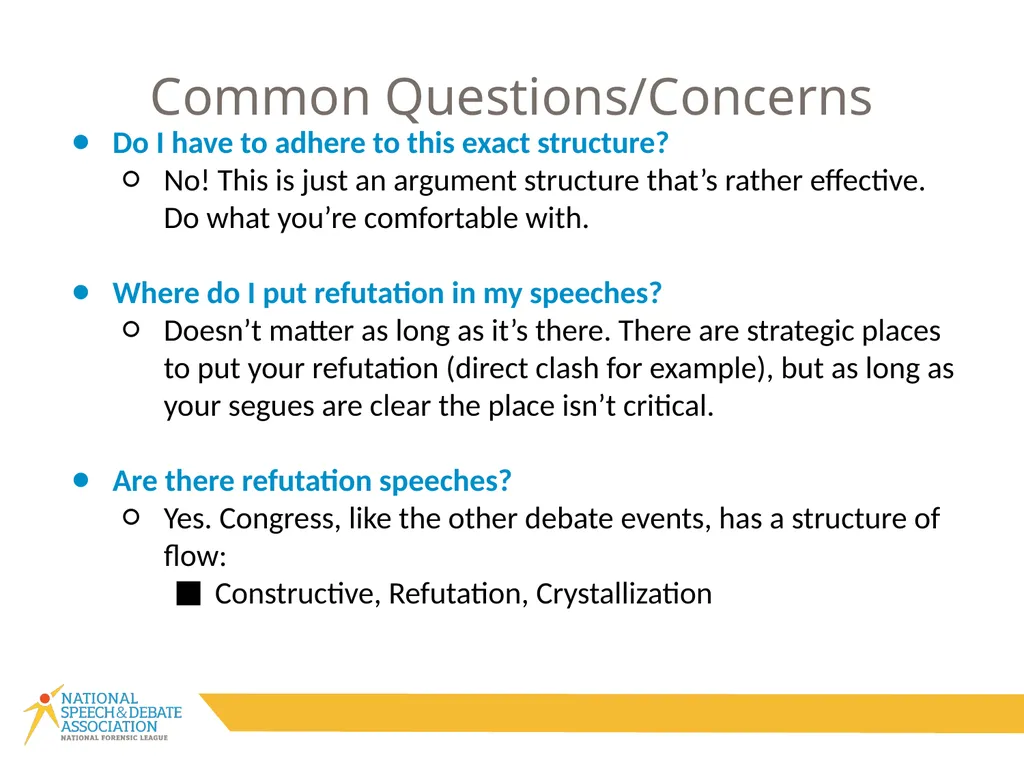
slide18. Common Questions/Concerns Do I have to adhere to this exact structure?
No! This is just an argument structure that’s rather effective. Do what you’re comfortable with.
Where do I put refutation in my speeches?
Doesn’t matter as long as it’s there. There are strategic places to put your refutation (direct clash for example), but as long as your segues are clear the place isn’t critical.
Are there refutation speeches?
Yes. Congress, like the other debate events, has a structure of flow:
Constructive, Refutation, Crystallization<br>
slide19. Presentation
The Big 3: Volume, Clarity, Eye Contact<br>
slide20. Presentation: Volume Project- Speak from diaphragm
Big Room Performances<br>
slide21. Presentation: Clarity Speed
Speak slower than you may feel comfortable - it will also improve fluency
However, make sure you can still fit within allotted time
Fluency
Avoid using filler words (um, uh, like, etc.)
Use strategic pausing to organize thoughts
Emphasis
When?
Important numbers/statistics
Important words/phrases
How?
Stress important words
End up/down
Pause after important words or phrases<br>
slide22. Presentation: Eye Contact Look up when possible
Less important than others - in this competition don’t sacrifice fluency, etc. for eye contact
Makes it seem like you know what you are talking about
Don’t type out or write out your whole speech<br>
slide23. Common Questions/Concerns Is presentation more important than argumentation/ refutation?
No. It can help you but overall there should be a [somewhat] equal balance between argumentation, refutation, and presentation.
Should I change anything about my presentation depending on my judging panel?
No. You should be well rounded enough in various sectors that it’s appealing all around.<br>
slide24. Strategy<br>
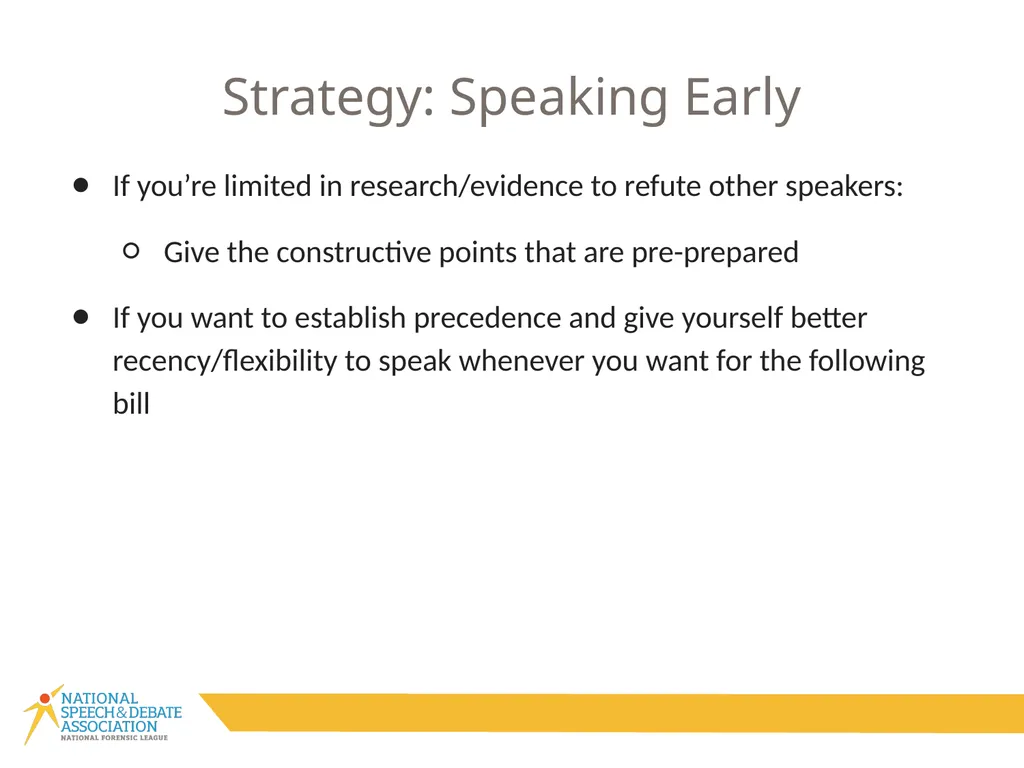
slide25. Strategy: Speaking Early If you’re limited in research/evidence to refute other speakers:
Give the constructive points that are pre-prepared
If you want to establish precedence and give yourself better recency/flexibility to speak whenever you want for the following bill<br>
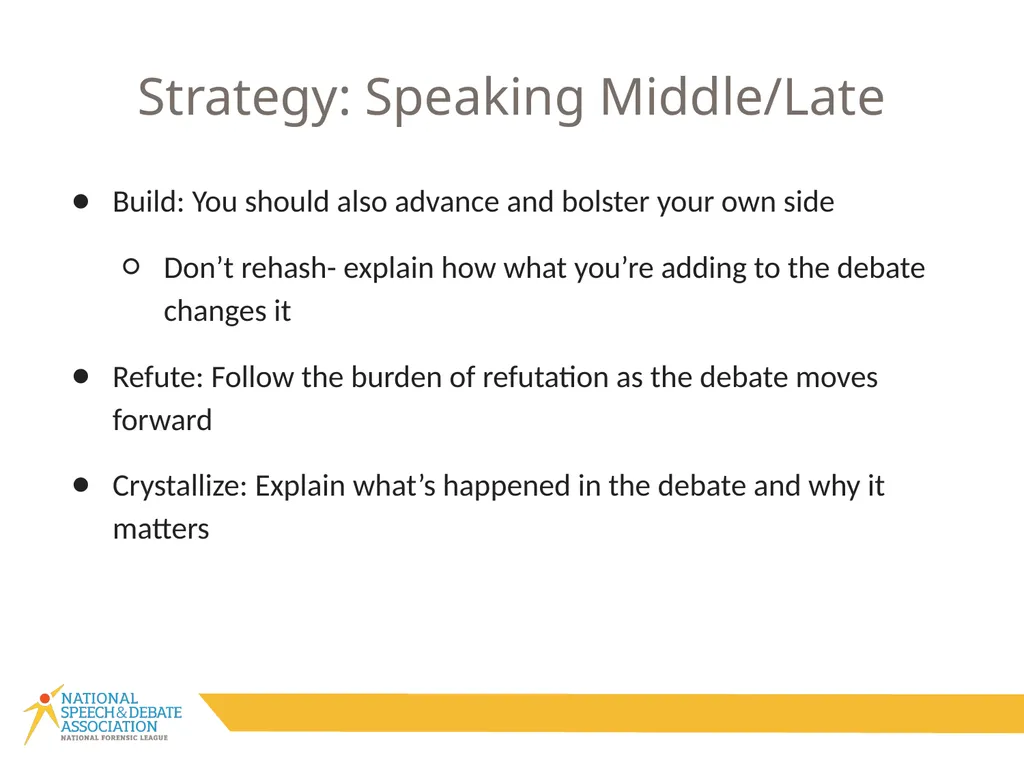
slide26. Strategy: Speaking Middle/Late Build: You should also advance and bolster your own side
Don’t rehash- explain how what you’re adding to the debate changes it
Refute: Follow the burden of refutation as the debate moves forward
Crystallize: Explain what’s happened in the debate and why it matters<br>
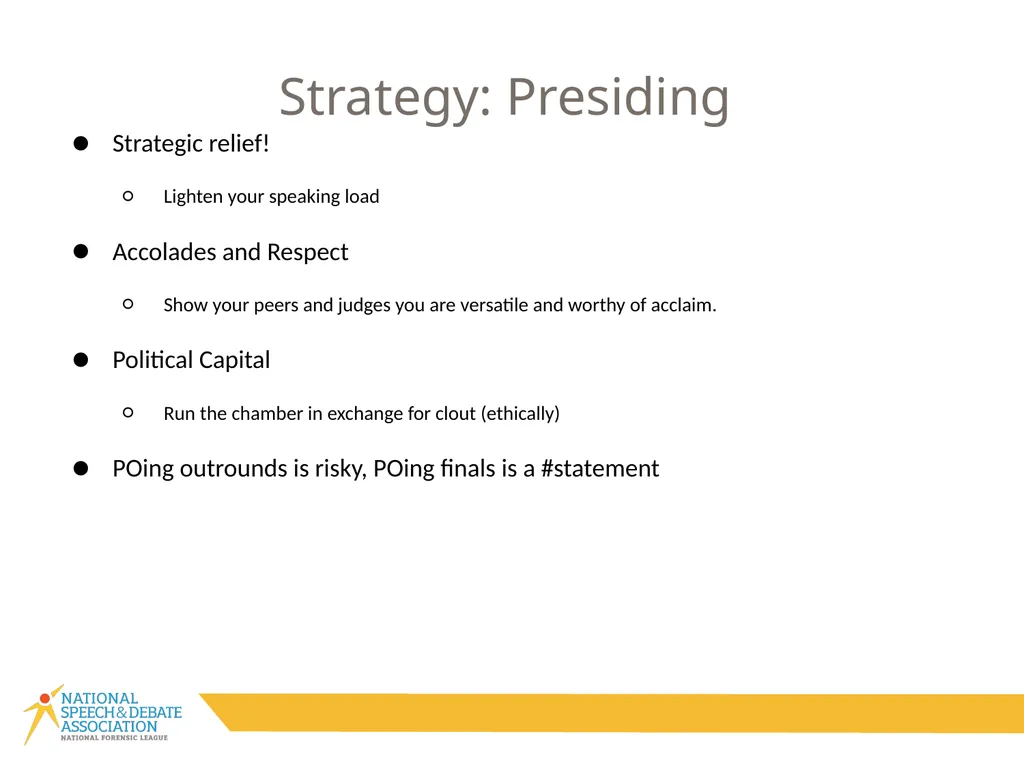
slide27. Strategy: Presiding Strategic relief!
Lighten your speaking load
Accolades and Respect
Show your peers and judges you are versatile and worthy of acclaim.
Political Capital
Run the chamber in exchange for clout (ethically)
POing outrounds is risky, POing finals is a #statement<br>
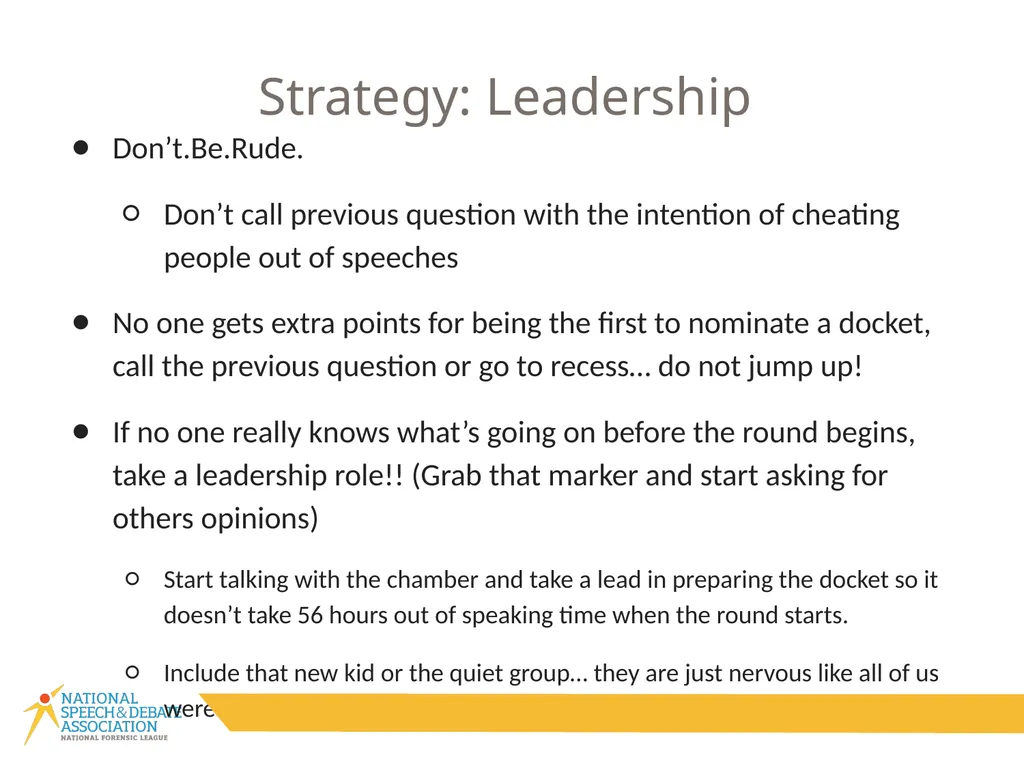
slide28. Strategy: Leadership Don’t.Be.Rude.
Don’t call previous question with the intention of cheating people out of speeches
No one gets extra points for being the first to nominate a docket, call the previous question or go to recess… do not jump up!
If no one really knows what’s going on before the round begins, take a leadership role!! (Grab that marker and start asking for others opinions)
Start talking with the chamber and take a lead in preparing the docket so it doesn’t take 56 hours out of speaking time when the round starts.
Include that new kid or the quiet group… they are just nervous like all of us were at one point<br>
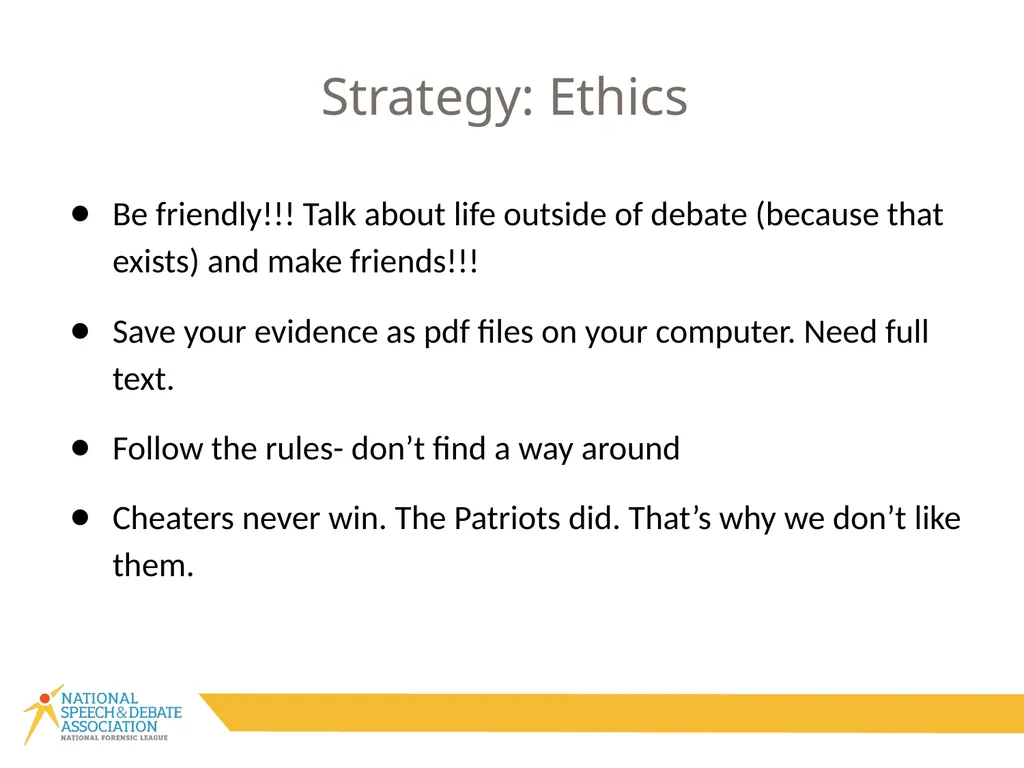
slide29. Strategy: Ethics Be friendly!!! Talk about life outside of debate (because that exists) and make friends!!!
Save your evidence as pdf files on your computer. Need full text.
Follow the rules- don’t find a way around
Cheaters never win. The Patriots did. That’s why we don’t like them.<br>
slide30. “Some of the great leaders in history were not adored, but respected. My advice to leaders- stop trying to please everyone and do what you believe is best” — Nick Saban, University of Alabama (Head Football Coach)<br>
Congressional Debate Moving from “Point A” to “Infinity and Beyond”<br>
slide2. Agenda What’s going on [at least for the next 40 minutes]:
Recap Event and Structure
Review Terms
Analyze Legislation
Prepare Speeches
Refutation
Refocus Presentation [in speeches]
Strategy<br>
slide3. Objectives By the end of this ‘webinar’, I will be able to:
Recall common terms used in Congress
Outline the structure of a session
Delineate arguments from legislation
Draft a speech [outline]
Deliver a speech<br>
slide4. Overview: Event Structure What is it?
Simulation of the United States Congress (both chambers)
What happens?
Discuss/Debate “Legislation”
Affirmative/Negative- questions
For how long?
2-3 hours<br>
slide5. Review:Terms Terms that will be referenced throughout:
Docket: Packet full of legislation (bills and resolutions)
Authorship: First speech given on a bill/res.
Presiding Officer: Student elect individual who runs the session
Caucus: Formal/ informal discussion with competitors about how to order the agenda [docket]
Motions: Actions in the chamber (how to do things)<br>
slide6. Delineate Arguments
From Legislation Text<br>
slide7. Legislation: Bills When passed, are implemented into law.
Have 5 sections- each serves a different purpose- and all are up for debate. The Muhammad Ali Expansion Act<br>
slide8. Legislation: Resolution When passed, simply become an outline for a bill.
Shorter- debate is focused on the “resolved” clause(s)
Constitutional Amendments follow this outline A Resolution to Remove Anti-Missile Systems from South Korea<br>
slide9. Where do I start? Read the bill text
Read background information (if necessary)
Create advocacy based on section 1
Shift that based on the preceding sections
*Keep the text in mind when you prep. The Muhammad Ali Expansion Act<br>
slide10. Where do I start? Read the resolved clause
Read background information
Create advocacy based on resolved clause A Resolution to Remove Anti-Missile Systems from South Korea<br>
slide11. Common Questions/Concerns How do I research?
In a document attached (based on your skill level).
Where do I keep my research?
Wherever you’re comfortable- Dropbox, Google Docs., Evernote, etc.
What if my arguments are stolen?
Depending on how you’re prepping this can be avoided....read more in the research document attached!<br>
slide12. Speech Structure
Reminder: Speeches are 3 minutes<br>
slide13. Speech Structure: General Overview Intro
Point 1
Refutation
Point 2
Refutation
Conclusion<br>
slide14. Intro Conclusion 3 Parts
-Attention Getting Device (AGD)
-'Introduces' your speech; gain attention; nothing crazy
- Link:
-Narrows down your attention
getter to the justification
-Justification:
-Explains why I'm listening to your
speech.
-Equivalent to a thesis: One statement to describe your advocacy -Ideally, you want to follow the inverse of the intro...but time doesn’t always allow for that
-Structure goal: Link to advocacy
-Strategic goal: Leave a lasting thought<br>
slide15. Point Construction 4 Parts:
Claim:The general argument that you're making
Warrant: The reason why your claim is true
Evidence: The “how” or “why” connection between the claim and warrant (data, literature)
Impact: Explains what your argument means/ who it affects Example
“Military aid is a prerequisite to effective development in the Sahel Region”
“That’s because if the Sahel Region is not stable, developmental projects cannot be carried out”
Dak Prescott for the Belfer Center at Harvard University [May 2017]:“Insurgencies can use violent attacks to purposefully disrupt the project and threaten the security of the project staff, leading the implementing agency to withdraw. Even if it continues, insurgents can hinder its successful implementation by attacking project staff and destroying project infrastructure.”
Obvious impact: Protect innocent lives Deeper impact: More stable, more investment<br>
slide16. Point Construction “Construction” is extremely diverse
More structures are moving away from the traditional format. That means:
More general explanation of argument instead of strict structure
Reference of cites rather than analysis
Less focus on impact analysis<br>
slide17. Refutation Critical to moving debate forward (tearing down arguments, creating new ground, etc.)
Flowing the session helps!!
How (most basic form):
Falsify (prove not true)
“Even if” (true...but not unique because...)
Minimize (true...but only kind of)
Outweigh (aff. arg/ neg. arg are more important)
Presentation:
Name, recap, response+ reasoning
Ex: “Ms. Lane argued X, that's false because...”<br>
slide18. Common Questions/Concerns Do I have to adhere to this exact structure?
No! This is just an argument structure that’s rather effective. Do what you’re comfortable with.
Where do I put refutation in my speeches?
Doesn’t matter as long as it’s there. There are strategic places to put your refutation (direct clash for example), but as long as your segues are clear the place isn’t critical.
Are there refutation speeches?
Yes. Congress, like the other debate events, has a structure of flow:
Constructive, Refutation, Crystallization<br>
slide19. Presentation
The Big 3: Volume, Clarity, Eye Contact<br>
slide20. Presentation: Volume Project- Speak from diaphragm
Big Room Performances<br>
slide21. Presentation: Clarity Speed
Speak slower than you may feel comfortable - it will also improve fluency
However, make sure you can still fit within allotted time
Fluency
Avoid using filler words (um, uh, like, etc.)
Use strategic pausing to organize thoughts
Emphasis
When?
Important numbers/statistics
Important words/phrases
How?
Stress important words
End up/down
Pause after important words or phrases<br>
slide22. Presentation: Eye Contact Look up when possible
Less important than others - in this competition don’t sacrifice fluency, etc. for eye contact
Makes it seem like you know what you are talking about
Don’t type out or write out your whole speech<br>
slide23. Common Questions/Concerns Is presentation more important than argumentation/ refutation?
No. It can help you but overall there should be a [somewhat] equal balance between argumentation, refutation, and presentation.
Should I change anything about my presentation depending on my judging panel?
No. You should be well rounded enough in various sectors that it’s appealing all around.<br>
slide24. Strategy<br>
slide25. Strategy: Speaking Early If you’re limited in research/evidence to refute other speakers:
Give the constructive points that are pre-prepared
If you want to establish precedence and give yourself better recency/flexibility to speak whenever you want for the following bill<br>
slide26. Strategy: Speaking Middle/Late Build: You should also advance and bolster your own side
Don’t rehash- explain how what you’re adding to the debate changes it
Refute: Follow the burden of refutation as the debate moves forward
Crystallize: Explain what’s happened in the debate and why it matters<br>
slide27. Strategy: Presiding Strategic relief!
Lighten your speaking load
Accolades and Respect
Show your peers and judges you are versatile and worthy of acclaim.
Political Capital
Run the chamber in exchange for clout (ethically)
POing outrounds is risky, POing finals is a #statement<br>
slide28. Strategy: Leadership Don’t.Be.Rude.
Don’t call previous question with the intention of cheating people out of speeches
No one gets extra points for being the first to nominate a docket, call the previous question or go to recess… do not jump up!
If no one really knows what’s going on before the round begins, take a leadership role!! (Grab that marker and start asking for others opinions)
Start talking with the chamber and take a lead in preparing the docket so it doesn’t take 56 hours out of speaking time when the round starts.
Include that new kid or the quiet group… they are just nervous like all of us were at one point<br>
slide29. Strategy: Ethics Be friendly!!! Talk about life outside of debate (because that exists) and make friends!!!
Save your evidence as pdf files on your computer. Need full text.
Follow the rules- don’t find a way around
Cheaters never win. The Patriots did. That’s why we don’t like them.<br>
slide30. “Some of the great leaders in history were not adored, but respected. My advice to leaders- stop trying to please everyone and do what you believe is best” — Nick Saban, University of Alabama (Head Football Coach)<br>