The Cliché Kid By Chloё, Freya and Lucy Complete the Clichés Its raining and dogs. Time flies when youre having ! Just in the of time. As fit as a . Every cloud has a
"The Cliché Kid By Chloё, Freya and Lucy Complete" is the property of its rightful owner. Permission is granted to
download and print the materials on this website for personal, non-commercial use only, and to display it
on your personal computer provided you do not modify the materials and that you retain all copyright
notices contained in the materials. By downloading content from our website, you accept the terms of this
agreement.
Presentation Transcript
01
The Cliché Kid By Chloё, Freya and Lucy<br>
02
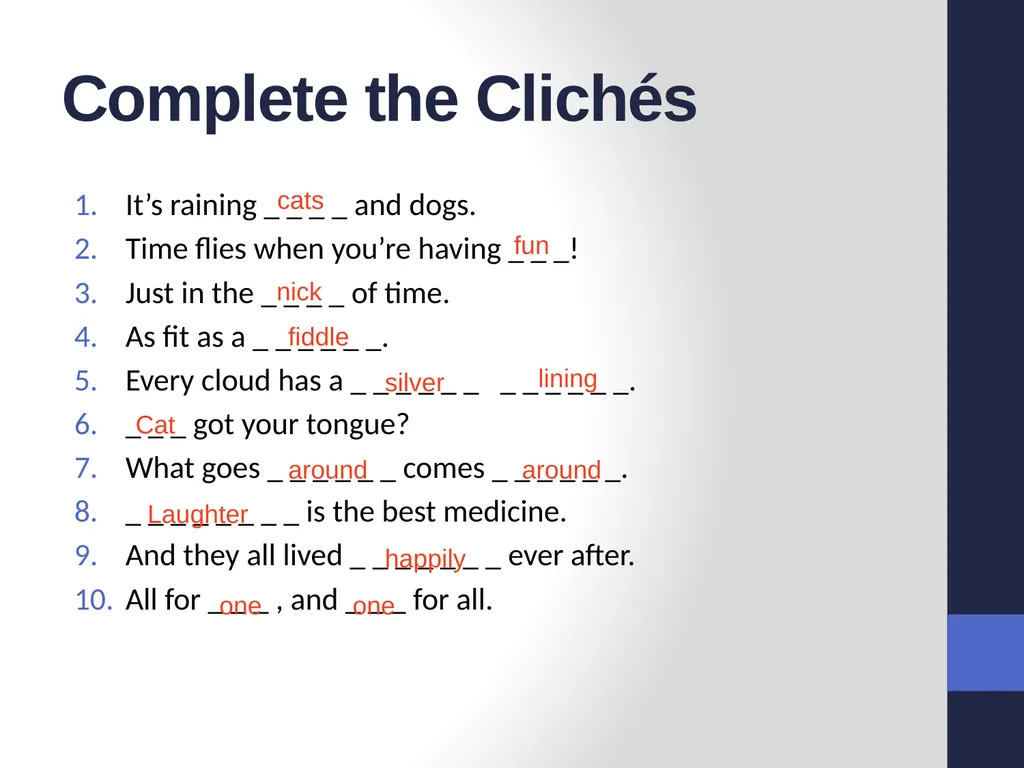
Complete the Clichés It’s raining _ _ _ _ and dogs.
Time flies when you’re having _ _ _!
Just in the _ _ _ _ of time.
As fit as a _ _ _ _ _ _.
Every cloud has a _ _ _ _ _ _ _ _ _ _ _ _.
_ _ _ got your tongue?
What goes _ _ _ _ _ _ comes _ _ _ _ _ _.
_ _ _ _ _ _ _ _ is the best medicine.
And they all lived _ _ _ _ _ _ _ ever after.
All for _ _ _ , and _ _ _ for all. cats fun nick fiddle silver lining Cat around around Laughter happily one one<br>
03
What do you think Cliché Kid means?<br>
04
Cliché – a phrase or opinion that is overused and betrays a lack of original thought.
or
A stereotype or electrotype (copy of something)
Kid- A colloquial term for a child or young person Once we read the poem through we can explore whether or not the title of the poem relates.<br>
05
Summary and Analysis The style of The Cliché Kid is light-hearted, in contrast to the emotional depressing memories described.
The poem is written using the persona of a male psychoanalysis patient addressing his doctor.
The persona appears to struggle to come to terms with his suppressed homosexual feelings, which are in conflict with society’s ideal of masculinity.
Psychoanalysis is a process by which people talk about forgotten events, often from childhood, in order to come to terms with them.<br>
06
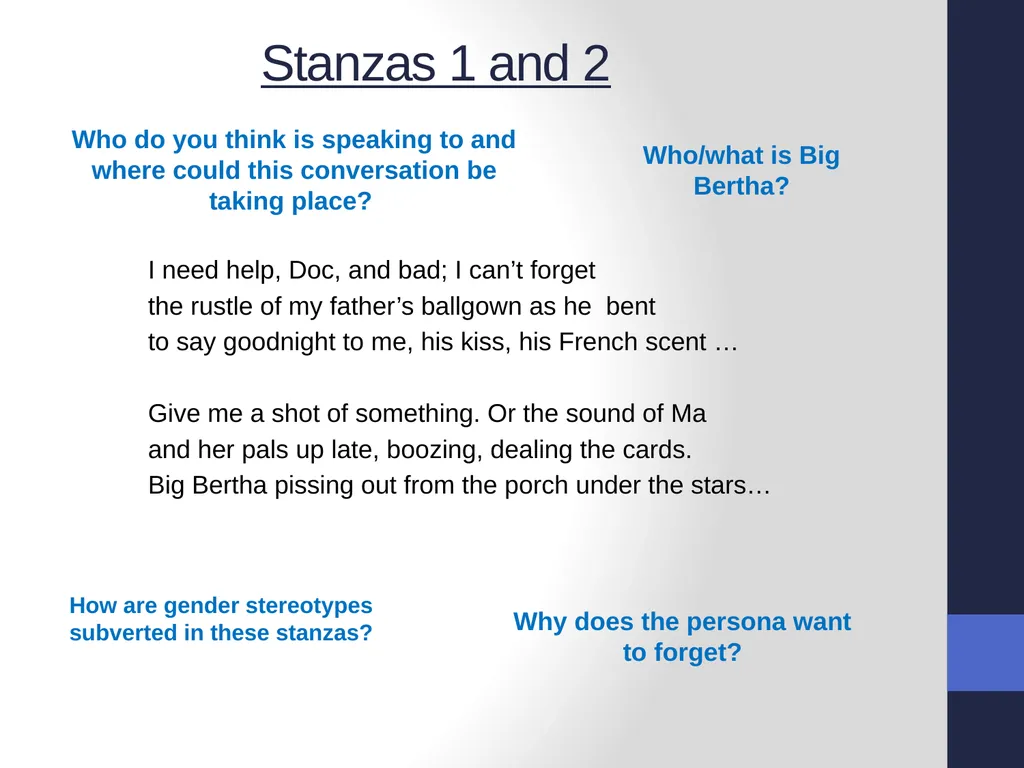
Stanzas 1 and 2 I need help, Doc, and bad; I can’t forget
the rustle of my father’s ballgown as he bent
to say goodnight to me, his kiss, his French scent …
Give me a shot of something. Or the sound of Ma
and her pals up late, boozing, dealing the cards.
Big Bertha pissing out from the porch under the stars… How are gender stereotypes subverted in these stanzas? Who do you think is speaking to and where could this conversation be taking place? Why does the persona want to forget? Who/what is Big Bertha?<br>
07
Stanzas 1 and 2 I need help, Doc, and bad; I can’t forget
the rustle of my father’s ballgown as he bent
to say goodnight to me, his kiss, his French scent …
Give me a shot of something. Or the sound of Ma
and her pals up late, boozing, dealing the cards.
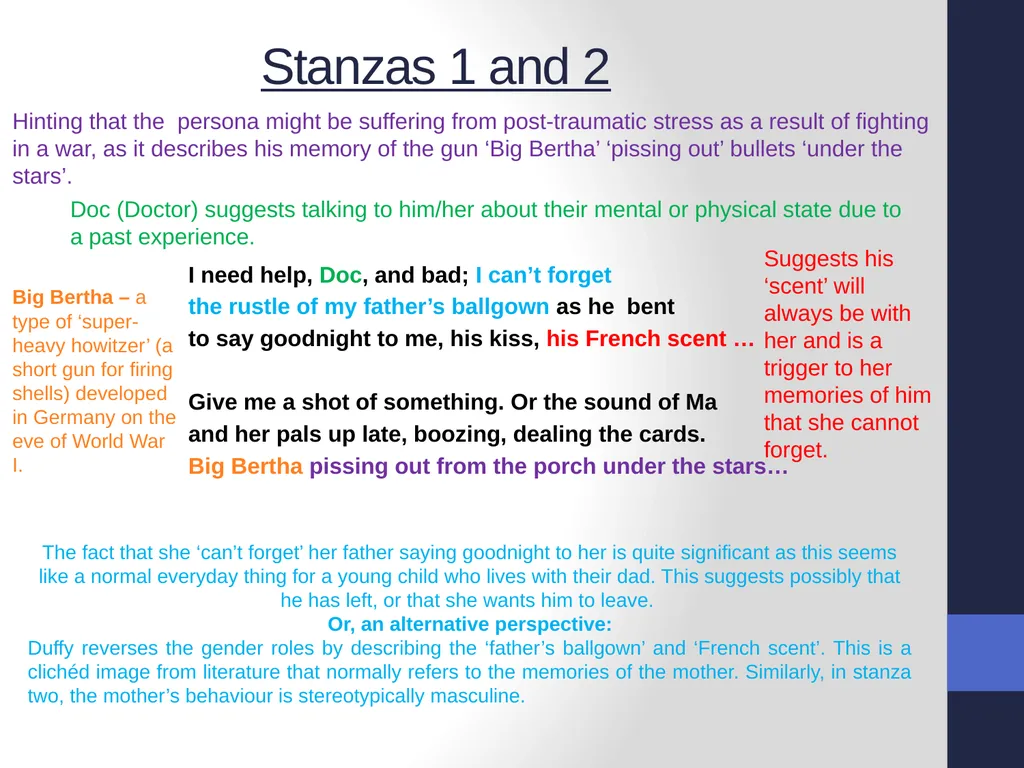
Big Bertha pissing out from the porch under the stars… Doc (Doctor) suggests talking to him/her about their mental or physical state due to a past experience. The fact that she ‘can’t forget’ her father saying goodnight to her is quite significant as this seems like a normal everyday thing for a young child who lives with their dad. This suggests possibly that he has left, or that she wants him to leave.
Or, an alternative perspective:
Duffy reverses the gender roles by describing the ‘father’s ballgown’ and ‘French scent’. This is a clichéd image from literature that normally refers to the memories of the mother. Similarly, in stanza two, the mother’s behaviour is stereotypically masculine. Suggests his ‘scent’ will always be with her and is a trigger to her memories of him that she cannot forget. Big Bertha – a type of ‘super-heavy howitzer’ (a short gun for firing shells) developed in Germany on the eve of World War I. Hinting that the persona might be suffering from post-traumatic stress as a result of fighting in a war, as it describes his memory of the gun ‘Big Bertha’ ‘pissing out’ bullets ‘under the stars’.<br>
08
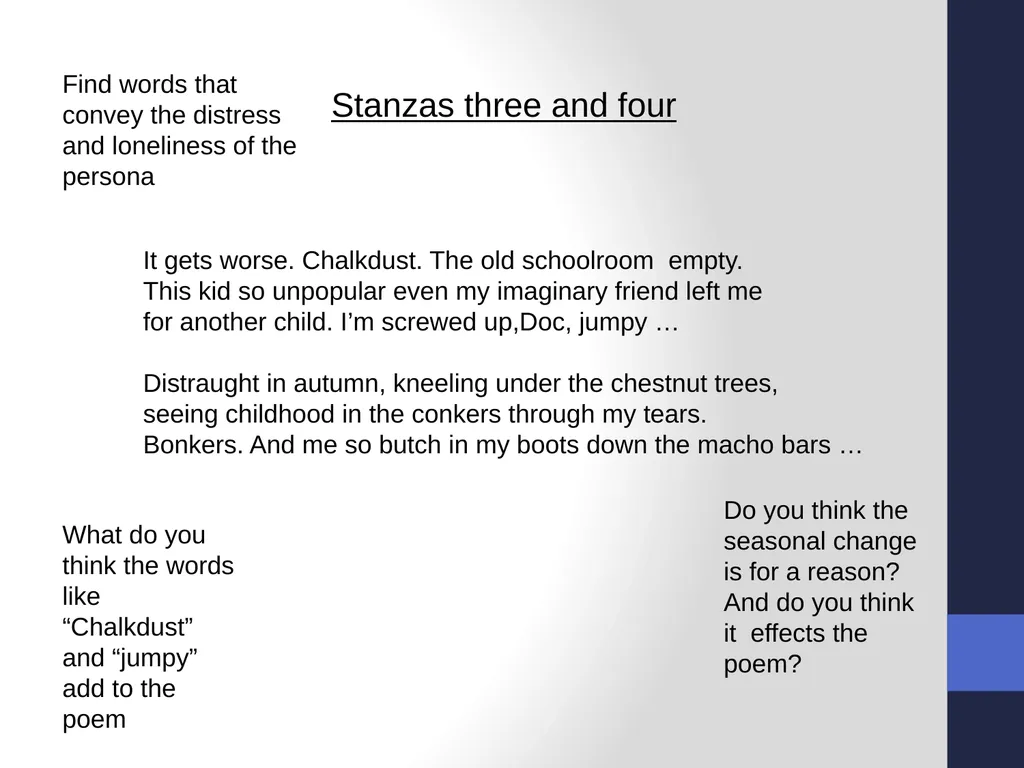
Stanzas three and four It gets worse. Chalkdust. The old schoolroom empty.
This kid so unpopular even my imaginary friend left me
for another child. I’m screwed up,Doc, jumpy …
Distraught in autumn, kneeling under the chestnut trees,
seeing childhood in the conkers through my tears.
Bonkers. And me so butch in my boots down the macho bars … Find words that convey the distress and loneliness of the persona Do you think the seasonal change is for a reason? And do you think it effects the poem? What do you think the words like “Chalkdust” and “jumpy” add to the poem<br>
09
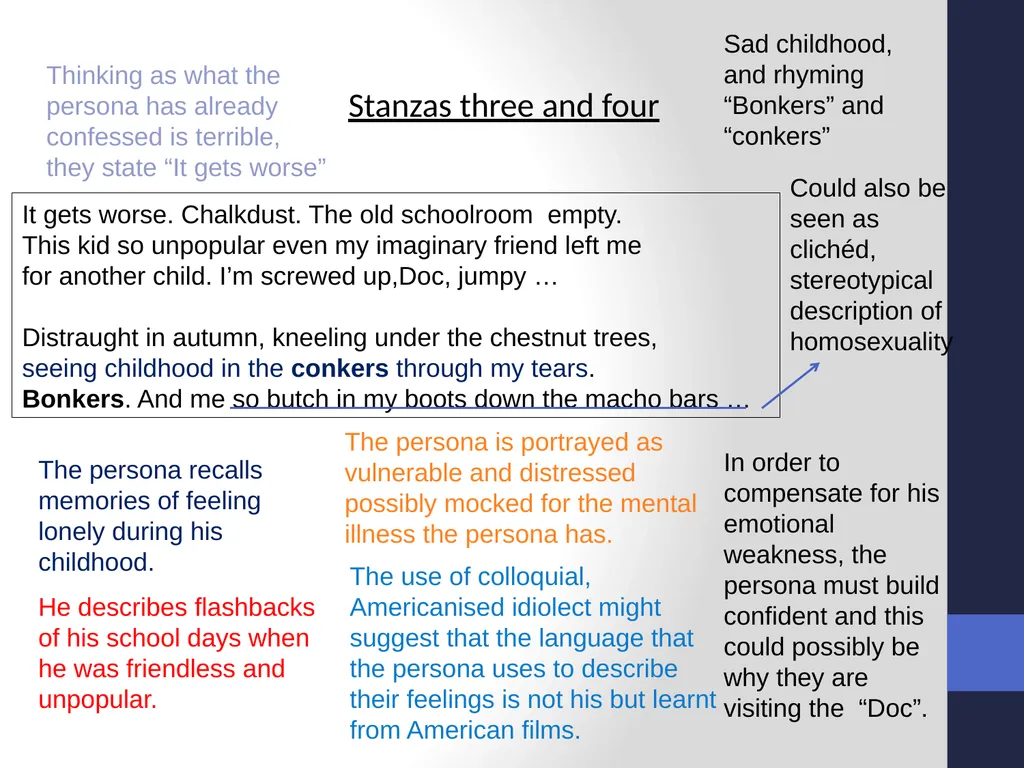
Stanzas three and four The persona recalls memories of feeling lonely during his childhood. He describes flashbacks of his school days when he was friendless and unpopular. The use of colloquial, Americanised idiolect might suggest that the language that the persona uses to describe their feelings is not his but learnt from American films. The persona is portrayed as vulnerable and distressed possibly mocked for the mental illness the persona has. In order to compensate for his emotional weakness, the persona must build confident and this could possibly be why they are visiting the “Doc”. Thinking as what the persona has already confessed is terrible, they state “It gets worse” Sad childhood, and rhyming “Bonkers” and “conkers”<br>
10
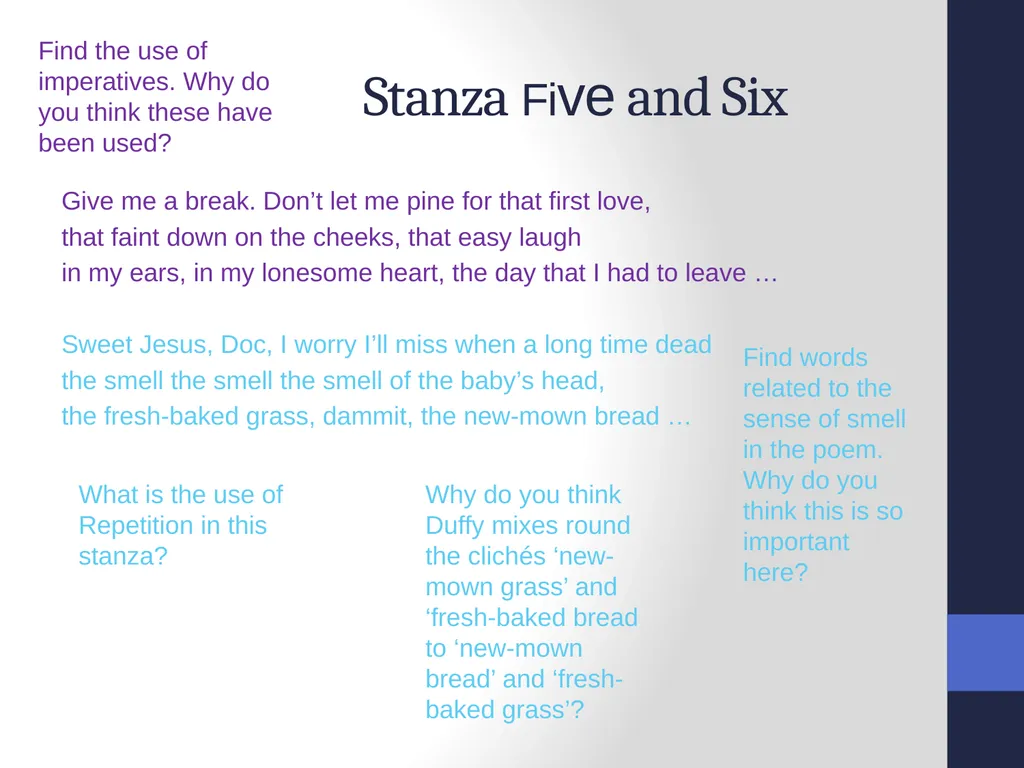
Stanza Five and Six Give me a break. Don’t let me pine for that first love,
that faint down on the cheeks, that easy laugh
in my ears, in my lonesome heart, the day that I had to leave …
Sweet Jesus, Doc, I worry I’ll miss when a long time dead
the smell the smell the smell of the baby’s head,
the fresh-baked grass, dammit, the new-mown bread … Find the use of imperatives. Why do you think these have been used? What is the use of Repetition in this stanza? Find words related to the sense of smell in the poem. Why do you think this is so important here? Why do you think Duffy mixes round the clichés ‘new-mown grass’ and ‘fresh-baked bread to ‘new-mown bread’ and ‘fresh-baked grass’?<br>
11
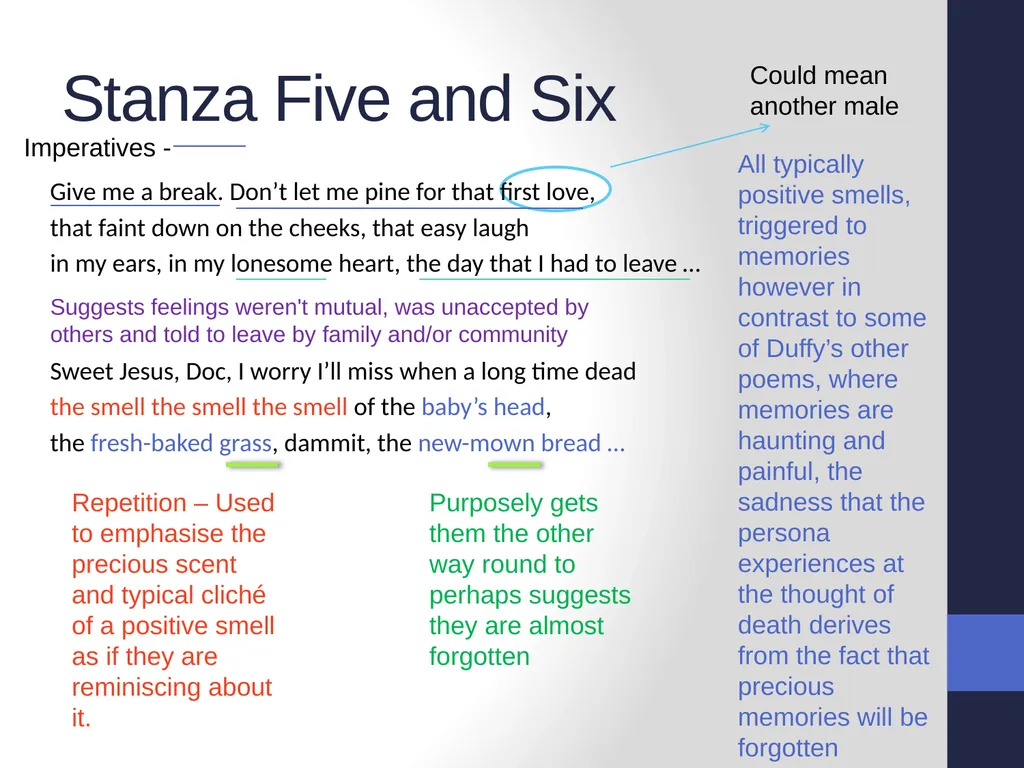
Stanza Five and Six Give me a break. Don’t let me pine for that first love,
that faint down on the cheeks, that easy laugh
in my ears, in my lonesome heart, the day that I had to leave …
Sweet Jesus, Doc, I worry I’ll miss when a long time dead
the smell the smell the smell of the baby’s head,
the fresh-baked grass, dammit, the new-mown bread … Imperatives - Repetition – Used to emphasise the precious scent and typical cliché of a positive smell as if they are reminiscing about it. All typically positive smells, triggered to memories however in contrast to some of Duffy’s other poems, where memories are haunting and painful, the sadness that the persona experiences at the thought of death derives from the fact that precious memories will be forgotten Purposely gets them the other way round to perhaps suggests they are almost forgotten Could mean another male Suggests feelings weren't mutual, was unaccepted by others and told to leave by family and/or community<br>
12
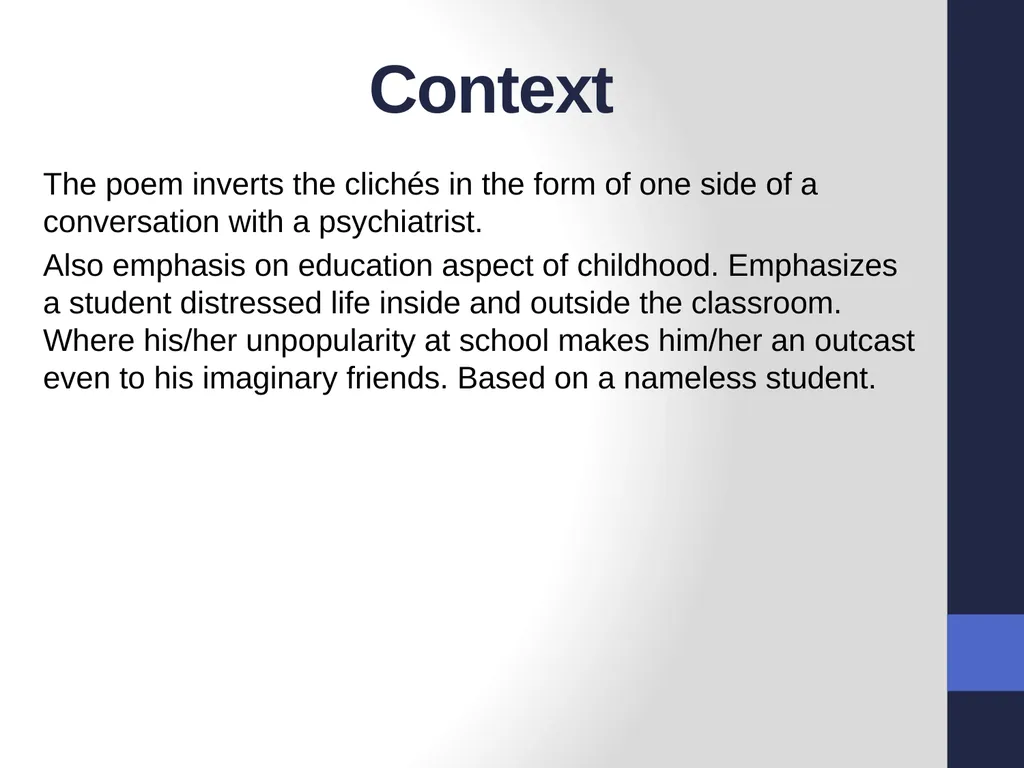
Context The poem inverts the clichés in the form of one side of a conversation with a psychiatrist.
Also emphasis on education aspect of childhood. Emphasizes a student distressed life inside and outside the classroom. Where his/her unpopularity at school makes him/her an outcast even to his imaginary friends. Based on a nameless student.<br>