The Commonwealth Fund 2012 International Health
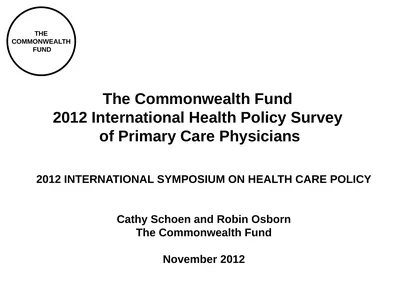
Description: The Commonwealth Fund 2012 International Health Policy Survey of Primary Care Physicians 2012 INTERNATIONAL Symposium ON HEALTH CARE POLICY Cathy Schoen and Robin Osborn The Commonwealth Fund November 2012 2012 Commonwealth Fund
Related Topics
Download Presentation
"The Commonwealth Fund 2012 International Health" is the property of its rightful owner. Permission is granted to download and print the materials on this website for personal, non-commercial use only, and to display it on your personal computer provided you do not modify the materials and that you retain all copyright notices contained in the materials. By downloading content from our website, you accept the terms of this agreement.
Presentation Transcript
slide1. The Commonwealth Fund 2012 International Health Policy Survey of Primary Care Physicians 2012 INTERNATIONAL Symposium ON HEALTH CARE POLICY
Cathy Schoen and Robin Osborn
The Commonwealth Fund
November 2012<br>
slide2. 2012 Commonwealth Fund International Health Policy Survey 2 Mail and phone survey of primary care physicians in Australia, Canada, France, Germany, Netherlands, New Zealand, Norway, Sweden, Switzerland, United Kingdom, and United States
Samples: Australia (500), Canada (2,124), France (501), Germany (909), Netherlands (522), New Zealand (500), Norway (869), Sweden (1,314), Switzerland (1,025), United Kingdom (500), and United States (1,012)
Survey in the field March to July 2012
Conducted by Harris Interactive and country contractors
Core topics: Health information technology; access; care coordination; financial incentives for quality improvement; assessment and feedback of practice performance; system views and physician satisfaction<br>
slide3. 3 Health Information Technology<br>
slide4. 4 Source: 2009 and 2012 Commonwealth Fund International Health Policy Survey of Primary Care Physicians. Percent Doctors’ Use of Electronic Medical Recordsin Their Practice, 2009 and 2012<br>
slide5. 5 Note: Multifunctional health IT capacity—uses electronic medical record and at least two electronic functions: for order entry management, generating patient information, generating panel information, and routine clinical decision support. Percent Doctors with Electronic Medical Records and Multifunctional Health IT Capacity Source: 2012 Commonwealth Fund International Health Policy Survey of Primary Care Physicians.<br>
slide6. 6 Percent Doctor Routinely Receives Electronic Prompts About Potential Problems with Rx Dose or Interaction Source: 2012 Commonwealth Fund International Health Policy Survey of Primary Care Physicians.<br>
slide7. 7 Percent Doctor Can Electronically Exchange Patient Summaries and Test Results with Doctors Outside their Practice Source: 2012 Commonwealth Fund International Health Policy Survey of Primary Care Physicians.<br>
slide8. 8 Access and Barriers to Care<br>
slide9. 9 Doctors’ Perception of Patient Access Barriers Source: 2012 Commonwealth Fund International Health Policy Survey of Primary Care Physicians.<br>
slide10. 10 Percent Practice Has Arrangement for Patients’ After-Hours Care to See Doctor or Nurse * In Norway, respondents were asked whether there practice has arrangements or if there are regional arrangements. Source: 2012 Commonwealth Fund International Health Policy Survey of Primary Care Physicians.<br>
slide11. 11 Percent of doctors responding almost all patients (>80%) can get a same- or next-day appointment when one is requested Almost All Patients Can Get Same- or Next-Day Appointment Source: 2012 Commonwealth Fund International Health Policy Survey of Primary Care Physicians.<br>
slide12. 12 Electronic Access for Patients Source: 2012 Commonwealth Fund International Health Policy Survey of Primary Care Physicians.<br>
slide13. 13 Care Coordination<br>
slide14. 14 Percent Practice Uses Nurse Case Managers or Navigators for Patients with Serious Chronic Conditions Note: Question asked differently in France. Source: 2012 Commonwealth Fund International Health Policy Survey of Primary Care Physicians.<br>
slide15. 15 Primary Care Doctors’ Receipt of Information from Specialists Source: 2012 Commonwealth Fund International Health Policy Survey of Primary Care Physicians.<br>
slide16. 16 Percent After Hospital Discharge, Primary Care Doctor Receives Needed Information to Manage the Patient Within 48 Hours Source: 2012 Commonwealth Fund International Health Policy Survey of Primary Care Physicians.<br>
slide17. 17 Financial Incentives or Supportfor Quality Improvement<br>
slide18. 18 Financial Incentives and Targeted Support * Including special payments, higher fees, or reimbursements.
** Including patient counseling or group visits. Source: 2012 Commonwealth Fund International Health Policy Survey of Primary Care Physicians.<br>
slide19. 19 Assessment and Feedback of Practice Performance<br>
slide20. 20 Practice Routinely Receives and Reviews Data on Patient Care Source: 2012 Commonwealth Fund International Health Policy Survey of Primary Care Physicians.<br>
slide21. 21 Percent Doctor Reviews Clinical Performance Against Targets at Least Annually Source: 2012 Commonwealth Fund International Health Policy Survey of Primary Care Physicians.<br>
slide22. 22 Percent Doctor Routinely Receives Data Comparing Practice’s Clinical Performance to Other Practices Source: 2012 Commonwealth Fund International Health Policy Survey of Primary Care Physicians.<br>
slide23. 23 Practice Routinely Receives and Reviews Data on Resource Use Source: 2012 Commonwealth Fund International Health Policy Survey of Primary Care Physicians.<br>
slide24. 24 System Views and Physician Satisfaction<br>
slide25. 25 Percent Physician Views of the Health System, 2009 and 2012:“System Works Well, Only Minor Changes Needed” Source: 2012 Commonwealth Fund International Health Policy Survey of Primary Care Physicians.<br>
slide26. 26 Physician Views of Whether the Quality of Care in the Health Care System Has Improved in the Past Three Years, 2012 Source: 2012 Commonwealth Fund International Health Policy Survey of Primary Care Physicians.<br>
slide27. 27 Insurance Restrictions on Medication or Treatment for Patients Pose Major Time Concerns for Doctors Percent saying amount of time physician or staff spend getting patients needed medications or treatment because of coverage restrictions is a MAJOR PROBLEM Source: 2012 Commonwealth Fund International Health Policy Survey of Primary Care Physicians.<br>
slide28. 28 Percent Physician Satisfaction with Practicing Medicine Source: 2012 Commonwealth Fund International Health Policy Survey of Primary Care Physicians.<br>
slide29. 29 Dissatisfaction with Income and Time with Patients Source: 2012 Commonwealth Fund International Health Policy Survey of Primary Care Physicians.<br>
slide30. 30 U.S. Primary Care Reports, by Practice Size<br>
slide31. U.S. Primary Care Doctors: Access, Information Capacity, and Administrative Burden by Practice Size 31 Percent Source: 2012 Commonwealth Fund International Health Policy Survey of Primary Care Physicians.<br>
slide32. Cross-Cutting Themes and Implications 32 National policies make a difference for primary care practices
Insurance design
Support for practice infrastructure and information feedback
Health IT is spreading, but differentially across countries
Information exchange and alerts slowest to spread
Feedback on performance is not yet routine in any country
Opportunities to learn within and across countries
Access varies widely: after hours, waits, and cost barriers
New technology and shared after-hour services enable multiple points of access
Opportunities to learn as these evolve
Gaps in communication across sites of care in all countries undermines care coordination and integration
Primary care workforce with expanded team-work, including nurses, key to a high performing health system<br>
slide33. 33 33 Acknowledgments and Cofunders Canada: Health Council of Canada, Health Quality Ontario, Quebec Health Commission, Health Quality Council of Alberta, Canada Health Infoway
France: Haute Authorité de Santé (HAS), Caisse Nationale de l’Assurance Maladie des Travailleurs Salariés (CNAMTS)
Germany: Federal Ministry of Health, German National Institute for Quality Measurement in Health Care
Netherlands: Dutch Ministry of Health, Welfare and Sport, and Scientific Institute for Quality of Healthcare, Radboud University Nijmegen
Norway: Norwegian Knowledge Centre for the Health Services
Sweden: Swedish Ministry of Health and Social Affairs
Switzerland: Federal Office of Public Health, Swiss Medical Association Thanks to coauthors David Squires, Michelle M. Doty, Petra Rasmussen, Roz Pierson, and Sandra Applebaum, and to Harris Interactive, Inc., and contractors for conducting the survey. Published in Health Affairs as: “A Survey of Primary Care Doctors in Ten Countries Shows Progress in Use of Health Information Technology, Less in Other Areas,” Web First, Nov. 15, 2012.<br>
Cathy Schoen and Robin Osborn
The Commonwealth Fund
November 2012<br>
slide2. 2012 Commonwealth Fund International Health Policy Survey 2 Mail and phone survey of primary care physicians in Australia, Canada, France, Germany, Netherlands, New Zealand, Norway, Sweden, Switzerland, United Kingdom, and United States
Samples: Australia (500), Canada (2,124), France (501), Germany (909), Netherlands (522), New Zealand (500), Norway (869), Sweden (1,314), Switzerland (1,025), United Kingdom (500), and United States (1,012)
Survey in the field March to July 2012
Conducted by Harris Interactive and country contractors
Core topics: Health information technology; access; care coordination; financial incentives for quality improvement; assessment and feedback of practice performance; system views and physician satisfaction<br>
slide3. 3 Health Information Technology<br>
slide4. 4 Source: 2009 and 2012 Commonwealth Fund International Health Policy Survey of Primary Care Physicians. Percent Doctors’ Use of Electronic Medical Recordsin Their Practice, 2009 and 2012<br>
slide5. 5 Note: Multifunctional health IT capacity—uses electronic medical record and at least two electronic functions: for order entry management, generating patient information, generating panel information, and routine clinical decision support. Percent Doctors with Electronic Medical Records and Multifunctional Health IT Capacity Source: 2012 Commonwealth Fund International Health Policy Survey of Primary Care Physicians.<br>
slide6. 6 Percent Doctor Routinely Receives Electronic Prompts About Potential Problems with Rx Dose or Interaction Source: 2012 Commonwealth Fund International Health Policy Survey of Primary Care Physicians.<br>
slide7. 7 Percent Doctor Can Electronically Exchange Patient Summaries and Test Results with Doctors Outside their Practice Source: 2012 Commonwealth Fund International Health Policy Survey of Primary Care Physicians.<br>
slide8. 8 Access and Barriers to Care<br>
slide9. 9 Doctors’ Perception of Patient Access Barriers Source: 2012 Commonwealth Fund International Health Policy Survey of Primary Care Physicians.<br>
slide10. 10 Percent Practice Has Arrangement for Patients’ After-Hours Care to See Doctor or Nurse * In Norway, respondents were asked whether there practice has arrangements or if there are regional arrangements. Source: 2012 Commonwealth Fund International Health Policy Survey of Primary Care Physicians.<br>
slide11. 11 Percent of doctors responding almost all patients (>80%) can get a same- or next-day appointment when one is requested Almost All Patients Can Get Same- or Next-Day Appointment Source: 2012 Commonwealth Fund International Health Policy Survey of Primary Care Physicians.<br>
slide12. 12 Electronic Access for Patients Source: 2012 Commonwealth Fund International Health Policy Survey of Primary Care Physicians.<br>
slide13. 13 Care Coordination<br>
slide14. 14 Percent Practice Uses Nurse Case Managers or Navigators for Patients with Serious Chronic Conditions Note: Question asked differently in France. Source: 2012 Commonwealth Fund International Health Policy Survey of Primary Care Physicians.<br>
slide15. 15 Primary Care Doctors’ Receipt of Information from Specialists Source: 2012 Commonwealth Fund International Health Policy Survey of Primary Care Physicians.<br>
slide16. 16 Percent After Hospital Discharge, Primary Care Doctor Receives Needed Information to Manage the Patient Within 48 Hours Source: 2012 Commonwealth Fund International Health Policy Survey of Primary Care Physicians.<br>
slide17. 17 Financial Incentives or Supportfor Quality Improvement<br>
slide18. 18 Financial Incentives and Targeted Support * Including special payments, higher fees, or reimbursements.
** Including patient counseling or group visits. Source: 2012 Commonwealth Fund International Health Policy Survey of Primary Care Physicians.<br>
slide19. 19 Assessment and Feedback of Practice Performance<br>
slide20. 20 Practice Routinely Receives and Reviews Data on Patient Care Source: 2012 Commonwealth Fund International Health Policy Survey of Primary Care Physicians.<br>
slide21. 21 Percent Doctor Reviews Clinical Performance Against Targets at Least Annually Source: 2012 Commonwealth Fund International Health Policy Survey of Primary Care Physicians.<br>
slide22. 22 Percent Doctor Routinely Receives Data Comparing Practice’s Clinical Performance to Other Practices Source: 2012 Commonwealth Fund International Health Policy Survey of Primary Care Physicians.<br>
slide23. 23 Practice Routinely Receives and Reviews Data on Resource Use Source: 2012 Commonwealth Fund International Health Policy Survey of Primary Care Physicians.<br>
slide24. 24 System Views and Physician Satisfaction<br>
slide25. 25 Percent Physician Views of the Health System, 2009 and 2012:“System Works Well, Only Minor Changes Needed” Source: 2012 Commonwealth Fund International Health Policy Survey of Primary Care Physicians.<br>
slide26. 26 Physician Views of Whether the Quality of Care in the Health Care System Has Improved in the Past Three Years, 2012 Source: 2012 Commonwealth Fund International Health Policy Survey of Primary Care Physicians.<br>
slide27. 27 Insurance Restrictions on Medication or Treatment for Patients Pose Major Time Concerns for Doctors Percent saying amount of time physician or staff spend getting patients needed medications or treatment because of coverage restrictions is a MAJOR PROBLEM Source: 2012 Commonwealth Fund International Health Policy Survey of Primary Care Physicians.<br>
slide28. 28 Percent Physician Satisfaction with Practicing Medicine Source: 2012 Commonwealth Fund International Health Policy Survey of Primary Care Physicians.<br>
slide29. 29 Dissatisfaction with Income and Time with Patients Source: 2012 Commonwealth Fund International Health Policy Survey of Primary Care Physicians.<br>
slide30. 30 U.S. Primary Care Reports, by Practice Size<br>
slide31. U.S. Primary Care Doctors: Access, Information Capacity, and Administrative Burden by Practice Size 31 Percent Source: 2012 Commonwealth Fund International Health Policy Survey of Primary Care Physicians.<br>
slide32. Cross-Cutting Themes and Implications 32 National policies make a difference for primary care practices
Insurance design
Support for practice infrastructure and information feedback
Health IT is spreading, but differentially across countries
Information exchange and alerts slowest to spread
Feedback on performance is not yet routine in any country
Opportunities to learn within and across countries
Access varies widely: after hours, waits, and cost barriers
New technology and shared after-hour services enable multiple points of access
Opportunities to learn as these evolve
Gaps in communication across sites of care in all countries undermines care coordination and integration
Primary care workforce with expanded team-work, including nurses, key to a high performing health system<br>
slide33. 33 33 Acknowledgments and Cofunders Canada: Health Council of Canada, Health Quality Ontario, Quebec Health Commission, Health Quality Council of Alberta, Canada Health Infoway
France: Haute Authorité de Santé (HAS), Caisse Nationale de l’Assurance Maladie des Travailleurs Salariés (CNAMTS)
Germany: Federal Ministry of Health, German National Institute for Quality Measurement in Health Care
Netherlands: Dutch Ministry of Health, Welfare and Sport, and Scientific Institute for Quality of Healthcare, Radboud University Nijmegen
Norway: Norwegian Knowledge Centre for the Health Services
Sweden: Swedish Ministry of Health and Social Affairs
Switzerland: Federal Office of Public Health, Swiss Medical Association Thanks to coauthors David Squires, Michelle M. Doty, Petra Rasmussen, Roz Pierson, and Sandra Applebaum, and to Harris Interactive, Inc., and contractors for conducting the survey. Published in Health Affairs as: “A Survey of Primary Care Doctors in Ten Countries Shows Progress in Use of Health Information Technology, Less in Other Areas,” Web First, Nov. 15, 2012.<br>