
The conversion of polytechnics to technical
NS
Published · 20 slides · 0 views
1 / 1
Description
The conversion of polytechnics to technical universities in Ghana George Afeti Former Principal, Ho Polytechnic Former Secretary General, Association of Technical Universities and Polytechnics in Africa Skills Development Advisor, Skills
Related Topics
Share
Embed code
Download this presentation From Below
"The conversion of polytechnics to technical" is the property of its rightful owner. Permission is granted to download and print the materials on this website for personal, non-commercial use only, and to display it on your personal computer provided you do not modify the materials and that you retain all copyright notices contained in the materials. By downloading content from our website, you accept the terms of this agreement.
Presentation Transcript
01
The conversion of polytechnics to technical universities in Ghana George Afeti
Former Principal, Ho Polytechnic
Former Secretary General, Association of Technical Universities and Polytechnics in Africa
Skills Development Advisor, Skills Initiative For Africa – SIFA
Chairman of Council, EP University College, Ho<br>
Former Principal, Ho Polytechnic
Former Secretary General, Association of Technical Universities and Polytechnics in Africa
Skills Development Advisor, Skills Initiative For Africa – SIFA
Chairman of Council, EP University College, Ho<br>
02
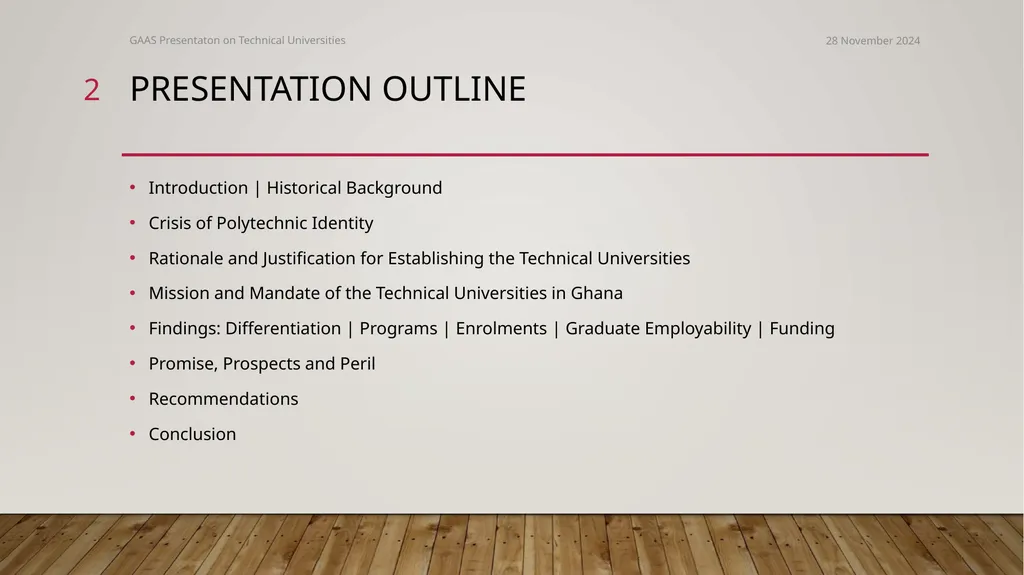
Presentation outline Introduction | Historical Background
Crisis of Polytechnic Identity
Rationale and Justification for Establishing the Technical Universities
Mission and Mandate of the Technical Universities in Ghana
Findings: Differentiation | Programs | Enrolments | Graduate Employability | Funding
Promise, Prospects and Peril
Recommendations
Conclusion 28 November 2024 GAAS Presentaton on Technical Universities 2<br>
Crisis of Polytechnic Identity
Rationale and Justification for Establishing the Technical Universities
Mission and Mandate of the Technical Universities in Ghana
Findings: Differentiation | Programs | Enrolments | Graduate Employability | Funding
Promise, Prospects and Peril
Recommendations
Conclusion 28 November 2024 GAAS Presentaton on Technical Universities 2<br>
03
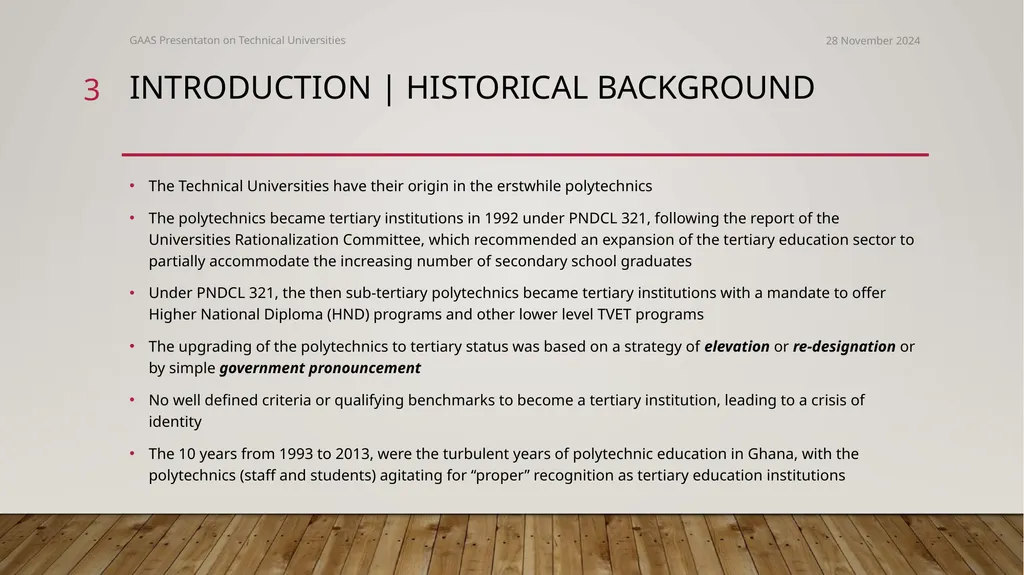
Introduction | historical background The Technical Universities have their origin in the erstwhile polytechnics
The polytechnics became tertiary institutions in 1992 under PNDCL 321, following the report of the Universities Rationalization Committee, which recommended an expansion of the tertiary education sector to partially accommodate the increasing number of secondary school graduates
Under PNDCL 321, the then sub-tertiary polytechnics became tertiary institutions with a mandate to offer Higher National Diploma (HND) programs and other lower level TVET programs
The upgrading of the polytechnics to tertiary status was based on a strategy of elevation or re-designation or by simple government pronouncement
No well defined criteria or qualifying benchmarks to become a tertiary institution, leading to a crisis of identity
The 10 years from 1993 to 2013, were the turbulent years of polytechnic education in Ghana, with the polytechnics (staff and students) agitating for “proper” recognition as tertiary education institutions 28 November 2024 GAAS Presentaton on Technical Universities 3<br>
The polytechnics became tertiary institutions in 1992 under PNDCL 321, following the report of the Universities Rationalization Committee, which recommended an expansion of the tertiary education sector to partially accommodate the increasing number of secondary school graduates
Under PNDCL 321, the then sub-tertiary polytechnics became tertiary institutions with a mandate to offer Higher National Diploma (HND) programs and other lower level TVET programs
The upgrading of the polytechnics to tertiary status was based on a strategy of elevation or re-designation or by simple government pronouncement
No well defined criteria or qualifying benchmarks to become a tertiary institution, leading to a crisis of identity
The 10 years from 1993 to 2013, were the turbulent years of polytechnic education in Ghana, with the polytechnics (staff and students) agitating for “proper” recognition as tertiary education institutions 28 November 2024 GAAS Presentaton on Technical Universities 3<br>
04
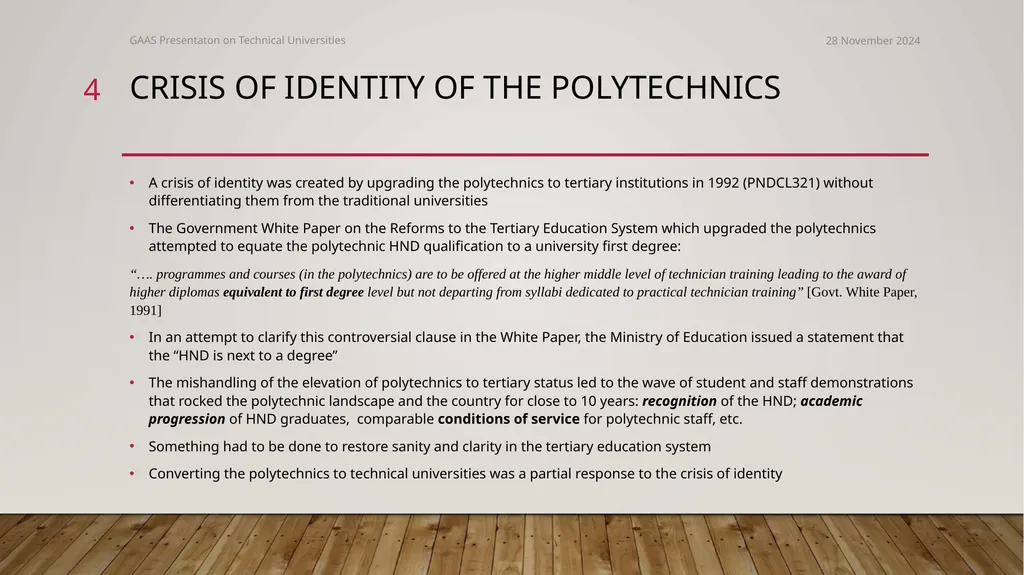
Crisis of identity of the polytechnics A crisis of identity was created by upgrading the polytechnics to tertiary institutions in 1992 (PNDCL321) without differentiating them from the traditional universities
The Government White Paper on the Reforms to the Tertiary Education System which upgraded the polytechnics attempted to equate the polytechnic HND qualification to a university first degree:
“…. programmes and courses (in the polytechnics) are to be offered at the higher middle level of technician training leading to the award of higher diplomas equivalent to first degree level but not departing from syllabi dedicated to practical technician training” [Govt. White Paper, 1991]
In an attempt to clarify this controversial clause in the White Paper, the Ministry of Education issued a statement that the “HND is next to a degree”
The mishandling of the elevation of polytechnics to tertiary status led to the wave of student and staff demonstrations that rocked the polytechnic landscape and the country for close to 10 years: recognition of the HND; academic progression of HND graduates, comparable conditions of service for polytechnic staff, etc.
Something had to be done to restore sanity and clarity in the tertiary education system
Converting the polytechnics to technical universities was a partial response to the crisis of identity 28 November 2024 GAAS Presentaton on Technical Universities 4<br>
The Government White Paper on the Reforms to the Tertiary Education System which upgraded the polytechnics attempted to equate the polytechnic HND qualification to a university first degree:
“…. programmes and courses (in the polytechnics) are to be offered at the higher middle level of technician training leading to the award of higher diplomas equivalent to first degree level but not departing from syllabi dedicated to practical technician training” [Govt. White Paper, 1991]
In an attempt to clarify this controversial clause in the White Paper, the Ministry of Education issued a statement that the “HND is next to a degree”
The mishandling of the elevation of polytechnics to tertiary status led to the wave of student and staff demonstrations that rocked the polytechnic landscape and the country for close to 10 years: recognition of the HND; academic progression of HND graduates, comparable conditions of service for polytechnic staff, etc.
Something had to be done to restore sanity and clarity in the tertiary education system
Converting the polytechnics to technical universities was a partial response to the crisis of identity 28 November 2024 GAAS Presentaton on Technical Universities 4<br>
05
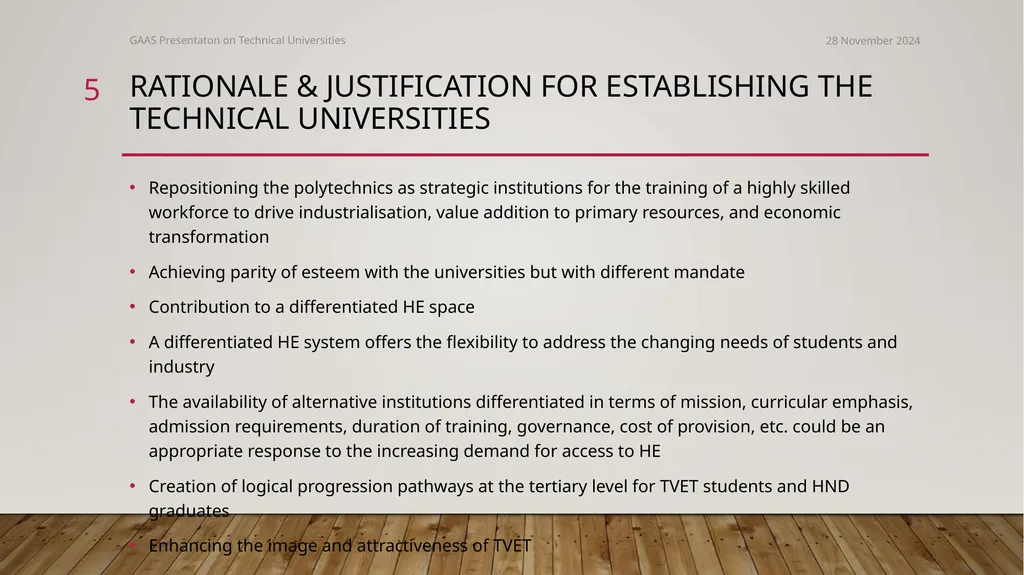
Rationale & justification for establishing the Technical universities Repositioning the polytechnics as strategic institutions for the training of a highly skilled workforce to drive industrialisation, value addition to primary resources, and economic transformation
Achieving parity of esteem with the universities but with different mandate
Contribution to a differentiated HE space
A differentiated HE system offers the flexibility to address the changing needs of students and industry
The availability of alternative institutions differentiated in terms of mission, curricular emphasis, admission requirements, duration of training, governance, cost of provision, etc. could be an appropriate response to the increasing demand for access to HE
Creation of logical progression pathways at the tertiary level for TVET students and HND graduates
Enhancing the image and attractiveness of TVET 28 November 2024 GAAS Presentaton on Technical Universities 5<br>
Achieving parity of esteem with the universities but with different mandate
Contribution to a differentiated HE space
A differentiated HE system offers the flexibility to address the changing needs of students and industry
The availability of alternative institutions differentiated in terms of mission, curricular emphasis, admission requirements, duration of training, governance, cost of provision, etc. could be an appropriate response to the increasing demand for access to HE
Creation of logical progression pathways at the tertiary level for TVET students and HND graduates
Enhancing the image and attractiveness of TVET 28 November 2024 GAAS Presentaton on Technical Universities 5<br>
06
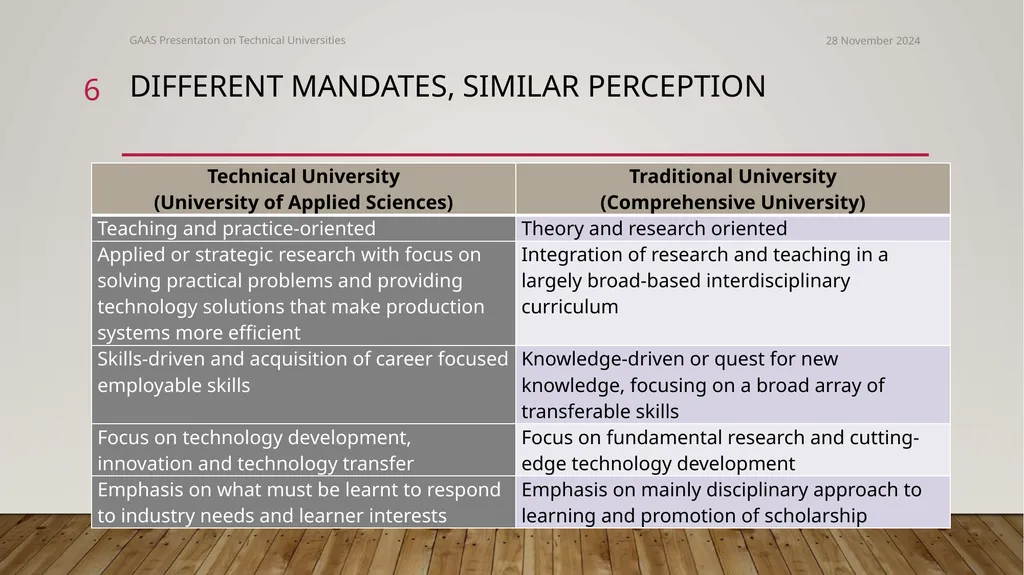
Different mandates, similar perception 28 November 2024 GAAS Presentaton on Technical Universities 6<br>
07
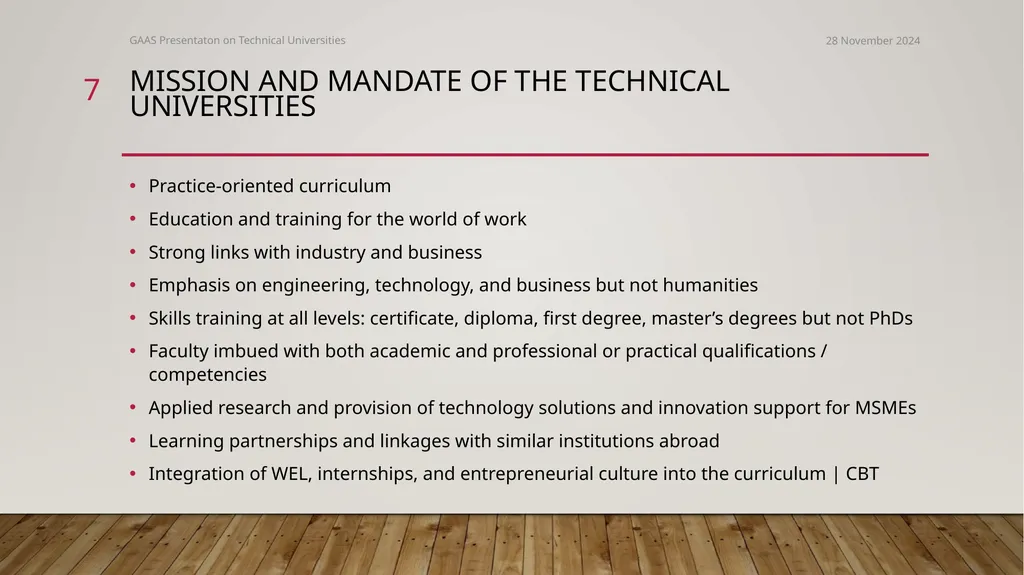
Mission and mandate of the technical universities Practice-oriented curriculum
Education and training for the world of work
Strong links with industry and business
Emphasis on engineering, technology, and business but not humanities
Skills training at all levels: certificate, diploma, first degree, master’s degrees but not PhDs
Faculty imbued with both academic and professional or practical qualifications / competencies
Applied research and provision of technology solutions and innovation support for MSMEs
Learning partnerships and linkages with similar institutions abroad
Integration of WEL, internships, and entrepreneurial culture into the curriculum | CBT 28 November 2024 GAAS Presentaton on Technical Universities 7<br>
Education and training for the world of work
Strong links with industry and business
Emphasis on engineering, technology, and business but not humanities
Skills training at all levels: certificate, diploma, first degree, master’s degrees but not PhDs
Faculty imbued with both academic and professional or practical qualifications / competencies
Applied research and provision of technology solutions and innovation support for MSMEs
Learning partnerships and linkages with similar institutions abroad
Integration of WEL, internships, and entrepreneurial culture into the curriculum | CBT 28 November 2024 GAAS Presentaton on Technical Universities 7<br>
08
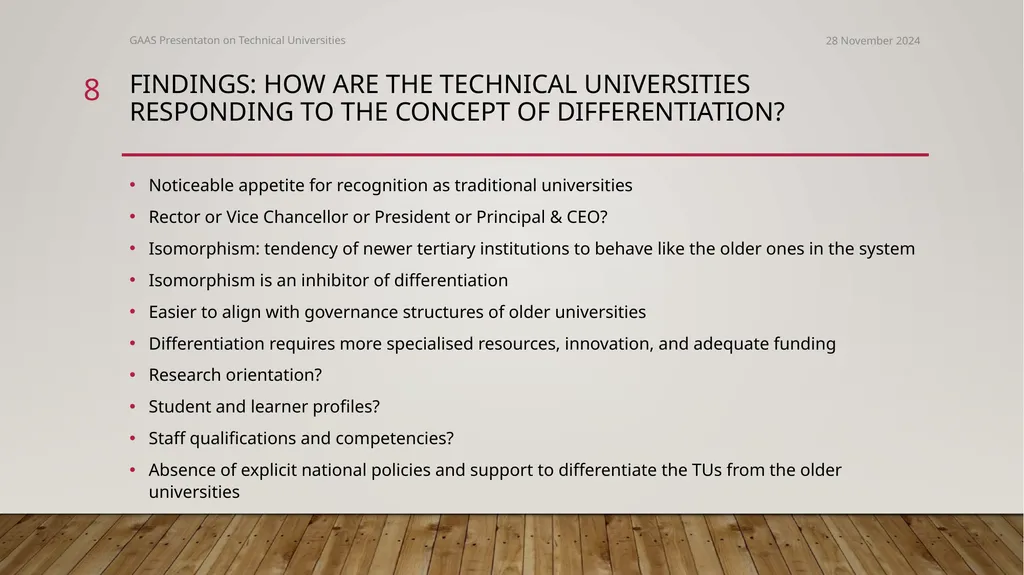
Findings: How Are the technical universities responding to the concept of differentiation? Noticeable appetite for recognition as traditional universities
Rector or Vice Chancellor or President or Principal & CEO?
Isomorphism: tendency of newer tertiary institutions to behave like the older ones in the system
Isomorphism is an inhibitor of differentiation
Easier to align with governance structures of older universities
Differentiation requires more specialised resources, innovation, and adequate funding
Research orientation?
Student and learner profiles?
Staff qualifications and competencies?
Absence of explicit national policies and support to differentiate the TUs from the older universities 28 November 2024 GAAS Presentaton on Technical Universities 8<br>
Rector or Vice Chancellor or President or Principal & CEO?
Isomorphism: tendency of newer tertiary institutions to behave like the older ones in the system
Isomorphism is an inhibitor of differentiation
Easier to align with governance structures of older universities
Differentiation requires more specialised resources, innovation, and adequate funding
Research orientation?
Student and learner profiles?
Staff qualifications and competencies?
Absence of explicit national policies and support to differentiate the TUs from the older universities 28 November 2024 GAAS Presentaton on Technical Universities 8<br>
09
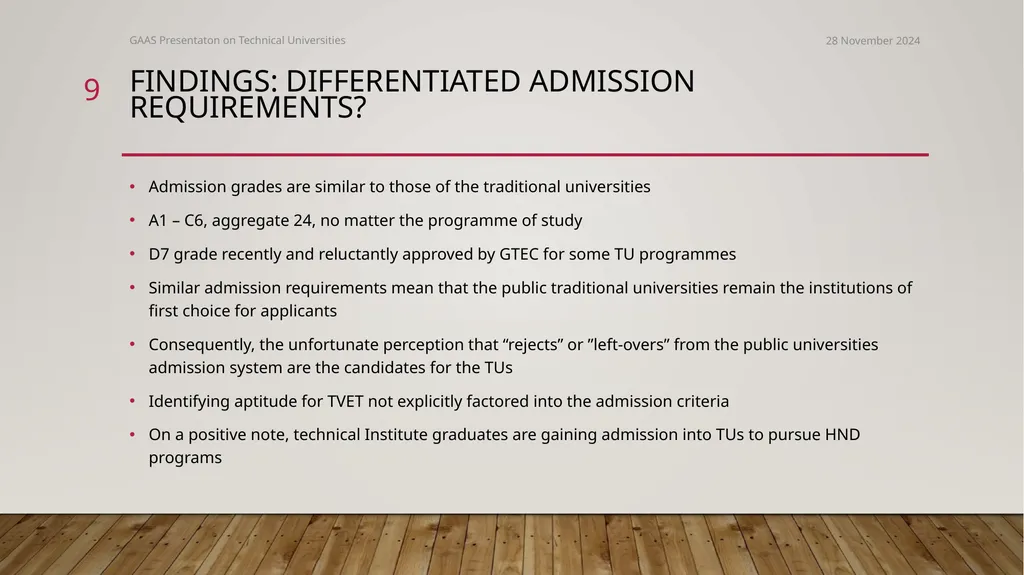
findings: Differentiated admission requirements? Admission grades are similar to those of the traditional universities
A1 – C6, aggregate 24, no matter the programme of study
D7 grade recently and reluctantly approved by GTEC for some TU programmes
Similar admission requirements mean that the public traditional universities remain the institutions of first choice for applicants
Consequently, the unfortunate perception that “rejects” or ”left-overs” from the public universities admission system are the candidates for the TUs
Identifying aptitude for TVET not explicitly factored into the admission criteria
On a positive note, technical Institute graduates are gaining admission into TUs to pursue HND programs 28 November 2024 GAAS Presentaton on Technical Universities 9<br>
A1 – C6, aggregate 24, no matter the programme of study
D7 grade recently and reluctantly approved by GTEC for some TU programmes
Similar admission requirements mean that the public traditional universities remain the institutions of first choice for applicants
Consequently, the unfortunate perception that “rejects” or ”left-overs” from the public universities admission system are the candidates for the TUs
Identifying aptitude for TVET not explicitly factored into the admission criteria
On a positive note, technical Institute graduates are gaining admission into TUs to pursue HND programs 28 November 2024 GAAS Presentaton on Technical Universities 9<br>
10
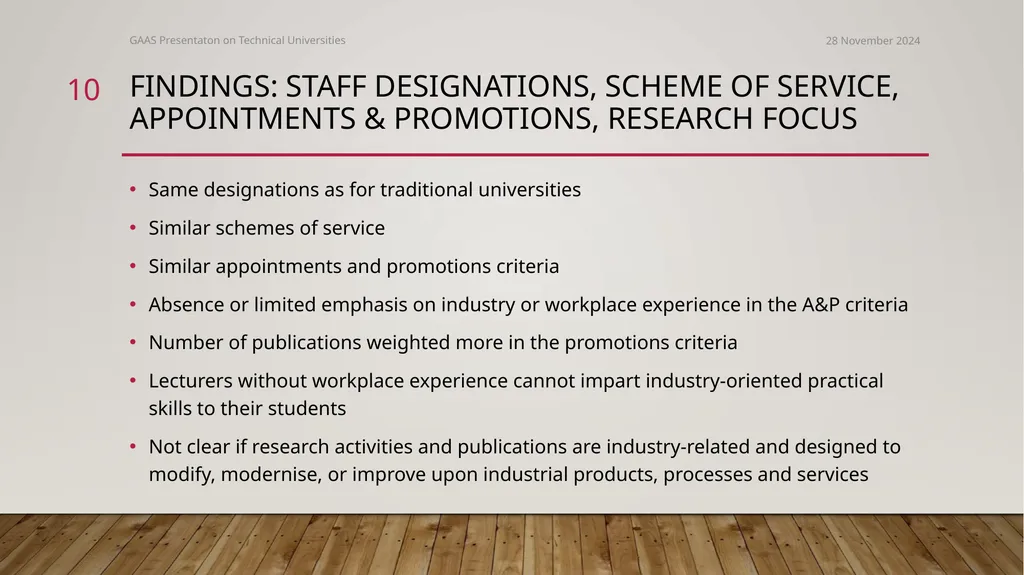
Findings: Staff Designations, scheme of service, Appointments & Promotions, research focus Same designations as for traditional universities
Similar schemes of service
Similar appointments and promotions criteria
Absence or limited emphasis on industry or workplace experience in the A&P criteria
Number of publications weighted more in the promotions criteria
Lecturers without workplace experience cannot impart industry-oriented practical skills to their students
Not clear if research activities and publications are industry-related and designed to modify, modernise, or improve upon industrial products, processes and services 28 November 2024 GAAS Presentaton on Technical Universities 10<br>
Similar schemes of service
Similar appointments and promotions criteria
Absence or limited emphasis on industry or workplace experience in the A&P criteria
Number of publications weighted more in the promotions criteria
Lecturers without workplace experience cannot impart industry-oriented practical skills to their students
Not clear if research activities and publications are industry-related and designed to modify, modernise, or improve upon industrial products, processes and services 28 November 2024 GAAS Presentaton on Technical Universities 10<br>
11
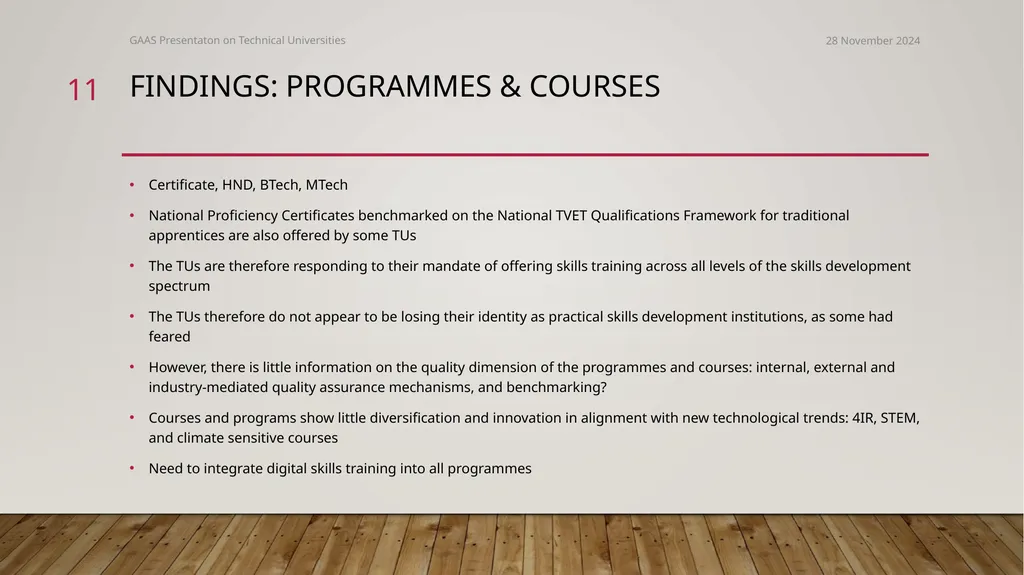
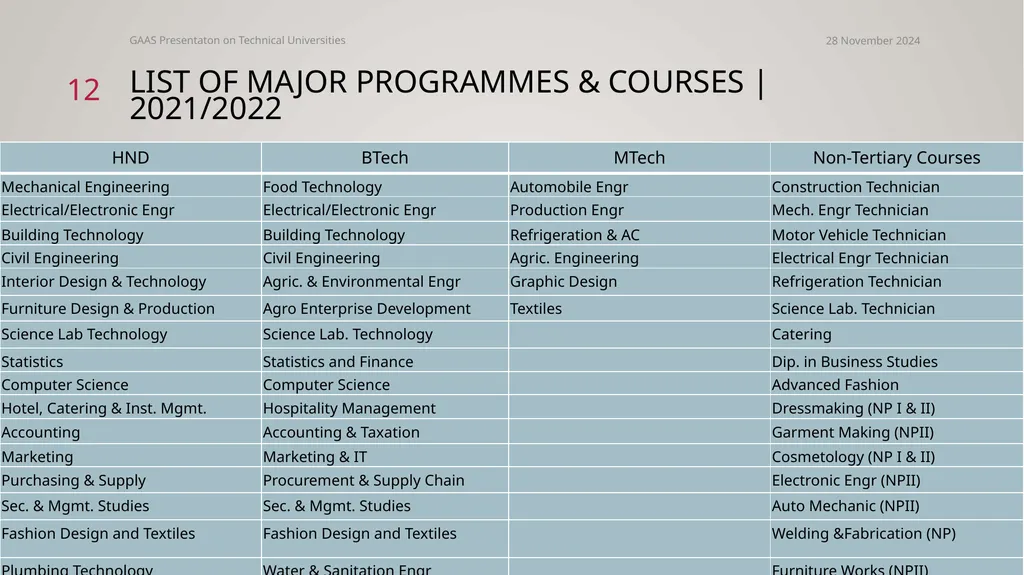
Findings: Programmes & courses Certificate, HND, BTech, MTech
National Proficiency Certificates benchmarked on the National TVET Qualifications Framework for traditional apprentices are also offered by some TUs
The TUs are therefore responding to their mandate of offering skills training across all levels of the skills development spectrum
The TUs therefore do not appear to be losing their identity as practical skills development institutions, as some had feared
However, there is little information on the quality dimension of the programmes and courses: internal, external and industry-mediated quality assurance mechanisms, and benchmarking?
Courses and programs show little diversification and innovation in alignment with new technological trends: 4IR, STEM, and climate sensitive courses
Need to integrate digital skills training into all programmes 28 November 2024 GAAS Presentaton on Technical Universities 11<br>
National Proficiency Certificates benchmarked on the National TVET Qualifications Framework for traditional apprentices are also offered by some TUs
The TUs are therefore responding to their mandate of offering skills training across all levels of the skills development spectrum
The TUs therefore do not appear to be losing their identity as practical skills development institutions, as some had feared
However, there is little information on the quality dimension of the programmes and courses: internal, external and industry-mediated quality assurance mechanisms, and benchmarking?
Courses and programs show little diversification and innovation in alignment with new technological trends: 4IR, STEM, and climate sensitive courses
Need to integrate digital skills training into all programmes 28 November 2024 GAAS Presentaton on Technical Universities 11<br>
12
List of major programmes & courses | 2021/2022 28 November 2024 GAAS Presentaton on Technical Universities 12<br>
13
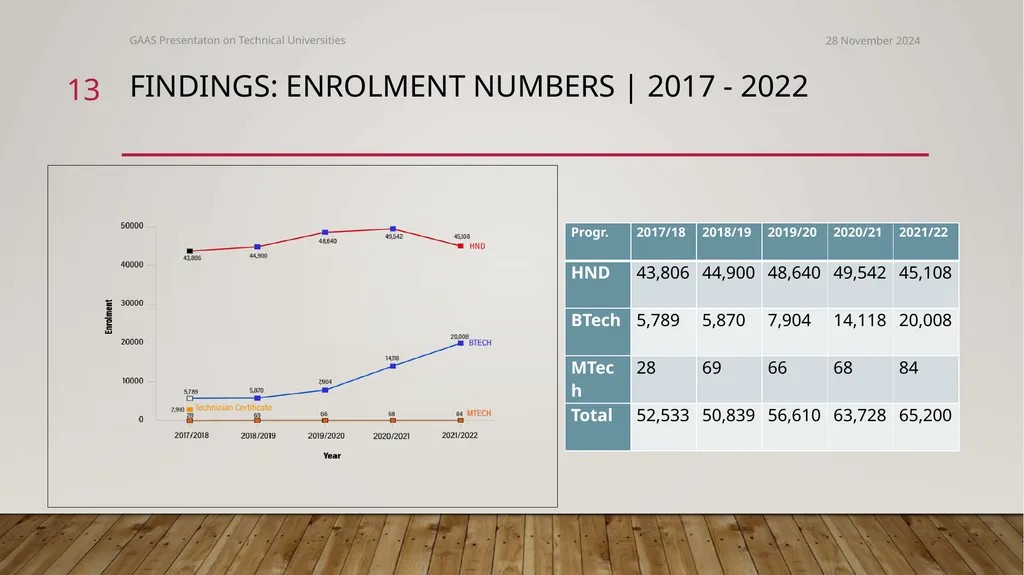
Findings: Enrolment numbers | 2017 - 2022 28 November 2024 GAAS Presentaton on Technical Universities 13<br>
14
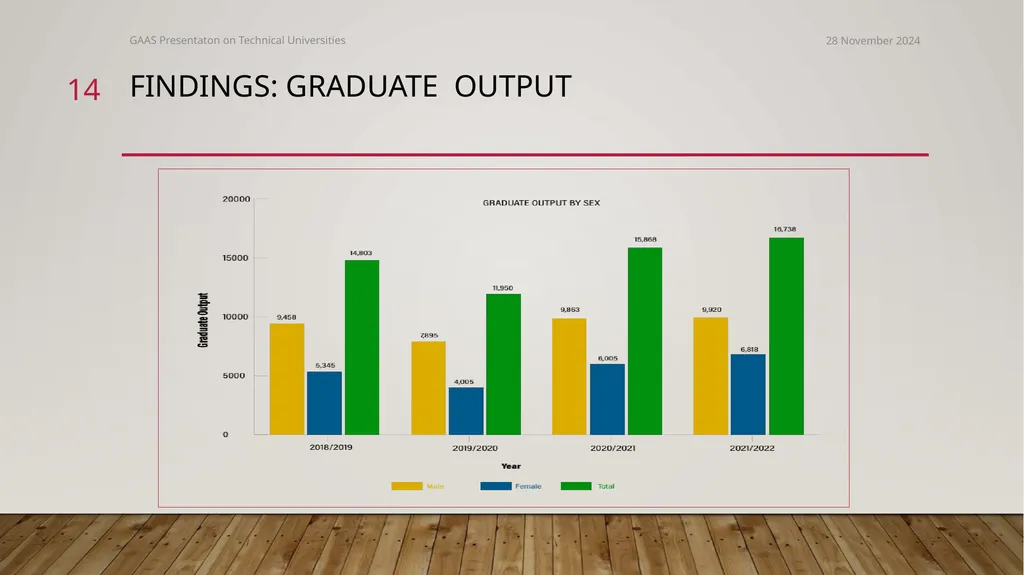
Findings: Graduate output 28 November 2024 GAAS Presentaton on Technical Universities 14<br>
15
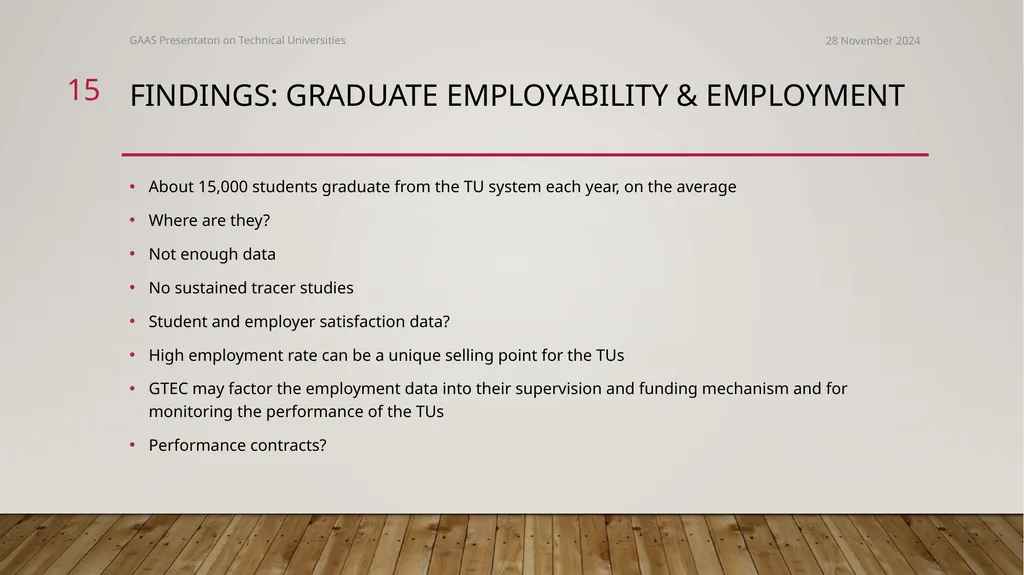
Findings: Graduate employability & employment About 15,000 students graduate from the TU system each year, on the average
Where are they?
Not enough data
No sustained tracer studies
Student and employer satisfaction data?
High employment rate can be a unique selling point for the TUs
GTEC may factor the employment data into their supervision and funding mechanism and for monitoring the performance of the TUs
Performance contracts? 28 November 2024 GAAS Presentaton on Technical Universities 15<br>
Where are they?
Not enough data
No sustained tracer studies
Student and employer satisfaction data?
High employment rate can be a unique selling point for the TUs
GTEC may factor the employment data into their supervision and funding mechanism and for monitoring the performance of the TUs
Performance contracts? 28 November 2024 GAAS Presentaton on Technical Universities 15<br>
16
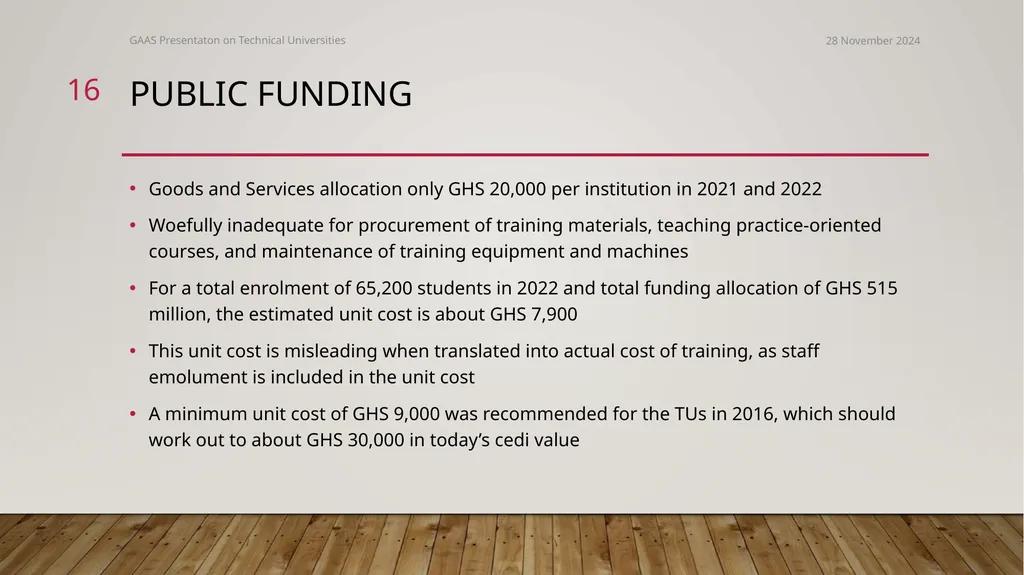
Public funding Goods and Services allocation only GHS 20,000 per institution in 2021 and 2022
Woefully inadequate for procurement of training materials, teaching practice-oriented courses, and maintenance of training equipment and machines
For a total enrolment of 65,200 students in 2022 and total funding allocation of GHS 515 million, the estimated unit cost is about GHS 7,900
This unit cost is misleading when translated into actual cost of training, as staff emolument is included in the unit cost
A minimum unit cost of GHS 9,000 was recommended for the TUs in 2016, which should work out to about GHS 30,000 in today’s cedi value 28 November 2024 GAAS Presentaton on Technical Universities 16<br>
Woefully inadequate for procurement of training materials, teaching practice-oriented courses, and maintenance of training equipment and machines
For a total enrolment of 65,200 students in 2022 and total funding allocation of GHS 515 million, the estimated unit cost is about GHS 7,900
This unit cost is misleading when translated into actual cost of training, as staff emolument is included in the unit cost
A minimum unit cost of GHS 9,000 was recommended for the TUs in 2016, which should work out to about GHS 30,000 in today’s cedi value 28 November 2024 GAAS Presentaton on Technical Universities 16<br>
17
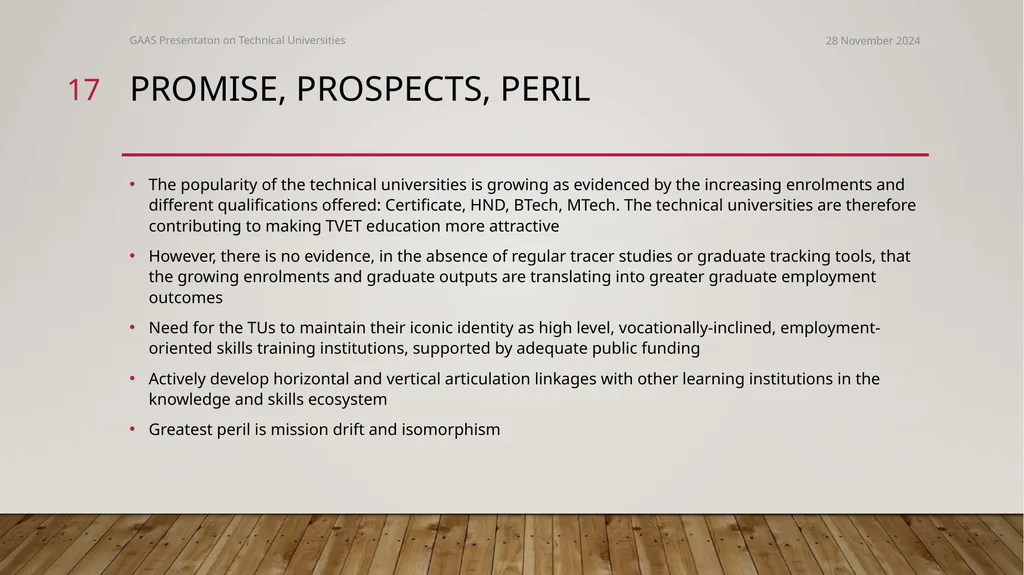
Promise, prospects, peril The popularity of the technical universities is growing as evidenced by the increasing enrolments and different qualifications offered: Certificate, HND, BTech, MTech. The technical universities are therefore contributing to making TVET education more attractive
However, there is no evidence, in the absence of regular tracer studies or graduate tracking tools, that the growing enrolments and graduate outputs are translating into greater graduate employment outcomes
Need for the TUs to maintain their iconic identity as high level, vocationally-inclined, employment-oriented skills training institutions, supported by adequate public funding
Actively develop horizontal and vertical articulation linkages with other learning institutions in the knowledge and skills ecosystem
Greatest peril is mission drift and isomorphism 28 November 2024 GAAS Presentaton on Technical Universities 17<br>
However, there is no evidence, in the absence of regular tracer studies or graduate tracking tools, that the growing enrolments and graduate outputs are translating into greater graduate employment outcomes
Need for the TUs to maintain their iconic identity as high level, vocationally-inclined, employment-oriented skills training institutions, supported by adequate public funding
Actively develop horizontal and vertical articulation linkages with other learning institutions in the knowledge and skills ecosystem
Greatest peril is mission drift and isomorphism 28 November 2024 GAAS Presentaton on Technical Universities 17<br>
18
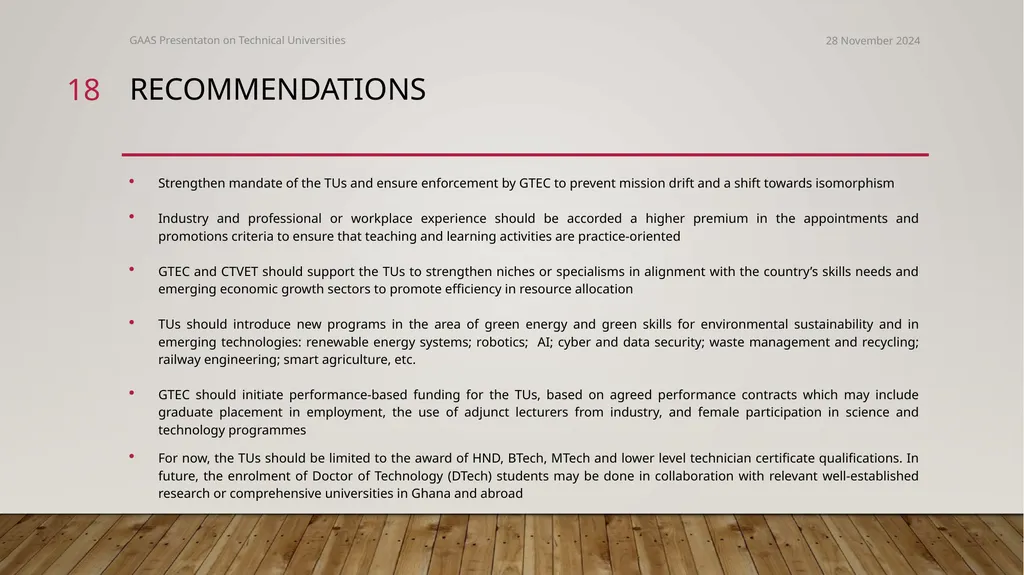
recommendations Strengthen mandate of the TUs and ensure enforcement by GTEC to prevent mission drift and a shift towards isomorphism
Industry and professional or workplace experience should be accorded a higher premium in the appointments and promotions criteria to ensure that teaching and learning activities are practice-oriented
GTEC and CTVET should support the TUs to strengthen niches or specialisms in alignment with the country’s skills needs and emerging economic growth sectors to promote efficiency in resource allocation
TUs should introduce new programs in the area of green energy and green skills for environmental sustainability and in emerging technologies: renewable energy systems; robotics; AI; cyber and data security; waste management and recycling; railway engineering; smart agriculture, etc.
GTEC should initiate performance-based funding for the TUs, based on agreed performance contracts which may include graduate placement in employment, the use of adjunct lecturers from industry, and female participation in science and technology programmes
For now, the TUs should be limited to the award of HND, BTech, MTech and lower level technician certificate qualifications. In future, the enrolment of Doctor of Technology (DTech) students may be done in collaboration with relevant well-established research or comprehensive universities in Ghana and abroad 28 November 2024 GAAS Presentaton on Technical Universities 18<br>
Industry and professional or workplace experience should be accorded a higher premium in the appointments and promotions criteria to ensure that teaching and learning activities are practice-oriented
GTEC and CTVET should support the TUs to strengthen niches or specialisms in alignment with the country’s skills needs and emerging economic growth sectors to promote efficiency in resource allocation
TUs should introduce new programs in the area of green energy and green skills for environmental sustainability and in emerging technologies: renewable energy systems; robotics; AI; cyber and data security; waste management and recycling; railway engineering; smart agriculture, etc.
GTEC should initiate performance-based funding for the TUs, based on agreed performance contracts which may include graduate placement in employment, the use of adjunct lecturers from industry, and female participation in science and technology programmes
For now, the TUs should be limited to the award of HND, BTech, MTech and lower level technician certificate qualifications. In future, the enrolment of Doctor of Technology (DTech) students may be done in collaboration with relevant well-established research or comprehensive universities in Ghana and abroad 28 November 2024 GAAS Presentaton on Technical Universities 18<br>
19
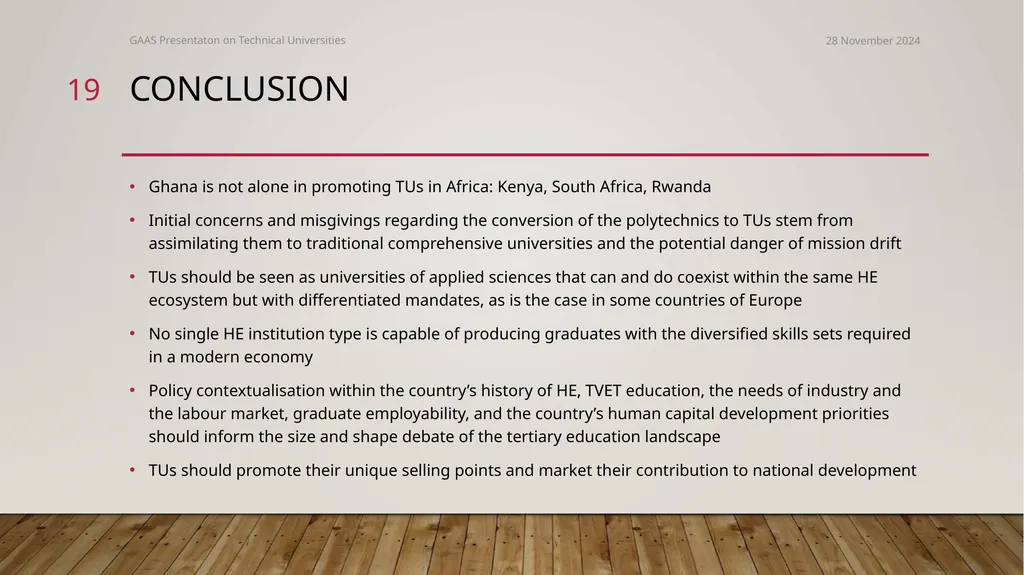
Conclusion Ghana is not alone in promoting TUs in Africa: Kenya, South Africa, Rwanda
Initial concerns and misgivings regarding the conversion of the polytechnics to TUs stem from assimilating them to traditional comprehensive universities and the potential danger of mission drift
TUs should be seen as universities of applied sciences that can and do coexist within the same HE ecosystem but with differentiated mandates, as is the case in some countries of Europe
No single HE institution type is capable of producing graduates with the diversified skills sets required in a modern economy
Policy contextualisation within the country’s history of HE, TVET education, the needs of industry and the labour market, graduate employability, and the country’s human capital development priorities should inform the size and shape debate of the tertiary education landscape
TUs should promote their unique selling points and market their contribution to national development 28 November 2024 GAAS Presentaton on Technical Universities 19<br>
Initial concerns and misgivings regarding the conversion of the polytechnics to TUs stem from assimilating them to traditional comprehensive universities and the potential danger of mission drift
TUs should be seen as universities of applied sciences that can and do coexist within the same HE ecosystem but with differentiated mandates, as is the case in some countries of Europe
No single HE institution type is capable of producing graduates with the diversified skills sets required in a modern economy
Policy contextualisation within the country’s history of HE, TVET education, the needs of industry and the labour market, graduate employability, and the country’s human capital development priorities should inform the size and shape debate of the tertiary education landscape
TUs should promote their unique selling points and market their contribution to national development 28 November 2024 GAAS Presentaton on Technical Universities 19<br>
20
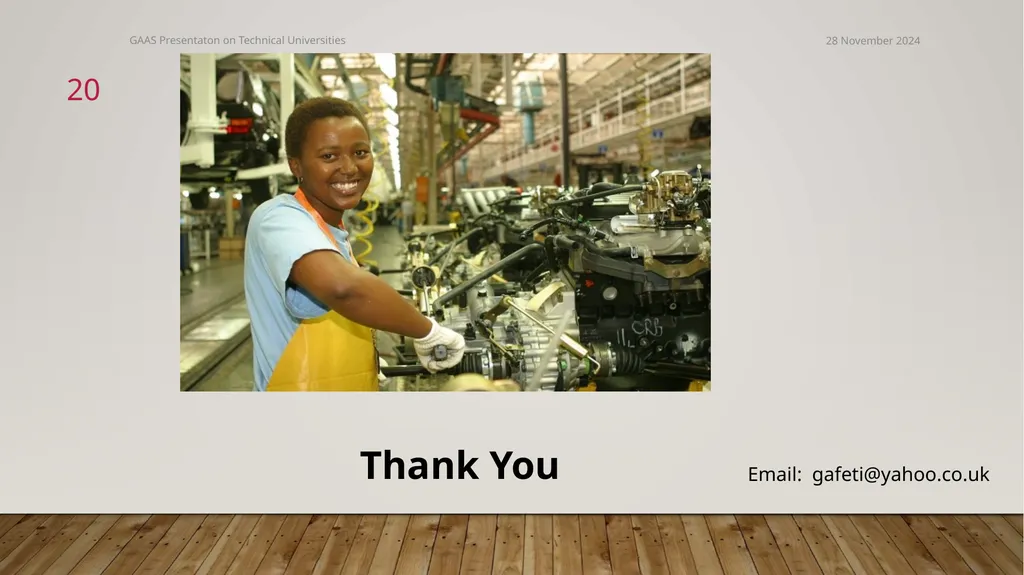
28 November 2024 GAAS Presentaton on Technical Universities 20 Thank You Email: gafeti@yahoo.co.uk<br>