
The CPA’s Guide to Ethical Behavior By Jolene A.
SB
Published · 39 slides · 0 views

1 / 1
Description
The CPAs Guide to Ethical Behavior By Jolene A. Lampton Ph.D., MBA, BSE, CPA, CGMA CFE January, 2022 The CPAs Guide to Ethical Behavior Jolene A. Lampton, Ph.D., MBA, BSE, CPA, CGMA and CFE CPA since 1982; CFE in 2015 Licensed in Texas
Related Topics
Share
Embed code
Download this presentation From Below
"The CPA’s Guide to Ethical Behavior By Jolene A." is the property of its rightful owner. Permission is granted to download and print the materials on this website for personal, non-commercial use only, and to display it on your personal computer provided you do not modify the materials and that you retain all copyright notices contained in the materials. By downloading content from our website, you accept the terms of this agreement.
Presentation Transcript
01
The CPA’s Guide
to Ethical Behavior By Jolene A. Lampton
Ph.D., MBA, BSE, CPA, CGMA & CFE
January, 2022<br>
Ph.D., MBA, BSE, CPA, CGMA & CFE
January, 2022<br>
02
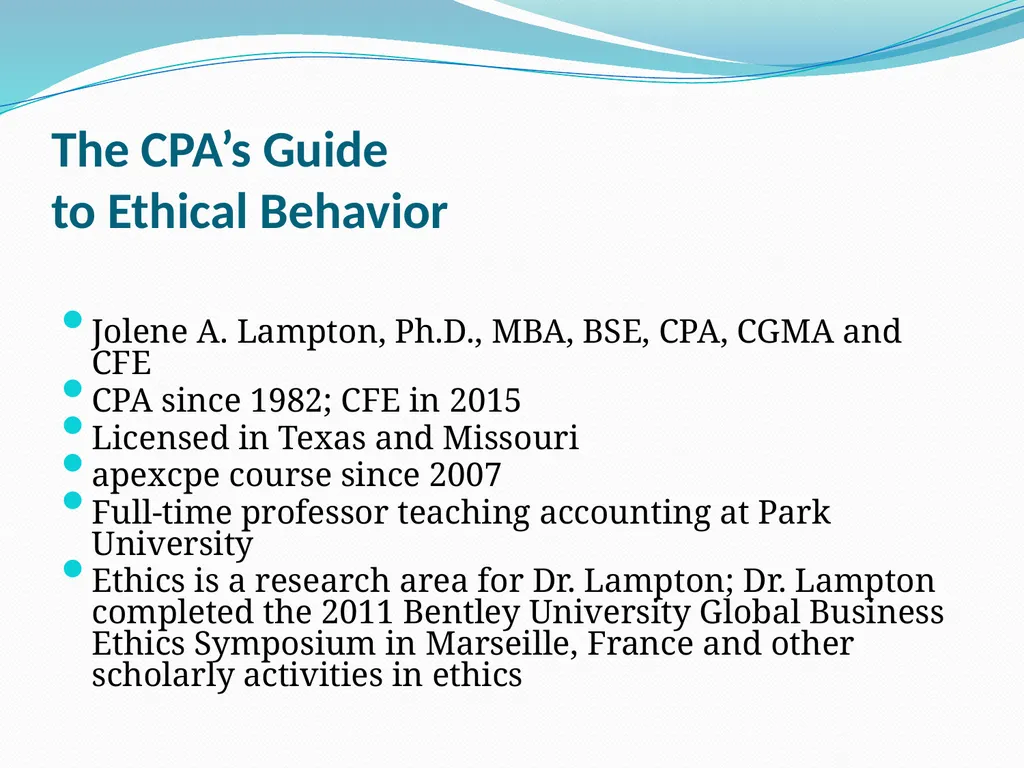
The CPA’s Guide
to Ethical Behavior Jolene A. Lampton, Ph.D., MBA, BSE, CPA, CGMA and CFE
CPA since 1982; CFE in 2015
Licensed in Texas and Missouri
apexcpe course since 2007
Full-time professor teaching accounting at Park University
Ethics is a research area for Dr. Lampton; Dr. Lampton completed the 2011 Bentley University Global Business Ethics Symposium in Marseille, France and other scholarly activities in ethics<br>
03
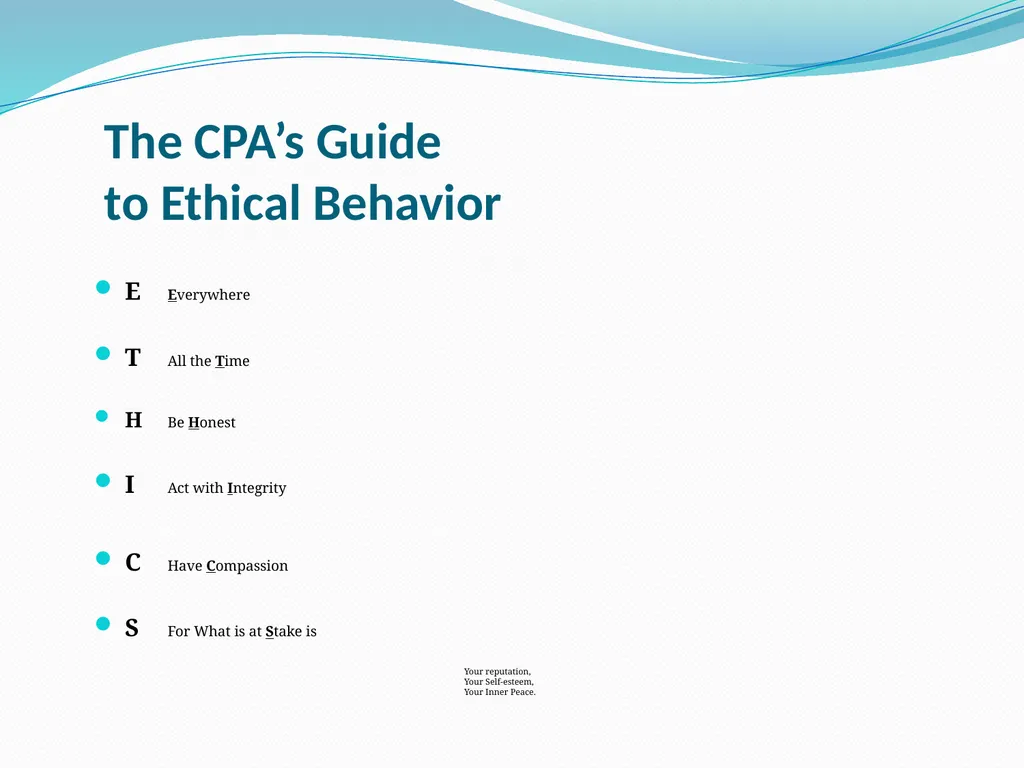
The CPA’s Guide
to Ethical Behavior E Everywhere
T All the Time
H Be Honest
I Act with Integrity
C Have Compassion
S For What is at Stake is
Your reputation,
Your Self-esteem,
Your Inner Peace.<br>
T All the Time
H Be Honest
I Act with Integrity
C Have Compassion
S For What is at Stake is
Your reputation,
Your Self-esteem,
Your Inner Peace.<br>
04
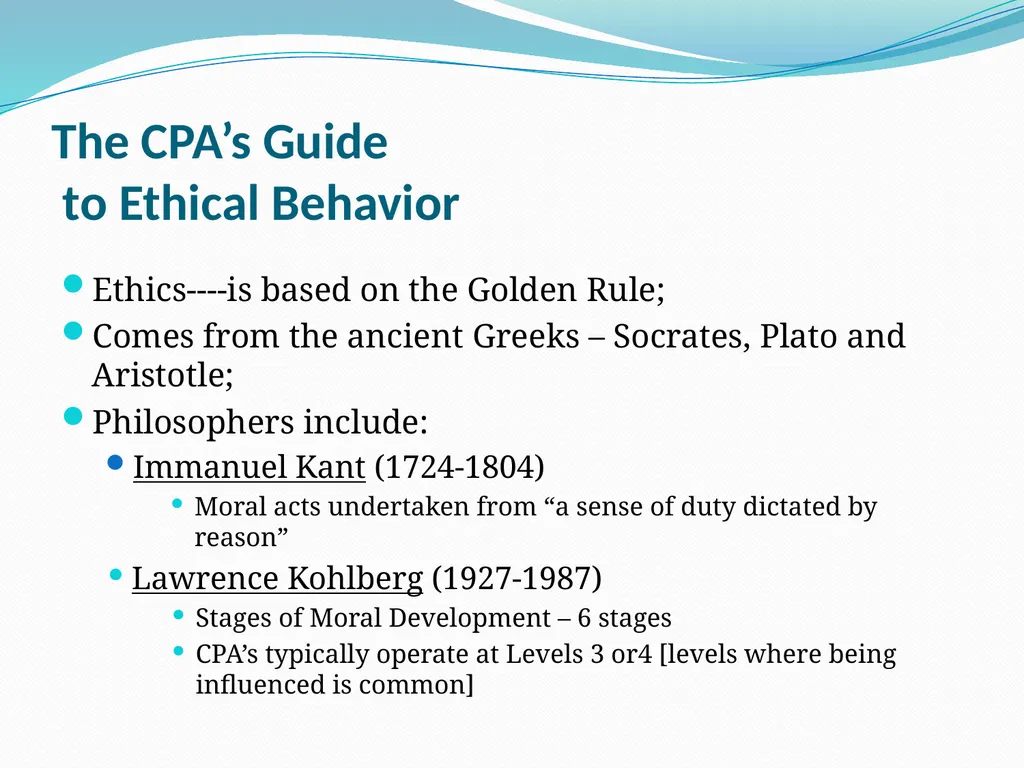
The CPA’s Guide
to Ethical Behavior Ethics----is based on the Golden Rule;
Comes from the ancient Greeks – Socrates, Plato and Aristotle;
Philosophers include:
Immanuel Kant (1724-1804)
Moral acts undertaken from “a sense of duty dictated by reason”
Lawrence Kohlberg (1927-1987)
Stages of Moral Development – 6 stages
CPA’s typically operate at Levels 3 or4 [levels where being influenced is common]<br>
05
The CPA’s Guide
to Ethical Behavior Ethics is a matter of ethos or participation in a community . . . a way of life;
To be moral means doing things right;
It pays to pursue a wider role on environmental and social issues;
Core tenets on which a company is built;
Core tenets emulate from values;
Companies with values are good companies to work for!<br>
To be moral means doing things right;
It pays to pursue a wider role on environmental and social issues;
Core tenets on which a company is built;
Core tenets emulate from values;
Companies with values are good companies to work for!<br>
06
The CPA’s Guide
to Ethical Behavior Our values do have voices---that we can use;
· Values are what we really want is strive for: to be able to feel like we have voiced and acted on our values is gratifying;
Need to focus our energy on finding ways to be consistent with our values.<br>
· Values are what we really want is strive for: to be able to feel like we have voiced and acted on our values is gratifying;
Need to focus our energy on finding ways to be consistent with our values.<br>
07
The CPA’s Guide
to Ethical Behavior Business practitioners can voice and implement their values . . . in the face of countervailing pressures in the workplace
Without whistleblowing;
Some people do voice and act on their values [and do so effectively];
Diminishing the impact of self-justifying rationalizations for actions;
Acknowledge values and ethical choice<br>
Without whistleblowing;
Some people do voice and act on their values [and do so effectively];
Diminishing the impact of self-justifying rationalizations for actions;
Acknowledge values and ethical choice<br>
08
The CPA’s Guide
to Ethical Behavior Ethical Approaches
Code of Ethics or Statement of Values
Cluster of objectives . . . core tenets on which the company is built
Mission Statements
Tone from the Top
Ways to use ethical reasoning
Let values have voices
Group/team approach to talk through dilemmas
Message from the “Top” of the organization
Leadership by example – the best way!<br>
09
The CPA’s Guide
to Ethical Behavior Vital to gain an understanding of the culture of the organization
Culture must support and nourish ethics
CEO should continuously demonstrate his/her expectations
Serves as a constant reminder to employees
CEO must require management team to expect clear numbers, good operations, clear measurements
Tips—when known—must be dealt with fairly
When the above practices are the norm, the culture stands a good chance of becoming “an ethical culture.”<br>
10
The CPA’s Guide
to Ethical Behavior An ethical culture
Requires constant behaviors
Always performed
Even under fire
To become habit for the organization;
. . . demands that the correct message be sent or it will be severely impaired.<br>
Requires constant behaviors
Always performed
Even under fire
To become habit for the organization;
. . . demands that the correct message be sent or it will be severely impaired.<br>
11
The CPA’s Guide
to Ethical Behavior To ensure an Ethical Culture
Create forums of ethical issues and dilemmas that face employees
Articulate steps to resolve matters
Role play training situations to practice the right thing
Highlight methods to be taken to resolve situations
If corrective action is taken no matter what it takes, employees get the message!
Culture is set in intricate and critical ways!
Obviously, the culture can be severely impaired if the wrong message is sent!<br>
12
The CPA’s Guide
to Ethical Behavior Ethical culture requires ethical reasoning coming through in various ways
CEO must lead by example
CEO and executive team need to display the expectation for ethical standards continuously
Ethical practices need to be reinforced in training and compliance programs
Steps for ethical reasoning should be documented in P&P manuals
Ethics needs to be the rule for the organization.<br>
13
"Ethics isn’t just about tone at the top. It’s about tone throughout the organization."
Jeff Thomson, CMA, CAE IMA President The CPA’s Guide to Ethical Behavior<br>
Jeff Thomson, CMA, CAE IMA President The CPA’s Guide to Ethical Behavior<br>
14
The CPA’s Guide
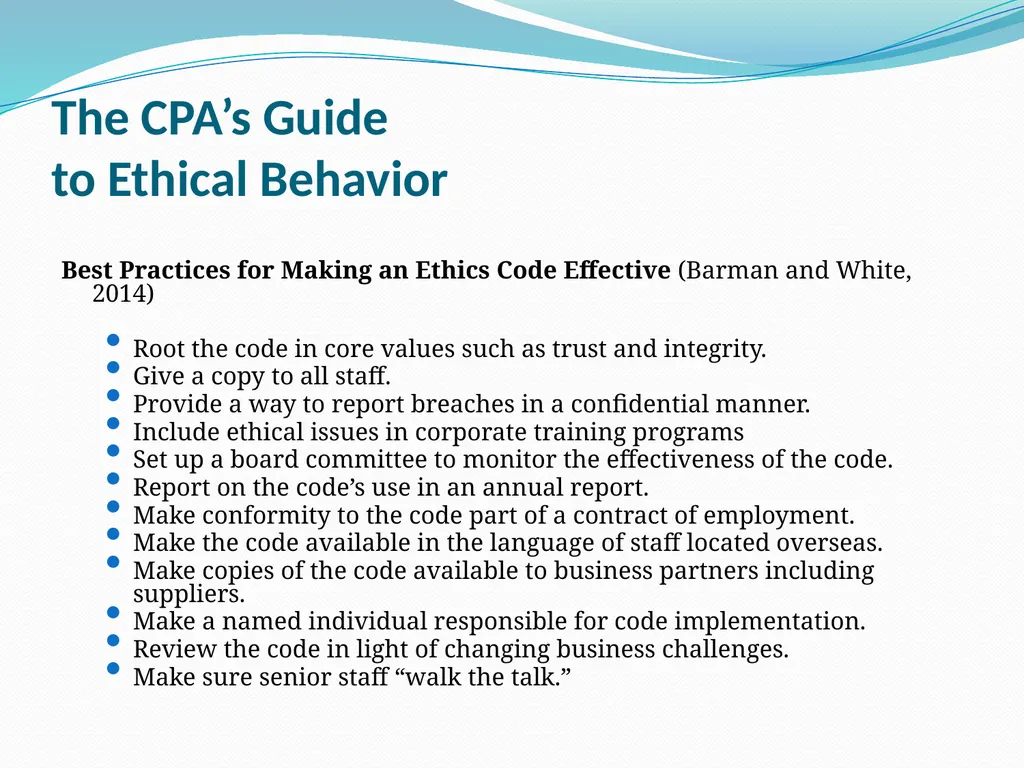
to Ethical Behavior Best Practices for Making an Ethics Code Effective (Barman and White, 2014)
Root the code in core values such as trust and integrity.
Give a copy to all staff.
Provide a way to report breaches in a confidential manner.
Include ethical issues in corporate training programs
Set up a board committee to monitor the effectiveness of the code.
Report on the code’s use in an annual report.
Make conformity to the code part of a contract of employment.
Make the code available in the language of staff located overseas.
Make copies of the code available to business partners including suppliers.
Make a named individual responsible for code implementation.
Review the code in light of changing business challenges.
Make sure senior staff “walk the talk.”<br>
15
The CPA’s Guide
to Ethical Behavior<br>
16
The CPA’s Guide
to Ethical Behavior Expectation from mid-level managers is ETHICAL LEADERSHIP<br>
17
The CPA’s Guide
to Ethical Behavior Public Accountancy Act directs the Texas State Board of Public Accountancy to develop rules of professional conduct to establish and maintain high standards of competence and integrity;
Follow the Rules of Professional Conduct from the TSBPA<br>
Follow the Rules of Professional Conduct from the TSBPA<br>
18
The CPA’s Guide
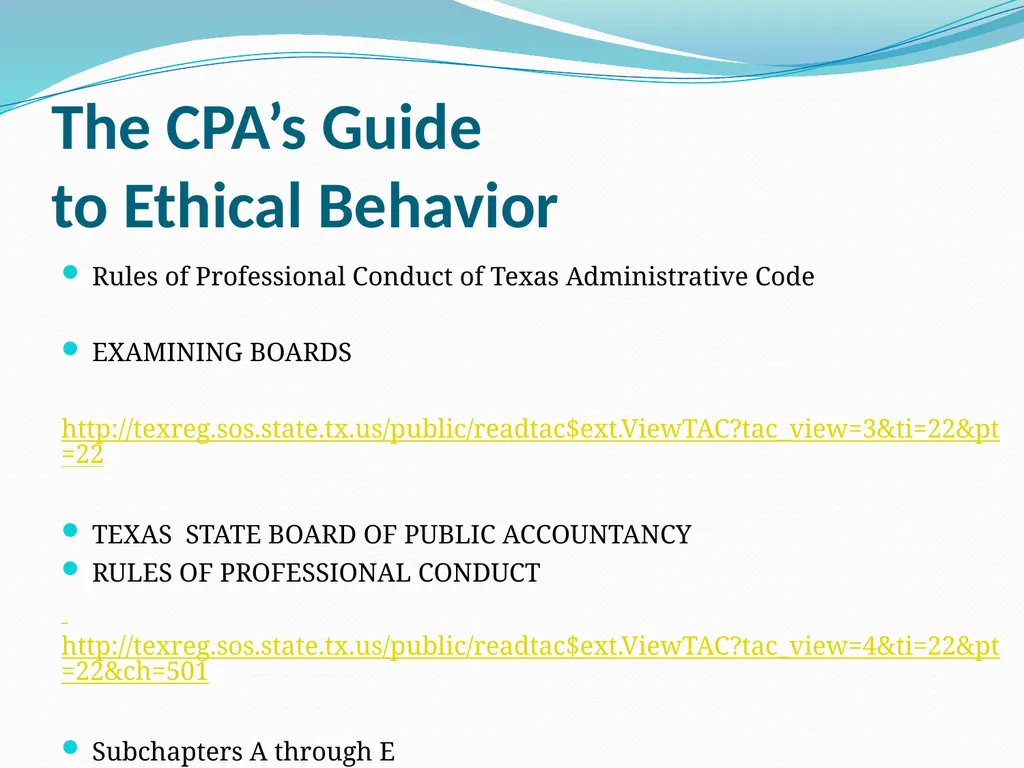
to Ethical Behavior Rules of Professional Conduct of Texas Administrative Code
EXAMINING BOARDS
http://texreg.sos.state.tx.us/public/readtac$ext.ViewTAC?tac_view=3&ti=22&pt=22
TEXAS STATE BOARD OF PUBLIC ACCOUNTANCY
RULES OF PROFESSIONAL CONDUCT
http://texreg.sos.state.tx.us/public/readtac$ext.ViewTAC?tac_view=4&ti=22&pt=22&ch=501
Subchapters A through E<br>
EXAMINING BOARDS
http://texreg.sos.state.tx.us/public/readtac$ext.ViewTAC?tac_view=3&ti=22&pt=22
TEXAS STATE BOARD OF PUBLIC ACCOUNTANCY
RULES OF PROFESSIONAL CONDUCT
http://texreg.sos.state.tx.us/public/readtac$ext.ViewTAC?tac_view=4&ti=22&pt=22&ch=501
Subchapters A through E<br>
19
The CPA’s Guide
to Ethical Behavior http://texreg.sos.state.tx.us/public/readtac$ext.ViewTAC?tac_view=3&ti=22&pt=22<br>
20
Rules of Professional Conduct - Rationale “Standards of competence and integrity in practice of public accountancy . . .
For the public . . .
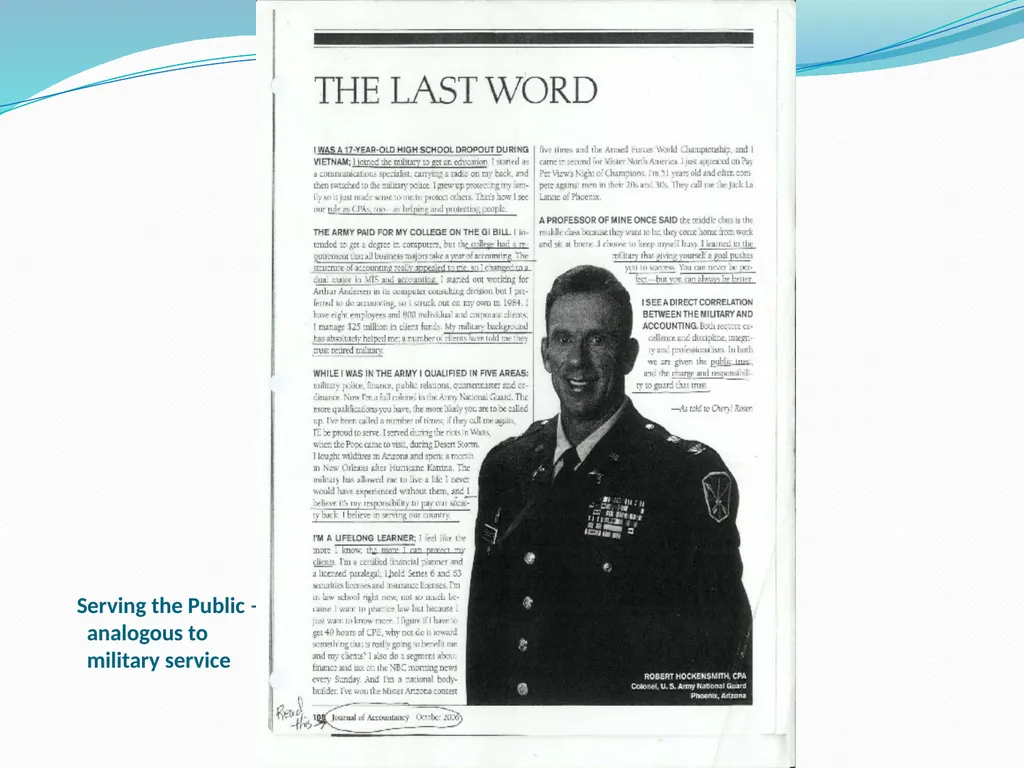
This means you are, in essence, working for the public interest
. . . accountants work for the public interest.<br>
For the public . . .
This means you are, in essence, working for the public interest
. . . accountants work for the public interest.<br>
21
Serving the Public –
analogous to
military service<br>
22
Professional Standards Subchapter B states “The public accounting profession has a duty to follow generally accepted auditing standards, generally accepted accounting principles, or other applicable professional standards. A certificate holder shall not permit his name to be associated with financial statements unless he has complied with GAAS.
A certificate holder shall not issue a report asserting that financial statements are in conformity with GAAP.
Must comply with other applicable standards.<br>
A certificate holder shall not issue a report asserting that financial statements are in conformity with GAAP.
Must comply with other applicable standards.<br>
23
Subchapter C – Responsibilities to Clients In order to serve clients, a certificate holder must be independent in fact and appearance when performing engagements in which a report will be issued on financial statements. Independence is impaired if certificate holder has:
Any direct or material indirect financial interest in the client
Any service as trustee or executor/administrator of estates/trusts
Any investment or loans with client
Any association with clients even by close relatives that would lead a reasonable person to conclude threat to objectivity/independence.<br>
24
Receipt of Commissions or other compensation Certificate holders shall not receive commissions when they perform services requiring independence. If compensation is received for services or products, disclosed in writing.
Disclose regardless of amount.<br>
Disclose regardless of amount.<br>
25
Receipt of Contingency Fees Certificate holder shall not perform any services for a contingent fee for services requiring independence. Contingent fee is liable or probable to occur due to dependence of a future event.
Prohibits things such as:
No tax return services for contingent fees
no accounting expert services for contingent fees<br>
Prohibits things such as:
No tax return services for contingent fees
no accounting expert services for contingent fees<br>
26
Integrity and Objectivity Certificate holder shall maintain integrity and objective, shall be free of conflicts of interest and shall not misrepresent facts now subordinate judgment to others. Attest engagements requiring independence cannot be eliminated by disclosure
Cannot pay commissions for clients<br>
Cannot pay commissions for clients<br>
27
Competence Certificate holder shall not undertake any engagement for performance of services which he/she cannot reasonably expect to complete with due professional competence. Competence includes technical qualifications and ability to supervise and evaluate work of others
Requires due professional care<br>
Requires due professional care<br>
28
Confidential Client Communications Be discreet; keep client things confidential Disclose only if pursuant to court proceedings, subpoenas or other compulsory services<br>
29
Records and
Work Papers Upon request, regardless of the status of the client’s account, a certificate holder shall provide records to the client used in performance of professional services. Reasonable to charge for personnel time/ copying, etc.
Working papers developed during services are the property of the certificate holder<br>
Working papers developed during services are the property of the certificate holder<br>
30
Subchapter D – Responsibilities to the Public Responsibility “to serve the public interest” is all important.
Certificate holders must allow use of his/her name with a set of financial statements with clear lines of responsibility to investors and others.
Scandals have created a major expectations gap between what the public considers as an audited financial statement and what it actually gets.
Rules of Professional Conduct clearly states responsibilities. Certificate holders have a duty to ensure “the public interest” in practice of public accountancy.<br>
31
Practice of Public Accountancy Certificate holders may not engage in the practice of public accountancy unless he/she holds a valid license issued by the board. Must be in good standing with the Board
Must practice in an entity that is registered in Texas
Or state “not qualified to register with the Texas State Board of Public Accountancy to practice”<br>
Must practice in an entity that is registered in Texas
Or state “not qualified to register with the Texas State Board of Public Accountancy to practice”<br>
32
Advertising Certificate holders shall not use any language that is false, fraudulent, misleading, or deceptive or that was obtained with coercion, duress, compulsion, intimidation, thread, overreaching, or vexatious conduct. Violation to persist in contacting clients that do not desire to be contacted
Should keep mailings along with lists of persons to whom mailings were distributed for 36 months<br>
Should keep mailings along with lists of persons to whom mailings were distributed for 36 months<br>
33
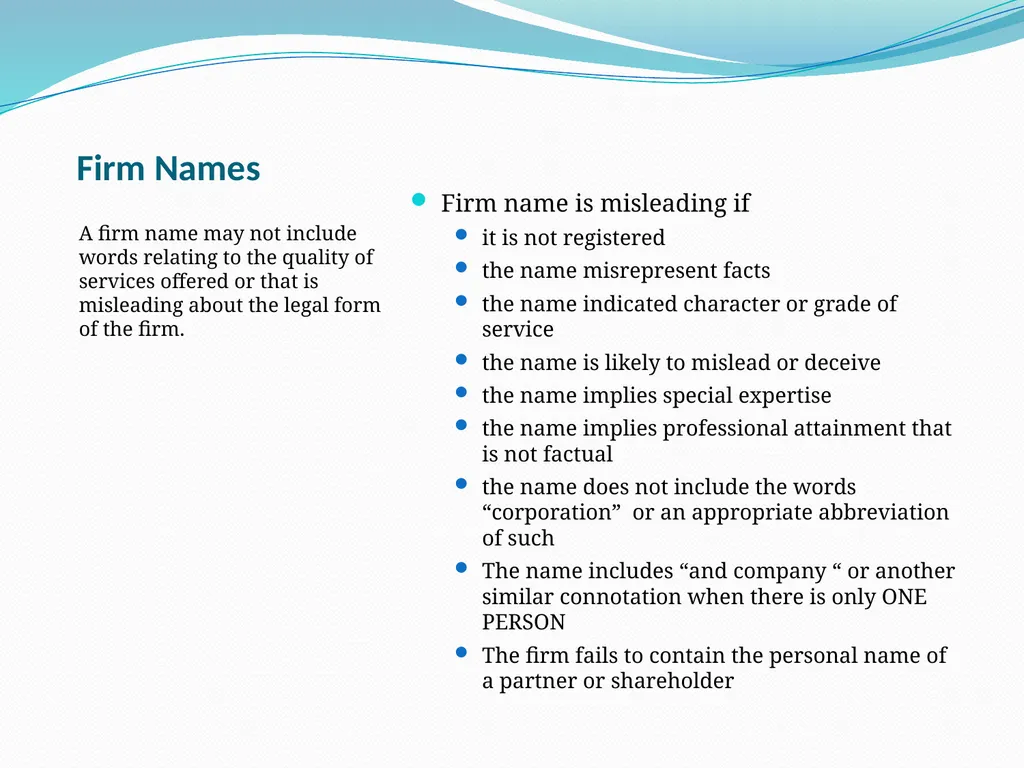
Firm Names A firm name may not include words relating to the quality of services offered or that is misleading about the legal form of the firm. Firm name is misleading if
it is not registered
the name misrepresent facts
the name indicated character or grade of service
the name is likely to mislead or deceive
the name implies special expertise
the name implies professional attainment that is not factual
the name does not include the words “corporation” or an appropriate abbreviation of such
The name includes “and company “ or another similar connotation when there is only ONE PERSON
The firm fails to contain the personal name of a partner or shareholder<br>
34
Subchapter E – Responsibilities to the Board/Profession Now in 2010m we have the U.S. Sentencing Guidelines and Sarbanes-Oxley Act that are intended to document consequences for adhering to good professional practices.
Subchapter E documents responsibilities for practitioners to the profession and to the Texas State Board of Public Accountancy. Certificate holder or licensee has duty to be responsible to the profession while practicing public accountancy
Such tone in operations is essential for integrity of performance<br>
35
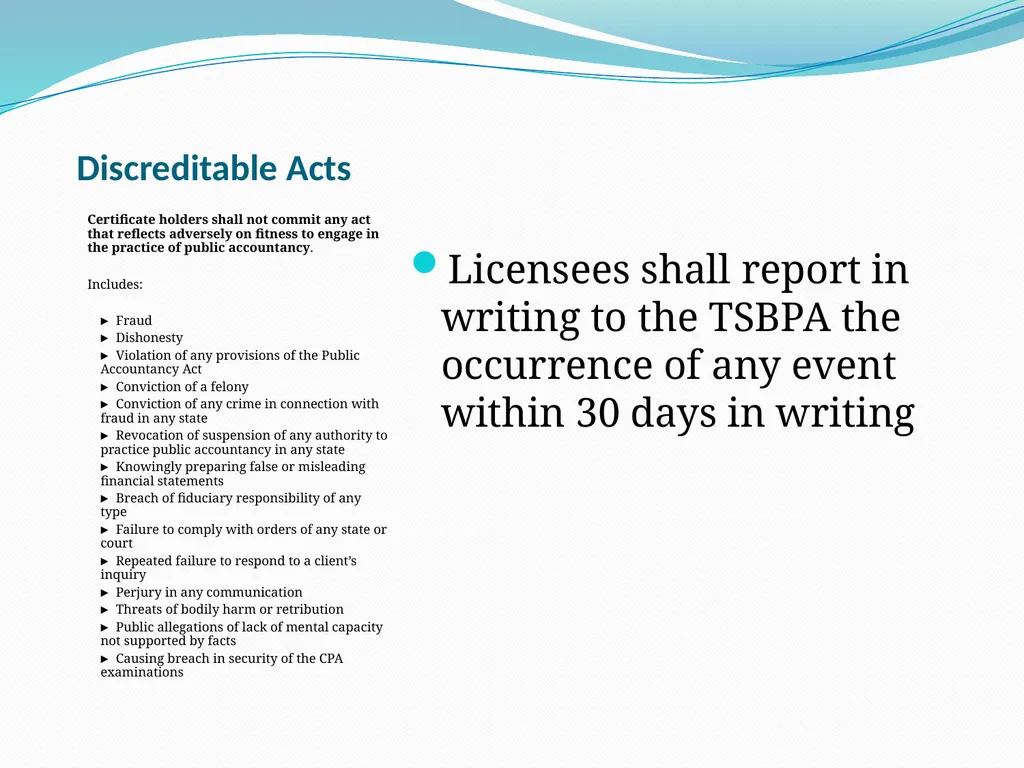
Discreditable Acts Certificate holders shall not commit any act that reflects adversely on fitness to engage in the practice of public accountancy.
Includes:
► Fraud
► Dishonesty
► Violation of any provisions of the Public Accountancy Act
► Conviction of a felony
► Conviction of any crime in connection with fraud in any state
► Revocation of suspension of any authority to practice public accountancy in any state
► Knowingly preparing false or misleading financial statements
► Breach of fiduciary responsibility of any type
► Failure to comply with orders of any state or court
► Repeated failure to respond to a client’s inquiry
► Perjury in any communication
► Threats of bodily harm or retribution
► Public allegations of lack of mental capacity not supported by facts
► Causing breach in security of the CPA examinations Licensees shall report in writing to the TSBPA the occurrence of any event within 30 days in writing<br>
36
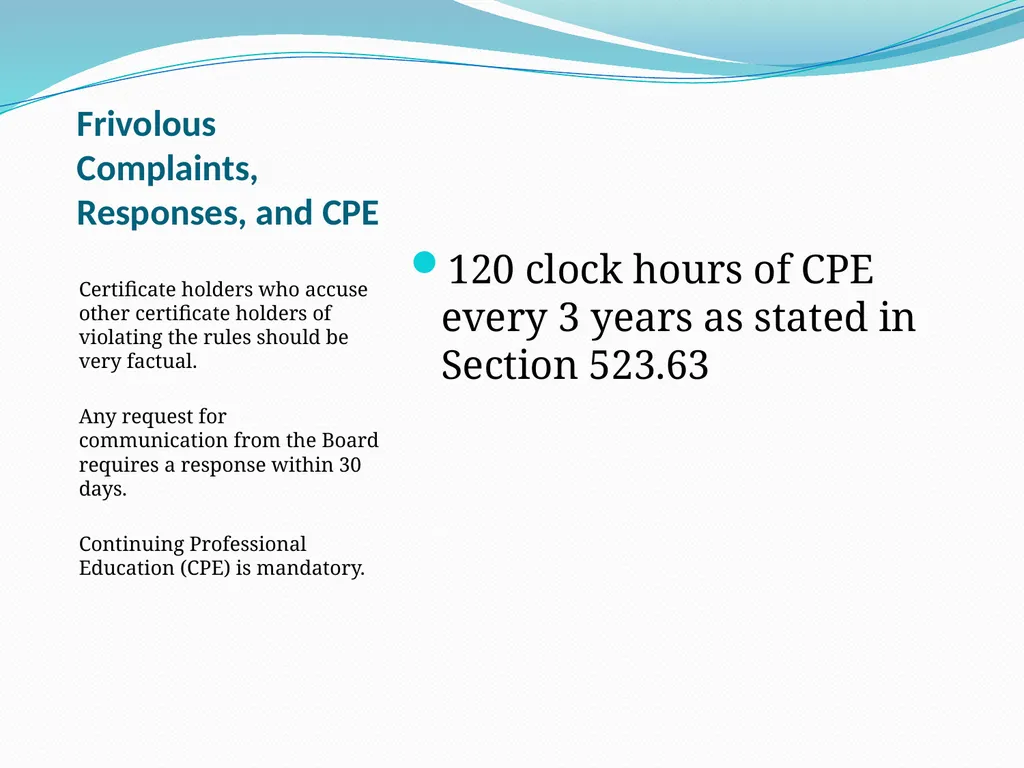
Frivolous Complaints, Responses, and CPE Certificate holders who accuse other certificate holders of violating the rules should be very factual.
Any request for communication from the Board requires a response within 30 days.
Continuing Professional Education (CPE) is mandatory. 120 clock hours of CPE every 3 years as stated in Section 523.63<br>
Any request for communication from the Board requires a response within 30 days.
Continuing Professional Education (CPE) is mandatory. 120 clock hours of CPE every 3 years as stated in Section 523.63<br>
37
The CPA’s Guide
to Ethical Behavior
in the 21st Century Sarbanes-Oxley (SOX)<br>
38
The CPA’s Guide
to Ethical Behavior CPAs must follow SOX;
This means the integrated audit, which covers internal controls;
Internal Control Systems deal with control environments that can be as “fragile as eggs”;
Certificate holders should be aware of red flags and signals of fraudulent activity;
SAS 99 and AUC 240 (or SAS 122) says CPAs must look for fraud . . . brainstorm ways fraud could occur (when doing audits of public companies).<br>
39
The CPA’s Guide
to Ethical Behavior Fraud costs all of us
Good employees can go bad and commit fraud
Virtue ethics is important
https://hbr.org/2011/06/wise-leadership<br>
Good employees can go bad and commit fraud
Virtue ethics is important
https://hbr.org/2011/06/wise-leadership<br>