
The Criminal Process Principles of sentencing
TD
Published · 25 slides · 0 views

1 / 1
Description
The Criminal Process Principles of sentencing Sentencing Discussion Points What do you think sentencing is? Why do we have to sentence people? Who should decide the sentence and do you think there should be any restrictions on their power
Related Topics
Share
Embed code
Download this presentation From Below
"The Criminal Process Principles of sentencing" is the property of its rightful owner. Permission is granted to download and print the materials on this website for personal, non-commercial use only, and to display it on your personal computer provided you do not modify the materials and that you retain all copyright notices contained in the materials. By downloading content from our website, you accept the terms of this agreement.
Presentation Transcript
01
The Criminal Process
Principles of sentencing<br>
02
Sentencing Discussion Points
What do you think sentencing is?
Why do we have to sentence people?
Who should decide the sentence and do you think there should be any restrictions on their power to sentence?<br>
What do you think sentencing is?
Why do we have to sentence people?
Who should decide the sentence and do you think there should be any restrictions on their power to sentence?<br>
03
Sentencing Once an accused is convicted of an offence, it is the Court’s job to decide what sentence will be given
Magistrate or Judge depending on what Court the case is heard in
There are a number of restrictions and factors that will be taken into account when deciding the appropriate sentence.<br>
Magistrate or Judge depending on what Court the case is heard in
There are a number of restrictions and factors that will be taken into account when deciding the appropriate sentence.<br>
04
Restrictions on Sentencing Magistrates:
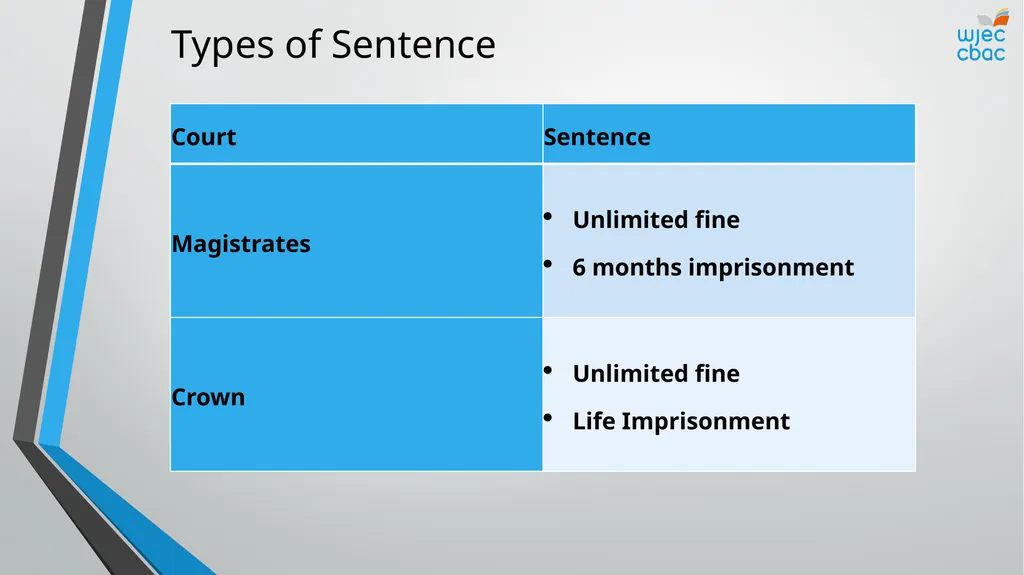
Max 6 months imprisonment for a single offence
Unlimited fine for serious offences: https://www.gov.uk/government/news/unlimited-fines-for-serious-offences
Crown Court Judges
Max life sentence
Unlimited fines.<br>
Max 6 months imprisonment for a single offence
Unlimited fine for serious offences: https://www.gov.uk/government/news/unlimited-fines-for-serious-offences
Crown Court Judges
Max life sentence
Unlimited fines.<br>
05
Maximum Sentences Magistrates and Judges are restricted by maximum sentences that are laid down by Parliament in the statute covering each offence.
e.g. the maximum sentence for theft is 7 years, the maximum sentence for rape is a discretionary life sentence.
Murder has a mandatory life sentence so is quite unique.<br>
e.g. the maximum sentence for theft is 7 years, the maximum sentence for rape is a discretionary life sentence.
Murder has a mandatory life sentence so is quite unique.<br>
06
Minimum Sentences The Crime (Sentences) Act 1997 introduced minimum sentences for both persistent offenders, drug dealers and burglars
The Act also introduced an automatic life sentence for offenders convicted of a second serious or violent offence.<br>
The Act also introduced an automatic life sentence for offenders convicted of a second serious or violent offence.<br>
07
SENTENCING As we explore sentencing in more detail, you will see that it is not an easy or simple process
First of all we need to look at the aims of sentencing – what is the criminal justice system trying to achieve by sentencing those who break the law
Then we will go on to have a look at the powers that are given to the courts and what type of sentences they can give
Comment as you go through as to how effective or otherwise you think the system is.<br>
First of all we need to look at the aims of sentencing – what is the criminal justice system trying to achieve by sentencing those who break the law
Then we will go on to have a look at the powers that are given to the courts and what type of sentences they can give
Comment as you go through as to how effective or otherwise you think the system is.<br>
08
SENTENCING Before sentencing those who have been convicted of a criminal offence, the Magistrates or the Judge have to consider a range of different factors regarding the offence and the offender
Often a pre-sentence report will be prepared by the Probation Service that will help with the decision to impose the most appropriate sentence for this particular offender.<br>
Often a pre-sentence report will be prepared by the Probation Service that will help with the decision to impose the most appropriate sentence for this particular offender.<br>
09
Factors surrounding the Offence The main issue that will be considered here is how serious the offence is for the type of offence it is
s 143(1) Criminal Justice Act 2003
“In considering the seriousness of the offence, the court must consider the offender’s culpability in committing the offence and any harm which the offence caused, or was intended to cause or might reasonably foreseeably have caused”. Sentencing<br>
s 143(1) Criminal Justice Act 2003
“In considering the seriousness of the offence, the court must consider the offender’s culpability in committing the offence and any harm which the offence caused, or was intended to cause or might reasonably foreseeably have caused”. Sentencing<br>
10
Factors surrounding the Offence CJA 2003 states that other factors that should be considered are:
Previous convictions for other similar offences or ones which are relevant to the current offence
Whether the defendant was on bail when the offence was committed
Whether there was any religious or racial element to the offence
Whether there was any hostility to disability or sexual orientation involved in the offence.<br>
Previous convictions for other similar offences or ones which are relevant to the current offence
Whether the defendant was on bail when the offence was committed
Whether there was any religious or racial element to the offence
Whether there was any hostility to disability or sexual orientation involved in the offence.<br>
11
Factors surrounding the Offence “Other points the courts will want to know may include….. In a case of theft, how much was stolen, and was the defendant in a position of trust? In a case of assault … what injuries were inflicted and whether the assault was premeditated; was the victim particularly vulnerable….? Where several defendants are convicted of committing a crime jointly, the court will want to know if any of them played a greater part than others, and who was involved in planning it.”
(The English Legal System, Jacqueline Martin).
Consider the above extract. Why do you think these aspects are taken into account? Why should these factors affect the length of the sentence given?<br>
(The English Legal System, Jacqueline Martin).
Consider the above extract. Why do you think these aspects are taken into account? Why should these factors affect the length of the sentence given?<br>
12
Effect of a Guilty Plea If a defendant pleads guilty, the sentence is likely to be reduced
The general rule is that the earlier the guilty plea is entered, the more time will be deducted from the sentence
If a defendant pleads guilty at their first opportunity to do so, up to one third will be deducted from their sentence
Pleaded guilty once the trial has started will receive up to one tenth discount
Discounts are calculated on a sliding scale.<br>
The general rule is that the earlier the guilty plea is entered, the more time will be deducted from the sentence
If a defendant pleads guilty at their first opportunity to do so, up to one third will be deducted from their sentence
Pleaded guilty once the trial has started will receive up to one tenth discount
Discounts are calculated on a sliding scale.<br>
13
Effect of a Guilty Plea Discussion Points:
Why do you think the sliding scale for discounts to sentences for guilty pleas is in operation?
Do you think it can be justified?
What are the problems with this system?<br>
Why do you think the sliding scale for discounts to sentences for guilty pleas is in operation?
Do you think it can be justified?
What are the problems with this system?<br>
14
Affect of a Guilty Plea Sentencing Council justifies the discount system as follows:
“A reduction in sentence is appropriate because a guilty plea avoids the need for a trial, shortens the gap between charge and sentence, saves considerable cost, and, in the case of an early plea, saves victims and witnesses from the concern about having to give evidence”.<br>
“A reduction in sentence is appropriate because a guilty plea avoids the need for a trial, shortens the gap between charge and sentence, saves considerable cost, and, in the case of an early plea, saves victims and witnesses from the concern about having to give evidence”.<br>
15
Affect of Guilty Pleas As you can see, the discount system for early guilty pleas can be very controversial.
As a result, the Government introduced changes to the system. Use the internet to find out what these changes were.<br>
As a result, the Government introduced changes to the system. Use the internet to find out what these changes were.<br>
16
The Offender’s Background Factors the Court will consider here include:
Any previous convictions, including reaction to previous sentences, whether he was on bail
Where there is the possibility of community sentences a pre-sentence report will be prepared by the Probation Service with details of the offender’s background and suitability for this type of sentence
If there are any medical or psychiatric issues involved in the offence the Court will ask for a medical report before making their decision
If imposing a fine, the financial situation of the offender will need to be fully disclosed.<br>
Any previous convictions, including reaction to previous sentences, whether he was on bail
Where there is the possibility of community sentences a pre-sentence report will be prepared by the Probation Service with details of the offender’s background and suitability for this type of sentence
If there are any medical or psychiatric issues involved in the offence the Court will ask for a medical report before making their decision
If imposing a fine, the financial situation of the offender will need to be fully disclosed.<br>
17
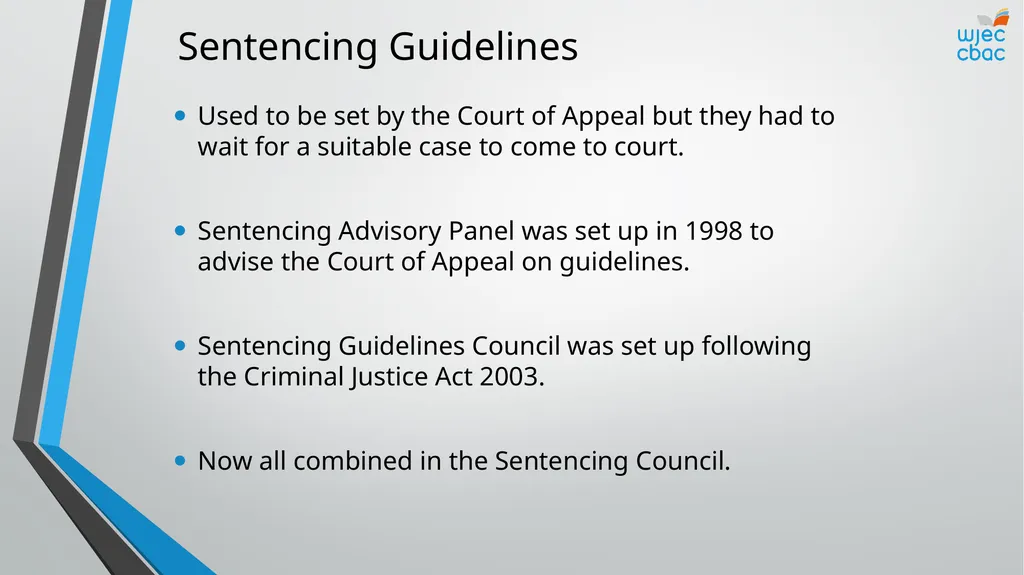
Sentencing Guidelines Used to be set by the Court of Appeal but they had to wait for a suitable case to come to court.
Sentencing Advisory Panel was set up in 1998 to advise the Court of Appeal on guidelines.
Sentencing Guidelines Council was set up following the Criminal Justice Act 2003.
Now all combined in the Sentencing Council.<br>
Sentencing Advisory Panel was set up in 1998 to advise the Court of Appeal on guidelines.
Sentencing Guidelines Council was set up following the Criminal Justice Act 2003.
Now all combined in the Sentencing Council.<br>
18
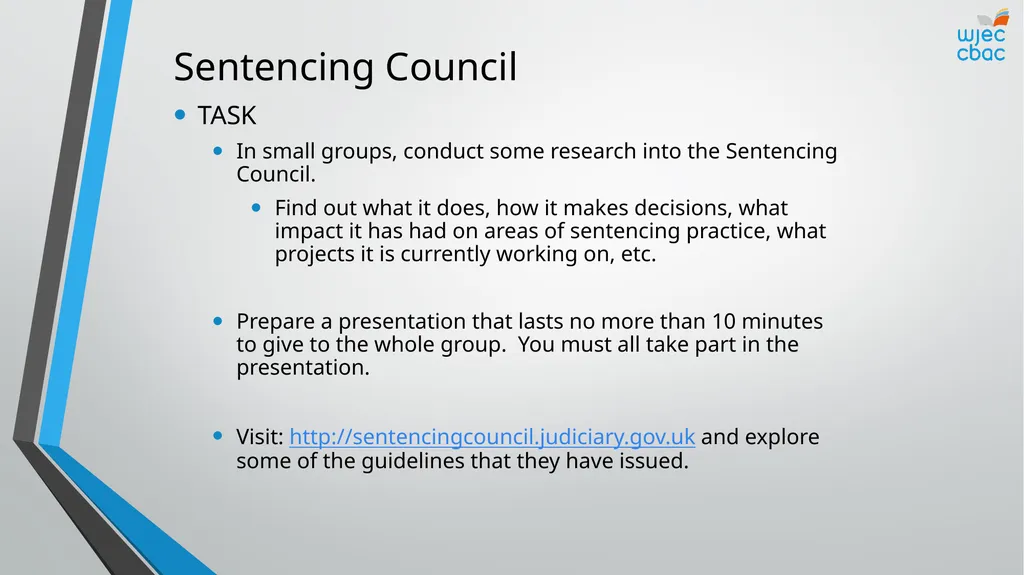
Sentencing Council TASK
In small groups, conduct some research into the Sentencing Council.
Find out what it does, how it makes decisions, what impact it has had on areas of sentencing practice, what projects it is currently working on, etc.
Prepare a presentation that lasts no more than 10 minutes to give to the whole group. You must all take part in the presentation.
Visit: http://sentencingcouncil.judiciary.gov.uk and explore some of the guidelines that they have issued.<br>
In small groups, conduct some research into the Sentencing Council.
Find out what it does, how it makes decisions, what impact it has had on areas of sentencing practice, what projects it is currently working on, etc.
Prepare a presentation that lasts no more than 10 minutes to give to the whole group. You must all take part in the presentation.
Visit: http://sentencingcouncil.judiciary.gov.uk and explore some of the guidelines that they have issued.<br>
19
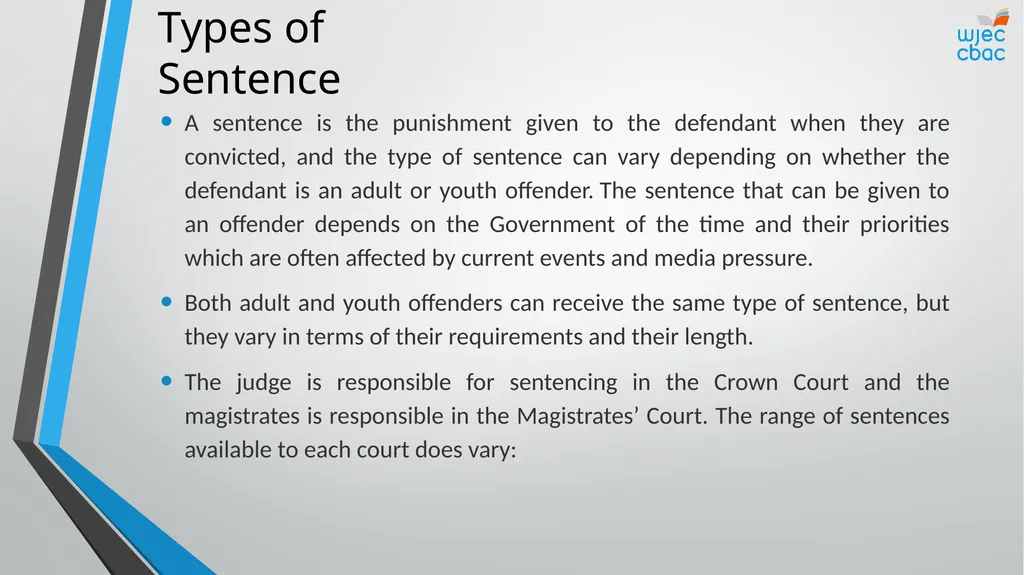
Types of Sentence A sentence is the punishment given to the defendant when they are convicted, and the type of sentence can vary depending on whether the defendant is an adult or youth offender. The sentence that can be given to an offender depends on the Government of the time and their priorities which are often affected by current events and media pressure.
Both adult and youth offenders can receive the same type of sentence, but they vary in terms of their requirements and their length.
The judge is responsible for sentencing in the Crown Court and the magistrates is responsible in the Magistrates’ Court. The range of sentences available to each court does vary:<br>
Both adult and youth offenders can receive the same type of sentence, but they vary in terms of their requirements and their length.
The judge is responsible for sentencing in the Crown Court and the magistrates is responsible in the Magistrates’ Court. The range of sentences available to each court does vary:<br>
20
Types of Sentence<br>
21
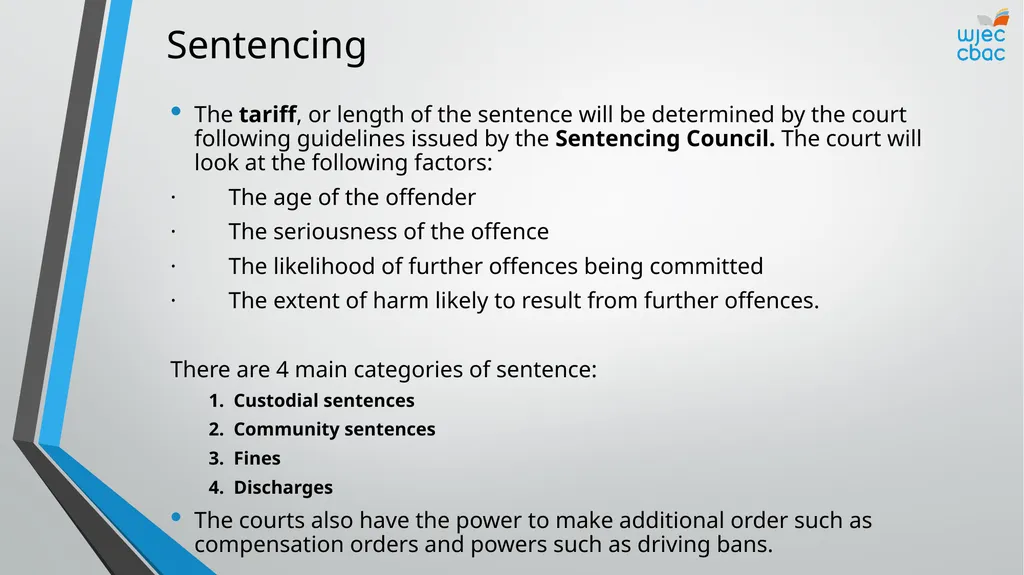
Sentencing The tariff, or length of the sentence will be determined by the court following guidelines issued by the Sentencing Council. The court will look at the following factors:
· The age of the offender
· The seriousness of the offence
· The likelihood of further offences being committed
· The extent of harm likely to result from further offences.
There are 4 main categories of sentence:
1. Custodial sentences
2. Community sentences
3. Fines
4. Discharges
The courts also have the power to make additional order such as compensation orders and powers such as driving bans.<br>
· The age of the offender
· The seriousness of the offence
· The likelihood of further offences being committed
· The extent of harm likely to result from further offences.
There are 4 main categories of sentence:
1. Custodial sentences
2. Community sentences
3. Fines
4. Discharges
The courts also have the power to make additional order such as compensation orders and powers such as driving bans.<br>
22
Types of Sentence<br>
23
Types of Sentence<br>
24
Types of Sentence<br>
25
Types of Sentence Custodial Sentences
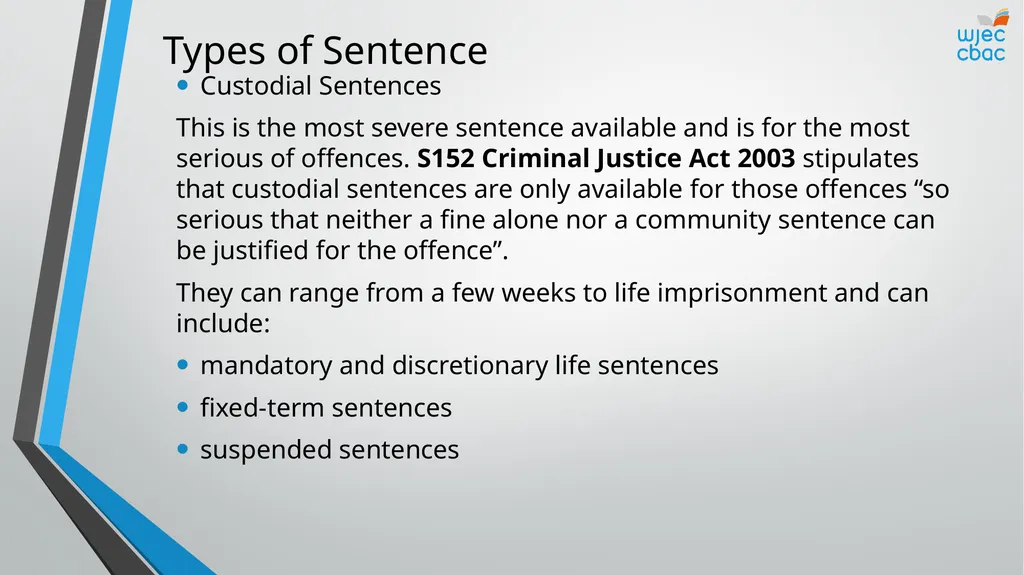
This is the most severe sentence available and is for the most serious of offences. S152 Criminal Justice Act 2003 stipulates that custodial sentences are only available for those offences “so serious that neither a fine alone nor a community sentence can be justified for the offence”.
They can range from a few weeks to life imprisonment and can include:
mandatory and discretionary life sentences
fixed-term sentences
suspended sentences<br>
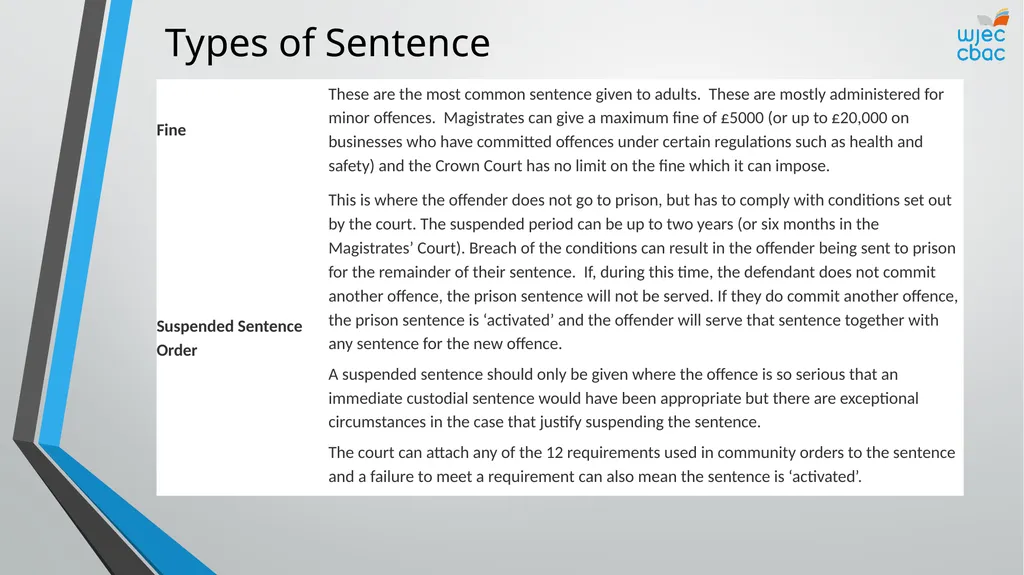
This is the most severe sentence available and is for the most serious of offences. S152 Criminal Justice Act 2003 stipulates that custodial sentences are only available for those offences “so serious that neither a fine alone nor a community sentence can be justified for the offence”.
They can range from a few weeks to life imprisonment and can include:
mandatory and discretionary life sentences
fixed-term sentences
suspended sentences<br>