
The Dream Shatters (again) LO: to explore the
MJ
Published · 93 slides · 0 views

1 / 1















Description
The Dream Shatters (again) LO: to explore the changes in Joe Starks in chapter 7 Starter: write down three quotes about Joe Starks! Create a Joe Starks vocabulary - Which words are best suited to describe him? Reading Activities Janie: Find
Related Topics
Share
Embed code
Download this presentation From Below
"The Dream Shatters (again) LO: to explore the" is the property of its rightful owner. Permission is granted to download and print the materials on this website for personal, non-commercial use only, and to display it on your personal computer provided you do not modify the materials and that you retain all copyright notices contained in the materials. By downloading content from our website, you accept the terms of this agreement.
Presentation Transcript
01
The Dream Shatters (again) LO: to explore the changes in Joe Starks in chapter 7 Starter: write down three quotes about Joe Starks!
Create a Joe Starks vocabulary - Which words are best suited to describe him?<br>
Create a Joe Starks vocabulary - Which words are best suited to describe him?<br>
02
Reading Activities Janie: Find a quote which shows each of these features or emotions Defeated
Submissive
Doubting herself
Releasing pent-up aggression and anger Joe: Find a quote which shows each of these features or emotions Deteriorating physical shape
Less sharp of mind
Irate
Vengeful How does Hurston communicate to the reader that Janie sees through Jody’s behaviour, to the real cause of his anger?<br>
Submissive
Doubting herself
Releasing pent-up aggression and anger Joe: Find a quote which shows each of these features or emotions Deteriorating physical shape
Less sharp of mind
Irate
Vengeful How does Hurston communicate to the reader that Janie sees through Jody’s behaviour, to the real cause of his anger?<br>
03
Epiphanies: Moments of realization Joe Then Joe Starks realized all the meanings and his vanity bled like a flood. Janie had robbed him of his illusion of irresistible maleness that all men cherish, which was terrible. The thing that Saul’s daughter had done to David. But Janie had done worse, she had cast down his empty armor before men and they had laughed, would keep on laughing. When he paraded his possessions hereafter, they would not consider the two together. They’d look with envy at the things and pity the man that owned them. When he sat in judgment it would be the same. Good-for-nothing’s like Dave and Lum and Jim wouldn’t change place with him. For what can excuse a man in the eyes of other men for lack of strength? Raggedy-behind squirts of sixteen and seventeen would be giving him their merciless pity out of their eyes while their mouths said something humble. There was nothing to do in life anymore. Ambition was useless. And the cruel deceit of Janie! Making all that show of humbleness and scorning him all the time! Laughing at him, and now putting the town up to do the same. Joe Starks didn’t know the words for all this, but he knew the feeling. So he struck Janie with all his might and drove her from the store.
p. 91 Janie She didn’t read books so she didn’t know that she was the world and the heavens boiled down to a drop. Man attempting to climb to painless heights from his dung hill. Then one day she sat and watched the shadow of herself going about tending store and prostrating itself before Jody, while all the time she herself sat under a shady tree with the wind blowing through her hair and her clothes. Somebody near about making summertime out of lonesomeness. This was the first time it happened, but after a while it got so common she ceased to be surprised. It was like a drug. In a way it was good because it reconciled her to things. She got so she received all things with the stolidness of the earth which soaks up urine and perfume with the same indifference.
p. 88 Describe how Hurston uses free indirect discourse in this chapter. How does she present each moment of realization? How do the two moments compare?<br>
p. 91 Janie She didn’t read books so she didn’t know that she was the world and the heavens boiled down to a drop. Man attempting to climb to painless heights from his dung hill. Then one day she sat and watched the shadow of herself going about tending store and prostrating itself before Jody, while all the time she herself sat under a shady tree with the wind blowing through her hair and her clothes. Somebody near about making summertime out of lonesomeness. This was the first time it happened, but after a while it got so common she ceased to be surprised. It was like a drug. In a way it was good because it reconciled her to things. She got so she received all things with the stolidness of the earth which soaks up urine and perfume with the same indifference.
p. 88 Describe how Hurston uses free indirect discourse in this chapter. How does she present each moment of realization? How do the two moments compare?<br>
04
To what effect does Hurston use dialogue? When does she switch from free indirect discourse to dialogue, and back again?
What is the effect of this?<br>
What is the effect of this?<br>
05
Close Reading: How does Hurston Present The change in Joe Starks? Then Joe Starks realized all the meanings and his vanity bled like a flood. Janie had robbed him of his illusion of irresistible maleness that all men cherish, which was terrible. The thing that Saul’s daughter had done to David. But Janie had done worse, she had cast down his empty armor before men and they had laughed, would keep on laughing. When he paraded his possessions hereafter, they would not consider the two together. They’d look with envy at the things and pity the man that owned them. When he sat in judgment it would be the same. Good-for-nothing’s like Dave and Lum and Jim wouldn’t change place with him. For what can excuse a man in the eyes of other men for lack of strength? Raggedy-behind squirts of sixteen and seventeen would be giving him their merciless pity out of their eyes while their mouths said something humble. There was nothing to do in life anymore. Ambition was useless. And the cruel deceit of Janie! Making all that show of humbleness and scorning him all the time! Laughing at him, and now putting the town up to do the same. Joe Starks didn’t know the words for all this, but he knew the feeling. So he struck Janie with all his might and drove her from the store.<br>
06
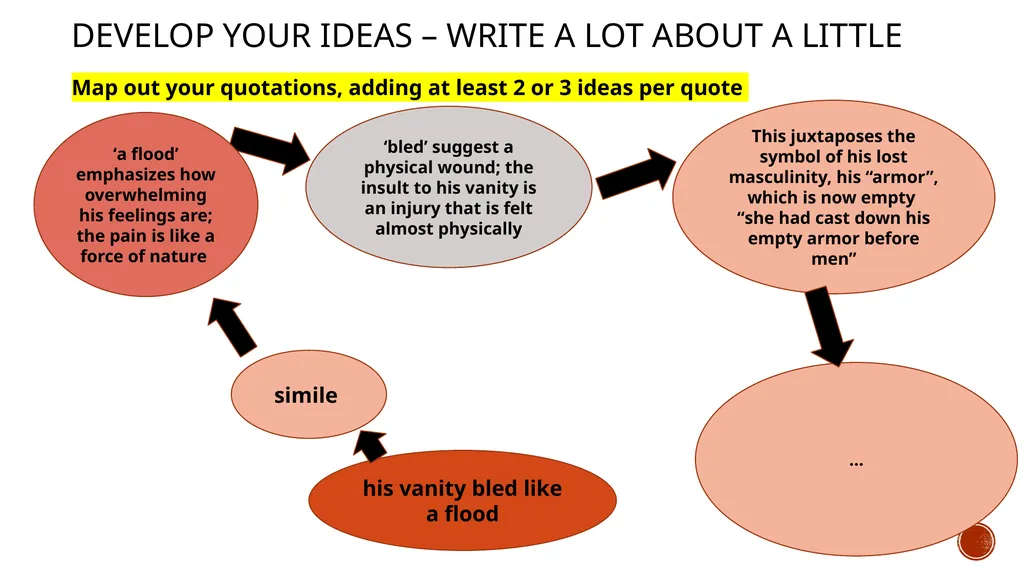
Develop your ideas – Write a lot about a little Map out your quotations, adding at least 2 or 3 ideas per quote his vanity bled like a flood simile ‘a flood’ emphasizes how overwhelming his feelings are; the pain is like a force of nature ‘bled’ suggest a physical wound; the insult to his vanity is an injury that is felt almost physically This juxtaposes the symbol of his lost masculinity, his “armor”, which is now empty
“she had cast down his empty armor before men” …<br>
“she had cast down his empty armor before men” …<br>
07
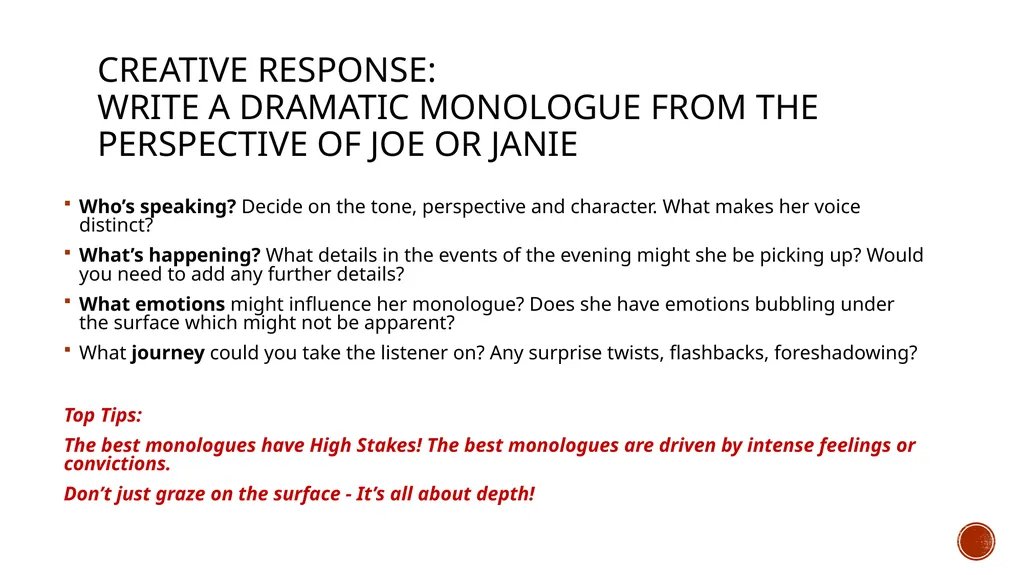
Creative Response:
Write a dramatic monologue from the perspective of Joe or Janie Who’s speaking? Decide on the tone, perspective and character. What makes her voice distinct?
What’s happening? What details in the events of the evening might she be picking up? Would you need to add any further details?
What emotions might influence her monologue? Does she have emotions bubbling under the surface which might not be apparent?
What journey could you take the listener on? Any surprise twists, flashbacks, foreshadowing?
Top Tips:
The best monologues have High Stakes! The best monologues are driven by intense feelings or convictions.
Don’t just graze on the surface - It’s all about depth!<br>
What’s happening? What details in the events of the evening might she be picking up? Would you need to add any further details?
What emotions might influence her monologue? Does she have emotions bubbling under the surface which might not be apparent?
What journey could you take the listener on? Any surprise twists, flashbacks, foreshadowing?
Top Tips:
The best monologues have High Stakes! The best monologues are driven by intense feelings or convictions.
Don’t just graze on the surface - It’s all about depth!<br>
08
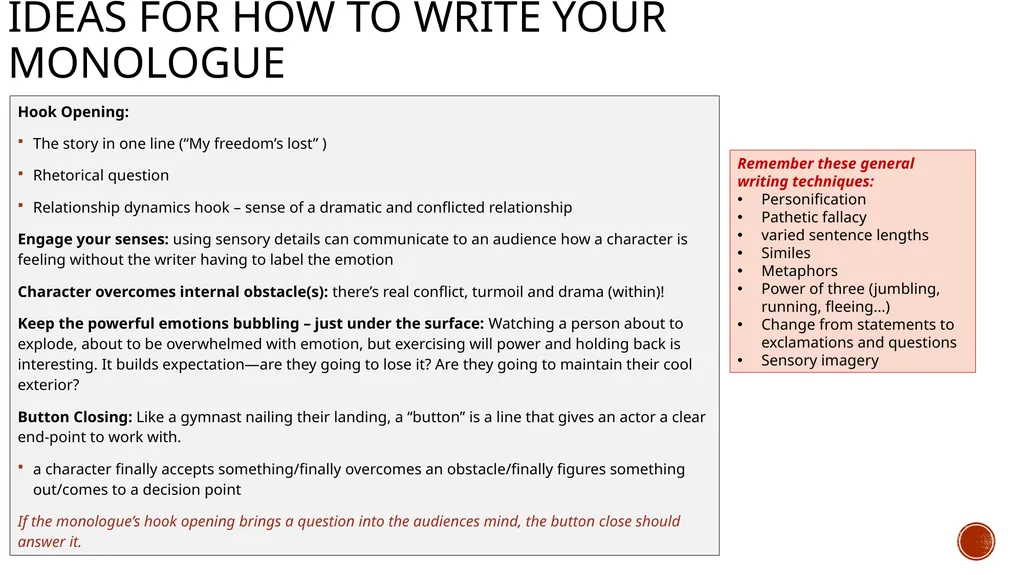
Ideas for how to write your Monologue Hook Opening:
The story in one line (“My freedom’s lost” )
Rhetorical question
Relationship dynamics hook – sense of a dramatic and conflicted relationship
Engage your senses: using sensory details can communicate to an audience how a character is feeling without the writer having to label the emotion
Character overcomes internal obstacle(s): there’s real conflict, turmoil and drama (within)!
Keep the powerful emotions bubbling – just under the surface: Watching a person about to explode, about to be overwhelmed with emotion, but exercising will power and holding back is interesting. It builds expectation—are they going to lose it? Are they going to maintain their cool exterior?
Button Closing: Like a gymnast nailing their landing, a “button” is a line that gives an actor a clear end-point to work with.
a character finally accepts something/finally overcomes an obstacle/finally figures something out/comes to a decision point
If the monologue’s hook opening brings a question into the audiences mind, the button close should answer it. Remember these general writing techniques:
Personification
Pathetic fallacy
varied sentence lengths
Similes
Metaphors
Power of three (jumbling, running, fleeing…)
Change from statements to exclamations and questions
Sensory imagery<br>
The story in one line (“My freedom’s lost” )
Rhetorical question
Relationship dynamics hook – sense of a dramatic and conflicted relationship
Engage your senses: using sensory details can communicate to an audience how a character is feeling without the writer having to label the emotion
Character overcomes internal obstacle(s): there’s real conflict, turmoil and drama (within)!
Keep the powerful emotions bubbling – just under the surface: Watching a person about to explode, about to be overwhelmed with emotion, but exercising will power and holding back is interesting. It builds expectation—are they going to lose it? Are they going to maintain their cool exterior?
Button Closing: Like a gymnast nailing their landing, a “button” is a line that gives an actor a clear end-point to work with.
a character finally accepts something/finally overcomes an obstacle/finally figures something out/comes to a decision point
If the monologue’s hook opening brings a question into the audiences mind, the button close should answer it. Remember these general writing techniques:
Personification
Pathetic fallacy
varied sentence lengths
Similes
Metaphors
Power of three (jumbling, running, fleeing…)
Change from statements to exclamations and questions
Sensory imagery<br>
09
Interview Janie! In pairs of two, you will create an interview with Janie
I – you are the interviewer. Create a list of 5 questions to ask Janie about her experiences and feelings when Joe died and her life after his death.
J – You are Janie – answer your interviewer’s questions!
While the interviewers are drafting their questions:
Create metaphors and similes which you can use in the interview to describe your experience!
(E.g.: Joe’s death as like….. / “Meeting Tea Cake for the first time was like….)<br>
I – you are the interviewer. Create a list of 5 questions to ask Janie about her experiences and feelings when Joe died and her life after his death.
J – You are Janie – answer your interviewer’s questions!
While the interviewers are drafting their questions:
Create metaphors and similes which you can use in the interview to describe your experience!
(E.g.: Joe’s death as like….. / “Meeting Tea Cake for the first time was like….)<br>
10
Death and Rebirth Starter:
Which folkloric ideas about death are you familiar with?
How is Death personified?<br>
Which folkloric ideas about death are you familiar with?
How is Death personified?<br>
11
Halloween folkloric beliefs The spectral hounds of the Welsh underworld are led across the skies... Anyone who hears the clamour of the hunt on the wind is said to be destined to die.
Celts believed that at the time of Samhain, more so than any other time of the year, the ghosts of the dead were able to mingle with the living, because at Samhain the souls of those who had died during the year traveled into the otherworld.<br>
Celts believed that at the time of Samhain, more so than any other time of the year, the ghosts of the dead were able to mingle with the living, because at Samhain the souls of those who had died during the year traveled into the otherworld.<br>
12
Joe’s Death.
Chapter 8 – Quickfire Questions Consider the language in the statement from page 92, “But the stillness was the sleep of swords.” What are the connotations of this description? How does the use of alliteration increase the effectiveness of the language?
What is Joe implying when he refuses to eat the soup that Janie makes for him?
What rumour might people be spreading about Janie (page 95, 96)?
Janie uses the term “multiplied cockroach” to describe the sham doctor that Joe hires. What are the connotations of calling someone a “multiplied cockroach” (p. 97)? How is it different from simply being called a “cockroach”?<br>
What is Joe implying when he refuses to eat the soup that Janie makes for him?
What rumour might people be spreading about Janie (page 95, 96)?
Janie uses the term “multiplied cockroach” to describe the sham doctor that Joe hires. What are the connotations of calling someone a “multiplied cockroach” (p. 97)? How is it different from simply being called a “cockroach”?<br>
13
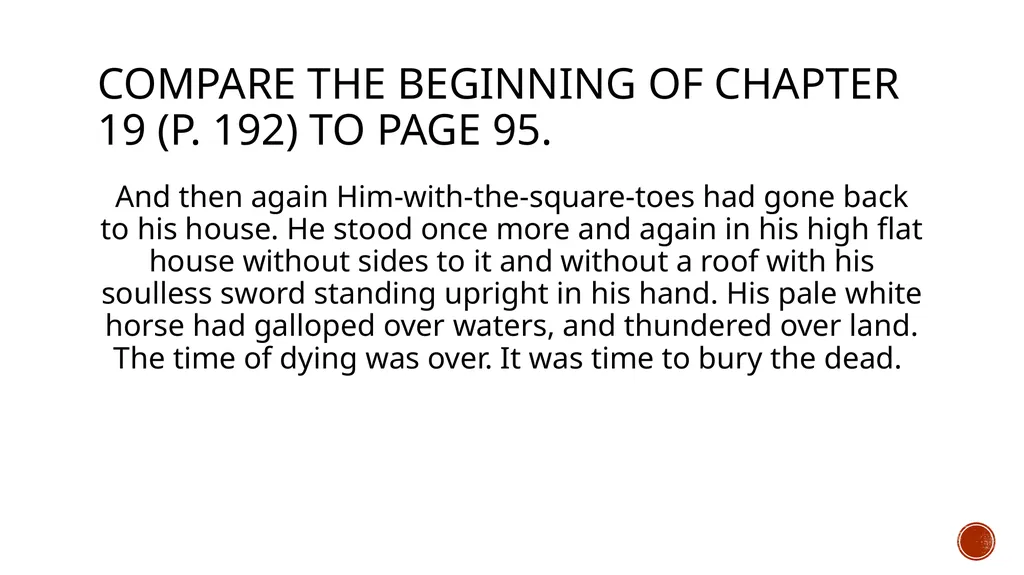
Chapter 8: Personifying Death (95) So Janie began to think of Death. Death, that strange being with the huge square toes who lived way in the West. The great one who lived in the straight house like a platform without sides to it, and without a roof. What need has Death for a cover, and what winds can blow against him? He stands in his high house that overlooks the world. Stands watchful and motionless all day with his sword drawn back, waiting for the messenger to bid him come. Been standing there before there was a where or a when or a then. She was liable to find a feather from his wings lying in her yard any day now. She was sad and afraid too.
Poor Jody! He ought not to have to wrassle in there by himself. She sent Sam in to suggest a visit, but Jody said No. These medical doctors wuz all right with the Godly sick, but they didn’t know a thing about a case like his. He’d be all right just as soon as the twoheaded man found what had been buried against him. He wasn’t going to die at all. That was what he thought. But Sam told her different, so she knew. And then if he hadn’t, the next morning she was bound to know, for people began to gather in the big yard under the palm and china-berry trees. People who would not have dared to foot the place before crept in and did not come to the house. Just squatted under the trees and waited. Rumor, that wingless bird, had shadowed over the town. Sketch Death, adding quotes and critical ideas
What is the significance of Death’s house?
Why does she emphasize the ‘huge square toes’?
What’s Death’s attitude towards the living world?
Extension: How does Hurston personify rumour? How does this compare to Death?<br>
Poor Jody! He ought not to have to wrassle in there by himself. She sent Sam in to suggest a visit, but Jody said No. These medical doctors wuz all right with the Godly sick, but they didn’t know a thing about a case like his. He’d be all right just as soon as the twoheaded man found what had been buried against him. He wasn’t going to die at all. That was what he thought. But Sam told her different, so she knew. And then if he hadn’t, the next morning she was bound to know, for people began to gather in the big yard under the palm and china-berry trees. People who would not have dared to foot the place before crept in and did not come to the house. Just squatted under the trees and waited. Rumor, that wingless bird, had shadowed over the town. Sketch Death, adding quotes and critical ideas
What is the significance of Death’s house?
Why does she emphasize the ‘huge square toes’?
What’s Death’s attitude towards the living world?
Extension: How does Hurston personify rumour? How does this compare to Death?<br>
14
Compare and Contrast! Those eerie square toes reappear in Hurston’s autobiography as she describes the day her mother died. Hurston was nine years old and no match against "that two-headed spirit that rules the beginning and end of things called Death."
How do both versions compare and contrast?
What might be the reason for any differences or similarities?
The Master-Maker in His making had made Old Death. Made him with big, soft feet and square toes. Made him with a face that reflects the face of all things, but neither changes itself, nor is mirrored anywhere. Made the body of Death out of infinite hunger. Made a weapon for his hand to satisfy his needs. ... Death had no home and he knew it at once. ... He was already old when he was made Death finished his prowling through the house on his padded feet and entered the room. He bowed to Mama—<br>
How do both versions compare and contrast?
What might be the reason for any differences or similarities?
The Master-Maker in His making had made Old Death. Made him with big, soft feet and square toes. Made him with a face that reflects the face of all things, but neither changes itself, nor is mirrored anywhere. Made the body of Death out of infinite hunger. Made a weapon for his hand to satisfy his needs. ... Death had no home and he knew it at once. ... He was already old when he was made Death finished his prowling through the house on his padded feet and entered the room. He bowed to Mama—<br>
15
Compare and Contrast: “Go Down Death" by James Weldon Johnson Available here: https://poets.org/poem/go-down-death<br>
16
What emotions do these Personified Deaths Inspire? Label the details in your sketch with emotions they might inspire
Fear bitterness frustration helplessness acceptance terror fright consternation dismay dread unease trepidation agitation horror alarm anxiety
What emotions might Janie be feeling at this moment?<br>
Fear bitterness frustration helplessness acceptance terror fright consternation dismay dread unease trepidation agitation horror alarm anxiety
What emotions might Janie be feeling at this moment?<br>
17
Is ZNH’s personification of death Frightening? Place them both on a terror scale:
1 – not alarming at all
5 – quite frightening
10 – absolute terror<br>
1 – not alarming at all
5 – quite frightening
10 – absolute terror<br>
18
at the Deathbed: Channelling the reader’s sympathies LO: What strategies can writers use to channel the reader’s sympathies? You feel sorry for an abandoned puppy or kitten and want your family to adopt it. How do you describe it in a way that will make your family sympathize with the animal?
One of your siblings or friends really does not want a dog or cat in the house – how would they describe the animal?<br>
One of your siblings or friends really does not want a dog or cat in the house – how would they describe the animal?<br>
19
In each quote, who do you sympathize with – Joe or Janie? After the fight: After that night Jody moved his things and slept in a room downstairs. He didn’t really hate Janie, but he wanted her to think so. He had crawled off to lick his wounds.
When Janie finds out Jo is having an elderly neighbour cook for him: So she bought a beef-bone and made him some soup. “Naw, thank you,” he told her shortly. “Ah’m havin’ uh hard enough time tuh try and git well as it is.” She was stunned at first and hurt afterwards.
Joe got too weak to look after things and took to his bed. But he relentlessly refused to admit her to his sick room.
She got up that morning with the firm determination to go on in there and have a good talk with Jody. But she sat a long time with the walls creeping in on her. Four walls squeezing her breath out. Fear lest he depart while she sat trembling upstairs nerved her.
About Joe: Weaklooking but sharp-pointed about the eyes. Through the thin counterpane she could see what was left of his belly huddled before him on the bed like some helpless thing seeking shelter.
“Yeah, Jody, don’t keer whut dat multiplied cockroach told yuh tuh git yo’ money, you got tuh die, and yuh can’t live.” A deep sob came out of Jody’s weak frame. It was like beating a bass drum in a hen-house. Then it rose high like pulling in a trombone.<br>
When Janie finds out Jo is having an elderly neighbour cook for him: So she bought a beef-bone and made him some soup. “Naw, thank you,” he told her shortly. “Ah’m havin’ uh hard enough time tuh try and git well as it is.” She was stunned at first and hurt afterwards.
Joe got too weak to look after things and took to his bed. But he relentlessly refused to admit her to his sick room.
She got up that morning with the firm determination to go on in there and have a good talk with Jody. But she sat a long time with the walls creeping in on her. Four walls squeezing her breath out. Fear lest he depart while she sat trembling upstairs nerved her.
About Joe: Weaklooking but sharp-pointed about the eyes. Through the thin counterpane she could see what was left of his belly huddled before him on the bed like some helpless thing seeking shelter.
“Yeah, Jody, don’t keer whut dat multiplied cockroach told yuh tuh git yo’ money, you got tuh die, and yuh can’t live.” A deep sob came out of Jody’s weak frame. It was like beating a bass drum in a hen-house. Then it rose high like pulling in a trombone.<br>
20
Conflict At the deathbed:
How does Zora Hurston channel the reader’s sympathies? Your first impression:
Was Janie right to confront Joe on his deathbed?
What does this show about her?
What reasons might she have had?
How can writers channel the readers’ sympathies?
To make readers empathize and sympathise with a character, authors might…
Write from that character’s point of view
Use language with emotional connotations – adjectives, verbs, nouns…
Give details about their background or reasons for acting the way they do
…<br>
Was Janie right to confront Joe on his deathbed?
What does this show about her?
What reasons might she have had?
How can writers channel the readers’ sympathies?
To make readers empathize and sympathise with a character, authors might…
Write from that character’s point of view
Use language with emotional connotations – adjectives, verbs, nouns…
Give details about their background or reasons for acting the way they do
…<br>
21
Conflict At the deathbed:
How does Zora Hurston channel the reader’s sympathies? Colour-code the extract:
In one colour, highlight any moments where you feel that Hurston is making you empathize / sympathize with JOE
In another colour, highlight any moments where you feel that Hurston is making you empathize / sympathize with JANIE
Annotate the quotes you highlight, labelling the techniques which Hurston uses
How does Hurston influence the reader’s sympathies in this extract? Write one paragraph!
2-3 quotes
To do especially well: compare quotes in which Hurston creates sympathy for Joe and Janie. Use 2 quotes each. Come to a conclusion – sympathy for which character dominates?<br>
In one colour, highlight any moments where you feel that Hurston is making you empathize / sympathize with JOE
In another colour, highlight any moments where you feel that Hurston is making you empathize / sympathize with JANIE
Annotate the quotes you highlight, labelling the techniques which Hurston uses
How does Hurston influence the reader’s sympathies in this extract? Write one paragraph!
2-3 quotes
To do especially well: compare quotes in which Hurston creates sympathy for Joe and Janie. Use 2 quotes each. Come to a conclusion – sympathy for which character dominates?<br>
22
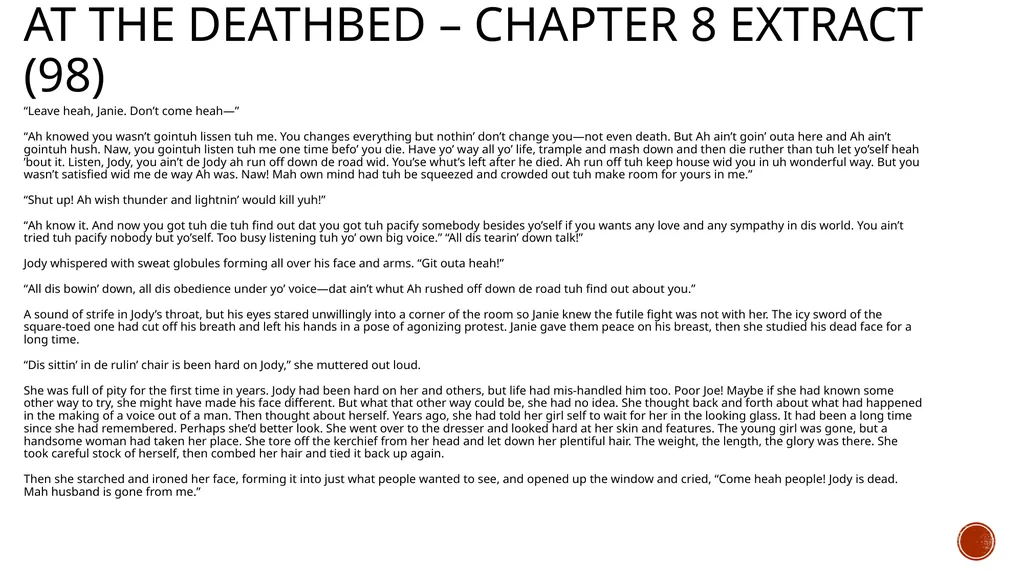
At the deathbed – chapter 8 extract (98) “Leave heah, Janie. Don’t come heah—”
“Ah knowed you wasn’t gointuh lissen tuh me. You changes everything but nothin’ don’t change you—not even death. But Ah ain’t goin’ outa here and Ah ain’t gointuh hush. Naw, you gointuh listen tuh me one time befo’ you die. Have yo’ way all yo’ life, trample and mash down and then die ruther than tuh let yo’self heah ’bout it. Listen, Jody, you ain’t de Jody ah run off down de road wid. You’se whut’s left after he died. Ah run off tuh keep house wid you in uh wonderful way. But you wasn’t satisfied wid me de way Ah was. Naw! Mah own mind had tuh be squeezed and crowded out tuh make room for yours in me.”
“Shut up! Ah wish thunder and lightnin’ would kill yuh!”
“Ah know it. And now you got tuh die tuh find out dat you got tuh pacify somebody besides yo’self if you wants any love and any sympathy in dis world. You ain’t tried tuh pacify nobody but yo’self. Too busy listening tuh yo’ own big voice.” “All dis tearin’ down talk!”
Jody whispered with sweat globules forming all over his face and arms. “Git outa heah!”
“All dis bowin’ down, all dis obedience under yo’ voice—dat ain’t whut Ah rushed off down de road tuh find out about you.”
A sound of strife in Jody’s throat, but his eyes stared unwillingly into a corner of the room so Janie knew the futile fight was not with her. The icy sword of the square-toed one had cut off his breath and left his hands in a pose of agonizing protest. Janie gave them peace on his breast, then she studied his dead face for a long time.
“Dis sittin’ in de rulin’ chair is been hard on Jody,” she muttered out loud.
She was full of pity for the first time in years. Jody had been hard on her and others, but life had mis-handled him too. Poor Joe! Maybe if she had known some other way to try, she might have made his face different. But what that other way could be, she had no idea. She thought back and forth about what had happened in the making of a voice out of a man. Then thought about herself. Years ago, she had told her girl self to wait for her in the looking glass. It had been a long time since she had remembered. Perhaps she’d better look. She went over to the dresser and looked hard at her skin and features. The young girl was gone, but a handsome woman had taken her place. She tore off the kerchief from her head and let down her plentiful hair. The weight, the length, the glory was there. She took careful stock of herself, then combed her hair and tied it back up again.
Then she starched and ironed her face, forming it into just what people wanted to see, and opened up the window and cried, “Come heah people! Jody is dead. Mah husband is gone from me.”<br>
“Ah knowed you wasn’t gointuh lissen tuh me. You changes everything but nothin’ don’t change you—not even death. But Ah ain’t goin’ outa here and Ah ain’t gointuh hush. Naw, you gointuh listen tuh me one time befo’ you die. Have yo’ way all yo’ life, trample and mash down and then die ruther than tuh let yo’self heah ’bout it. Listen, Jody, you ain’t de Jody ah run off down de road wid. You’se whut’s left after he died. Ah run off tuh keep house wid you in uh wonderful way. But you wasn’t satisfied wid me de way Ah was. Naw! Mah own mind had tuh be squeezed and crowded out tuh make room for yours in me.”
“Shut up! Ah wish thunder and lightnin’ would kill yuh!”
“Ah know it. And now you got tuh die tuh find out dat you got tuh pacify somebody besides yo’self if you wants any love and any sympathy in dis world. You ain’t tried tuh pacify nobody but yo’self. Too busy listening tuh yo’ own big voice.” “All dis tearin’ down talk!”
Jody whispered with sweat globules forming all over his face and arms. “Git outa heah!”
“All dis bowin’ down, all dis obedience under yo’ voice—dat ain’t whut Ah rushed off down de road tuh find out about you.”
A sound of strife in Jody’s throat, but his eyes stared unwillingly into a corner of the room so Janie knew the futile fight was not with her. The icy sword of the square-toed one had cut off his breath and left his hands in a pose of agonizing protest. Janie gave them peace on his breast, then she studied his dead face for a long time.
“Dis sittin’ in de rulin’ chair is been hard on Jody,” she muttered out loud.
She was full of pity for the first time in years. Jody had been hard on her and others, but life had mis-handled him too. Poor Joe! Maybe if she had known some other way to try, she might have made his face different. But what that other way could be, she had no idea. She thought back and forth about what had happened in the making of a voice out of a man. Then thought about herself. Years ago, she had told her girl self to wait for her in the looking glass. It had been a long time since she had remembered. Perhaps she’d better look. She went over to the dresser and looked hard at her skin and features. The young girl was gone, but a handsome woman had taken her place. She tore off the kerchief from her head and let down her plentiful hair. The weight, the length, the glory was there. She took careful stock of herself, then combed her hair and tied it back up again.
Then she starched and ironed her face, forming it into just what people wanted to see, and opened up the window and cried, “Come heah people! Jody is dead. Mah husband is gone from me.”<br>
23
Evaluate the Author's choices In your opinion, why does Zora Neale Hurston decide to stage Joe’s death during a fight with Janie?
What does this suggest about…
Joe?
Janie?
Joe and Janie’s relationship?<br>
What does this suggest about…
Joe?
Janie?
Joe and Janie’s relationship?<br>
24
After the Funeral: A Moment of Renewal? LO: to explore how Hurston presents moments of renewal and rebirth Which moments of renewal, rebirth or liberation can you remember from the book?
How and when do characters reinvent themselves?<br>
How and when do characters reinvent themselves?<br>
25
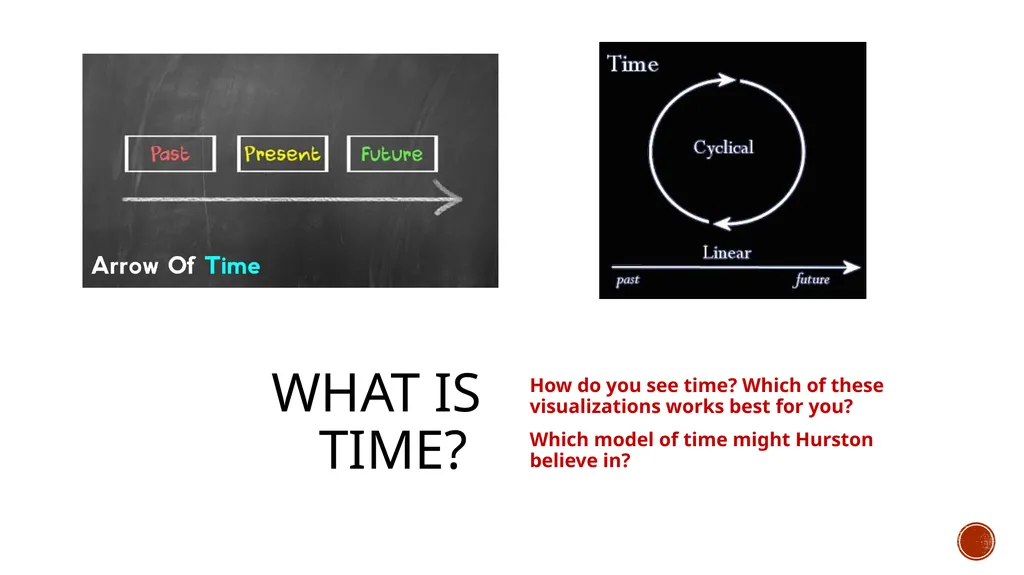
What is time? How do you see time? Which of these visualizations works best for you?
Which model of time might Hurston believe in?<br>
Which model of time might Hurston believe in?<br>
26
Which model of time does ZNH suggest with her imagery? Arrow of Time Beginning and end (creation and salvation/destruction)
Christianity and Western culture (belief in an omnipotent creator god)
Passing of time – also in the sense of ‘time running out’ Cyclical Time Observing seasonal or generational cycles
Concept of re-births
prevalent among the Hindus and the pre-Christian Greeks, the Chinese, and the Aztecs<br>
Christianity and Western culture (belief in an omnipotent creator god)
Passing of time – also in the sense of ‘time running out’ Cyclical Time Observing seasonal or generational cycles
Concept of re-births
prevalent among the Hindus and the pre-Christian Greeks, the Chinese, and the Aztecs<br>
27
Beginning of chapter 9 – Joe’s funeral Joe’s funeral was the finest thing Orange County had ever seen with Negro eyes. The motor hearse, the Cadillac and Buick carriages; Dr. Henderson there in his Lincoln; the hosts from far and wide. Then again the gold and red and purple, the gloat and glamor of the secret orders, each with its insinuations of power and glory undreamed of by the uninitiated. People on farm horses and mules; babies riding astride of brothers’ and sisters’ backs. The Elks band ranked at the church door and playing “Safe in the Arms of Jesus” with such a dominant drum rhythm that it could be stepped off smartly by the long line as it filed inside. The Little Emperor of the cross-roads was leaving Orange County as he had come—with the out-stretched hand of power.
Janie starched and ironed her face and came set in the funeral behind her veil. It was like a wall of stone and steel. The funeral was going on outside. All things concerning death and burial were said and done. Finish. End. Never-more. Darkness. Deep hole. Dissolution. Eternity. Weeping and wailing outside. Inside the expensive black folds were resurrection and life. She did not reach outside for anything, nor did the things of death reach inside to disturb her calm. She sent her face to Joe’s funeral, and herself went rollicking with the springtime across the world. After a while the people finished their celebration and Janie went on home.
Before she slept that night she burnt up every one of her head rags and went about the house next morning with her hair in one thick braid swinging well below her waist. That was the only change people saw in her. She kept the store in the same way except of evenings she sat on the porch and listened and sent Hezekiah in to wait on late custom. She saw no reason to rush at changing things around. She would have the rest of her life to do as she pleased. Hurston refers to Joe as “The Little Emperor of the cross-roads.” What tone does she use here? What attitude towards Joe does this suggest?
What metaphor describes Janie’s preparation for the funeral? What can you infer from this about Janie’s emotions at this point?
How does she feel behind the funeral veil? What does she realize?
What symbol shows Janie’s moment of rebirth? How does this compare to the symbol of the pear tree?<br>
Janie starched and ironed her face and came set in the funeral behind her veil. It was like a wall of stone and steel. The funeral was going on outside. All things concerning death and burial were said and done. Finish. End. Never-more. Darkness. Deep hole. Dissolution. Eternity. Weeping and wailing outside. Inside the expensive black folds were resurrection and life. She did not reach outside for anything, nor did the things of death reach inside to disturb her calm. She sent her face to Joe’s funeral, and herself went rollicking with the springtime across the world. After a while the people finished their celebration and Janie went on home.
Before she slept that night she burnt up every one of her head rags and went about the house next morning with her hair in one thick braid swinging well below her waist. That was the only change people saw in her. She kept the store in the same way except of evenings she sat on the porch and listened and sent Hezekiah in to wait on late custom. She saw no reason to rush at changing things around. She would have the rest of her life to do as she pleased. Hurston refers to Joe as “The Little Emperor of the cross-roads.” What tone does she use here? What attitude towards Joe does this suggest?
What metaphor describes Janie’s preparation for the funeral? What can you infer from this about Janie’s emotions at this point?
How does she feel behind the funeral veil? What does she realize?
What symbol shows Janie’s moment of rebirth? How does this compare to the symbol of the pear tree?<br>
28
How does this compare to the mule’s funeral? Out in the swamp they made great ceremony over the mule. They mocked everything human in death. Starks led off with a great eulogy on our departed citizen, our most distinguished citizen and the grief he left behind him, and the people loved the speech. It made him more solid than building the schoolhouse had done. He stood on the distended belly of the mule for a platform and made gestures. When he stepped down, they hoisted Sam up and he talked about the mule as a school teacher first. Then he set his hat like John Pearson and imitated his preaching. He spoke of the joys of mule-heaven to which the dear brother had departed this valley of sorrow; the mule-angels flying around; the miles of green corn and cool water, a pasture of pure bran with a river of molasses running through it; and most glorious of all, No Matt Bonner with plow lines and halters to come in and corrupt. Up there, mule-angels would have people to ride on and from his place beside the glittering throne, the dear departed brother would look down into hell and see the devil plowing Matt Bonner all day long in a hell-hot sun and laying the rawhide to his back.
With that the sisters got mock-happy and shouted and had to be held up by the menfolks. Everybody enjoyed themselves to the highest and then finally the mule was left to the already impatient buzzards. They were holding a great flying-meet way up over the heads of the mourners and some of the nearby trees were already peopled with the stoop-shouldered forms.
As soon as the crowd was out of sight they closed in circles. The near ones got nearer and the far ones got near. A circle, a swoop and a hop with spread-out wings. Close in, close in till some of the more hungry or daring perched on the carcass. They wanted to begin, but the Parson wasn’t there, so a messenger was sent to the ruler in a tree where he sat.
The flock had to wait the white-headed leader, but it was hard. They jostled each other and pecked at heads in hungry irritation. Some walked up and down the beast from head to tail, tail to head. The Parson sat motionless in a dead pine tree about two miles off. He had scented the matter as quickly as any of the rest, but decorum demanded that he sit oblivious until he was notified. Then he took off with ponderous flight and circled and lowered, circled and lowered until the others danced in joy and hunger at his approach. He finally lit on the ground and walked around the body to see if it were really dead. Peered into its nose and mouth. Examined it well from end to end and leaped upon it and bowed, and the others danced a response. That being over, he balanced and asked:
“What killed this man?” The chorus answered, “Bare, bare fat.” “What killed this man?” “Bare, bare fat.” “What killed this man?” “Bare, bare fat.” “Who’ll stand his funeral?” “We!!!!!” “Well, all right now.”
So he picked out the eyes in the ceremonial way and the feast went on. The yaller mule was gone from the town except for the porch talk, and for the children visiting his bleaching bones now and then in the spirit of adventure.<br>
With that the sisters got mock-happy and shouted and had to be held up by the menfolks. Everybody enjoyed themselves to the highest and then finally the mule was left to the already impatient buzzards. They were holding a great flying-meet way up over the heads of the mourners and some of the nearby trees were already peopled with the stoop-shouldered forms.
As soon as the crowd was out of sight they closed in circles. The near ones got nearer and the far ones got near. A circle, a swoop and a hop with spread-out wings. Close in, close in till some of the more hungry or daring perched on the carcass. They wanted to begin, but the Parson wasn’t there, so a messenger was sent to the ruler in a tree where he sat.
The flock had to wait the white-headed leader, but it was hard. They jostled each other and pecked at heads in hungry irritation. Some walked up and down the beast from head to tail, tail to head. The Parson sat motionless in a dead pine tree about two miles off. He had scented the matter as quickly as any of the rest, but decorum demanded that he sit oblivious until he was notified. Then he took off with ponderous flight and circled and lowered, circled and lowered until the others danced in joy and hunger at his approach. He finally lit on the ground and walked around the body to see if it were really dead. Peered into its nose and mouth. Examined it well from end to end and leaped upon it and bowed, and the others danced a response. That being over, he balanced and asked:
“What killed this man?” The chorus answered, “Bare, bare fat.” “What killed this man?” “Bare, bare fat.” “What killed this man?” “Bare, bare fat.” “Who’ll stand his funeral?” “We!!!!!” “Well, all right now.”
So he picked out the eyes in the ceremonial way and the feast went on. The yaller mule was gone from the town except for the porch talk, and for the children visiting his bleaching bones now and then in the spirit of adventure.<br>
29
Compare both funerals Mule funeral Joe’s funeral What attitudes do the mourners show, and what tone does the narrative voice use?
How is death/the dead body presented? Is it explicitly described or hidden from sight? Why? The mule funeral precedes Joe’s death, and both happen not far apart in the novel – what is the effect of this structural choice? What attitudes do the mourners show, and what tone does the narrative voice use?
How is death/the dead body presented? Is it explicitly described or hidden from sight? Why?<br>
How is death/the dead body presented? Is it explicitly described or hidden from sight? Why? The mule funeral precedes Joe’s death, and both happen not far apart in the novel – what is the effect of this structural choice? What attitudes do the mourners show, and what tone does the narrative voice use?
How is death/the dead body presented? Is it explicitly described or hidden from sight? Why?<br>
30
From Mud-ball to Spark:
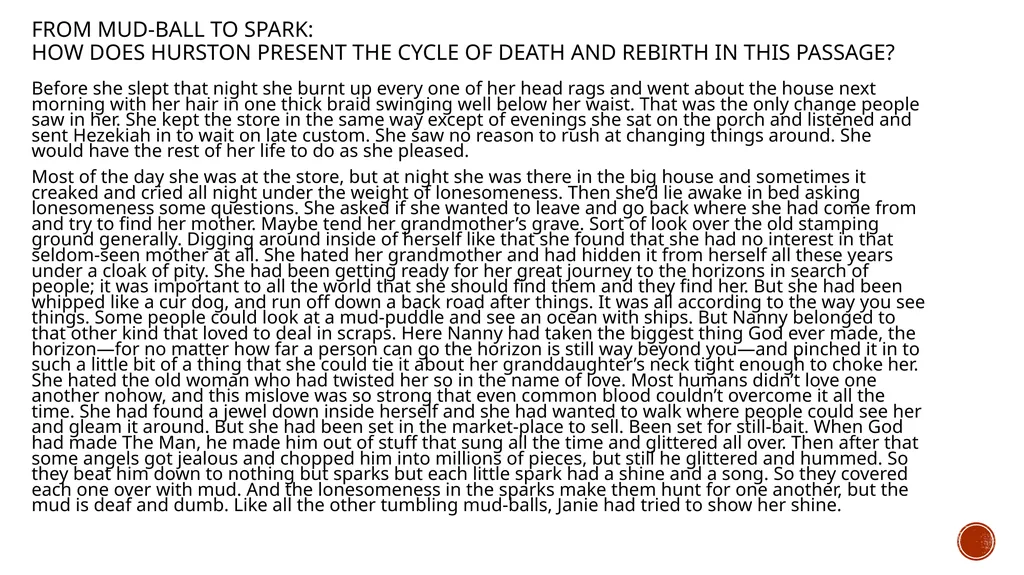
How does Hurston present the cycle of death and rebirth in this passage? Before she slept that night she burnt up every one of her head rags and went about the house next morning with her hair in one thick braid swinging well below her waist. That was the only change people saw in her. She kept the store in the same way except of evenings she sat on the porch and listened and sent Hezekiah in to wait on late custom. She saw no reason to rush at changing things around. She would have the rest of her life to do as she pleased.
Most of the day she was at the store, but at night she was there in the big house and sometimes it creaked and cried all night under the weight of lonesomeness. Then she’d lie awake in bed asking lonesomeness some questions. She asked if she wanted to leave and go back where she had come from and try to find her mother. Maybe tend her grandmother’s grave. Sort of look over the old stamping ground generally. Digging around inside of herself like that she found that she had no interest in that seldom-seen mother at all. She hated her grandmother and had hidden it from herself all these years under a cloak of pity. She had been getting ready for her great journey to the horizons in search of people; it was important to all the world that she should find them and they find her. But she had been whipped like a cur dog, and run off down a back road after things. It was all according to the way you see things. Some people could look at a mud-puddle and see an ocean with ships. But Nanny belonged to that other kind that loved to deal in scraps. Here Nanny had taken the biggest thing God ever made, the horizon—for no matter how far a person can go the horizon is still way beyond you—and pinched it in to such a little bit of a thing that she could tie it about her granddaughter’s neck tight enough to choke her. She hated the old woman who had twisted her so in the name of love. Most humans didn’t love one another nohow, and this mislove was so strong that even common blood couldn’t overcome it all the time. She had found a jewel down inside herself and she had wanted to walk where people could see her and gleam it around. But she had been set in the market-place to sell. Been set for still-bait. When God had made The Man, he made him out of stuff that sung all the time and glittered all over. Then after that some angels got jealous and chopped him into millions of pieces, but still he glittered and hummed. So they beat him down to nothing but sparks but each little spark had a shine and a song. So they covered each one over with mud. And the lonesomeness in the sparks make them hunt for one another, but the mud is deaf and dumb. Like all the other tumbling mud-balls, Janie had tried to show her shine.<br>
Most of the day she was at the store, but at night she was there in the big house and sometimes it creaked and cried all night under the weight of lonesomeness. Then she’d lie awake in bed asking lonesomeness some questions. She asked if she wanted to leave and go back where she had come from and try to find her mother. Maybe tend her grandmother’s grave. Sort of look over the old stamping ground generally. Digging around inside of herself like that she found that she had no interest in that seldom-seen mother at all. She hated her grandmother and had hidden it from herself all these years under a cloak of pity. She had been getting ready for her great journey to the horizons in search of people; it was important to all the world that she should find them and they find her. But she had been whipped like a cur dog, and run off down a back road after things. It was all according to the way you see things. Some people could look at a mud-puddle and see an ocean with ships. But Nanny belonged to that other kind that loved to deal in scraps. Here Nanny had taken the biggest thing God ever made, the horizon—for no matter how far a person can go the horizon is still way beyond you—and pinched it in to such a little bit of a thing that she could tie it about her granddaughter’s neck tight enough to choke her. She hated the old woman who had twisted her so in the name of love. Most humans didn’t love one another nohow, and this mislove was so strong that even common blood couldn’t overcome it all the time. She had found a jewel down inside herself and she had wanted to walk where people could see her and gleam it around. But she had been set in the market-place to sell. Been set for still-bait. When God had made The Man, he made him out of stuff that sung all the time and glittered all over. Then after that some angels got jealous and chopped him into millions of pieces, but still he glittered and hummed. So they beat him down to nothing but sparks but each little spark had a shine and a song. So they covered each one over with mud. And the lonesomeness in the sparks make them hunt for one another, but the mud is deaf and dumb. Like all the other tumbling mud-balls, Janie had tried to show her shine.<br>
31
From Mud-ball to Spark:
How does Hurston present the cycle of death and rebirth in this passage? Flick through the ‘style’ literacy cards
Write down a number of questions to ask about the style of this extract
Swap your questions and discuss
Examples:
Structure: Why does Hurston start the passage in Janie’s house, but end it with a short creation myth? How would you describe this shift?
Narrative voice: What narrative perspective is used here? To what effect does Hurston use it?
Imagery: What do Janie’s hair, the shop and the horizon symbolize?
Word choice and connotations: What are the connotations of the verbs “pinched” and “choke”? What is the effect of these word choices?<br>
Write down a number of questions to ask about the style of this extract
Swap your questions and discuss
Examples:
Structure: Why does Hurston start the passage in Janie’s house, but end it with a short creation myth? How would you describe this shift?
Narrative voice: What narrative perspective is used here? To what effect does Hurston use it?
Imagery: What do Janie’s hair, the shop and the horizon symbolize?
Word choice and connotations: What are the connotations of the verbs “pinched” and “choke”? What is the effect of these word choices?<br>
32
Make sure your questions ask about these 4 elements: Structure (prolepsis / foreshadowing, analepsis, contrast between atmosphere of different paragraphs, intensifying tension, cyclical structure, etc)
Narrative voice (tone, perspective, attitude…)
Imagery (personification, metaphors, similes)
Word choice and connotations Structure: Why does Hurston start the passage in Janie’s house, but end it with a short creation myth? How would you describe this shift?
Narrative voice: What narrative perspective is used here? To what effect does Hurston use it?
Imagery: What do Janie’s hair, the shop and the horizon symbolize?
Word choice and connotations: What are the connotations of the verbs “pinched” and “choke”? What is the effect of these word choices?<br>
Narrative voice (tone, perspective, attitude…)
Imagery (personification, metaphors, similes)
Word choice and connotations Structure: Why does Hurston start the passage in Janie’s house, but end it with a short creation myth? How would you describe this shift?
Narrative voice: What narrative perspective is used here? To what effect does Hurston use it?
Imagery: What do Janie’s hair, the shop and the horizon symbolize?
Word choice and connotations: What are the connotations of the verbs “pinched” and “choke”? What is the effect of these word choices?<br>
33
Check each other’s work Are your topic sentences clear ?
Are quotes fluently embedded in your sentences?
Do you use precise vocabulary?
Do you use connectives to link your argument?
Your peer-marking needs to include:
Two ‘ticks’ stating which of the above criteria you achieved
One target (for example: use connectives)
Highlight particular successes:
Links to other parts of the novel
Evaluation of narrative perspective / free indirect discourse
Discussion of alternative interpretations of a quote, or of ambivalent / ambiguous meanings
Awareness of a character or idea to be complex – one motif/character/idea might have different sides, might have positives and negatives
Discussion of themes and contexts<br>
Are quotes fluently embedded in your sentences?
Do you use precise vocabulary?
Do you use connectives to link your argument?
Your peer-marking needs to include:
Two ‘ticks’ stating which of the above criteria you achieved
One target (for example: use connectives)
Highlight particular successes:
Links to other parts of the novel
Evaluation of narrative perspective / free indirect discourse
Discussion of alternative interpretations of a quote, or of ambivalent / ambiguous meanings
Awareness of a character or idea to be complex – one motif/character/idea might have different sides, might have positives and negatives
Discussion of themes and contexts<br>
34
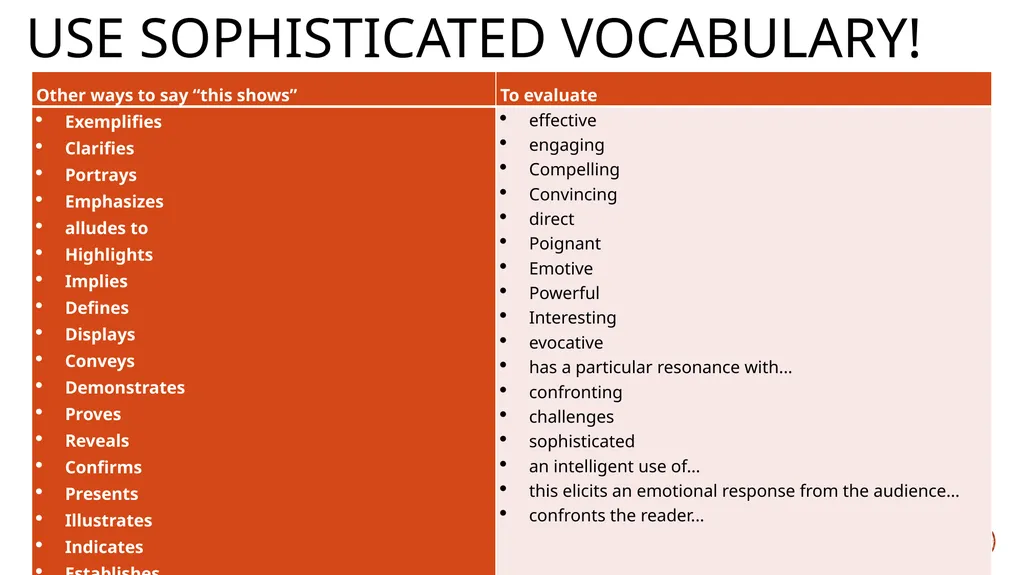
Use sophisticated Vocabulary!<br>
35
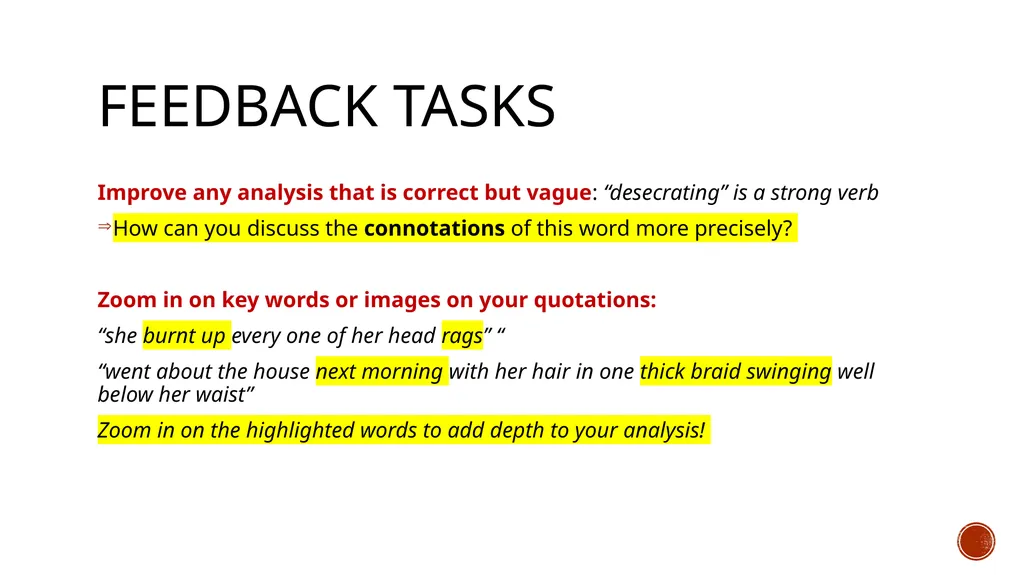
Feedback Tasks Improve any analysis that is correct but vague: “desecrating” is a strong verb
How can you discuss the connotations of this word more precisely?
Zoom in on key words or images on your quotations:
“she burnt up every one of her head rags” “
“went about the house next morning with her hair in one thick braid swinging well below her waist”
Zoom in on the highlighted words to add depth to your analysis!<br>
How can you discuss the connotations of this word more precisely?
Zoom in on key words or images on your quotations:
“she burnt up every one of her head rags” “
“went about the house next morning with her hair in one thick braid swinging well below her waist”
Zoom in on the highlighted words to add depth to your analysis!<br>
36
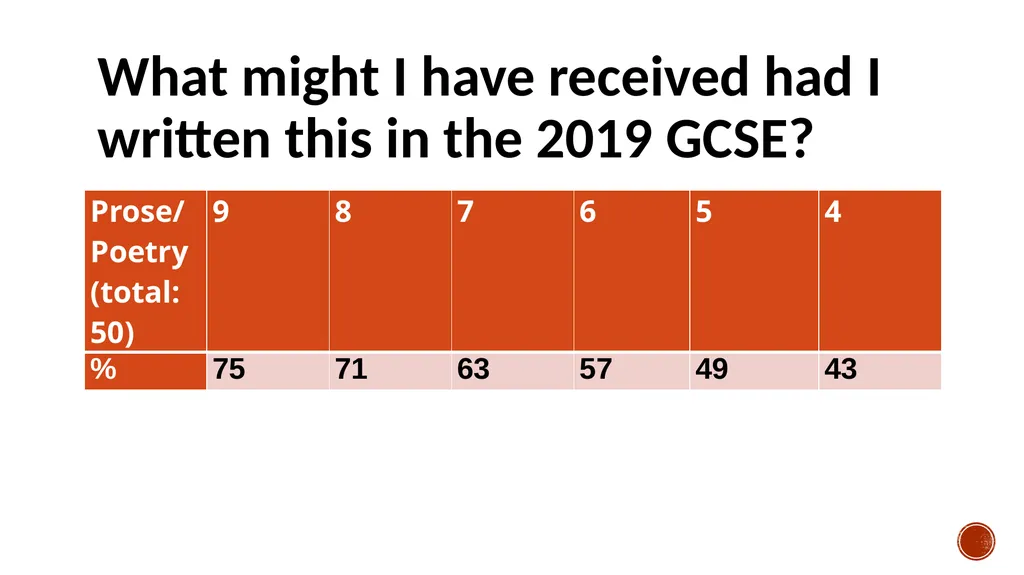
What might I have received had I written this in the 2019 GCSE?<br>
37
Enter Tea Cake LO: to debate whether Tea Cake represents a new start for Janie, or the beginning of another failed marriage<br>
38
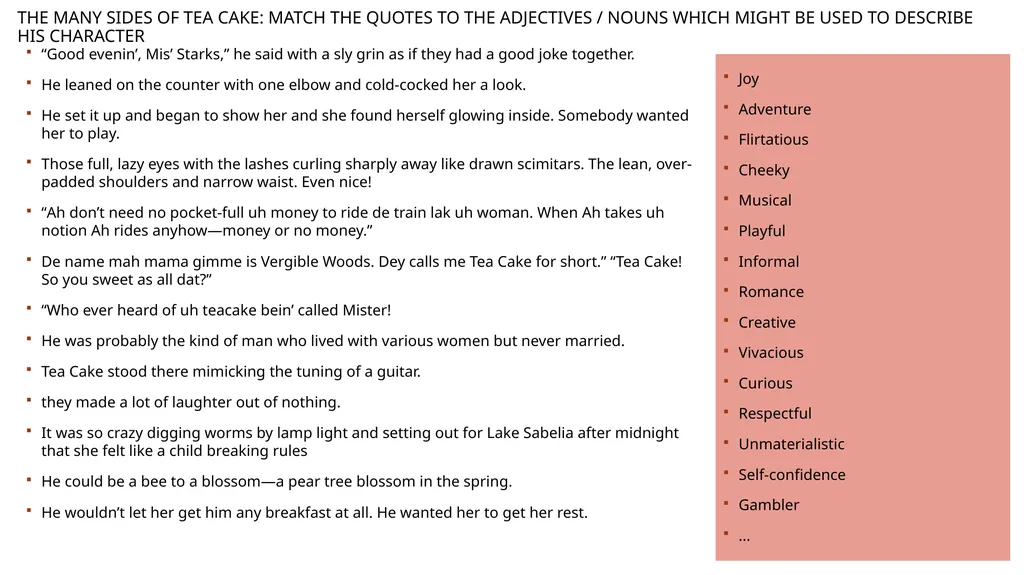
The many sides of Tea Cake: Match the quotes to the adjectives / nouns which might be used to describe his character “Good evenin’, Mis’ Starks,” he said with a sly grin as if they had a good joke together.
He leaned on the counter with one elbow and cold-cocked her a look.
He set it up and began to show her and she found herself glowing inside. Somebody wanted her to play.
Those full, lazy eyes with the lashes curling sharply away like drawn scimitars. The lean, over-padded shoulders and narrow waist. Even nice!
“Ah don’t need no pocket-full uh money to ride de train lak uh woman. When Ah takes uh notion Ah rides anyhow—money or no money.”
De name mah mama gimme is Vergible Woods. Dey calls me Tea Cake for short.” “Tea Cake! So you sweet as all dat?”
“Who ever heard of uh teacake bein’ called Mister!
He was probably the kind of man who lived with various women but never married.
Tea Cake stood there mimicking the tuning of a guitar.
they made a lot of laughter out of nothing.
It was so crazy digging worms by lamp light and setting out for Lake Sabelia after midnight that she felt like a child breaking rules
He could be a bee to a blossom—a pear tree blossom in the spring.
He wouldn’t let her get him any breakfast at all. He wanted her to get her rest. Joy
Adventure
Flirtatious
Cheeky
Musical
Playful
Informal
Romance
Creative
Vivacious
Curious
Respectful
Unmaterialistic
Self-confidence
Gambler
…<br>
He leaned on the counter with one elbow and cold-cocked her a look.
He set it up and began to show her and she found herself glowing inside. Somebody wanted her to play.
Those full, lazy eyes with the lashes curling sharply away like drawn scimitars. The lean, over-padded shoulders and narrow waist. Even nice!
“Ah don’t need no pocket-full uh money to ride de train lak uh woman. When Ah takes uh notion Ah rides anyhow—money or no money.”
De name mah mama gimme is Vergible Woods. Dey calls me Tea Cake for short.” “Tea Cake! So you sweet as all dat?”
“Who ever heard of uh teacake bein’ called Mister!
He was probably the kind of man who lived with various women but never married.
Tea Cake stood there mimicking the tuning of a guitar.
they made a lot of laughter out of nothing.
It was so crazy digging worms by lamp light and setting out for Lake Sabelia after midnight that she felt like a child breaking rules
He could be a bee to a blossom—a pear tree blossom in the spring.
He wouldn’t let her get him any breakfast at all. He wanted her to get her rest. Joy
Adventure
Flirtatious
Cheeky
Musical
Playful
Informal
Romance
Creative
Vivacious
Curious
Respectful
Unmaterialistic
Self-confidence
Gambler
…<br>
39
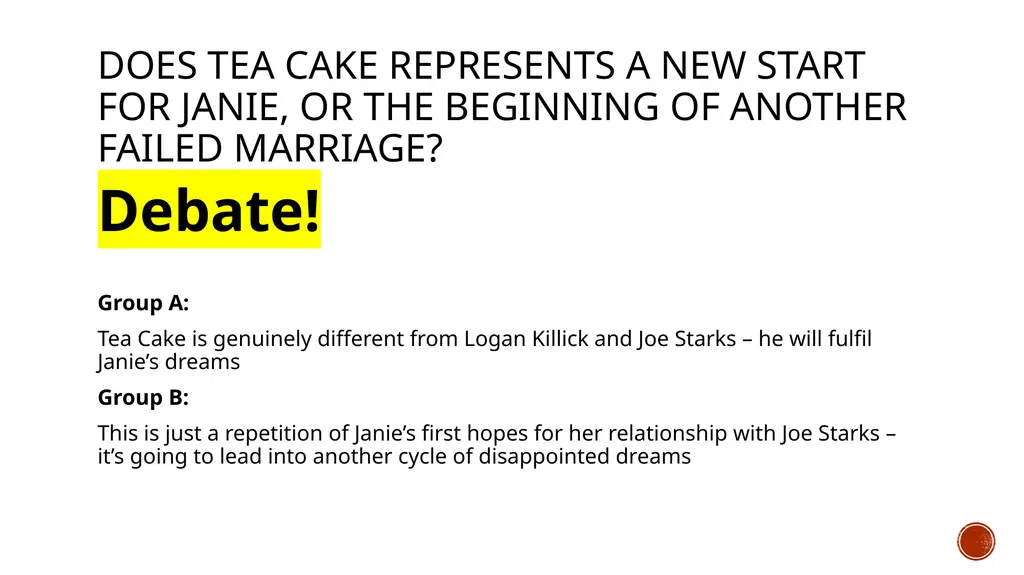
Does Tea Cake represents a new start for Janie, or the beginning of another failed marriage? Debate!
Group A:
Tea Cake is genuinely different from Logan Killick and Joe Starks – he will fulfil Janie’s dreams
Group B:
This is just a repetition of Janie’s first hopes for her relationship with Joe Starks – it’s going to lead into another cycle of disappointed dreams<br>
Group A:
Tea Cake is genuinely different from Logan Killick and Joe Starks – he will fulfil Janie’s dreams
Group B:
This is just a repetition of Janie’s first hopes for her relationship with Joe Starks – it’s going to lead into another cycle of disappointed dreams<br>
40
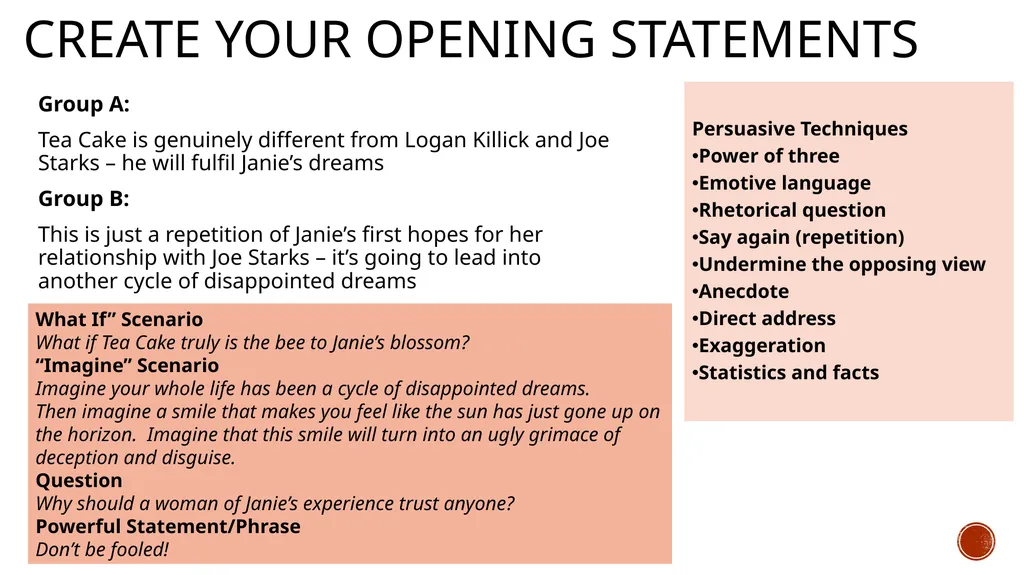
Create your opening statements Group A:
Tea Cake is genuinely different from Logan Killick and Joe Starks – he will fulfil Janie’s dreams
Group B:
This is just a repetition of Janie’s first hopes for her relationship with Joe Starks – it’s going to lead into another cycle of disappointed dreams Persuasive Techniques
Power of three
Emotive language
Rhetorical question
Say again (repetition)
Undermine the opposing view
Anecdote
Direct address
Exaggeration
Statistics and facts What If” Scenario
What if Tea Cake truly is the bee to Janie’s blossom?
“Imagine” Scenario
Imagine your whole life has been a cycle of disappointed dreams.
Then imagine a smile that makes you feel like the sun has just gone up on the horizon. Imagine that this smile will turn into an ugly grimace of deception and disguise.
Question
Why should a woman of Janie’s experience trust anyone?
Powerful Statement/Phrase
Don’t be fooled!<br>
Tea Cake is genuinely different from Logan Killick and Joe Starks – he will fulfil Janie’s dreams
Group B:
This is just a repetition of Janie’s first hopes for her relationship with Joe Starks – it’s going to lead into another cycle of disappointed dreams Persuasive Techniques
Power of three
Emotive language
Rhetorical question
Say again (repetition)
Undermine the opposing view
Anecdote
Direct address
Exaggeration
Statistics and facts What If” Scenario
What if Tea Cake truly is the bee to Janie’s blossom?
“Imagine” Scenario
Imagine your whole life has been a cycle of disappointed dreams.
Then imagine a smile that makes you feel like the sun has just gone up on the horizon. Imagine that this smile will turn into an ugly grimace of deception and disguise.
Question
Why should a woman of Janie’s experience trust anyone?
Powerful Statement/Phrase
Don’t be fooled!<br>
41
Your first impression If it a good idea for Janie to begin this relationship?<br>
42
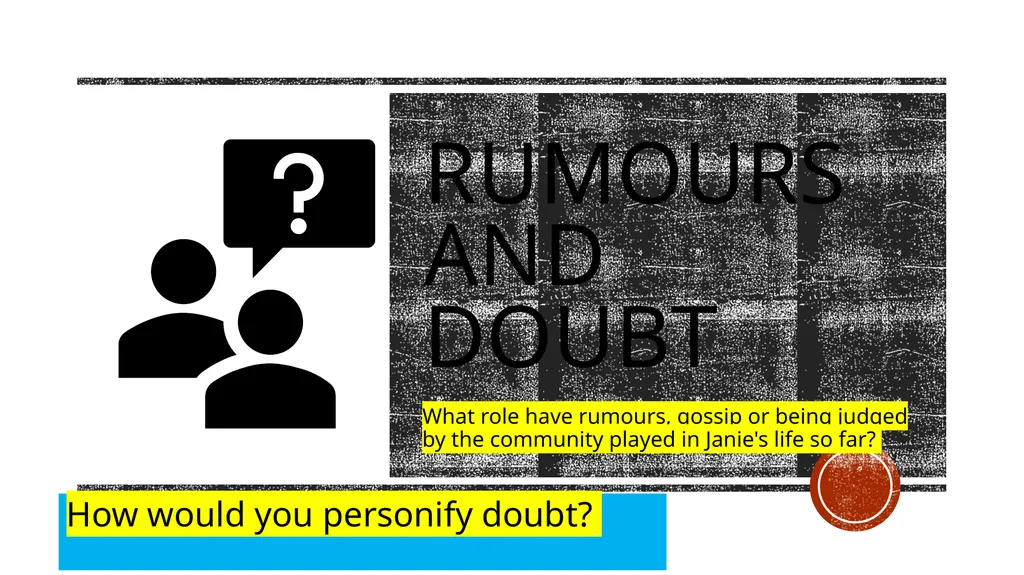
Rumours and Doubt What role have rumours, gossip or being judged by the community played in Janie's life so far? How would you personify doubt?<br>
43
How does Hurston present all the rumours? P. 125
What is her tone here?<br>
What is her tone here?<br>
44
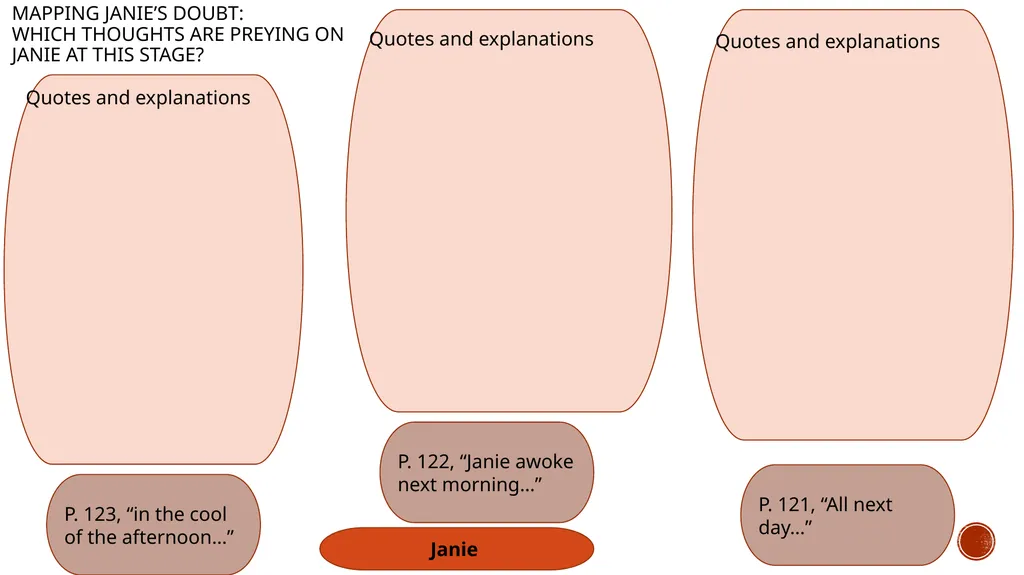
Mapping Janie’s Doubt:
Which thoughts are preying on Janie at this stage? Janie P. 121, “All next day…” P. 123, “in the cool of the afternoon…” P. 122, “Janie awoke next morning…” Quotes and explanations Quotes and explanations Quotes and explanations<br>
45
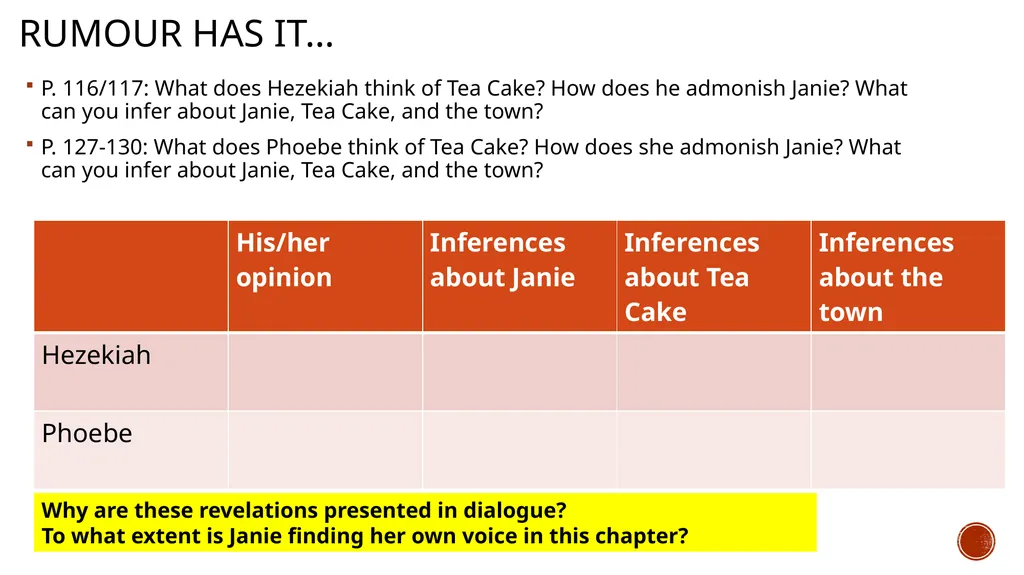
Rumour has it… P. 116/117: What does Hezekiah think of Tea Cake? How does he admonish Janie? What can you infer about Janie, Tea Cake, and the town?
P. 127-130: What does Phoebe think of Tea Cake? How does she admonish Janie? What can you infer about Janie, Tea Cake, and the town? Why are these revelations presented in dialogue?
To what extent is Janie finding her own voice in this chapter?<br>
P. 127-130: What does Phoebe think of Tea Cake? How does she admonish Janie? What can you infer about Janie, Tea Cake, and the town? Why are these revelations presented in dialogue?
To what extent is Janie finding her own voice in this chapter?<br>
46
Evaluate! Given all this, is this a promising new beginning?<br>
47
Read Chapter 14 Moodmap for the Everglades<br>
48
Janie’s New Life<br>
49
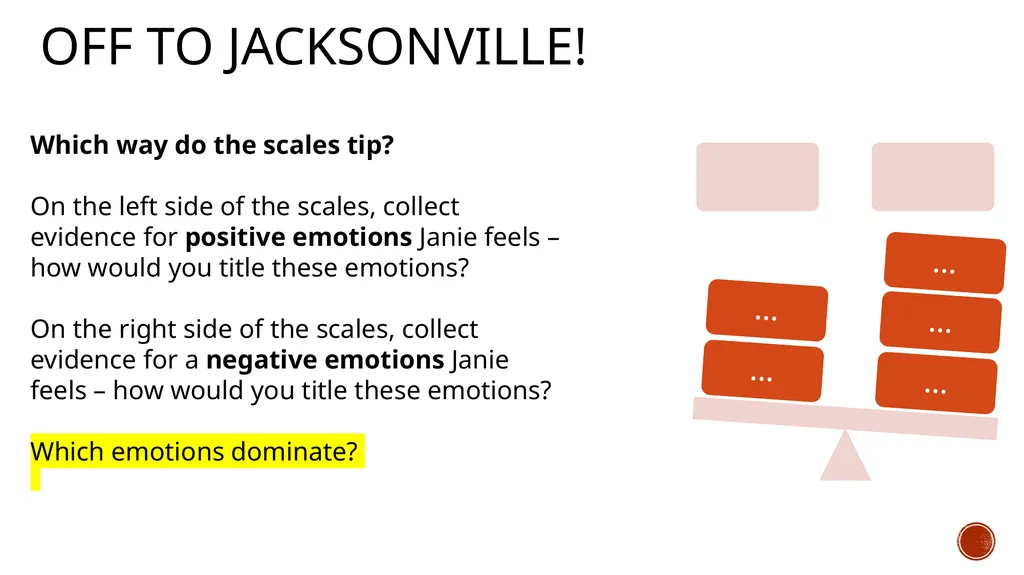
Off to Jacksonville! Which way do the scales tip?
On the left side of the scales, collect evidence for positive emotions Janie feels – how would you title these emotions?
On the right side of the scales, collect evidence for a negative emotions Janie feels – how would you title these emotions?
Which emotions dominate?<br>
On the left side of the scales, collect evidence for positive emotions Janie feels – how would you title these emotions?
On the right side of the scales, collect evidence for a negative emotions Janie feels – how would you title these emotions?
Which emotions dominate?<br>
50
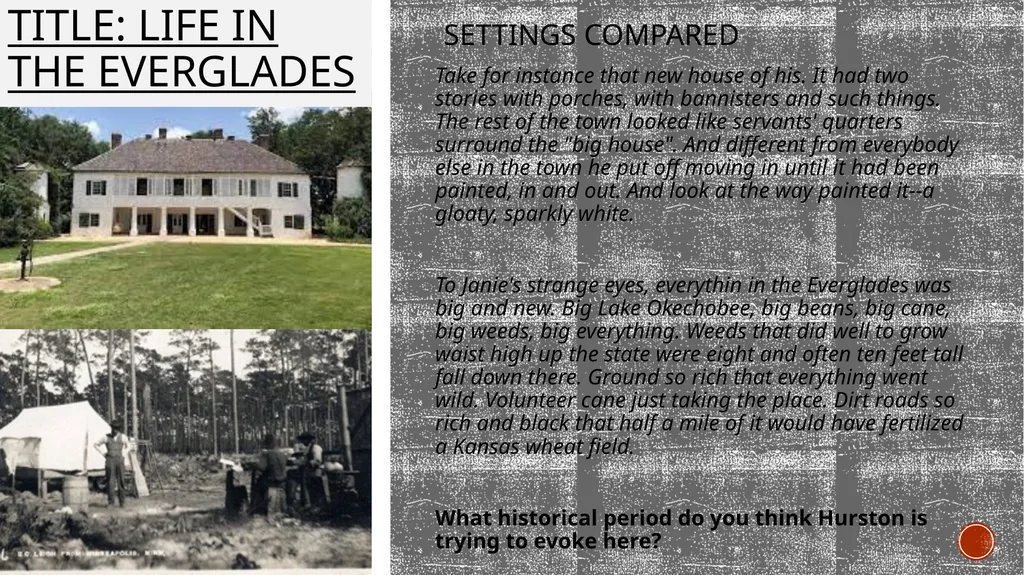
Settings compared Take for instance that new house of his. It had two stories with porches, with bannisters and such things. The rest of the town looked like servants' quarters surround the "big house". And different from everybody else in the town he put off moving in until it had been painted, in and out. And look at the way painted it--a gloaty, sparkly white.
To Janie's strange eyes, everythin in the Everglades was big and new. Big Lake Okechobee, big beans, big cane, big weeds, big everything. Weeds that did well to grow waist high up the state were eight and often ten feet tall fall down there. Ground so rich that everything went wild. Volunteer cane just taking the place. Dirt roads so rich and black that half a mile of it would have fertilized a Kansas wheat field.
What historical period do you think Hurston is trying to evoke here? Title: Life in the Everglades<br>
To Janie's strange eyes, everythin in the Everglades was big and new. Big Lake Okechobee, big beans, big cane, big weeds, big everything. Weeds that did well to grow waist high up the state were eight and often ten feet tall fall down there. Ground so rich that everything went wild. Volunteer cane just taking the place. Dirt roads so rich and black that half a mile of it would have fertilized a Kansas wheat field.
What historical period do you think Hurston is trying to evoke here? Title: Life in the Everglades<br>
51
Surprise! What does Janie do or learn that is unexpected and new in this setting?<br>
52
Tea Cake in context: The Blues History of the Blues:
evolved in the southern states of the USA from the late 19th century
Has roots in the experience of slavery and African rhythms, as well as early types of African American music (spirituals)
The Delta blues, first recorded in the 1920s, was one of the earliest types of blues music and originated in Mississippi in the Delta. The Delta was particularly poverty stricken and the plantation owners kept their workers in harsh conditions.
Features of the Blues:
Call and response
strong rhythms
improvisation
Melancholic melodies
handed down by word of mouth and old lyrics were often adapted and turned into new ones
simple but powerful lyrics What kind of life experience would Tea Cake have?
What attitudes and values might this Blues culture stand for?
How does it compare to Joe Starks entrepreneurship? 1930 Blues recording: https://youtu.be/Wl5BiHw74xU
Video explainer: https://www.bbc.co.uk/bitesize/articles/zkbh2v4<br>
evolved in the southern states of the USA from the late 19th century
Has roots in the experience of slavery and African rhythms, as well as early types of African American music (spirituals)
The Delta blues, first recorded in the 1920s, was one of the earliest types of blues music and originated in Mississippi in the Delta. The Delta was particularly poverty stricken and the plantation owners kept their workers in harsh conditions.
Features of the Blues:
Call and response
strong rhythms
improvisation
Melancholic melodies
handed down by word of mouth and old lyrics were often adapted and turned into new ones
simple but powerful lyrics What kind of life experience would Tea Cake have?
What attitudes and values might this Blues culture stand for?
How does it compare to Joe Starks entrepreneurship? 1930 Blues recording: https://youtu.be/Wl5BiHw74xU
Video explainer: https://www.bbc.co.uk/bitesize/articles/zkbh2v4<br>
53
Emulate Zora Neale Hurston: A bustling place How does Hurston create a lively and joyful atmosphere?
Extract: p. 149-150 (“Day by day – laughing in the bean field”
Identify her main strategies
Write your own version of a bustling, lively place!<br>
Extract: p. 149-150 (“Day by day – laughing in the bean field”
Identify her main strategies
Write your own version of a bustling, lively place!<br>
54
Emulate Zora Neale Hurston: A bustling place How does Hurston create a lively and joyful atmosphere?
Starter: What are the most effective strategies Hurston uses?
Write your own version of a bustling, lively place!<br>
Starter: What are the most effective strategies Hurston uses?
Write your own version of a bustling, lively place!<br>
55
Day by day now, the hordes of workers poured in. Some came limping in with their shoes and sore feet from walking. It’s hard trying to follow your shoe instead of your shoe following you. They came in wagons from way up in Georgia and they came in truck loads from east, west, north and south. Permanent transients with no attachments and tired looking men with their families and dogs in flivvers. All night, all day, hurrying in to pick beans. Skillets, beds, patched up spare inner tubes all hanging and dangling from the ancient cars on the outside and hopeful humanity, herded and hovered on the inside, chugging on to the muck. People ugly from ignorance and broken from being poor.
All night now the jooks clanged and clamored. Pianos living three lifetimes in one. Blues made and used right on the spot. Dancing, fighting, singing, crying, laughing, winning and losing love every hour. Work all day for money, fight all night for love. The rich black earth clinging to bodies and biting the skin like ants.
Finally no more sleeping places. Men made big fires and fifty or sixty men slept around each fire. But they had to pay the man whose land they slept on. He ran the fire just like his boarding place—for pay. But nobody cared. They made good money, even to the children. So they spent good money. Next month and next year were other times. No need to mix them up with the present.
Tea Cake’s house was a magnet, the unauthorized center of the “job.” The way he would sit in the doorway and play his guitar made people stop and listen and maybe disappoint the jook for that night. He was always laughing and full of fun too. He kept everybody laughing in the bean field.<br>
All night now the jooks clanged and clamored. Pianos living three lifetimes in one. Blues made and used right on the spot. Dancing, fighting, singing, crying, laughing, winning and losing love every hour. Work all day for money, fight all night for love. The rich black earth clinging to bodies and biting the skin like ants.
Finally no more sleeping places. Men made big fires and fifty or sixty men slept around each fire. But they had to pay the man whose land they slept on. He ran the fire just like his boarding place—for pay. But nobody cared. They made good money, even to the children. So they spent good money. Next month and next year were other times. No need to mix them up with the present.
Tea Cake’s house was a magnet, the unauthorized center of the “job.” The way he would sit in the doorway and play his guitar made people stop and listen and maybe disappoint the jook for that night. He was always laughing and full of fun too. He kept everybody laughing in the bean field.<br>
56
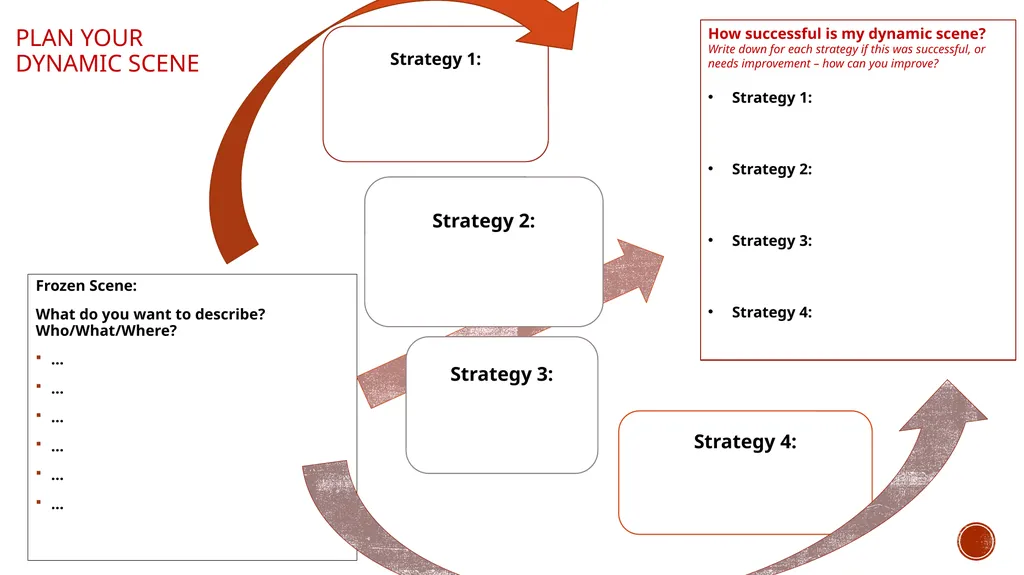
Plan your dynamic scene Frozen Scene:
What do you want to describe? Who/What/Where?
…
…
…
…
…
… How successful is my dynamic scene? Write down for each strategy if this was successful, or needs improvement – how can you improve?
Strategy 1:
Strategy 2:
Strategy 3:
Strategy 4: Strategy 4: Strategy 1: Strategy 2: Strategy 3:<br>
What do you want to describe? Who/What/Where?
…
…
…
…
…
… How successful is my dynamic scene? Write down for each strategy if this was successful, or needs improvement – how can you improve?
Strategy 1:
Strategy 2:
Strategy 3:
Strategy 4: Strategy 4: Strategy 1: Strategy 2: Strategy 3:<br>
57
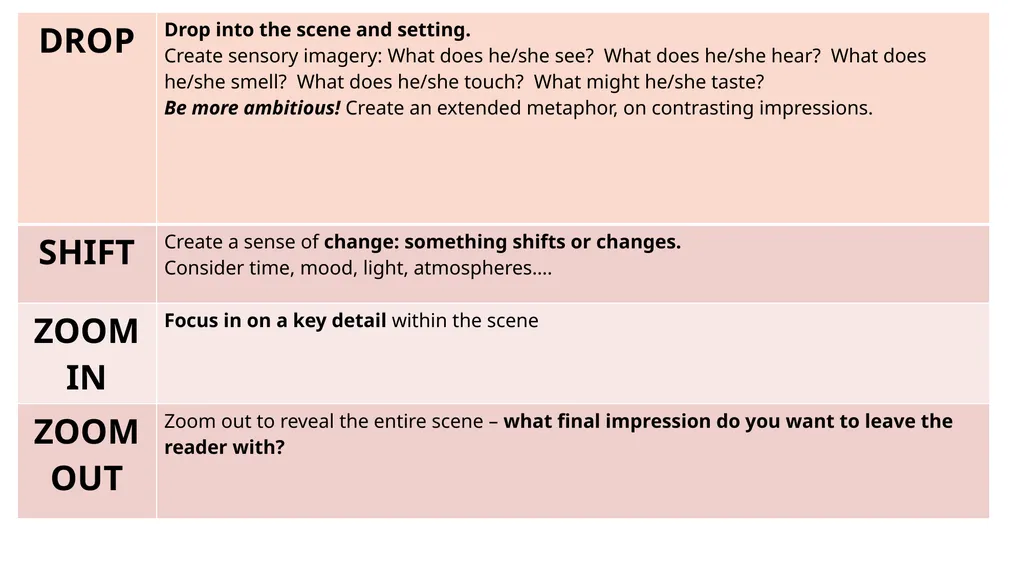
How to write dynamically<br>
58
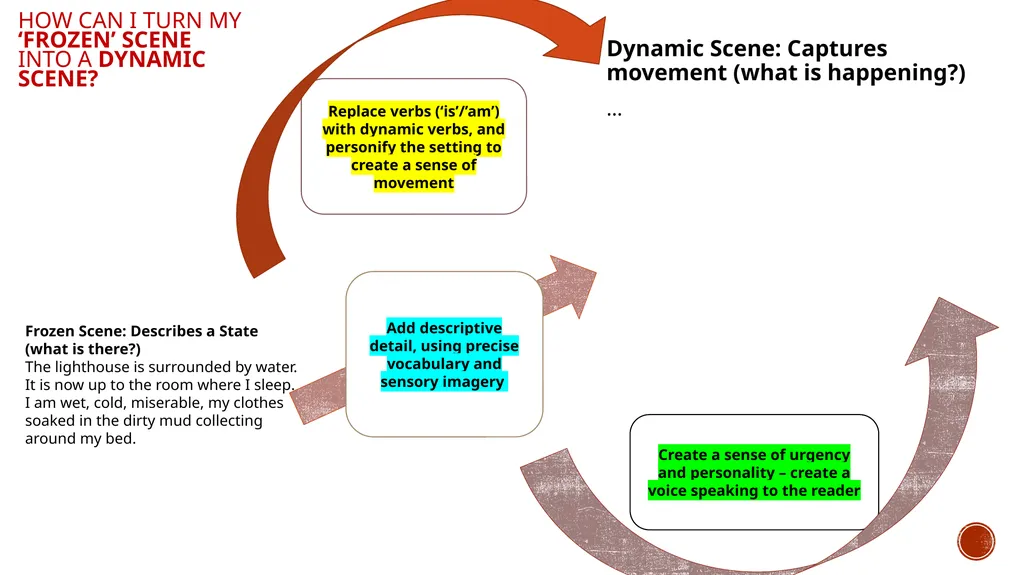
How Can I turn my ‘Frozen’ scene
into a dynamic scene? Dynamic Scene: Captures movement (what is happening?)
… Frozen Scene: Describes a State (what is there?)
The lighthouse is surrounded by water. It is now up to the room where I sleep. I am wet, cold, miserable, my clothes soaked in the dirty mud collecting around my bed. Create a sense of urgency and personality – create a voice speaking to the reader Replace verbs (‘is’/’am’) with dynamic verbs, and personify the setting to create a sense of movement Add descriptive detail, using precise vocabulary and sensory imagery<br>
… Frozen Scene: Describes a State (what is there?)
The lighthouse is surrounded by water. It is now up to the room where I sleep. I am wet, cold, miserable, my clothes soaked in the dirty mud collecting around my bed. Create a sense of urgency and personality – create a voice speaking to the reader Replace verbs (‘is’/’am’) with dynamic verbs, and personify the setting to create a sense of movement Add descriptive detail, using precise vocabulary and sensory imagery<br>
59
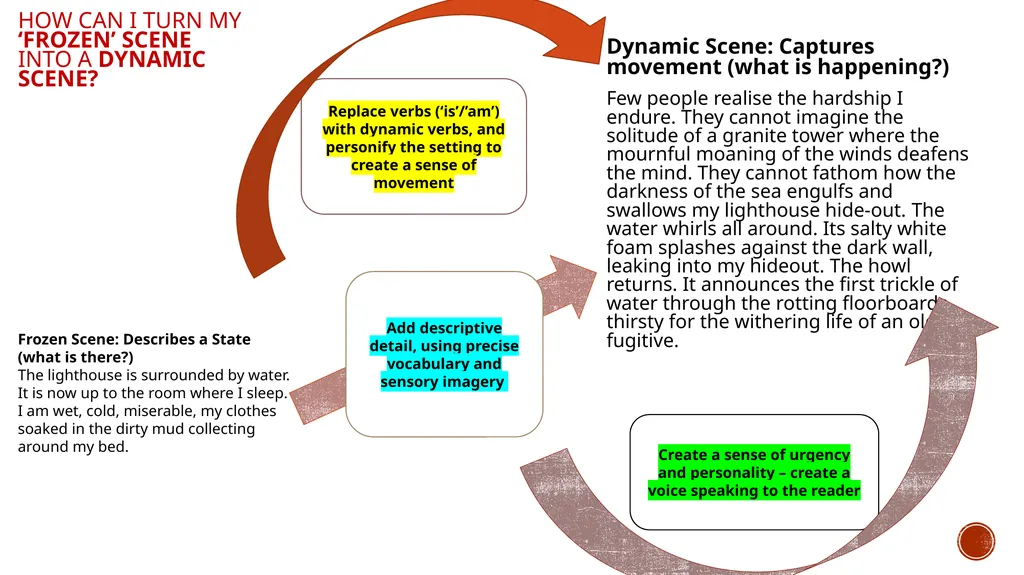
How Can I turn my ‘Frozen’ scene
into a dynamic scene? Dynamic Scene: Captures movement (what is happening?)
Few people realise the hardship I endure. They cannot imagine the solitude of a granite tower where the mournful moaning of the winds deafens the mind. They cannot fathom how the darkness of the sea engulfs and swallows my lighthouse hide-out. The water whirls all around. Its salty white foam splashes against the dark wall, leaking into my hideout. The howl returns. It announces the first trickle of water through the rotting floorboards, thirsty for the withering life of an old fugitive. Frozen Scene: Describes a State (what is there?)
The lighthouse is surrounded by water. It is now up to the room where I sleep. I am wet, cold, miserable, my clothes soaked in the dirty mud collecting around my bed. Create a sense of urgency and personality – create a voice speaking to the reader Replace verbs (‘is’/’am’) with dynamic verbs, and personify the setting to create a sense of movement Add descriptive detail, using precise vocabulary and sensory imagery<br>
Few people realise the hardship I endure. They cannot imagine the solitude of a granite tower where the mournful moaning of the winds deafens the mind. They cannot fathom how the darkness of the sea engulfs and swallows my lighthouse hide-out. The water whirls all around. Its salty white foam splashes against the dark wall, leaking into my hideout. The howl returns. It announces the first trickle of water through the rotting floorboards, thirsty for the withering life of an old fugitive. Frozen Scene: Describes a State (what is there?)
The lighthouse is surrounded by water. It is now up to the room where I sleep. I am wet, cold, miserable, my clothes soaked in the dirty mud collecting around my bed. Create a sense of urgency and personality – create a voice speaking to the reader Replace verbs (‘is’/’am’) with dynamic verbs, and personify the setting to create a sense of movement Add descriptive detail, using precise vocabulary and sensory imagery<br>
60
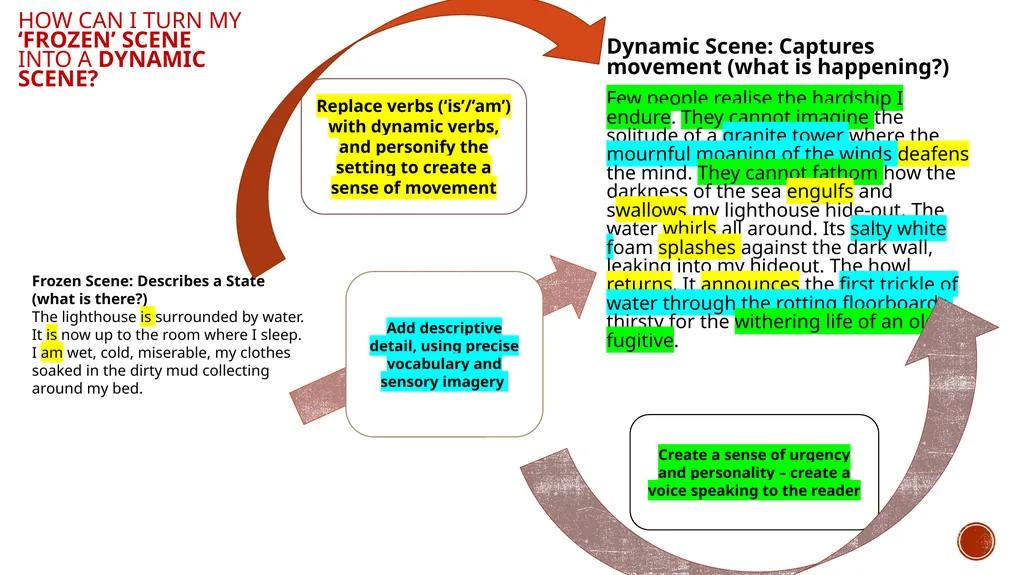
How Can I turn my ‘Frozen’ scene
into a dynamic scene? Dynamic Scene: Captures movement (what is happening?)
Few people realise the hardship I endure. They cannot imagine the solitude of a granite tower where the mournful moaning of the winds deafens the mind. They cannot fathom how the darkness of the sea engulfs and swallows my lighthouse hide-out. The water whirls all around. Its salty white foam splashes against the dark wall, leaking into my hideout. The howl returns. It announces the first trickle of water through the rotting floorboards, thirsty for the withering life of an old fugitive. Frozen Scene: Describes a State (what is there?)
The lighthouse is surrounded by water. It is now up to the room where I sleep. I am wet, cold, miserable, my clothes soaked in the dirty mud collecting around my bed. Create a sense of urgency and personality – create a voice speaking to the reader Replace verbs (‘is’/’am’) with dynamic verbs, and personify the setting to create a sense of movement Add descriptive detail, using precise vocabulary and sensory imagery<br>
Few people realise the hardship I endure. They cannot imagine the solitude of a granite tower where the mournful moaning of the winds deafens the mind. They cannot fathom how the darkness of the sea engulfs and swallows my lighthouse hide-out. The water whirls all around. Its salty white foam splashes against the dark wall, leaking into my hideout. The howl returns. It announces the first trickle of water through the rotting floorboards, thirsty for the withering life of an old fugitive. Frozen Scene: Describes a State (what is there?)
The lighthouse is surrounded by water. It is now up to the room where I sleep. I am wet, cold, miserable, my clothes soaked in the dirty mud collecting around my bed. Create a sense of urgency and personality – create a voice speaking to the reader Replace verbs (‘is’/’am’) with dynamic verbs, and personify the setting to create a sense of movement Add descriptive detail, using precise vocabulary and sensory imagery<br>
61
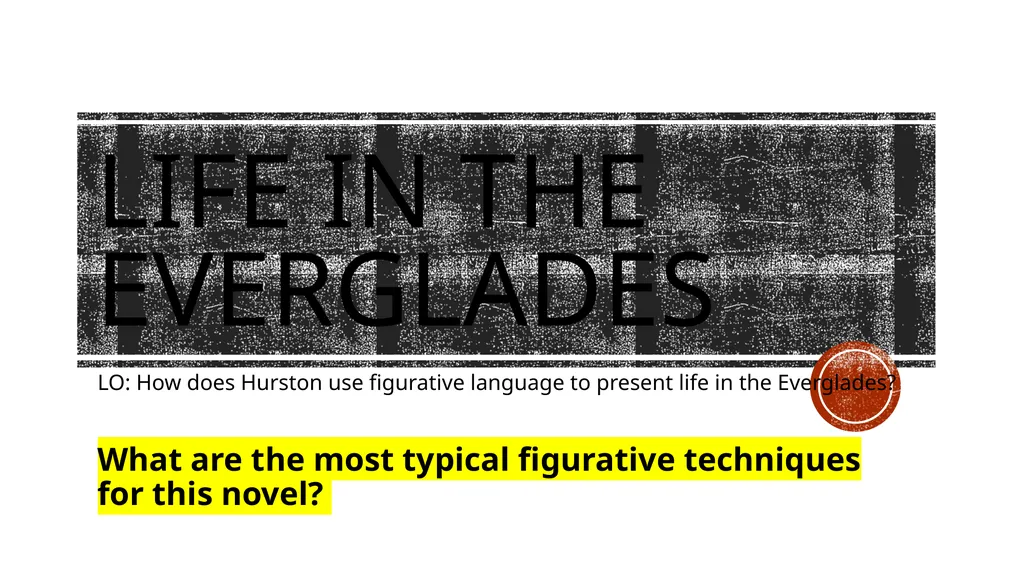
Life in the Everglades LO: How does Hurston use figurative language to present life in the Everglades?
What are the most typical figurative techniques for this novel?<br>
What are the most typical figurative techniques for this novel?<br>
62
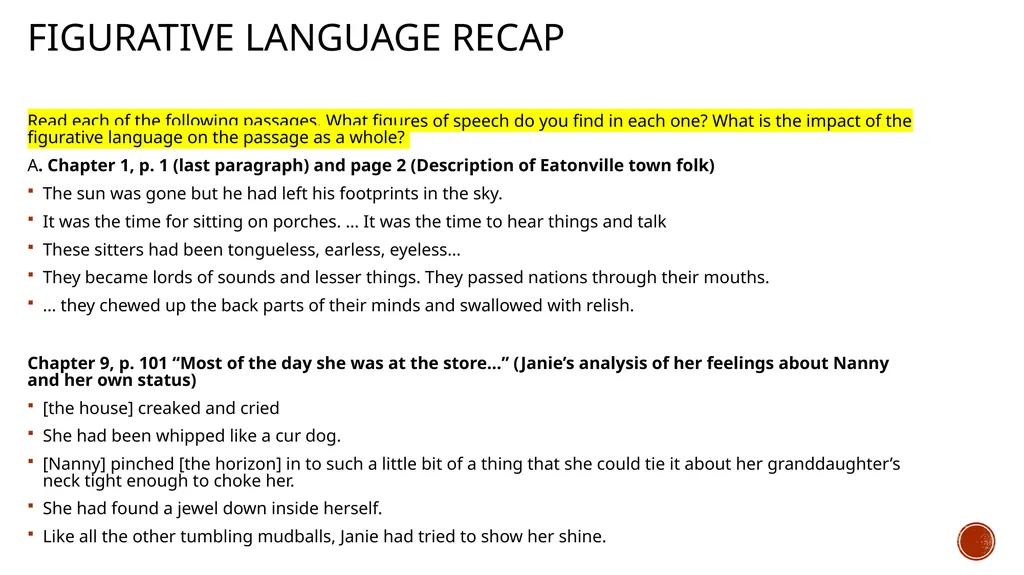
Figurative language RECAP Read each of the following passages. What figures of speech do you find in each one? What is the impact of the figurative language on the passage as a whole?
A. Chapter 1, p. 1 (last paragraph) and page 2 (Description of Eatonville town folk)
The sun was gone but he had left his footprints in the sky.
It was the time for sitting on porches. … It was the time to hear things and talk
These sitters had been tongueless, earless, eyeless…
They became lords of sounds and lesser things. They passed nations through their mouths.
… they chewed up the back parts of their minds and swallowed with relish.
Chapter 9, p. 101 “Most of the day she was at the store…” (Janie’s analysis of her feelings about Nanny and her own status)
[the house] creaked and cried
She had been whipped like a cur dog.
[Nanny] pinched [the horizon] in to such a little bit of a thing that she could tie it about her granddaughter’s neck tight enough to choke her.
She had found a jewel down inside herself.
Like all the other tumbling mudballs, Janie had tried to show her shine.<br>
A. Chapter 1, p. 1 (last paragraph) and page 2 (Description of Eatonville town folk)
The sun was gone but he had left his footprints in the sky.
It was the time for sitting on porches. … It was the time to hear things and talk
These sitters had been tongueless, earless, eyeless…
They became lords of sounds and lesser things. They passed nations through their mouths.
… they chewed up the back parts of their minds and swallowed with relish.
Chapter 9, p. 101 “Most of the day she was at the store…” (Janie’s analysis of her feelings about Nanny and her own status)
[the house] creaked and cried
She had been whipped like a cur dog.
[Nanny] pinched [the horizon] in to such a little bit of a thing that she could tie it about her granddaughter’s neck tight enough to choke her.
She had found a jewel down inside herself.
Like all the other tumbling mudballs, Janie had tried to show her shine.<br>
63
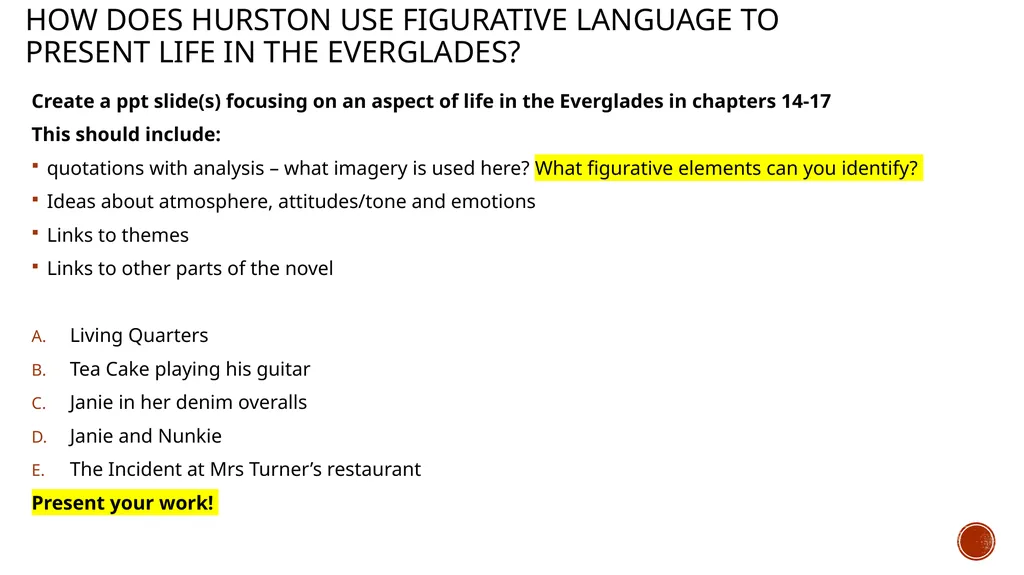
How does Hurston use figurative language to present Life in the everglades? Create a ppt slide(s) focusing on an aspect of life in the Everglades in chapters 14-17
This should include:
quotations with analysis – what imagery is used here? What figurative elements can you identify?
Ideas about atmosphere, attitudes/tone and emotions
Links to themes
Links to other parts of the novel
Living Quarters
Tea Cake playing his guitar
Janie in her denim overalls
Janie and Nunkie
The Incident at Mrs Turner’s restaurant
Present your work!<br>
This should include:
quotations with analysis – what imagery is used here? What figurative elements can you identify?
Ideas about atmosphere, attitudes/tone and emotions
Links to themes
Links to other parts of the novel
Living Quarters
Tea Cake playing his guitar
Janie in her denim overalls
Janie and Nunkie
The Incident at Mrs Turner’s restaurant
Present your work!<br>
64
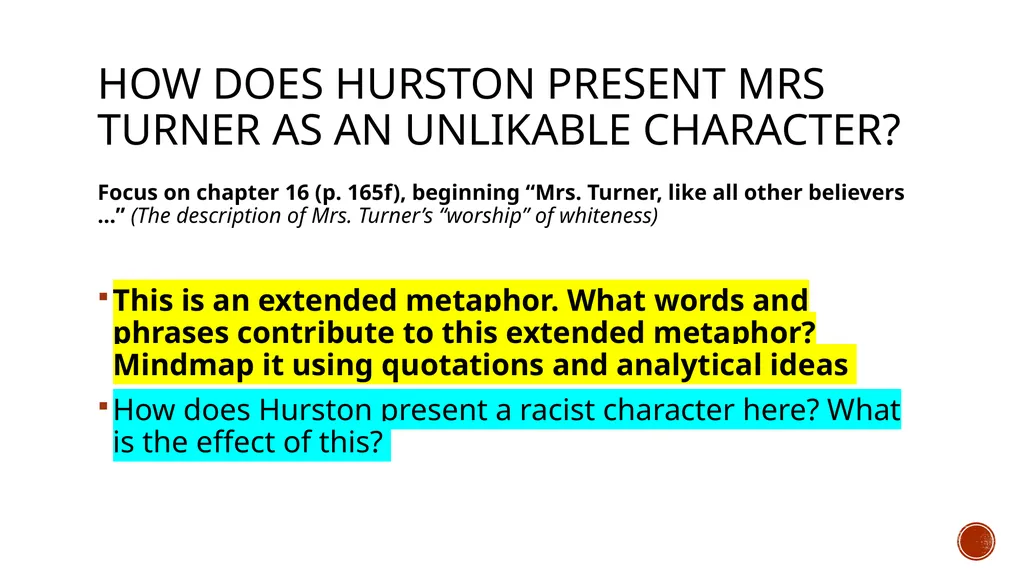
How does Hurston present Mrs Turner as an unlikable character? Focus on chapter 16 (p. 165f), beginning “Mrs. Turner, like all other believers …” (The description of Mrs. Turner’s “worship” of whiteness)
This is an extended metaphor. What words and phrases contribute to this extended metaphor? Mindmap it using quotations and analytical ideas
How does Hurston present a racist character here? What is the effect of this?<br>
This is an extended metaphor. What words and phrases contribute to this extended metaphor? Mindmap it using quotations and analytical ideas
How does Hurston present a racist character here? What is the effect of this?<br>
65
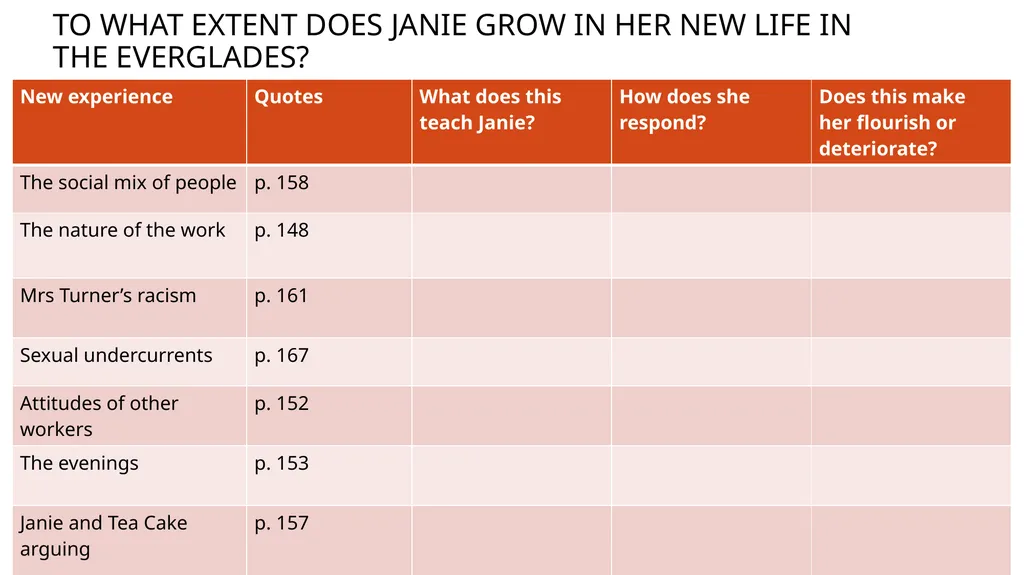
To what extent Does Janie grow in her new life in the Everglades?<br>
66
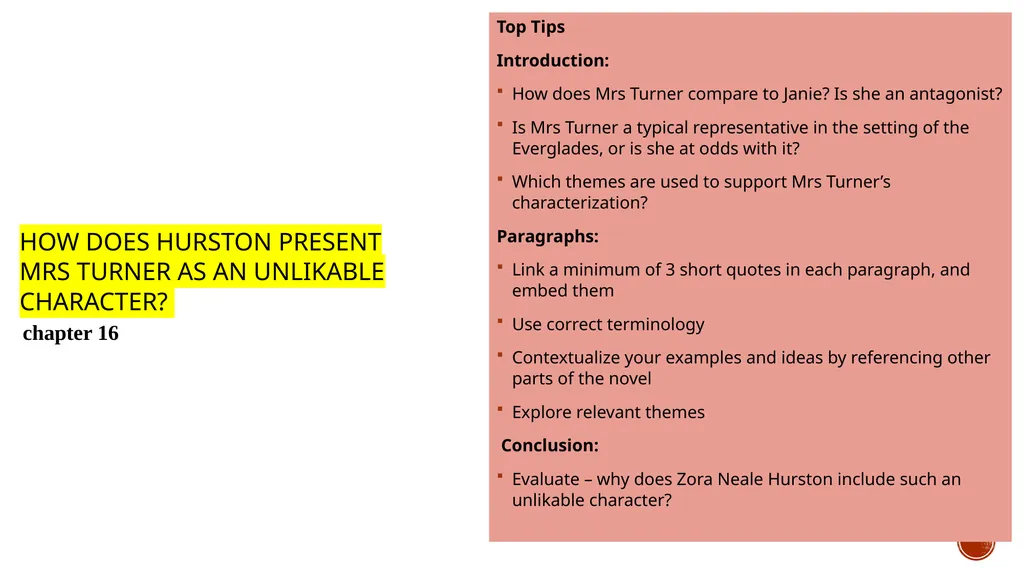
How does Hurston present Mrs Turner as an unlikable character? chapter 16 Top Tips
Introduction:
How does Mrs Turner compare to Janie? Is she an antagonist?
Is Mrs Turner a typical representative in the setting of the Everglades, or is she at odds with it?
Which themes are used to support Mrs Turner’s characterization?
Paragraphs:
Link a minimum of 3 short quotes in each paragraph, and embed them
Use correct terminology
Contextualize your examples and ideas by referencing other parts of the novel
Explore relevant themes
Conclusion:
Evaluate – why does Zora Neale Hurston include such an unlikable character?<br>
Introduction:
How does Mrs Turner compare to Janie? Is she an antagonist?
Is Mrs Turner a typical representative in the setting of the Everglades, or is she at odds with it?
Which themes are used to support Mrs Turner’s characterization?
Paragraphs:
Link a minimum of 3 short quotes in each paragraph, and embed them
Use correct terminology
Contextualize your examples and ideas by referencing other parts of the novel
Explore relevant themes
Conclusion:
Evaluate – why does Zora Neale Hurston include such an unlikable character?<br>
67
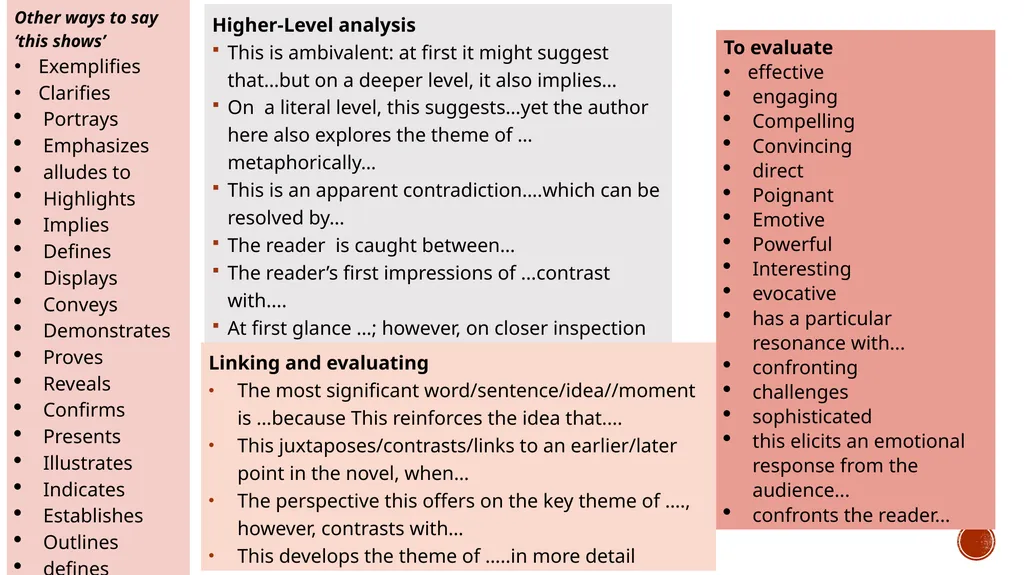
Higher-Level analysis
This is ambivalent: at first it might suggest that…but on a deeper level, it also implies…
On a literal level, this suggests…yet the author here also explores the theme of …metaphorically…
This is an apparent contradiction….which can be resolved by…
The reader is caught between…
The reader’s first impressions of ...contrast with....
At first glance …; however, on closer inspection Linking and evaluating
The most significant word/sentence/idea//moment is …because This reinforces the idea that....
This juxtaposes/contrasts/links to an earlier/later point in the novel, when…
The perspective this offers on the key theme of …., however, contrasts with…
This develops the theme of …..in more detail Other ways to say ‘this shows’
Exemplifies
Clarifies
Portrays
Emphasizes
alludes to
Highlights
Implies
Defines
Displays
Conveys
Demonstrates
Proves
Reveals
Confirms
Presents
Illustrates
Indicates
Establishes
Outlines
defines To evaluate
effective
engaging
Compelling
Convincing
direct
Poignant
Emotive
Powerful
Interesting
evocative
has a particular resonance with...
confronting
challenges
sophisticated
this elicits an emotional response from the audience...
confronts the reader...<br>
This is ambivalent: at first it might suggest that…but on a deeper level, it also implies…
On a literal level, this suggests…yet the author here also explores the theme of …metaphorically…
This is an apparent contradiction….which can be resolved by…
The reader is caught between…
The reader’s first impressions of ...contrast with....
At first glance …; however, on closer inspection Linking and evaluating
The most significant word/sentence/idea//moment is …because This reinforces the idea that....
This juxtaposes/contrasts/links to an earlier/later point in the novel, when…
The perspective this offers on the key theme of …., however, contrasts with…
This develops the theme of …..in more detail Other ways to say ‘this shows’
Exemplifies
Clarifies
Portrays
Emphasizes
alludes to
Highlights
Implies
Defines
Displays
Conveys
Demonstrates
Proves
Reveals
Confirms
Presents
Illustrates
Indicates
Establishes
Outlines
defines To evaluate
effective
engaging
Compelling
Convincing
direct
Poignant
Emotive
Powerful
Interesting
evocative
has a particular resonance with...
confronting
challenges
sophisticated
this elicits an emotional response from the audience...
confronts the reader...<br>
68
Mrs turner continued… chapter 16 (p. 165f), beginning “Mrs. Turner, like all other believers …” (The description of Mrs. Turner’s “worship” of whiteness)
Assessment warm-up:
What’s the difference between
Metaphor
Extended metaphor
Symbol<br>
Assessment warm-up:
What’s the difference between
Metaphor
Extended metaphor
Symbol<br>
69
Which example of figurative language best illustrates Janie’s new life in the everglades?<br>
70
The storm strikes Starter: Janie is a survivor. Which confusing, unpredictable, or threatening forces has she overcome in her life?
You could also consider collective challenges of the groups, family or communities she is part of. LO: to explore how the climax of the novel develops they central conflict<br>
You could also consider collective challenges of the groups, family or communities she is part of. LO: to explore how the climax of the novel develops they central conflict<br>
71
A Hurricane Strikes: https://youtu.be/zPBD06EFMf8
Explore the actual 1928 hurricane here https://www.publishersweekly.com/978-0-7867-1146-8 Which ideas and themes from the article do you expect to be important in the novel?<br>
Explore the actual 1928 hurricane here https://www.publishersweekly.com/978-0-7867-1146-8 Which ideas and themes from the article do you expect to be important in the novel?<br>
72
What might the opening foreshadow about this storm? “So the beginning of this was a woman and she had come back from burying the dead. Not the dead of sick and ailing with friends at the pillow and the feet. She had come back from the sodden and the bloated; the sudden dead, their eyes flung wide open in judgment.”<br>
73
Chapter 18: The Storm How does this help you interpret the book?
“They sat in company with the others . . . They seemed to be staring at the dark, but their eyes were watching God.”
Where on the narrative arc would you locate this chapter?<br>
“They sat in company with the others . . . They seemed to be staring at the dark, but their eyes were watching God.”
Where on the narrative arc would you locate this chapter?<br>
74
Key extract: Annotate and discuss Sometime that night the winds came back. Everything in the world had a strong rattle, sharp and short like Stew Beef vibrating the drum head near the edge with his fingers. By morning Gabriel was playing the deep tones in the center of the drum. So when Janie looked out of her door she saw the drifting mists gathered in the west—that cloud field of the sky—to arm themselves with thunders and march forth against the world. Louder and higher and lower and wider the sound and motion spread, mounting, sinking, darking.
It woke up old Okechobee and the monster began to roll in his bed. Began to roll and complain like a peevish world on a grumble. The folks in the quarters and the people in the big houses further around the shore heard the big lake and wondered. The people felt uncomfortable but safe because there were the seawalls to chain the senseless monster in his bed. The folks let the people do the thinking. If the castles thought themselves secure, the cabins needn’t worry. Their decision was already made as always. Chink up your cracks, shiver in your wet beds and wait on the mercy of the Lord. The bossman might have the thing stopped before morning anyway. It is so easy to be hopeful in the day time when you can see the things you wish on. But it was night, it stayed night. Night was striding across nothingness with the whole round world in his hands
(p. 179-180)<br>
It woke up old Okechobee and the monster began to roll in his bed. Began to roll and complain like a peevish world on a grumble. The folks in the quarters and the people in the big houses further around the shore heard the big lake and wondered. The people felt uncomfortable but safe because there were the seawalls to chain the senseless monster in his bed. The folks let the people do the thinking. If the castles thought themselves secure, the cabins needn’t worry. Their decision was already made as always. Chink up your cracks, shiver in your wet beds and wait on the mercy of the Lord. The bossman might have the thing stopped before morning anyway. It is so easy to be hopeful in the day time when you can see the things you wish on. But it was night, it stayed night. Night was striding across nothingness with the whole round world in his hands
(p. 179-180)<br>
75
How does Hurston make this such a dramatic turning point? “Tea Cake!” He heard her and sprang up. Janie was trying to swim but fighting water too hard. He saw a cow swimming slowly towards the fill in an oblique line. A massive built dog was sitting on her shoulders and shivering and growling. The cow was approaching Janie. A few strokes would bring her there.
“Make it tuh de cow and grab hold of her tail! Don’t use yo’ feet. Jus’ yo’ hands is enough. Dat’s right, come on!”
Janie achieved the tail of the cow and lifted her head up along the cow’s rump, as far as she could above water. The cow sunk a little with the added load and thrashed a moment in terror. Thought she was being pulled down by a gator. Then she continued on. The dog stood up and growled like a lion, stiff-standing hackles, stiff muscles, teeth uncovered as he lashed up his fury for the charge. Tea Cake split the water like an otter, opening his knife as he dived. The dog raced down the back-bone of the cow to the attack and Janie screamed and slipped far back on the tail of the cow, just out of reach of the dog’s angry jaws. He wanted to plunge in after her but dreaded the water, somehow. Tea Cake rose out of the water at the cow’s rump and seized the dog by the neck. But he was a powerful dog and Tea Cake was over-tired. So he didn’t kill the dog with one stroke as he had intended. But the dog couldn’t free himself either. They fought and somehow he managed to bite Tea Cake high up on his cheek-bone once. Then Tea Cake finished him and sent him to the bottom to stay there. The cow relieved of a great weight was landing on the fill with Janie before Tea Cake stroked in and crawled weakly upon the fill again.
Janie began to fuss around his face where the dog had bitten him but he said it didn’t amount to anything. “He’d uh raised hell though if he had uh grabbed me uh inch higher and bit me in mah eye. Yuh can’t buy eyes in de store, yuh know.” He flopped to the edge of the fill as if the storm wasn’t going on at all. “Lemme rest awhile, then us got tuh make it on intuh town somehow.”
It was next day by the sun and the clock when they reached Palm Beach. It was years later by their bodies. Winters and winters of hardship and suffering. The wheel kept turning round and round. Hope, hopelessness and despair. But the storm blew itself out as they approached the city of refuge. Havoc was there with her mouth wide open. Back in the Everglades the wind had romped among lakes and trees. In the city it had raged among houses and men. Tea Cake and Janie stood on the edge of things and looked over the desolation.
(p. 188)<br>
“Make it tuh de cow and grab hold of her tail! Don’t use yo’ feet. Jus’ yo’ hands is enough. Dat’s right, come on!”
Janie achieved the tail of the cow and lifted her head up along the cow’s rump, as far as she could above water. The cow sunk a little with the added load and thrashed a moment in terror. Thought she was being pulled down by a gator. Then she continued on. The dog stood up and growled like a lion, stiff-standing hackles, stiff muscles, teeth uncovered as he lashed up his fury for the charge. Tea Cake split the water like an otter, opening his knife as he dived. The dog raced down the back-bone of the cow to the attack and Janie screamed and slipped far back on the tail of the cow, just out of reach of the dog’s angry jaws. He wanted to plunge in after her but dreaded the water, somehow. Tea Cake rose out of the water at the cow’s rump and seized the dog by the neck. But he was a powerful dog and Tea Cake was over-tired. So he didn’t kill the dog with one stroke as he had intended. But the dog couldn’t free himself either. They fought and somehow he managed to bite Tea Cake high up on his cheek-bone once. Then Tea Cake finished him and sent him to the bottom to stay there. The cow relieved of a great weight was landing on the fill with Janie before Tea Cake stroked in and crawled weakly upon the fill again.
Janie began to fuss around his face where the dog had bitten him but he said it didn’t amount to anything. “He’d uh raised hell though if he had uh grabbed me uh inch higher and bit me in mah eye. Yuh can’t buy eyes in de store, yuh know.” He flopped to the edge of the fill as if the storm wasn’t going on at all. “Lemme rest awhile, then us got tuh make it on intuh town somehow.”
It was next day by the sun and the clock when they reached Palm Beach. It was years later by their bodies. Winters and winters of hardship and suffering. The wheel kept turning round and round. Hope, hopelessness and despair. But the storm blew itself out as they approached the city of refuge. Havoc was there with her mouth wide open. Back in the Everglades the wind had romped among lakes and trees. In the city it had raged among houses and men. Tea Cake and Janie stood on the edge of things and looked over the desolation.
(p. 188)<br>
76
How does Hurston make this scene so dramatic? Extension task: add an introduction which focuses on the central conflict of this novel and in this passage
Group A:
dialogue, exclamation, movements converging, conflicting emotions, contrasting figures /imagery, sense of urgency
Group B:
Internal conflict, juxtaposed emotions, connotations, simile, predatory, dynamic verbs
Group C:
Simile, animal imagery, personification, uncertainty, connotations
Group D
Contrast, metaphor, sentence structure, sense of chaos and confusion, double meaning
Group E
Tone, contrast, simile, connotations, precarious, ambivalence
Group F
Theme of time, cyclical, sentence fragments, personification
All paragraphs need to copied onto the document on Teams!<br>
Group A:
dialogue, exclamation, movements converging, conflicting emotions, contrasting figures /imagery, sense of urgency
Group B:
Internal conflict, juxtaposed emotions, connotations, simile, predatory, dynamic verbs
Group C:
Simile, animal imagery, personification, uncertainty, connotations
Group D
Contrast, metaphor, sentence structure, sense of chaos and confusion, double meaning
Group E
Tone, contrast, simile, connotations, precarious, ambivalence
Group F
Theme of time, cyclical, sentence fragments, personification
All paragraphs need to copied onto the document on Teams!<br>
77
Evaluate: How does this chapter develop the central conflict of the novel? What does the storm suggest about Janie’s quest to find her place in the world amid confusing, unpredictable, and often threatening forces?
For characters in this novel, is it possible to control their environment and secure a place for themselves in the world? Or is this a delusion?
What can Jody’s attempts to play God tell you about this question?
Does Tea Cake have such delusions, too?<br>
For characters in this novel, is it possible to control their environment and secure a place for themselves in the world? Or is this a delusion?
What can Jody’s attempts to play God tell you about this question?
Does Tea Cake have such delusions, too?<br>
78
Map out the conflict Map out the conflict by adding quotes for all 3 relevant aspects
What helps Janie survive?<br>
What helps Janie survive?<br>
79
How does the storm resolve the central conflict of the novel? Does it suggest
The idea that humans can control their lives is a delusion
partnership and community can give humans some control over their lives
The forces of nature and God are unpredictable and stronger than any human agency<br>
The idea that humans can control their lives is a delusion
partnership and community can give humans some control over their lives
The forces of nature and God are unpredictable and stronger than any human agency<br>
80
Loss or murder? LO: to explore Janie’s trials at the end of the novel Which trials has Janie survived in the course of the novel?
What did she go in search of? What is her quest whilst going through all these trials?<br>
What did she go in search of? What is her quest whilst going through all these trials?<br>
81
Compare the beginning of chapter 19 (p. 192) to page 95. And then again Him-with-the-square-toes had gone back to his house. He stood once more and again in his high flat house without sides to it and without a roof with his soulless sword standing upright in his hand. His pale white horse had galloped over waters, and thundered over land. The time of dying was over. It was time to bury the dead.<br>
82
Map out Janie’s trials. Each mindmap should include:
Quotations with analysis and annotations (and page numbers)
Links to themes
Links to other parts in the novel
Trial 1: Racism (194-197)
Trial 2: Tea Cake’s illness and death (209-211)
Trial 3: Janie’s trial (211-216)
“It was not death she feared. It was misunderstanding.”<br>
Quotations with analysis and annotations (and page numbers)
Links to themes
Links to other parts in the novel
Trial 1: Racism (194-197)
Trial 2: Tea Cake’s illness and death (209-211)
Trial 3: Janie’s trial (211-216)
“It was not death she feared. It was misunderstanding.”<br>
83
Focus on Narrative Technique For most of the second half of the story, Janie speaks without interruption
What does this show about how she has changed and developed? Was finding her voice her true quest?
However:
At the trial, Hurston renders her silent – the narrator summarizes Janie’s statements indirectly, but Janie herself does not speak to the reader.
“She talked. . . . She just sat there and told and when she was through she hushed.”
Which critical view do you agree with:
Some critics have argued that this shift reflects that Janie’s quest has gone unfulfilled, that she has not found her voice or the horizon.
Other critics, notably Alice Walker, have argued that Janie’s silence reflects her mastery of her own voice. They see her silence as inner strength. They support this by pointing out that Janie’s passive acceptance of Tea Cake’s beating her in Chapter 17 is actually a sign of her strength.<br>
What does this show about how she has changed and developed? Was finding her voice her true quest?
However:
At the trial, Hurston renders her silent – the narrator summarizes Janie’s statements indirectly, but Janie herself does not speak to the reader.
“She talked. . . . She just sat there and told and when she was through she hushed.”
Which critical view do you agree with:
Some critics have argued that this shift reflects that Janie’s quest has gone unfulfilled, that she has not found her voice or the horizon.
Other critics, notably Alice Walker, have argued that Janie’s silence reflects her mastery of her own voice. They see her silence as inner strength. They support this by pointing out that Janie’s passive acceptance of Tea Cake’s beating her in Chapter 17 is actually a sign of her strength.<br>
84
How does Hurston comment on the theme of racism? Does Hurston
Expose how racism works - how it might affect the lives and minds of all people (base your argument on Mrs. Turner and the trial)?
Criticize racism and its impact (base your argument on Janie’s family back story)
Offer an alternative worldview of what a world without racism might be like (base your argument on the Everglades community)?
Which aspect dominates in the end?<br>
Expose how racism works - how it might affect the lives and minds of all people (base your argument on Mrs. Turner and the trial)?
Criticize racism and its impact (base your argument on Janie’s family back story)
Offer an alternative worldview of what a world without racism might be like (base your argument on the Everglades community)?
Which aspect dominates in the end?<br>
85
Evaluate the novel as a whole Your task: Mindmap a minimum of two (ideally all three) of these questions. Your mindmaps need to include:
relevant moments in the novel (with quotations – 4-5 quotations or examples per question, which need to be from different parts of the novel)
Annotate each example - what does it suggest in relation to the question
A final evaluation: 4-5 sentences summing up your response to the questions.
Examine Hurston’s use of point of view. How does the way she structures the novel with the narrative frame of Janie telling her story to Pheoby impact the reader’s experience and help develop theme? How would the effect of the novel be different if it were written from a first-person point of view?
The novel’s title is taken from a line describing the hurricane that hits Belle Glade: “They sat in company with the others in other shanties, their eyes straining against crude walls and their souls asking if He meant to measure their puny might against His. They seemed to be staring at the dark, but their eyes were watching God”. How does Hurston develop the idea of God? What role does God play in the world of the novel?
One of the universal themes of literature is the idea that children suffer because of the mistakes of an earlier generation. Examine the development of this theme in Their Eyes Were Watching God by analyzing the story that Nanny tells about her life. Discuss Nanny’s interactions with white men and women. How did growing up in slavery impact her worldview? How has her past impacted her relationship with her daughter and granddaughter?<br>
relevant moments in the novel (with quotations – 4-5 quotations or examples per question, which need to be from different parts of the novel)
Annotate each example - what does it suggest in relation to the question
A final evaluation: 4-5 sentences summing up your response to the questions.
Examine Hurston’s use of point of view. How does the way she structures the novel with the narrative frame of Janie telling her story to Pheoby impact the reader’s experience and help develop theme? How would the effect of the novel be different if it were written from a first-person point of view?
The novel’s title is taken from a line describing the hurricane that hits Belle Glade: “They sat in company with the others in other shanties, their eyes straining against crude walls and their souls asking if He meant to measure their puny might against His. They seemed to be staring at the dark, but their eyes were watching God”. How does Hurston develop the idea of God? What role does God play in the world of the novel?
One of the universal themes of literature is the idea that children suffer because of the mistakes of an earlier generation. Examine the development of this theme in Their Eyes Were Watching God by analyzing the story that Nanny tells about her life. Discuss Nanny’s interactions with white men and women. How did growing up in slavery impact her worldview? How has her past impacted her relationship with her daughter and granddaughter?<br>
86
Regionalism or Romanticism? LO: to explore the genre of ‘Their eyes were watching God’ On your mini-whiteboards… Which different genres of literature do you know? What’s your favourite / least favourite one?<br>
87
Why is it important to think abut genre? Genre: French word that means “kind” or “type”
refers to types, forms, or classes of work
Why are these important?
Genres allow us to classify literature
Allows us to better understand what ‘project’ a novel might be embarking on – what is the aim of a novel? What is it trying to achieve? What new experiences, emotions, or ideas does it want to introduce us to? All these questions are different depending on what genre you choose.
https://youtu.be/Go0Mto2fOXY?list=PLSEuljLye7NTirILYGH19NVTtQh8O1wK- What genres could you choose to tell Janie’s story, as you know it so far? What would change?<br>
refers to types, forms, or classes of work
Why are these important?
Genres allow us to classify literature
Allows us to better understand what ‘project’ a novel might be embarking on – what is the aim of a novel? What is it trying to achieve? What new experiences, emotions, or ideas does it want to introduce us to? All these questions are different depending on what genre you choose.
https://youtu.be/Go0Mto2fOXY?list=PLSEuljLye7NTirILYGH19NVTtQh8O1wK- What genres could you choose to tell Janie’s story, as you know it so far? What would change?<br>
88
Regionalism or ‘Local Color’ Fiction<br>
89
Regionalism or ‘Local Color’ Fiction In what ways can identify Their Eyes Were Watching God be understood as a "regionalist" novel?
What does this genre aim for? What is this genre’s project?
Makes clear that certain (and perhaps unexpected) characters, dialects, customs or cultures deserve literary attention
Often written by those / about those who are NOT in power, making their voices heard
Chronicles or records traditions or cultures which might be changing or already in the past
Which of these characteristics can you identify in the novel?
Setting: The emphasis is frequently on nature and the challenges it poses; settings are frequently remote and inaccessible. The setting may sometimes become a character in itself.
Characters: Local color stories tend to be concerned with the character of the district or region rather than with the individual: characters may become character types, sometimes quaint or stereotypical. The characters are marked by their adherence to the old ways, by dialect, and by particular personality traits central to the region. In women’s local color fiction, the heroines are often unmarried women or young girls.
Narrator: The narrator is typically an educated observer from the world beyond who learns something from the characters while preserving a sometimes sympathetic, sometimes ironic distance from them.
Themes: Many local color stories share a nostalgia for an always-past golden age. They might also discuss the relation between communities and outsiders. A celebration of community and acceptance in the face of adversity characterizes women’s local color fiction.
Techniques:
Dialect: Use of dialect to establish credibility and authenticity of regional characters.
Detailed Description: Use of detailed description, especially of small, seemingly insignificant details central to an understanding of the region.
Frame Story: Use of a frame story in which the narrator hears some tale of the region.
What does this tell you about ZNH’s aims for this novel?<br>
What does this genre aim for? What is this genre’s project?
Makes clear that certain (and perhaps unexpected) characters, dialects, customs or cultures deserve literary attention
Often written by those / about those who are NOT in power, making their voices heard
Chronicles or records traditions or cultures which might be changing or already in the past
Which of these characteristics can you identify in the novel?
Setting: The emphasis is frequently on nature and the challenges it poses; settings are frequently remote and inaccessible. The setting may sometimes become a character in itself.
Characters: Local color stories tend to be concerned with the character of the district or region rather than with the individual: characters may become character types, sometimes quaint or stereotypical. The characters are marked by their adherence to the old ways, by dialect, and by particular personality traits central to the region. In women’s local color fiction, the heroines are often unmarried women or young girls.
Narrator: The narrator is typically an educated observer from the world beyond who learns something from the characters while preserving a sometimes sympathetic, sometimes ironic distance from them.
Themes: Many local color stories share a nostalgia for an always-past golden age. They might also discuss the relation between communities and outsiders. A celebration of community and acceptance in the face of adversity characterizes women’s local color fiction.
Techniques:
Dialect: Use of dialect to establish credibility and authenticity of regional characters.
Detailed Description: Use of detailed description, especially of small, seemingly insignificant details central to an understanding of the region.
Frame Story: Use of a frame story in which the narrator hears some tale of the region.
What does this tell you about ZNH’s aims for this novel?<br>
90
Romanticism<br>
91
Romanticism Term in use by the early nineteenth century to describe the movement in art and literature distinguished by a new interest in human psychology, expression of personal feeling and interest in the natural world1)
What does this genre aim for? What is this genre’s project?
Celebrates nature and the common man
Is interested in the individual, especially in the individual as an outsider
embraces isolation and melancholy
Is interested in the spontaneous and the imaginative
Interested in emotional worlds
Which of these characteristics can you identify in the novel?
Rebellion and Revolution: Many important rebellions occur during this time period, such as the French and American Revolutions (1700s) and the American Civil War (1860s). These create a general spirit of unrest and defiance among young people.
Imagination: Romantics favor imagination and dreams. They rebelled against balanced and rational thought
Nature: Nature inspires Romantics. They see it as powerful, influential, and God-like. The natural world, whether stars, mountains, volcanoes, oceans, rivers, storms, is capable of producing strong emotions.
Innocence: Romantics cherished childhood and the innocence and imagination associated with it.
Solitude: Romantics are wanderers. They often (literally) wandered off into nature alone. They also often allowed their minds to wander.
Reflection and Meditation: Romantics are deep thinkers. They like to ponder the “meaning of life.” Usually this occurs while they are alone in nature, but not always What does this tell you about ZNH’s aims for this novel?<br>
What does this genre aim for? What is this genre’s project?
Celebrates nature and the common man
Is interested in the individual, especially in the individual as an outsider
embraces isolation and melancholy
Is interested in the spontaneous and the imaginative
Interested in emotional worlds
Which of these characteristics can you identify in the novel?
Rebellion and Revolution: Many important rebellions occur during this time period, such as the French and American Revolutions (1700s) and the American Civil War (1860s). These create a general spirit of unrest and defiance among young people.
Imagination: Romantics favor imagination and dreams. They rebelled against balanced and rational thought
Nature: Nature inspires Romantics. They see it as powerful, influential, and God-like. The natural world, whether stars, mountains, volcanoes, oceans, rivers, storms, is capable of producing strong emotions.
Innocence: Romantics cherished childhood and the innocence and imagination associated with it.
Solitude: Romantics are wanderers. They often (literally) wandered off into nature alone. They also often allowed their minds to wander.
Reflection and Meditation: Romantics are deep thinkers. They like to ponder the “meaning of life.” Usually this occurs while they are alone in nature, but not always What does this tell you about ZNH’s aims for this novel?<br>
92
Romanticism or Regionalism? Which genre is more important for ZNH, in your opinion?
WHY?
What would happen if you re-wrote this novel in a completely different genre?<br>
WHY?
What would happen if you re-wrote this novel in a completely different genre?<br>