
The Duluth Model, Coordinated Community Response
LS
Published · 31 slides · 0 views
1 / 1



Description
The Duluth Model, Coordinated Community Response and Mens Nonviolence Program Scott Miller Domestic Abuse Intervention Programs (DAIP) Battering An ongoing patterned use of intimidation, coercion, and violence as well as other tactics of
Related Topics
Share
Embed code
Download this presentation From Below
"The Duluth Model, Coordinated Community Response" is the property of its rightful owner. Permission is granted to download and print the materials on this website for personal, non-commercial use only, and to display it on your personal computer provided you do not modify the materials and that you retain all copyright notices contained in the materials. By downloading content from our website, you accept the terms of this agreement.
Presentation Transcript
01
The Duluth Model, Coordinated Community Response and Men’s Nonviolence Program Scott Miller
Domestic Abuse Intervention Programs (DAIP)<br>
Domestic Abuse Intervention Programs (DAIP)<br>
02
Battering An ongoing patterned use of intimidation, coercion, and violence as well as other tactics of control to establish and maintain a relationship of dominance over an intimate partner.
When a person systematically utilizes various tactics of restricting an intimate partner’s autonomy and uses force or the threat of force as a coercive tactic. It is much more than a single act of violence or intimidation.
Domestic Abuse Intervention Programs<br>
When a person systematically utilizes various tactics of restricting an intimate partner’s autonomy and uses force or the threat of force as a coercive tactic. It is much more than a single act of violence or intimidation.
Domestic Abuse Intervention Programs<br>
03
Origins of the Duluth Model The Domestic Abuse Intervention Project which was a criminal justice reform effort began organizing in Duluth, MN in 1980.
The DAIP responded to the problem of placing most of the responsibility for dealing with a batterer on the victim unless the officer witnessed the crime or there were serious injuries.
The DAIP started with the notion that protecting victims is the obligation of the state. For this to be actualized meant that each criminal justice agency would have to change how they intervene when this crime was reported.
Because there wasn’t a manual on how to do this, the early organizers drew on their experience working in other social change movements and their own common sense.<br>
The DAIP responded to the problem of placing most of the responsibility for dealing with a batterer on the victim unless the officer witnessed the crime or there were serious injuries.
The DAIP started with the notion that protecting victims is the obligation of the state. For this to be actualized meant that each criminal justice agency would have to change how they intervene when this crime was reported.
Because there wasn’t a manual on how to do this, the early organizers drew on their experience working in other social change movements and their own common sense.<br>
04
Early Strategies that Set the Foundation of the Duluth Model Building trusting relationships with criminal justice agencies was critical which entailed:
Building a relationship with key decision makers.
Observing and understanding the work of the agency.
Reading policy, practice guides and forms that directed workers in the agency.
Although police were the first agency to partner with the DAIP, all agencies would have to be coordinated in a complementary way.
The DAIP organizers knew that no single agency could solve this social problem alone. All criminal justice agencies would have to be involved.<br>
Building a relationship with key decision makers.
Observing and understanding the work of the agency.
Reading policy, practice guides and forms that directed workers in the agency.
Although police were the first agency to partner with the DAIP, all agencies would have to be coordinated in a complementary way.
The DAIP organizers knew that no single agency could solve this social problem alone. All criminal justice agencies would have to be involved.<br>
05
Early Organizing Leads to the First Policy Change: Mandatory Arrest In 1981, the Chief of Police agreed to a study: First third of patrol officers would be given a mandatory arrest policy in DV cases when probable cause could be determined and there were visible signs of injury.
The second third of officers followed the existing policy which gave them complete discretion to arrest, mediate or separate.
The last third of officers were encouraged but not required to arrest and had to write a report detailing their decision.<br>
The second third of officers followed the existing policy which gave them complete discretion to arrest, mediate or separate.
The last third of officers were encouraged but not required to arrest and had to write a report detailing their decision.<br>
06
Mandatory Arrest Study Results: “striking and persuasive.” The mandatory arrest group of officers had the lowest recidivism rate and those with complete discretion had the highest.
Mandatory arrest impacted recidivism.
Separation and mediation was inadequate in domestic violence cases.
Marked increase in the number of white men getting arrested.
Police Chief agreed on the first ever police policy requiring mandatory arrest on the condition that all subsequent intervening agencies agree to a coordinated effort.<br>
Mandatory arrest impacted recidivism.
Separation and mediation was inadequate in domestic violence cases.
Marked increase in the number of white men getting arrested.
Police Chief agreed on the first ever police policy requiring mandatory arrest on the condition that all subsequent intervening agencies agree to a coordinated effort.<br>
07
The Duluth Model The Duluth Model is an organizing method that prioritizes victim safety and offender accountability within a social change framework. The model guides organizers to build interventions within systems that are aligned with the lived experience of victims.
The Duluth Model creates a distinctive form of organized public responses to domestic violence. It is characterized by:
Clearly identifiable and largely shared assumptions and theories about the source of battering and the effective means to deter it.
Empirically tested intervention strategies that build safety and accountability into all elements of the infrastructure of processing cases of violence.
Well defined methods of inter-agency cooperation guided by advocacy programs.<br>
The Duluth Model creates a distinctive form of organized public responses to domestic violence. It is characterized by:
Clearly identifiable and largely shared assumptions and theories about the source of battering and the effective means to deter it.
Empirically tested intervention strategies that build safety and accountability into all elements of the infrastructure of processing cases of violence.
Well defined methods of inter-agency cooperation guided by advocacy programs.<br>
08
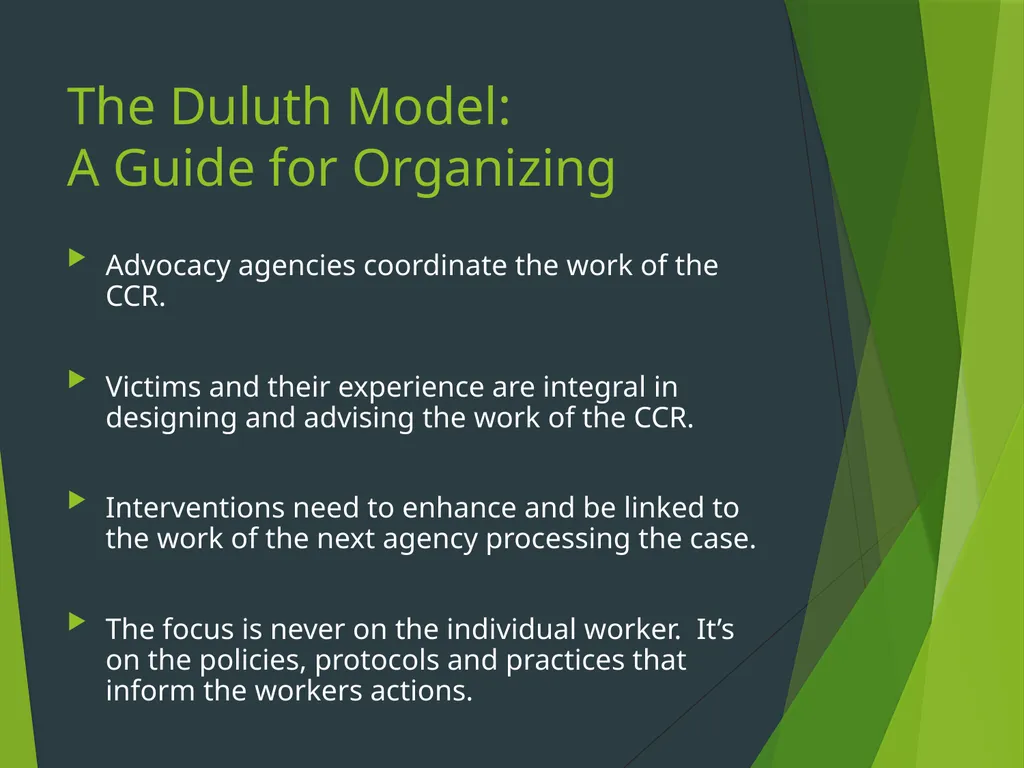
The Duluth Model:
A Guide for Organizing Advocacy agencies coordinate the work of the CCR.
Victims and their experience are integral in designing and advising the work of the CCR.
Interventions need to enhance and be linked to the work of the next agency processing the case.
The focus is never on the individual worker. It’s on the policies, protocols and practices that inform the workers actions.<br>
Victims and their experience are integral in designing and advising the work of the CCR.
Interventions need to enhance and be linked to the work of the next agency processing the case.
The focus is never on the individual worker. It’s on the policies, protocols and practices that inform the workers actions.<br>
09
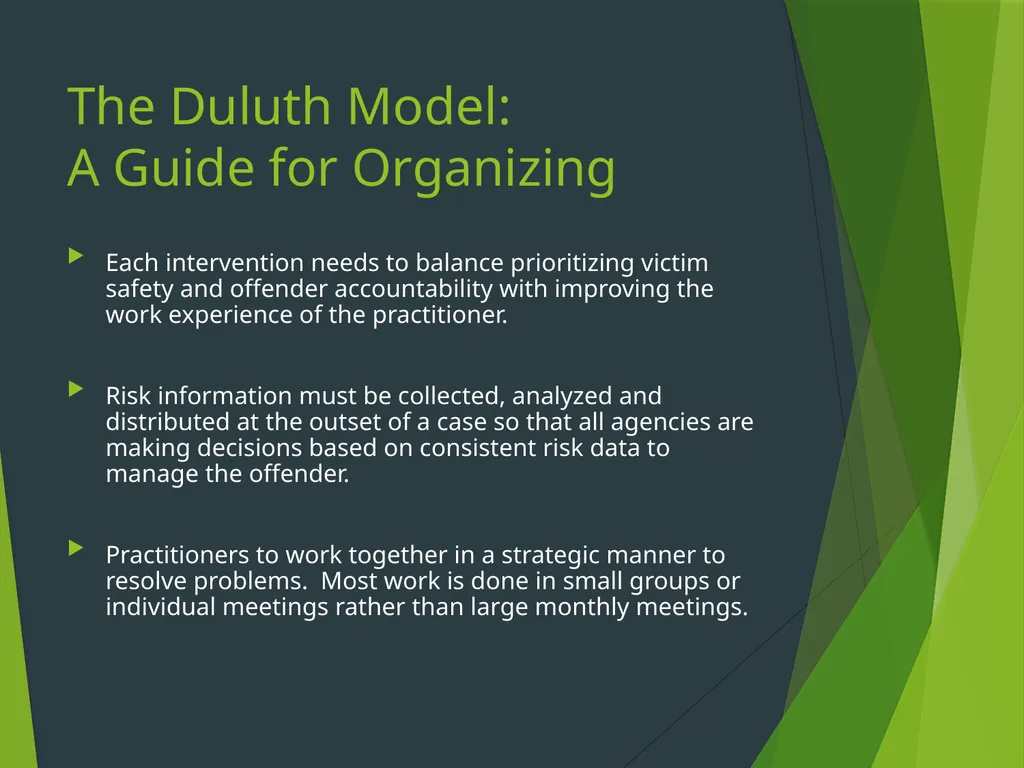
The Duluth Model:
A Guide for Organizing Each intervention needs to balance prioritizing victim safety and offender accountability with improving the work experience of the practitioner.
Risk information must be collected, analyzed and distributed at the outset of a case so that all agencies are making decisions based on consistent risk data to manage the offender.
Practitioners to work together in a strategic manner to resolve problems. Most work is done in small groups or individual meetings rather than large monthly meetings.<br>
Risk information must be collected, analyzed and distributed at the outset of a case so that all agencies are making decisions based on consistent risk data to manage the offender.
Practitioners to work together in a strategic manner to resolve problems. Most work is done in small groups or individual meetings rather than large monthly meetings.<br>
10
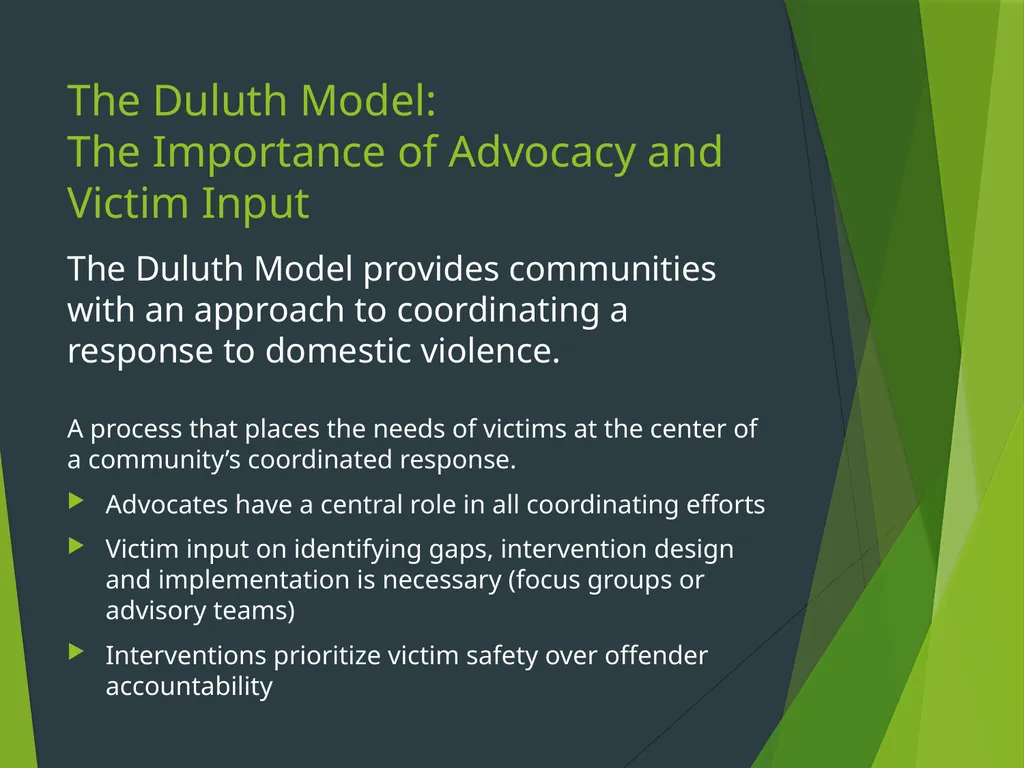
The Duluth Model:
The Importance of Advocacy and Victim Input The Duluth Model provides communities with an approach to coordinating a response to domestic violence.
A process that places the needs of victims at the center of a community’s coordinated response.
Advocates have a central role in all coordinating efforts
Victim input on identifying gaps, intervention design and implementation is necessary (focus groups or advisory teams)
Interventions prioritize victim safety over offender accountability<br>
A process that places the needs of victims at the center of a community’s coordinated response.
Advocates have a central role in all coordinating efforts
Victim input on identifying gaps, intervention design and implementation is necessary (focus groups or advisory teams)
Interventions prioritize victim safety over offender accountability<br>
11
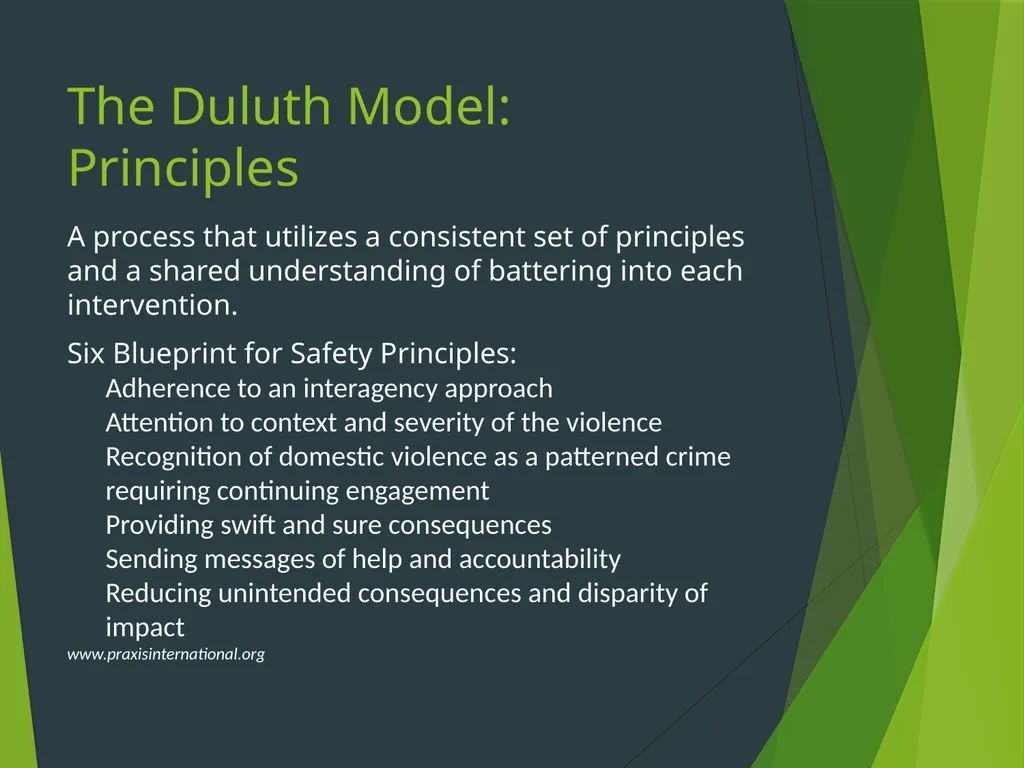
The Duluth Model:
Principles A process that utilizes a consistent set of principles and a shared understanding of battering into each intervention.
Six Blueprint for Safety Principles:
Adherence to an interagency approach
Attention to context and severity of the violence
Recognition of domestic violence as a patterned crime requiring continuing engagement
Providing swift and sure consequences
Sending messages of help and accountability
Reducing unintended consequences and disparity of impact
www.praxisinternational.org<br>
Six Blueprint for Safety Principles:
Adherence to an interagency approach
Attention to context and severity of the violence
Recognition of domestic violence as a patterned crime requiring continuing engagement
Providing swift and sure consequences
Sending messages of help and accountability
Reducing unintended consequences and disparity of impact
www.praxisinternational.org<br>
12
The Duluth Model:
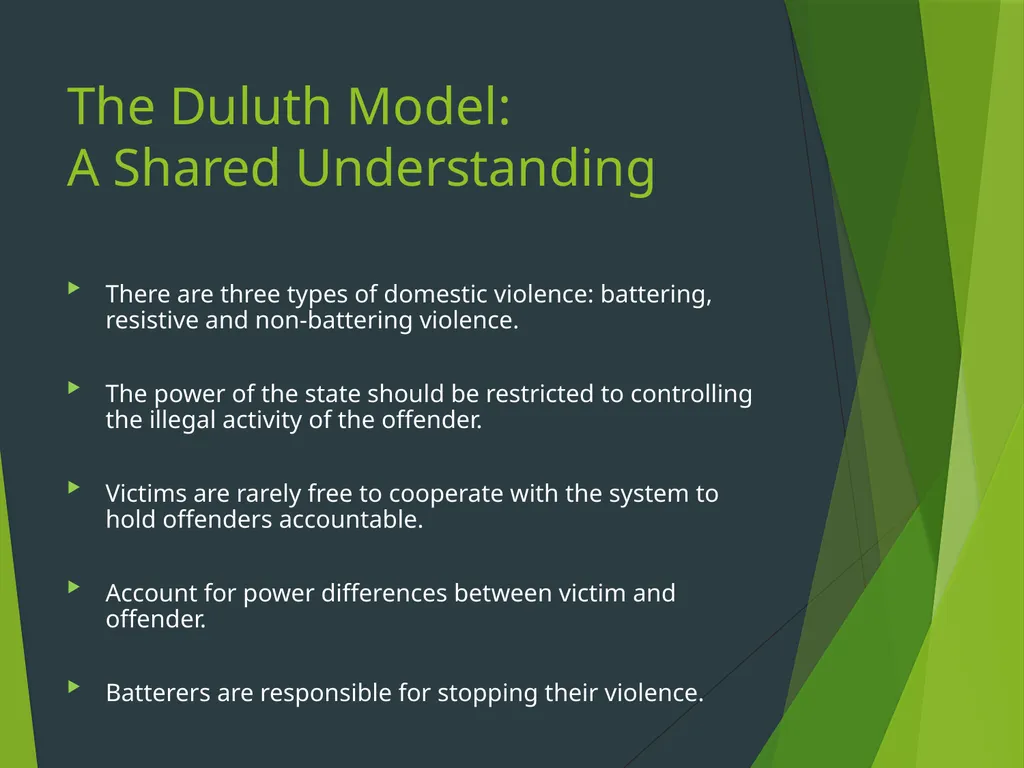
A Shared Understanding There are three types of domestic violence: battering, resistive and non-battering violence.
The power of the state should be restricted to controlling the illegal activity of the offender.
Victims are rarely free to cooperate with the system to hold offenders accountable.
Account for power differences between victim and offender.
Batterers are responsible for stopping their violence.<br>
The power of the state should be restricted to controlling the illegal activity of the offender.
Victims are rarely free to cooperate with the system to hold offenders accountable.
Account for power differences between victim and offender.
Batterers are responsible for stopping their violence.<br>
13
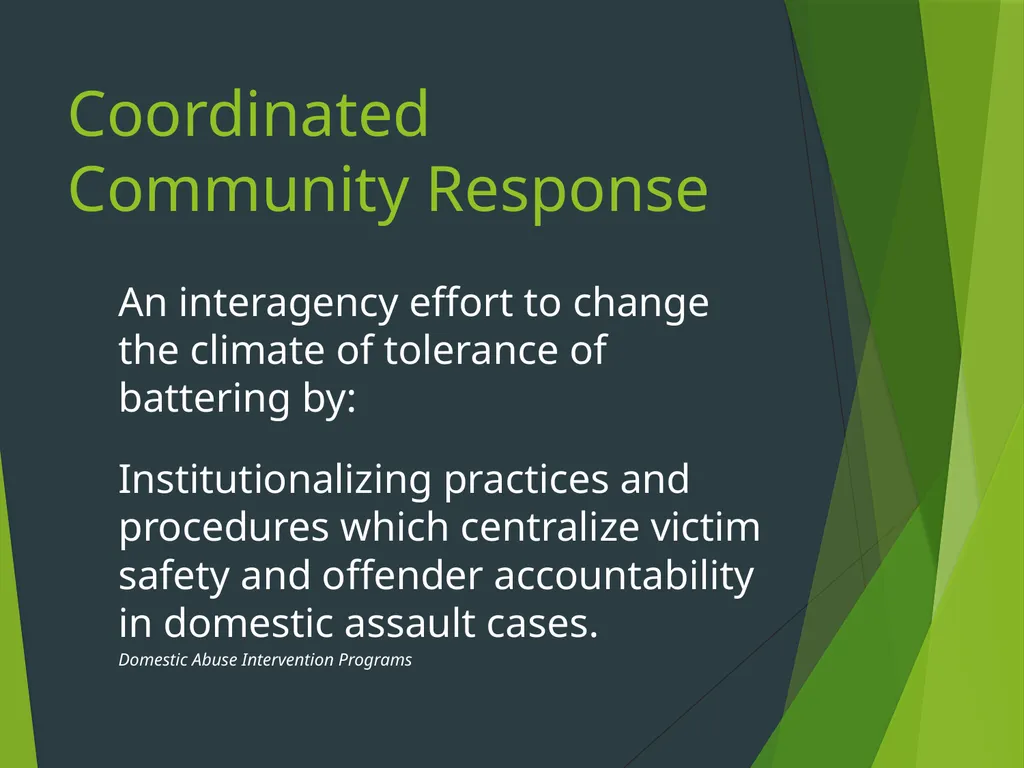
Coordinated Community Response An interagency effort to change the climate of tolerance of battering by:
Institutionalizing practices and procedures which centralize victim safety and offender accountability in domestic assault cases.
Domestic Abuse Intervention Programs<br>
Institutionalizing practices and procedures which centralize victim safety and offender accountability in domestic assault cases.
Domestic Abuse Intervention Programs<br>
14
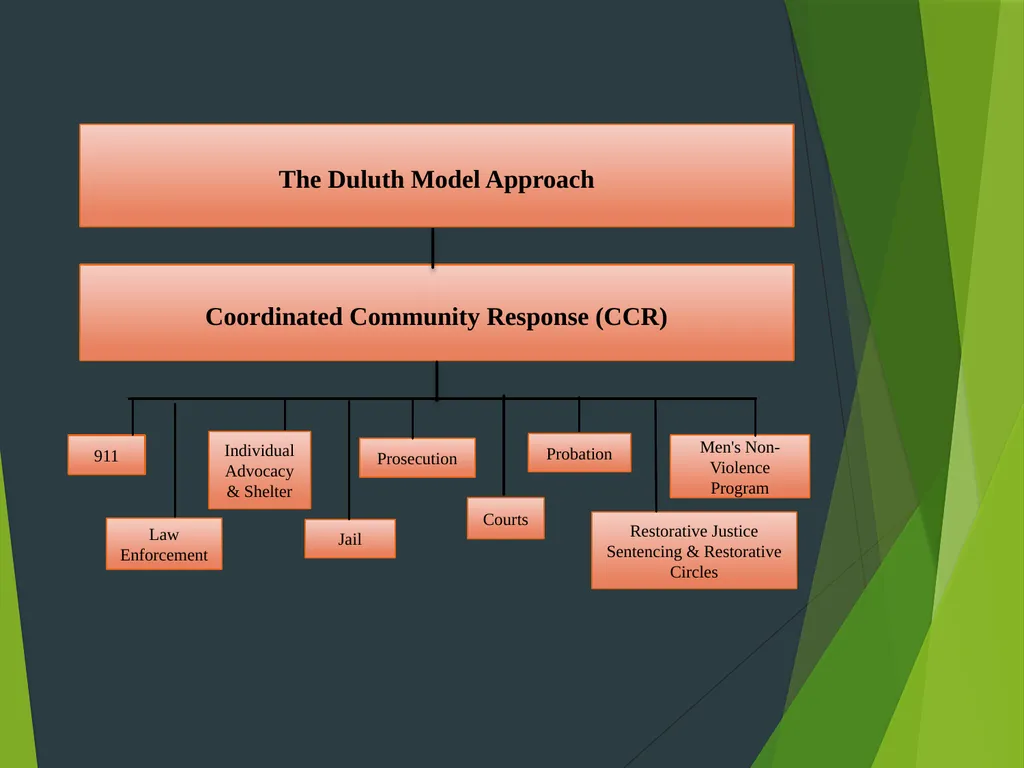
The Duluth Model Approach Coordinated Community Response (CCR) 911 Law Enforcement Individual Advocacy & Shelter Jail Prosecution Courts Probation Restorative Justice Sentencing & Restorative Circles Men's Non-Violence Program<br>
15
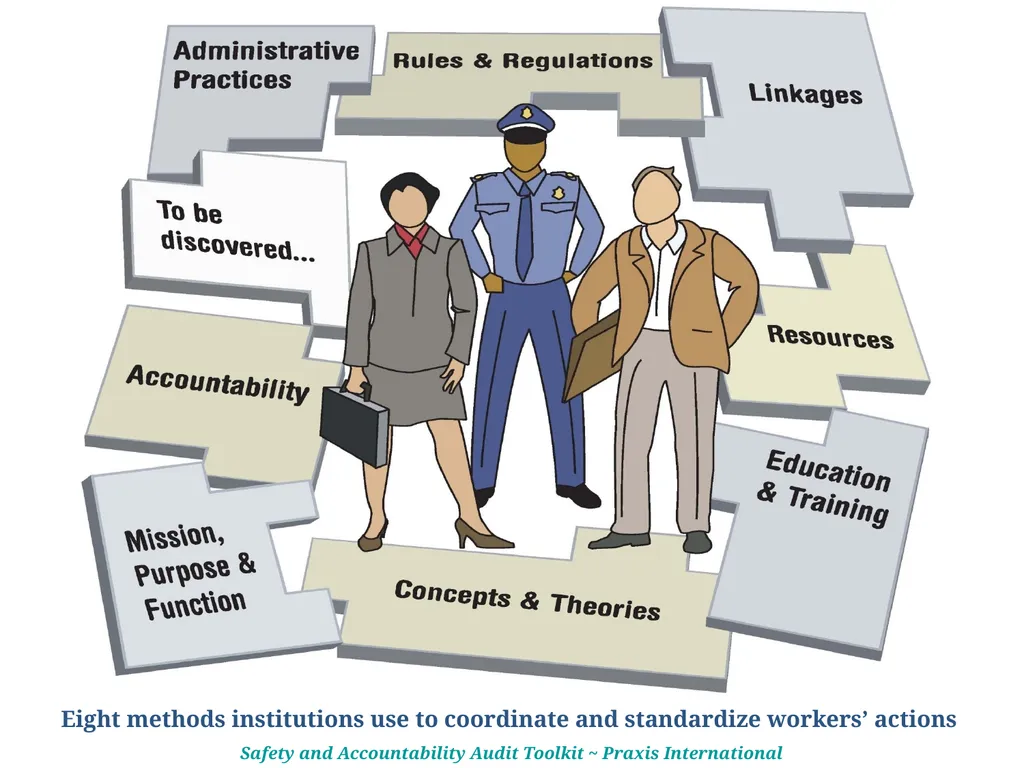
Eight methods institutions use to coordinate and standardize workers’ actions
Safety and Accountability Audit Toolkit ~ Praxis International<br>
Safety and Accountability Audit Toolkit ~ Praxis International<br>
16
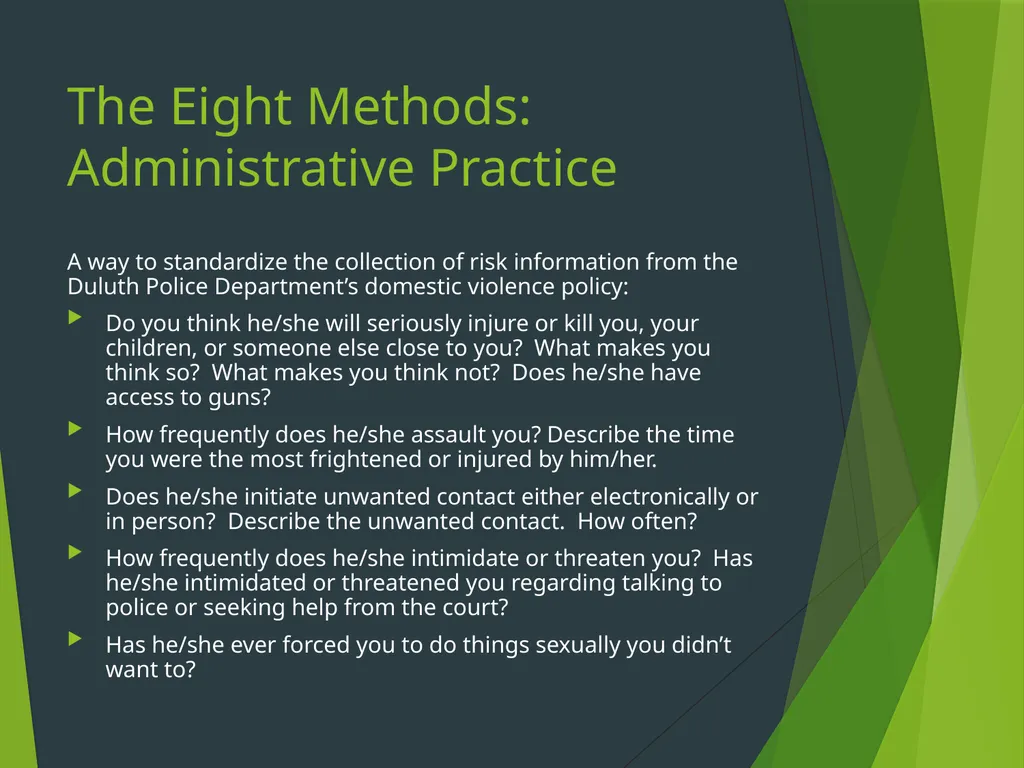
The Eight Methods: Administrative Practice A way to standardize the collection of risk information from the Duluth Police Department’s domestic violence policy:
Do you think he/she will seriously injure or kill you, your children, or someone else close to you? What makes you think so? What makes you think not? Does he/she have access to guns?
How frequently does he/she assault you? Describe the time you were the most frightened or injured by him/her.
Does he/she initiate unwanted contact either electronically or in person? Describe the unwanted contact. How often?
How frequently does he/she intimidate or threaten you? Has he/she intimidated or threatened you regarding talking to police or seeking help from the court?
Has he/she ever forced you to do things sexually you didn’t want to?<br>
Do you think he/she will seriously injure or kill you, your children, or someone else close to you? What makes you think so? What makes you think not? Does he/she have access to guns?
How frequently does he/she assault you? Describe the time you were the most frightened or injured by him/her.
Does he/she initiate unwanted contact either electronically or in person? Describe the unwanted contact. How often?
How frequently does he/she intimidate or threaten you? Has he/she intimidated or threatened you regarding talking to police or seeking help from the court?
Has he/she ever forced you to do things sexually you didn’t want to?<br>
17
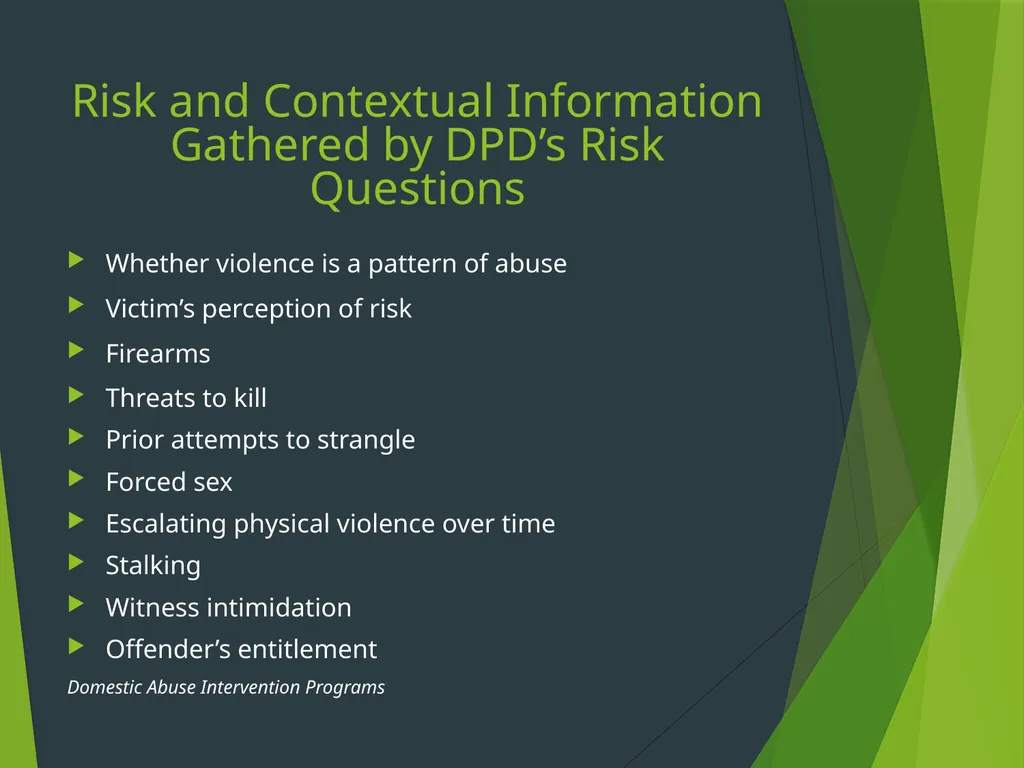
Risk and Contextual Information Gathered by DPD’s Risk Questions Whether violence is a pattern of abuse
Victim’s perception of risk
Firearms
Threats to kill
Prior attempts to strangle
Forced sex
Escalating physical violence over time
Stalking
Witness intimidation
Offender’s entitlement
Domestic Abuse Intervention Programs<br>
Victim’s perception of risk
Firearms
Threats to kill
Prior attempts to strangle
Forced sex
Escalating physical violence over time
Stalking
Witness intimidation
Offender’s entitlement
Domestic Abuse Intervention Programs<br>
18
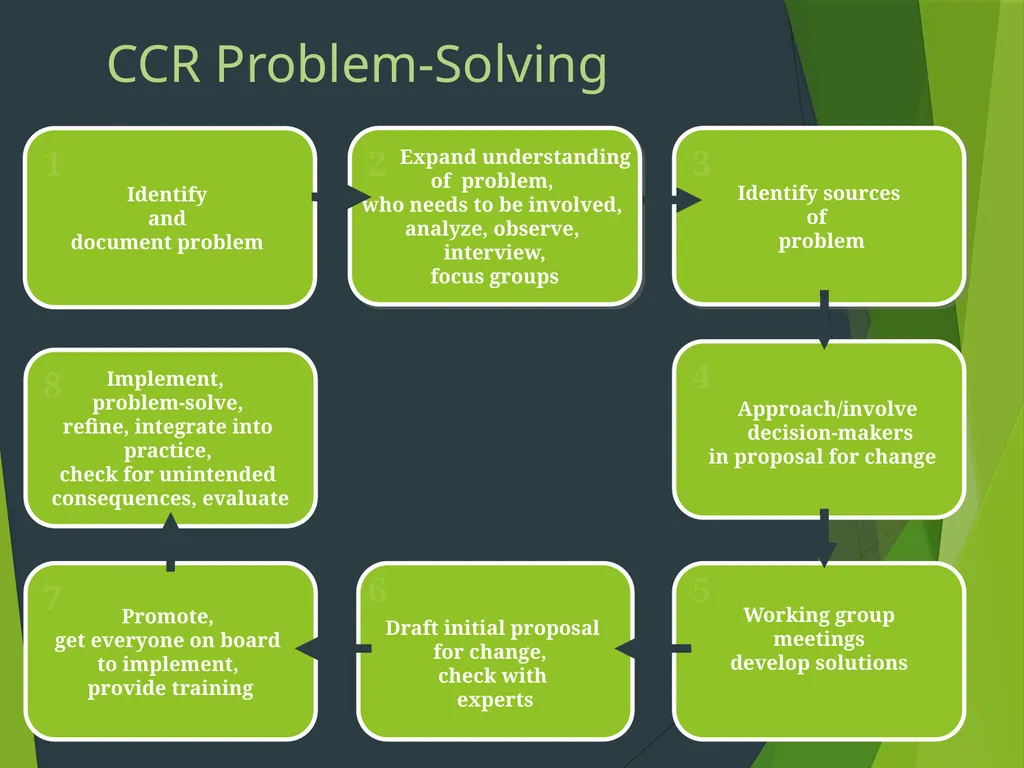
CCR Problem-Solving Identify
and
document problem Expand understanding
of problem,
who needs to be involved,
analyze, observe,
interview,
focus groups Identify sources
of
problem Draft initial proposal
for change,
check with
experts Promote,
get everyone on board
to implement,
provide training Implement,
problem-solve,
refine, integrate into
practice,
check for unintended
consequences, evaluate 1 2 3 4 7 6 5 8 Approach/involve
decision-makers
in proposal for change Working group
meetings
develop solutions<br>
and
document problem Expand understanding
of problem,
who needs to be involved,
analyze, observe,
interview,
focus groups Identify sources
of
problem Draft initial proposal
for change,
check with
experts Promote,
get everyone on board
to implement,
provide training Implement,
problem-solve,
refine, integrate into
practice,
check for unintended
consequences, evaluate 1 2 3 4 7 6 5 8 Approach/involve
decision-makers
in proposal for change Working group
meetings
develop solutions<br>
19
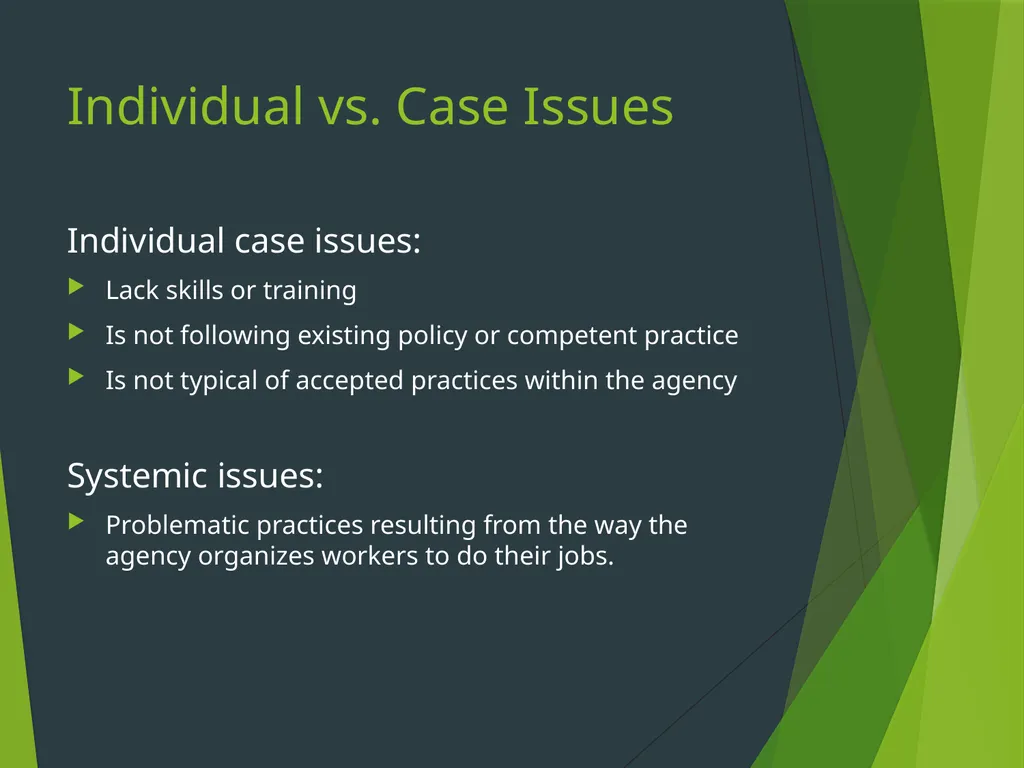
Individual vs. Case Issues Individual case issues:
Lack skills or training
Is not following existing policy or competent practice
Is not typical of accepted practices within the agency
Systemic issues:
Problematic practices resulting from the way the agency organizes workers to do their jobs.<br>
Lack skills or training
Is not following existing policy or competent practice
Is not typical of accepted practices within the agency
Systemic issues:
Problematic practices resulting from the way the agency organizes workers to do their jobs.<br>
20
The Role of Advocacy in CCR Work Advocates working on behalf of individual women deal with the problems created by both how the system is organized and what practitioners do on a specific case. Given this proximity to victims who are battered, advocates are best positioned to see when systemic problems emerge.
Without a trusted and formal link to community advocates, the impact of CCR work on the lives of those victimized by battering will be limited.
Domestic Abuse Intervention Programs<br>
Without a trusted and formal link to community advocates, the impact of CCR work on the lives of those victimized by battering will be limited.
Domestic Abuse Intervention Programs<br>
21
Research and Program Evaluation in Duluth The first study done in Duluth was in 1983 by Novak and Galaway.
Between 1983 and the present, Duluth has continued to evaluate and research it’s community response to domestic violence.
For more information, go to the following link: http://www.theduluthmodel.org/pdf/programevaluation.pdf<br>
Between 1983 and the present, Duluth has continued to evaluate and research it’s community response to domestic violence.
For more information, go to the following link: http://www.theduluthmodel.org/pdf/programevaluation.pdf<br>
22
Research on Duluth’s Coordinated Community Response Predicting Batterer Recidivism Five Years After Community Intervention, Dr. Melanie Shepard , Journal of Family Violence, Vol. 7, No. 3, 1992
First five year study on recidivism in the U.S (1985-1990)
Recidivism 40% (N=100)
Community response includes mandatory arrest, prosecution guidelines discouraging dismissal and routine pre-sentence investigations. However, only 9 of the subjects were ordered to time in jail.
Men’s program had the men participate in 11 counseling sessions with a mental health provider and 11 education classes with DAIP. 66% of the men completed the program.<br>
First five year study on recidivism in the U.S (1985-1990)
Recidivism 40% (N=100)
Community response includes mandatory arrest, prosecution guidelines discouraging dismissal and routine pre-sentence investigations. However, only 9 of the subjects were ordered to time in jail.
Men’s program had the men participate in 11 counseling sessions with a mental health provider and 11 education classes with DAIP. 66% of the men completed the program.<br>
23
Research on Duluth’s Coordinated Community Response Enhancing Coordinated Community Responses to Reduce Recidivism in Cases of Domestic Violence, (Shepard, Falk, Elliott), Journal of Interpersonal Violence, Vol. 17, No. 5, May, 2002.
“…the core of the DAIP has always been focused on institutional change to effectively coordinate community responses to domestic violence.” (p. 552)
“The results are encouraging in that there was evidence of reduced recidivism rates with the enhanced coordinated responses…Overall, the study findings suggest that improved coordination through the sharing of risk information among criminal justice professionals can reduce recidivism among men who abuse their partners.” (p. 568)<br>
“…the core of the DAIP has always been focused on institutional change to effectively coordinate community responses to domestic violence.” (p. 552)
“The results are encouraging in that there was evidence of reduced recidivism rates with the enhanced coordinated responses…Overall, the study findings suggest that improved coordination through the sharing of risk information among criminal justice professionals can reduce recidivism among men who abuse their partners.” (p. 568)<br>
24
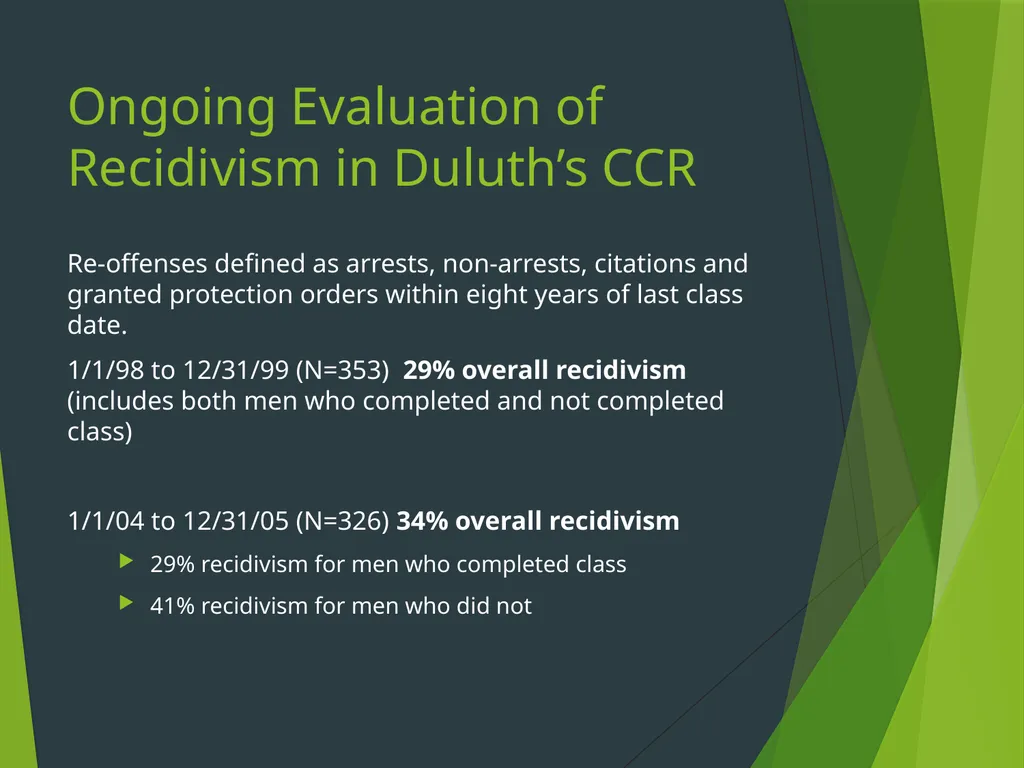
Ongoing Evaluation of Recidivism in Duluth’s CCR Re-offenses defined as arrests, non-arrests, citations and granted protection orders within eight years of last class date.
1/1/98 to 12/31/99 (N=353) 29% overall recidivism (includes both men who completed and not completed class)
1/1/04 to 12/31/05 (N=326) 34% overall recidivism
29% recidivism for men who completed class
41% recidivism for men who did not<br>
1/1/98 to 12/31/99 (N=353) 29% overall recidivism (includes both men who completed and not completed class)
1/1/04 to 12/31/05 (N=326) 34% overall recidivism
29% recidivism for men who completed class
41% recidivism for men who did not<br>
25
DAIP’s Men’s Nonviolence Program Component of Duluth’s Coordinated Community Response
Formal partner with community advocacy programs
Has access to all LE reports, OFPs, risk analysis, imposed sentence, probation conditions, visitation center records and initiates victim contact
Probation receives bi-weekly reports from DAIP on men’s status, attendance record
Meets the same Duluth Model principles and shared understanding that all other agencies build interventions from (includes curriculum).
Provides classes for court ordered men, women and support and education groups for female victims.<br>
Formal partner with community advocacy programs
Has access to all LE reports, OFPs, risk analysis, imposed sentence, probation conditions, visitation center records and initiates victim contact
Probation receives bi-weekly reports from DAIP on men’s status, attendance record
Meets the same Duluth Model principles and shared understanding that all other agencies build interventions from (includes curriculum).
Provides classes for court ordered men, women and support and education groups for female victims.<br>
26
Part of a Social Movement Learned from and partnered with women’s advocates and victims of battering to develop the curriculum
Organized to provide safety for women and change for men
Organized to be a component of Duluth’s Coordinated Community Response<br>
Organized to provide safety for women and change for men
Organized to be a component of Duluth’s Coordinated Community Response<br>
27
Core Principles of Social Change Create and experience that is liberating rather than dominating
Engage in dialogue vs. counsel and advise
Approach as a social problem vs. a problem with an individual
Adapted from the work of Praxis International<br>
Engage in dialogue vs. counsel and advise
Approach as a social problem vs. a problem with an individual
Adapted from the work of Praxis International<br>
28
Principles of a Duluth Model
Men’s Nonviolence Program The program purpose is to increase the safety of women and children
The reference point for understanding battering is the experience of women who have been battered
The program focus is on deconstructing men’s historical and socially constructed entitlement to be violent to women
An ongoing, formal relationship with shelter/court advocates is a critical part of providing safety for women and children<br>
The reference point for understanding battering is the experience of women who have been battered
The program focus is on deconstructing men’s historical and socially constructed entitlement to be violent to women
An ongoing, formal relationship with shelter/court advocates is a critical part of providing safety for women and children<br>
29
Principles of a Duluth Model
Men’s Nonviolence Program Critical dialogue is central to creating an educational process of change for men who batter
The men’s nonviolence program recognizes and responds to the advocacy, safety and empowerment needs of the women whose partners are in the program.
The men’s nonviolence program is a component of a larger interagency response to battering.<br>
The men’s nonviolence program recognizes and responds to the advocacy, safety and empowerment needs of the women whose partners are in the program.
The men’s nonviolence program is a component of a larger interagency response to battering.<br>
30
Current Batterer Intervention Programs (BIP) Heading in the direction of:
Stand alone agencies
Organized to provide a service from a referral
Loosely connected to CCR and women’s programs<br>
Stand alone agencies
Organized to provide a service from a referral
Loosely connected to CCR and women’s programs<br>
31
Resources Domestic Abuse Intervention Programs www.theduluthmodel.org
Turning Points Curriculum for Women www.dvturningpoints.com
Battered Women’s Justice Project www.bwjp.org
Praxis International www.praxisinternational.org<br>
Turning Points Curriculum for Women www.dvturningpoints.com
Battered Women’s Justice Project www.bwjp.org
Praxis International www.praxisinternational.org<br>