The Earth is divided into three main layers The dense, hot inner core (yellow), the molten outer core (orange), the mantle (red), and the thin crust (brown)e in the known universe. Core, mantle Crust Interior of Earth Interior of Earth
"The Earth is divided into three main layers The" is the property of its rightful owner. Permission is granted to
download and print the materials on this website for personal, non-commercial use only, and to display it
on your personal computer provided you do not modify the materials and that you retain all copyright
notices contained in the materials. By downloading content from our website, you accept the terms of this
agreement.
Presentation Transcript
01
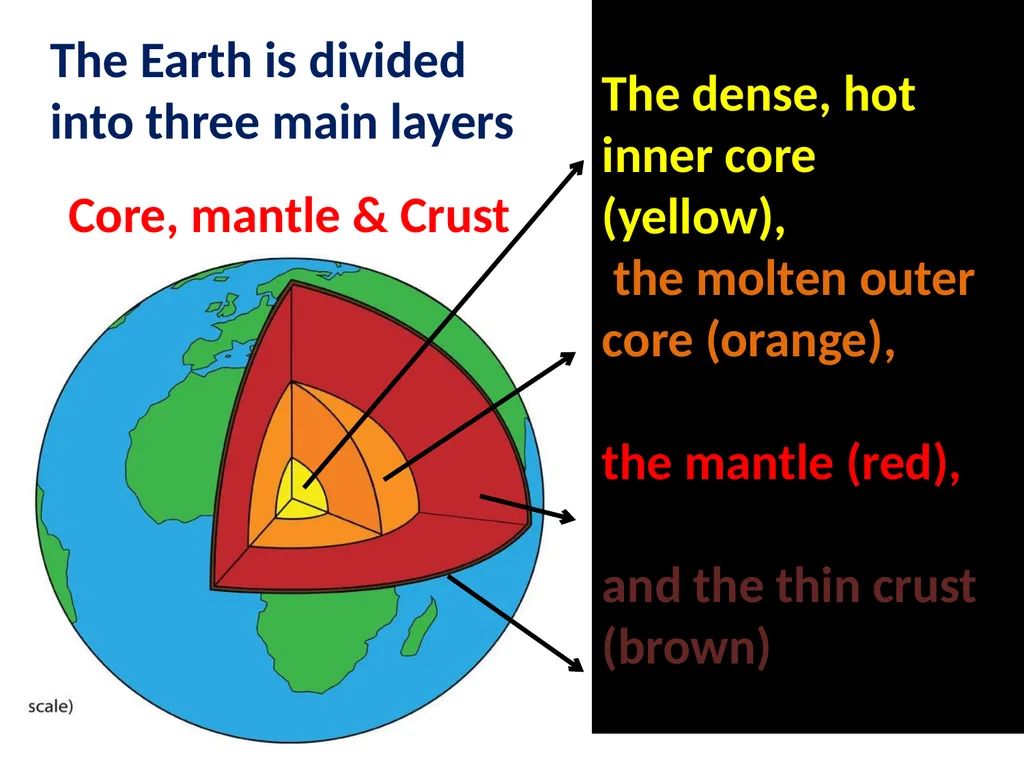
The Earth is divided into three main layers The dense, hot inner core (yellow),
the molten outer core (orange),
the mantle (red),
and the thin crust (brown)e in the known universe. Core, mantle & Crust<br>
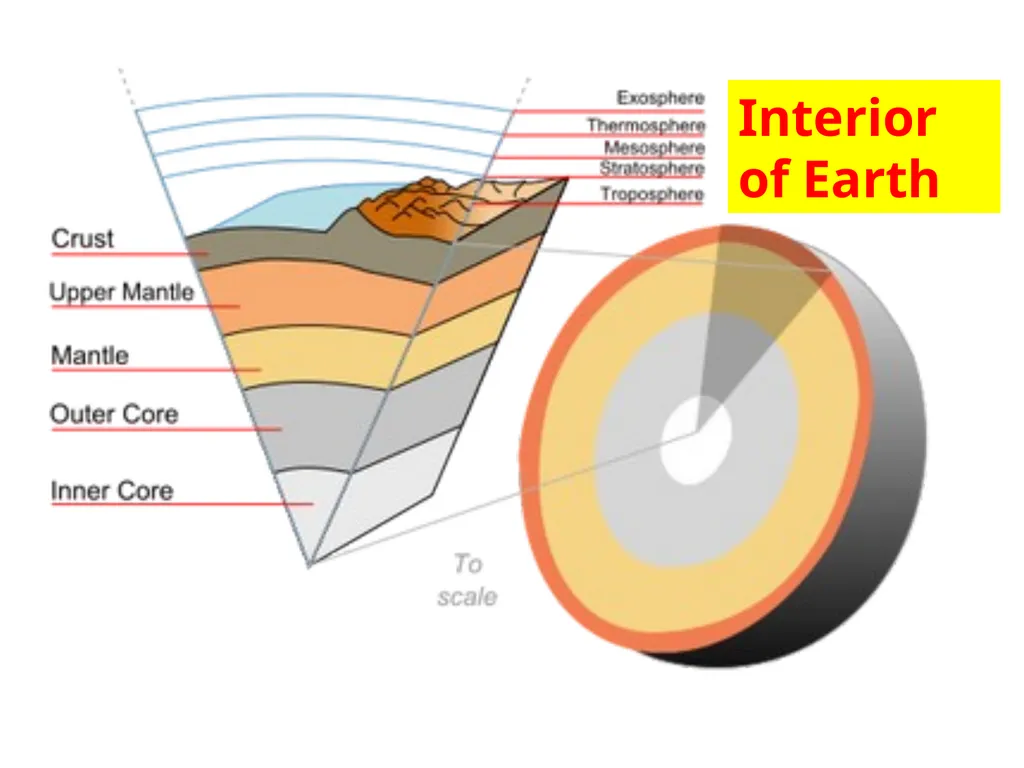
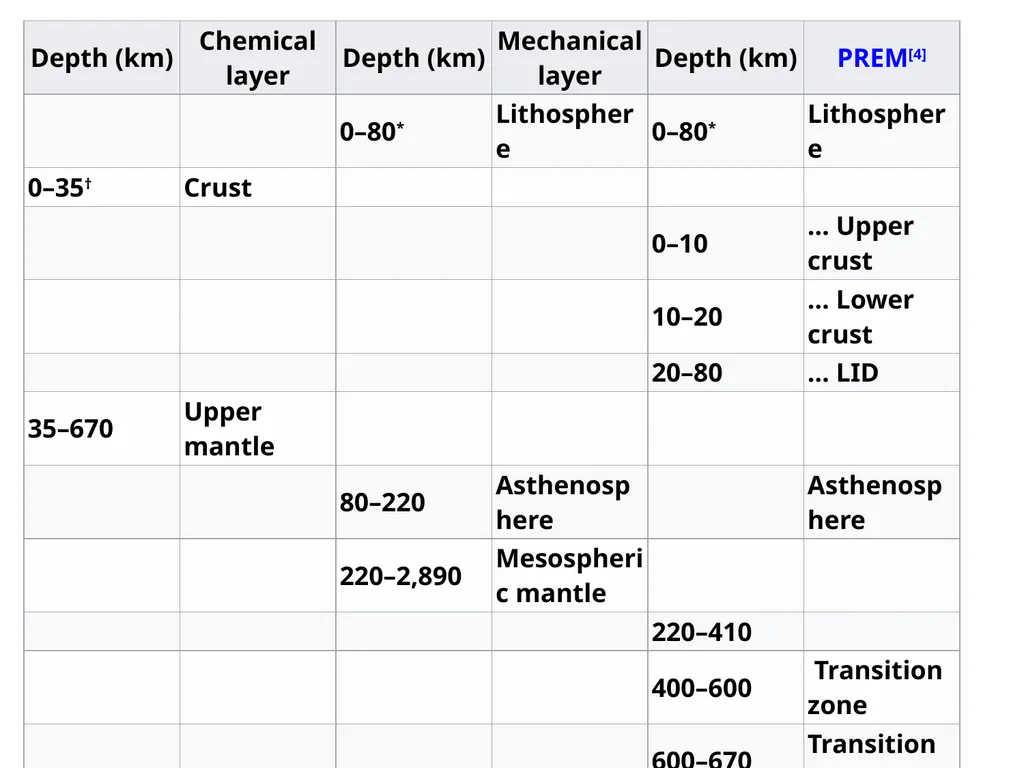
The structure of Earth can be defined in two ways Mechanically, it can be divided into lithosphere, asthenosphere, mesospheric mantle, outer core, and the inner core.
Chemically, Earth can be divided into the crust, upper mantle, lower mantle, outer core, and inner core.
The geologic component layers of Earth are at the following depths below the surface<br>
05
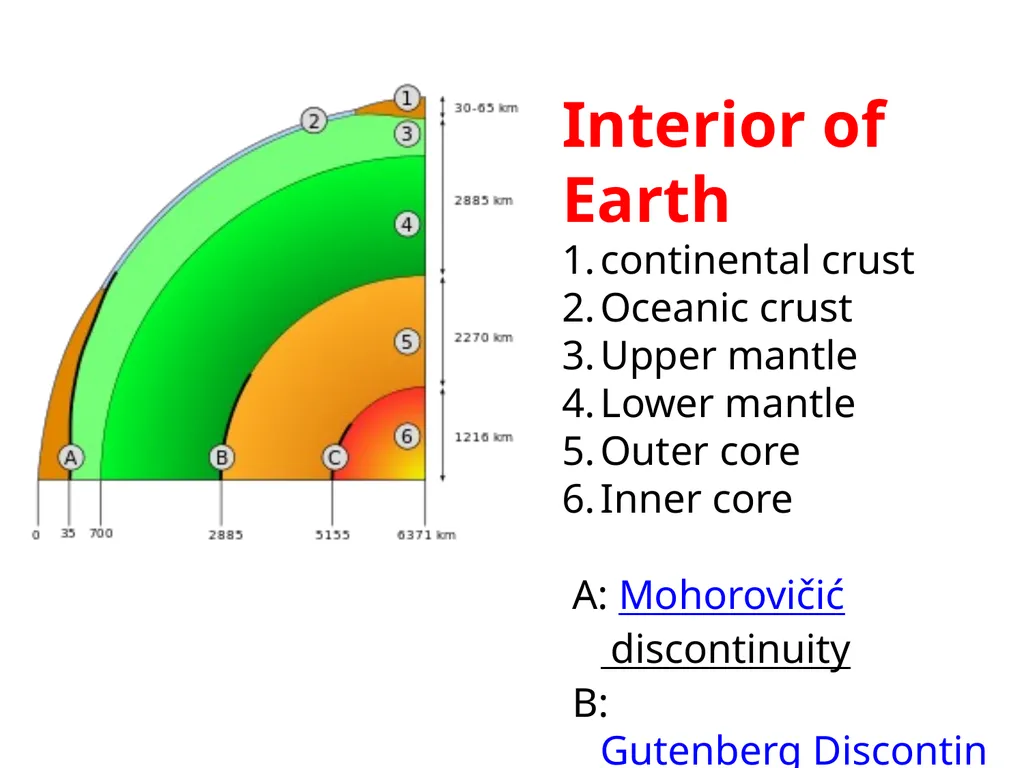
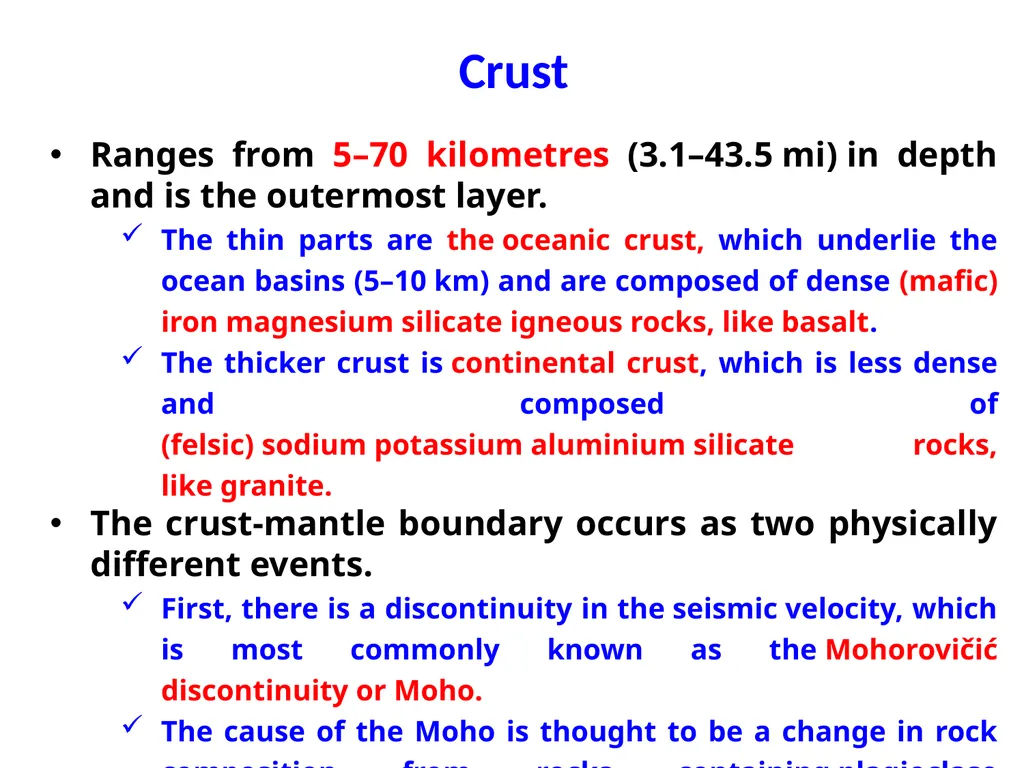
Ranges from 5–70 kilometres (3.1–43.5 mi) in depth and is the outermost layer.
The thin parts are the oceanic crust, which underlie the ocean basins (5–10 km) and are composed of dense (mafic) iron magnesium silicate igneous rocks, like basalt.
The thicker crust is continental crust, which is less dense and composed of (felsic) sodium potassium aluminium silicate rocks, like granite.
The crust-mantle boundary occurs as two physically different events.
First, there is a discontinuity in the seismic velocity, which is most commonly known as the Mohorovičić discontinuity or Moho.
The cause of the Moho is thought to be a change in rock composition from rocks containing plagioclase feldspar (above) to rocks that contain no feldspars (below).
Second, in oceanic crust, there is a chemical discontinuity between ultramafic cumulates and tectonized harzburgites, which has been observed from deep parts of the oceanic crust that have been abducted onto the continental crust and preserved as ophiolite sequences. Crust<br>
06
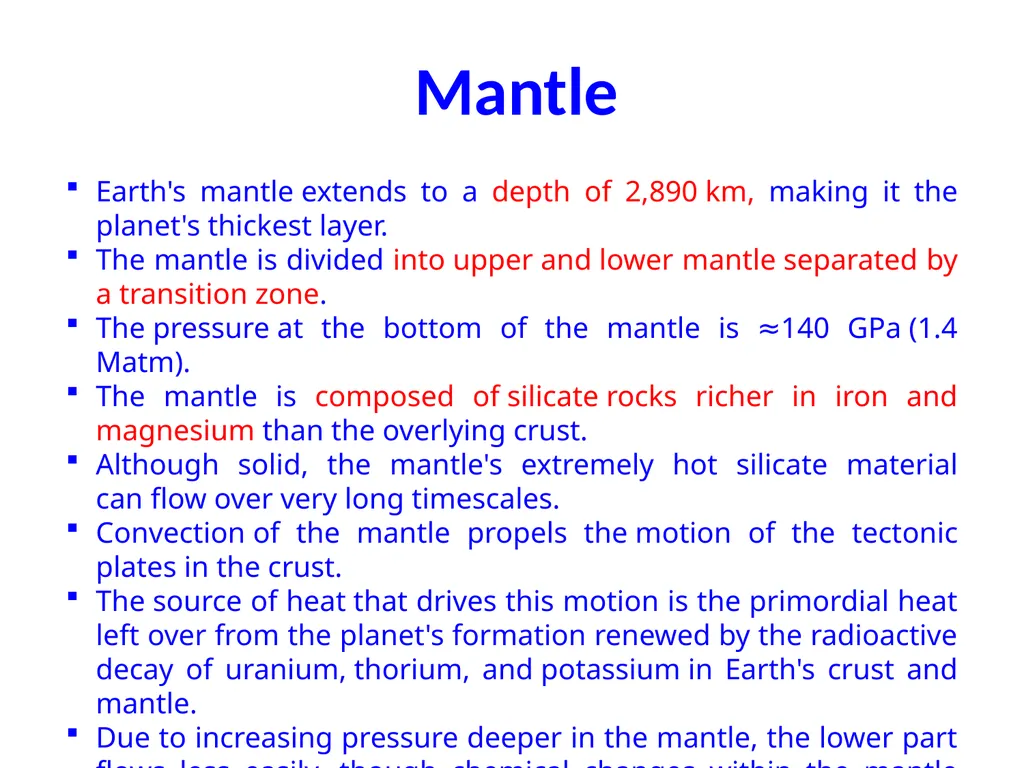
Mantle Earth's mantle extends to a depth of 2,890 km, making it the planet's thickest layer.
The mantle is divided into upper and lower mantle separated by a transition zone.
The pressure at the bottom of the mantle is ≈140 GPa (1.4 Matm).
The mantle is composed of silicate rocks richer in iron and magnesium than the overlying crust.
Although solid, the mantle's extremely hot silicate material can flow over very long timescales.
Convection of the mantle propels the motion of the tectonic plates in the crust.
The source of heat that drives this motion is the primordial heat left over from the planet's formation renewed by the radioactive decay of uranium, thorium, and potassium in Earth's crust and mantle.
Due to increasing pressure deeper in the mantle, the lower part flows less easily, though chemical changes within the mantle may also be important.<br>
07
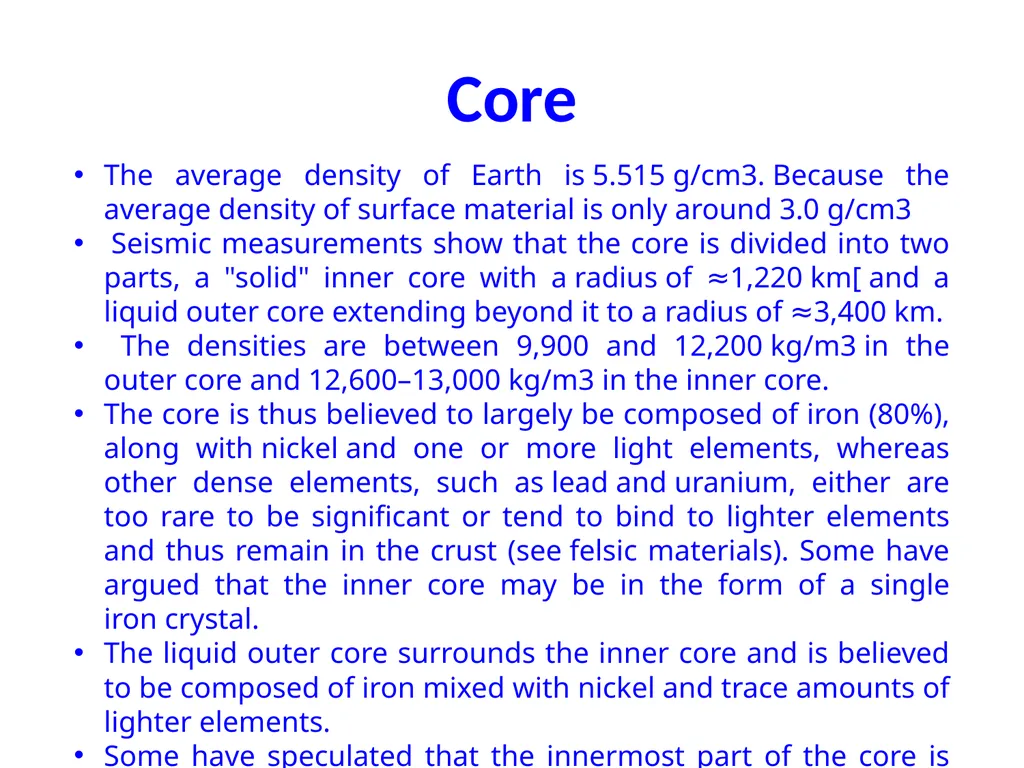
Core The average density of Earth is 5.515 g/cm3. Because the average density of surface material is only around 3.0 g/cm3
Seismic measurements show that the core is divided into two parts, a "solid" inner core with a radius of ≈1,220 km[ and a liquid outer core extending beyond it to a radius of ≈3,400 km.
The densities are between 9,900 and 12,200 kg/m3 in the outer core and 12,600–13,000 kg/m3 in the inner core.
The core is thus believed to largely be composed of iron (80%), along with nickel and one or more light elements, whereas other dense elements, such as lead and uranium, either are too rare to be significant or tend to bind to lighter elements and thus remain in the crust (see felsic materials). Some have argued that the inner core may be in the form of a single iron crystal.
The liquid outer core surrounds the inner core and is believed to be composed of iron mixed with nickel and trace amounts of lighter elements.
Some have speculated that the innermost part of the core is enriched in gold, platinum and other siderophile elements.<br>