The Einstein Model of a Solid In 1907, Einstein proposed a model that reasonably predicted the thermal behavior of crystalline solids (a 3D bed-spring model): a crystalline solid containing N atoms, behaves as if it contained 3N identical
"The Einstein Model of a Solid In 1907, Einstein" is the property of its rightful owner. Permission is granted to
download and print the materials on this website for personal, non-commercial use only, and to display it
on your personal computer provided you do not modify the materials and that you retain all copyright
notices contained in the materials. By downloading content from our website, you accept the terms of this
agreement.
Presentation Transcript
01
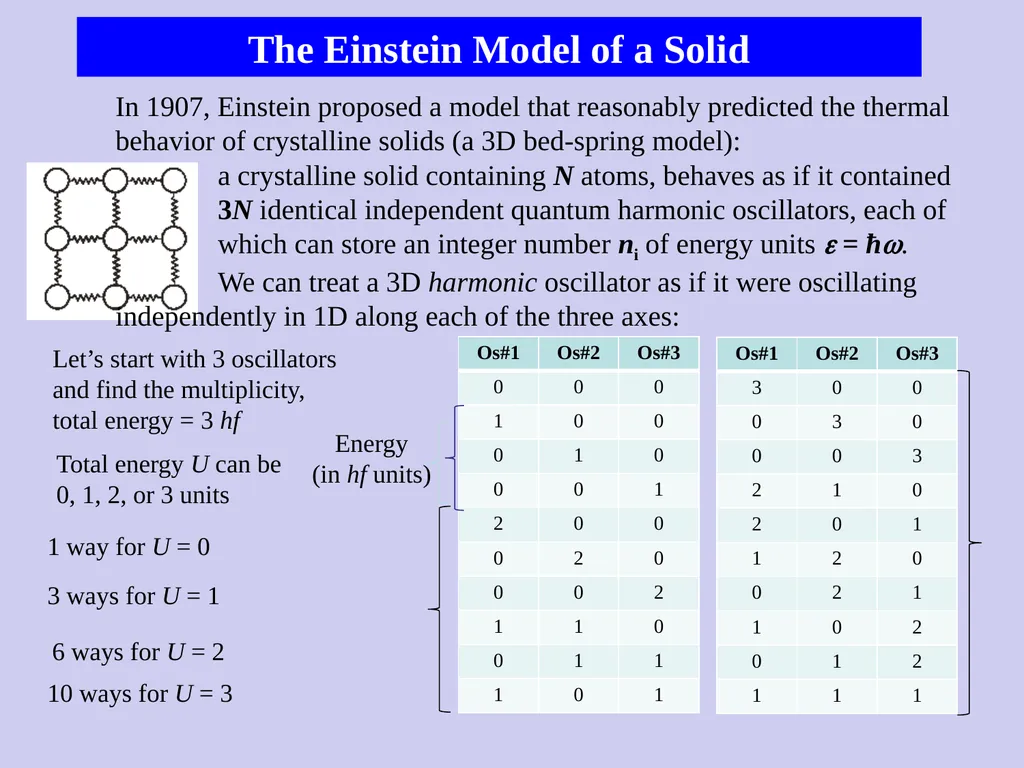
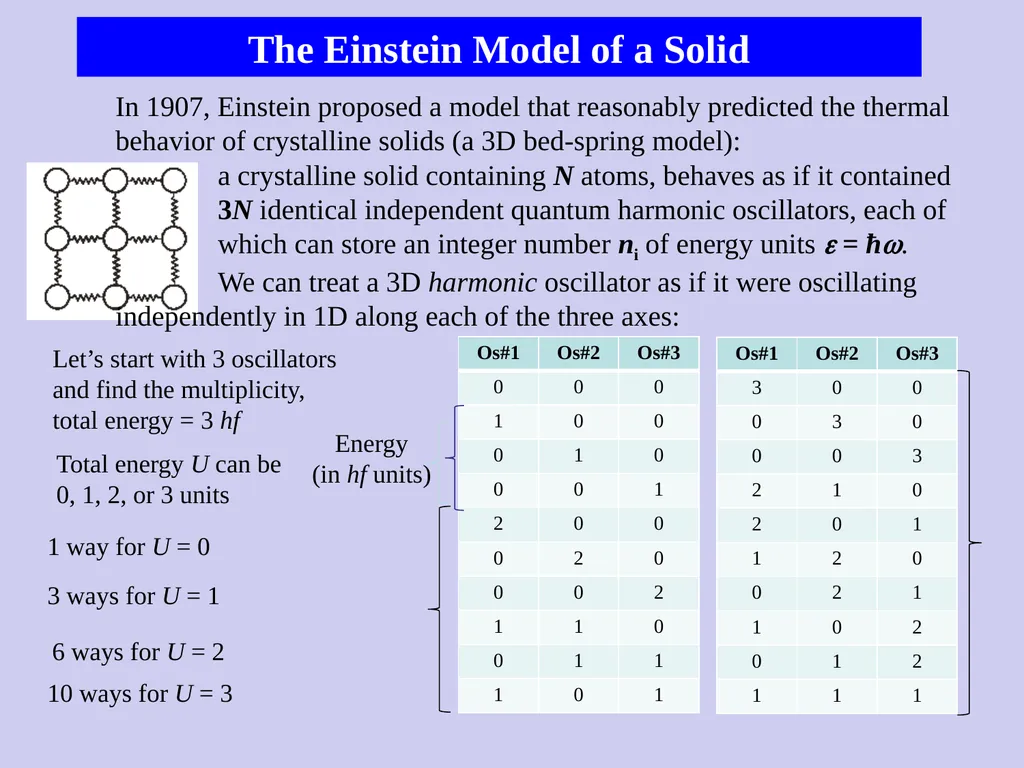
The Einstein Model of a Solid In 1907, Einstein proposed a model that reasonably predicted the thermal behavior of crystalline solids (a 3D bed-spring model):
a crystalline solid containing N atoms, behaves as if it contained 3N identical independent quantum harmonic oscillators, each of which can store an integer number ni of energy units = ħ.
We can treat a 3D harmonic oscillator as if it were oscillating independently in 1D along each of the three axes: Let’s start with 3 oscillators and find the multiplicity, total energy = 3 hf Energy
(in hf units) 1 way for U = 0 3 ways for U = 1 6 ways for U = 2 10 ways for U = 3 Total energy U can be
0, 1, 2, or 3 units<br>
02
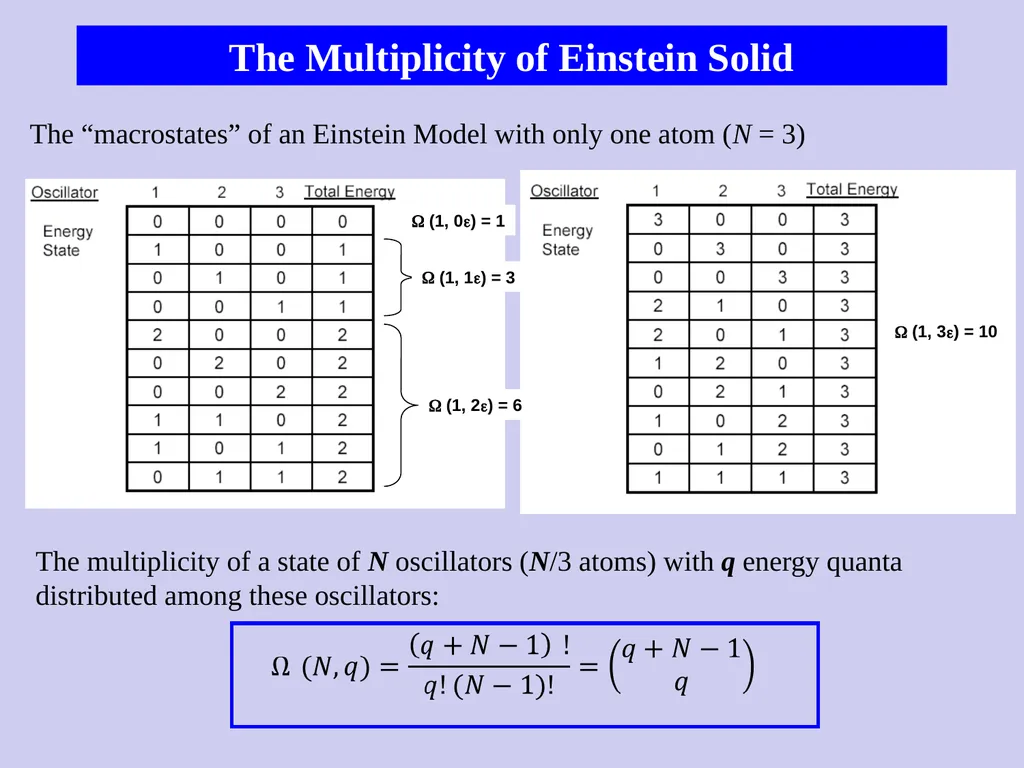
The “macrostates” of an Einstein Model with only one atom (N = 3) (1, 0) = 1 (1, 1) = 3 (1, 2) = 6 (1, 3) = 10 The multiplicity of a state of N oscillators (N/3 atoms) with q energy quanta distributed among these oscillators: The Multiplicity of Einstein Solid<br>
03
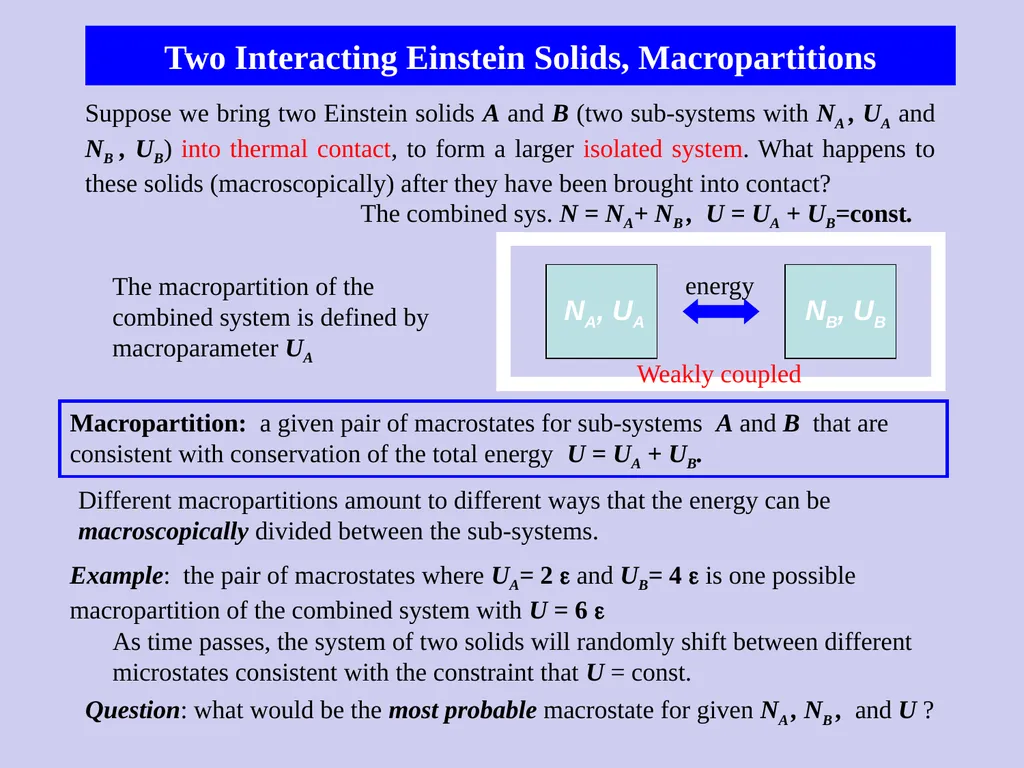
Two Interacting Einstein Solids, Macropartitions Suppose we bring two Einstein solids A and B (two sub-systems with NA , UA and NB , UB) into thermal contact, to form a larger isolated system. What happens to these solids (macroscopically) after they have been brought into contact? The combined sys. N = NA+ NB , U = UA + UB=const. Question: what would be the most probable macrostate for given NA , NB , and U ? The macropartition of the combined system is defined by macroparameter UA Macropartition: a given pair of macrostates for sub-systems A and B that are consistent with conservation of the total energy U = UA + UB. Example: the pair of macrostates where UA= 2 and UB= 4 is one possible macropartition of the combined system with U = 6 As time passes, the system of two solids will randomly shift between different microstates consistent with the constraint that U = const. Different macropartitions amount to different ways that the energy can be macroscopically divided between the sub-systems. Weakly coupled<br>
04
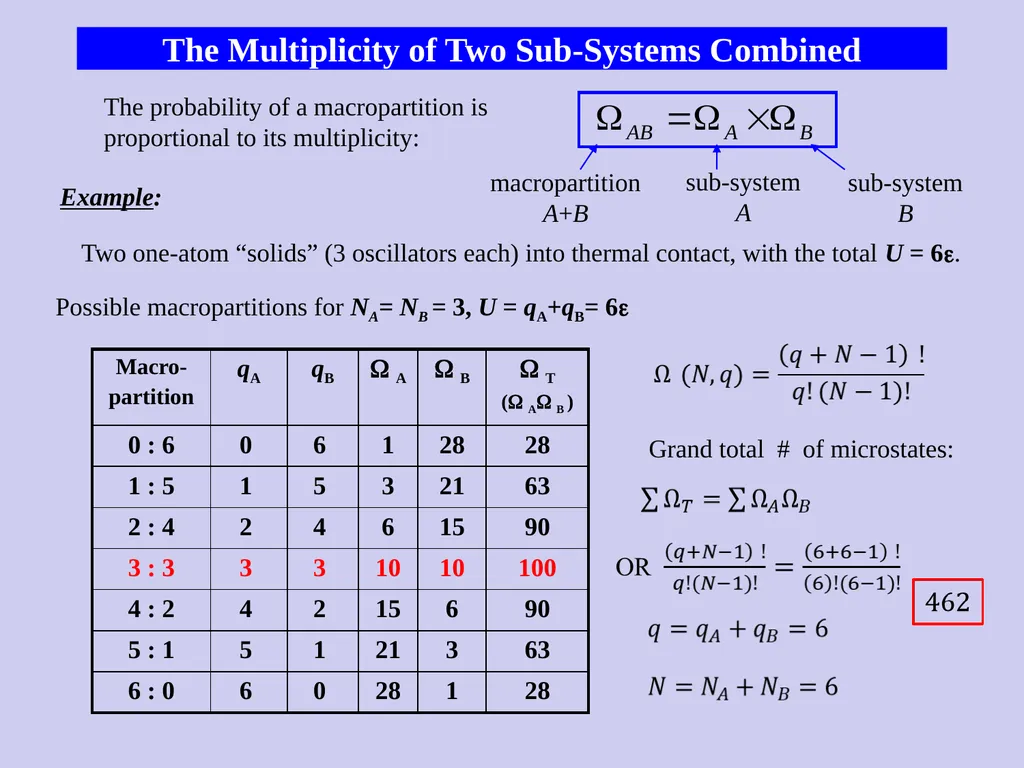
The Multiplicity of Two Sub-Systems Combined Two one-atom “solids” (3 oscillators each) into thermal contact, with the total U = 6. Possible macropartitions for NA= NB = 3, U = qA+qB= 6 Grand total # of microstates: The probability of a macropartition is proportional to its multiplicity: macropartition
A+B sub-system
A sub-system
B Example:<br>
05
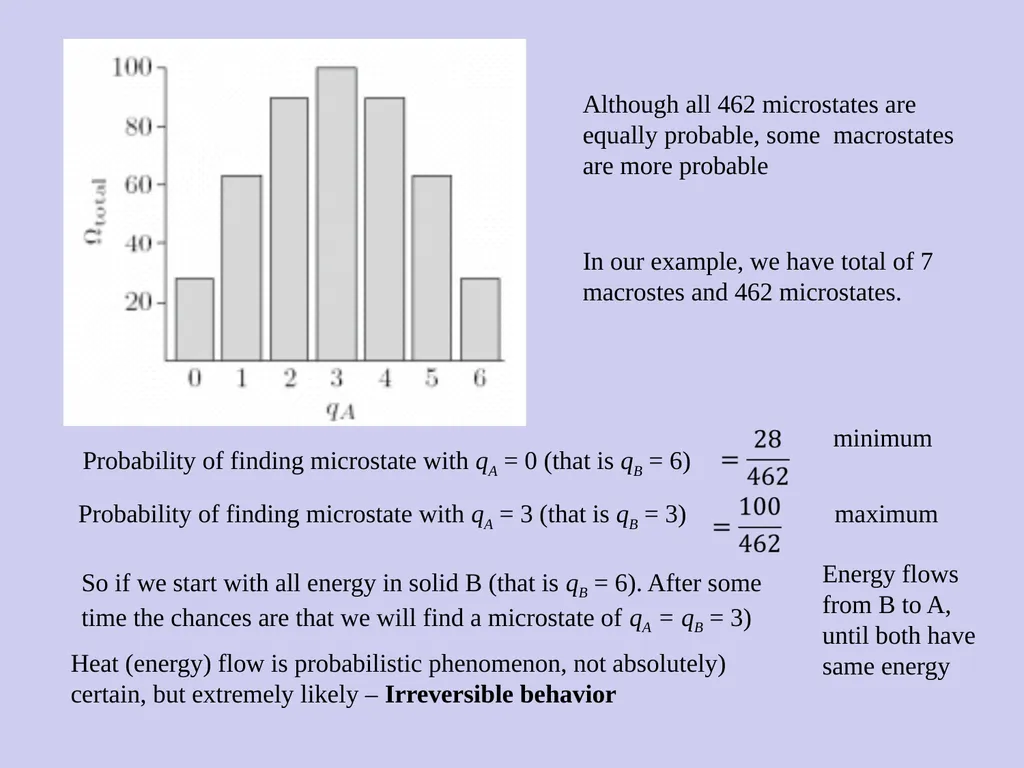
Although all 462 microstates are equally probable, some macrostates are more probable In our example, we have total of 7 macrostes and 462 microstates. Probability of finding microstate with qA = 0 (that is qB = 6) minimum Probability of finding microstate with qA = 3 (that is qB = 3) maximum So if we start with all energy in solid B (that is qB = 6). After some time the chances are that we will find a microstate of qA = qB = 3) Energy flows from B to A, until both have same energy Heat (energy) flow is probabilistic phenomenon, not absolutely) certain, but extremely likely – Irreversible behavior<br>
06
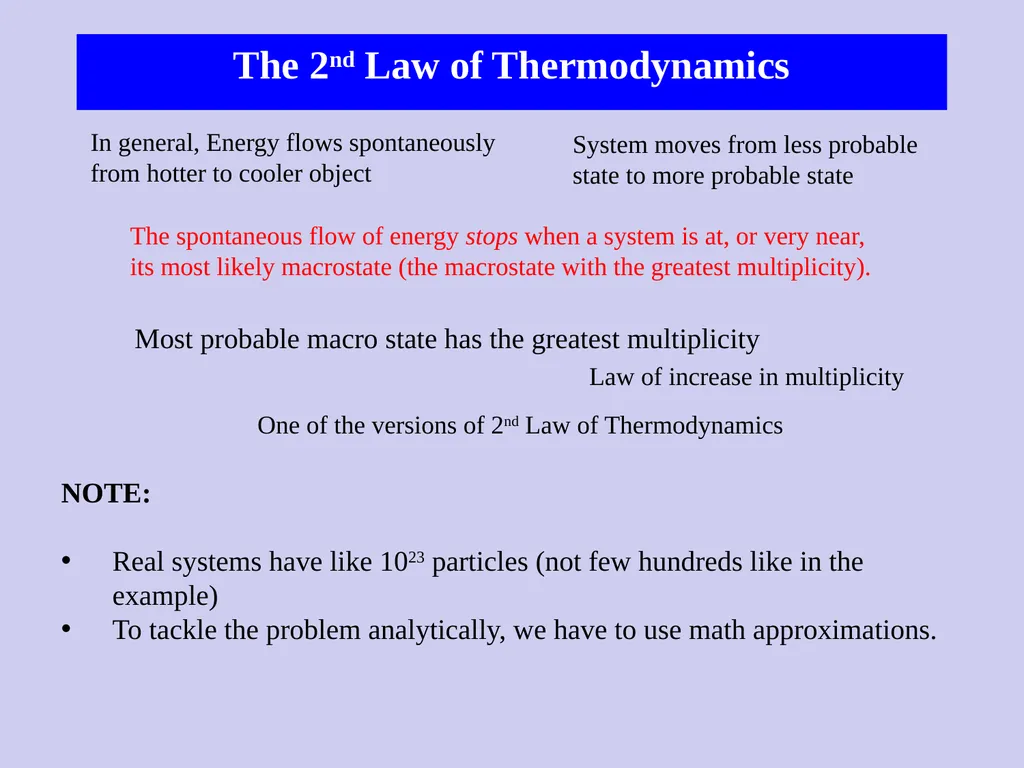
In general, Energy flows spontaneously from hotter to cooler object System moves from less probable state to more probable state Most probable macro state has the greatest multiplicity Law of increase in multiplicity One of the versions of 2nd Law of Thermodynamics The 2nd Law of Thermodynamics The spontaneous flow of energy stops when a system is at, or very near, its most likely macrostate (the macrostate with the greatest multiplicity). NOTE:
Real systems have like 1023 particles (not few hundreds like in the example)
To tackle the problem analytically, we have to use math approximations.<br>
07
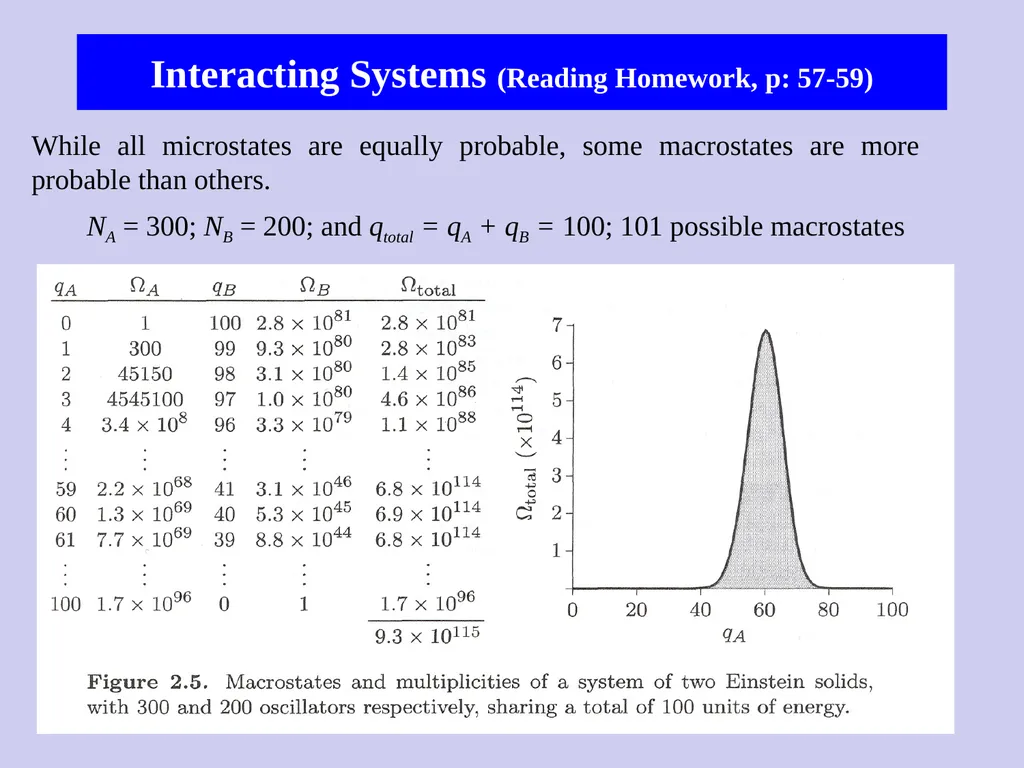
Interacting Systems (Reading Homework, p: 57-59) While all microstates are equally probable, some macrostates are more probable than others. NA = 300; NB = 200; and qtotal = qA + qB = 100; 101 possible macrostates<br>
08
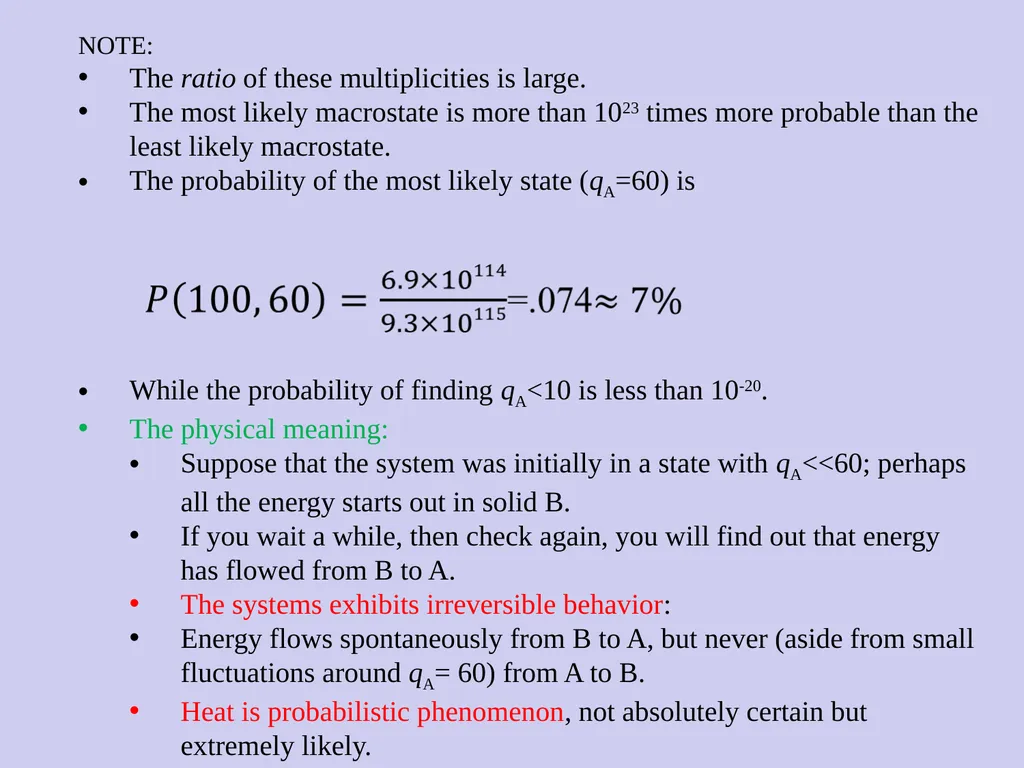
NOTE:
The ratio of these multiplicities is large.
The most likely macrostate is more than 1023 times more probable than the least likely macrostate.
The probability of the most likely state (qA=60) is
While the probability of finding qA<10 is less than 10-20.
The physical meaning:
Suppose that the system was initially in a state with qA<<60; perhaps all the energy starts out in solid B.
If you wait a while, then check again, you will find out that energy has flowed from B to A.
The systems exhibits irreversible behavior:
Energy flows spontaneously from B to A, but never (aside from small fluctuations around qA= 60) from A to B.
Heat is probabilistic phenomenon, not absolutely certain but extremely likely.<br>
09
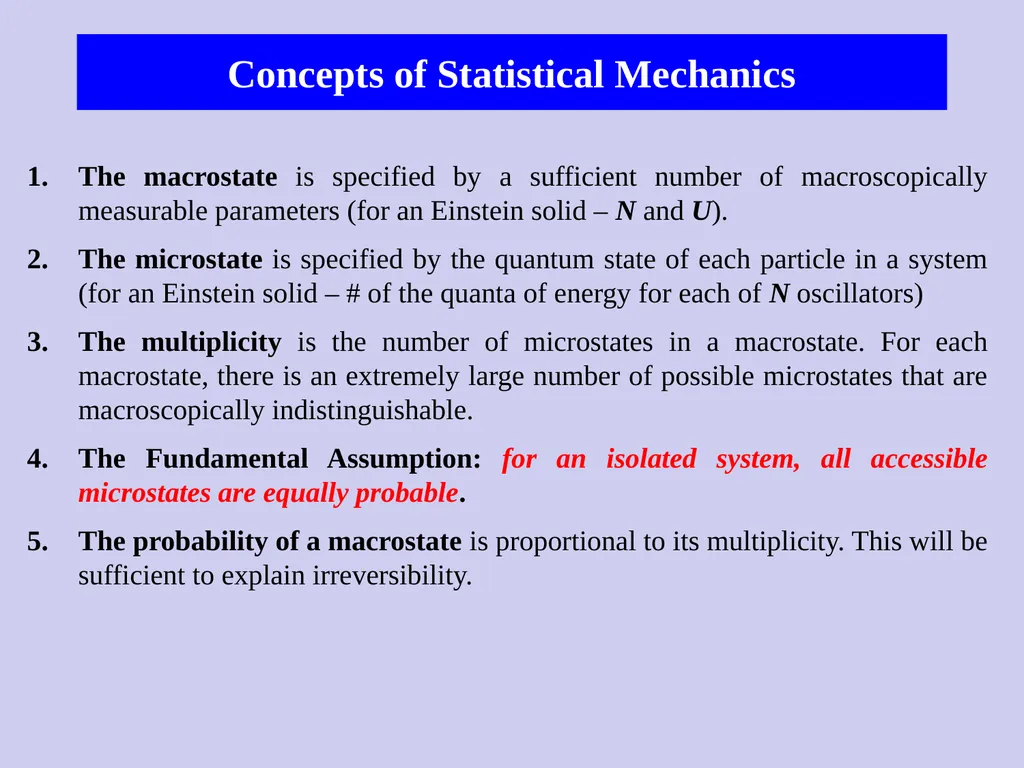
Concepts of Statistical Mechanics The macrostate is specified by a sufficient number of macroscopically measurable parameters (for an Einstein solid – N and U).
The microstate is specified by the quantum state of each particle in a system (for an Einstein solid – # of the quanta of energy for each of N oscillators)
The multiplicity is the number of microstates in a macrostate. For each macrostate, there is an extremely large number of possible microstates that are macroscopically indistinguishable.
The Fundamental Assumption: for an isolated system, all accessible microstates are equally probable.
The probability of a macrostate is proportional to its multiplicity. This will be sufficient to explain irreversibility.<br>
10
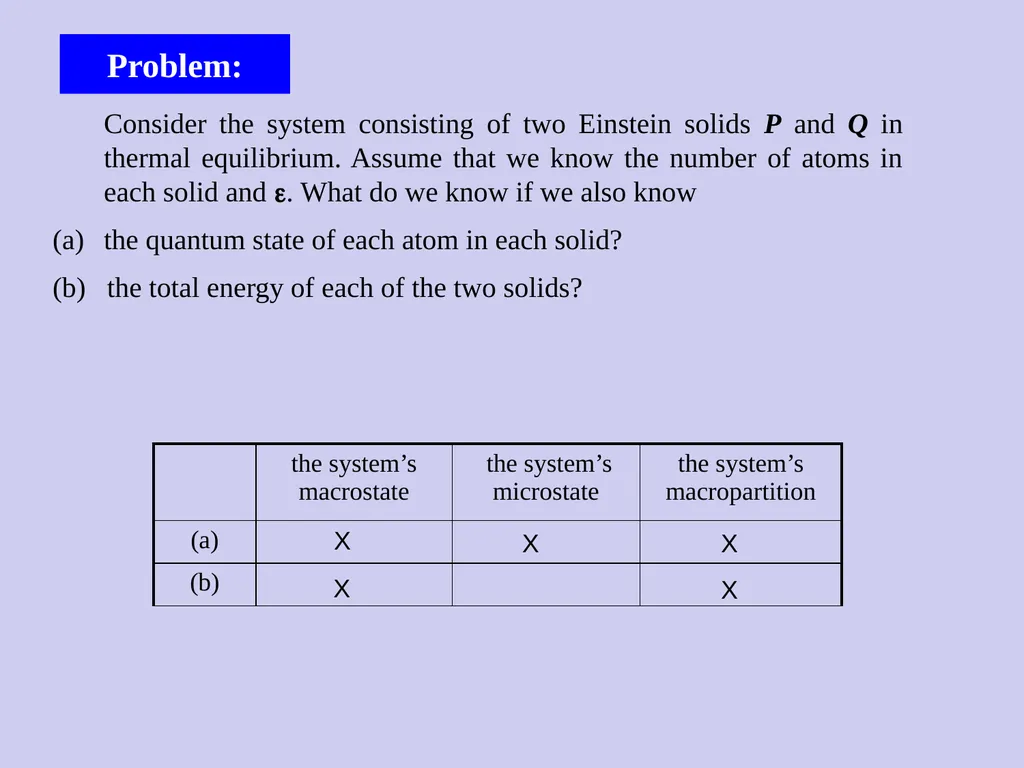
Problem: Consider the system consisting of two Einstein solids P and Q in thermal equilibrium. Assume that we know the number of atoms in each solid and . What do we know if we also know
the quantum state of each atom in each solid?
(b) the total energy of each of the two solids? X X X X X<br>
11
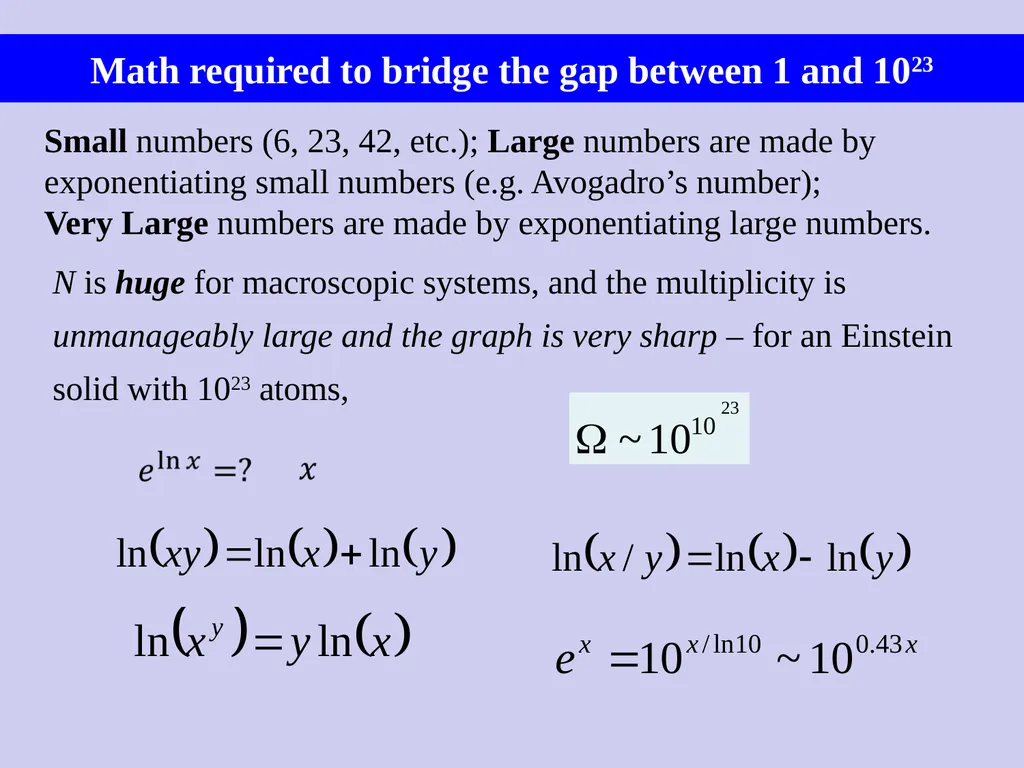
Math required to bridge the gap between 1 and 1023 N is huge for macroscopic systems, and the multiplicity is unmanageably large and the graph is very sharp – for an Einstein solid with 1023 atoms, Small numbers (6, 23, 42, etc.); Large numbers are made by exponentiating small numbers (e.g. Avogadro’s number);
Very Large numbers are made by exponentiating large numbers.<br>
12
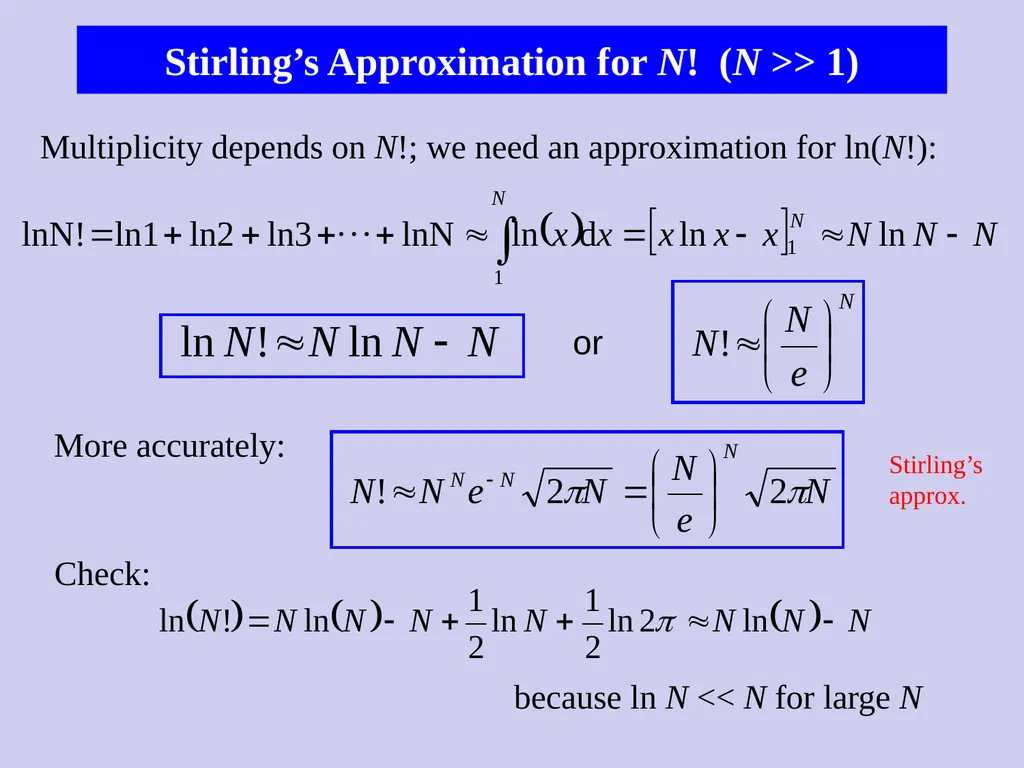
Stirling’s Approximation for N! (N >> 1) Multiplicity depends on N!; we need an approximation for ln(N!): Check: More accurately: because ln N << N for large N or Stirling’s
approx.<br>
13
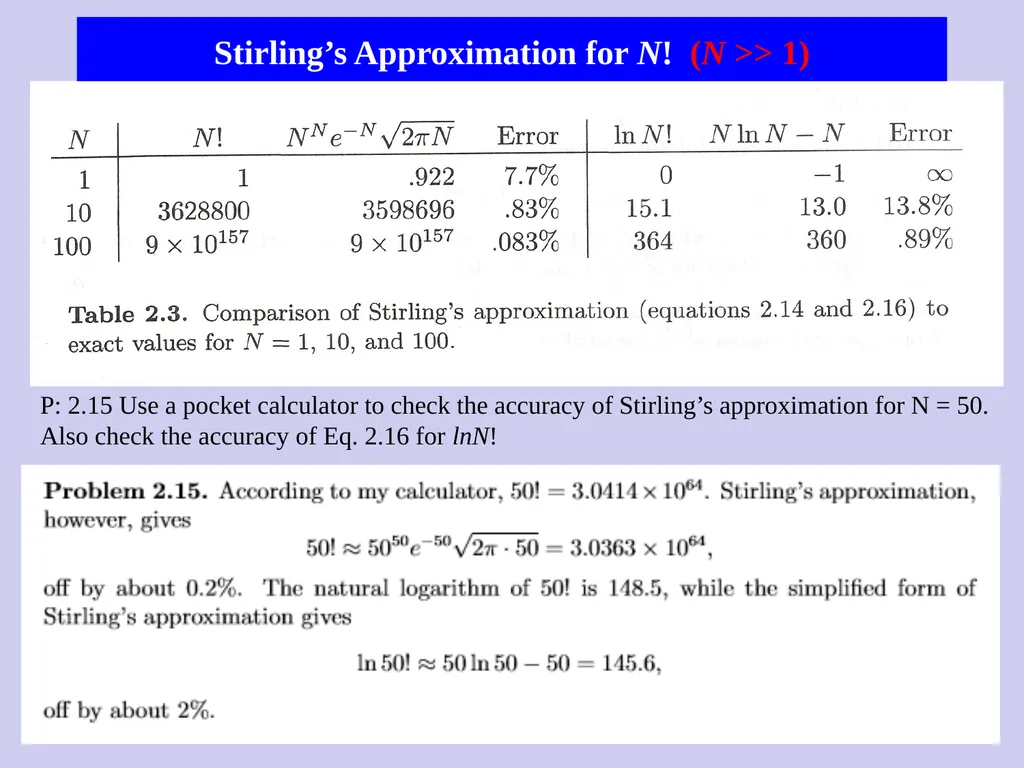
Stirling’s Approximation for N! (N >> 1) P: 2.15 Use a pocket calculator to check the accuracy of Stirling’s approximation for N = 50. Also check the accuracy of Eq. 2.16 for lnN!<br>
14
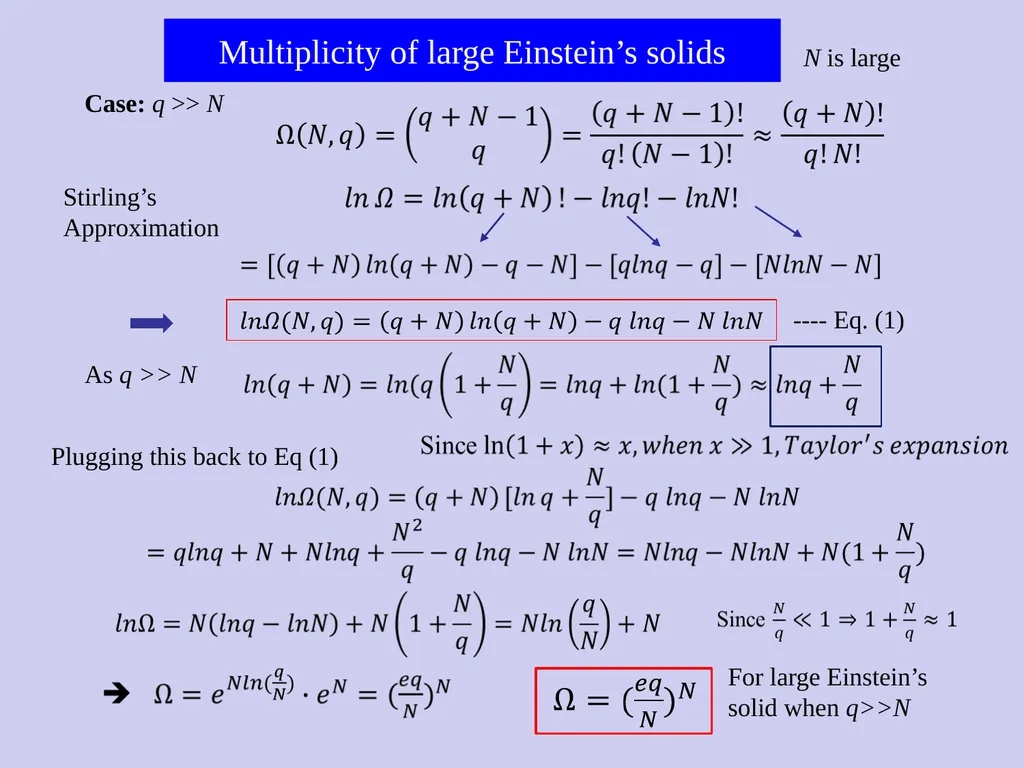
Multiplicity of large Einstein’s solids N is large Case: q >> N Stirling’s Approximation ---- Eq. (1) As q >> N Plugging this back to Eq (1) For large Einstein’s solid when q>>N<br>
15
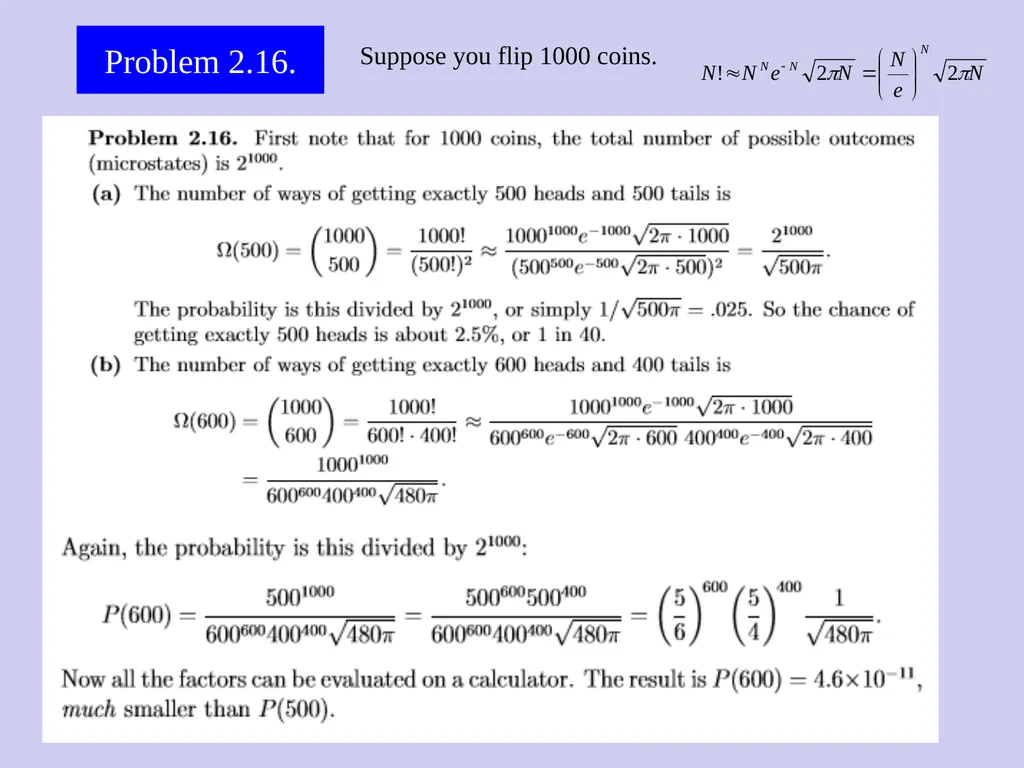
Problem 2.16. Suppose you flip 1000 coins.<br>
16
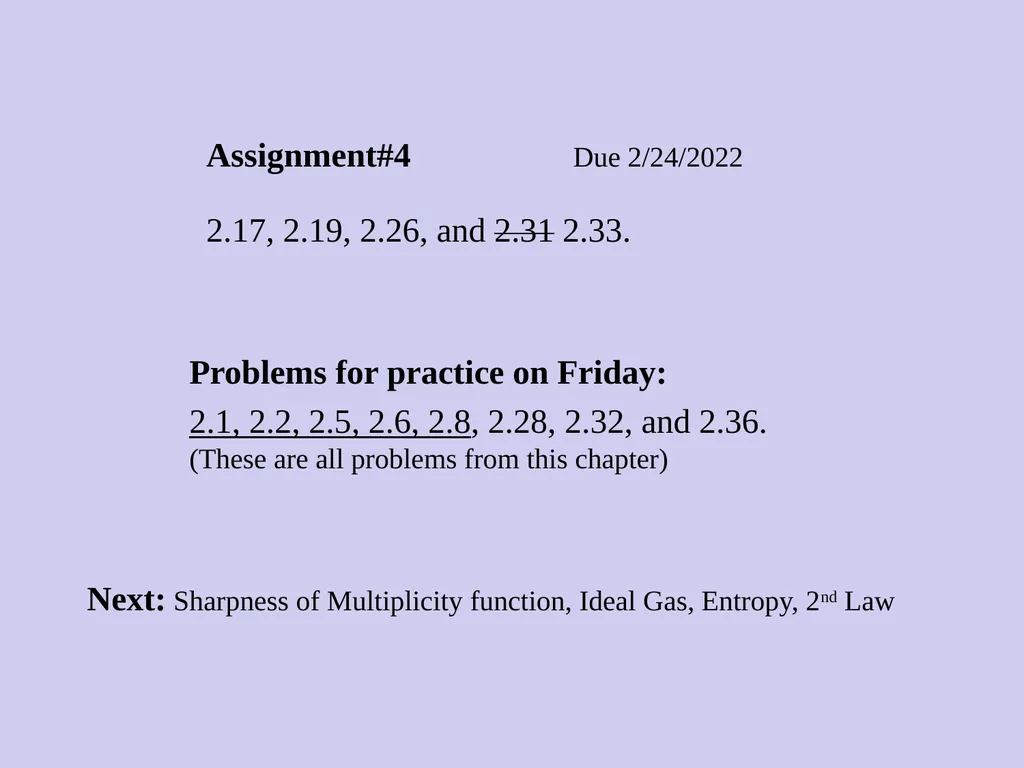
Assignment#4 Due 2/24/2022
2.17, 2.19, 2.26, and 2.31 2.33. Next: Sharpness of Multiplicity function, Ideal Gas, Entropy, 2nd Law Problems for practice on Friday:
2.1, 2.2, 2.5, 2.6, 2.8, 2.28, 2.32, and 2.36.
(These are all problems from this chapter)<br>