The Elementary Forms of Religious Life A
Description: The Elementary Forms of Religious Life A presentation by Tyler Anderson and Jared Wright Introduction Sociology as a positivist science Understanding the fundamental characteristics of religion Durkheim is trying to take an objective view
Related Topics
Download Presentation
"The Elementary Forms of Religious Life A" is the property of its rightful owner. Permission is granted to download and print the materials on this website for personal, non-commercial use only, and to display it on your personal computer provided you do not modify the materials and that you retain all copyright notices contained in the materials. By downloading content from our website, you accept the terms of this agreement.
Presentation Transcript
slide1. The Elementary Forms of Religious Life A presentation by Tyler Anderson and Jared Wright<br>
slide2. Introduction Sociology as a positivist science
Understanding the fundamental characteristics of religion
Durkheim is trying to take an objective view of religious belief which can be applied to all religions<br>
slide3. “If we admit that the crude cults of the Australian tribes can help us understand Christianity, for example, is that not supposing that this latter religion proceeds from the same mentality as the former, that it is made up of the same superstitions and rests upon the same errors?” (p. 2)<br>
slide4. Introduction (cont.) Durkheim’s reasons for using primitive religion as a unit of study
To “resolve an institution to its constituent elements” in order to understand the components
To better understand what is primary and secondary
To better understand more complex religions
“What we want to do is find a means of discerning the ever-present causes upon which the most essential forms of religious thought and practice depend” (p. 8)<br>
slide5. Defining religion Religion as “eminently social”
Durkheim rejects that religion has to have a concept of the “supernatural”
Also rejects that religion requires a god or “spiritual beings”<br>
slide6. “Thus there are rites without gods, and even rites from which gods are derived. All religious powers do not emanate from divine personalities, and there are relations of cult which have other object than uniting man to a deity. Religion is more than the idea of gods or spirits, and consequently cannot be defined exclusively in relation to these latter.” (p. 35)<br>
slide7. Defining Religion (cont.) Two categories make up religion
Belief
Classify all things into the sacred and the profane
Rituals
“determined modes of actions”<br>
slide8. Defining Religion (cont.) The Sacred and the Profane
Profane: the mundane; ordinary
Sacred: those things which man holds superior to himself
Not only represented as divine beings but to multiple degrees<br>
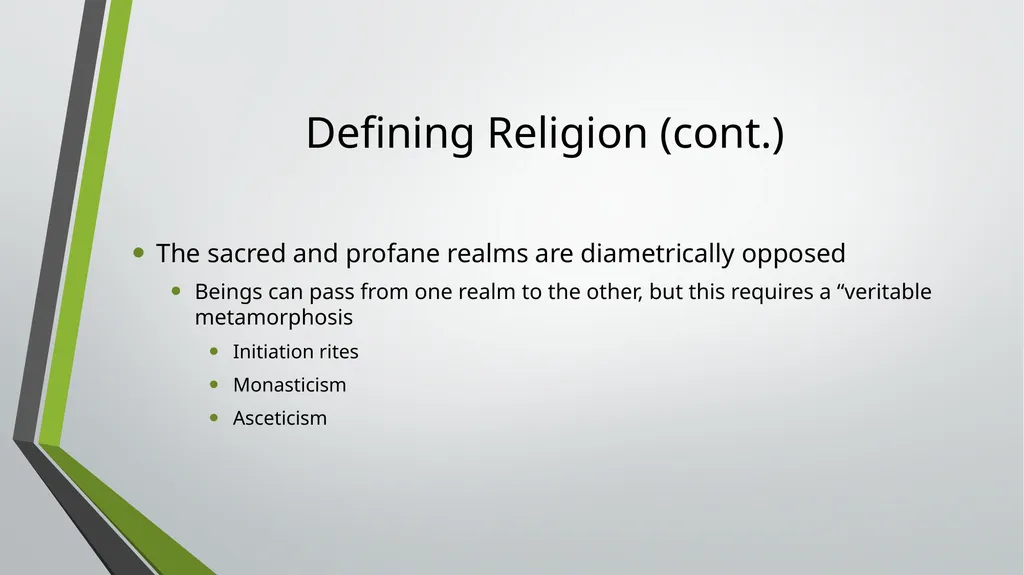
slide9. Defining Religion (cont.) The sacred and profane realms are diametrically opposed
Beings can pass from one realm to the other, but this requires a “veritable metamorphosis
Initiation rites
Monasticism
Asceticism<br>
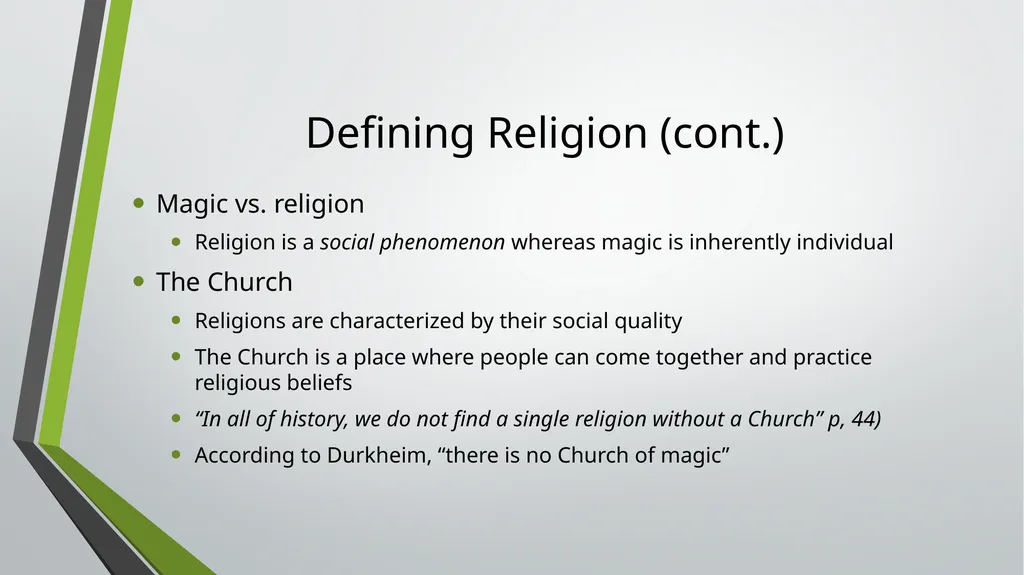
slide10. Defining Religion (cont.) Magic vs. religion
Religion is a social phenomenon whereas magic is inherently individual
The Church
Religions are characterized by their social quality
The Church is a place where people can come together and practice religious beliefs
“In all of history, we do not find a single religion without a Church” p, 44)
According to Durkheim, “there is no Church of magic”<br>
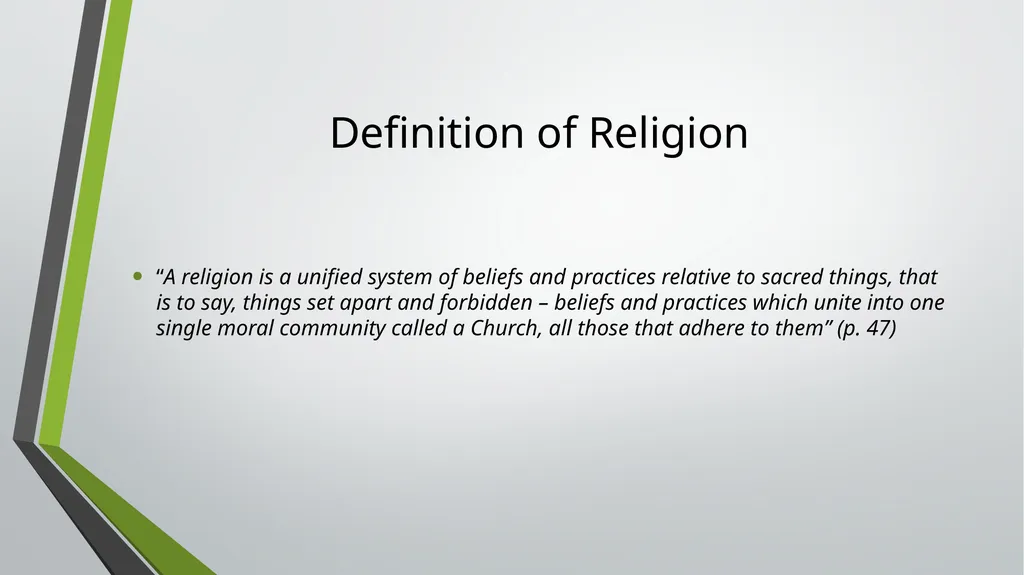
slide11. Definition of Religion “A religion is a unified system of beliefs and practices relative to sacred things, that is to say, things set apart and forbidden – beliefs and practices which unite into one single moral community called a Church, all those that adhere to them” (p. 47)<br>
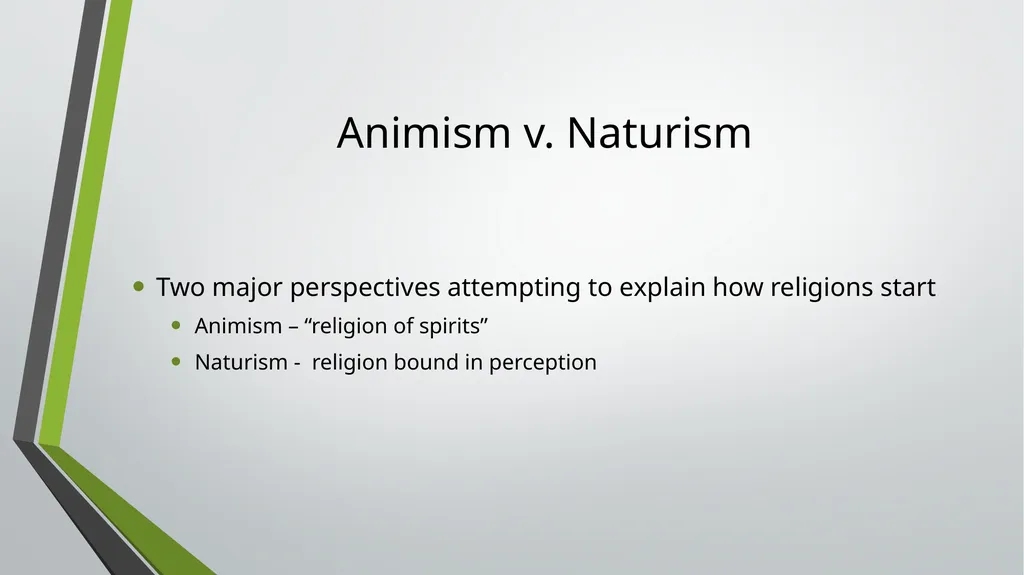
slide12. Animism v. Naturism Two major perspectives attempting to explain how religions start
Animism – “religion of spirits”
Naturism - religion bound in perception<br>
slide13. Animism The soul has a “second self” that manifests in dreams but remains connected to the body
Upon death, the soul turns into a spirit no longer bound to its profane form
People assign animate properties to inanimate objects<br>
slide14. Durkheim’s problems with Animism Does not explain why the soul is grounded to the individual
Does not account for other possible explanations for dreams
Does not answer why people would choose to explain dreams as opposed to other puzzles<br>
slide15. Naturism What is “natural” is consistent, so things like fire that aren’t permanent must be explained
Language helps define these forces
Nature is given human qualities<br>
slide16. Problems with Naturism This explanation offers no sense of order
Neglects the social element<br>
slide17. Totemism and clans Clans united by strong bonds of kinship that aren’t necessarily ancestral
This kinship is represented by the totem
A “coat-of-arms” for a clan
Elevates the bond from the profane to the sacred<br>
slide18. The Origins of Totemic Beliefs What gives the totem its sacred qualities?
Effervescence
Feelings of passion developed through social interaction
Produce “sacred” feelings in the individual that must be explained
Totems are a way to represent this feeling in the material world<br>
slide19. The Idea of the Soul, Spirits, and Gods: Every known contemporary society has an idea of the soul.
Evolved from the tribal Aborigine belief that the soul of a newborn was the reincarnation of dead ancestors of the clan, which are conceived of as animal or plant spirits with superhuman abilities, thus making them sacred.<br>
slide20. The Idea of the Soul, Spirits, and Gods: 3. Aborigine belief developed into modern concepts such as immortality and personality.
A. Immortality (303).
B. “civilizing hero” - “individual totemism” - ”international deity” (315).<br>
slide21. The Principal of Ritual Attitudes: Negative Cults:
1. The sacred and profane realms of life cannot coexist in the same time or place.
2. Negative cult: “taboos” & “degree of sacredness” (338-340).<br>
slide22. The Principal of Ritual Attitudes: Negative Cults:
3. Negative rites purify the individual, allowing him access to the sacred positive cult (355-356).
4. “contagiousness of the sacred” (356-361).<br>
slide23. The Principal of Ritual Attitudes: Positive Cults:
Intichiuma (368-377).
2. Sacrificial rites of Intichiuma (380-385).
3. “Mutual Interdependence” (385-392).<br>
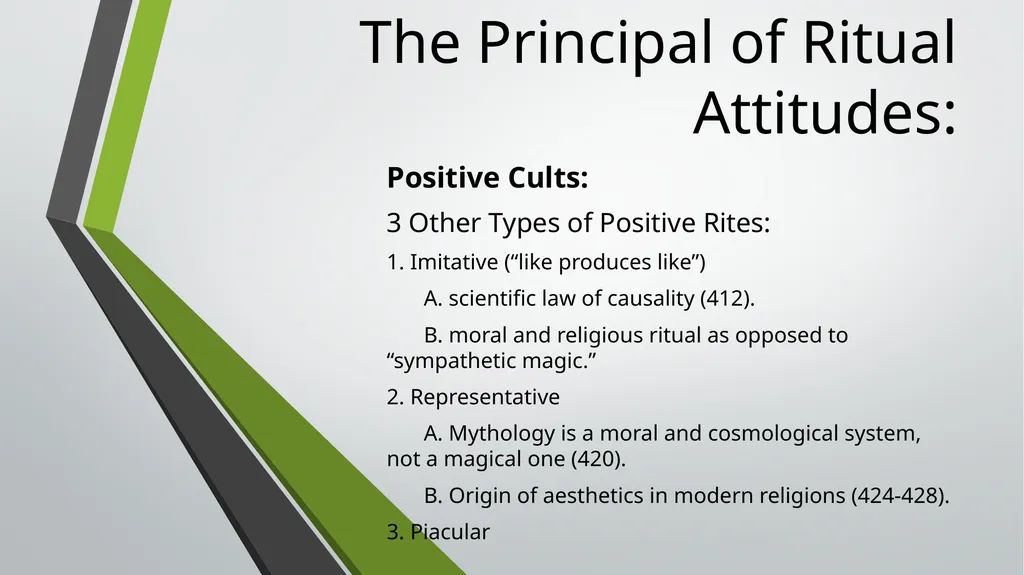
slide24. The Principal of Ritual Attitudes: Positive Cults:
3 Other Types of Positive Rites:
1. Imitative (“like produces like”)
A. scientific law of causality (412).
B. moral and religious ritual as opposed to “sympathetic magic.”
2. Representative
A. Mythology is a moral and cosmological system, not a magical one (420).
B. Origin of aesthetics in modern religions (424-428).
3. Piacular<br>
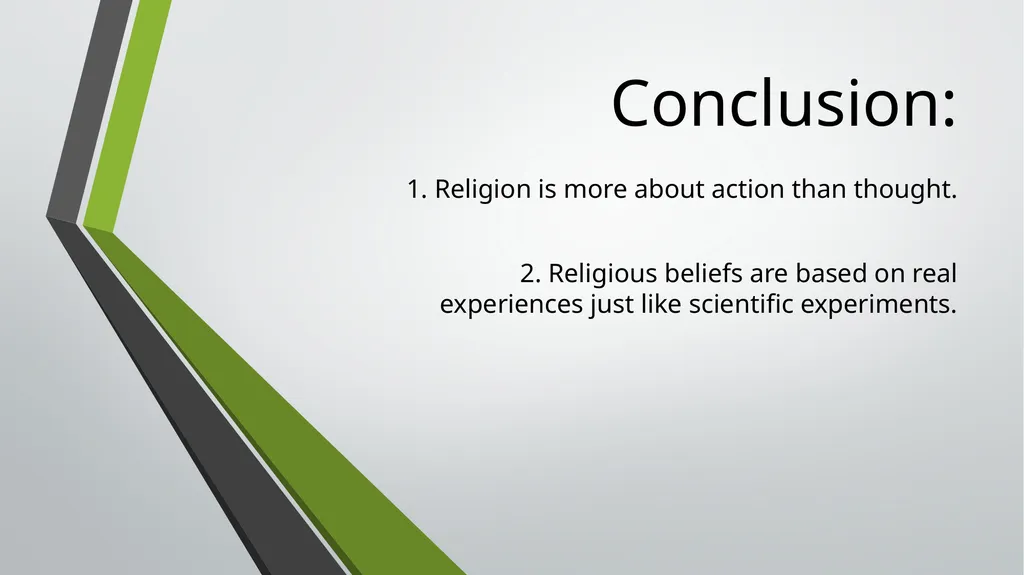
slide25. Conclusion: 1. Religion is more about action than thought.
2. Religious beliefs are based on real experiences just like scientific experiments.<br>
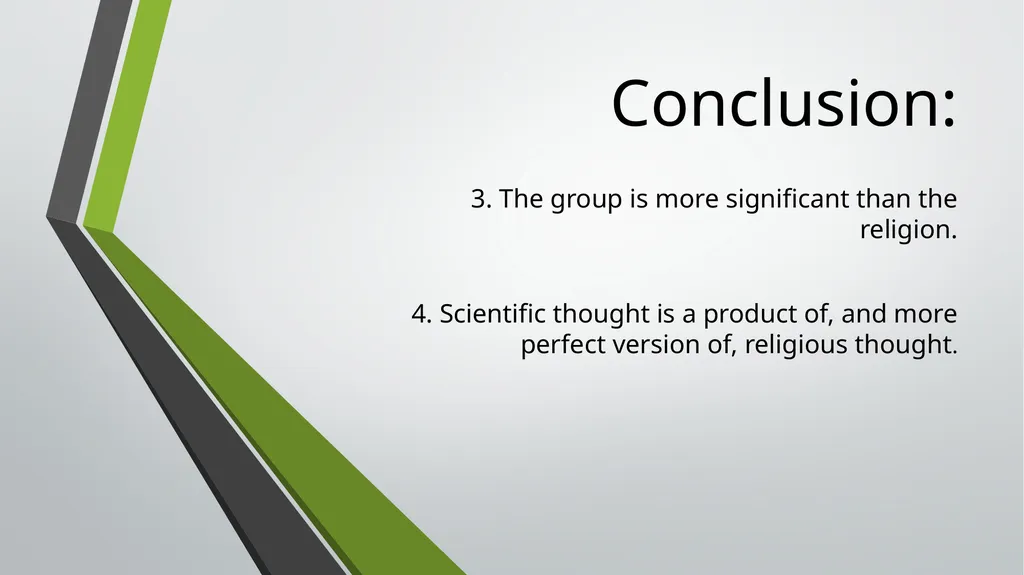
slide26. Conclusion: 3. The group is more significant than the religion.
4. Scientific thought is a product of, and more perfect version of, religious thought.<br>
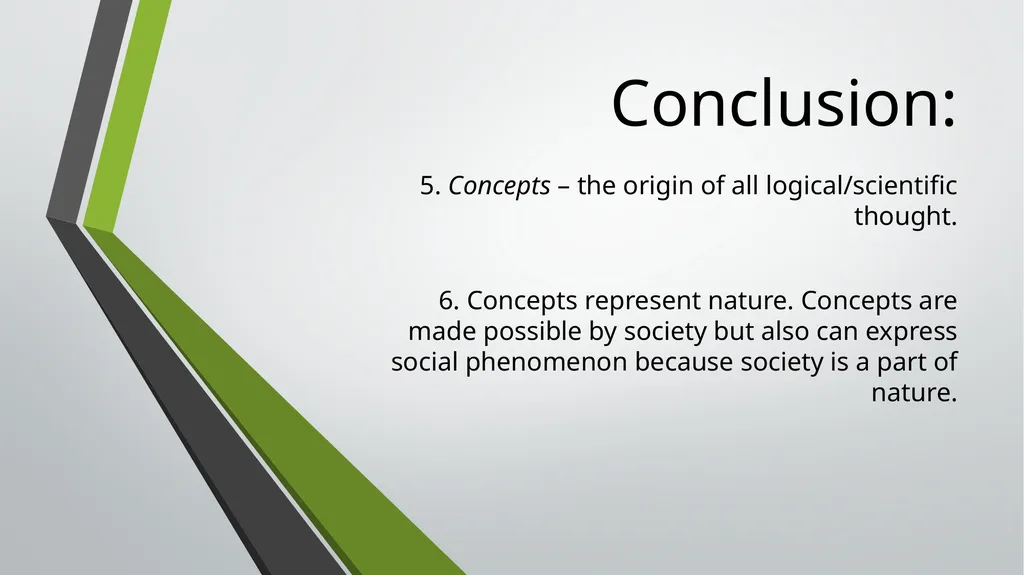
slide27. Conclusion: 5. Concepts – the origin of all logical/scientific thought.
6. Concepts represent nature. Concepts are made possible by society but also can express social phenomenon because society is a part of nature.<br>
slide28. Conclusion: 7. Individual experience is subjective, but through society we create universal concepts which bring us closer to the truth.
8. We are both individual and social; we cannot exist without society any more than society can exist without us.<br>

slide2. Introduction Sociology as a positivist science
Understanding the fundamental characteristics of religion
Durkheim is trying to take an objective view of religious belief which can be applied to all religions<br>
slide3. “If we admit that the crude cults of the Australian tribes can help us understand Christianity, for example, is that not supposing that this latter religion proceeds from the same mentality as the former, that it is made up of the same superstitions and rests upon the same errors?” (p. 2)<br>
slide4. Introduction (cont.) Durkheim’s reasons for using primitive religion as a unit of study
To “resolve an institution to its constituent elements” in order to understand the components
To better understand what is primary and secondary
To better understand more complex religions
“What we want to do is find a means of discerning the ever-present causes upon which the most essential forms of religious thought and practice depend” (p. 8)<br>
slide5. Defining religion Religion as “eminently social”
Durkheim rejects that religion has to have a concept of the “supernatural”
Also rejects that religion requires a god or “spiritual beings”<br>
slide6. “Thus there are rites without gods, and even rites from which gods are derived. All religious powers do not emanate from divine personalities, and there are relations of cult which have other object than uniting man to a deity. Religion is more than the idea of gods or spirits, and consequently cannot be defined exclusively in relation to these latter.” (p. 35)<br>
slide7. Defining Religion (cont.) Two categories make up religion
Belief
Classify all things into the sacred and the profane
Rituals
“determined modes of actions”<br>
slide8. Defining Religion (cont.) The Sacred and the Profane
Profane: the mundane; ordinary
Sacred: those things which man holds superior to himself
Not only represented as divine beings but to multiple degrees<br>
slide9. Defining Religion (cont.) The sacred and profane realms are diametrically opposed
Beings can pass from one realm to the other, but this requires a “veritable metamorphosis
Initiation rites
Monasticism
Asceticism<br>
slide10. Defining Religion (cont.) Magic vs. religion
Religion is a social phenomenon whereas magic is inherently individual
The Church
Religions are characterized by their social quality
The Church is a place where people can come together and practice religious beliefs
“In all of history, we do not find a single religion without a Church” p, 44)
According to Durkheim, “there is no Church of magic”<br>
slide11. Definition of Religion “A religion is a unified system of beliefs and practices relative to sacred things, that is to say, things set apart and forbidden – beliefs and practices which unite into one single moral community called a Church, all those that adhere to them” (p. 47)<br>
slide12. Animism v. Naturism Two major perspectives attempting to explain how religions start
Animism – “religion of spirits”
Naturism - religion bound in perception<br>
slide13. Animism The soul has a “second self” that manifests in dreams but remains connected to the body
Upon death, the soul turns into a spirit no longer bound to its profane form
People assign animate properties to inanimate objects<br>
slide14. Durkheim’s problems with Animism Does not explain why the soul is grounded to the individual
Does not account for other possible explanations for dreams
Does not answer why people would choose to explain dreams as opposed to other puzzles<br>
slide15. Naturism What is “natural” is consistent, so things like fire that aren’t permanent must be explained
Language helps define these forces
Nature is given human qualities<br>
slide16. Problems with Naturism This explanation offers no sense of order
Neglects the social element<br>
slide17. Totemism and clans Clans united by strong bonds of kinship that aren’t necessarily ancestral
This kinship is represented by the totem
A “coat-of-arms” for a clan
Elevates the bond from the profane to the sacred<br>
slide18. The Origins of Totemic Beliefs What gives the totem its sacred qualities?
Effervescence
Feelings of passion developed through social interaction
Produce “sacred” feelings in the individual that must be explained
Totems are a way to represent this feeling in the material world<br>
slide19. The Idea of the Soul, Spirits, and Gods: Every known contemporary society has an idea of the soul.
Evolved from the tribal Aborigine belief that the soul of a newborn was the reincarnation of dead ancestors of the clan, which are conceived of as animal or plant spirits with superhuman abilities, thus making them sacred.<br>
slide20. The Idea of the Soul, Spirits, and Gods: 3. Aborigine belief developed into modern concepts such as immortality and personality.
A. Immortality (303).
B. “civilizing hero” - “individual totemism” - ”international deity” (315).<br>
slide21. The Principal of Ritual Attitudes: Negative Cults:
1. The sacred and profane realms of life cannot coexist in the same time or place.
2. Negative cult: “taboos” & “degree of sacredness” (338-340).<br>
slide22. The Principal of Ritual Attitudes: Negative Cults:
3. Negative rites purify the individual, allowing him access to the sacred positive cult (355-356).
4. “contagiousness of the sacred” (356-361).<br>
slide23. The Principal of Ritual Attitudes: Positive Cults:
Intichiuma (368-377).
2. Sacrificial rites of Intichiuma (380-385).
3. “Mutual Interdependence” (385-392).<br>
slide24. The Principal of Ritual Attitudes: Positive Cults:
3 Other Types of Positive Rites:
1. Imitative (“like produces like”)
A. scientific law of causality (412).
B. moral and religious ritual as opposed to “sympathetic magic.”
2. Representative
A. Mythology is a moral and cosmological system, not a magical one (420).
B. Origin of aesthetics in modern religions (424-428).
3. Piacular<br>
slide25. Conclusion: 1. Religion is more about action than thought.
2. Religious beliefs are based on real experiences just like scientific experiments.<br>
slide26. Conclusion: 3. The group is more significant than the religion.
4. Scientific thought is a product of, and more perfect version of, religious thought.<br>
slide27. Conclusion: 5. Concepts – the origin of all logical/scientific thought.
6. Concepts represent nature. Concepts are made possible by society but also can express social phenomenon because society is a part of nature.<br>
slide28. Conclusion: 7. Individual experience is subjective, but through society we create universal concepts which bring us closer to the truth.
8. We are both individual and social; we cannot exist without society any more than society can exist without us.<br>