
The evolving EU framework on phytosanitary
Description: The evolving EU framework on phytosanitary measures FSR Online debate 3 March 2026 Wolfgang Reinert Unit G. 1 - Plant Health Health and Food Safety Directorate-General European Commission Need for phytosanitary measures Invasive alien
Related Topics
Download Presentation
"The evolving EU framework on phytosanitary" is the property of its rightful owner. Permission is granted to download and print the materials on this website for personal, non-commercial use only, and to display it on your personal computer provided you do not modify the materials and that you retain all copyright notices contained in the materials. By downloading content from our website, you accept the terms of this agreement.
Presentation Transcript
slide1. The evolving EU framework on phytosanitary measures FSR Online debate – 3 March 2026 Wolfgang Reinert
Unit G. 1 - Plant Health
Health and Food Safety Directorate-General
European Commission<br>
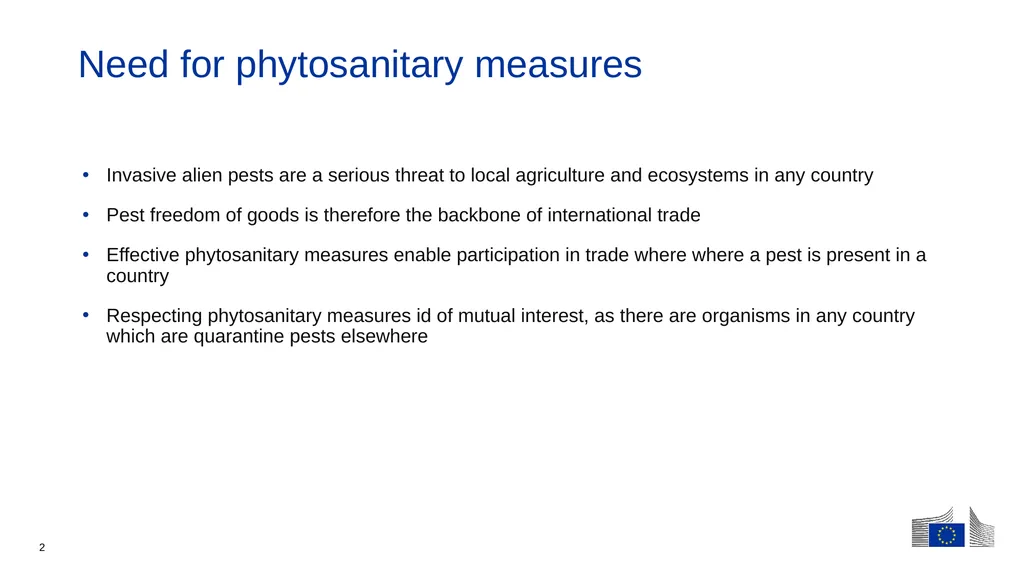
slide2. Need for phytosanitary measures Invasive alien pests are a serious threat to local agriculture and ecosystems in any country
Pest freedom of goods is therefore the backbone of international trade
Effective phytosanitary measures enable participation in trade where where a pest is present in a country
Respecting phytosanitary measures id of mutual interest, as there are organisms in any country which are quarantine pests elsewhere 2<br>
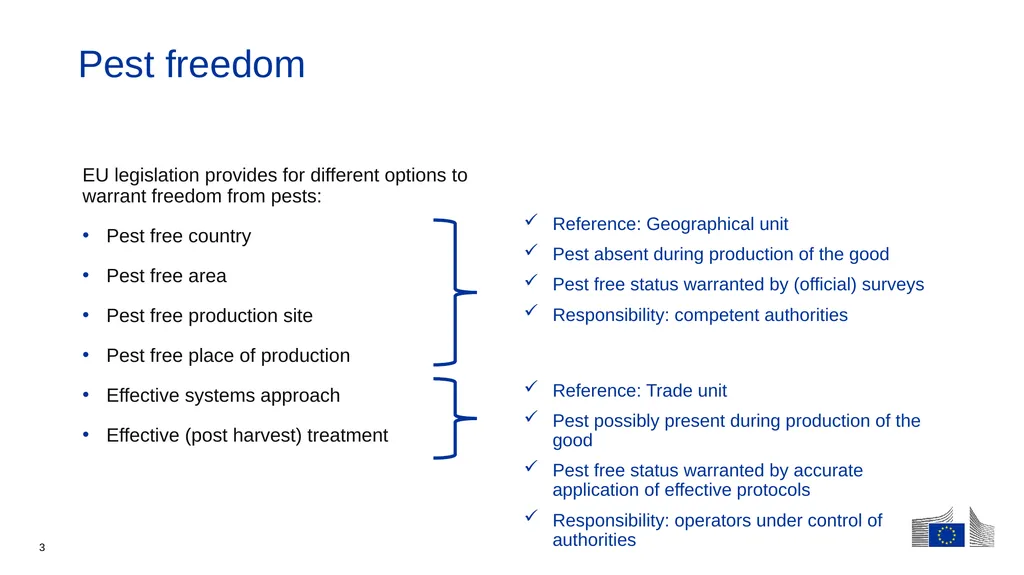
slide3. Pest freedom EU legislation provides for different options to warrant freedom from pests:
Pest free country
Pest free area
Pest free production site
Pest free place of production
Effective systems approach
Effective (post harvest) treatment 3 Reference: Geographical unit
Pest absent during production of the good
Pest free status warranted by (official) surveys
Responsibility: competent authorities
Reference: Trade unit
Pest possibly present during production of the good
Pest free status warranted by accurate application of effective protocols
Responsibility: operators under control of authorities<br>
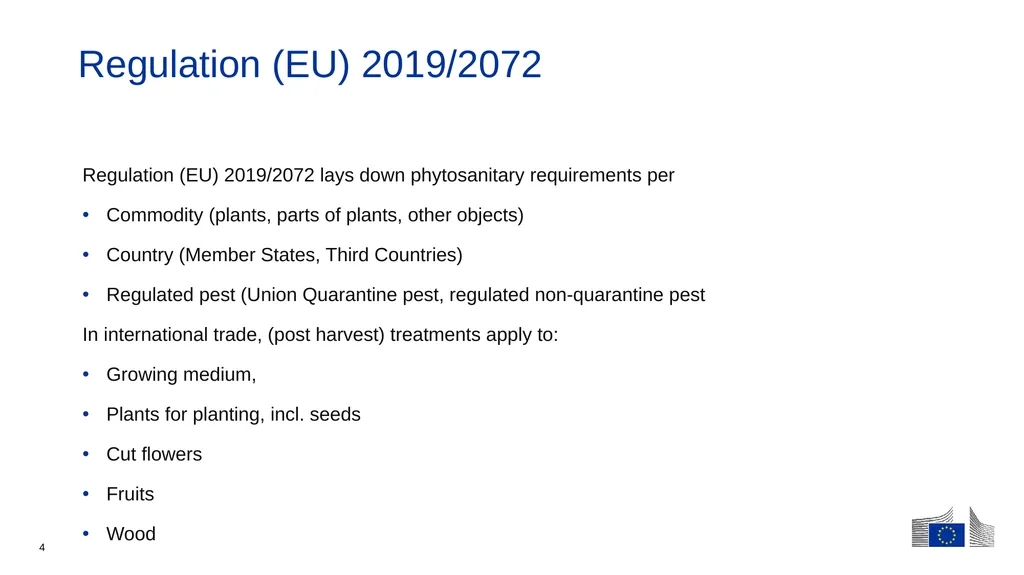
slide4. Regulation (EU) 2019/2072 Regulation (EU) 2019/2072 lays down phytosanitary requirements per
Commodity (plants, parts of plants, other objects)
Country (Member States, Third Countries)
Regulated pest (Union Quarantine pest, regulated non-quarantine pest
In international trade, (post harvest) treatments apply to:
Growing medium,
Plants for planting, incl. seeds
Cut flowers
Fruits
Wood 4<br>
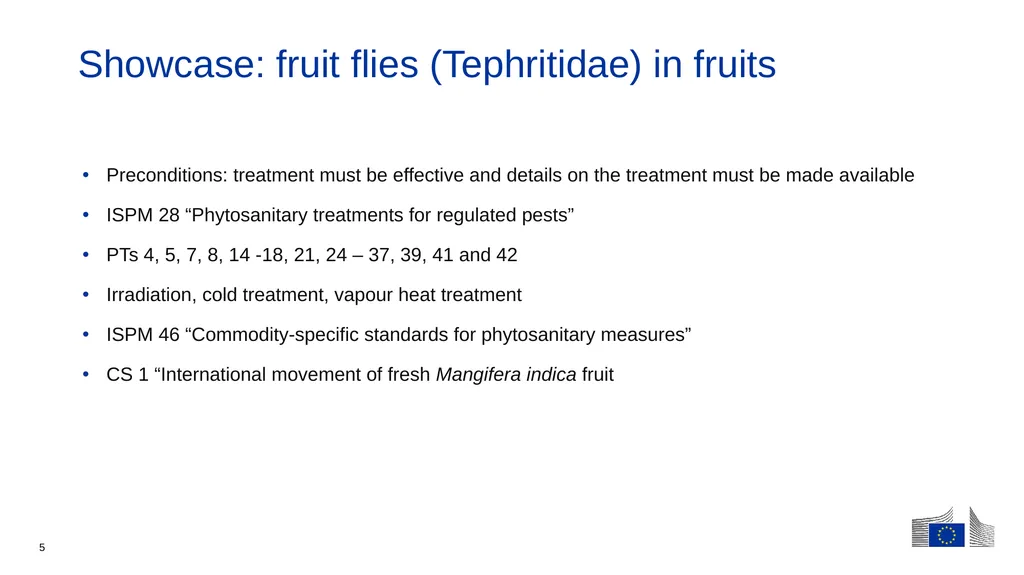
slide5. Showcase: fruit flies (Tephritidae) in fruits Preconditions: treatment must be effective and details on the treatment must be made available
ISPM 28 “Phytosanitary treatments for regulated pests”
PTs 4, 5, 7, 8, 14 -18, 21, 24 – 37, 39, 41 and 42
Irradiation, cold treatment, vapour heat treatment
ISPM 46 “Commodity-specific standards for phytosanitary measures”
CS 1 “International movement of fresh Mangifera indica fruit 5<br>
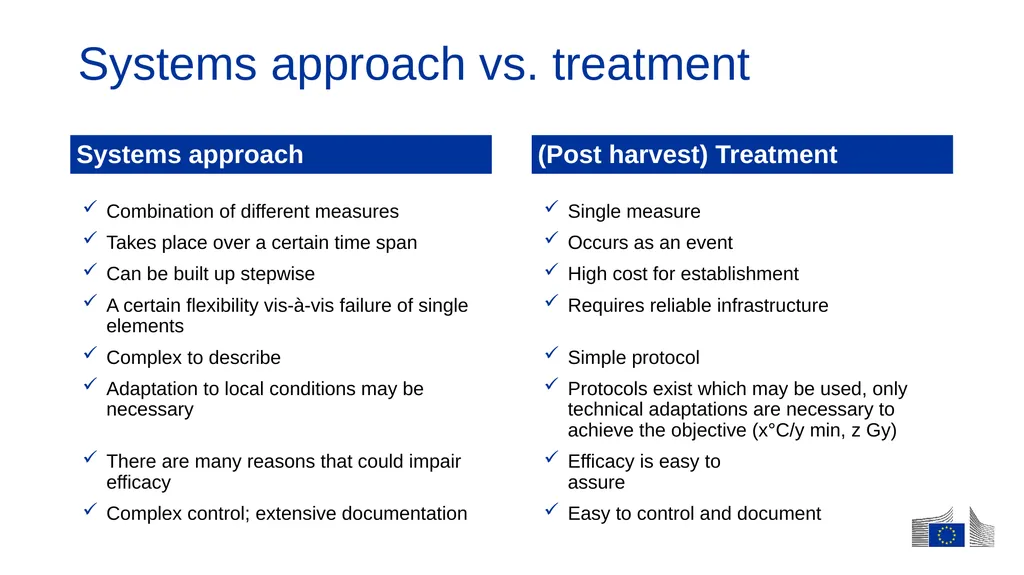
slide6. Systems approach vs. treatment Systems approach Combination of different measures
Takes place over a certain time span
Can be built up stepwise
A certain flexibility vis-à-vis failure of single elements
Complex to describe
Adaptation to local conditions may be necessary .
There are many reasons that could impair efficacy
Complex control; extensive documentation (Post harvest) Treatment Single measure
Occurs as an event
High cost for establishment
Requires reliable infrastructure .
Simple protocol
Protocols exist which may be used, only technical adaptations are necessary to achieve the objective (x°C/y min, z Gy)
Efficacy is easy to assure .
Easy to control and document<br>
slide7. Thank you © European Union 2026
Unless otherwise noted the reuse of this presentation is authorised under the CC BY 4.0 license. For any use or reproduction of elements that are not owned by the EU, permission may need to be sought directly from the respective right holders.<br>
Unit G. 1 - Plant Health
Health and Food Safety Directorate-General
European Commission<br>
slide2. Need for phytosanitary measures Invasive alien pests are a serious threat to local agriculture and ecosystems in any country
Pest freedom of goods is therefore the backbone of international trade
Effective phytosanitary measures enable participation in trade where where a pest is present in a country
Respecting phytosanitary measures id of mutual interest, as there are organisms in any country which are quarantine pests elsewhere 2<br>
slide3. Pest freedom EU legislation provides for different options to warrant freedom from pests:
Pest free country
Pest free area
Pest free production site
Pest free place of production
Effective systems approach
Effective (post harvest) treatment 3 Reference: Geographical unit
Pest absent during production of the good
Pest free status warranted by (official) surveys
Responsibility: competent authorities
Reference: Trade unit
Pest possibly present during production of the good
Pest free status warranted by accurate application of effective protocols
Responsibility: operators under control of authorities<br>
slide4. Regulation (EU) 2019/2072 Regulation (EU) 2019/2072 lays down phytosanitary requirements per
Commodity (plants, parts of plants, other objects)
Country (Member States, Third Countries)
Regulated pest (Union Quarantine pest, regulated non-quarantine pest
In international trade, (post harvest) treatments apply to:
Growing medium,
Plants for planting, incl. seeds
Cut flowers
Fruits
Wood 4<br>
slide5. Showcase: fruit flies (Tephritidae) in fruits Preconditions: treatment must be effective and details on the treatment must be made available
ISPM 28 “Phytosanitary treatments for regulated pests”
PTs 4, 5, 7, 8, 14 -18, 21, 24 – 37, 39, 41 and 42
Irradiation, cold treatment, vapour heat treatment
ISPM 46 “Commodity-specific standards for phytosanitary measures”
CS 1 “International movement of fresh Mangifera indica fruit 5<br>
slide6. Systems approach vs. treatment Systems approach Combination of different measures
Takes place over a certain time span
Can be built up stepwise
A certain flexibility vis-à-vis failure of single elements
Complex to describe
Adaptation to local conditions may be necessary .
There are many reasons that could impair efficacy
Complex control; extensive documentation (Post harvest) Treatment Single measure
Occurs as an event
High cost for establishment
Requires reliable infrastructure .
Simple protocol
Protocols exist which may be used, only technical adaptations are necessary to achieve the objective (x°C/y min, z Gy)
Efficacy is easy to assure .
Easy to control and document<br>
slide7. Thank you © European Union 2026
Unless otherwise noted the reuse of this presentation is authorised under the CC BY 4.0 license. For any use or reproduction of elements that are not owned by the EU, permission may need to be sought directly from the respective right holders.<br>