The Expanded Very Large Array Rick Perley National Radio Astronomy Observatory The Expanded Very Large Array The Expanded Very Large Array is a 90M upgrade of the Very Large Array. Project began in 2001, will be completed in 2012 on
"The Expanded Very Large Array Rick Perley National" is the property of its rightful owner. Permission is granted to
download and print the materials on this website for personal, non-commercial use only, and to display it
on your personal computer provided you do not modify the materials and that you retain all copyright
notices contained in the materials. By downloading content from our website, you accept the terms of this
agreement.
Presentation Transcript
01
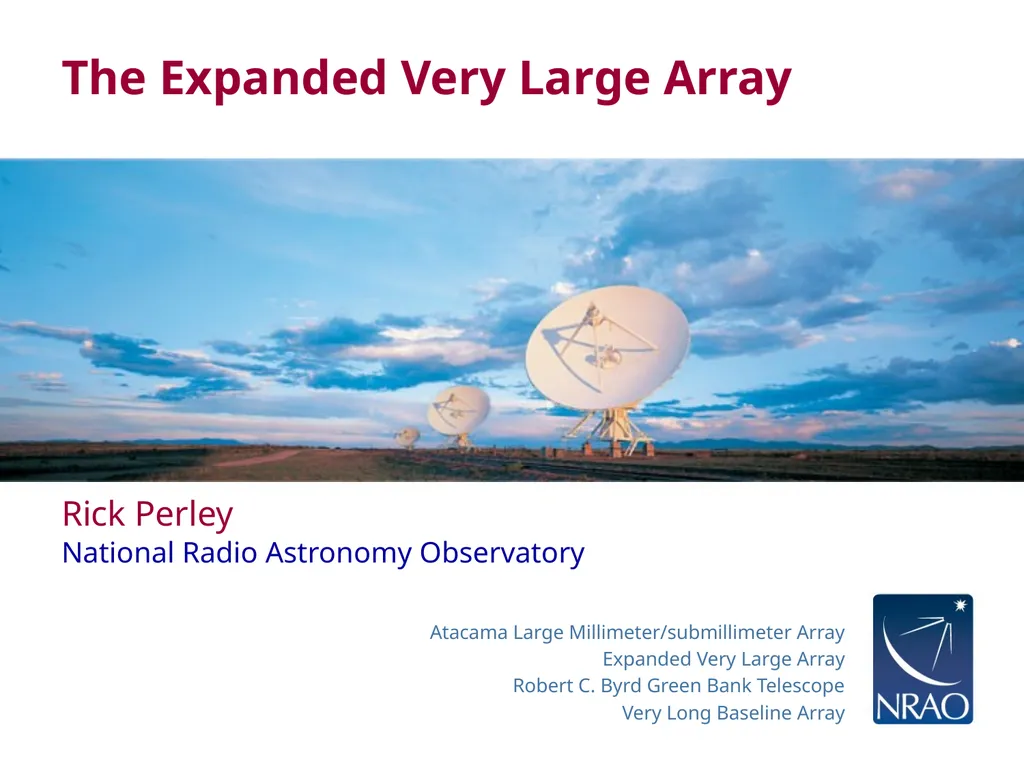
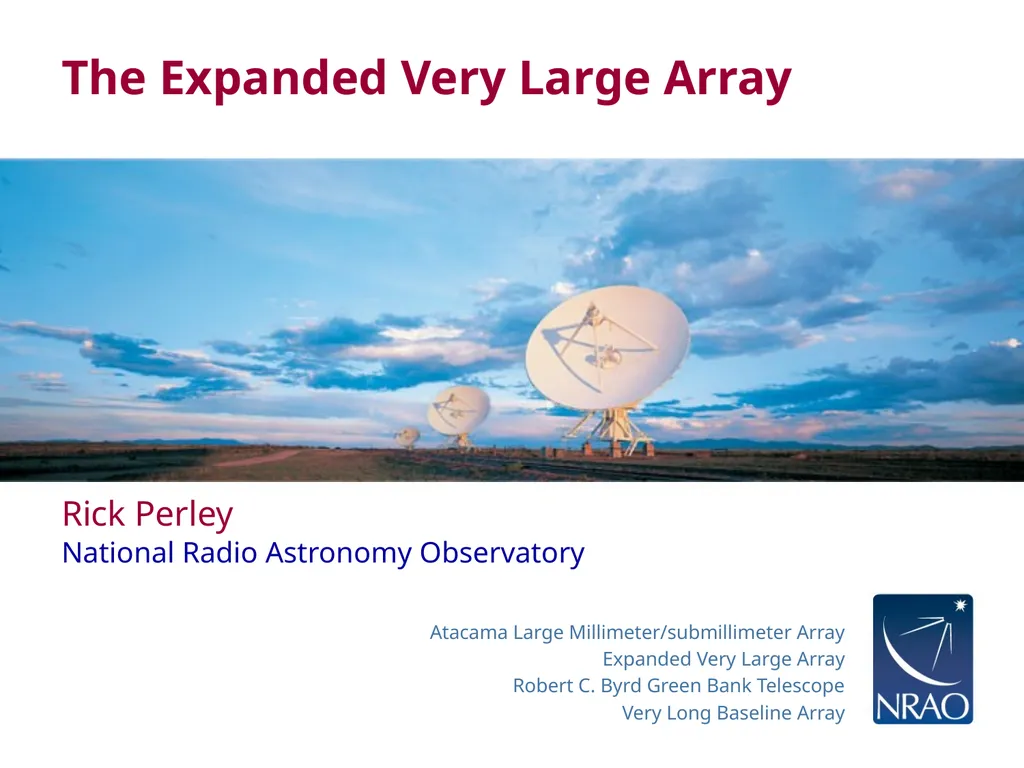
The Expanded Very Large Array Rick Perley National Radio Astronomy Observatory<br>
02
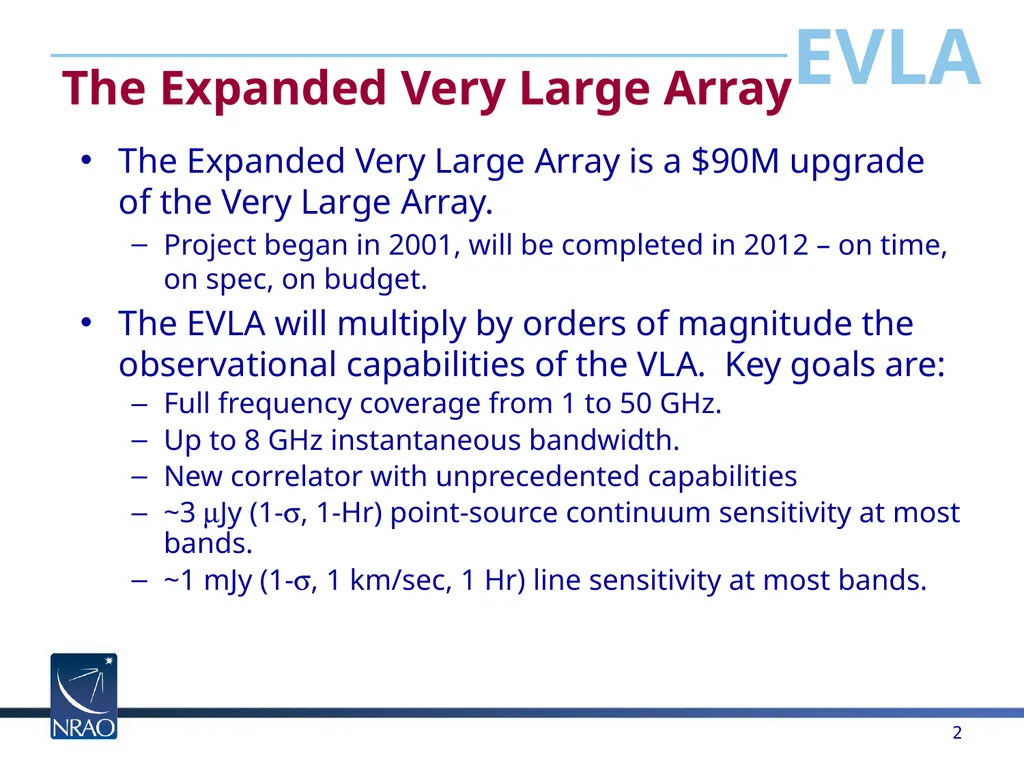
The Expanded Very Large Array The Expanded Very Large Array is a $90M upgrade of the Very Large Array.
Project began in 2001, will be completed in 2012 – on time, on spec, on budget.
The EVLA will multiply by orders of magnitude the observational capabilities of the VLA. Key goals are:
Full frequency coverage from 1 to 50 GHz.
Up to 8 GHz instantaneous bandwidth.
New correlator with unprecedented capabilities
~3 mJy (1-s, 1-Hr) point-source continuum sensitivity at most bands.
~1 mJy (1-s, 1 km/sec, 1 Hr) line sensitivity at most bands. 2<br>
03
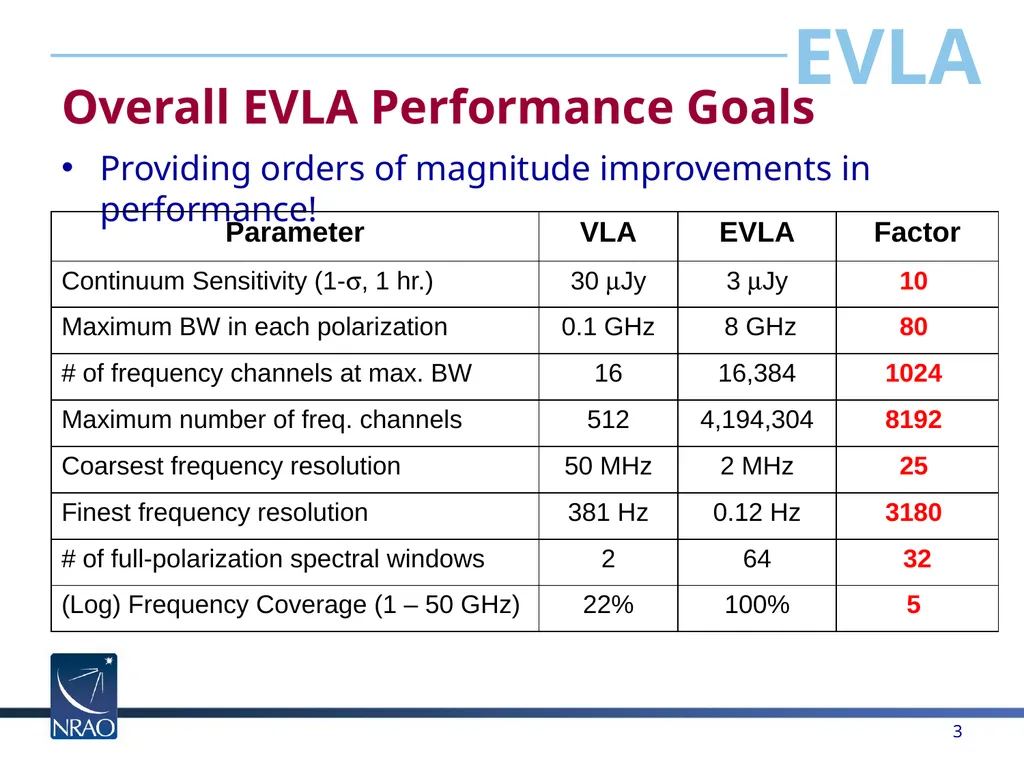
Overall EVLA Performance Goals Providing orders of magnitude improvements in performance! 3<br>
04
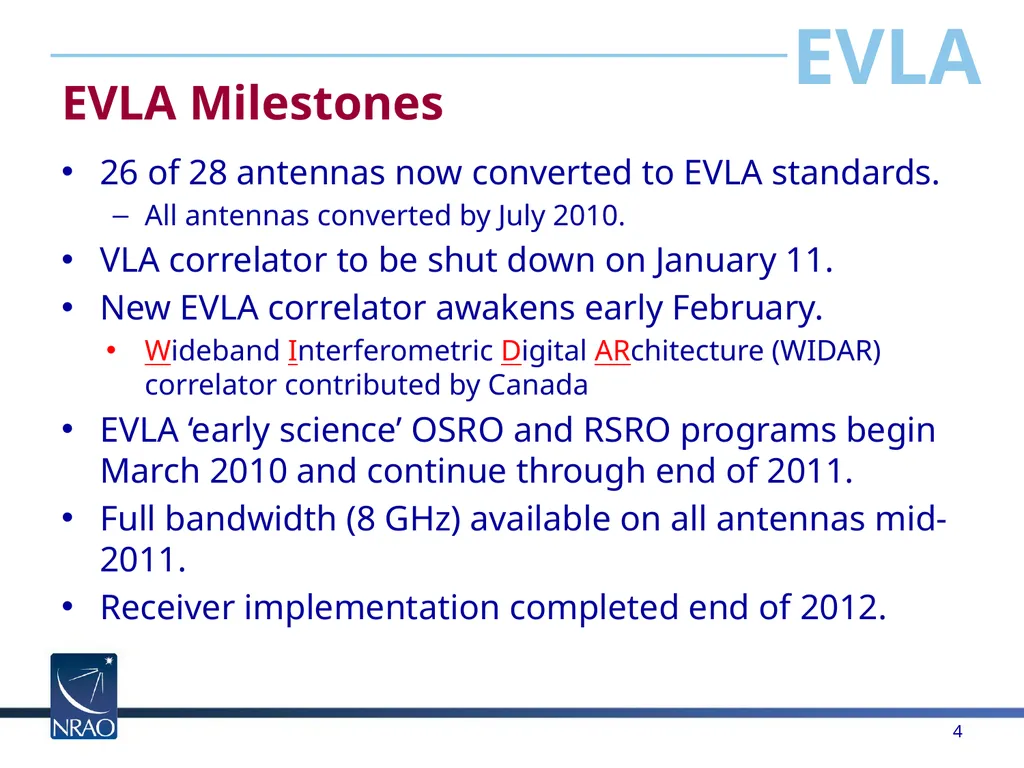
EVLA Milestones 26 of 28 antennas now converted to EVLA standards.
All antennas converted by July 2010.
VLA correlator to be shut down on January 11.
New EVLA correlator awakens early February.
Wideband Interferometric Digital ARchitecture (WIDAR) correlator contributed by Canada
EVLA ‘early science’ OSRO and RSRO programs begin March 2010 and continue through end of 2011.
Full bandwidth (8 GHz) available on all antennas mid-2011.
Receiver implementation completed end of 2012. 4<br>
05
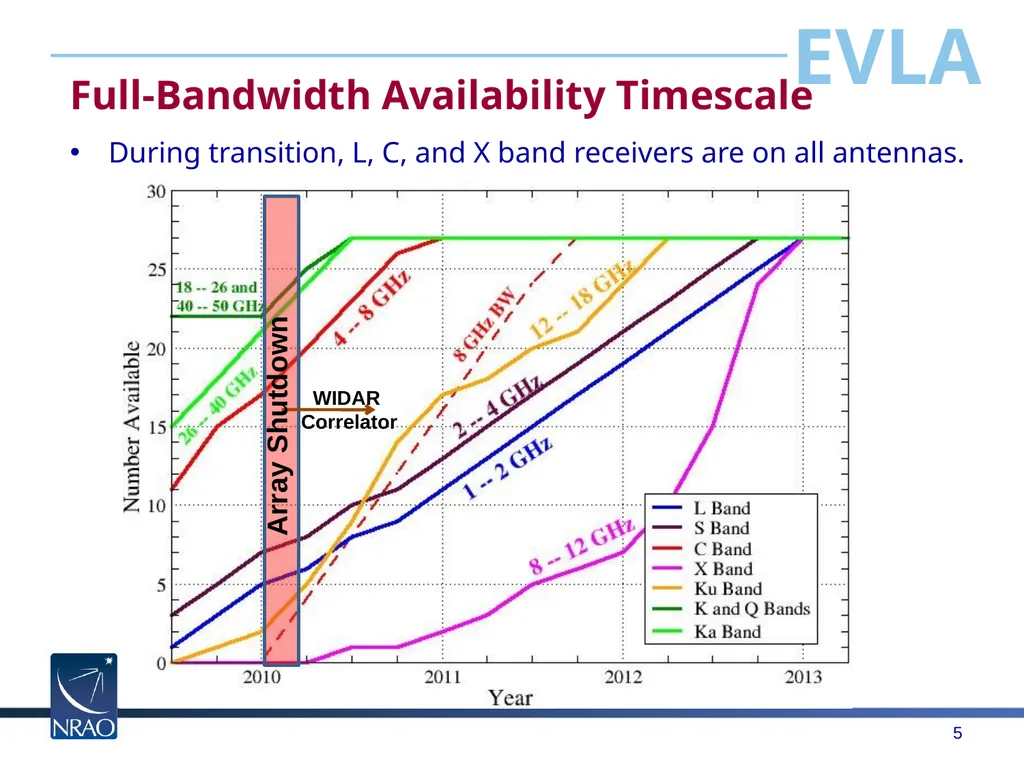
5 Full-Bandwidth Availability Timescale During transition, L, C, and X band receivers are on all antennas. WIDAR
Correlator Array Shutdown<br>
06
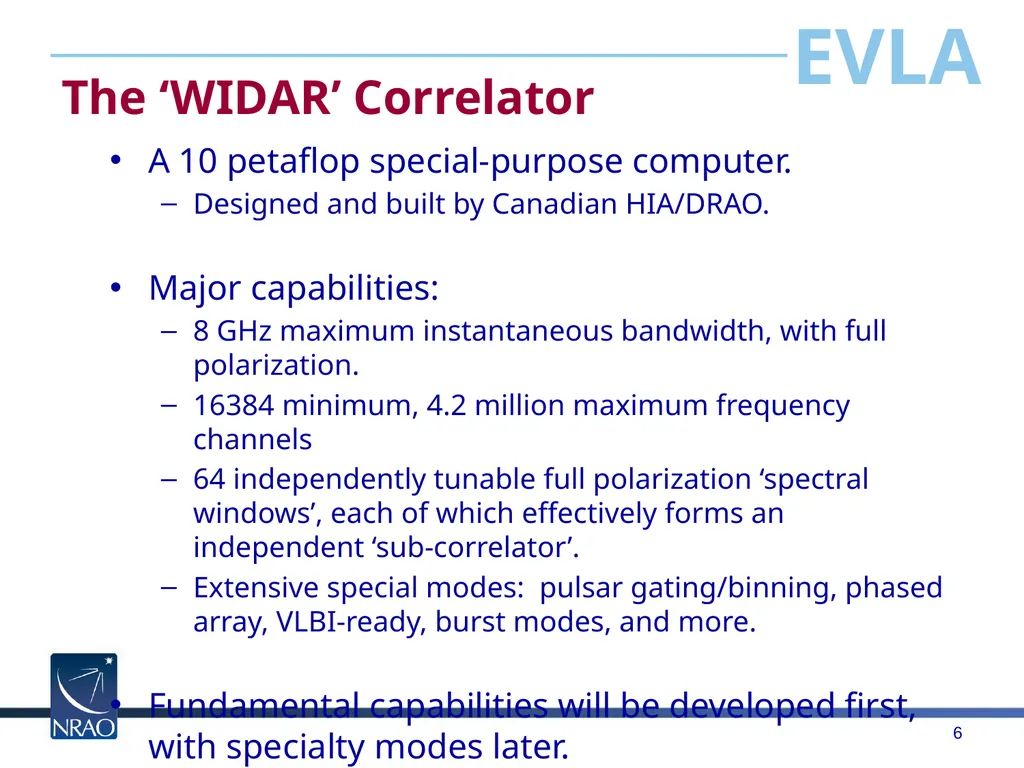
The ‘WIDAR’ Correlator A 10 petaflop special-purpose computer.
Designed and built by Canadian HIA/DRAO.
Major capabilities:
8 GHz maximum instantaneous bandwidth, with full polarization.
16384 minimum, 4.2 million maximum frequency channels
64 independently tunable full polarization ‘spectral windows’, each of which effectively forms an independent ‘sub-correlator’.
Extensive special modes: pulsar gating/binning, phased array, VLBI-ready, burst modes, and more.
Fundamental capabilities will be developed first, with specialty modes later. 6<br>
07
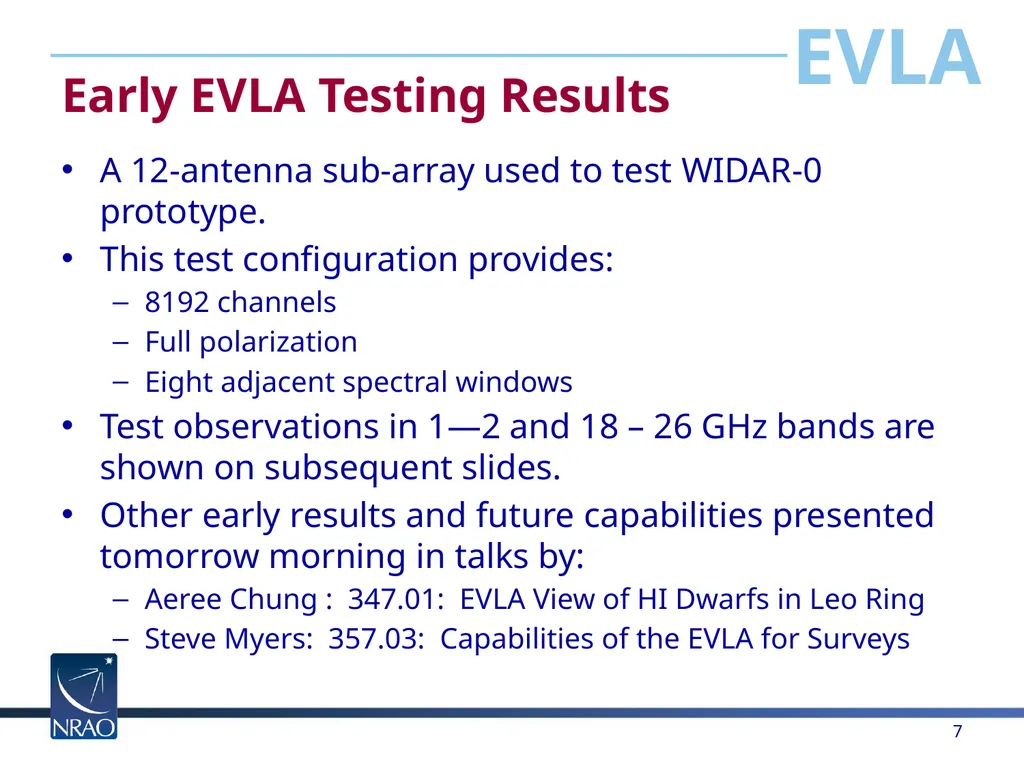
Early EVLA Testing Results A 12-antenna sub-array used to test WIDAR-0 prototype.
This test configuration provides:
8192 channels
Full polarization
Eight adjacent spectral windows
Test observations in 1—2 and 18 – 26 GHz bands are shown on subsequent slides.
Other early results and future capabilities presented tomorrow morning in talks by:
Aeree Chung : 347.01: EVLA View of HI Dwarfs in Leo Ring
Steve Myers: 357.03: Capabilities of the EVLA for Surveys 7<br>
08
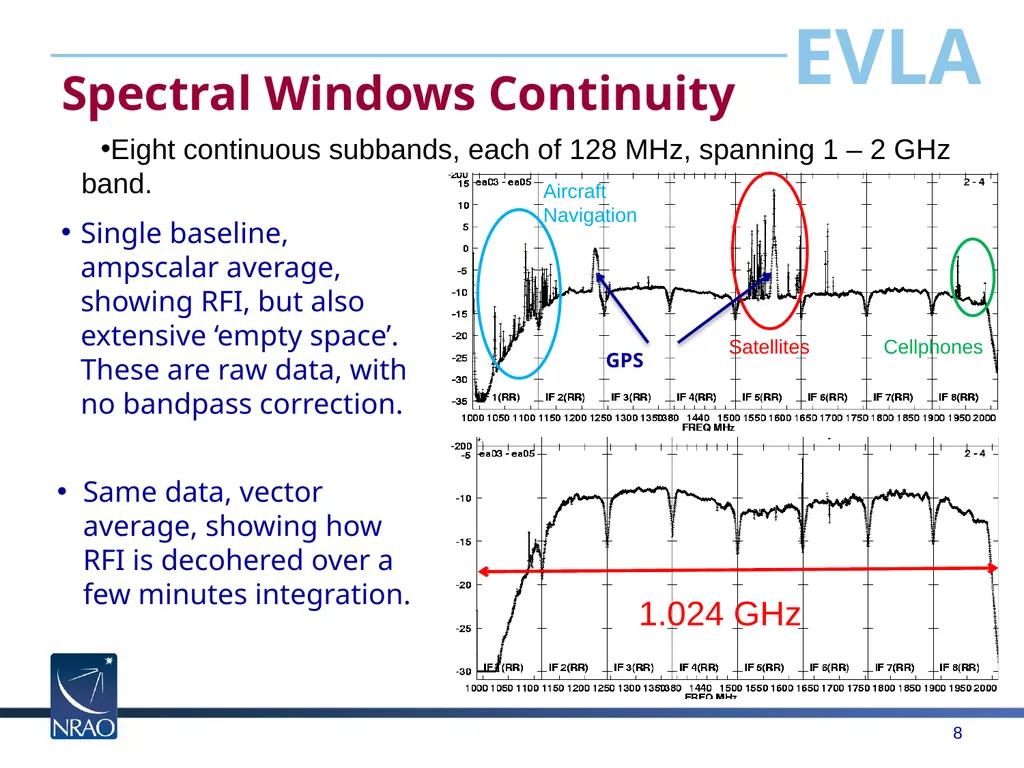
Spectral Windows Continuity 8 Eight continuous subbands, each of 128 MHz, spanning 1 – 2 GHz band. 1.024 GHz Satellites Aircraft
Navigation Cellphones Single baseline, ampscalar average, showing RFI, but also extensive ‘empty space’. These are raw data, with no bandpass correction. Same data, vector average, showing how RFI is decohered over a few minutes integration. GPS<br>
09
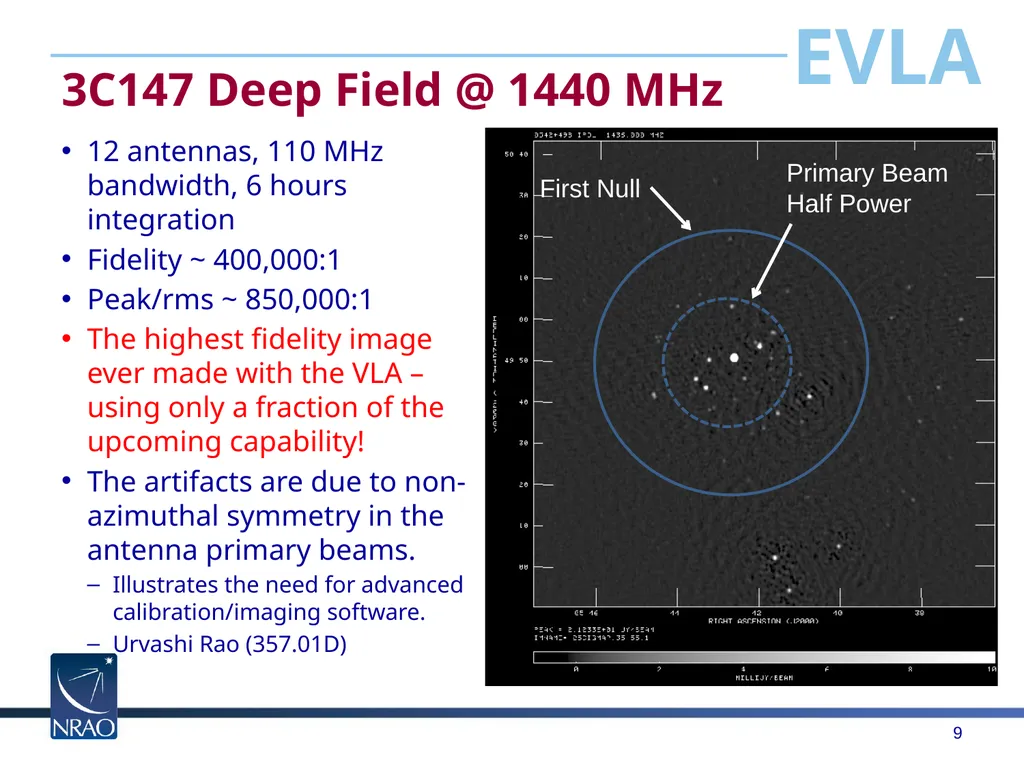
3C147 Deep Field @ 1440 MHz 12 antennas, 110 MHz bandwidth, 6 hours integration
Fidelity ~ 400,000:1
Peak/rms ~ 850,000:1
The highest fidelity image ever made with the VLA – using only a fraction of the upcoming capability!
The artifacts are due to non-azimuthal symmetry in the antenna primary beams.
Illustrates the need for advanced calibration/imaging software.
Urvashi Rao (357.01D) 9 First Null Primary Beam
Half Power<br>
10
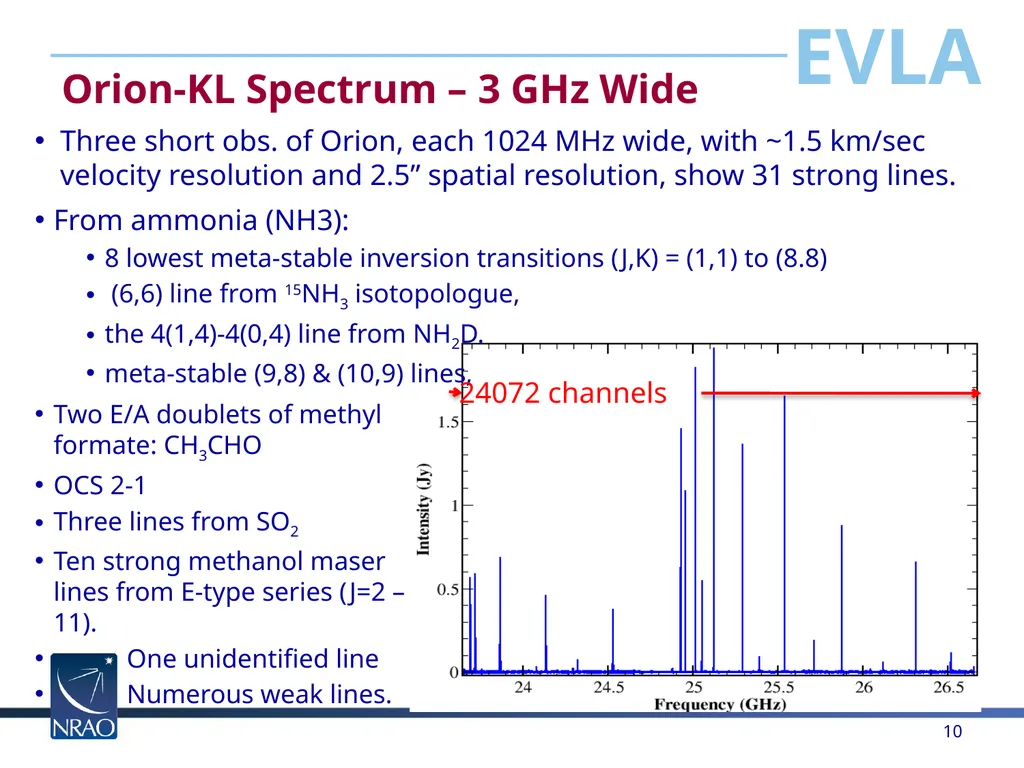
Orion-KL Spectrum – 3 GHz Wide 10 Three short obs. of Orion, each 1024 MHz wide, with ~1.5 km/sec velocity resolution and 2.5” spatial resolution, show 31 strong lines. From ammonia (NH3):
8 lowest meta-stable inversion transitions (J,K) = (1,1) to (8.8)
(6,6) line from 15NH3 isotopologue,
the 4(1,4)-4(0,4) line from NH2D.
meta-stable (9,8) & (10,9) lines, Two E/A doublets of methyl formate: CH3CHO
OCS 2-1
Three lines from SO2
Ten strong methanol maser lines from E-type series (J=2 – 11).
One unidentified line
Numerous weak lines. 24072 channels<br>
11
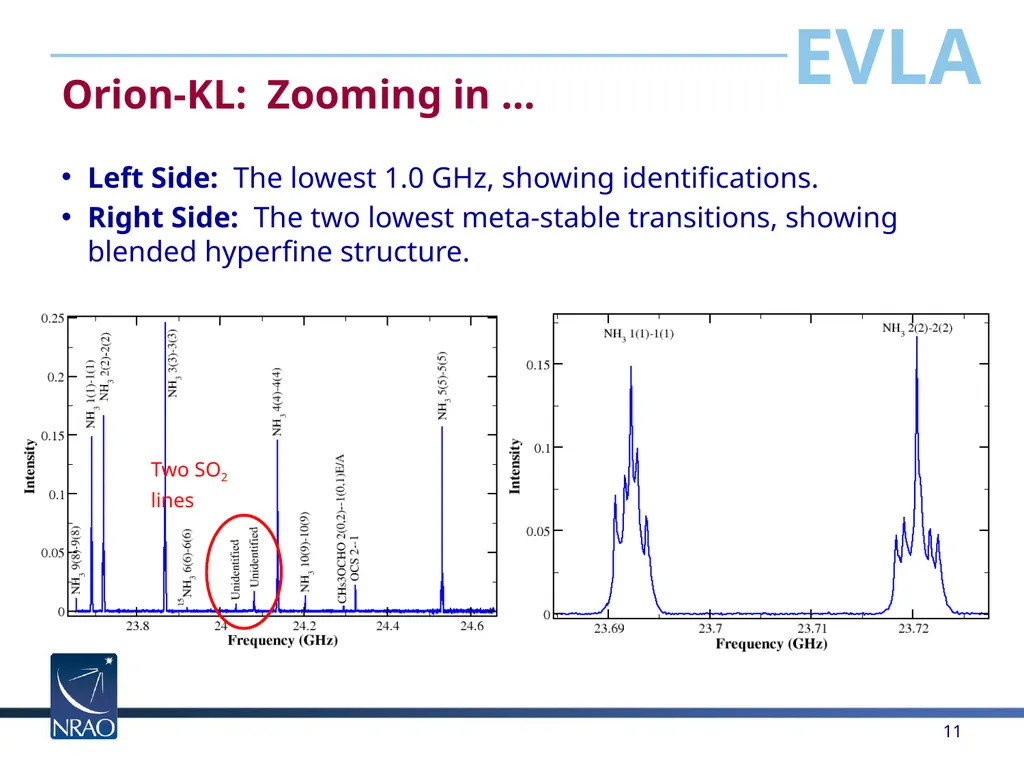
Orion-KL: Zooming in … 11 Left Side: The lowest 1.0 GHz, showing identifications.
Right Side: The two lowest meta-stable transitions, showing blended hyperfine structure. Two SO2
lines<br>
12
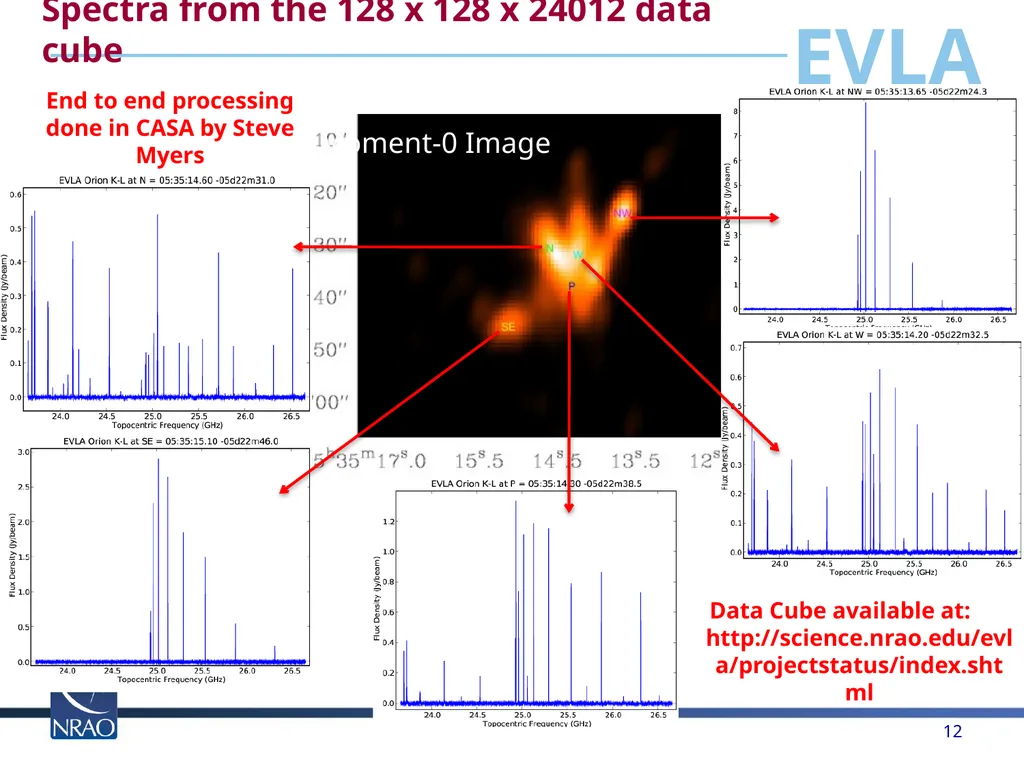
Spectra from the 128 x 128 x 24012 data cube 12 Moment-0 Image End to end processing done in CASA by Steve Myers Data Cube available at: http://science.nrao.edu/evla/projectstatus/index.shtml<br>
13
Early Science Programs Two early science programs: March 2010 through December 2011.
Open Shared Risk Observing (OSRO):
A ‘business as usual’ observing protocol.
Observers will access EVLA in same manner as current for VLA.
Initial configuration provides 512 spectral channels with one or two spectral windows of 128 MHz (maximum) each.
Resident Shared Risk Observing (RSRO):
Must be resident in Socorro for at least 3 months.
Participants will have access to more extensive observing capabilities.
Participants will assist NRAO staff in expanding capabilities
Observing time proportional to length of residency.
27 proposals received on first call, 13 have been accepted.
For details, see:
http://science.nrao.edu/evla/earlyscience/osro.shtml
http://science.nrao.edu/evla/earlyscience/osro.shtml 13<br>
14
14 WIDAR Growth: 2010+ Observational capabilities will be rapid thru 2010 - 11
All initial observations will be with the ‘fundamental homogeneous correlator setup’
All spectral windows adjacent, with same width & channelization, arranged to maximize total bandwidth (BW) coverage
Resident observers (RSRO Program) should have access to:
2 GHz/polarization BW (all antennas) by mid-2010
8 GHz/polarization BW (all antennas) by end of 2011.
Recirculation (increased spectral resolution) by late 2010
Independent spectral window tuning by early 2011
Flexible resource allocation (trading spectral windows for more spectral resolution) by mid 2011<br>
15
Summary EVLA ready for science observations with all antennas and unprecedented new capabilities: Mar 2010
Wide-band (full tuning range) receivers available on all antennas
Highest frequency bands (18 – 50 GHz): mid 2010
4 – 8 GHz: end 2010
Remaining four bands: 2012
Early Science opportunities: Mar 2010 - Dec 2011
Basic modes via OSRO Program: You stay home
Advanced modes via RSRO Program: You come to Socorro
RSRO Program access will include
2 GHz BW available on all antennas by mid 2010
8 GHz BW available on all antennas by mid 2011
Increasing spectral resolution and tuning flexibility through 2010-11
Specialty modes as implemented, guided by user interest 15<br>