
The Flipped Online Classroom A Strategy for





Description: The Flipped Online Classroom A Strategy for Student Engagement Success Presented by: Isabelle Barrette-Ng Neil Pettit With acknowledgement and thanks to Patrick Kelly (University of Calgary) for his co-development of the workshop
Related Topics
Download Presentation
"The Flipped Online Classroom A Strategy for" is the property of its rightful owner. Permission is granted to download and print the materials on this website for personal, non-commercial use only, and to display it on your personal computer provided you do not modify the materials and that you retain all copyright notices contained in the materials. By downloading content from our website, you accept the terms of this agreement.
Presentation Transcript
slide1. The Flipped Online Classroom A Strategy for Student Engagement & Success
Presented by:
Isabelle Barrette-Ng & Neil Pettit
With acknowledgement and thanks to Patrick Kelly (University of Calgary) for his co-development of the workshop materials and FLICS model<br>
slide2. Land Acknowledgment The University of Windsor & St. Clair College sits on the traditional territory of the Three Fires Confederacy of First Nations, which includes the Ojibwa, the Odawa, and the Potawatomie. We respect the longstanding relationships with First Nations people in this place in the 100-mile Windsor-Essex peninsula and the straits – les détroits – of Detroit.<br>
slide3. Outcomes Conceptualize how a flipped classroom could be structured.
Identify when to best use technology to complement other course activities
Create a flipped lesson that includes online content, in-class activities, and a student assessment plan.
* Online or in the classroom *<br>
slide4. “Many instructors sit down to plan a lesson and begin with the question, ‘What am I going to talk about today?’. Flip that thinking. When you sit down to plan your flipped lesson, always begin by asking yourself, ‘What do students need to do to achieve the learning outcomes for this lesson?’”
- Honeycutt, 2016<br>
slide5. Definition Flipped Learning is a pedagogical framework to facilitate meaningful student learning experiences using active learning strategies. A Flipped classroom has online interactive instruction, content exploration and student collaboration, while the classroom space is transformed into an interactive learning environment where the students work together and with the instructor to apply their knowledge and test their assumptions.
Adapted from Flipped Learning Network, http://www.flippedlearning.org/domain/46<br>
slide6. What is FLICS? Flipped Learning-Centered Interactive Classroom Strategy
A sequential model to plan and create flipped lessons.<br>
slide7. Literature Review Content becomes more easily accessed and controlled by the student (Gerstein, 2012; Moffett, 2014)
Evidence that flipped learning as a positive impact on student learning (Tune, Sturek, and Basile, 2013; Herreid & Schiller, 2013; Gilboy, Heinerichs, Pazzaglia, 2014)
Start small by selecting one lesson (Steed, 2012)
Facilitates mastery learning (Bergmann & Sams, 2012)
Students become more open to cooperative and innovative teaching strategies (Strayer, 2010)
Flip your approach to teaching and learning (Honeycutt, 2016)<br>
slide8. Literature Review Focus on pedagogy, building community and a safe, collaborative space (Garrison et al., 2010) (ie. Participation in discussions)
Intentionally align online assessments need to course learning outcomes (Gikandi, Morrow, & Davis, 2011)
Break down course into chunks or modules (and write module learning outcomes)
Leverage synchronous and asynchronous activities, and what students can do offline<br>
slide9. 7 principles of effective teaching and learning Encourages interaction between students and faculty
Encourages interaction between students
Utilizes active learning strategies
Provides prompt and useful feedback
Emphasizes time on task
Sets high expectations
Respects diversity and ways of learning (Chickering & Gamson, 1991)<br>
slide10. Initial Thoughts? What are your initial thoughts about flipped learning in an online environment?
Concerns
Benefits
Questions
Enter your thoughts into the chat!<br>
slide11. FLOW<br>
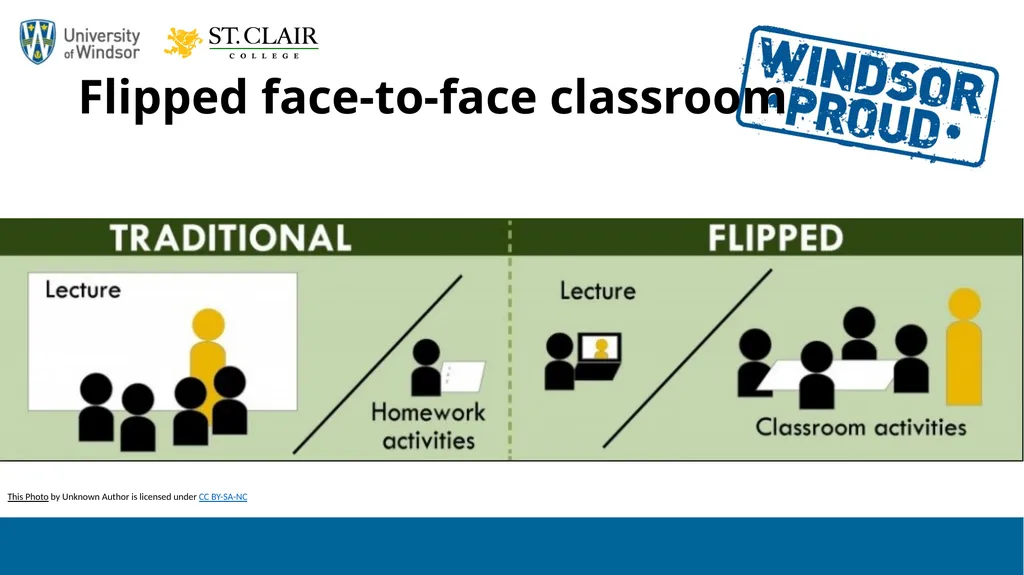
slide12. This Photo by Unknown Author is licensed under CC BY-SA-NC Flipped face-to-face classroom<br>
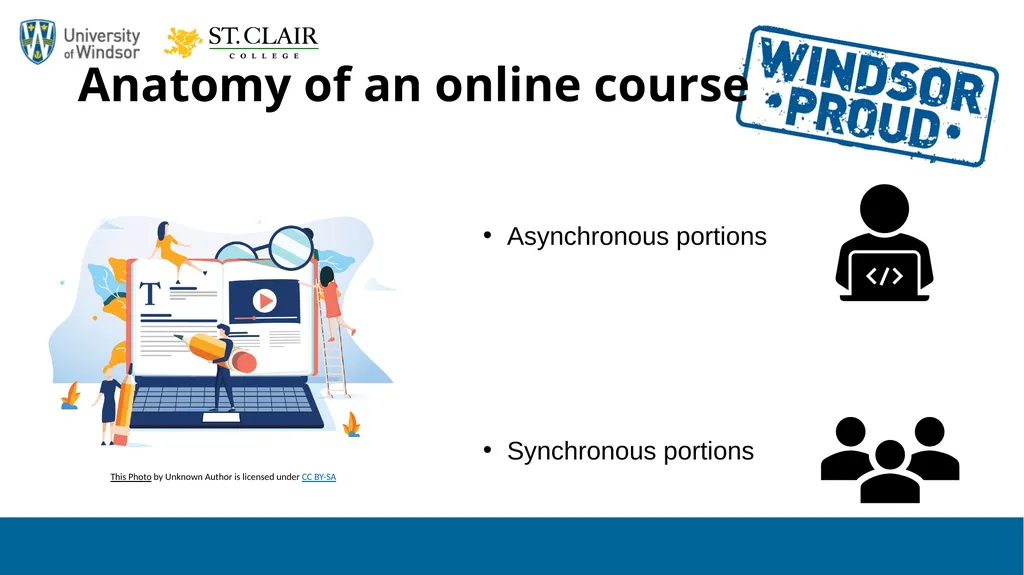
slide13. Anatomy of an online course This Photo by Unknown Author is licensed under CC BY-SA Asynchronous portions
Synchronous portions<br>
slide14. Examining types of activities in online classes online offline<br>
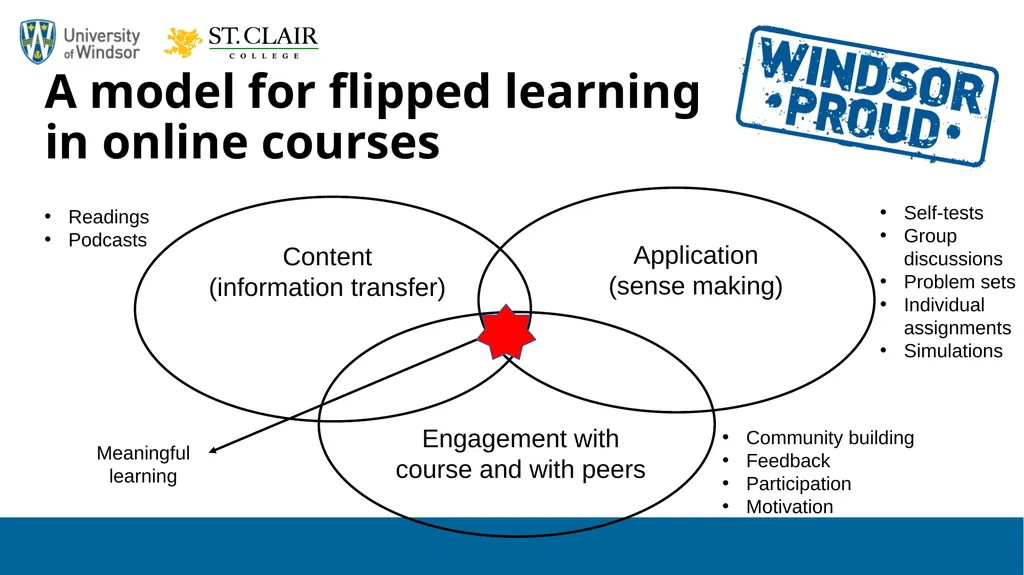
slide15. Content
(information transfer) Application
(sense making) Engagement with course and with peers A model for flipped learning in online courses Readings
Podcasts Self-tests
Group discussions
Problem sets
Individual assignments
Simulations Community building
Feedback
Participation
Motivation<br>
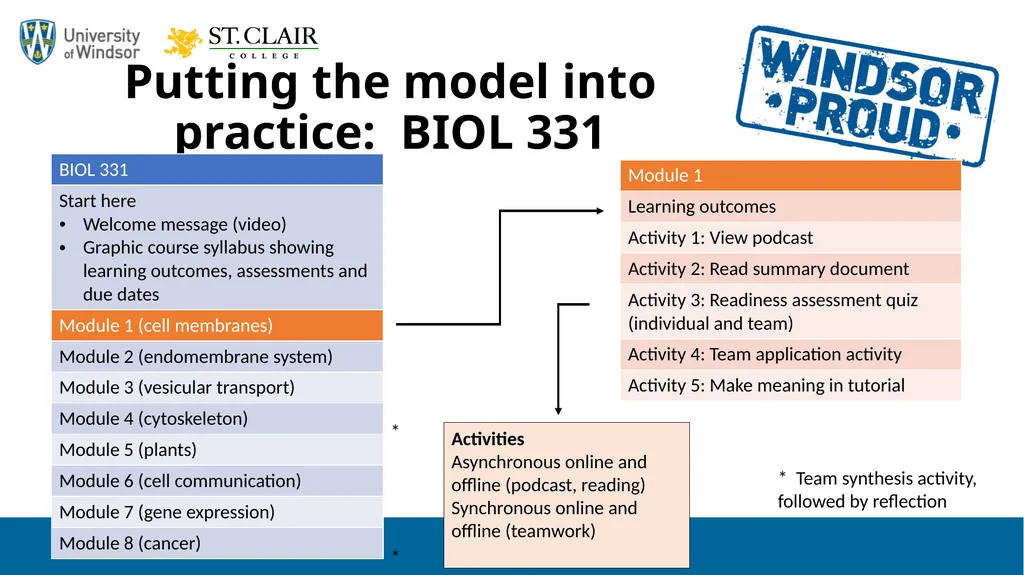
slide16. Putting the model into practice: BIOL 331 * * * Team synthesis activity, followed by reflection Activities
Asynchronous online and offline (podcast, reading)
Synchronous online and offline (teamwork)<br>
slide17. Example Podcast<br>
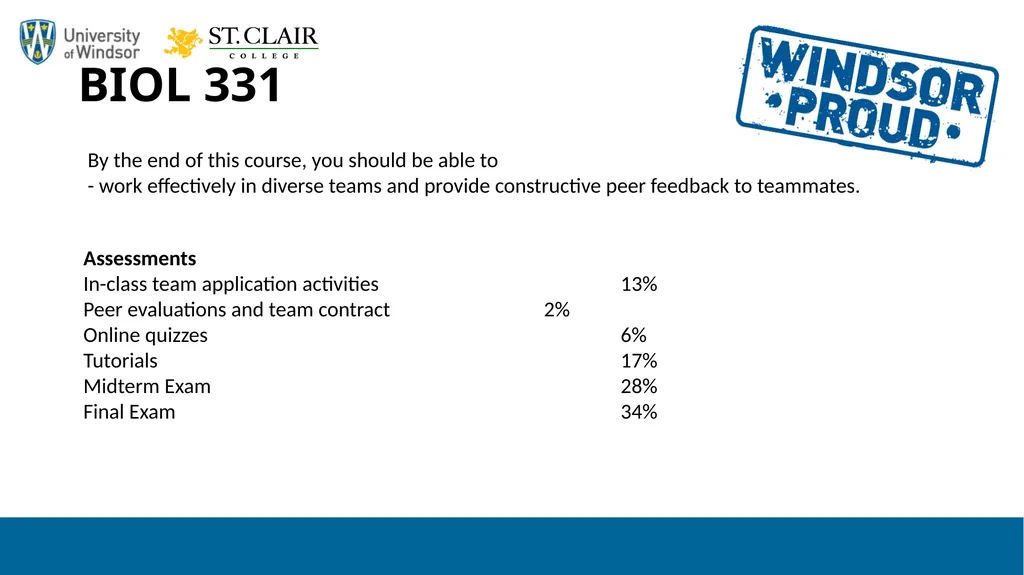
slide18. BIOL 331 By the end of this course, you should be able to
- work effectively in diverse teams and provide constructive peer feedback to teammates. Assessments
In-class team application activities 13%
Peer evaluations and team contract 2%
Online quizzes 6%
Tutorials 17%
Midterm Exam 28%
Final Exam 34%<br>
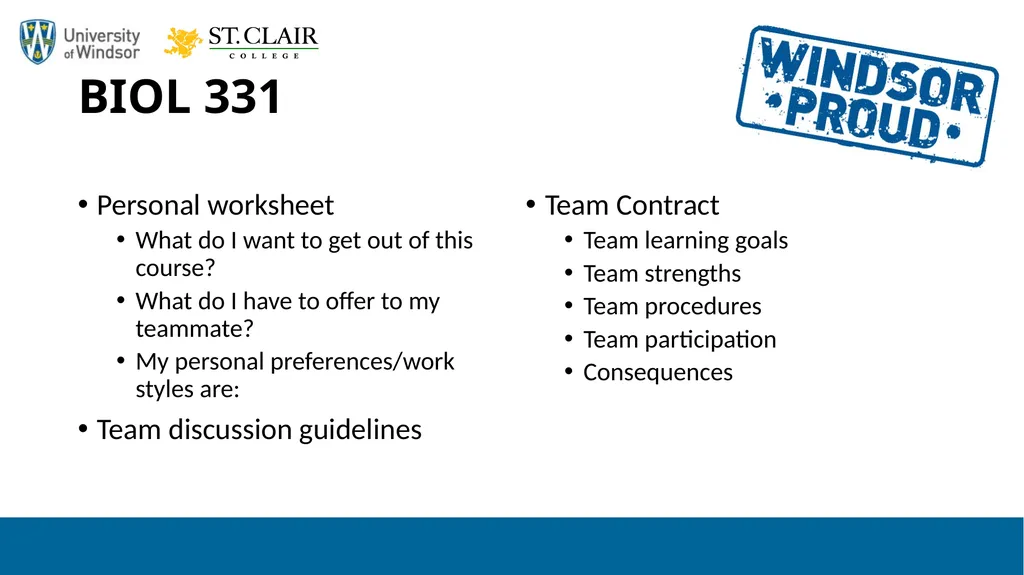
slide19. BIOL 331 Personal worksheet
What do I want to get out of this course?
What do I have to offer to my teammate?
My personal preferences/work styles are:
Team discussion guidelines Team Contract
Team learning goals
Team strengths
Team procedures
Team participation
Consequences<br>
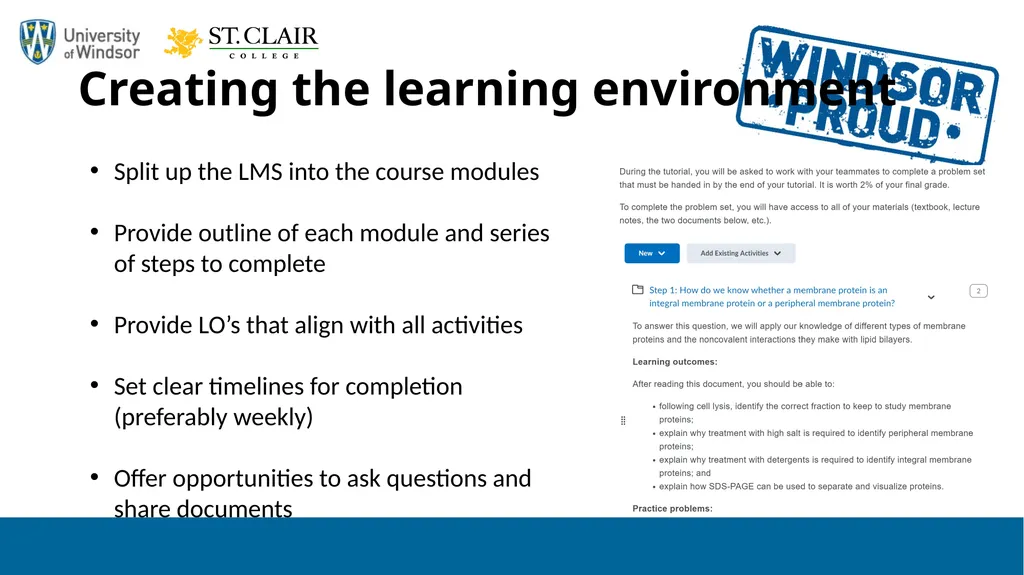
slide20. Creating the learning environment Split up the LMS into the course modules
Provide outline of each module and series of steps to complete
Provide LO’s that align with all activities
Set clear timelines for completion (preferably weekly)
Offer opportunities to ask questions and share documents<br>
slide21. Create a flipped lesson<br>
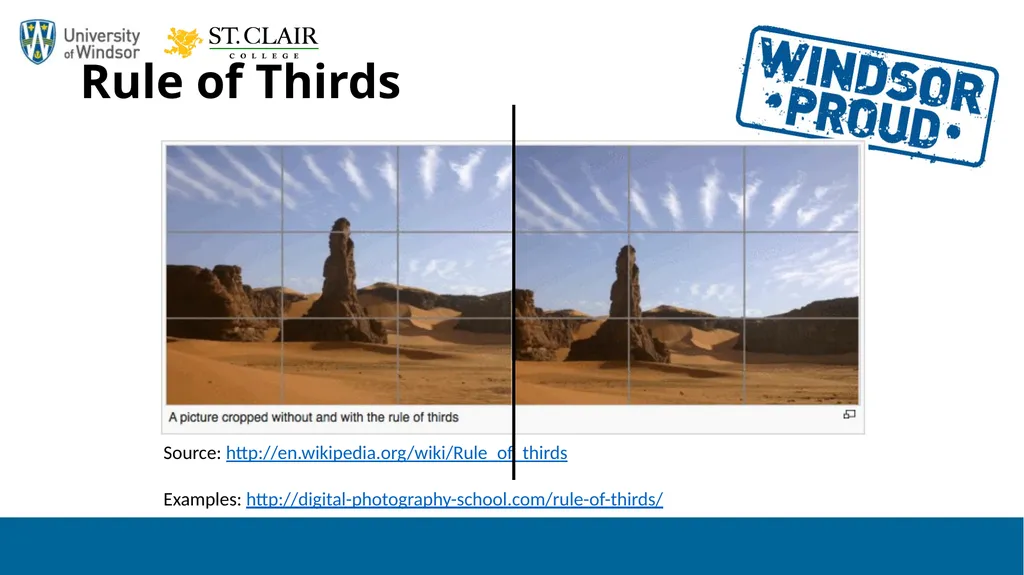
slide22. Rule of Thirds Source: http://en.wikipedia.org/wiki/Rule_of_thirds
Examples: http://digital-photography-school.com/rule-of-thirds/<br>
slide23. Take a Picture! Let’s plan an flipped online module for:
Outcome: Students should be able to compose a picture by using the Rule of Thirds.
For content, activities and assessment
Asynchronous
Synchronous
Offline<br>
slide24. Common Challenges with flipped learning Student resistance
Student fears about grades
Students think they have to learn by themselves
Planning ahead (instructors and students)
Instructor anxiety
Questions you haven’t anticipated
New to online<br>
slide25. Common Challenges with flipped learning Finding online resources [content, simulation]
Planning well structured online activities that promote student engagement
Students that do not participate online
Students police each other (good and bad)<br>
slide26. Student Assessment Assessments have intention and add value to student learning (not just for grades or make work project)
Use a variety of assessments that include both formative and summative (Talbert, 2016)
Double up Exams (individual then as group)
Make student learning and accountable visible (the frequent and small approach with frequent feedback) (Talbert, 2015)
Co-create rubrics with students and provide opportunity for reflection (Spangler, 2015)<br>
slide27. Tips for success Create groups early and keep the groups throughout semester
Scaffold the group work process to help students learn the benefits and strengths of working in groups (provide grades for process and product)
Use early low-stakes assignments
Provide team building activities early in course
Communicate expectations early (be self-directed, come prepared, participate, take risks)
Use low-stakes online quizzes as motivation and feedback (10% of final grade)
Grading scale for team projects
Want to reward trying (students are afraid to be wrong)
If get 80% => A<br>
slide28. Creating Videos or Podcasts Find ready made content online (publishers, Ted talks, Khan academy, MERLOT)
Case studies, simulations, news items, other authentic resources
Keep to a single topic in a short time (Educause, 2012)
Less than 10 minute
Don’t worry about perfection (script it and record it)
Use Institution supported tools (Blackboard Collaborate, Microsoft Teams)<br>
slide29. Summary & next steps Flip your thinking, focus on what students need to do
Align content and activities to course learning outcomes (be intentional)
Use technology meaningfully<br>
slide30. References Bergmann, J., Sams, A. (2012). Flip your classroom. Reach every student in every class every day. Eugene, Oregon:ISTE
Brame, C.J. (2013). Flipping the classroom, Retrieved from http://cft.vanderbilt.edu/guides-sub-pages/flipping-the-classroom/
Buemi, S. (2014). Microflipping: a modest twist on the ‘flipped’ classroom. The Chronicle of Higher Education, Retrieved from http://chronicle.com/article/Microflipping-a-Modest-Twist/145951/?cid=wb&utm_source=wb&utm_medium=en
Chickering, A. W., & Gamson, Z. F. (1991). Applying the seven principles for good practice in undergraduate education. New directions for teaching and learning. 47. San Francisco, CA: JosseyBass.
Educause. (2012, November 1). 7 things you should know about microlectures. Retrieved from https://net.educause.edu/ir/library/pdf/ELI7090.pdf
Flipped Learning Network (2014). The four pillars of F-L-I-P™, Retrieved from http://http://www.flippedlearning.org
Fulton, K. (2012). Upside down and inside out: Flip your classroom to improve student learning. Learning and Leading with Technology, 39(8), 12-17
Gerstein, J. (2012). Flipped classroom: The full picture for higher education. Retrieved from http://usergeneratededucation.wordpress.com/2012/05/15/flipped-classroom-the-full-picture-for-higher-education/<br>
slide31. References Gilboy, M.B., Heinerichs, S., Pazzaglia, G. (2014) Enhancing student engagement using the flipped classroom. Journal of Nutritional Education and Behavior, Published online September 25, 2014
Herried, C.F., Schiller, N.A. (2013). Case studies and the flipped classroom. Journal of College Science Teaching, 42(5), 62-66.
Honeycutt, B. (Ed.). (2016). Flipping the college classroom: practical advice from faculty. Madison, WI: Magna Publications
Moffett, J. (2014) Twelve tips for “flipping” the classroom. Medical Teacher, Published online on August 26, 2014
Seven principles for good practice in undergraduate education. (n.d) Retrieved from http://www.uwo.ca/tsc/resources/pdf/SevenPrinciples.pdf
Steed, A. (2012). The flipped classroom. Teaching business and economics, 16(3), 9-11
Strayer, J. (2012). How learning in an inverted classroom influences cooperation, innovation and task orientation. Learning Environments Research, 15(2), 171-193. doi:10.1007/s10984-012-9108-4
Strayer, J. (2011). The flipped classroom. Retrieved from http://www.knewton.com/flipped-classroom/
Tune, J.D., Sturek, M., Basile, D.P. (2013) Flipped classroom model improves graduate student performance in cardiovascular, respiratory, and renal physiology. Advances in Physiology Education, 37(4), 316-320<br>
slide32. Websites http://www.usask.ca/gmcte/flipped-teaching
http://usergeneratededucation.wordpress.com/2012/05/15/flipped-classroom-the-full-picture-for-higher-education/
http://www.flippedlearning.org<br>
slide33. Thank You! Isabelle Barrette-Ng, Isabelle.barrette-ng@uwindsor.ca
Neil Pettit, npettit@stclaircollege.ca<br>
Presented by:
Isabelle Barrette-Ng & Neil Pettit
With acknowledgement and thanks to Patrick Kelly (University of Calgary) for his co-development of the workshop materials and FLICS model<br>
slide2. Land Acknowledgment The University of Windsor & St. Clair College sits on the traditional territory of the Three Fires Confederacy of First Nations, which includes the Ojibwa, the Odawa, and the Potawatomie. We respect the longstanding relationships with First Nations people in this place in the 100-mile Windsor-Essex peninsula and the straits – les détroits – of Detroit.<br>
slide3. Outcomes Conceptualize how a flipped classroom could be structured.
Identify when to best use technology to complement other course activities
Create a flipped lesson that includes online content, in-class activities, and a student assessment plan.
* Online or in the classroom *<br>
slide4. “Many instructors sit down to plan a lesson and begin with the question, ‘What am I going to talk about today?’. Flip that thinking. When you sit down to plan your flipped lesson, always begin by asking yourself, ‘What do students need to do to achieve the learning outcomes for this lesson?’”
- Honeycutt, 2016<br>
slide5. Definition Flipped Learning is a pedagogical framework to facilitate meaningful student learning experiences using active learning strategies. A Flipped classroom has online interactive instruction, content exploration and student collaboration, while the classroom space is transformed into an interactive learning environment where the students work together and with the instructor to apply their knowledge and test their assumptions.
Adapted from Flipped Learning Network, http://www.flippedlearning.org/domain/46<br>
slide6. What is FLICS? Flipped Learning-Centered Interactive Classroom Strategy
A sequential model to plan and create flipped lessons.<br>
slide7. Literature Review Content becomes more easily accessed and controlled by the student (Gerstein, 2012; Moffett, 2014)
Evidence that flipped learning as a positive impact on student learning (Tune, Sturek, and Basile, 2013; Herreid & Schiller, 2013; Gilboy, Heinerichs, Pazzaglia, 2014)
Start small by selecting one lesson (Steed, 2012)
Facilitates mastery learning (Bergmann & Sams, 2012)
Students become more open to cooperative and innovative teaching strategies (Strayer, 2010)
Flip your approach to teaching and learning (Honeycutt, 2016)<br>
slide8. Literature Review Focus on pedagogy, building community and a safe, collaborative space (Garrison et al., 2010) (ie. Participation in discussions)
Intentionally align online assessments need to course learning outcomes (Gikandi, Morrow, & Davis, 2011)
Break down course into chunks or modules (and write module learning outcomes)
Leverage synchronous and asynchronous activities, and what students can do offline<br>
slide9. 7 principles of effective teaching and learning Encourages interaction between students and faculty
Encourages interaction between students
Utilizes active learning strategies
Provides prompt and useful feedback
Emphasizes time on task
Sets high expectations
Respects diversity and ways of learning (Chickering & Gamson, 1991)<br>
slide10. Initial Thoughts? What are your initial thoughts about flipped learning in an online environment?
Concerns
Benefits
Questions
Enter your thoughts into the chat!<br>
slide11. FLOW<br>
slide12. This Photo by Unknown Author is licensed under CC BY-SA-NC Flipped face-to-face classroom<br>
slide13. Anatomy of an online course This Photo by Unknown Author is licensed under CC BY-SA Asynchronous portions
Synchronous portions<br>
slide14. Examining types of activities in online classes online offline<br>
slide15. Content
(information transfer) Application
(sense making) Engagement with course and with peers A model for flipped learning in online courses Readings
Podcasts Self-tests
Group discussions
Problem sets
Individual assignments
Simulations Community building
Feedback
Participation
Motivation<br>
slide16. Putting the model into practice: BIOL 331 * * * Team synthesis activity, followed by reflection Activities
Asynchronous online and offline (podcast, reading)
Synchronous online and offline (teamwork)<br>
slide17. Example Podcast<br>
slide18. BIOL 331 By the end of this course, you should be able to
- work effectively in diverse teams and provide constructive peer feedback to teammates. Assessments
In-class team application activities 13%
Peer evaluations and team contract 2%
Online quizzes 6%
Tutorials 17%
Midterm Exam 28%
Final Exam 34%<br>
slide19. BIOL 331 Personal worksheet
What do I want to get out of this course?
What do I have to offer to my teammate?
My personal preferences/work styles are:
Team discussion guidelines Team Contract
Team learning goals
Team strengths
Team procedures
Team participation
Consequences<br>
slide20. Creating the learning environment Split up the LMS into the course modules
Provide outline of each module and series of steps to complete
Provide LO’s that align with all activities
Set clear timelines for completion (preferably weekly)
Offer opportunities to ask questions and share documents<br>
slide21. Create a flipped lesson<br>
slide22. Rule of Thirds Source: http://en.wikipedia.org/wiki/Rule_of_thirds
Examples: http://digital-photography-school.com/rule-of-thirds/<br>
slide23. Take a Picture! Let’s plan an flipped online module for:
Outcome: Students should be able to compose a picture by using the Rule of Thirds.
For content, activities and assessment
Asynchronous
Synchronous
Offline<br>
slide24. Common Challenges with flipped learning Student resistance
Student fears about grades
Students think they have to learn by themselves
Planning ahead (instructors and students)
Instructor anxiety
Questions you haven’t anticipated
New to online<br>
slide25. Common Challenges with flipped learning Finding online resources [content, simulation]
Planning well structured online activities that promote student engagement
Students that do not participate online
Students police each other (good and bad)<br>
slide26. Student Assessment Assessments have intention and add value to student learning (not just for grades or make work project)
Use a variety of assessments that include both formative and summative (Talbert, 2016)
Double up Exams (individual then as group)
Make student learning and accountable visible (the frequent and small approach with frequent feedback) (Talbert, 2015)
Co-create rubrics with students and provide opportunity for reflection (Spangler, 2015)<br>
slide27. Tips for success Create groups early and keep the groups throughout semester
Scaffold the group work process to help students learn the benefits and strengths of working in groups (provide grades for process and product)
Use early low-stakes assignments
Provide team building activities early in course
Communicate expectations early (be self-directed, come prepared, participate, take risks)
Use low-stakes online quizzes as motivation and feedback (10% of final grade)
Grading scale for team projects
Want to reward trying (students are afraid to be wrong)
If get 80% => A<br>
slide28. Creating Videos or Podcasts Find ready made content online (publishers, Ted talks, Khan academy, MERLOT)
Case studies, simulations, news items, other authentic resources
Keep to a single topic in a short time (Educause, 2012)
Less than 10 minute
Don’t worry about perfection (script it and record it)
Use Institution supported tools (Blackboard Collaborate, Microsoft Teams)<br>
slide29. Summary & next steps Flip your thinking, focus on what students need to do
Align content and activities to course learning outcomes (be intentional)
Use technology meaningfully<br>
slide30. References Bergmann, J., Sams, A. (2012). Flip your classroom. Reach every student in every class every day. Eugene, Oregon:ISTE
Brame, C.J. (2013). Flipping the classroom, Retrieved from http://cft.vanderbilt.edu/guides-sub-pages/flipping-the-classroom/
Buemi, S. (2014). Microflipping: a modest twist on the ‘flipped’ classroom. The Chronicle of Higher Education, Retrieved from http://chronicle.com/article/Microflipping-a-Modest-Twist/145951/?cid=wb&utm_source=wb&utm_medium=en
Chickering, A. W., & Gamson, Z. F. (1991). Applying the seven principles for good practice in undergraduate education. New directions for teaching and learning. 47. San Francisco, CA: JosseyBass.
Educause. (2012, November 1). 7 things you should know about microlectures. Retrieved from https://net.educause.edu/ir/library/pdf/ELI7090.pdf
Flipped Learning Network (2014). The four pillars of F-L-I-P™, Retrieved from http://http://www.flippedlearning.org
Fulton, K. (2012). Upside down and inside out: Flip your classroom to improve student learning. Learning and Leading with Technology, 39(8), 12-17
Gerstein, J. (2012). Flipped classroom: The full picture for higher education. Retrieved from http://usergeneratededucation.wordpress.com/2012/05/15/flipped-classroom-the-full-picture-for-higher-education/<br>
slide31. References Gilboy, M.B., Heinerichs, S., Pazzaglia, G. (2014) Enhancing student engagement using the flipped classroom. Journal of Nutritional Education and Behavior, Published online September 25, 2014
Herried, C.F., Schiller, N.A. (2013). Case studies and the flipped classroom. Journal of College Science Teaching, 42(5), 62-66.
Honeycutt, B. (Ed.). (2016). Flipping the college classroom: practical advice from faculty. Madison, WI: Magna Publications
Moffett, J. (2014) Twelve tips for “flipping” the classroom. Medical Teacher, Published online on August 26, 2014
Seven principles for good practice in undergraduate education. (n.d) Retrieved from http://www.uwo.ca/tsc/resources/pdf/SevenPrinciples.pdf
Steed, A. (2012). The flipped classroom. Teaching business and economics, 16(3), 9-11
Strayer, J. (2012). How learning in an inverted classroom influences cooperation, innovation and task orientation. Learning Environments Research, 15(2), 171-193. doi:10.1007/s10984-012-9108-4
Strayer, J. (2011). The flipped classroom. Retrieved from http://www.knewton.com/flipped-classroom/
Tune, J.D., Sturek, M., Basile, D.P. (2013) Flipped classroom model improves graduate student performance in cardiovascular, respiratory, and renal physiology. Advances in Physiology Education, 37(4), 316-320<br>
slide32. Websites http://www.usask.ca/gmcte/flipped-teaching
http://usergeneratededucation.wordpress.com/2012/05/15/flipped-classroom-the-full-picture-for-higher-education/
http://www.flippedlearning.org<br>
slide33. Thank You! Isabelle Barrette-Ng, Isabelle.barrette-ng@uwindsor.ca
Neil Pettit, npettit@stclaircollege.ca<br>