
The Forgotten Enemy Read lines 1-9 A1 List five
KB
Published · 13 slides · 0 views
1 / 1

Description
The Forgotten Enemy Read lines 1-9 A1 List five things you learn about the setting that Professor Millward is in. (5) Do Now A1. The air was so cold it rasped against Millwards lungs. Professor Millward got out of bed and went to the
Related Topics
Share
Embed code
Download this presentation From Below
"The Forgotten Enemy Read lines 1-9 A1 List five" is the property of its rightful owner. Permission is granted to download and print the materials on this website for personal, non-commercial use only, and to display it on your personal computer provided you do not modify the materials and that you retain all copyright notices contained in the materials. By downloading content from our website, you accept the terms of this agreement.
Presentation Transcript
01
The Forgotten Enemy Read lines 1-9
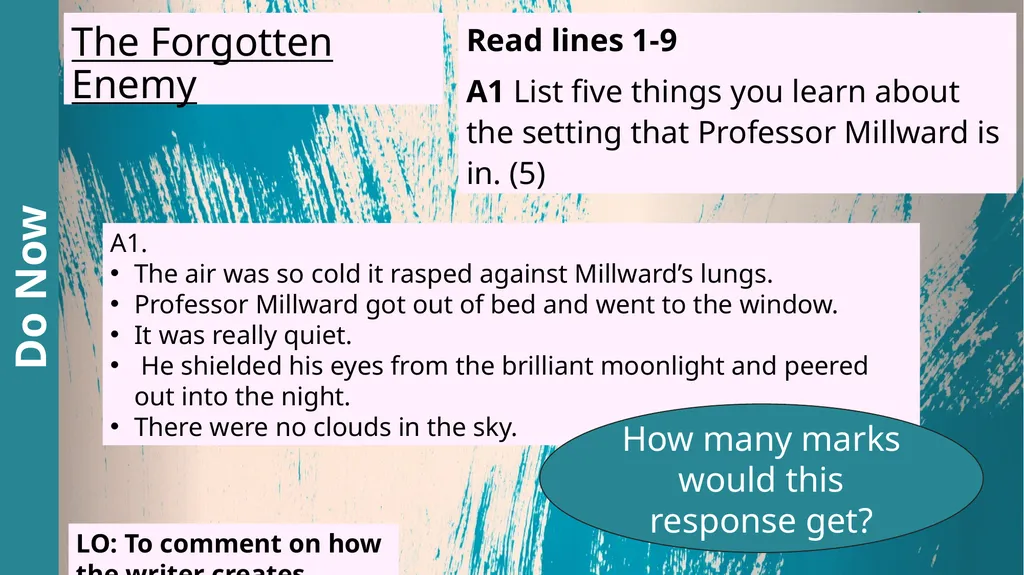
A1 List five things you learn about the setting that Professor Millward is in. (5) Do Now A1.
The air was so cold it rasped against Millward’s lungs.
Professor Millward got out of bed and went to the window.
It was really quiet.
He shielded his eyes from the brilliant moonlight and peered out into the night.
There were no clouds in the sky. How many marks would this response get? LO: To comment on how the writer creates meaning.<br>
A1 List five things you learn about the setting that Professor Millward is in. (5) Do Now A1.
The air was so cold it rasped against Millward’s lungs.
Professor Millward got out of bed and went to the window.
It was really quiet.
He shielded his eyes from the brilliant moonlight and peered out into the night.
There were no clouds in the sky. How many marks would this response get? LO: To comment on how the writer creates meaning.<br>
02
The Forgotten Enemy Read lines 1-9
A1 List five things you learn about the setting that Professor Millward is in. (5) Checking Understanding A1.
The air was so cold it rasped against Millward’s lungs.
Professor Millward got out of bed and went to the window.
It was really quiet.
He shielded his eyes from the brilliant moonlight and peered out into the night.
There were no clouds in the sky. LO: To comment on how the writer creates meaning. How many marks would this person get?<br>
A1 List five things you learn about the setting that Professor Millward is in. (5) Checking Understanding A1.
The air was so cold it rasped against Millward’s lungs.
Professor Millward got out of bed and went to the window.
It was really quiet.
He shielded his eyes from the brilliant moonlight and peered out into the night.
There were no clouds in the sky. LO: To comment on how the writer creates meaning. How many marks would this person get?<br>
03
The Forgotten Enemy Read lines 1-9
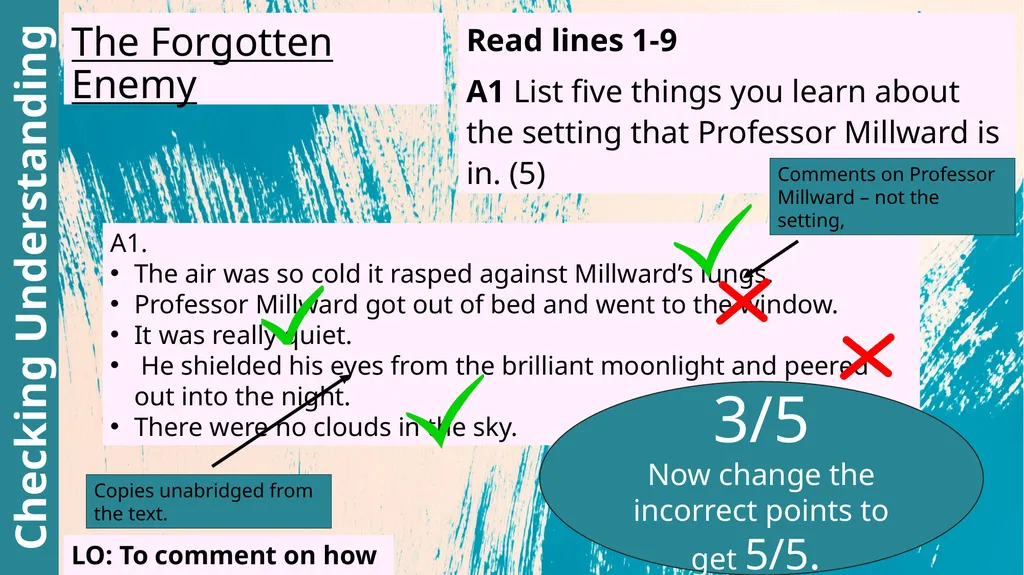
A1 List five things you learn about the setting that Professor Millward is in. (5) Checking Understanding A1.
The air was so cold it rasped against Millward’s lungs.
Professor Millward got out of bed and went to the window.
It was really quiet.
He shielded his eyes from the brilliant moonlight and peered out into the night.
There were no clouds in the sky. 3/5
Now change the incorrect points to get 5/5. Comments on Professor Millward – not the setting, Copies unabridged from the text. LO: To comment on how the writer creates meaning.<br>
A1 List five things you learn about the setting that Professor Millward is in. (5) Checking Understanding A1.
The air was so cold it rasped against Millward’s lungs.
Professor Millward got out of bed and went to the window.
It was really quiet.
He shielded his eyes from the brilliant moonlight and peered out into the night.
There were no clouds in the sky. 3/5
Now change the incorrect points to get 5/5. Comments on Professor Millward – not the setting, Copies unabridged from the text. LO: To comment on how the writer creates meaning.<br>
04
Match the vocabulary to the correct definitions 1. struggle or stagger clumsily
2. the mass or size of something large.
3. a mass departure of people
4. continuously and without end.
5. something that is unbearable
6. the state or condition of being superior to all others in authority, power, or status
Bulk Ceaselessly Supremacy
Exodus Floundering Intolerable Unlocking Vocabulary LO: To comment on how the writer creates meaning.<br>
2. the mass or size of something large.
3. a mass departure of people
4. continuously and without end.
5. something that is unbearable
6. the state or condition of being superior to all others in authority, power, or status
Bulk Ceaselessly Supremacy
Exodus Floundering Intolerable Unlocking Vocabulary LO: To comment on how the writer creates meaning.<br>
05
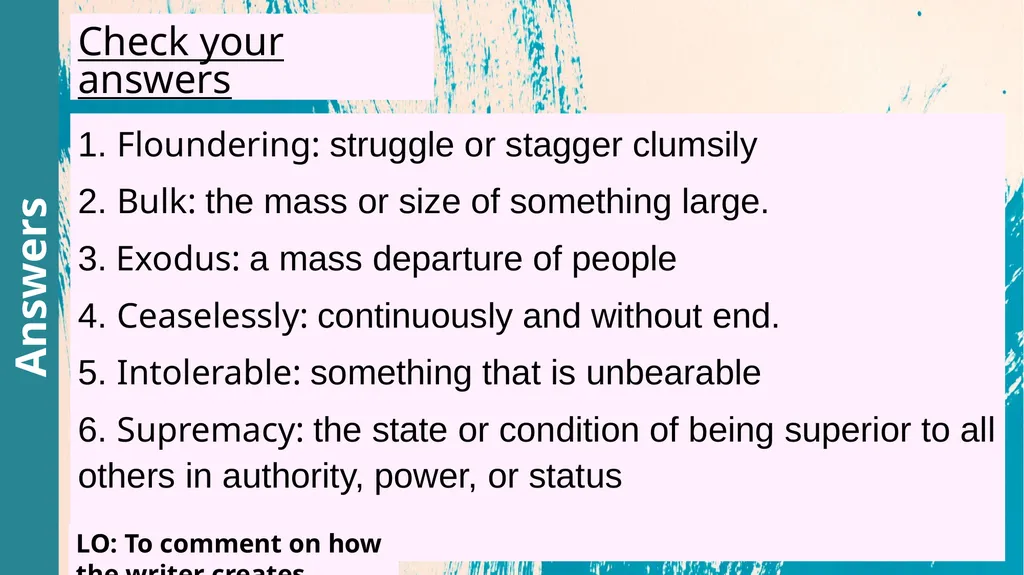
Check your answers 1. Floundering: struggle or stagger clumsily
2. Bulk: the mass or size of something large.
3. Exodus: a mass departure of people
4. Ceaselessly: continuously and without end.
5. Intolerable: something that is unbearable
6. Supremacy: the state or condition of being superior to all others in authority, power, or status Answers LO: To comment on how the writer creates meaning.<br>
2. Bulk: the mass or size of something large.
3. Exodus: a mass departure of people
4. Ceaselessly: continuously and without end.
5. Intolerable: something that is unbearable
6. Supremacy: the state or condition of being superior to all others in authority, power, or status Answers LO: To comment on how the writer creates meaning.<br>
06
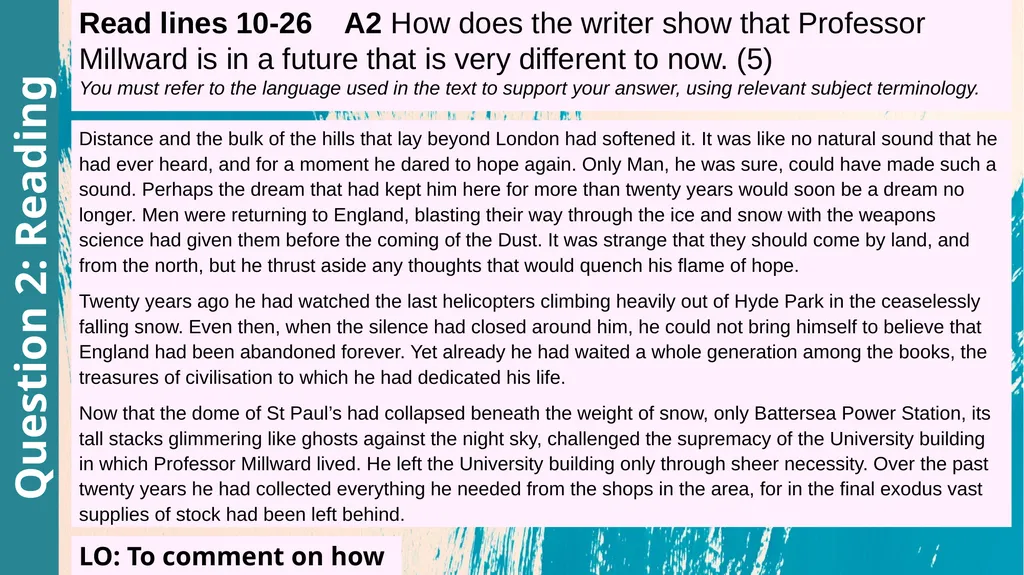
Read lines 10-26 A2 How does the writer show that Professor Millward is in a future that is very different to now. (5)
You must refer to the language used in the text to support your answer, using relevant subject terminology. Distance and the bulk of the hills that lay beyond London had softened it. It was like no natural sound that he had ever heard, and for a moment he dared to hope again. Only Man, he was sure, could have made such a sound. Perhaps the dream that had kept him here for more than twenty years would soon be a dream no longer. Men were returning to England, blasting their way through the ice and snow with the weapons science had given them before the coming of the Dust. It was strange that they should come by land, and from the north, but he thrust aside any thoughts that would quench his flame of hope.
Twenty years ago he had watched the last helicopters climbing heavily out of Hyde Park in the ceaselessly falling snow. Even then, when the silence had closed around him, he could not bring himself to believe that England had been abandoned forever. Yet already he had waited a whole generation among the books, the treasures of civilisation to which he had dedicated his life.
Now that the dome of St Paul’s had collapsed beneath the weight of snow, only Battersea Power Station, its tall stacks glimmering like ghosts against the night sky, challenged the supremacy of the University building in which Professor Millward lived. He left the University building only through sheer necessity. Over the past twenty years he had collected everything he needed from the shops in the area, for in the final exodus vast supplies of stock had been left behind. Question 2: Reading LO: To comment on how the writer creates meaning.<br>
Twenty years ago he had watched the last helicopters climbing heavily out of Hyde Park in the ceaselessly falling snow. Even then, when the silence had closed around him, he could not bring himself to believe that England had been abandoned forever. Yet already he had waited a whole generation among the books, the treasures of civilisation to which he had dedicated his life.
Now that the dome of St Paul’s had collapsed beneath the weight of snow, only Battersea Power Station, its tall stacks glimmering like ghosts against the night sky, challenged the supremacy of the University building in which Professor Millward lived. He left the University building only through sheer necessity. Over the past twenty years he had collected everything he needed from the shops in the area, for in the final exodus vast supplies of stock had been left behind. Question 2: Reading LO: To comment on how the writer creates meaning.<br>
07
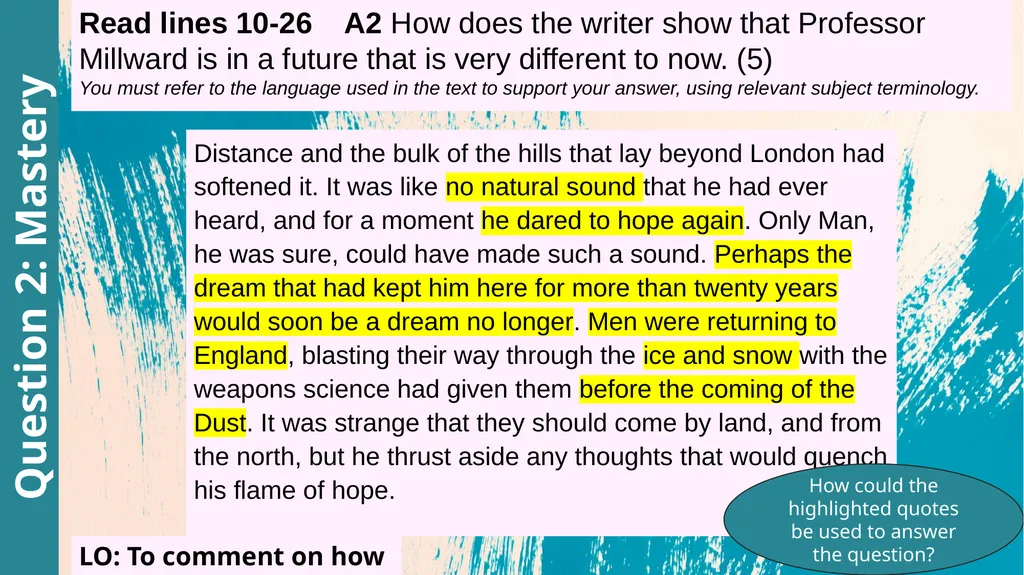
Read lines 10-26 A2 How does the writer show that Professor Millward is in a future that is very different to now. (5)
You must refer to the language used in the text to support your answer, using relevant subject terminology. Distance and the bulk of the hills that lay beyond London had softened it. It was like no natural sound that he had ever heard, and for a moment he dared to hope again. Only Man, he was sure, could have made such a sound. Perhaps the dream that had kept him here for more than twenty years would soon be a dream no longer. Men were returning to England, blasting their way through the ice and snow with the weapons science had given them before the coming of the Dust. It was strange that they should come by land, and from the north, but he thrust aside any thoughts that would quench his flame of hope. Question 2: Mastery LO: To comment on how the writer creates meaning. How could the highlighted quotes be used to answer the question?<br>
08
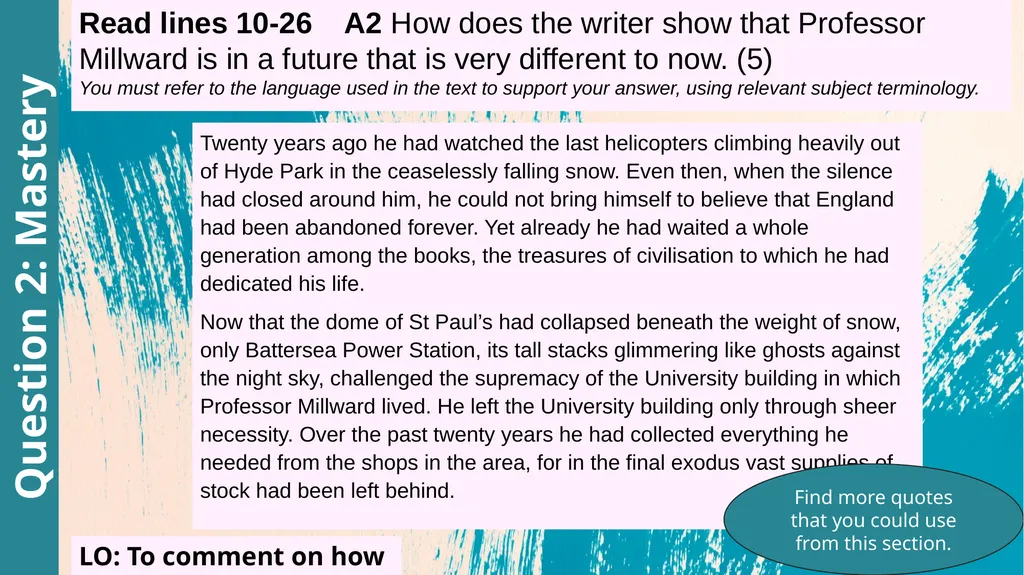
Read lines 10-26 A2 How does the writer show that Professor Millward is in a future that is very different to now. (5)
You must refer to the language used in the text to support your answer, using relevant subject terminology. Twenty years ago he had watched the last helicopters climbing heavily out of Hyde Park in the ceaselessly falling snow. Even then, when the silence had closed around him, he could not bring himself to believe that England had been abandoned forever. Yet already he had waited a whole generation among the books, the treasures of civilisation to which he had dedicated his life.
Now that the dome of St Paul’s had collapsed beneath the weight of snow, only Battersea Power Station, its tall stacks glimmering like ghosts against the night sky, challenged the supremacy of the University building in which Professor Millward lived. He left the University building only through sheer necessity. Over the past twenty years he had collected everything he needed from the shops in the area, for in the final exodus vast supplies of stock had been left behind. Question 2: Mastery LO: To comment on how the writer creates meaning. Find more quotes that you could use from this section.<br>
Now that the dome of St Paul’s had collapsed beneath the weight of snow, only Battersea Power Station, its tall stacks glimmering like ghosts against the night sky, challenged the supremacy of the University building in which Professor Millward lived. He left the University building only through sheer necessity. Over the past twenty years he had collected everything he needed from the shops in the area, for in the final exodus vast supplies of stock had been left behind. Question 2: Mastery LO: To comment on how the writer creates meaning. Find more quotes that you could use from this section.<br>
09
Read lines 10-26 A2 How does the writer show that Professor Millward is in a future that is very different to now. (5)
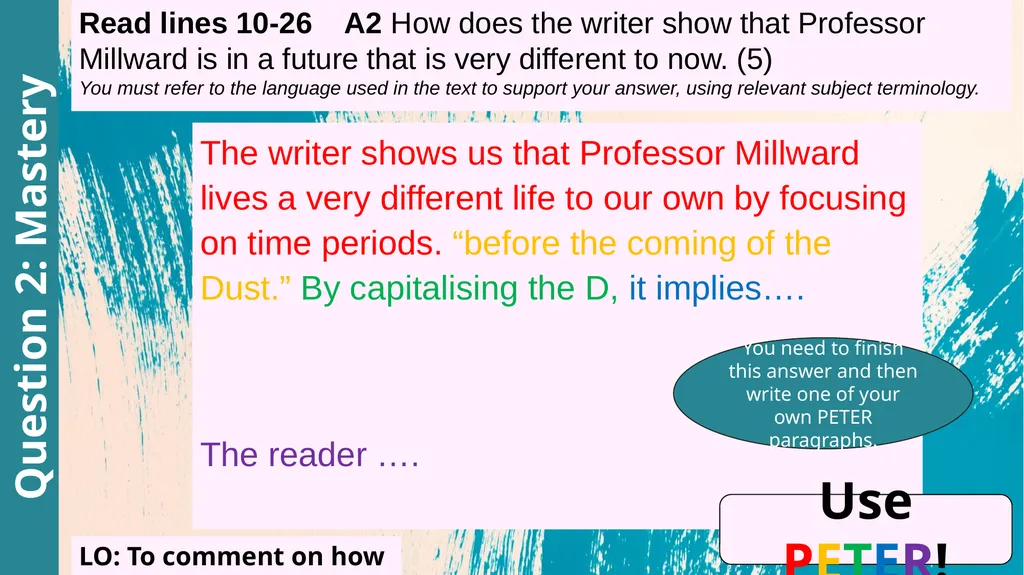
You must refer to the language used in the text to support your answer, using relevant subject terminology. The writer shows us that Professor Millward lives a very different life to our own by focusing on time periods. “before the coming of the Dust.” By capitalising the D, it implies….
The reader …. Question 2: Mastery LO: To comment on how the writer creates meaning. Use PETER! You need to finish this answer and then write one of your own PETER paragraphs.<br>
The reader …. Question 2: Mastery LO: To comment on how the writer creates meaning. Use PETER! You need to finish this answer and then write one of your own PETER paragraphs.<br>
10
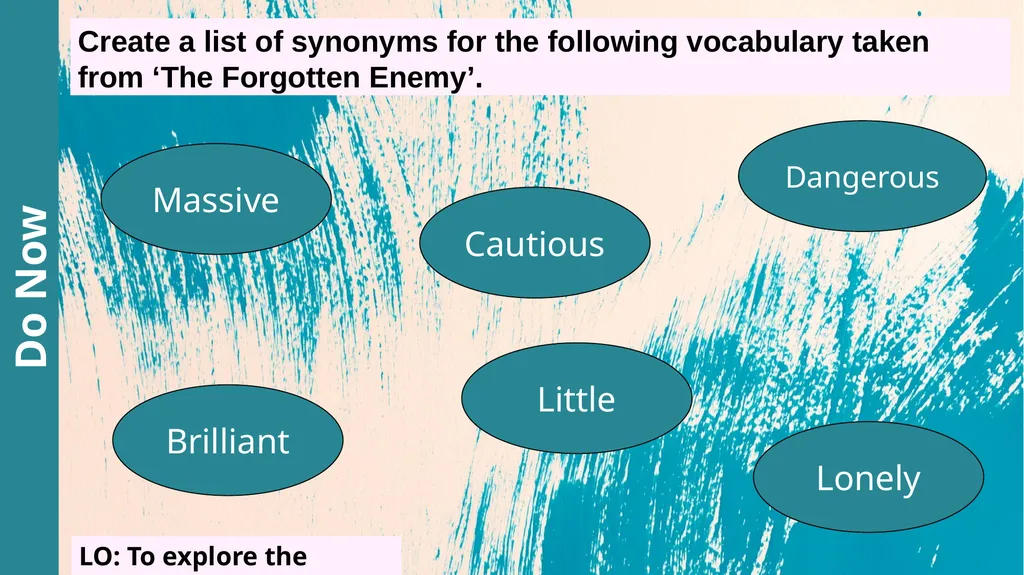
Create a list of synonyms for the following vocabulary taken from ‘The Forgotten Enemy’. Do Now LO: To explore the impressions created by a writer. Massive Brilliant Cautious Lonely Dangerous Little<br>
11
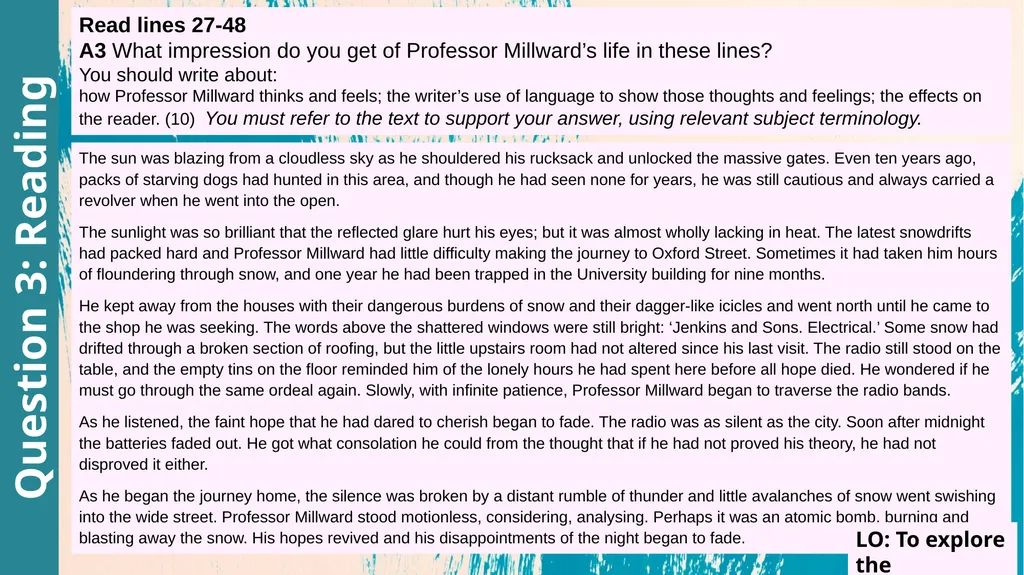
Read lines 27-48
A3 What impression do you get of Professor Millward’s life in these lines?
You should write about:
how Professor Millward thinks and feels; the writer’s use of language to show those thoughts and feelings; the effects on the reader. (10) You must refer to the text to support your answer, using relevant subject terminology. The sun was blazing from a cloudless sky as he shouldered his rucksack and unlocked the massive gates. Even ten years ago, packs of starving dogs had hunted in this area, and though he had seen none for years, he was still cautious and always carried a revolver when he went into the open.
The sunlight was so brilliant that the reflected glare hurt his eyes; but it was almost wholly lacking in heat. The latest snowdrifts had packed hard and Professor Millward had little difficulty making the journey to Oxford Street. Sometimes it had taken him hours of floundering through snow, and one year he had been trapped in the University building for nine months.
He kept away from the houses with their dangerous burdens of snow and their dagger-like icicles and went north until he came to the shop he was seeking. The words above the shattered windows were still bright: ‘Jenkins and Sons. Electrical.’ Some snow had drifted through a broken section of roofing, but the little upstairs room had not altered since his last visit. The radio still stood on the table, and the empty tins on the floor reminded him of the lonely hours he had spent here before all hope died. He wondered if he must go through the same ordeal again. Slowly, with infinite patience, Professor Millward began to traverse the radio bands.
As he listened, the faint hope that he had dared to cherish began to fade. The radio was as silent as the city. Soon after midnight the batteries faded out. He got what consolation he could from the thought that if he had not proved his theory, he had not disproved it either.
As he began the journey home, the silence was broken by a distant rumble of thunder and little avalanches of snow went swishing into the wide street. Professor Millward stood motionless, considering, analysing. Perhaps it was an atomic bomb, burning and blasting away the snow. His hopes revived and his disappointments of the night began to fade. Question 3: Reading LO: To explore the impressions
created by a writer.<br>
The sunlight was so brilliant that the reflected glare hurt his eyes; but it was almost wholly lacking in heat. The latest snowdrifts had packed hard and Professor Millward had little difficulty making the journey to Oxford Street. Sometimes it had taken him hours of floundering through snow, and one year he had been trapped in the University building for nine months.
He kept away from the houses with their dangerous burdens of snow and their dagger-like icicles and went north until he came to the shop he was seeking. The words above the shattered windows were still bright: ‘Jenkins and Sons. Electrical.’ Some snow had drifted through a broken section of roofing, but the little upstairs room had not altered since his last visit. The radio still stood on the table, and the empty tins on the floor reminded him of the lonely hours he had spent here before all hope died. He wondered if he must go through the same ordeal again. Slowly, with infinite patience, Professor Millward began to traverse the radio bands.
As he listened, the faint hope that he had dared to cherish began to fade. The radio was as silent as the city. Soon after midnight the batteries faded out. He got what consolation he could from the thought that if he had not proved his theory, he had not disproved it either.
As he began the journey home, the silence was broken by a distant rumble of thunder and little avalanches of snow went swishing into the wide street. Professor Millward stood motionless, considering, analysing. Perhaps it was an atomic bomb, burning and blasting away the snow. His hopes revived and his disappointments of the night began to fade. Question 3: Reading LO: To explore the impressions
created by a writer.<br>
12
Read lines 27-48
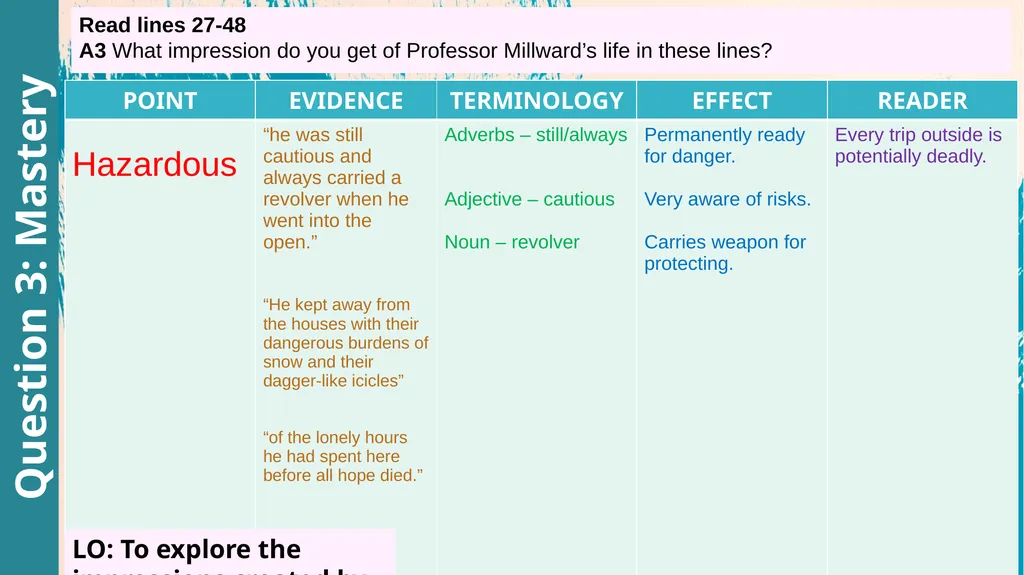
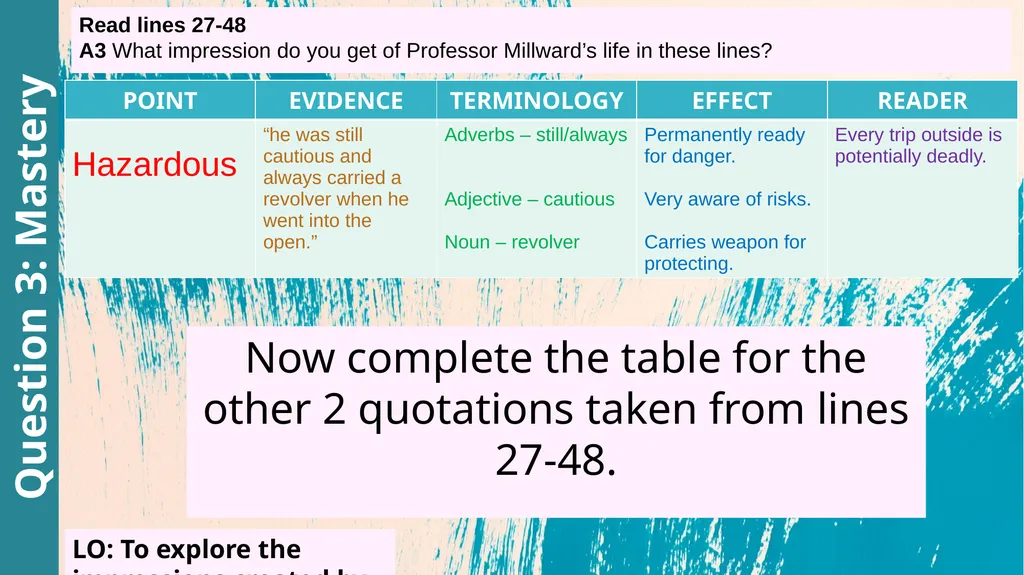
A3 What impression do you get of Professor Millward’s life in these lines? Question 3: Mastery LO: To explore the impressions created by a writer.<br>
13
Read lines 27-48
A3 What impression do you get of Professor Millward’s life in these lines? Question 3: Mastery LO: To explore the impressions created by a writer. Now complete the table for the other 2 quotations taken from lines 27-48.<br>