03
Standard IIA12 The institution requires of all of its degree programs a component of general education based on a carefully considered philosophy for both associate and baccalaureate degrees that is clearly stated in its catalog. The institution, relying on faculty expertise, determines the appropriateness of each course for inclusion in the general education curriculum, based upon student learning outcomes and competencies appropriate to the degree level. The learning outcomes include a student’s preparation for and acceptance of responsible participation in civil society, skills for lifelong learning and application of learning, and a broad comprehension of the development of knowledge, practice, and interpretive approaches in the arts and humanities, the sciences, mathematics, and social sciences. (ER 12) ASCCC Curriculum Institute, July 6-9, 2016 ‹#›<br>
04
Standard IIA12 The institution requires of all of its degree programs a component of general education based on a carefully considered philosophy for both associate and baccalaureate degrees that is clearly stated in its catalog. The institution, relying on faculty expertise, determines the appropriateness of each course for inclusion in the general education curriculum, based upon student learning outcomes and competencies appropriate to the degree level. The learning outcomes include a student’s preparation for and acceptance of responsible participation in civil society, skills for lifelong learning and application of learning, and a broad comprehension of the development of knowledge, practice, and interpretive approaches in the arts and humanities, the sciences, mathematics, and social sciences. (ER 12) ASCCC Curriculum Institute, July 6-9, 2016 ‹#›<br>
05
Standard IIA12 What is the standard asking for...?
How do you interpret this locally? ASCCC Curriculum Institute, July 6-9, 2016 ‹#›<br>
06
Other Relevant Standards II.A.11 The institution includes in all of its programs, student learning outcomes, appropriate to the program level, in communication competency, information competency, quantitative competency, analytic inquiry skills, ethical reasoning, the ability to engage diverse perspectives, and other program-specific learning outcomes.
I.B.1. The institution demonstrates a sustained, substantive and collegial dialog about student outcomes, student equity, academic quality, institutional effectiveness, and continuous improvement of student learning and achievement. ASCCC Curriculum Institute, July 6-9, 2016 ‹#›<br>
07
Useful Terms General Education Learning Outcomes (GELOs or GEOs)
Agreed upon outcomes that measure ALL students’ ability to perform broad skills that are learned by completing any course of study for a degree or certificate, reflect the goals and rigor of a generally expected college experience and consider ACCJC expectations.
Institutional Student Learning Outcomes (ISLOs or ILOs)
Agreed upon outcomes that measure student ability to perform broad skills that are learned by completing any educational program, not necessarily resulting in a degree or certificate and that ALL students, regardless of program, should show proficiency. ISLOs are GESLOs that should be addressed in all programs. ASCCC Curriculum Institute, July 6-9, 2016 ‹#›<br>
08
Are GELOs and ISLOs the Same? GELOs
May be tied to local IGETC or CSU requirements
May reflect Title 5 requirements for general education
May be focused solely on your local AA or AS or certificates
ISLOs
May be more reflective of faculty values than transfer requirements
May vary for “terminal” AA or AS degrees
Can these be the same? ASCCC Curriculum Institute, July 6-9, 2016 ‹#›<br>
09
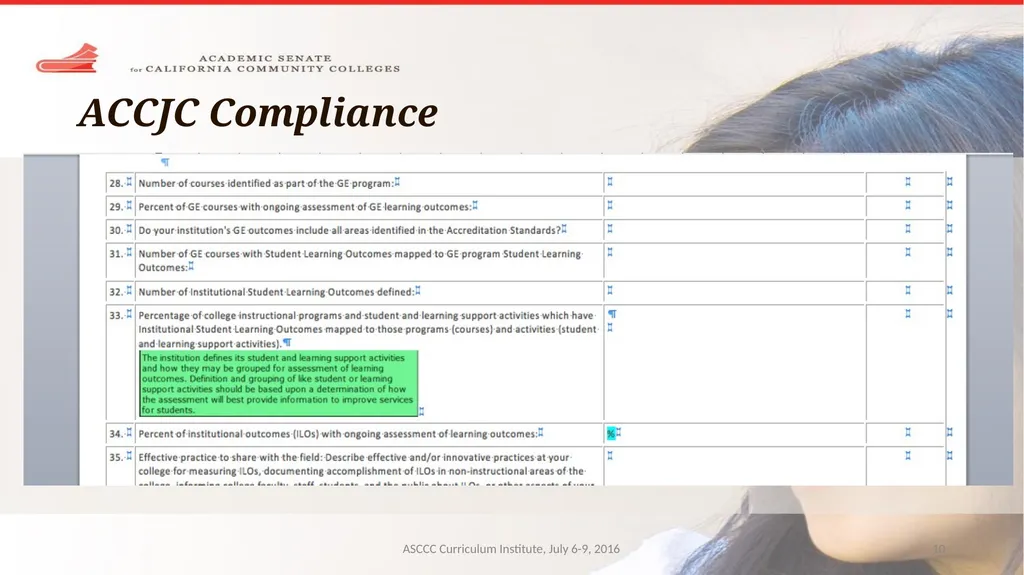
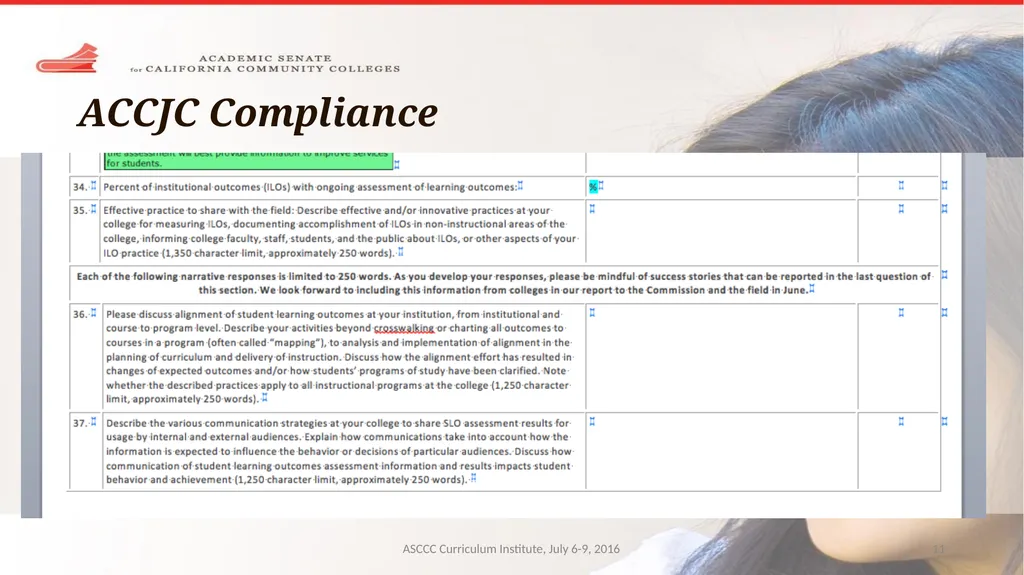
ACCJC Compliance Respond to Standard II.A.12 and II.A.11 (others) with examples of GELOs/ISLOs reflective of general education principles whether determined specifically for local degrees or based on articulated transfer patterns.
Report annually on assessment of GELOs/ISLOs in Annual Report due in March. ASCCC Curriculum Institute, July 6-9, 2016 ‹#›<br>
10
ACCJC Compliance ASCCC Curriculum Institute, July 6-9, 2016 ‹#›<br>
11
ACCJC Compliance ASCCC Curriculum Institute, July 6-9, 2016 ‹#›<br>
12
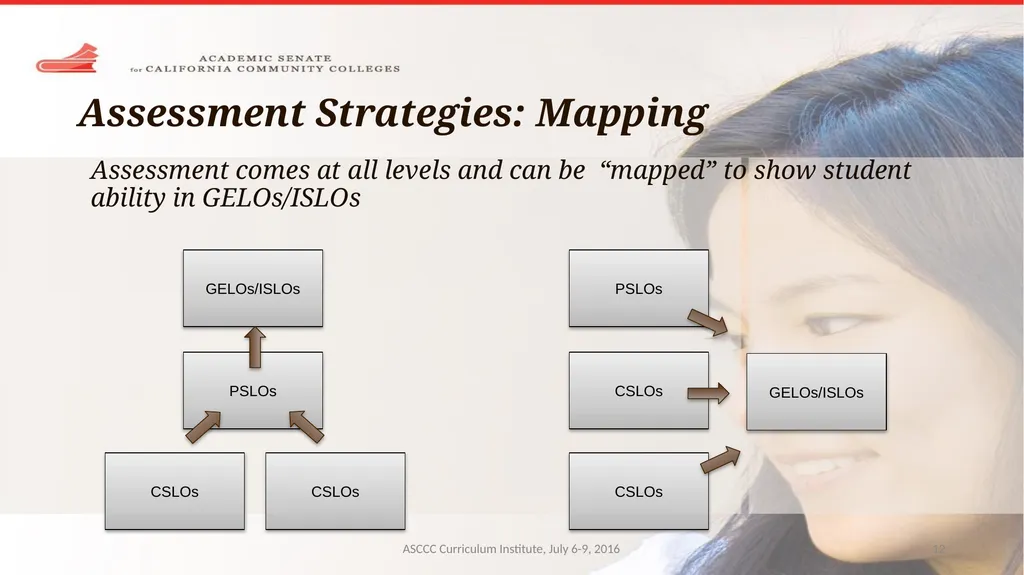
Assessment Strategies: Mapping Assessment comes at all levels and can be “mapped” to show student ability in GELOs/ISLOs ASCCC Curriculum Institute, July 6-9, 2016 ‹#›<br>
13
Assessment Strategies: Mapping Link popular, high enrollment general education courses to your ISLOs/GELOs
Link outcomes assessment data in program capstone courses to your ISLOs/GELOs
Curriculum should be written “backwards” with outcomes in mind in order to link to ISLOs/GELOs ASCCC Curriculum Institute, July 6-9, 2016 ‹#›<br>
14
Assessment Strategies: Direct Assessment Annual report specifically asks for ways to assess program and institutional outcomes OTHER than mapping.
Projects
Presentations
Performances
Internships
Portfolios
Exit interviews
Focus groups
Reflective writing ASCCC Curriculum Institute, July 6-9, 2016 ‹#› Graduation Surveys and program exit exams
Useful for ISLOs and GELOs
Consider a pre/post assessment
Can map to specific courses in the patterns<br>
15
Assessment Strategy: Chaffey College Pre/Post Assessment
Consisting of 19 questions which address the Core Competencies
Administered upon arrival at the college as part of application process
Chaffey College Graduation Exit Survey ASCCC Curriculum Institute, July 6-9, 2016 ‹#›<br>
16
Using Value Rubrics What is a Rubric?
A rubric is a list of criteria aligned with a hierarchical scale that judges the level of student ability expected after receiving an educational experience or a service.
Why Use a Rubric?
Establishes validity (sets the standard) for the instructor, for the data, for the program, and communicates expectations to the student ASCCC Curriculum Institute, July 6-9, 2016 ‹#›<br>
17
Using Value Rubrics Increases multi-rater and longitudinal reliability
Makes Scoring easier by relieving uncertainty
Increases faculty confidence in scores
Differentiates Scoring from Grading
Aligns an Activity to an SLO ASCCC Curriculum Institute, July 6-9, 2016 ‹#›<br>
18
Value Rubrics Inquiry and analysis
Critical thinking
Creative thinking
Written communication
Oral communication
Reading ASCCC Curriculum Institute, July 6-9, 2016 ‹#› Quantitative literacy
Information literacy
Teamwork
Problem solving Use this link to access the Association of American Colleges and Universities Value Rubrics
https://www.aacu.org/value-rubrics<br>
19
Value Rubrics “Speed Dating” Step 1: Form a small group (3-4 people)
Step 2: Choose a rubric and discuss it’s validity and how you might use it
Step 3: Determine 2 ways you agree, one way you disagree and one strategy for assessing that includes the rubric.
10 minutes to discuss
Step 4: Breakout and find a member of another group
Step 5: Teach each other about the rubrics you reviewed
3 minutes to teach
Step 6: Change “daters” and teach another person. ASCCC Curriculum Institute, July 6-9, 2016 ‹#›<br>
20
“ ASCCC Curriculum Institute, July 6-9, 2016 ‹#› QUESTIONS?<br>