
The Future Literature, Theory and Time: Week 8
CM
Published · 13 slides · 0 views

1 / 1




Description
The Future Literature, Theory and Time: Week 8 Stephen Kern, The Culture of Time and Space 1800-1918 (Weidenfeld and Nicolson, 1983) Stephen Kern explores the ways in which private notions of time (and space) were profoundly altered and
Related Topics
Share
Embed code
Download this presentation From Below
"The Future Literature, Theory and Time: Week 8" is the property of its rightful owner. Permission is granted to download and print the materials on this website for personal, non-commercial use only, and to display it on your personal computer provided you do not modify the materials and that you retain all copyright notices contained in the materials. By downloading content from our website, you accept the terms of this agreement.
Presentation Transcript
01
The Future Literature, Theory and Time: Week 8<br>
02
Stephen Kern, The Culture of Time and Space 1800-1918 (Weidenfeld and Nicolson, 1983) Stephen Kern explores the ways in which private notions of time (and space) were profoundly altered and extended in the thirty years before the First World War.
The very period which saw the establishment of public time brought about a reaction in thinking about private time (and space). As the measurement of time became more public and precise, so the perception of time became more private and pluralistic. Not for nothing did Conrad’s secret agent set out to blow up the Greenwich Observatory, the supreme symbol of standard time.
The development of the phonograph and the cinema meant that the past was no longer something finished, separate and discrete, but actively persisted into the present in a new and immediate way.
There was a reaction against the public past of history towards the private past of the mind. It was there that Freud sought the sources of individual neuroses; he stressed the crucial importance of childhood experience in influencing later life; and he argued that all subsequent experiences, too, left traces in the mind that shaped future responses.
(David Cannadine, ‘Time, Gentlemen, Please’ [review of Stephen Kern’s book, London Review of Books, Vol. 6 No. 13 · 19 July 1984)<br>
The very period which saw the establishment of public time brought about a reaction in thinking about private time (and space). As the measurement of time became more public and precise, so the perception of time became more private and pluralistic. Not for nothing did Conrad’s secret agent set out to blow up the Greenwich Observatory, the supreme symbol of standard time.
The development of the phonograph and the cinema meant that the past was no longer something finished, separate and discrete, but actively persisted into the present in a new and immediate way.
There was a reaction against the public past of history towards the private past of the mind. It was there that Freud sought the sources of individual neuroses; he stressed the crucial importance of childhood experience in influencing later life; and he argued that all subsequent experiences, too, left traces in the mind that shaped future responses.
(David Cannadine, ‘Time, Gentlemen, Please’ [review of Stephen Kern’s book, London Review of Books, Vol. 6 No. 13 · 19 July 1984)<br>
03
Stephen Kern, The Culture of Time and Space on ‘The Future’ 1880-1918 Two modes:
Eugene Minkowski
Activity – the individual goes towards the future, driving into the surroundings in control of events
Expectation – the future comes towards the individual, who contracts against an overpowering environment
H.G. Wells
retrospective, a ‘legal or submissive mind’ – precedents to decide how to deal with the future (passive);
legislative, creative, organising, masterful (active)<br>
Eugene Minkowski
Activity – the individual goes towards the future, driving into the surroundings in control of events
Expectation – the future comes towards the individual, who contracts against an overpowering environment
H.G. Wells
retrospective, a ‘legal or submissive mind’ – precedents to decide how to deal with the future (passive);
legislative, creative, organising, masterful (active)<br>
04
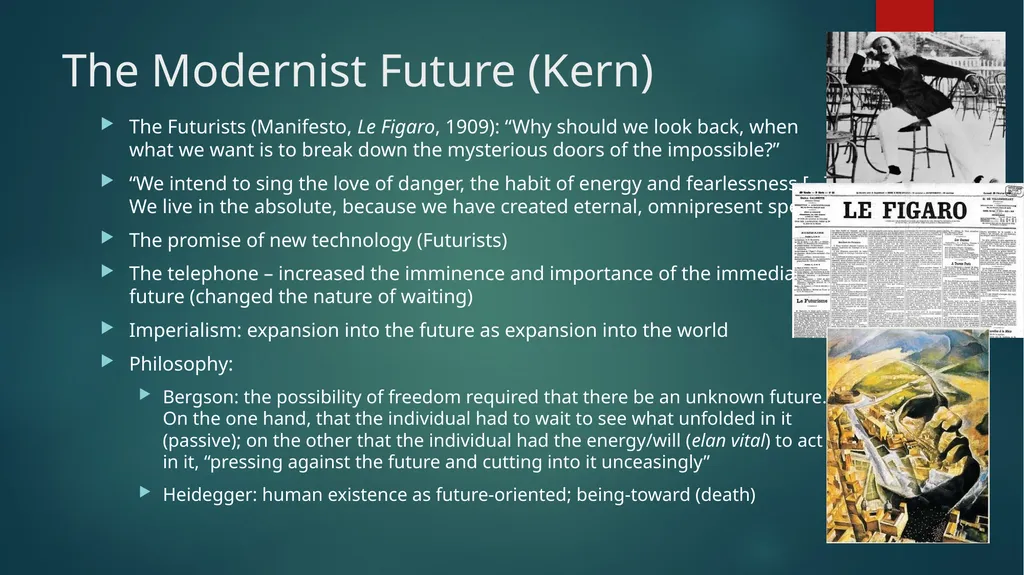
The Modernist Future (Kern) The Futurists (Manifesto, Le Figaro, 1909): “Why should we look back, when what we want is to break down the mysterious doors of the impossible?”
“We intend to sing the love of danger, the habit of energy and fearlessness […] We live in the absolute, because we have created eternal, omnipresent speed.”
The promise of new technology (Futurists)
The telephone – increased the imminence and importance of the immediate future (changed the nature of waiting)
Imperialism: expansion into the future as expansion into the world
Philosophy:
Bergson: the possibility of freedom required that there be an unknown future. On the one hand, that the individual had to wait to see what unfolded in it (passive); on the other that the individual had the energy/will (elan vital) to act in it, “pressing against the future and cutting into it unceasingly”
Heidegger: human existence as future-oriented; being-toward (death)<br>
“We intend to sing the love of danger, the habit of energy and fearlessness […] We live in the absolute, because we have created eternal, omnipresent speed.”
The promise of new technology (Futurists)
The telephone – increased the imminence and importance of the immediate future (changed the nature of waiting)
Imperialism: expansion into the future as expansion into the world
Philosophy:
Bergson: the possibility of freedom required that there be an unknown future. On the one hand, that the individual had to wait to see what unfolded in it (passive); on the other that the individual had the energy/will (elan vital) to act in it, “pressing against the future and cutting into it unceasingly”
Heidegger: human existence as future-oriented; being-toward (death)<br>
05
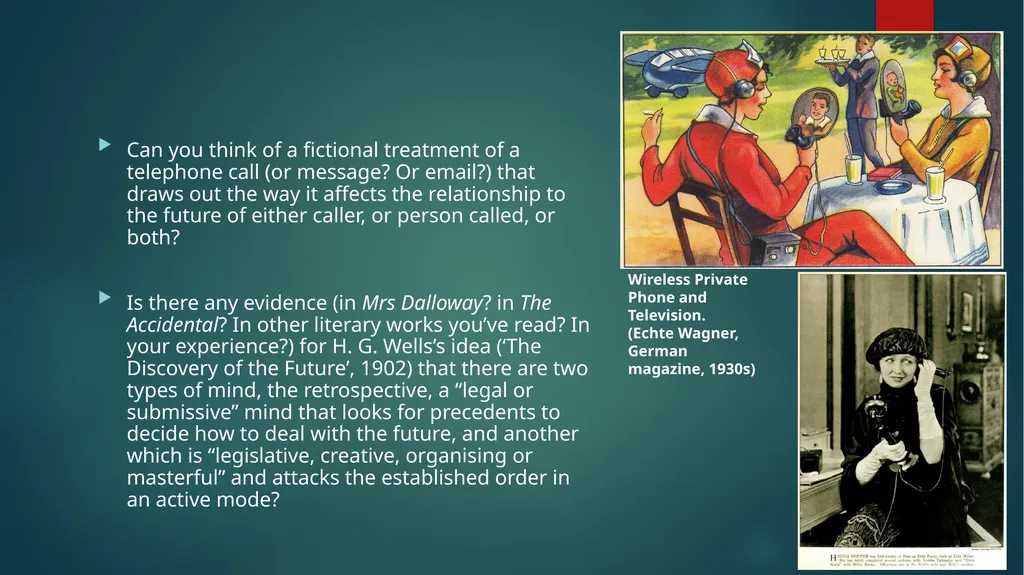
Can you think of a fictional treatment of a telephone call (or message? Or email?) that draws out the way it affects the relationship to the future of either caller, or person called, or both?
Is there any evidence (in Mrs Dalloway? in The Accidental? In other literary works you’ve read? In your experience?) for H. G. Wells’s idea (‘The Discovery of the Future’, 1902) that there are two types of mind, the retrospective, a “legal or submissive” mind that looks for precedents to decide how to deal with the future, and another which is “legislative, creative, organising or masterful” and attacks the established order in an active mode? Wireless Private
Phone and Television.
(Echte Wagner, German
magazine, 1930s)<br>
Is there any evidence (in Mrs Dalloway? in The Accidental? In other literary works you’ve read? In your experience?) for H. G. Wells’s idea (‘The Discovery of the Future’, 1902) that there are two types of mind, the retrospective, a “legal or submissive” mind that looks for precedents to decide how to deal with the future, and another which is “legislative, creative, organising or masterful” and attacks the established order in an active mode? Wireless Private
Phone and Television.
(Echte Wagner, German
magazine, 1930s)<br>
06
Futurism: Antonio Balla, ‘Abstract Speed: The Car Has Passed’ D. H. Lawrence, The Lost Girl: time for the heroine Alvina passed “like an express train”. Earlier, she wishes “with all her force that she could travel like a cablegram to Australia” to see her boyfriend (‘Alexander Graham’…) there. Marinetti in Futurist Manifesto (1919): a fast car is more beautiful than the ‘Victory of Samothrace’ Technologies not a universal way of conceiving of the subject, of course. David Harvey: “superior command over space has always been a vital aspect of class (and intra-class) struggle” (The Condition of Postmodernity, 232). Who has access to telecommunications, fast cars, flights? Kreemo’s message is transmitted to more people than the plight of the old woman in the park (though this is no guarantee that it is decipherable).<br>
07
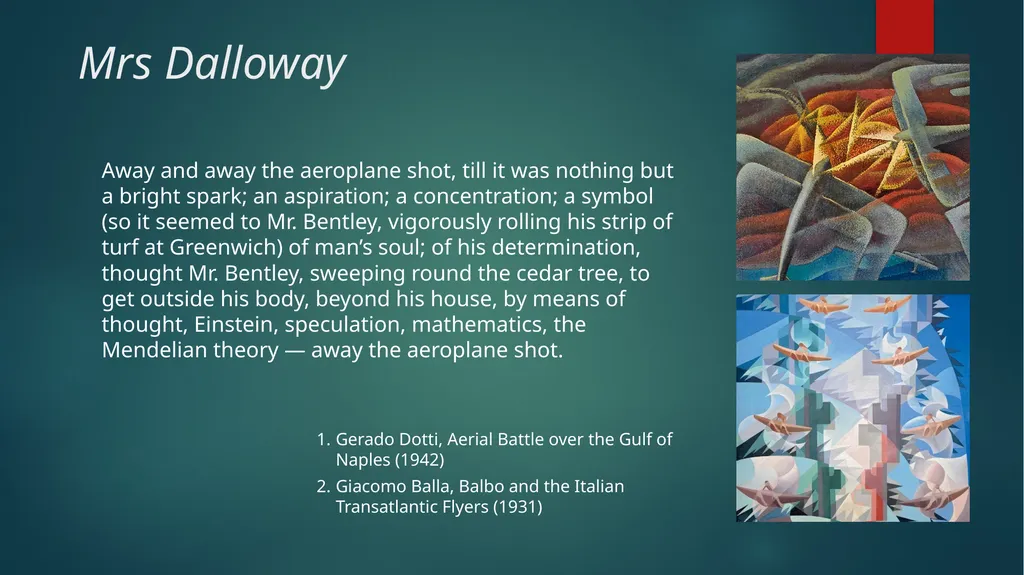
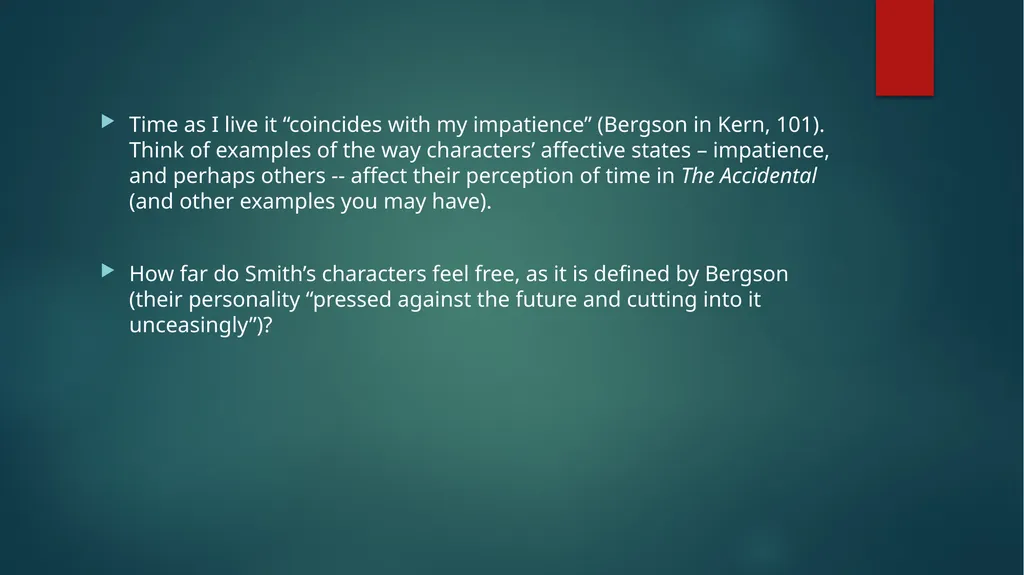
Mrs Dalloway Away and away the aeroplane shot, till it was nothing but a bright spark; an aspiration; a concentration; a symbol (so it seemed to Mr. Bentley, vigorously rolling his strip of turf at Greenwich) of man’s soul; of his determination, thought Mr. Bentley, sweeping round the cedar tree, to get outside his body, beyond his house, by means of thought, Einstein, speculation, mathematics, the Mendelian theory — away the aeroplane shot. Gerado Dotti, Aerial Battle over the Gulf of Naples (1942)
Giacomo Balla, Balbo and the Italian Transatlantic Flyers (1931)<br>
Giacomo Balla, Balbo and the Italian Transatlantic Flyers (1931)<br>
08
Time as I live it “coincides with my impatience” (Bergson in Kern, 101). Think of examples of the way characters’ affective states – impatience, and perhaps others -- affect their perception of time in The Accidental (and other examples you may have).
How far do Smith’s characters feel free, as it is defined by Bergson (their personality “pressed against the future and cutting into it unceasingly”)?<br>
How far do Smith’s characters feel free, as it is defined by Bergson (their personality “pressed against the future and cutting into it unceasingly”)?<br>
09
Heidegger and Time
David Couzens Hoy, The Time of Our Lives: A Critical History of Temporality (MIT Press, 2009), 57:
Ordinary time – an infinite series of Nows: countable, discrete points that succeed one another in a sequence [inauthentic time, for Heidegger]
World time (via Heidegger) – datability (‘now’, ‘then, ‘on a particular occasion’), significance, spannedness, publicness
(Spannedness is a version of duration, but Heidegger sees Bergson as over-emphasizing the subjectivity of time, when in fact we are ‘thrown’ into a situation that is always public, which will determine what is significant for us (and which makes e.g. datability possible…))
Primordial time – (authentic time for Heidegger) time in which the present is configured not in relation to the past but the future; the present is the future coming towards it. This is the experience of time encountered in Dasein – authentic awareness of being.<br>
David Couzens Hoy, The Time of Our Lives: A Critical History of Temporality (MIT Press, 2009), 57:
Ordinary time – an infinite series of Nows: countable, discrete points that succeed one another in a sequence [inauthentic time, for Heidegger]
World time (via Heidegger) – datability (‘now’, ‘then, ‘on a particular occasion’), significance, spannedness, publicness
(Spannedness is a version of duration, but Heidegger sees Bergson as over-emphasizing the subjectivity of time, when in fact we are ‘thrown’ into a situation that is always public, which will determine what is significant for us (and which makes e.g. datability possible…))
Primordial time – (authentic time for Heidegger) time in which the present is configured not in relation to the past but the future; the present is the future coming towards it. This is the experience of time encountered in Dasein – authentic awareness of being.<br>
10
Tina Chanter, Time, Death and the Feminine, xiv-xv For Martin Heidegger, the whole of metaphysics from Aristotle on has been sustained by a concept of time that is based on a confusion about being and time. He characterizes the tradition as adhering to a naïve metaphysics of presence. […] Western metaphysics has inherited from the Greeks a concept of time that privileges the present. The assumed priority of the present is based on a particular conception of being.
Since our finitude is integral to our being-human, H argues that it is the future that should have priority in thinking time, and not the present.
Dasein (authentic being) is individuated by death (no one can die our death for us) – mortality is a structuring part of life. Death, for H, becomes the ground of possibility.<br>
Since our finitude is integral to our being-human, H argues that it is the future that should have priority in thinking time, and not the present.
Dasein (authentic being) is individuated by death (no one can die our death for us) – mortality is a structuring part of life. Death, for H, becomes the ground of possibility.<br>
11
Time (i.e., the experienced passage of time) appears to be an integral part of an individual’s psychological makeup, since most human experiences (e.g., emotional experiences, relationships) occur more in the domain of time than in space (Rollo May, ‘Contributions of existential psychotherapy’, 1958).
Existential thinkers like May [following thinkers like Martin Heidegger] view the dominant mode of time for humans as being the future, and therefore a basic question of each individual is thought to be what they are becoming, what they are pointing toward, or what they will be in the immediate future. Individuals can theoretically understand themselves only as they projects themselves forward in time. (see Rappaport et al [on death anxiety], 1993)
Rollo May (1958), ‘Contributions of existential psychotherapy’. In R. May, E. Angel, & H. Ellenberger (Eds.), Existence. New York: Simon & Schuster
Herbert Rappaport , Robert J. Fossler , Laura S. Bross & Dona Gilden (1993) ‘Future time, death anxiety, and life purpose among older adults’, Death Studies, 17:4, 369-379<br>
Existential thinkers like May [following thinkers like Martin Heidegger] view the dominant mode of time for humans as being the future, and therefore a basic question of each individual is thought to be what they are becoming, what they are pointing toward, or what they will be in the immediate future. Individuals can theoretically understand themselves only as they projects themselves forward in time. (see Rappaport et al [on death anxiety], 1993)
Rollo May (1958), ‘Contributions of existential psychotherapy’. In R. May, E. Angel, & H. Ellenberger (Eds.), Existence. New York: Simon & Schuster
Herbert Rappaport , Robert J. Fossler , Laura S. Bross & Dona Gilden (1993) ‘Future time, death anxiety, and life purpose among older adults’, Death Studies, 17:4, 369-379<br>
12
Dasein and anxiety The whole of Being and Time is concerned with one question: the question of the meaning of Being (See Mulhall, Heidegger and Being and Time, 2)
Authentic being in the world (Dasein)
Anxiety, or angst, can pivot Dasein from being lost in anonymity, ‘das man’, to an authentic grasp of itself, the world and Being. (Mulhall, ibid. xii)
Anxiety isn’t about anything specific; it is about nothing in the sense that it is expressly not about any given thing. But it is about the world as world, the idea of being that underlies any given instance of being, any existing thing. (Being and Time, I.iv.187, p. 181)
In anxiety, one has an “uncanny” feeling. […a] not-being-at-home, [which] fetches Dasein back out of its entangled absorption in the “world”. ((Being and Time, p.182)<br>
Authentic being in the world (Dasein)
Anxiety, or angst, can pivot Dasein from being lost in anonymity, ‘das man’, to an authentic grasp of itself, the world and Being. (Mulhall, ibid. xii)
Anxiety isn’t about anything specific; it is about nothing in the sense that it is expressly not about any given thing. But it is about the world as world, the idea of being that underlies any given instance of being, any existing thing. (Being and Time, I.iv.187, p. 181)
In anxiety, one has an “uncanny” feeling. […a] not-being-at-home, [which] fetches Dasein back out of its entangled absorption in the “world”. ((Being and Time, p.182)<br>
13
Death anxiety (see Rappaport et al, 1993) Existential theorists such as Heidegger (Being and Time,1926) have focused on the importance of death, postulating that an individual must accept the inevitability and finality of death, and must ultimately find the meaning of human existence in the fact of his [or her] own death.
Following Heidegger, psychiatrist Eugene Minkowski (1933) hypothesized that existence takes on vitality and immediacy with the act of confronting death or “nonbeing.”
An awareness of death results in “being toward a possibility,” in that humans have the unique capacity to consider multiple possibilities for life or to design different potentialities for living (Binswanger, 1958; Heidegger, 1926)
The terror of death is a principal source of motivation, and avoidance of this fact results in a depersonalized, empty life which seems to hold little meaning or purpose (Heidegger, 1926)<br>
Following Heidegger, psychiatrist Eugene Minkowski (1933) hypothesized that existence takes on vitality and immediacy with the act of confronting death or “nonbeing.”
An awareness of death results in “being toward a possibility,” in that humans have the unique capacity to consider multiple possibilities for life or to design different potentialities for living (Binswanger, 1958; Heidegger, 1926)
The terror of death is a principal source of motivation, and avoidance of this fact results in a depersonalized, empty life which seems to hold little meaning or purpose (Heidegger, 1926)<br>