
Much Ado about The Nothing Carnap and Heidegger on
MS
Published · 86 slides · 0 views

1 / 1



Description
Much Ado about The Nothing Carnap and Heidegger on Logic and Metaphysics Edward Witherspoon 1 The emptiness of metaphysics Carnaps 1932 essay: The Elimination of Metaphysics through Logical Analysis of Language Typifies the traditional
Related Topics
Share
Embed code
Download this presentation From Below
"Much Ado about The Nothing Carnap and Heidegger on" is the property of its rightful owner. Permission is granted to download and print the materials on this website for personal, non-commercial use only, and to display it on your personal computer provided you do not modify the materials and that you retain all copyright notices contained in the materials. By downloading content from our website, you accept the terms of this agreement.
Presentation Transcript
01
Much Ado about The Nothing
Carnap and Heidegger
on Logic and Metaphysics Edward Witherspoon 1<br>
02
The emptiness of metaphysics Carnap’s 1932 essay: “The Elimination of Metaphysics through Logical Analysis of Language”
Typifies the traditional antagonism between analytic and Continental philosophy
Ambitious goal: to show the emptiness of metaphysics from Plato to Hegel—
but especially focusing on Heidegger,
the leader of “that metaphysical school which at present exerts the strongest influence in Germany” 2<br>
Typifies the traditional antagonism between analytic and Continental philosophy
Ambitious goal: to show the emptiness of metaphysics from Plato to Hegel—
but especially focusing on Heidegger,
the leader of “that metaphysical school which at present exerts the strongest influence in Germany” 2<br>
03
The self-image of analytic philosophy Takes quotations from Heidegger’s inaugural lecture at the University of Freiburg in 1929, “What is Metaphysics?”
to argue that they are “nonsense”
as are all metaphysical statements
Carnap’s over-all approach has largely shaped the image and self-image of analytic philosophy
1) with the essential tool being the discipline of formal logic
Ignoring its strictures produces only intellectual fog
2) Philosophy is modelled on the sciences 3<br>
to argue that they are “nonsense”
as are all metaphysical statements
Carnap’s over-all approach has largely shaped the image and self-image of analytic philosophy
1) with the essential tool being the discipline of formal logic
Ignoring its strictures produces only intellectual fog
2) Philosophy is modelled on the sciences 3<br>
04
The self-image of Continental philosophy To be scientific philosophy must
1) be directed at conceptual problems that arise in the sciences
2) adopt a program that will allow for something analogous to scientific progress
Individuals can solve problems within a large-scale research project
that can command universal acceptance
Heidegger rejects this conception of philosophy
His alternative shapes the self-image of Continental philosophy
He denigrates symbolic logic
as a mere method of calculation
Its preeminence as a sign of shallowness and sterility 4<br>
1) be directed at conceptual problems that arise in the sciences
2) adopt a program that will allow for something analogous to scientific progress
Individuals can solve problems within a large-scale research project
that can command universal acceptance
Heidegger rejects this conception of philosophy
His alternative shapes the self-image of Continental philosophy
He denigrates symbolic logic
as a mere method of calculation
Its preeminence as a sign of shallowness and sterility 4<br>
05
Using metaphysics Insight into being and human being (Dasein)
goes far beyond what calculation can yield
Philosophy’s “most rigorous” thinking
requires violating the laws of logic
Rather than overcoming (or eliminating) metaphysics
Heidegger argues that we use metaphysics to overcome the narrow and sterile fascination with logical analysis 5<br>
goes far beyond what calculation can yield
Philosophy’s “most rigorous” thinking
requires violating the laws of logic
Rather than overcoming (or eliminating) metaphysics
Heidegger argues that we use metaphysics to overcome the narrow and sterile fascination with logical analysis 5<br>
06
What this examination shows But this sharp contrast is an oversimplification.
A more nuanced examination shows:
limitations of Carnap’s critique
questions and problems for Heidegger
a paradox confronting both analytic and Continental traditions 6<br>
A more nuanced examination shows:
limitations of Carnap’s critique
questions and problems for Heidegger
a paradox confronting both analytic and Continental traditions 6<br>
07
It’s nonsense The goal of Carnap’s “Elimination” is not to show
that metaphysics is false
that metaphysics transcends the powers of human reason [i.e., Kant]
but that it is a “meaningless sequence of words”—literally nonsense
Metaphysical “pseudopropositions”
masquerading as real propositions
They appear to make genuine claims about reality
but a theory of meaningfulness will show that they are nonsense 7<br>
that metaphysics is false
that metaphysics transcends the powers of human reason [i.e., Kant]
but that it is a “meaningless sequence of words”—literally nonsense
Metaphysical “pseudopropositions”
masquerading as real propositions
They appear to make genuine claims about reality
but a theory of meaningfulness will show that they are nonsense 7<br>
08
Correct application of a word Carnap’s theory of meaningfulness:
1) an account of what it is for a word to be meaningful
2) an account of how meaningful words make up meaningful sentences.
1) A word is meaningful if and only if it is possible to state conditions for its correct application
E.g., “God”: How would we determine that word is correctly applied? 8<br>
1) an account of what it is for a word to be meaningful
2) an account of how meaningful words make up meaningful sentences.
1) A word is meaningful if and only if it is possible to state conditions for its correct application
E.g., “God”: How would we determine that word is correctly applied? 8<br>
09
Violating grammatical syntax 2) “Caesar is general a fine” violates rules of English syntax, and so is meaningless or nonsensical
“a” is followed by a noun phrase
Adjectives generally go before a noun
3) But sometimes nonsensical combinations of words can follow the rules of grammatical syntax, but not “logical syntax”
E.g., “Caesar is a prime number” 9<br>
“a” is followed by a noun phrase
Adjectives generally go before a noun
3) But sometimes nonsensical combinations of words can follow the rules of grammatical syntax, but not “logical syntax”
E.g., “Caesar is a prime number” 9<br>
10
Combining words from different logical categories Logical syntax. Words are divided into logical categories:
words for things
words for properties of things
words for relations between things
and also, words for numbers, for properties of numbers, for relations between numbers
Rules of logical syntax forbid the combination of words from different logical categories 10<br>
words for things
words for properties of things
words for relations between things
and also, words for numbers, for properties of numbers, for relations between numbers
Rules of logical syntax forbid the combination of words from different logical categories 10<br>
11
The goal of a logically correct language The job of philosophical analysis
to discover and formulate the rules of logical syntax
This would provide a ready test
for whether a word or combination of words is meaningful or not
Carnap calls this the task of creating a “logically correct language”
a language whose grammatical syntax mirrors logical syntax
The criterion of meaningfulness of a word sequence in a natural language:
whether it can be translated into this artificial language 11<br>
to discover and formulate the rules of logical syntax
This would provide a ready test
for whether a word or combination of words is meaningful or not
Carnap calls this the task of creating a “logically correct language”
a language whose grammatical syntax mirrors logical syntax
The criterion of meaningfulness of a word sequence in a natural language:
whether it can be translated into this artificial language 11<br>
12
Pseudopropositions A pseudoproposition accords with grammatical syntax
and so appears to express a proposition
but violates rules of logical syntax
and so is meaningless
We are easily seduced by grammar into accepting pseudopropositions as real propositions
when violation of logical syntax is subtle and hard to detect
When metaphysicians recognize that their propositions are pseudo,
they will give them up 12<br>
and so appears to express a proposition
but violates rules of logical syntax
and so is meaningless
We are easily seduced by grammar into accepting pseudopropositions as real propositions
when violation of logical syntax is subtle and hard to detect
When metaphysicians recognize that their propositions are pseudo,
they will give them up 12<br>
13
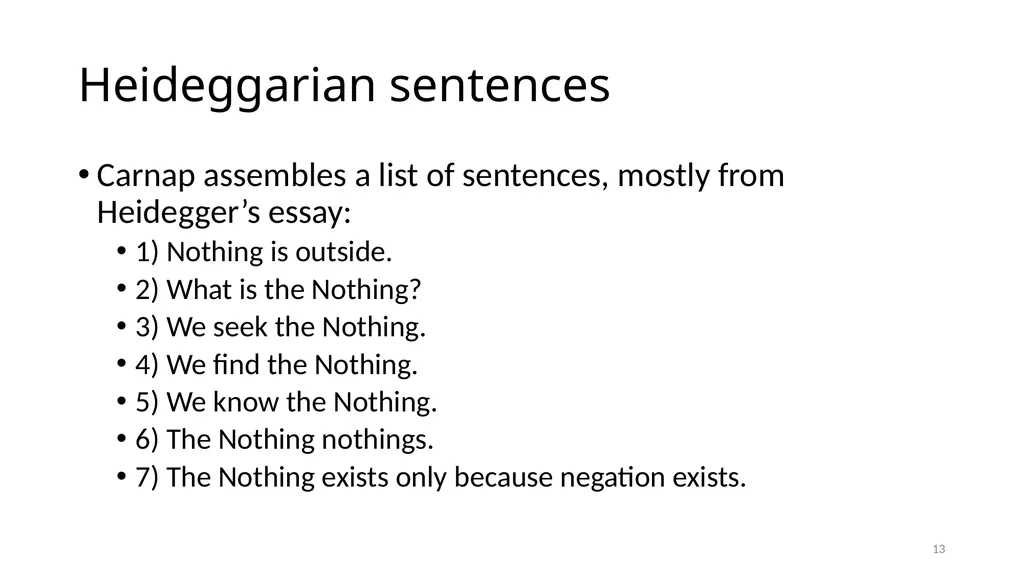
Heideggarian sentences Carnap assembles a list of sentences, mostly from Heidegger’s essay:
1) Nothing is outside.
2) What is the Nothing?
3) We seek the Nothing.
4) We find the Nothing.
5) We know the Nothing.
6) The Nothing nothings.
7) The Nothing exists only because negation exists. 13<br>
1) Nothing is outside.
2) What is the Nothing?
3) We seek the Nothing.
4) We find the Nothing.
5) We know the Nothing.
6) The Nothing nothings.
7) The Nothing exists only because negation exists. 13<br>
14
The key to the sentences The first sentence, “Nothing is outside,” is not from Heidegger,
but provides the key to how we might accept 2-7 as meaningful claims
They are either formulations of Heidegger’s sentences
or obvious implications of them 14<br>
but provides the key to how we might accept 2-7 as meaningful claims
They are either formulations of Heidegger’s sentences
or obvious implications of them 14<br>
15
Looking for the nothing In “Nothing is outside,” “Nothing”
functions grammatically as a noun, as the subject of the sentence
which deceives us into thinking it can be a noun in other contexts
It makes sense to say “We are looking for the cat.”
And so we think we can substitute, “We are looking for the nothing.”
We are easily deceived by analogy with the meaningful sentence. 15<br>
functions grammatically as a noun, as the subject of the sentence
which deceives us into thinking it can be a noun in other contexts
It makes sense to say “We are looking for the cat.”
And so we think we can substitute, “We are looking for the nothing.”
We are easily deceived by analogy with the meaningful sentence. 15<br>
16
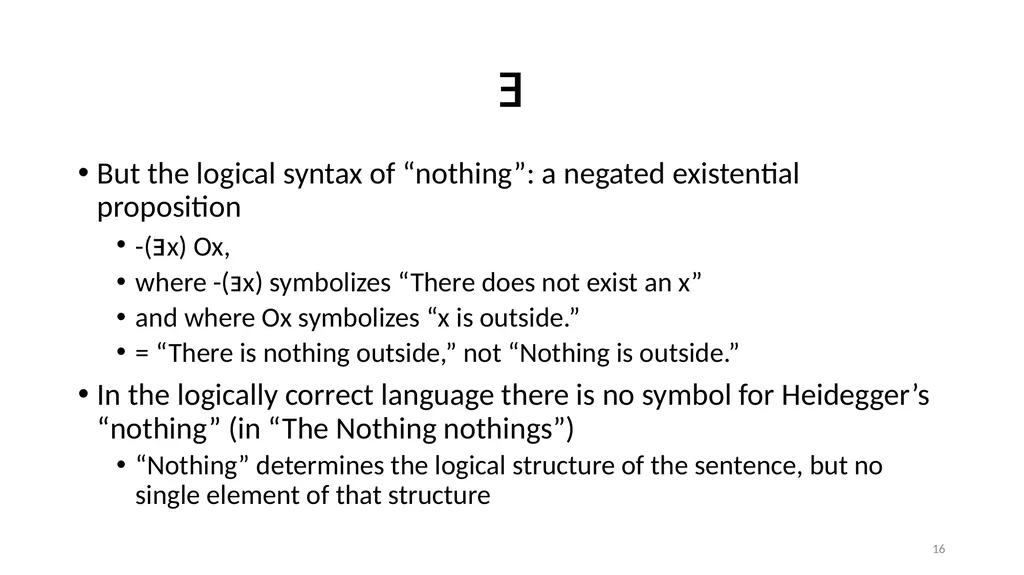
ⱻ But the logical syntax of “nothing”: a negated existential proposition
-(ⱻx) Ox,
where -(ⱻx) symbolizes “There does not exist an x”
and where Ox symbolizes “x is outside.”
= “There is nothing outside,” not “Nothing is outside.”
In the logically correct language there is no symbol for Heidegger’s “nothing” (in “The Nothing nothings”)
“Nothing” determines the logical structure of the sentence, but no single element of that structure 16<br>
-(ⱻx) Ox,
where -(ⱻx) symbolizes “There does not exist an x”
and where Ox symbolizes “x is outside.”
= “There is nothing outside,” not “Nothing is outside.”
In the logically correct language there is no symbol for Heidegger’s “nothing” (in “The Nothing nothings”)
“Nothing” determines the logical structure of the sentence, but no single element of that structure 16<br>
17
Replies 1) Perhaps the most striking false note in this analysis of Heidegger’s utterances:
that the nonsensicality is not obvious because the grammatical form is normal,
and so one is easily deceived
But no one is easily deceived since Heidegger stresses that his assertions are paradoxical
He is consciously warping ordinary language
He recognizes and emphasizes the strangeness of his talk about the Nothing.
No theory of logical syntax is needed to recognize this (i.e., Heidegger presupposes an understanding of ordinary logical syntax) 17<br>
that the nonsensicality is not obvious because the grammatical form is normal,
and so one is easily deceived
But no one is easily deceived since Heidegger stresses that his assertions are paradoxical
He is consciously warping ordinary language
He recognizes and emphasizes the strangeness of his talk about the Nothing.
No theory of logical syntax is needed to recognize this (i.e., Heidegger presupposes an understanding of ordinary logical syntax) 17<br>
18
Heidegger coins a new term 2) Carnap says that Heidegger’s word Nichts is the same “nichts” that serves as a logical particle, -ⱻ
But Heidegger is coining a new term: das Nichts which is not the nichts (lower case “n”) of the logical particle
So first we must consider the meaning of this coinage, not its logical syntax
Carnap recognizes that Heidegger is coining a new term with the verb “nichten” in the sentence “das Nichts selbst nichtet”
The problem for Carnap: how can you tell that the new terms have no meaning? 18<br>
But Heidegger is coining a new term: das Nichts which is not the nichts (lower case “n”) of the logical particle
So first we must consider the meaning of this coinage, not its logical syntax
Carnap recognizes that Heidegger is coining a new term with the verb “nichten” in the sentence “das Nichts selbst nichtet”
The problem for Carnap: how can you tell that the new terms have no meaning? 18<br>
19
How does he use the new term? According to Carnap terms are meaningful
if the applications that speakers regard as correct
can be specified in testable conditions of application
I.e., the meaningfulness of the term consists in its use
But Carnap fails to investigate Heidegger’s use of these words
Carma[ recognizes the possibility of the new meaning for das Nichts or nichtet,
but argues from another quotation that even for Heidegger they only refer to the logical particle 19<br>
if the applications that speakers regard as correct
can be specified in testable conditions of application
I.e., the meaningfulness of the term consists in its use
But Carnap fails to investigate Heidegger’s use of these words
Carma[ recognizes the possibility of the new meaning for das Nichts or nichtet,
but argues from another quotation that even for Heidegger they only refer to the logical particle 19<br>
20
But Heidegger himself says it’s a logical particle Carnap cites Heidegger:
“What is to be investigated is
beings only and—nothing else;
beings alone and further—nothing;
solely beings, and beyond beings—nothing.”
Carnap comments:
“the combination of ‘only’ and ‘nothing else’ shows unmistakably that the word ‘nothing’ here has the usual meaning of a logical particle that serves for the formulation of a negative existential statement.
“This introduction of the word “nothing’ is immediately followed by the leading question of the treatise: ‘What about this Nothing?’” 20<br>
“What is to be investigated is
beings only and—nothing else;
beings alone and further—nothing;
solely beings, and beyond beings—nothing.”
Carnap comments:
“the combination of ‘only’ and ‘nothing else’ shows unmistakably that the word ‘nothing’ here has the usual meaning of a logical particle that serves for the formulation of a negative existential statement.
“This introduction of the word “nothing’ is immediately followed by the leading question of the treatise: ‘What about this Nothing?’” 20<br>
21
The principle of charity Carnap assumes
that because a sign has one meaning in one context, it must have the same meaning in another
The principle of charity in interpretation:
interpret each occurrence of a word-sign in the way that makes the most sense of its occurrence.
Heidegger provides cues for this difference
with the definite article “das” and differences of capitalization
It’s Carnap’s interpretation that turns Heidegger’s words into nonsense 21<br>
that because a sign has one meaning in one context, it must have the same meaning in another
The principle of charity in interpretation:
interpret each occurrence of a word-sign in the way that makes the most sense of its occurrence.
Heidegger provides cues for this difference
with the definite article “das” and differences of capitalization
It’s Carnap’s interpretation that turns Heidegger’s words into nonsense 21<br>
22
Perhaps Heidegger is equating the two different items There are two possibilities:
1) Perhaps Heidegger is really making this identity of the logical particle with the substantive
when he writes: “solely beings, and beyond that—nothing.” and then goes on to ask “What about this Nothing?” – i.e., the nothing of the logical particle in the previous sentences,
where nothing is used in the usual way of negating existence
And so his sentences are a meaningless combination of words, pseudo-propositions
2) There is a meaningful explanation of Heidegger’s combination
And if we are charitable we will look for an explanation that is meaningful 22<br>
1) Perhaps Heidegger is really making this identity of the logical particle with the substantive
when he writes: “solely beings, and beyond that—nothing.” and then goes on to ask “What about this Nothing?” – i.e., the nothing of the logical particle in the previous sentences,
where nothing is used in the usual way of negating existence
And so his sentences are a meaningless combination of words, pseudo-propositions
2) There is a meaningful explanation of Heidegger’s combination
And if we are charitable we will look for an explanation that is meaningful 22<br>
23
Dissolution of logic But what convinces Carnap that his interpretation is correct is another passage in which Heidegger seems to disavow logic”
“Question and answer in regard to the Nothing are equally absurd in themselves…. The fundamental rule of thinking commonly appealed to, the law of prohibited contradiction, general ‘logic,’ destroys this question….
“If the power of the understanding in the field of questions concerning Nothing and Being is broken, then the fate of the sovereignty of ‘logic’ within philosophy is thereby decided as well. The very idea of ‘logic’ dissolves in the whirl of a more basic questioning….
“The alleged superiority of science becomes ridiculous if it does not take the Nothing seriously.” 23<br>
“Question and answer in regard to the Nothing are equally absurd in themselves…. The fundamental rule of thinking commonly appealed to, the law of prohibited contradiction, general ‘logic,’ destroys this question….
“If the power of the understanding in the field of questions concerning Nothing and Being is broken, then the fate of the sovereignty of ‘logic’ within philosophy is thereby decided as well. The very idea of ‘logic’ dissolves in the whirl of a more basic questioning….
“The alleged superiority of science becomes ridiculous if it does not take the Nothing seriously.” 23<br>
24
Confirming his thesis Carnap comments:
“Thus we find here a good confirmation of our thesis; a metaphysician himself here states that his questions and answers are irreconcilable with logic and the scientific way of thinking.”
Carnap thus is relying on Heidegger’s own position regarding logic
to excuse his failure to seek a charitable explanation of the apparent violation of logical syntax 24<br>
“Thus we find here a good confirmation of our thesis; a metaphysician himself here states that his questions and answers are irreconcilable with logic and the scientific way of thinking.”
Carnap thus is relying on Heidegger’s own position regarding logic
to excuse his failure to seek a charitable explanation of the apparent violation of logical syntax 24<br>
25
Problems with Carnap’s diagnosis Three problems with Carnap’s diagnosis of Heidegger’s apparent violation of logical syntax:
1) Carnap’s theory of logical syntax plays no role in exposing the meaninglessness of Heidegger’s statements
Heidegger’s statements on the Nothing are clearly meant to be paradoxical
Heidegger himself notes their illogicality 25<br>
1) Carnap’s theory of logical syntax plays no role in exposing the meaninglessness of Heidegger’s statements
Heidegger’s statements on the Nothing are clearly meant to be paradoxical
Heidegger himself notes their illogicality 25<br>
26
Why Carnap needs Heidegger 2) Carnap needs someone like Heidegger
who confesses to apparent counter-logical utterances to make his case against metaphysicians
Otherwise we will always suspect
that it is Carnap’s interpretation that is wrong, and not the metaphysics he interprets
or at most we might say
that the metaphysicians are using words in unspecified and unclear ways,
but some sense could be made of them 26<br>
who confesses to apparent counter-logical utterances to make his case against metaphysicians
Otherwise we will always suspect
that it is Carnap’s interpretation that is wrong, and not the metaphysics he interprets
or at most we might say
that the metaphysicians are using words in unspecified and unclear ways,
but some sense could be made of them 26<br>
27
Heidegger sees the problem, but does not give up his metaphysics 3) Carnap thinks that once metaphysicians see that their statements violate logical syntax
they will give them up
But Heidegger sees this and yet is not willing to do so
He propounds a metaphysics that he recognizes to be logically problematic
To understand why Heidegger comes to this, we must examine the doctrines of Being and Time
that demand this trespass against logic in order to be communicated 27<br>
they will give them up
But Heidegger sees this and yet is not willing to do so
He propounds a metaphysics that he recognizes to be logically problematic
To understand why Heidegger comes to this, we must examine the doctrines of Being and Time
that demand this trespass against logic in order to be communicated 27<br>
28
We still don’t have a clue We still have no clue as to what Heidegger’s claims involving the Nothing mean
words that are fraught with angst and so revelatory of being
The goal of Being and Time: to recover a relationship with being (das Sein)
that has been systematically covered up in the history of philosophy
It is impossible to give a definition of this “being”
But we can approximate to it by marking “the ontological difference”
between being and beings or entities (das Seiende) 28<br>
words that are fraught with angst and so revelatory of being
The goal of Being and Time: to recover a relationship with being (das Sein)
that has been systematically covered up in the history of philosophy
It is impossible to give a definition of this “being”
But we can approximate to it by marking “the ontological difference”
between being and beings or entities (das Seiende) 28<br>
29
Being and beings “Beings”: a label applying to anything we might encounter
physical objects, tools, human beings, institutions, etc.
Concerns regarding such entities, Heidegger terms “ontical”
“Being”: what it is that beings possess that allows them to be
Concern with this, Heidegger terms “ontological”
Hence: “The being of beings ‘is’ not itself a being.”
Hence it is “the No-thing” 29<br>
physical objects, tools, human beings, institutions, etc.
Concerns regarding such entities, Heidegger terms “ontical”
“Being”: what it is that beings possess that allows them to be
Concern with this, Heidegger terms “ontological”
Hence: “The being of beings ‘is’ not itself a being.”
Hence it is “the No-thing” 29<br>
30
The starting point of the enquiry In attending anew to being, human beings have a special role to play
We are the ones enquiring
And we have an understanding of being, which we display when we interact with beings
when we use a tool
or perceive an object in our environment
This understanding is typically inexplicit and confused
But it supplies the starting point of the philosophical enquiry 30<br>
We are the ones enquiring
And we have an understanding of being, which we display when we interact with beings
when we use a tool
or perceive an object in our environment
This understanding is typically inexplicit and confused
But it supplies the starting point of the philosophical enquiry 30<br>
31
Kinds of being, and totality 3 different kinds of being or different ways something can be
Readiness-to-hand, the being of tools in use
Presence-at-hand, the manner of being of things we encounter through more or less explicit theorizing
And Dasein’s own kind of being
To encounter a being in one of these senses is to locate it within a totality
E.g., I grasp a hammer when I see and use it in relation to nails, lumber, blueprints …
each of which is what it is in relation to the others
To understand anything within this nexus I have to understand, at least dimly, the nexus as a whole 31<br>
Readiness-to-hand, the being of tools in use
Presence-at-hand, the manner of being of things we encounter through more or less explicit theorizing
And Dasein’s own kind of being
To encounter a being in one of these senses is to locate it within a totality
E.g., I grasp a hammer when I see and use it in relation to nails, lumber, blueprints …
each of which is what it is in relation to the others
To understand anything within this nexus I have to understand, at least dimly, the nexus as a whole 31<br>
32
The world This is most obvious with the “for the sake of” structure of tools and their uses
But is also true for the other kinds of beings
The ultimate totality Heidegger calls “the world”
The understanding of which is presupposed for the understanding of any particular entity
Because the world is not itself an entity or thing
Heidegger says that it is “nothing”
by which he means at first to register the ontological difference 32<br>
But is also true for the other kinds of beings
The ultimate totality Heidegger calls “the world”
The understanding of which is presupposed for the understanding of any particular entity
Because the world is not itself an entity or thing
Heidegger says that it is “nothing”
by which he means at first to register the ontological difference 32<br>
33
Being anxious about the Nothing But then he slides into talking of “the Nothing”
as another way of talking about the world
“That in the face of which anxiety is anxious is nothing ready-to-hand within-the-world. But this Nothing ready-to-hand is not totally nothing. The Nothing of readiness-to-hand is grounded in the most primordial ‘something’—in the world. Ontologically, however, the world belongs to Dasein’s Being as Being-in-the-world. So if the Nothing—that is the world as such—exhibits itself as that in the face of which one has anxiety, this means that Being in the world itself is that in the face of which anxiety is anxious.” 33<br>
as another way of talking about the world
“That in the face of which anxiety is anxious is nothing ready-to-hand within-the-world. But this Nothing ready-to-hand is not totally nothing. The Nothing of readiness-to-hand is grounded in the most primordial ‘something’—in the world. Ontologically, however, the world belongs to Dasein’s Being as Being-in-the-world. So if the Nothing—that is the world as such—exhibits itself as that in the face of which one has anxiety, this means that Being in the world itself is that in the face of which anxiety is anxious.” 33<br>
34
There’s no logical barrier here Here we see the same transition from the logical particle, “nothing,” to the apparent substantive, “Nothing.”
But this Nothing is given an unproblematic meaning as equivalent to “the world as such”
I.e., the world is not a being in the world, so it is a no-thing but is nevertheless something—something that is not a thing
This may be odd, but there is no logical barrier here
to understanding Heidegger’s thought about being and the world
In B&T there is no disparagement of logic
And so Carnap’s criticism has no basis in Heidegger’s major work
Why then the new accent two years later, with his challenge to logic? 34<br>
But this Nothing is given an unproblematic meaning as equivalent to “the world as such”
I.e., the world is not a being in the world, so it is a no-thing but is nevertheless something—something that is not a thing
This may be odd, but there is no logical barrier here
to understanding Heidegger’s thought about being and the world
In B&T there is no disparagement of logic
And so Carnap’s criticism has no basis in Heidegger’s major work
Why then the new accent two years later, with his challenge to logic? 34<br>
35
In B&T Heidegger makes assertions about being, ontological claims Witherspoon thinks the answer is an implicit tension in his position in B&T which he later makes explicit
a tension arising from reflection on the status of his own attempt to articulate a fundamental ontology
In B&T Heidegger is making assertions about being, about the world, about the Nothing
But his conception of assertion entails that there can be no such thing as assertions of ontological claims 35<br>
a tension arising from reflection on the status of his own attempt to articulate a fundamental ontology
In B&T Heidegger is making assertions about being, about the world, about the Nothing
But his conception of assertion entails that there can be no such thing as assertions of ontological claims 35<br>
36
Assertions point out entities Heidegger examines the context of our assertions
1) “This hammer is too heavy.”
In the context of ready-to-hand employment
2) “This hammer is made of steal.”
In the more theoretical context, of present-at-hand beings
Every assertion refers to, points out, some entity
But within an implicit context, underlying the pointing-out
But then if being and the Nothing are not entities,
they cannot serve as subject matter of assertions
Hence we mistake Heidegger’s work if we take it to be a body of ontological assertions 36<br>
1) “This hammer is too heavy.”
In the context of ready-to-hand employment
2) “This hammer is made of steal.”
In the more theoretical context, of present-at-hand beings
Every assertion refers to, points out, some entity
But within an implicit context, underlying the pointing-out
But then if being and the Nothing are not entities,
they cannot serve as subject matter of assertions
Hence we mistake Heidegger’s work if we take it to be a body of ontological assertions 36<br>
37
Entities are grasped on the basis of a prior disclosure What then can he mean in saying that an understanding of being is necessary in order to encounter any beings?
What looks like an assertion of a truth
must be doing some different work
Dasein always grasps entities on the basis of a prior disclosure
i.e., before we can recognize any entity we must already possess an understanding of the domain of entities to which it belongs
E.g., to recognize a government bond we must already understand … 37<br>
What looks like an assertion of a truth
must be doing some different work
Dasein always grasps entities on the basis of a prior disclosure
i.e., before we can recognize any entity we must already possess an understanding of the domain of entities to which it belongs
E.g., to recognize a government bond we must already understand … 37<br>
38
The pointing-out and its basis Assertions are about entities
not the range of entities within which they appear
the understanding of which is presupposed, but is not itself the subject of an assertion
“The pointing-out which assertion does is performed on the basis of
what has already been disclosed in understanding or discovered circumspectively…. 38<br>
not the range of entities within which they appear
the understanding of which is presupposed, but is not itself the subject of an assertion
“The pointing-out which assertion does is performed on the basis of
what has already been disclosed in understanding or discovered circumspectively…. 38<br>
39
Being-in-the-world “Assertion is not a free-floating kind of behavior which, in its own right, might be capable of disclosing entities in general in a primary way: on the contrary it always maintains itself on the basis of Being-in-the-world….
“Any assertion requires a fore-having of whatever has been disclosed; and this is what it points out by way of giving something a definite character.” 39<br>
“Any assertion requires a fore-having of whatever has been disclosed; and this is what it points out by way of giving something a definite character.” 39<br>
40
[Recall: Kant’s a priori synthesis] Kant’s position: to perceive a house requires a “synthetic a priori” understanding of
a thing-with-properties,
in space and time,
governed by causal conditions
These conditions of experiencing objects presuppose even more general presuppositions
of the being or existence of the determinate thing perceived, which is not itself a concept
as well as of the “I” who does the experiencing 40<br>
a thing-with-properties,
in space and time,
governed by causal conditions
These conditions of experiencing objects presuppose even more general presuppositions
of the being or existence of the determinate thing perceived, which is not itself a concept
as well as of the “I” who does the experiencing 40<br>
41
The prior experience of being Since assertions cannot convey the disclosure of entities
that enables us to grasp entities
and to make and understand assertions
how do we come by this disclosure?
Heidegger’s answer:
This disclosure occurs in an experience that Dasein already has
whose significance we typically fail to appreciate
i.e., an experience of being 41<br>
that enables us to grasp entities
and to make and understand assertions
how do we come by this disclosure?
Heidegger’s answer:
This disclosure occurs in an experience that Dasein already has
whose significance we typically fail to appreciate
i.e., an experience of being 41<br>
42
Anxiety In B&T Heidegger describes this as an experience of the Nothing
occurring in the “fundamental mood” of anxiety
Anxiety is not fear: a feeling that is directed to a definite entity
So we can ask: “Why do I feel anxious all the time?”
A: I am a being-in-the-world
but at any time I might die
Hence anxiety arises out of my being-toward-death
In the light of which my life as a whole, my being-in-the-world, comes before me 42<br>
occurring in the “fundamental mood” of anxiety
Anxiety is not fear: a feeling that is directed to a definite entity
So we can ask: “Why do I feel anxious all the time?”
A: I am a being-in-the-world
but at any time I might die
Hence anxiety arises out of my being-toward-death
In the light of which my life as a whole, my being-in-the-world, comes before me 42<br>
43
Revealing the Nothing The Nothing is revealed,
and with it entities as a whole: the totality
always implicitly the framework in which Dasein encounters entities
This is experience crucial to “What Is Metaphysics?”
which adds to B&T reflections on the problematic character of Heidegger’s own philosophical discourse 43<br>
and with it entities as a whole: the totality
always implicitly the framework in which Dasein encounters entities
This is experience crucial to “What Is Metaphysics?”
which adds to B&T reflections on the problematic character of Heidegger’s own philosophical discourse 43<br>
44
Nonassertions Hence Heidegger becomes aware of the problematic character of his own ontology regarded as a set of assertions.
1) Assertions cannot refer to being, the Nothing, or disclosure
2) Assertions cannot describe the original experience of being
3) Since the function of assertions is to point out entities, they are incapable of bringing about this kind of experience
Hence, Heidegger turns to nonassertions
sentences that are not about anything
And in this way evoke the experience that underlies all assertions 44<br>
1) Assertions cannot refer to being, the Nothing, or disclosure
2) Assertions cannot describe the original experience of being
3) Since the function of assertions is to point out entities, they are incapable of bringing about this kind of experience
Hence, Heidegger turns to nonassertions
sentences that are not about anything
And in this way evoke the experience that underlies all assertions 44<br>
45
Wittgenstein: what cannot be said Heidegger thus aligns with the early Wittgenstein of the Tractatus— who similarly distinguishes logic and what can be said with a reality or truth that can only be shown
“What can be shown cannot be said” (4.1212)
“Logic fills the world: the limits of the world are also its limits.” (5.61)
“In fact what solipsism means, is quite correct, only it cannot be said, but it shows itself in the fact that the limits of language (the language which I understand) mean the limits of my world.” (5.62)
“The world and life are one.” (5.621)
“I am my world (the microcosm).” (5.63) 45<br>
“What can be shown cannot be said” (4.1212)
“Logic fills the world: the limits of the world are also its limits.” (5.61)
“In fact what solipsism means, is quite correct, only it cannot be said, but it shows itself in the fact that the limits of language (the language which I understand) mean the limits of my world.” (5.62)
“The world and life are one.” (5.621)
“I am my world (the microcosm).” (5.63) 45<br>
46
What solipsism means Solipsism cannot be said
because what it means is that my world is there wholly for me
but to say this is to speak in universal terms
accessible to everyone
and so to contradict the solipsism that is meant
The solution to this problem is not to say anything
to express the inexpressible is to contradict oneself
Carnap’s logic would have no trouble dismissing this as nonsense
And yet, Wittgenstein says, it is true! 46<br>
because what it means is that my world is there wholly for me
but to say this is to speak in universal terms
accessible to everyone
and so to contradict the solipsism that is meant
The solution to this problem is not to say anything
to express the inexpressible is to contradict oneself
Carnap’s logic would have no trouble dismissing this as nonsense
And yet, Wittgenstein says, it is true! 46<br>
47
Expressing the inexpressible Wittgenstein concludes his work that so inspired the logical positivists, such as Carnap:
“There is indeed the inexpressible. This shows itself; it is the mystical.” (6.522)
The focus of the Tractatus
is on what can be said, and the logical language that maps this
while yet recognizing that this is not all there is
nor even that which is true— Solipsism!
The paradox [contradiction?] is that Wittgenstein asserts or expresses what he recognizes to be inexpressible 47<br>
“There is indeed the inexpressible. This shows itself; it is the mystical.” (6.522)
The focus of the Tractatus
is on what can be said, and the logical language that maps this
while yet recognizing that this is not all there is
nor even that which is true— Solipsism!
The paradox [contradiction?] is that Wittgenstein asserts or expresses what he recognizes to be inexpressible 47<br>
48
Beyond assertions Wittgenstein: “Logic fills the world: the limits of the world are also its limits.” (5.61)
I.e., the world itself is beyond the logic that fills it, that applies to the entities within the world
While Wittgenstein and the logical positivists focus on what can be said, and its logic, Heidegger focuses rather on what is beyond assertions and their logic:
the world that encompasses all this
Logic is about all that occurs within the world—entities—but not the world itself
My experience of the world as my world (solipsism) anxiety, authenticity, being-toward-death or non-being
brings into awareness the being that encompasses all beings 48<br>
I.e., the world itself is beyond the logic that fills it, that applies to the entities within the world
While Wittgenstein and the logical positivists focus on what can be said, and its logic, Heidegger focuses rather on what is beyond assertions and their logic:
the world that encompasses all this
Logic is about all that occurs within the world—entities—but not the world itself
My experience of the world as my world (solipsism) anxiety, authenticity, being-toward-death or non-being
brings into awareness the being that encompasses all beings 48<br>
49
Nothing is not a name for anything Carnap gives two reasons why Heidegger’s talk about the Nothing is logically defective
1)“Nothing” is not a name but a logical particle
A statement in which Nothing is the grammatical subject is, in logical terms, a universal negative categorical proposition
not a name for some entity
But this argument does not consider that “the Nothing” is a new coinage
But even then, Carnap replies, it is contradictory to suggest that the Nothing, whatever that is, exists. 49<br>
1)“Nothing” is not a name but a logical particle
A statement in which Nothing is the grammatical subject is, in logical terms, a universal negative categorical proposition
not a name for some entity
But this argument does not consider that “the Nothing” is a new coinage
But even then, Carnap replies, it is contradictory to suggest that the Nothing, whatever that is, exists. 49<br>
50
It is absurd, says Heidegger Heidegger himself recognizes this argument:
“What is the nothing? Our very first approach to this question has something unusual about it. In our asking we posit the nothing in advance as something that ‘is” such and such; we posit it as a being. But that is exactly what it is distinguished from….
“The question deprives itself of its own object …
“Accordingly every answer to this question is also impossible from the start. For it necessarily assumes the form: the nothing ‘is’ this or that. With regard to the nothing, question and answer alike are inherently absurd.”
--Heidegger, Pathmarks [a collection of Heidegger’s essays available on-line] 50<br>
“What is the nothing? Our very first approach to this question has something unusual about it. In our asking we posit the nothing in advance as something that ‘is” such and such; we posit it as a being. But that is exactly what it is distinguished from….
“The question deprives itself of its own object …
“Accordingly every answer to this question is also impossible from the start. For it necessarily assumes the form: the nothing ‘is’ this or that. With regard to the nothing, question and answer alike are inherently absurd.”
--Heidegger, Pathmarks [a collection of Heidegger’s essays available on-line] 50<br>
51
Philosophical role of nonsense Carnap allows that nonsensical sentences could express or evoke an emotional response
but without any philosophical insight
[E.g., in poetry]
But Heidegger thinks such “nonsensical” expressions play a central role in describing and evoking an experience of being
And so Carnap’s argument is a dialectical move that Heidegger has anticipated
Underlining this apparent nonsense is less a criticism than a preliminary, necessary step
in appreciating what these expressions have to teach us 51<br>
but without any philosophical insight
[E.g., in poetry]
But Heidegger thinks such “nonsensical” expressions play a central role in describing and evoking an experience of being
And so Carnap’s argument is a dialectical move that Heidegger has anticipated
Underlining this apparent nonsense is less a criticism than a preliminary, necessary step
in appreciating what these expressions have to teach us 51<br>
52
Heidegger’s lectures on logic Carnap could reply:
By embracing the absurdity of his expressions, Heidegger is admitting that they fail to express a thought
for the laws of logic are the laws governing all thought
After B&T and before “What is Metaphysics?” Heidegger investigated the relationship between logic, metaphysics, and “thinking” in a course of lectures published as The Metaphysical Foundations of Logic.
He expresses views that Carnap would find congenial
and involve a deeper understanding of logic than Carnap’s own 52<br>
By embracing the absurdity of his expressions, Heidegger is admitting that they fail to express a thought
for the laws of logic are the laws governing all thought
After B&T and before “What is Metaphysics?” Heidegger investigated the relationship between logic, metaphysics, and “thinking” in a course of lectures published as The Metaphysical Foundations of Logic.
He expresses views that Carnap would find congenial
and involve a deeper understanding of logic than Carnap’s own 52<br>
53
Rules of thought In his lectures Heidegger argues that thinking requires following traditional rules of thought
1) The principle of identity
2) The principle of noncontradiction
3) The principle of the excluded middle
4) And the principle of sufficient reason 53<br>
1) The principle of identity
2) The principle of noncontradiction
3) The principle of the excluded middle
4) And the principle of sufficient reason 53<br>
54
They are the grounds of thinking “These basic principles are not rules alongside a thinking that would be determined from elsewhere, but they are the grounds for statements in general, grounds which make thinking possible. And they are this, furthermore, only because they are the grounds for understanding, existence, the understanding of being, Dasein, and primal transcendence. … Using the rules of thought in the thinking process is uncircumventable.” 54<br>
55
“logic” and Logic—two meanings of ‘logic’ But while Carnap would agree that the use of logic in thinking is uncircumventable (unumgänglich), Heidegger writes:
“The uncircumventability or rule usage does not in itself immediately imply the uncircumventability of logic.”
Heidegger is distinguishing two meanings of ‘logic’ (the word ‘logic,’ designated by single quotes)
1) the “principles governing the essence of thought as such” or Logic (capital L)
2) the formal discipline that codifies and systematizes the rules: “logic” (lower case, double quotes):
Thus, “logic” is the philosophical discipline that takes Logic as its object 55<br>
“The uncircumventability or rule usage does not in itself immediately imply the uncircumventability of logic.”
Heidegger is distinguishing two meanings of ‘logic’ (the word ‘logic,’ designated by single quotes)
1) the “principles governing the essence of thought as such” or Logic (capital L)
2) the formal discipline that codifies and systematizes the rules: “logic” (lower case, double quotes):
Thus, “logic” is the philosophical discipline that takes Logic as its object 55<br>
56
Heidegger’s constitutive conception of Logic Hence the Laws of Logic do not regulate thoughts whose content is independently given
but determine what it is for anything to be thought
This is Heidegger’s constitutive conception of Logic: the Laws of Logic constitute real thinking
Logic demands allegiance of the thinker rather than conformity.
Demanding conformity is both too strong and too weak a requirement 56<br>
but determine what it is for anything to be thought
This is Heidegger’s constitutive conception of Logic: the Laws of Logic constitute real thinking
Logic demands allegiance of the thinker rather than conformity.
Demanding conformity is both too strong and too weak a requirement 56<br>
57
Allegiance to Logic 1) Actual conformity is too strong.
E.g., re the principle of noncontradiction, assuming that this is an expression of a Law of Logic:
Someone in one area of her thought may commit to claims that contradict what she says in another area
Her thinking is thus not in conformity to the Laws of Logic
But this is not to say that she doesn’t have thoughts, or only has the illusion of thinking, 57<br>
E.g., re the principle of noncontradiction, assuming that this is an expression of a Law of Logic:
Someone in one area of her thought may commit to claims that contradict what she says in another area
Her thinking is thus not in conformity to the Laws of Logic
But this is not to say that she doesn’t have thoughts, or only has the illusion of thinking, 57<br>
58
Pledging allegiance to Logic It is only because she has thoughts with determinate content that she/we can recognize her incompatible statements
And so when she recognizes this incompatibility of her thoughts her allegiance to Logic obliges her to address it
[Carnap would say that her thought, since it is contradictory, is nonsense
But this is too strong a condemnation
She is thinking something in these contradictory forms
And Logic requires her to go beyond her faulty understanding of what she is really thinking
This is the essence of Hegel’s “dialectical logic”] 58<br>
And so when she recognizes this incompatibility of her thoughts her allegiance to Logic obliges her to address it
[Carnap would say that her thought, since it is contradictory, is nonsense
But this is too strong a condemnation
She is thinking something in these contradictory forms
And Logic requires her to go beyond her faulty understanding of what she is really thinking
This is the essence of Hegel’s “dialectical logic”] 58<br>
59
The normative character of Logic 2) Actual conformity is also too weak
It allows for accidental conformity (thoughtless statements may happen to conform to a “logic” but not to the Laws of Logic)
which leaves out the guiding, normative character of the Laws of Logic
of Heidegger’s constitutive conception of Logic
To be a thinker is not just to conform to Logic but to be normatively bound by Logic
[Are we morally obligated to conform to the Laws and to correct oneself when you violate them?
Is this a psychological necessity?
Why should we be logical?] 59<br>
It allows for accidental conformity (thoughtless statements may happen to conform to a “logic” but not to the Laws of Logic)
which leaves out the guiding, normative character of the Laws of Logic
of Heidegger’s constitutive conception of Logic
To be a thinker is not just to conform to Logic but to be normatively bound by Logic
[Are we morally obligated to conform to the Laws and to correct oneself when you violate them?
Is this a psychological necessity?
Why should we be logical?] 59<br>
60
The Laws of Logic are essential to thinking So if Heidegger intends to overthrow the sovereignty of “logic”
he does not intend to overthrow Logic
i.e., to celebrate illogical thought
“Every science, including metaphysics, and every form of prescientific thinking uses, as thinking, the formal rules of thought [the Laws of Logic]. Using the rules of thought [Logic] in the thinking process is uncircumventable [unumgänglich].” (Google translate: essential, inevitable) 60<br>
he does not intend to overthrow Logic
i.e., to celebrate illogical thought
“Every science, including metaphysics, and every form of prescientific thinking uses, as thinking, the formal rules of thought [the Laws of Logic]. Using the rules of thought [Logic] in the thinking process is uncircumventable [unumgänglich].” (Google translate: essential, inevitable) 60<br>
61
History of “logic” Heidegger however distinguishes between Logic and the traditional discipline of “logic”
Once a fruitful, living investigation into Logic, “developed under the impetus of Aristotle and solidified into an academic discipline since the Stoics in the last centuries before the Christian era”
Since the Stoics this discipline has become petrified
This consideration involves the conception of a variety of different logics
Thus “logic” as an investigation into Logic yields a variety of logics (lower case, not quotation marks)
Recall: logical positivism admits that a plurality of logics is possible
Hence while Logic is unumgänglich, a particular logic is not 61<br>
Once a fruitful, living investigation into Logic, “developed under the impetus of Aristotle and solidified into an academic discipline since the Stoics in the last centuries before the Christian era”
Since the Stoics this discipline has become petrified
This consideration involves the conception of a variety of different logics
Thus “logic” as an investigation into Logic yields a variety of logics (lower case, not quotation marks)
Recall: logical positivism admits that a plurality of logics is possible
Hence while Logic is unumgänglich, a particular logic is not 61<br>
62
Dry as dust “logic” Hence, using this notation, logicians are engaged in “logic”
which is the systematic investigation of the Laws of Logic
producing a more or less adequate formal system, or logic
Heidegger however criticizes such “logic”
“This logic stalwartly taught by philosophy professors does not speak to its students. It is not only dry as dust; it leaves the student perplexed in the end. He finds no connection between this logic and his own academic study. And it certainly never becomes clear what use this logic is supposed to have, unless it be so paltry and basically unworthy a use as the preparation of more-or-less convenient material for an examination.” 62<br>
which is the systematic investigation of the Laws of Logic
producing a more or less adequate formal system, or logic
Heidegger however criticizes such “logic”
“This logic stalwartly taught by philosophy professors does not speak to its students. It is not only dry as dust; it leaves the student perplexed in the end. He finds no connection between this logic and his own academic study. And it certainly never becomes clear what use this logic is supposed to have, unless it be so paltry and basically unworthy a use as the preparation of more-or-less convenient material for an examination.” 62<br>
63
Fundamental issues regarding all logics Heidegger is referring here to the old-fashioned, essentially Stoic logic
And so perhaps the new logic of Frege and Russell would be an improvement?
But his criticism is more profound: it is that all such logics ignore the fundamental issues raised by reflection on Logic
“Are these [above listed laws of Logic] all?
In what order to they stand?
What intrinsic connection do they have?
Where do they find their foundation and their necessity?
Are we dealing there with laws of nature, with psychological or moral laws?
Or of what sort are they that Dasein is subject to them?” 63<br>
And so perhaps the new logic of Frege and Russell would be an improvement?
But his criticism is more profound: it is that all such logics ignore the fundamental issues raised by reflection on Logic
“Are these [above listed laws of Logic] all?
In what order to they stand?
What intrinsic connection do they have?
Where do they find their foundation and their necessity?
Are we dealing there with laws of nature, with psychological or moral laws?
Or of what sort are they that Dasein is subject to them?” 63<br>
64
Why do we have an obligation to Logic? An inquiry to answer these questions is not a “logical” one
He is not interested in improving logic
But in seeking the “conditions of their possibility”
“But the account of the laws governing thinking pushes us back into the question of the conditions of their possibility. How must that being which is subject to such laws, Dasein itself, be constituted as to be able to be thus governed by laws? How “is” Dasein according to its essence so that such an obligation as that of being governed by logical laws [Laws of Logic] can arise in and for Dasein?” 64<br>
He is not interested in improving logic
But in seeking the “conditions of their possibility”
“But the account of the laws governing thinking pushes us back into the question of the conditions of their possibility. How must that being which is subject to such laws, Dasein itself, be constituted as to be able to be thus governed by laws? How “is” Dasein according to its essence so that such an obligation as that of being governed by logical laws [Laws of Logic] can arise in and for Dasein?” 64<br>
65
Heidegger’s “Logic” He is seeking “the metaphysical foundations of Logic”
but this requires an understanding of truth
“Only insofar as the intrinsic possibility of truth becomes clear will the possibility of knowledge, and therefore of judgment and thinking, become intelligible, and not conversely! The implication of this for the concept of logic is that the task for logic is, put quite generally, to clarify the essence of truth. If, however, clarifying the essence of truth can only be carried out as a metaphysics, as an ontology, then logic must be conceived as the metaphysics of truth.”
Hence his own project of a “philosophical logic” is conceived as the “metaphysics of truth”
Witherspoon indicates Heidegger’s conception of a metaphysics of Logic as his “Logic” 65<br>
but this requires an understanding of truth
“Only insofar as the intrinsic possibility of truth becomes clear will the possibility of knowledge, and therefore of judgment and thinking, become intelligible, and not conversely! The implication of this for the concept of logic is that the task for logic is, put quite generally, to clarify the essence of truth. If, however, clarifying the essence of truth can only be carried out as a metaphysics, as an ontology, then logic must be conceived as the metaphysics of truth.”
Hence his own project of a “philosophical logic” is conceived as the “metaphysics of truth”
Witherspoon indicates Heidegger’s conception of a metaphysics of Logic as his “Logic” 65<br>
66
Four meanings of ‘logic’ And so there are four distinguished meanings of the term ‘logic’:
Logic, the constitutive laws of thinking to which we owe allegiance
“logic” (the investigation into Logic that seeks formal representations of its laws and their system),
logic or logics (the various formal disciplines resulting from “logic”),
and Heidegger’s own “Logic”—his metaphysical investigation into Logic 66<br>
Logic, the constitutive laws of thinking to which we owe allegiance
“logic” (the investigation into Logic that seeks formal representations of its laws and their system),
logic or logics (the various formal disciplines resulting from “logic”),
and Heidegger’s own “Logic”—his metaphysical investigation into Logic 66<br>
67
The usual idea:
the priority of a logic rather than Logic Failure to distinguish the different possible meanings of the word ‘logic’ is at the root of the traditional argument for the priority of “logic” over metaphysics
“The argument says that metaphysics, as philosophical knowledge and as knowing, is a thinking. Thinking presupposes logic [Logic], and before one can lay the foundations of metaphysics, logic [a particular logic] must be therefore established as the foundation for metaphysics, and not conversely. It is easy to see that this argument can be applied to every science, with the conclusion that logic must provide the presupposition for all sciences.” 67<br>
“The argument says that metaphysics, as philosophical knowledge and as knowing, is a thinking. Thinking presupposes logic [Logic], and before one can lay the foundations of metaphysics, logic [a particular logic] must be therefore established as the foundation for metaphysics, and not conversely. It is easy to see that this argument can be applied to every science, with the conclusion that logic must provide the presupposition for all sciences.” 67<br>
68
What thinking presupposes is not “logic” but Logic Heidegger agrees that all sciences, metaphysics, as well as prescientific thinking use the formal rules of thought
because all thinking presupposes Logic
From this presupposition the position holds that “logic” (and its resultant logics) must precede metaphysics and all other kinds of thinking
But this equivocates regarding ‘logic’
All thinking presupposes Logic, not “logic” 68<br>
because all thinking presupposes Logic
From this presupposition the position holds that “logic” (and its resultant logics) must precede metaphysics and all other kinds of thinking
But this equivocates regarding ‘logic’
All thinking presupposes Logic, not “logic” 68<br>
69
Before logic there was Logic “But does it follow from the uncircumventability of using rules in the thought process [Logic] that science has its basis in logic [“logic”]? Not at all. For the uncircumventability of rule usage [Logic] does not in itself immediately imply the uncircumventability of logic [“logic”]. Using rules [the Laws of Logic] does not necessarily require a science of the rules of thought [“logic”] and certainly not a reasoned knowledge of these rules in the sense of traditional logic [a particular logic]. For otherwise the thoughtful justification of logic [“logic”] itself would be intrinsically impossible, or superfluous. A fully developed logic [“logic” and its resulting logic or logics] would have to exist then already insofar as there was thought.” 69<br>
70
Heidegger’s “Logic” comes before Carnap’s “logic” The origin of any formal logic presupposes Logic, as the basis of the thinking that leads to it
This logical investigation cannot already presuppose what is to be established
So there must be a thinking that is prior to any “logical” investigation or any formal system of logic
So when Heidegger aims at overthrowing ‘the sovereignty of “logic”’ he means
“1) Logic [“logic”] is not even the operational condition for thinking but only a science of the rules [of Logic] as such preserved in a tradition.
2) But if it is a science of rules, then obviously logic [“logic”], in its traditional form, can neither clarify nor justify these very rules in their essence. 70<br>
This logical investigation cannot already presuppose what is to be established
So there must be a thinking that is prior to any “logical” investigation or any formal system of logic
So when Heidegger aims at overthrowing ‘the sovereignty of “logic”’ he means
“1) Logic [“logic”] is not even the operational condition for thinking but only a science of the rules [of Logic] as such preserved in a tradition.
2) But if it is a science of rules, then obviously logic [“logic”], in its traditional form, can neither clarify nor justify these very rules in their essence. 70<br>
71
“3) Insofar as the intrinsic possibility of something that provides a foundation must be prior in order to the actual operation and the conditions of thinking, the explication of the intrinsic possibility of thinking as such [Heidegger’s “Logic”] is the presupposition of “logic.”
4) The entire problem of the possible precedence of metaphysics over logic or logic over metaphysics cannot be posed, discussed, and solved by logic [“logic”], unless ‘logic’ is conceived as the metaphysics of truth [as “Logic”]. If it is possible to discuss these issues according to the manner of metaphysics, then the usage of logical rules [Logical Laws] is, to be sure, one condition among others for its operation.” 71<br>
4) The entire problem of the possible precedence of metaphysics over logic or logic over metaphysics cannot be posed, discussed, and solved by logic [“logic”], unless ‘logic’ is conceived as the metaphysics of truth [as “Logic”]. If it is possible to discuss these issues according to the manner of metaphysics, then the usage of logical rules [Logical Laws] is, to be sure, one condition among others for its operation.” 71<br>
72
Quite different investigations Hence metaphysics, including “Logic,” owes allegiance to Logic
which is an uncircumventable condition for metaphysical investigation
But this does not make metaphysics a branch of philosophical “logic”
since “logic” and “Logic” are quite different investigations 72<br>
which is an uncircumventable condition for metaphysical investigation
But this does not make metaphysics a branch of philosophical “logic”
since “logic” and “Logic” are quite different investigations 72<br>
73
Our pretheoretical understanding of Logic And so any logic,
such as the logical syntax that Carnap urges us to develop to clarify our ordinary vague expressions
(but others may propose alternative logics)
rests on a prior understanding of the Logical rules that the logic formalizes
And so a pretheoretical determination of the validity of arguments is required to determine whether a formal logic is adequate
i.e., whether the techniques that a formal system provides for testing inferences yields correct results 73<br>
such as the logical syntax that Carnap urges us to develop to clarify our ordinary vague expressions
(but others may propose alternative logics)
rests on a prior understanding of the Logical rules that the logic formalizes
And so a pretheoretical determination of the validity of arguments is required to determine whether a formal logic is adequate
i.e., whether the techniques that a formal system provides for testing inferences yields correct results 73<br>
74
Heidegger’s concept of assertions Heidegger’s metaphysical (or ontological) investigations aim at bringing to consciousness the understanding that underpins any explicitly “logical” investigation
E.g., he articulates the general nature of assertions—
i.e., that they always presuppose prior understandings,
and are not free-floating depictions of things
without considering how they should be represented in a formal system 74<br>
E.g., he articulates the general nature of assertions—
i.e., that they always presuppose prior understandings,
and are not free-floating depictions of things
without considering how they should be represented in a formal system 74<br>
75
Heidegger’s anti-logical statements Returning to Carnap’s critique of Heidegger, resting on Heidegger’s statements about ‘logic’ and “nothing”
violating the rules of logical syntax,
declaring that the “reign of ‘logic’” and the “power of the intellect” to inquire into the nothing and into being are “shattered”
noting that “universal ‘logic’ itself lays low this question [of the Nothing]” because of the contradiction in saying that the Nothing is this or that
adding, “assuming that in this question “logic” is of supreme importance, that the intellect is the means, and thought the way, to conceive the nothing originally and to decide about its possible unveiling.”
Does Heidegger repudiate in “What is Metaphysics?” what he says previously in his lectures about the allegiance to Logic? 75<br>
violating the rules of logical syntax,
declaring that the “reign of ‘logic’” and the “power of the intellect” to inquire into the nothing and into being are “shattered”
noting that “universal ‘logic’ itself lays low this question [of the Nothing]” because of the contradiction in saying that the Nothing is this or that
adding, “assuming that in this question “logic” is of supreme importance, that the intellect is the means, and thought the way, to conceive the nothing originally and to decide about its possible unveiling.”
Does Heidegger repudiate in “What is Metaphysics?” what he says previously in his lectures about the allegiance to Logic? 75<br>
76
A charitable interpretation A charitable interpretation here would have to recognize
that when Heidegger belittles “logic” he always does so using scare quotes
E.g., he says it is ‘the idea of “logic”’ that disintegrates
and writes “logic in the usual sense, what one takes to be logic”
or “the traditional interpretation of thinking”
meaning that he has in mind particular formal disciplines, not Logic, not rationality in general
Hence he still respects Logic
while finding defects in what philosophers have offered as articulations of that essence 76<br>
that when Heidegger belittles “logic” he always does so using scare quotes
E.g., he says it is ‘the idea of “logic”’ that disintegrates
and writes “logic in the usual sense, what one takes to be logic”
or “the traditional interpretation of thinking”
meaning that he has in mind particular formal disciplines, not Logic, not rationality in general
Hence he still respects Logic
while finding defects in what philosophers have offered as articulations of that essence 76<br>
77
Exact and essential thinking When he suggests that the inquiry into the Nothing might not be a form of thinking
he is distinguishing between thinking as a mere application of a formal system, which is inadequate to his task
later called “exact thinking”
and a deeper form of thinking, which has its own kind of rigor
later called “essential thinking”
And so in “What is Metaphysics?” he links
(mere) thinking, “logic,” making assertions, and (mere) propositional truth
[E.g.: “The cat is on the mat” is true if and only if the cat is on the mat.]
This is not the way to the truth of being 77<br>
he is distinguishing between thinking as a mere application of a formal system, which is inadequate to his task
later called “exact thinking”
and a deeper form of thinking, which has its own kind of rigor
later called “essential thinking”
And so in “What is Metaphysics?” he links
(mere) thinking, “logic,” making assertions, and (mere) propositional truth
[E.g.: “The cat is on the mat” is true if and only if the cat is on the mat.]
This is not the way to the truth of being 77<br>
78
The purpose of nonsense Heidegger agrees with Carnap that his statements about the Nothing
violate formal rules of logical syntax
and so fail to express propositions
and so are not assertions
and so are nonsensical or absurd
But while Carnap concludes that there can be no philosophical insight here
Heidegger insists that such statements, with their recognized “logical” deficiency, are essential to his purposes 78<br>
violate formal rules of logical syntax
and so fail to express propositions
and so are not assertions
and so are nonsensical or absurd
But while Carnap concludes that there can be no philosophical insight here
Heidegger insists that such statements, with their recognized “logical” deficiency, are essential to his purposes 78<br>
79
Evoking an experience Heidegger uses sentences
not to communicate thoughts
but to evoke a special kind of experience
that goes beyond all descriptions that are acceptable to “logic”
This experience will provide the understanding of entities as a whole, i.e., the world
that is presupposed in Dasein’s encounters with any particular entity 79<br>
not to communicate thoughts
but to evoke a special kind of experience
that goes beyond all descriptions that are acceptable to “logic”
This experience will provide the understanding of entities as a whole, i.e., the world
that is presupposed in Dasein’s encounters with any particular entity 79<br>
80
The uninitiated and the initiates “the objections of the intellect would call a halt to our search, whose legitimacy, however, can be demonstrated only on the basis of a fundamental experience of the Nothing”
Hence those who do not share this experience have no grounds for criticism
Those who do will recognize what the Nothing is and why it cannot be described
What the uninitiated regard as nonsense becomes a fundamental truth for the initiates
as in a religious conversion 80<br>
Hence those who do not share this experience have no grounds for criticism
Those who do will recognize what the Nothing is and why it cannot be described
What the uninitiated regard as nonsense becomes a fundamental truth for the initiates
as in a religious conversion 80<br>
81
Irrational dogmatism? What to make of Heidegger’s enterprise?
It would be presumptuous to say such a transformative experience is impossible
Heidegger would say that it is only impossible given the assumptions of the sovereignty of “logic” that he wants to overturn
But this way of immunizing his discourse about the Nothing from external criticism
can license irrational dogmatism
as well as his supposed fundamental insight into being 81<br>
It would be presumptuous to say such a transformative experience is impossible
Heidegger would say that it is only impossible given the assumptions of the sovereignty of “logic” that he wants to overturn
But this way of immunizing his discourse about the Nothing from external criticism
can license irrational dogmatism
as well as his supposed fundamental insight into being 81<br>
82
A hermeneutically insulated confabulation? Heidegger claims that the experience of the Nothing in anxiety
is not a hermeneutically insulated confabulation (an invention that is immune to rational understanding)
It is accessible to essential thinking, a reflection that owes allegiance
to Logic,
which is “the most rigorous thinking”
though not to “logic”
which is “exact thinking”
or “calculation” 82<br>
is not a hermeneutically insulated confabulation (an invention that is immune to rational understanding)
It is accessible to essential thinking, a reflection that owes allegiance
to Logic,
which is “the most rigorous thinking”
though not to “logic”
which is “exact thinking”
or “calculation” 82<br>
83
Extending ordinary concepts In claiming that his thinking is rigorous, that it employs a concept of truth, that it is Logical
Heidegger is using concepts that have their home in our ordinary language
where our notions of thinking, truth, and logic are bound up with propositions (assertions, judgments, beliefs)
He is free to extend these concepts to what cannot be expressed in propositions 83<br>
Heidegger is using concepts that have their home in our ordinary language
where our notions of thinking, truth, and logic are bound up with propositions (assertions, judgments, beliefs)
He is free to extend these concepts to what cannot be expressed in propositions 83<br>
84
Isn’t he going too far? But when Heidegger goes so far as to deny that the principle of noncontradiction applies to what appear to be propositions
we might legitimately doubt that he is entitled to the rigor he claims for them
Perhaps this criticism opens up a possible route to criticism
But it leaves one central issue unaddressed:
What makes it possible to think about or refer to entities is “the world”
which, we must admit, is not itself an entity
But when we conceive it as some thing we falsify it 84<br>
we might legitimately doubt that he is entitled to the rigor he claims for them
Perhaps this criticism opens up a possible route to criticism
But it leaves one central issue unaddressed:
What makes it possible to think about or refer to entities is “the world”
which, we must admit, is not itself an entity
But when we conceive it as some thing we falsify it 84<br>
85
Expressing the inexpressible In the history of analytical philosophy, Frege analogously discusses the difficulty of talking about concepts
See Witherspoon’s “Logic and the Inexpressible in Frege and Heidegger”
Recall Wittgenstein regarding what cannot be said but only shown
in which Wittgenstein says that what he says is inexpressible, what is beyond definite naming or describing
And yet is evident – perhaps only by recognizing the limits of logic and what can be said in its framework 85<br>
See Witherspoon’s “Logic and the Inexpressible in Frege and Heidegger”
Recall Wittgenstein regarding what cannot be said but only shown
in which Wittgenstein says that what he says is inexpressible, what is beyond definite naming or describing
And yet is evident – perhaps only by recognizing the limits of logic and what can be said in its framework 85<br>
86
Thinking about the conditions of thinking This is a general problem that arises whenever we want to talk about what is a condition for thought or a condition for reference to entities
the felt need to bring these conditions of thought together as a thinkable unity
[what Kant calls a “transcendental logic”]
Examining this relation between Carnap and Heidegger raises the question:
is bringing the conditions of thought into thought
—i.e., thinking about what thinking presupposes
really necessary? 86<br>
the felt need to bring these conditions of thought together as a thinkable unity
[what Kant calls a “transcendental logic”]
Examining this relation between Carnap and Heidegger raises the question:
is bringing the conditions of thought into thought
—i.e., thinking about what thinking presupposes
really necessary? 86<br>