04
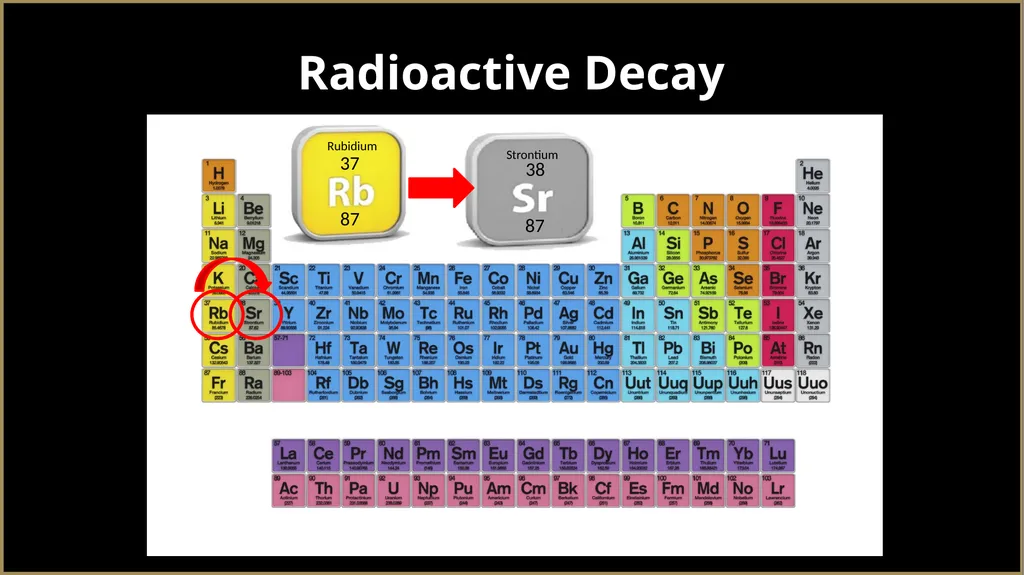
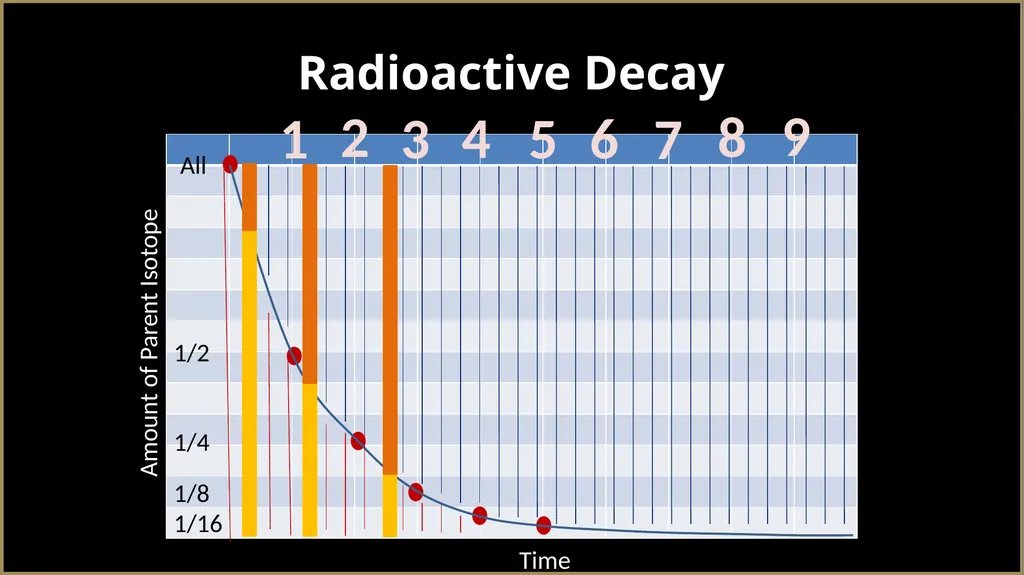
Radiometric Dating This decay process from parent to daughter occurs at a known, steady rate called a half-life<br>
06
Radioactive Decay 1 2 3 4 5 All 1/2 1/4 1/8 1/16 6 7 8 9 Time Amount of Parent Isotope<br>
07
Parent 1 2 3 4 5 All 1/2 1/4 1/8 1/16 6 7 8 9 Time Amount of Parent Isotope<br>
08
Daughter 1 2 3 4 5 All 1/2 1/4 1/8 1/16 6 7 8 9 Time Amount of Parent Isotope<br>
09
Radioactive Decay 1 2 3 4 5 All 1/2 1/4 1/8 1/16 6 7 8 9 Time Amount of Parent Isotope<br>
10
Radiometric Dating 1 2 3 4 5 All 1/2 1/4 1/8 1/16 6 7 8 9 Time Amount of Parent Isotope<br>
11
Radiometric Dating 1 2 3 4 5 All 1/2 1/4 1/8 1/16 6 7 8 9 U-238 Time Amount of Parent Isotope<br>
12
Radiometric Dating 1 2 3 4 5 All 1/2 1/4 1/8 1/16 6 7 8 9 Half-life of uranium 238 =
4.5 billion years U-238 Pb-206 Time Amount of Parent Isotope<br>
13
Radiometric Dating 1 2 3 4 5 All 1/2 1/4 1/8 1/16 6 7 8 9 U-238 Pb-206 Time Amount of Parent Isotope<br>
14
Radiometric Dating 1 2 3 4 5 All 1/2 1/4 1/8 1/16 6 7 8 9 Half-life = 4.5 billion years 4.5 x 2 = 9 billion years Time Amount of Parent Isotope<br>
15
Radiometric Dating 1 2 3 4 5 All 1/2 1/4 1/8 1/16 6 7 8 9 Time Amount of Parent Isotope<br>
16
Radiometric Dating Igneous
From magma or lava Granite<br>
17
Radiometric Dating Sedimentary rocks<br>
18
Quaternary Neogene Paleogene Cretaceous Jurassic Triassic Permian Pennsylvanian Mississippian Devonian Silurian Ordovician Cambrian Precambrian Paleozoic Mesozoic Cenozoic Phanerozoic<br>
19
Sediment Sediment Lava<br>
20
Quaternary Neogene Paleogene Cretaceous Jurassic Triassic Permian Pennsylvanian Mississippian Devonian Silurian Ordovician Cambrian Precambrian Paleozoic Mesozoic Cenozoic Phanerozoic<br>
22
Geologic Column Radiometric Dating—Accuracy and Assumptions<br>
23
Recorded at
Chattanooga Public RadioSM
Classical 90.5 WSMC<br>
24
Images may appear on more than one slide. Citation is given on the first slide where each image appears.
[1a] Zion National Park 489588635, kaiborder, Thinkstock, Thinkstock Image Subscription Agreement
[1b] Folded rocks 24286621 Matauw, Getty Images (US), Inc. Subscription Agreement
[1c] Blue Mesa Petrified Forest National Park 479232619, estivillml, Thinkstock, Thinkstock Image Subscription Agreement
[1d] Bryce Canyon National Park, Keith Snyder
[1e] Folded rocks, Raul Esperante, used with permission
[1f] Grand Canyon, taken by Ed Chatelain, used with permission
[2a] Periodic Table of the Elements 487671929, Nerthuz, Thinkstock, Thinkstock Image Subscription Agreement
[2b] Rubidium material sign 180861989, nmcandre, Thinkstock, Thinkstock Image Subscription Agreement
[2c] Strontium material sign 180862867, nmcandre, Thinkstock, Thinkstock Image Subscription Agreement Images By<br>
25
[16] Granite background 486750575, Abykov, Thinkstock, Thinkstock Image Subscription Agreement
[17a] Limestone cave 477215889, Gudella, Thinkstock, Thinkstock Image Subscription Agreement
[17b] Shale 486884397, KiddFoto, Thinkstock, Thinkstock Image Subscription Agreement
[17c] Sedona, Red Sandstone, AZ, USA 101819969, Noel Moore, Thinkstock, Thinkstock Image Subscription Agreement
[18] Erupt 175129634, Colematt, Thinkstock, Thinkstock Image Subscription Agreement
[19-21] Layers, Thomas Bartlett
[22] Magma illustration, Thomas Bartlett Images By<br>
26
Special Thanks
Chris Hansen, PhD
Physics Professor, Southern Adventist University
Ken Caviness, PhD
Physics Professor, Southern Adventist University
Foundation for Adventist Education<br>
27
© Origins Curriculum Resources 2015<br>
28
© Southern Adventist University 2015<br>
29
© Seventh-day Adventist North American Division 2015<br>
30
© General Conference of Seventh-day Adventists 2015<br>
31
© SCORE Southern Center for Origins Research & Education 2015<br>