
The Good Phytosanitary Practices Program


Description: The Good Phytosanitary Practices Program Confindustria Ceramica, the Italian Ceramic Manufacturers Association From the World Trade Organization web site Overview: The World Trade Organization the WTO is the international
Related Topics
Download Presentation
"The Good Phytosanitary Practices Program" is the property of its rightful owner. Permission is granted to download and print the materials on this website for personal, non-commercial use only, and to display it on your personal computer provided you do not modify the materials and that you retain all copyright notices contained in the materials. By downloading content from our website, you accept the terms of this agreement.
Presentation Transcript
slide1. The Good Phytosanitary Practices Program Confindustria Ceramica, the Italian Ceramic Manufacturers Association<br>
slide2. From the World Trade Organization web site – “Overview”:
The World Trade Organization — the WTO — is the international organization whose primary purpose is to open trade for the benefit of all
The opening of national markets to international trade, with justifiable exceptions or with adequate flexibilities, will encourage and contribute to sustainable development, raise people's welfare, reduce poverty, and foster peace and stability Premise<br>
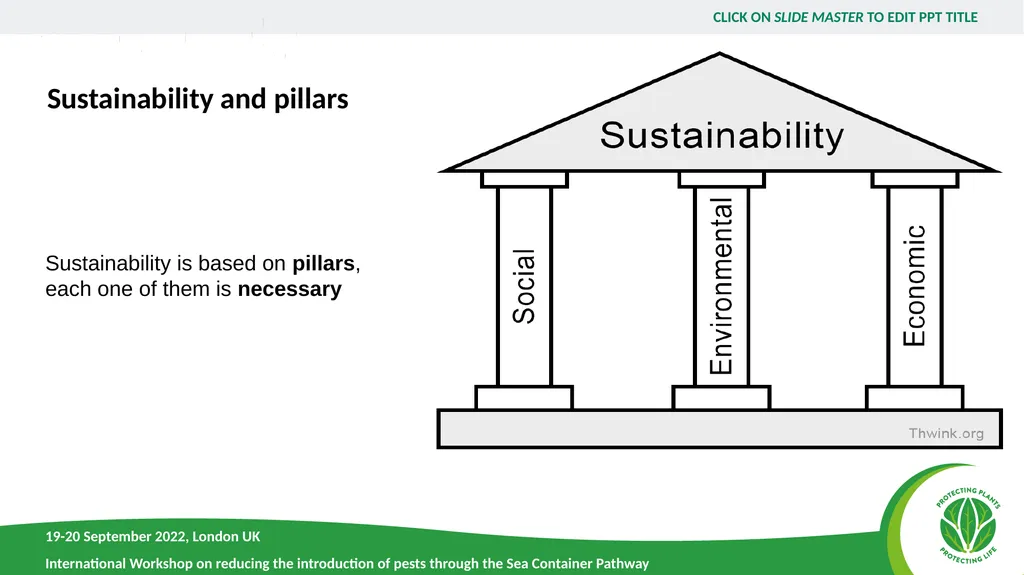
slide3. Sustainability is based on pillars,
each one of them is necessary Sustainability and pillars<br>
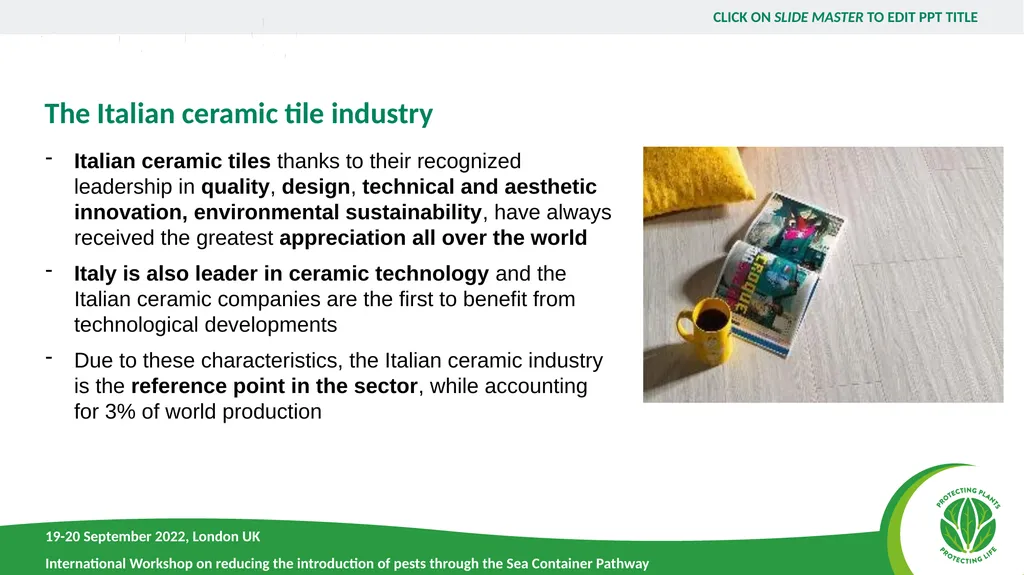
slide4. Italian ceramic tiles thanks to their recognized leadership in quality, design, technical and aesthetic innovation, environmental sustainability, have always received the greatest appreciation all over the world
Italy is also leader in ceramic technology and the Italian ceramic companies are the first to benefit from technological developments
Due to these characteristics, the Italian ceramic industry is the reference point in the sector, while accounting for 3% of world production The Italian ceramic tile industry<br>
slide5. Confindustria Ceramica is the Italian Association of Ceramics
Our mission is to represent, support, inform, provide services and liaise the Italian companies of the following sectors:
Ceramic tiles
Bricks
Refractories
Sanitaryware
Tableware
Technical ceramics Confindustria Ceramica<br>
slide6. The world economy depends on the efficient and uninterrupted movement of trade, a large part of which is facilitated by the efficient movement of sea containers
On the other hand, the movement of goods from one country to another entails in itself the risk of moving invasive species alien to the ecosystems of the countries of destination
A fair balance of possible measures is needed, in order not to generate negative knock-on effects
International trade, essential for the economy and consumers, cannot be stopped, but the related phytosanitary risks can be mitigated Some remarks<br>
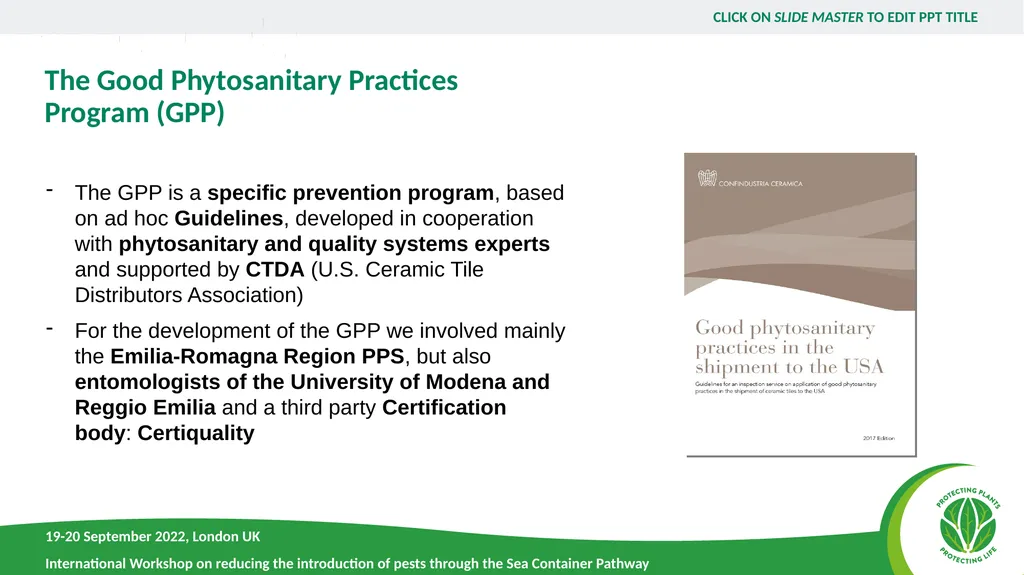
slide7. The GPP is a specific prevention program, based on ad hoc Guidelines, developed in cooperation with phytosanitary and quality systems experts and supported by CTDA (U.S. Ceramic Tile Distributors Association)
For the development of the GPP we involved mainly the Emilia-Romagna Region PPS, but also entomologists of the University of Modena and Reggio Emilia and a third party Certification body: Certiquality The Good Phytosanitary Practices Program (GPP)<br>
slide8. 140 Italian brands qualified
Reduction of treated containers by 83% from 2013 to 2020
Education and information shared among all the participant companies and beyond
Preventive actions carried out at company and sectoral level
Cooperation among the ceramic companies
Confindustria Ceramica as reference point and coordinator of the initiative GPP: main results and achievements<br>
slide9. Cooperation among companies in the supply chain, institutions and stakeholders
Empowering each of supply chain actors, based on their role
Prompt exchange of information on existing/emerging problems
Endorsement of the program by authorities
Reward policies that foster participation GPP: items for improvement<br>
slide10. The Italian ceramic industry with great efforts and costs has developed and brought to success the Good Phytosanitary Practices (GPP) Program
The GPP represents a new way to safeguard both the ecosystem and international trade and its model can be extended to ceramic companies around the world and to other sectors
In order to further enhance the GPP and its results, encouraging the implementation of sectorial phytosanitary prevention programs by other countries/sectors, the introduction of rewarding policies for participants is strongly advisable Conclusions<br>
slide11. Text here Title here<br>
slide12. Thank You Enrico Lupi Confindustria Ceramica<br>
slide2. From the World Trade Organization web site – “Overview”:
The World Trade Organization — the WTO — is the international organization whose primary purpose is to open trade for the benefit of all
The opening of national markets to international trade, with justifiable exceptions or with adequate flexibilities, will encourage and contribute to sustainable development, raise people's welfare, reduce poverty, and foster peace and stability Premise<br>
slide3. Sustainability is based on pillars,
each one of them is necessary Sustainability and pillars<br>
slide4. Italian ceramic tiles thanks to their recognized leadership in quality, design, technical and aesthetic innovation, environmental sustainability, have always received the greatest appreciation all over the world
Italy is also leader in ceramic technology and the Italian ceramic companies are the first to benefit from technological developments
Due to these characteristics, the Italian ceramic industry is the reference point in the sector, while accounting for 3% of world production The Italian ceramic tile industry<br>
slide5. Confindustria Ceramica is the Italian Association of Ceramics
Our mission is to represent, support, inform, provide services and liaise the Italian companies of the following sectors:
Ceramic tiles
Bricks
Refractories
Sanitaryware
Tableware
Technical ceramics Confindustria Ceramica<br>
slide6. The world economy depends on the efficient and uninterrupted movement of trade, a large part of which is facilitated by the efficient movement of sea containers
On the other hand, the movement of goods from one country to another entails in itself the risk of moving invasive species alien to the ecosystems of the countries of destination
A fair balance of possible measures is needed, in order not to generate negative knock-on effects
International trade, essential for the economy and consumers, cannot be stopped, but the related phytosanitary risks can be mitigated Some remarks<br>
slide7. The GPP is a specific prevention program, based on ad hoc Guidelines, developed in cooperation with phytosanitary and quality systems experts and supported by CTDA (U.S. Ceramic Tile Distributors Association)
For the development of the GPP we involved mainly the Emilia-Romagna Region PPS, but also entomologists of the University of Modena and Reggio Emilia and a third party Certification body: Certiquality The Good Phytosanitary Practices Program (GPP)<br>
slide8. 140 Italian brands qualified
Reduction of treated containers by 83% from 2013 to 2020
Education and information shared among all the participant companies and beyond
Preventive actions carried out at company and sectoral level
Cooperation among the ceramic companies
Confindustria Ceramica as reference point and coordinator of the initiative GPP: main results and achievements<br>
slide9. Cooperation among companies in the supply chain, institutions and stakeholders
Empowering each of supply chain actors, based on their role
Prompt exchange of information on existing/emerging problems
Endorsement of the program by authorities
Reward policies that foster participation GPP: items for improvement<br>
slide10. The Italian ceramic industry with great efforts and costs has developed and brought to success the Good Phytosanitary Practices (GPP) Program
The GPP represents a new way to safeguard both the ecosystem and international trade and its model can be extended to ceramic companies around the world and to other sectors
In order to further enhance the GPP and its results, encouraging the implementation of sectorial phytosanitary prevention programs by other countries/sectors, the introduction of rewarding policies for participants is strongly advisable Conclusions<br>
slide11. Text here Title here<br>
slide12. Thank You Enrico Lupi Confindustria Ceramica<br>