The Great Spurt 1892-1903 Driven by Sergei Witte 1 In Russia after the Great famine of 1891, the reason for hundreds of thousands dead, as the government was blamed for incompetence. With its backwards economy compared to other
"The “Great Spurt” 1892-1903 Driven by Sergei Witte" is the property of its rightful owner. Permission is granted to
download and print the materials on this website for personal, non-commercial use only, and to display it
on your personal computer provided you do not modify the materials and that you retain all copyright
notices contained in the materials. By downloading content from our website, you accept the terms of this
agreement.
Presentation Transcript
01
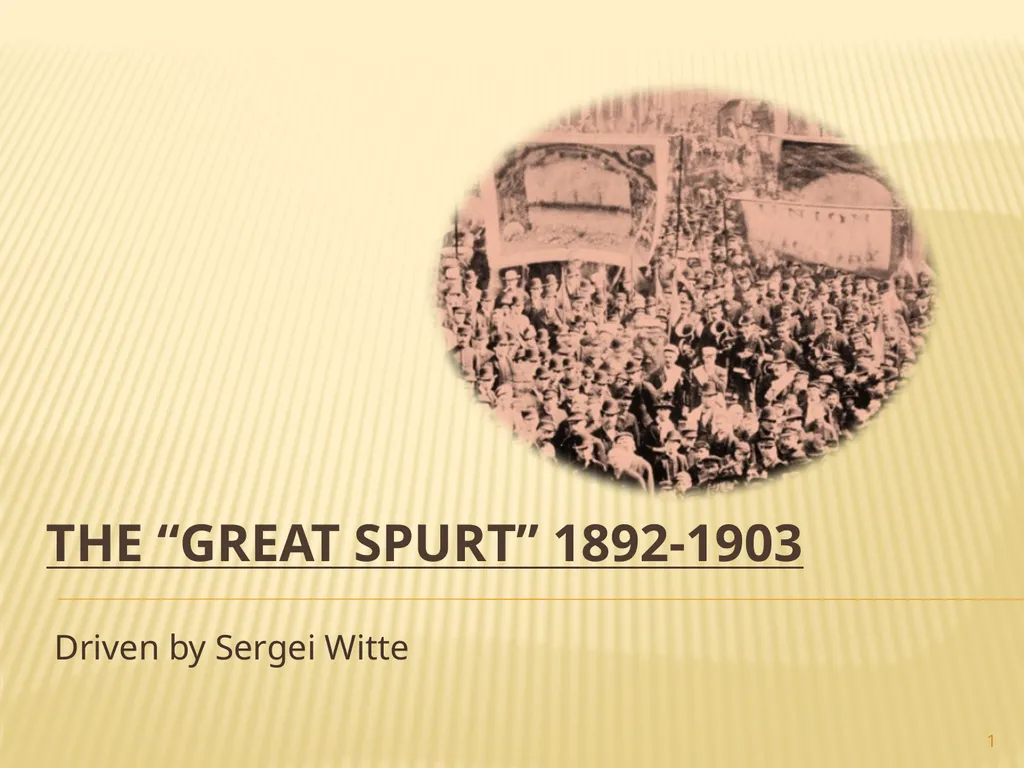
The “Great Spurt” 1892-1903 Driven by Sergei Witte 1<br>
02
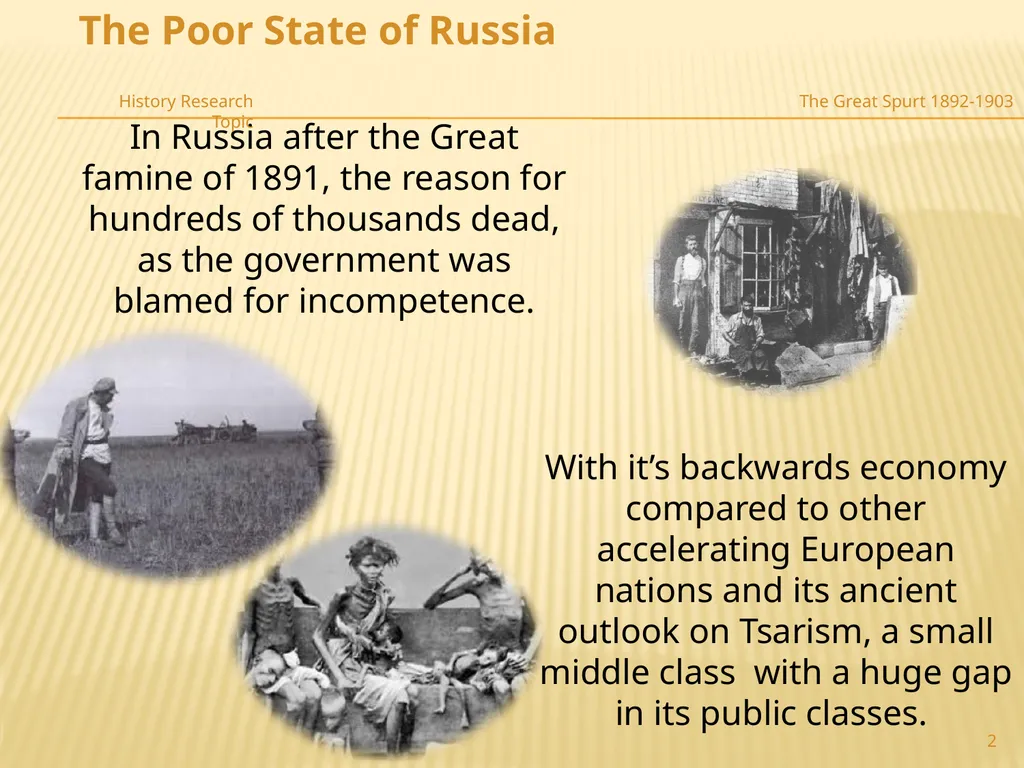
In Russia after the Great famine of 1891, the reason for hundreds of thousands dead, as the government was blamed for incompetence. With it’s backwards economy compared to other accelerating European nations and its ancient outlook on Tsarism, a small middle class with a huge gap in its public classes. 2 The Great Spurt 1892-1903 History Research Topic The Poor State of Russia<br>
03
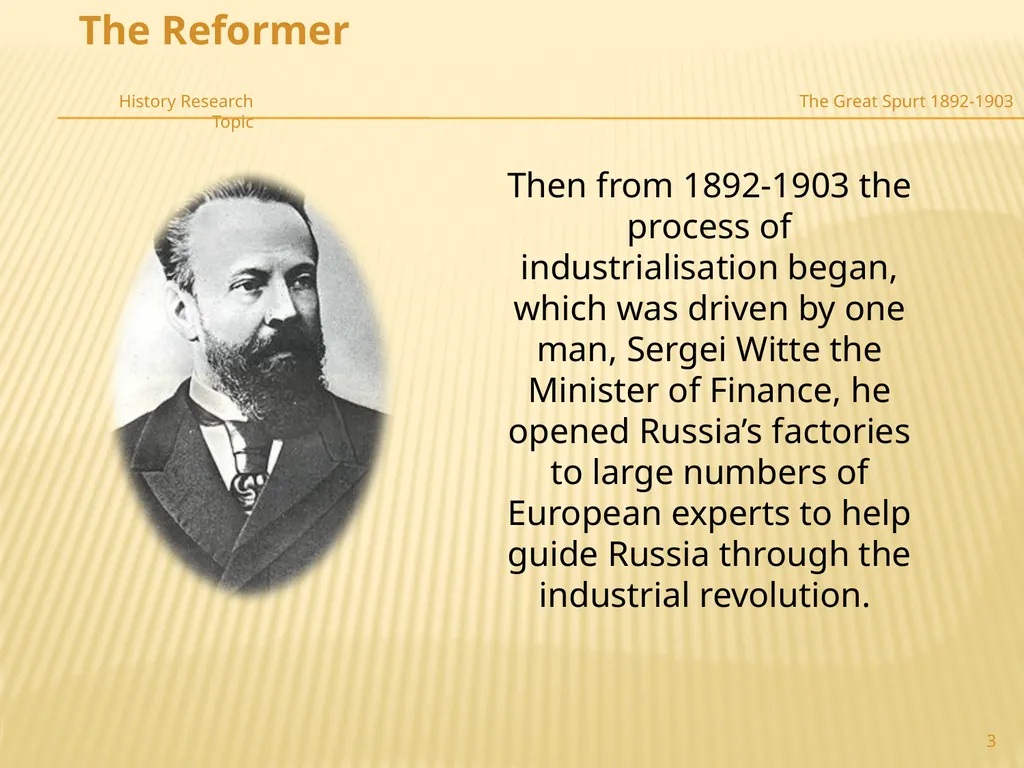
Then from 1892-1903 the process of industrialisation began, which was driven by one man, Sergei Witte the Minister of Finance, he opened Russia’s factories to large numbers of European experts to help guide Russia through the industrial revolution. 3 The Great Spurt 1892-1903 History Research Topic The Reformer<br>
04
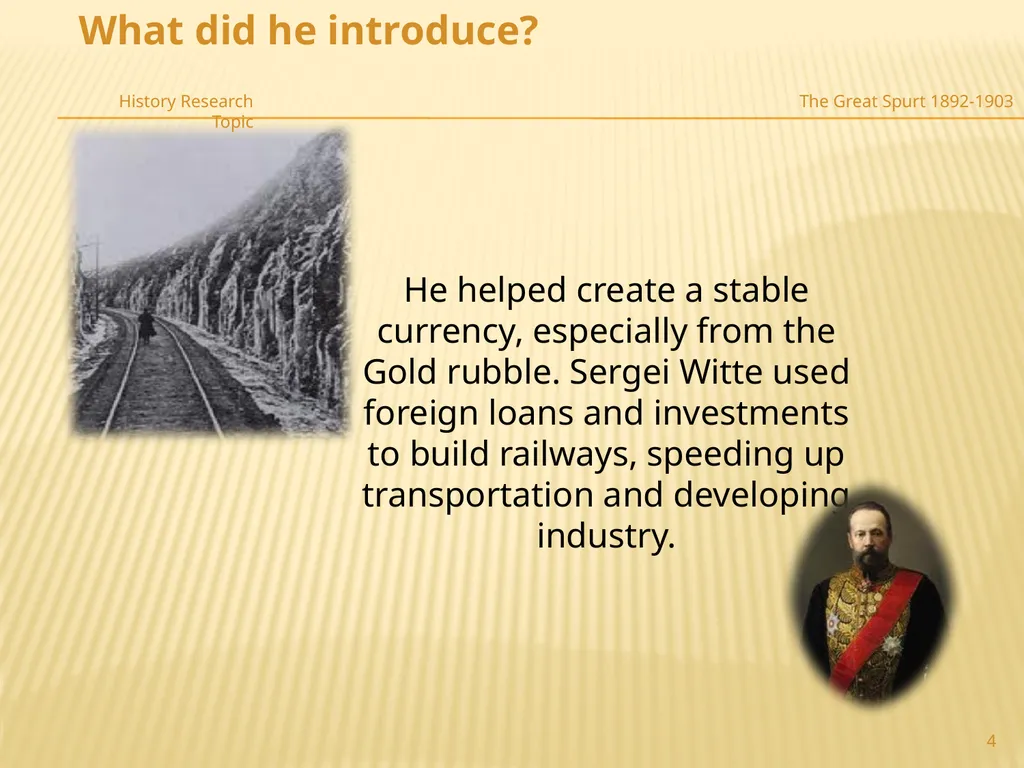
He helped create a stable currency, especially from the Gold rubble. Sergei Witte used foreign loans and investments to build railways, speeding up transportation and developing industry. 4 The Great Spurt 1892-1903 History Research Topic What did he introduce?<br>
05
So the 1890s saw the ‘Great Spurt’ of modernisation and industrialisation in Russia, from the increase in production of coal in Ukraine, oil in Caucasus, Iron, chemicals, engineering petroleum and steel industries; were all established within 10 years. 5 The Great Spurt 1892-1903 History Research Topic The Great Spurt<br>
06
A new social and industrial working class appeared, with a modern economic position holding better living conditions; more peasants were leaving poverty and a large move of people from stricken farms to huge developing cities increased such as Moscow and St Petersburg. 6 The Great Spurt 1892-1903 History Research Topic From poverty to working class<br>
07
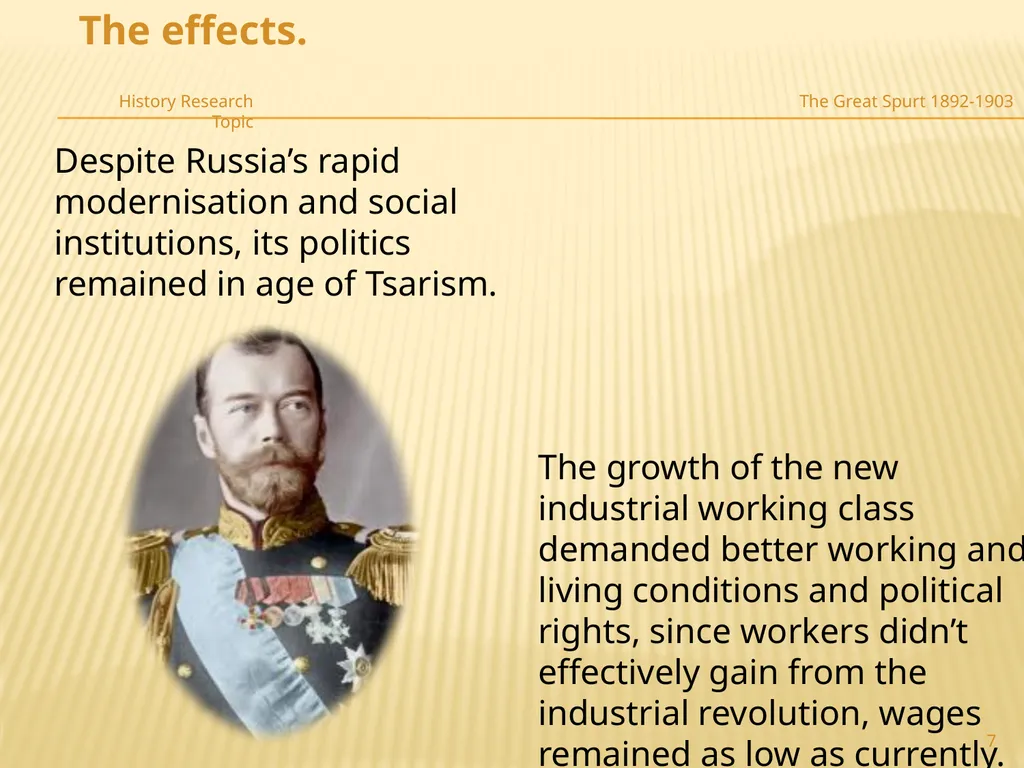
Despite Russia’s rapid modernisation and social institutions, its politics remained in age of Tsarism. The growth of the new industrial working class demanded better working and living conditions and political rights, since workers didn’t effectively gain from the industrial revolution, wages remained as low as currently. 7 The Great Spurt 1892-1903 History Research Topic The effects.<br>
08
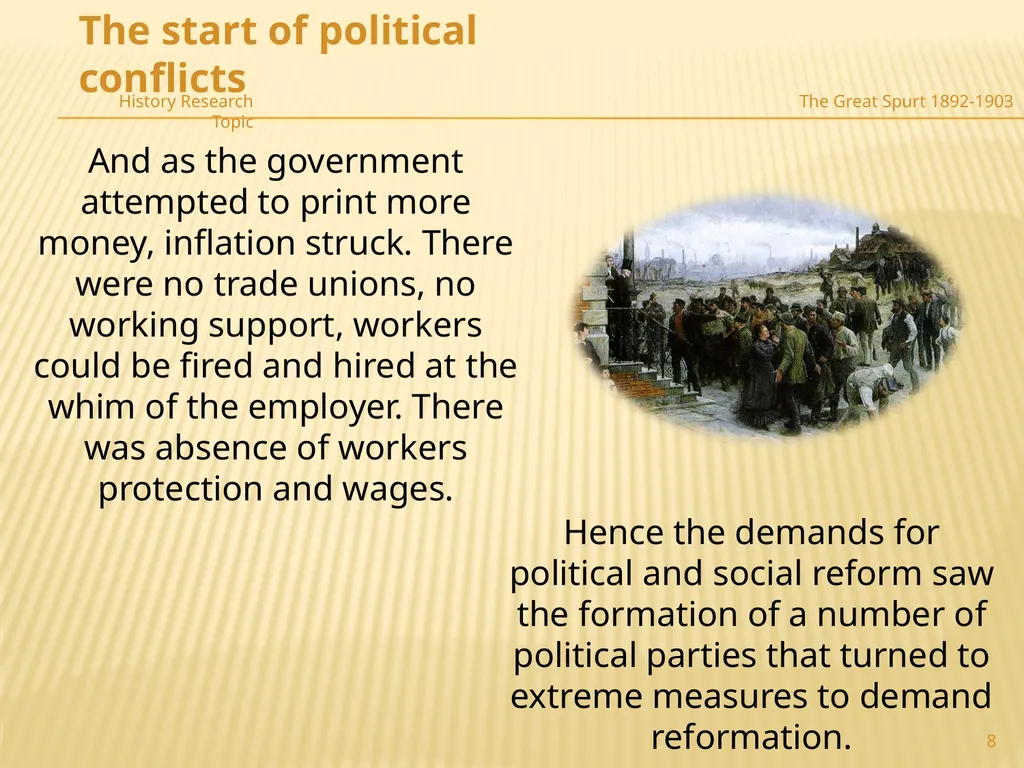
And as the government attempted to print more money, inflation struck. There were no trade unions, no working support, workers could be fired and hired at the whim of the employer. There was absence of workers protection and wages. Hence the demands for political and social reform saw the formation of a number of political parties that turned to extreme measures to demand reformation. 8 The Great Spurt 1892-1903 History Research Topic The start of political conflicts<br>