"The IARC Monographs: Volume 112, Glyphosate" is the property of its rightful owner. Permission is granted to
download and print the materials on this website for personal, non-commercial use only, and to display it
on your personal computer provided you do not modify the materials and that you retain all copyright
notices contained in the materials. By downloading content from our website, you accept the terms of this
agreement.
Share
Embed code
Presentation Transcript
01
The IARC Monographs: Volume 112, Glyphosate Evaluation Kate Z. Guyton PhD DABT Senior Toxicologist
Responsible Officer, Volume 112 Monographs Programme<br>
02
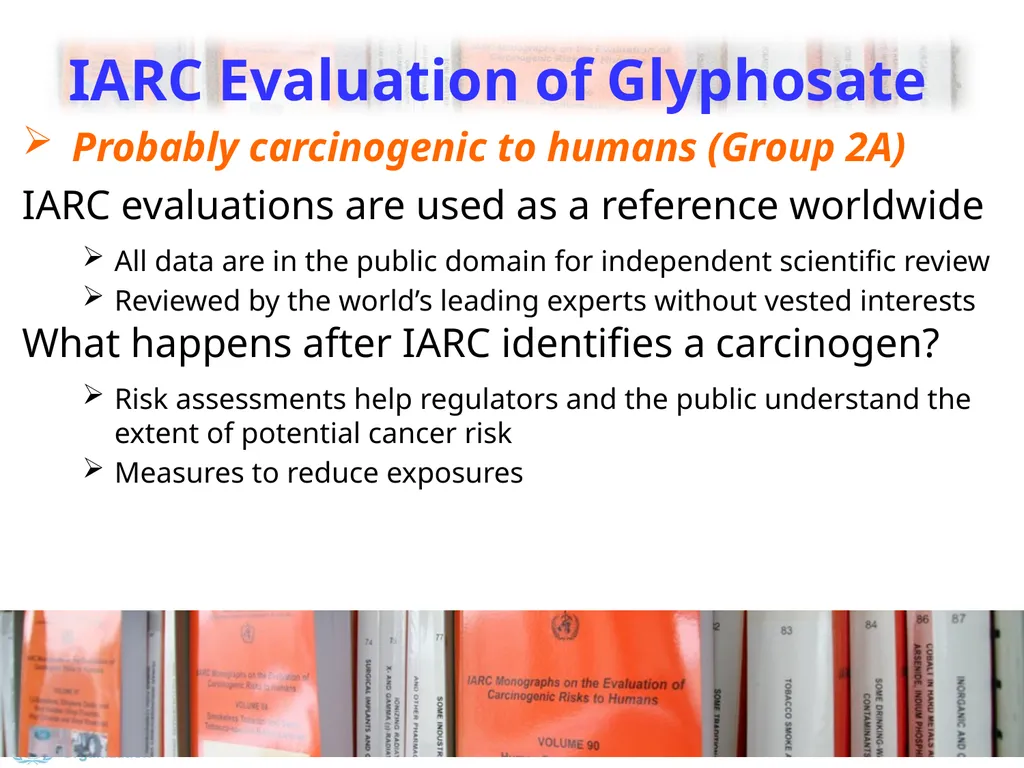
IARC Evaluation of Glyphosate Probably carcinogenic to humans (Group 2A)
IARC evaluations are used as a reference worldwide
All data are in the public domain for independent scientific review
Reviewed by the world’s leading experts without vested interests
What happens after IARC identifies a carcinogen?
Risk assessments help regulators and the public understand the extent of potential cancer risk
Measures to reduce exposures<br>
03
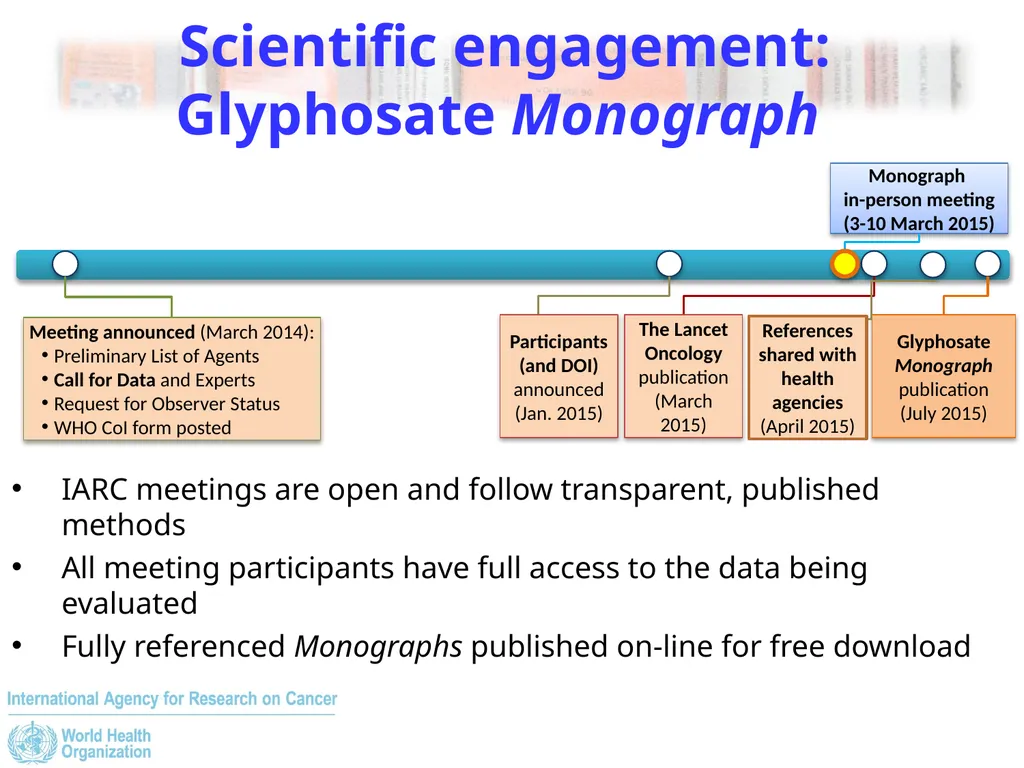
Scientific engagement: Glyphosate Monograph Meeting announced (March 2014):
Preliminary List of Agents
Call for Data and Experts
Request for Observer Status
WHO CoI form posted Monograph
in-person meeting
(3-10 March 2015) The Lancet Oncology
publication
(March 2015) Glyphosate Monograph
publication
(July 2015) Participants (and DOI) announced
(Jan. 2015) References shared with health agencies
(April 2015) IARC meetings are open and follow transparent, published methods
All meeting participants have full access to the data being evaluated
Fully referenced Monographs published on-line for free download<br>
04
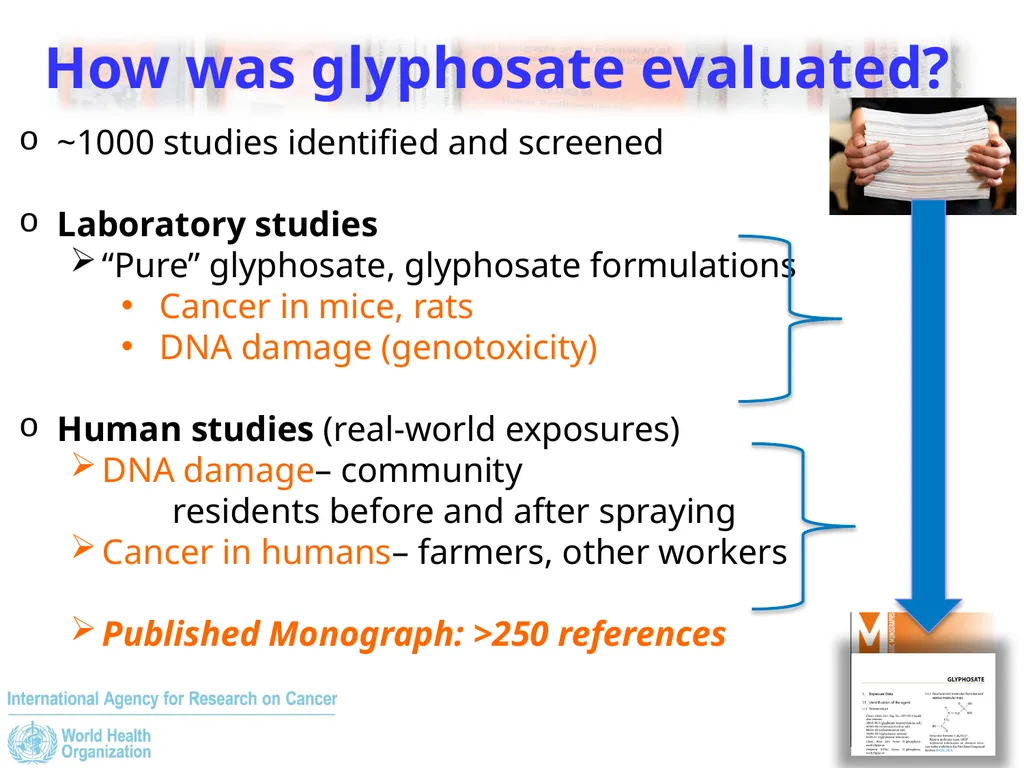
How was glyphosate evaluated? ~1000 studies identified and screened
Laboratory studies
“Pure” glyphosate, glyphosate formulations
Cancer in mice, rats
DNA damage (genotoxicity)
Human studies (real-world exposures)
DNA damage– community
residents before and after spraying
Cancer in humans– farmers, other workers
Published Monograph: >250 references<br>
05
Cancers in mice fed glyphosate Positive results in 2 of 2 feeding studies
Rare cancers: extremely important in assessing human risk….but challenging to detect signal from background noise
High statistical significance
Benign, malignant cancers; no toxicity
Evaluation fully in line with accepted principles
Sufficient evidence of cancer in animals<br>
06
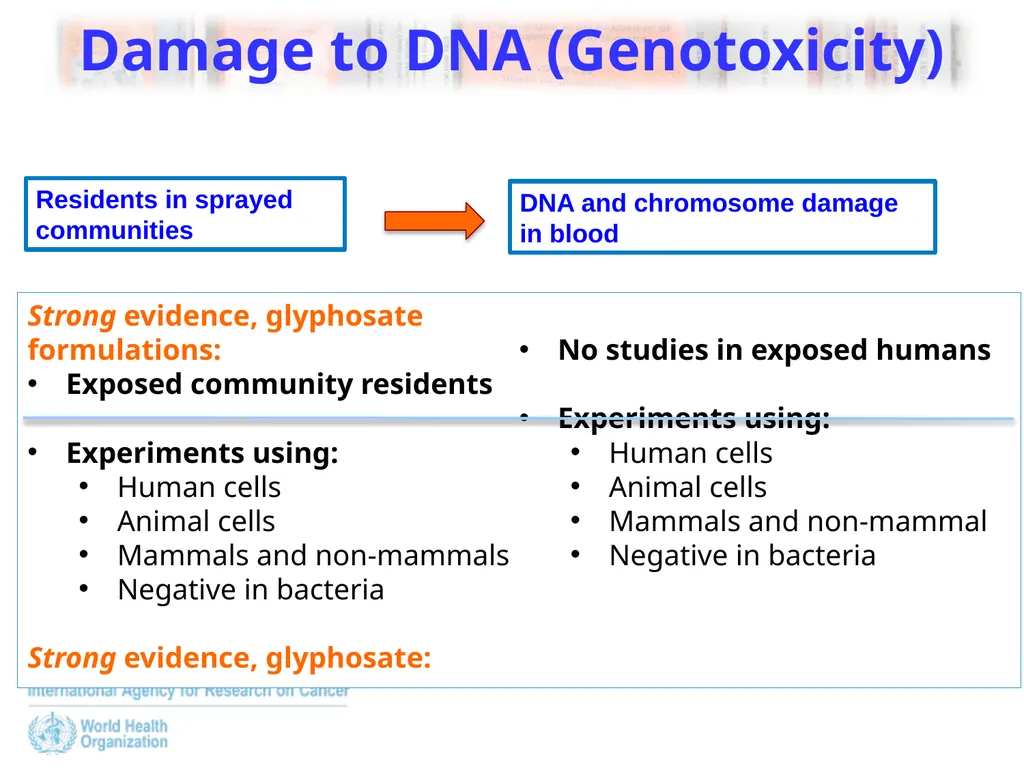
Damage to DNA (Genotoxicity) Strong evidence, glyphosate formulations:
Exposed community residents
Experiments using:
Human cells
Animal cells
Mammals and non-mammals
Negative in bacteria
Strong evidence, glyphosate:
No studies in exposed humans
Experiments using:
Human cells
Animal cells
Mammals and non-mammal
Negative in bacteria Residents in sprayed communities DNA and chromosome damage in blood<br>
07
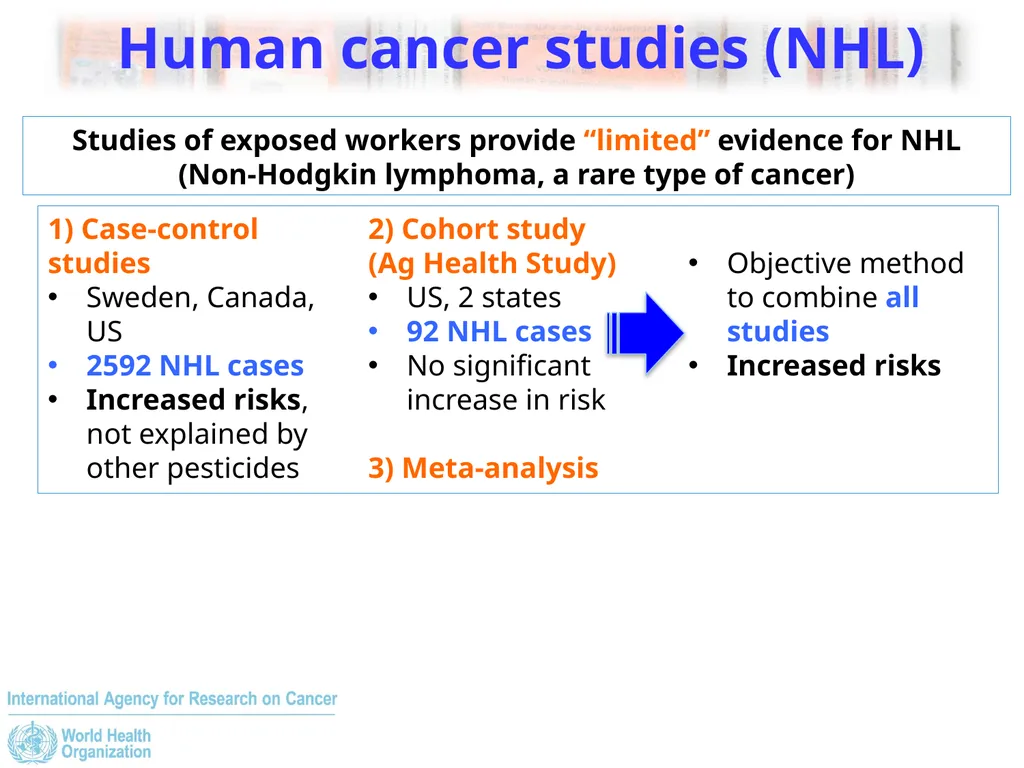
Human cancer studies (NHL) 1) Case-control studies
Sweden, Canada, US
2592 NHL cases
Increased risks, not explained by other pesticides
2) Cohort study
(Ag Health Study)
US, 2 states
92 NHL cases
No significant increase in risk
3) Meta-analysis
Objective method to combine all studies
Increased risks Studies of exposed workers provide “limited” evidence for NHL (Non-Hodgkin lymphoma, a rare type of cancer)<br>
08
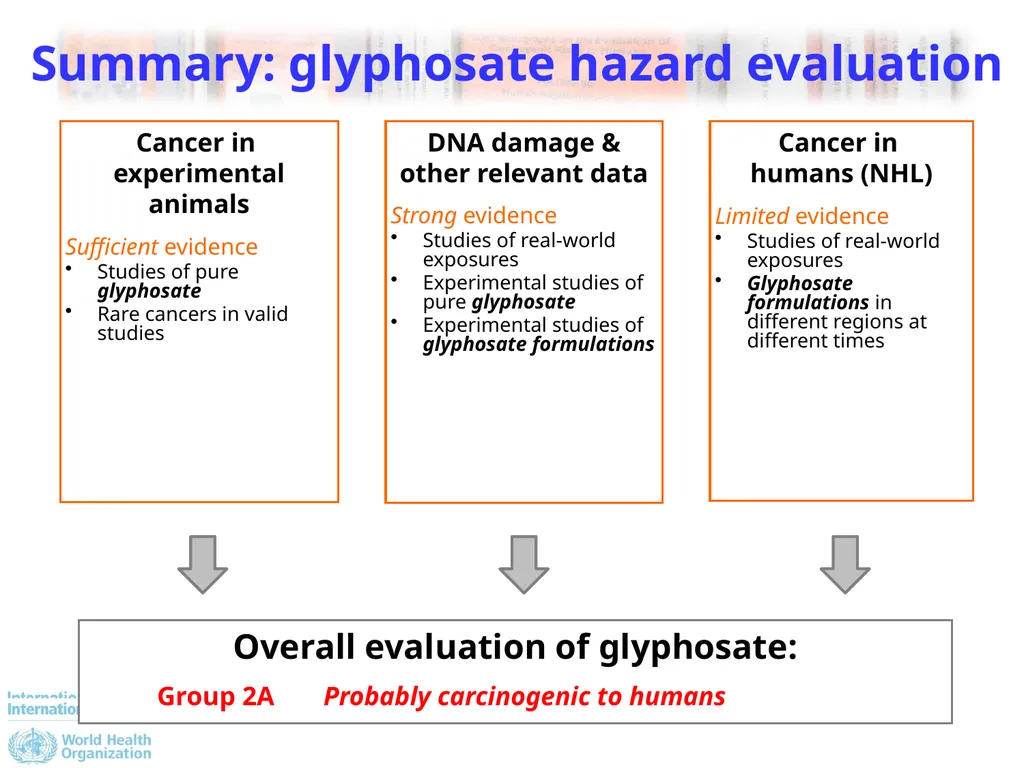
DNA damage & other relevant data
Strong evidence
Studies of real-world exposures
Experimental studies of pure glyphosate
Experimental studies of glyphosate formulations Cancer in humans (NHL)
Limited evidence
Studies of real-world exposures
Glyphosate formulations in different regions at different times Summary: glyphosate hazard evaluation Cancer in experimental animals
Sufficient evidence
Studies of pure glyphosate
Rare cancers in valid studies Overall evaluation of glyphosate:
Group 2A Probably carcinogenic to humans<br>
09
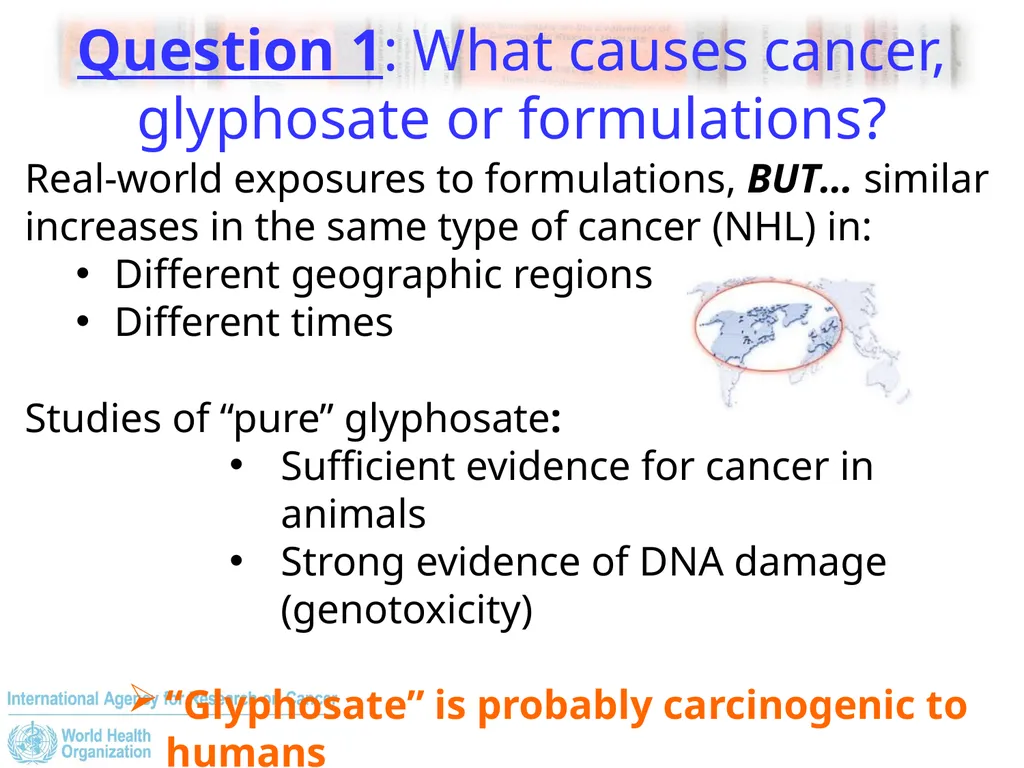
Question 1: What causes cancer, glyphosate or formulations? Real-world exposures to formulations, BUT… similar increases in the same type of cancer (NHL) in:
Different geographic regions
Different times
Studies of “pure” glyphosate:
Sufficient evidence for cancer in animals
Strong evidence of DNA damage (genotoxicity)
“Glyphosate” is probably carcinogenic to humans<br>
10
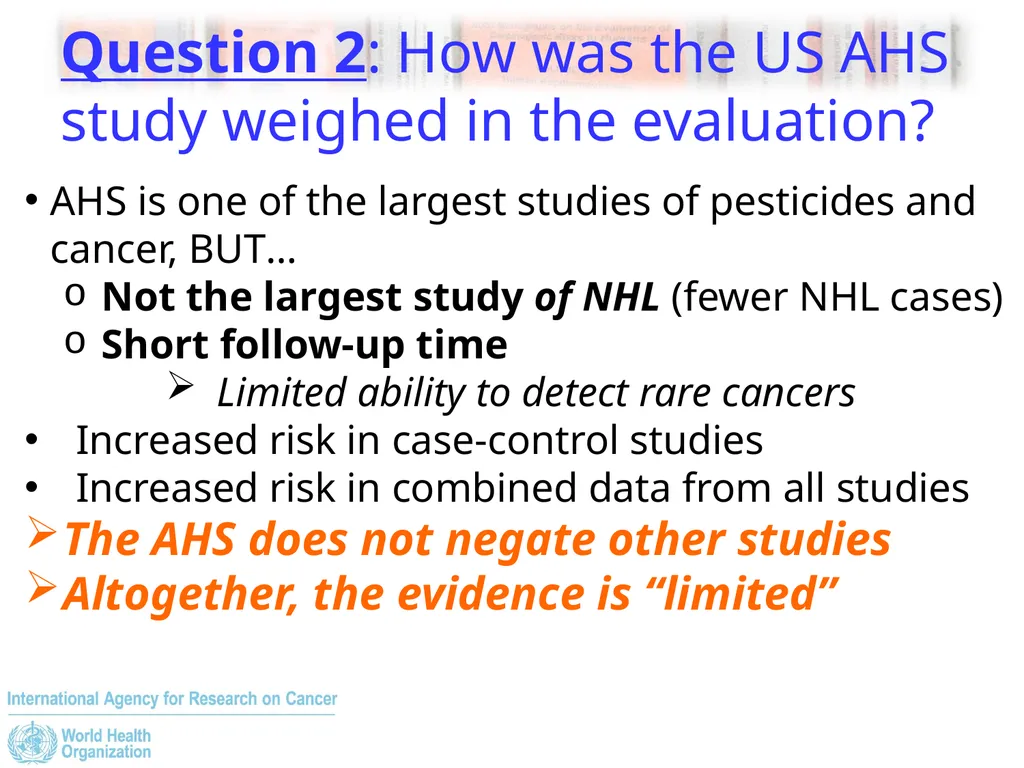
AHS is one of the largest studies of pesticides and cancer, BUT…
Not the largest study of NHL (fewer NHL cases)
Short follow-up time
Limited ability to detect rare cancers
Increased risk in case-control studies
Increased risk in combined data from all studies
The AHS does not negate other studies
Altogether, the evidence is “limited” Question 2: How was the US AHS study weighed in the evaluation?<br>
11
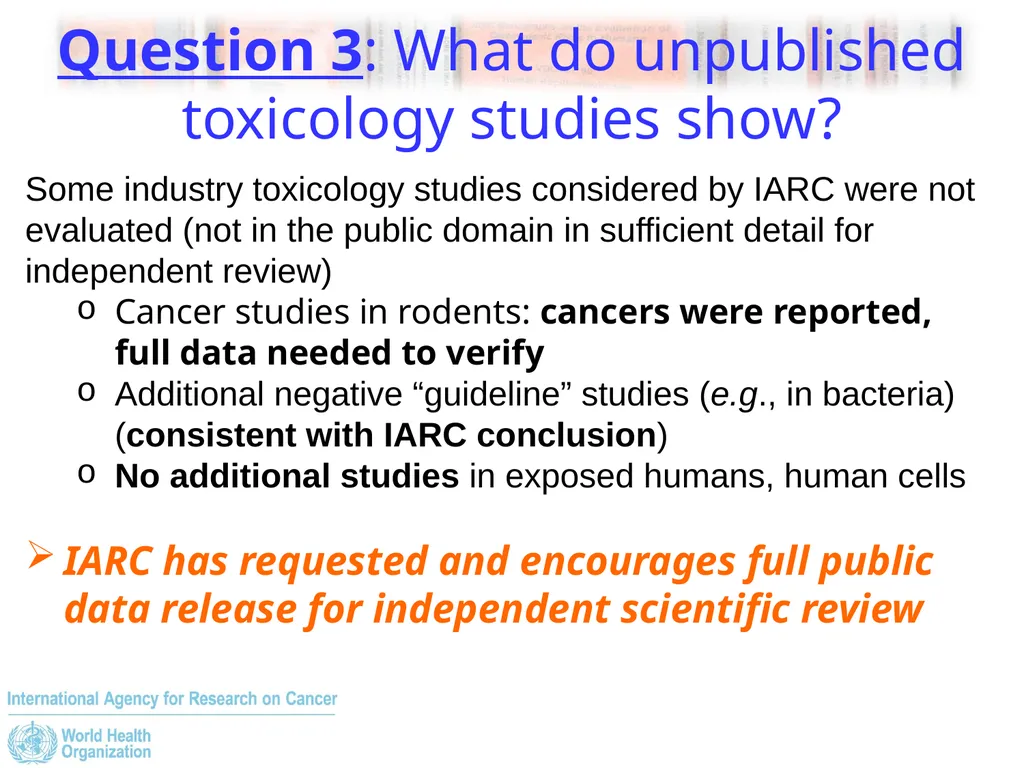
Question 3: What do unpublished toxicology studies show? Some industry toxicology studies considered by IARC were not evaluated (not in the public domain in sufficient detail for independent review)
Cancer studies in rodents: cancers were reported, full data needed to verify
Additional negative “guideline” studies (e.g., in bacteria) (consistent with IARC conclusion)
No additional studies in exposed humans, human cells
IARC has requested and encourages full public data release for independent scientific review<br>
12
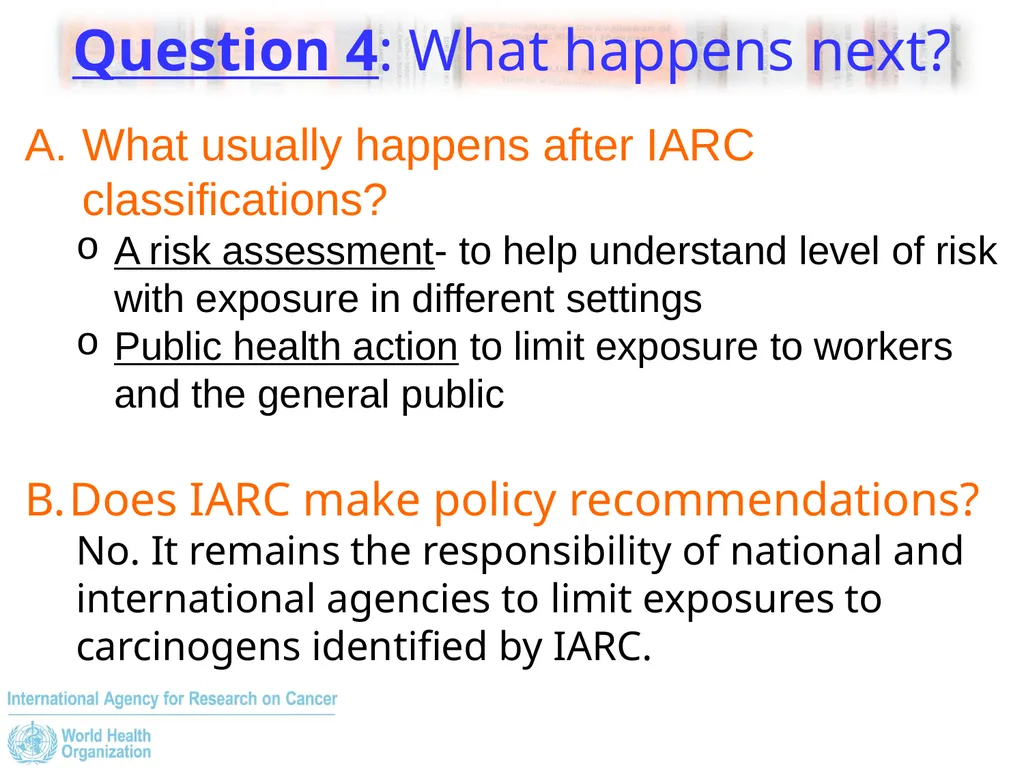
Question 4: What happens next? What usually happens after IARC classifications?
A risk assessment- to help understand level of risk with exposure in different settings
Public health action to limit exposure to workers and the general public
Does IARC make policy recommendations?
No. It remains the responsibility of national and international agencies to limit exposures to carcinogens identified by IARC.<br>