
The Intelligence and Development Scales-second
CS
Published · 25 slides · 0 views
1 / 1

Description
The Intelligence and Development Scales-second edition (IDS-2) Dr Jane Yeomans STEC Committee member SASC conference 2024 IDS-2 basic information Age range 5 to 21 (but note that age ranges vary for some subtests) Published by Hogrefe
Related Topics
Share
Embed code
Download this presentation From Below
"The Intelligence and Development Scales-second" is the property of its rightful owner. Permission is granted to download and print the materials on this website for personal, non-commercial use only, and to display it on your personal computer provided you do not modify the materials and that you retain all copyright notices contained in the materials. By downloading content from our website, you accept the terms of this agreement.
Presentation Transcript
01
The Intelligence and Development Scales-second edition (IDS-2) Dr Jane Yeomans
STEC Committee member
SASC conference 2024<br>
STEC Committee member
SASC conference 2024<br>
02
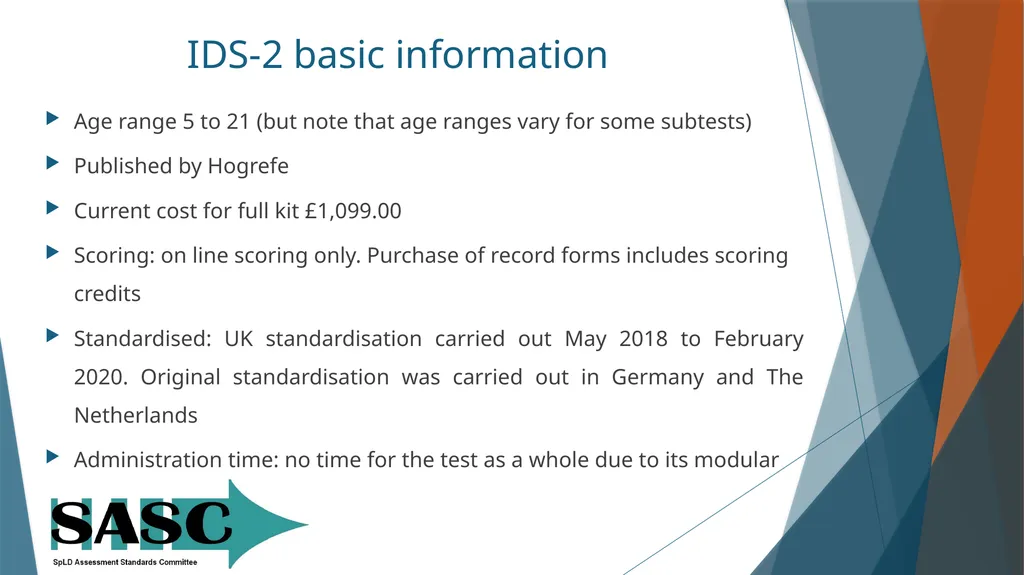
IDS-2 basic information Age range 5 to 21 (but note that age ranges vary for some subtests)
Published by Hogrefe
Current cost for full kit £1,099.00
Scoring: on line scoring only. Purchase of record forms includes scoring credits
Standardised: UK standardisation carried out May 2018 to February 2020. Original standardisation was carried out in Germany and The Netherlands
Administration time: no time for the test as a whole due to its modular structure<br>
Published by Hogrefe
Current cost for full kit £1,099.00
Scoring: on line scoring only. Purchase of record forms includes scoring credits
Standardised: UK standardisation carried out May 2018 to February 2020. Original standardisation was carried out in Germany and The Netherlands
Administration time: no time for the test as a whole due to its modular structure<br>
03
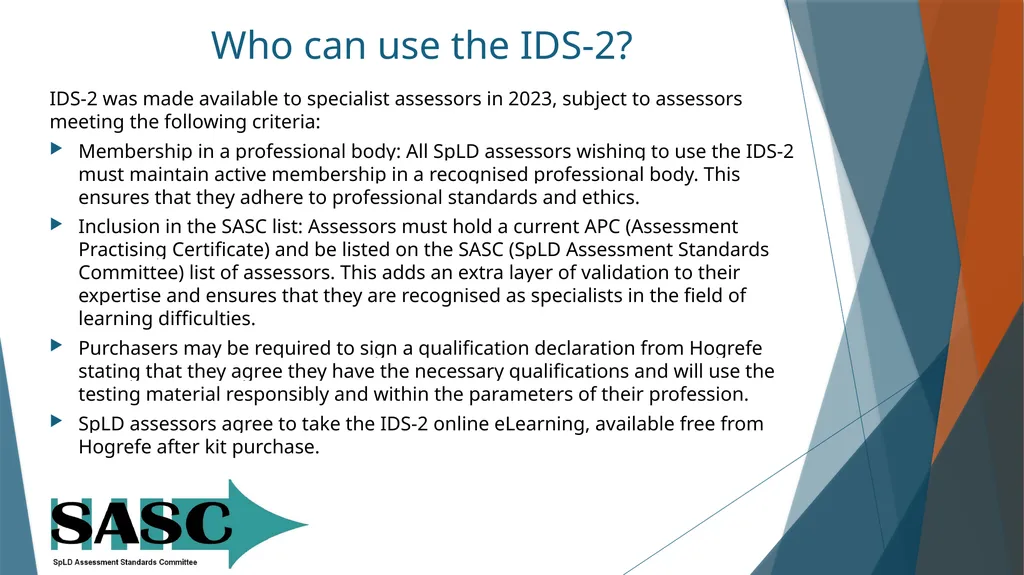
Who can use the IDS-2? IDS-2 was made available to specialist assessors in 2023, subject to assessors meeting the following criteria:
Membership in a professional body: All SpLD assessors wishing to use the IDS-2 must maintain active membership in a recognised professional body. This ensures that they adhere to professional standards and ethics.
Inclusion in the SASC list: Assessors must hold a current APC (Assessment Practising Certificate) and be listed on the SASC (SpLD Assessment Standards Committee) list of assessors. This adds an extra layer of validation to their expertise and ensures that they are recognised as specialists in the field of learning difficulties.
Purchasers may be required to sign a qualification declaration from Hogrefe stating that they agree they have the necessary qualifications and will use the testing material responsibly and within the parameters of their profession.
SpLD assessors agree to take the IDS-2 online eLearning, available free from Hogrefe after kit purchase.<br>
Membership in a professional body: All SpLD assessors wishing to use the IDS-2 must maintain active membership in a recognised professional body. This ensures that they adhere to professional standards and ethics.
Inclusion in the SASC list: Assessors must hold a current APC (Assessment Practising Certificate) and be listed on the SASC (SpLD Assessment Standards Committee) list of assessors. This adds an extra layer of validation to their expertise and ensures that they are recognised as specialists in the field of learning difficulties.
Purchasers may be required to sign a qualification declaration from Hogrefe stating that they agree they have the necessary qualifications and will use the testing material responsibly and within the parameters of their profession.
SpLD assessors agree to take the IDS-2 online eLearning, available free from Hogrefe after kit purchase.<br>
04
Structure of the IDS-2 The test is organised into two broad domains:
Cognitive domain, which includes:
Intelligence Scales
Executive Function scales
General development domain, which includes:
Psychomotor skills
Scholastic skills
Social and emotional skills
Two rating scales are included that can be used with ages 11 to 20 in order to gather some structured information about motivation and attitude during the assessment (conscientiousness and achievement motivation).<br>
Cognitive domain, which includes:
Intelligence Scales
Executive Function scales
General development domain, which includes:
Psychomotor skills
Scholastic skills
Social and emotional skills
Two rating scales are included that can be used with ages 11 to 20 in order to gather some structured information about motivation and attitude during the assessment (conscientiousness and achievement motivation).<br>
05
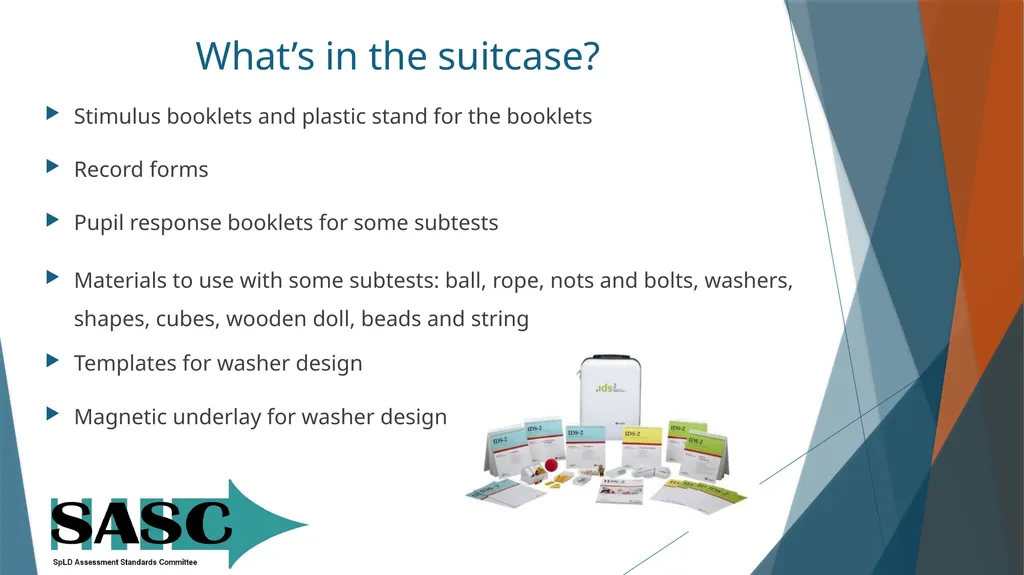
What’s in the suitcase? Stimulus booklets and plastic stand for the booklets
Record forms
Pupil response booklets for some subtests
Materials to use with some subtests: ball, rope, nots and bolts, washers, shapes, cubes, wooden doll, beads and string
Templates for washer design
Magnetic underlay for washer design<br>
Record forms
Pupil response booklets for some subtests
Materials to use with some subtests: ball, rope, nots and bolts, washers, shapes, cubes, wooden doll, beads and string
Templates for washer design
Magnetic underlay for washer design<br>
06
Cognitive domain: underlying theory/concepts The Intelligence Scales are based on CHC (Cattell-Horn-Carroll) theory, which involves:
10 factors: fluid intelligence, crystallized intelligence, quantitative knowledge, reading/writing, short term memory, visual processing, auditory processing, long term memory, processing speed and reaction/decision speed (the IDS2 measures six of these)
But….is not based on the concept of g (however g does feature in Carroll’s theory)
Static model of intelligence
Three process components of developmental psychology: universal, differential and individual
Constructivist view of development
Executive Function scales reflect some underlying theory of key elements of EF (self regulation, working memory, cognitive flexibility)<br>
10 factors: fluid intelligence, crystallized intelligence, quantitative knowledge, reading/writing, short term memory, visual processing, auditory processing, long term memory, processing speed and reaction/decision speed (the IDS2 measures six of these)
But….is not based on the concept of g (however g does feature in Carroll’s theory)
Static model of intelligence
Three process components of developmental psychology: universal, differential and individual
Constructivist view of development
Executive Function scales reflect some underlying theory of key elements of EF (self regulation, working memory, cognitive flexibility)<br>
07
General development domain: underlying theory/concepts Psychomotor skills
Gross and fine motor as discrete elements of motor skills, recognises the visual and perceptual elements
Social emotional skills
Draws on constructs of social and emotional competence
Scholastic skills
Logical mathematical reasoning reflects concepts included in DfE programmes of study, and reflects working memory model
Language
Two models of language acquisition are mentioned. Phonological awareness identified as a key skill
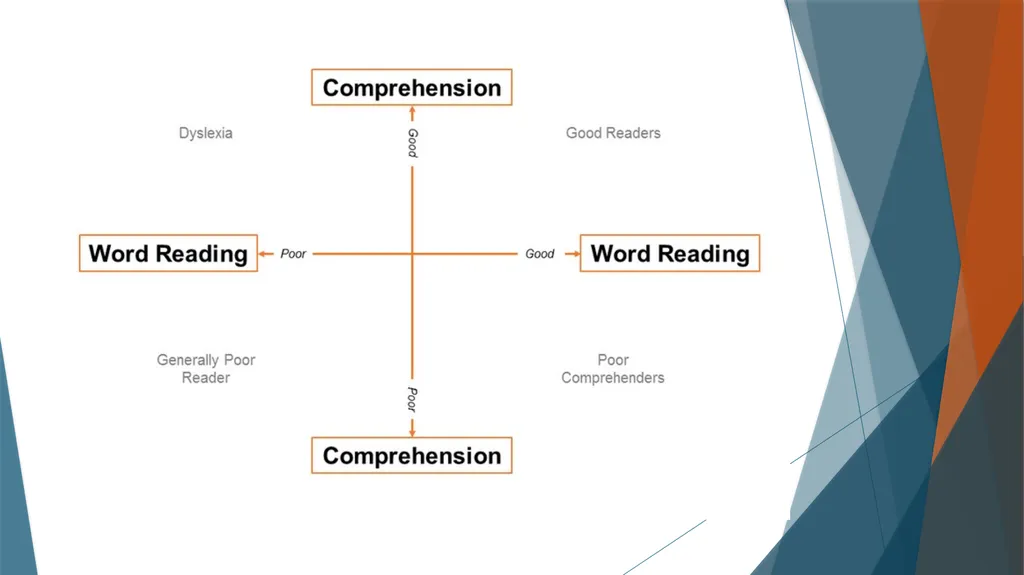
Reading
Gough and Tumners Simple View<br>
Gross and fine motor as discrete elements of motor skills, recognises the visual and perceptual elements
Social emotional skills
Draws on constructs of social and emotional competence
Scholastic skills
Logical mathematical reasoning reflects concepts included in DfE programmes of study, and reflects working memory model
Language
Two models of language acquisition are mentioned. Phonological awareness identified as a key skill
Reading
Gough and Tumners Simple View<br>
08
IDS-2 Cognitive Development domain: intelligence scales The intelligence scales consist of 14 subtests that examine the following seven factors of intelligence:
Visual processing
Long-term memory
Processing Speed
Auditory short-term memory
Visual-spatial short-term memory
Abstract Reasoning
Verbal Reasoning<br>
Visual processing
Long-term memory
Processing Speed
Auditory short-term memory
Visual-spatial short-term memory
Abstract Reasoning
Verbal Reasoning<br>
09
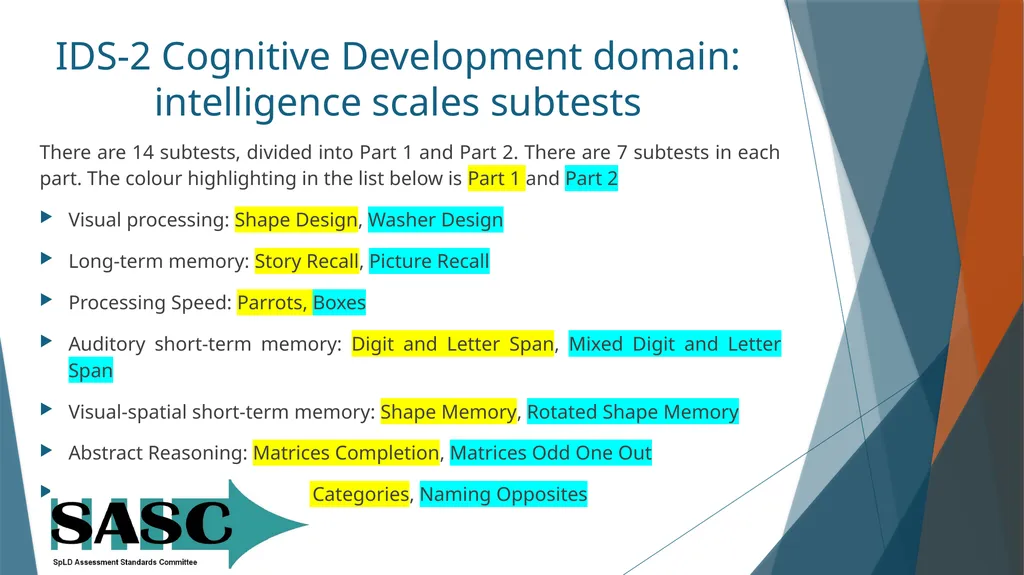
IDS-2 Cognitive Development domain: intelligence scales subtests There are 14 subtests, divided into Part 1 and Part 2. There are 7 subtests in each part. The colour highlighting in the list below is Part 1 and Part 2
Visual processing: Shape Design, Washer Design
Long-term memory: Story Recall, Picture Recall
Processing Speed: Parrots, Boxes
Auditory short-term memory: Digit and Letter Span, Mixed Digit and Letter Span
Visual-spatial short-term memory: Shape Memory, Rotated Shape Memory
Abstract Reasoning: Matrices Completion, Matrices Odd One Out
Verbal Reasoning: Naming Categories, Naming Opposites<br>
Visual processing: Shape Design, Washer Design
Long-term memory: Story Recall, Picture Recall
Processing Speed: Parrots, Boxes
Auditory short-term memory: Digit and Letter Span, Mixed Digit and Letter Span
Visual-spatial short-term memory: Shape Memory, Rotated Shape Memory
Abstract Reasoning: Matrices Completion, Matrices Odd One Out
Verbal Reasoning: Naming Categories, Naming Opposites<br>
10
IDS-2 Cognitive Development domain: administration of Intelligence Scales Using the 14 Intelligence Scales subtests, there are three possible modes of administration which produce the following:
An IQ score, using the seven Part 1 of the 14 subtests
An IQ profile using all 14 subtests from Parts 1 and Parts 2. This profile gives a composite index score for each of the seven areas of intelligence listed on slide 7
An IQ screen using two subtests (Matrices Completion and Naming Categories)<br>
An IQ score, using the seven Part 1 of the 14 subtests
An IQ profile using all 14 subtests from Parts 1 and Parts 2. This profile gives a composite index score for each of the seven areas of intelligence listed on slide 7
An IQ screen using two subtests (Matrices Completion and Naming Categories)<br>
11
IDS-2 Cognitive Development domain: Executive Function scales Four subtests are used to assess Executive Function:
Divided Attention
Listing Words
Animal Colours
Drawing Routes<br>
Divided Attention
Listing Words
Animal Colours
Drawing Routes<br>
12
IDS-2 General Development domain overview The General Development Domain assesses three areas:
Psychomotor skills
Two subtests: Gross Motor Skills and Fine Motor Skills
Social and emotional skills
Three subtests: Identifying Emotions, Regulating Emotions and Socially Competent Behaviour
Scholastic skills
Eight subtests: Phonological Awareness, Receptive Language, Expressive Language, Single Word Reading, Single Word Non Reading, Reading Comprehension, Logical Mathematical Reasoning, Spelling.<br>
Psychomotor skills
Two subtests: Gross Motor Skills and Fine Motor Skills
Social and emotional skills
Three subtests: Identifying Emotions, Regulating Emotions and Socially Competent Behaviour
Scholastic skills
Eight subtests: Phonological Awareness, Receptive Language, Expressive Language, Single Word Reading, Single Word Non Reading, Reading Comprehension, Logical Mathematical Reasoning, Spelling.<br>
13
Unravelling the Scholastic scales These scales need a bit more unravelling!
The age range varies for some of these scales:
Phonological Awareness age 5 to 10
Receptive and Expressive Language age 5 to 10
Reading Comprehension, Single Word Reading, Single Non Word Reading and Spelling age 7 to 20
The online scoring will only give a score for Reading Comprehension if the pupil reads more than 10 words correctly
Reading Comprehension passages have to be read out loud (the report format requires silent reading of prose)<br>
The age range varies for some of these scales:
Phonological Awareness age 5 to 10
Receptive and Expressive Language age 5 to 10
Reading Comprehension, Single Word Reading, Single Non Word Reading and Spelling age 7 to 20
The online scoring will only give a score for Reading Comprehension if the pupil reads more than 10 words correctly
Reading Comprehension passages have to be read out loud (the report format requires silent reading of prose)<br>
14
Administration The IDS-2 is a modular test so does not have to be administered in its entirety
The Intelligence Scales have to be administered in order (7 or 14 subtest administration)
All 4 EF scales should be administered in order to produce a score for EF
Each of the Psychomotor skills subtests can be administered separately but if a composite score is needed both subtests must be administered
Similarly, each of the Scholastic Skills subtests can be administered as ‘stand alones’, but if a composite score for reading is needed then all of the reading subtests must be administered<br>
The Intelligence Scales have to be administered in order (7 or 14 subtest administration)
All 4 EF scales should be administered in order to produce a score for EF
Each of the Psychomotor skills subtests can be administered separately but if a composite score is needed both subtests must be administered
Similarly, each of the Scholastic Skills subtests can be administered as ‘stand alones’, but if a composite score for reading is needed then all of the reading subtests must be administered<br>
15
Scoring All scoring is carried out online. There is no option for hand scoring.
The scores produced are:
Scaled scores for subtests
Standard composite score for IQ scales (7 or 14 subtests)
Average scaled scores for other areas rather than a composite
Confidence Intervals are given for standard composite IQ scores but the online scoring does not generate confidence levels for any other scores
Percentile scores are also generated by the online scoring tool<br>
The scores produced are:
Scaled scores for subtests
Standard composite score for IQ scales (7 or 14 subtests)
Average scaled scores for other areas rather than a composite
Confidence Intervals are given for standard composite IQ scores but the online scoring does not generate confidence levels for any other scores
Percentile scores are also generated by the online scoring tool<br>
16
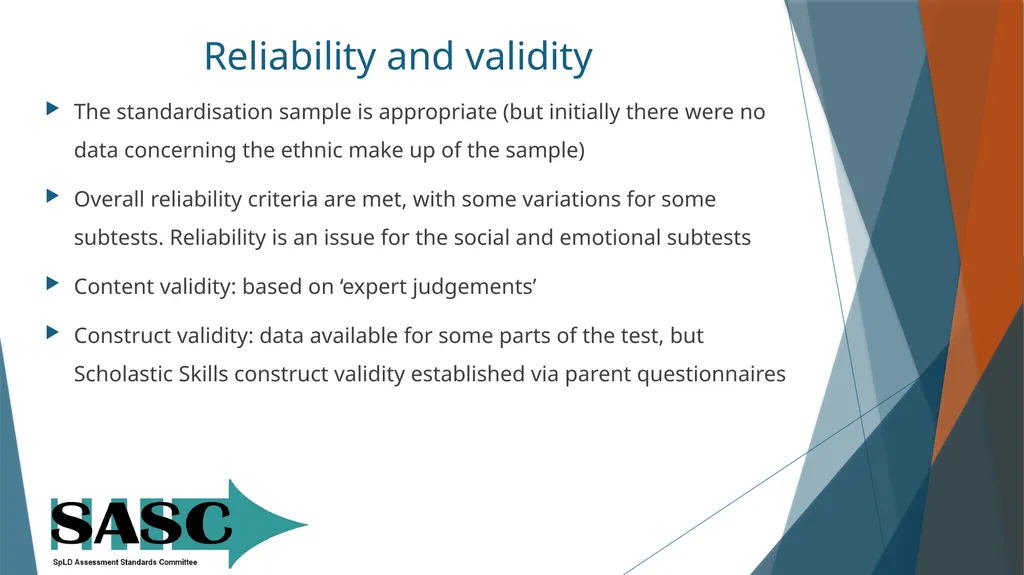
Reliability and validity The standardisation sample is appropriate (but initially there were no data concerning the ethnic make up of the sample)
Overall reliability criteria are met, with some variations for some subtests. Reliability is an issue for the social and emotional subtests
Content validity: based on ‘expert judgements’
Construct validity: data available for some parts of the test, but Scholastic Skills construct validity established via parent questionnaires<br>
Overall reliability criteria are met, with some variations for some subtests. Reliability is an issue for the social and emotional subtests
Content validity: based on ‘expert judgements’
Construct validity: data available for some parts of the test, but Scholastic Skills construct validity established via parent questionnaires<br>
17
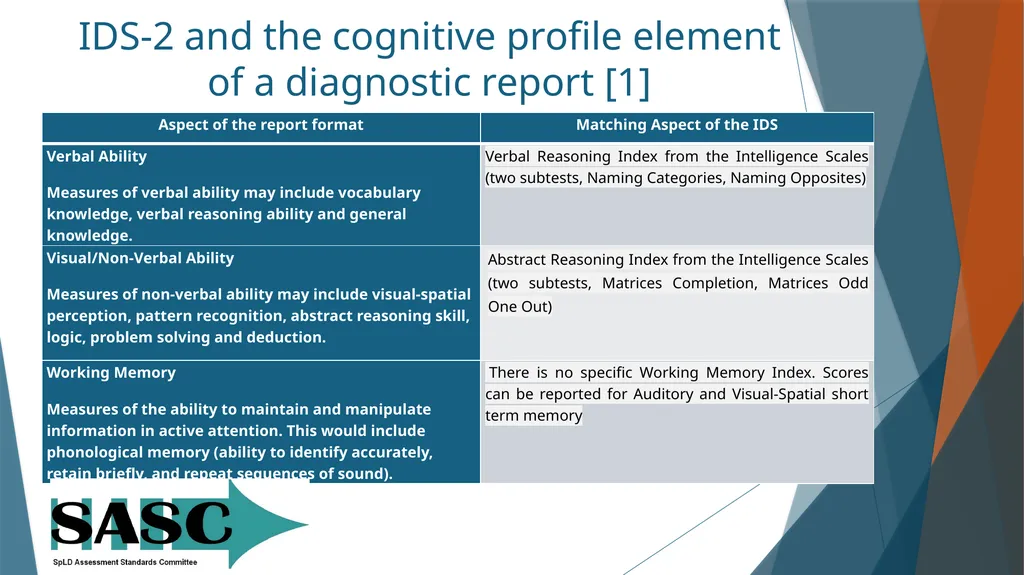
IDS-2 and the cognitive profile element of a diagnostic report [1]<br>
18
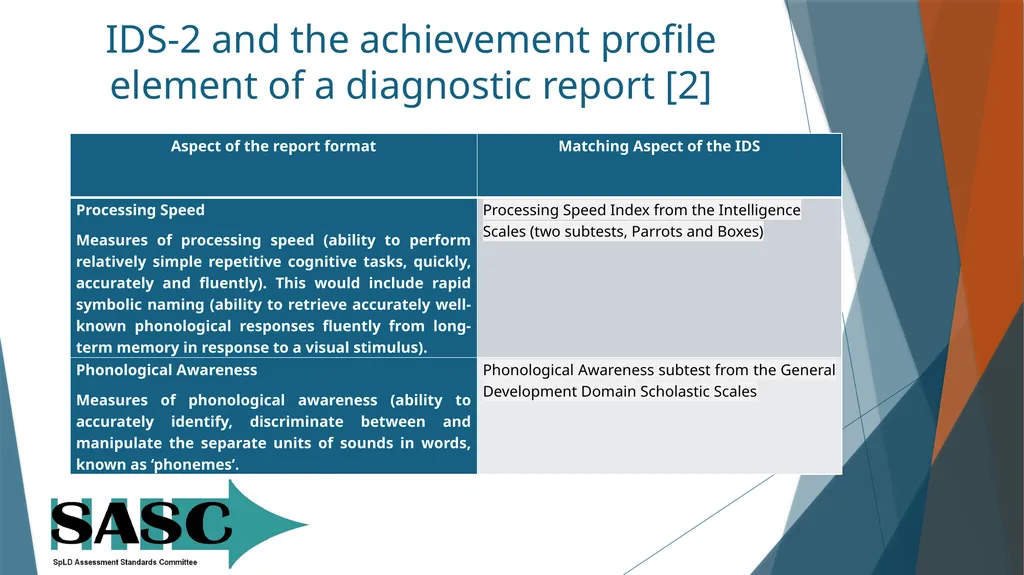
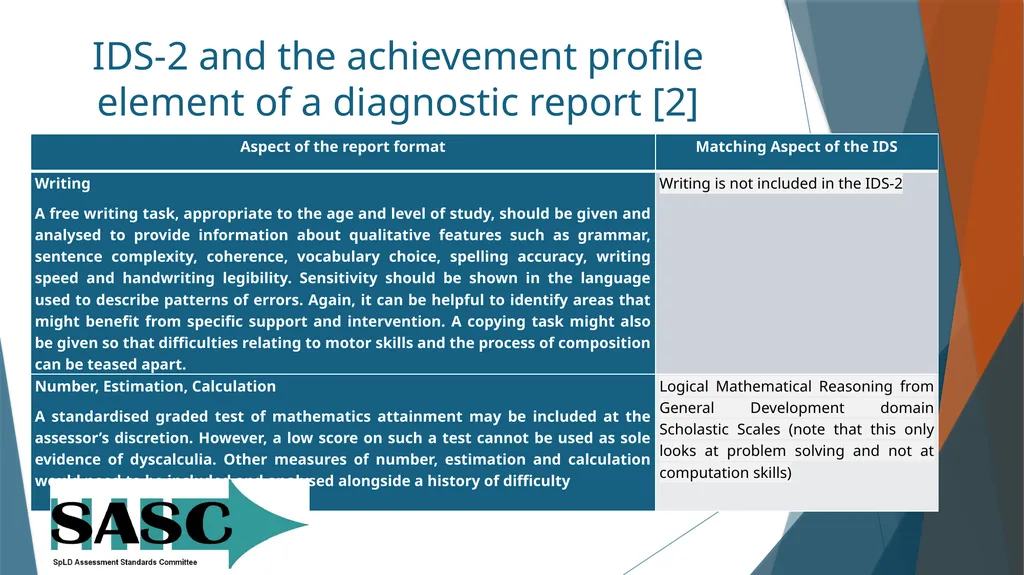
IDS-2 and the achievement profile element of a diagnostic report [2]<br>
19
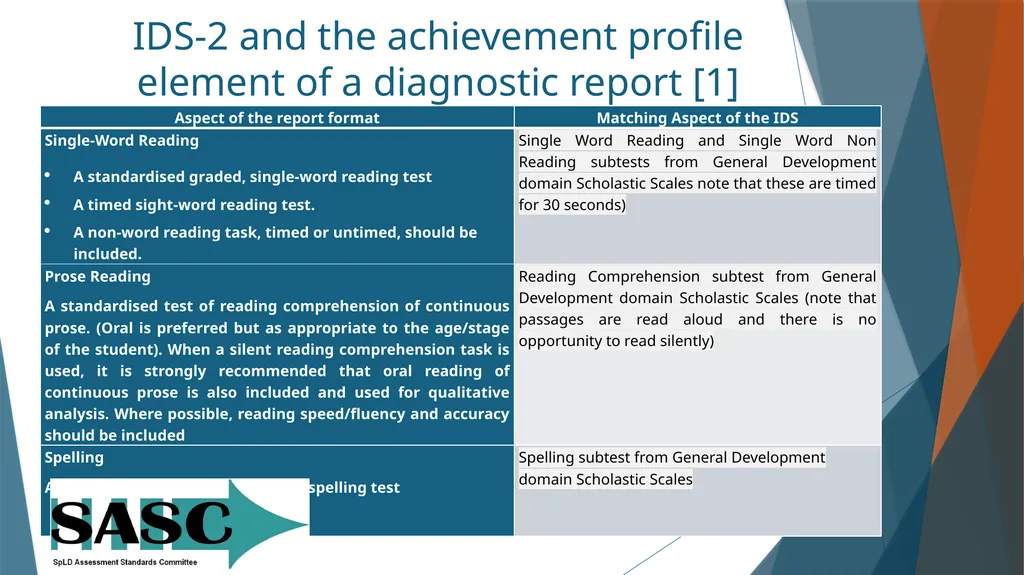
IDS-2 and the achievement profile element of a diagnostic report [1]<br>
20
IDS-2 and the achievement profile element of a diagnostic report [2]<br>
21
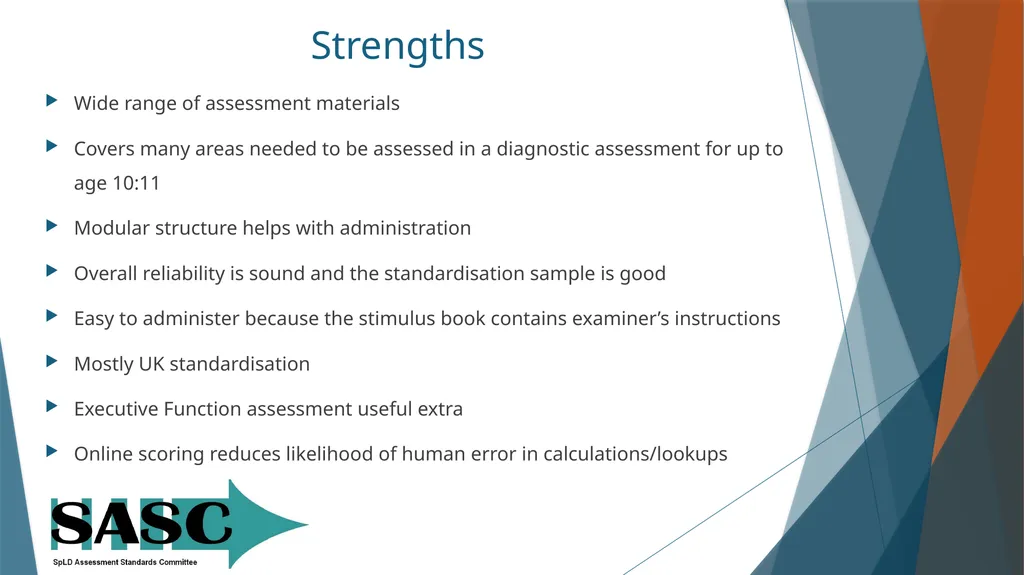
Strengths Wide range of assessment materials
Covers many areas needed to be assessed in a diagnostic assessment for up to age 10:11
Modular structure helps with administration
Overall reliability is sound and the standardisation sample is good
Easy to administer because the stimulus book contains examiner’s instructions
Mostly UK standardisation
Executive Function assessment useful extra
Online scoring reduces likelihood of human error in calculations/lookups<br>
Covers many areas needed to be assessed in a diagnostic assessment for up to age 10:11
Modular structure helps with administration
Overall reliability is sound and the standardisation sample is good
Easy to administer because the stimulus book contains examiner’s instructions
Mostly UK standardisation
Executive Function assessment useful extra
Online scoring reduces likelihood of human error in calculations/lookups<br>
22
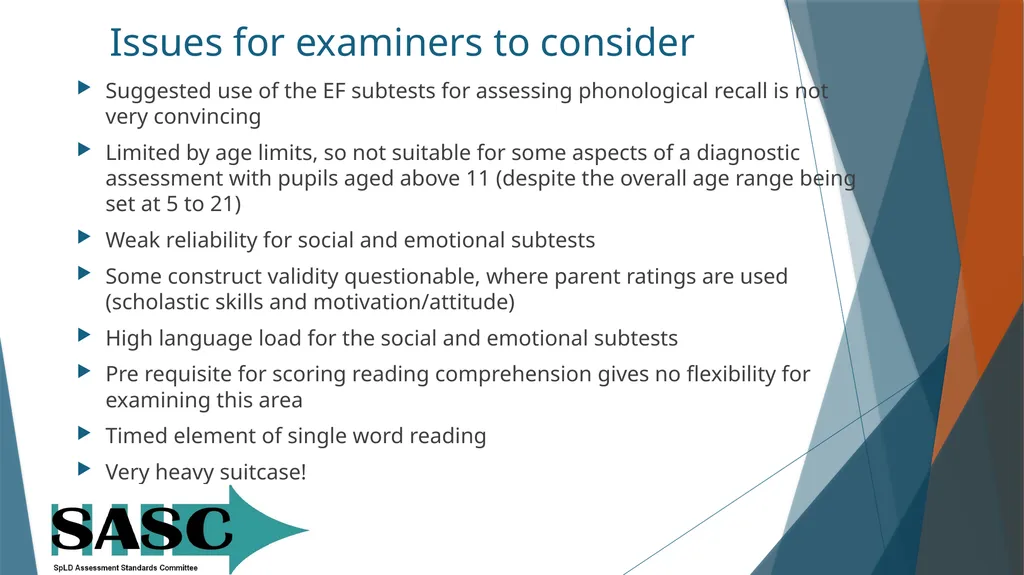
Issues for examiners to consider Suggested use of the EF subtests for assessing phonological recall is not very convincing
Limited by age limits, so not suitable for some aspects of a diagnostic assessment with pupils aged above 11 (despite the overall age range being set at 5 to 21)
Weak reliability for social and emotional subtests
Some construct validity questionable, where parent ratings are used (scholastic skills and motivation/attitude)
High language load for the social and emotional subtests
Pre requisite for scoring reading comprehension gives no flexibility for examining this area
Timed element of single word reading
Very heavy suitcase!<br>
Limited by age limits, so not suitable for some aspects of a diagnostic assessment with pupils aged above 11 (despite the overall age range being set at 5 to 21)
Weak reliability for social and emotional subtests
Some construct validity questionable, where parent ratings are used (scholastic skills and motivation/attitude)
High language load for the social and emotional subtests
Pre requisite for scoring reading comprehension gives no flexibility for examining this area
Timed element of single word reading
Very heavy suitcase!<br>
23
Finally…… Questions?
Comments?
Feedback? The Hogrefe panel of experts will participate in the Q and A session<br>
Comments?
Feedback? The Hogrefe panel of experts will participate in the Q and A session<br>
24
IDS2 Guidance Sep 2022 (sasc.org.uk)<br>