
The interwar period and conclusions Overview
JO
Published · 16 slides · 0 views

1 / 1

Description
The interwar period and conclusions Overview Suffrage Women and Legislation Women and Voting Work Sexuality Conclusion Suffrage NUWSS founded in 1897 numbered about 50,000 followed a policy of civil disobedience WSPU which started in 1903,
Related Topics
Share
Embed code
Download this presentation From Below
"The interwar period and conclusions Overview" is the property of its rightful owner. Permission is granted to download and print the materials on this website for personal, non-commercial use only, and to display it on your personal computer provided you do not modify the materials and that you retain all copyright notices contained in the materials. By downloading content from our website, you accept the terms of this agreement.
Presentation Transcript
01
The interwar period and conclusions<br>
02
Overview Suffrage
Women and Legislation
Women and Voting
Work
Sexuality
Conclusion<br>
Women and Legislation
Women and Voting
Work
Sexuality
Conclusion<br>
03
Suffrage NUWSS founded in 1897 numbered about 50,000 followed a policy of civil disobedience
WSPU which started in 1903, with about 5,000 members used militant tactics
Government response included forcible feeding and the so-called Cat & Mouse Act
But women remained unenfranchised at the start of the war
The Speakers Conference added the grant of the vote for women to its recommendations.
Women over thirty who were on local government registers or wives of registered men and/or graduates of British universities were enfranchised by the 1918 Representation of the People Act.<br>
04
Interpretations The ‘gift’ thesis – that women received the vote in return for their war effort has been discredited by historians.
Only women over 30 were given the vote thus excluding the vast majority of women who worked during the war.
Martin Pugh wrote that the vote was won for women by men rather than as a reward for war work or by the campaigning of the suffragettes
Recent feminist historians have demonstrated that the NUWSS kept up the pressure during the war and it is likely the government wanted to escape renewed suffrage aggression
Sandra Stanley Holton: ‘an appreciation of the suffrage campaign as a site for gender contestation’<br>
05
Legislation The enfranchisement of women had an immediate political effect. Millicent Garrett Fawcett noted in The Women's Victory and After: ‘only two really important Acts bearing especially upon the welfare and status of women had been passed.. from 1907 to 1914’ But in the year following the Reform Act of 1918 ‘at least seven important measures effecting large improvements in the status of women have rapidly gone through all the stages in both Houses of Parliament’.
These included the Sex Disqualification Removal Act, 1919, which enabled women to enter certain professions; the doubling, in 1918, of the sum fathers could be obliged to pay toward the maintenance of an illegitimate child, from five to ten shillings a week; the Midwives Amending Act and the Nurses Registration Act, 1919; the Maternity and Child Welfare Act, 1918, which improved health and welfare facilities for mothers and children and the Industrial Courts Act, 1919, which appointed women to these newly established courts of arbitration on pay and working conditions.
Fawcett wrote: We did not, except as a symbol of free citizenship, value [the vote] as a thing good in itself . . . but for the sake of equal laws, the enlarged opportunities, the improved status of women which we knew it involved. We worked for it . . . because . . . it would benefit not women only, but the whole community . . . it was the cause of men, women and children.<br>
06
Equality? At least twenty-three pieces of legislation were passed between 1918 and 1930 for which women's groups lobbied because they believed that they would promote gender equality. These included changes in marriage and family law in the direction of equalization of the right to sue for divorce, equalization of guardianship rights over children and greater equalization of property rights. There were new welfare measures, such as the first state pensions for widowed mothers and orphans, introduced in 1925,. In 1929 the permissible age of marriage for both sexes was raised to sixteen.
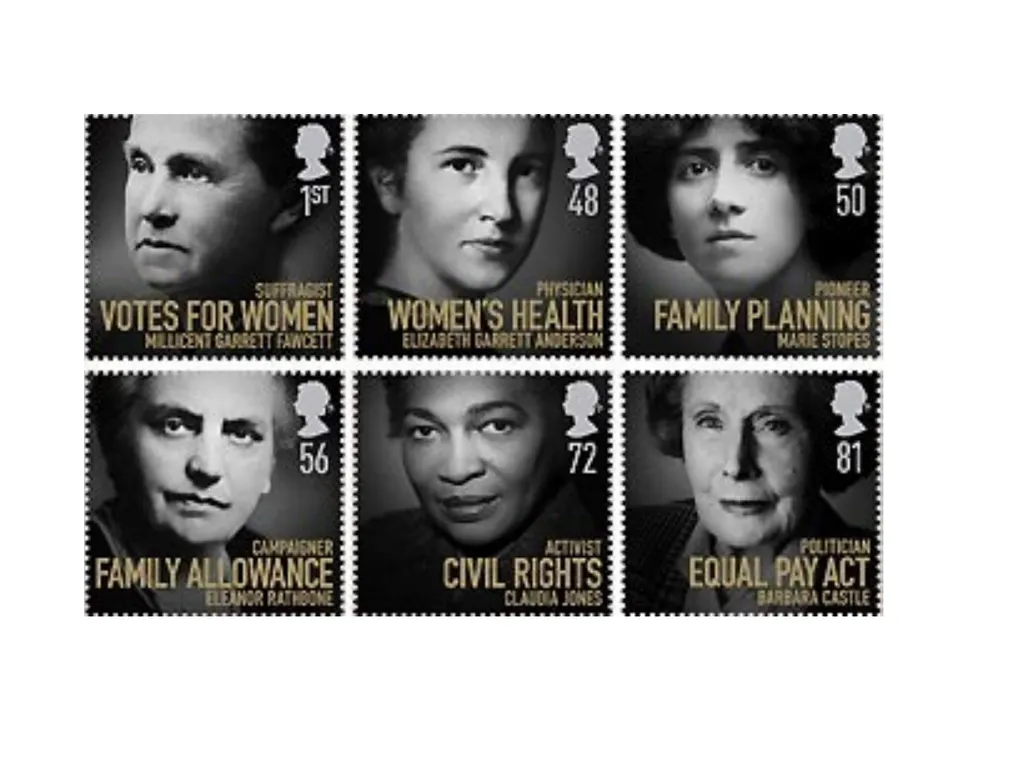
Millicent Garret Fawcett resigned her leadership of the reformed NUWSS now called the National Union of Societies for Equal Citizenship because of its change of focus away from the franchise (which was still unequal) to a broader agenda. She was replaced by Eleanor Rathbone.
Rathbone did not promote gender equality but an equal valuation of different gender roles. Her major campaign was for sizable family allowances
Her campaigns lost popularity and the women’s movement fragmented in the interwar period. The 478 original branches were reduced to 90 by 1929 and 48 by 1935.
Historians more recently have been celebrating the diversity of the interwar feminist groups rather than emphasising ‘failure’<br>
07
The vote The 1918 General Election was contested by 1623 candidates of whom 17 were women. Few suffrage camapigners stood for election. Christabel Pankhurst was the most successful, failing to win a seat as a Conservative by a mere 775 votes.
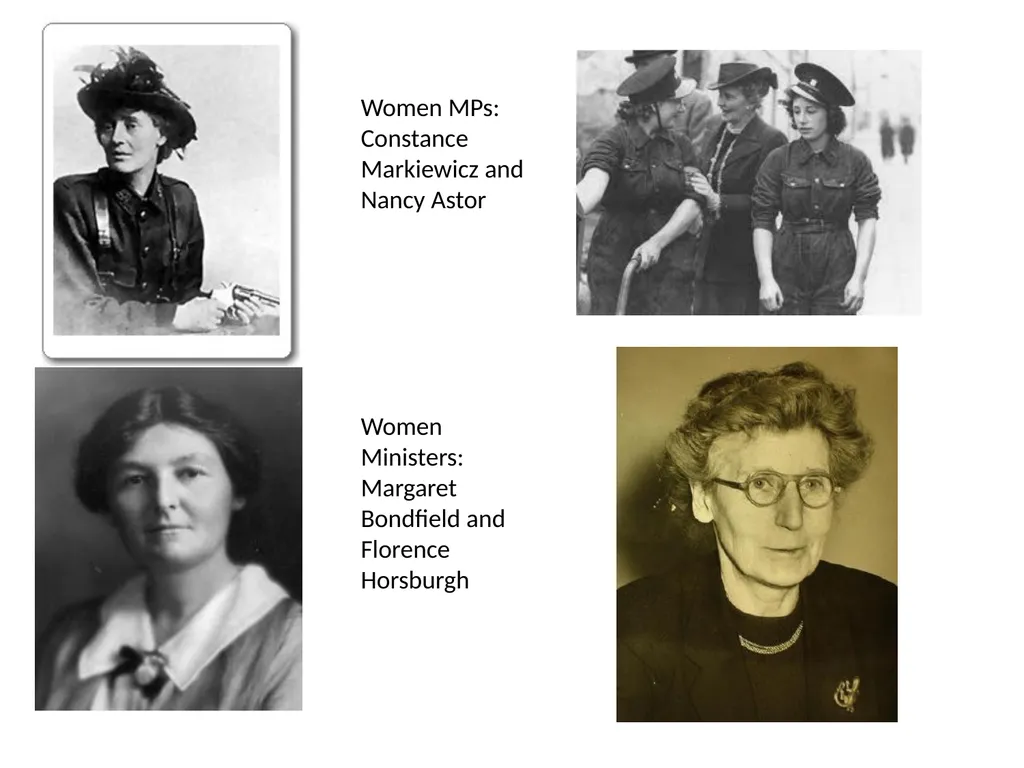
Only one woman was elected, Sinn Fein’s Constance Markiewicz. She refused to take her seat in protest at British imperialism.
Viscountess Astor was the first woman to take up her parliamentary seat winning Plymouth at a by-election in 1919 caused by her husbands accession to the peerage. The first three women in the Commons all replaced their husbands.
15 Conservative seats were won by women from 1918-39; 4 Liberal; 16 Labour; 1 independent (Eleanor Rathbone) and 1 Sinn Fein. The presence of women did not change the party political balance.
The bills they introduced were largely on social policy including the bastardy laws, adoption, nursing home regulations, the Poor Law, expectant mothers and the death sentence, hire purchase and alcohol licensing.
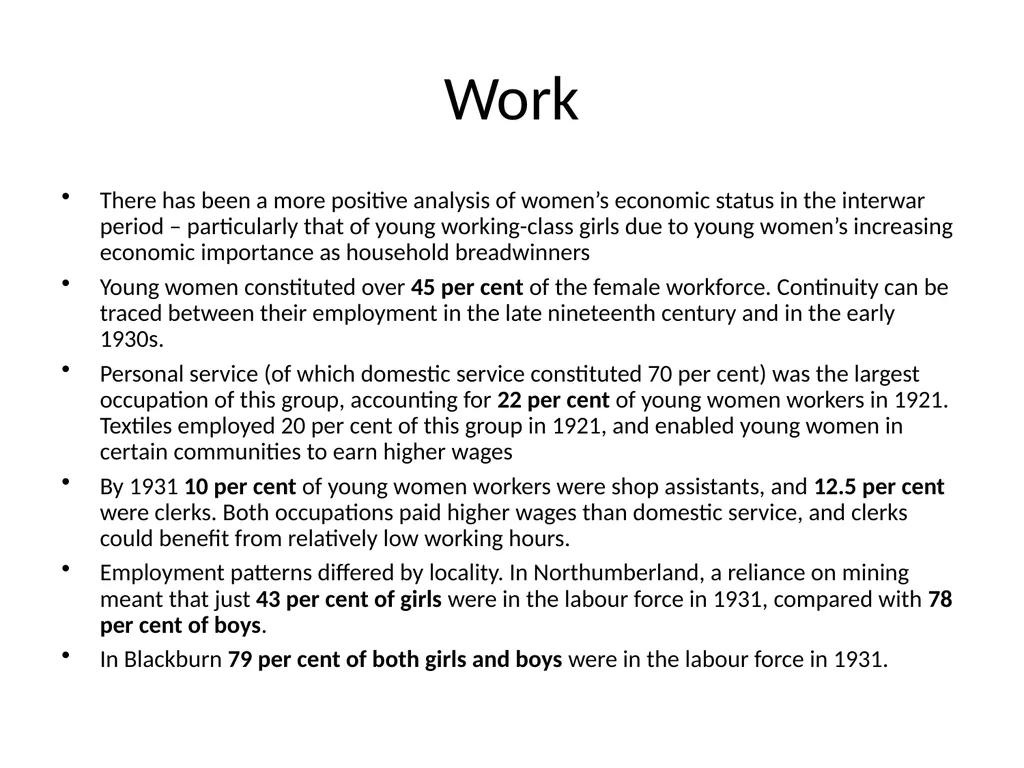
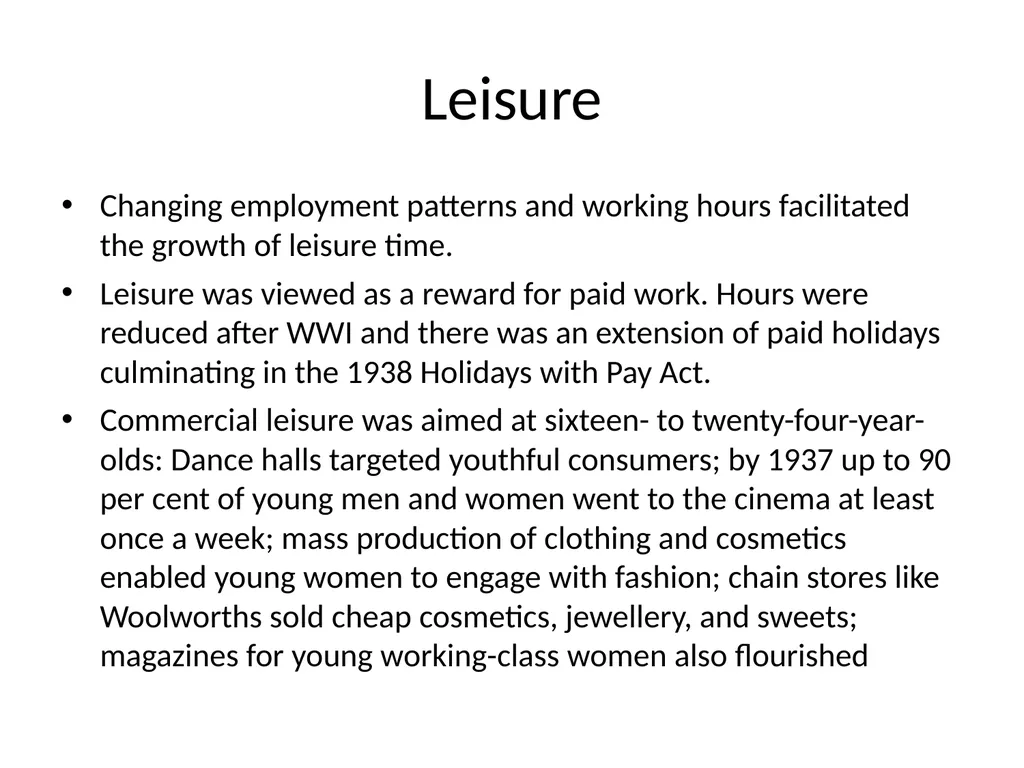
4 women had been appointed to cabinet positions by 1939: Margaret Bondfield (Labour – as Minister for Labour); the duchess of Atholl (Conservative, Education); Susan Lawrence (Labour, Health) and Florence Horsburgh (Conservative, Health)<br>
08
Women MPs:
Constance Markiewicz and Nancy Astor Women Ministers:
Margaret Bondfield and Florence Horsburgh<br>
Constance Markiewicz and Nancy Astor Women Ministers:
Margaret Bondfield and Florence Horsburgh<br>
09
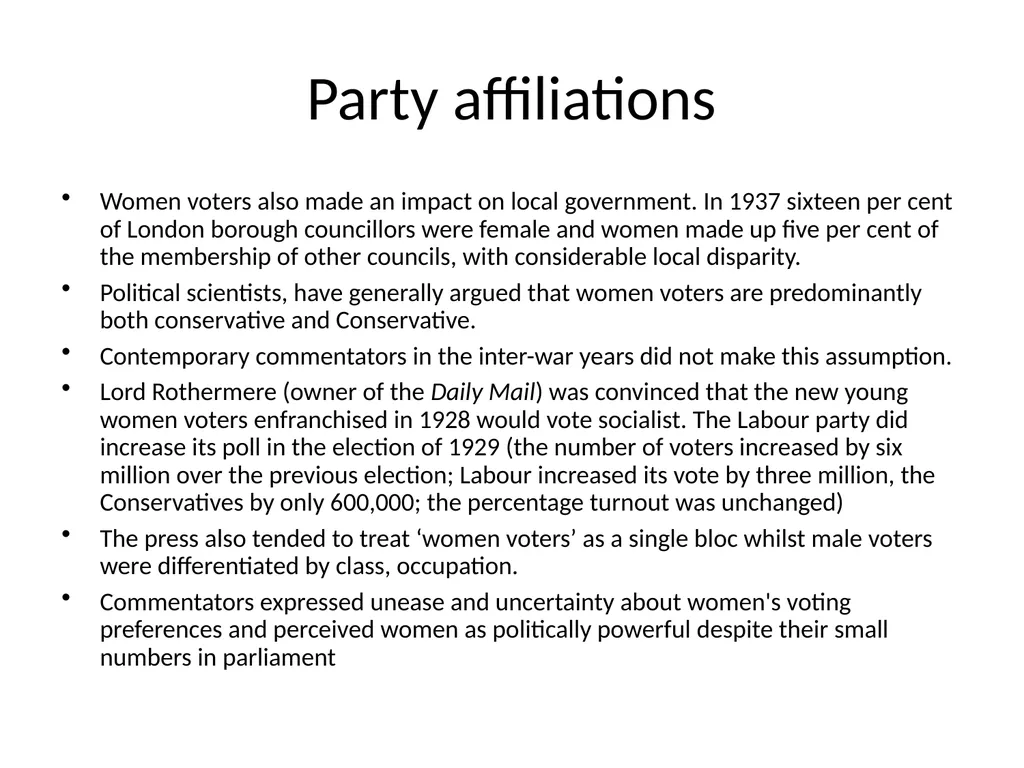
Party affiliations Women voters also made an impact on local government. In 1937 sixteen per cent of London borough councillors were female and women made up five per cent of the membership of other councils, with considerable local disparity.
Political scientists, have generally argued that women voters are predominantly both conservative and Conservative.
Contemporary commentators in the inter-war years did not make this assumption.
Lord Rothermere (owner of the Daily Mail) was convinced that the new young women voters enfranchised in 1928 would vote socialist. The Labour party did increase its poll in the election of 1929 (the number of voters increased by six million over the previous election; Labour increased its vote by three million, the Conservatives by only 600,000; the percentage turnout was unchanged)
The press also tended to treat ‘women voters’ as a single bloc whilst male voters were differentiated by class, occupation.
Commentators expressed unease and uncertainty about women's voting preferences and perceived women as politically powerful despite their small numbers in parliament<br>
10
Work There has been a more positive analysis of women’s economic status in the interwar period – particularly that of young working-class girls due to young women’s increasing economic importance as household breadwinners
Young women constituted over 45 per cent of the female workforce. Continuity can be traced between their employment in the late nineteenth century and in the early 1930s.
Personal service (of which domestic service constituted 70 per cent) was the largest occupation of this group, accounting for 22 per cent of young women workers in 1921. Textiles employed 20 per cent of this group in 1921, and enabled young women in certain communities to earn higher wages
By 1931 10 per cent of young women workers were shop assistants, and 12.5 per cent were clerks. Both occupations paid higher wages than domestic service, and clerks could benefit from relatively low working hours.
Employment patterns differed by locality. In Northumberland, a reliance on mining meant that just 43 per cent of girls were in the labour force in 1931, compared with 78 per cent of boys.
In Blackburn 79 per cent of both girls and boys were in the labour force in 1931.<br>
11
Leisure Changing employment patterns and working hours facilitated the growth of leisure time.
Leisure was viewed as a reward for paid work. Hours were reduced after WWI and there was an extension of paid holidays culminating in the 1938 Holidays with Pay Act.
Commercial leisure was aimed at sixteen- to twenty-four-year-olds: Dance halls targeted youthful consumers; by 1937 up to 90 per cent of young men and women went to the cinema at least once a week; mass production of clothing and cosmetics enabled young women to engage with fashion; chain stores like Woolworths sold cheap cosmetics, jewellery, and sweets; magazines for young working-class women also flourished<br>
12
Sexuality The Eugenics Society was founded in 1907 and its view was that women as guardians of the future of the British ‘race’ should be both chaste and fruitful some arguing that the employment of married women led to a decline in virility and high infant mortality rates
The Mental Deficiency Act of 1913 gave local authorities powers over pregnant women who were homeless, destitute or ‘immoral’
There was an attempt in 1921 to criminalise lesbianism. The Obscene Publications legislation was used to repress Radclyffe Hall’s The Well of Loneliness written in 1928
the Matrimonial Causes Act of 1923 made adultery the sole grounds of divorce for either spouse. Further grounds were added in 1937 including a wife’s right to divorce her husband for rape.
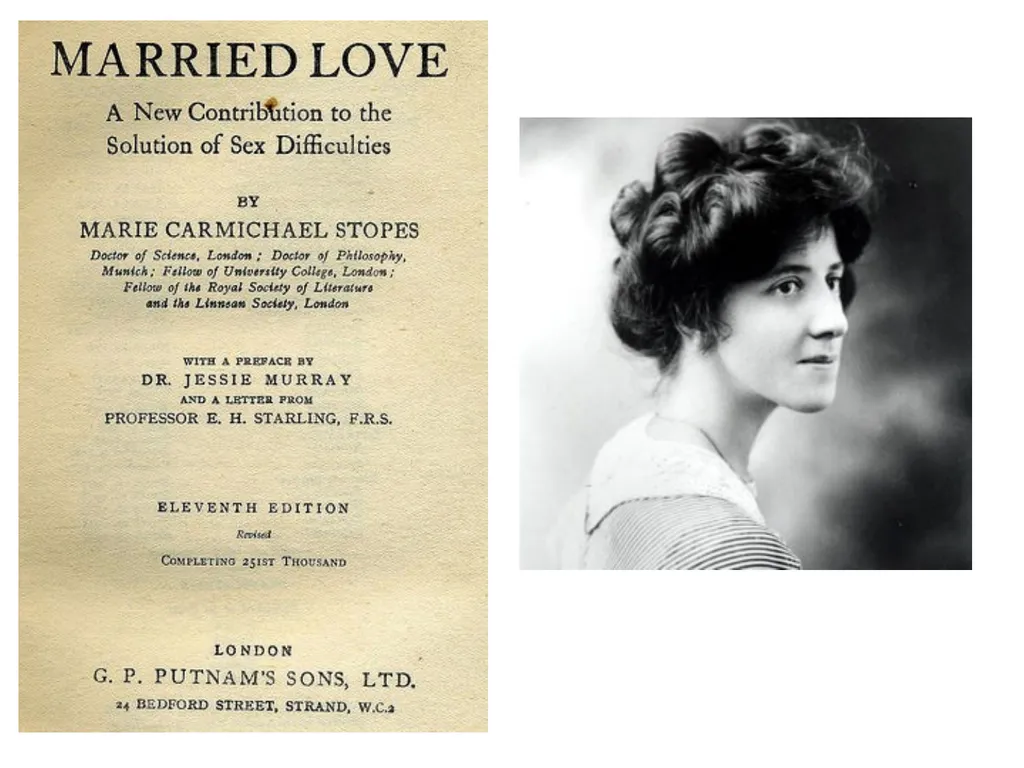
Marie Stopes founded a birth control clinic but contraception was controversial and its availability largely confined to middle and upper class women. Abortion remained illegal although in 1929 legislation was passed making it legal to abort if the mother’s life was in danger. The Abortion Law Reform Association was formed in 1936 and a government committee was created to review the legislation in 1938<br>
13
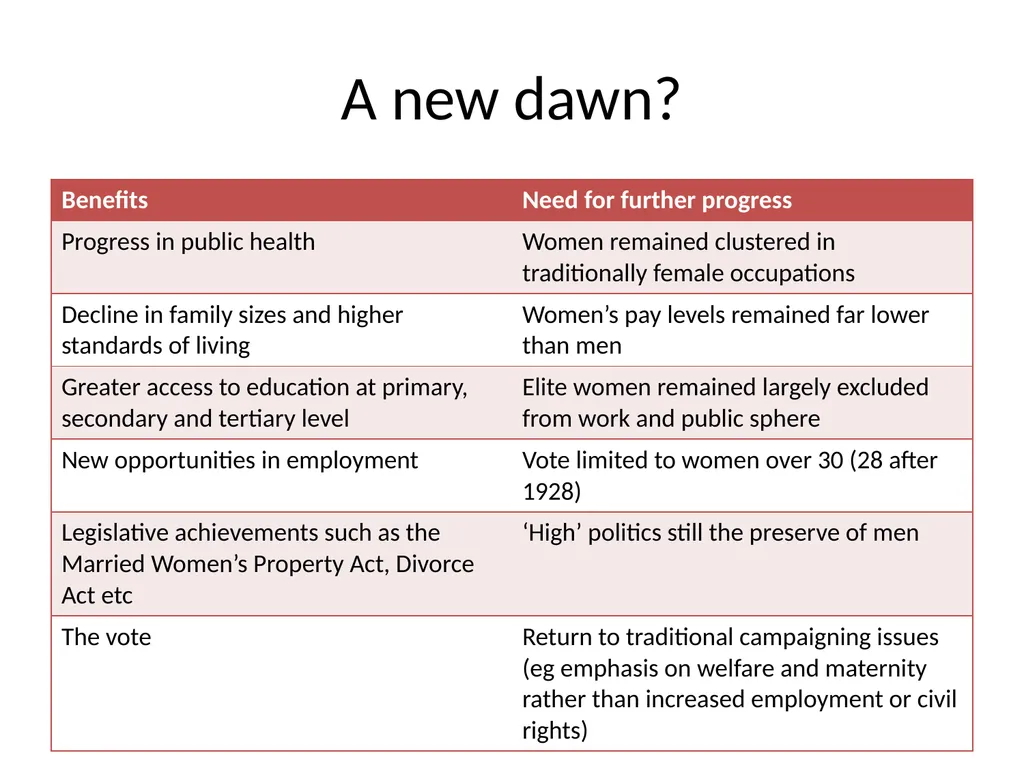
A new dawn?<br>