
The Mandatory Performance Framework and Quality

Description: The Mandatory Performance Framework and Quality Reviews Anthony V. Aaron, CFA, ASA, FRICS Adjunct Professor University of Southern California Presentation to the VII International Business Valuation Conference Organismo Italiano di
Related Topics
Download Presentation
"The Mandatory Performance Framework and Quality" is the property of its rightful owner. Permission is granted to download and print the materials on this website for personal, non-commercial use only, and to display it on your personal computer provided you do not modify the materials and that you retain all copyright notices contained in the materials. By downloading content from our website, you accept the terms of this agreement.
Presentation Transcript
slide1. The Mandatory
Performance Framework and Quality Reviews
Anthony V. Aaron, CFA, ASA, FRICS
Adjunct Professor
University of Southern California
Presentation to the
VII International Business Valuation Conference
Organismo Italiano di Valutazione
November 12, 2018<br>
slide2. This presentation contains numerous quotations from documents entitled “Mandatory Performance Framework” and ”Application of the Mandatory Performance Framework”. These documents are copyrighted works of the Corporate and Intangibles Valuation Organization, LLC. In addition, reference is made to the Certified in Entity and Intangible Valuation credential, which is a trademark of the Corporate and Intangibles Valuation Organization, LLC.
Parts of this presentation have been adapted from class materials created by Professor Anthony V. Aaron and utilized in a graduate class, ACCT 558, “Advanced Accounting Valuation” at the University of Southern California.<br>
slide3. Today’s Topics The Fair Value Quality Initiative (“FVQI”)
The Certified in Entity and Intangible Valuations credential (“CEIV”)
The Mandatory Performance Framework (“MPF”) and the Application of the Mandatory Performance Framework (“AMPF”)
Quality Reviews for CEIV credential holders<br>
slide4. The Fair Value Quality Initiative (“FVQI”)<br>
slide5. The Fair Value Quality Initiative The Fair Value Quality Initiative (“FVQI” ): What is it?
“Within the past several years, public statements by U.S. capital market regulators have called into question whether some of the individuals that assist SEC registrants with estimating fair value for financial reporting purposes have the requisite training, qualifications, experience, and expertise to perform this type of work. The SEC staff has expressed a desire that the various stakeholders in the valuation profession coordinate their efforts to establish rigorous and uniform qualifications, training, accreditation, and oversight of individuals conducting fair value measurements.”<br>
slide6. The Fair Value Quality Initiative The Fair Value Quality Initiative (“FVQI”): What is it?
“In response to these regulatory concerns and the public perceptions, numerous groups including not-for-profit valuation professional organizations (VPOs), non-membership VPOs, and others collaborated to form a task force (Ultimately, the FVQI) that focused on the issues facing the valuation profession and how best to address them.” (emphasis added)
A legal entity, the “Corporate and Intangibles Valuation Organization, LLC” (“CIVO”) was created to house the intellectual property created by the initiative and carry out joint activities of the joint efforts of the three founding Valuation Professional Organizations (“VPO’s”).<br>
slide7. The Certified in Entity and Intangible Valuations Credential (“CEIV“)<br>
slide8. Certified in Entity and Intangible Valuation Credential The Certified in Entity and Intangible Valuation credential (“CEIV”): What is it?
The Certified in Entity and Intangible Valuations credential was developed jointly by the AICPA, the ASA and the Royal Institution of Chartered Surveyors (“RICS”) for Valuation Professionals who perform fair value measurements (ASC 820) for entities and intangible assets for financial reporting purposes.
This includes performing valuations for business combinations (ASC 805), the testing of goodwill and other long-lived assets for impairment (ASC 350/360), applying the fair value option (ASC 825), measuring investments of investment companies (ASC 946) and analyzing share-based compensation (ASC 718).<br>
slide9. Certified in Entity and Intangible Valuation Credential The Certified in Entity and Intangible Valuation credential (“CEIV”): What is it?
CEIVs must;
Meet a minimum number of hours of fair value measurement-related experience (initial and ongoing)
Possess/undertake required fair value-related education and training (initial and ongoing)
Successfully complete an examination demonstrating their knowledge of the MPF/AMPF and the valuation body of knowledge relevant to fair value measurement
Submit to a proactive, ongoing engagement-level quality review process
Comply with the established Mandatory Performance Framework<br>
slide10. The Mandatory
Performance Framework (“MPF”) and the Application of the Mandatory Performance Framework (“AMPF”)<br>
slide11. Mandatory Performance Framework The Mandatory Performance Framework (“MPF”): What is it?
“The MPF contains requirements that cover how much work should be performed in order to prepare a professional work product. The performance framework addresses scope of work, extent of documentation and analysis, consideration of contrary evidence, and documentation in both the report and the supporting working papers. Alternatively, the performance framework establishes the extent to which valuation professionals perform their work in terms of depth of analysis and documentation.”<br>
slide12. Mandatory Performance Framework The MPF is really two documents: the MPF and the Application of the MPF (“AMPF”), which are often collectively referred to as the “MPF documents”.
The MPF contains the following sections:
Executive Summary
Preamble
Valuation Engagement Guidance
Mandatory Performance Framework Glossary
Authoritative and Technical Guidance<br>
slide13. Mandatory Performance Framework The Executive Summary contains discussion of the following topics:
Problem Identification
Performance Requirements
Professional Standards – “Who should do this work?”
Technical Standards – “How should the work be done?”
Performance Framework – “How much work must be done?”
Structure of the MPF and the AMPF
Scope of Adoption and Adherence
Mandatory for CEIV credential holders
Best Practice for all others<br>
slide14. Mandatory Performance Framework The Preamble contains discussion of the following topics:
Introductory material
Applicable business valuation standards
AICPA VS Section 100 (formerly SSVS No. 1)
ASA BVS
RICS Professional Standards
TAF USPAP
IVSC IVS
Relevant accounting and audit Standards applicable to business valuation and intangible assets
ASC and in some cases IFRS
Scope of the Mandatory Performance Framework
Engagements to estimate fair value
Exceptions to the Mandatory Performance Framework<br>
slide15. Mandatory Performance Framework The Valuation Engagement Guidance section contains discussion of the following topics:
Documentation Requirements for Fair Value Engagements
Source Documents
Analysis Documents
Computational Analysis (i.e. spreadsheets)
Narrative-based Analysis (explain the “why”)
Extent of Documentation Requirements
“An experienced professional (note: who may or may not be a valuation professional) reviewing the final valuation report who has no involvement with the engagement must be able to understand the purpose, nature, extent, and results of the valuation procedures performed…”<br>
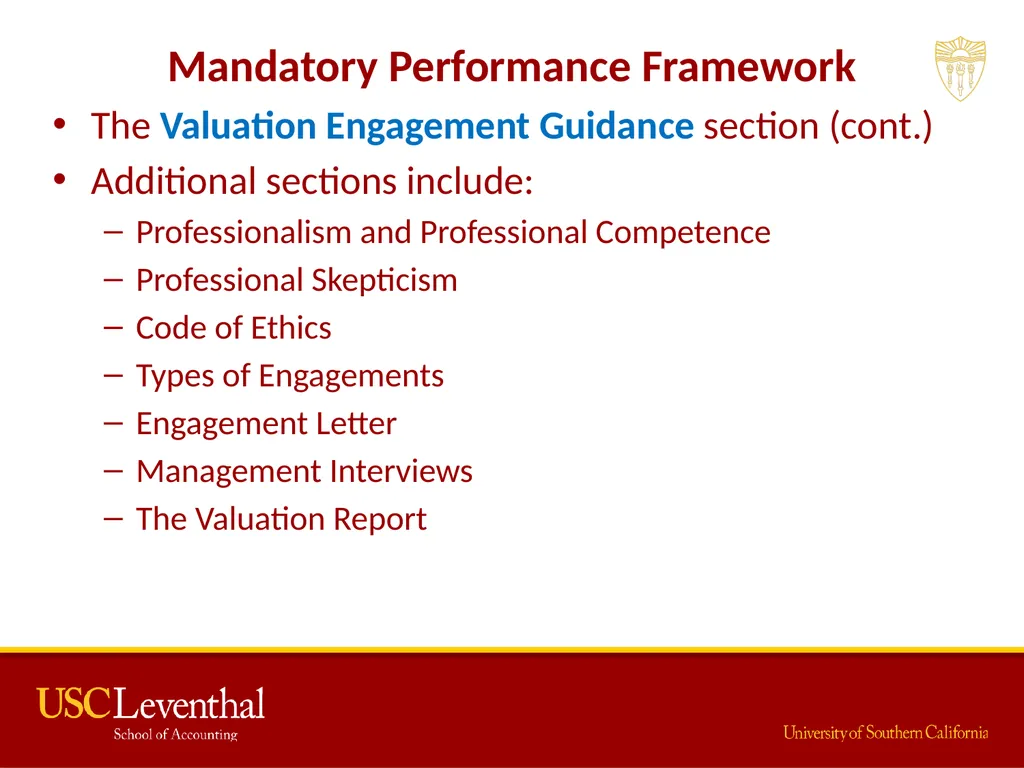
slide16. Mandatory Performance Framework The Valuation Engagement Guidance section (cont.)
Additional sections include:
Professionalism and Professional Competence
Professional Skepticism
Code of Ethics
Types of Engagements
Engagement Letter
Management Interviews
The Valuation Report<br>
slide17. Mandatory Performance Framework The Mandatory Performance Framework Glossary section can best be described by the following:
“The glossary sets forth definitions of terms that may be unique to the framework, or defines their meaning within the context of the framework”<br>
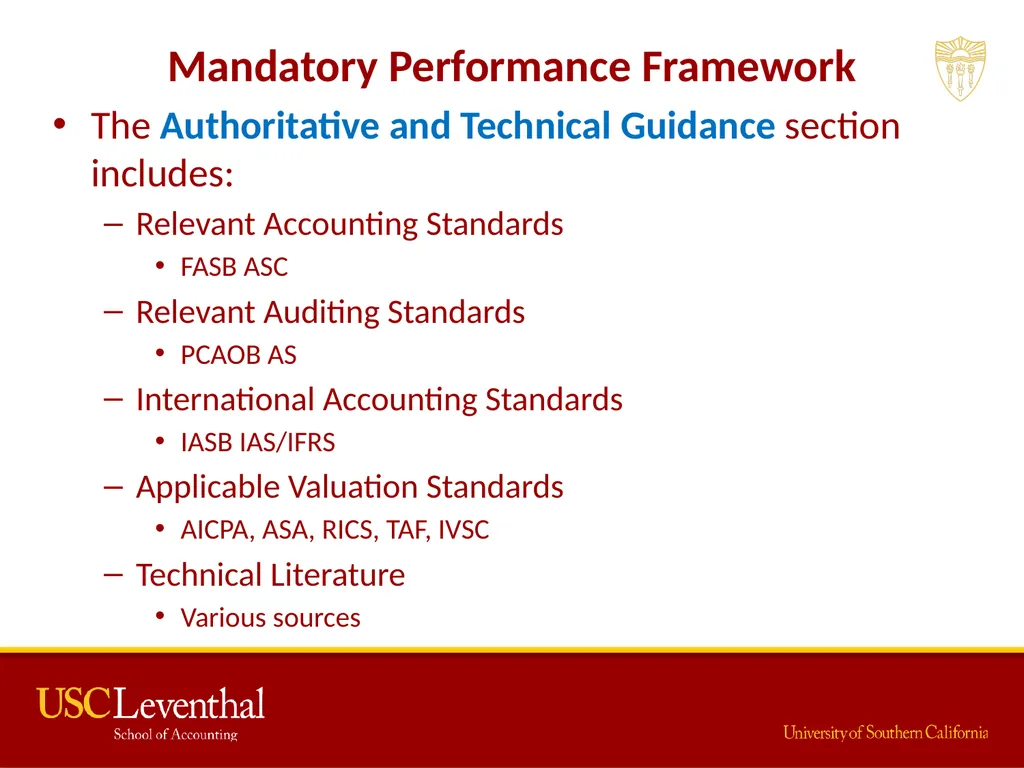
slide18. Mandatory Performance Framework The Authoritative and Technical Guidance section includes:
Relevant Accounting Standards
FASB ASC
Relevant Auditing Standards
PCAOB AS
International Accounting Standards
IASB IAS/IFRS
Applicable Valuation Standards
AICPA, ASA, RICS, TAF, IVSC
Technical Literature
Various sources<br>
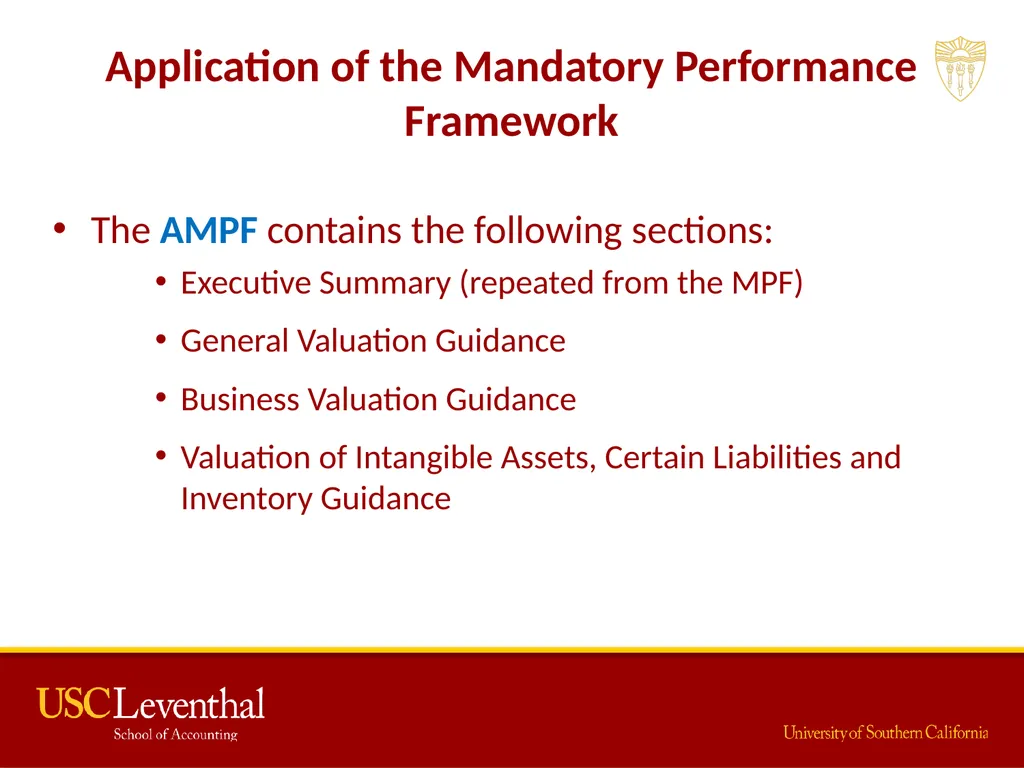
slide19. Application of the Mandatory Performance Framework The AMPF contains the following sections:
Executive Summary (repeated from the MPF)
General Valuation Guidance
Business Valuation Guidance
Valuation of Intangible Assets, Certain Liabilities and Inventory Guidance<br>
slide20. Application of the Mandatory Performance Framework General Valuation Guidance
Fair Value Measurement
Selection of Valuation Approaches and Methods
Prospective Financial Information (PFI)<br>
slide21. Application of the Mandatory Performance Framework Business Valuation Guidance
Discount rate Derivation (A2.2)
Growth rates (A2.3)
Terminal Value Multiples and Methods and Models (A2.4)
Selection of, and Adjustments to, Valuation Multiples (A2.5)
Selection of Guideline Public Companies or Guideline Company Transactions (A2.6)
Discounts and Premiums (A2.7)<br>
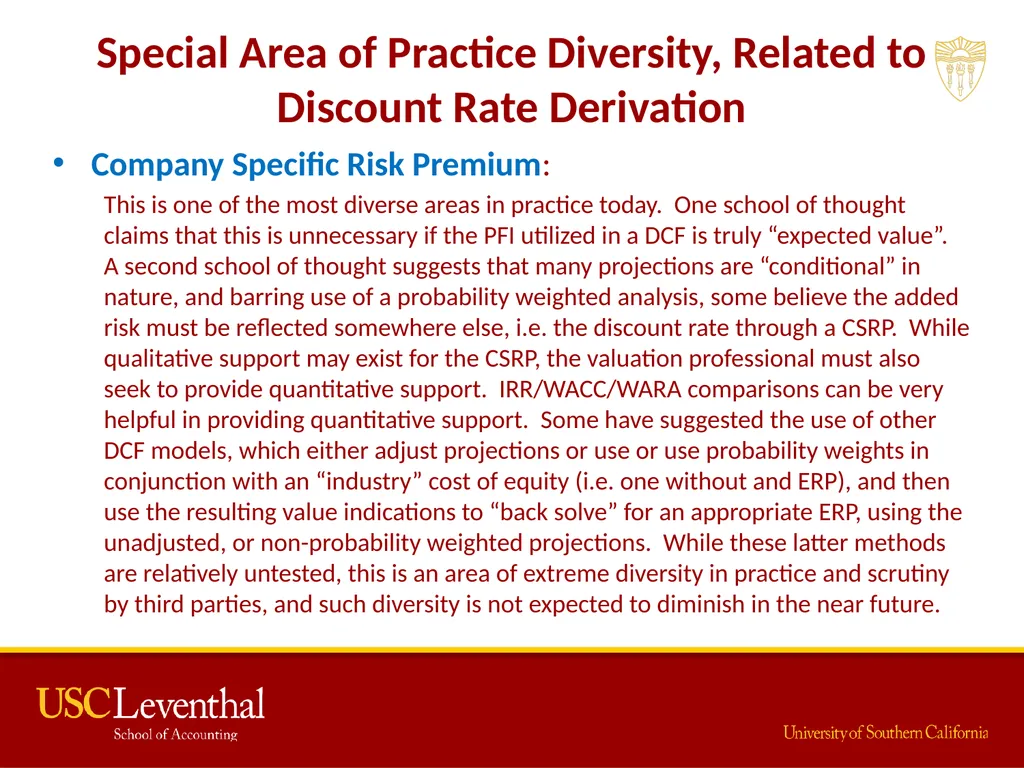
slide22. Special Area of Practice Diversity, Related to Discount Rate Derivation Company Specific Risk Premium:
This is one of the most diverse areas in practice today. One school of thought claims that this is unnecessary if the PFI utilized in a DCF is truly “expected value”. A second school of thought suggests that many projections are “conditional” in nature, and barring use of a probability weighted analysis, some believe the added risk must be reflected somewhere else, i.e. the discount rate through a CSRP. While qualitative support may exist for the CSRP, the valuation professional must also seek to provide quantitative support. IRR/WACC/WARA comparisons can be very helpful in providing quantitative support. Some have suggested the use of other DCF models, which either adjust projections or use or use probability weights in conjunction with an “industry” cost of equity (i.e. one without and ERP), and then use the resulting value indications to “back solve” for an appropriate ERP, using the unadjusted, or non-probability weighted projections. While these latter methods are relatively untested, this is an area of extreme diversity in practice and scrutiny by third parties, and such diversity is not expected to diminish in the near future.<br>
slide23. Application of the Mandatory Performance Framework Valuation of Intangible Assets, Certain Liabilities and Inventory Guidance
Identified Assets and Liabilities (A3.2)
Operating rights (A3.3)
Life for Projection Period (A3.4)
Customer related intangible assets (A3.5)
Royalty rates (A3.6)
Contributory Asset Charges (A3.7)
Tax Amortization Benefits (A3.8)
Discount Rate/IRR/WARA (A3.9)
Reconciliation of Intangible Asset Values (A3.10)
Contract Liabilities (A3.11)
Inventory (A3.12)<br>
slide24. MPF and AMPF A “Frequently Asked Questions” Document (“FAQ”) has been prepared by members of the Performance Requirements Work Stream to provide interpretive guidance on the MPF and AMPF
This document was prepared as a result of responses to a request made to the US valuation community for input on questions related to implementation and interpretation of the MPF and AMPF<br>
slide25. Quality Reviews for CEIV credential holders<br>
slide26. Quality Reviews for CEIV Credential Holders The Quality Review process for CEIV credential holders will likely commence in early 2019
The process will implemented on a confidential basis for both CEIV credential holders that are reviewed and with respect to the confidentiality of client work product
Quality reviews will focus on compliance with the MPF/AMPF<br>
slide27. Quality Reviews for CEIV Credential Holders For larger Firms that have internal quality control processes, the focus will be on assessing the Firm’s processes and performing sample reviews of CEIV credential holders and of individual client files
All CEIV credential credential holders will eventually be subject to review
The timing of initial quality reviews and the frequency of quality reviews thereafter will be determined as the process is implemented<br>
slide28. Quality Reviews for CEIV Credential Holders A common review “form” has been drafted, and will used across for all CEIV credential holders, regardless of which VPO awarded their credential
A single reviewer organization is contemplated. As such there will not be a separate review process to be conducted by individual VPOs. Quality reviewers will undergo MPF/AMPF training
Adjudication and Sanctions, where necessary, post quality review, will be handled by the individual VPOs, with respect to their members who hold the CEIV credential<br>
slide29. Summary The FVQI and CIVO were created through a collaboration across an number of organizations in response to critical comments made by US securities regulators, about the Valuation Profession
The MPF and AMPF documents were drafted by the Performance Requirements Work stream of the FVQI, to set forth a framework for scope of work and documentation, which has as its goal the maintenance/improvement of quality and consistency in fair value measurements prepared for financial reporting purposes<br>
slide30. Summary (continued) The CEIV credential was developed to demonstrate a high level of professionalism by credential holders in preparing fair value measurements in financial reporting
CEIV credential holders must possess minimum levels of education and specific experience in performing fair value measurements for financial reporting, must undertake specific training relating to the MPF/AMPF and the valuation body of knowledge, must pass a comprehensive examination, and must submit to periodic quality reviews regarding their compliance with the requirements of the CEIV credential, particularly with respect to compliance with the MPF/AMPF<br>
slide31. Questions?<br>
Performance Framework and Quality Reviews
Anthony V. Aaron, CFA, ASA, FRICS
Adjunct Professor
University of Southern California
Presentation to the
VII International Business Valuation Conference
Organismo Italiano di Valutazione
November 12, 2018<br>
slide2. This presentation contains numerous quotations from documents entitled “Mandatory Performance Framework” and ”Application of the Mandatory Performance Framework”. These documents are copyrighted works of the Corporate and Intangibles Valuation Organization, LLC. In addition, reference is made to the Certified in Entity and Intangible Valuation credential, which is a trademark of the Corporate and Intangibles Valuation Organization, LLC.
Parts of this presentation have been adapted from class materials created by Professor Anthony V. Aaron and utilized in a graduate class, ACCT 558, “Advanced Accounting Valuation” at the University of Southern California.<br>
slide3. Today’s Topics The Fair Value Quality Initiative (“FVQI”)
The Certified in Entity and Intangible Valuations credential (“CEIV”)
The Mandatory Performance Framework (“MPF”) and the Application of the Mandatory Performance Framework (“AMPF”)
Quality Reviews for CEIV credential holders<br>
slide4. The Fair Value Quality Initiative (“FVQI”)<br>
slide5. The Fair Value Quality Initiative The Fair Value Quality Initiative (“FVQI” ): What is it?
“Within the past several years, public statements by U.S. capital market regulators have called into question whether some of the individuals that assist SEC registrants with estimating fair value for financial reporting purposes have the requisite training, qualifications, experience, and expertise to perform this type of work. The SEC staff has expressed a desire that the various stakeholders in the valuation profession coordinate their efforts to establish rigorous and uniform qualifications, training, accreditation, and oversight of individuals conducting fair value measurements.”<br>
slide6. The Fair Value Quality Initiative The Fair Value Quality Initiative (“FVQI”): What is it?
“In response to these regulatory concerns and the public perceptions, numerous groups including not-for-profit valuation professional organizations (VPOs), non-membership VPOs, and others collaborated to form a task force (Ultimately, the FVQI) that focused on the issues facing the valuation profession and how best to address them.” (emphasis added)
A legal entity, the “Corporate and Intangibles Valuation Organization, LLC” (“CIVO”) was created to house the intellectual property created by the initiative and carry out joint activities of the joint efforts of the three founding Valuation Professional Organizations (“VPO’s”).<br>
slide7. The Certified in Entity and Intangible Valuations Credential (“CEIV“)<br>
slide8. Certified in Entity and Intangible Valuation Credential The Certified in Entity and Intangible Valuation credential (“CEIV”): What is it?
The Certified in Entity and Intangible Valuations credential was developed jointly by the AICPA, the ASA and the Royal Institution of Chartered Surveyors (“RICS”) for Valuation Professionals who perform fair value measurements (ASC 820) for entities and intangible assets for financial reporting purposes.
This includes performing valuations for business combinations (ASC 805), the testing of goodwill and other long-lived assets for impairment (ASC 350/360), applying the fair value option (ASC 825), measuring investments of investment companies (ASC 946) and analyzing share-based compensation (ASC 718).<br>
slide9. Certified in Entity and Intangible Valuation Credential The Certified in Entity and Intangible Valuation credential (“CEIV”): What is it?
CEIVs must;
Meet a minimum number of hours of fair value measurement-related experience (initial and ongoing)
Possess/undertake required fair value-related education and training (initial and ongoing)
Successfully complete an examination demonstrating their knowledge of the MPF/AMPF and the valuation body of knowledge relevant to fair value measurement
Submit to a proactive, ongoing engagement-level quality review process
Comply with the established Mandatory Performance Framework<br>
slide10. The Mandatory
Performance Framework (“MPF”) and the Application of the Mandatory Performance Framework (“AMPF”)<br>
slide11. Mandatory Performance Framework The Mandatory Performance Framework (“MPF”): What is it?
“The MPF contains requirements that cover how much work should be performed in order to prepare a professional work product. The performance framework addresses scope of work, extent of documentation and analysis, consideration of contrary evidence, and documentation in both the report and the supporting working papers. Alternatively, the performance framework establishes the extent to which valuation professionals perform their work in terms of depth of analysis and documentation.”<br>
slide12. Mandatory Performance Framework The MPF is really two documents: the MPF and the Application of the MPF (“AMPF”), which are often collectively referred to as the “MPF documents”.
The MPF contains the following sections:
Executive Summary
Preamble
Valuation Engagement Guidance
Mandatory Performance Framework Glossary
Authoritative and Technical Guidance<br>
slide13. Mandatory Performance Framework The Executive Summary contains discussion of the following topics:
Problem Identification
Performance Requirements
Professional Standards – “Who should do this work?”
Technical Standards – “How should the work be done?”
Performance Framework – “How much work must be done?”
Structure of the MPF and the AMPF
Scope of Adoption and Adherence
Mandatory for CEIV credential holders
Best Practice for all others<br>
slide14. Mandatory Performance Framework The Preamble contains discussion of the following topics:
Introductory material
Applicable business valuation standards
AICPA VS Section 100 (formerly SSVS No. 1)
ASA BVS
RICS Professional Standards
TAF USPAP
IVSC IVS
Relevant accounting and audit Standards applicable to business valuation and intangible assets
ASC and in some cases IFRS
Scope of the Mandatory Performance Framework
Engagements to estimate fair value
Exceptions to the Mandatory Performance Framework<br>
slide15. Mandatory Performance Framework The Valuation Engagement Guidance section contains discussion of the following topics:
Documentation Requirements for Fair Value Engagements
Source Documents
Analysis Documents
Computational Analysis (i.e. spreadsheets)
Narrative-based Analysis (explain the “why”)
Extent of Documentation Requirements
“An experienced professional (note: who may or may not be a valuation professional) reviewing the final valuation report who has no involvement with the engagement must be able to understand the purpose, nature, extent, and results of the valuation procedures performed…”<br>
slide16. Mandatory Performance Framework The Valuation Engagement Guidance section (cont.)
Additional sections include:
Professionalism and Professional Competence
Professional Skepticism
Code of Ethics
Types of Engagements
Engagement Letter
Management Interviews
The Valuation Report<br>
slide17. Mandatory Performance Framework The Mandatory Performance Framework Glossary section can best be described by the following:
“The glossary sets forth definitions of terms that may be unique to the framework, or defines their meaning within the context of the framework”<br>
slide18. Mandatory Performance Framework The Authoritative and Technical Guidance section includes:
Relevant Accounting Standards
FASB ASC
Relevant Auditing Standards
PCAOB AS
International Accounting Standards
IASB IAS/IFRS
Applicable Valuation Standards
AICPA, ASA, RICS, TAF, IVSC
Technical Literature
Various sources<br>
slide19. Application of the Mandatory Performance Framework The AMPF contains the following sections:
Executive Summary (repeated from the MPF)
General Valuation Guidance
Business Valuation Guidance
Valuation of Intangible Assets, Certain Liabilities and Inventory Guidance<br>
slide20. Application of the Mandatory Performance Framework General Valuation Guidance
Fair Value Measurement
Selection of Valuation Approaches and Methods
Prospective Financial Information (PFI)<br>
slide21. Application of the Mandatory Performance Framework Business Valuation Guidance
Discount rate Derivation (A2.2)
Growth rates (A2.3)
Terminal Value Multiples and Methods and Models (A2.4)
Selection of, and Adjustments to, Valuation Multiples (A2.5)
Selection of Guideline Public Companies or Guideline Company Transactions (A2.6)
Discounts and Premiums (A2.7)<br>
slide22. Special Area of Practice Diversity, Related to Discount Rate Derivation Company Specific Risk Premium:
This is one of the most diverse areas in practice today. One school of thought claims that this is unnecessary if the PFI utilized in a DCF is truly “expected value”. A second school of thought suggests that many projections are “conditional” in nature, and barring use of a probability weighted analysis, some believe the added risk must be reflected somewhere else, i.e. the discount rate through a CSRP. While qualitative support may exist for the CSRP, the valuation professional must also seek to provide quantitative support. IRR/WACC/WARA comparisons can be very helpful in providing quantitative support. Some have suggested the use of other DCF models, which either adjust projections or use or use probability weights in conjunction with an “industry” cost of equity (i.e. one without and ERP), and then use the resulting value indications to “back solve” for an appropriate ERP, using the unadjusted, or non-probability weighted projections. While these latter methods are relatively untested, this is an area of extreme diversity in practice and scrutiny by third parties, and such diversity is not expected to diminish in the near future.<br>
slide23. Application of the Mandatory Performance Framework Valuation of Intangible Assets, Certain Liabilities and Inventory Guidance
Identified Assets and Liabilities (A3.2)
Operating rights (A3.3)
Life for Projection Period (A3.4)
Customer related intangible assets (A3.5)
Royalty rates (A3.6)
Contributory Asset Charges (A3.7)
Tax Amortization Benefits (A3.8)
Discount Rate/IRR/WARA (A3.9)
Reconciliation of Intangible Asset Values (A3.10)
Contract Liabilities (A3.11)
Inventory (A3.12)<br>
slide24. MPF and AMPF A “Frequently Asked Questions” Document (“FAQ”) has been prepared by members of the Performance Requirements Work Stream to provide interpretive guidance on the MPF and AMPF
This document was prepared as a result of responses to a request made to the US valuation community for input on questions related to implementation and interpretation of the MPF and AMPF<br>
slide25. Quality Reviews for CEIV credential holders<br>
slide26. Quality Reviews for CEIV Credential Holders The Quality Review process for CEIV credential holders will likely commence in early 2019
The process will implemented on a confidential basis for both CEIV credential holders that are reviewed and with respect to the confidentiality of client work product
Quality reviews will focus on compliance with the MPF/AMPF<br>
slide27. Quality Reviews for CEIV Credential Holders For larger Firms that have internal quality control processes, the focus will be on assessing the Firm’s processes and performing sample reviews of CEIV credential holders and of individual client files
All CEIV credential credential holders will eventually be subject to review
The timing of initial quality reviews and the frequency of quality reviews thereafter will be determined as the process is implemented<br>
slide28. Quality Reviews for CEIV Credential Holders A common review “form” has been drafted, and will used across for all CEIV credential holders, regardless of which VPO awarded their credential
A single reviewer organization is contemplated. As such there will not be a separate review process to be conducted by individual VPOs. Quality reviewers will undergo MPF/AMPF training
Adjudication and Sanctions, where necessary, post quality review, will be handled by the individual VPOs, with respect to their members who hold the CEIV credential<br>
slide29. Summary The FVQI and CIVO were created through a collaboration across an number of organizations in response to critical comments made by US securities regulators, about the Valuation Profession
The MPF and AMPF documents were drafted by the Performance Requirements Work stream of the FVQI, to set forth a framework for scope of work and documentation, which has as its goal the maintenance/improvement of quality and consistency in fair value measurements prepared for financial reporting purposes<br>
slide30. Summary (continued) The CEIV credential was developed to demonstrate a high level of professionalism by credential holders in preparing fair value measurements in financial reporting
CEIV credential holders must possess minimum levels of education and specific experience in performing fair value measurements for financial reporting, must undertake specific training relating to the MPF/AMPF and the valuation body of knowledge, must pass a comprehensive examination, and must submit to periodic quality reviews regarding their compliance with the requirements of the CEIV credential, particularly with respect to compliance with the MPF/AMPF<br>
slide31. Questions?<br>