
The Myth of “Gray Rape” and Implications for
MY
Published · 27 slides · 0 views

1 / 1

Description
The Myth of Gray Rape and Implications for College Counseling Centers Christina McGrath Fair, LMHC Objectives Participants will learn about and discuss factors that create a rape culture, specifically on college and university campuses
Related Topics
Share
Embed code
Download this presentation From Below
"The Myth of “Gray Rape” and Implications for" is the property of its rightful owner. Permission is granted to download and print the materials on this website for personal, non-commercial use only, and to display it on your personal computer provided you do not modify the materials and that you retain all copyright notices contained in the materials. By downloading content from our website, you accept the terms of this agreement.
Presentation Transcript
01
The Myth of “Gray Rape” and Implications for College Counseling Centers Christina McGrath Fair, LMHC<br>
02
Objectives Participants will learn about and discuss factors that create a rape culture, specifically on college and university campuses and discuss current programming and policies being utilized at colleges and universities nationally.
Participants will explore future directions for programming and policies through a feminist lens.
Participants will be able to identify the impact the sexual culture on campus and university policies have on counselor educators and supervisors, as well as counselors in training.<br>
Participants will explore future directions for programming and policies through a feminist lens.
Participants will be able to identify the impact the sexual culture on campus and university policies have on counselor educators and supervisors, as well as counselors in training.<br>
03
Clarifications Heterosexual phenomenon
Cisgender females
Power & Control<br>
Cisgender females
Power & Control<br>
04
“Gray Rape” In 2007 Cosmopolitan magazine - “The New Kind of Date Rape” that popularized the term Gray Rape (Stepp)
Used to describe situations in which the binary categories of rape/not rape are insufficient to explain ambiguous and complex experiences that are common in the widespread hook-up culture on college campuses (Alcoff, 2014)
Situations involving gray rape are those where there is not a clear “no” message, but also not a clear “yes” message either<br>
Used to describe situations in which the binary categories of rape/not rape are insufficient to explain ambiguous and complex experiences that are common in the widespread hook-up culture on college campuses (Alcoff, 2014)
Situations involving gray rape are those where there is not a clear “no” message, but also not a clear “yes” message either<br>
05
What leads to “Gray Rape”? Many causes from the unwilling partner
not wanting to fight
not knowing what to say
feeling the weight of expectations
fearing potential, unspoken consequences
being “too intoxicated to have the cognitive or emotional ability to find another solution and therefore, simply capitulating” (Wilson, 2015)
relenting (coercion)<br>
not wanting to fight
not knowing what to say
feeling the weight of expectations
fearing potential, unspoken consequences
being “too intoxicated to have the cognitive or emotional ability to find another solution and therefore, simply capitulating” (Wilson, 2015)
relenting (coercion)<br>
06
Why is the use of “Gray Rape” problematic? Leads to victims questioning their own feelings and beliefs about assault and victim-blaming (Mukhopadhyay, 2008)
Promotes the myth that sexual assault can somehow be accidental
Perpetuates the misconception that a victim may have partially consented on some level
That some sexual assaults are “less bad” than others
perpetuating blaming the victim (Mukhopadhyay, 2008)
Victims may feel confused and self-blame leading them not to seek help or report<br>
Promotes the myth that sexual assault can somehow be accidental
Perpetuates the misconception that a victim may have partially consented on some level
That some sexual assaults are “less bad” than others
perpetuating blaming the victim (Mukhopadhyay, 2008)
Victims may feel confused and self-blame leading them not to seek help or report<br>
07
Scope of the Problem The Hunting Ground, written and directed by Kirby Dick, Sundance Film Festival in 2015
Several critics of the film question its accuracy and objectivity, but the victims’ experiences are hard to ignore:
Over concern about false reporting, yet much smaller than estimated –ranges from 5-7% (Lonsway & Archambault, 2008; Spohn et al., 2014).
More than 16% of college women are sexually assaulted while in college (Anderson & Clement, 2015; Carey et al., 2015; Fisher et al., 2000).
Victim blaming often cited, no response by university, advised to drop out until it blows over, more concern for perpetrator and his needs (Ziering, 2015)
Victim blaming leads to silencing effect; 88% women on college campuses do not report (Anderson & Clement, 2015; Fisher, et al., 2000).
Faculty and staff report multiple victims by the same perpetrators
Universities want to avoid perpetrators’ lawsuits
Administrators’ first job is to protect the institute not the student from harm
And thus, try to suppress reports of rape (Zeiring, 2015)
Administrators make it difficult for victims to report keeping numbers artificially low and discourage police involvement (keep it out of public record)
In 2012, 45% of colleges reported 0 sexual assaults (Washington Post, 2014)
More than 100 colleges & universities currently (as of 2015) are under federal investigation for their handling of sexual assault complaints (Ziering, 2015)<br>
Several critics of the film question its accuracy and objectivity, but the victims’ experiences are hard to ignore:
Over concern about false reporting, yet much smaller than estimated –ranges from 5-7% (Lonsway & Archambault, 2008; Spohn et al., 2014).
More than 16% of college women are sexually assaulted while in college (Anderson & Clement, 2015; Carey et al., 2015; Fisher et al., 2000).
Victim blaming often cited, no response by university, advised to drop out until it blows over, more concern for perpetrator and his needs (Ziering, 2015)
Victim blaming leads to silencing effect; 88% women on college campuses do not report (Anderson & Clement, 2015; Fisher, et al., 2000).
Faculty and staff report multiple victims by the same perpetrators
Universities want to avoid perpetrators’ lawsuits
Administrators’ first job is to protect the institute not the student from harm
And thus, try to suppress reports of rape (Zeiring, 2015)
Administrators make it difficult for victims to report keeping numbers artificially low and discourage police involvement (keep it out of public record)
In 2012, 45% of colleges reported 0 sexual assaults (Washington Post, 2014)
More than 100 colleges & universities currently (as of 2015) are under federal investigation for their handling of sexual assault complaints (Ziering, 2015)<br>
08
Rape Culture “A complex set of beliefs that encourages male sexual aggression and supports violence against women” (Buchwald et al., 2005, p.ix)
Any rape-supportive psychosocial environments that hold normative beliefs, behaviors, and customs that increase the risk of sexual violence
Women are socialized to assume the moral and social responsibility for “controlling the ‘naturally aggressive’ behavior of men in interpersonal relations and by restricting their own movements and behavior”
When women ‘fail’ at this perceived social responsibility (i.e. any deviation from traditional or “appropriate” feminine behavior), it often leads to blaming women for their own victimization<br>
Any rape-supportive psychosocial environments that hold normative beliefs, behaviors, and customs that increase the risk of sexual violence
Women are socialized to assume the moral and social responsibility for “controlling the ‘naturally aggressive’ behavior of men in interpersonal relations and by restricting their own movements and behavior”
When women ‘fail’ at this perceived social responsibility (i.e. any deviation from traditional or “appropriate” feminine behavior), it often leads to blaming women for their own victimization<br>
09
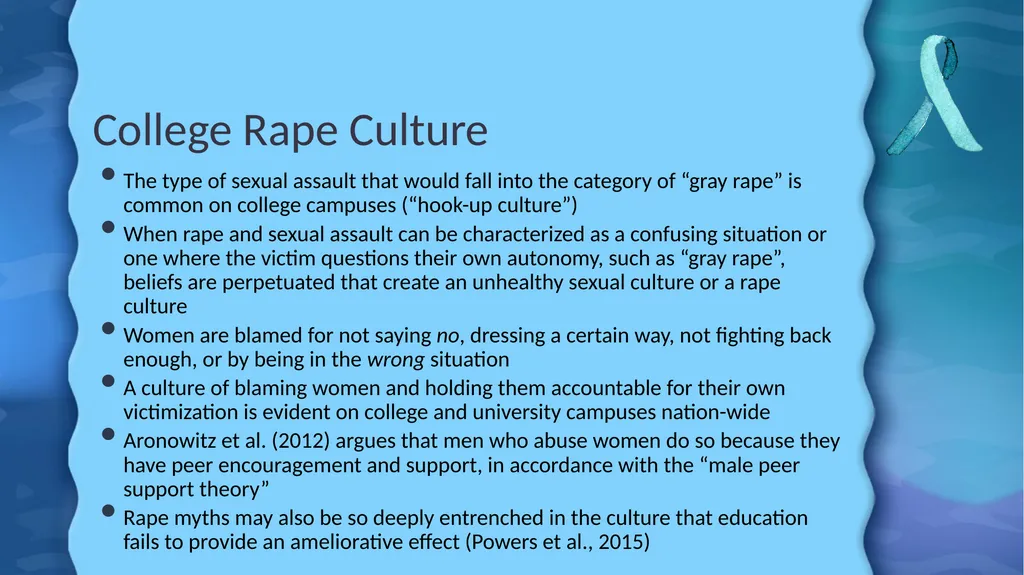
College Rape Culture The type of sexual assault that would fall into the category of “gray rape” is common on college campuses (“hook-up culture”)
When rape and sexual assault can be characterized as a confusing situation or one where the victim questions their own autonomy, such as “gray rape”, beliefs are perpetuated that create an unhealthy sexual culture or a rape culture
Women are blamed for not saying no, dressing a certain way, not fighting back enough, or by being in the wrong situation
A culture of blaming women and holding them accountable for their own victimization is evident on college and university campuses nation-wide
Aronowitz et al. (2012) argues that men who abuse women do so because they have peer encouragement and support, in accordance with the “male peer support theory”
Rape myths may also be so deeply entrenched in the culture that education fails to provide an ameliorative effect (Powers et al., 2015)<br>
When rape and sexual assault can be characterized as a confusing situation or one where the victim questions their own autonomy, such as “gray rape”, beliefs are perpetuated that create an unhealthy sexual culture or a rape culture
Women are blamed for not saying no, dressing a certain way, not fighting back enough, or by being in the wrong situation
A culture of blaming women and holding them accountable for their own victimization is evident on college and university campuses nation-wide
Aronowitz et al. (2012) argues that men who abuse women do so because they have peer encouragement and support, in accordance with the “male peer support theory”
Rape myths may also be so deeply entrenched in the culture that education fails to provide an ameliorative effect (Powers et al., 2015)<br>
10
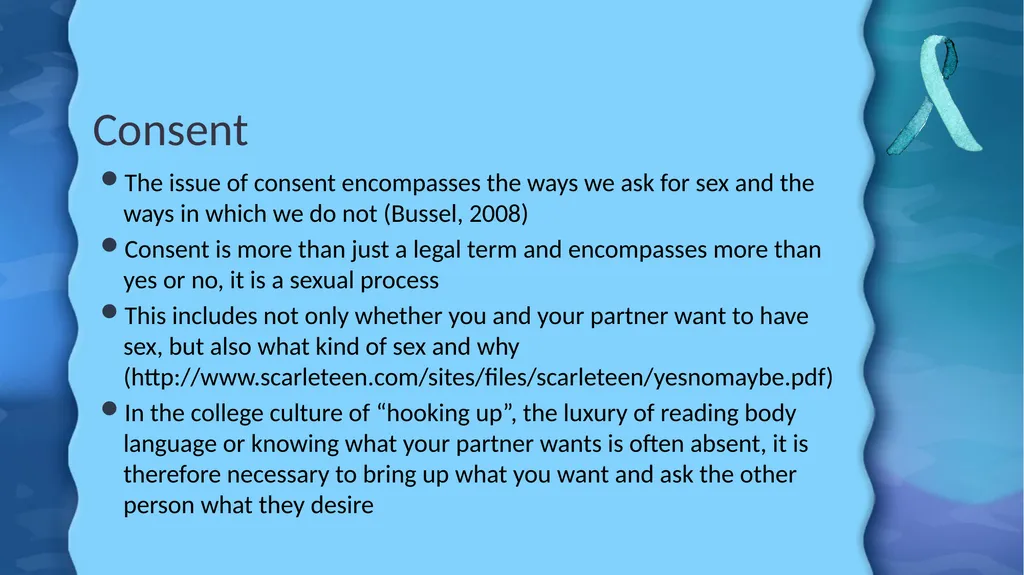
Consent The issue of consent encompasses the ways we ask for sex and the ways in which we do not (Bussel, 2008)
Consent is more than just a legal term and encompasses more than yes or no, it is a sexual process
This includes not only whether you and your partner want to have sex, but also what kind of sex and why (http://www.scarleteen.com/sites/files/scarleteen/yesnomaybe.pdf)
In the college culture of “hooking up”, the luxury of reading body language or knowing what your partner wants is often absent, it is therefore necessary to bring up what you want and ask the other person what they desire<br>
Consent is more than just a legal term and encompasses more than yes or no, it is a sexual process
This includes not only whether you and your partner want to have sex, but also what kind of sex and why (http://www.scarleteen.com/sites/files/scarleteen/yesnomaybe.pdf)
In the college culture of “hooking up”, the luxury of reading body language or knowing what your partner wants is often absent, it is therefore necessary to bring up what you want and ask the other person what they desire<br>
11
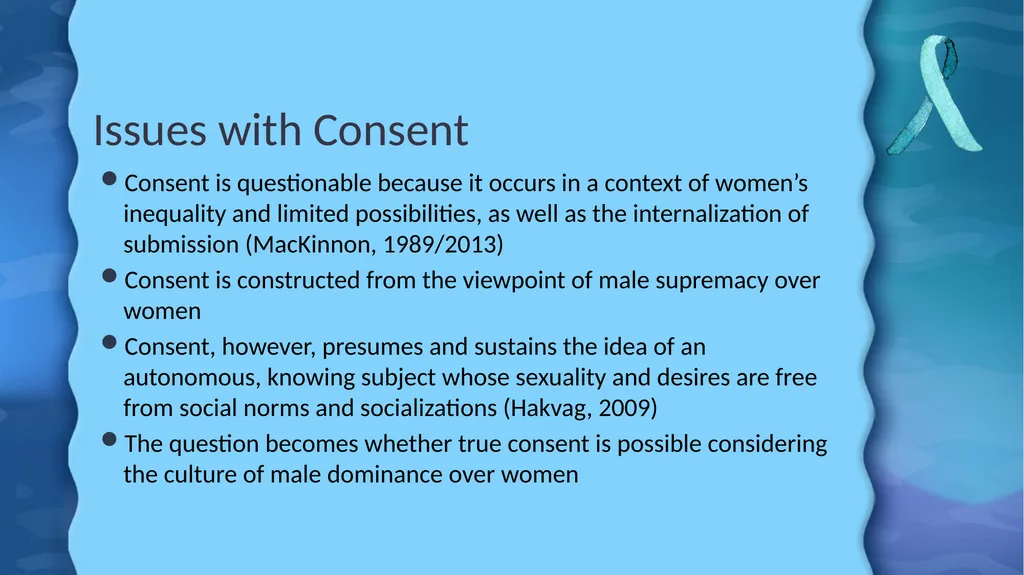
Issues with Consent Consent is questionable because it occurs in a context of women’s inequality and limited possibilities, as well as the internalization of submission (MacKinnon, 1989/2013)
Consent is constructed from the viewpoint of male supremacy over women
Consent, however, presumes and sustains the idea of an autonomous, knowing subject whose sexuality and desires are free from social norms and socializations (Hakvag, 2009)
The question becomes whether true consent is possible considering the culture of male dominance over women<br>
Consent is constructed from the viewpoint of male supremacy over women
Consent, however, presumes and sustains the idea of an autonomous, knowing subject whose sexuality and desires are free from social norms and socializations (Hakvag, 2009)
The question becomes whether true consent is possible considering the culture of male dominance over women<br>
12
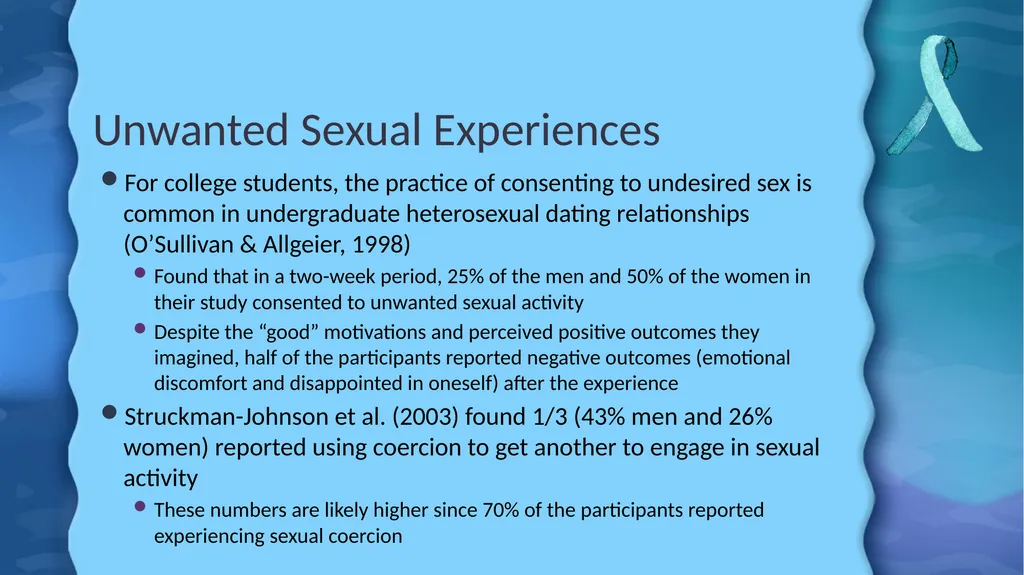
Unwanted Sexual Experiences For college students, the practice of consenting to undesired sex is common in undergraduate heterosexual dating relationships (O’Sullivan & Allgeier, 1998)
Found that in a two-week period, 25% of the men and 50% of the women in their study consented to unwanted sexual activity
Despite the “good” motivations and perceived positive outcomes they imagined, half of the participants reported negative outcomes (emotional discomfort and disappointed in oneself) after the experience
Struckman-Johnson et al. (2003) found 1/3 (43% men and 26% women) reported using coercion to get another to engage in sexual activity
These numbers are likely higher since 70% of the participants reported experiencing sexual coercion<br>
Found that in a two-week period, 25% of the men and 50% of the women in their study consented to unwanted sexual activity
Despite the “good” motivations and perceived positive outcomes they imagined, half of the participants reported negative outcomes (emotional discomfort and disappointed in oneself) after the experience
Struckman-Johnson et al. (2003) found 1/3 (43% men and 26% women) reported using coercion to get another to engage in sexual activity
These numbers are likely higher since 70% of the participants reported experiencing sexual coercion<br>
13
Coercion Physical actions or tactics used with intent of having sexual contact (Fisher et al., 2010)
Sexual coercion is a result of a perpetrator’s use of psychological or emotional tactics. The compliance is not voluntary, but as a result of the perpetrator’s coercion (Fisher et al., 2010).
Finklehor & Yllo (1985) identified four types of coercion: social, interpersonal, threatened physical, and physical.
Psychological coercion was identified by Hamby & Koss (2003) to include situations in which the perpetrator used nagging, false promises, or similar strategies.
Four tactics of sexual coercion were identified by Livingston et al. (2004): verbal persuasion, persistence, physical persuasion, and gaining access.
The researchers found that verbal persuasion and persistence were the most common of these.
Due to their nonviolent nature, women may interpret these incidents as “not serious enough” to define and report as sexual assault
Social norms of male sexual dominance and female sexual submission aid in the trivialization and justification of male sexual coercion toward females (Krape et al., 2000)<br>
Sexual coercion is a result of a perpetrator’s use of psychological or emotional tactics. The compliance is not voluntary, but as a result of the perpetrator’s coercion (Fisher et al., 2010).
Finklehor & Yllo (1985) identified four types of coercion: social, interpersonal, threatened physical, and physical.
Psychological coercion was identified by Hamby & Koss (2003) to include situations in which the perpetrator used nagging, false promises, or similar strategies.
Four tactics of sexual coercion were identified by Livingston et al. (2004): verbal persuasion, persistence, physical persuasion, and gaining access.
The researchers found that verbal persuasion and persistence were the most common of these.
Due to their nonviolent nature, women may interpret these incidents as “not serious enough” to define and report as sexual assault
Social norms of male sexual dominance and female sexual submission aid in the trivialization and justification of male sexual coercion toward females (Krape et al., 2000)<br>
14
Feminist Theory Feminist research on rape, sexual assault, and related topics has portrayed the power that men have over women in our society
MacKinnon’s (1989/2013) theory suggests that the sexual role of males is centered on an aggressive intrusion on those with less power
Sexuality exists within an atmosphere of gender inequality that places men over women in the social hierarchy
Feminist sexual theory treats sexuality as a social construct of male power, in that it has been defined by men and forced on women
In order to change this perspective of sexuality, it is necessary to look at it for what it is, a socially created gender hierarchy
Women may find ways of resisting this supremacy of men, but they also may embrace it in order to receive acceptance and approval
Submission is internalized by women
MacKinnon asserts that men force women into becoming sexual objects and in effect hold themselves helpless and powerless when aroused by them
Men are then able to place blame on the woman as, “asking for it”<br>
MacKinnon’s (1989/2013) theory suggests that the sexual role of males is centered on an aggressive intrusion on those with less power
Sexuality exists within an atmosphere of gender inequality that places men over women in the social hierarchy
Feminist sexual theory treats sexuality as a social construct of male power, in that it has been defined by men and forced on women
In order to change this perspective of sexuality, it is necessary to look at it for what it is, a socially created gender hierarchy
Women may find ways of resisting this supremacy of men, but they also may embrace it in order to receive acceptance and approval
Submission is internalized by women
MacKinnon asserts that men force women into becoming sexual objects and in effect hold themselves helpless and powerless when aroused by them
Men are then able to place blame on the woman as, “asking for it”<br>
15
Feminist Theory (cont.) For the last several decades, representations and discussions of sexual violence have almost exclusively focused on the victims and all but ignored the traits of perpetrators (Mardorossian, 2002)
If rape prevention is aimed solely at women’s behavior and identity, then interventions are aligned with the culture’s tendency to see rape as a women’s issue, as both their problem to solve and one they caused
A focus on victims’ (mis)behavior also allows for perpetrators’ behaviors to go un-scrutinized (Swauger, Witham, Shinberg, 2013), which easily becomes victim blaming
According to Hakvag (2009), current feminist anti-rape activism centers on consent versus non-consent and emphasizes the importance of consent and suggests that feminist rape theory would benefit from studying the phenomenon of consensual, but unwanted sex
Gavey (2005) defines unwanted sex as sex in which the pressure and sense of obligation is so strong that the woman does not feel that she had a choice; it is clearly unwanted in the sense that it takes place in the absence of desire (Porges & Peper, 2015)<br>
If rape prevention is aimed solely at women’s behavior and identity, then interventions are aligned with the culture’s tendency to see rape as a women’s issue, as both their problem to solve and one they caused
A focus on victims’ (mis)behavior also allows for perpetrators’ behaviors to go un-scrutinized (Swauger, Witham, Shinberg, 2013), which easily becomes victim blaming
According to Hakvag (2009), current feminist anti-rape activism centers on consent versus non-consent and emphasizes the importance of consent and suggests that feminist rape theory would benefit from studying the phenomenon of consensual, but unwanted sex
Gavey (2005) defines unwanted sex as sex in which the pressure and sense of obligation is so strong that the woman does not feel that she had a choice; it is clearly unwanted in the sense that it takes place in the absence of desire (Porges & Peper, 2015)<br>
16
Policies Title IX (K-12 and higher ed)
This statute prohibits sex-based harassment by peers, employees, or third-parties, including unwelcome conduct of a sexual nature, unwelcome sexual advances, requests for sexual favors, and other verbal, nonverbal, or physical conduct of a sexual nature. Sexual violence is a form of sexual harassment, defined as “physical sexual acts perpetrated against a person’s will or where a person is incapable of giving consent” (U.S. Department of Education, 2015).
The Clery Act (higher ed)
This federal act that requires colleges and universities that participate in federal student aid programs to disclose campus safety information (Safe Campuses, LLC, 2018).
In 2013, an amendment was made to this act called the Campus Sexual Violence Elimination Act, or Campus SaVE Act (SaVE; SAFE Campuses, 2018). As part of the Violence Against Women Reauthorization Act of 2013 and required increased transparency on the scope of sexual violence on campuses, as well as guarantee victims greater rights, provide standards in institutional conduct proceedings, and provide campus-wide prevention educational programming (Safe Campuses, LLC, 2018).<br>
This statute prohibits sex-based harassment by peers, employees, or third-parties, including unwelcome conduct of a sexual nature, unwelcome sexual advances, requests for sexual favors, and other verbal, nonverbal, or physical conduct of a sexual nature. Sexual violence is a form of sexual harassment, defined as “physical sexual acts perpetrated against a person’s will or where a person is incapable of giving consent” (U.S. Department of Education, 2015).
The Clery Act (higher ed)
This federal act that requires colleges and universities that participate in federal student aid programs to disclose campus safety information (Safe Campuses, LLC, 2018).
In 2013, an amendment was made to this act called the Campus Sexual Violence Elimination Act, or Campus SaVE Act (SaVE; SAFE Campuses, 2018). As part of the Violence Against Women Reauthorization Act of 2013 and required increased transparency on the scope of sexual violence on campuses, as well as guarantee victims greater rights, provide standards in institutional conduct proceedings, and provide campus-wide prevention educational programming (Safe Campuses, LLC, 2018).<br>
17
New Policies on Campus Sexual Misconduct Recent Proposal:
Allows schools to ignore sexual assault occurring off-campus
Allows alleged perpetrators to directly cross-examine survivors
Allows mediation for sexual assault cases, and other informal resolutions
Allows schools to choose evidentiary standards for rape cases that are higher than what schools use in other misconduct cases (no requirement for appeals process)
New definition of “sexual harassment” – unwelcome conduct on the basis of sex that is so severe, pervasive and objectively offensive that it denies a person access to the school’s education program or activity (repeated complaints or most egregious allegations)
https://www.mindingthecampus.org/2018/09/10/comparing-seven-key-changes-in-devos-title-ix-proposal/<br>
Allows schools to ignore sexual assault occurring off-campus
Allows alleged perpetrators to directly cross-examine survivors
Allows mediation for sexual assault cases, and other informal resolutions
Allows schools to choose evidentiary standards for rape cases that are higher than what schools use in other misconduct cases (no requirement for appeals process)
New definition of “sexual harassment” – unwelcome conduct on the basis of sex that is so severe, pervasive and objectively offensive that it denies a person access to the school’s education program or activity (repeated complaints or most egregious allegations)
https://www.mindingthecampus.org/2018/09/10/comparing-seven-key-changes-in-devos-title-ix-proposal/<br>
18
Policy Issues There is incentive not to report - potential damage to the school’s public image from increased reporting of violence (Chi Cantalupo, 2011)
One of the greatest flaws of the Clery Act is that the DOE is limited to punishing a school with a fine (capped at $35,000) when finds that the school violated the Clery Act (Marshall, 2014) and the DOE is not required to fine a school even if found guilty of violating the act (Schroeder, 2014)
The DOE also has no power under this law to force a school in violation of the act to make improvements to reporting policies
The Clery Act perpetuates the notion that stranger rape is the most common form of sexual assault despite research to the contrary (Chi Cantalupo, 2011; Schroeder, 2014) - requires disclosure of the location of crimes committed on campus and not those involved despite students being at higher risk in social situations than walking alone on campus (Schroeder, 2014)
The Clery Act relies on rape reporting to determine the prevalence of crime on campus, however, only a small percentage of students actually report sexual victimization (Schroeder, 2014)
Campus response to sexual assault reports are often inadequate and perpetrators face few consequences - Not all schools have written policies or even adjudicative processes<br>
One of the greatest flaws of the Clery Act is that the DOE is limited to punishing a school with a fine (capped at $35,000) when finds that the school violated the Clery Act (Marshall, 2014) and the DOE is not required to fine a school even if found guilty of violating the act (Schroeder, 2014)
The DOE also has no power under this law to force a school in violation of the act to make improvements to reporting policies
The Clery Act perpetuates the notion that stranger rape is the most common form of sexual assault despite research to the contrary (Chi Cantalupo, 2011; Schroeder, 2014) - requires disclosure of the location of crimes committed on campus and not those involved despite students being at higher risk in social situations than walking alone on campus (Schroeder, 2014)
The Clery Act relies on rape reporting to determine the prevalence of crime on campus, however, only a small percentage of students actually report sexual victimization (Schroeder, 2014)
Campus response to sexual assault reports are often inadequate and perpetrators face few consequences - Not all schools have written policies or even adjudicative processes<br>
19
Current Programming Bedera & Nordmeyer (2015) examined rape prevention and risk reduction strategies from 40 college websites
Findings included that most tips were directed at women and four prominent messages were conveyed: “there are no safe places for women, women can’t trust anyone, women should never be alone, and women are vulnerable”
Bystander intervention programs have increased in popularity on college campuses bringing into focus the larger social context of sexual assault and how others can contribute to or defend against it (Haaken, 2017).
In these programs, students pledge not to be a passive bystander when noticing incidents taking place that can lead to rape and learn effective ways to intervene or prevent assault.
Bystander interventions allow for a more complex view of assaults than blaming or labeling the victim and perpetrator (Haaken, 2017).
This approach can also help reduce male defensiveness for being seen as a potential perpetrator and enlist them to confront sexism and violence (Haaken, 2017).
However, a drawback of bystander intervention is that they can also reinforce “patriarchal rescue narratives”, and the belief that women are too weak and need a rescuer (Haaken 2017, p. 25).
Some research has suggested this is harmful to bystanders<br>
Findings included that most tips were directed at women and four prominent messages were conveyed: “there are no safe places for women, women can’t trust anyone, women should never be alone, and women are vulnerable”
Bystander intervention programs have increased in popularity on college campuses bringing into focus the larger social context of sexual assault and how others can contribute to or defend against it (Haaken, 2017).
In these programs, students pledge not to be a passive bystander when noticing incidents taking place that can lead to rape and learn effective ways to intervene or prevent assault.
Bystander interventions allow for a more complex view of assaults than blaming or labeling the victim and perpetrator (Haaken, 2017).
This approach can also help reduce male defensiveness for being seen as a potential perpetrator and enlist them to confront sexism and violence (Haaken, 2017).
However, a drawback of bystander intervention is that they can also reinforce “patriarchal rescue narratives”, and the belief that women are too weak and need a rescuer (Haaken 2017, p. 25).
Some research has suggested this is harmful to bystanders<br>
20
What do we do???<br>
21
Privilege the Female Voice Women have been far too silent
Lugones and Spelman (1983/2013), feminism is a response to an almost exclusive male account of the world in which women are left out of or included only in demeaning ways. Men cannot, therefore, be solely responsible for writing policies and creating programming to prevent sexual assault and promote healthy sexuality.
When policies are put into place that do not include the female voice they are likely to be ineffective or place continued burden on women to be responsible for their own assault prevention. Women cannot be solely responsible for preventing sexual assault.<br>
Lugones and Spelman (1983/2013), feminism is a response to an almost exclusive male account of the world in which women are left out of or included only in demeaning ways. Men cannot, therefore, be solely responsible for writing policies and creating programming to prevent sexual assault and promote healthy sexuality.
When policies are put into place that do not include the female voice they are likely to be ineffective or place continued burden on women to be responsible for their own assault prevention. Women cannot be solely responsible for preventing sexual assault.<br>
22
Make it an All Gender Issue There are two dominant and conflicting paradigms apparent in many rape prevention strategies (Bedera & Nordmeyer, 2015):
The first is that women’s involvement in prevention is empowering and effective (Higginbotham, 2008). We must challenge the idea that women’s risk reduction is effective due to constant risk reduction efforts and the tendency to blame rape victims who engage in what may be considered risky behavior (Filipovic, 2008).
The second paradigm advocates for an approach to rape prevention that involves men and fights the systemic causes of sexual assault (Filipovich, 2008). While women can be responsible for efforts to reduce their personal risk, this will not keep them safe in all situations and increases the risk for internalizing blame. There must be efforts aimed at teaching males healthy sexual communication, respecting boundaries, and to seek ongoing and verbal consent.
The movement to transform from a rape culture can progress only if “men come to feminist thinking and actively challenge sexism and male violence against women” (hooks, 2005, p.295)<br>
The first is that women’s involvement in prevention is empowering and effective (Higginbotham, 2008). We must challenge the idea that women’s risk reduction is effective due to constant risk reduction efforts and the tendency to blame rape victims who engage in what may be considered risky behavior (Filipovic, 2008).
The second paradigm advocates for an approach to rape prevention that involves men and fights the systemic causes of sexual assault (Filipovich, 2008). While women can be responsible for efforts to reduce their personal risk, this will not keep them safe in all situations and increases the risk for internalizing blame. There must be efforts aimed at teaching males healthy sexual communication, respecting boundaries, and to seek ongoing and verbal consent.
The movement to transform from a rape culture can progress only if “men come to feminist thinking and actively challenge sexism and male violence against women” (hooks, 2005, p.295)<br>
23
Create a Sex Positive Culture Pervasive sexual harms that women suffer under patriarchal cultures are routinely and systemically dismissed (Haaken, 2017). The focus needs to be on the broader social context of sexual culture rather than just the individuals involved in incidents that occur.
In order to create a more positive culture means acknowledging the complexity and innate ambiguities of sexuality (Haaken, 2017).
We need to resist the victim-perpetrator script that relies on the idea that rape is a fate worse than death and feeds into the idea that rape creates an injured womanhood (Haaken, 2017).
Colleges also need to avoid the normalization of sexual assault, such as including a rape whistle in orientation packets (Haaken, 2017).
It is important to remember that there is a complexity to sexuality and that uncertain sexual boundaries can be confusing for young people (Haaken, 2017).
There is also the need to recognize that coercion has become integrated into normative heterosexuality (Hakvag, 2009), specifically in the scenario of consensual but unwanted sex.
Even if an encounter cannot be defined as sexual assault, this does not mean the experience is always acceptable (Hakvag, 2009).<br>
In order to create a more positive culture means acknowledging the complexity and innate ambiguities of sexuality (Haaken, 2017).
We need to resist the victim-perpetrator script that relies on the idea that rape is a fate worse than death and feeds into the idea that rape creates an injured womanhood (Haaken, 2017).
Colleges also need to avoid the normalization of sexual assault, such as including a rape whistle in orientation packets (Haaken, 2017).
It is important to remember that there is a complexity to sexuality and that uncertain sexual boundaries can be confusing for young people (Haaken, 2017).
There is also the need to recognize that coercion has become integrated into normative heterosexuality (Hakvag, 2009), specifically in the scenario of consensual but unwanted sex.
Even if an encounter cannot be defined as sexual assault, this does not mean the experience is always acceptable (Hakvag, 2009).<br>
24
Comprehensive Programs Banyard (2014) suggests that successful prevention programs are theory-driven and require multicomponent interventions that incorporate active engagement in learning and building positive relationships.
These interventions should be developmentally appropriate, socioculturally relevant, and have well-trained staff and clearly articulated goals (Banyard, 2014).
Forward movement should be in partnership between researchers, practitioners, and policy makers (Banyard, 2014), requiring a multidisciplinary lens (Haaken, 2017).
Banyard (2014) outlines the need for measures of community readiness, evaluation of strategies, combination of prevention tools, addressing different needs across college years, creation of policy and campus norms to support prevention, improved efficacy and trust in campus administration, and finally, training of students, staff, and faculty.<br>
These interventions should be developmentally appropriate, socioculturally relevant, and have well-trained staff and clearly articulated goals (Banyard, 2014).
Forward movement should be in partnership between researchers, practitioners, and policy makers (Banyard, 2014), requiring a multidisciplinary lens (Haaken, 2017).
Banyard (2014) outlines the need for measures of community readiness, evaluation of strategies, combination of prevention tools, addressing different needs across college years, creation of policy and campus norms to support prevention, improved efficacy and trust in campus administration, and finally, training of students, staff, and faculty.<br>
25
Thoughts, Questions, Ideas? Thank you!
Christina McGrath Fair, LMHC
cmcgrathfair@ufl.edu<br>
Christina McGrath Fair, LMHC
cmcgrathfair@ufl.edu<br>
26
References Alcoff, L.M. (2014). Sexual violations and the question of experience. New Literary History, 45(3), 445-462.
Aronowitz, T., Lambert, C.A., Davidoff, S. (2012). The role of rape myth acceptance in the social norms regarding sexual behavior among college students. Journal of Community Health Nursing, 29(3), 173-182. doi: 10.1080/07370016.2012.697852
Banyard, V.L. (2014). Improving college campus-based prevention of violence against women: A strategic plan for research built on multipronged practices and policies. Trauma, Violence, & Abuse, 15(4), 339-351.
Bedera, N. & Nordmeyer, K. (2015). “Never Go Out Alone”: An analysis of college rape prevention tips. Sexuality & Culture, 19(3), 533-542.
Buchwald, E., Fletcher, P.R., & Roth, M. (2005). Transforming a rape culture, Revised Edition. Minneapolis: Milkweed Editions.
Bussel, R.K. (2008). Beyond yes or no: Consent as sexual process. In J. Friedman & J. Valenti (Eds.), Yes means yes! Visions of female sexual power and a world without rape (pp. 43-52). Berkeley, CA: Seal Press.
Chi Cantalupo, N. (2011). Burying our heads in the sand: Lack of knowledge, knowledge avoidance, and the persistent problem of campus peer sexual violence. Loyola University Chicago Law Journal, 43, 205-266.
Filipovic, J. (2008). Offensive feminism: The conservative gender norms that perpetuate rape culture, and how feminists can fight back. In J. Friedman & J. Valenti (Eds.), Yes means yes! Visions of female sexual power and a world without rape (pp. 13-28). Berkeley, CA: Seal Press.Gavey, N. (2005). Just Sex? The Cultural Scaffolding of Rape. London: Routledge.
Finklehor, D. & Yllo, K. (1985). License to rape. New York: Holt, Rinehart, and Winston.
Fisher, B.S., Daigle, L.E., & Cullen, F.T. (2010). Unsafe in the Ivory Tower: The Sexual Victimization of College Women. Thousand Oaks, CA: Sage Publications, Inc.
Haaken, J. (2017). Many mornings after: Campus sexual assault and Feminist politics. Family Relations, 66(1), 17-28.
Hakvag, H. (2009). Does yes mean yes? Exploring sexual coercion in normative heterosexuality. Canadian Woman Studies, 28(1), 121-126.
Hamby, S.L. & Koss, M.P. (2003). Shades of gray: A qualitative study of terms used in the measurement of sexual victimization. Psychology of Women Quarterly, 27, 243-255.
Higginbotham, A. (2008). Sex worth fighting for. In J. Friedman & J. Valenti (Eds.), Yes means yes! Visions of female sexual power and a world without rape (pp. 241-250). Berkeley, CA: Seal Press.
hooks, b. (2005). Seduced by violence no more. In E. Buchwald, P.R. Fletcher, & M. Roth (Eds.), Transforming a rape culture, Revised Edition pp. 295-298). Minneapolis: Milkweed Editions.
Krape, B., Scheinberger-Olwig, R., Kolpin, S. (2000). Ambiguous communication if sexual intentions as a risk marker of sexual aggression. Sex Roles, 42, 313-337.
Livingston, J.A., Buddie, A.M., Testa, M., & VanZile-Tamsen, C. (2004). The role of precedence in verbal sexual coercion. Psychology of Women Quarterly, 28, 287-297.<br>
Aronowitz, T., Lambert, C.A., Davidoff, S. (2012). The role of rape myth acceptance in the social norms regarding sexual behavior among college students. Journal of Community Health Nursing, 29(3), 173-182. doi: 10.1080/07370016.2012.697852
Banyard, V.L. (2014). Improving college campus-based prevention of violence against women: A strategic plan for research built on multipronged practices and policies. Trauma, Violence, & Abuse, 15(4), 339-351.
Bedera, N. & Nordmeyer, K. (2015). “Never Go Out Alone”: An analysis of college rape prevention tips. Sexuality & Culture, 19(3), 533-542.
Buchwald, E., Fletcher, P.R., & Roth, M. (2005). Transforming a rape culture, Revised Edition. Minneapolis: Milkweed Editions.
Bussel, R.K. (2008). Beyond yes or no: Consent as sexual process. In J. Friedman & J. Valenti (Eds.), Yes means yes! Visions of female sexual power and a world without rape (pp. 43-52). Berkeley, CA: Seal Press.
Chi Cantalupo, N. (2011). Burying our heads in the sand: Lack of knowledge, knowledge avoidance, and the persistent problem of campus peer sexual violence. Loyola University Chicago Law Journal, 43, 205-266.
Filipovic, J. (2008). Offensive feminism: The conservative gender norms that perpetuate rape culture, and how feminists can fight back. In J. Friedman & J. Valenti (Eds.), Yes means yes! Visions of female sexual power and a world without rape (pp. 13-28). Berkeley, CA: Seal Press.Gavey, N. (2005). Just Sex? The Cultural Scaffolding of Rape. London: Routledge.
Finklehor, D. & Yllo, K. (1985). License to rape. New York: Holt, Rinehart, and Winston.
Fisher, B.S., Daigle, L.E., & Cullen, F.T. (2010). Unsafe in the Ivory Tower: The Sexual Victimization of College Women. Thousand Oaks, CA: Sage Publications, Inc.
Haaken, J. (2017). Many mornings after: Campus sexual assault and Feminist politics. Family Relations, 66(1), 17-28.
Hakvag, H. (2009). Does yes mean yes? Exploring sexual coercion in normative heterosexuality. Canadian Woman Studies, 28(1), 121-126.
Hamby, S.L. & Koss, M.P. (2003). Shades of gray: A qualitative study of terms used in the measurement of sexual victimization. Psychology of Women Quarterly, 27, 243-255.
Higginbotham, A. (2008). Sex worth fighting for. In J. Friedman & J. Valenti (Eds.), Yes means yes! Visions of female sexual power and a world without rape (pp. 241-250). Berkeley, CA: Seal Press.
hooks, b. (2005). Seduced by violence no more. In E. Buchwald, P.R. Fletcher, & M. Roth (Eds.), Transforming a rape culture, Revised Edition pp. 295-298). Minneapolis: Milkweed Editions.
Krape, B., Scheinberger-Olwig, R., Kolpin, S. (2000). Ambiguous communication if sexual intentions as a risk marker of sexual aggression. Sex Roles, 42, 313-337.
Livingston, J.A., Buddie, A.M., Testa, M., & VanZile-Tamsen, C. (2004). The role of precedence in verbal sexual coercion. Psychology of Women Quarterly, 28, 287-297.<br>
27
References Lugones, M.C. & Spelman, E.V. (2013). Have we got a theory for you!: Feminist theory, cultural imperialism and the demand for “the woman’s voice”. In W.K. Kolmar & F. Bartkowski(Eds.), Feminist Theory: A Reader, 4th ed. (pp. 17-24). New York: McGraw Hill. (Original work published 1983)
MacKinnon, C.A. (2013). Sexuality. In W.K. Kolmar & F. Bartkowski (Eds.), Feminist Theory: A Reader, 4th ed. (pp. 415-427). New York: McGraw Hill. (Original work published 1989)
Mardorossian, C.M. (2002). Toward a new feminist theory of rape. Journal of Women in Culture and Society, 27(3), 743-775.
Mukhopadhyay, S. (2008). Trial by media: Black feminist lasciviousness and the question of consent. In J. Friedman & J. Valenti (Eds.), Yes means yes! Visions of female sexual power and a world without rape (pp. 151-162). Berkeley, CA: Seal Press.
O’Sullivan, L.F. & Allgeier, E.R. (1998). Feigning sexual desire: Consenting to unwanted sexual activity in heterosexual dating relationships. Journal of Sex Research, 35(3), 234-243.
Porges, S.W. & Peper, E. (2015). When not saying no does not mean yes: Psychophysiological factors involved in date rape. Biofeedback, 43(1), 45-48.doi: 10.5298/1081-5937-43.1.01.
Powers, R.A., Leili, J., Hagman, B., & Cohn, A. (2015). The impact of college education on rape myth acceptance, alcohol expectancies, and bystander attitudes. Deviant Behavior, 36(12), 956-973. doi: 10.1080/01639625.2014.982747
SAFE Campuses, LLC. (2018). Clery Act. Retrieved from: http://safecampuses.biz/clery-act/
Schroeder, L.P. (2014). Cracks in the Ivory Tower: How the Campus Sexual Violence Elimination Act can protect students from sexual assault. Loyola University Chicago Law Journal, 45, 1195-1243.
Stepp, L.S. (2007). A new kind of date rape. Cosmopolitan. Retrieved fromhttp://www.cosmopolitan.com/sex-love/advice/a1912/new-kind-of-date-rape/
Struckman-Johnson, C., Struckman-Johnson, D., & Anderson, P.B. (2003). Tactics of sexual cohersion: When men and women won’t take no for an answer. Journal of Sex Research, 40, 76-86.
Swauger, M., Witham, D.H., Shinburg, D. (2013). No stranger in the bushes: The ambiguity of consent and rape in hook up culture. Sex Roles, 68, 629-633. doi: 10.1007/s11199-012-0251-2.
The Clery Center. (2018). Retrieved from: https://clerycenter.org/
U.S. Department of Education. (2015). Title IX Resource Guide. Retrieved from file:///F:/Dissertation/Title%20IX%20Resource%20Guide.pdf
Wilson, R. (2015). Colleges wrestle with how to define rape. Retrieved from http://chronicle.com/article/When-Does-Unwanted-Sex-Become/151245/
Ziering, A. (producer) & Dick, K. (director). (2015). The Hunting Ground [Motion Picture]. United States: The Weinstein Company.<br>
MacKinnon, C.A. (2013). Sexuality. In W.K. Kolmar & F. Bartkowski (Eds.), Feminist Theory: A Reader, 4th ed. (pp. 415-427). New York: McGraw Hill. (Original work published 1989)
Mardorossian, C.M. (2002). Toward a new feminist theory of rape. Journal of Women in Culture and Society, 27(3), 743-775.
Mukhopadhyay, S. (2008). Trial by media: Black feminist lasciviousness and the question of consent. In J. Friedman & J. Valenti (Eds.), Yes means yes! Visions of female sexual power and a world without rape (pp. 151-162). Berkeley, CA: Seal Press.
O’Sullivan, L.F. & Allgeier, E.R. (1998). Feigning sexual desire: Consenting to unwanted sexual activity in heterosexual dating relationships. Journal of Sex Research, 35(3), 234-243.
Porges, S.W. & Peper, E. (2015). When not saying no does not mean yes: Psychophysiological factors involved in date rape. Biofeedback, 43(1), 45-48.doi: 10.5298/1081-5937-43.1.01.
Powers, R.A., Leili, J., Hagman, B., & Cohn, A. (2015). The impact of college education on rape myth acceptance, alcohol expectancies, and bystander attitudes. Deviant Behavior, 36(12), 956-973. doi: 10.1080/01639625.2014.982747
SAFE Campuses, LLC. (2018). Clery Act. Retrieved from: http://safecampuses.biz/clery-act/
Schroeder, L.P. (2014). Cracks in the Ivory Tower: How the Campus Sexual Violence Elimination Act can protect students from sexual assault. Loyola University Chicago Law Journal, 45, 1195-1243.
Stepp, L.S. (2007). A new kind of date rape. Cosmopolitan. Retrieved fromhttp://www.cosmopolitan.com/sex-love/advice/a1912/new-kind-of-date-rape/
Struckman-Johnson, C., Struckman-Johnson, D., & Anderson, P.B. (2003). Tactics of sexual cohersion: When men and women won’t take no for an answer. Journal of Sex Research, 40, 76-86.
Swauger, M., Witham, D.H., Shinburg, D. (2013). No stranger in the bushes: The ambiguity of consent and rape in hook up culture. Sex Roles, 68, 629-633. doi: 10.1007/s11199-012-0251-2.
The Clery Center. (2018). Retrieved from: https://clerycenter.org/
U.S. Department of Education. (2015). Title IX Resource Guide. Retrieved from file:///F:/Dissertation/Title%20IX%20Resource%20Guide.pdf
Wilson, R. (2015). Colleges wrestle with how to define rape. Retrieved from http://chronicle.com/article/When-Does-Unwanted-Sex-Become/151245/
Ziering, A. (producer) & Dick, K. (director). (2015). The Hunting Ground [Motion Picture]. United States: The Weinstein Company.<br>