
The new LIFE Programme & relevant elements for
AS
Published · 16 slides · 0 views
1 / 1

Description
The new LIFE Programme relevant elements for SMEs Milina Schumannova Project Manager, LIFE Environment - Circular economy and quality of life EU Climate, Infrastructure and Environment Executive Agency (CINEA) Training session for EEN and
Related Topics
Share
Embed code
Download this presentation From Below
"The new LIFE Programme & relevant elements for" is the property of its rightful owner. Permission is granted to download and print the materials on this website for personal, non-commercial use only, and to display it on your personal computer provided you do not modify the materials and that you retain all copyright notices contained in the materials. By downloading content from our website, you accept the terms of this agreement.
Presentation Transcript
01
The new LIFE Programme
& relevant elements for SMEs Milina Schumannova
Project Manager, LIFE Environment
- Circular economy and quality of life
EU Climate, Infrastructure and Environment Executive Agency (CINEA)
Training session for EEN and clusters organisations on EU Funding Programmes and Financial instruments, 19 November 2021<br>
Project Manager, LIFE Environment
- Circular economy and quality of life
EU Climate, Infrastructure and Environment Executive Agency (CINEA)
Training session for EEN and clusters organisations on EU Funding Programmes and Financial instruments, 19 November 2021<br>
02
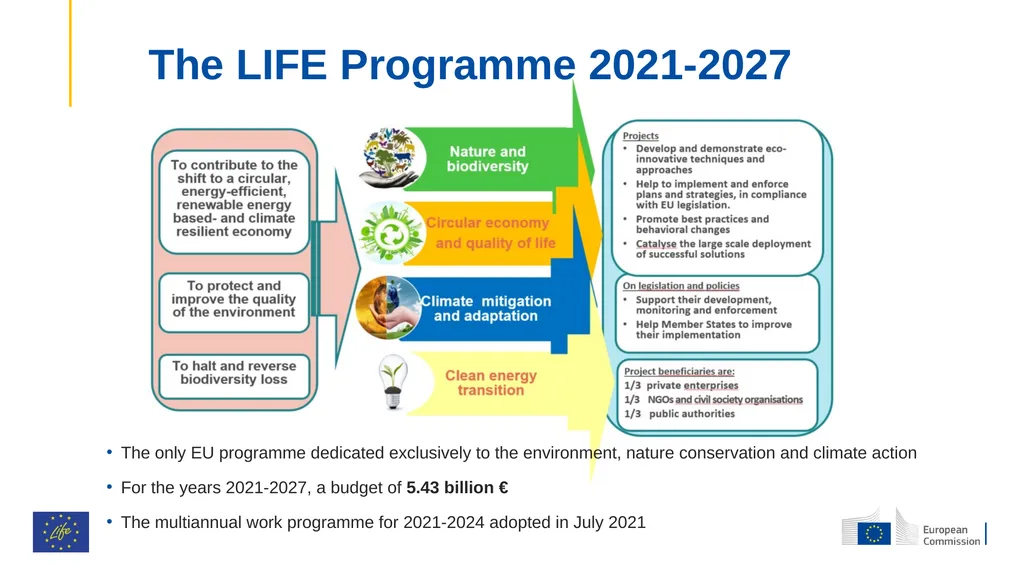
The LIFE Programme 2021-2027 The only EU programme dedicated exclusively to the environment, nature conservation and climate action
For the years 2021-2027, a budget of 5.43 billion €
The multiannual work programme for 2021-2024 adopted in July 2021<br>
For the years 2021-2027, a budget of 5.43 billion €
The multiannual work programme for 2021-2024 adopted in July 2021<br>
03
Circular economy, noise, air, chemicals, green and circular economy, industrial accidents, marine and coastal management, noise, soil, waste, water, and the urban environment. Typical actions Integrated projects beyond air, water, waste to other areas such as circular economy.
Promote upscale and access to finance. Contribution in the area of: Support to public authorities and other stakeholders to implement EU environment legislation. Support to technologies and solutions that are ready to be implemented in close-to-market conditions, at industrial or commercial scale, during the project duration. Sub-programme Circular Economy and Quality of life (CEQL) Budget: €1.35 billion, 25% of the total LIFE budget<br>
Promote upscale and access to finance. Contribution in the area of: Support to public authorities and other stakeholders to implement EU environment legislation. Support to technologies and solutions that are ready to be implemented in close-to-market conditions, at industrial or commercial scale, during the project duration. Sub-programme Circular Economy and Quality of life (CEQL) Budget: €1.35 billion, 25% of the total LIFE budget<br>
04
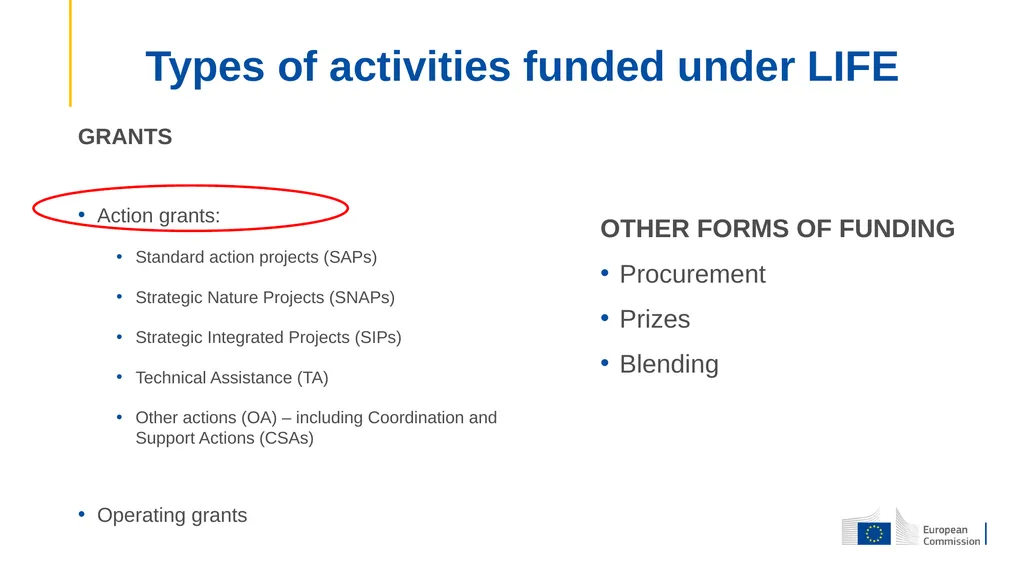
GRANTS
Action grants:
Standard action projects (SAPs)
Strategic Nature Projects (SNAPs)
Strategic Integrated Projects (SIPs)
Technical Assistance (TA)
Other actions (OA) – including Coordination and Support Actions (CSAs)
Operating grants Types of activities funded under LIFE OTHER FORMS OF FUNDING
Procurement
Prizes
Blending<br>
Action grants:
Standard action projects (SAPs)
Strategic Nature Projects (SNAPs)
Strategic Integrated Projects (SIPs)
Technical Assistance (TA)
Other actions (OA) – including Coordination and Support Actions (CSAs)
Operating grants Types of activities funded under LIFE OTHER FORMS OF FUNDING
Procurement
Prizes
Blending<br>
05
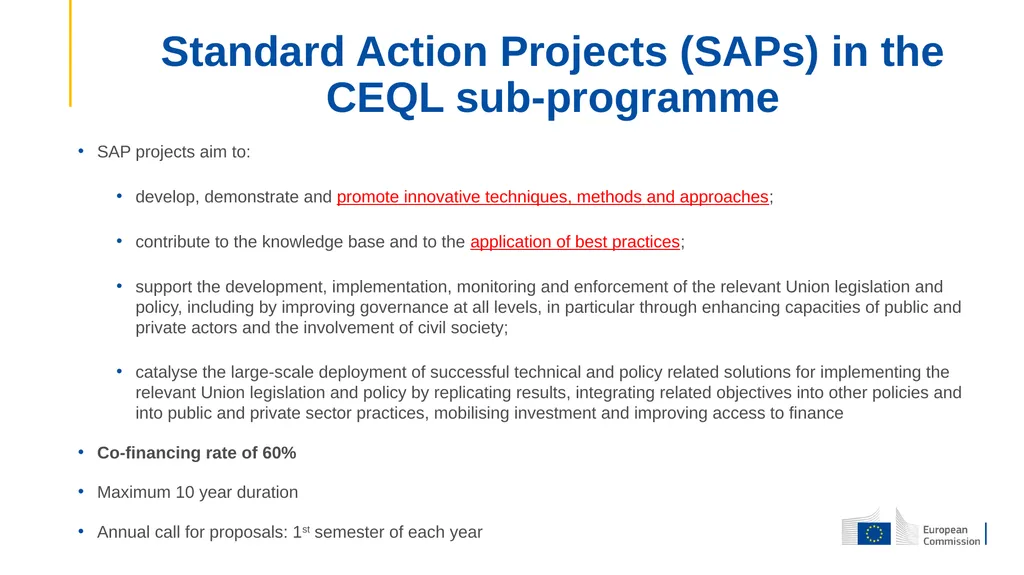
SAP projects aim to:
develop, demonstrate and promote innovative techniques, methods and approaches;
contribute to the knowledge base and to the application of best practices;
support the development, implementation, monitoring and enforcement of the relevant Union legislation and policy, including by improving governance at all levels, in particular through enhancing capacities of public and private actors and the involvement of civil society;
catalyse the large-scale deployment of successful technical and policy related solutions for implementing the relevant Union legislation and policy by replicating results, integrating related objectives into other policies and into public and private sector practices, mobilising investment and improving access to finance
Co-financing rate of 60%
Maximum 10 year duration
Annual call for proposals: 1st semester of each year Standard Action Projects (SAPs) in the CEQL sub-programme<br>
develop, demonstrate and promote innovative techniques, methods and approaches;
contribute to the knowledge base and to the application of best practices;
support the development, implementation, monitoring and enforcement of the relevant Union legislation and policy, including by improving governance at all levels, in particular through enhancing capacities of public and private actors and the involvement of civil society;
catalyse the large-scale deployment of successful technical and policy related solutions for implementing the relevant Union legislation and policy by replicating results, integrating related objectives into other policies and into public and private sector practices, mobilising investment and improving access to finance
Co-financing rate of 60%
Maximum 10 year duration
Annual call for proposals: 1st semester of each year Standard Action Projects (SAPs) in the CEQL sub-programme<br>
06
LIFE Environment – CE and Waste
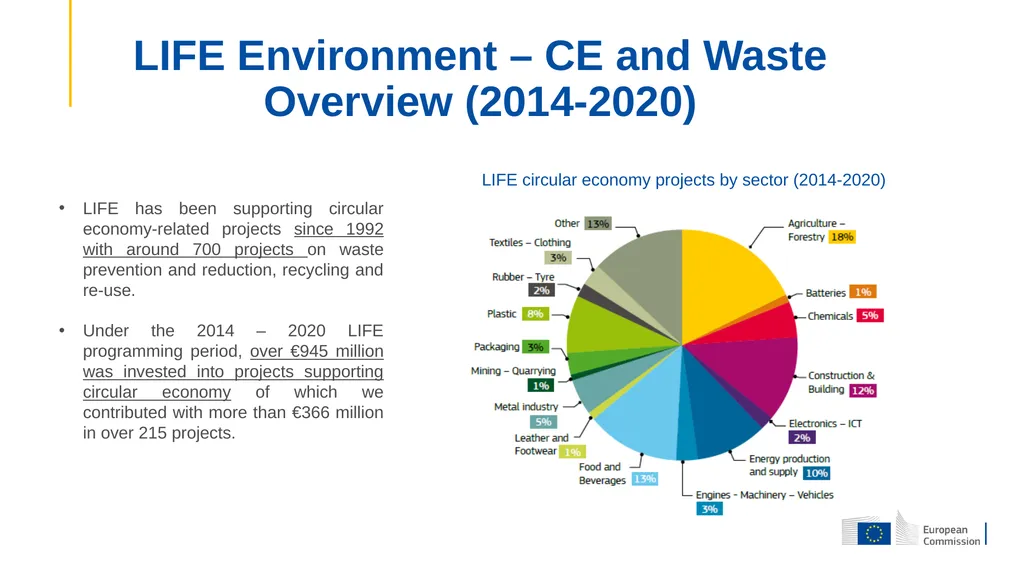
Overview (2014-2020) LIFE has been supporting circular economy-related projects since 1992 with around 700 projects on waste prevention and reduction, recycling and re-use.
Under the 2014 – 2020 LIFE programming period, over €945 million was invested into projects supporting circular economy of which we contributed with more than €366 million in over 215 projects. LIFE circular economy projects by sector (2014-2020)<br>
Under the 2014 – 2020 LIFE programming period, over €945 million was invested into projects supporting circular economy of which we contributed with more than €366 million in over 215 projects. LIFE circular economy projects by sector (2014-2020)<br>
07
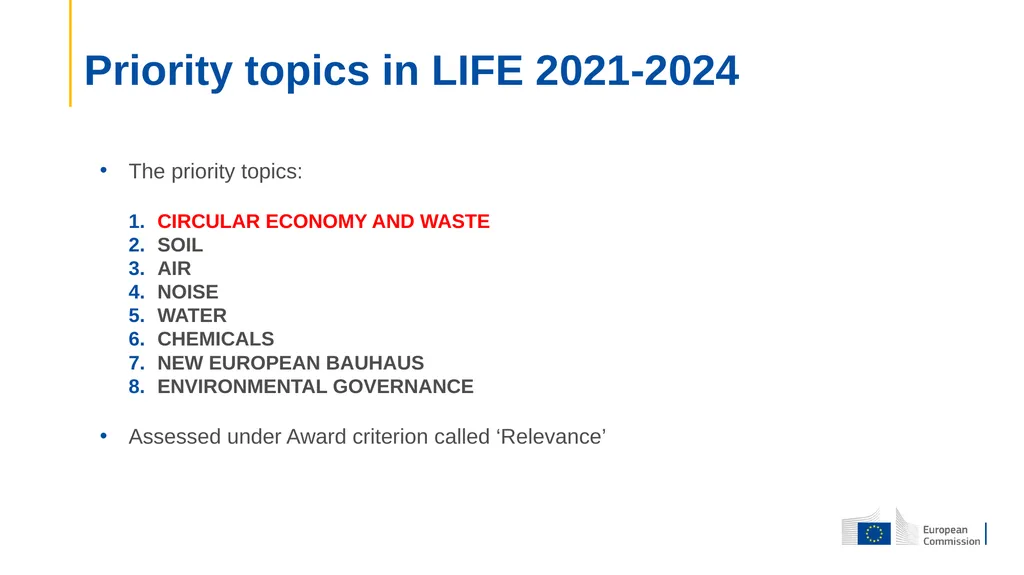
The priority topics:
CIRCULAR ECONOMY AND WASTE
SOIL
AIR
NOISE
WATER
CHEMICALS
NEW EUROPEAN BAUHAUS
ENVIRONMENTAL GOVERNANCE
Assessed under Award criterion called ‘Relevance’ Priority topics in LIFE 2021-2024<br>
CIRCULAR ECONOMY AND WASTE
SOIL
AIR
NOISE
WATER
CHEMICALS
NEW EUROPEAN BAUHAUS
ENVIRONMENTAL GOVERNANCE
Assessed under Award criterion called ‘Relevance’ Priority topics in LIFE 2021-2024<br>
08
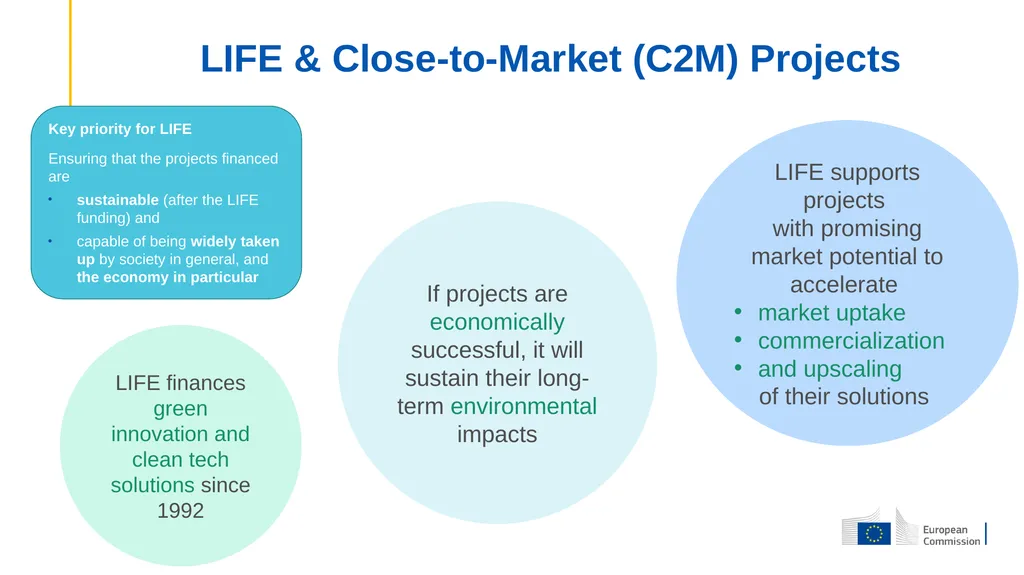
LIFE & Close-to-Market (C2M) Projects LIFE finances green innovation and clean tech solutions since 1992 If projects are economically successful, it will sustain their long-term environmental impacts LIFE supports projects
with promising market potential to accelerate
market uptake
commercialization
and upscaling
of their solutions Key priority for LIFE
Ensuring that the projects financed are
sustainable (after the LIFE funding) and
capable of being widely taken up by society in general, and the economy in particular<br>
with promising market potential to accelerate
market uptake
commercialization
and upscaling
of their solutions Key priority for LIFE
Ensuring that the projects financed are
sustainable (after the LIFE funding) and
capable of being widely taken up by society in general, and the economy in particular<br>
09
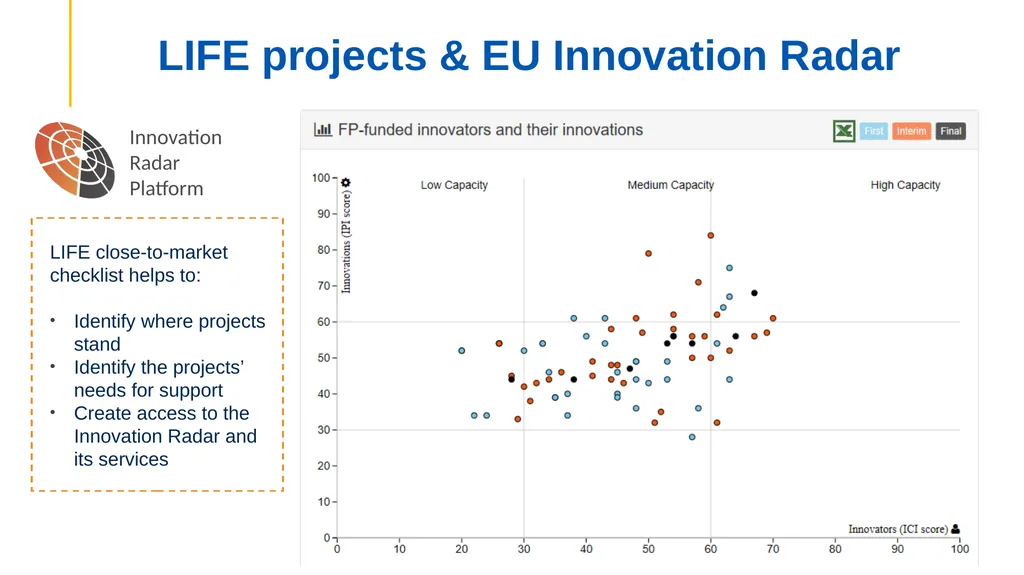
LIFE projects & EU Innovation Radar LIFE close-to-market checklist helps to:
Identify where projects stand
Identify the projects’ needs for support
Create access to the Innovation Radar and its services Innovation Radar
Platform<br>
Identify where projects stand
Identify the projects’ needs for support
Create access to the Innovation Radar and its services Innovation Radar
Platform<br>
10
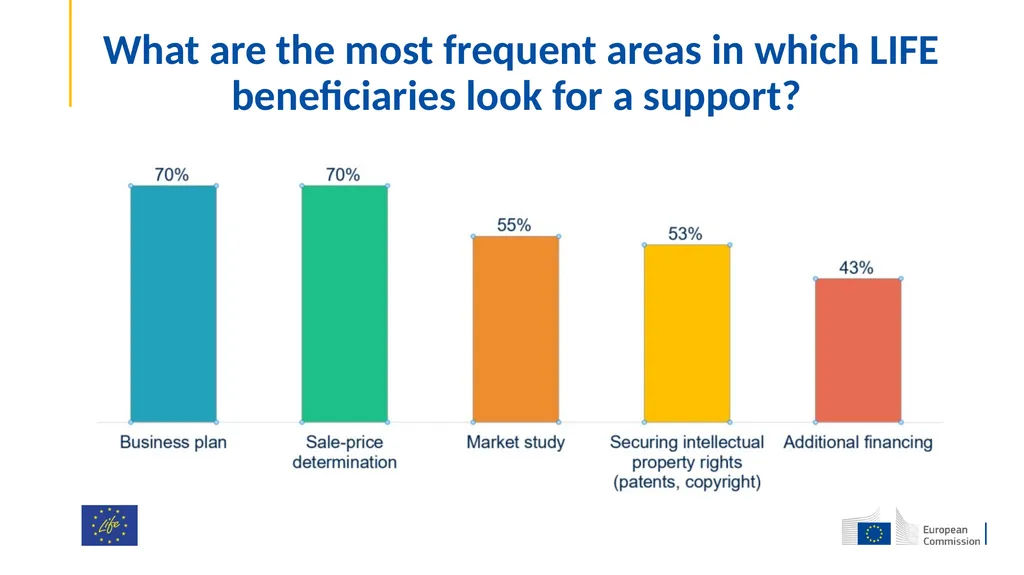
What are the most frequent areas in which LIFE beneficiaries look for a support?<br>
11
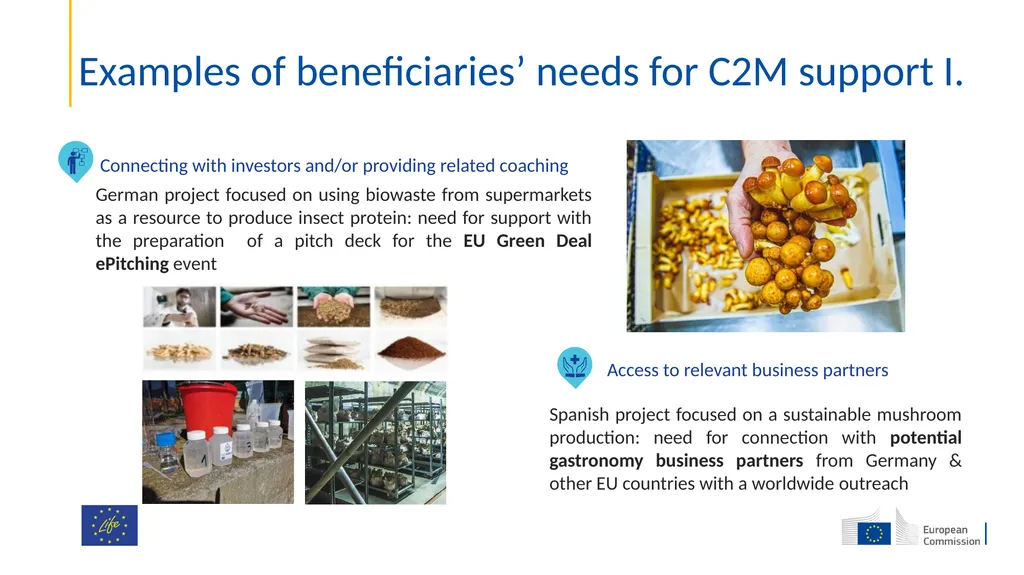
Examples of beneficiaries’ needs for C2M support I. Spanish project focused on a sustainable mushroom production: need for connection with potential gastronomy business partners from Germany & other EU countries with a worldwide outreach German project focused on using biowaste from supermarkets as a resource to produce insect protein: need for support with the preparation of a pitch deck for the EU Green Deal ePitching event<br>
12
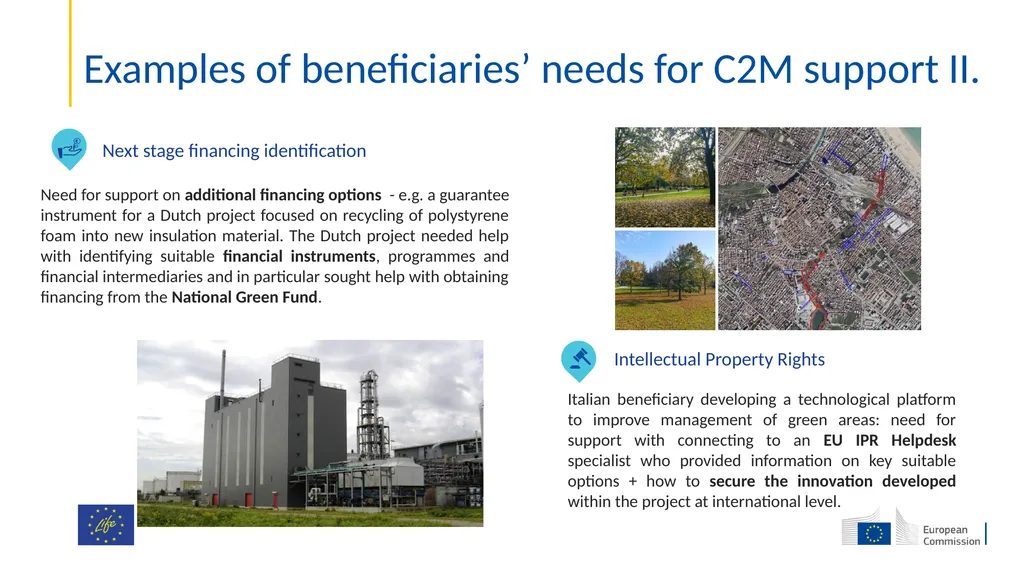
Examples of beneficiaries’ needs for C2M support II. Need for support on additional financing options - e.g. a guarantee instrument for a Dutch project focused on recycling of polystyrene foam into new insulation material. The Dutch project needed help with identifying suitable financial instruments, programmes and financial intermediaries and in particular sought help with obtaining financing from the National Green Fund. Italian beneficiary developing a technological platform to improve management of green areas: need for support with connecting to an EU IPR Helpdesk specialist who provided information on key suitable options + how to secure the innovation developed within the project at international level.<br>
13
LIFE Web site https://cinea.ec.europa.eu/life_en & LIFE project database
Call documents @ EU Funding & tender opportunities portal
LIFE Regulation and Multi-annual work-programme
Guidelines designed by the individual National Contact Points MUST READ for LIFE applicants 30 April Brussels | #EULife19<br>
Call documents @ EU Funding & tender opportunities portal
LIFE Regulation and Multi-annual work-programme
Guidelines designed by the individual National Contact Points MUST READ for LIFE applicants 30 April Brussels | #EULife19<br>
14
Thank you
https://cinea.ec.europa.eu/life/circular-economy-and-quality-life_en © European Union 2021<br>
15
CIRCULAR ECONOMY AND WASTE Circular Economy and the Environment
Implementation of business and consumption models or solutions to support value chains, particularly the key product value chains set out in the new EU Action Plan for the Circular Economy, aiming at reducing or preventing resource use and waste including one or more of the following:
Implementation of design for the environment solutions, including circular design, to improve durability, reparability, reusability, upgradability, recycling and use of recycled content in new products;
These solutions shall aim at reducing impacts holistically by considering aspects such as: life cycle approach, wide uptake of labelling, green procurement and tracking of raw materials in components and products;
Solutions (post-design) to support the implementation, transfer and/or uptake of product durability, reuse and repair, including upgrading and remanufacturing;
Support to the implementation, transfer and/or uptake of one or more of the following:
Product-as-a-service solutions and other business models or technologies to optimise asset use,
Industrial symbiosis and creation of circular value chains, better tracking resources and matching surplus or by-product materials or recyclable waste across industrial sectors,
Digital product passports.
The models and/or solutions proposed should ideally consider the environmental performance of the whole value chain, but can equally focus on any specific stage of the value chain. Projects may include, as an element, the development of data to support value chain thinking. Particular attention should be given to the involvement and active participation of SMEs.<br>
Implementation of business and consumption models or solutions to support value chains, particularly the key product value chains set out in the new EU Action Plan for the Circular Economy, aiming at reducing or preventing resource use and waste including one or more of the following:
Implementation of design for the environment solutions, including circular design, to improve durability, reparability, reusability, upgradability, recycling and use of recycled content in new products;
These solutions shall aim at reducing impacts holistically by considering aspects such as: life cycle approach, wide uptake of labelling, green procurement and tracking of raw materials in components and products;
Solutions (post-design) to support the implementation, transfer and/or uptake of product durability, reuse and repair, including upgrading and remanufacturing;
Support to the implementation, transfer and/or uptake of one or more of the following:
Product-as-a-service solutions and other business models or technologies to optimise asset use,
Industrial symbiosis and creation of circular value chains, better tracking resources and matching surplus or by-product materials or recyclable waste across industrial sectors,
Digital product passports.
The models and/or solutions proposed should ideally consider the environmental performance of the whole value chain, but can equally focus on any specific stage of the value chain. Projects may include, as an element, the development of data to support value chain thinking. Particular attention should be given to the involvement and active participation of SMEs.<br>
16
CIRCULAR ECONOMY AND WASTE Recovery of Resources from Waste
Implementation of innovative solutions to support value-added recycled materials, components or products for the following areas:
Separate collection and recycling of waste electrical and electronic equipment (WEEE) in particular but not limited to photovoltaic panels, smartphones, tablets and computers;
Separate collection and recycling of batteries and accumulators;
Dismantling, remanufacturing and recycling of End of Life Vehicles (ELVs) and End-of-Life Ships;
Selective separation and recycling of construction works or buildings;
Sorting and recycling of plastics;
Separate collection and recycling of bio-waste;
Separate collection and recycling of textiles;
Recycling of composite and multilayer materials in particular but not limited to carbon or glass fibres. Special attention should be given to face-masks used by the general public for COVID protection purposes, in such case also best practice solutions will be considered;
Recovering critical raw materials from waste
Sorting and recycling of packaging.
Implementation of innovative solutions for the identification, tracking, separation, prevention and decontamination of waste containing hazardous substances, to enable value-added recycling of the treated waste and safe disposal of the hazardous substances or reducing the scale of the problem within the framework of the project. Special attention should be given to those substances considered as the most harmful for the environment and human health, also known as substances of concern.<br>
Implementation of innovative solutions to support value-added recycled materials, components or products for the following areas:
Separate collection and recycling of waste electrical and electronic equipment (WEEE) in particular but not limited to photovoltaic panels, smartphones, tablets and computers;
Separate collection and recycling of batteries and accumulators;
Dismantling, remanufacturing and recycling of End of Life Vehicles (ELVs) and End-of-Life Ships;
Selective separation and recycling of construction works or buildings;
Sorting and recycling of plastics;
Separate collection and recycling of bio-waste;
Separate collection and recycling of textiles;
Recycling of composite and multilayer materials in particular but not limited to carbon or glass fibres. Special attention should be given to face-masks used by the general public for COVID protection purposes, in such case also best practice solutions will be considered;
Recovering critical raw materials from waste
Sorting and recycling of packaging.
Implementation of innovative solutions for the identification, tracking, separation, prevention and decontamination of waste containing hazardous substances, to enable value-added recycling of the treated waste and safe disposal of the hazardous substances or reducing the scale of the problem within the framework of the project. Special attention should be given to those substances considered as the most harmful for the environment and human health, also known as substances of concern.<br>