
The New Republic Chapter Tour Launching a New
GB
Published · 59 slides · 0 views

1 / 1





Description
The New Republic Chapter Tour Launching a New Republic, 17891800 The leaders of the new nation face the challenges of establishing a strong economy and a stable, democratic government. 9-1: Washingtons Presidency The president and the
Related Topics
Share
Embed code
Download this presentation From Below
"The New Republic Chapter Tour Launching a New" is the property of its rightful owner. Permission is granted to download and print the materials on this website for personal, non-commercial use only, and to display it on your personal computer provided you do not modify the materials and that you retain all copyright notices contained in the materials. By downloading content from our website, you accept the terms of this agreement.
Presentation Transcript
01
The New Republic Chapter Tour<br>
02
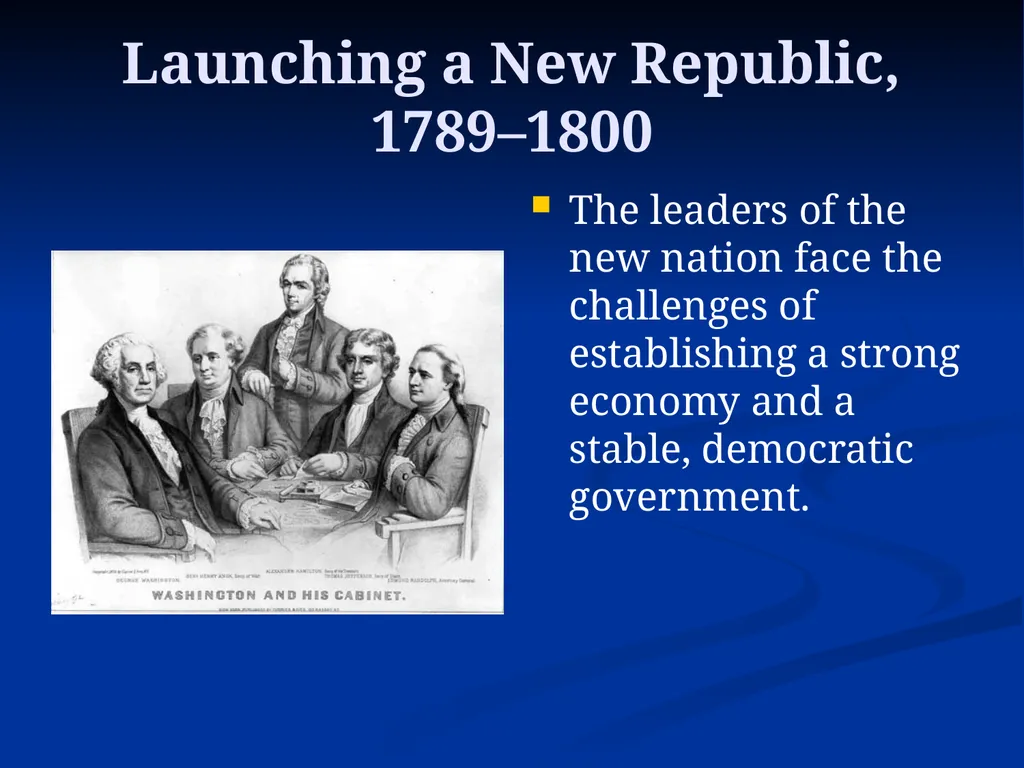
Launching a New Republic, 1789–1800 The leaders of the new nation face the challenges of establishing a strong economy and a stable, democratic government.<br>
03
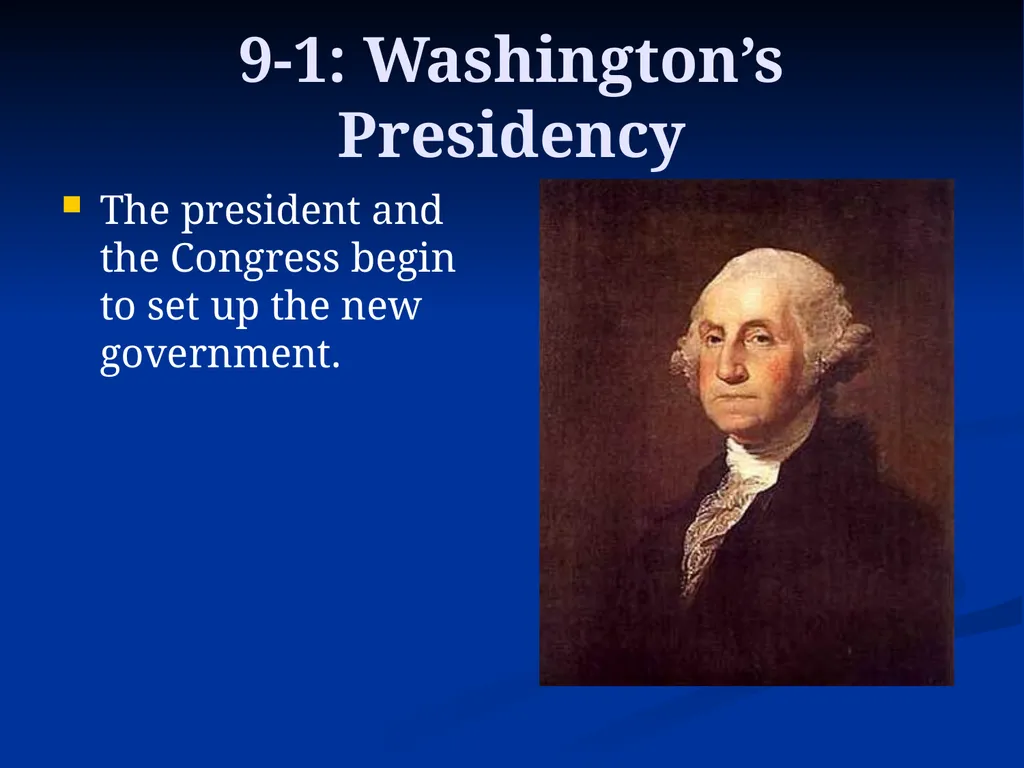
9-1: Washington’s Presidency The president and the Congress begin to set up the new government.<br>
04
Essential Question: How did the economic problems of America lead to disagreements between members of Washington’s cabinet?<br>
05
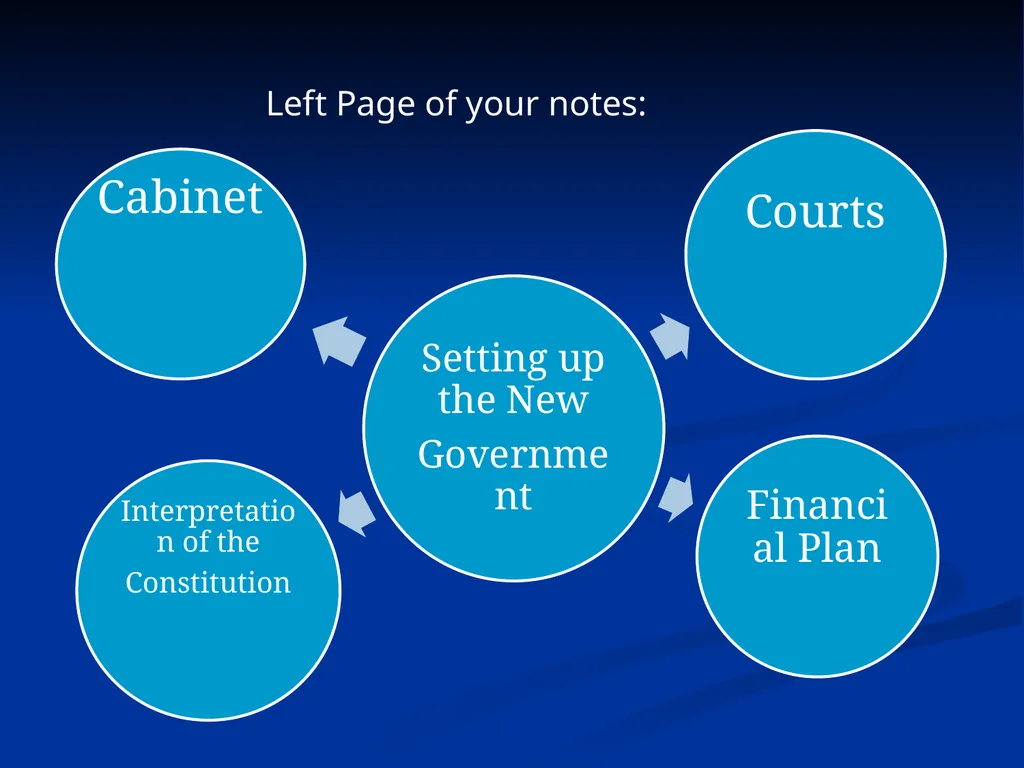
Left Page of your notes:<br>
06
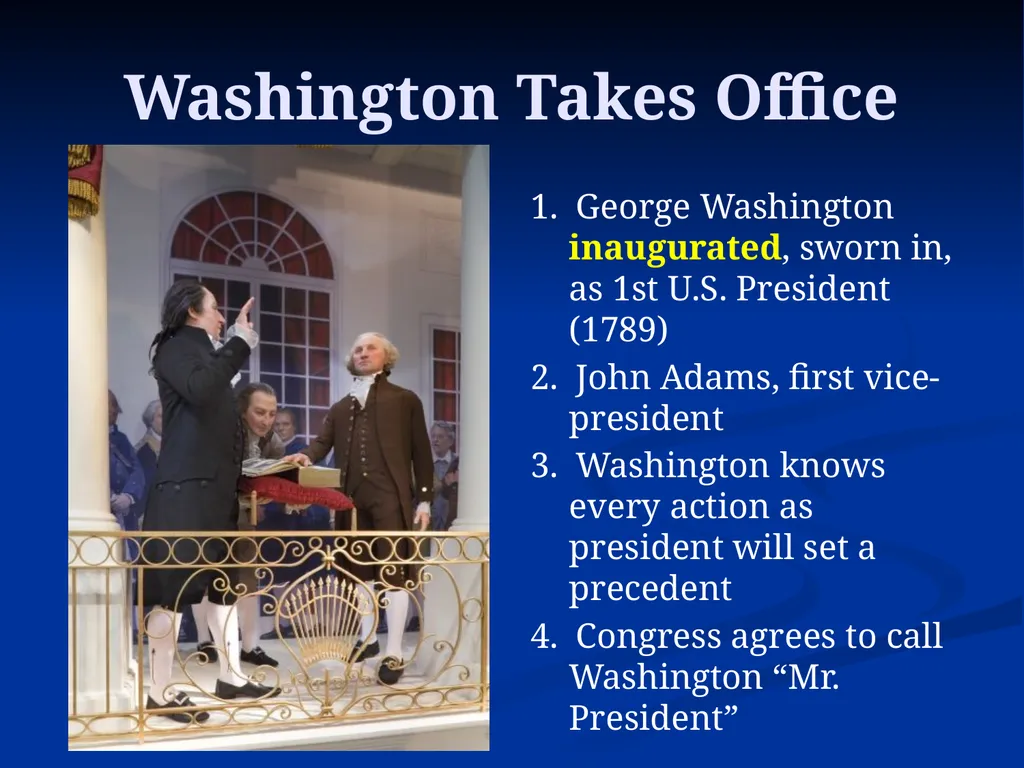
Washington Takes Office 1. George Washington inaugurated, sworn in, as 1st U.S. President (1789)
2. John Adams, first vice-president
3. Washington knows every action as president will set a precedent
4. Congress agrees to call Washington “Mr. President”<br>
2. John Adams, first vice-president
3. Washington knows every action as president will set a precedent
4. Congress agrees to call Washington “Mr. President”<br>
07
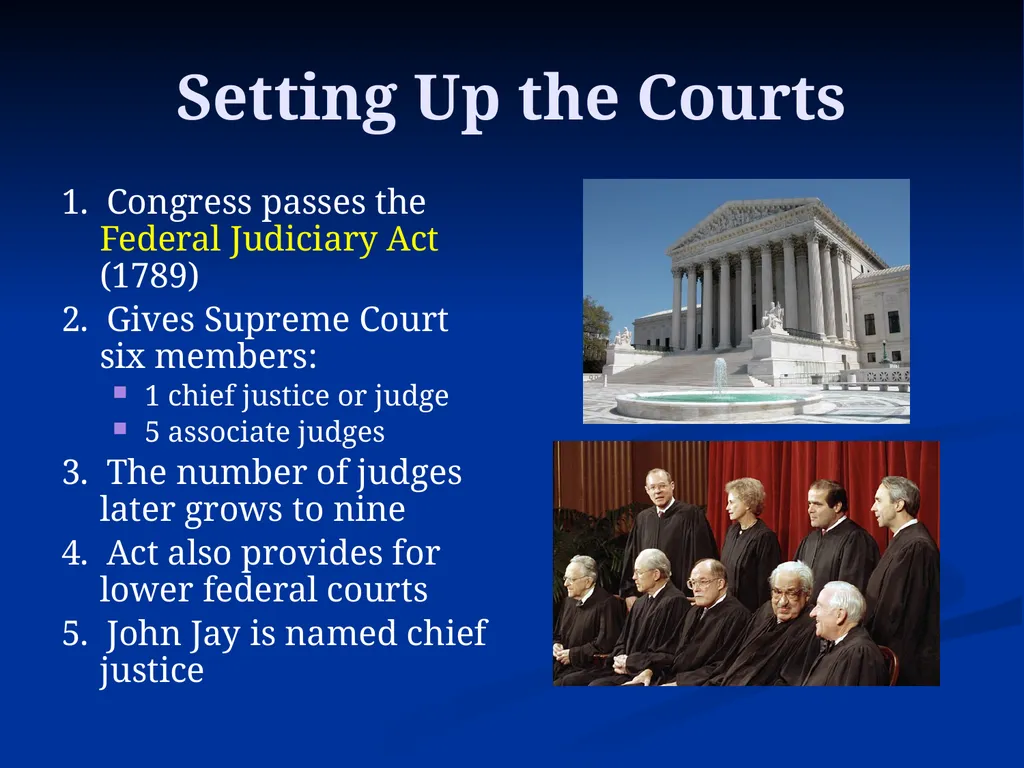
Setting Up the Courts 1. Congress passes the Federal Judiciary Act (1789)
2. Gives Supreme Court six members:
1 chief justice or judge
5 associate judges
3. The number of judges later grows to nine
4. Act also provides for lower federal courts
5. John Jay is named chief justice<br>
2. Gives Supreme Court six members:
1 chief justice or judge
5 associate judges
3. The number of judges later grows to nine
4. Act also provides for lower federal courts
5. John Jay is named chief justice<br>
08
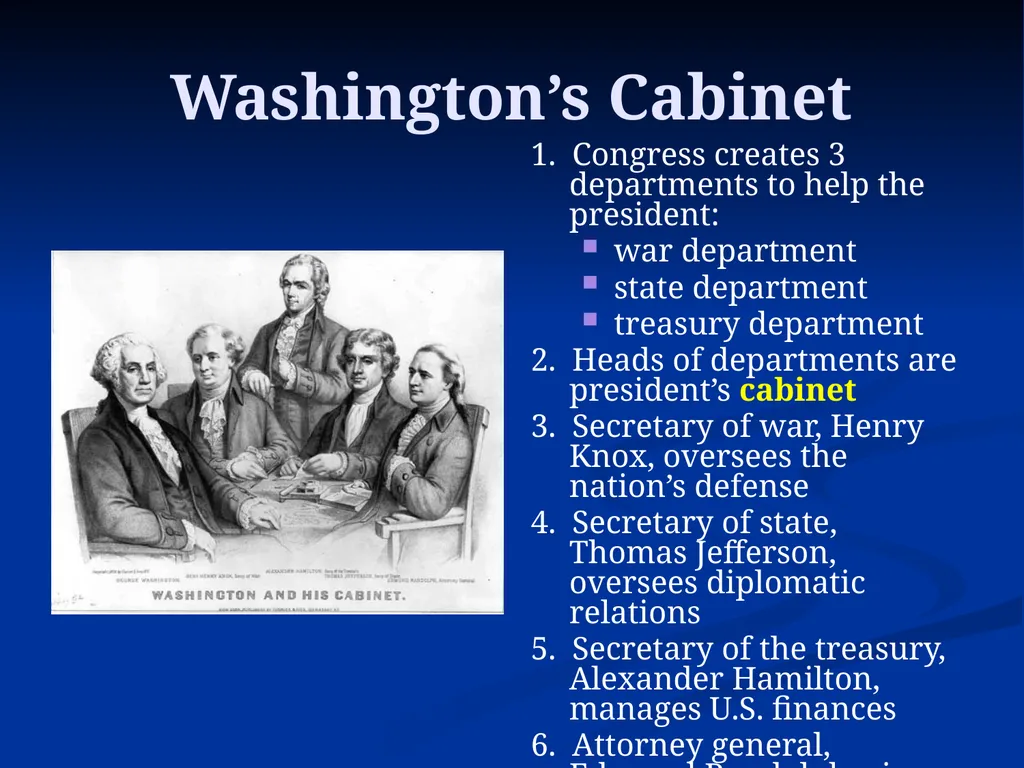
Washington’s Cabinet 1. Congress creates 3 departments to help the president:
war department
state department
treasury department
2. Heads of departments are president’s cabinet
3. Secretary of war, Henry Knox, oversees the nation’s defense
4. Secretary of state, Thomas Jefferson, oversees diplomatic relations
5. Secretary of the treasury, Alexander Hamilton, manages U.S. finances
6. Attorney general, Edmund Randolph, gives legal advice<br>
war department
state department
treasury department
2. Heads of departments are president’s cabinet
3. Secretary of war, Henry Knox, oversees the nation’s defense
4. Secretary of state, Thomas Jefferson, oversees diplomatic relations
5. Secretary of the treasury, Alexander Hamilton, manages U.S. finances
6. Attorney general, Edmund Randolph, gives legal advice<br>
09
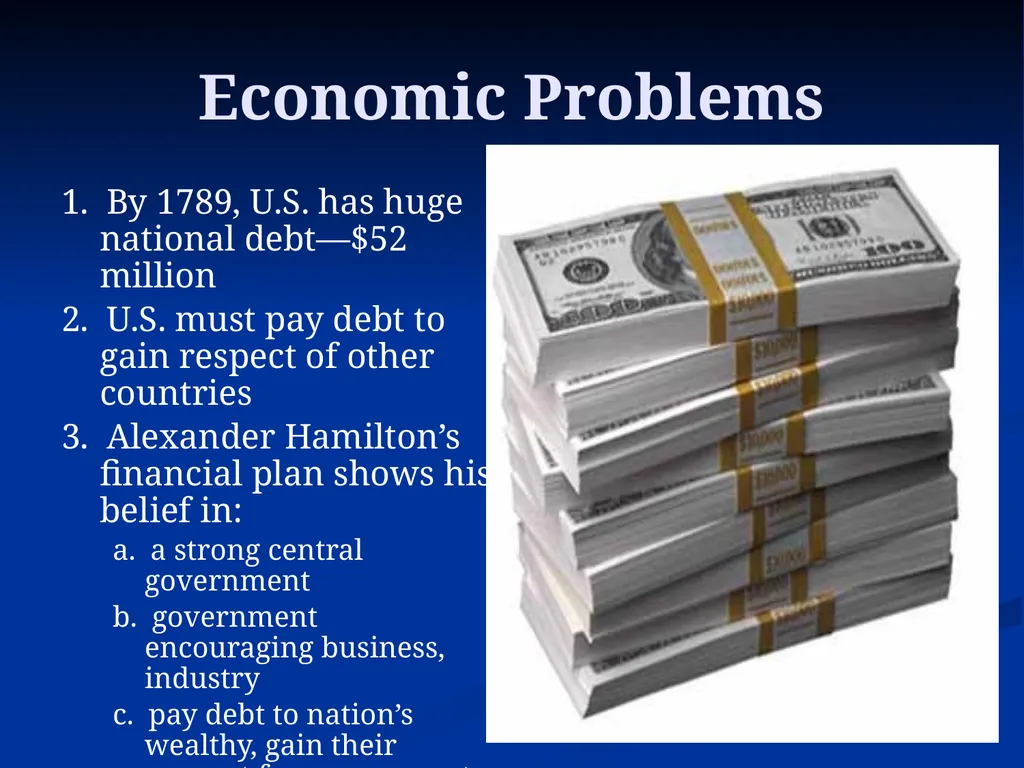
Economic Problems 1. By 1789, U.S. has huge national debt—$52 million
2. U.S. must pay debt to gain respect of other countries
3. Alexander Hamilton’s financial plan shows his belief in:
a. a strong central government
b. government encouraging business, industry
c. pay debt to nation’s wealthy, gain their support for government<br>
2. U.S. must pay debt to gain respect of other countries
3. Alexander Hamilton’s financial plan shows his belief in:
a. a strong central government
b. government encouraging business, industry
c. pay debt to nation’s wealthy, gain their support for government<br>
10
Hamilton’s Financial Plan 1. Alexander Hamilton proposes 3-step financial plan to Congress (1790)
pay off all war debts
raise government revenues
create a national bank
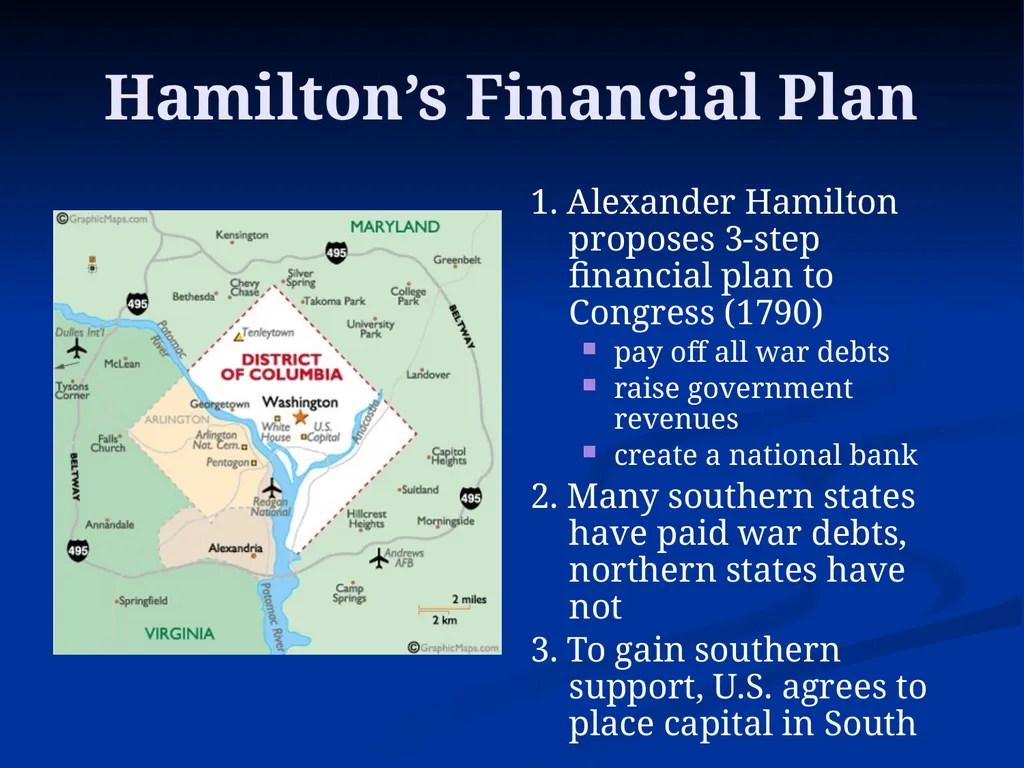
2. Many southern states have paid war debts, northern states have not
3. To gain southern support, U.S. agrees to place capital in South<br>
pay off all war debts
raise government revenues
create a national bank
2. Many southern states have paid war debts, northern states have not
3. To gain southern support, U.S. agrees to place capital in South<br>
11
Hamilton’s Financial Plan 1. Hamilton supports tariffs (tax on imported goods) because:
a. raises money for U.S. government
b. encourages growth of U.S. industry
c. encourages people to buy American goods
2. Hamilton calls for National bank, safe for government investments
3. Bank would make loans to businesses, issue bank notes<br>
a. raises money for U.S. government
b. encourages growth of U.S. industry
c. encourages people to buy American goods
2. Hamilton calls for National bank, safe for government investments
3. Bank would make loans to businesses, issue bank notes<br>
12
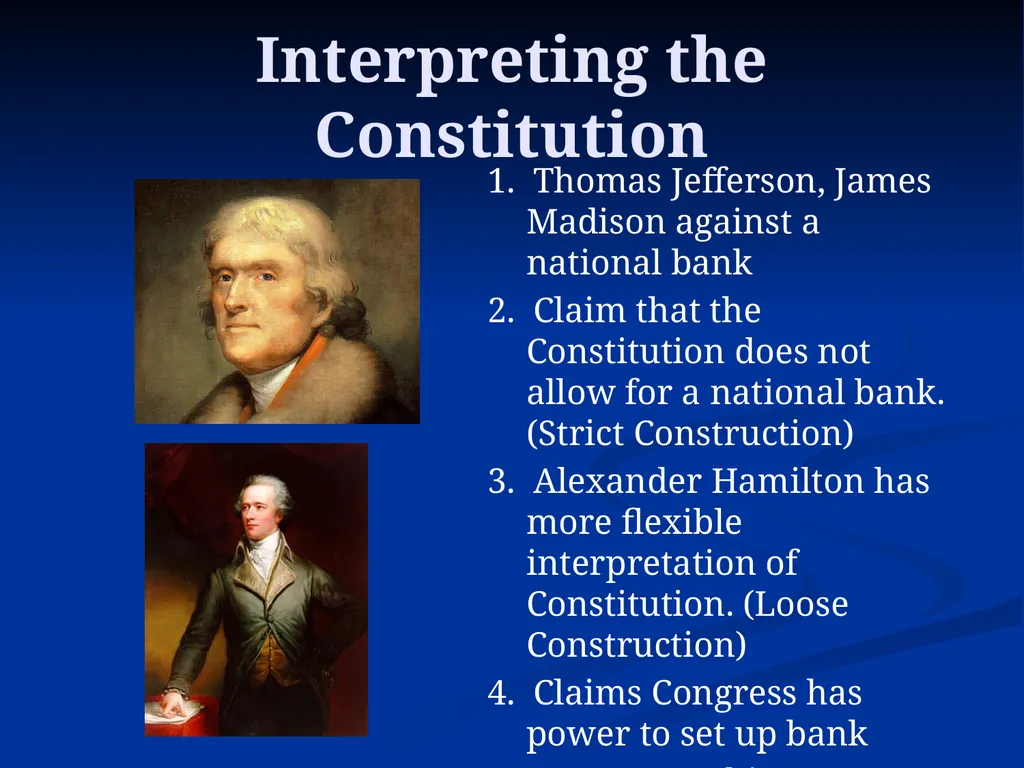
Interpreting the Constitution 1. Thomas Jefferson, James Madison against a national bank
2. Claim that the Constitution does not allow for a national bank. (Strict Construction)
3. Alexander Hamilton has more flexible interpretation of Constitution. (Loose Construction)
4. Claims Congress has power to set up bank
5. George Washington approves a national bank (1791)<br>
2. Claim that the Constitution does not allow for a national bank. (Strict Construction)
3. Alexander Hamilton has more flexible interpretation of Constitution. (Loose Construction)
4. Claims Congress has power to set up bank
5. George Washington approves a national bank (1791)<br>
13
Finish Notes Summarize this section, focusing on the essential question.
Quiz Time!<br>
Quiz Time!<br>
14
Secretary of State Thomas Jefferson, Secretary of the Treasury Alexander Hamilton, Secretary of War Henry Knox, and Attorney General Edmund Randolph formed the first Senate that advised President Washington.
One of the ways that the national government raised money was by putting a tariff on goods imported from other countries.
In 1789, Congress passed the Administration of Justice Act, which established the federal court system.
Alexander Hamilton’s financial plan for the nation included a national bank. If the statement is true, write true.
If it is false, change the underlined word or words to make it true.<br>
One of the ways that the national government raised money was by putting a tariff on goods imported from other countries.
In 1789, Congress passed the Administration of Justice Act, which established the federal court system.
Alexander Hamilton’s financial plan for the nation included a national bank. If the statement is true, write true.
If it is false, change the underlined word or words to make it true.<br>
15
9-2: Challenges to the New Government Washington establishes central authority at home and avoids war with European powers.<br>
16
Essential Question: What were the challenges Washington faced while establishing a new government?<br>
17
Left Page of your notes:<br>
18
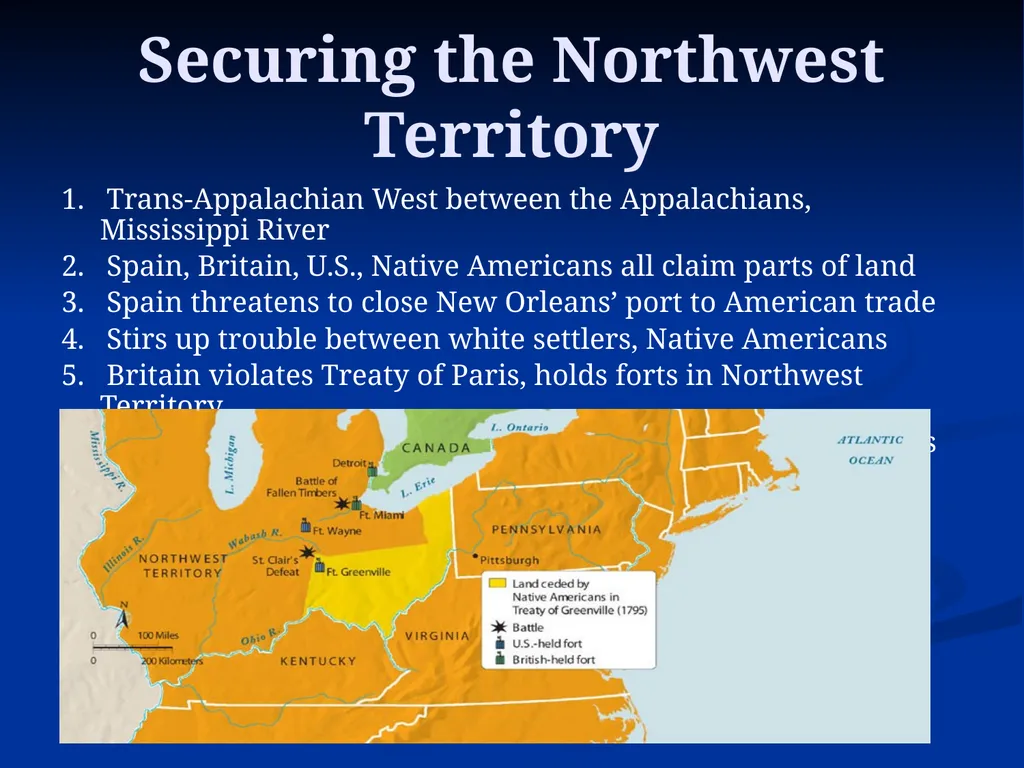
Securing the Northwest Territory 1. Trans-Appalachian West between the Appalachians, Mississippi River
2. Spain, Britain, U.S., Native Americans all claim parts of land
3. Spain threatens to close New Orleans’ port to American trade
4. Stirs up trouble between white settlers, Native Americans
5. Britain violates Treaty of Paris, holds forts in Northwest Territory
6. Supports Native Americans who clash with American settlers<br>
2. Spain, Britain, U.S., Native Americans all claim parts of land
3. Spain threatens to close New Orleans’ port to American trade
4. Stirs up trouble between white settlers, Native Americans
5. Britain violates Treaty of Paris, holds forts in Northwest Territory
6. Supports Native Americans who clash with American settlers<br>
19
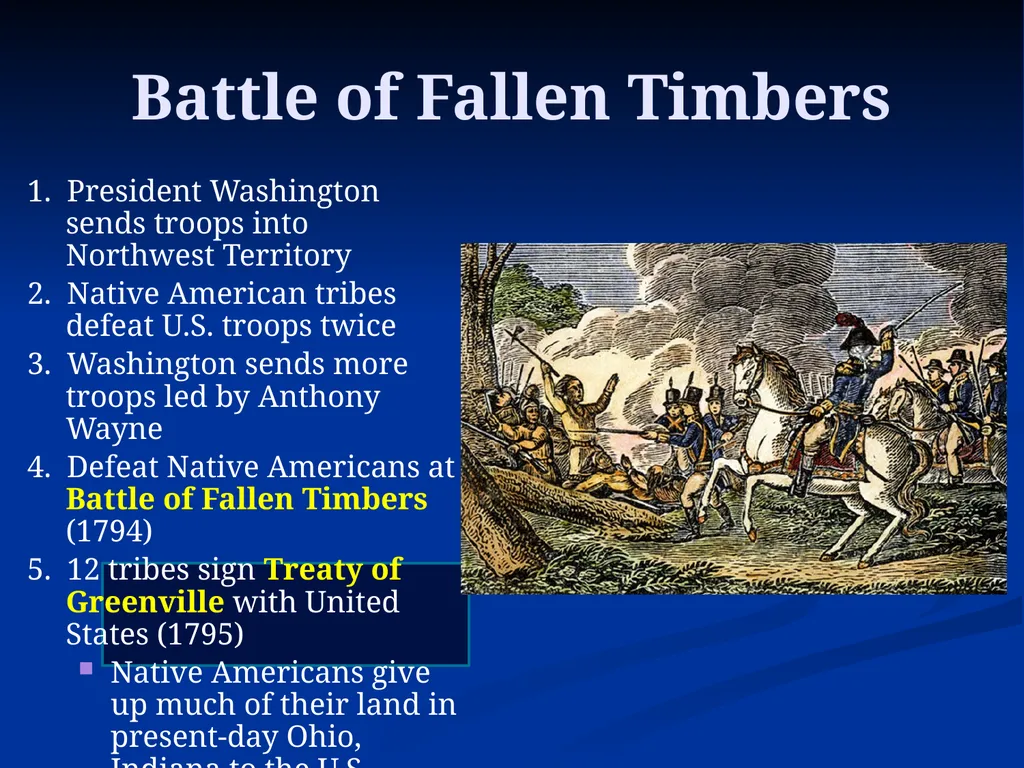
Battle of Fallen Timbers 1. President Washington sends troops into Northwest Territory
2. Native American tribes defeat U.S. troops twice
3. Washington sends more troops led by Anthony Wayne
4. Defeat Native Americans at Battle of Fallen Timbers (1794)
5. 12 tribes sign Treaty of Greenville with United States (1795)
Native Americans give up much of their land in present-day Ohio, Indiana to the U.S.<br>
2. Native American tribes defeat U.S. troops twice
3. Washington sends more troops led by Anthony Wayne
4. Defeat Native Americans at Battle of Fallen Timbers (1794)
5. 12 tribes sign Treaty of Greenville with United States (1795)
Native Americans give up much of their land in present-day Ohio, Indiana to the U.S.<br>
20
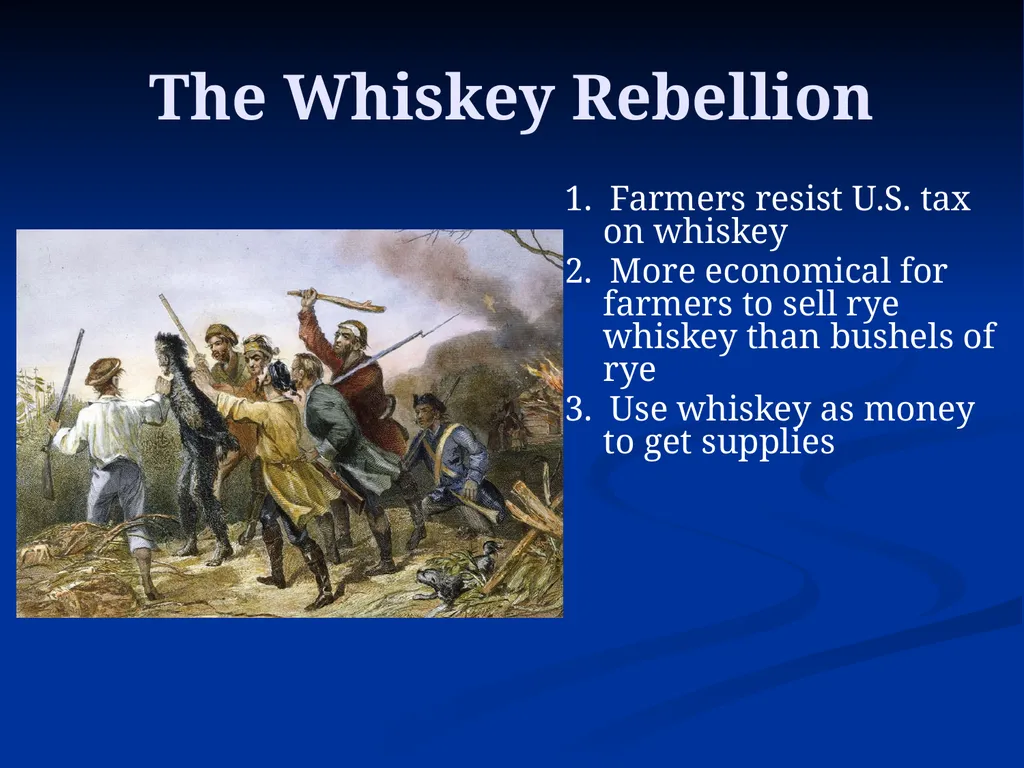
The Whiskey Rebellion 1. Farmers resist U.S. tax on whiskey
2. More economical for farmers to sell rye whiskey than bushels of rye
3. Use whiskey as money to get supplies<br>
2. More economical for farmers to sell rye whiskey than bushels of rye
3. Use whiskey as money to get supplies<br>
21
From The Text (301) “Such a resistance is treason against society, against liberty, against everything that ought to be dear to a free, enlightened, and prudent people. To tolerate it were to abandon your most precious interests. Not to subdue it were to tolerate it.” - Alexander Hamilton What resistance is Hamilton referring to?
What is Hamilton stating that President Washington should do?<br>
What is Hamilton stating that President Washington should do?<br>
22
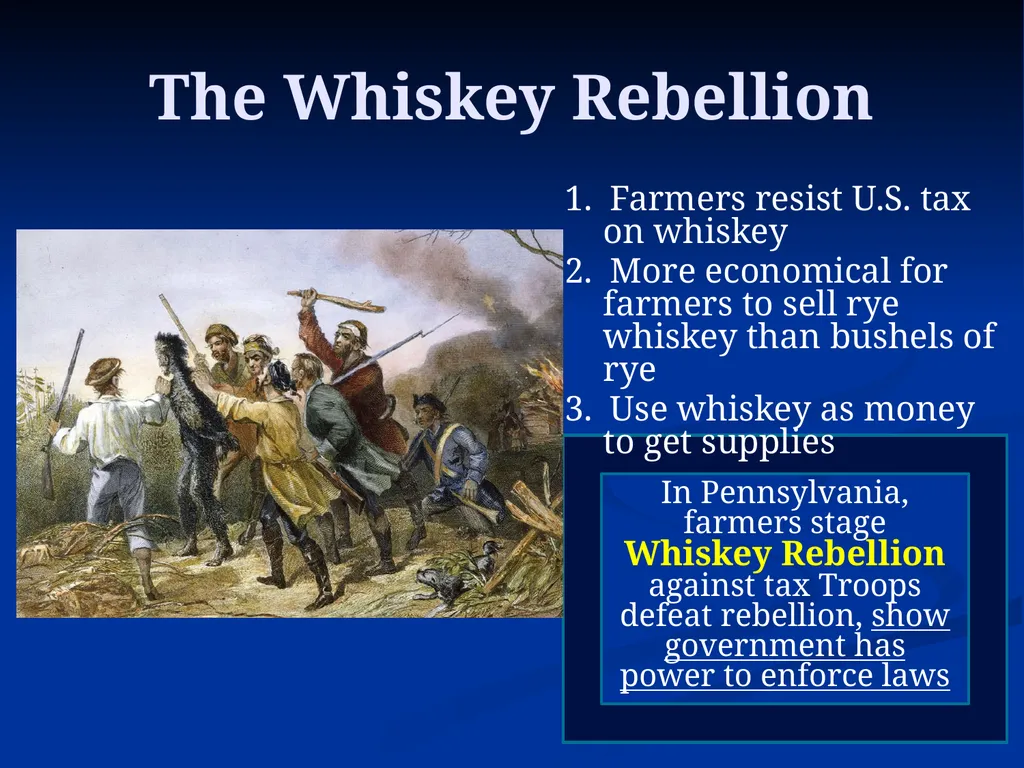
The Whiskey Rebellion 1. Farmers resist U.S. tax on whiskey
2. More economical for farmers to sell rye whiskey than bushels of rye
3. Use whiskey as money to get supplies In Pennsylvania, farmers stage Whiskey Rebellion against tax Troops defeat rebellion, show government has power to enforce laws<br>
2. More economical for farmers to sell rye whiskey than bushels of rye
3. Use whiskey as money to get supplies In Pennsylvania, farmers stage Whiskey Rebellion against tax Troops defeat rebellion, show government has power to enforce laws<br>
23
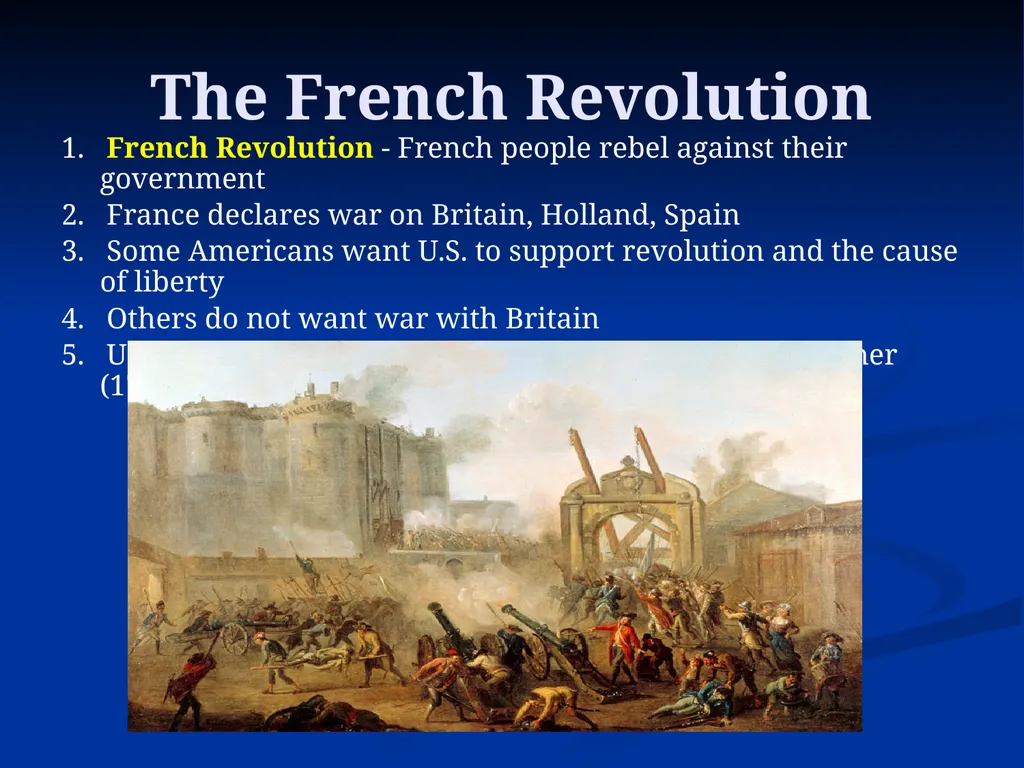
The French Revolution 1. French Revolution - French people rebel against their government
2. France declares war on Britain, Holland, Spain
3. Some Americans want U.S. to support revolution and the cause of liberty
4. Others do not want war with Britain
5. U.S. remains neutral, not siding with one country or other (1793)<br>
2. France declares war on Britain, Holland, Spain
3. Some Americans want U.S. to support revolution and the cause of liberty
4. Others do not want war with Britain
5. U.S. remains neutral, not siding with one country or other (1793)<br>
24
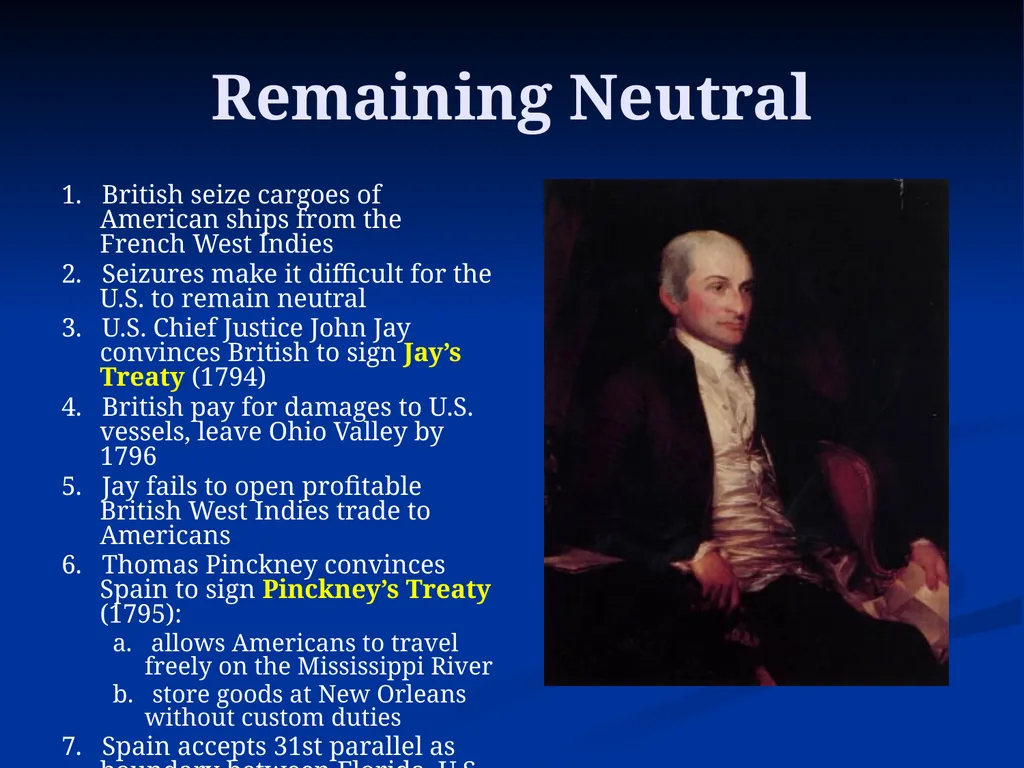
Remaining Neutral 1. British seize cargoes of American ships from the French West Indies
2. Seizures make it difficult for the U.S. to remain neutral
3. U.S. Chief Justice John Jay convinces British to sign Jay’s Treaty (1794)
4. British pay for damages to U.S. vessels, leave Ohio Valley by 1796
5. Jay fails to open profitable British West Indies trade to Americans
6. Thomas Pinckney convinces Spain to sign Pinckney’s Treaty (1795):
a. allows Americans to travel freely on the Mississippi River
b. store goods at New Orleans without custom duties
7. Spain accepts 31st parallel as boundary between Florida, U.S.<br>
2. Seizures make it difficult for the U.S. to remain neutral
3. U.S. Chief Justice John Jay convinces British to sign Jay’s Treaty (1794)
4. British pay for damages to U.S. vessels, leave Ohio Valley by 1796
5. Jay fails to open profitable British West Indies trade to Americans
6. Thomas Pinckney convinces Spain to sign Pinckney’s Treaty (1795):
a. allows Americans to travel freely on the Mississippi River
b. store goods at New Orleans without custom duties
7. Spain accepts 31st parallel as boundary between Florida, U.S.<br>
25
Finish Notes Summarize this section, focusing on the essential question.
Quiz Time!<br>
Quiz Time!<br>
26
a. Mad Anthony Wayne
b. Ohio Valley
c. Mississippi River
d. Little Turtle
e. Treaty of Greenville
f. Whiskey Rebellion Pinckney’s Treaty gave Americans access to this.
Led Native Americans to defeat United States in the Ohio Valley.
This turned over much of present-day Ohio and Indiana from Native Americans to the U.S. government.
Western Pennsylvania farmers rose up against the U.S. government.
Led U.S. troops at the Battle of Fallen Timbers.
Jay’s Treaty kept the British from this location.<br>
b. Ohio Valley
c. Mississippi River
d. Little Turtle
e. Treaty of Greenville
f. Whiskey Rebellion Pinckney’s Treaty gave Americans access to this.
Led Native Americans to defeat United States in the Ohio Valley.
This turned over much of present-day Ohio and Indiana from Native Americans to the U.S. government.
Western Pennsylvania farmers rose up against the U.S. government.
Led U.S. troops at the Battle of Fallen Timbers.
Jay’s Treaty kept the British from this location.<br>
27
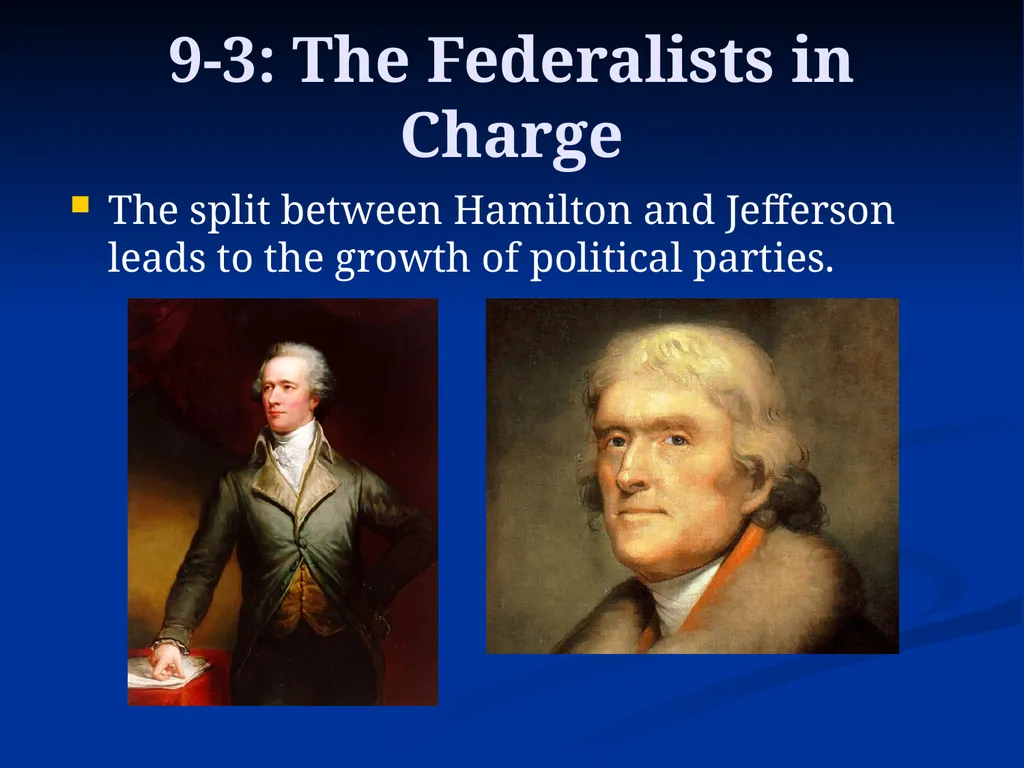
9-3: The Federalists in Charge The split between Hamilton and Jefferson leads to the growth of political parties.<br>
28
Essential Question: What disagreements led to the formation of political parties? What were the first political parties and who were the leaders of each?<br>
29
Left Page of your notes:<br>
30
Washington Retires During second term, George Washington receives some criticism<br>
31
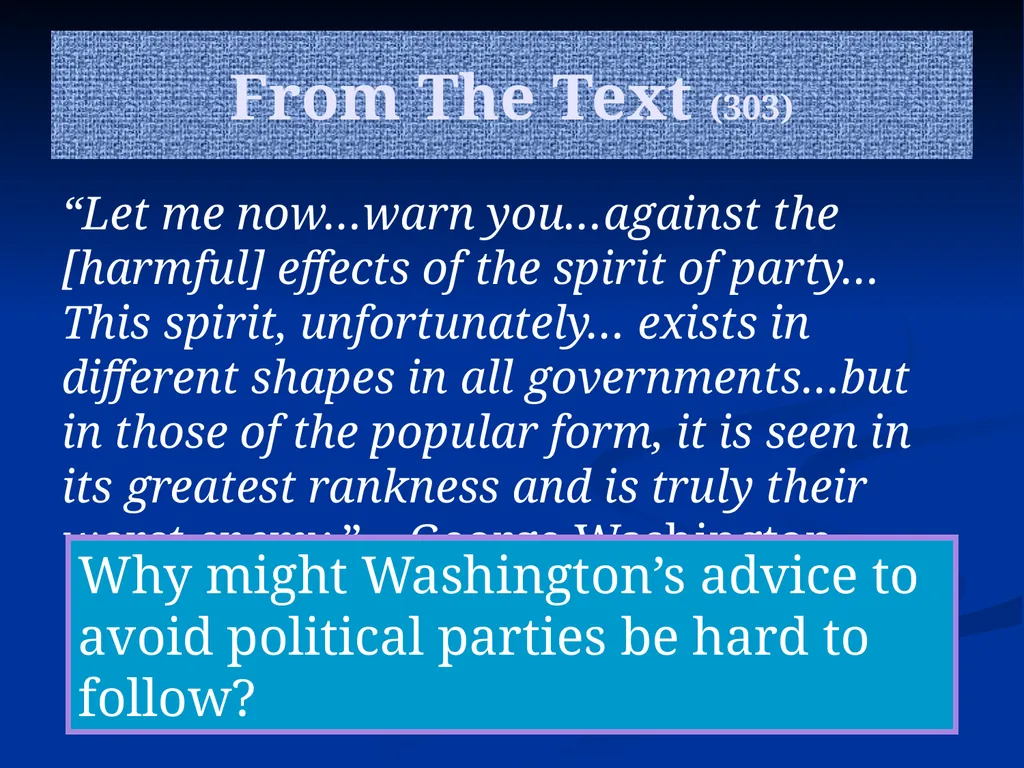
“Let me now…warn you…against the [harmful] effects of the spirit of party… This spirit, unfortunately… exists in different shapes in all governments…but in those of the popular form, it is seen in its greatest rankness and is truly their worst enemy.” - George Washington From The Text (303) Why might Washington’s advice to avoid political parties be hard to follow?<br>
32
Washington Retires During second term, George Washington receives some criticism
1. Washington warns that political divisions can weaken the nation
2. Relations with governments of other countries - foreign policy
3. Washington urges U.S. not to form permanent alliances with nations<br>
1. Washington warns that political divisions can weaken the nation
2. Relations with governments of other countries - foreign policy
3. Washington urges U.S. not to form permanent alliances with nations<br>
33
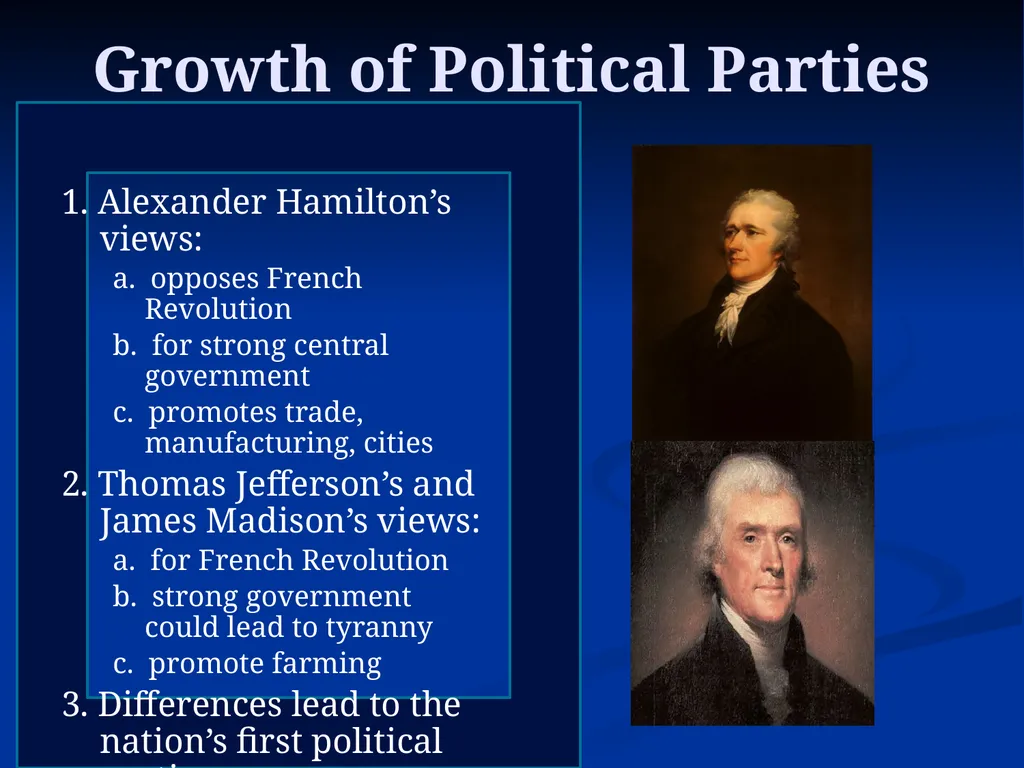
Growth of Political Parties 1. Alexander Hamilton’s views:
a. opposes French Revolution
b. for strong central government
c. promotes trade, manufacturing, cities
2. Thomas Jefferson’s and James Madison’s views:
a. for French Revolution
b. strong government could lead to tyranny
c. promote farming
3. Differences lead to the nation’s first political parties<br>
a. opposes French Revolution
b. for strong central government
c. promotes trade, manufacturing, cities
2. Thomas Jefferson’s and James Madison’s views:
a. for French Revolution
b. strong government could lead to tyranny
c. promote farming
3. Differences lead to the nation’s first political parties<br>
34
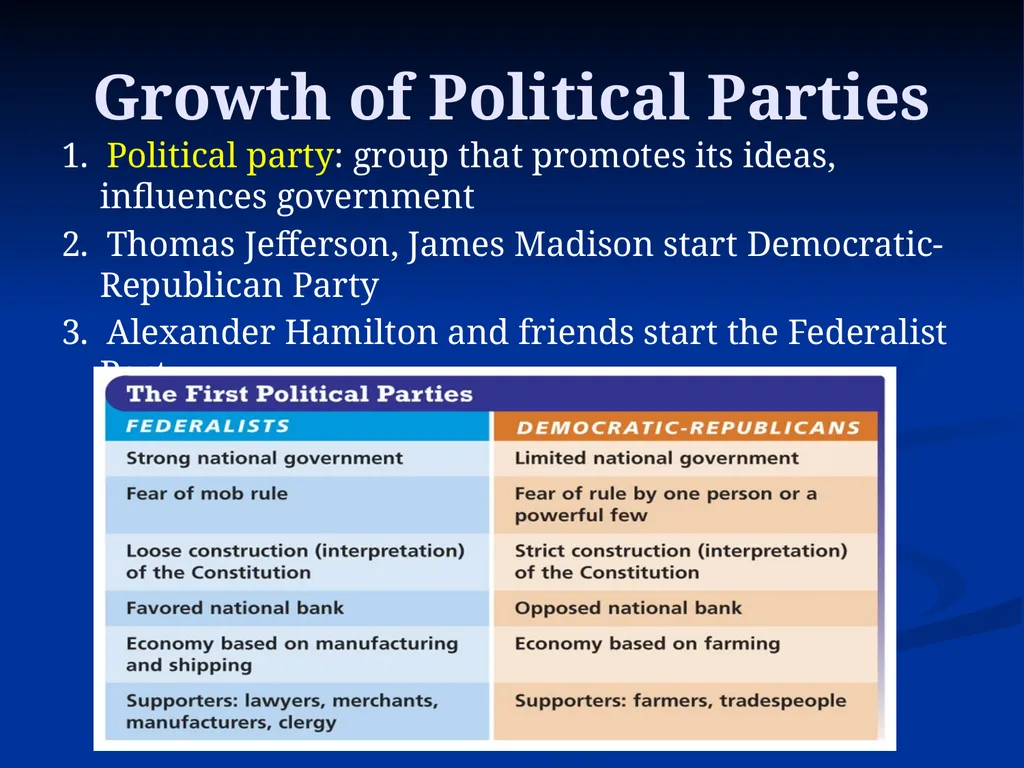
Growth of Political Parties 1. Political party: group that promotes its ideas, influences government
2. Thomas Jefferson, James Madison start Democratic-Republican Party
3. Alexander Hamilton and friends start the Federalist Party<br>
2. Thomas Jefferson, James Madison start Democratic-Republican Party
3. Alexander Hamilton and friends start the Federalist Party<br>
35
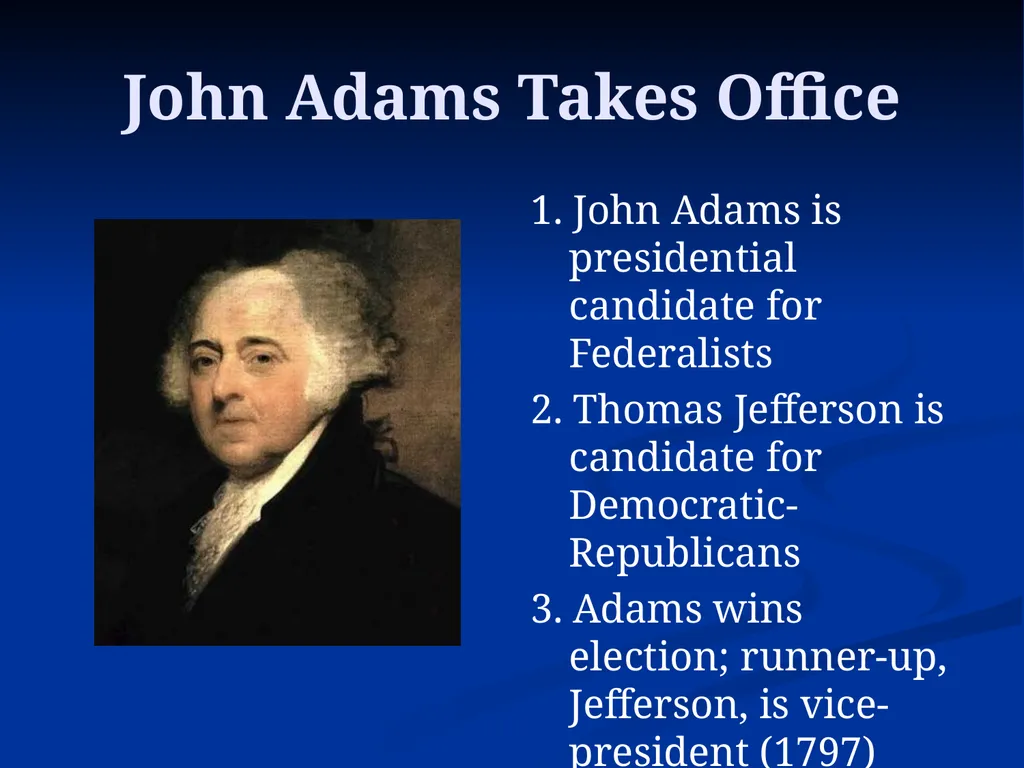
John Adams Takes Office 1. John Adams is presidential candidate for Federalists
2. Thomas Jefferson is candidate for Democratic-Republicans
3. Adams wins election; runner-up, Jefferson, is vice-president (1797)<br>
2. Thomas Jefferson is candidate for Democratic-Republicans
3. Adams wins election; runner-up, Jefferson, is vice-president (1797)<br>
36
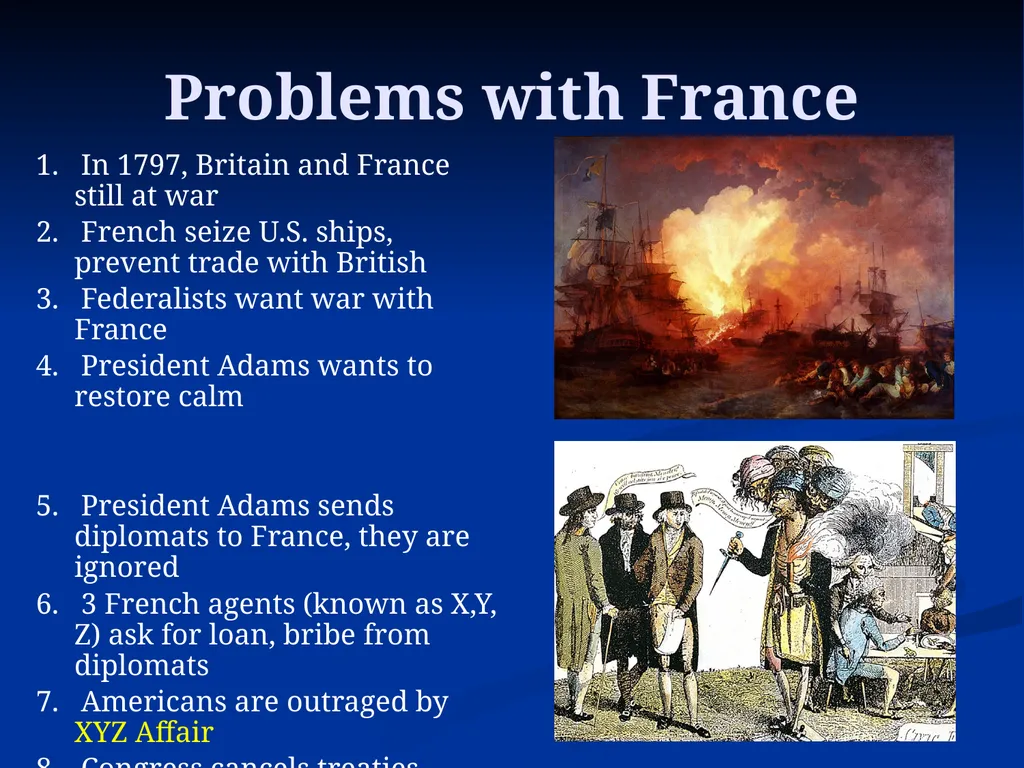
Problems with France 1. In 1797, Britain and France still at war
2. French seize U.S. ships, prevent trade with British
3. Federalists want war with France
4. President Adams wants to restore calm
5. President Adams sends diplomats to France, they are ignored
6. 3 French agents (known as X,Y, Z) ask for loan, bribe from diplomats
7. Americans are outraged by XYZ Affair
8. Congress cancels treaties, allows U.S. to seize French ships<br>
2. French seize U.S. ships, prevent trade with British
3. Federalists want war with France
4. President Adams wants to restore calm
5. President Adams sends diplomats to France, they are ignored
6. 3 French agents (known as X,Y, Z) ask for loan, bribe from diplomats
7. Americans are outraged by XYZ Affair
8. Congress cancels treaties, allows U.S. to seize French ships<br>
37
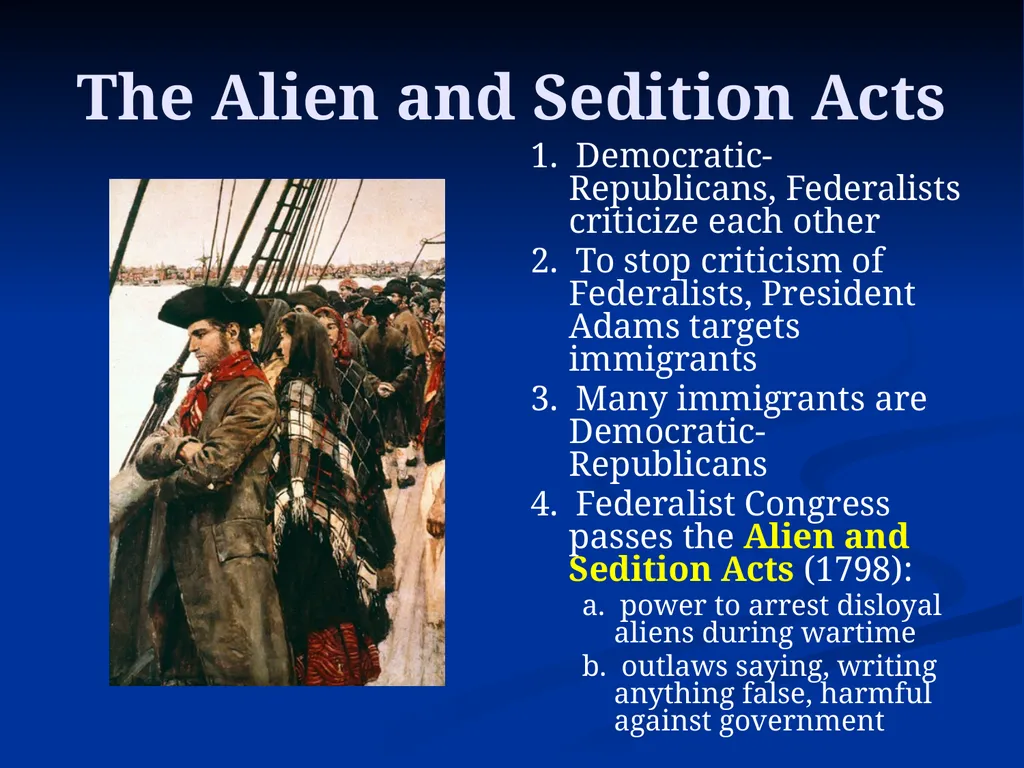
The Alien and Sedition Acts 1. Democratic-Republicans, Federalists criticize each other
2. To stop criticism of Federalists, President Adams targets immigrants
3. Many immigrants are Democratic-Republicans
4. Federalist Congress passes the Alien and Sedition Acts (1798):
a. power to arrest disloyal aliens during wartime
b. outlaws saying, writing anything false, harmful against government<br>
2. To stop criticism of Federalists, President Adams targets immigrants
3. Many immigrants are Democratic-Republicans
4. Federalist Congress passes the Alien and Sedition Acts (1798):
a. power to arrest disloyal aliens during wartime
b. outlaws saying, writing anything false, harmful against government<br>
38
The Alien and Sedition Acts 1. Alien and Sedition Acts clamp down on freedom of speech
2. Democratic-Republicans use states’ rights to fight acts
3. State can refuse to pass a federal law if it sees law as unconstitutional
4. Kentucky, Virginia find Alien and Sedition Acts unconstitutional
5. Democratic-Republicans gain control of Congress
6. Repeal acts or let them expire between 1800 and 1802<br>
2. Democratic-Republicans use states’ rights to fight acts
3. State can refuse to pass a federal law if it sees law as unconstitutional
4. Kentucky, Virginia find Alien and Sedition Acts unconstitutional
5. Democratic-Republicans gain control of Congress
6. Repeal acts or let them expire between 1800 and 1802<br>
39
Peace with France U.S. and France make peace, sign Convention of 1800:
stops naval attacks between France and U.S.
allows U.S., French ships to sail the ocean in peace<br>
stops naval attacks between France and U.S.
allows U.S., French ships to sail the ocean in peace<br>
40
Finish Notes Summarize this section, focusing on the essential question.
Quiz Time!<br>
Quiz Time!<br>
41
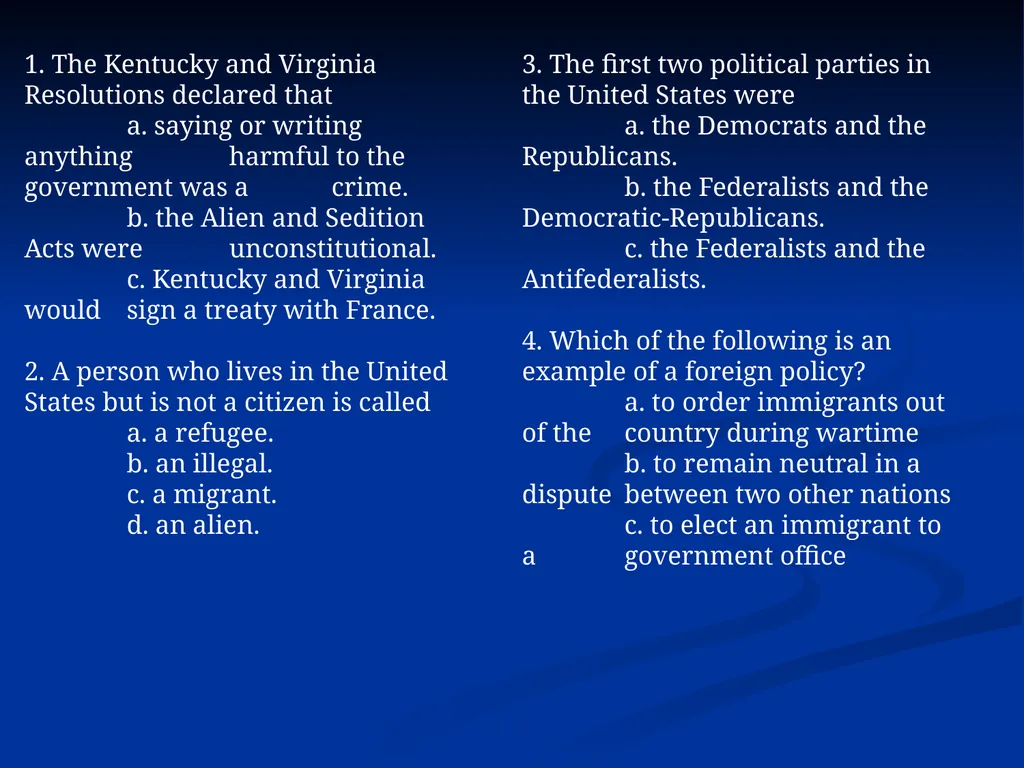
1. The Kentucky and Virginia Resolutions declared that
a. saying or writing anything harmful to the government was a crime.
b. the Alien and Sedition Acts were unconstitutional.
c. Kentucky and Virginia would sign a treaty with France.
2. A person who lives in the United States but is not a citizen is called
a. a refugee.
b. an illegal.
c. a migrant.
d. an alien. 3. The first two political parties in the United States were
a. the Democrats and the Republicans.
b. the Federalists and the Democratic-Republicans.
c. the Federalists and the Antifederalists.
4. Which of the following is an example of a foreign policy?
a. to order immigrants out of the country during wartime
b. to remain neutral in a dispute between two other nations
c. to elect an immigrant to a government office<br>
a. saying or writing anything harmful to the government was a crime.
b. the Alien and Sedition Acts were unconstitutional.
c. Kentucky and Virginia would sign a treaty with France.
2. A person who lives in the United States but is not a citizen is called
a. a refugee.
b. an illegal.
c. a migrant.
d. an alien. 3. The first two political parties in the United States were
a. the Democrats and the Republicans.
b. the Federalists and the Democratic-Republicans.
c. the Federalists and the Antifederalists.
4. Which of the following is an example of a foreign policy?
a. to order immigrants out of the country during wartime
b. to remain neutral in a dispute between two other nations
c. to elect an immigrant to a government office<br>
42
I AM Washington
Hamilton
Jefferson
Adams<br>
Hamilton
Jefferson
Adams<br>
43
TEST REVIEW!<br>
44
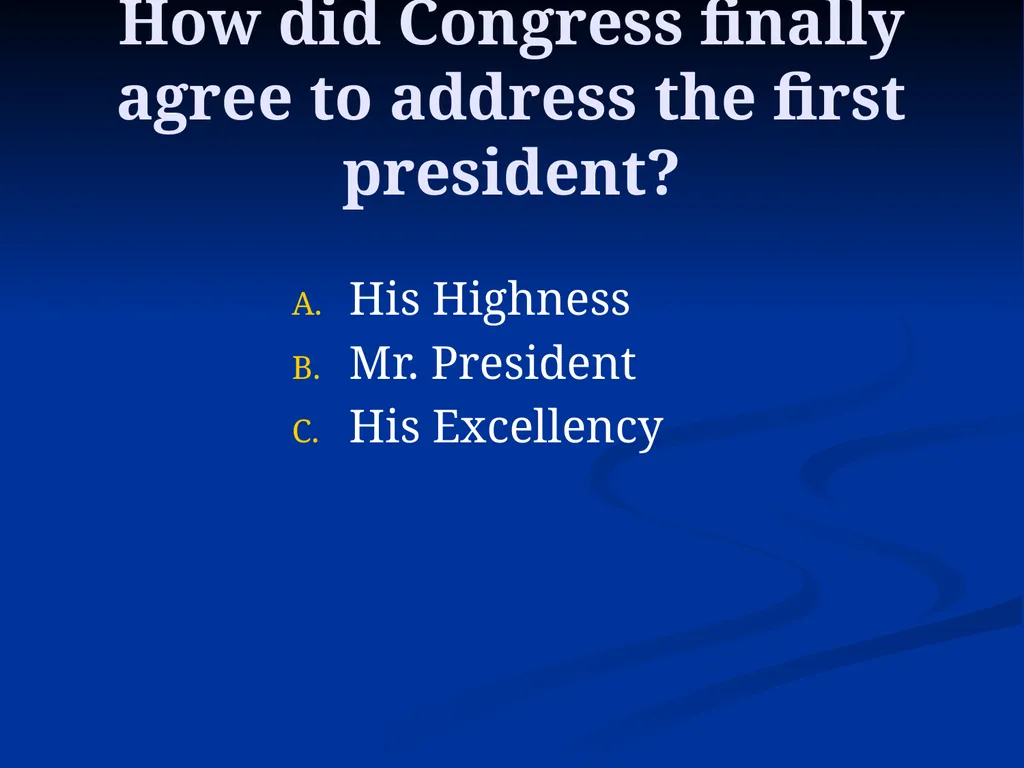
How did Congress finally agree to address the first president? His Highness
Mr. President
His Excellency<br>
Mr. President
His Excellency<br>
45
The group of people that advise the President are called: Supreme Court
Cabinet
Tariffs<br>
Cabinet
Tariffs<br>
46
Which document set up the federal court system? The Constitution of the United States
The Articles of Confederation
The Federal Judiciary Act of 1789<br>
The Articles of Confederation
The Federal Judiciary Act of 1789<br>
47
pay off all war debts
raise government revenues
create a national bank George Washington
Thomas Jefferson
Alexander Hamilton Who’s ideas for strengthening the U.S. economy are listed above?<br>
Thomas Jefferson
Alexander Hamilton Who’s ideas for strengthening the U.S. economy are listed above?<br>
48
What is the purpose of a tariff? To ensure a steady flow of income
To encourage Americans to buy American goods
To encourage the growth of American industry
All of the above<br>
To encourage Americans to buy American goods
To encourage the growth of American industry
All of the above<br>
49
As a result of the Battle of Fallen Timbers: Native Americans were paid for their land.
Native Americans defeated the American army.
Native Americans were forced to give up their land.<br>
Native Americans defeated the American army.
Native Americans were forced to give up their land.<br>
50
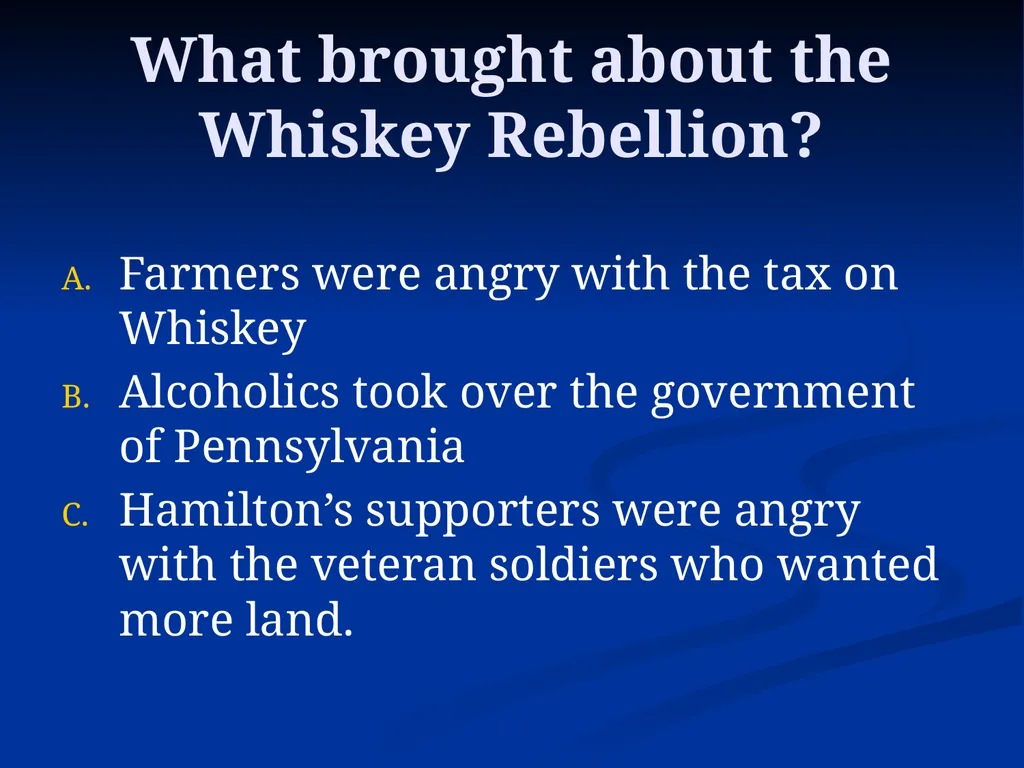
What brought about the Whiskey Rebellion? Farmers were angry with the tax on Whiskey
Alcoholics took over the government of Pennsylvania
Hamilton’s supporters were angry with the veteran soldiers who wanted more land.<br>
Alcoholics took over the government of Pennsylvania
Hamilton’s supporters were angry with the veteran soldiers who wanted more land.<br>
51
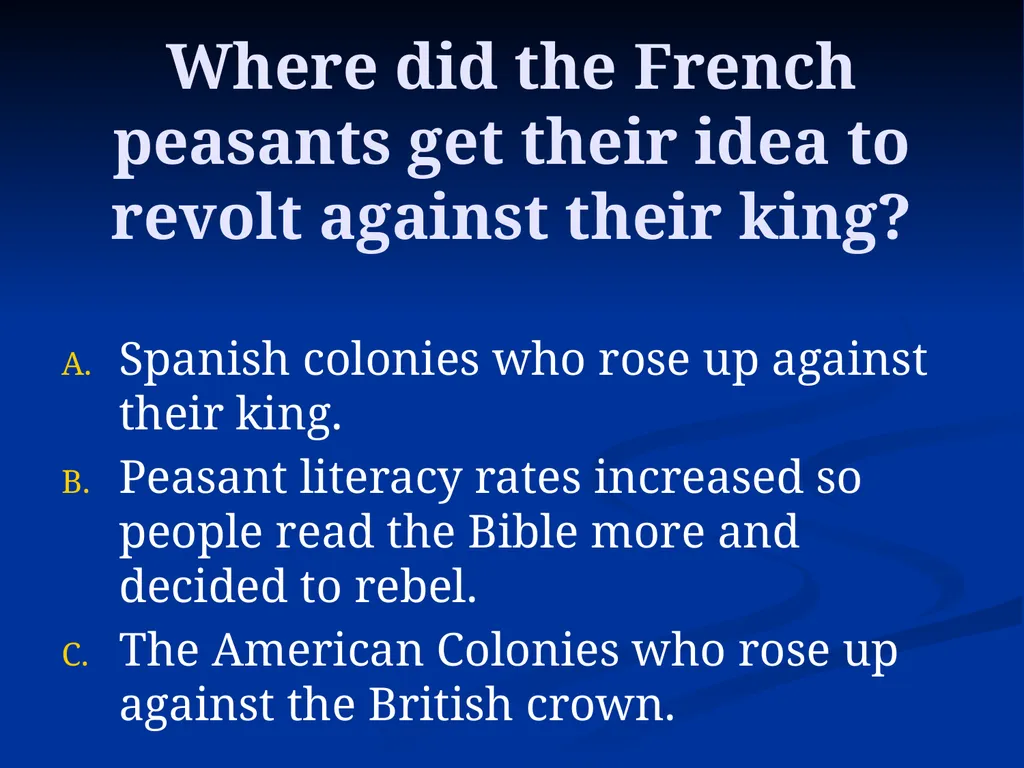
Where did the French peasants get their idea to revolt against their king? Spanish colonies who rose up against their king.
Peasant literacy rates increased so people read the Bible more and decided to rebel.
The American Colonies who rose up against the British crown.<br>
Peasant literacy rates increased so people read the Bible more and decided to rebel.
The American Colonies who rose up against the British crown.<br>
52
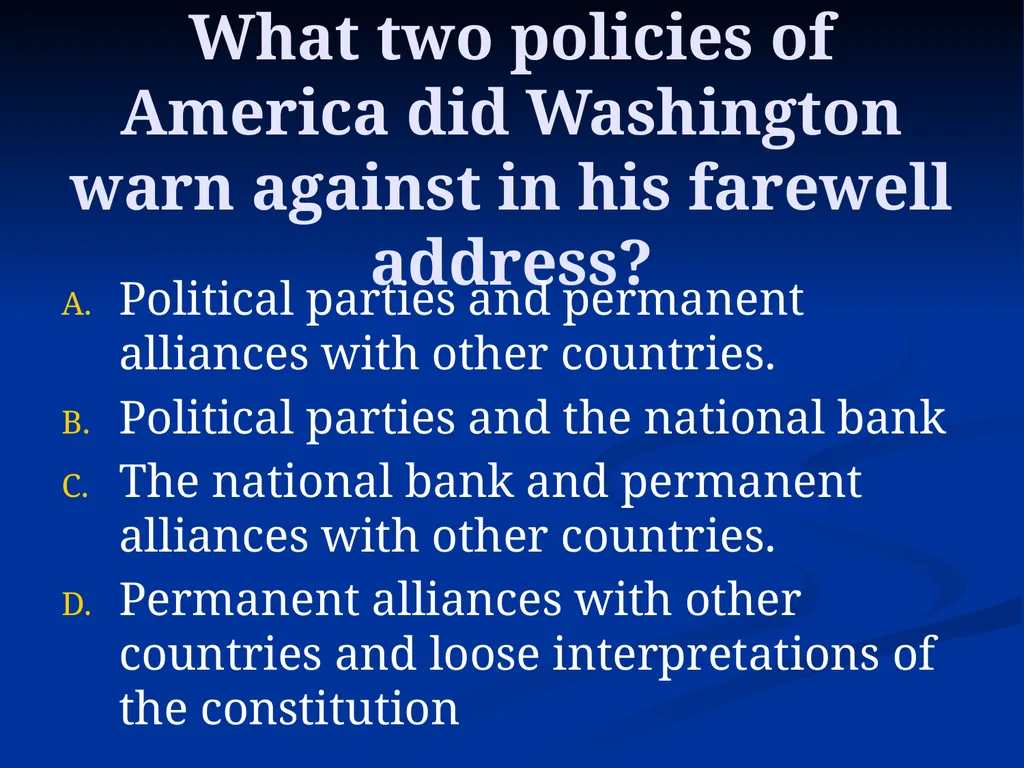
What two policies of America did Washington warn against in his farewell address? Political parties and permanent alliances with other countries.
Political parties and the national bank
The national bank and permanent alliances with other countries.
Permanent alliances with other countries and loose interpretations of the constitution<br>
Political parties and the national bank
The national bank and permanent alliances with other countries.
Permanent alliances with other countries and loose interpretations of the constitution<br>
53
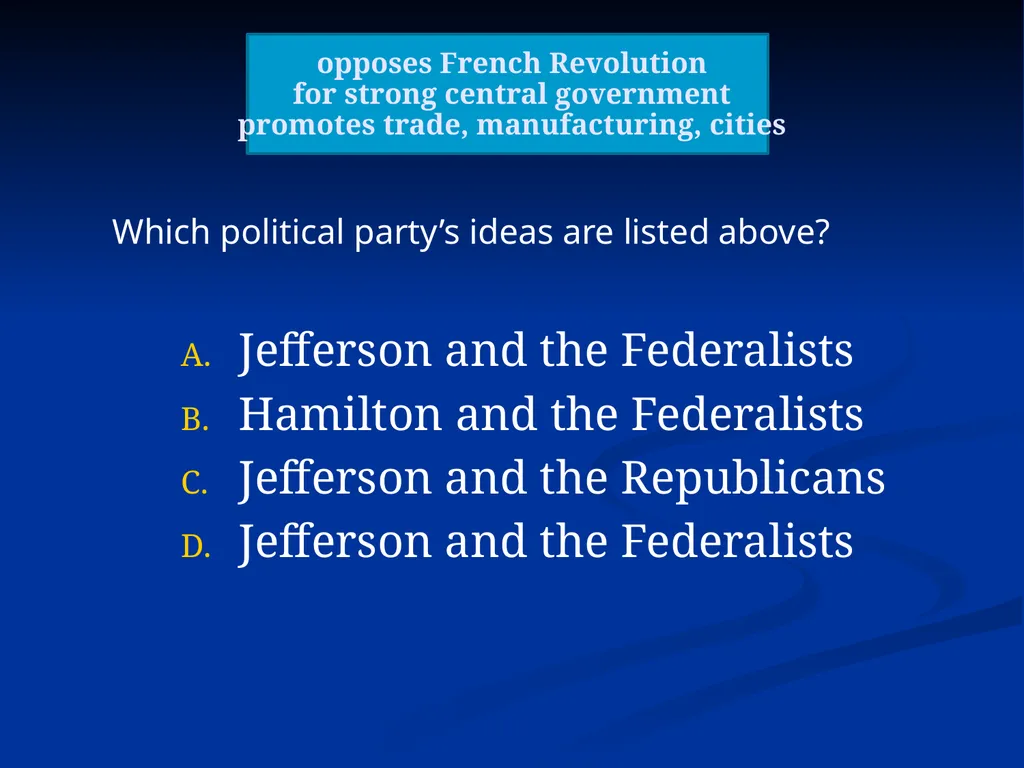
opposes French Revolution
for strong central government
promotes trade, manufacturing, cities Jefferson and the Federalists
Hamilton and the Federalists
Jefferson and the Republicans
Jefferson and the Federalists Which political party’s ideas are listed above?<br>
Hamilton and the Federalists
Jefferson and the Republicans
Jefferson and the Federalists Which political party’s ideas are listed above?<br>
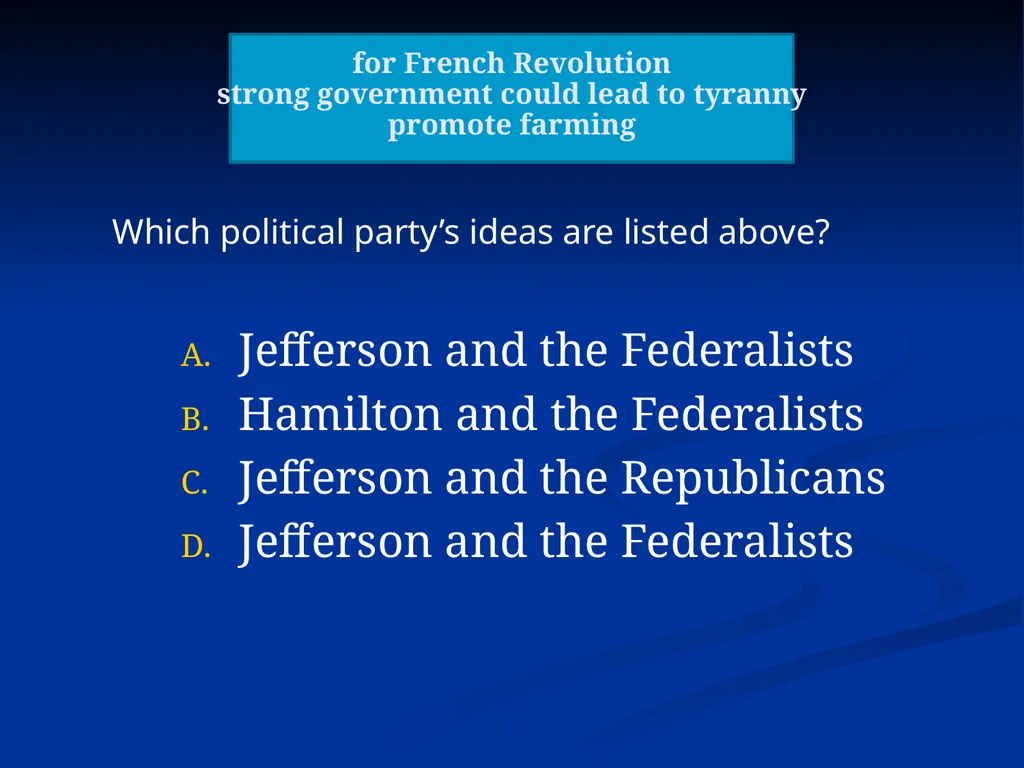
54
for French Revolution
strong government could lead to tyranny
promote farming Which political party’s ideas are listed above? Jefferson and the Federalists
Hamilton and the Federalists
Jefferson and the Republicans
Jefferson and the Federalists<br>
Hamilton and the Federalists
Jefferson and the Republicans
Jefferson and the Federalists<br>
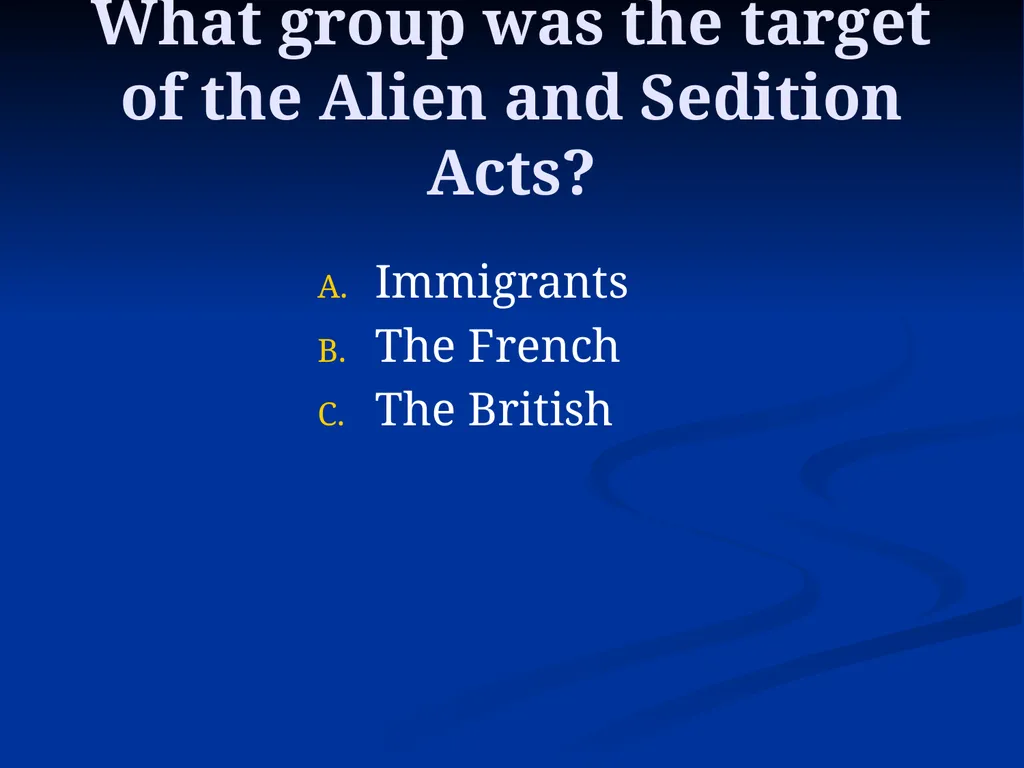
55
What group was the target of the Alien and Sedition Acts? Immigrants
The French
The British<br>
The French
The British<br>