
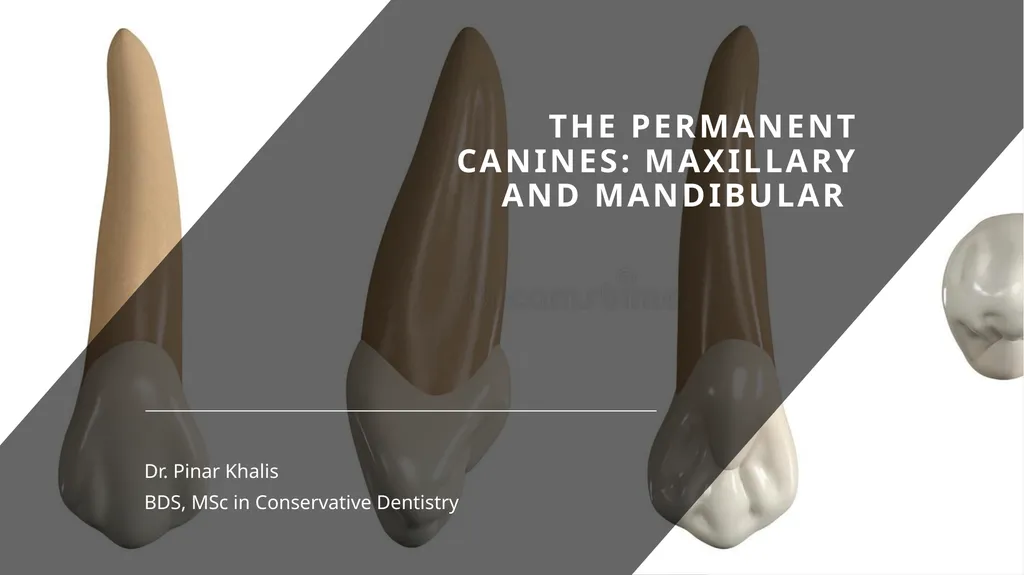
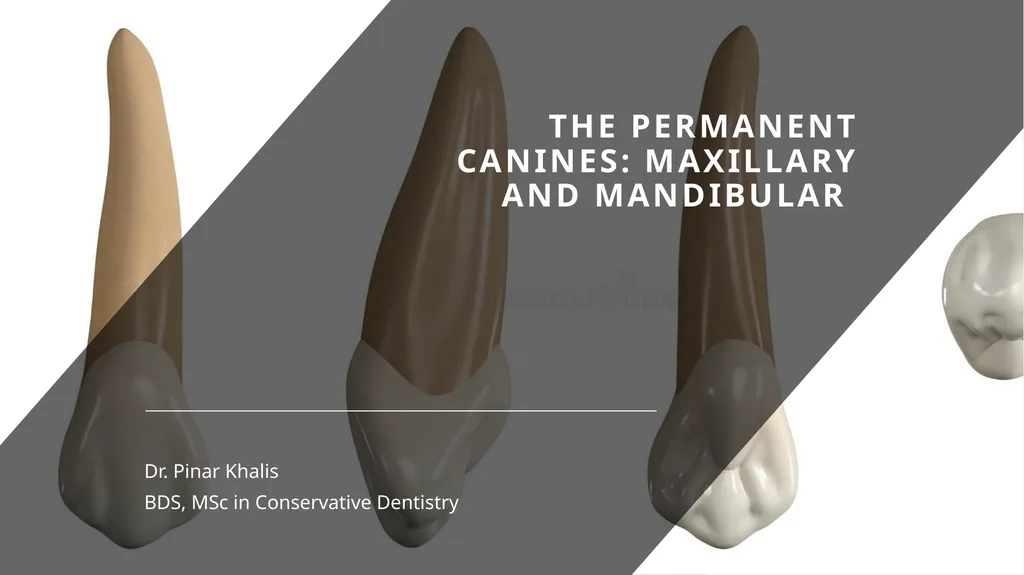
The Permanent Canines: Maxillary and Mandibular
MT
Published · 36 slides · 0 views
1 / 1


Description
The Permanent Canines: Maxillary and Mandibular Dr. Pinar Khalis BDS, MSc in Conservative Dentistry Introduction The maxillary and mandibular canines bear a close resemblance to each other. They are 4 in number. Their functions are to shear
Related Topics
Download this presentation From Below
"The Permanent Canines: Maxillary and Mandibular" is the property of its rightful owner. Permission is granted to download and print the materials on this website for personal, non-commercial use only, and to display it on your personal computer provided you do not modify the materials and that you retain all copyright notices contained in the materials. By downloading content from our website, you accept the terms of this agreement.
Share
Embed code
Presentation Transcript
01
The Permanent Canines: Maxillary and Mandibular Dr. Pinar Khalis
BDS, MSc in Conservative Dentistry<br>
BDS, MSc in Conservative Dentistry<br>
02
Introduction The maxillary and mandibular canines bear a close resemblance to each other.
They are 4 in number.
Their functions are to shear food.
The four canines are placed at the “corners” of the mouth; each one is the third tooth from the median line, right and left, in the maxilla and mandible.
They are commonly referred to as the cornerstone of the dental arches.<br>
They are 4 in number.
Their functions are to shear food.
The four canines are placed at the “corners” of the mouth; each one is the third tooth from the median line, right and left, in the maxilla and mandible.
They are commonly referred to as the cornerstone of the dental arches.<br>
03
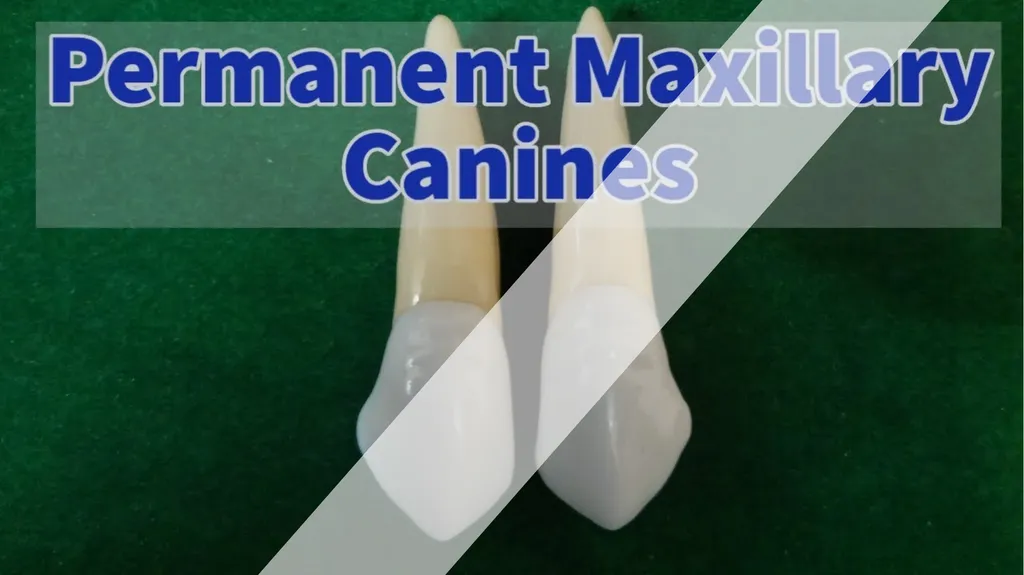
Cont.. They are the longest teeth in the mouth.
The crowns are usually as long as the maxillary central incisors.
The single roots are longer than the other teeth.
Strongest tooth in the mouth.
Because of the labiolingual thickness of crown and root, these teeth are perhaps the most stable in the mouth.
When teeth are lost, the canines are usually the last ones to go.
They are very valuable teeth, when considered either as units of the natural dental arches or as possible assistants in stabilizing replacements of lost teeth in prosthetic procedures.<br>
The crowns are usually as long as the maxillary central incisors.
The single roots are longer than the other teeth.
Strongest tooth in the mouth.
Because of the labiolingual thickness of crown and root, these teeth are perhaps the most stable in the mouth.
When teeth are lost, the canines are usually the last ones to go.
They are very valuable teeth, when considered either as units of the natural dental arches or as possible assistants in stabilizing replacements of lost teeth in prosthetic procedures.<br>
04
Cont.. The positions and forms of these teeth, along with the bone ridge over the labial portions of the roots, called the canine eminence, have a cosmetic value.
They help form a foundation that ensures normal facial expression at the corners of the mouth.
Loss of all of these teeth makes it extremely difficult, to make replacements that restore that natural appearance of the face for any length of time.
In function, the canines support the incisors and premolars, since they are located between these groups.
The canine crowns have some characteristics of functional form, which bears a resemblance to incisor form and to the premolar form.<br>
They help form a foundation that ensures normal facial expression at the corners of the mouth.
Loss of all of these teeth makes it extremely difficult, to make replacements that restore that natural appearance of the face for any length of time.
In function, the canines support the incisors and premolars, since they are located between these groups.
The canine crowns have some characteristics of functional form, which bears a resemblance to incisor form and to the premolar form.<br>
05
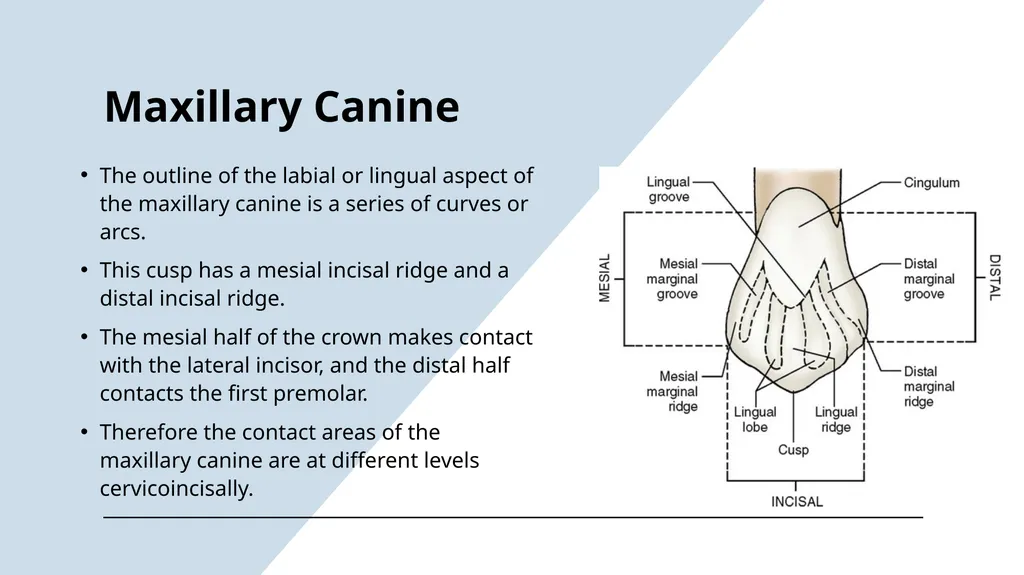
Maxillary Canine The outline of the labial or lingual aspect of the maxillary canine is a series of curves or arcs.
This cusp has a mesial incisal ridge and a distal incisal ridge.
The mesial half of the crown makes contact with the lateral incisor, and the distal half contacts the first premolar.
Therefore the contact areas of the maxillary canine are at different levels cervicoincisally.<br>
This cusp has a mesial incisal ridge and a distal incisal ridge.
The mesial half of the crown makes contact with the lateral incisor, and the distal half contacts the first premolar.
Therefore the contact areas of the maxillary canine are at different levels cervicoincisally.<br>
06
Cont.. From a labial view, the mesial half of the crown resembles a portion of an incisor, whereas the distal half resembles a portion of a premolar.
This tooth seems to be a compromise in the change from anterior to posterior teeth in the dental arch.
The incising portion (incisal third) is thicker labiolingually than the maxillary central or the lateral incisor.
The labiolingual measurement of the crown is about 1 mm greater than the maxillary central incisor.
The mesiodistal measurement is approximately 1 mm less than the maxillary central incisor.
The cingulum shows greater development the central incisor.<br>
This tooth seems to be a compromise in the change from anterior to posterior teeth in the dental arch.
The incising portion (incisal third) is thicker labiolingually than the maxillary central or the lateral incisor.
The labiolingual measurement of the crown is about 1 mm greater than the maxillary central incisor.
The mesiodistal measurement is approximately 1 mm less than the maxillary central incisor.
The cingulum shows greater development the central incisor.<br>
07
DETAILED DESCRIPTION OF THE MAXILLARY CANINE FROM ALL ASPECTS<br>
08
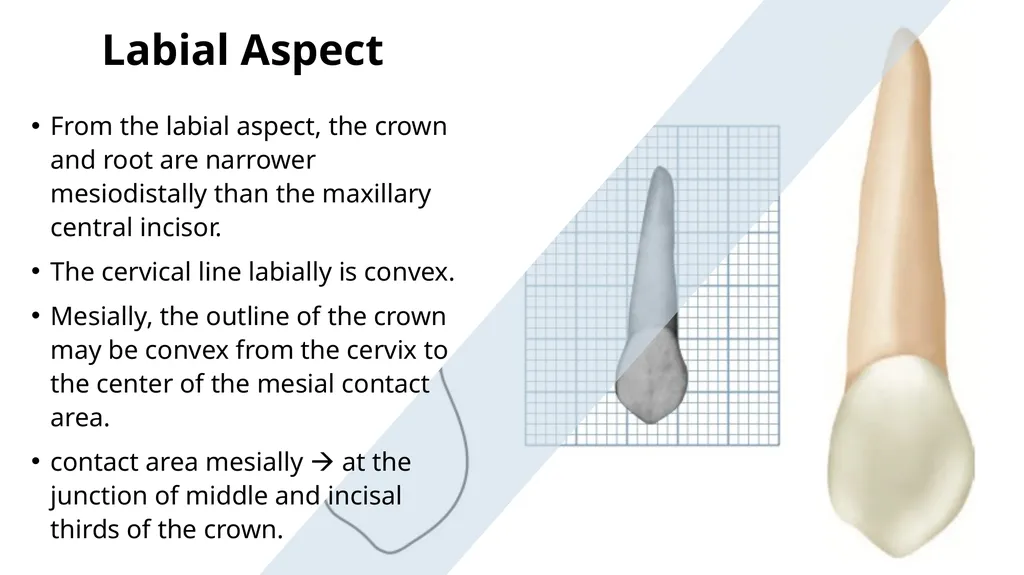
Labial Aspect From the labial aspect, the crown and root are narrower mesiodistally than the maxillary central incisor.
The cervical line labially is convex.
Mesially, the outline of the crown may be convex from the cervix to the center of the mesial contact area.
contact area mesially at the junction of middle and incisal thirds of the crown.<br>
The cervical line labially is convex.
Mesially, the outline of the crown may be convex from the cervix to the center of the mesial contact area.
contact area mesially at the junction of middle and incisal thirds of the crown.<br>
09
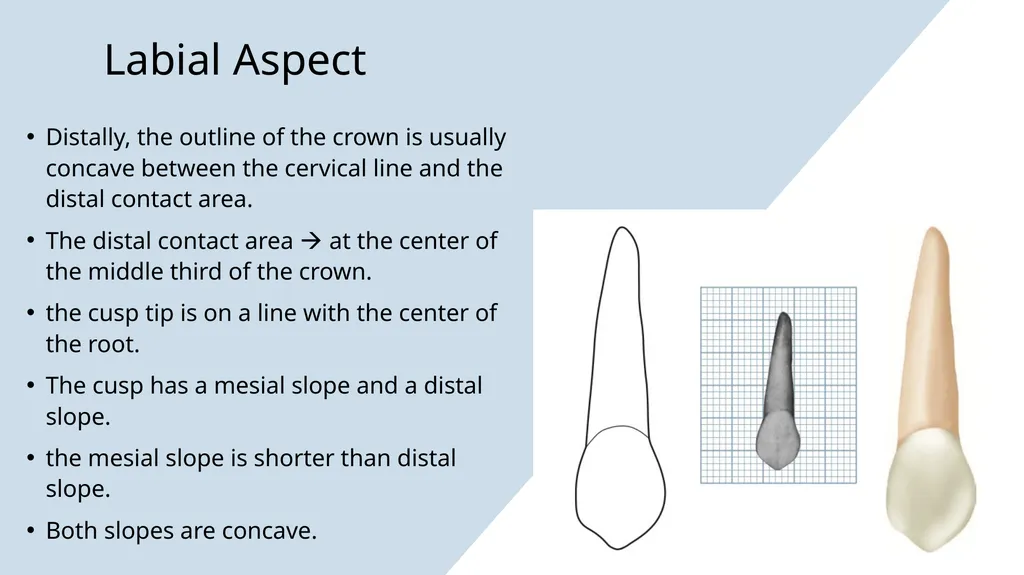
Labial Aspect Distally, the outline of the crown is usually concave between the cervical line and the distal contact area.
The distal contact area at the center of the middle third of the crown.
the cusp tip is on a line with the center of the root.
The cusp has a mesial slope and a distal slope.
the mesial slope is shorter than distal slope.
Both slopes are concave.<br>
The distal contact area at the center of the middle third of the crown.
the cusp tip is on a line with the center of the root.
The cusp has a mesial slope and a distal slope.
the mesial slope is shorter than distal slope.
Both slopes are concave.<br>
10
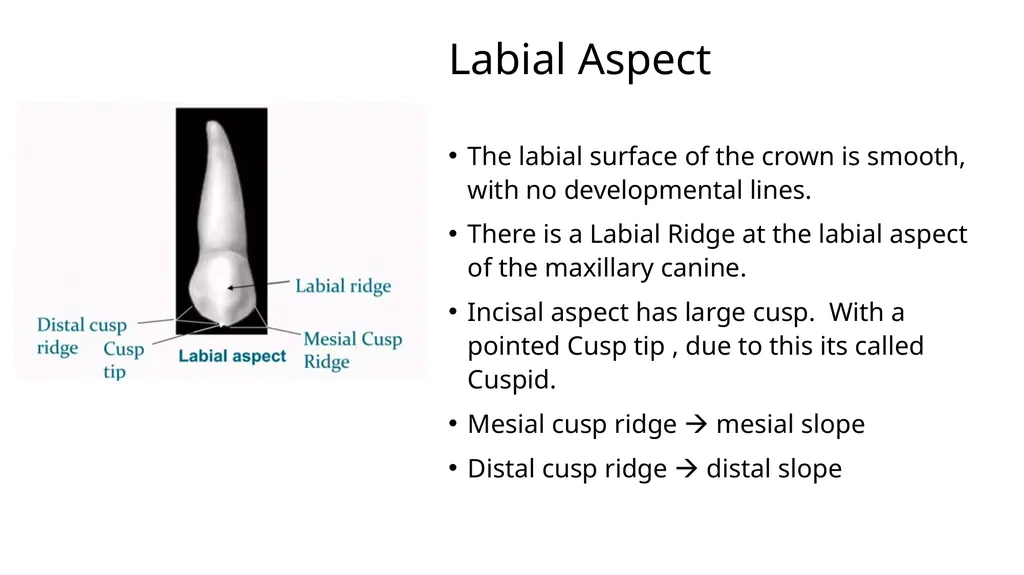
Labial Aspect The labial surface of the crown is smooth, with no developmental lines.
There is a Labial Ridge at the labial aspect of the maxillary canine.
Incisal aspect has large cusp. With a pointed Cusp tip , due to this its called Cuspid.
Mesial cusp ridge mesial slope
Distal cusp ridge distal slope<br>
There is a Labial Ridge at the labial aspect of the maxillary canine.
Incisal aspect has large cusp. With a pointed Cusp tip , due to this its called Cuspid.
Mesial cusp ridge mesial slope
Distal cusp ridge distal slope<br>
11
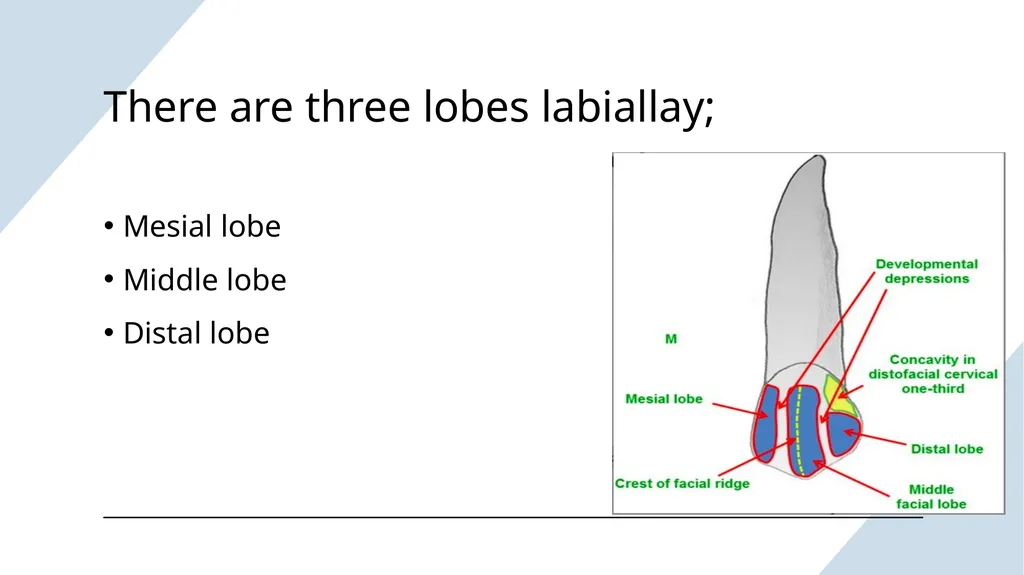
There are three lobes labiallay; Mesial lobe
Middle lobe
Distal lobe<br>
Middle lobe
Distal lobe<br>
12
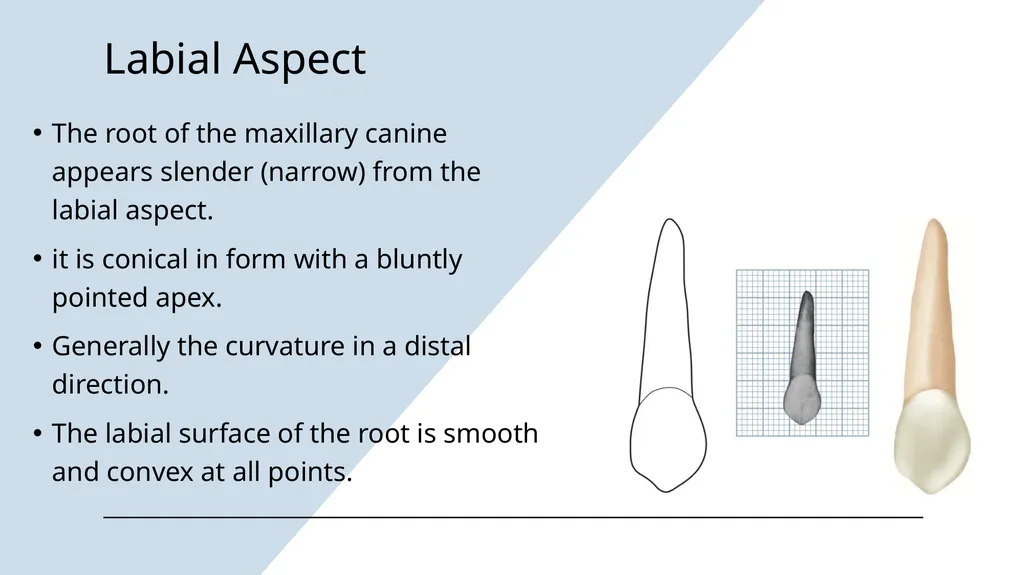
Labial Aspect The root of the maxillary canine appears slender (narrow) from the labial aspect.
it is conical in form with a bluntly pointed apex.
Generally the curvature in a distal direction.
The labial surface of the root is smooth and convex at all points.<br>
it is conical in form with a bluntly pointed apex.
Generally the curvature in a distal direction.
The labial surface of the root is smooth and convex at all points.<br>
13
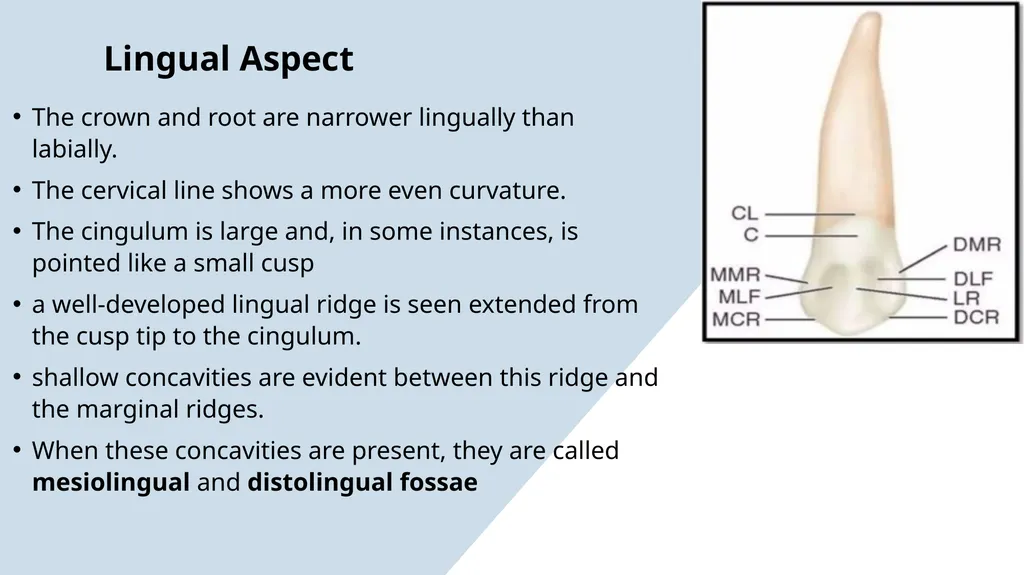
Lingual Aspect The crown and root are narrower lingually than labially.
The cervical line shows a more even curvature.
The cingulum is large and, in some instances, is pointed like a small cusp
a well-developed lingual ridge is seen extended from the cusp tip to the cingulum.
shallow concavities are evident between this ridge and the marginal ridges.
When these concavities are present, they are called mesiolingual and distolingual fossae CL, Cervical line;
C, cingulum;
MMR, mesial marginal ridge; MLF, mesiolingual fossa;
MCR, mesial cusp ridge;
DCR, distal cusp ridge;
LR, lingual ridge;
DLF, distolingual fossa;
DMR, distal marginal ridge.<br>
The cervical line shows a more even curvature.
The cingulum is large and, in some instances, is pointed like a small cusp
a well-developed lingual ridge is seen extended from the cusp tip to the cingulum.
shallow concavities are evident between this ridge and the marginal ridges.
When these concavities are present, they are called mesiolingual and distolingual fossae CL, Cervical line;
C, cingulum;
MMR, mesial marginal ridge; MLF, mesiolingual fossa;
MCR, mesial cusp ridge;
DCR, distal cusp ridge;
LR, lingual ridge;
DLF, distolingual fossa;
DMR, distal marginal ridge.<br>
14
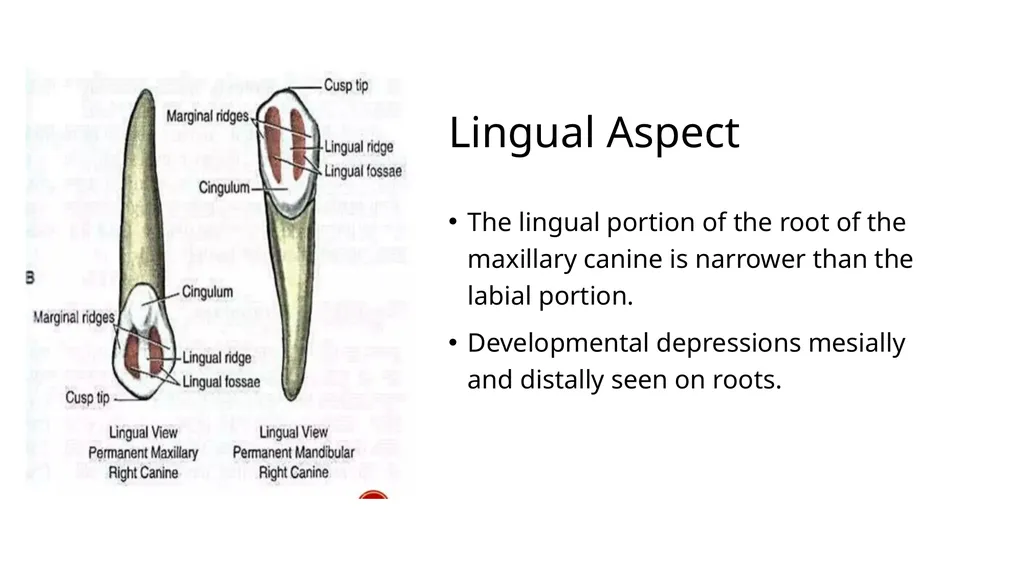
Lingual Aspect The lingual portion of the root of the maxillary canine is narrower than the labial portion.
Developmental depressions mesially and distally seen on roots.<br>
Developmental depressions mesially and distally seen on roots.<br>
15
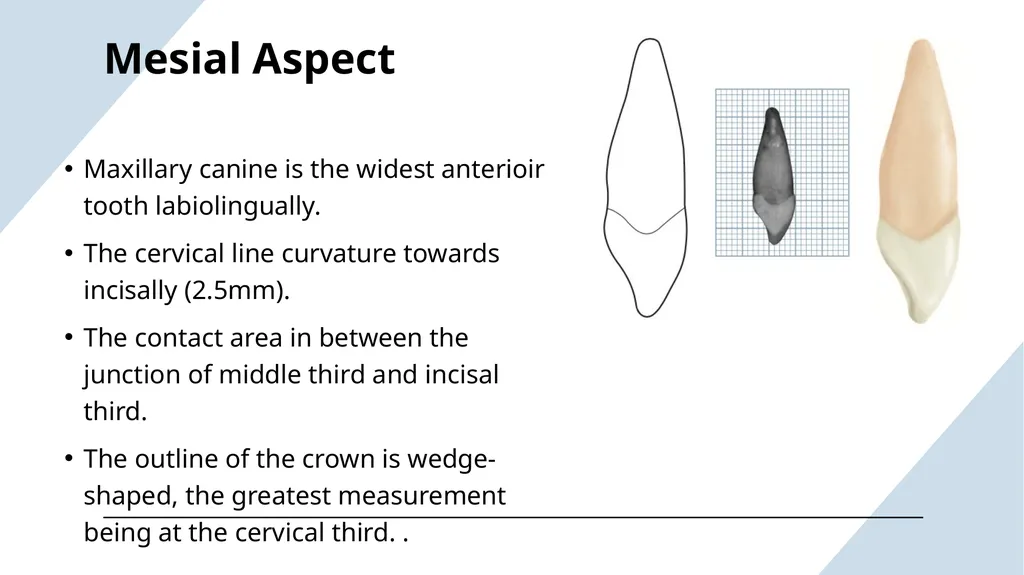
Mesial Aspect Maxillary canine is the widest anterioir tooth labiolingually.
The cervical line curvature towards incisally (2.5mm).
The contact area in between the junction of middle third and incisal third.
The outline of the crown is wedge-shaped, the greatest measurement being at the cervical third. .<br>
The cervical line curvature towards incisally (2.5mm).
The contact area in between the junction of middle third and incisal third.
The outline of the crown is wedge-shaped, the greatest measurement being at the cervical third. .<br>
16
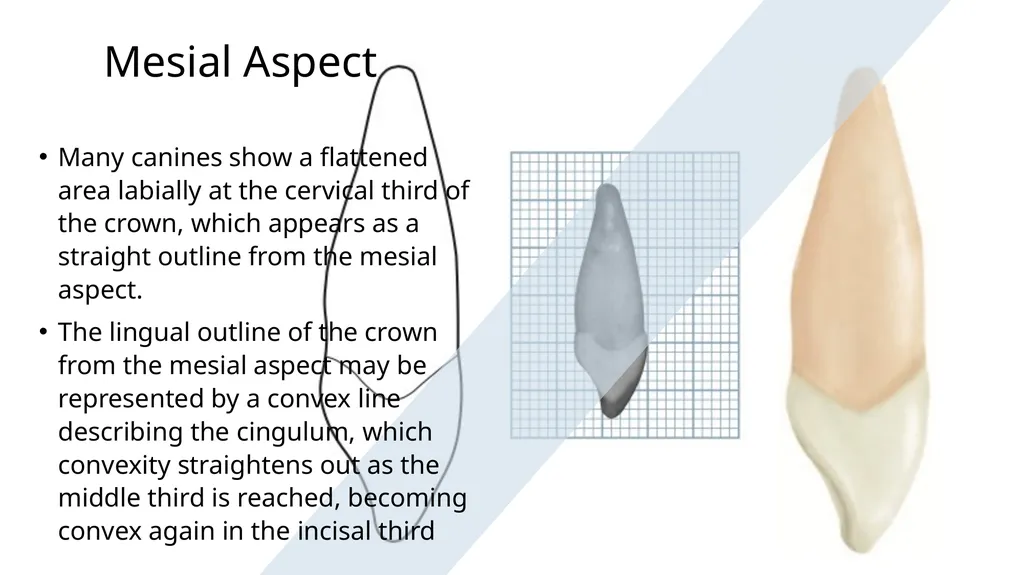
Mesial Aspect Many canines show a flattened area labially at the cervical third of the crown, which appears as a straight outline from the mesial aspect.
The lingual outline of the crown from the mesial aspect may be represented by a convex line describing the cingulum, which convexity straightens out as the middle third is reached, becoming convex again in the incisal third<br>
The lingual outline of the crown from the mesial aspect may be represented by a convex line describing the cingulum, which convexity straightens out as the middle third is reached, becoming convex again in the incisal third<br>
17
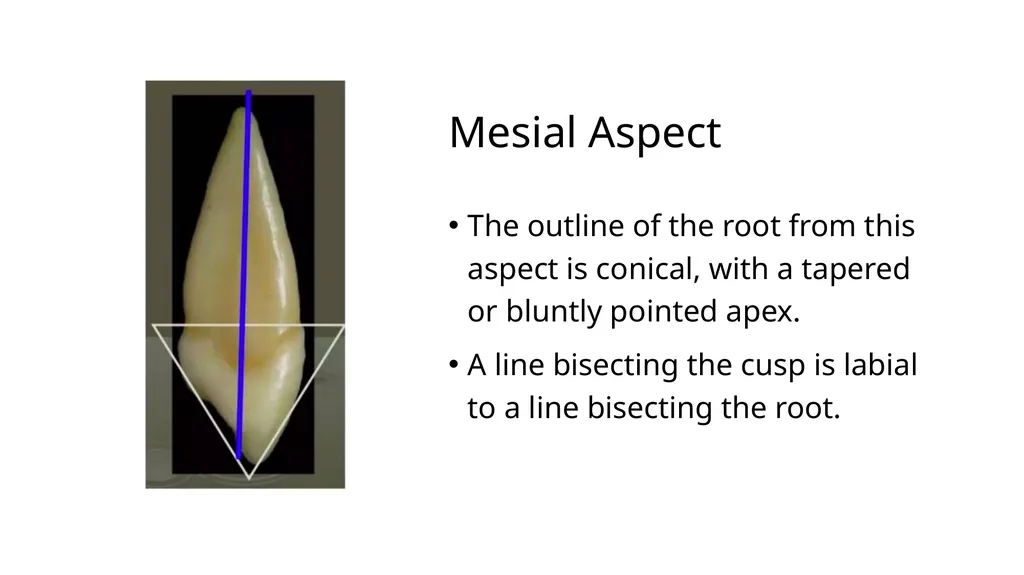
Mesial Aspect The outline of the root from this aspect is conical, with a tapered or bluntly pointed apex.
A line bisecting the cusp is labial to a line bisecting the root.<br>
A line bisecting the cusp is labial to a line bisecting the root.<br>
18
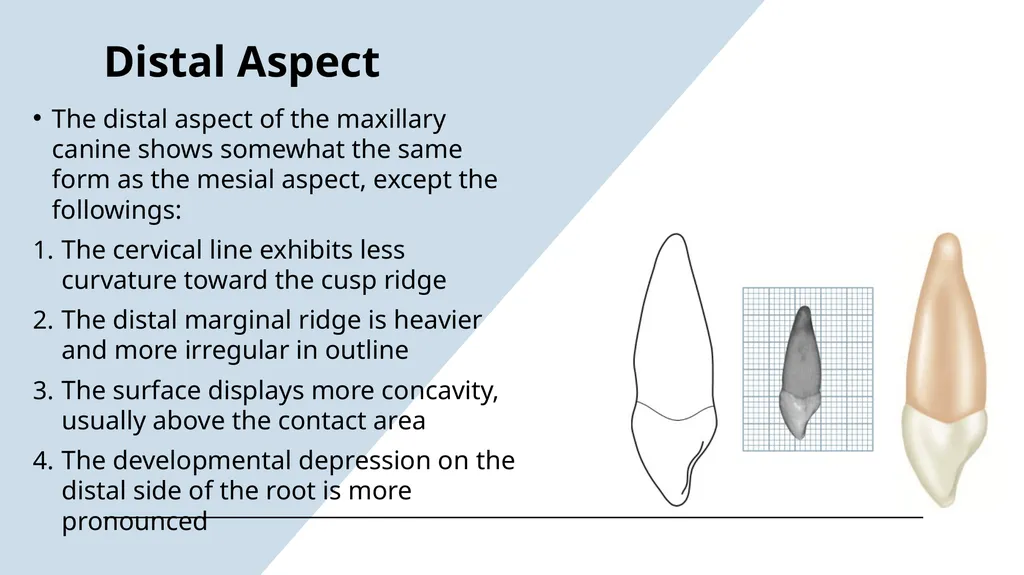
Distal Aspect The distal aspect of the maxillary canine shows somewhat the same form as the mesial aspect, except the followings:
The cervical line exhibits less curvature toward the cusp ridge
The distal marginal ridge is heavier and more irregular in outline
The surface displays more concavity, usually above the contact area
The developmental depression on the distal side of the root is more pronounced<br>
The cervical line exhibits less curvature toward the cusp ridge
The distal marginal ridge is heavier and more irregular in outline
The surface displays more concavity, usually above the contact area
The developmental depression on the distal side of the root is more pronounced<br>
19
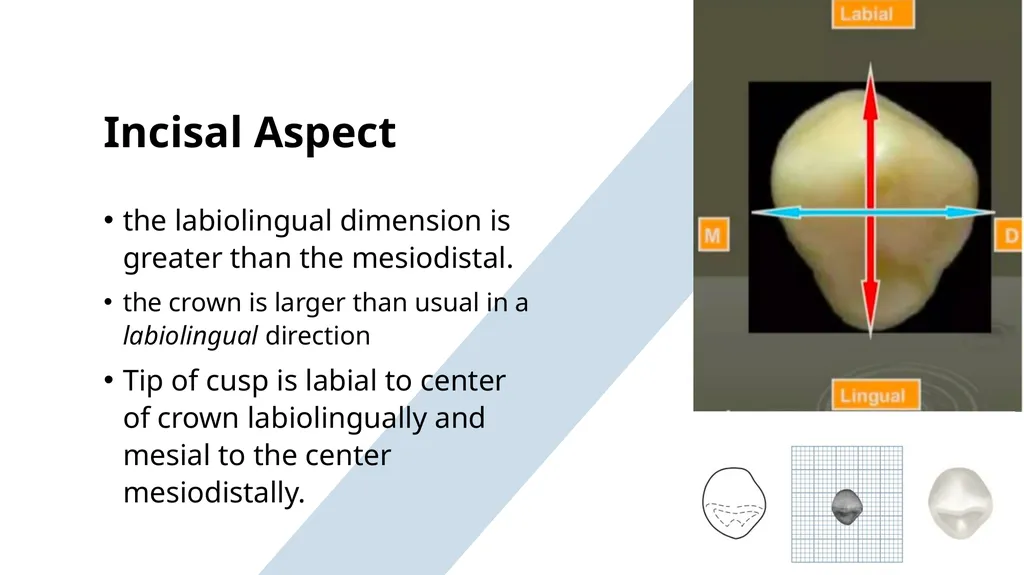
Incisal Aspect the labiolingual dimension is greater than the mesiodistal.
the crown is larger than usual in a labiolingual direction
Tip of cusp is labial to center of crown labiolingually and mesial to the center mesiodistally.<br>
the crown is larger than usual in a labiolingual direction
Tip of cusp is labial to center of crown labiolingually and mesial to the center mesiodistally.<br>
20
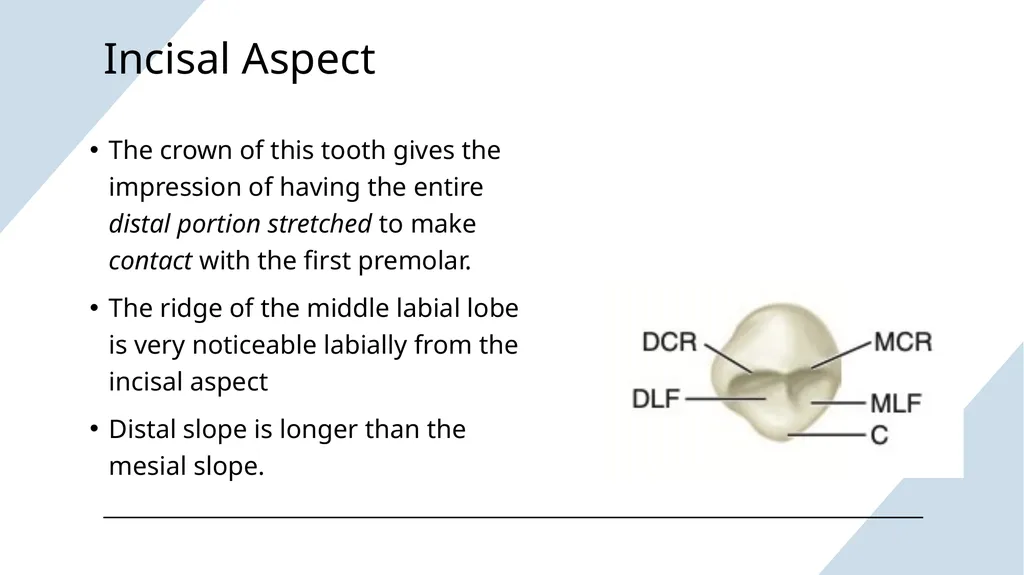
Incisal Aspect The crown of this tooth gives the impression of having the entire distal portion stretched to make contact with the first premolar.
The ridge of the middle labial lobe is very noticeable labially from the incisal aspect
Distal slope is longer than the mesial slope.<br>
The ridge of the middle labial lobe is very noticeable labially from the incisal aspect
Distal slope is longer than the mesial slope.<br>
21
Introduction The mandibular canine crown is narrower mesiodistally than the maxillary canine.
The length of the root is the same or longer than the maxillary canine.
The lingual surface of the crown is smoother, with less cingulum development and less bulk to the marginal ridges.
The cusp of the mandibular canine is not as developed than the maxillary canine, and the cusp ridges are thinner labiolingually.<br>
The length of the root is the same or longer than the maxillary canine.
The lingual surface of the crown is smoother, with less cingulum development and less bulk to the marginal ridges.
The cusp of the mandibular canine is not as developed than the maxillary canine, and the cusp ridges are thinner labiolingually.<br>
22
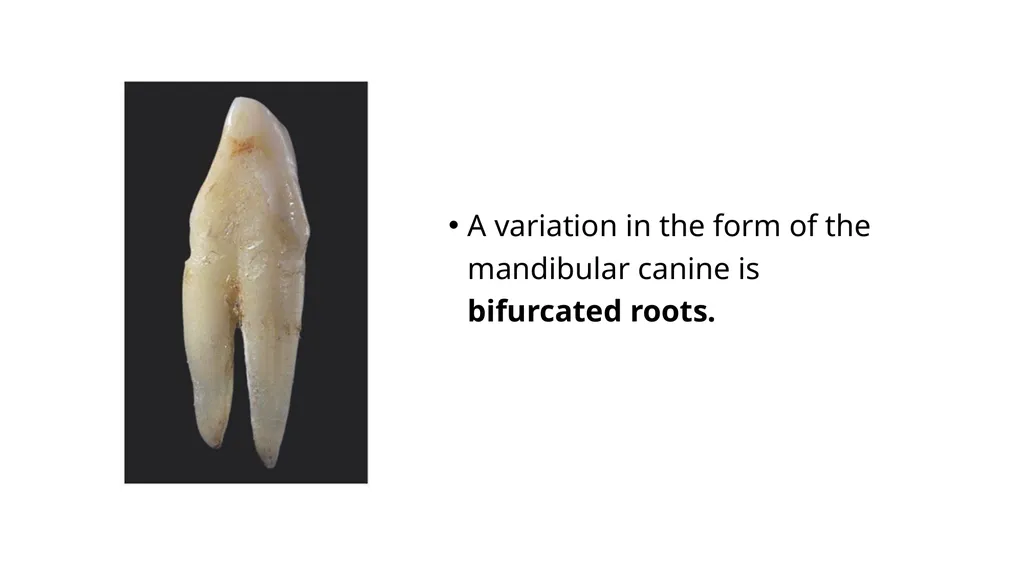
A variation in the form of the mandibular canine is bifurcated roots.<br>
23
DETAILED DESCRIPTION OF THE MANDIBULAR CANINE FROM ALL ASPECTS<br>
24
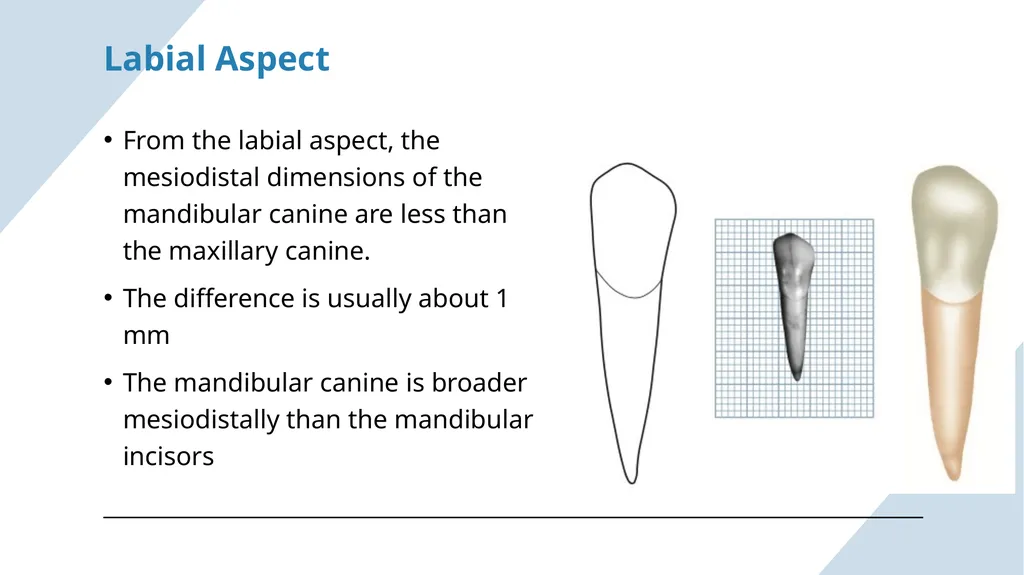
Labial Aspect From the labial aspect, the mesiodistal dimensions of the mandibular canine are less than the maxillary canine.
The difference is usually about 1 mm
The mandibular canine is broader mesiodistally than the mandibular incisors<br>
The difference is usually about 1 mm
The mandibular canine is broader mesiodistally than the mandibular incisors<br>
25
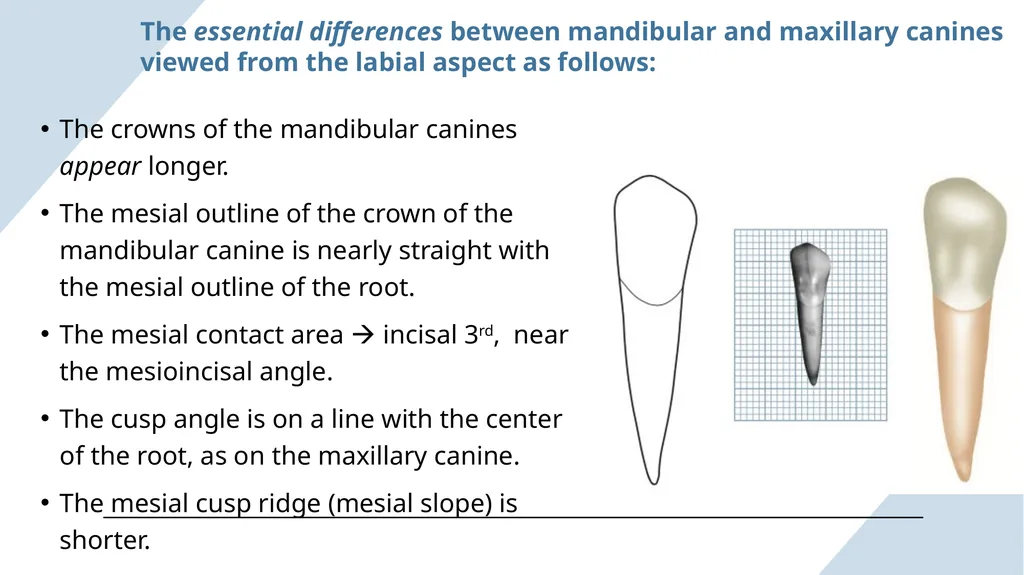
The essential differences between mandibular and maxillary canines viewed from the labial aspect as follows: The crowns of the mandibular canines appear longer.
The mesial outline of the crown of the mandibular canine is nearly straight with the mesial outline of the root.
The mesial contact area incisal 3rd, near the mesioincisal angle.
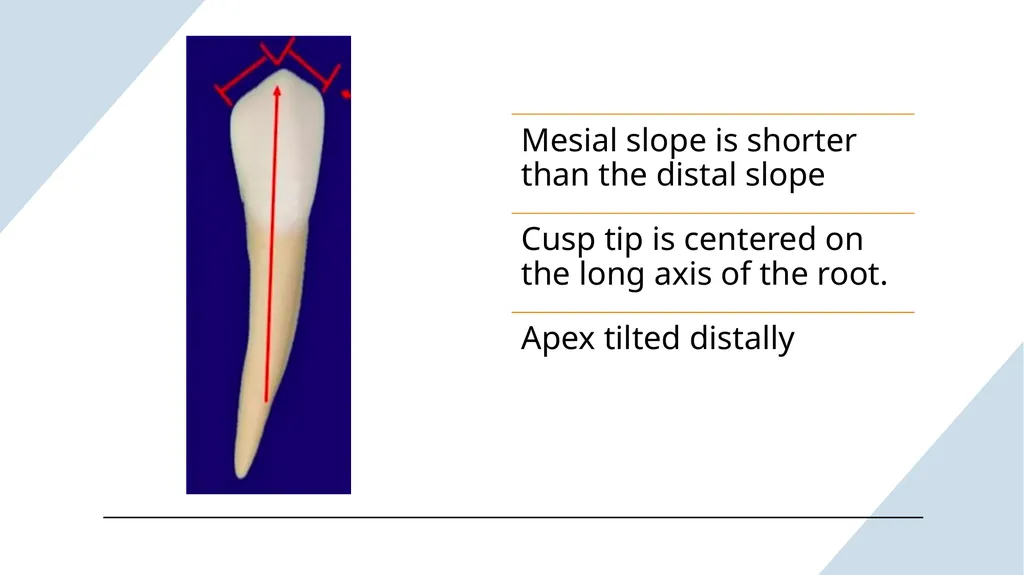
The cusp angle is on a line with the center of the root, as on the maxillary canine.
The mesial cusp ridge (mesial slope) is shorter.<br>
The mesial outline of the crown of the mandibular canine is nearly straight with the mesial outline of the root.
The mesial contact area incisal 3rd, near the mesioincisal angle.
The cusp angle is on a line with the center of the root, as on the maxillary canine.
The mesial cusp ridge (mesial slope) is shorter.<br>
26
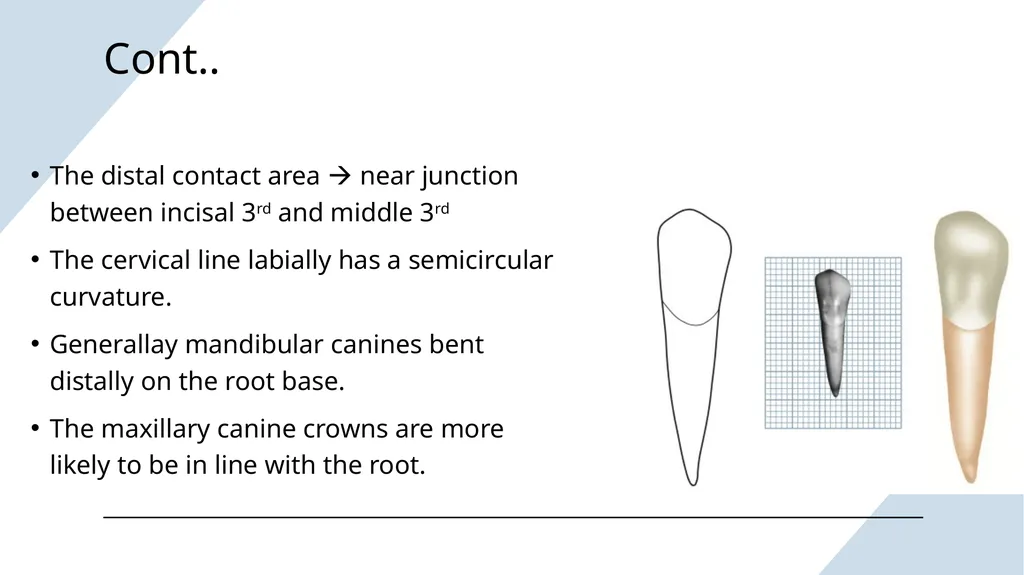
Cont.. The distal contact area near junction between incisal 3rd and middle 3rd
The cervical line labially has a semicircular curvature.
Generallay mandibular canines bent distally on the root base.
The maxillary canine crowns are more likely to be in line with the root.<br>
The cervical line labially has a semicircular curvature.
Generallay mandibular canines bent distally on the root base.
The maxillary canine crowns are more likely to be in line with the root.<br>
27
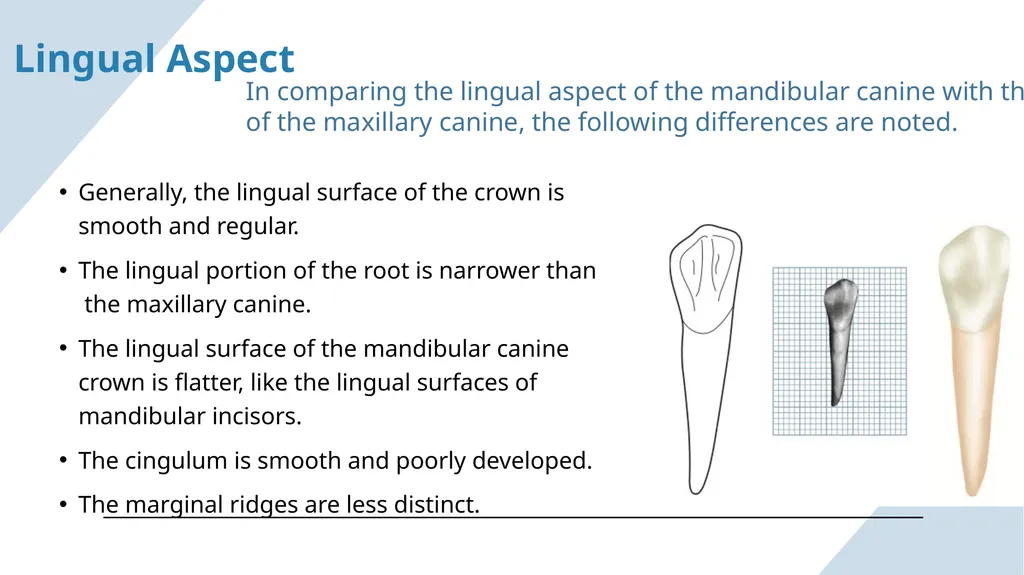
Lingual Aspect Generally, the lingual surface of the crown is smooth and regular.
The lingual portion of the root is narrower than the maxillary canine.
The lingual surface of the mandibular canine crown is flatter, like the lingual surfaces of mandibular incisors.
The cingulum is smooth and poorly developed.
The marginal ridges are less distinct. In comparing the lingual aspect of the mandibular canine with that
of the maxillary canine, the following differences are noted.<br>
The lingual portion of the root is narrower than the maxillary canine.
The lingual surface of the mandibular canine crown is flatter, like the lingual surfaces of mandibular incisors.
The cingulum is smooth and poorly developed.
The marginal ridges are less distinct. In comparing the lingual aspect of the mandibular canine with that
of the maxillary canine, the following differences are noted.<br>
28
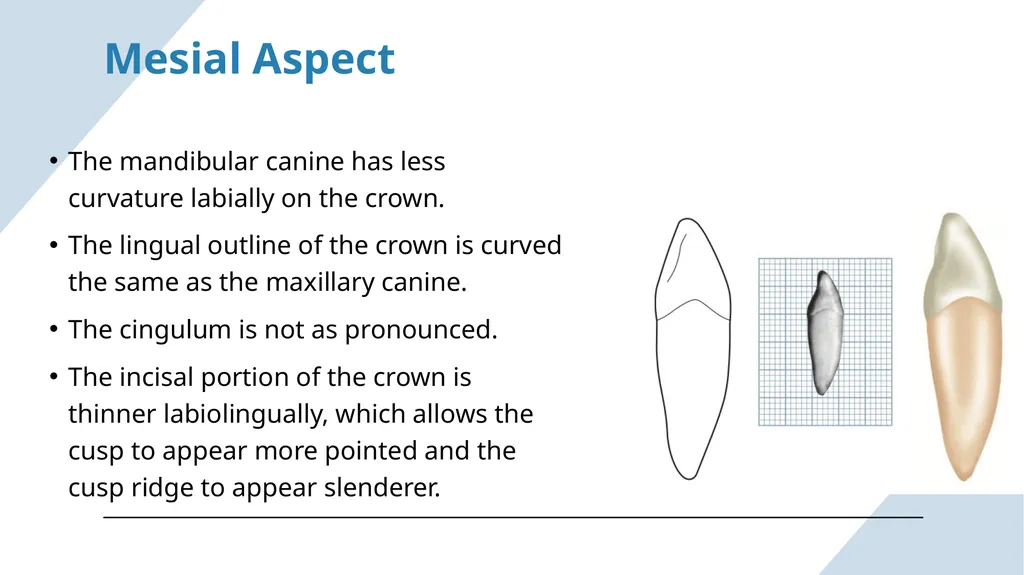
Mesial Aspect The mandibular canine has less curvature labially on the crown.
The lingual outline of the crown is curved the same as the maxillary canine.
The cingulum is not as pronounced.
The incisal portion of the crown is thinner labiolingually, which allows the cusp to appear more pointed and the cusp ridge to appear slenderer.<br>
The lingual outline of the crown is curved the same as the maxillary canine.
The cingulum is not as pronounced.
The incisal portion of the crown is thinner labiolingually, which allows the cusp to appear more pointed and the cusp ridge to appear slenderer.<br>
29
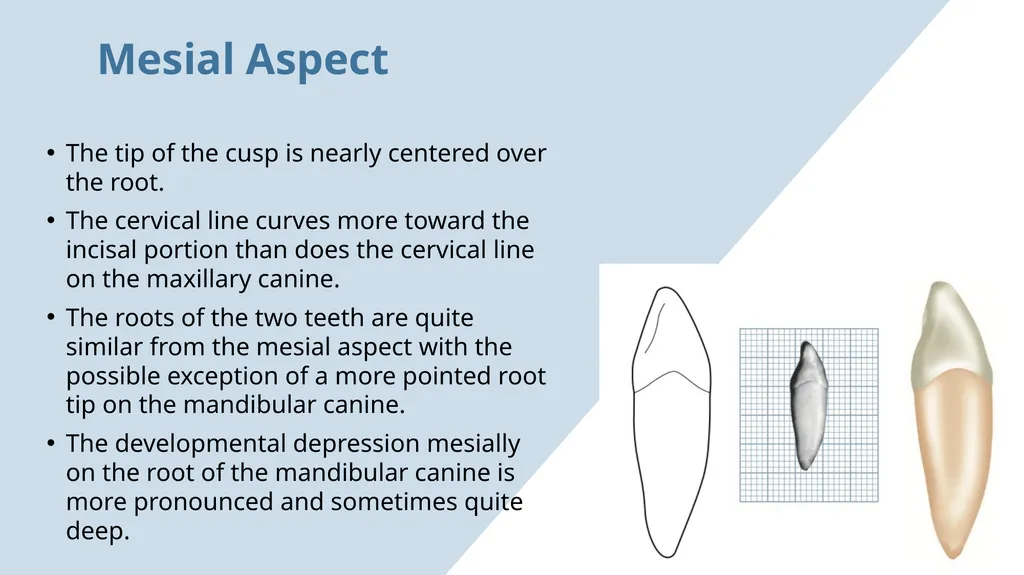
Mesial Aspect The tip of the cusp is nearly centered over the root.
The cervical line curves more toward the incisal portion than does the cervical line on the maxillary canine.
The roots of the two teeth are quite similar from the mesial aspect with the possible exception of a more pointed root tip on the mandibular canine.
The developmental depression mesially on the root of the mandibular canine is more pronounced and sometimes quite deep.<br>
The cervical line curves more toward the incisal portion than does the cervical line on the maxillary canine.
The roots of the two teeth are quite similar from the mesial aspect with the possible exception of a more pointed root tip on the mandibular canine.
The developmental depression mesially on the root of the mandibular canine is more pronounced and sometimes quite deep.<br>
30
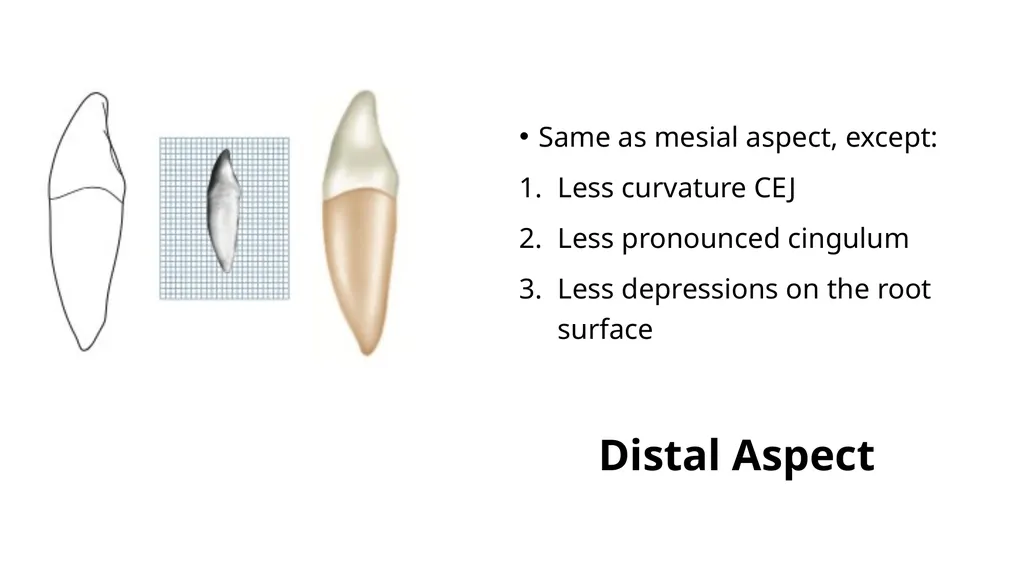
Distal Aspect Same as mesial aspect, except:
Less curvature CEJ
Less pronounced cingulum
Less depressions on the root surface<br>
Less curvature CEJ
Less pronounced cingulum
Less depressions on the root surface<br>
31
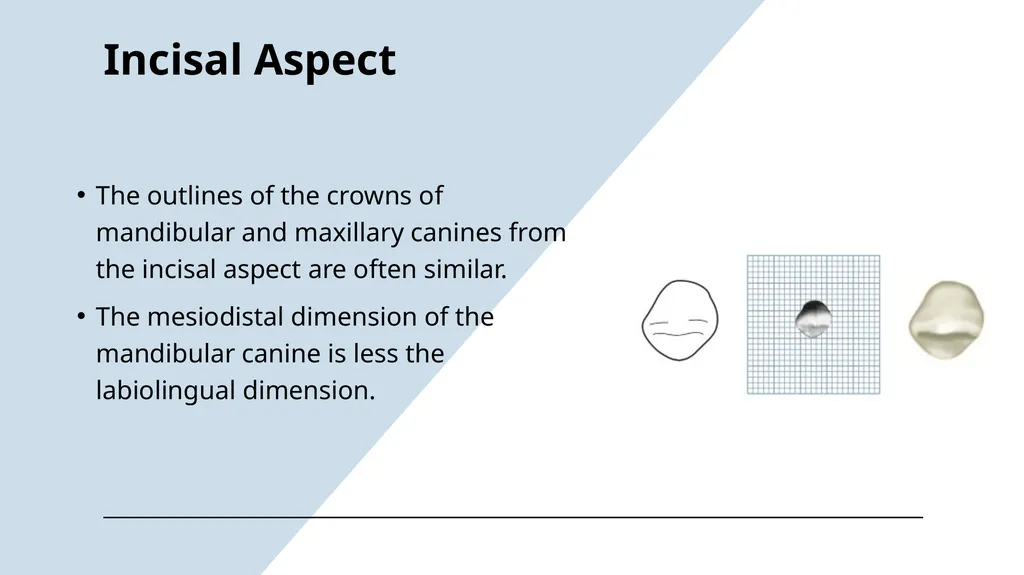
Incisal Aspect The outlines of the crowns of mandibular and maxillary canines from the incisal aspect are often similar.
The mesiodistal dimension of the mandibular canine is less the labiolingual dimension.<br>
The mesiodistal dimension of the mandibular canine is less the labiolingual dimension.<br>
32
Thank you for listening<br>