
The Polish language and PIE Diacritics,

Description: The Polish language and PIE Diacritics, Palatalizations, et cetera. Annaliese Holden CLAS196A A little background Polish is a modern language, in Fortsons Balto-Slavic chapter, it is identified as West Slavic. -Of the Slavic languages,
Related Topics
Download Presentation
"The Polish language and PIE Diacritics," is the property of its rightful owner. Permission is granted to download and print the materials on this website for personal, non-commercial use only, and to display it on your personal computer provided you do not modify the materials and that you retain all copyright notices contained in the materials. By downloading content from our website, you accept the terms of this agreement.
Presentation Transcript
slide1. The Polish language and PIE
Diacritics, Palatalizations, et cetera. Annaliese Holden
CLAS196A<br>
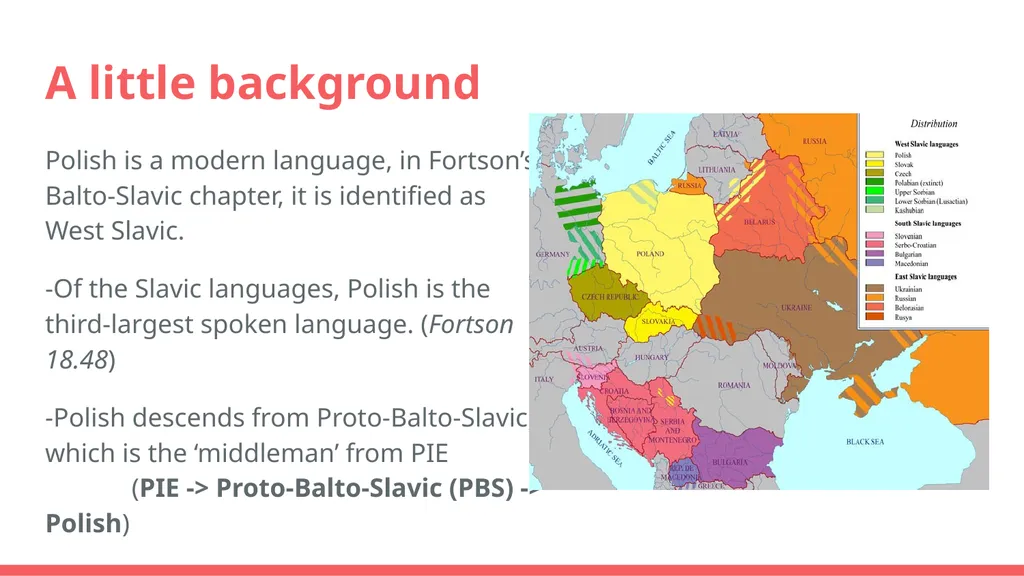
slide2. A little background Polish is a modern language, in Fortson’s Balto-Slavic chapter, it is identified as West Slavic.
-Of the Slavic languages, Polish is the third-largest spoken language. (Fortson 18.48)
-Polish descends from Proto-Balto-Slavic, which is the ‘middleman’ from PIE (PIE -> Proto-Balto-Slavic (PBS) -> Polish)<br>
slide3. The Polish alphabet and its differences Polish is written in the standard Latin alphabet, with a few exceptions.
The diacritical exceptions are ą, ć, ę, ł, ń, ó, ś, ź, ż. I will explain the diacritics and how they originated in an upcoming slide.
Some of these are nasalized vowels, and some are palatal consonants, both of which the Latin alphabet was not equipped to describe.
The letters q, v, and x are not considered part of the alphabet either, only in words that are borrowed from other languages.
A ‘q’ sound would be made with the consonant pair ‘kw’ (example: qualification vs. kwalifikacje)
A ‘v’ sound is simply replaced, made by the letter ‘w’ (example: Warszawa, the capital city)
A ‘x’ sound is replicated by ‘ks’ [example: tekst vs. text (message)] Pronounced: var-SHAV-ah<br>
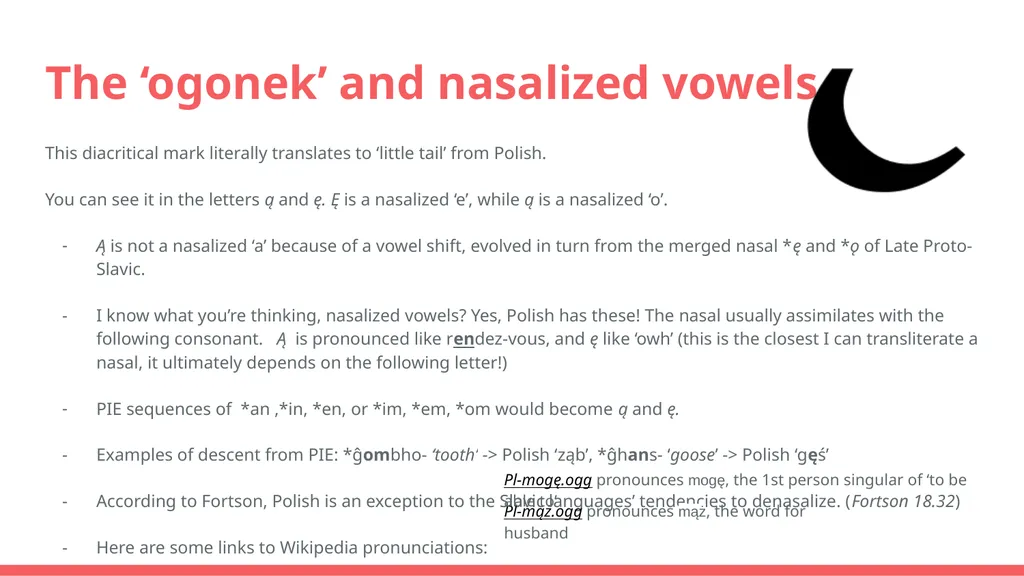
slide4. The ‘ogonek’ and nasalized vowels This diacritical mark literally translates to ‘little tail’ from Polish.
You can see it in the letters ą and ę. Ę is a nasalized ‘e’, while ą is a nasalized ‘o’.
Ą is not a nasalized ‘a’ because of a vowel shift, evolved in turn from the merged nasal *ę and *ǫ of Late Proto-Slavic.
I know what you’re thinking, nasalized vowels? Yes, Polish has these! The nasal usually assimilates with the following consonant. Ą is pronounced like rendez-vous, and ę like ‘owh’ (this is the closest I can transliterate a nasal, it ultimately depends on the following letter!)
PIE sequences of *an ,*in, *en, or *im, *em, *om would become ą and ę.
Examples of descent from PIE: *ĝombho- ‘tooth’ -> Polish ‘ząb’, *ĝhans- ‘goose’ -> Polish ‘gęś’
According to Fortson, Polish is an exception to the Slavic languages’ tendencies to denasalize. (Fortson 18.32)
Here are some links to Wikipedia pronunciations: Pl-mąż.ogg pronounces mąż, the word for husband Pl-mogę.ogg pronounces mogę, the 1st person singular of ‘to be able to’<br>
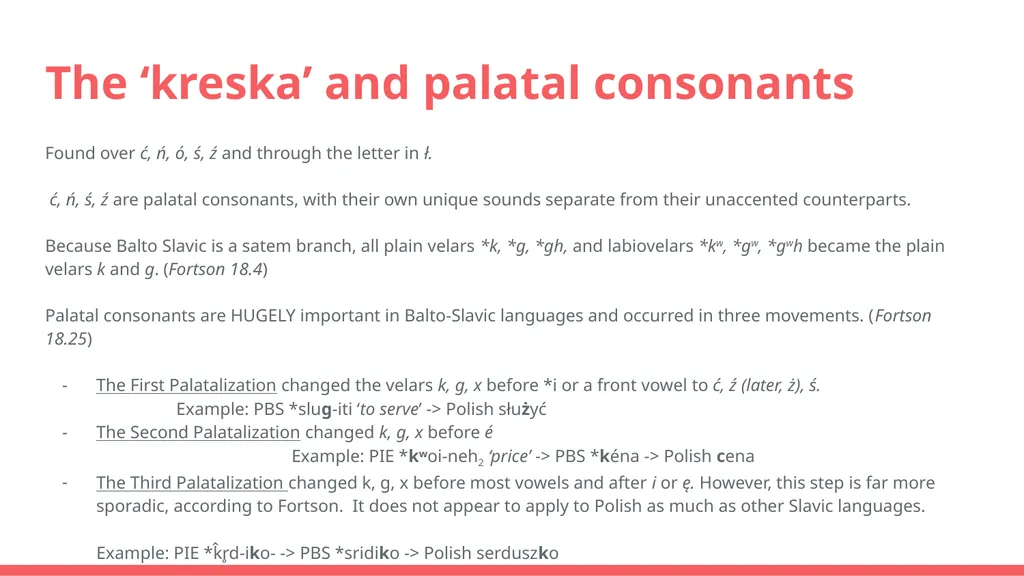
slide5. The ‘kreska’ and palatal consonants Found over ć, ń, ó, ś, ź and through the letter in ł.
ć, ń, ś, ź are palatal consonants, with their own unique sounds separate from their unaccented counterparts.
Because Balto Slavic is a satem branch, all plain velars *k, *g, *gh, and labiovelars *kw, *gw, *gwh became the plain velars k and g. (Fortson 18.4)
Palatal consonants are HUGELY important in Balto-Slavic languages and occurred in three movements. (Fortson 18.25)
The First Palatalization changed the velars k, g, x before *i or a front vowel to ć, ź (later, ż), ś. Example: PBS *slug-iti ‘to serve’ -> Polish służyć
The Second Palatalization changed k, g, x before é Example: PIE *kwoi-neh2 ‘price’ -> PBS *kéna -> Polish cena
The Third Palatalization changed k, g, x before most vowels and after i or ę. However, this step is far more sporadic, according to Fortson. It does not appear to apply to Polish as much as other Slavic languages. Example: PIE *k̂r̥d-iko- -> PBS *sridiko -> Polish serduszko<br>
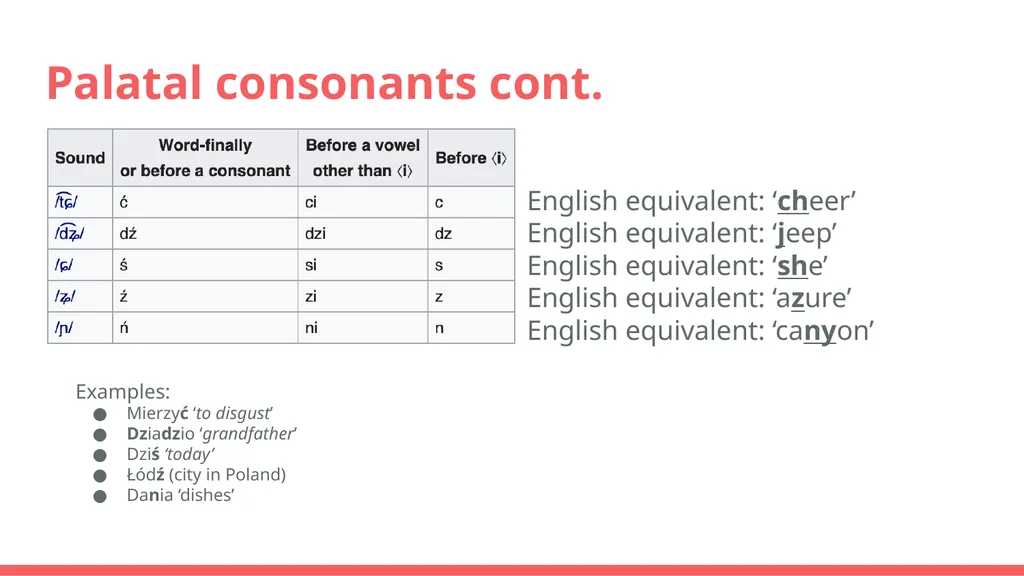
slide6. Palatal consonants cont. English equivalent: ‘cheer’
English equivalent: ‘jeep’
English equivalent: ‘she’
English equivalent: ‘azure’
English equivalent: ‘canyon’ Examples:
Mierzyć ‘to disgust’
Dziadzio ‘grandfather’
Dziś ‘today’
Łódź (city in Poland)
Dania ‘dishes’<br>
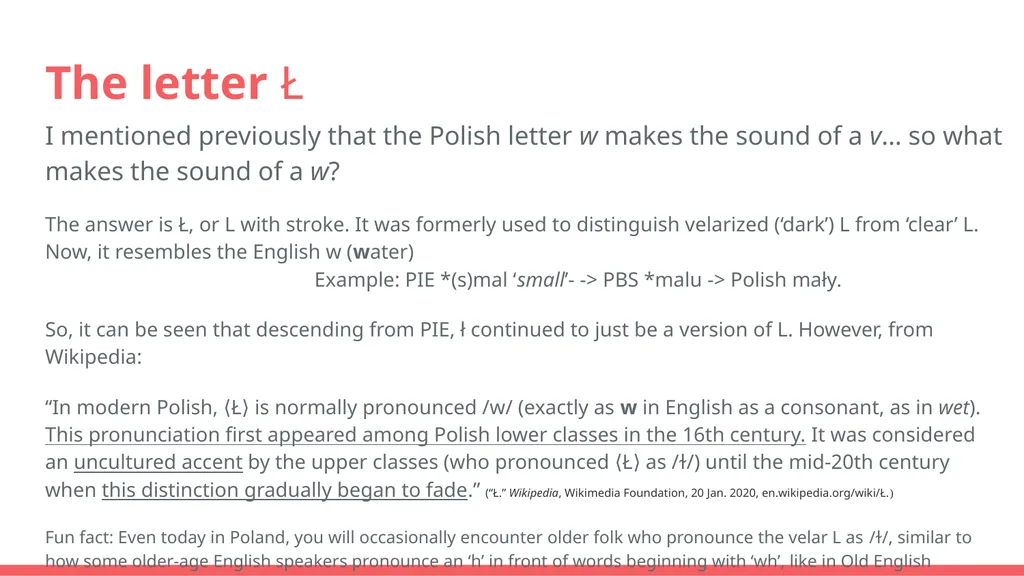
slide7. The letter Ł I mentioned previously that the Polish letter w makes the sound of a v… so what makes the sound of a w?
The answer is Ł, or L with stroke. It was formerly used to distinguish velarized (‘dark’) L from ‘clear’ L. Now, it resembles the English w (water) Example: PIE *(s)mal ‘small’- -> PBS *malu -> Polish mały.
So, it can be seen that descending from PIE, ł continued to just be a version of L. However, from Wikipedia:
“In modern Polish, ⟨Ł⟩ is normally pronounced /w/ (exactly as w in English as a consonant, as in wet). This pronunciation first appeared among Polish lower classes in the 16th century. It was considered an uncultured accent by the upper classes (who pronounced ⟨Ł⟩ as /ɫ/) until the mid-20th century when this distinction gradually began to fade.” (“Ł.” Wikipedia, Wikimedia Foundation, 20 Jan. 2020, en.wikipedia.org/wiki/Ł.)
Fun fact: Even today in Poland, you will occasionally encounter older folk who pronounce the velar L as /ɫ/, similar to how some older-age English speakers pronounce an ‘h’ in front of words beginning with ‘wh’, like in Old English ( ‘hwhat’, ‘hwhere’, ‘hwhite’ )<br>
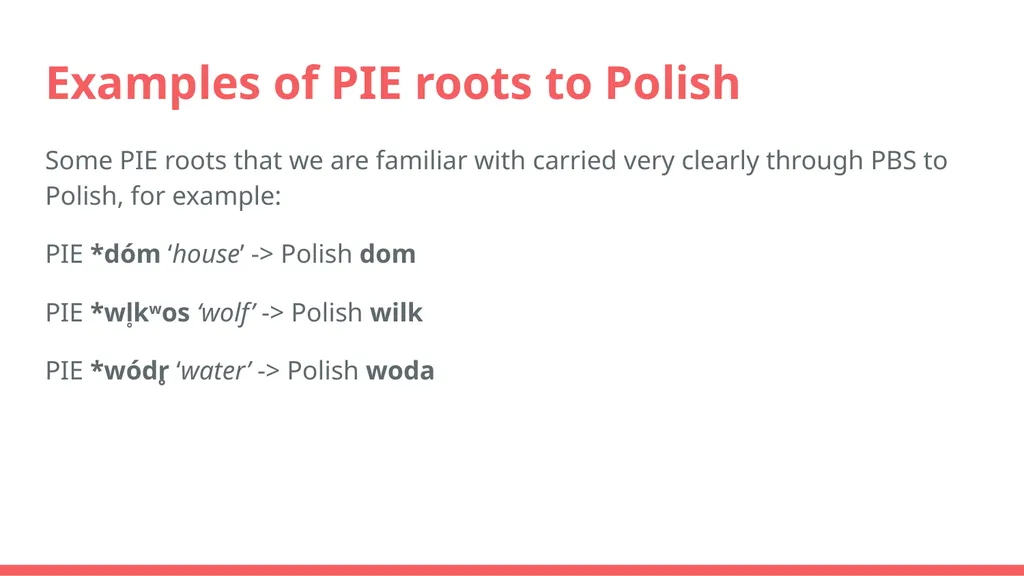
slide8. Examples of PIE roots to Polish Some PIE roots that we are familiar with carried very clearly through PBS to Polish, for example:
PIE *dóm ‘house’ -> Polish dom
PIE *wl̥kwos ‘wolf’ -> Polish wilk
PIE *wódr̥ ‘water’ -> Polish woda<br>
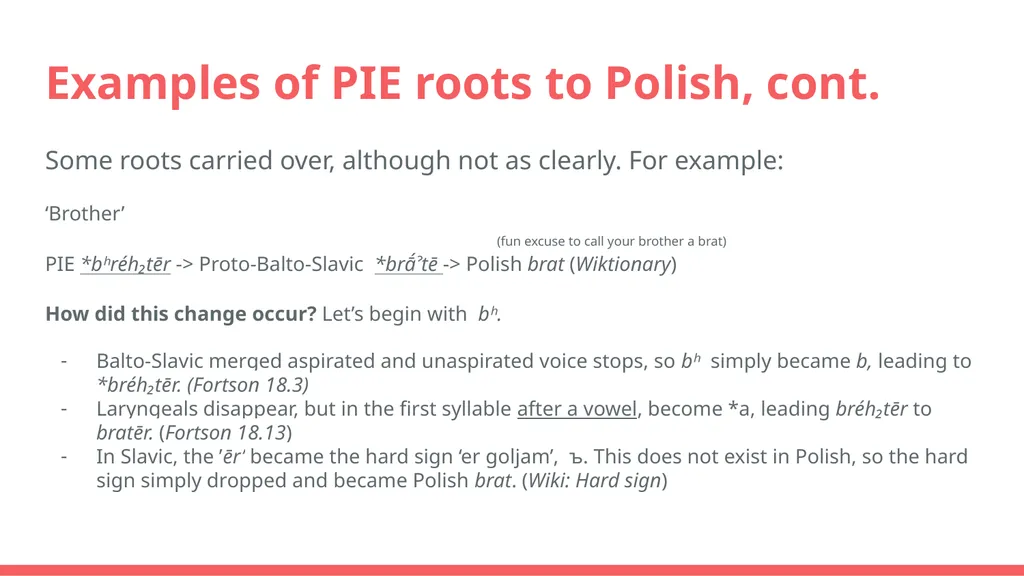
slide9. Examples of PIE roots to Polish, cont. Some roots carried over, although not as clearly. For example:
‘Brother’
PIE *bʰréh₂tēr -> Proto-Balto-Slavic *brā́ˀtē -> Polish brat (Wiktionary)
How did this change occur? Let’s begin with bʰ.
Balto-Slavic merged aspirated and unaspirated voice stops, so bʰ simply became b, leading to *bréh₂tēr. (Fortson 18.3)
Laryngeals disappear, but in the first syllable after a vowel, become *a, leading bréh₂tēr to bratēr. (Fortson 18.13)
In Slavic, the ’ēr’ became the hard sign ‘er goljam’, ъ. This does not exist in Polish, so the hard sign simply dropped and became Polish brat. (Wiki: Hard sign) (fun excuse to call your brother a brat)<br>
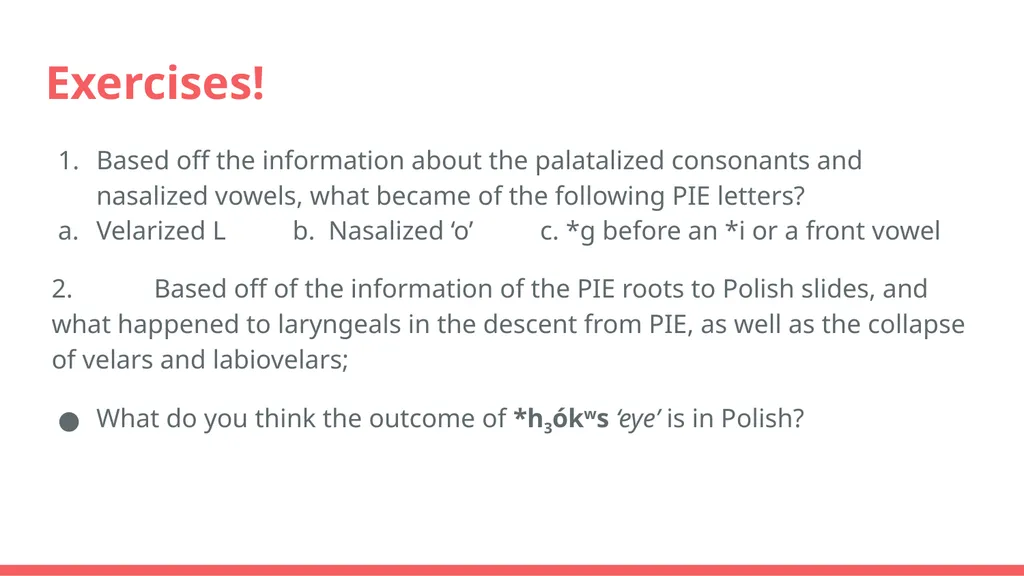
slide10. Exercises! Based off the information about the palatalized consonants and nasalized vowels, what became of the following PIE letters?
Velarized L b. Nasalized ‘o’ c. *g before an *i or a front vowel
2. Based off of the information of the PIE roots to Polish slides, and what happened to laryngeals in the descent from PIE, as well as the collapse of velars and labiovelars;
What do you think the outcome of *h3ókws ‘eye’ is in Polish?<br>
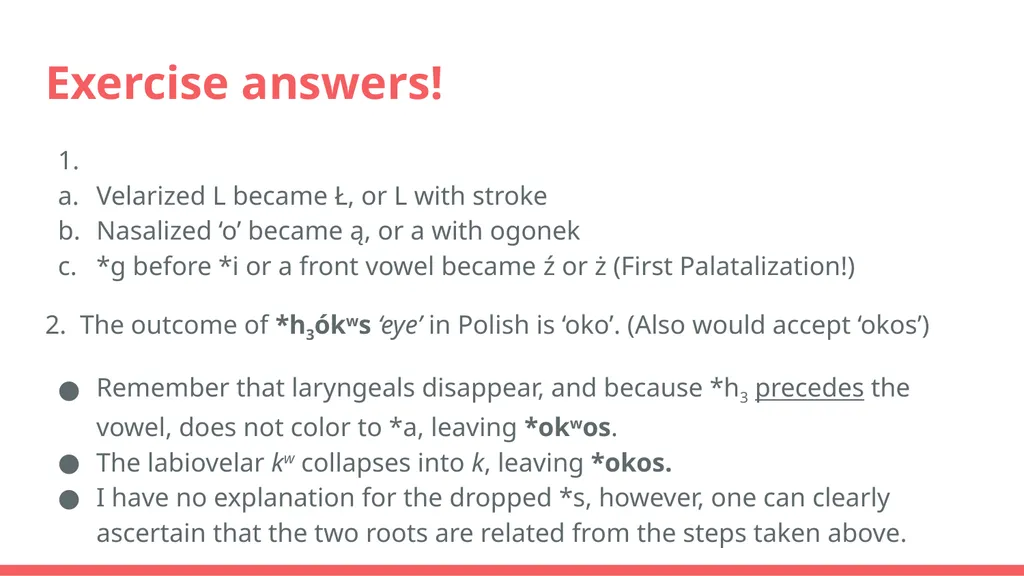
slide11. Exercise answers! Velarized L became Ł, or L with stroke
Nasalized ‘o’ became ą, or a with ogonek
*g before *i or a front vowel became ź or ż (First Palatalization!)
2. The outcome of *h3ókws ‘eye’ in Polish is ‘oko’. (Also would accept ‘okos’)
Remember that laryngeals disappear, and because *h3 precedes the vowel, does not color to *a, leaving *okwos.
The labiovelar kw collapses into k, leaving *okos.
I have no explanation for the dropped *s, however, one can clearly ascertain that the two roots are related from the steps taken above.<br>
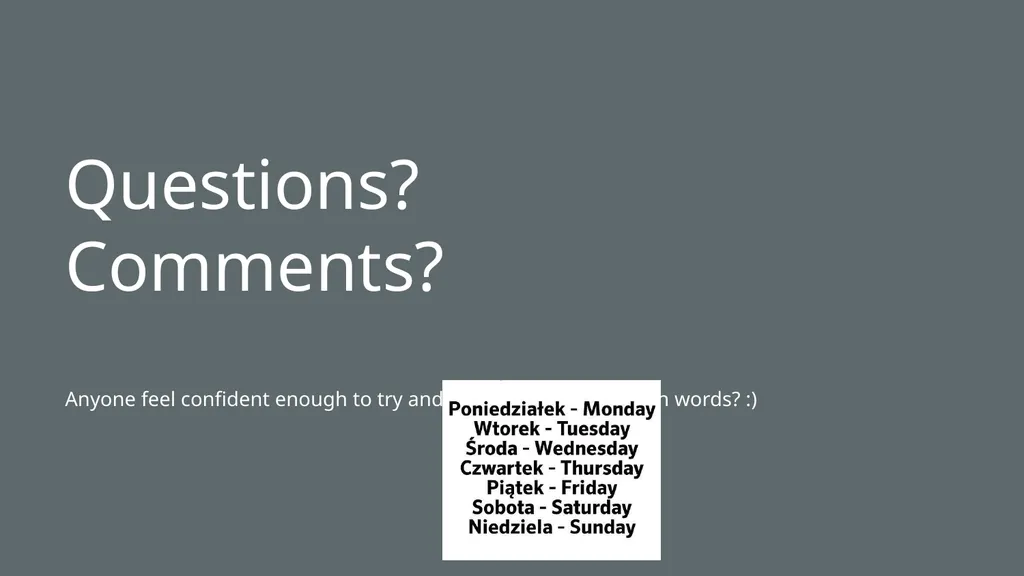
slide12. Questions? Comments?
Anyone feel confident enough to try and pronounce some Polish words? :)<br>
slide13. Citations References:
“Ą.” Wikipedia, Wikimedia Foundation, 20 Mar. 2020, en.wikipedia.org/wiki/Ą.
“Ę.” Wikipedia, Wikimedia Foundation, 17 Feb. 2020, en.wikipedia.org/wiki/Ę.
Fortson, Benjamin W. Indo-European Language and Culture: an Introduction. 2nd ed., Wiley-Blackwell, 2010.
“Ł.” Wikipedia, Wikimedia Foundation, 20 Jan. 2020, en.wikipedia.org/wiki/Ł.
“Mały.” Wiktionary, en.wiktionary.org/wiki/mały#Polish.
“Ogonek.” Wikipedia, Wikimedia Foundation, 22 Feb. 2020, en.wikipedia.org/wiki/Ogonek.
“Polish Orthography.” Wikipedia, Wikimedia Foundation, 9 Nov. 2019, en.wikipedia.org/wiki/Polish_orthography.
“Proto-Slavic.” Wikipedia, Wikimedia Foundation, 7 Apr. 2020, en.wikipedia.org/wiki/Proto-Slavic. Images:
“Https://Crazypolishguy.files.wordpress.com/2015/01/Polish-Letters.gif.” Https://Crazypolishguy.files.wordpress.com/2015/01/Polish-Letters.gif.
“Https://Upload.wikimedia.org/Wikipedia/Commons/6/67/Slavic_languages.Jpg.” Https://Upload.wikimedia.org/Wikipedia/Commons/6/67/Slavic_languages.Jpg, Wikimedia.<br>
Diacritics, Palatalizations, et cetera. Annaliese Holden
CLAS196A<br>
slide2. A little background Polish is a modern language, in Fortson’s Balto-Slavic chapter, it is identified as West Slavic.
-Of the Slavic languages, Polish is the third-largest spoken language. (Fortson 18.48)
-Polish descends from Proto-Balto-Slavic, which is the ‘middleman’ from PIE (PIE -> Proto-Balto-Slavic (PBS) -> Polish)<br>
slide3. The Polish alphabet and its differences Polish is written in the standard Latin alphabet, with a few exceptions.
The diacritical exceptions are ą, ć, ę, ł, ń, ó, ś, ź, ż. I will explain the diacritics and how they originated in an upcoming slide.
Some of these are nasalized vowels, and some are palatal consonants, both of which the Latin alphabet was not equipped to describe.
The letters q, v, and x are not considered part of the alphabet either, only in words that are borrowed from other languages.
A ‘q’ sound would be made with the consonant pair ‘kw’ (example: qualification vs. kwalifikacje)
A ‘v’ sound is simply replaced, made by the letter ‘w’ (example: Warszawa, the capital city)
A ‘x’ sound is replicated by ‘ks’ [example: tekst vs. text (message)] Pronounced: var-SHAV-ah<br>
slide4. The ‘ogonek’ and nasalized vowels This diacritical mark literally translates to ‘little tail’ from Polish.
You can see it in the letters ą and ę. Ę is a nasalized ‘e’, while ą is a nasalized ‘o’.
Ą is not a nasalized ‘a’ because of a vowel shift, evolved in turn from the merged nasal *ę and *ǫ of Late Proto-Slavic.
I know what you’re thinking, nasalized vowels? Yes, Polish has these! The nasal usually assimilates with the following consonant. Ą is pronounced like rendez-vous, and ę like ‘owh’ (this is the closest I can transliterate a nasal, it ultimately depends on the following letter!)
PIE sequences of *an ,*in, *en, or *im, *em, *om would become ą and ę.
Examples of descent from PIE: *ĝombho- ‘tooth’ -> Polish ‘ząb’, *ĝhans- ‘goose’ -> Polish ‘gęś’
According to Fortson, Polish is an exception to the Slavic languages’ tendencies to denasalize. (Fortson 18.32)
Here are some links to Wikipedia pronunciations: Pl-mąż.ogg pronounces mąż, the word for husband Pl-mogę.ogg pronounces mogę, the 1st person singular of ‘to be able to’<br>
slide5. The ‘kreska’ and palatal consonants Found over ć, ń, ó, ś, ź and through the letter in ł.
ć, ń, ś, ź are palatal consonants, with their own unique sounds separate from their unaccented counterparts.
Because Balto Slavic is a satem branch, all plain velars *k, *g, *gh, and labiovelars *kw, *gw, *gwh became the plain velars k and g. (Fortson 18.4)
Palatal consonants are HUGELY important in Balto-Slavic languages and occurred in three movements. (Fortson 18.25)
The First Palatalization changed the velars k, g, x before *i or a front vowel to ć, ź (later, ż), ś. Example: PBS *slug-iti ‘to serve’ -> Polish służyć
The Second Palatalization changed k, g, x before é Example: PIE *kwoi-neh2 ‘price’ -> PBS *kéna -> Polish cena
The Third Palatalization changed k, g, x before most vowels and after i or ę. However, this step is far more sporadic, according to Fortson. It does not appear to apply to Polish as much as other Slavic languages. Example: PIE *k̂r̥d-iko- -> PBS *sridiko -> Polish serduszko<br>
slide6. Palatal consonants cont. English equivalent: ‘cheer’
English equivalent: ‘jeep’
English equivalent: ‘she’
English equivalent: ‘azure’
English equivalent: ‘canyon’ Examples:
Mierzyć ‘to disgust’
Dziadzio ‘grandfather’
Dziś ‘today’
Łódź (city in Poland)
Dania ‘dishes’<br>
slide7. The letter Ł I mentioned previously that the Polish letter w makes the sound of a v… so what makes the sound of a w?
The answer is Ł, or L with stroke. It was formerly used to distinguish velarized (‘dark’) L from ‘clear’ L. Now, it resembles the English w (water) Example: PIE *(s)mal ‘small’- -> PBS *malu -> Polish mały.
So, it can be seen that descending from PIE, ł continued to just be a version of L. However, from Wikipedia:
“In modern Polish, ⟨Ł⟩ is normally pronounced /w/ (exactly as w in English as a consonant, as in wet). This pronunciation first appeared among Polish lower classes in the 16th century. It was considered an uncultured accent by the upper classes (who pronounced ⟨Ł⟩ as /ɫ/) until the mid-20th century when this distinction gradually began to fade.” (“Ł.” Wikipedia, Wikimedia Foundation, 20 Jan. 2020, en.wikipedia.org/wiki/Ł.)
Fun fact: Even today in Poland, you will occasionally encounter older folk who pronounce the velar L as /ɫ/, similar to how some older-age English speakers pronounce an ‘h’ in front of words beginning with ‘wh’, like in Old English ( ‘hwhat’, ‘hwhere’, ‘hwhite’ )<br>
slide8. Examples of PIE roots to Polish Some PIE roots that we are familiar with carried very clearly through PBS to Polish, for example:
PIE *dóm ‘house’ -> Polish dom
PIE *wl̥kwos ‘wolf’ -> Polish wilk
PIE *wódr̥ ‘water’ -> Polish woda<br>
slide9. Examples of PIE roots to Polish, cont. Some roots carried over, although not as clearly. For example:
‘Brother’
PIE *bʰréh₂tēr -> Proto-Balto-Slavic *brā́ˀtē -> Polish brat (Wiktionary)
How did this change occur? Let’s begin with bʰ.
Balto-Slavic merged aspirated and unaspirated voice stops, so bʰ simply became b, leading to *bréh₂tēr. (Fortson 18.3)
Laryngeals disappear, but in the first syllable after a vowel, become *a, leading bréh₂tēr to bratēr. (Fortson 18.13)
In Slavic, the ’ēr’ became the hard sign ‘er goljam’, ъ. This does not exist in Polish, so the hard sign simply dropped and became Polish brat. (Wiki: Hard sign) (fun excuse to call your brother a brat)<br>
slide10. Exercises! Based off the information about the palatalized consonants and nasalized vowels, what became of the following PIE letters?
Velarized L b. Nasalized ‘o’ c. *g before an *i or a front vowel
2. Based off of the information of the PIE roots to Polish slides, and what happened to laryngeals in the descent from PIE, as well as the collapse of velars and labiovelars;
What do you think the outcome of *h3ókws ‘eye’ is in Polish?<br>
slide11. Exercise answers! Velarized L became Ł, or L with stroke
Nasalized ‘o’ became ą, or a with ogonek
*g before *i or a front vowel became ź or ż (First Palatalization!)
2. The outcome of *h3ókws ‘eye’ in Polish is ‘oko’. (Also would accept ‘okos’)
Remember that laryngeals disappear, and because *h3 precedes the vowel, does not color to *a, leaving *okwos.
The labiovelar kw collapses into k, leaving *okos.
I have no explanation for the dropped *s, however, one can clearly ascertain that the two roots are related from the steps taken above.<br>
slide12. Questions? Comments?
Anyone feel confident enough to try and pronounce some Polish words? :)<br>
slide13. Citations References:
“Ą.” Wikipedia, Wikimedia Foundation, 20 Mar. 2020, en.wikipedia.org/wiki/Ą.
“Ę.” Wikipedia, Wikimedia Foundation, 17 Feb. 2020, en.wikipedia.org/wiki/Ę.
Fortson, Benjamin W. Indo-European Language and Culture: an Introduction. 2nd ed., Wiley-Blackwell, 2010.
“Ł.” Wikipedia, Wikimedia Foundation, 20 Jan. 2020, en.wikipedia.org/wiki/Ł.
“Mały.” Wiktionary, en.wiktionary.org/wiki/mały#Polish.
“Ogonek.” Wikipedia, Wikimedia Foundation, 22 Feb. 2020, en.wikipedia.org/wiki/Ogonek.
“Polish Orthography.” Wikipedia, Wikimedia Foundation, 9 Nov. 2019, en.wikipedia.org/wiki/Polish_orthography.
“Proto-Slavic.” Wikipedia, Wikimedia Foundation, 7 Apr. 2020, en.wikipedia.org/wiki/Proto-Slavic. Images:
“Https://Crazypolishguy.files.wordpress.com/2015/01/Polish-Letters.gif.” Https://Crazypolishguy.files.wordpress.com/2015/01/Polish-Letters.gif.
“Https://Upload.wikimedia.org/Wikipedia/Commons/6/67/Slavic_languages.Jpg.” Https://Upload.wikimedia.org/Wikipedia/Commons/6/67/Slavic_languages.Jpg, Wikimedia.<br>