
The Prelude (Book I) William Wordsworth Presented

Description: The Prelude (Book I) William Wordsworth Presented by: Jaspal Kaur Matharu Guest Faculty Department of English Gangadhar Meher University William Wordsworth William Wordsworth (7 April 1770- 23 April 1850) was one of the founders of English
Related Topics
Download Presentation
"The Prelude (Book I) William Wordsworth Presented" is the property of its rightful owner. Permission is granted to download and print the materials on this website for personal, non-commercial use only, and to display it on your personal computer provided you do not modify the materials and that you retain all copyright notices contained in the materials. By downloading content from our website, you accept the terms of this agreement.
Presentation Transcript
slide1. The Prelude
(Book I)
William Wordsworth Presented by: Jaspal Kaur Matharu
Guest Faculty
Department of English
Gangadhar Meher University<br>
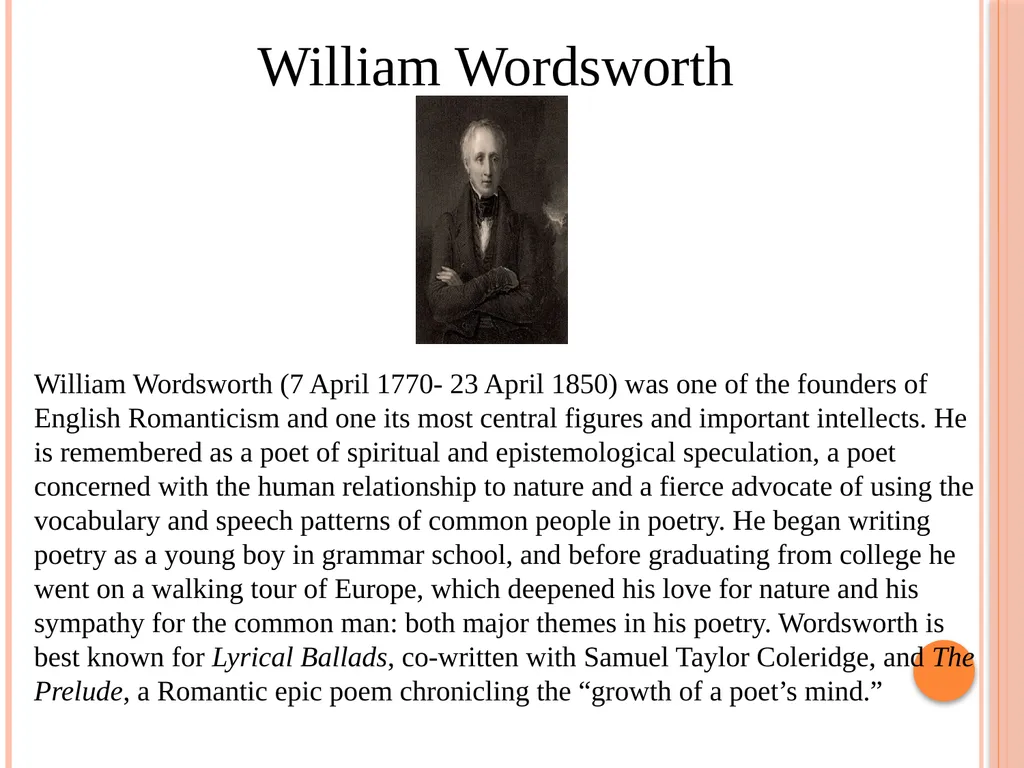
slide2. William Wordsworth William Wordsworth (7 April 1770- 23 April 1850) was one of the founders of English Romanticism and one its most central figures and important intellects. He is remembered as a poet of spiritual and epistemological speculation, a poet concerned with the human relationship to nature and a fierce advocate of using the vocabulary and speech patterns of common people in poetry. He began writing poetry as a young boy in grammar school, and before graduating from college he went on a walking tour of Europe, which deepened his love for nature and his sympathy for the common man: both major themes in his poetry. Wordsworth is best known for Lyrical Ballads, co-written with Samuel Taylor Coleridge, and The Prelude, a Romantic epic poem chronicling the “growth of a poet’s mind.”<br>
slide3. The Prelude
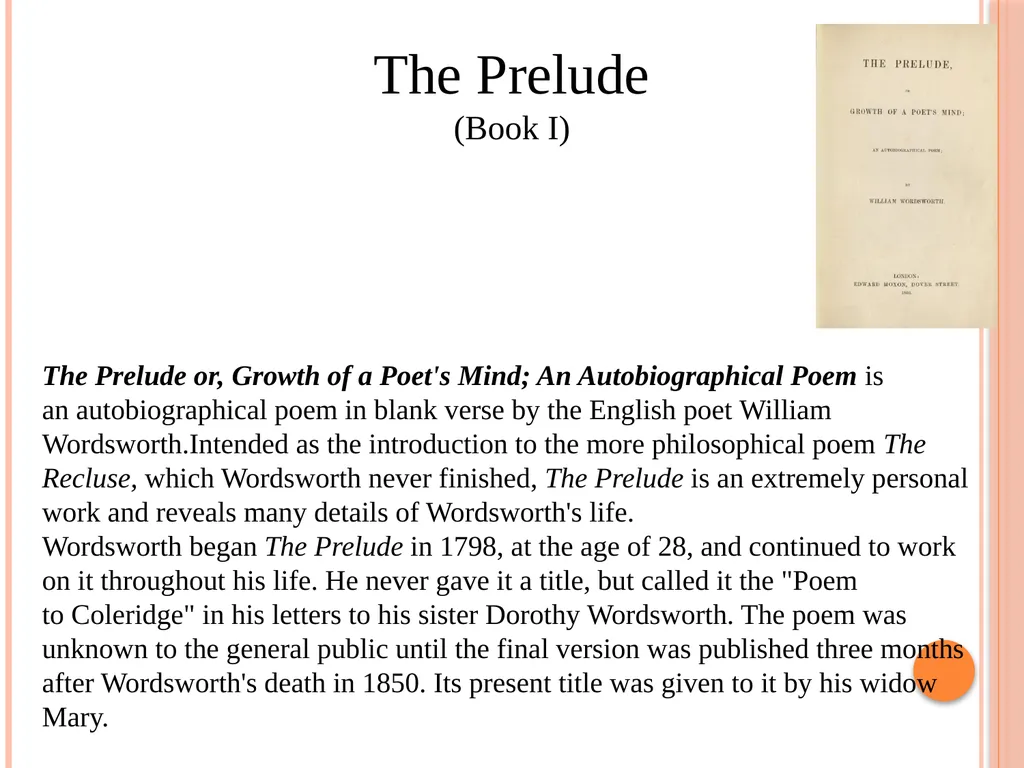
(Book I) The Prelude or, Growth of a Poet's Mind; An Autobiographical Poem is an autobiographical poem in blank verse by the English poet William Wordsworth.Intended as the introduction to the more philosophical poem The Recluse, which Wordsworth never finished, The Prelude is an extremely personal work and reveals many details of Wordsworth's life.
Wordsworth began The Prelude in 1798, at the age of 28, and continued to work on it throughout his life. He never gave it a title, but called it the "Poem to Coleridge" in his letters to his sister Dorothy Wordsworth. The poem was unknown to the general public until the final version was published three months after Wordsworth's death in 1850. Its present title was given to it by his widow Mary.<br>
slide4. Plot The subtitle of The Prelude is ‘Growth of a Poet’s Mind’. William Wordsworth (1770-1850) began writing his autobiographical blank verse epic in 1798, working on it intermittently until 1839. It was published posthumously in 1850. Book I establishes Wordsworth’s sense of life as a journey, both literal – as the poet leaves the city for his beloved Lake District – and metaphorical, as he searches for a subject to write about that will justify his decision to become a poet: he eventually decides to focus on his own life. His vivid accounts of boyhood incidents – skating on frozen lakes in the winter twilight, flying kites, playing cards – give the poem an immediacy, justifying his description of his early years as the ‘seed-time’ of his ‘soul’.<br>
slide5. Themes The poem is suffused with the beauty of the Cumberland landscape, which for the most part is soothing and benevolent, characterised by the ‘blessing’ of the ‘gentle breeze’ that Wordsworth describes in the poem’s opening lines. Crucially, however, there are also hints of nature’s more troubling power, most notably in the ‘boat-stealing’ episode where the young Wordsworth is struck by the ‘huge and mighty forms’ of the mountains that loom above him as fearsome, admonitory presences. The poem can be seen as a response to John Milton’s attempt to ‘justify the ways of God to man’ in his great poem Paradise Lost: Wordsworth’s justification of his poetic vocation was an audacious attempt to make the epic personal, giving the genre a new psychological focus.<br>
(Book I)
William Wordsworth Presented by: Jaspal Kaur Matharu
Guest Faculty
Department of English
Gangadhar Meher University<br>
slide2. William Wordsworth William Wordsworth (7 April 1770- 23 April 1850) was one of the founders of English Romanticism and one its most central figures and important intellects. He is remembered as a poet of spiritual and epistemological speculation, a poet concerned with the human relationship to nature and a fierce advocate of using the vocabulary and speech patterns of common people in poetry. He began writing poetry as a young boy in grammar school, and before graduating from college he went on a walking tour of Europe, which deepened his love for nature and his sympathy for the common man: both major themes in his poetry. Wordsworth is best known for Lyrical Ballads, co-written with Samuel Taylor Coleridge, and The Prelude, a Romantic epic poem chronicling the “growth of a poet’s mind.”<br>
slide3. The Prelude
(Book I) The Prelude or, Growth of a Poet's Mind; An Autobiographical Poem is an autobiographical poem in blank verse by the English poet William Wordsworth.Intended as the introduction to the more philosophical poem The Recluse, which Wordsworth never finished, The Prelude is an extremely personal work and reveals many details of Wordsworth's life.
Wordsworth began The Prelude in 1798, at the age of 28, and continued to work on it throughout his life. He never gave it a title, but called it the "Poem to Coleridge" in his letters to his sister Dorothy Wordsworth. The poem was unknown to the general public until the final version was published three months after Wordsworth's death in 1850. Its present title was given to it by his widow Mary.<br>
slide4. Plot The subtitle of The Prelude is ‘Growth of a Poet’s Mind’. William Wordsworth (1770-1850) began writing his autobiographical blank verse epic in 1798, working on it intermittently until 1839. It was published posthumously in 1850. Book I establishes Wordsworth’s sense of life as a journey, both literal – as the poet leaves the city for his beloved Lake District – and metaphorical, as he searches for a subject to write about that will justify his decision to become a poet: he eventually decides to focus on his own life. His vivid accounts of boyhood incidents – skating on frozen lakes in the winter twilight, flying kites, playing cards – give the poem an immediacy, justifying his description of his early years as the ‘seed-time’ of his ‘soul’.<br>
slide5. Themes The poem is suffused with the beauty of the Cumberland landscape, which for the most part is soothing and benevolent, characterised by the ‘blessing’ of the ‘gentle breeze’ that Wordsworth describes in the poem’s opening lines. Crucially, however, there are also hints of nature’s more troubling power, most notably in the ‘boat-stealing’ episode where the young Wordsworth is struck by the ‘huge and mighty forms’ of the mountains that loom above him as fearsome, admonitory presences. The poem can be seen as a response to John Milton’s attempt to ‘justify the ways of God to man’ in his great poem Paradise Lost: Wordsworth’s justification of his poetic vocation was an audacious attempt to make the epic personal, giving the genre a new psychological focus.<br>