The Reality of Multinational Insurance Programs: Challenges and Solutions with Cross Border Claims and Servicing June 2018 June 2018 2 Overview Multinational Programmes 3 Structure 6 Freedom of Services 7 DIC DIL 8 FEL Endorsements 9
"The Reality of Multinational Insurance Programs:" is the property of its rightful owner. Permission is granted to
download and print the materials on this website for personal, non-commercial use only, and to display it
on your personal computer provided you do not modify the materials and that you retain all copyright
notices contained in the materials. By downloading content from our website, you accept the terms of this
agreement.
Presentation Transcript
01
The Reality of Multinational Insurance Programs: Challenges and Solutions with Cross Border Claims and Servicing June 2018<br>
02
June 2018 2 Overview – Multinational Programmes 3
Structure 6
Freedom of Services 7
DIC/ DIL 8
FEL Endorsements 9
Examples 10 Content<br>
03
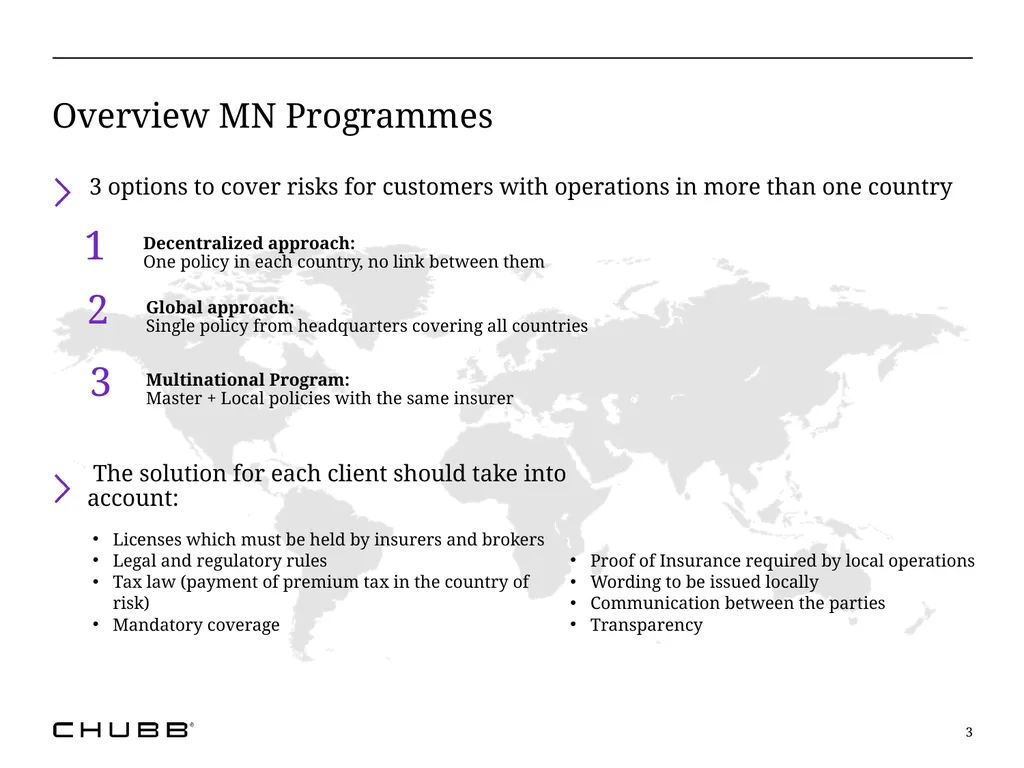
3 options to cover risks for customers with operations in more than one country 3 Decentralized approach:
One policy in each country, no link between them Global approach:
Single policy from headquarters covering all countries Multinational Program:
Master + Local policies with the same insurer Licenses which must be held by insurers and brokers
Legal and regulatory rules
Tax law (payment of premium tax in the country of risk)
Mandatory coverage
Proof of Insurance required by local operations
Wording to be issued locally
Communication between the parties
Transparency Overview MN Programmes The solution for each client should take into account: 1 2 3<br>
04
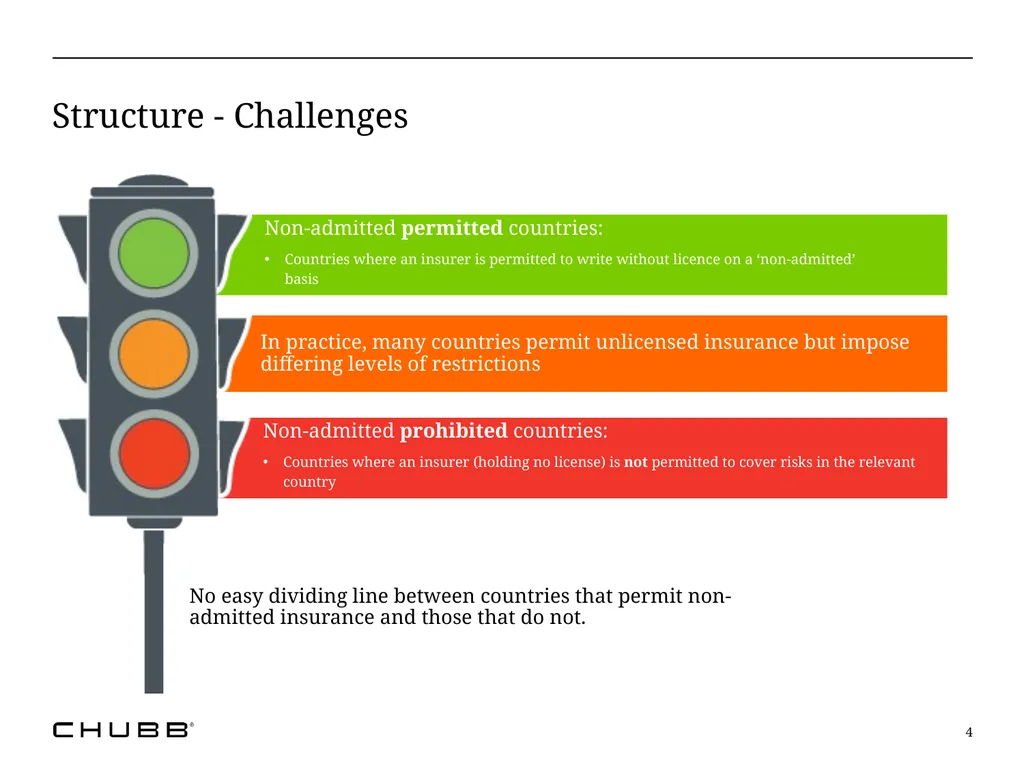
Structure - Challenges 4 No easy dividing line between countries that permit non-admitted insurance and those that do not. Non-admitted permitted countries:
Countries where an insurer is permitted to write without licence on a ‘non-admitted’ basis
Australia, Canada, Chile, Germany, Peru, Sweden, UK, United States (conditionally) In practice, many countries permit unlicensed insurance but impose differing levels of restrictions Non-admitted prohibited countries:
Countries where an insurer (holding no license) is not permitted to cover risks in the relevant country
Most restrictive – Argentina, Brazil, China, India, Japan, Mexico, Russia, Switzerland<br>
05
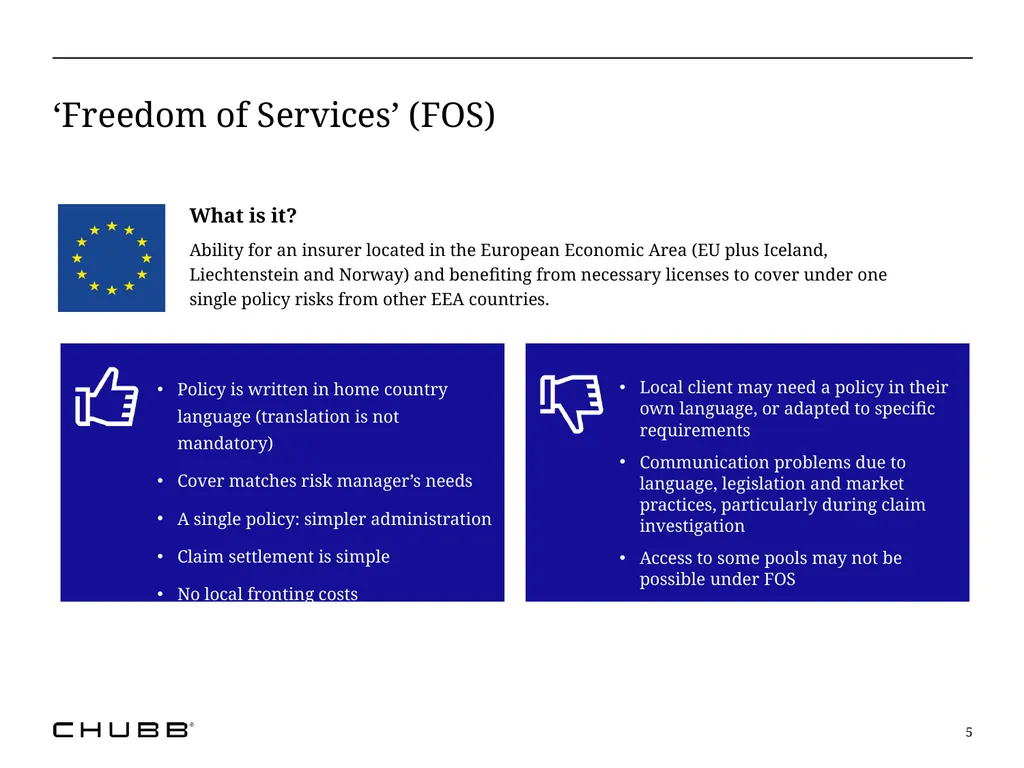
‘Freedom of Services’ (FOS) 5 Policy is written in home country language (translation is not mandatory)
Cover matches risk manager’s needs
A single policy: simpler administration
Claim settlement is simple
No local fronting costs Local client may need a policy in their own language, or adapted to specific requirements
Communication problems due to language, legislation and market practices, particularly during claim investigation
Access to some pools may not be possible under FOS<br>
06
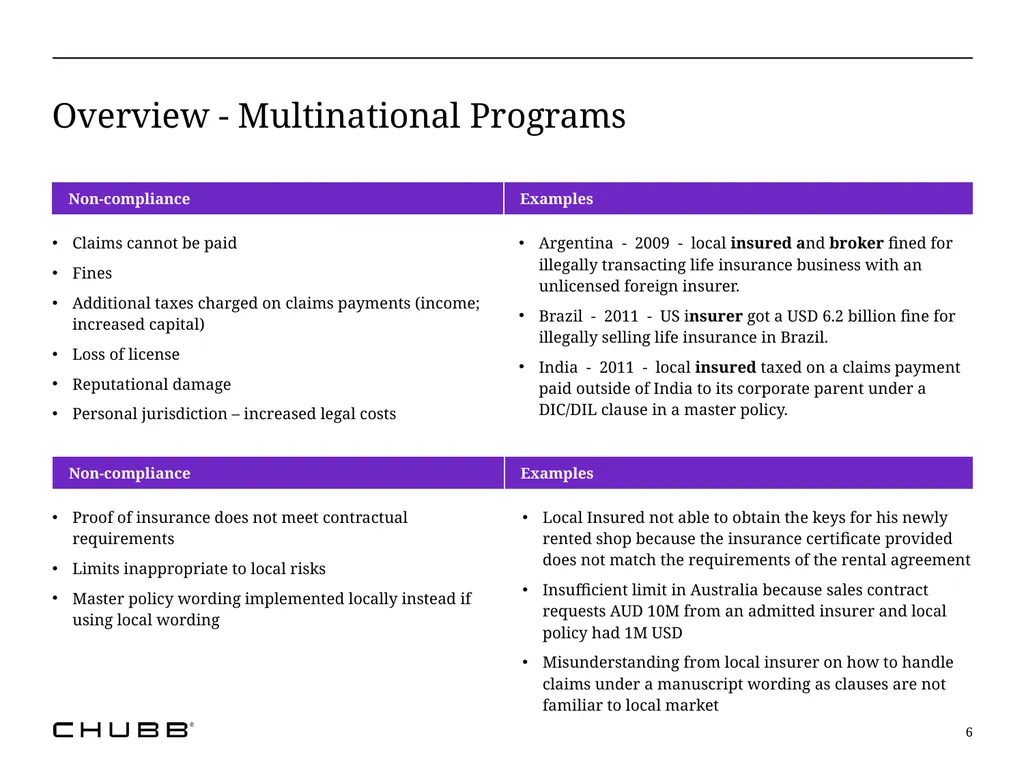
6 Overview - Multinational Programs Claims cannot be paid
Fines
Additional taxes charged on claims payments (income; increased capital)
Loss of license
Reputational damage
Personal jurisdiction – increased legal costs
Argentina - 2009 - local insured and broker fined for illegally transacting life insurance business with an unlicensed foreign insurer.
Brazil - 2011 - US insurer got a USD 6.2 billion fine for illegally selling life insurance in Brazil.
India - 2011 - local insured taxed on a claims payment paid outside of India to its corporate parent under a DIC/DIL clause in a master policy. Proof of insurance does not meet contractual requirements
Limits inappropriate to local risks
Master policy wording implemented locally instead if using local wording
Local Insured not able to obtain the keys for his newly rented shop because the insurance certificate provided does not match the requirements of the rental agreement
Insufficient limit in Australia because sales contract requests AUD 10M from an admitted insurer and local policy had 1M USD
Misunderstanding from local insurer on how to handle claims under a manuscript wording as clauses are not familiar to local market<br>
07
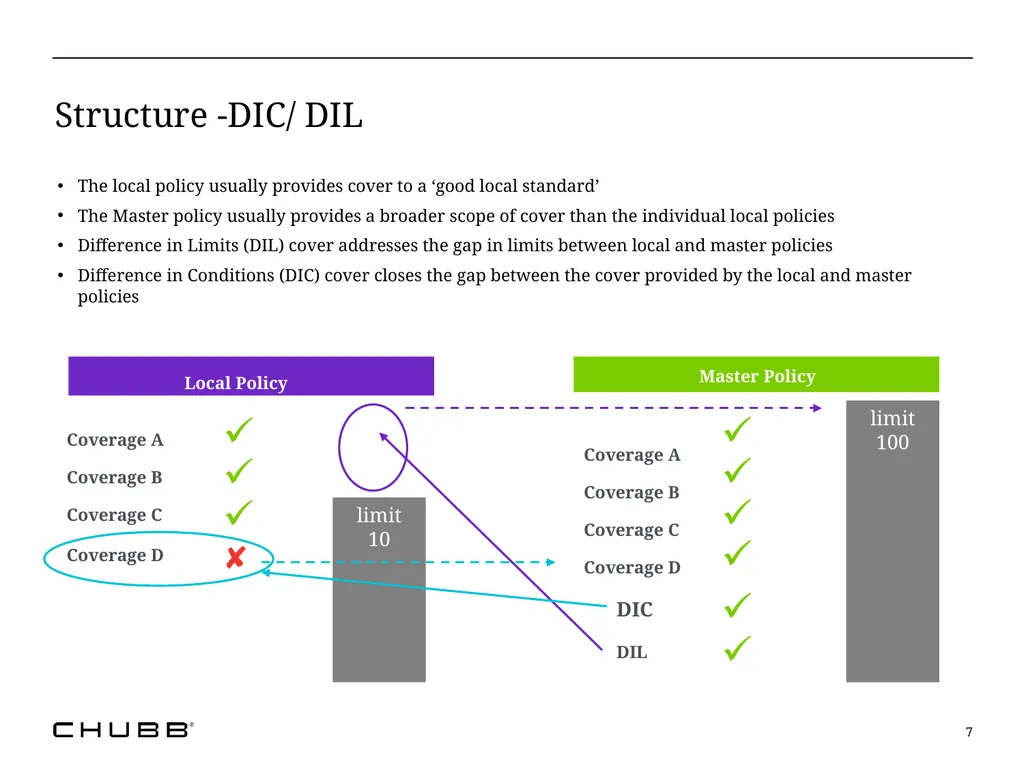
Structure -DIC/ DIL 7 The local policy usually provides cover to a ‘good local standard’
The Master policy usually provides a broader scope of cover than the individual local policies
Difference in Limits (DIL) cover addresses the gap in limits between local and master policies
Difference in Conditions (DIC) cover closes the gap between the cover provided by the local and master policies limit
10 limit
100 DIC DIL Coverage A
Coverage B
Coverage C
Coverage D Master Policy
Coverage A
Coverage B
Coverage C
Coverage D Local Policy<br>
08
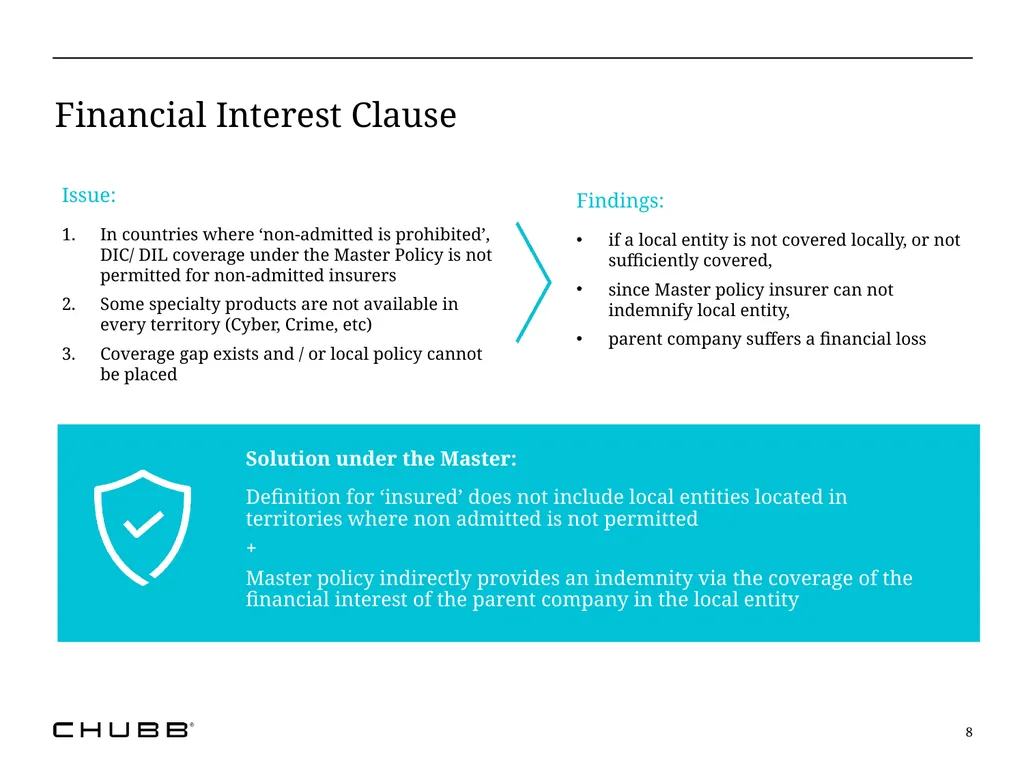
Financial Interest Clause 8 Findings:
if a local entity is not covered locally, or not sufficiently covered,
since Master policy insurer can not indemnify local entity,
parent company suffers a financial loss Issue:
In countries where ‘non-admitted is prohibited’, DIC/ DIL coverage under the Master Policy is not permitted for non-admitted insurers
Some specialty products are not available in every territory (Cyber, Crime, etc)
Coverage gap exists and / or local policy cannot be placed Solution under the Master:
Definition for ‘insured’ does not include local entities located in territories where non admitted is not permitted
+
Master policy indirectly provides an indemnity via the coverage of the financial interest of the parent company in the local entity<br>
09
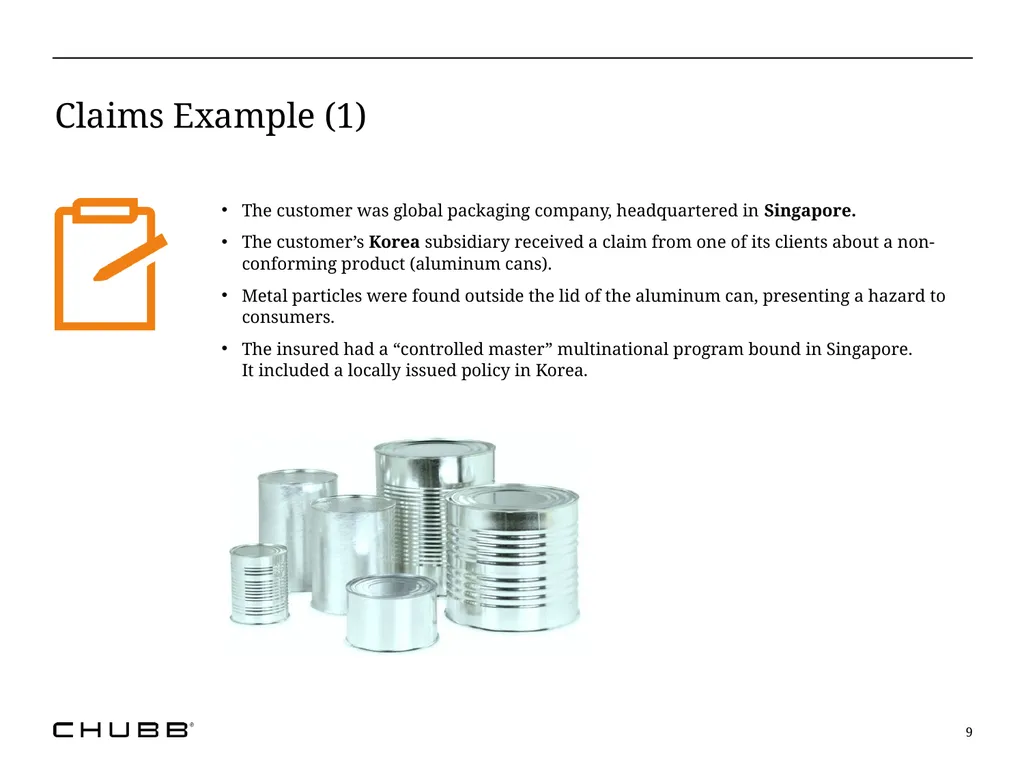
Claims Example (1) 9 The customer was global packaging company, headquartered in Singapore.
The customer’s Korea subsidiary received a claim from one of its clients about a non-conforming product (aluminum cans).
Metal particles were found outside the lid of the aluminum can, presenting a hazard to consumers.
The insured had a “controlled master” multinational program bound in Singapore. It included a locally issued policy in Korea.<br>
10
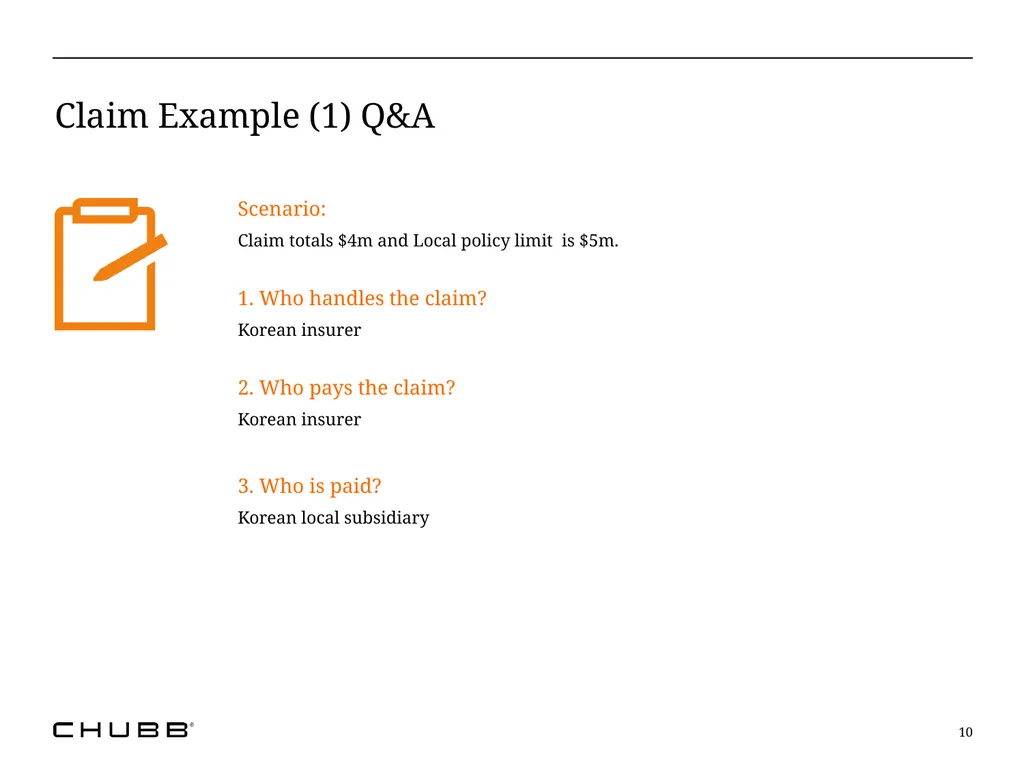
10 Claim Example (1) Q&A Scenario:
Claim totals $4m and Local policy limit is $5m.
1. Who handles the claim?
Korean insurer
2. Who pays the claim?
Korean insurer Not so fast !
Did you check if local policy wording was covering that claim
3. Who is paid?
Korean local subsidiary<br>
11
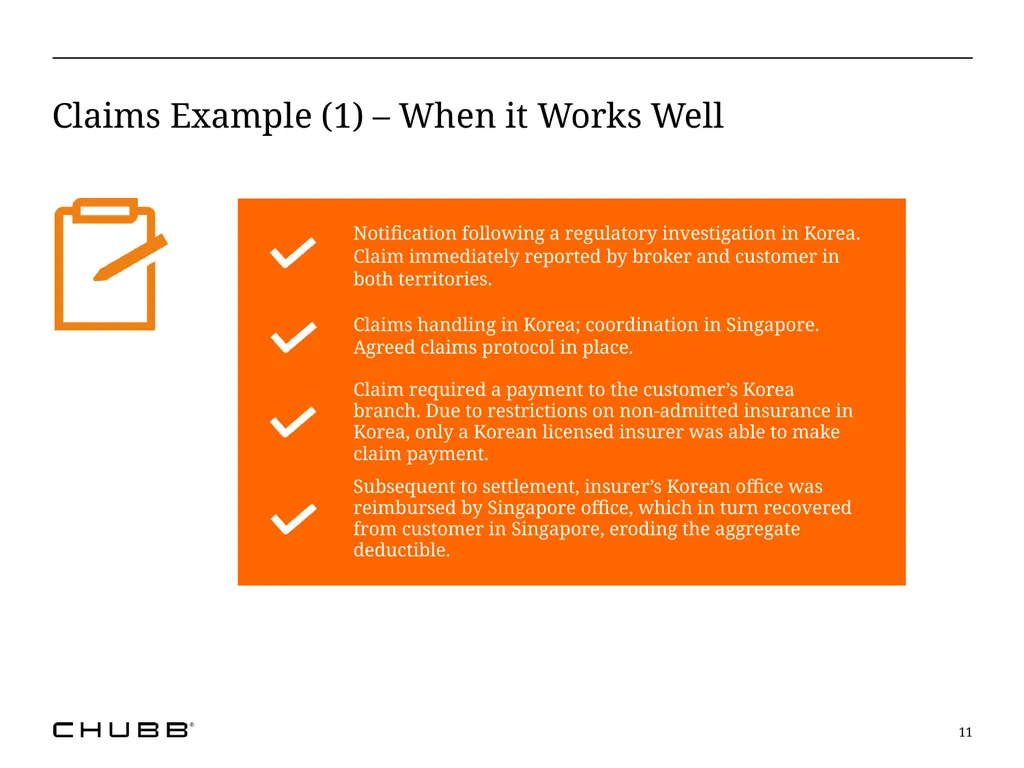
Claims Example (1) – When it Works Well 11<br>
12
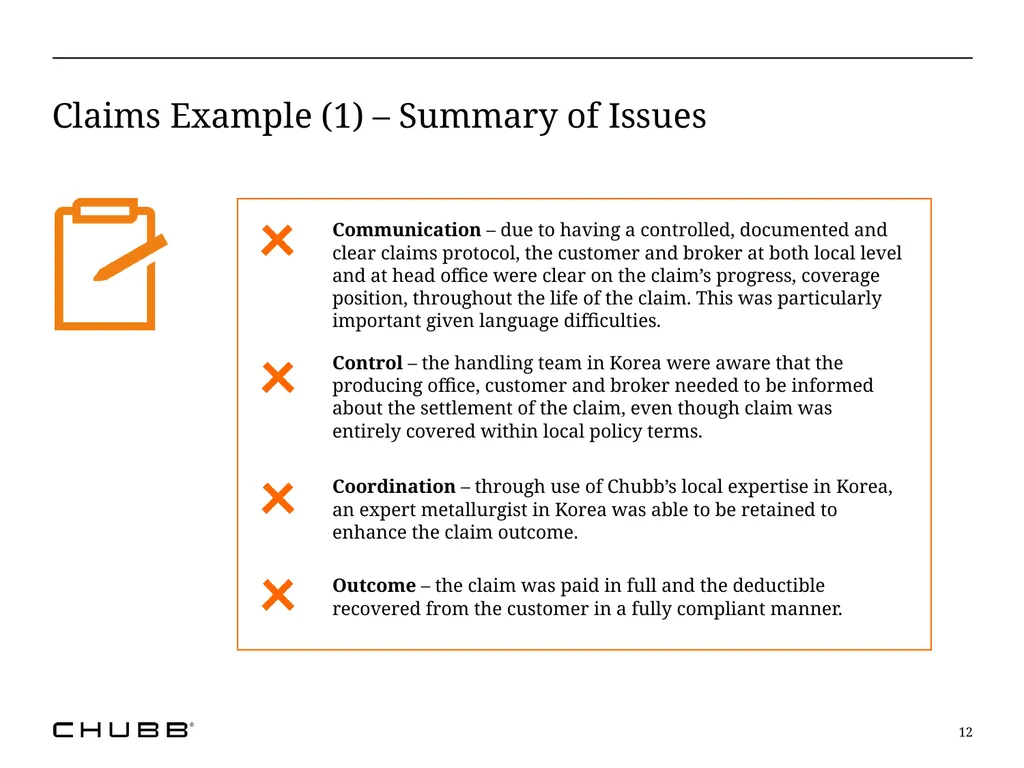
Claims Example (1) – Summary of Issues 12<br>
13
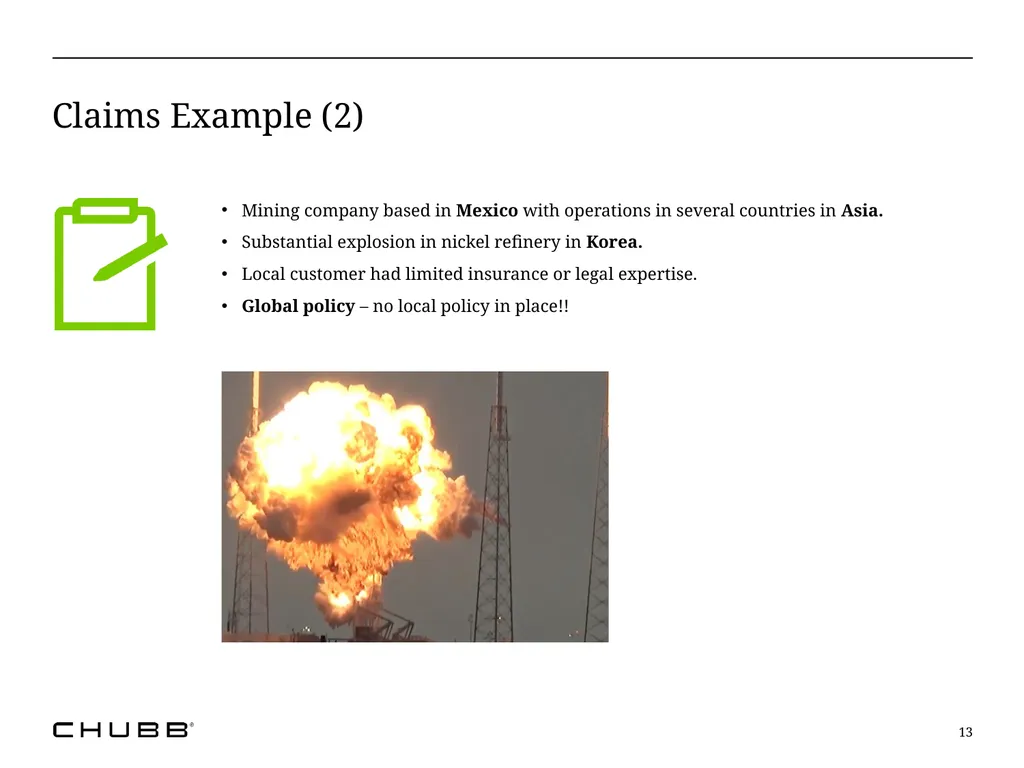
Claims Example (2) 13 Mining company based in Mexico with operations in several countries in Asia.
Substantial explosion in nickel refinery in Korea.
Local customer had limited insurance or legal expertise.
Global policy – no local policy in place!!<br>
14
14 Scenario:
Claim totals $40m
1. Who handles the claim?
Korean customer
2. Who pays the claim?
Mexican insurer
3. Who is paid?
Parent company in Mexico Claims Example (2) Q&A<br>
15
Claims Example (2) – Where it Can Go Wrong 15<br>
16
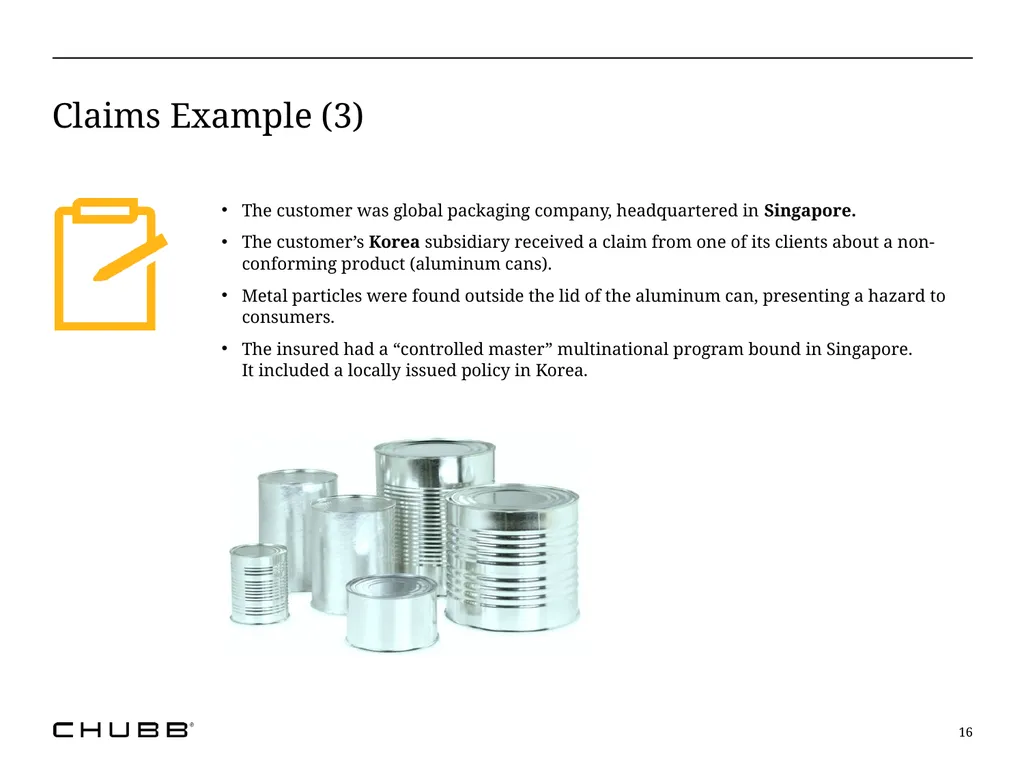
16 The customer was global packaging company, headquartered in Singapore.
The customer’s Korea subsidiary received a claim from one of its clients about a non-conforming product (aluminum cans).
Metal particles were found outside the lid of the aluminum can, presenting a hazard to consumers.
The insured had a “controlled master” multinational program bound in Singapore. It included a locally issued policy in Korea. Claims Example (3)<br>
17
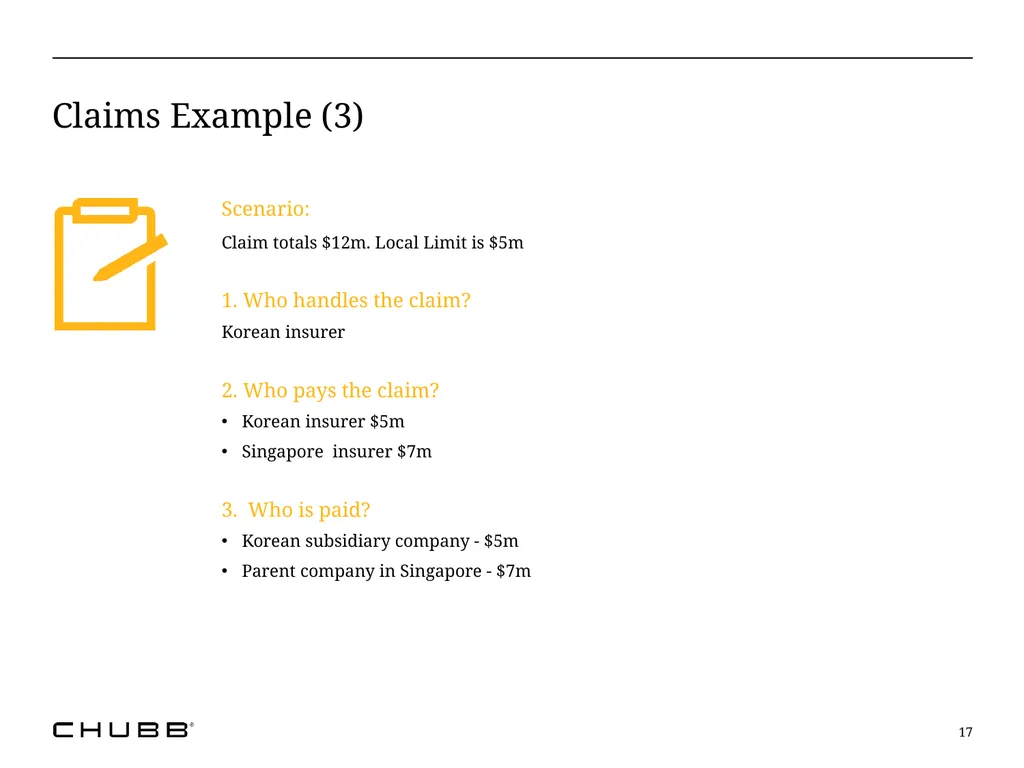
17 Scenario:
Claim totals $12m. Local Limit is $5m
1. Who handles the claim?
Korean insurer
2. Who pays the claim?
Korean insurer $5m
Singapore insurer $7m
3. Who is paid?
Korean subsidiary company - $5m
Parent company in Singapore - $7m Claims Example (3)<br>
18
18 In non-admitted prohibited countries (e.g. Argentina, Brazil, China, India, Japan, Mexico, Russia, Switzerland), local regulatory requirements are satisfied
Claims are paid in the local country
Follow local law and customs
Local language
Appropriate taxes paid in country
Appropriate wording issued as per local market practice Purchasing/issuing local policies – the Claims advantages<br>
19
Local policies are critical but having enough local limit and the right coverages is just as important! What is the claims conclusion?<br>
20
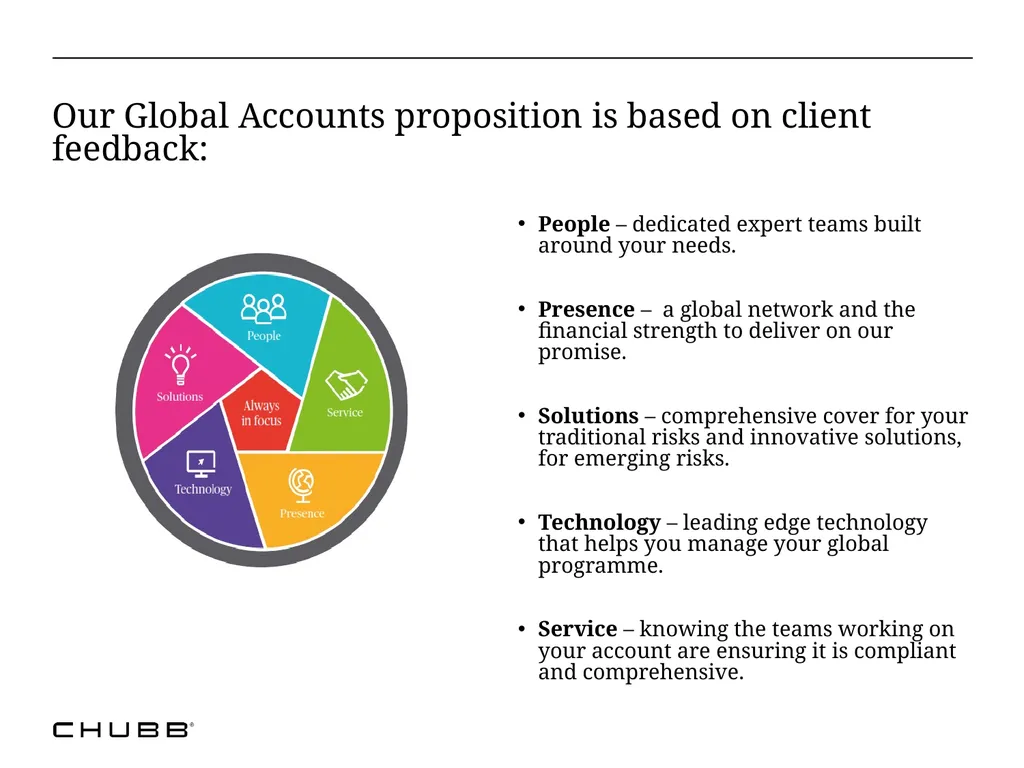
Our Global Accounts proposition is based on client feedback: People – dedicated expert teams built around your needs.
Presence – a global network and the financial strength to deliver on our promise.
Solutions – comprehensive cover for your traditional risks and innovative solutions, for emerging risks.
Technology – leading edge technology that helps you manage your global programme.
Service – knowing the teams working on your account are ensuring it is compliant and comprehensive.<br>