
The same medicine will both harm and cure me. (Res
A
Published · 47 slides · 0 views

1 / 1










Description
The same medicine will both harm and cure me. (Res eadem vulnus opemque feret) OVID, Tristia Appropriate Drug Prescribing in Older Adults Objectives Understand age-related changes in pharmacokinetics and pharmacodynamics Recognize high risk
Related Topics
Share
Embed code
Download this presentation From Below
"The same medicine will both harm and cure me. (Res" is the property of its rightful owner. Permission is granted to download and print the materials on this website for personal, non-commercial use only, and to display it on your personal computer provided you do not modify the materials and that you retain all copyright notices contained in the materials. By downloading content from our website, you accept the terms of this agreement.
Presentation Transcript
01
The same medicine will both harm and cure me.
(Res eadem vulnus opemque feret)
OVID, Tristia Appropriate Drug Prescribing in Older Adults<br>
(Res eadem vulnus opemque feret)
OVID, Tristia Appropriate Drug Prescribing in Older Adults<br>
02
Objectives Understand age-related changes in pharmacokinetics and pharmacodynamics
Recognize high risk medications which should generally be avoided in older adults
Recognize common drug-drug interactions in older adults
Perform a quick drug list review and revision using these principles<br>
Recognize high risk medications which should generally be avoided in older adults
Recognize common drug-drug interactions in older adults
Perform a quick drug list review and revision using these principles<br>
03
The same medicine will both harm and cure me. (Res eadem vulnus opemque feret).
OVID, Tristia, Book II, L. 20
Good medicine is man’s salvation. Excessive use gives aggravation.
Romanoff, Alexis Lawrence; Encylopedia of Thoughts, Couplets
Formerly, when religion was strong and science weak, men mistook magic for medicine; now, when science is strong and religion weak, men mistake medicine for magic.
Szasz, Thomas; The Second Sin, Science and Scientism (p. 115)
The desire to take medicine is perhaps the greatest feature which distinguishes man from animal.
Osler, Sir William; In Harvey Cushing, The Life of Sir William Osler, Volume I (p. 342)
Frequent changes of medicines proclaims the ignorance of the physician and is calamitous for the patients.
Hoffman, Friedrich; Fundamenta Medicianae, Therapeutics, Chapter I, 37 (p. 137)<br>
OVID, Tristia, Book II, L. 20
Good medicine is man’s salvation. Excessive use gives aggravation.
Romanoff, Alexis Lawrence; Encylopedia of Thoughts, Couplets
Formerly, when religion was strong and science weak, men mistook magic for medicine; now, when science is strong and religion weak, men mistake medicine for magic.
Szasz, Thomas; The Second Sin, Science and Scientism (p. 115)
The desire to take medicine is perhaps the greatest feature which distinguishes man from animal.
Osler, Sir William; In Harvey Cushing, The Life of Sir William Osler, Volume I (p. 342)
Frequent changes of medicines proclaims the ignorance of the physician and is calamitous for the patients.
Hoffman, Friedrich; Fundamenta Medicianae, Therapeutics, Chapter I, 37 (p. 137)<br>
04
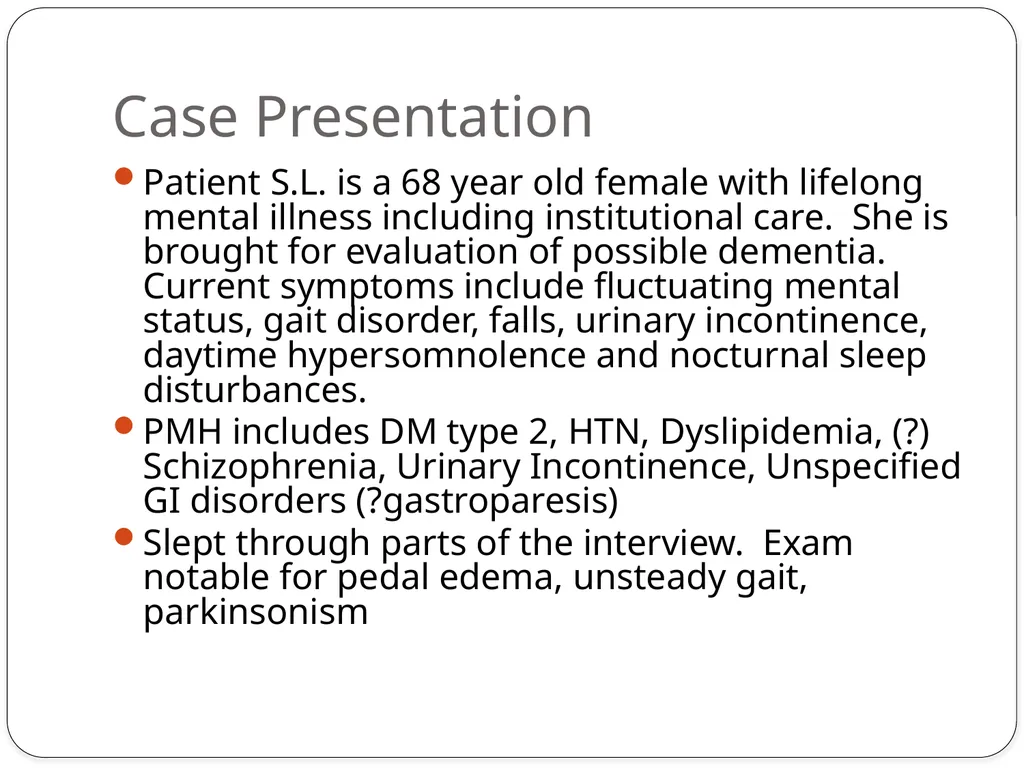
Case Presentation Patient S.L. is a 68 year old female with lifelong mental illness including institutional care. She is brought for evaluation of possible dementia. Current symptoms include fluctuating mental status, gait disorder, falls, urinary incontinence, daytime hypersomnolence and nocturnal sleep disturbances.
PMH includes DM type 2, HTN, Dyslipidemia, (?) Schizophrenia, Urinary Incontinence, Unspecified GI disorders (?gastroparesis)
Slept through parts of the interview. Exam notable for pedal edema, unsteady gait, parkinsonism<br>
PMH includes DM type 2, HTN, Dyslipidemia, (?) Schizophrenia, Urinary Incontinence, Unspecified GI disorders (?gastroparesis)
Slept through parts of the interview. Exam notable for pedal edema, unsteady gait, parkinsonism<br>
05
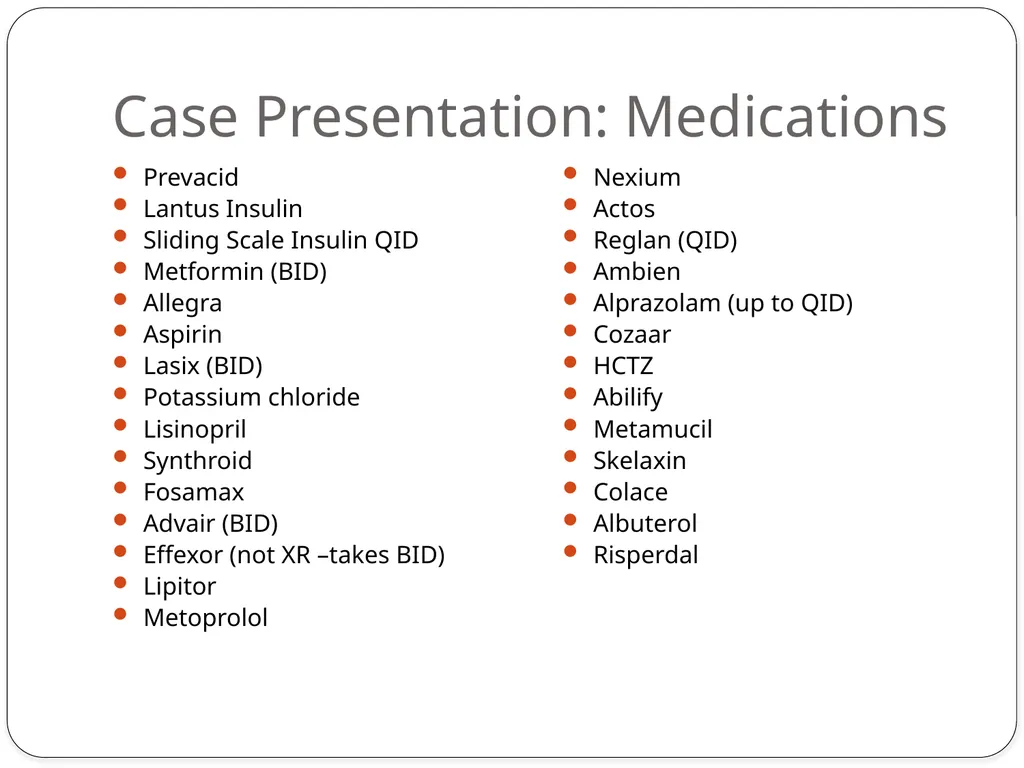
Case Presentation: Medications Prevacid
Lantus Insulin
Sliding Scale Insulin QID
Metformin (BID)
Allegra
Aspirin
Lasix (BID)
Potassium chloride
Lisinopril
Synthroid
Fosamax
Advair (BID)
Effexor (not XR –takes BID)
Lipitor
Metoprolol Nexium
Actos
Reglan (QID)
Ambien
Alprazolam (up to QID)
Cozaar
HCTZ
Abilify
Metamucil
Skelaxin
Colace
Albuterol
Risperdal<br>
Lantus Insulin
Sliding Scale Insulin QID
Metformin (BID)
Allegra
Aspirin
Lasix (BID)
Potassium chloride
Lisinopril
Synthroid
Fosamax
Advair (BID)
Effexor (not XR –takes BID)
Lipitor
Metoprolol Nexium
Actos
Reglan (QID)
Ambien
Alprazolam (up to QID)
Cozaar
HCTZ
Abilify
Metamucil
Skelaxin
Colace
Albuterol
Risperdal<br>
06
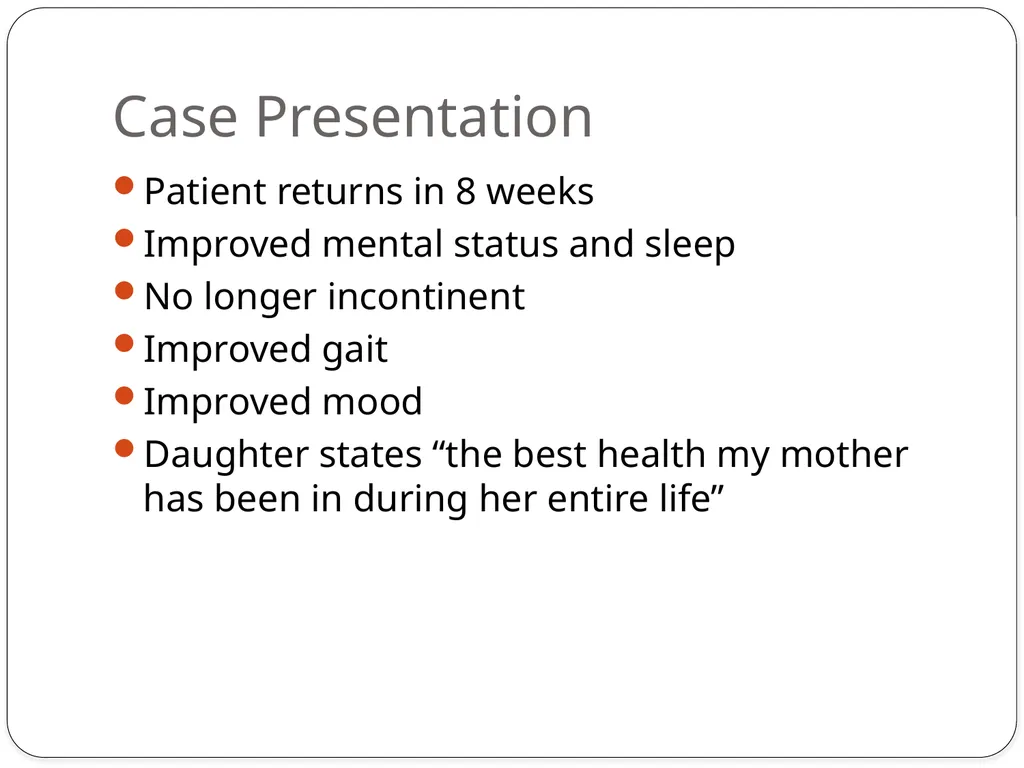
Case Presentation Patient returns in 8 weeks
Improved mental status and sleep
No longer incontinent
Improved gait
Improved mood
Daughter states “the best health my mother has been in during her entire life”<br>
Improved mental status and sleep
No longer incontinent
Improved gait
Improved mood
Daughter states “the best health my mother has been in during her entire life”<br>
07
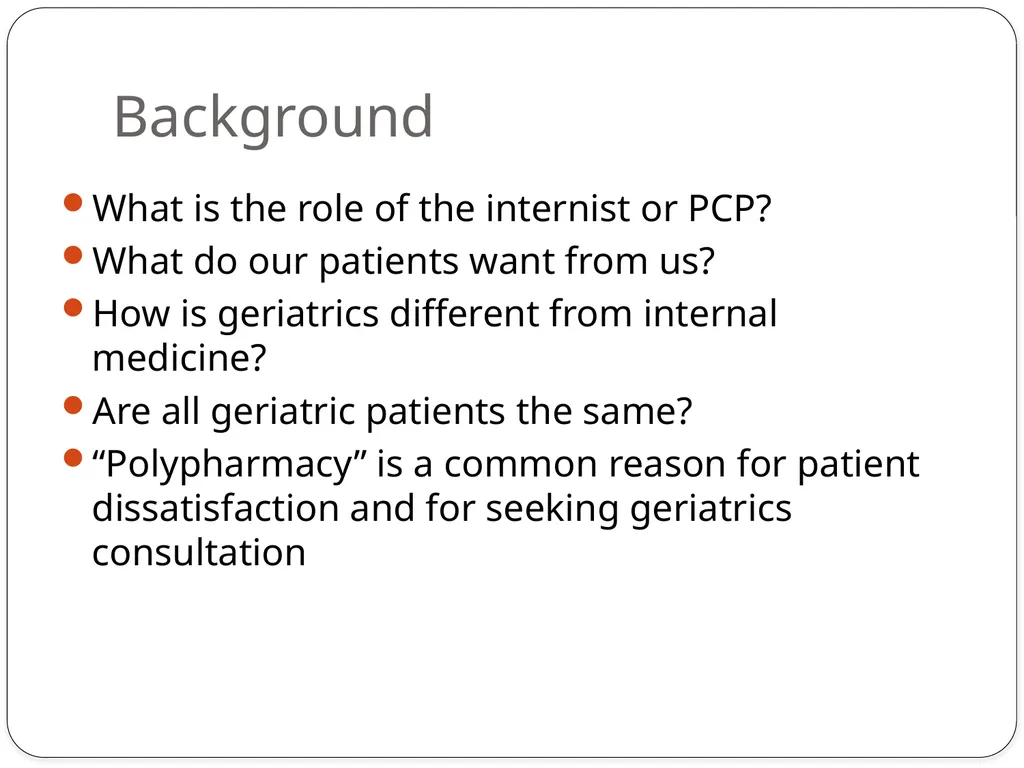
Background What is the role of the internist or PCP?
What do our patients want from us?
How is geriatrics different from internal medicine?
Are all geriatric patients the same?
“Polypharmacy” is a common reason for patient dissatisfaction and for seeking geriatrics consultation<br>
What do our patients want from us?
How is geriatrics different from internal medicine?
Are all geriatric patients the same?
“Polypharmacy” is a common reason for patient dissatisfaction and for seeking geriatrics consultation<br>
08
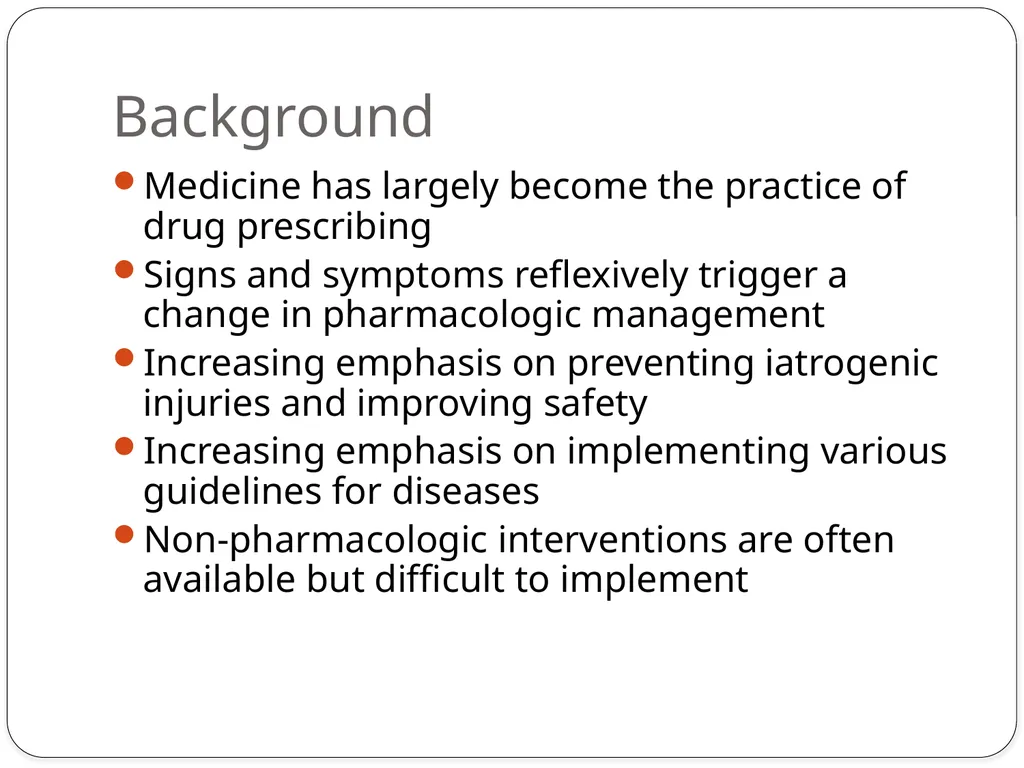
Background Medicine has largely become the practice of drug prescribing
Signs and symptoms reflexively trigger a change in pharmacologic management
Increasing emphasis on preventing iatrogenic injuries and improving safety
Increasing emphasis on implementing various guidelines for diseases
Non-pharmacologic interventions are often available but difficult to implement<br>
Signs and symptoms reflexively trigger a change in pharmacologic management
Increasing emphasis on preventing iatrogenic injuries and improving safety
Increasing emphasis on implementing various guidelines for diseases
Non-pharmacologic interventions are often available but difficult to implement<br>
09
Target Population for This Discussion The oldest old (over 75-80)
All patients with impaired cognition
Patients taking psychoactive medications
Patients with depression
Patients with history of falls, abnormal gait, or hip fracture
Patients with weight loss
Patients with incontinence and constipation
Nursing home residents<br>
All patients with impaired cognition
Patients taking psychoactive medications
Patients with depression
Patients with history of falls, abnormal gait, or hip fracture
Patients with weight loss
Patients with incontinence and constipation
Nursing home residents<br>
10
Categories of Drug Related Problems Polypharmacy
Adverse drug reactions (ADR’s)
Subtherapeutic drug dosage
Overdose
Failure to receive a prescribed drug
Adverse effect of drug withdrawal
Drug use without an indication
Duplication of drug therapy
Drug-Drug interaction
Underuse of beneficial therapies<br>
Adverse drug reactions (ADR’s)
Subtherapeutic drug dosage
Overdose
Failure to receive a prescribed drug
Adverse effect of drug withdrawal
Drug use without an indication
Duplication of drug therapy
Drug-Drug interaction
Underuse of beneficial therapies<br>
11
Polypharmacy No absolute definition
Not necessarily inappropriate
Medications can accumulate over decades
Every old and new medication taken should be questioned
Avoid using medications to treat adverse effects of other medications<br>
Not necessarily inappropriate
Medications can accumulate over decades
Every old and new medication taken should be questioned
Avoid using medications to treat adverse effects of other medications<br>
12
Adverse Drug Reactions: Risk Factors Increasing age
Increasing number of prescriptions
Female
Lower body weight,
Hepatic or renal insufficiency
History of prior drug reactions<br>
Increasing number of prescriptions
Female
Lower body weight,
Hepatic or renal insufficiency
History of prior drug reactions<br>
13
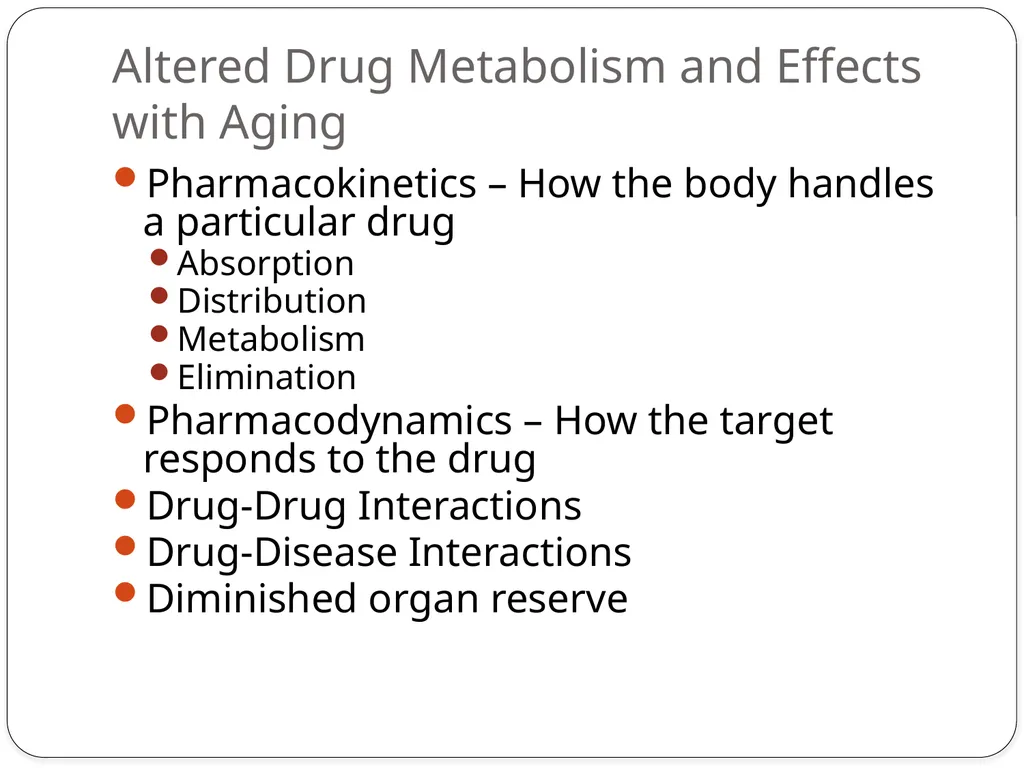
Altered Drug Metabolism and Effects with Aging Pharmacokinetics – How the body handles a particular drug
Absorption
Distribution
Metabolism
Elimination
Pharmacodynamics – How the target responds to the drug
Drug-Drug Interactions
Drug-Disease Interactions
Diminished organ reserve<br>
Absorption
Distribution
Metabolism
Elimination
Pharmacodynamics – How the target responds to the drug
Drug-Drug Interactions
Drug-Disease Interactions
Diminished organ reserve<br>
14
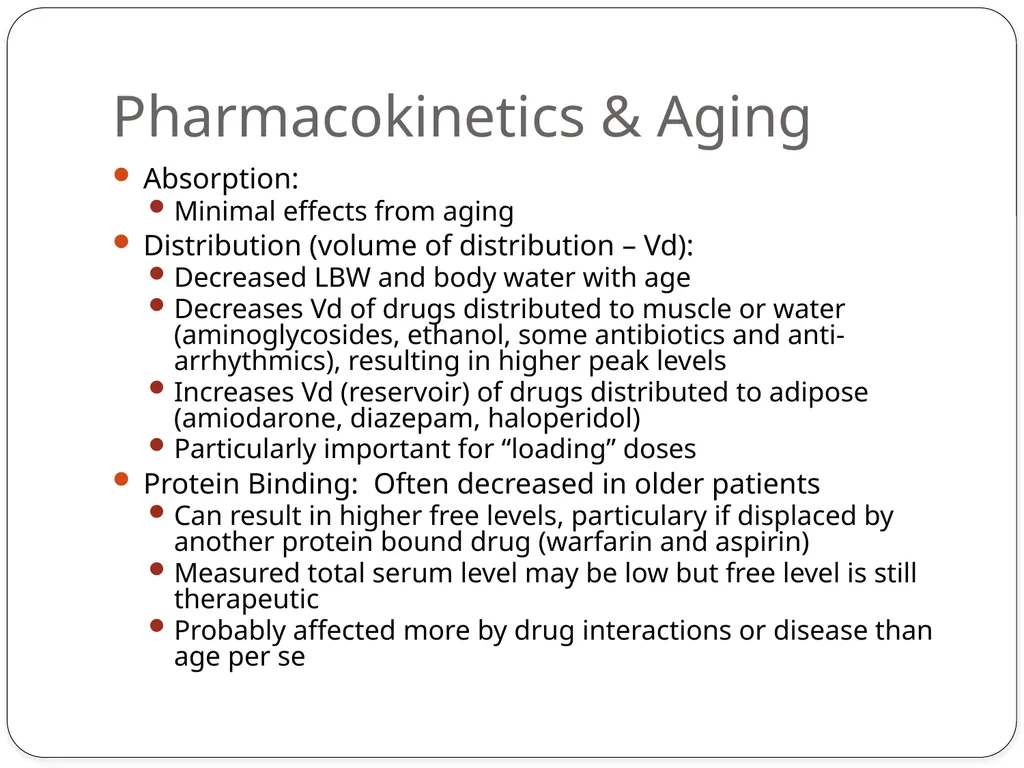
Pharmacokinetics & Aging Absorption:
Minimal effects from aging
Distribution (volume of distribution – Vd):
Decreased LBW and body water with age
Decreases Vd of drugs distributed to muscle or water (aminoglycosides, ethanol, some antibiotics and anti-arrhythmics), resulting in higher peak levels
Increases Vd (reservoir) of drugs distributed to adipose (amiodarone, diazepam, haloperidol)
Particularly important for “loading” doses
Protein Binding: Often decreased in older patients
Can result in higher free levels, particulary if displaced by another protein bound drug (warfarin and aspirin)
Measured total serum level may be low but free level is still therapeutic
Probably affected more by drug interactions or disease than age per se<br>
Minimal effects from aging
Distribution (volume of distribution – Vd):
Decreased LBW and body water with age
Decreases Vd of drugs distributed to muscle or water (aminoglycosides, ethanol, some antibiotics and anti-arrhythmics), resulting in higher peak levels
Increases Vd (reservoir) of drugs distributed to adipose (amiodarone, diazepam, haloperidol)
Particularly important for “loading” doses
Protein Binding: Often decreased in older patients
Can result in higher free levels, particulary if displaced by another protein bound drug (warfarin and aspirin)
Measured total serum level may be low but free level is still therapeutic
Probably affected more by drug interactions or disease than age per se<br>
15
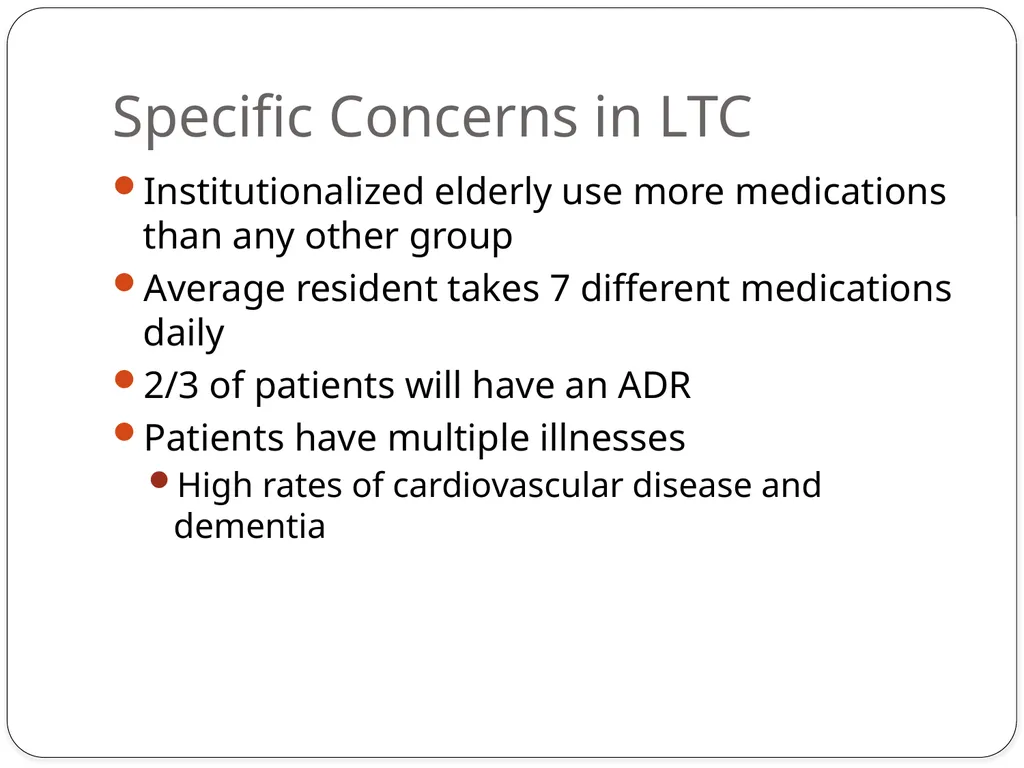
Specific Concerns in LTC Institutionalized elderly use more medications than any other group
Average resident takes 7 different medications daily
2/3 of patients will have an ADR
Patients have multiple illnesses
High rates of cardiovascular disease and dementia<br>
Average resident takes 7 different medications daily
2/3 of patients will have an ADR
Patients have multiple illnesses
High rates of cardiovascular disease and dementia<br>
16
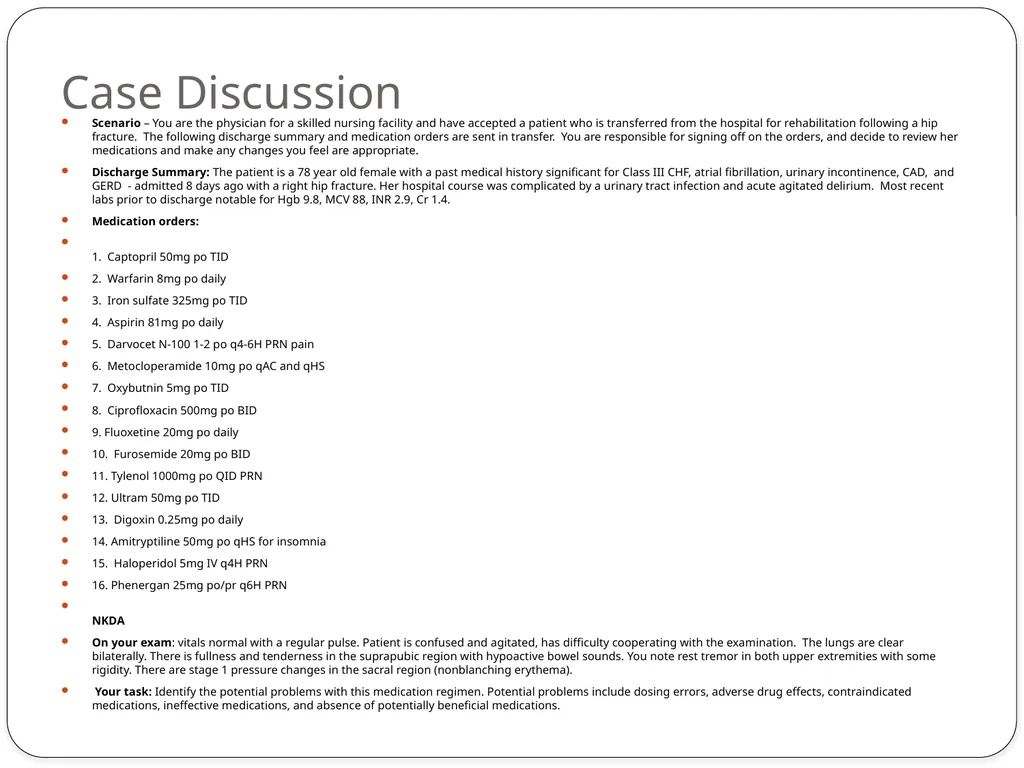
Case Discussion Scenario – You are the physician for a skilled nursing facility and have accepted a patient who is transferred from the hospital for rehabilitation following a hip fracture. The following discharge summary and medication orders are sent in transfer. You are responsible for signing off on the orders, and decide to review her medications and make any changes you feel are appropriate.
Discharge Summary: The patient is a 78 year old female with a past medical history significant for Class III CHF, atrial fibrillation, urinary incontinence, CAD, and GERD - admitted 8 days ago with a right hip fracture. Her hospital course was complicated by a urinary tract infection and acute agitated delirium. Most recent labs prior to discharge notable for Hgb 9.8, MCV 88, INR 2.9, Cr 1.4.
Medication orders:
1. Captopril 50mg po TID
2. Warfarin 8mg po daily
3. Iron sulfate 325mg po TID
4. Aspirin 81mg po daily
5. Darvocet N-100 1-2 po q4-6H PRN pain
6. Metocloperamide 10mg po qAC and qHS
7. Oxybutnin 5mg po TID
8. Ciprofloxacin 500mg po BID
9. Fluoxetine 20mg po daily
10. Furosemide 20mg po BID
11. Tylenol 1000mg po QID PRN
12. Ultram 50mg po TID
13. Digoxin 0.25mg po daily
14. Amitryptiline 50mg po qHS for insomnia
15. Haloperidol 5mg IV q4H PRN
16. Phenergan 25mg po/pr q6H PRN
NKDA
On your exam: vitals normal with a regular pulse. Patient is confused and agitated, has difficulty cooperating with the examination. The lungs are clear bilaterally. There is fullness and tenderness in the suprapubic region with hypoactive bowel sounds. You note rest tremor in both upper extremities with some rigidity. There are stage 1 pressure changes in the sacral region (nonblanching erythema).
Your task: Identify the potential problems with this medication regimen. Potential problems include dosing errors, adverse drug effects, contraindicated medications, ineffective medications, and absence of potentially beneficial medications.<br>
Discharge Summary: The patient is a 78 year old female with a past medical history significant for Class III CHF, atrial fibrillation, urinary incontinence, CAD, and GERD - admitted 8 days ago with a right hip fracture. Her hospital course was complicated by a urinary tract infection and acute agitated delirium. Most recent labs prior to discharge notable for Hgb 9.8, MCV 88, INR 2.9, Cr 1.4.
Medication orders:
1. Captopril 50mg po TID
2. Warfarin 8mg po daily
3. Iron sulfate 325mg po TID
4. Aspirin 81mg po daily
5. Darvocet N-100 1-2 po q4-6H PRN pain
6. Metocloperamide 10mg po qAC and qHS
7. Oxybutnin 5mg po TID
8. Ciprofloxacin 500mg po BID
9. Fluoxetine 20mg po daily
10. Furosemide 20mg po BID
11. Tylenol 1000mg po QID PRN
12. Ultram 50mg po TID
13. Digoxin 0.25mg po daily
14. Amitryptiline 50mg po qHS for insomnia
15. Haloperidol 5mg IV q4H PRN
16. Phenergan 25mg po/pr q6H PRN
NKDA
On your exam: vitals normal with a regular pulse. Patient is confused and agitated, has difficulty cooperating with the examination. The lungs are clear bilaterally. There is fullness and tenderness in the suprapubic region with hypoactive bowel sounds. You note rest tremor in both upper extremities with some rigidity. There are stage 1 pressure changes in the sacral region (nonblanching erythema).
Your task: Identify the potential problems with this medication regimen. Potential problems include dosing errors, adverse drug effects, contraindicated medications, ineffective medications, and absence of potentially beneficial medications.<br>
17
1. Captopril 50mg po TID
2. Warfarin 8mg po daily
3. Iron sulfate 325mg po TID
4. Aspirin 81mg po daily
5. Darvocet N-100 1-2 po q4-6H PRN pain
6. Metocloperamide 10mg po qAC and qHS
7. Oxybutnin 5mg po TID
8. Ciprofloxacin 500mg po BID 9. Fluoxetine 20mg po daily
10. Furosemide 20mg po BID
11. Tylenol 1000mg po QID PRN
12. Ultram 50mg po TID
13. Digoxin 0.25mg po daily
14. Amitryptiline 50mg po qHS for insomnia
15. Haloperidol 5mg IV q4H PRN
16. Phenergan 25mg po/pr q6H PRN MEDICATION LIST<br>
2. Warfarin 8mg po daily
3. Iron sulfate 325mg po TID
4. Aspirin 81mg po daily
5. Darvocet N-100 1-2 po q4-6H PRN pain
6. Metocloperamide 10mg po qAC and qHS
7. Oxybutnin 5mg po TID
8. Ciprofloxacin 500mg po BID 9. Fluoxetine 20mg po daily
10. Furosemide 20mg po BID
11. Tylenol 1000mg po QID PRN
12. Ultram 50mg po TID
13. Digoxin 0.25mg po daily
14. Amitryptiline 50mg po qHS for insomnia
15. Haloperidol 5mg IV q4H PRN
16. Phenergan 25mg po/pr q6H PRN MEDICATION LIST<br>
18
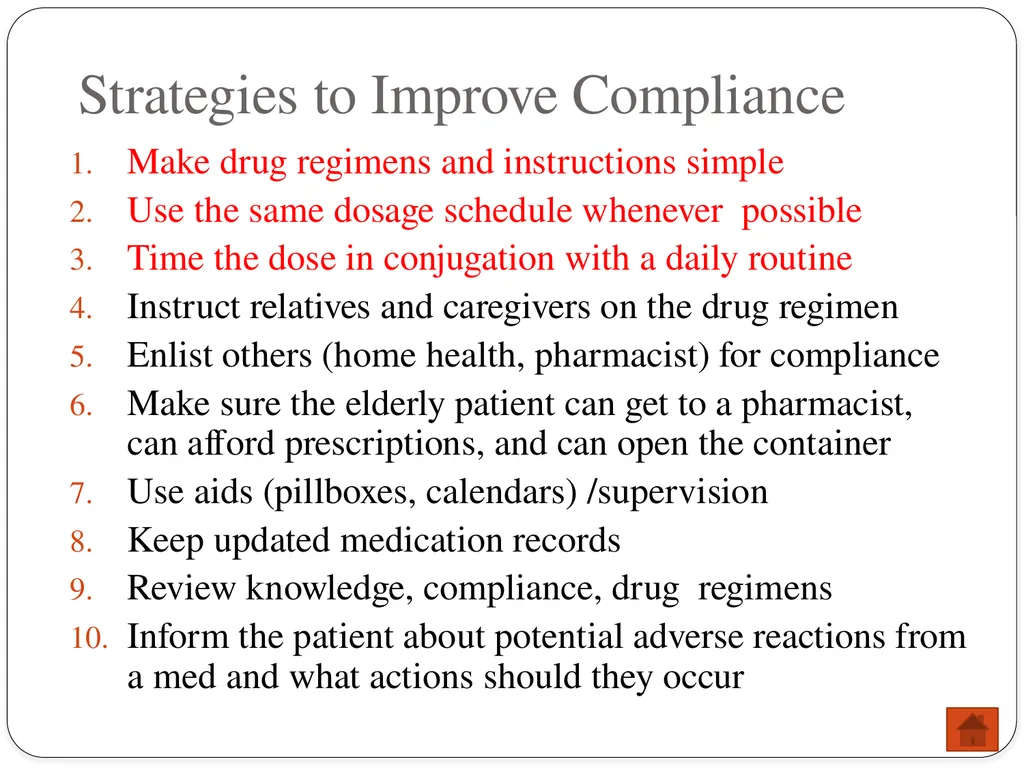
Strategies to Improve Compliance Make drug regimens and instructions simple
Use the same dosage schedule whenever possible
Time the dose in conjugation with a daily routine
Instruct relatives and caregivers on the drug regimen
Enlist others (home health, pharmacist) for compliance
Make sure the elderly patient can get to a pharmacist, can afford prescriptions, and can open the container
Use aids (pillboxes, calendars) /supervision
Keep updated medication records
Review knowledge, compliance, drug regimens
Inform the patient about potential adverse reactions from a med and what actions should they occur<br>
Use the same dosage schedule whenever possible
Time the dose in conjugation with a daily routine
Instruct relatives and caregivers on the drug regimen
Enlist others (home health, pharmacist) for compliance
Make sure the elderly patient can get to a pharmacist, can afford prescriptions, and can open the container
Use aids (pillboxes, calendars) /supervision
Keep updated medication records
Review knowledge, compliance, drug regimens
Inform the patient about potential adverse reactions from a med and what actions should they occur<br>
19
Iron in Older Adults Oral iron causes frequent gastrointestinal side effects.
Absorption of iron increases in patients with true iron deficiency.
One study showing that low dose oral iron (15mg elemental Fe) was as effective as high dose iron (150mg), with fewer adverse effects.
Abdominal discomfort 70% vs. 20%
Nausea and vomiting 67% vs. 13%
Constipation 23% vs. 0%
Diarrhea 70% vs. 13%
Iron best absorbed in acidic environment without food
Absorption may be poor on PPI or H2RA
Can consider giving with ascorbic acid
Start with lowest dose and follow response, titrate if needed
Ferrous fumarate — 106 mg elemental iron/tablet
Ferrous sulfate — 65 mg elemental iron/tablet
Ferrous gluconate — 28 to 36 mg iron/tablet
Iron can effect absorption of other drugs.
Quinolones, levothyroxine, tetracyclines, levodopa most notable
Ensure that the diagnosis is correct (AOCD?)
TID iron is on the Beers list and on the banned list for nursing home use.
Consider parenteral iron if side effects intolerable Reference: Rimon E, Kagansky N, Kagansky M, et al. “Are we giving too much iron? Low-dose iron therapy is effective in octogenarians.” American Journal of Medicine 2005;118:1142-1147. Return to Medication List<br>
Absorption of iron increases in patients with true iron deficiency.
One study showing that low dose oral iron (15mg elemental Fe) was as effective as high dose iron (150mg), with fewer adverse effects.
Abdominal discomfort 70% vs. 20%
Nausea and vomiting 67% vs. 13%
Constipation 23% vs. 0%
Diarrhea 70% vs. 13%
Iron best absorbed in acidic environment without food
Absorption may be poor on PPI or H2RA
Can consider giving with ascorbic acid
Start with lowest dose and follow response, titrate if needed
Ferrous fumarate — 106 mg elemental iron/tablet
Ferrous sulfate — 65 mg elemental iron/tablet
Ferrous gluconate — 28 to 36 mg iron/tablet
Iron can effect absorption of other drugs.
Quinolones, levothyroxine, tetracyclines, levodopa most notable
Ensure that the diagnosis is correct (AOCD?)
TID iron is on the Beers list and on the banned list for nursing home use.
Consider parenteral iron if side effects intolerable Reference: Rimon E, Kagansky N, Kagansky M, et al. “Are we giving too much iron? Low-dose iron therapy is effective in octogenarians.” American Journal of Medicine 2005;118:1142-1147. Return to Medication List<br>
20
Aspirin and Warfarin There are very few indications where the combination of aspirin and warfarin has been shown to be superior to warfarin alone
High risk mechanical heart valves
Antiphospholipid antibody syndrome
The most common reason this is done is probably CAD with AF
2.5 million in North America with AF, up to 40% have AF
Not shown to decrease the rate of stroke but doubles the risk of major bleeding
ASA displaces warfarin from albumin Reference: Dentail, F, Douketis J, Lim W, Crowther M. “Combined Aspirin-Oral Anticoagulant Therapy Compared with Oral Anticoagulant Therapy Alone Among Patients at Risk for Cardiovascular Disease: A Meta-analysis of Randomized Trials.” Arch Intern Med. 2007;167:117-124. Return to Medication List<br>
High risk mechanical heart valves
Antiphospholipid antibody syndrome
The most common reason this is done is probably CAD with AF
2.5 million in North America with AF, up to 40% have AF
Not shown to decrease the rate of stroke but doubles the risk of major bleeding
ASA displaces warfarin from albumin Reference: Dentail, F, Douketis J, Lim W, Crowther M. “Combined Aspirin-Oral Anticoagulant Therapy Compared with Oral Anticoagulant Therapy Alone Among Patients at Risk for Cardiovascular Disease: A Meta-analysis of Randomized Trials.” Arch Intern Med. 2007;167:117-124. Return to Medication List<br>
21
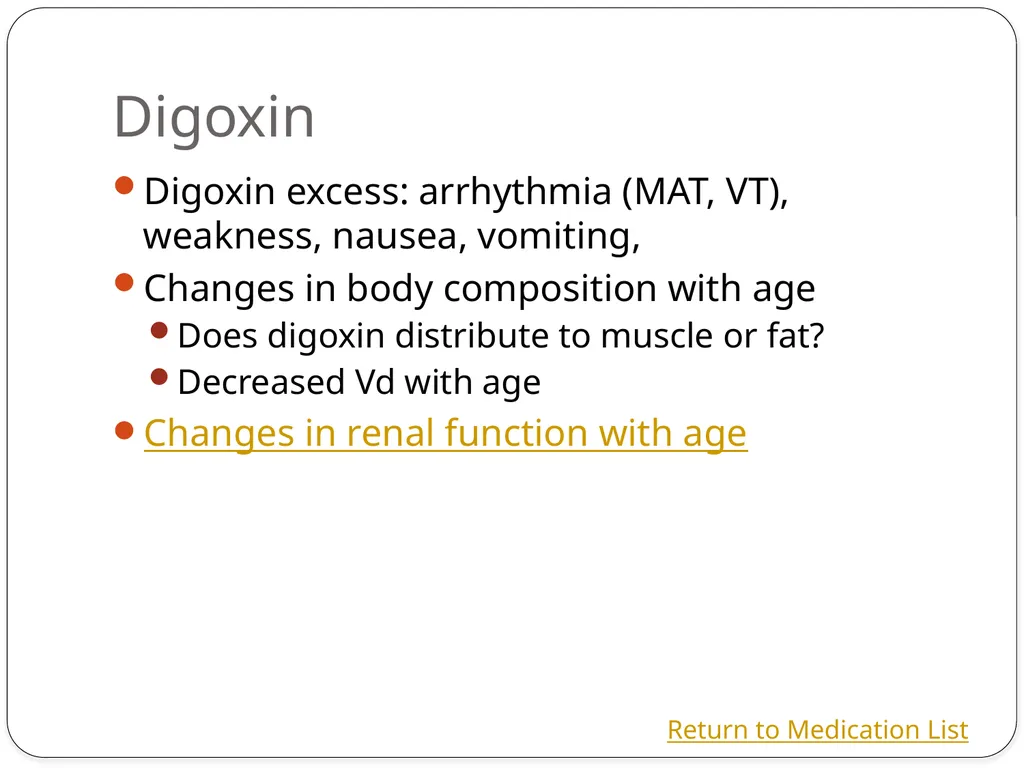
Digoxin Digoxin excess: arrhythmia (MAT, VT), weakness, nausea, vomiting,
Changes in body composition with age
Does digoxin distribute to muscle or fat?
Decreased Vd with age
Changes in renal function with age Return to Medication List<br>
Changes in body composition with age
Does digoxin distribute to muscle or fat?
Decreased Vd with age
Changes in renal function with age Return to Medication List<br>
22
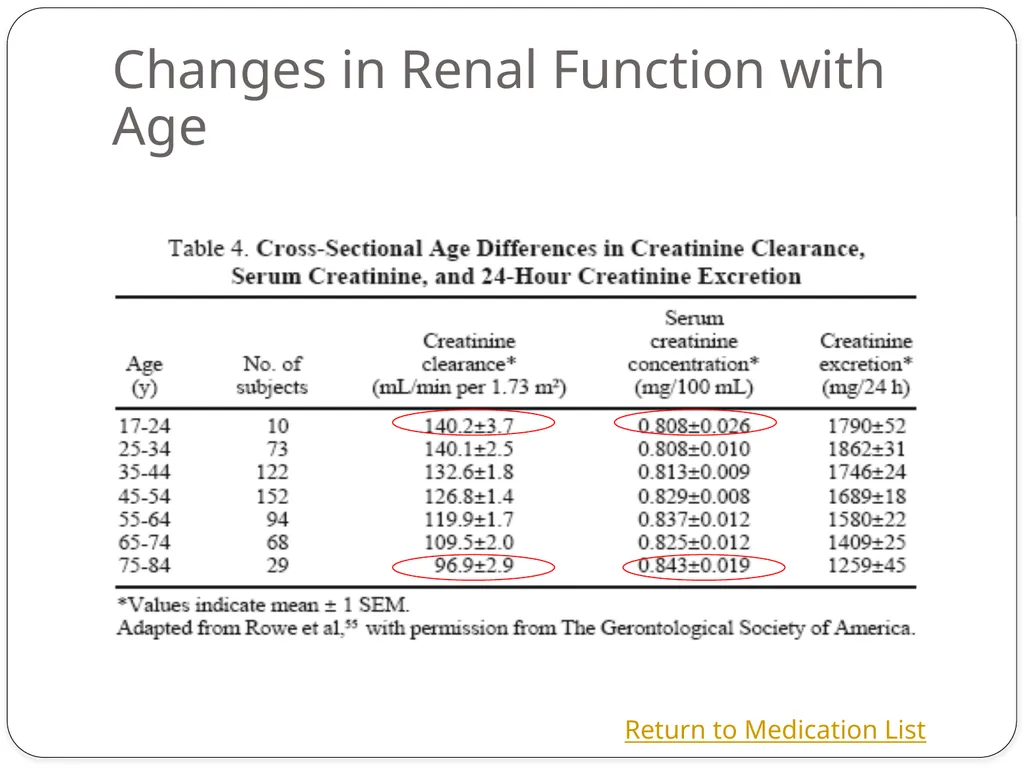
Changes in Renal Function with Age Return to Medication List<br>
23
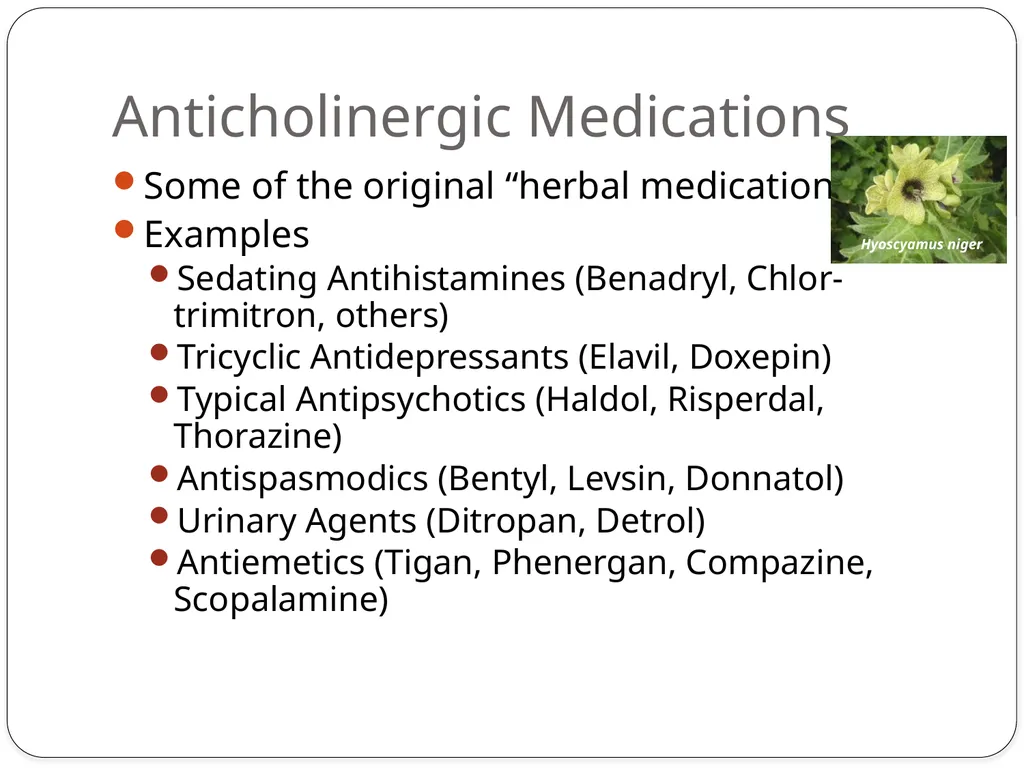
Anticholinergic Medications Some of the original “herbal medications”
Examples
Sedating Antihistamines (Benadryl, Chlor-trimitron, others)
Tricyclic Antidepressants (Elavil, Doxepin)
Typical Antipsychotics (Haldol, Risperdal, Thorazine)
Antispasmodics (Bentyl, Levsin, Donnatol)
Urinary Agents (Ditropan, Detrol)
Antiemetics (Tigan, Phenergan, Compazine, Scopalamine) Hyoscyamus niger<br>
Examples
Sedating Antihistamines (Benadryl, Chlor-trimitron, others)
Tricyclic Antidepressants (Elavil, Doxepin)
Typical Antipsychotics (Haldol, Risperdal, Thorazine)
Antispasmodics (Bentyl, Levsin, Donnatol)
Urinary Agents (Ditropan, Detrol)
Antiemetics (Tigan, Phenergan, Compazine, Scopalamine) Hyoscyamus niger<br>
24
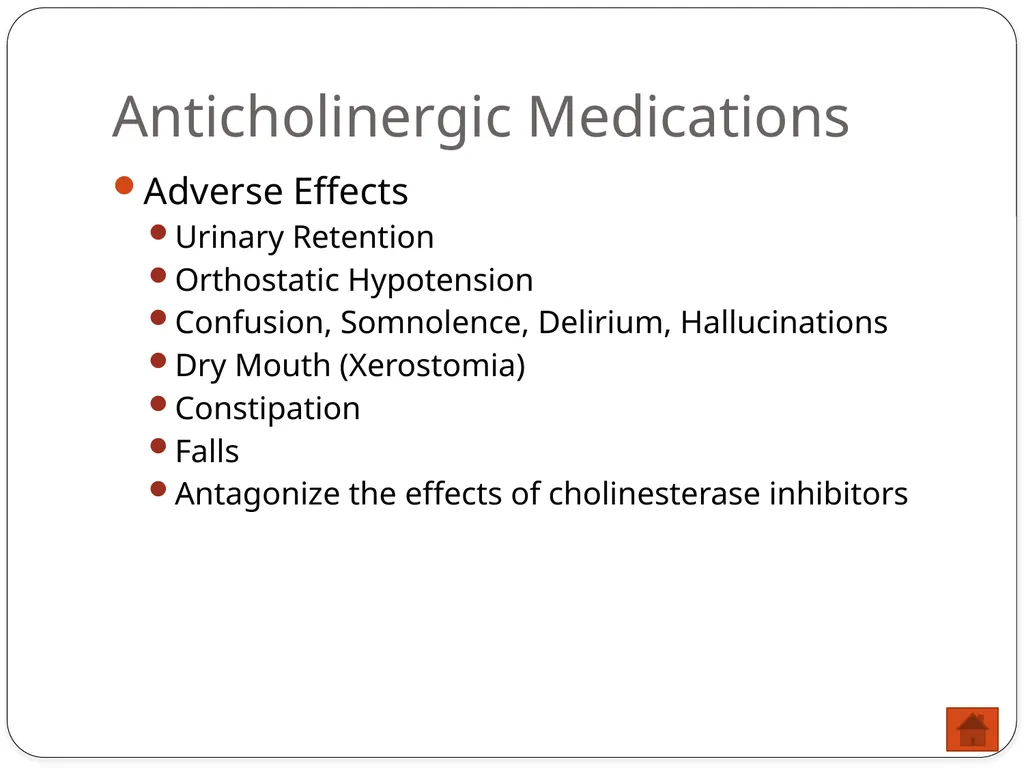
Anticholinergic Medications Adverse Effects
Urinary Retention
Orthostatic Hypotension
Confusion, Somnolence, Delirium, Hallucinations
Dry Mouth (Xerostomia)
Constipation
Falls
Antagonize the effects of cholinesterase inhibitors<br>
Urinary Retention
Orthostatic Hypotension
Confusion, Somnolence, Delirium, Hallucinations
Dry Mouth (Xerostomia)
Constipation
Falls
Antagonize the effects of cholinesterase inhibitors<br>
25
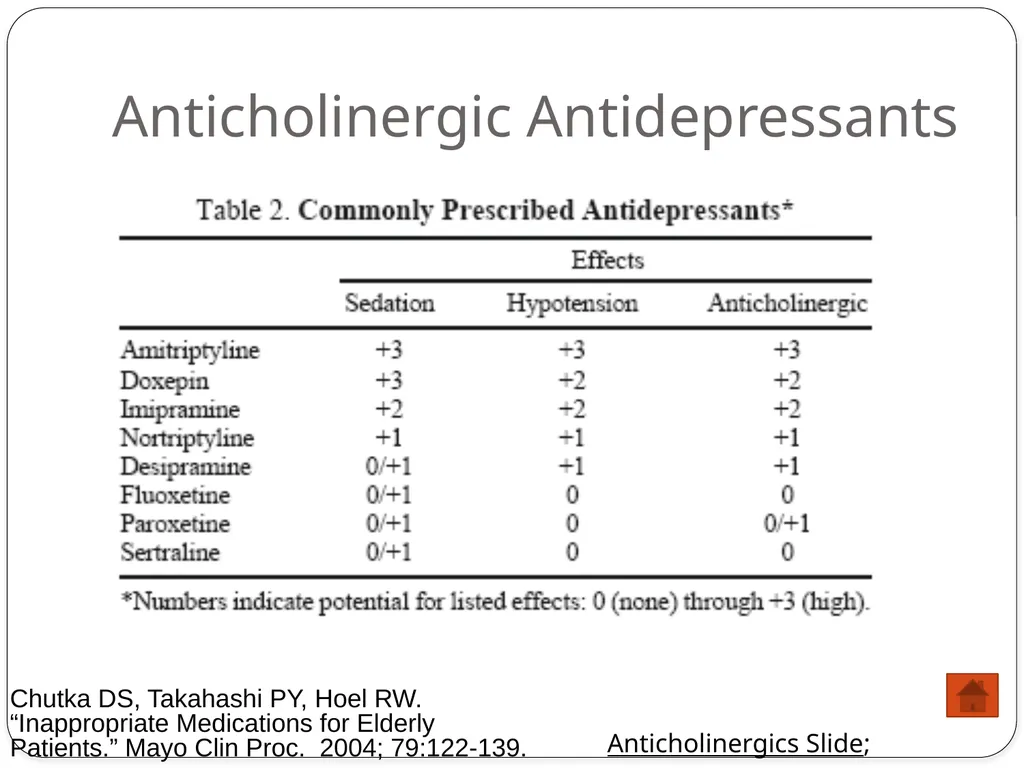
Anticholinergic Antidepressants Chutka DS, Takahashi PY, Hoel RW. “Inappropriate Medications for Elderly Patients.” Mayo Clin Proc. 2004; 79:122-139. Anticholinergics Slide; More on TCA’s<br>
26
Tricyclic Antidepressants in Older Adults Elderly are prone to toxicity and adverse effects
May have prominent anticholinergic effects
Dry mouth
Confusion
Orthostatic hypotension
Constipation
Mydriasis
TCA’s should not be used for the treatment of depression in the elderly
Smaller doses for chronic pain or insomnia may be tolerated well by some older patients<br>
May have prominent anticholinergic effects
Dry mouth
Confusion
Orthostatic hypotension
Constipation
Mydriasis
TCA’s should not be used for the treatment of depression in the elderly
Smaller doses for chronic pain or insomnia may be tolerated well by some older patients<br>
27
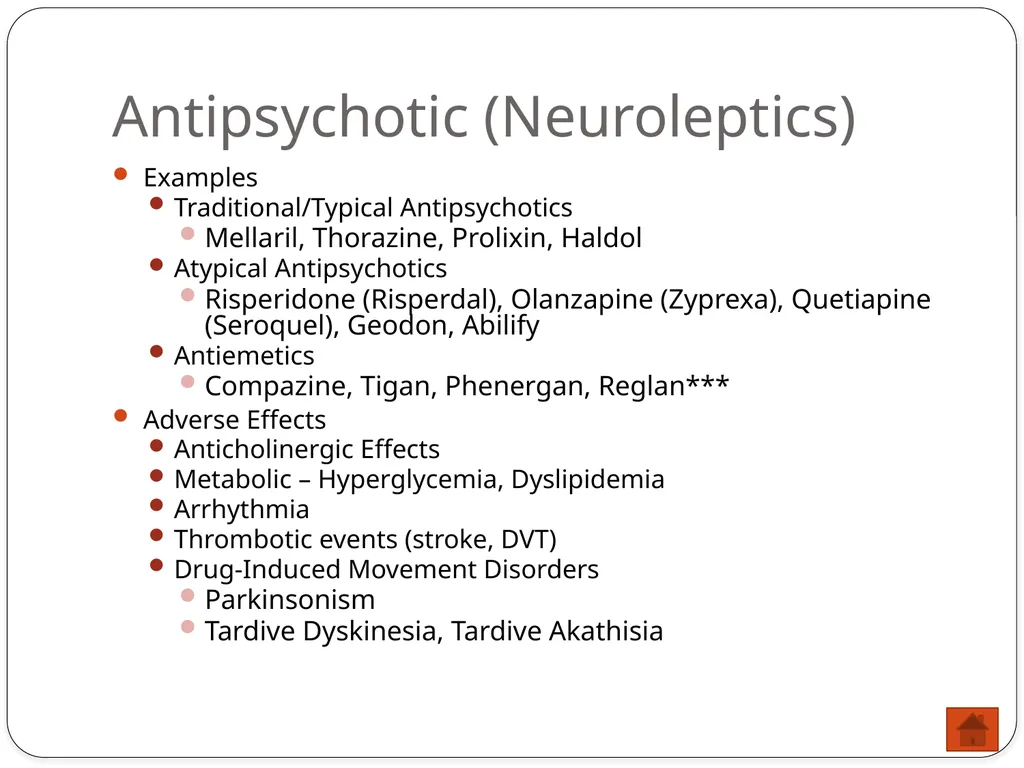
Antipsychotic (Neuroleptics) Examples
Traditional/Typical Antipsychotics
Mellaril, Thorazine, Prolixin, Haldol
Atypical Antipsychotics
Risperidone (Risperdal), Olanzapine (Zyprexa), Quetiapine (Seroquel), Geodon, Abilify
Antiemetics
Compazine, Tigan, Phenergan, Reglan***
Adverse Effects
Anticholinergic Effects
Metabolic – Hyperglycemia, Dyslipidemia
Arrhythmia
Thrombotic events (stroke, DVT)
Drug-Induced Movement Disorders
Parkinsonism
Tardive Dyskinesia, Tardive Akathisia<br>
Traditional/Typical Antipsychotics
Mellaril, Thorazine, Prolixin, Haldol
Atypical Antipsychotics
Risperidone (Risperdal), Olanzapine (Zyprexa), Quetiapine (Seroquel), Geodon, Abilify
Antiemetics
Compazine, Tigan, Phenergan, Reglan***
Adverse Effects
Anticholinergic Effects
Metabolic – Hyperglycemia, Dyslipidemia
Arrhythmia
Thrombotic events (stroke, DVT)
Drug-Induced Movement Disorders
Parkinsonism
Tardive Dyskinesia, Tardive Akathisia<br>
28
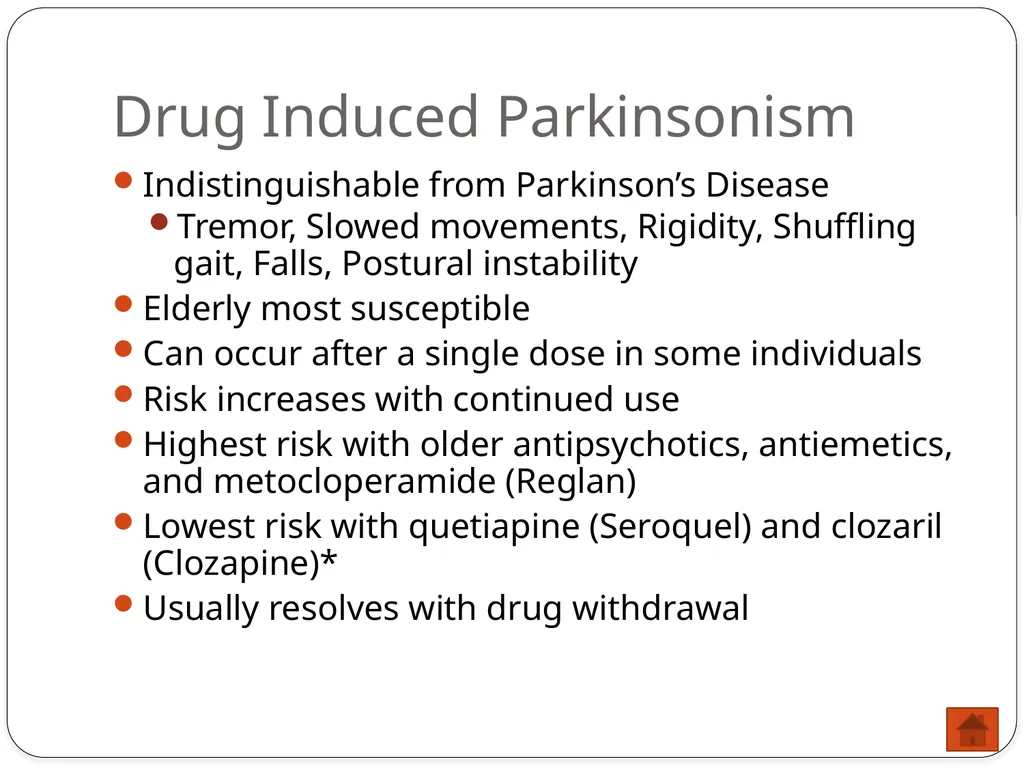
Drug Induced Parkinsonism Indistinguishable from Parkinson’s Disease
Tremor, Slowed movements, Rigidity, Shuffling gait, Falls, Postural instability
Elderly most susceptible
Can occur after a single dose in some individuals
Risk increases with continued use
Highest risk with older antipsychotics, antiemetics, and metocloperamide (Reglan)
Lowest risk with quetiapine (Seroquel) and clozaril (Clozapine)*
Usually resolves with drug withdrawal<br>
Tremor, Slowed movements, Rigidity, Shuffling gait, Falls, Postural instability
Elderly most susceptible
Can occur after a single dose in some individuals
Risk increases with continued use
Highest risk with older antipsychotics, antiemetics, and metocloperamide (Reglan)
Lowest risk with quetiapine (Seroquel) and clozaril (Clozapine)*
Usually resolves with drug withdrawal<br>
29
Tardive Dyskinesia Abnormal involuntary movements
Repetitive, somewhat rhythmic
Often involves the tongue, jaw, cheeks and lips, trunk, extremities
Elderly most susceptible (30% at one year and 60% at three years)
Women at higher risk
Spontaneously resolves in some patients
Higher risk with older antipsychotics
May get worse when medications are stopped<br>
Repetitive, somewhat rhythmic
Often involves the tongue, jaw, cheeks and lips, trunk, extremities
Elderly most susceptible (30% at one year and 60% at three years)
Women at higher risk
Spontaneously resolves in some patients
Higher risk with older antipsychotics
May get worse when medications are stopped<br>
30
Preventing misuse of psych drugs D: Describe
Clarify symptoms
R: Reason for the behavior
Psychiatric symptoms are often caused by medical conditions or psychosocial issues
N: Non-medication Approaches
Consider behavioral modifications, environmental manipulations
O: Order Medication<br>
Clarify symptoms
R: Reason for the behavior
Psychiatric symptoms are often caused by medical conditions or psychosocial issues
N: Non-medication Approaches
Consider behavioral modifications, environmental manipulations
O: Order Medication<br>
31
Narcotics and Pain Management The double-edged sword
Increasing pressure to recognize and treat pain (the fifth vital sign)
Recognition of potential adverse effects
NSAIDs often not safe, including COX-2 inhibitors
Inappropriate Agents in this class
Meperedine (Demerol) – normeperidine accumulation and seizures, myoclonus, SS
Pentazocine (Talwin)
Propoxyphene (Darvocet) – ineffective analgeisic with class adverse effects
Potentially problematic due to varied CYP450 metabolism
Codeine
Tramadol (Ultram)
Known Class Adverse Effects
Constipation
Somnolence, Confusion, Falls
Pruritis
Nausea
Dependence and Tolerance<br>
Increasing pressure to recognize and treat pain (the fifth vital sign)
Recognition of potential adverse effects
NSAIDs often not safe, including COX-2 inhibitors
Inappropriate Agents in this class
Meperedine (Demerol) – normeperidine accumulation and seizures, myoclonus, SS
Pentazocine (Talwin)
Propoxyphene (Darvocet) – ineffective analgeisic with class adverse effects
Potentially problematic due to varied CYP450 metabolism
Codeine
Tramadol (Ultram)
Known Class Adverse Effects
Constipation
Somnolence, Confusion, Falls
Pruritis
Nausea
Dependence and Tolerance<br>
32
Propoxyphene (Darvocet) Longstanding member of the Beer’s inappropriate drug list for elderly patients
12th highest-selling generic drug in 2004
23 million prescriptions filled and sales that year of $291 million
Analgesic properties are inferior to other opiates
May not be better than NSAID’s or acetaminophen alone for acute pain
Still has some opiate side effects
The elimination half-lives of both propoxyphene and its even more potent metabolite, norpropoxyphene, are prolonged in healthy elderly subjects relative to young controls
In young people, propoxyphene had a 13.2 day half-life
23.7 day half-life in the elderly group
Recent call from Public Citizen to phase out distribution in the U.S. Narcotics and Pain Management<br>
12th highest-selling generic drug in 2004
23 million prescriptions filled and sales that year of $291 million
Analgesic properties are inferior to other opiates
May not be better than NSAID’s or acetaminophen alone for acute pain
Still has some opiate side effects
The elimination half-lives of both propoxyphene and its even more potent metabolite, norpropoxyphene, are prolonged in healthy elderly subjects relative to young controls
In young people, propoxyphene had a 13.2 day half-life
23.7 day half-life in the elderly group
Recent call from Public Citizen to phase out distribution in the U.S. Narcotics and Pain Management<br>
33
Warfarin – Drug Interactions Doublecheck before starting any new medication with warfarin
Important cytochrome P-450 interactions
Drug highly bound to albumin, which can be displaced by other protein-bound medications (Aspirin, others)
Risk of adverse outcome from drug interaction is significant (both from bleeding and breakthrough thrombotic events)
Most Common/Important interactions
Other anticoagulants, antiplatelet agents
Steroids
Antibiotics, Antibiotics, Antibiotics- Can often reduce the dose of warfarin empirically and follow the INR closely
Dosing help: www.warfarindosing.org<br>
Important cytochrome P-450 interactions
Drug highly bound to albumin, which can be displaced by other protein-bound medications (Aspirin, others)
Risk of adverse outcome from drug interaction is significant (both from bleeding and breakthrough thrombotic events)
Most Common/Important interactions
Other anticoagulants, antiplatelet agents
Steroids
Antibiotics, Antibiotics, Antibiotics- Can often reduce the dose of warfarin empirically and follow the INR closely
Dosing help: www.warfarindosing.org<br>
34
Fluoxetine (Prozac) in Older Adults Use of fluoxetine should be avoided in the elderly
Prolonged half-life can be even longer with advancing age
Cases of Serotonin Syndrome reported with a new SSRI started within 5 weeks of discontinuation of fluoxetine
High rate of anorexia in the elderly
Multiple CYP450 drug interactions<br>
Prolonged half-life can be even longer with advancing age
Cases of Serotonin Syndrome reported with a new SSRI started within 5 weeks of discontinuation of fluoxetine
High rate of anorexia in the elderly
Multiple CYP450 drug interactions<br>
35
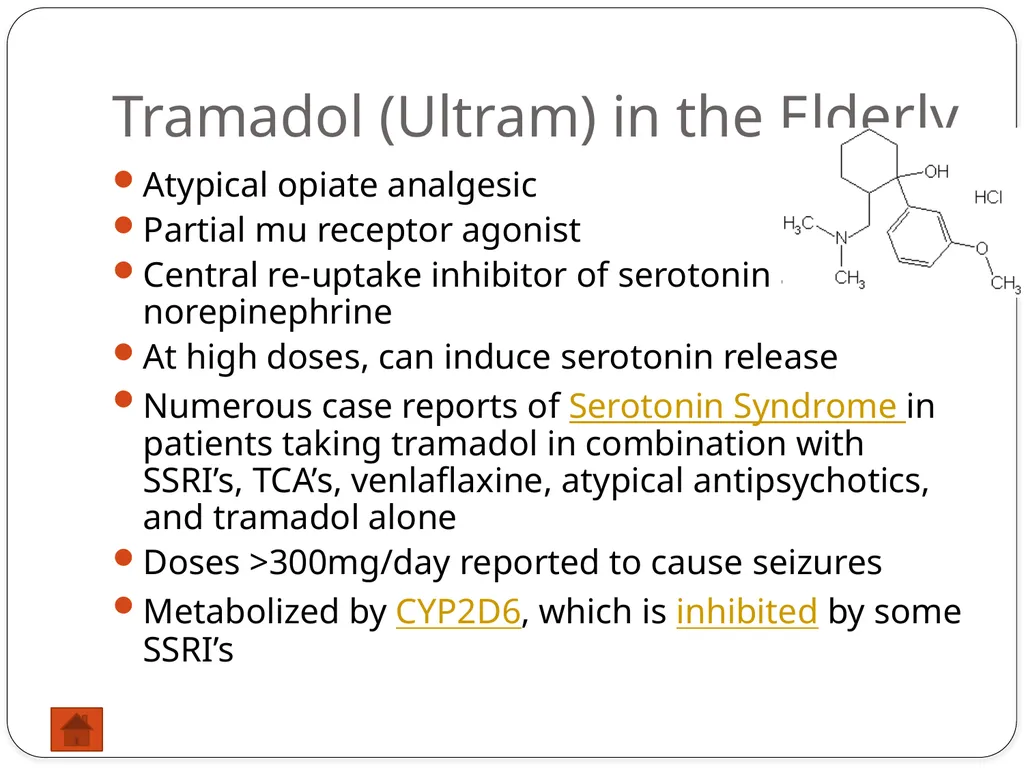
Tramadol (Ultram) in the Elderly Atypical opiate analgesic
Partial mu receptor agonist
Central re-uptake inhibitor of serotonin and norepinephrine
At high doses, can induce serotonin release
Numerous case reports of Serotonin Syndrome in patients taking tramadol in combination with SSRI’s, TCA’s, venlaflaxine, atypical antipsychotics, and tramadol alone
Doses >300mg/day reported to cause seizures
Metabolized by CYP2D6, which is inhibited by some SSRI’s<br>
Partial mu receptor agonist
Central re-uptake inhibitor of serotonin and norepinephrine
At high doses, can induce serotonin release
Numerous case reports of Serotonin Syndrome in patients taking tramadol in combination with SSRI’s, TCA’s, venlaflaxine, atypical antipsychotics, and tramadol alone
Doses >300mg/day reported to cause seizures
Metabolized by CYP2D6, which is inhibited by some SSRI’s<br>
36
Quinolones in the Older Adult Commonly used antibiotic class in this population
Frequently require renal dosing adjustment
Complex with divalent and trivalent cation salts when co-administered orally, markedly reducing bioavailability
Iron
Zinc
Calcium
Magnesium/Aluminum (antacids)
Adverse effects
Tendinopathy more common in elderly
Achilles' tendon most often affected (rupture)
More common with concomitant corticosteroids
More common in transplant patients
10-15% of patients develop arthritic symptoms while taking them
Delirium
Hypo- and hyperglycemia
QT prolongation (check www.qtdrugs.org)<br>
Frequently require renal dosing adjustment
Complex with divalent and trivalent cation salts when co-administered orally, markedly reducing bioavailability
Iron
Zinc
Calcium
Magnesium/Aluminum (antacids)
Adverse effects
Tendinopathy more common in elderly
Achilles' tendon most often affected (rupture)
More common with concomitant corticosteroids
More common in transplant patients
10-15% of patients develop arthritic symptoms while taking them
Delirium
Hypo- and hyperglycemia
QT prolongation (check www.qtdrugs.org)<br>
37
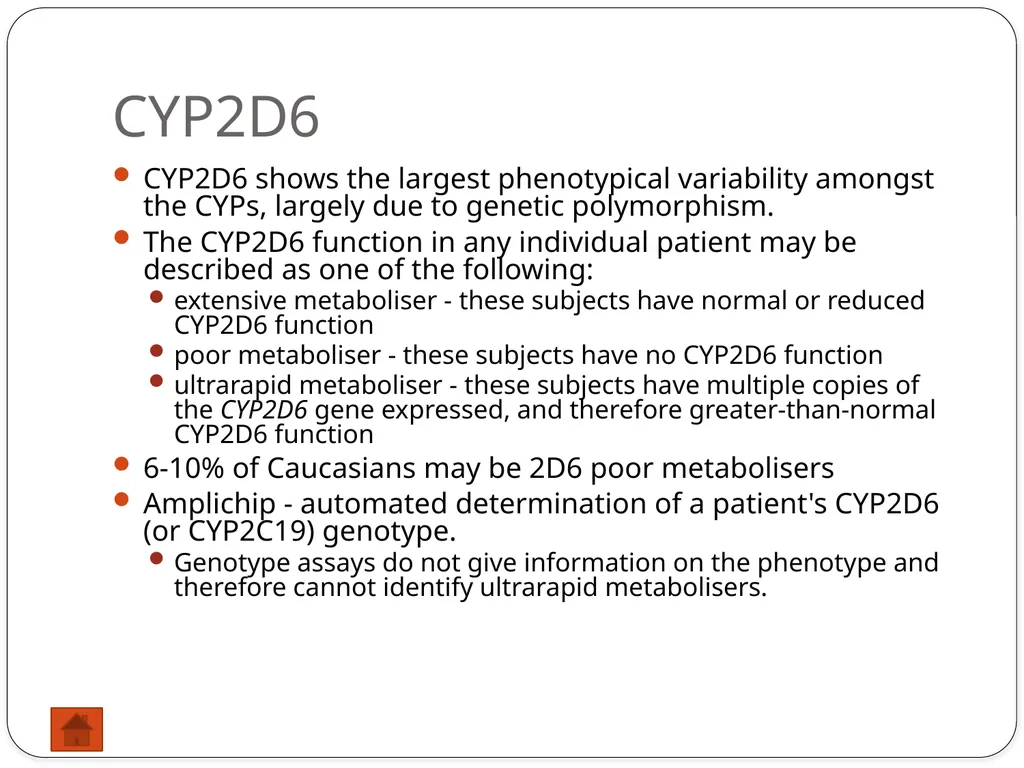
CYP2D6 CYP2D6 shows the largest phenotypical variability amongst the CYPs, largely due to genetic polymorphism.
The CYP2D6 function in any individual patient may be described as one of the following:
extensive metaboliser - these subjects have normal or reduced CYP2D6 function
poor metaboliser - these subjects have no CYP2D6 function
ultrarapid metaboliser - these subjects have multiple copies of the CYP2D6 gene expressed, and therefore greater-than-normal CYP2D6 function
6-10% of Caucasians may be 2D6 poor metabolisers
Amplichip - automated determination of a patient's CYP2D6 (or CYP2C19) genotype.
Genotype assays do not give information on the phenotype and therefore cannot identify ultrarapid metabolisers.<br>
The CYP2D6 function in any individual patient may be described as one of the following:
extensive metaboliser - these subjects have normal or reduced CYP2D6 function
poor metaboliser - these subjects have no CYP2D6 function
ultrarapid metaboliser - these subjects have multiple copies of the CYP2D6 gene expressed, and therefore greater-than-normal CYP2D6 function
6-10% of Caucasians may be 2D6 poor metabolisers
Amplichip - automated determination of a patient's CYP2D6 (or CYP2C19) genotype.
Genotype assays do not give information on the phenotype and therefore cannot identify ultrarapid metabolisers.<br>
38
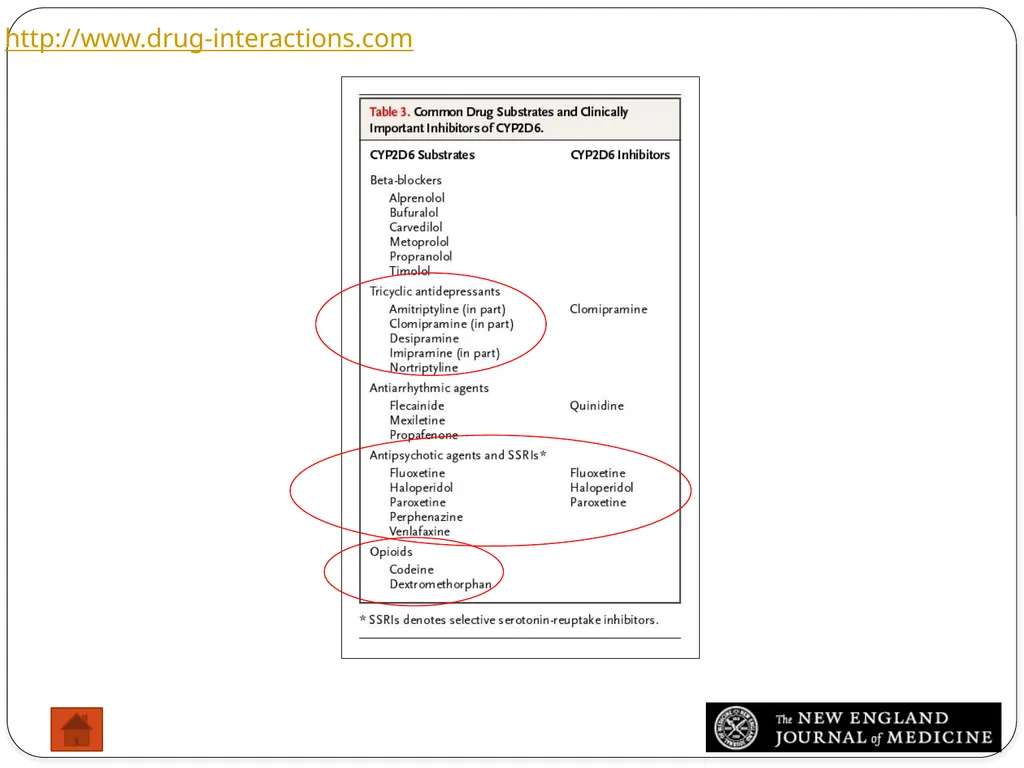
Wilkinson, G. R. N Engl J Med 2005;352:2211-2221 Common Drug Substrates and Clinically Important Inhibitors of CYP2D6 http://www.drug-interactions.com<br>
39
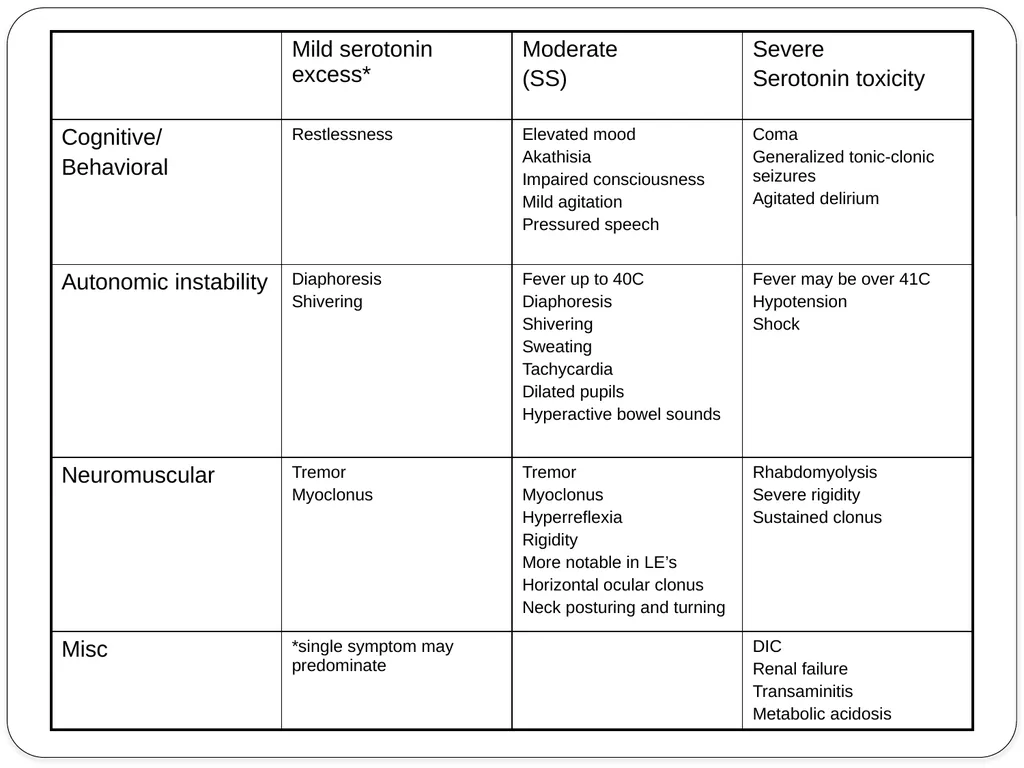
Boyer, E. W. et al. N Engl J Med 2005;352:1112-1120 Spectrum of Clinical Findings Serotonin Syndrome – A Spectrum of Toxicity<br>
40
Boyer, E. W. et al. N Engl J Med 2005;352:1112-1120 Findings in a Patient with Moderately Severe Serotonin Syndrome<br>
41
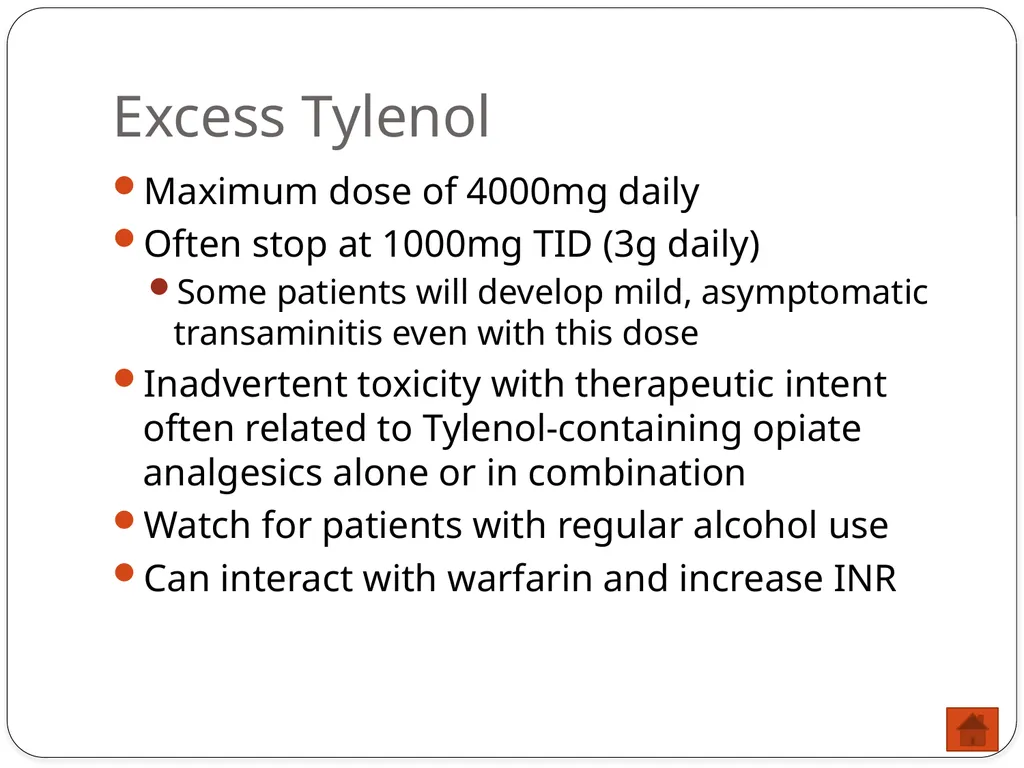
Excess Tylenol Maximum dose of 4000mg daily
Often stop at 1000mg TID (3g daily)
Some patients will develop mild, asymptomatic transaminitis even with this dose
Inadvertent toxicity with therapeutic intent often related to Tylenol-containing opiate analgesics alone or in combination
Watch for patients with regular alcohol use
Can interact with warfarin and increase INR<br>
Often stop at 1000mg TID (3g daily)
Some patients will develop mild, asymptomatic transaminitis even with this dose
Inadvertent toxicity with therapeutic intent often related to Tylenol-containing opiate analgesics alone or in combination
Watch for patients with regular alcohol use
Can interact with warfarin and increase INR<br>
42
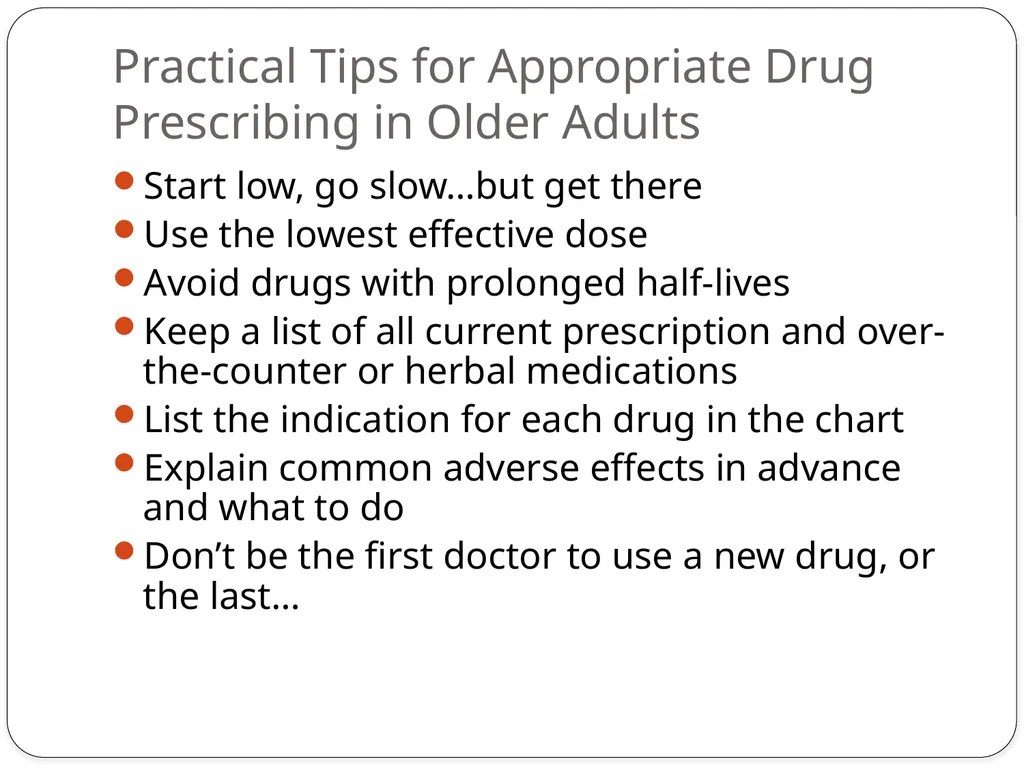
Practical Tips for Appropriate Drug Prescribing in Older Adults Start low, go slow…but get there
Use the lowest effective dose
Avoid drugs with prolonged half-lives
Keep a list of all current prescription and over-the-counter or herbal medications
List the indication for each drug in the chart
Explain common adverse effects in advance and what to do
Don’t be the first doctor to use a new drug, or the last…<br>
Use the lowest effective dose
Avoid drugs with prolonged half-lives
Keep a list of all current prescription and over-the-counter or herbal medications
List the indication for each drug in the chart
Explain common adverse effects in advance and what to do
Don’t be the first doctor to use a new drug, or the last…<br>
43
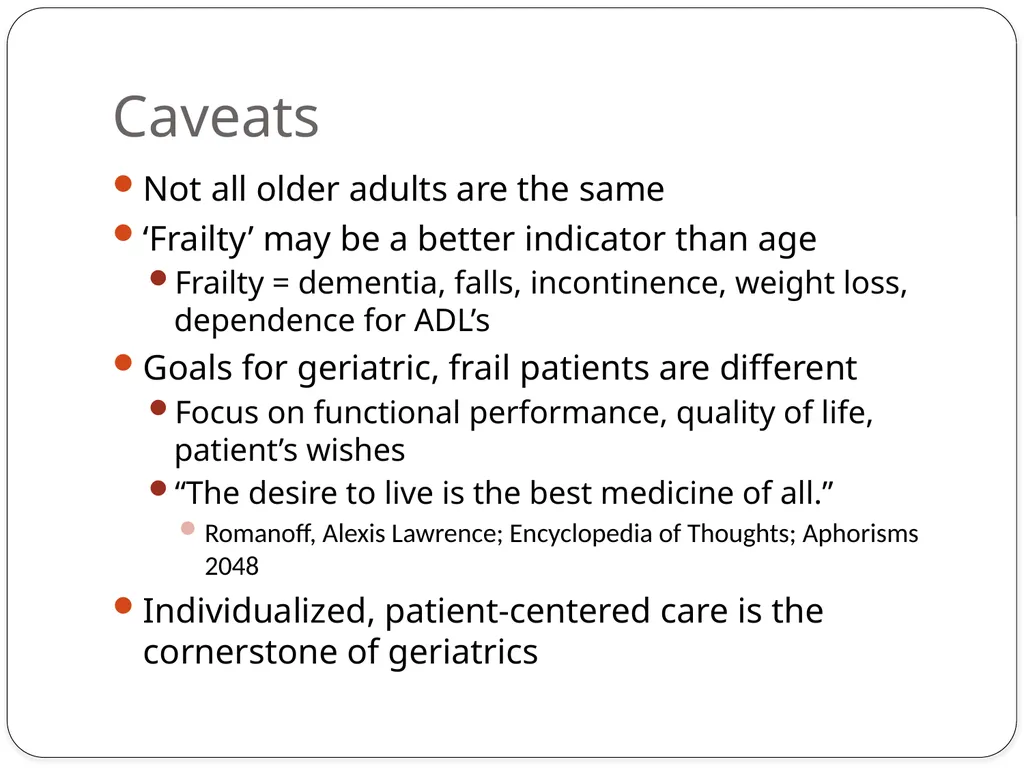
Caveats Not all older adults are the same
‘Frailty’ may be a better indicator than age
Frailty = dementia, falls, incontinence, weight loss, dependence for ADL’s
Goals for geriatric, frail patients are different
Focus on functional performance, quality of life, patient’s wishes
“The desire to live is the best medicine of all.”
Romanoff, Alexis Lawrence; Encyclopedia of Thoughts; Aphorisms 2048
Individualized, patient-centered care is the cornerstone of geriatrics<br>
‘Frailty’ may be a better indicator than age
Frailty = dementia, falls, incontinence, weight loss, dependence for ADL’s
Goals for geriatric, frail patients are different
Focus on functional performance, quality of life, patient’s wishes
“The desire to live is the best medicine of all.”
Romanoff, Alexis Lawrence; Encyclopedia of Thoughts; Aphorisms 2048
Individualized, patient-centered care is the cornerstone of geriatrics<br>
44
Dr. Moylan’s Drug Paradise A master drug list
A central pharmacy
New drugs
Once daily, once monthly
No active metabolites
No drug interactions
Combination products
Minimal titrations<br>
A central pharmacy
New drugs
Once daily, once monthly
No active metabolites
No drug interactions
Combination products
Minimal titrations<br>
45
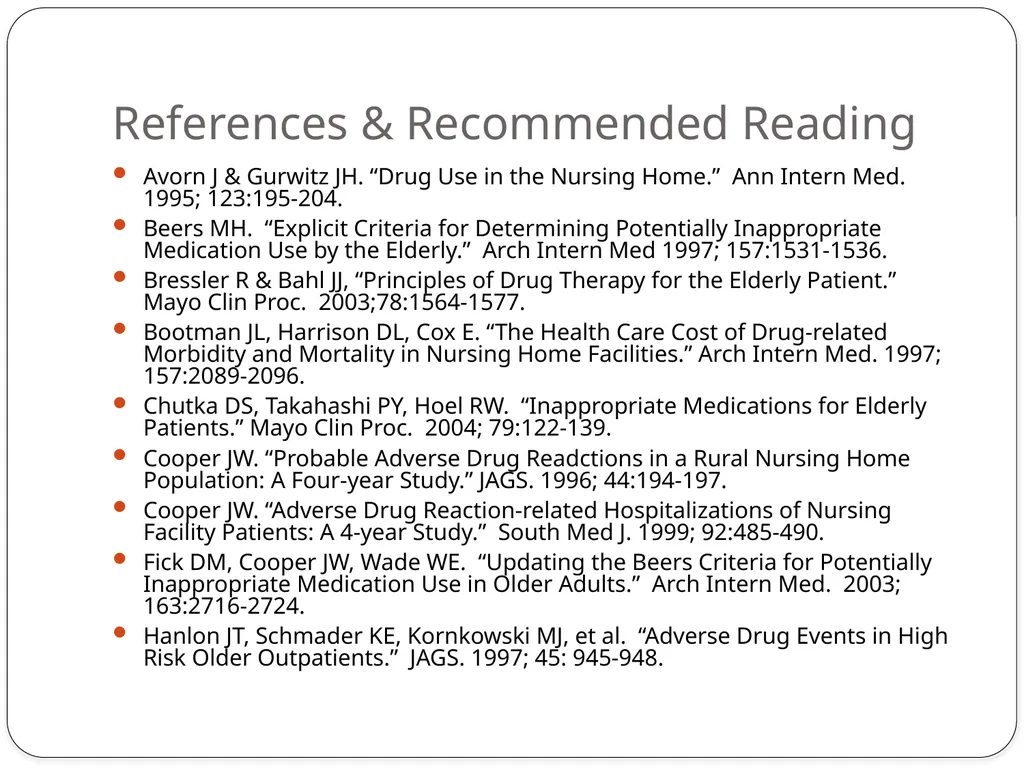
References & Recommended Reading Avorn J & Gurwitz JH. “Drug Use in the Nursing Home.” Ann Intern Med. 1995; 123:195-204.
Beers MH. “Explicit Criteria for Determining Potentially Inappropriate Medication Use by the Elderly.” Arch Intern Med 1997; 157:1531-1536.
Bressler R & Bahl JJ, “Principles of Drug Therapy for the Elderly Patient.” Mayo Clin Proc. 2003;78:1564-1577.
Bootman JL, Harrison DL, Cox E. “The Health Care Cost of Drug-related Morbidity and Mortality in Nursing Home Facilities.” Arch Intern Med. 1997; 157:2089-2096.
Chutka DS, Takahashi PY, Hoel RW. “Inappropriate Medications for Elderly Patients.” Mayo Clin Proc. 2004; 79:122-139.
Cooper JW. “Probable Adverse Drug Readctions in a Rural Nursing Home Population: A Four-year Study.” JAGS. 1996; 44:194-197.
Cooper JW. “Adverse Drug Reaction-related Hospitalizations of Nursing Facility Patients: A 4-year Study.” South Med J. 1999; 92:485-490.
Fick DM, Cooper JW, Wade WE. “Updating the Beers Criteria for Potentially Inappropriate Medication Use in Older Adults.” Arch Intern Med. 2003; 163:2716-2724.
Hanlon JT, Schmader KE, Kornkowski MJ, et al. “Adverse Drug Events in High Risk Older Outpatients.” JAGS. 1997; 45: 945-948.<br>
Beers MH. “Explicit Criteria for Determining Potentially Inappropriate Medication Use by the Elderly.” Arch Intern Med 1997; 157:1531-1536.
Bressler R & Bahl JJ, “Principles of Drug Therapy for the Elderly Patient.” Mayo Clin Proc. 2003;78:1564-1577.
Bootman JL, Harrison DL, Cox E. “The Health Care Cost of Drug-related Morbidity and Mortality in Nursing Home Facilities.” Arch Intern Med. 1997; 157:2089-2096.
Chutka DS, Takahashi PY, Hoel RW. “Inappropriate Medications for Elderly Patients.” Mayo Clin Proc. 2004; 79:122-139.
Cooper JW. “Probable Adverse Drug Readctions in a Rural Nursing Home Population: A Four-year Study.” JAGS. 1996; 44:194-197.
Cooper JW. “Adverse Drug Reaction-related Hospitalizations of Nursing Facility Patients: A 4-year Study.” South Med J. 1999; 92:485-490.
Fick DM, Cooper JW, Wade WE. “Updating the Beers Criteria for Potentially Inappropriate Medication Use in Older Adults.” Arch Intern Med. 2003; 163:2716-2724.
Hanlon JT, Schmader KE, Kornkowski MJ, et al. “Adverse Drug Events in High Risk Older Outpatients.” JAGS. 1997; 45: 945-948.<br>
46
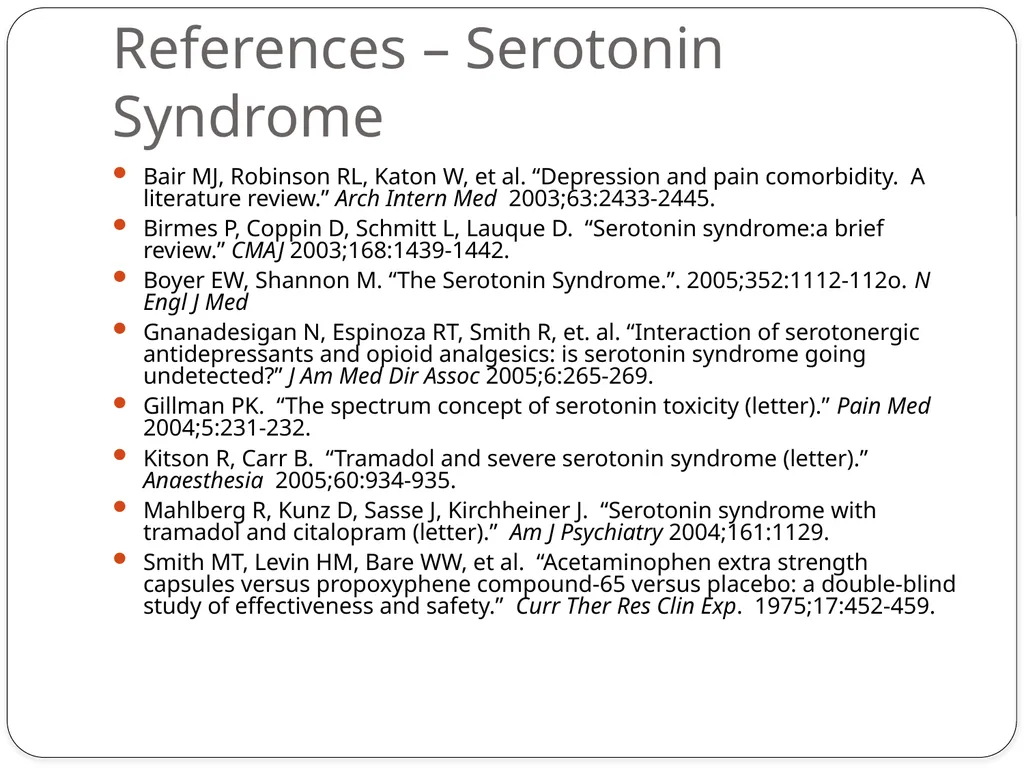
References – Serotonin Syndrome Bair MJ, Robinson RL, Katon W, et al. “Depression and pain comorbidity. A literature review.” Arch Intern Med 2003;63:2433-2445.
Birmes P, Coppin D, Schmitt L, Lauque D. “Serotonin syndrome:a brief review.” CMAJ 2003;168:1439-1442.
Boyer EW, Shannon M. “The Serotonin Syndrome.”. 2005;352:1112-112o. N Engl J Med
Gnanadesigan N, Espinoza RT, Smith R, et. al. “Interaction of serotonergic antidepressants and opioid analgesics: is serotonin syndrome going undetected?” J Am Med Dir Assoc 2005;6:265-269.
Gillman PK. “The spectrum concept of serotonin toxicity (letter).” Pain Med 2004;5:231-232.
Kitson R, Carr B. “Tramadol and severe serotonin syndrome (letter).” Anaesthesia 2005;60:934-935.
Mahlberg R, Kunz D, Sasse J, Kirchheiner J. “Serotonin syndrome with tramadol and citalopram (letter).” Am J Psychiatry 2004;161:1129.
Smith MT, Levin HM, Bare WW, et al. “Acetaminophen extra strength capsules versus propoxyphene compound-65 versus placebo: a double-blind study of effectiveness and safety.” Curr Ther Res Clin Exp. 1975;17:452-459.<br>
Birmes P, Coppin D, Schmitt L, Lauque D. “Serotonin syndrome:a brief review.” CMAJ 2003;168:1439-1442.
Boyer EW, Shannon M. “The Serotonin Syndrome.”. 2005;352:1112-112o. N Engl J Med
Gnanadesigan N, Espinoza RT, Smith R, et. al. “Interaction of serotonergic antidepressants and opioid analgesics: is serotonin syndrome going undetected?” J Am Med Dir Assoc 2005;6:265-269.
Gillman PK. “The spectrum concept of serotonin toxicity (letter).” Pain Med 2004;5:231-232.
Kitson R, Carr B. “Tramadol and severe serotonin syndrome (letter).” Anaesthesia 2005;60:934-935.
Mahlberg R, Kunz D, Sasse J, Kirchheiner J. “Serotonin syndrome with tramadol and citalopram (letter).” Am J Psychiatry 2004;161:1129.
Smith MT, Levin HM, Bare WW, et al. “Acetaminophen extra strength capsules versus propoxyphene compound-65 versus placebo: a double-blind study of effectiveness and safety.” Curr Ther Res Clin Exp. 1975;17:452-459.<br>