
The SciTokens Authorization Model: JSON Web Tokens
TD
Published · 20 slides · 0 views
1 / 1
Description
The SciTokens Authorization Model: JSON Web Tokens OAuth Jim Basney jbasneyncsa.Illinois.edu Brian Bockelman bbockelmcse.unl.edu This material is based upon work supported by the National Science Foundation under Grant No. 1738962.
Related Topics
Share
Embed code
Download this presentation From Below
"The SciTokens Authorization Model: JSON Web Tokens" is the property of its rightful owner. Permission is granted to download and print the materials on this website for personal, non-commercial use only, and to display it on your personal computer provided you do not modify the materials and that you retain all copyright notices contained in the materials. By downloading content from our website, you accept the terms of this agreement.
Presentation Transcript
01
The SciTokens Authorization Model: JSON Web Tokens & OAuth Jim Basney <jbasney@ncsa.Illinois.edu>
Brian Bockelman <bbockelm@cse.unl.edu> This material is based upon work supported by the National Science Foundation under Grant No. 1738962. Any opinions, findings, and conclusions or recommendations expressed in this material are those of the author(s) and do not necessarily reflect the views of the National Science Foundation.<br>
Brian Bockelman <bbockelm@cse.unl.edu> This material is based upon work supported by the National Science Foundation under Grant No. 1738962. Any opinions, findings, and conclusions or recommendations expressed in this material are those of the author(s) and do not necessarily reflect the views of the National Science Foundation.<br>
02
SciTokens Project The SciTokens project, starting July 2017, aims to:
Introduce a capabilities-based authorization infrastructure for distributed scientific computing,
Provide a reference platform, combining CILogon, HTCondor, CVMFS, and XRootD, and
Implement specific use cases to help our science stakeholders (LIGO and LSST) better achieve their scientific aims.<br>
Introduce a capabilities-based authorization infrastructure for distributed scientific computing,
Provide a reference platform, combining CILogon, HTCondor, CVMFS, and XRootD, and
Implement specific use cases to help our science stakeholders (LIGO and LSST) better achieve their scientific aims.<br>
03
Identity-based Authorization At the core of today’s grid security infrastructure is the concept of identity and impersonation.
A grid certificate provides you with a globally-recognized identification.
The grid proxy allows a third party to impersonate you, (ideally) on your behalf.
The remote service maps your identity to some set of locally-defined authorizations.
We believe this approach is fundamentally wrong because it exposes too much global state: identity and policy should be kept locally!<br>
04
Capability-based Authorization We want to change the infrastructure to focus on capabilities!
The tokens passed to the remote service describe what authorizations the bearer has.
For traceability purposes, there may be an identifier that allows tracing of the token bearer back to an identity.
Identifier != identity. It may be privacy-preserving, requiring the issuer (VO) to provide help in mapping.
Example: “The bearer of this piece of paper is entitled to write into /castor/cern.ch/cms".<br>
05
Capabilities versus Impersonation If GSI took over the world, an attacker could use a stolen grid proxy to make withdrawals from your bank account.
With capabilities, a stolen token only gets you access to a specific authorization (“stageout to /store/user at Nebraska”).
SciTokens is following the principle of least privilege for distributed scientific computing.<br>
With capabilities, a stolen token only gets you access to a specific authorization (“stageout to /store/user at Nebraska”).
SciTokens is following the principle of least privilege for distributed scientific computing.<br>
06
The World Uses Capabilities! The rest of the world uses capabilities for distributed services.
The authorization service creates a token that describes a certain capability or authorization.
Any bearer of that token may present it to a resource service and utilize the authorization.
The primary way this is implemented is through OAuth2.
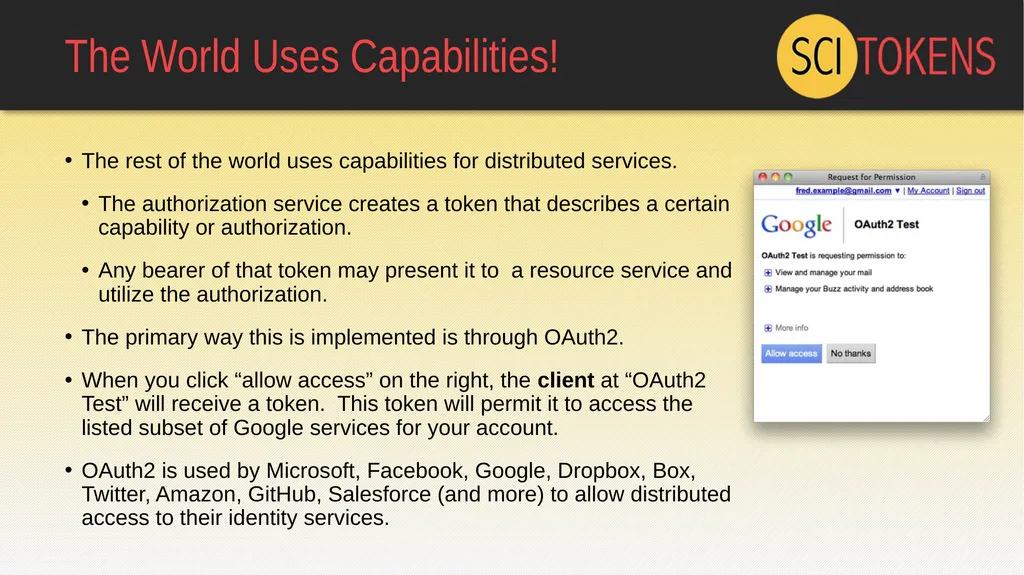
When you click “allow access” on the right, the client at “OAuth2 Test” will receive a token. This token will permit it to access the listed subset of Google services for your account.
OAuth2 is used by Microsoft, Facebook, Google, Dropbox, Box, Twitter, Amazon, GitHub, Salesforce (and more) to allow distributed access to their identity services.<br>
07
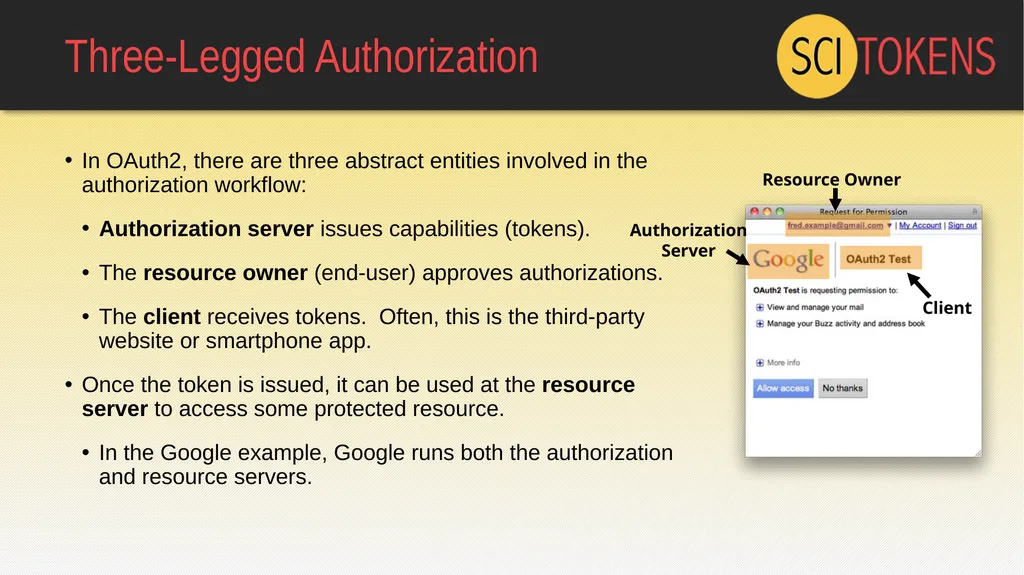
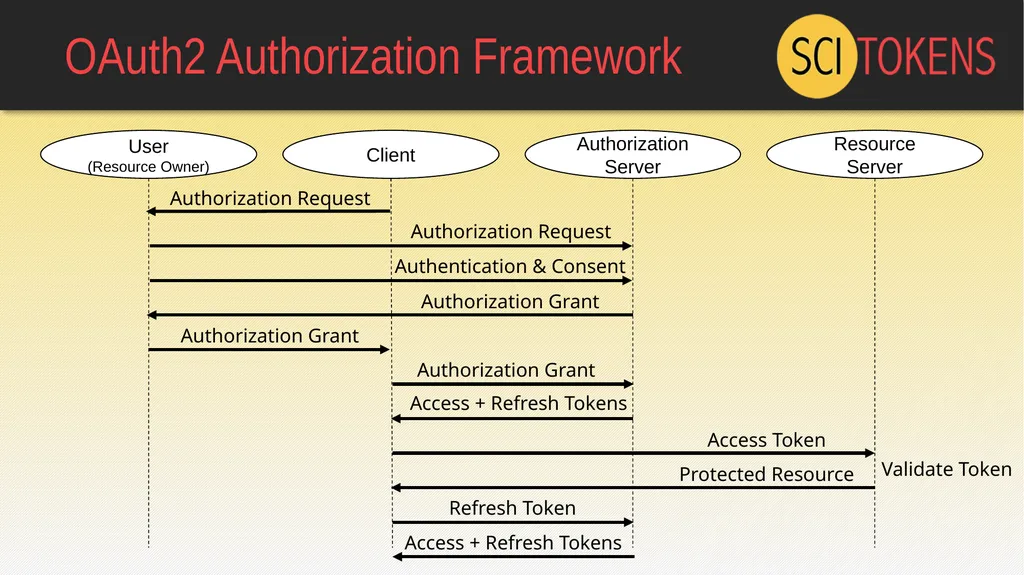
Three-Legged Authorization In OAuth2, there are three abstract entities involved in the authorization workflow:
Authorization server issues capabilities (tokens).
The resource owner (end-user) approves authorizations.
The client receives tokens. Often, this is the third-party website or smartphone app.
Once the token is issued, it can be used at the resource server to access some protected resource.
In the Google example, Google runs both the authorization and resource servers. Resource Owner Authorization Server Client<br>
08
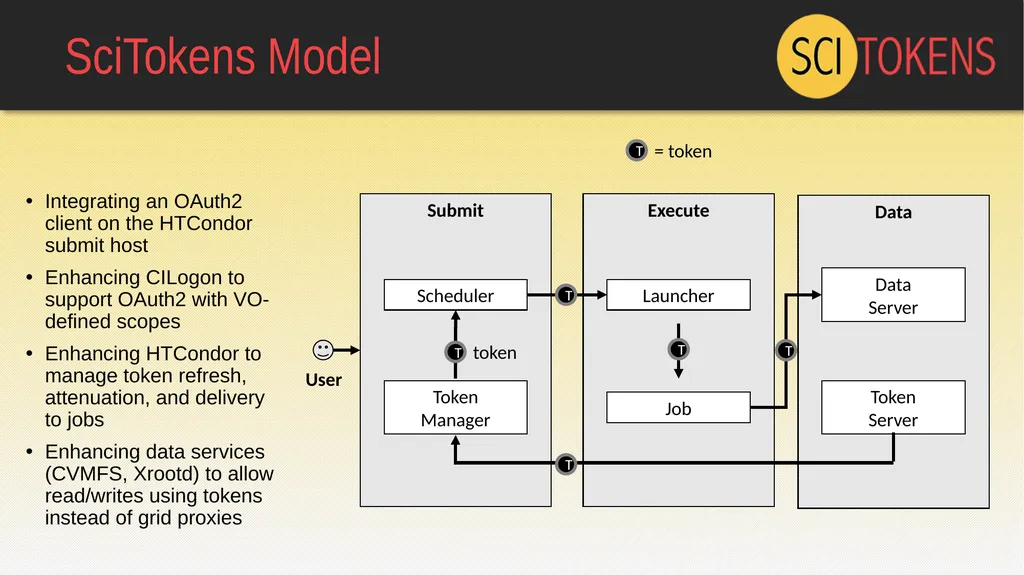
SciTokens Model Integrating an OAuth2 client on the HTCondor submit host
Enhancing CILogon to support OAuth2 with VO-defined scopes
Enhancing HTCondor to manage token refresh, attenuation, and delivery to jobs
Enhancing data services (CVMFS, Xrootd) to allow read/writes using tokens instead of grid proxies Submit Execute Data Scheduler Token Manager T token Launcher Job T T Data Server Token Server T T User = token T<br>
09
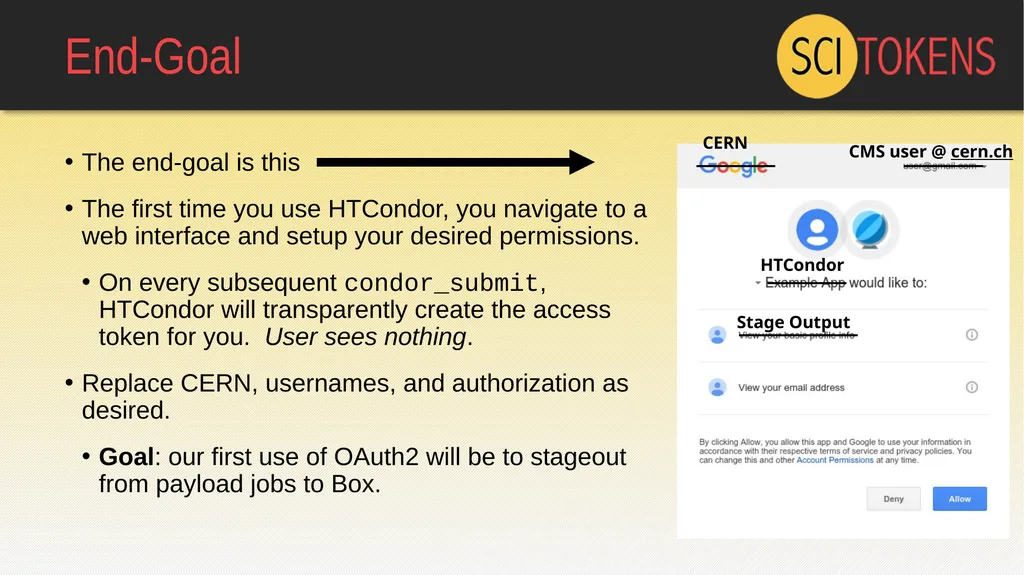
End-Goal The end-goal is this
The first time you use HTCondor, you navigate to a web interface and setup your desired permissions.
On every subsequent condor_submit, HTCondor will transparently create the access token for you. User sees nothing.
Replace CERN, usernames, and authorization as desired.
Goal: our first use of OAuth2 will be to stageout from payload jobs to Box. CMS user @ cern.ch HTCondor Stage Output CERN<br>
10
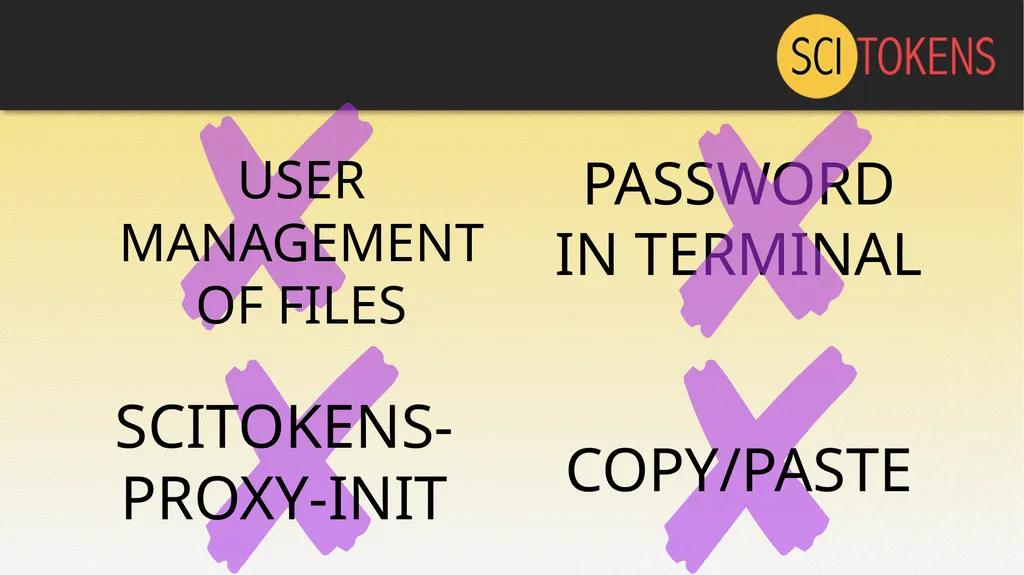
SCITOKENS-PROXY-INIT PASSWORD IN TERMINAL COPY/PASTE USER MANAGEMENT OF FILES<br>
11
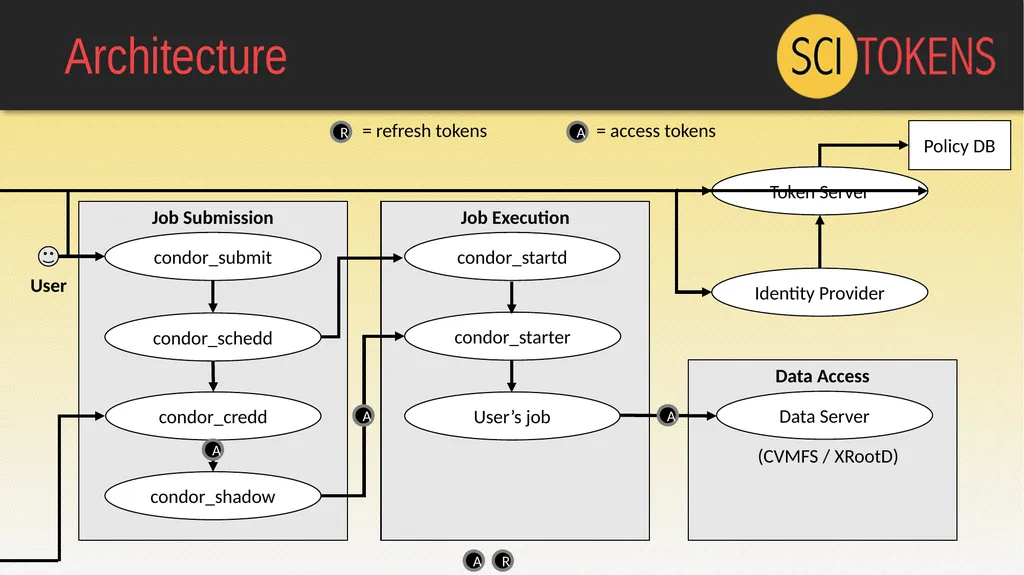
Architecture Job Submission Job Execution Data Access condor_submit condor_schedd condor_credd condor_shadow condor_startd condor_starter User’s job Token Server Data Server (CVMFS / XRootD) User Policy DB = refresh tokens A A A R R A = access tokens A Identity Provider<br>
12
OAuth2 Authorization Framework Authorization Request Authorization Request Authorization Grant Authorization Grant Authorization Grant Access + Refresh Tokens Access Token Protected Resource Refresh Token Access + Refresh Tokens Validate Token Authentication & Consent<br>
13
User ID
Name
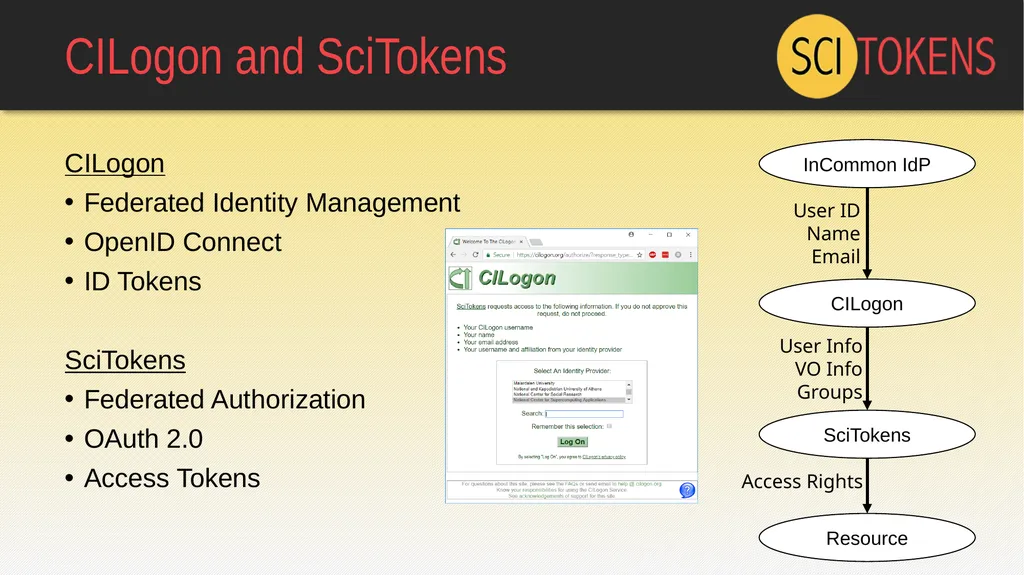
Email CILogon and SciTokens CILogon
Federated Identity Management
OpenID Connect
ID Tokens
SciTokens
Federated Authorization
OAuth 2.0
Access Tokens InCommon IdP CILogon SciTokens Resource User Info VO Info Groups Access Rights<br>
Federated Identity Management
OpenID Connect
ID Tokens
SciTokens
Federated Authorization
OAuth 2.0
Access Tokens InCommon IdP CILogon SciTokens Resource User Info VO Info Groups Access Rights<br>
14
Tokens for
Distributed Science Infrastructures Distributed science infrastructures are distinct from a “resource server” like Google because they are not run by a single central entity.
Hence, unlike Google, we can’t use opaque random strings for the token. We need something that allows for distributed verification.
Given a token, a storage service can determine it is valid.
Analogously, given a proxy chain and a set of trust roots, you can determine the GSI proxy is valid.
Goal: Sites set aside some area for each VO; VOs manage the authorizations within these “VO home” areas.<br>
15
JWT in action! Free tokens! Navigate to https://demo.scitokens.org to get your free tokens!
This demo illustrates the access token format we’re working on.
Utilizes JSON Web Tokens (JWT) as the access token format.
Various RFCs provide clear guidance on how to verify token integrity.
Adds a few domain-specific claims for receiving access to storage.
The tokens are base64-encoded and can be used as part of a curl command to use protected resources.<br>
16
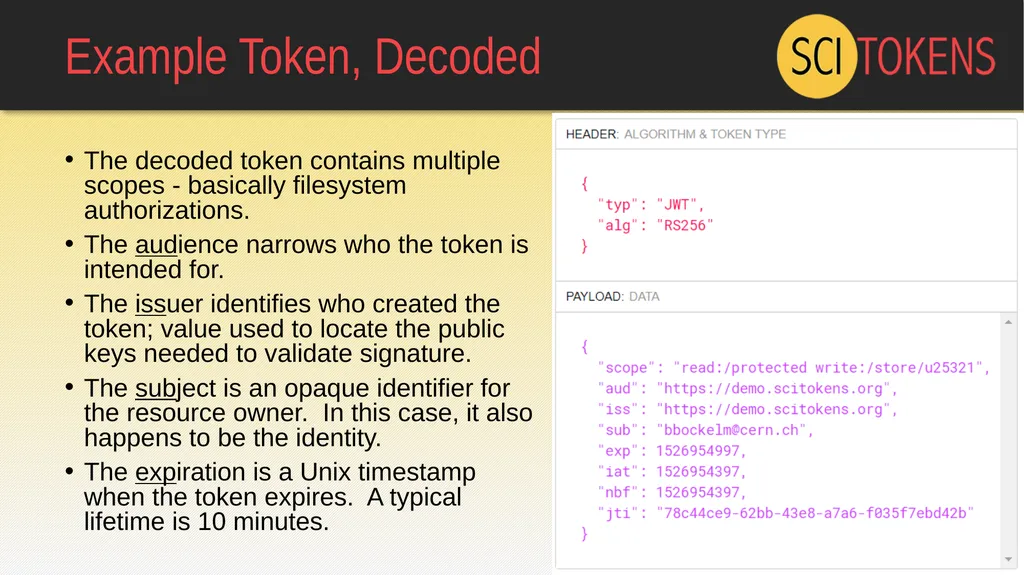
Example Token, Decoded The decoded token contains multiple scopes - basically filesystem authorizations.
The audience narrows who the token is intended for.
The issuer identifies who created the token; value used to locate the public keys needed to validate signature.
The subject is an opaque identifier for the resource owner. In this case, it also happens to be the identity.
The expiration is a Unix timestamp when the token expires. A typical lifetime is 10 minutes.<br>
17
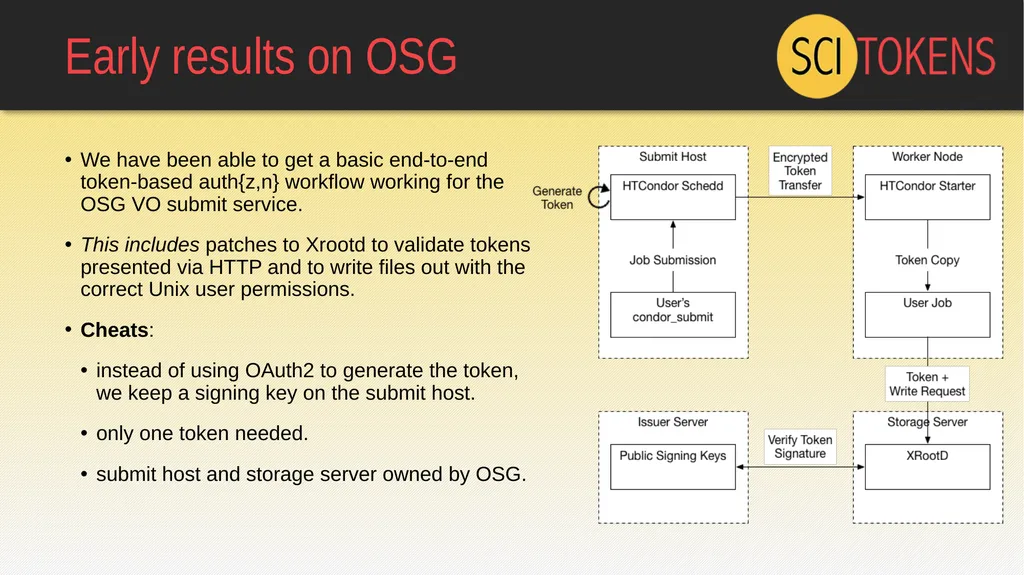
Early results on OSG We have been able to get a basic end-to-end token-based auth{z,n} workflow working for the OSG VO submit service.
This includes patches to Xrootd to validate tokens presented via HTTP and to write files out with the correct Unix user permissions.
Cheats:
instead of using OAuth2 to generate the token, we keep a signing key on the submit host.
only one token needed.
submit host and storage server owned by OSG.<br>
18
Wait, I’ve seen this before! If you’re from ALICE and getting a sense of déjà vu — you’re right!
The capability-based infrastructure is precisely the authorization infrastructure used by ALICE for the past decade.
SciTokens takes this successful model, recasts it using modern web protocols, and utilizes OAuth2 workflows to issue the tokens.
The use of common protocols and workflows means that we have a large number of battle-tested libraries we can leverage (spend our time doing other stuff besides writing the basics!).
Using JWT-formatted access tokens is somewhat-commonplace among web companies.
We think SciTokens is unique in using JWT access tokens for distributed verification in a federated infrastructure.<br>
19
Status & Next Steps So far we have:
Version 1.0 of Python and Java libraries
Simple HTCondor OAuth client implementation
XRootD token validation plugins
Token-based CVMFS access
X509-to-SciToken translation service
3rd-party HTTPS FTS transfers authorized with SciTokens
Next steps:
Use Java library for a dCache authorization plugin
Release plugin for CVMFS support
More fine-grained token management in HTCondor
Integration with LIGO LDAP
Enhancing HTCondor token support with OAuth flows<br>
20
Thanks!
Visit
https://scitokens.org/
for more info.
Any questions?<br>
Visit
https://scitokens.org/
for more info.
Any questions?<br>