04
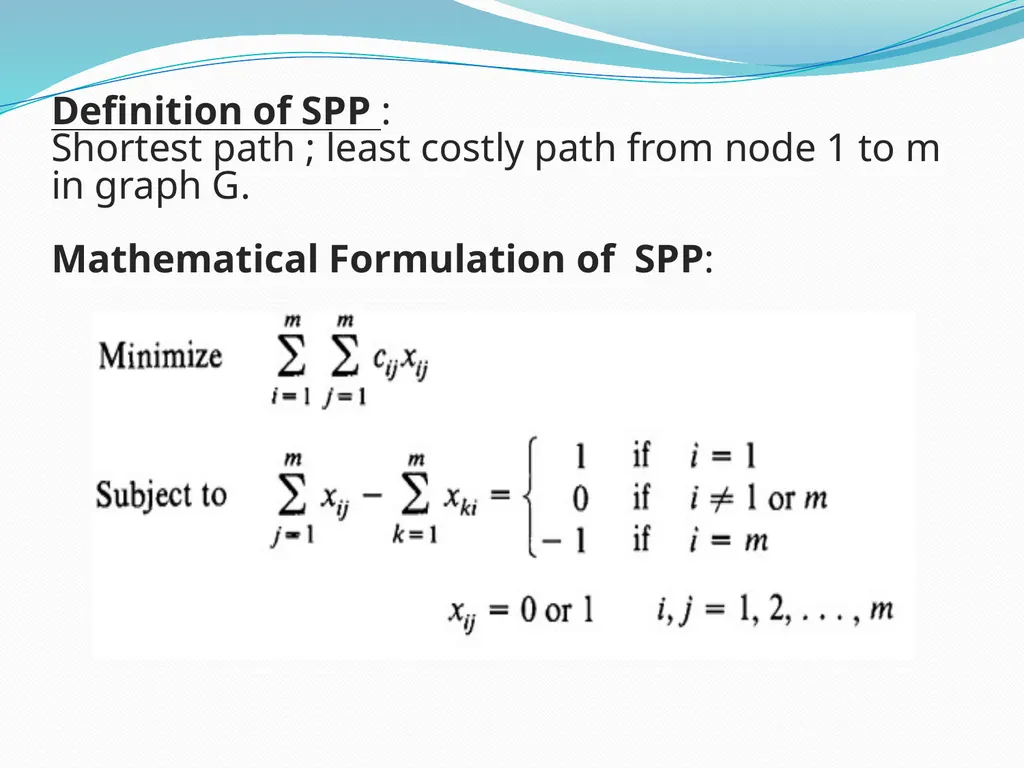
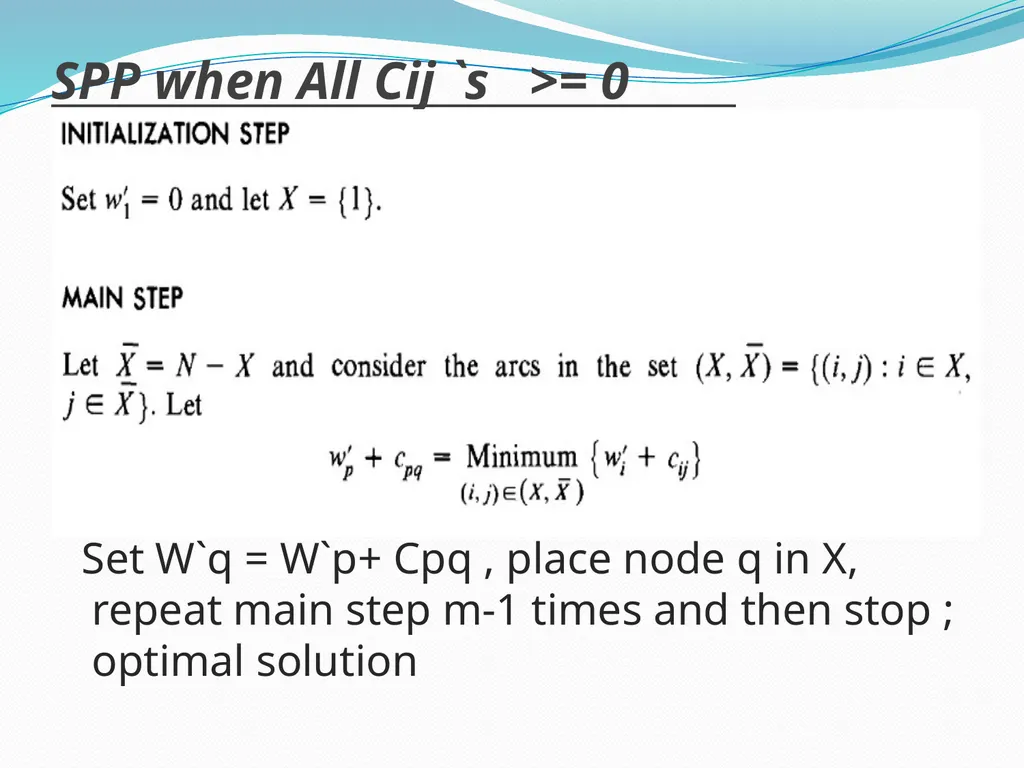
SPP when All Cij `s >= 0 Set W`q = W`p+ Cpq , place node q in X, repeat main step m-1 times and then stop ; optimal solution<br>
05
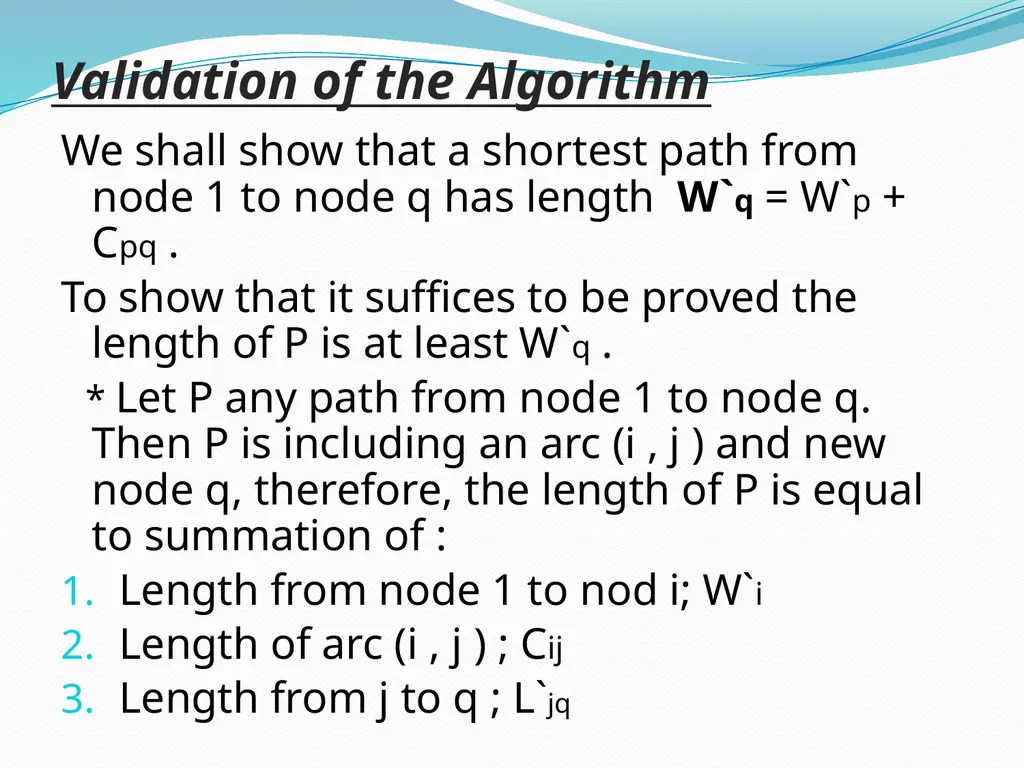
Validation of the Algorithm We shall show that a shortest path from node 1 to node q has length W`q = W`p + Cpq .
To show that it suffices to be proved the length of P is at least W`q .
* Let P any path from node 1 to node q. Then P is including an arc (i , j ) and new node q, therefore, the length of P is equal to summation of :
Length from node 1 to nod i; W`i
Length of arc (i , j ) ; Cij
Length from j to q ; L`jq<br>
06
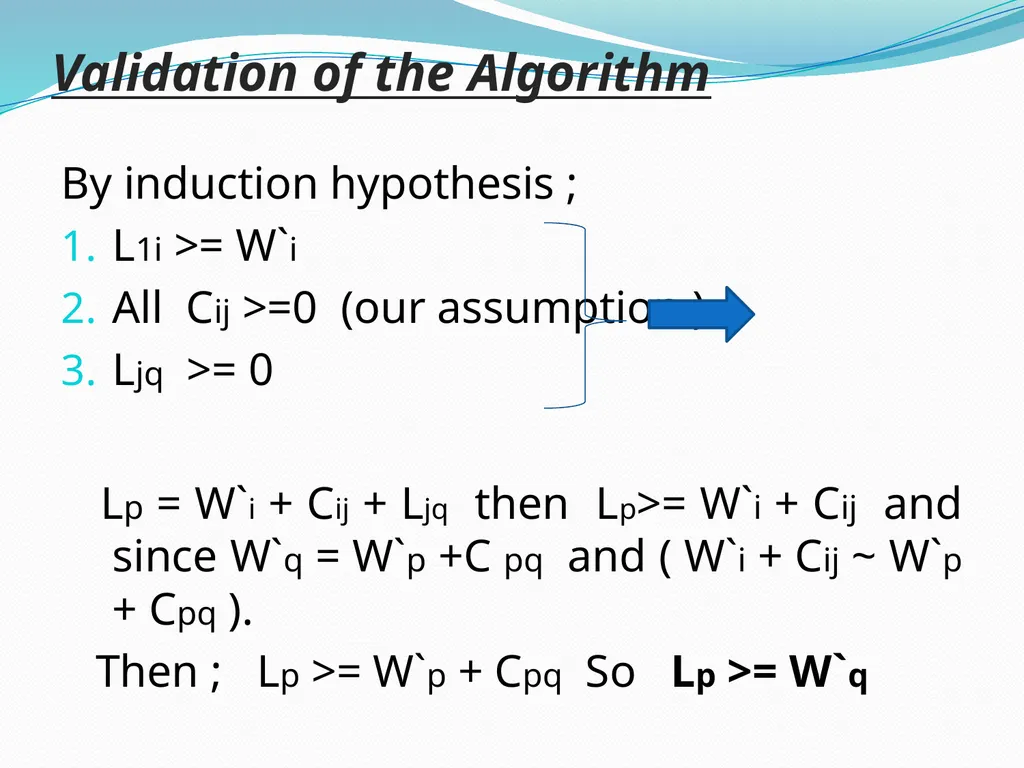
Validation of the Algorithm By induction hypothesis ;
L1i >= W`i
All Cij >=0 (our assumption )
Ljq >= 0
Lp = W`i + Cij + Ljq then Lp>= W`i + Cij and since W`q = W`p +C pq and ( W`i + Cij ~ W`p + Cpq ).
Then ; Lp >= W`p + Cpq So Lp >= W`q<br>
07
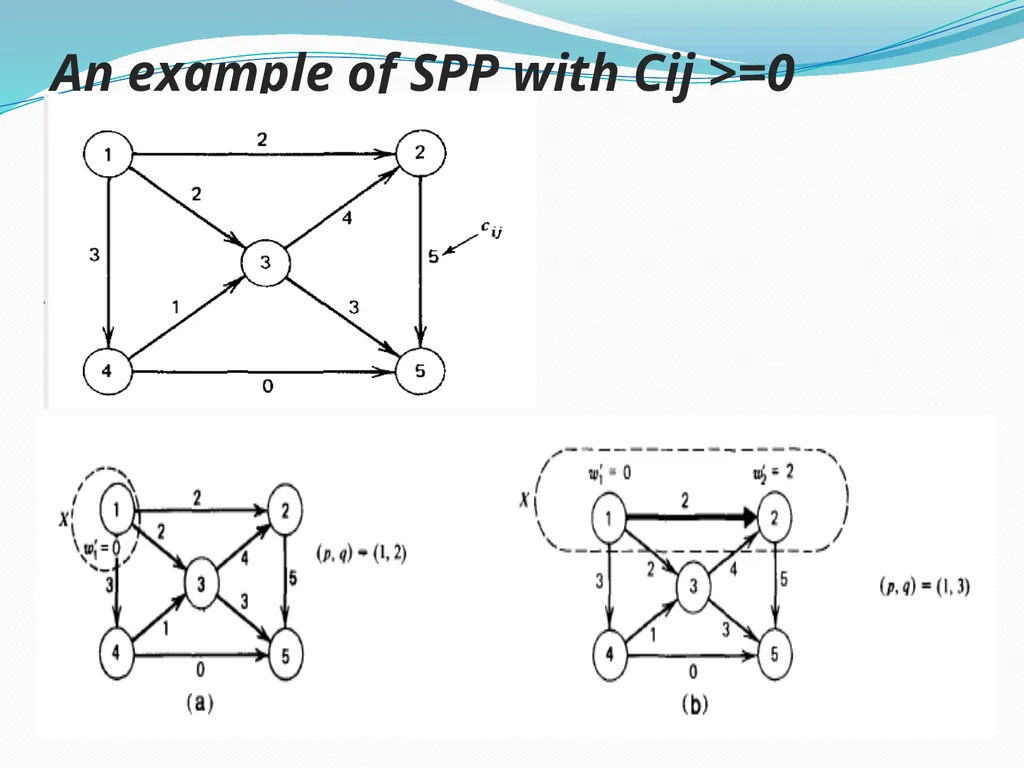
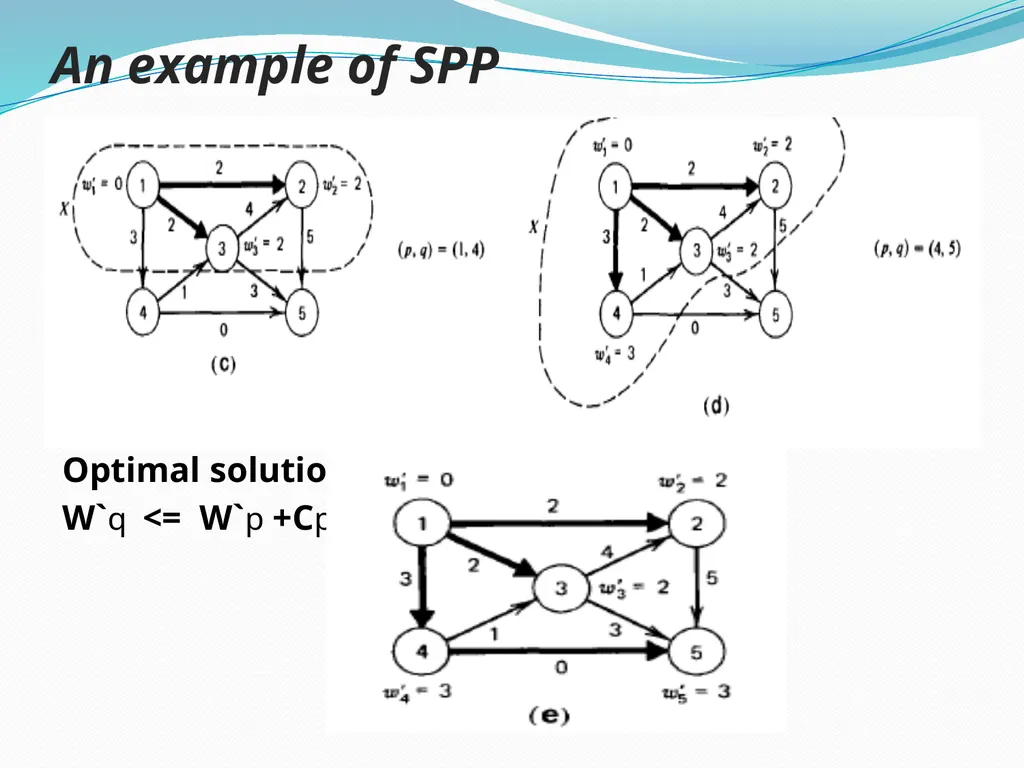
An example of SPP with Cij >=0 1<br>
08
An example of SPP Optimal solution
W`q <= W`p +Cpq<br>
09
Dijkstra`s Algorithm Updating the calculation of path lengths to the nodes rather than recomputing them at every iteration.
Whenever a new node is added to X, its forward star may be scanned to the possibly update any of the distance labels W`i for the nodes in X`. The nodes having the smallest W`i can be transferred to X and the current distance calculation for nodes in X` can be retained instead of being erased.<br>
10
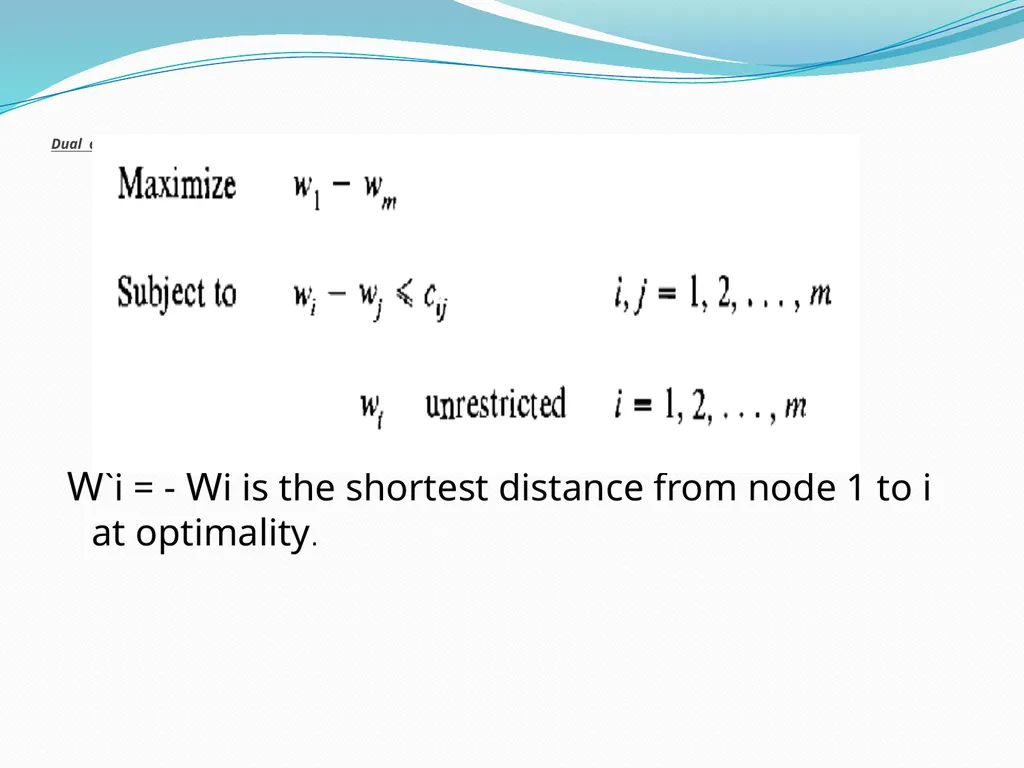
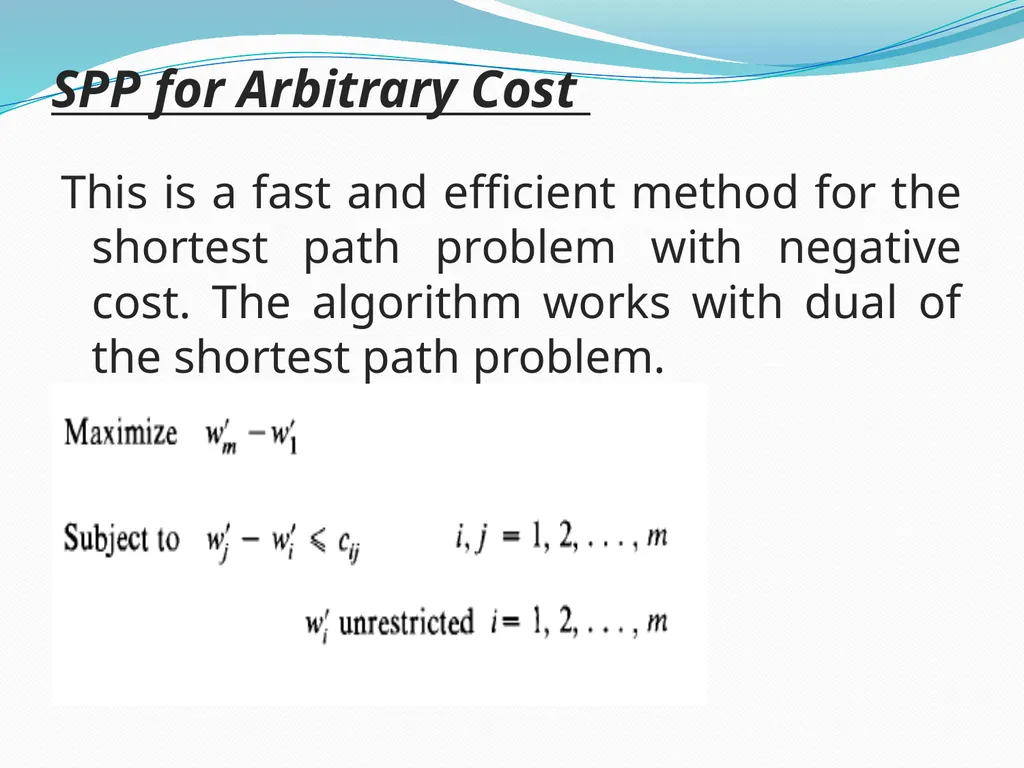
SPP for Arbitrary Cost This is a fast and efficient method for the shortest path problem with negative cost. The algorithm works with dual of the shortest path problem.
W`i = - Wi for i = 1,2,…, m<br>
11
SPP for Arbitrary Cost Initialization step ;
Set W`1= 0 and W`i = i # 1
Main step ;
If W`j <= W`i + Cij then optimality , otherwise:
Select (p,q) such that W`q > W`p + Cpq and set W`q = W`p + Cpq
And repeat the main step.<br>
12
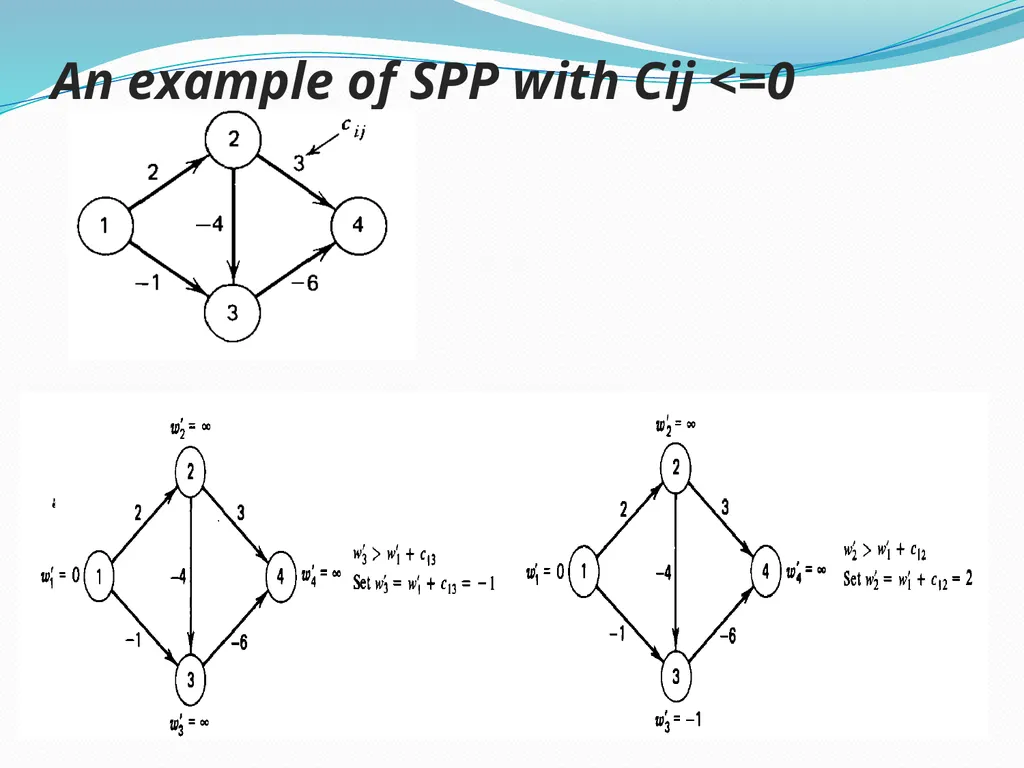
An example of SPP with Cij <=0 Iteration 1 ;<br>
13
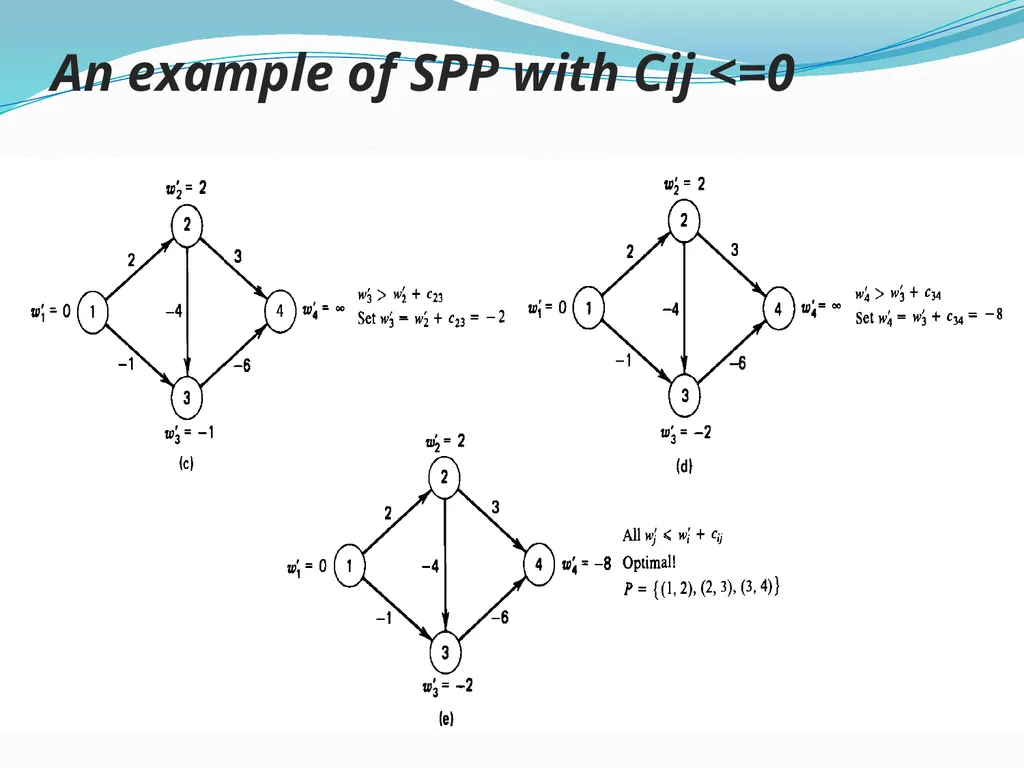
An example of SPP with Cij <=0<br>
14
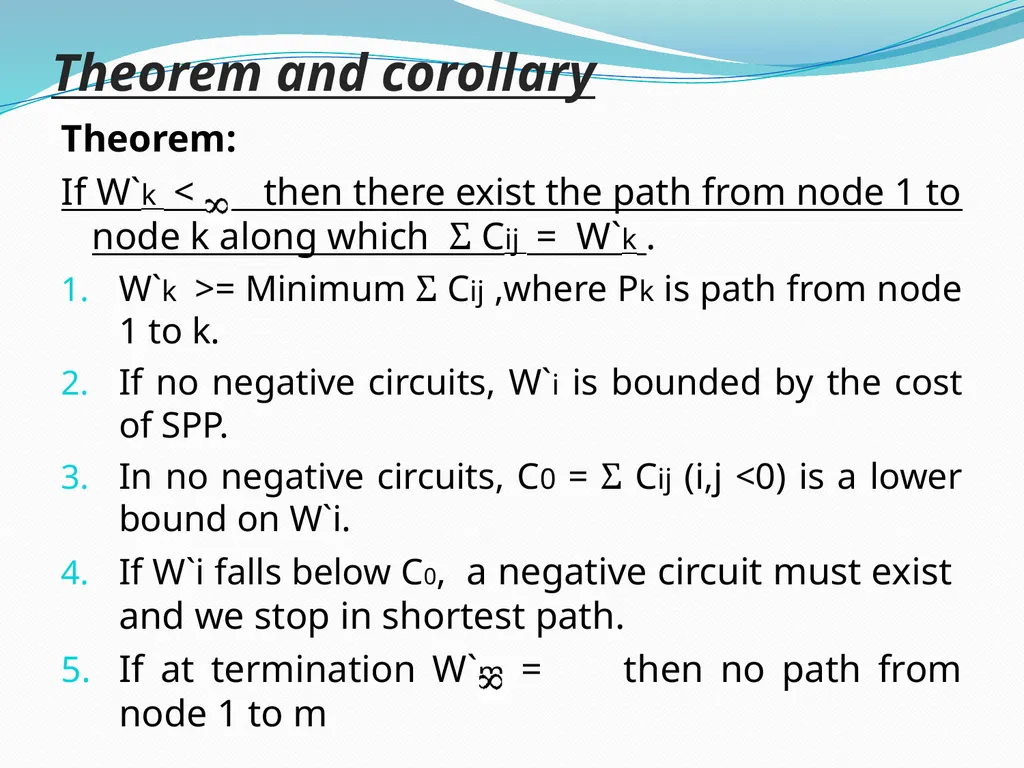
Theorem and corollary Theorem:
If W`k < then there exist the path from node 1 to node k along which Σ Cij = W`k .
W`k >= Minimum Σ Cij ,where Pk is path from node 1 to k.
If no negative circuits, W`i is bounded by the cost of SPP.
In no negative circuits, C0 = Σ Cij (i,j <0) is a lower bound on W`i.
If W`i falls below C0, a negative circuit must exist and we stop in shortest path.
If at termination W`m = then no path from node 1 to m<br>
15
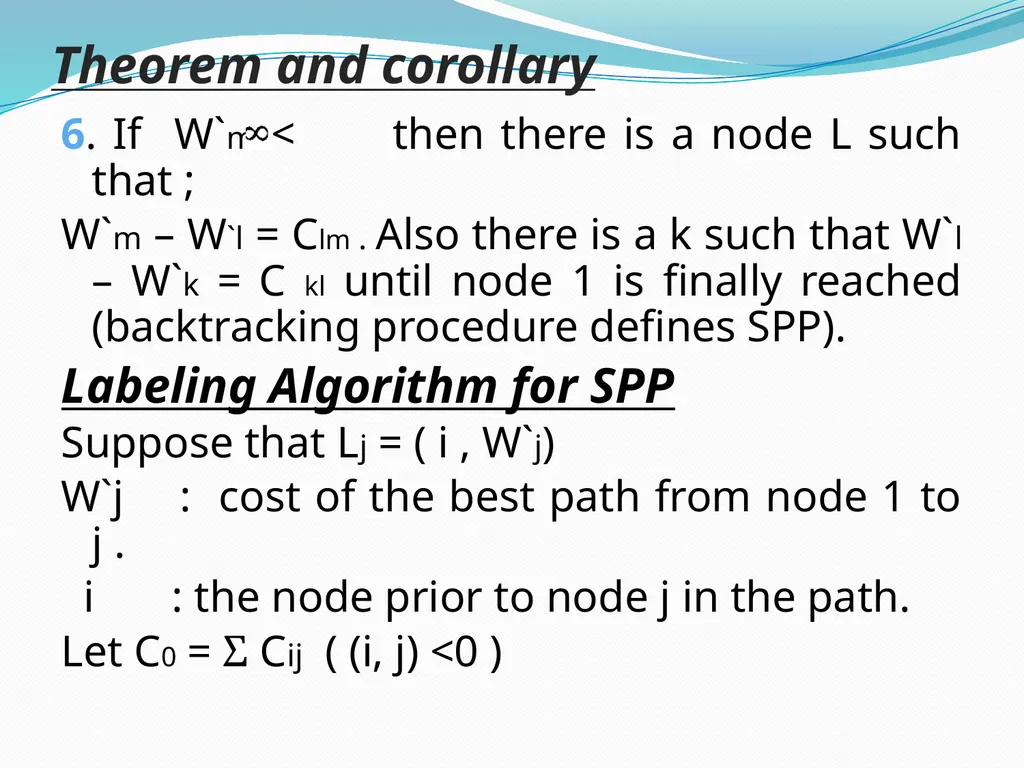
Theorem and corollary 6. If W`m < then there is a node L such that ;
W`m – W`l = Clm . Also there is a k such that W`l – W`k = C kl until node 1 is finally reached (backtracking procedure defines SPP).
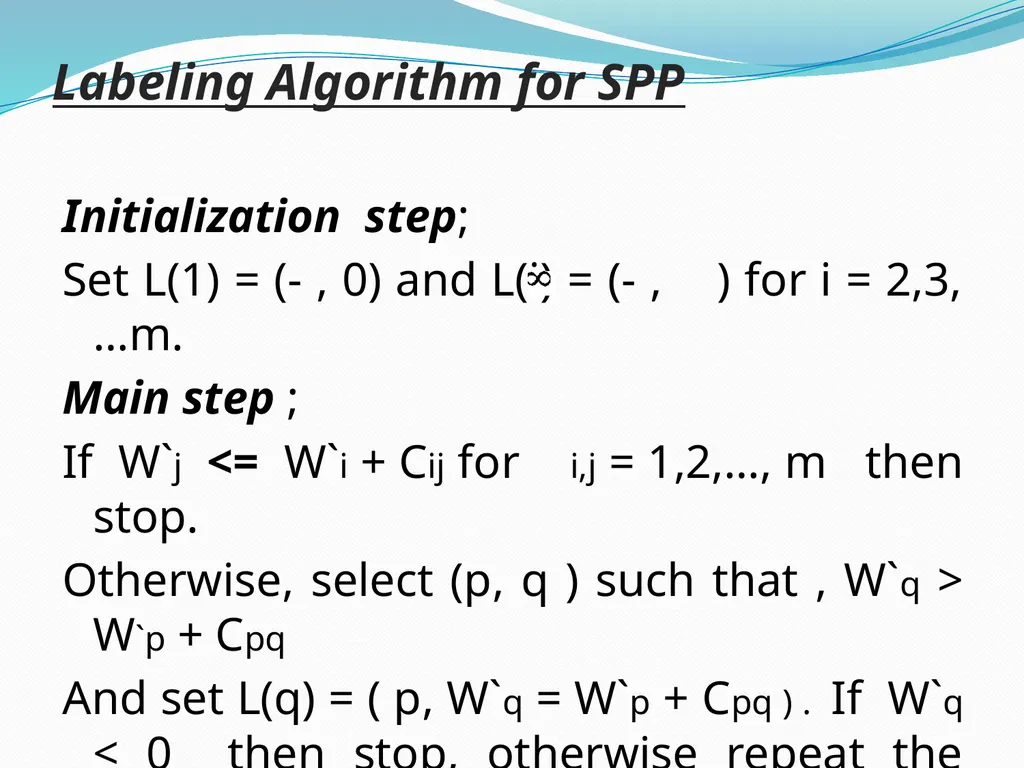
Labeling Algorithm for SPP
Suppose that Lj = ( i , W`j)
W`j : cost of the best path from node 1 to j .
i : the node prior to node j in the path.
Let C0 = Σ Cij ( (i, j) <0 )<br>
16
Labeling Algorithm for SPP Initialization step;
Set L(1) = (- , 0) and L(i) = (- , ) for i = 2,3,…m.
Main step ;
If W`j <= W`i + Cij for i,j = 1,2,…, m then stop.
Otherwise, select (p, q ) such that , W`q > W`p + Cpq
And set L(q) = ( p, W`q = W`p + Cpq ) . If W`q < 0 then stop, otherwise repeat the main step.<br>
17
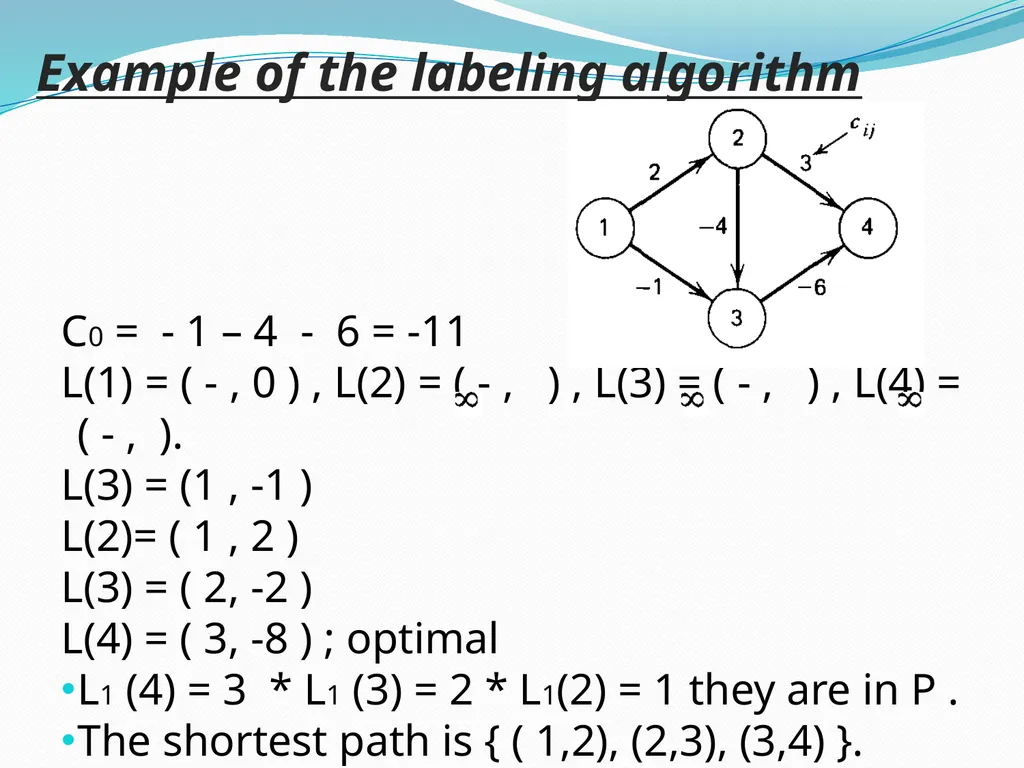
Example of the labeling algorithm C0 = - 1 – 4 - 6 = -11
L(1) = ( - , 0 ) , L(2) = ( - , ) , L(3) = ( - , ) , L(4) = ( - , ).
L(3) = (1 , -1 )
L(2)= ( 1 , 2 )
L(3) = ( 2, -2 )
L(4) = ( 3, -8 ) ; optimal
L1 (4) = 3 * L1 (3) = 2 * L1(2) = 1 they are in P .
The shortest path is { ( 1,2), (2,3), (3,4) }.<br>
18
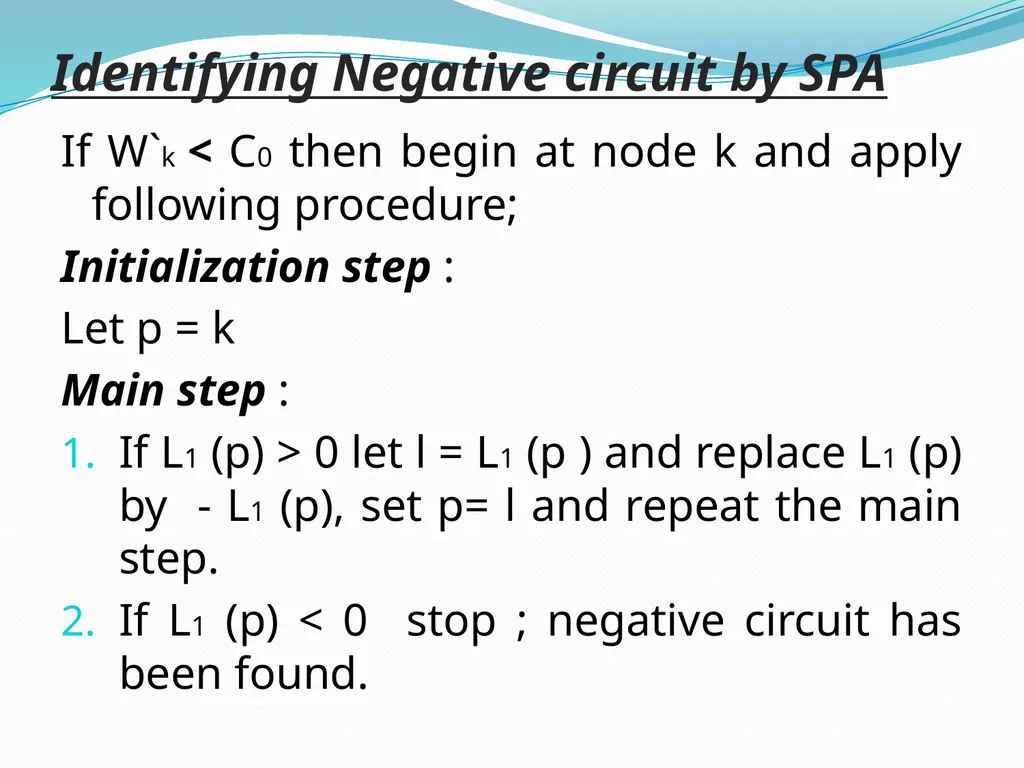
Identifying Negative circuit by SPA If W`k < C0 then begin at node k and apply following procedure;
Initialization step :
Let p = k
Main step :
If L1 (p) > 0 let l = L1 (p ) and replace L1 (p) by - L1 (p), set p= l and repeat the main step.
If L1 (p) < 0 stop ; negative circuit has been found.<br>
19
Thanks for your
Attention<br>