
The Shrinking World Effect 2023 update Simon Oakes
Description: The Shrinking World Effect 2023 update Simon Oakes Key terms Do you know what these terms mean? Click to reveal the definitions Hodder Stoughton Limited 2023 Hodder Stoughton Limited 2023 Geographical theories about the shrinking
Related Topics
Download Presentation
"The Shrinking World Effect 2023 update Simon Oakes" is the property of its rightful owner. Permission is granted to download and print the materials on this website for personal, non-commercial use only, and to display it on your personal computer provided you do not modify the materials and that you retain all copyright notices contained in the materials. By downloading content from our website, you accept the terms of this agreement.
Presentation Transcript
slide1. The Shrinking World Effect
2023 update Simon Oakes<br>
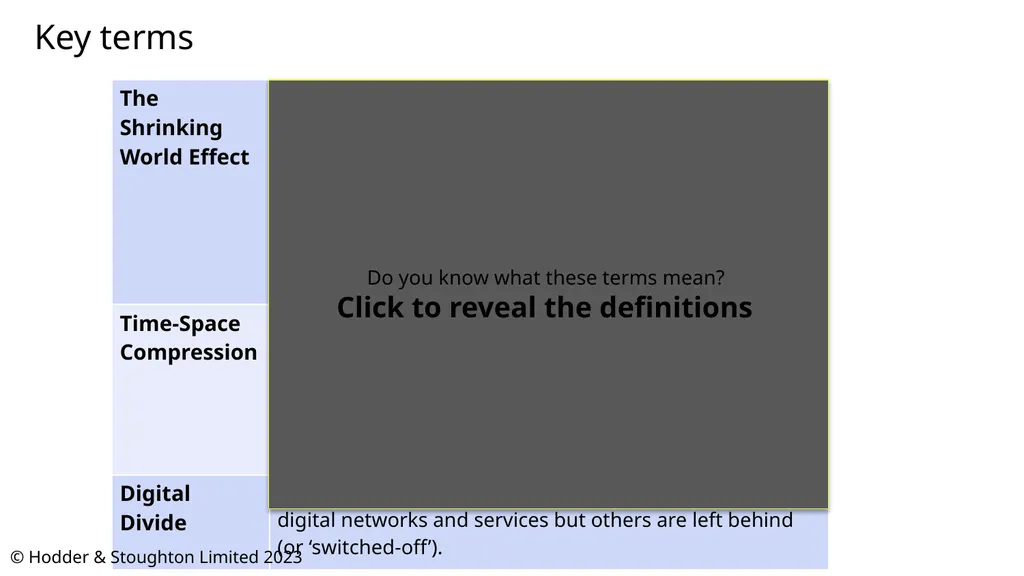
slide2. Key terms Do you know what these terms mean?
Click to reveal the definitions © Hodder & Stoughton Limited 2023<br>
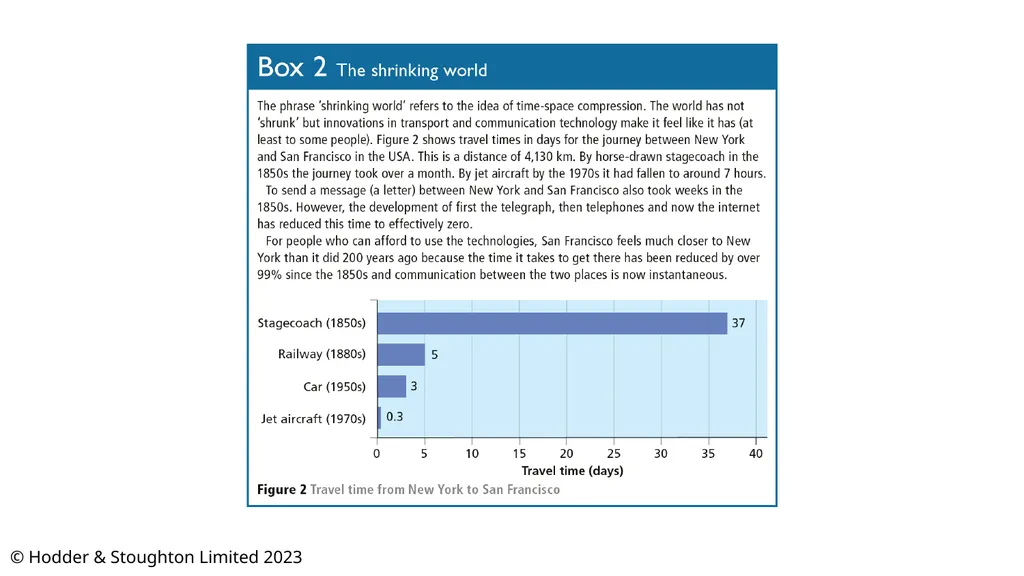
slide3. © Hodder & Stoughton Limited 2023<br>
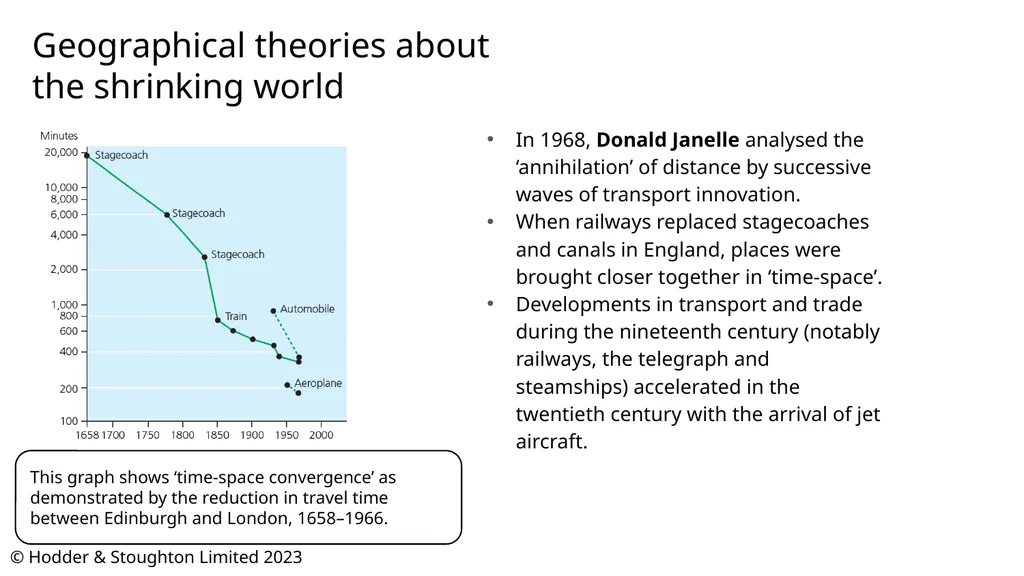
slide4. Geographical theories about the shrinking world In 1968, Donald Janelle analysed the ‘annihilation’ of distance by successive waves of transport innovation.
When railways replaced stagecoaches and canals in England, places were brought closer together in ‘time-space’.
Developments in transport and trade during the nineteenth century (notably railways, the telegraph and steamships) accelerated in the twentieth century with the arrival of jet aircraft. This graph shows ‘time-space convergence’ as demonstrated by the reduction in travel time between Edinburgh and London, 1658–1966. © Hodder & Stoughton Limited 2023<br>
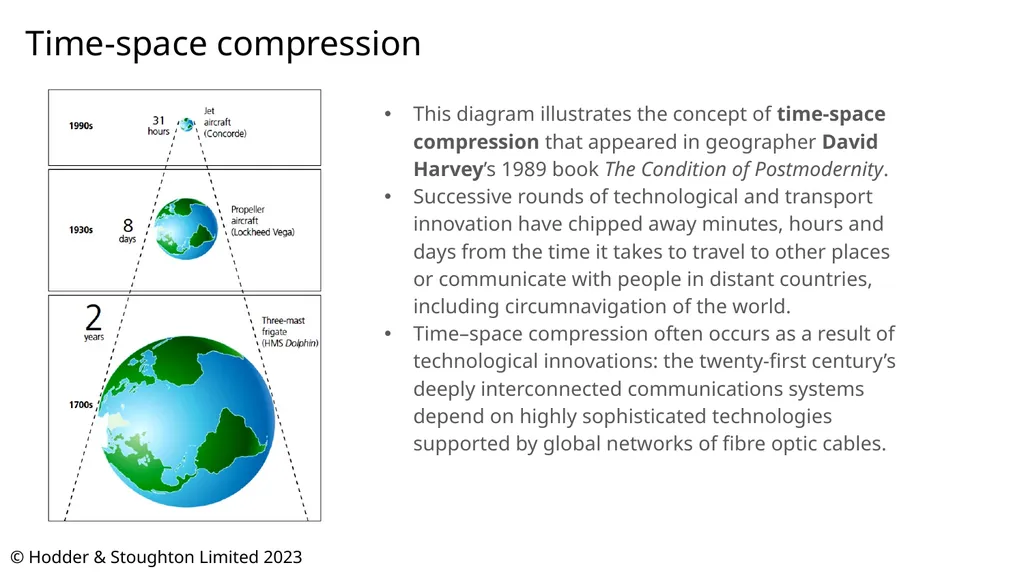
slide5. Time-space compression This diagram illustrates the concept of time-space compression that appeared in geographer David Harvey’s 1989 book The Condition of Postmodernity.
Successive rounds of technological and transport innovation have chipped away minutes, hours and days from the time it takes to travel to other places or communicate with people in distant countries, including circumnavigation of the world.
Time–space compression often occurs as a result of technological innovations: the twenty-first century’s deeply interconnected communications systems depend on highly sophisticated technologies supported by global networks of fibre optic cables. © Hodder & Stoughton Limited 2023<br>
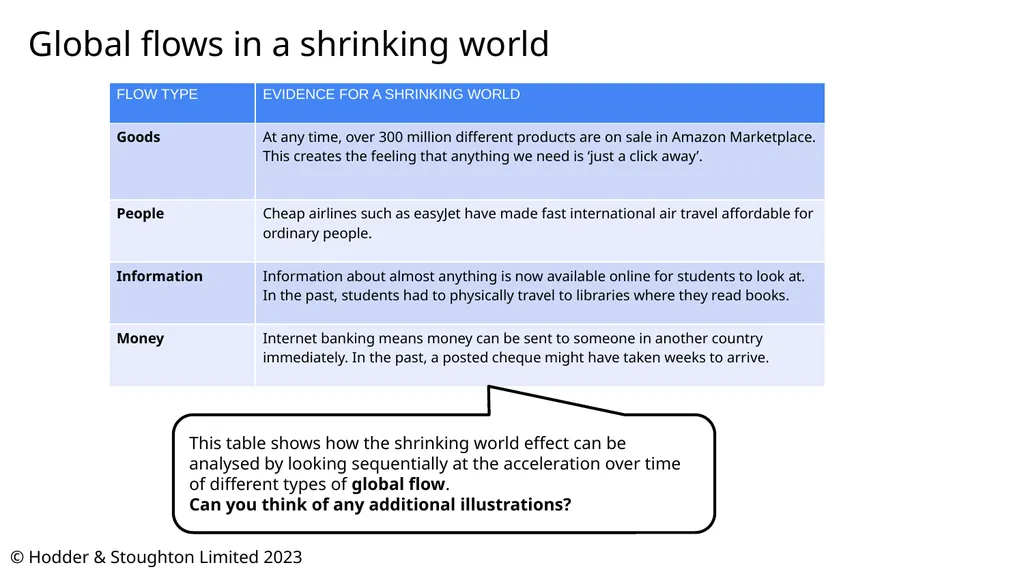
slide6. Global flows in a shrinking world This table shows how the shrinking world effect can be analysed by looking sequentially at the acceleration over time of different types of global flow.
Can you think of any additional illustrations? © Hodder & Stoughton Limited 2023<br>
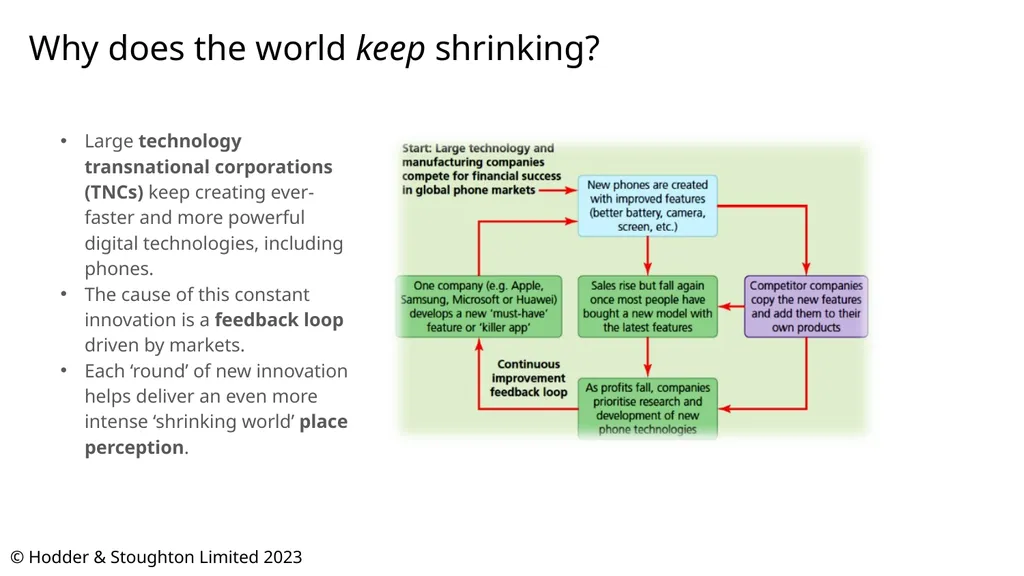
slide7. Why does the world keep shrinking? Large technology transnational corporations (TNCs) keep creating ever-faster and more powerful digital technologies, including phones.
The cause of this constant innovation is a feedback loop driven by markets.
Each ‘round’ of new innovation helps deliver an even more intense ‘shrinking world’ place perception. © Hodder & Stoughton Limited 2023<br>
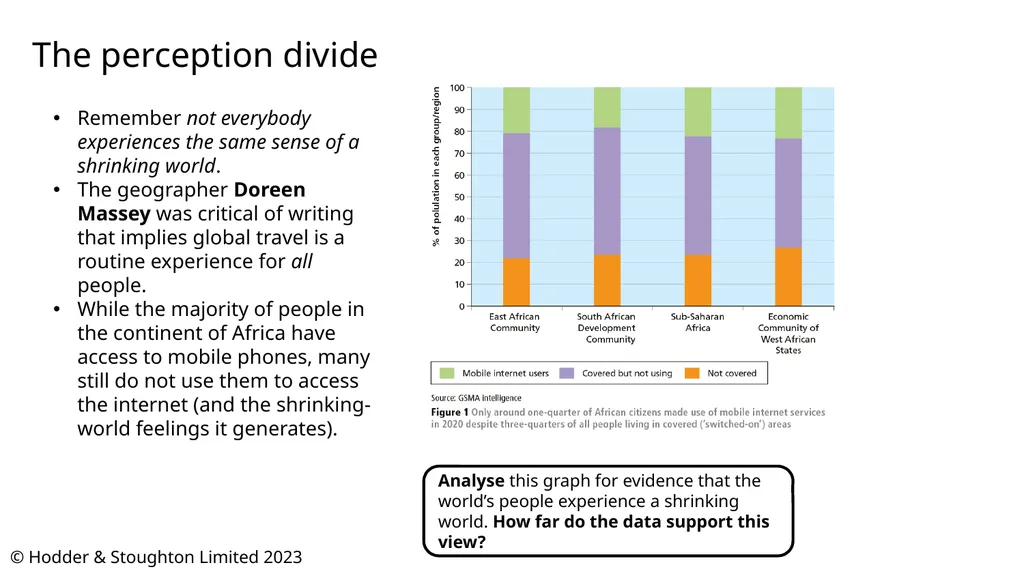
slide8. The perception divide Remember not everybody experiences the same sense of a shrinking world.
The geographer Doreen Massey was critical of writing that implies global travel is a routine experience for all people.
While the majority of people in the continent of Africa have access to mobile phones, many still do not use them to access the internet (and the shrinking-world feelings it generates). Analyse this graph for evidence that the world’s people experience a shrinking world. How far do the data support this view? © Hodder & Stoughton Limited 2023<br>
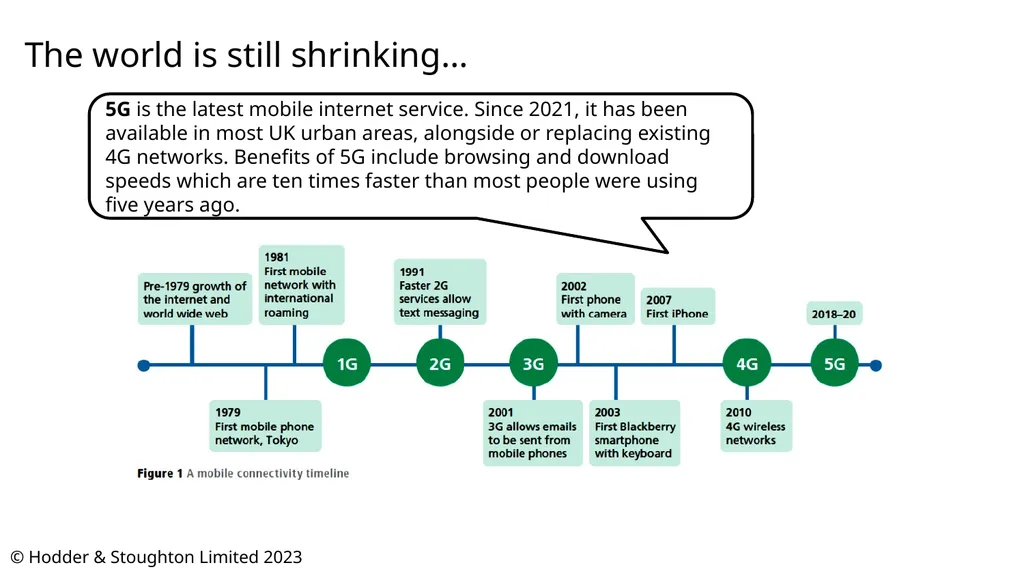
slide9. The world is still shrinking… 5G is the latest mobile internet service. Since 2021, it has been available in most UK urban areas, alongside or replacing existing 4G networks. Benefits of 5G include browsing and download speeds which are ten times faster than most people were using five years ago. © Hodder & Stoughton Limited 2023<br>
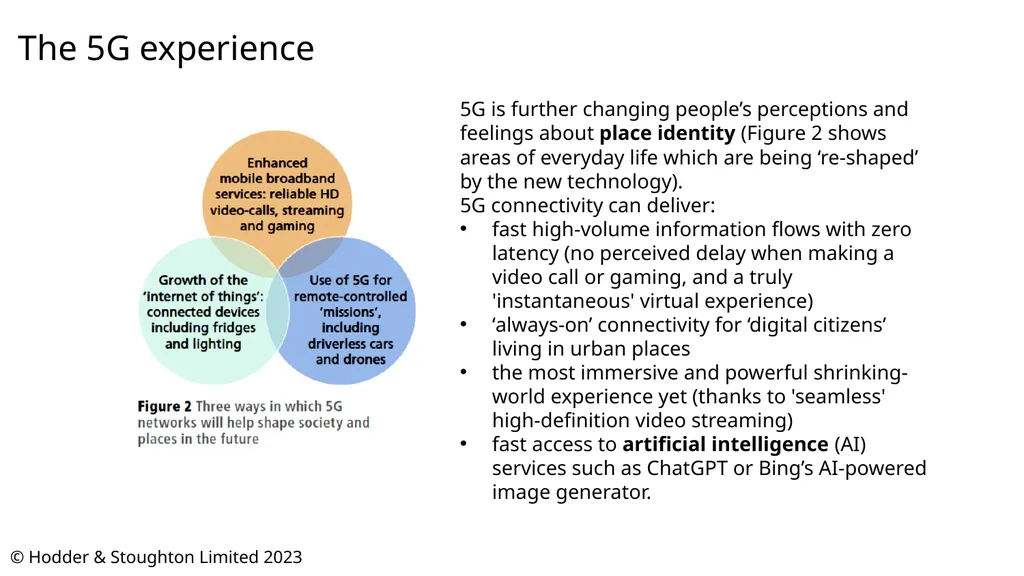
slide10. The 5G experience © Hodder & Stoughton Limited 2023 5G is further changing people’s perceptions and feelings about place identity (Figure 2 shows areas of everyday life which are being ‘re-shaped’ by the new technology).
5G connectivity can deliver:
fast high-volume information flows with zero latency (no perceived delay when making a video call or gaming, and a truly 'instantaneous' virtual experience)
‘always-on’ connectivity for ‘digital citizens’ living in urban places
the most immersive and powerful shrinking-world experience yet (thanks to 'seamless' high-definition video streaming)
fast access to artificial intelligence (AI) services such as ChatGPT or Bing’s AI-powered image generator.<br>
slide11. Plenary questions Think about all of your different A-level Geography topics. How have the places, societies and environments you have studied been affected by the arrival of super-fast 5G? What are the implications for hazards and disaster management, for example?
Shrinking-world technologies may bring economic growth and development but can also become a cause of injustice if some people are excluded from the new services. Will new digital divides be created by the arrival of technologies like 5G and AI? There are concerns that 5G will make cities ‘smarter’ while rural areas will be left behind as ‘not spots’ ('5G will primarily be an urban service for densely populated areas' according to a BBC News report).
Shrinking-world technology creates new risks for societies, notably increased vulnerability to cyber-attacks. In your assessment, are the potential costs worth the benefits created? © Hodder & Stoughton Limited 2023<br>
slide2. Key terms Do you know what these terms mean?
Click to reveal the definitions © Hodder & Stoughton Limited 2023<br>
slide3. © Hodder & Stoughton Limited 2023<br>
slide4. Geographical theories about the shrinking world In 1968, Donald Janelle analysed the ‘annihilation’ of distance by successive waves of transport innovation.
When railways replaced stagecoaches and canals in England, places were brought closer together in ‘time-space’.
Developments in transport and trade during the nineteenth century (notably railways, the telegraph and steamships) accelerated in the twentieth century with the arrival of jet aircraft. This graph shows ‘time-space convergence’ as demonstrated by the reduction in travel time between Edinburgh and London, 1658–1966. © Hodder & Stoughton Limited 2023<br>
slide5. Time-space compression This diagram illustrates the concept of time-space compression that appeared in geographer David Harvey’s 1989 book The Condition of Postmodernity.
Successive rounds of technological and transport innovation have chipped away minutes, hours and days from the time it takes to travel to other places or communicate with people in distant countries, including circumnavigation of the world.
Time–space compression often occurs as a result of technological innovations: the twenty-first century’s deeply interconnected communications systems depend on highly sophisticated technologies supported by global networks of fibre optic cables. © Hodder & Stoughton Limited 2023<br>
slide6. Global flows in a shrinking world This table shows how the shrinking world effect can be analysed by looking sequentially at the acceleration over time of different types of global flow.
Can you think of any additional illustrations? © Hodder & Stoughton Limited 2023<br>
slide7. Why does the world keep shrinking? Large technology transnational corporations (TNCs) keep creating ever-faster and more powerful digital technologies, including phones.
The cause of this constant innovation is a feedback loop driven by markets.
Each ‘round’ of new innovation helps deliver an even more intense ‘shrinking world’ place perception. © Hodder & Stoughton Limited 2023<br>
slide8. The perception divide Remember not everybody experiences the same sense of a shrinking world.
The geographer Doreen Massey was critical of writing that implies global travel is a routine experience for all people.
While the majority of people in the continent of Africa have access to mobile phones, many still do not use them to access the internet (and the shrinking-world feelings it generates). Analyse this graph for evidence that the world’s people experience a shrinking world. How far do the data support this view? © Hodder & Stoughton Limited 2023<br>
slide9. The world is still shrinking… 5G is the latest mobile internet service. Since 2021, it has been available in most UK urban areas, alongside or replacing existing 4G networks. Benefits of 5G include browsing and download speeds which are ten times faster than most people were using five years ago. © Hodder & Stoughton Limited 2023<br>
slide10. The 5G experience © Hodder & Stoughton Limited 2023 5G is further changing people’s perceptions and feelings about place identity (Figure 2 shows areas of everyday life which are being ‘re-shaped’ by the new technology).
5G connectivity can deliver:
fast high-volume information flows with zero latency (no perceived delay when making a video call or gaming, and a truly 'instantaneous' virtual experience)
‘always-on’ connectivity for ‘digital citizens’ living in urban places
the most immersive and powerful shrinking-world experience yet (thanks to 'seamless' high-definition video streaming)
fast access to artificial intelligence (AI) services such as ChatGPT or Bing’s AI-powered image generator.<br>
slide11. Plenary questions Think about all of your different A-level Geography topics. How have the places, societies and environments you have studied been affected by the arrival of super-fast 5G? What are the implications for hazards and disaster management, for example?
Shrinking-world technologies may bring economic growth and development but can also become a cause of injustice if some people are excluded from the new services. Will new digital divides be created by the arrival of technologies like 5G and AI? There are concerns that 5G will make cities ‘smarter’ while rural areas will be left behind as ‘not spots’ ('5G will primarily be an urban service for densely populated areas' according to a BBC News report).
Shrinking-world technology creates new risks for societies, notably increased vulnerability to cyber-attacks. In your assessment, are the potential costs worth the benefits created? © Hodder & Stoughton Limited 2023<br>