The Structure of Agents Simple reflex agents Model-based reflex agents Four basic types embody the principles underlying almost all intelligent systems: Goal-based agents Utility-based agents All of them can be converted into
"The Structure of Agents Simple reflex agents" is the property of its rightful owner. Permission is granted to
download and print the materials on this website for personal, non-commercial use only, and to display it
on your personal computer provided you do not modify the materials and that you retain all copyright
notices contained in the materials. By downloading content from our website, you accept the terms of this
agreement.
Presentation Transcript
01
The Structure of Agents Simple reflex agents Model-based reflex agents Four basic types embody the principles underlying almost all
intelligent systems: Goal-based agents Utility-based agents All of them can be converted into Learning-based agents Lecture notes for Principles of Artificial Intelligence (COMS 4720/5720)
Yan-Bin Jia, Iowa State University * Figures are from the textbook site (or drawn by the instructor) unless the source is specifically cited.<br>
02
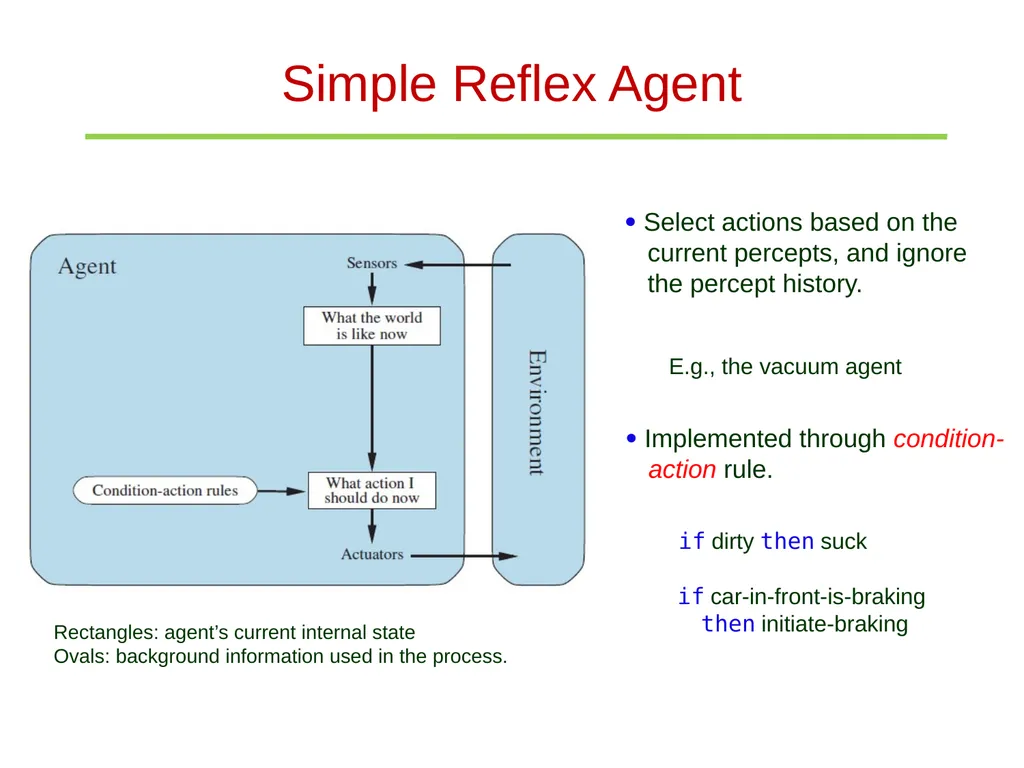
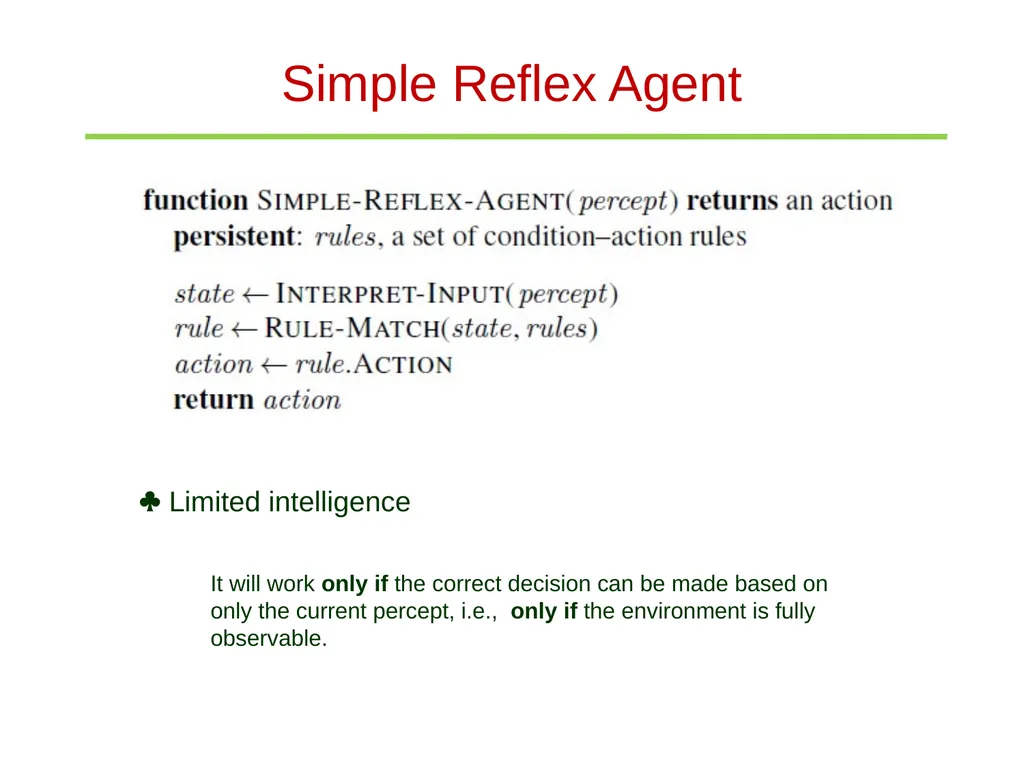
Simple Reflex Agent Rectangles: agent’s current internal state
Ovals: background information used in the process. Select actions based on the
current percepts, and ignore
the percept history. E.g., the vacuum agent Implemented through condition-
action rule. if dirty then suck if car-in-front-is-braking
then initiate-braking<br>
03
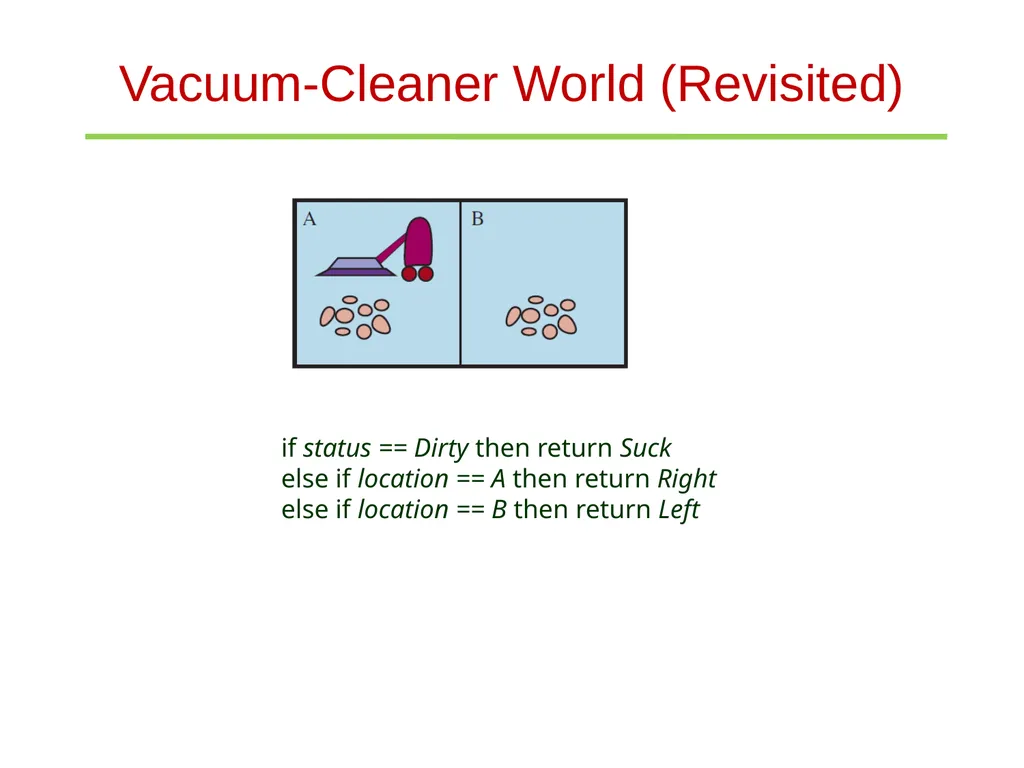
Vacuum-Cleaner World (Revisited) if status == Dirty then return Suck
else if location == A then return Right
else if location == B then return Left<br>
04
Simple Reflex Agent Limited intelligence It will work only if the correct decision can be made based on
only the current percept, i.e., only if the environment is fully
observable.<br>
05
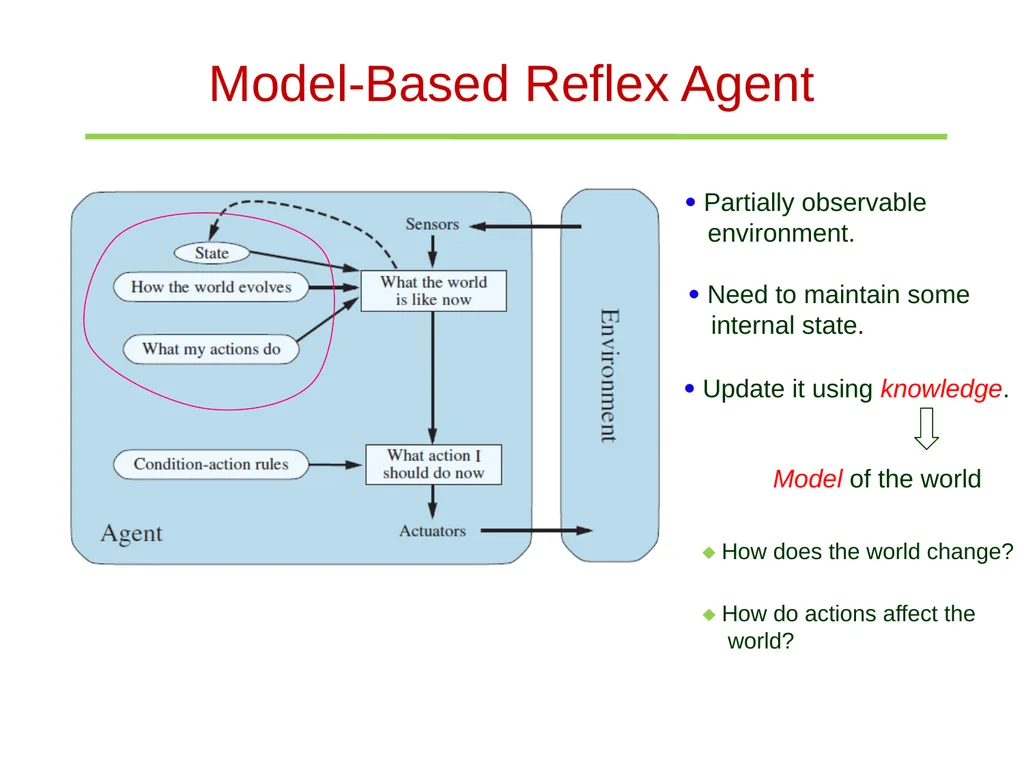
Model-Based Reflex Agent Partially observable
environment. Need to maintain some
internal state. Update it using knowledge. How does the world change? How do actions affect the
world? Model of the world<br>
06
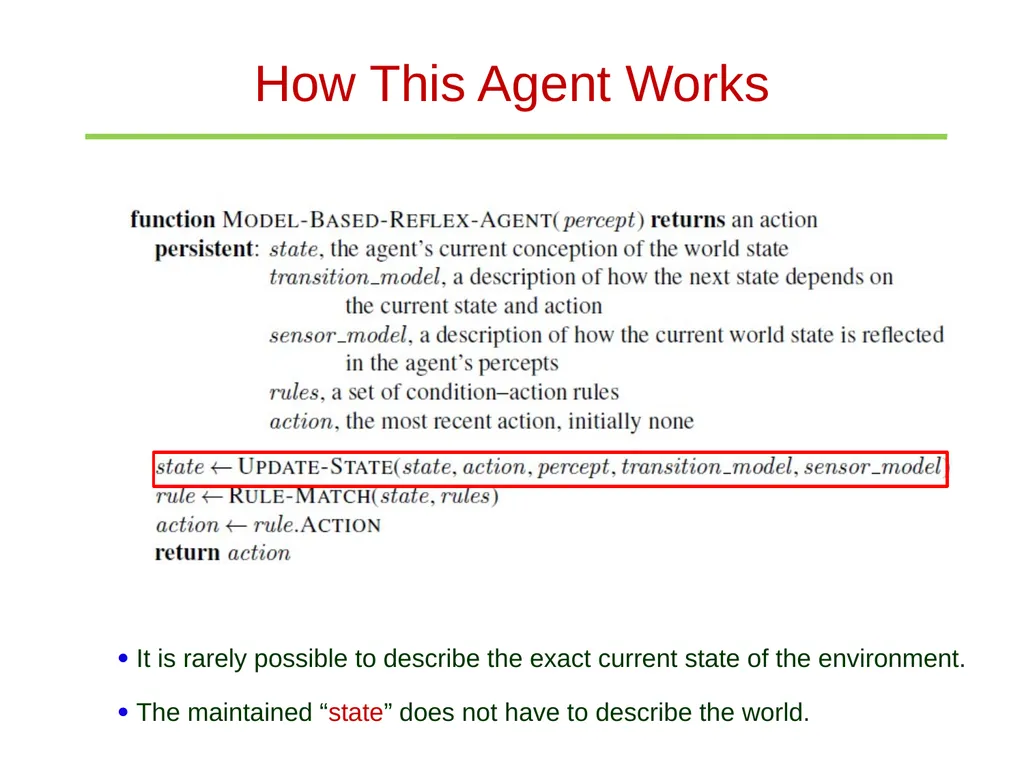
How This Agent Works It is rarely possible to describe the exact current state of the environment. The maintained “state” does not have to describe the world.<br>
07
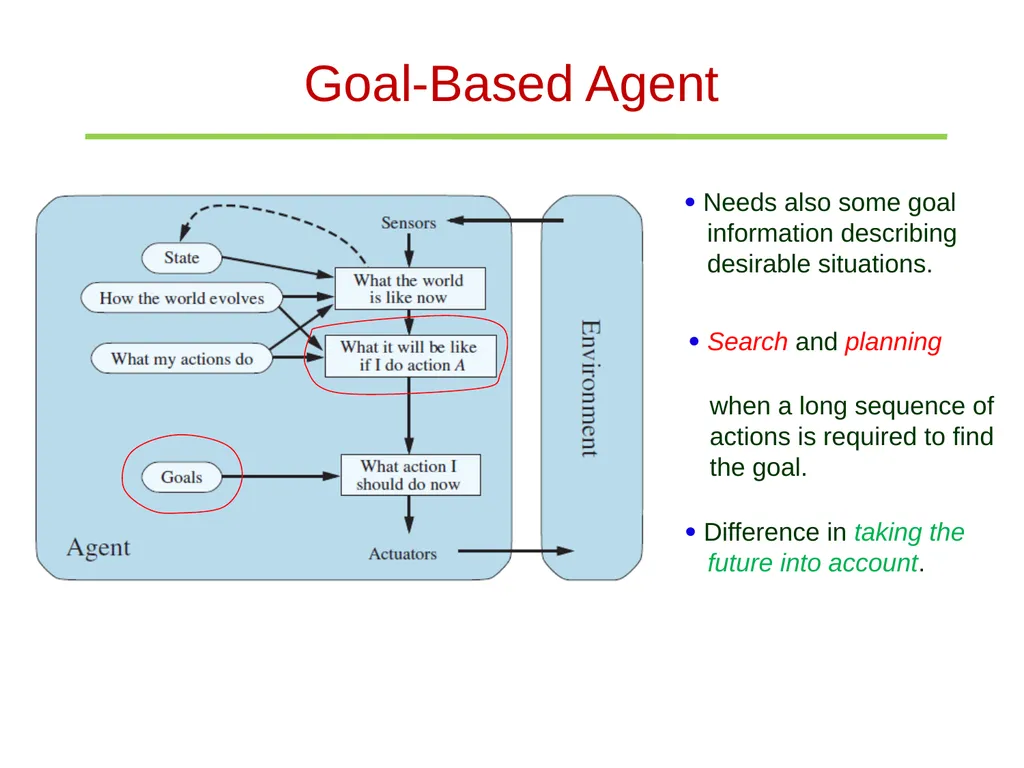
Goal-Based Agent Needs also some goal
information describing
desirable situations. Search and planning when a long sequence of actions is required to find the goal. Difference in taking the
future into account.<br>
08
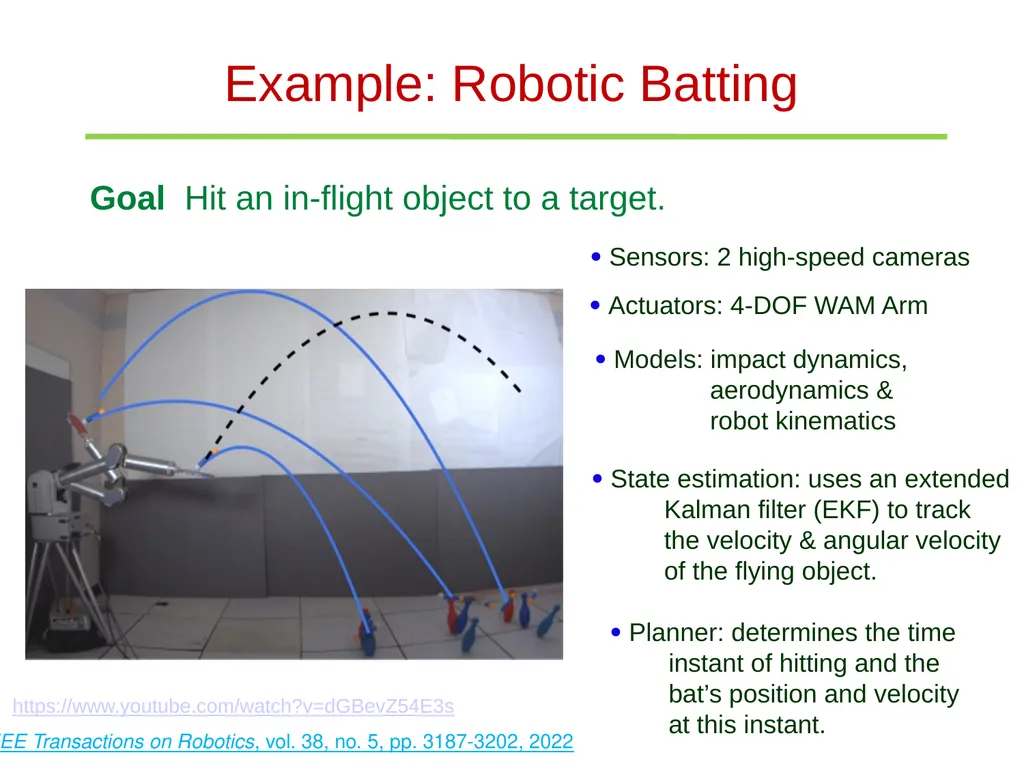
Example: Robotic Batting Goal Hit an in-flight object to a target. Models: impact dynamics,
aerodynamics &
robot kinematics State estimation: uses an extended
Kalman filter (EKF) to track
the velocity & angular velocity
of the flying object. Planner: determines the time
instant of hitting and the
bat’s position and velocity
at this instant. Sensors: 2 high-speed cameras Actuators: 4-DOF WAM Arm IEEE Transactions on Robotics, vol. 38, no. 5, pp. 3187-3202, 2022 https://www.youtube.com/watch?v=dGBevZ54E3s<br>
09
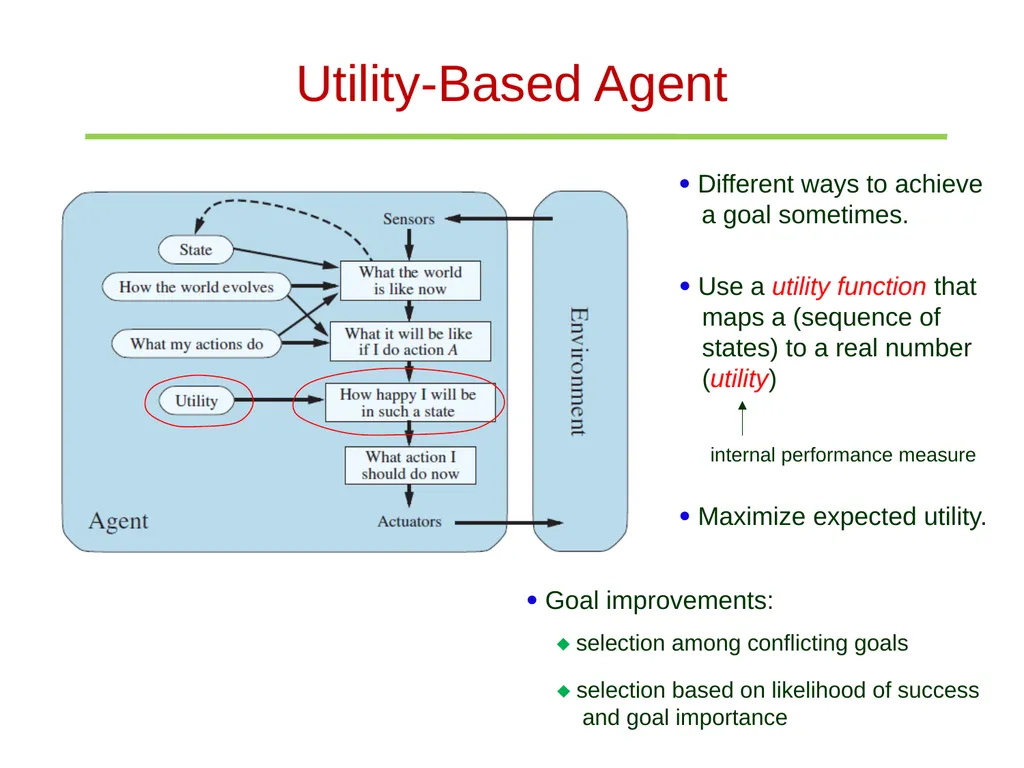
Utility-Based Agent Different ways to achieve
a goal sometimes. Use a utility function that
maps a (sequence of
states) to a real number
(utility) internal performance measure Maximize expected utility. Goal improvements: selection among conflicting goals selection based on likelihood of success
and goal importance<br>
10
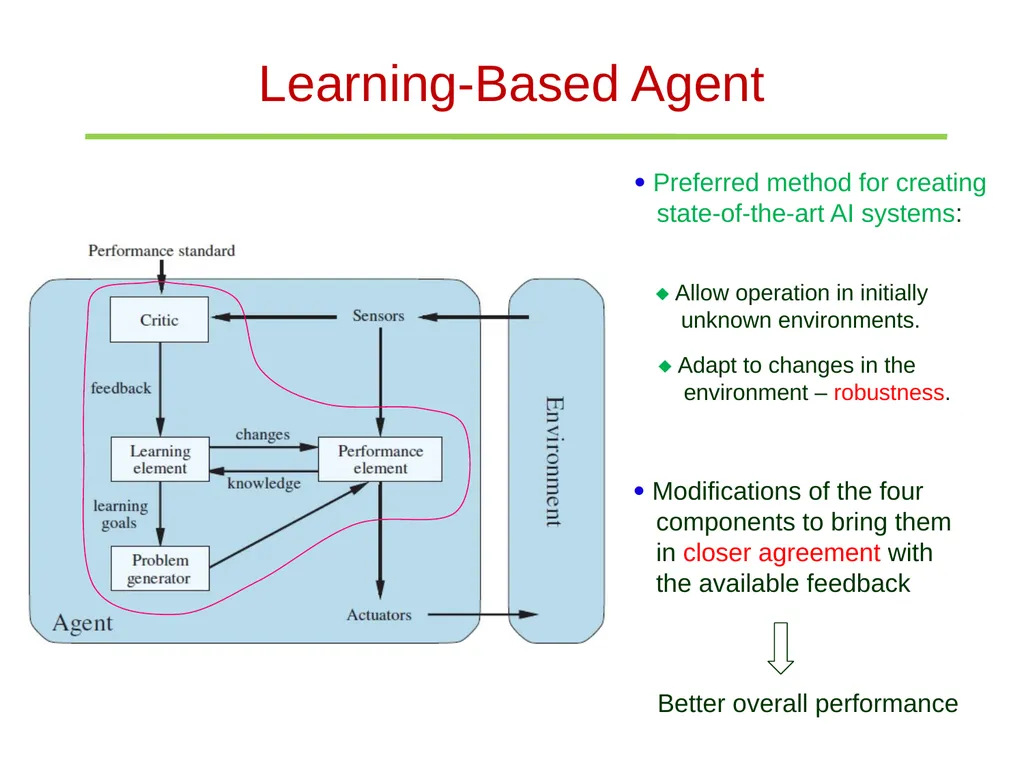
Learning-Based Agent Preferred method for creating
state-of-the-art AI systems: Allow operation in initially
unknown environments. Adapt to changes in the
environment – robustness. Modifications of the four
components to bring them
in closer agreement with
the available feedback Better overall performance<br>
11
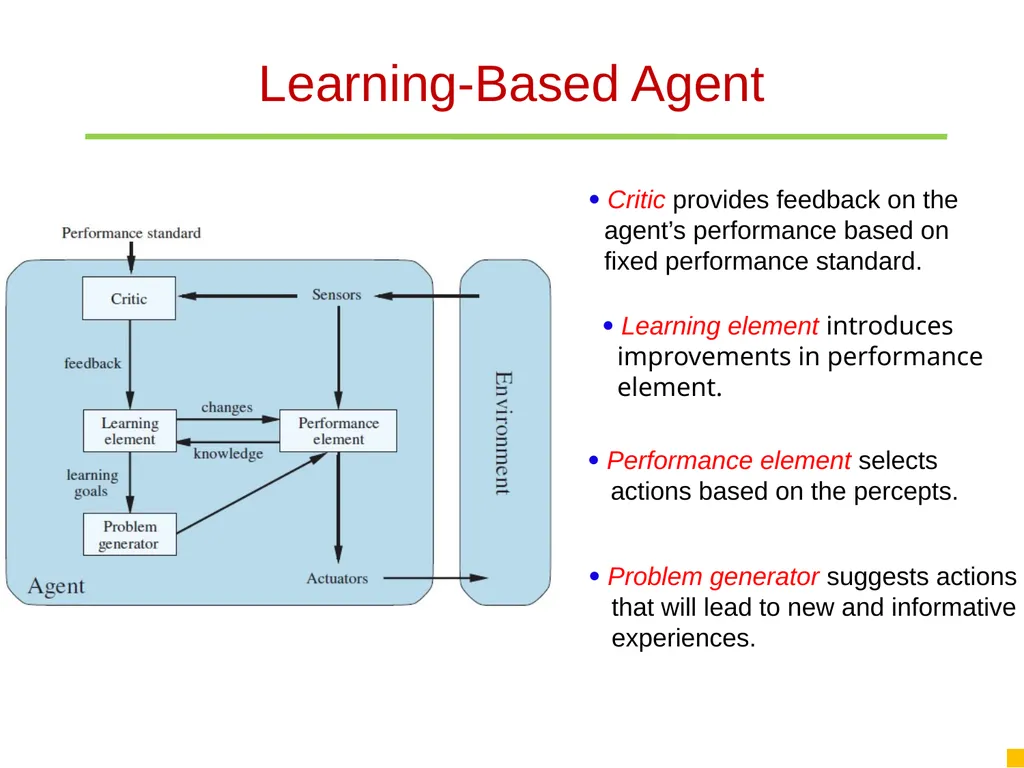
Learning-Based Agent Learning element introduces
improvements in performance
element. Critic provides feedback on the
agent’s performance based on
fixed performance standard. Performance element selects
actions based on the percepts. Problem generator suggests actions
that will lead to new and informative
experiences.<br>