
The Switch to Tenecteplase (TNK) for Thrombolysis



Description: The Switch to Tenecteplase (TNK) for Thrombolysis in Stroke May 2024 Objectives Share evidence for switch to tenecteplase (TNK) from alteplase (tPA) for thrombolysis in stroke Review the benefits and risks of TNK Review reconstitution and
Related Topics
Download Presentation
"The Switch to Tenecteplase (TNK) for Thrombolysis" is the property of its rightful owner. Permission is granted to download and print the materials on this website for personal, non-commercial use only, and to display it on your personal computer provided you do not modify the materials and that you retain all copyright notices contained in the materials. By downloading content from our website, you accept the terms of this agreement.
Presentation Transcript
slide1. The Switch to Tenecteplase (TNK)
for Thrombolysis in Stroke May 2024<br>
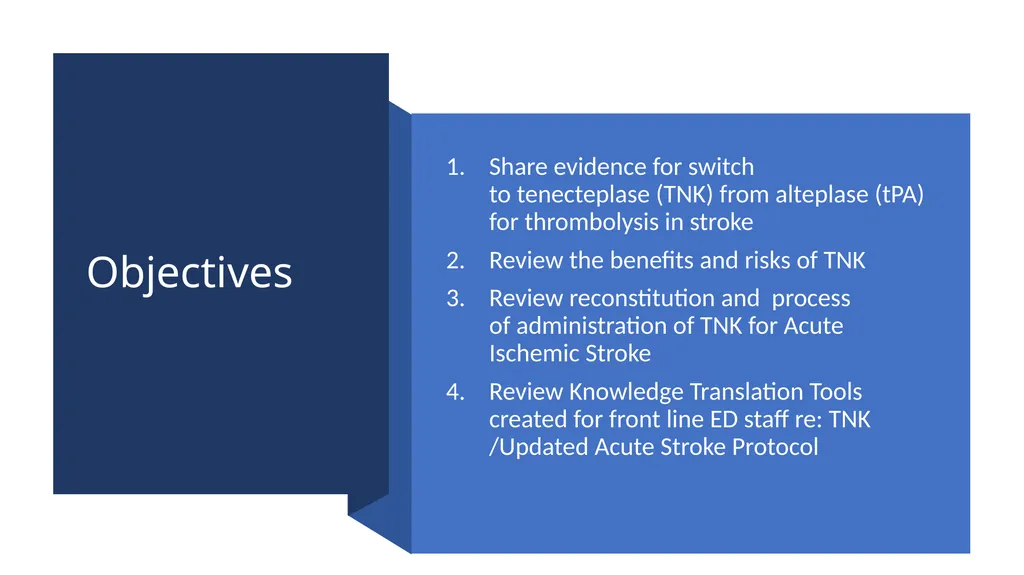
slide2. Objectives Share evidence for switch to tenecteplase (TNK) from alteplase (tPA) for thrombolysis in stroke
Review the benefits and risks of TNK
Review reconstitution and process of administration of TNK for Acute Ischemic Stroke
Review Knowledge Translation Tools created for front line ED staff re: TNK /Updated Acute Stroke Protocol<br>
slide3. Where’s the evidence for the switch? The AcT trial is a Canadian, multicentre, open-label, parallel, randomized, controlled trial that showed that TNK is non-inferior to tPA for thrombolysis in stroke. “Intravenous tenecteplase (0·25 mg/kg) is a reasonable alternative to alteplase for all patients presenting with acute ischaemic stroke who meet standard criteria for thrombolysis.”<br>
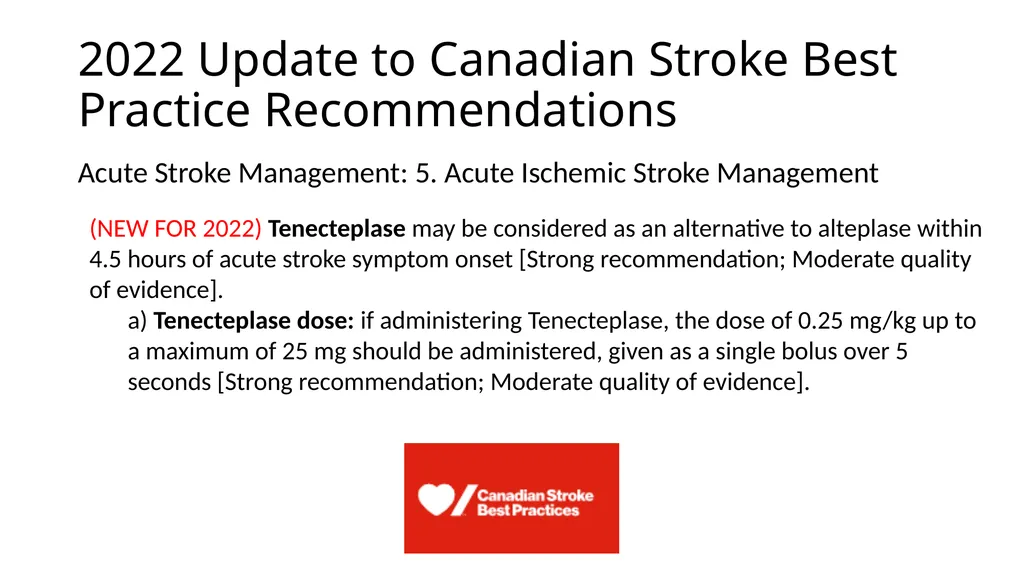
slide4. 2022 Update to Canadian Stroke Best Practice Recommendations Acute Stroke Management: 5. Acute Ischemic Stroke Management (NEW FOR 2022) Tenecteplase may be considered as an alternative to alteplase within 4.5 hours of acute stroke symptom onset [Strong recommendation; Moderate quality of evidence].
a) Tenecteplase dose: if administering Tenecteplase, the dose of 0.25 mg/kg up to a maximum of 25 mg should be administered, given as a single bolus over 5 seconds [Strong recommendation; Moderate quality of evidence].<br>
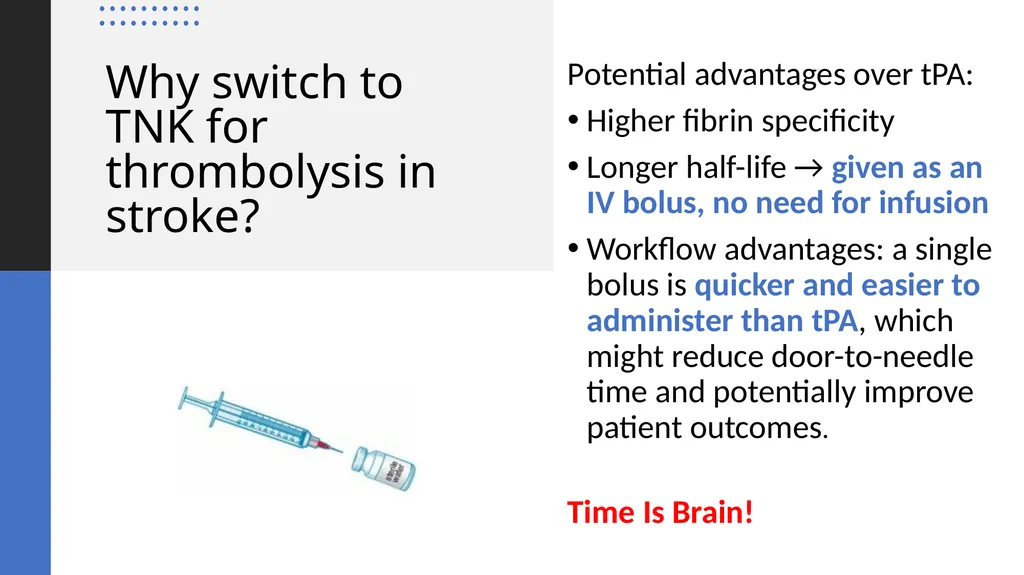
slide5. Why switch to TNK for thrombolysis in stroke? Potential advantages over tPA:
Higher fibrin specificity
Longer half-life → given as an IV bolus, no need for infusion
Workflow advantages: a single bolus is quicker and easier to administer than tPA, which might reduce door-to-needle time and potentially improve patient outcomes.
Time Is Brain!<br>
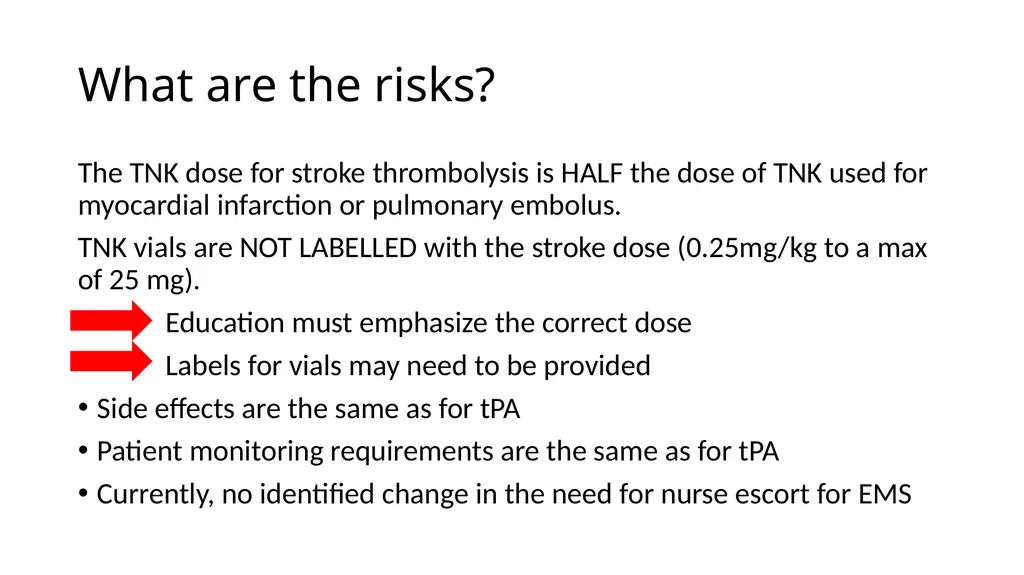
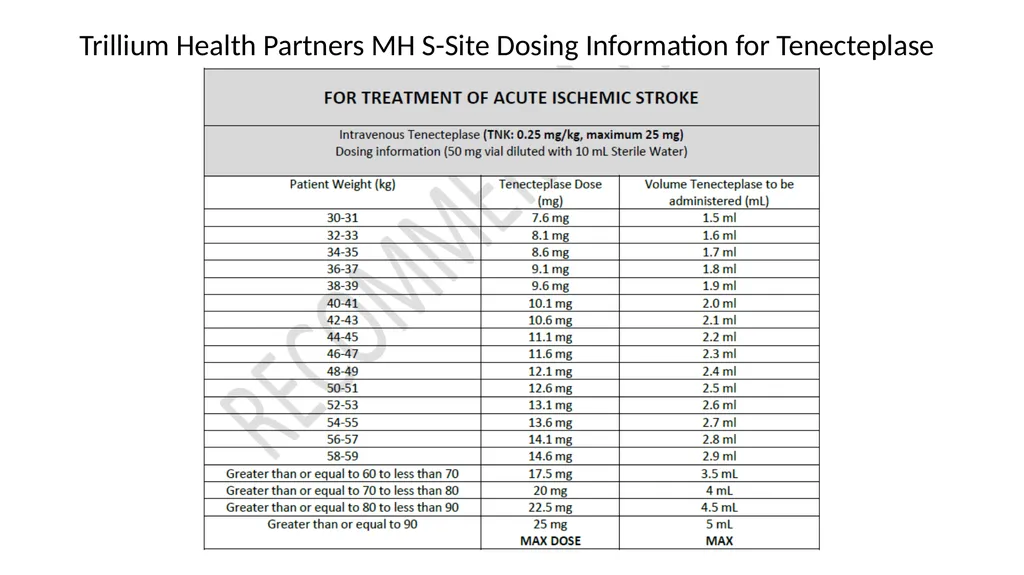
slide6. What are the risks? The TNK dose for stroke thrombolysis is HALF the dose of TNK used for myocardial infarction or pulmonary embolus.
TNK vials are NOT LABELLED with the stroke dose (0.25mg/kg to a max of 25 mg).
Education must emphasize the correct dose
Labels for vials may need to be provided
Side effects are the same as for tPA
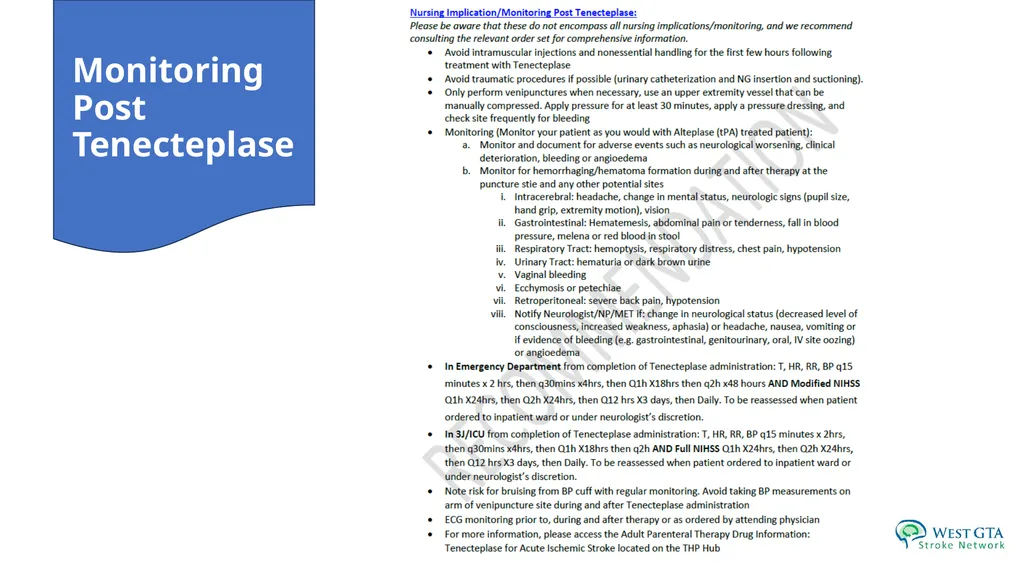
Patient monitoring requirements are the same as for tPA
Currently, no identified change in the need for nurse escort for EMS<br>
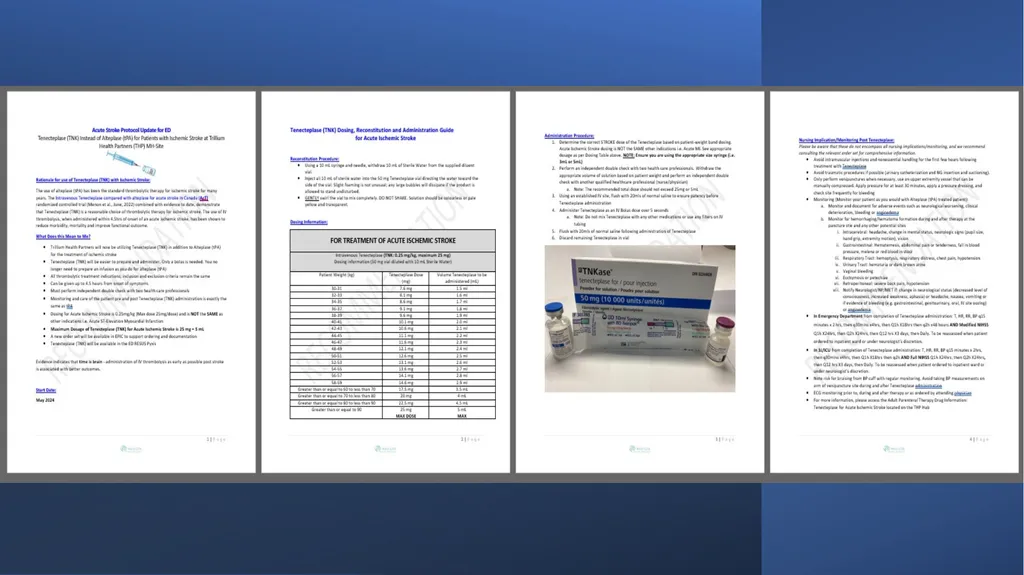
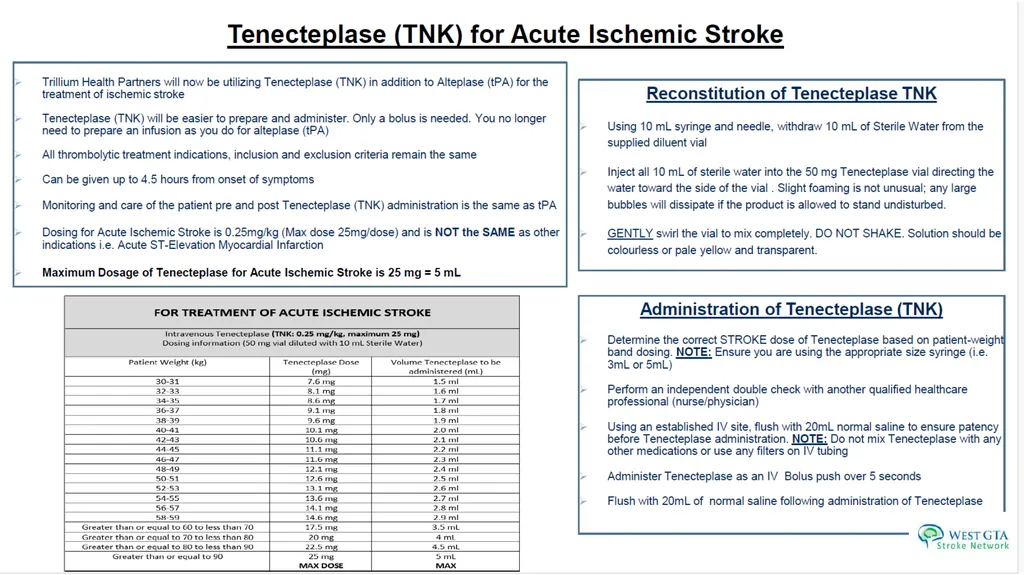
slide7. Trillium Health Partners MH S-Site Dosing Information for Tenecteplase<br>
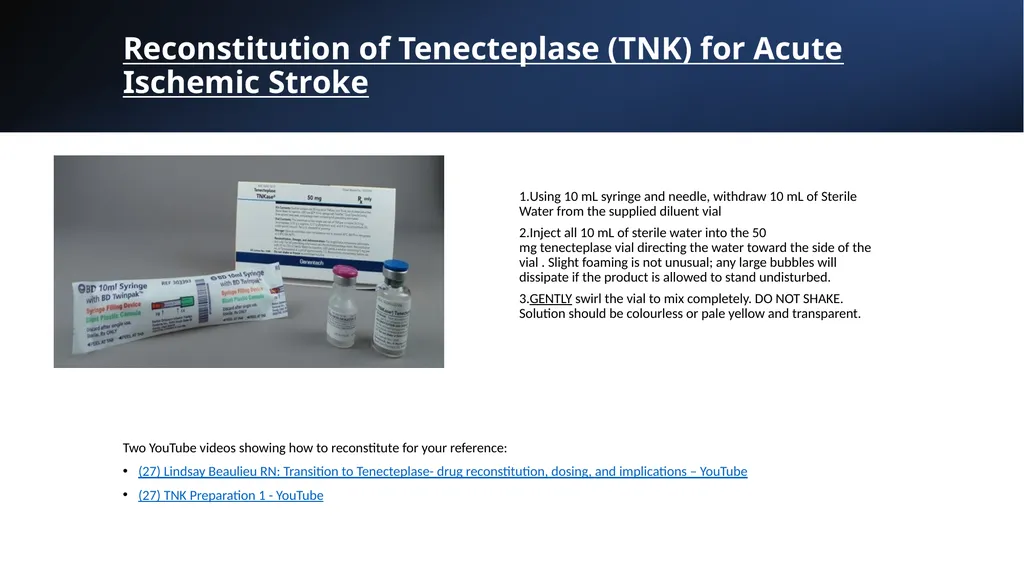
slide8. Reconstitution of Tenecteplase (TNK) for Acute Ischemic Stroke Using 10 mL syringe and needle, withdraw 10 mL of Sterile Water from the supplied diluent vial
Inject all 10 mL of sterile water into the 50 mg tenecteplase vial directing the water toward the side of the vial . Slight foaming is not unusual; any large bubbles will dissipate if the product is allowed to stand undisturbed.
GENTLY swirl the vial to mix completely. DO NOT SHAKE. Solution should be colourless or pale yellow and transparent. Two YouTube videos showing how to reconstitute for your reference:
(27) Lindsay Beaulieu RN: Transition to Tenecteplase- drug reconstitution, dosing, and implications – YouTube
(27) TNK Preparation 1 - YouTube<br>
slide9. Administration Instructions for Tenecteplase (TNK) Administration of TNK
Max dosing for TNK in stroke patients is 25mg or 5mL
Stroke dosing is different from cardiac dosing
Nurses/Physicians are to reconstitute the medication and draw up the correct dose to be administered *ensure you are using the appropriate size syringe (i.e. 3ml or 5ml)
Perform an independent double check with nurse/physician
Physician/nurse will ensure IV line is patent by flushing with 20ml Normal Saline prior to administering, then administer the medication IV push over 5 seconds, then flush IV line again with 20ml Normal Saline to ensure no medication remains in line.
Discard syringe with needle and remaining TNK in vial
NOTE: Do not mix Tenecteplase with any other medications or use any filters on IV tubing<br>
slide10. Monitoring Post Tenecteplase<br>
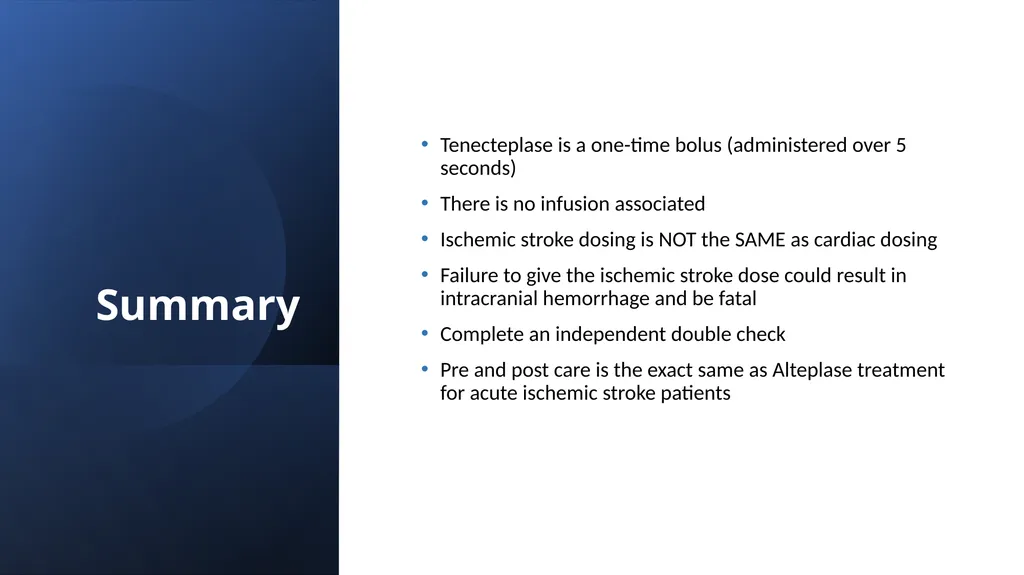
slide13. Summary Tenecteplase is a one-time bolus (administered over 5 seconds)
There is no infusion associated
Ischemic stroke dosing is NOT the SAME as cardiac dosing
Failure to give the ischemic stroke dose could result in intracranial hemorrhage and be fatal
Complete an independent double check
Pre and post care is the exact same as Alteplase treatment for acute ischemic stroke patients<br>
slide2. Objectives Share evidence for switch to tenecteplase (TNK) from alteplase (tPA) for thrombolysis in stroke
Review the benefits and risks of TNK
Review reconstitution and process of administration of TNK for Acute Ischemic Stroke
Review Knowledge Translation Tools created for front line ED staff re: TNK /Updated Acute Stroke Protocol<br>
slide3. Where’s the evidence for the switch? The AcT trial is a Canadian, multicentre, open-label, parallel, randomized, controlled trial that showed that TNK is non-inferior to tPA for thrombolysis in stroke. “Intravenous tenecteplase (0·25 mg/kg) is a reasonable alternative to alteplase for all patients presenting with acute ischaemic stroke who meet standard criteria for thrombolysis.”<br>
slide4. 2022 Update to Canadian Stroke Best Practice Recommendations Acute Stroke Management: 5. Acute Ischemic Stroke Management (NEW FOR 2022) Tenecteplase may be considered as an alternative to alteplase within 4.5 hours of acute stroke symptom onset [Strong recommendation; Moderate quality of evidence].
a) Tenecteplase dose: if administering Tenecteplase, the dose of 0.25 mg/kg up to a maximum of 25 mg should be administered, given as a single bolus over 5 seconds [Strong recommendation; Moderate quality of evidence].<br>
slide5. Why switch to TNK for thrombolysis in stroke? Potential advantages over tPA:
Higher fibrin specificity
Longer half-life → given as an IV bolus, no need for infusion
Workflow advantages: a single bolus is quicker and easier to administer than tPA, which might reduce door-to-needle time and potentially improve patient outcomes.
Time Is Brain!<br>
slide6. What are the risks? The TNK dose for stroke thrombolysis is HALF the dose of TNK used for myocardial infarction or pulmonary embolus.
TNK vials are NOT LABELLED with the stroke dose (0.25mg/kg to a max of 25 mg).
Education must emphasize the correct dose
Labels for vials may need to be provided
Side effects are the same as for tPA
Patient monitoring requirements are the same as for tPA
Currently, no identified change in the need for nurse escort for EMS<br>
slide7. Trillium Health Partners MH S-Site Dosing Information for Tenecteplase<br>
slide8. Reconstitution of Tenecteplase (TNK) for Acute Ischemic Stroke Using 10 mL syringe and needle, withdraw 10 mL of Sterile Water from the supplied diluent vial
Inject all 10 mL of sterile water into the 50 mg tenecteplase vial directing the water toward the side of the vial . Slight foaming is not unusual; any large bubbles will dissipate if the product is allowed to stand undisturbed.
GENTLY swirl the vial to mix completely. DO NOT SHAKE. Solution should be colourless or pale yellow and transparent. Two YouTube videos showing how to reconstitute for your reference:
(27) Lindsay Beaulieu RN: Transition to Tenecteplase- drug reconstitution, dosing, and implications – YouTube
(27) TNK Preparation 1 - YouTube<br>
slide9. Administration Instructions for Tenecteplase (TNK) Administration of TNK
Max dosing for TNK in stroke patients is 25mg or 5mL
Stroke dosing is different from cardiac dosing
Nurses/Physicians are to reconstitute the medication and draw up the correct dose to be administered *ensure you are using the appropriate size syringe (i.e. 3ml or 5ml)
Perform an independent double check with nurse/physician
Physician/nurse will ensure IV line is patent by flushing with 20ml Normal Saline prior to administering, then administer the medication IV push over 5 seconds, then flush IV line again with 20ml Normal Saline to ensure no medication remains in line.
Discard syringe with needle and remaining TNK in vial
NOTE: Do not mix Tenecteplase with any other medications or use any filters on IV tubing<br>
slide10. Monitoring Post Tenecteplase<br>
slide13. Summary Tenecteplase is a one-time bolus (administered over 5 seconds)
There is no infusion associated
Ischemic stroke dosing is NOT the SAME as cardiac dosing
Failure to give the ischemic stroke dose could result in intracranial hemorrhage and be fatal
Complete an independent double check
Pre and post care is the exact same as Alteplase treatment for acute ischemic stroke patients<br>