
The Uniform Guidance Cost Principles Training Date
MY
Published · 74 slides · 0 views
1 / 1

Description
The Uniform Guidance Cost Principles Training Date Presented to Faculty and Support Staff The Basic Idea Agenda Introductions Background on the Uniform Guidance: Introduction to Sponsored Project Compliance, Overview and Institutional
Related Topics
Share
Embed code
Download this presentation From Below
"The Uniform Guidance Cost Principles Training Date" is the property of its rightful owner. Permission is granted to download and print the materials on this website for personal, non-commercial use only, and to display it on your personal computer provided you do not modify the materials and that you retain all copyright notices contained in the materials. By downloading content from our website, you accept the terms of this agreement.
Presentation Transcript
01
The Uniform Guidance Cost Principles Training Date Presented to Faculty and Support Staff<br>
02
The Basic Idea Agenda
Introductions
Background on the Uniform Guidance: Introduction to Sponsored Project Compliance, Overview and Institutional Impact
Cost Principles: Cost Principles, Cost Transfers
Processes
Roles and Responsibilities
Practice Activities
Key Takeaways
Resources
Outcome: After this training we expect that you have an understanding of the Uniform Guidance and the changes to the regulations for allowable charges, direct charging and cost transfer (aka transfers). You will know your responsibilities, and know where to find answers to any questions that may arise. Agenda and Outcomes<br>
Introductions
Background on the Uniform Guidance: Introduction to Sponsored Project Compliance, Overview and Institutional Impact
Cost Principles: Cost Principles, Cost Transfers
Processes
Roles and Responsibilities
Practice Activities
Key Takeaways
Resources
Outcome: After this training we expect that you have an understanding of the Uniform Guidance and the changes to the regulations for allowable charges, direct charging and cost transfer (aka transfers). You will know your responsibilities, and know where to find answers to any questions that may arise. Agenda and Outcomes<br>
03
1. Background on The Uniform Guidance<br>
04
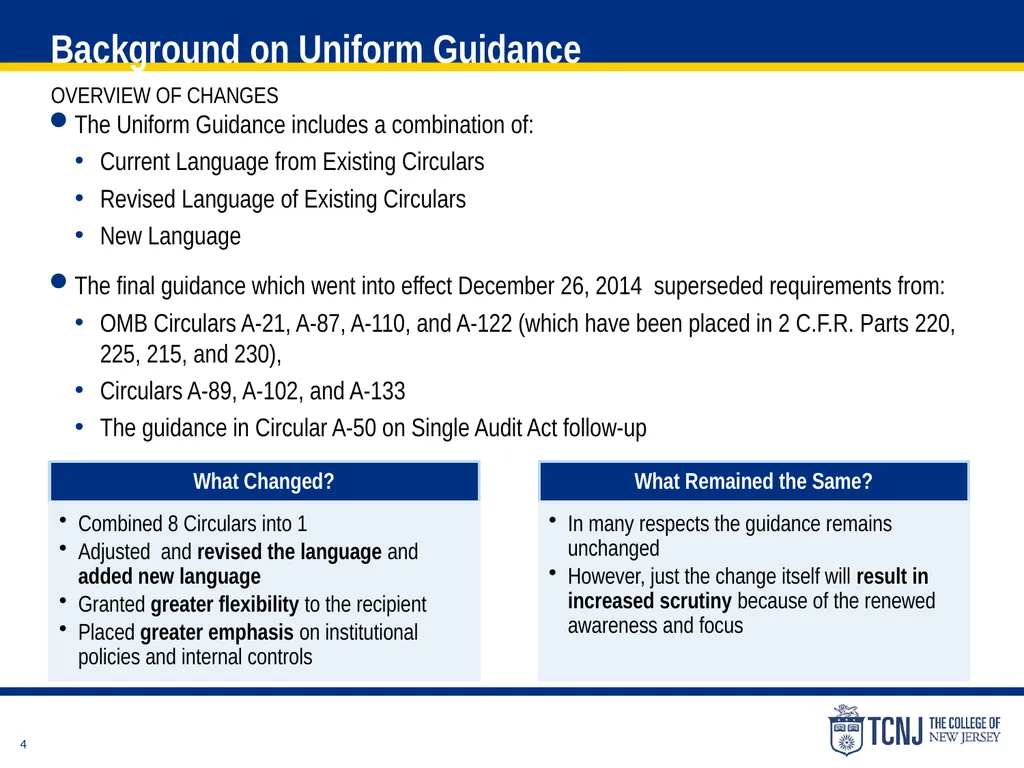
Background on Uniform Guidance Overview of Changes The Uniform Guidance includes a combination of:
Current Language from Existing Circulars
Revised Language of Existing Circulars
New Language
The final guidance which went into effect December 26, 2014 superseded requirements from:
OMB Circulars A-21, A-87, A-110, and A-122 (which have been placed in 2 C.F.R. Parts 220, 225, 215, and 230),
Circulars A-89, A-102, and A-133
The guidance in Circular A-50 on Single Audit Act follow-up<br>
Current Language from Existing Circulars
Revised Language of Existing Circulars
New Language
The final guidance which went into effect December 26, 2014 superseded requirements from:
OMB Circulars A-21, A-87, A-110, and A-122 (which have been placed in 2 C.F.R. Parts 220, 225, 215, and 230),
Circulars A-89, A-102, and A-133
The guidance in Circular A-50 on Single Audit Act follow-up<br>
05
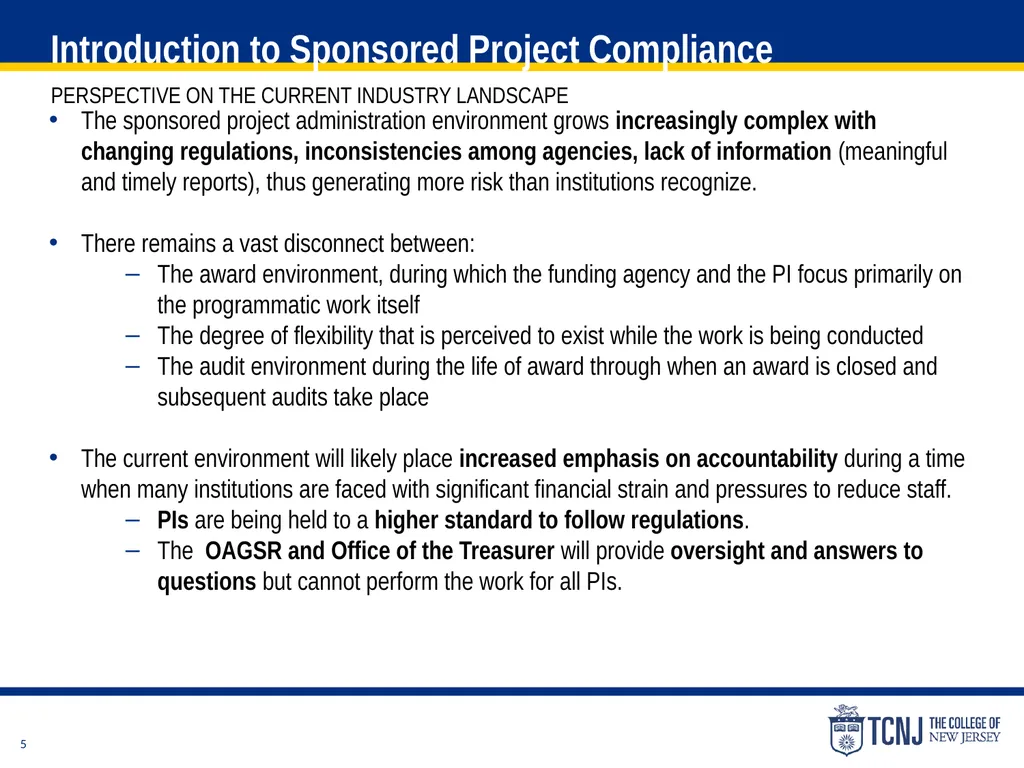
Introduction to Sponsored Project Compliance Perspective on the Current Industry Landscape The sponsored project administration environment grows increasingly complex with changing regulations, inconsistencies among agencies, lack of information (meaningful and timely reports), thus generating more risk than institutions recognize.
There remains a vast disconnect between:
The award environment, during which the funding agency and the PI focus primarily on the programmatic work itself
The degree of flexibility that is perceived to exist while the work is being conducted
The audit environment during the life of award through when an award is closed and subsequent audits take place
The current environment will likely place increased emphasis on accountability during a time when many institutions are faced with significant financial strain and pressures to reduce staff.
PIs are being held to a higher standard to follow regulations.
The OAGSR and Office of the Treasurer will provide oversight and answers to questions but cannot perform the work for all PIs.<br>
There remains a vast disconnect between:
The award environment, during which the funding agency and the PI focus primarily on the programmatic work itself
The degree of flexibility that is perceived to exist while the work is being conducted
The audit environment during the life of award through when an award is closed and subsequent audits take place
The current environment will likely place increased emphasis on accountability during a time when many institutions are faced with significant financial strain and pressures to reduce staff.
PIs are being held to a higher standard to follow regulations.
The OAGSR and Office of the Treasurer will provide oversight and answers to questions but cannot perform the work for all PIs.<br>
06
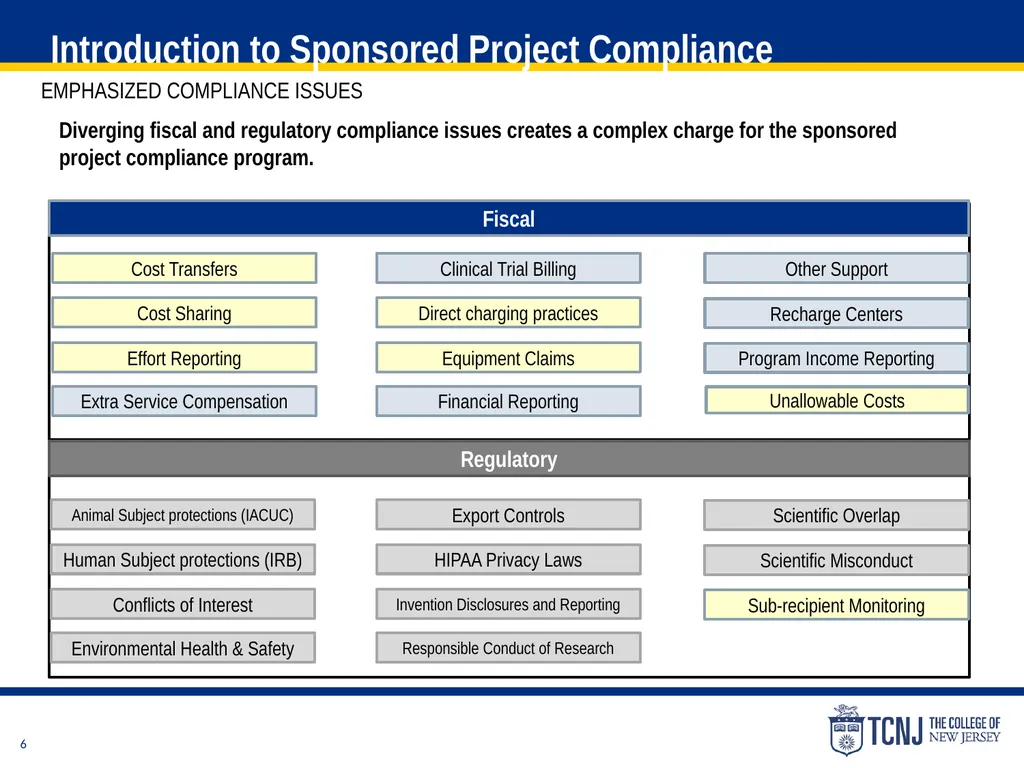
EMPHASIZED COMPLIANCE ISSUES Fiscal Regulatory Cost Transfers Clinical Trial Billing Cost Sharing Direct charging practices Effort Reporting Equipment Claims Extra Service Compensation Financial Reporting Other Support Program Income Reporting Recharge Centers Unallowable Costs Animal Subject protections (IACUC) Export Controls Human Subject protections (IRB) HIPAA Privacy Laws Conflicts of Interest Invention Disclosures and Reporting Environmental Health & Safety Responsible Conduct of Research Scientific Overlap Sub-recipient Monitoring Scientific Misconduct Introduction to Sponsored Project Compliance Diverging fiscal and regulatory compliance issues creates a complex charge for the sponsored project compliance program.<br>
07
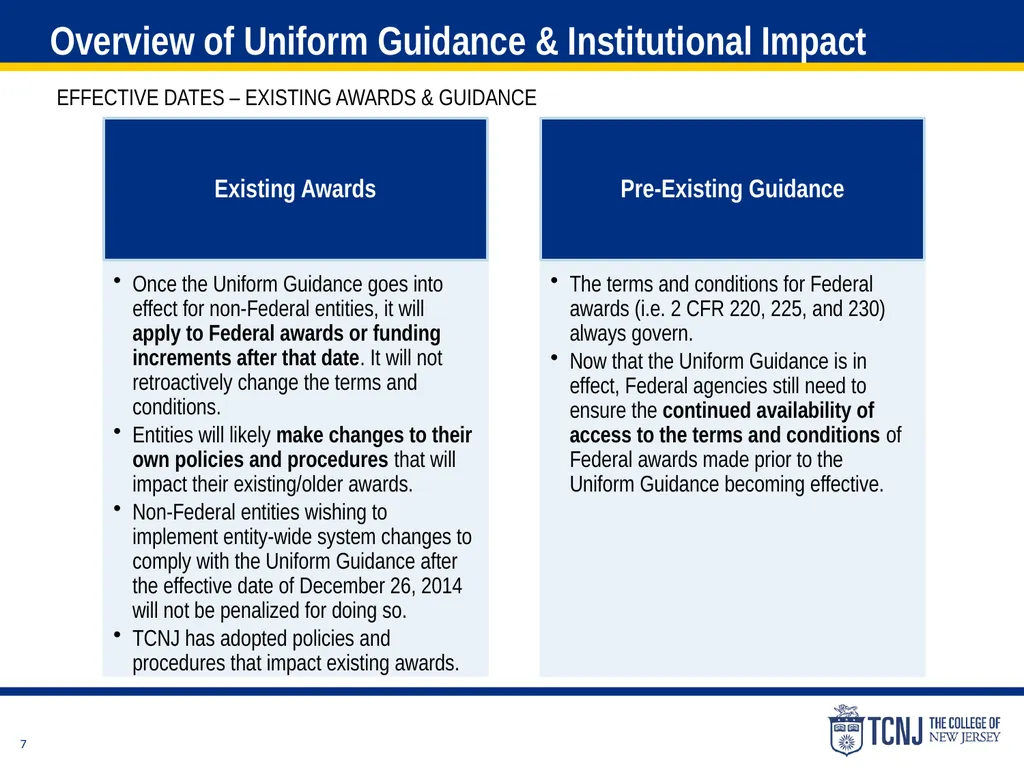
Overview of Uniform Guidance & Institutional Impact EFFECTIVE DATES – EXISTING AWARDS & GUIDANCE<br>
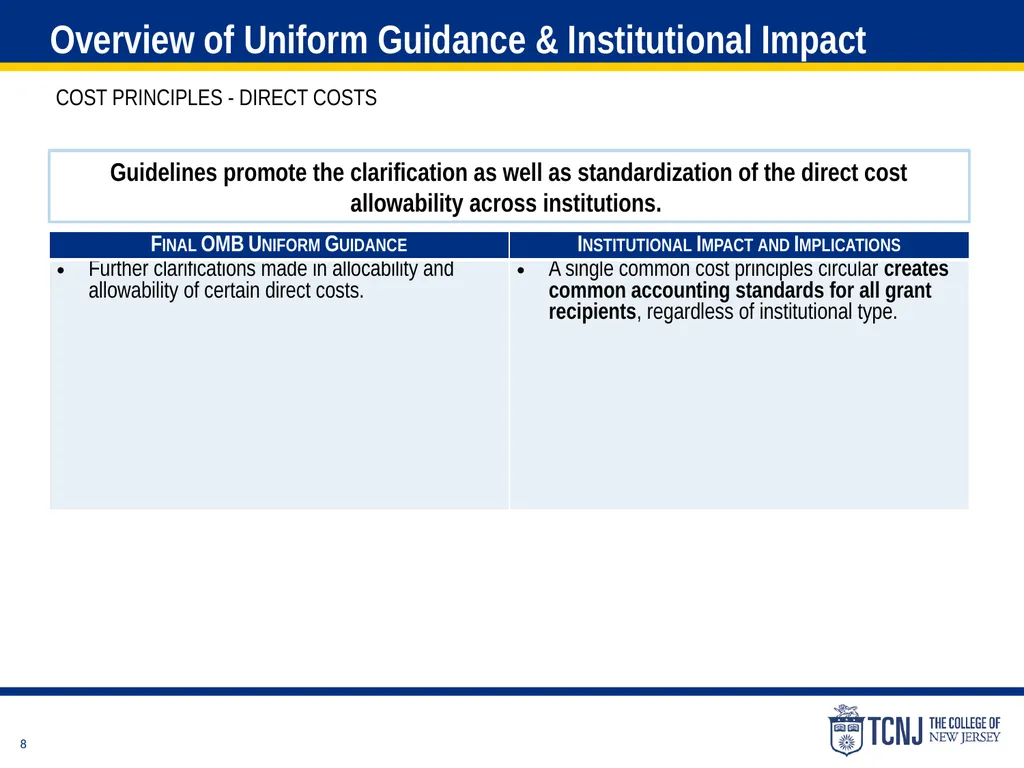
08
Overview of Uniform Guidance & Institutional Impact Cost principles - direct costs Guidelines promote the clarification as well as standardization of the direct cost allowability across institutions.<br>
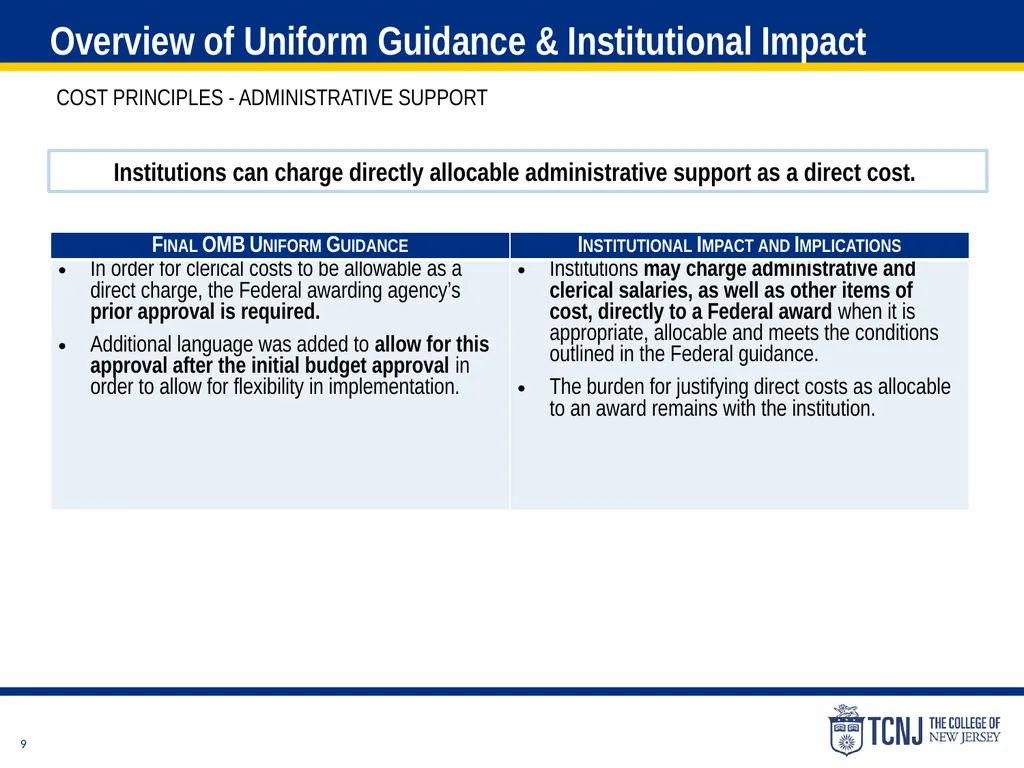
09
Overview of Uniform Guidance & Institutional Impact Cost principles - Administrative support Institutions can charge directly allocable administrative support as a direct cost.<br>
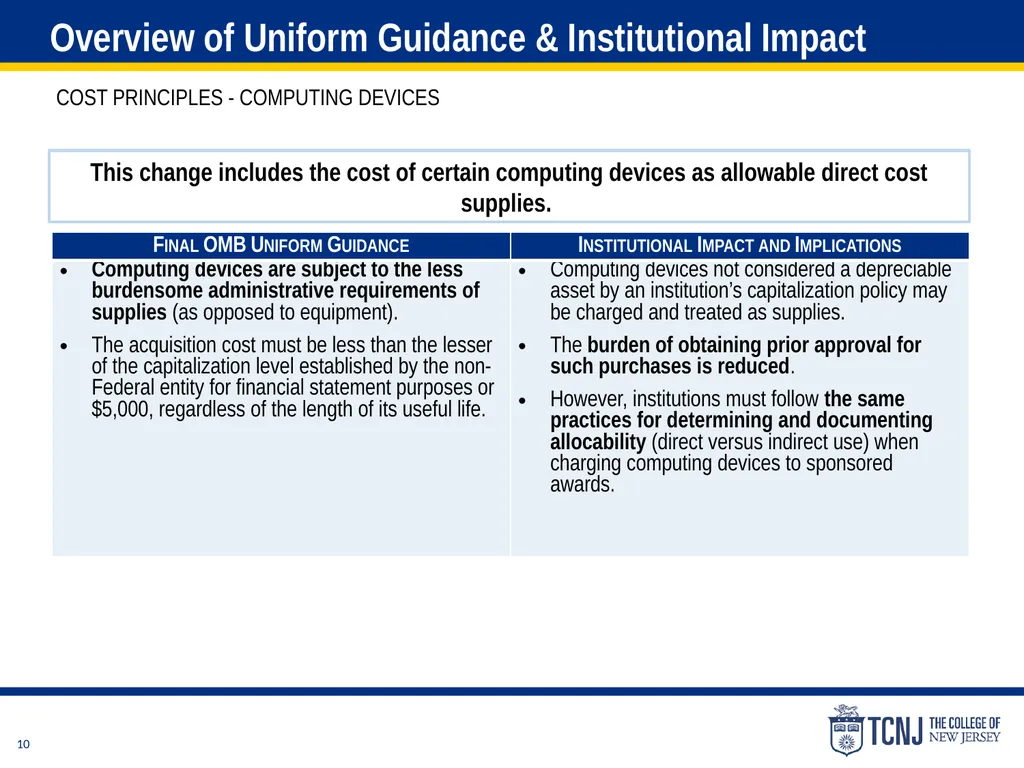
10
Overview of Uniform Guidance & Institutional Impact Cost principles - Computing devices This change includes the cost of certain computing devices as allowable direct cost supplies.<br>
11
2. Cost Principles<br>
12
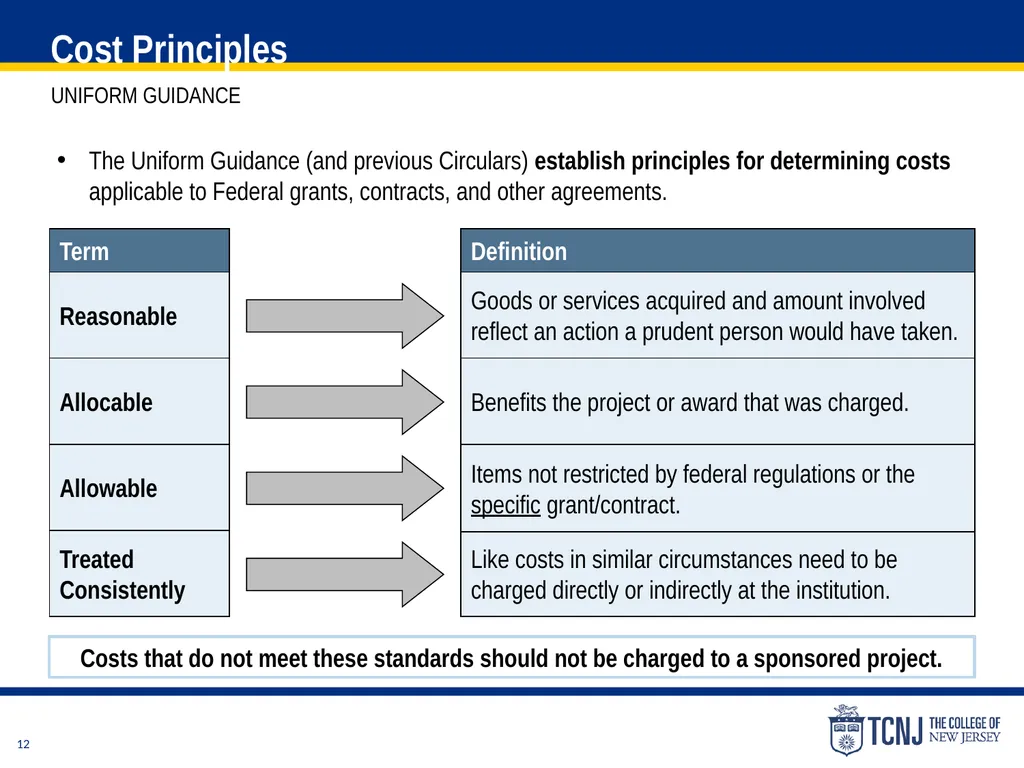
Cost Principles Uniform Guidance Costs that do not meet these standards should not be charged to a sponsored project. The Uniform Guidance (and previous Circulars) establish principles for determining costs applicable to Federal grants, contracts, and other agreements.<br>
13
Cost Principles Cost Accounting Standards and Sponsored Project Costs<br>
14
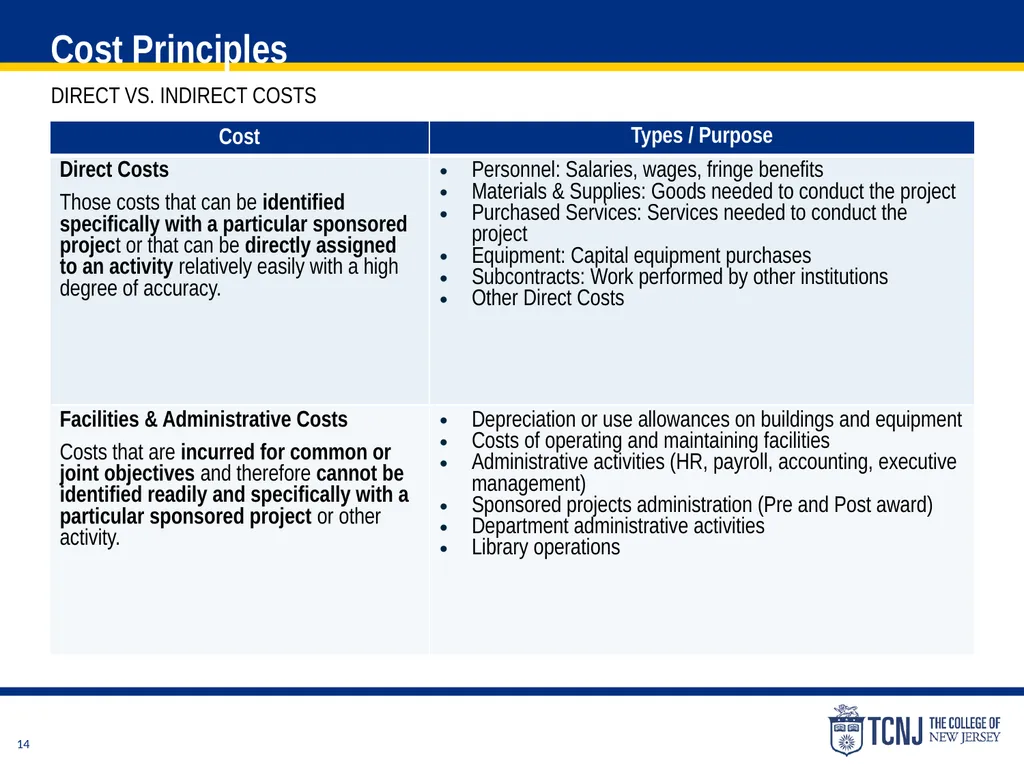
Cost Principles Direct vs. Indirect Costs<br>
15
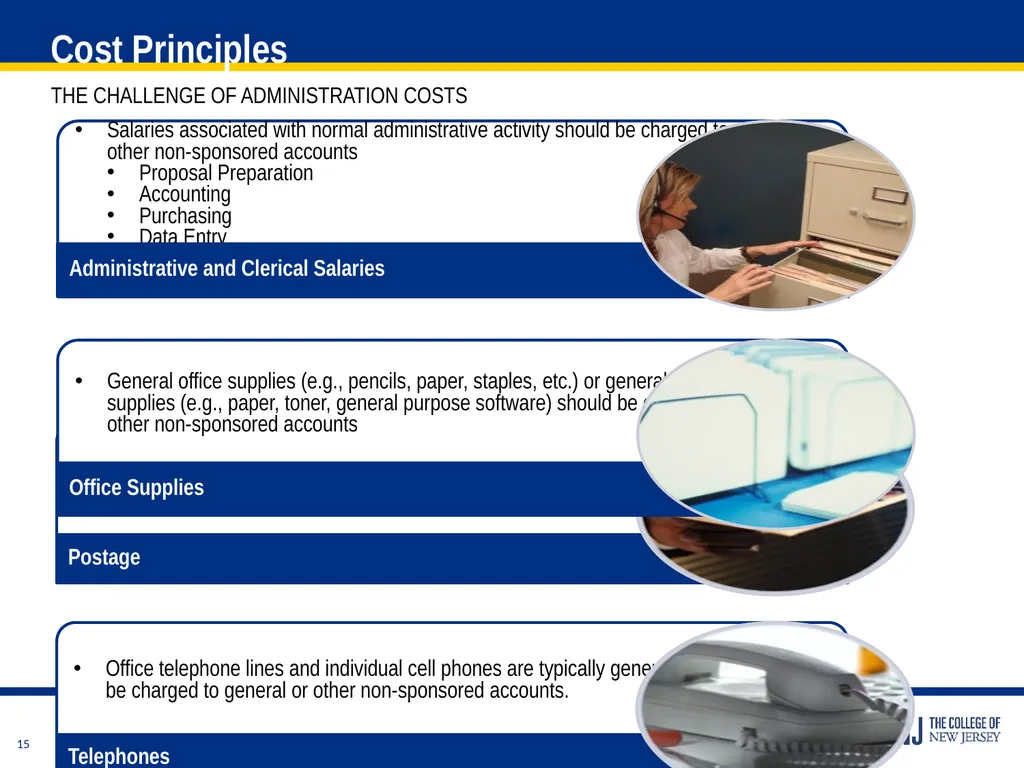
Cost Principles The Challenge of Administration Costs<br>
16
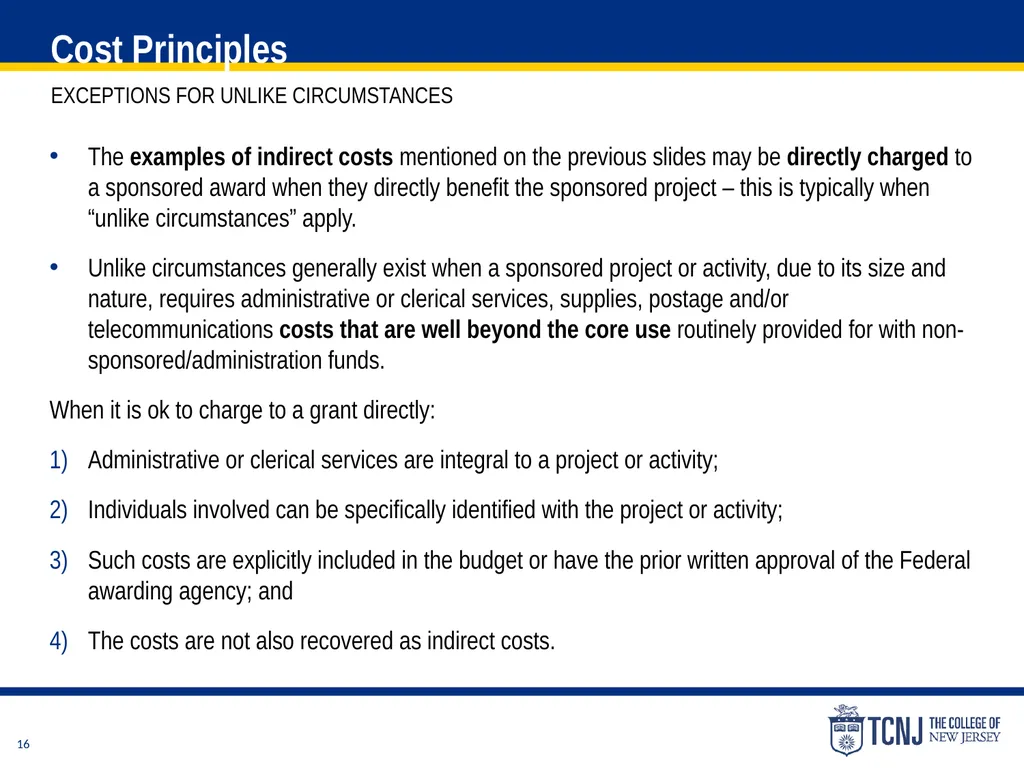
Cost Principles Exceptions for Unlike Circumstances The examples of indirect costs mentioned on the previous slides may be directly charged to a sponsored award when they directly benefit the sponsored project – this is typically when “unlike circumstances” apply.
Unlike circumstances generally exist when a sponsored project or activity, due to its size and nature, requires administrative or clerical services, supplies, postage and/or telecommunications costs that are well beyond the core use routinely provided for with non-sponsored/administration funds.
When it is ok to charge to a grant directly:
Administrative or clerical services are integral to a project or activity;
Individuals involved can be specifically identified with the project or activity;
Such costs are explicitly included in the budget or have the prior written approval of the Federal awarding agency; and
The costs are not also recovered as indirect costs.<br>
Unlike circumstances generally exist when a sponsored project or activity, due to its size and nature, requires administrative or clerical services, supplies, postage and/or telecommunications costs that are well beyond the core use routinely provided for with non-sponsored/administration funds.
When it is ok to charge to a grant directly:
Administrative or clerical services are integral to a project or activity;
Individuals involved can be specifically identified with the project or activity;
Such costs are explicitly included in the budget or have the prior written approval of the Federal awarding agency; and
The costs are not also recovered as indirect costs.<br>
17
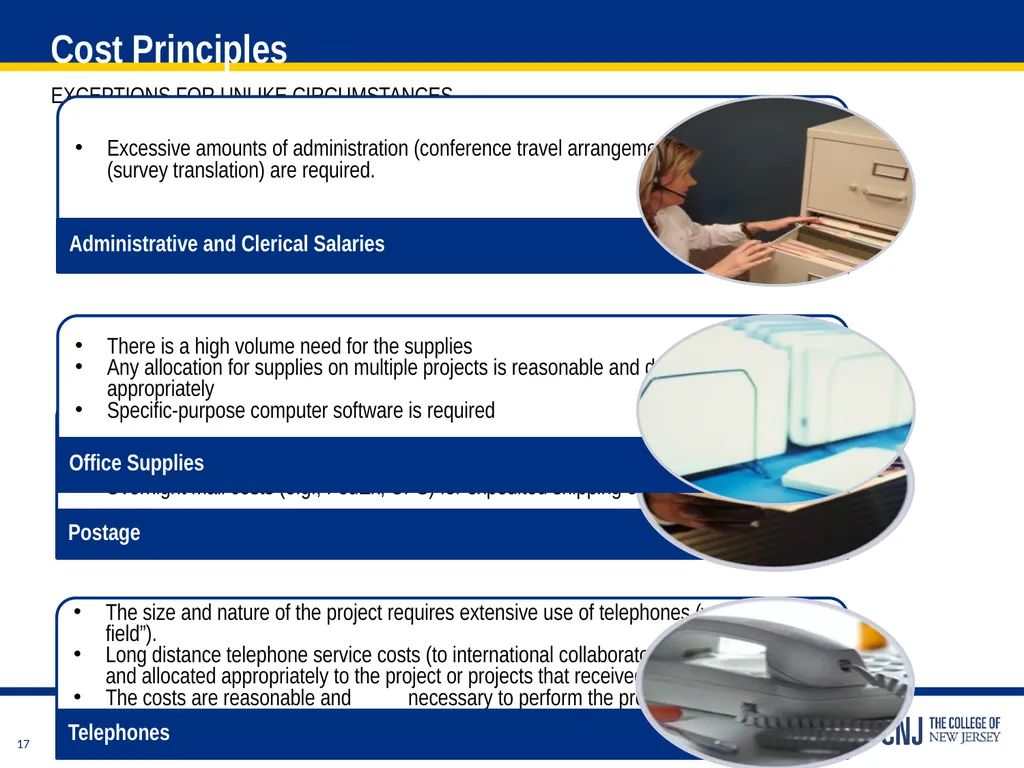
Cost Principles Exceptions for Unlike Circumstances<br>
18
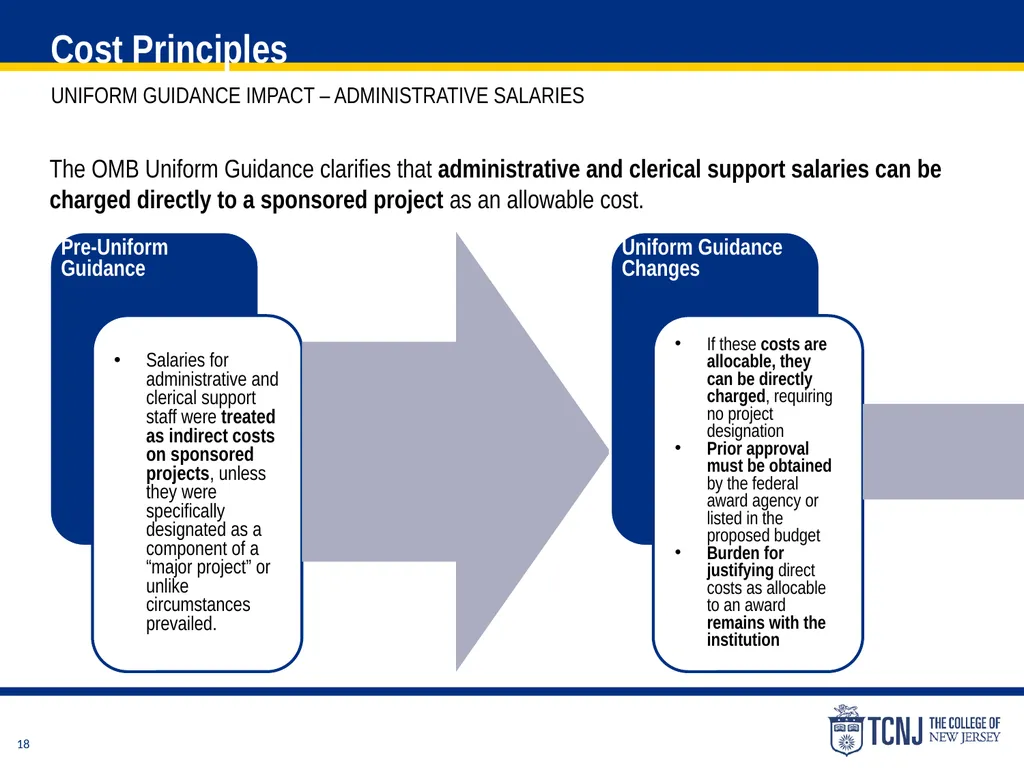
Cost Principles Uniform Guidance Impact – Administrative Salaries The OMB Uniform Guidance clarifies that administrative and clerical support salaries can be charged directly to a sponsored project as an allowable cost.<br>
19
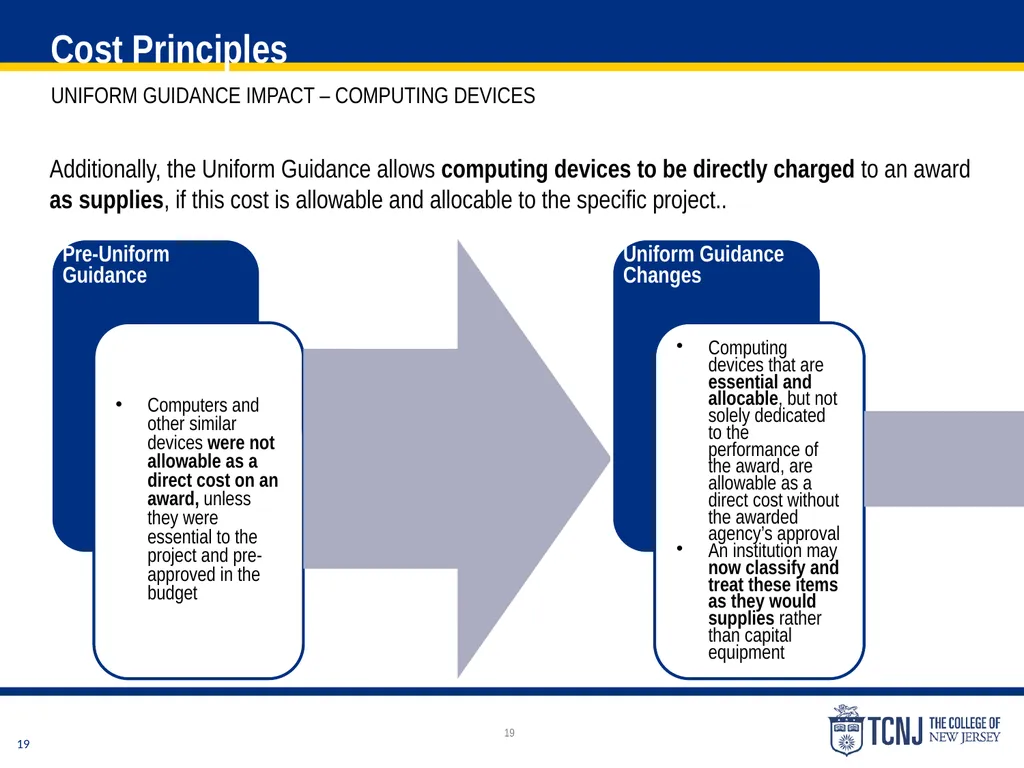
18 Cost Principles Uniform Guidance Impact – Computing Devices Additionally, the Uniform Guidance allows computing devices to be directly charged to an award as supplies, if this cost is allowable and allocable to the specific project..<br>
20
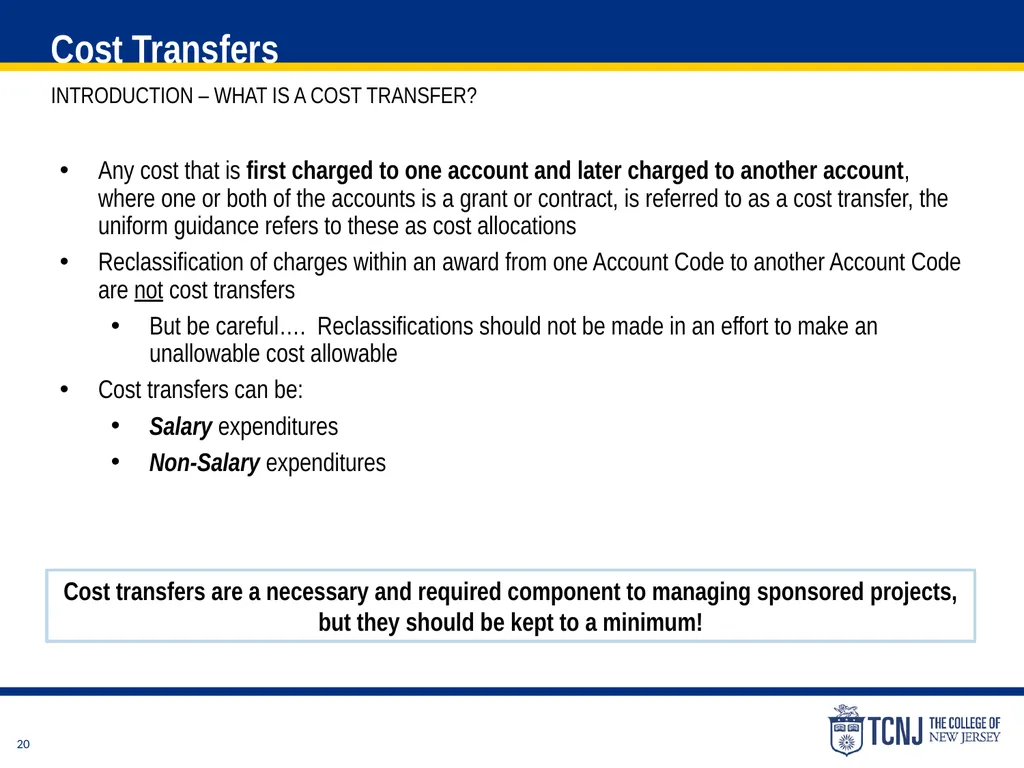
Any cost that is first charged to one account and later charged to another account, where one or both of the accounts is a grant or contract, is referred to as a cost transfer, the uniform guidance refers to these as cost allocations
Reclassification of charges within an award from one Account Code to another Account Code are not cost transfers
But be careful…. Reclassifications should not be made in an effort to make an unallowable cost allowable
Cost transfers can be:
Salary expenditures
Non-Salary expenditures Cost transfers are a necessary and required component to managing sponsored projects, but they should be kept to a minimum! Introduction – What Is a cost Transfer? Cost Transfers<br>
Reclassification of charges within an award from one Account Code to another Account Code are not cost transfers
But be careful…. Reclassifications should not be made in an effort to make an unallowable cost allowable
Cost transfers can be:
Salary expenditures
Non-Salary expenditures Cost transfers are a necessary and required component to managing sponsored projects, but they should be kept to a minimum! Introduction – What Is a cost Transfer? Cost Transfers<br>
21
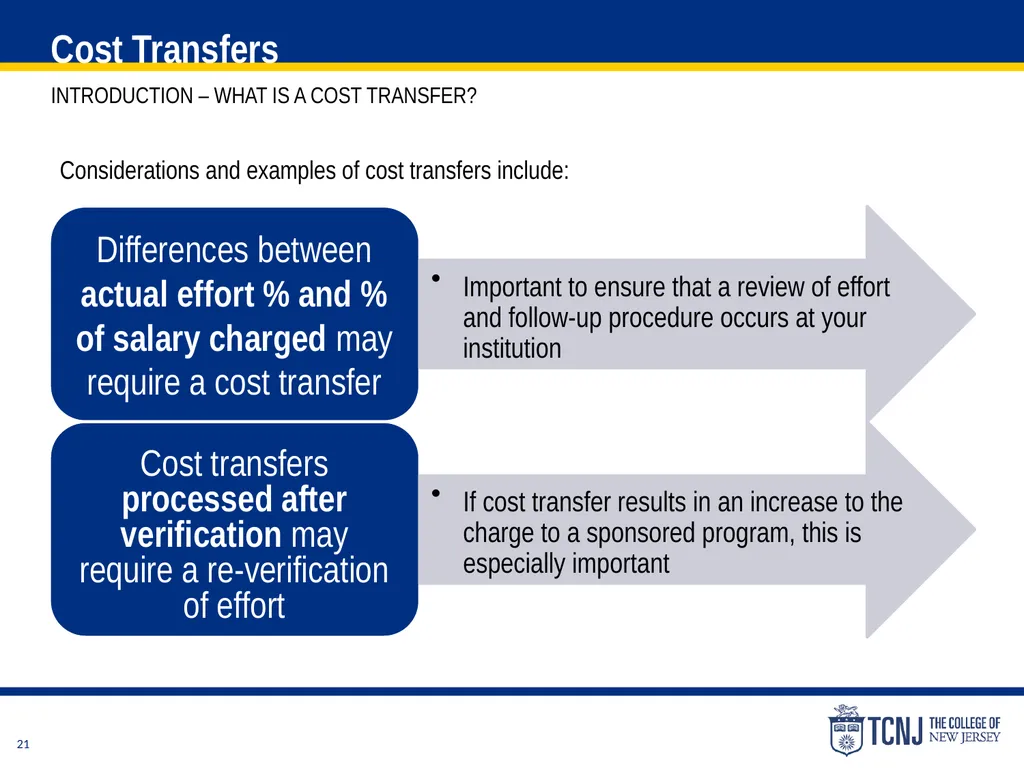
Considerations and examples of cost transfers include: Introduction – What Is a cost transfer? Cost Transfers<br>
22
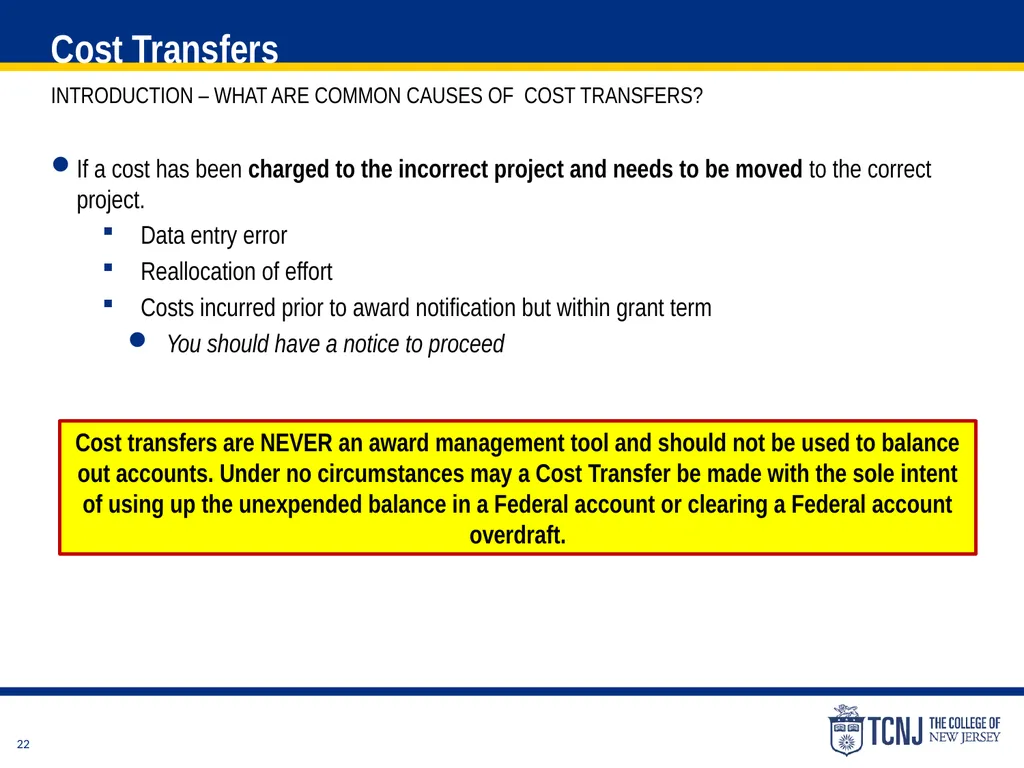
If a cost has been charged to the incorrect project and needs to be moved to the correct project.
Data entry error
Reallocation of effort
Costs incurred prior to award notification but within grant term
You should have a notice to proceed Cost transfers are NEVER an award management tool and should not be used to balance out accounts. Under no circumstances may a Cost Transfer be made with the sole intent of using up the unexpended balance in a Federal account or clearing a Federal account overdraft. Introduction – What are common causes of cost transfers? Cost Transfers<br>
Data entry error
Reallocation of effort
Costs incurred prior to award notification but within grant term
You should have a notice to proceed Cost transfers are NEVER an award management tool and should not be used to balance out accounts. Under no circumstances may a Cost Transfer be made with the sole intent of using up the unexpended balance in a Federal account or clearing a Federal account overdraft. Introduction – What are common causes of cost transfers? Cost Transfers<br>
23
Compliance Risk Cost Transfers<br>
24
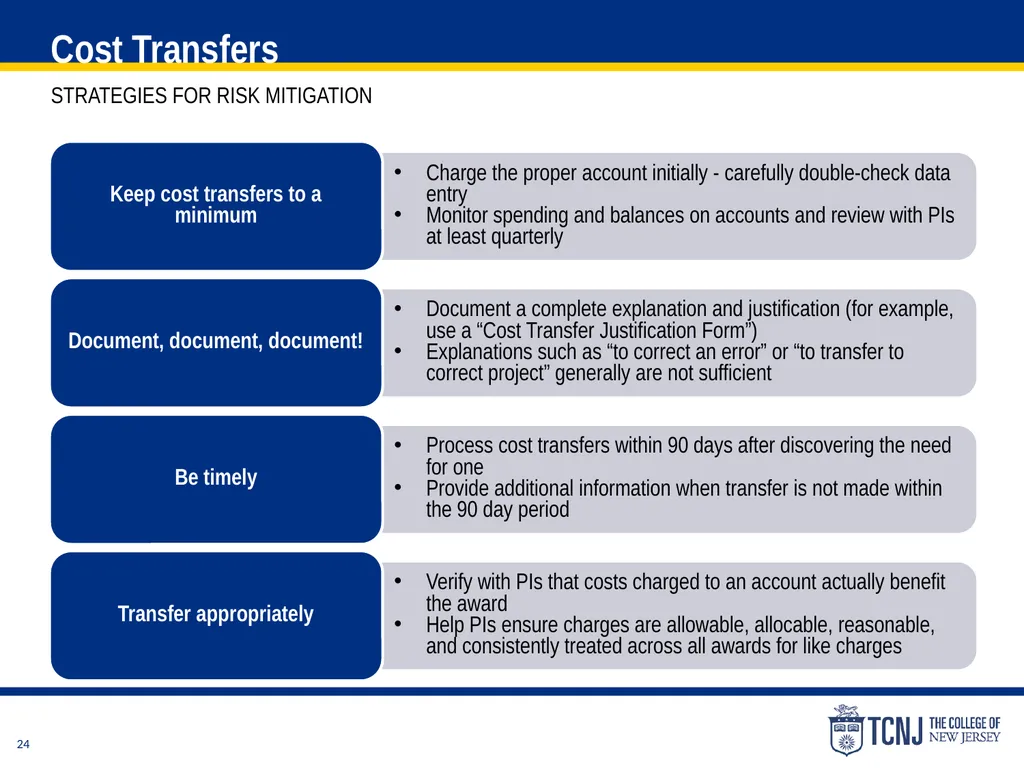
Strategies for Risk Mitigation Cost Transfers<br>
25
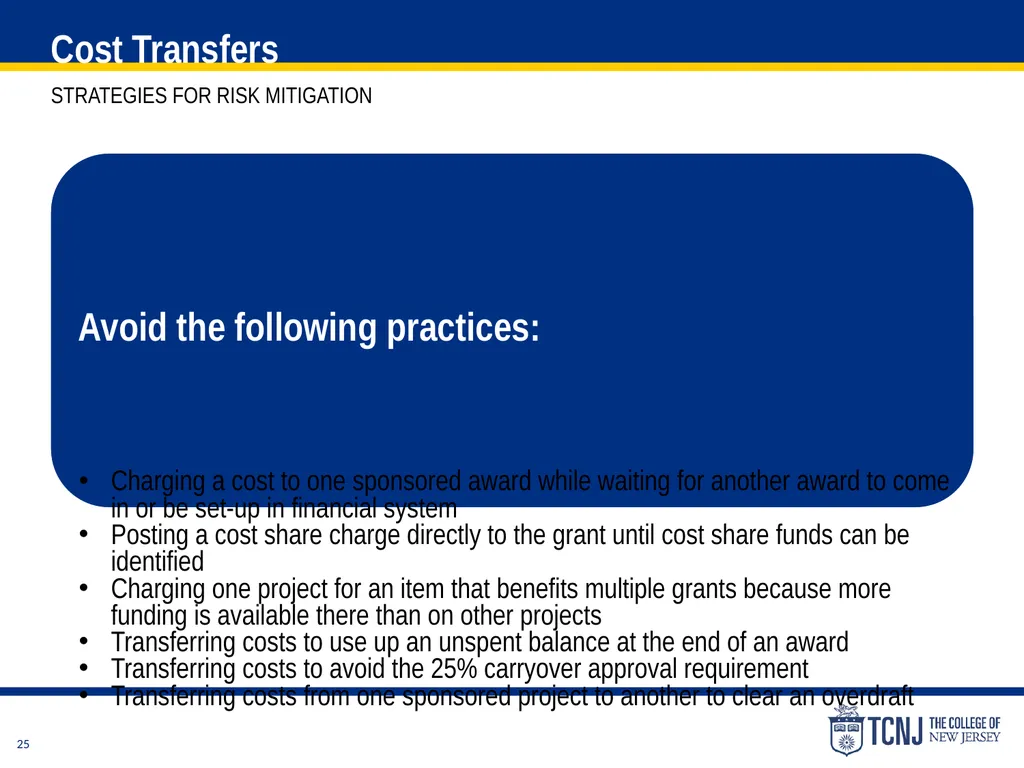
Strategies for Risk Mitigation Cost Transfers<br>
26
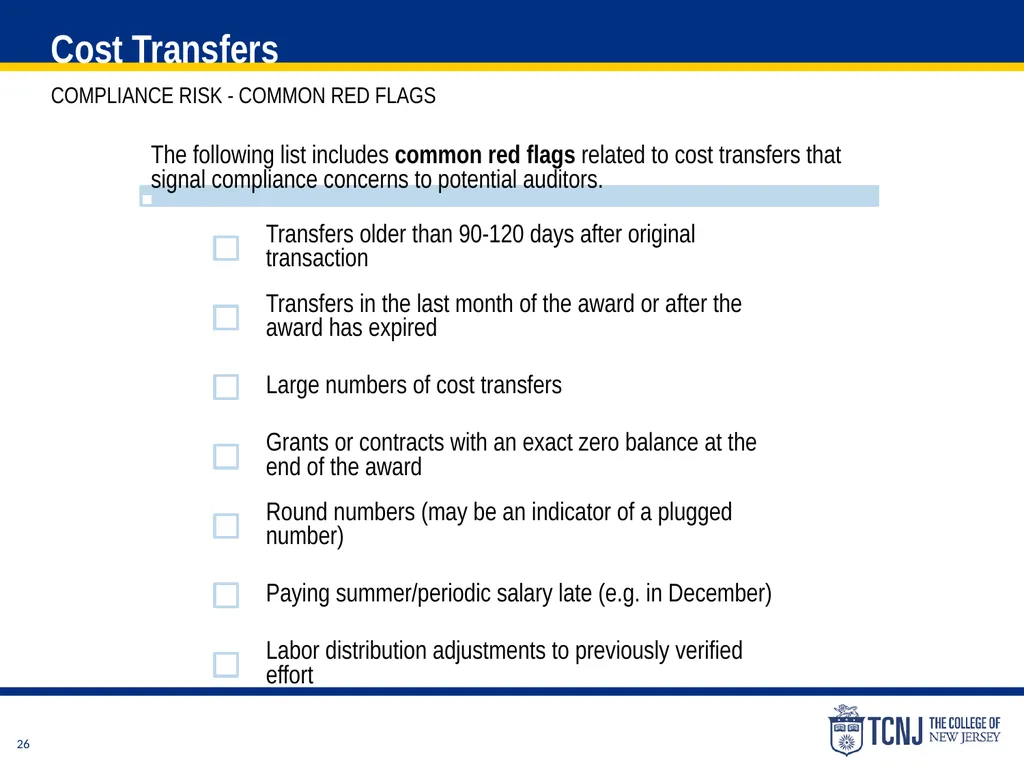
Compliance Risk - Common Red Flags Cost Transfers<br>
27
3. Processes<br>
28
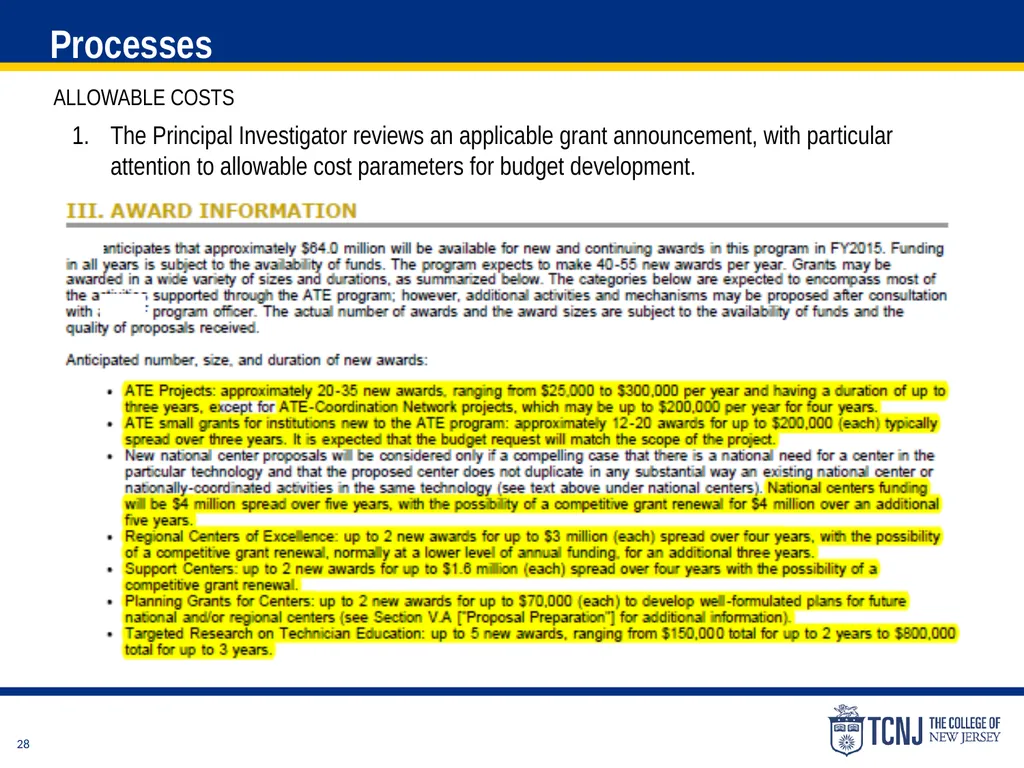
The Principal Investigator reviews an applicable grant announcement, with particular attention to allowable cost parameters for budget development. Processes Allowable Costs<br>
29
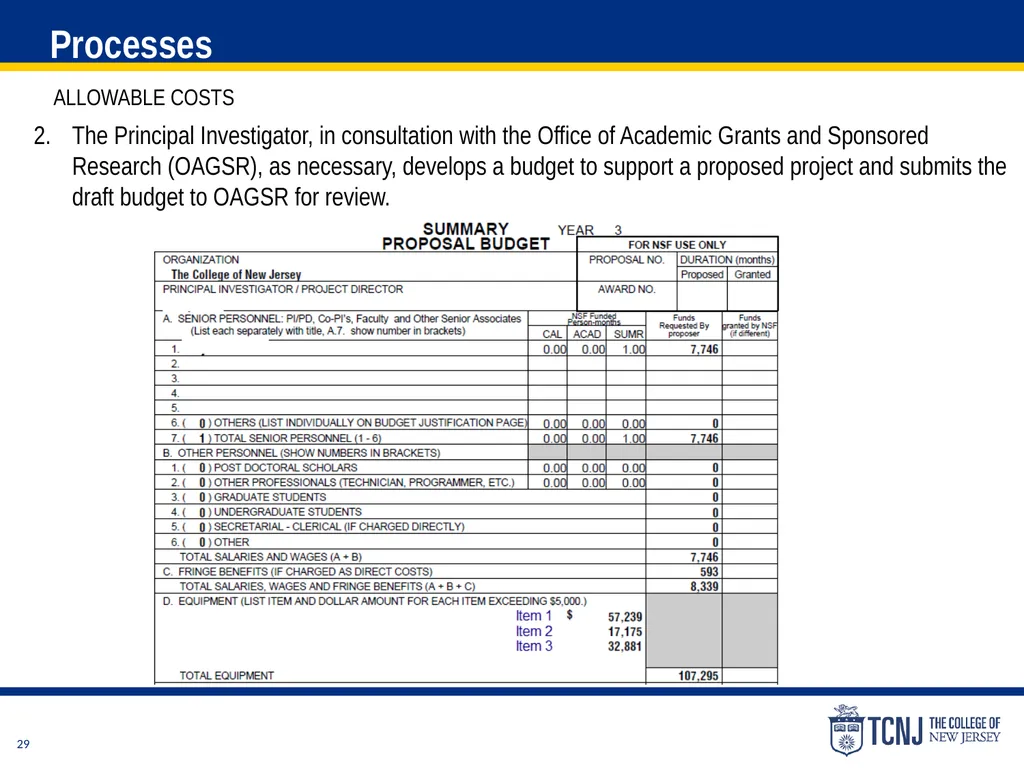
The Principal Investigator, in consultation with the Office of Academic Grants and Sponsored Research (OAGSR), as necessary, develops a budget to support a proposed project and submits the draft budget to OAGSR for review. Processes Allowable Costs<br>
30
The OAGSR reviews the proposed budget for consistency with the grant announcement parameters and the Subpart E—Cost Principles of 2 CFR 200.
The cognizant school dean and department chair review the full proposal, including the proposed budget after it has been reviewed by OAGSR and deemed acceptable to advance.
The Principal Investigator consults with the Office of the Treasurer in ensuring that any proposed cost transfers comply fully with the grant announcement and the Subpart E—Cost Principles of 2 CFR 200. Processes Allowable Costs<br>
The cognizant school dean and department chair review the full proposal, including the proposed budget after it has been reviewed by OAGSR and deemed acceptable to advance.
The Principal Investigator consults with the Office of the Treasurer in ensuring that any proposed cost transfers comply fully with the grant announcement and the Subpart E—Cost Principles of 2 CFR 200. Processes Allowable Costs<br>
31
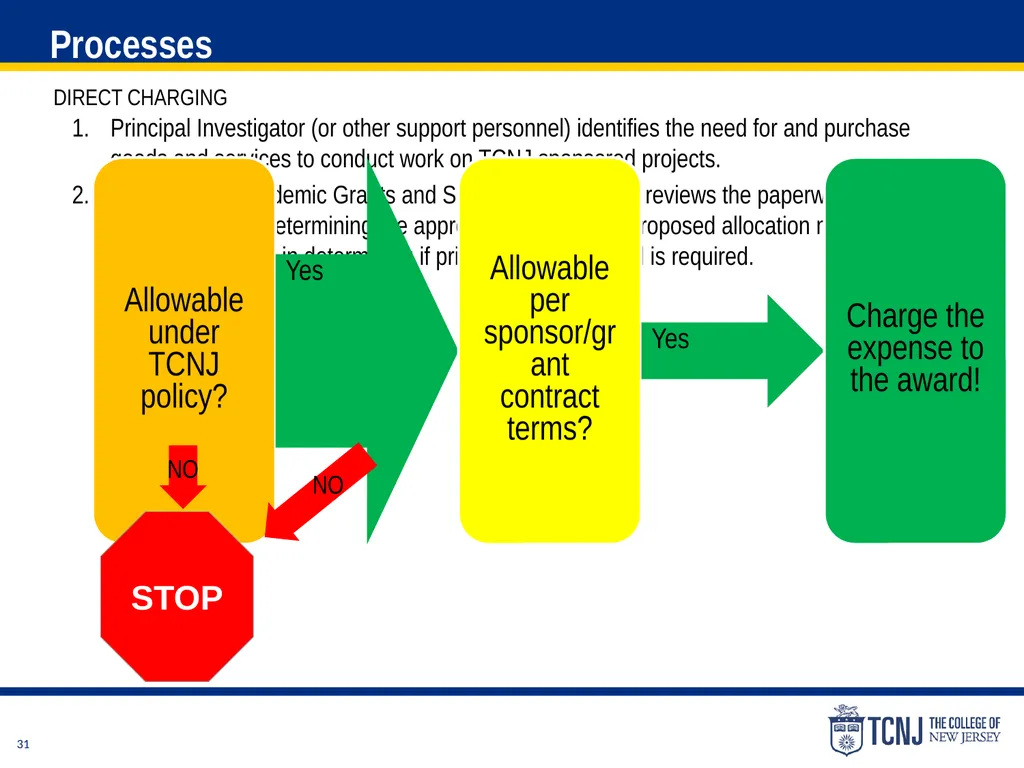
Principal Investigator (or other support personnel) identifies the need for and purchase goods and services to conduct work on TCNJ sponsored projects.
The Office of Academic Grants and Sponsored Research reviews the paperwork and assists the PI in determining the appropriateness of the proposed allocation methodology, and assists the PI in determining if prior sponsor approval is required. Processes Direct Charging STOP<br>
The Office of Academic Grants and Sponsored Research reviews the paperwork and assists the PI in determining the appropriateness of the proposed allocation methodology, and assists the PI in determining if prior sponsor approval is required. Processes Direct Charging STOP<br>
32
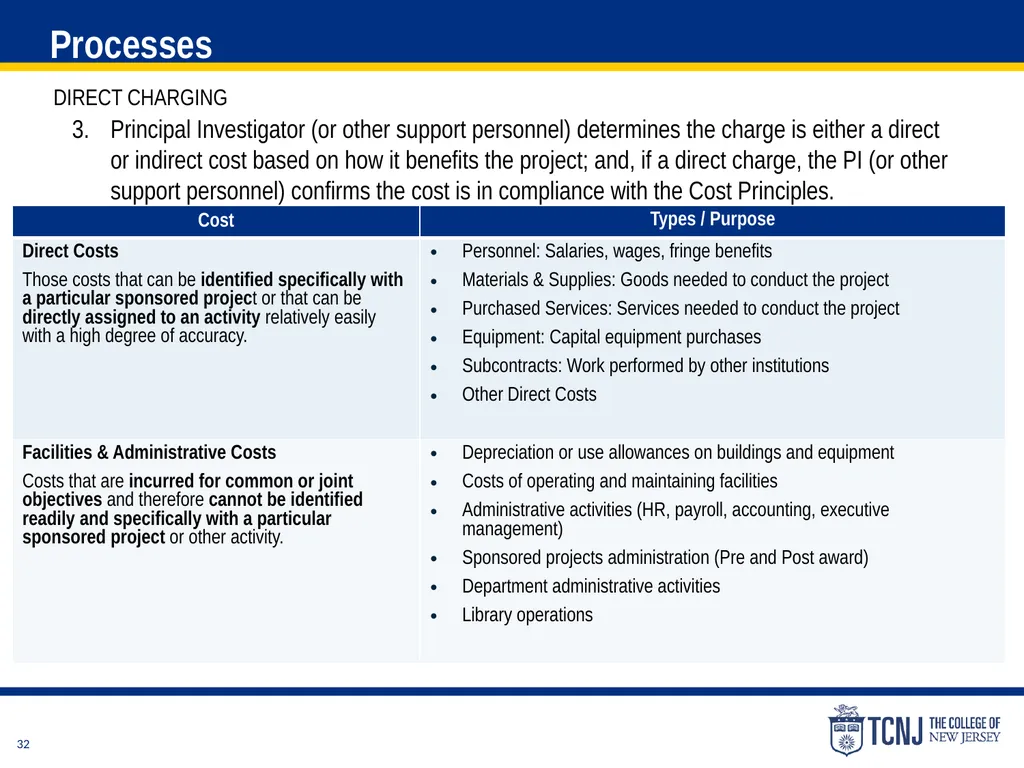
Principal Investigator (or other support personnel) determines the charge is either a direct or indirect cost based on how it benefits the project; and, if a direct charge, the PI (or other support personnel) confirms the cost is in compliance with the Cost Principles. Processes Direct Charging<br>
33
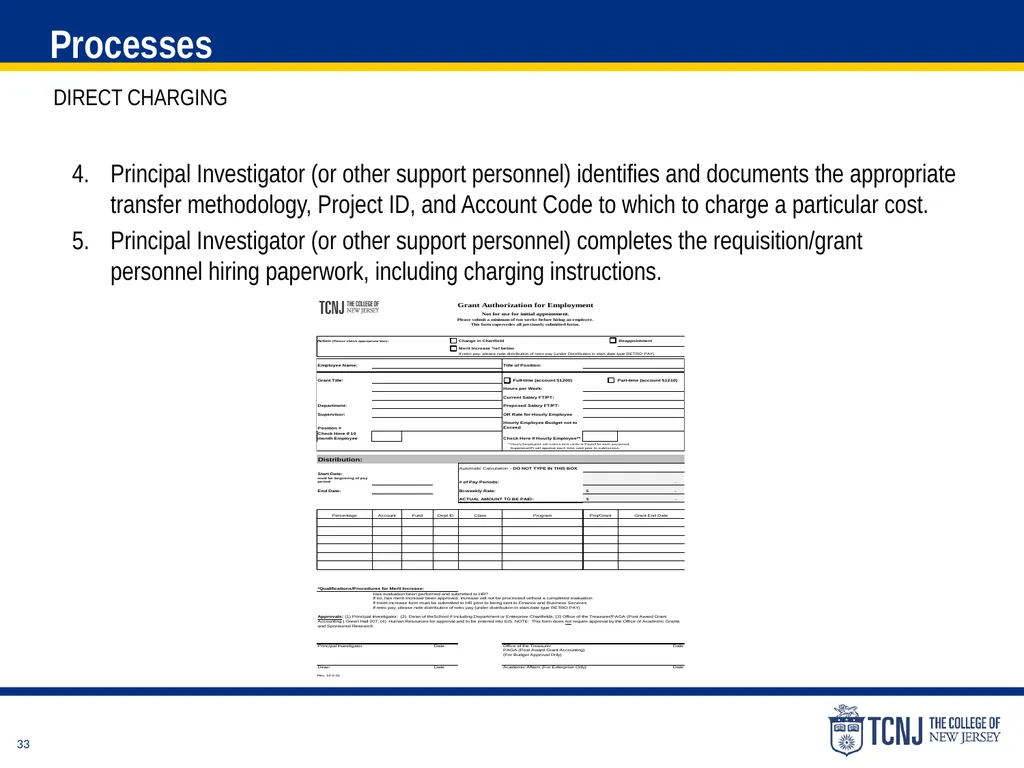
Principal Investigator (or other support personnel) identifies and documents the appropriate transfer methodology, Project ID, and Account Code to which to charge a particular cost.
Principal Investigator (or other support personnel) completes the requisition/grant personnel hiring paperwork, including charging instructions. Processes Direct Charging<br>
Principal Investigator (or other support personnel) completes the requisition/grant personnel hiring paperwork, including charging instructions. Processes Direct Charging<br>
34
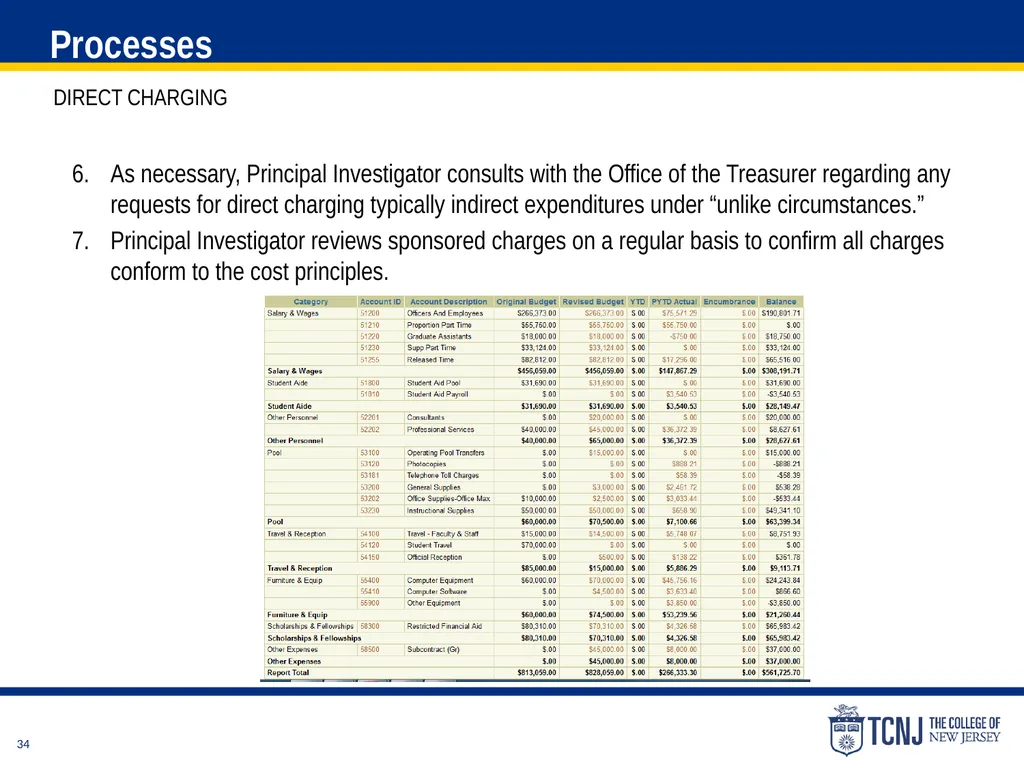
As necessary, Principal Investigator consults with the Office of the Treasurer regarding any requests for direct charging typically indirect expenditures under “unlike circumstances.”
Principal Investigator reviews sponsored charges on a regular basis to confirm all charges conform to the cost principles. Processes Direct Charging<br>
Principal Investigator reviews sponsored charges on a regular basis to confirm all charges conform to the cost principles. Processes Direct Charging<br>
35
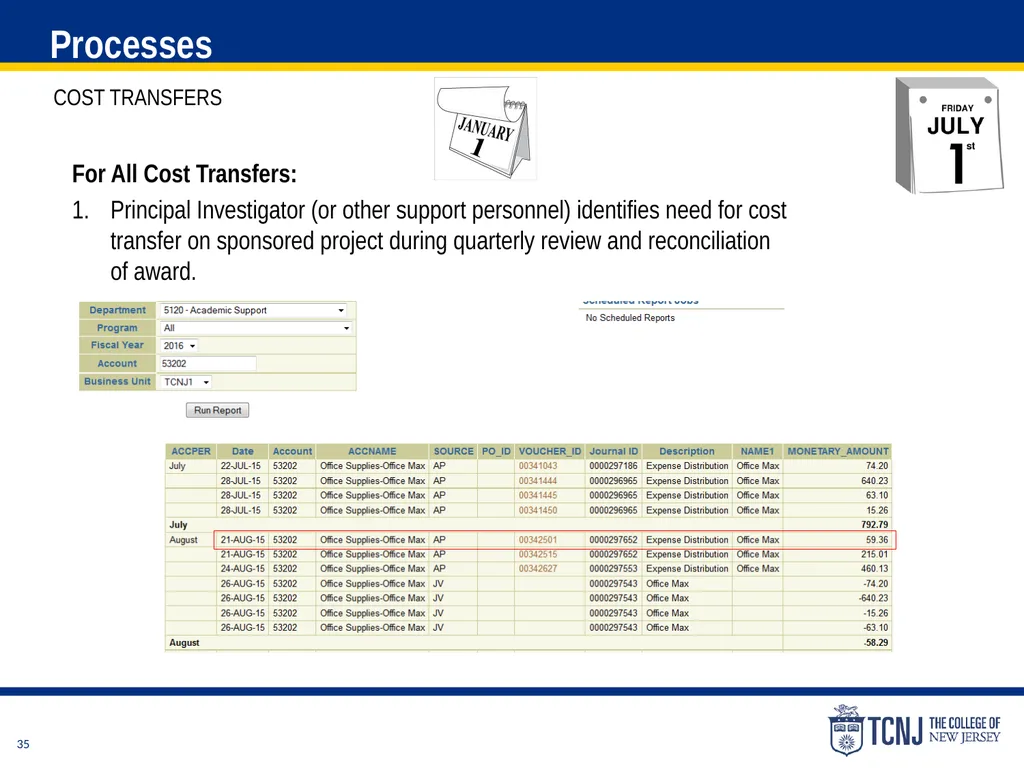
For All Cost Transfers:
Principal Investigator (or other support personnel) identifies need for cost transfer on sponsored project during quarterly review and reconciliation of award. Processes Cost Transfers<br>
Principal Investigator (or other support personnel) identifies need for cost transfer on sponsored project during quarterly review and reconciliation of award. Processes Cost Transfers<br>
36
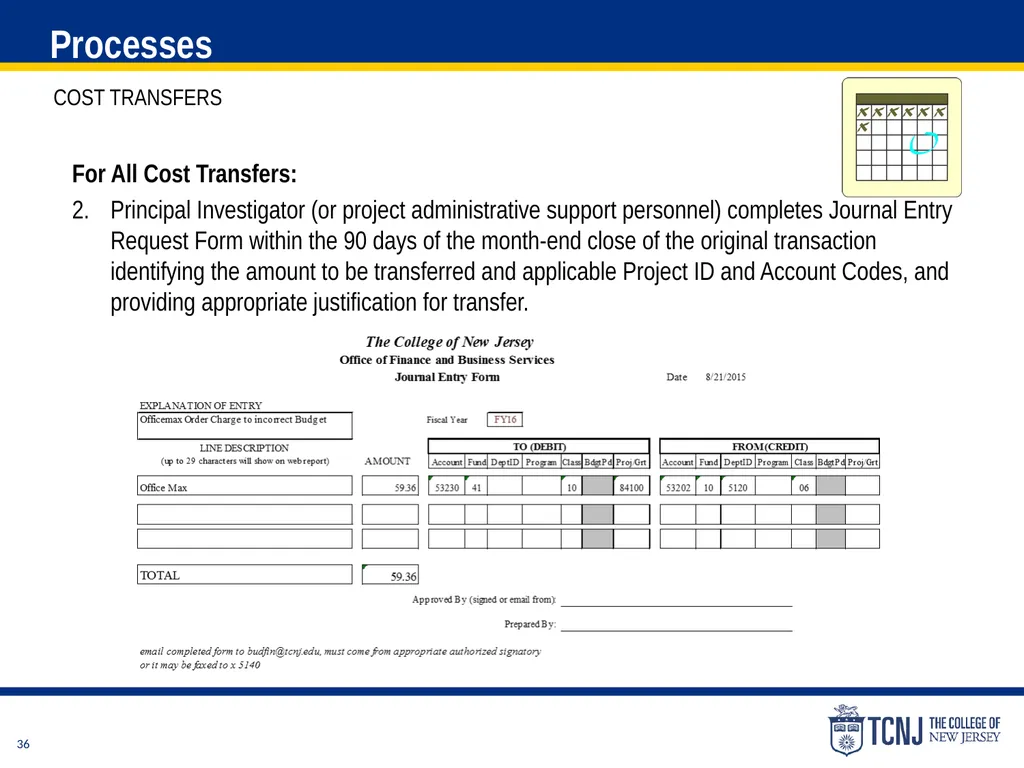
For All Cost Transfers:
Principal Investigator (or project administrative support personnel) completes Journal Entry Request Form within the 90 days of the month-end close of the original transaction identifying the amount to be transferred and applicable Project ID and Account Codes, and providing appropriate justification for transfer. Processes Cost Transfers<br>
Principal Investigator (or project administrative support personnel) completes Journal Entry Request Form within the 90 days of the month-end close of the original transaction identifying the amount to be transferred and applicable Project ID and Account Codes, and providing appropriate justification for transfer. Processes Cost Transfers<br>
37
For All Cost Transfers:
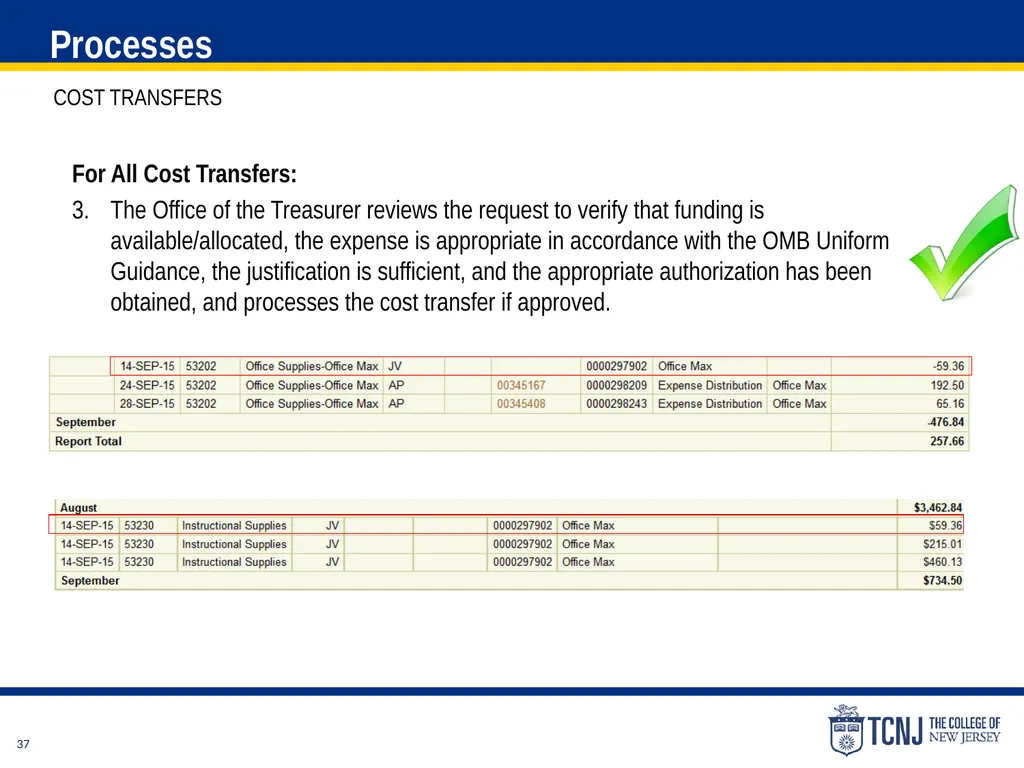
The Office of the Treasurer reviews the request to verify that funding is available/allocated, the expense is appropriate in accordance with the OMB Uniform Guidance, the justification is sufficient, and the appropriate authorization has been obtained, and processes the cost transfer if approved. Processes Cost Transfers<br>
The Office of the Treasurer reviews the request to verify that funding is available/allocated, the expense is appropriate in accordance with the OMB Uniform Guidance, the justification is sufficient, and the appropriate authorization has been obtained, and processes the cost transfer if approved. Processes Cost Transfers<br>
38
Additional Procedures for Cost Transfers Outside of the 90-Day Timeframe:
If a cost transfer is requested outside of the 90-day timeframe and, hence, is considered “late,” the Principal Investigator (or project administrative support personnel) requests approval from the appropriate dean to approve the submission of a formal request for a late cost transfer. Processes Cost Transfers<br>
If a cost transfer is requested outside of the 90-day timeframe and, hence, is considered “late,” the Principal Investigator (or project administrative support personnel) requests approval from the appropriate dean to approve the submission of a formal request for a late cost transfer. Processes Cost Transfers<br>
39
Additional Procedures for Cost Transfers Outside of the 90-Day Timeframe:
Upon receiving approval from the appropriate dean, the PI submits a request in writing (e.g., via memo or email) to the Office of the Treasurer with details and justification, and indicating prior approval of the dean for submission. Deans must be copied on all written requests for late cost transfers.
If approved, the Office of the Treasurer processes the journal entry to complete the cost transfer.
If disapproved, the Office of the Treasurer coordinates with the PI/project administrative support staff to identify an alternate non-sponsored source of funds and transfers the cost to the alternative project. Processes Cost Transfers<br>
Upon receiving approval from the appropriate dean, the PI submits a request in writing (e.g., via memo or email) to the Office of the Treasurer with details and justification, and indicating prior approval of the dean for submission. Deans must be copied on all written requests for late cost transfers.
If approved, the Office of the Treasurer processes the journal entry to complete the cost transfer.
If disapproved, the Office of the Treasurer coordinates with the PI/project administrative support staff to identify an alternate non-sponsored source of funds and transfers the cost to the alternative project. Processes Cost Transfers<br>
40
4. Roles and Responsibilities<br>
41
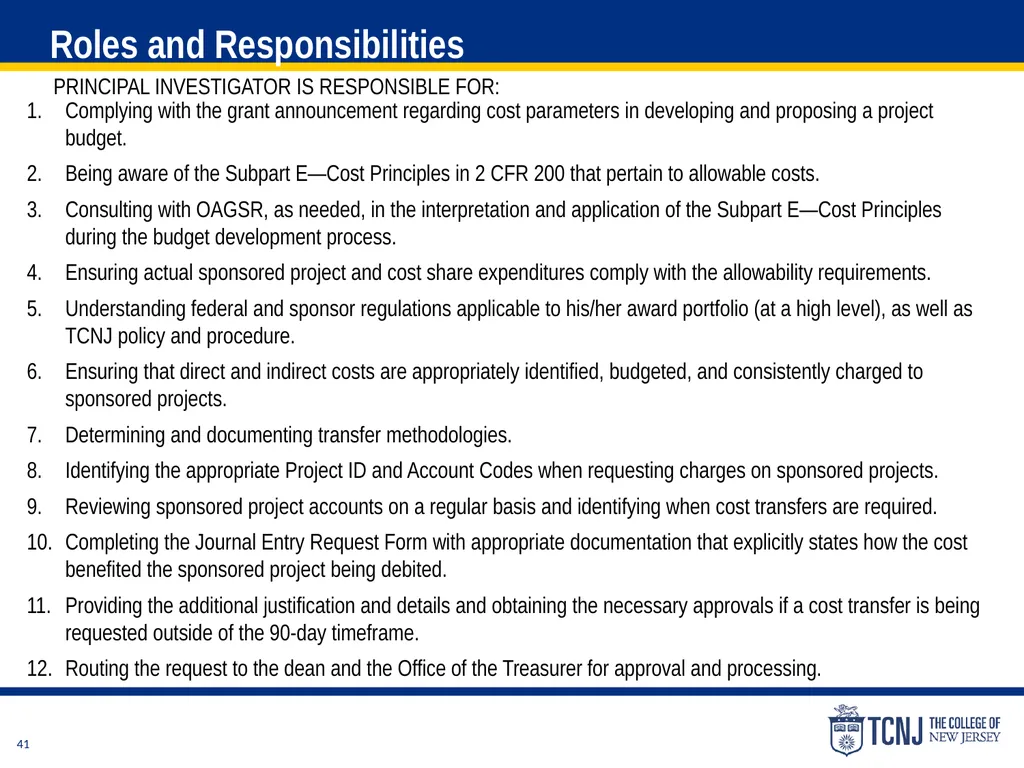
Roles and Responsibilities Principal Investigator is Responsible for: Complying with the grant announcement regarding cost parameters in developing and proposing a project budget.
Being aware of the Subpart E—Cost Principles in 2 CFR 200 that pertain to allowable costs.
Consulting with OAGSR, as needed, in the interpretation and application of the Subpart E—Cost Principles during the budget development process.
Ensuring actual sponsored project and cost share expenditures comply with the allowability requirements.
Understanding federal and sponsor regulations applicable to his/her award portfolio (at a high level), as well as TCNJ policy and procedure.
Ensuring that direct and indirect costs are appropriately identified, budgeted, and consistently charged to sponsored projects.
Determining and documenting transfer methodologies.
Identifying the appropriate Project ID and Account Codes when requesting charges on sponsored projects.
Reviewing sponsored project accounts on a regular basis and identifying when cost transfers are required.
Completing the Journal Entry Request Form with appropriate documentation that explicitly states how the cost benefited the sponsored project being debited.
Providing the additional justification and details and obtaining the necessary approvals if a cost transfer is being requested outside of the 90-day timeframe.
Routing the request to the dean and the Office of the Treasurer for approval and processing.<br>
Being aware of the Subpart E—Cost Principles in 2 CFR 200 that pertain to allowable costs.
Consulting with OAGSR, as needed, in the interpretation and application of the Subpart E—Cost Principles during the budget development process.
Ensuring actual sponsored project and cost share expenditures comply with the allowability requirements.
Understanding federal and sponsor regulations applicable to his/her award portfolio (at a high level), as well as TCNJ policy and procedure.
Ensuring that direct and indirect costs are appropriately identified, budgeted, and consistently charged to sponsored projects.
Determining and documenting transfer methodologies.
Identifying the appropriate Project ID and Account Codes when requesting charges on sponsored projects.
Reviewing sponsored project accounts on a regular basis and identifying when cost transfers are required.
Completing the Journal Entry Request Form with appropriate documentation that explicitly states how the cost benefited the sponsored project being debited.
Providing the additional justification and details and obtaining the necessary approvals if a cost transfer is being requested outside of the 90-day timeframe.
Routing the request to the dean and the Office of the Treasurer for approval and processing.<br>
42
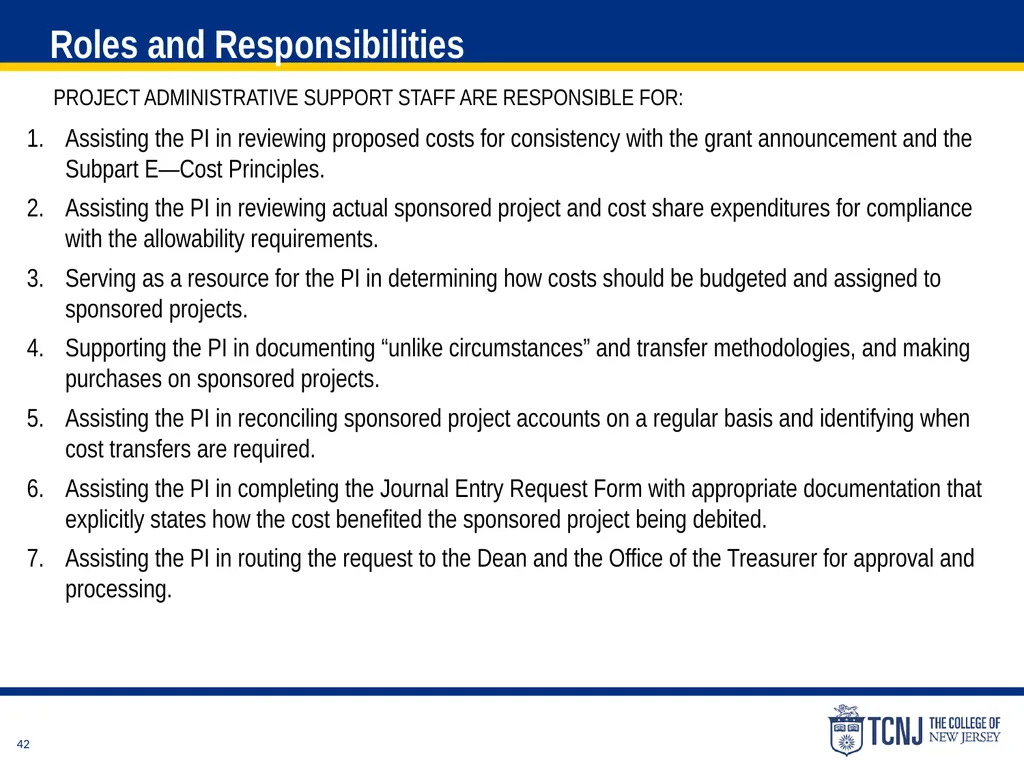
Roles and Responsibilities Project Administrative Support Staff are responsible for: Assisting the PI in reviewing proposed costs for consistency with the grant announcement and the Subpart E—Cost Principles.
Assisting the PI in reviewing actual sponsored project and cost share expenditures for compliance with the allowability requirements.
Serving as a resource for the PI in determining how costs should be budgeted and assigned to sponsored projects.
Supporting the PI in documenting “unlike circumstances” and transfer methodologies, and making purchases on sponsored projects.
Assisting the PI in reconciling sponsored project accounts on a regular basis and identifying when cost transfers are required.
Assisting the PI in completing the Journal Entry Request Form with appropriate documentation that explicitly states how the cost benefited the sponsored project being debited.
Assisting the PI in routing the request to the Dean and the Office of the Treasurer for approval and processing.<br>
Assisting the PI in reviewing actual sponsored project and cost share expenditures for compliance with the allowability requirements.
Serving as a resource for the PI in determining how costs should be budgeted and assigned to sponsored projects.
Supporting the PI in documenting “unlike circumstances” and transfer methodologies, and making purchases on sponsored projects.
Assisting the PI in reconciling sponsored project accounts on a regular basis and identifying when cost transfers are required.
Assisting the PI in completing the Journal Entry Request Form with appropriate documentation that explicitly states how the cost benefited the sponsored project being debited.
Assisting the PI in routing the request to the Dean and the Office of the Treasurer for approval and processing.<br>
43
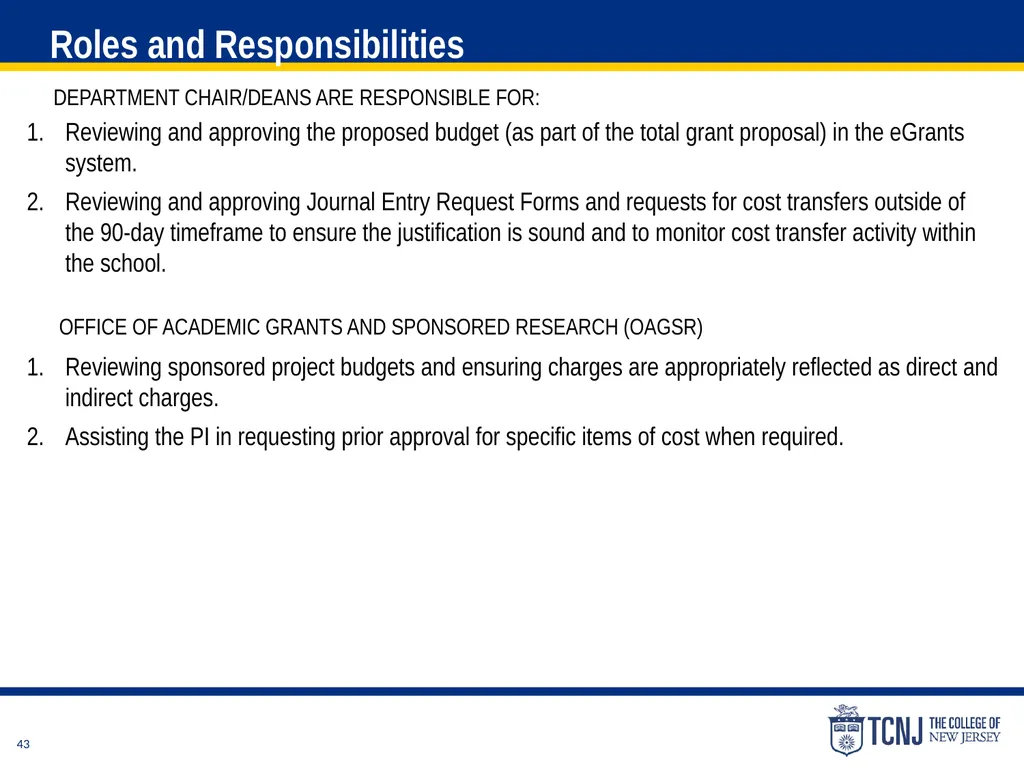
Roles and Responsibilities Department Chair/Deans arE responsible for: Reviewing and approving the proposed budget (as part of the total grant proposal) in the eGrants system.
Reviewing and approving Journal Entry Request Forms and requests for cost transfers outside of the 90-day timeframe to ensure the justification is sound and to monitor cost transfer activity within the school. Office of Academic Grants and Sponsored Research (OAGSR) Reviewing sponsored project budgets and ensuring charges are appropriately reflected as direct and indirect charges.
Assisting the PI in requesting prior approval for specific items of cost when required.<br>
Reviewing and approving Journal Entry Request Forms and requests for cost transfers outside of the 90-day timeframe to ensure the justification is sound and to monitor cost transfer activity within the school. Office of Academic Grants and Sponsored Research (OAGSR) Reviewing sponsored project budgets and ensuring charges are appropriately reflected as direct and indirect charges.
Assisting the PI in requesting prior approval for specific items of cost when required.<br>
44
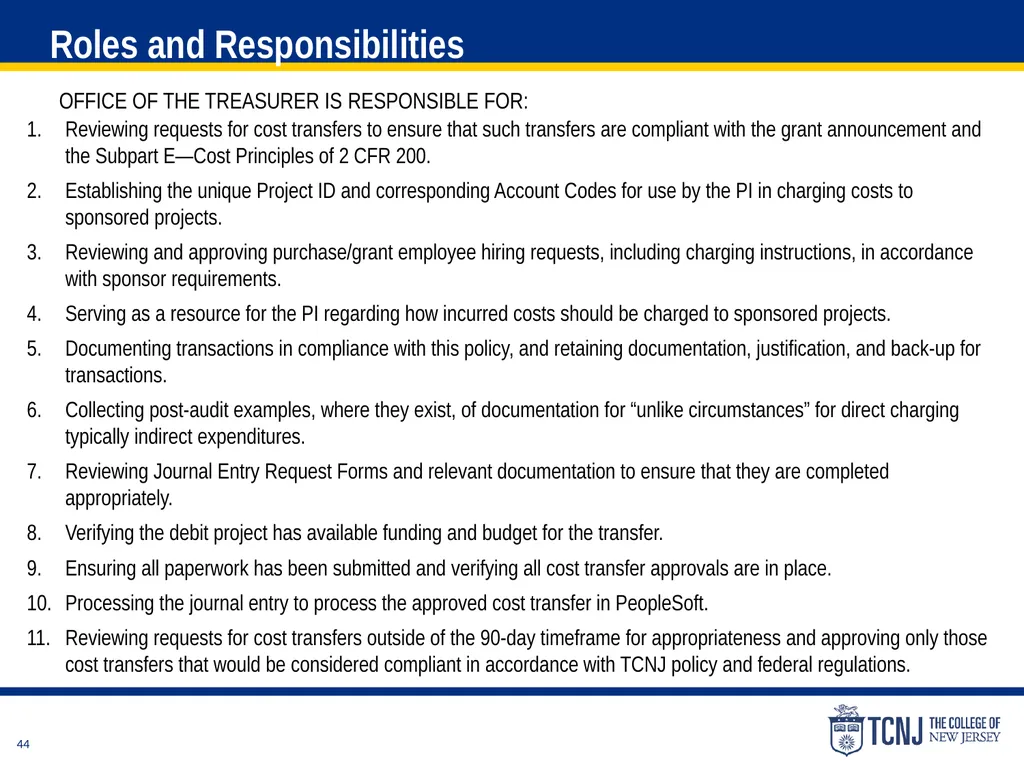
Roles and Responsibilities Office of The Treasurer Is responsible for: Reviewing requests for cost transfers to ensure that such transfers are compliant with the grant announcement and the Subpart E—Cost Principles of 2 CFR 200.
Establishing the unique Project ID and corresponding Account Codes for use by the PI in charging costs to sponsored projects.
Reviewing and approving purchase/grant employee hiring requests, including charging instructions, in accordance with sponsor requirements.
Serving as a resource for the PI regarding how incurred costs should be charged to sponsored projects.
Documenting transactions in compliance with this policy, and retaining documentation, justification, and back-up for transactions.
Collecting post-audit examples, where they exist, of documentation for “unlike circumstances” for direct charging typically indirect expenditures.
Reviewing Journal Entry Request Forms and relevant documentation to ensure that they are completed appropriately.
Verifying the debit project has available funding and budget for the transfer.
Ensuring all paperwork has been submitted and verifying all cost transfer approvals are in place.
Processing the journal entry to process the approved cost transfer in PeopleSoft.
Reviewing requests for cost transfers outside of the 90-day timeframe for appropriateness and approving only those cost transfers that would be considered compliant in accordance with TCNJ policy and federal regulations.<br>
Establishing the unique Project ID and corresponding Account Codes for use by the PI in charging costs to sponsored projects.
Reviewing and approving purchase/grant employee hiring requests, including charging instructions, in accordance with sponsor requirements.
Serving as a resource for the PI regarding how incurred costs should be charged to sponsored projects.
Documenting transactions in compliance with this policy, and retaining documentation, justification, and back-up for transactions.
Collecting post-audit examples, where they exist, of documentation for “unlike circumstances” for direct charging typically indirect expenditures.
Reviewing Journal Entry Request Forms and relevant documentation to ensure that they are completed appropriately.
Verifying the debit project has available funding and budget for the transfer.
Ensuring all paperwork has been submitted and verifying all cost transfer approvals are in place.
Processing the journal entry to process the approved cost transfer in PeopleSoft.
Reviewing requests for cost transfers outside of the 90-day timeframe for appropriateness and approving only those cost transfers that would be considered compliant in accordance with TCNJ policy and federal regulations.<br>
45
5. Practice Activities<br>
46
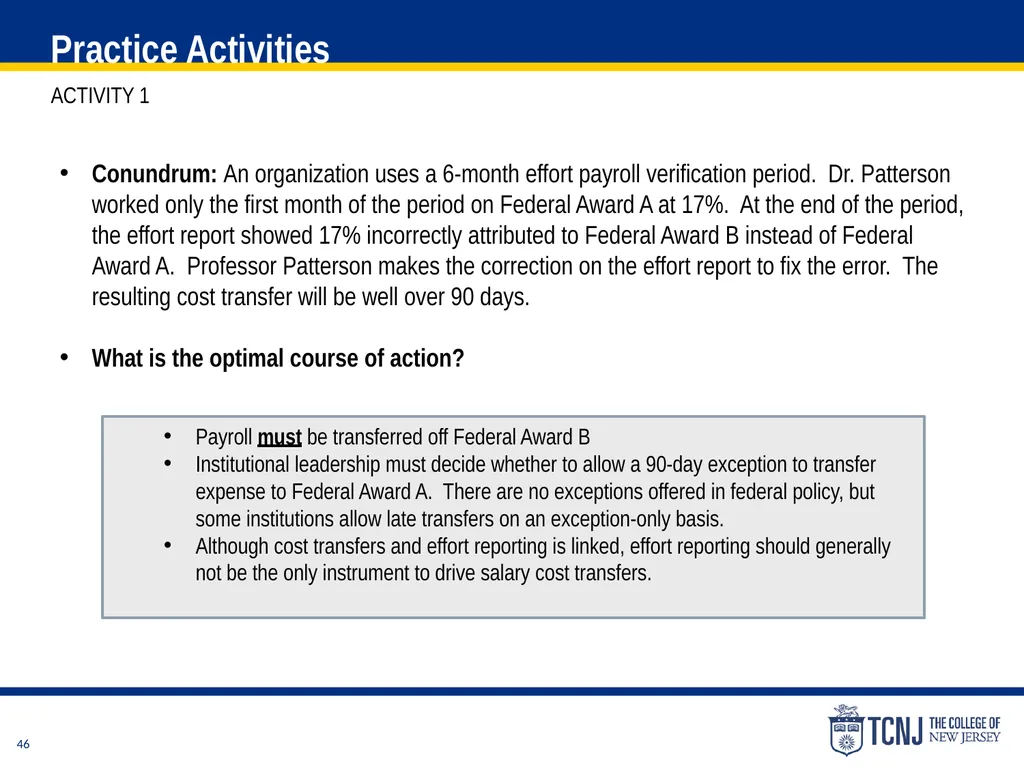
Activity 1 Practice Activities Conundrum: An organization uses a 6-month effort payroll verification period. Dr. Patterson worked only the first month of the period on Federal Award A at 17%. At the end of the period, the effort report showed 17% incorrectly attributed to Federal Award B instead of Federal Award A. Professor Patterson makes the correction on the effort report to fix the error. The resulting cost transfer will be well over 90 days.
What is the optimal course of action? Payroll must be transferred off Federal Award B
Institutional leadership must decide whether to allow a 90-day exception to transfer expense to Federal Award A. There are no exceptions offered in federal policy, but some institutions allow late transfers on an exception-only basis.
Although cost transfers and effort reporting is linked, effort reporting should generally not be the only instrument to drive salary cost transfers.<br>
What is the optimal course of action? Payroll must be transferred off Federal Award B
Institutional leadership must decide whether to allow a 90-day exception to transfer expense to Federal Award A. There are no exceptions offered in federal policy, but some institutions allow late transfers on an exception-only basis.
Although cost transfers and effort reporting is linked, effort reporting should generally not be the only instrument to drive salary cost transfers.<br>
47
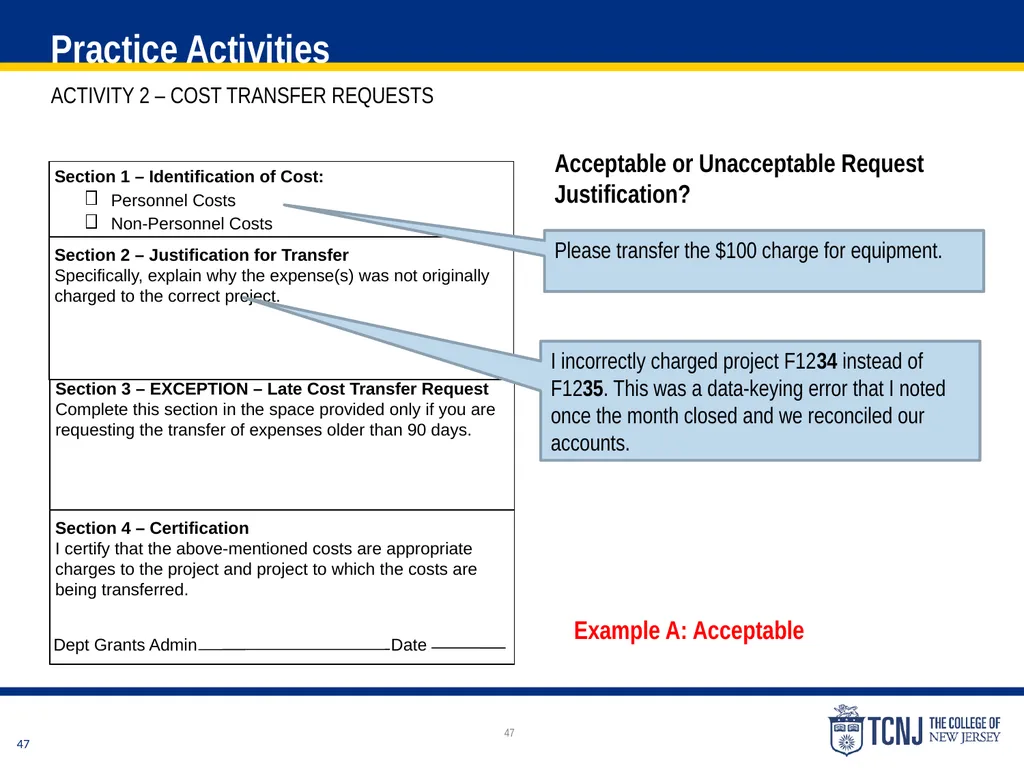
46 Activity 2 – Cost transfer Requests Practice Activities Personnel Costs Non-Personnel Costs Section 2 – Justification for Transfer
Specifically, explain why the expense(s) was not originally charged to the correct project. Section 3 – EXCEPTION – Late Cost Transfer Request
Complete this section in the space provided only if you are requesting the transfer of expenses older than 90 days. Please transfer the $100 charge for equipment. I incorrectly charged project F1234 instead of F1235. This was a data-keying error that I noted once the month closed and we reconciled our accounts. Example A: Acceptable Section 1 – Identification of Cost: Acceptable or Unacceptable Request Justification?<br>
Specifically, explain why the expense(s) was not originally charged to the correct project. Section 3 – EXCEPTION – Late Cost Transfer Request
Complete this section in the space provided only if you are requesting the transfer of expenses older than 90 days. Please transfer the $100 charge for equipment. I incorrectly charged project F1234 instead of F1235. This was a data-keying error that I noted once the month closed and we reconciled our accounts. Example A: Acceptable Section 1 – Identification of Cost: Acceptable or Unacceptable Request Justification?<br>
48
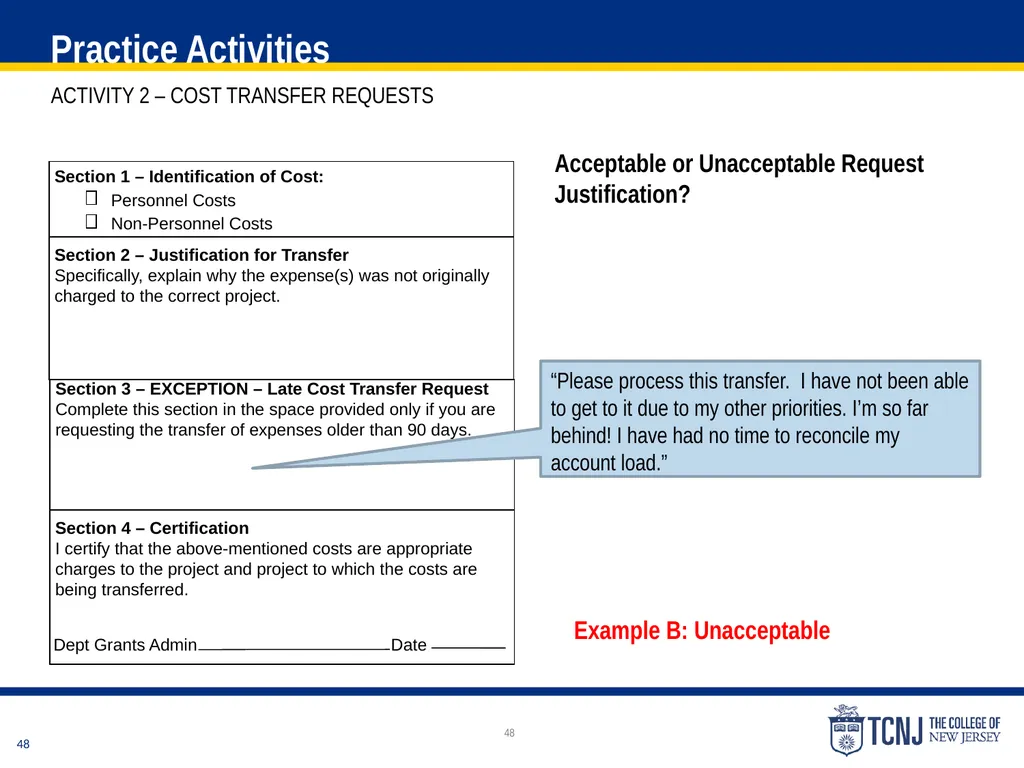
47 Activity 2 – Cost transfer Requests Practice Activities Personnel Costs Non-Personnel Costs Section 2 – Justification for Transfer
Specifically, explain why the expense(s) was not originally charged to the correct project. Section 3 – EXCEPTION – Late Cost Transfer Request
Complete this section in the space provided only if you are requesting the transfer of expenses older than 90 days. “Please process this transfer. I have not been able to get to it due to my other priorities. I’m so far behind! I have had no time to reconcile my account load.” Section 1 – Identification of Cost: Acceptable or Unacceptable Request Justification? Example B: Unacceptable<br>
Specifically, explain why the expense(s) was not originally charged to the correct project. Section 3 – EXCEPTION – Late Cost Transfer Request
Complete this section in the space provided only if you are requesting the transfer of expenses older than 90 days. “Please process this transfer. I have not been able to get to it due to my other priorities. I’m so far behind! I have had no time to reconcile my account load.” Section 1 – Identification of Cost: Acceptable or Unacceptable Request Justification? Example B: Unacceptable<br>
49
48 Activity 2 – Cost transfer Requests Practice Activities Personnel Costs Non-Personnel Costs Section 2 – Justification for Transfer
Specifically, explain why the expense(s) was not originally charged to the correct project. Section 3 – EXCEPTION – Late Cost Transfer Request
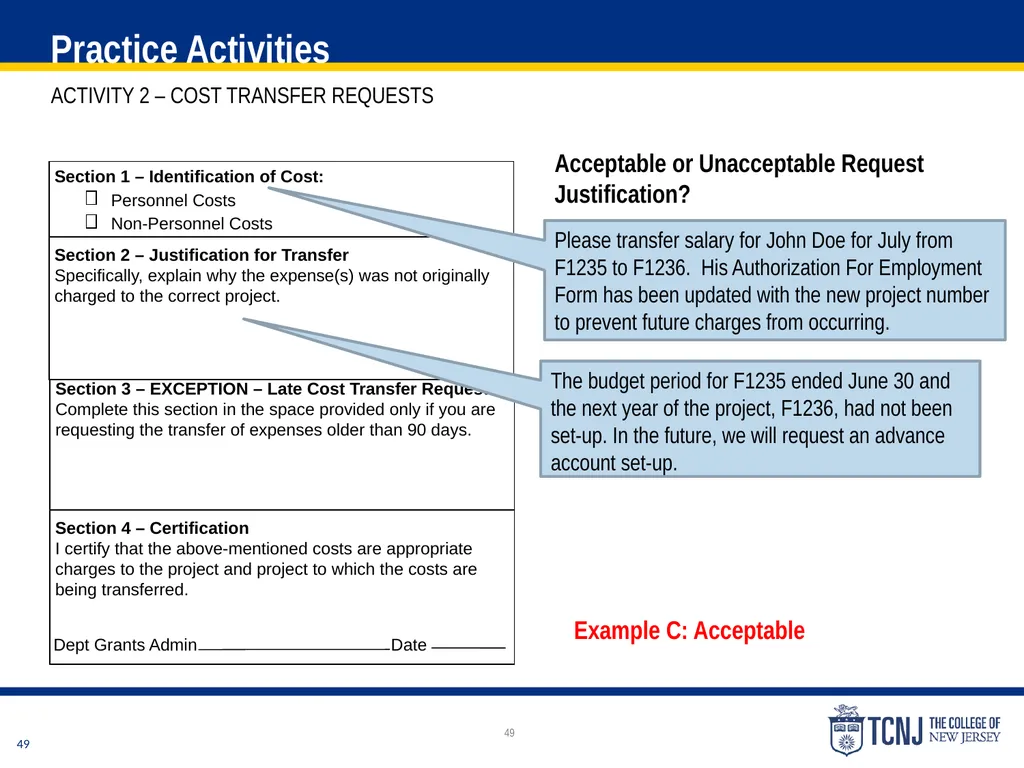
Complete this section in the space provided only if you are requesting the transfer of expenses older than 90 days. Please transfer salary for John Doe for July from F1235 to F1236. His Authorization For Employment Form has been updated with the new project number to prevent future charges from occurring. The budget period for F1235 ended June 30 and the next year of the project, F1236, had not been set-up. In the future, we will request an advance account set-up. Section 1 – Identification of Cost: Example C: Acceptable Acceptable or Unacceptable Request Justification?<br>
Specifically, explain why the expense(s) was not originally charged to the correct project. Section 3 – EXCEPTION – Late Cost Transfer Request
Complete this section in the space provided only if you are requesting the transfer of expenses older than 90 days. Please transfer salary for John Doe for July from F1235 to F1236. His Authorization For Employment Form has been updated with the new project number to prevent future charges from occurring. The budget period for F1235 ended June 30 and the next year of the project, F1236, had not been set-up. In the future, we will request an advance account set-up. Section 1 – Identification of Cost: Example C: Acceptable Acceptable or Unacceptable Request Justification?<br>
50
49 Activity 2 – Cost transfer Requests Practice Activities Personnel Costs Non-Personnel Costs Section 2 – Justification for Transfer
Specifically, explain why the expense(s) was not originally charged to the correct project. Section 3 – EXCEPTION – Late Cost Transfer Request
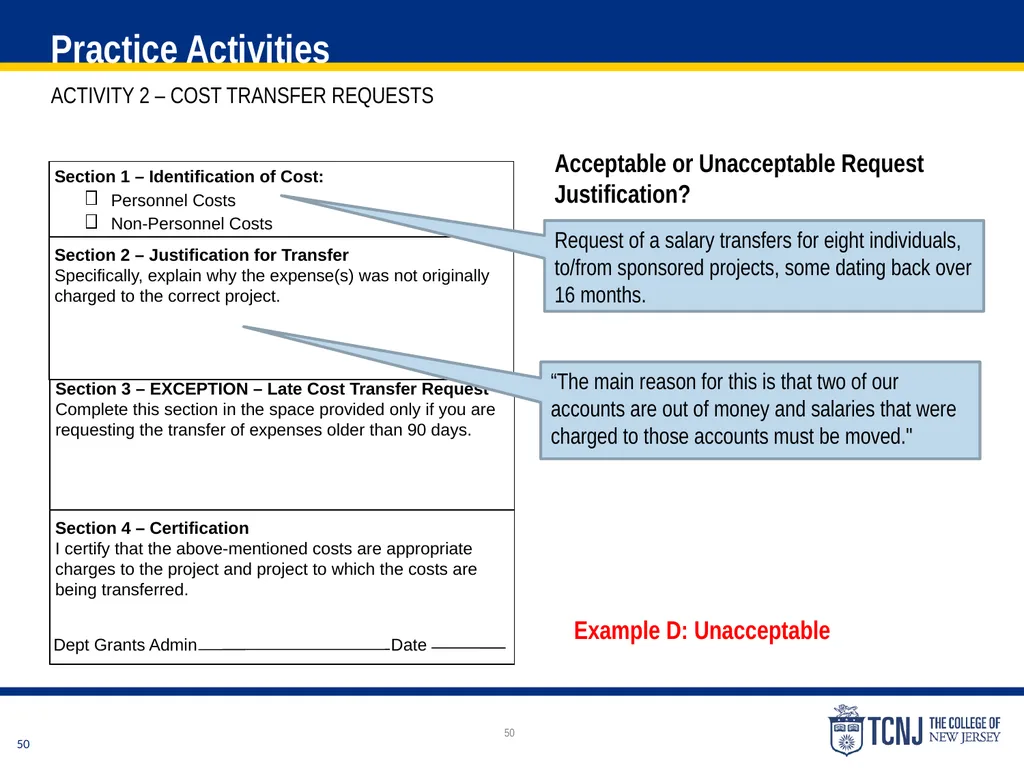
Complete this section in the space provided only if you are requesting the transfer of expenses older than 90 days. Request of a salary transfers for eight individuals, to/from sponsored projects, some dating back over 16 months. “The main reason for this is that two of our accounts are out of money and salaries that were charged to those accounts must be moved." Section 1 – Identification of Cost: Example D: Unacceptable Acceptable or Unacceptable Request Justification?<br>
Specifically, explain why the expense(s) was not originally charged to the correct project. Section 3 – EXCEPTION – Late Cost Transfer Request
Complete this section in the space provided only if you are requesting the transfer of expenses older than 90 days. Request of a salary transfers for eight individuals, to/from sponsored projects, some dating back over 16 months. “The main reason for this is that two of our accounts are out of money and salaries that were charged to those accounts must be moved." Section 1 – Identification of Cost: Example D: Unacceptable Acceptable or Unacceptable Request Justification?<br>
51
6. Key Takeaways<br>
52
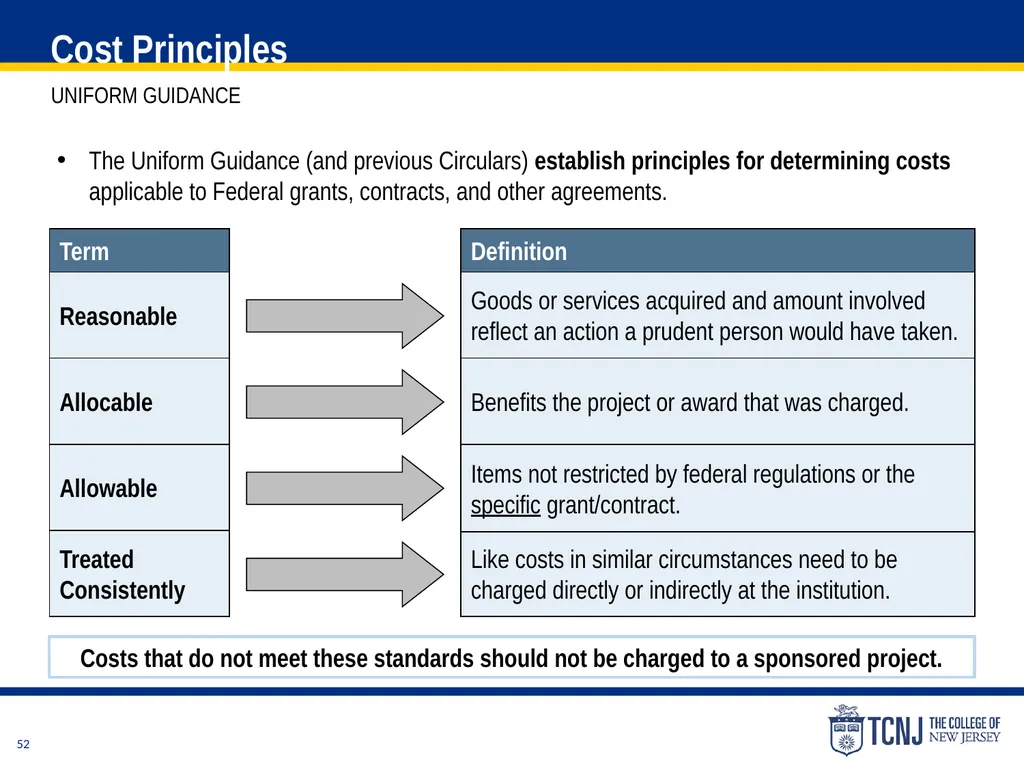
Cost Principles Uniform Guidance Costs that do not meet these standards should not be charged to a sponsored project. The Uniform Guidance (and previous Circulars) establish principles for determining costs applicable to Federal grants, contracts, and other agreements.<br>
53
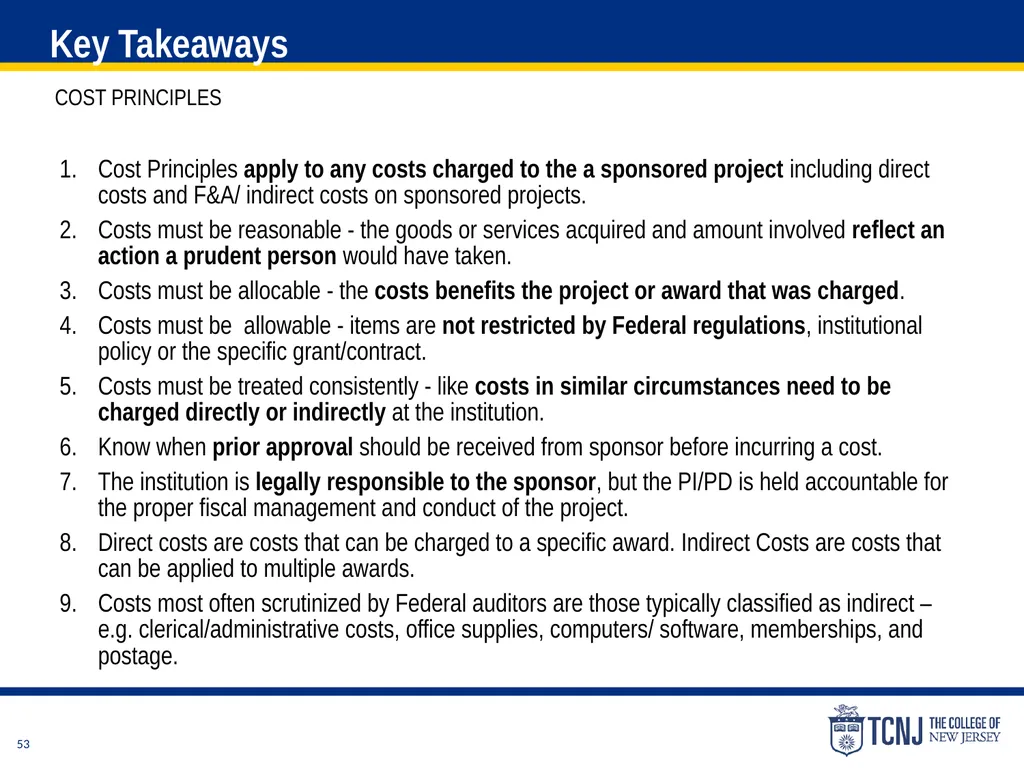
Key Takeaways COST PRINCIPLES Cost Principles apply to any costs charged to the a sponsored project including direct costs and F&A/ indirect costs on sponsored projects.
Costs must be reasonable - the goods or services acquired and amount involved reflect an action a prudent person would have taken.
Costs must be allocable - the costs benefits the project or award that was charged.
Costs must be allowable - items are not restricted by Federal regulations, institutional policy or the specific grant/contract.
Costs must be treated consistently - like costs in similar circumstances need to be charged directly or indirectly at the institution.
Know when prior approval should be received from sponsor before incurring a cost.
The institution is legally responsible to the sponsor, but the PI/PD is held accountable for the proper fiscal management and conduct of the project.
Direct costs are costs that can be charged to a specific award. Indirect Costs are costs that can be applied to multiple awards.
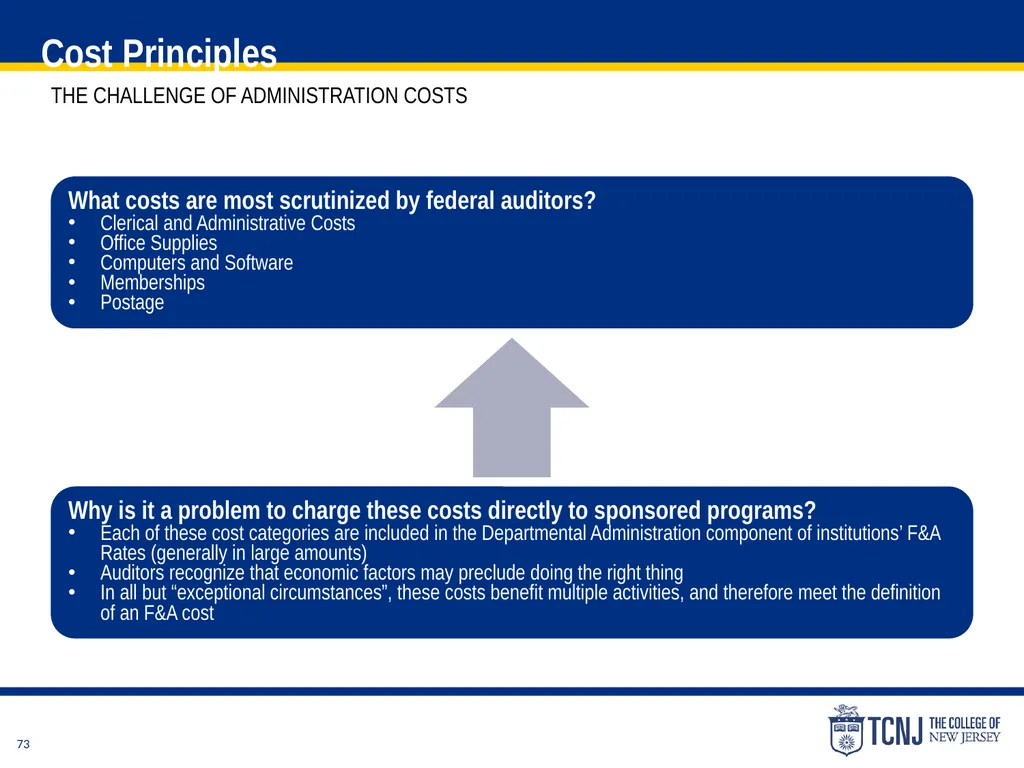
Costs most often scrutinized by Federal auditors are those typically classified as indirect – e.g. clerical/administrative costs, office supplies, computers/ software, memberships, and postage.<br>
Costs must be reasonable - the goods or services acquired and amount involved reflect an action a prudent person would have taken.
Costs must be allocable - the costs benefits the project or award that was charged.
Costs must be allowable - items are not restricted by Federal regulations, institutional policy or the specific grant/contract.
Costs must be treated consistently - like costs in similar circumstances need to be charged directly or indirectly at the institution.
Know when prior approval should be received from sponsor before incurring a cost.
The institution is legally responsible to the sponsor, but the PI/PD is held accountable for the proper fiscal management and conduct of the project.
Direct costs are costs that can be charged to a specific award. Indirect Costs are costs that can be applied to multiple awards.
Costs most often scrutinized by Federal auditors are those typically classified as indirect – e.g. clerical/administrative costs, office supplies, computers/ software, memberships, and postage.<br>
54
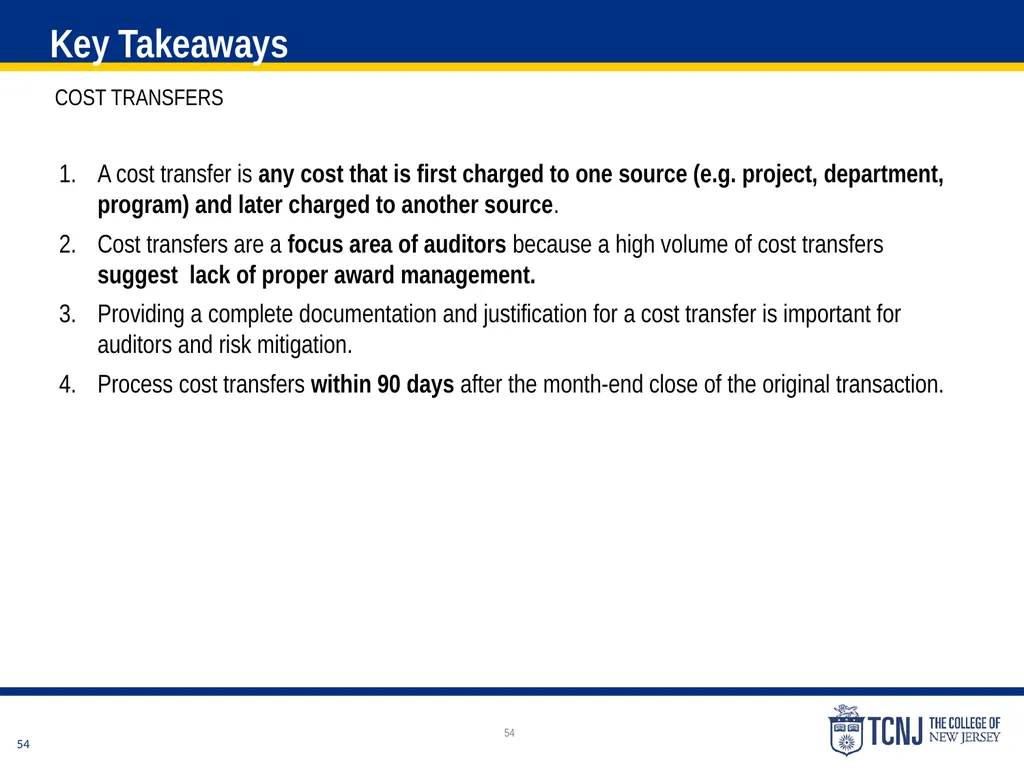
Key Takeaways COST TRANSFERS A cost transfer is any cost that is first charged to one source (e.g. project, department, program) and later charged to another source.
Cost transfers are a focus area of auditors because a high volume of cost transfers suggest lack of proper award management.
Providing a complete documentation and justification for a cost transfer is important for auditors and risk mitigation.
Process cost transfers within 90 days after the month-end close of the original transaction. 53<br>
Cost transfers are a focus area of auditors because a high volume of cost transfers suggest lack of proper award management.
Providing a complete documentation and justification for a cost transfer is important for auditors and risk mitigation.
Process cost transfers within 90 days after the month-end close of the original transaction. 53<br>
55
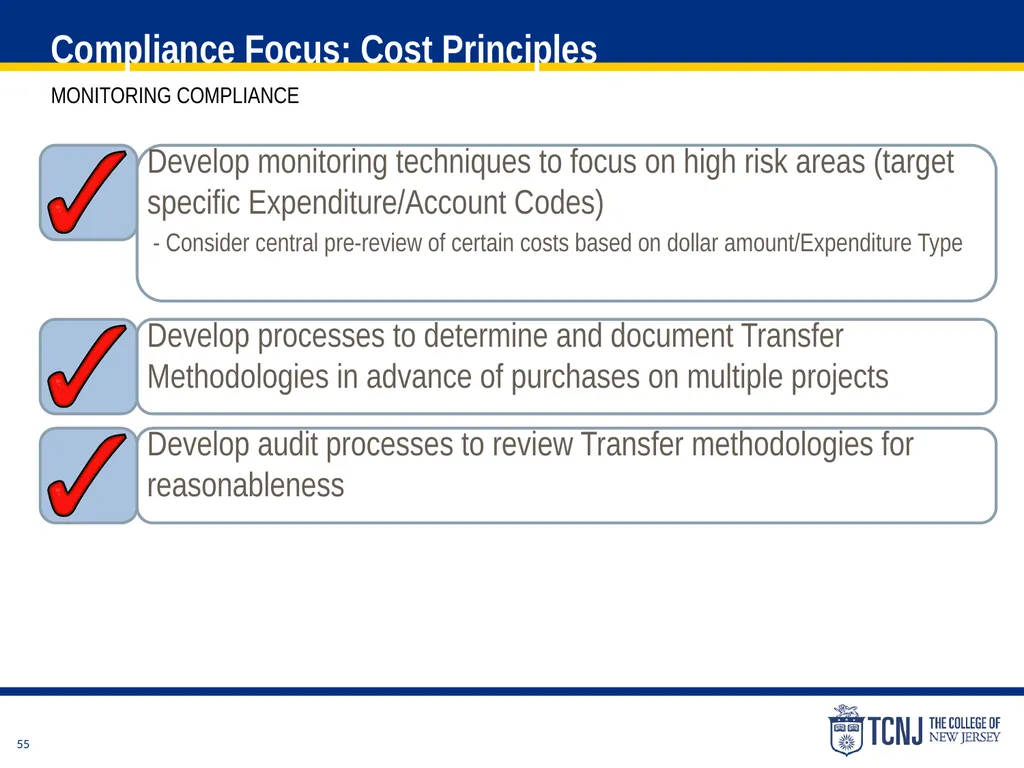
c Compliance Focus: Cost Principles Monitoring compliance c Develop monitoring techniques to focus on high risk areas (target specific Expenditure/Account Codes)
- Consider central pre-review of certain costs based on dollar amount/Expenditure Type c c Develop processes to determine and document Transfer Methodologies in advance of purchases on multiple projects c c Develop audit processes to review Transfer methodologies for reasonableness<br>
- Consider central pre-review of certain costs based on dollar amount/Expenditure Type c c Develop processes to determine and document Transfer Methodologies in advance of purchases on multiple projects c c Develop audit processes to review Transfer methodologies for reasonableness<br>
56
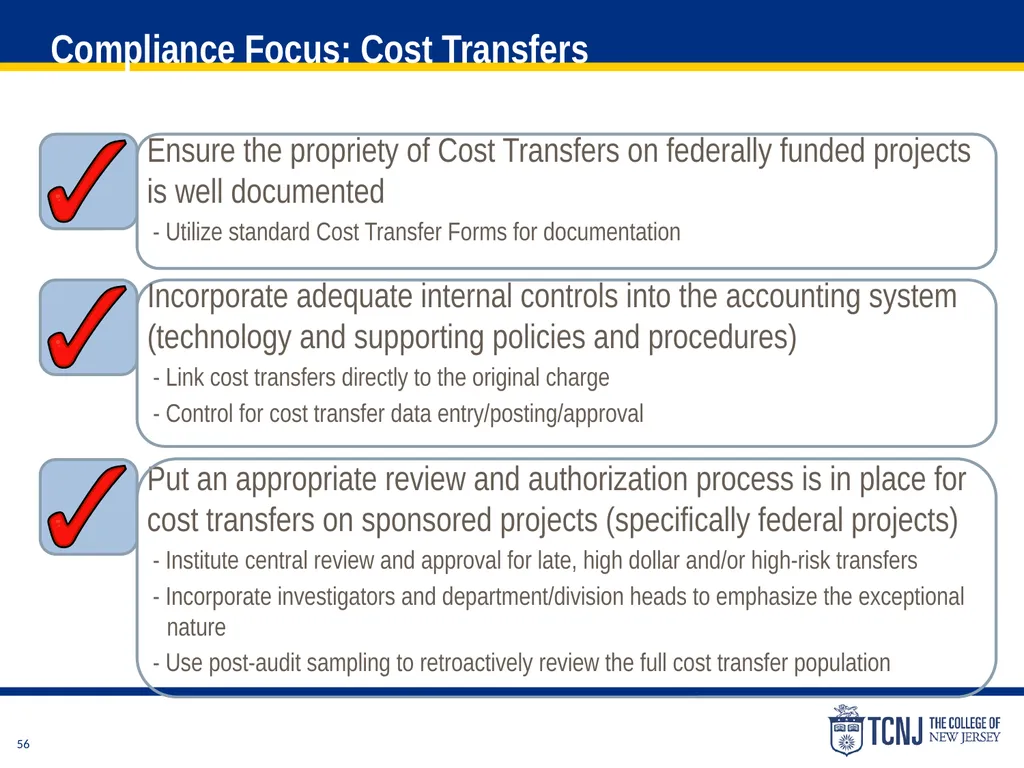
Compliance Focus: Cost Transfers Monitoring compliance c c Ensure the propriety of Cost Transfers on federally funded projects is well documented
- Utilize standard Cost Transfer Forms for documentation c Put an appropriate review and authorization process is in place for cost transfers on sponsored projects (specifically federal projects)
- Institute central review and approval for late, high dollar and/or high-risk transfers
- Incorporate investigators and department/division heads to emphasize the exceptional nature
- Use post-audit sampling to retroactively review the full cost transfer population c c Incorporate adequate internal controls into the accounting system (technology and supporting policies and procedures)
- Link cost transfers directly to the original charge
- Control for cost transfer data entry/posting/approval c<br>
- Utilize standard Cost Transfer Forms for documentation c Put an appropriate review and authorization process is in place for cost transfers on sponsored projects (specifically federal projects)
- Institute central review and approval for late, high dollar and/or high-risk transfers
- Incorporate investigators and department/division heads to emphasize the exceptional nature
- Use post-audit sampling to retroactively review the full cost transfer population c c Incorporate adequate internal controls into the accounting system (technology and supporting policies and procedures)
- Link cost transfers directly to the original charge
- Control for cost transfer data entry/posting/approval c<br>
57
7. Resources<br>
58
Resources Where to get Help Reference updated policies and procedures on the OAGSR website (http://academicgrants.tcnj.edu/)
Sign up for additional trainings
Review the Uniform Guidance Language (http://www.ecfr.gov/cgi-bin/text-idx?tpl=/ecfrbrowse/Title02/2cfr200_main_02.tpl )
Ask your colleagues
Contact OAGSR
Green Hall, Room 202
P) 609.771.3255
E) grants@tcnj.edu
Contact the Office of the Treasurer
Green Hall, Room 207
P) 609.771.2186<br>
Sign up for additional trainings
Review the Uniform Guidance Language (http://www.ecfr.gov/cgi-bin/text-idx?tpl=/ecfrbrowse/Title02/2cfr200_main_02.tpl )
Ask your colleagues
Contact OAGSR
Green Hall, Room 202
P) 609.771.3255
E) grants@tcnj.edu
Contact the Office of the Treasurer
Green Hall, Room 207
P) 609.771.2186<br>
59
8. Appendix<br>
60
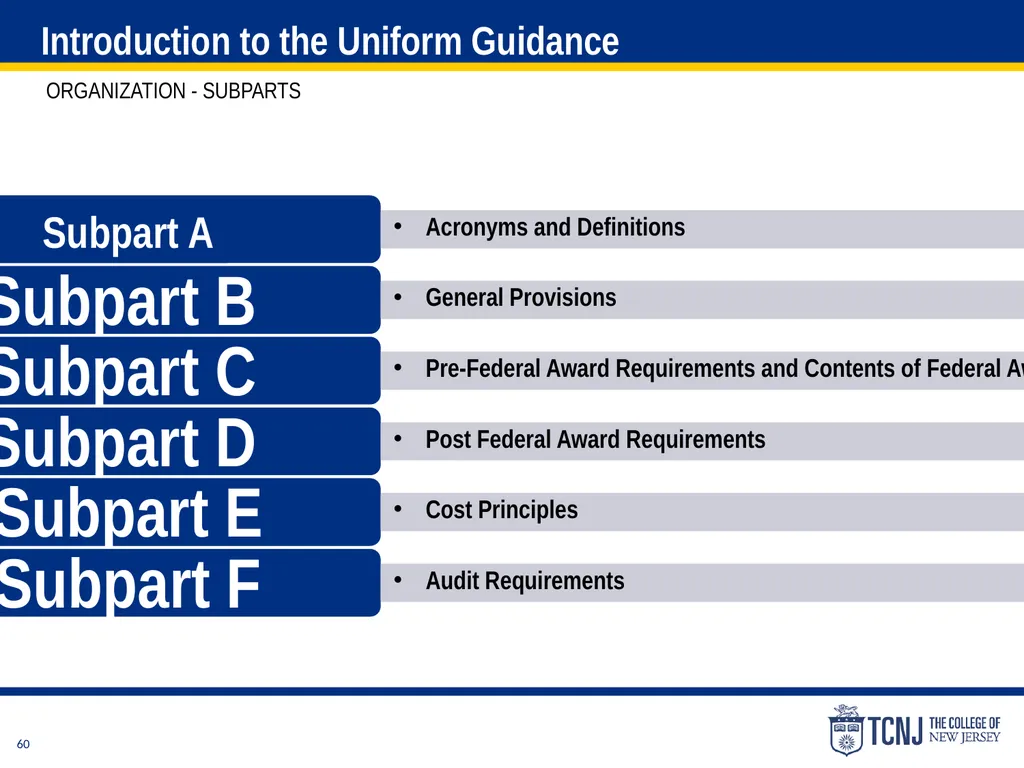
Introduction to the Uniform Guidance Organization - Subparts<br>
61
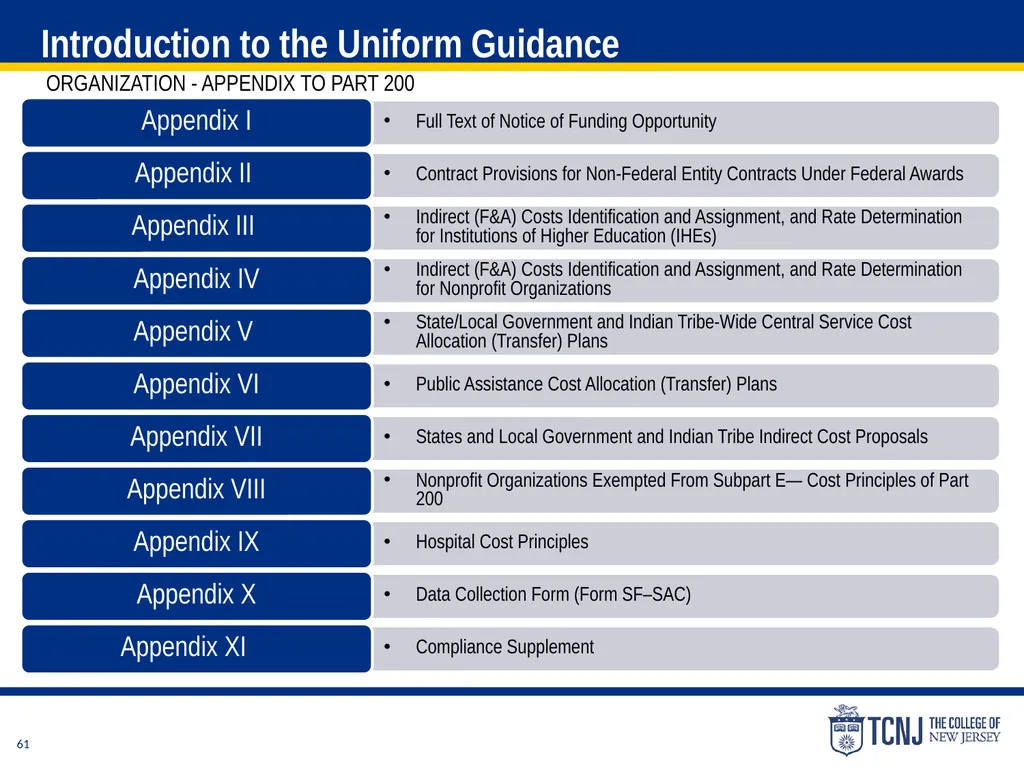
Introduction to the Uniform Guidance Organization - Appendix to Part 200<br>
62
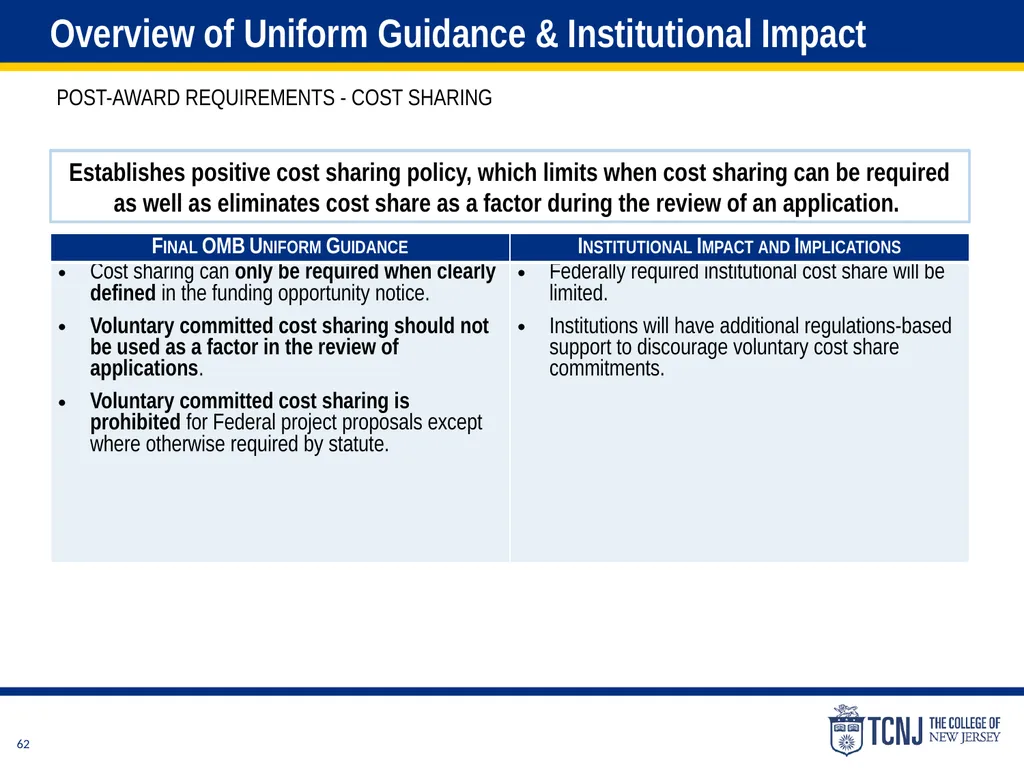
Overview of Uniform Guidance & Institutional Impact Post-award requirements - Cost sharing Establishes positive cost sharing policy, which limits when cost sharing can be required as well as eliminates cost share as a factor during the review of an application.<br>
63
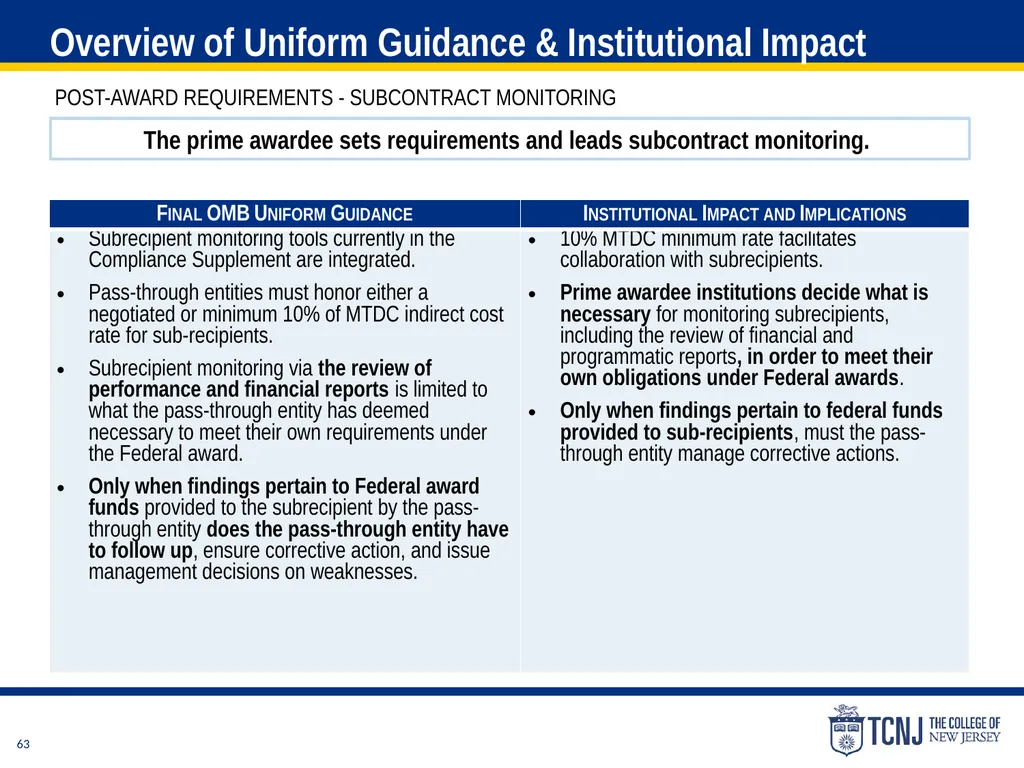
Overview of Uniform Guidance & Institutional Impact POST-award requirements - subcontract monitoring The prime awardee sets requirements and leads subcontract monitoring.<br>
64
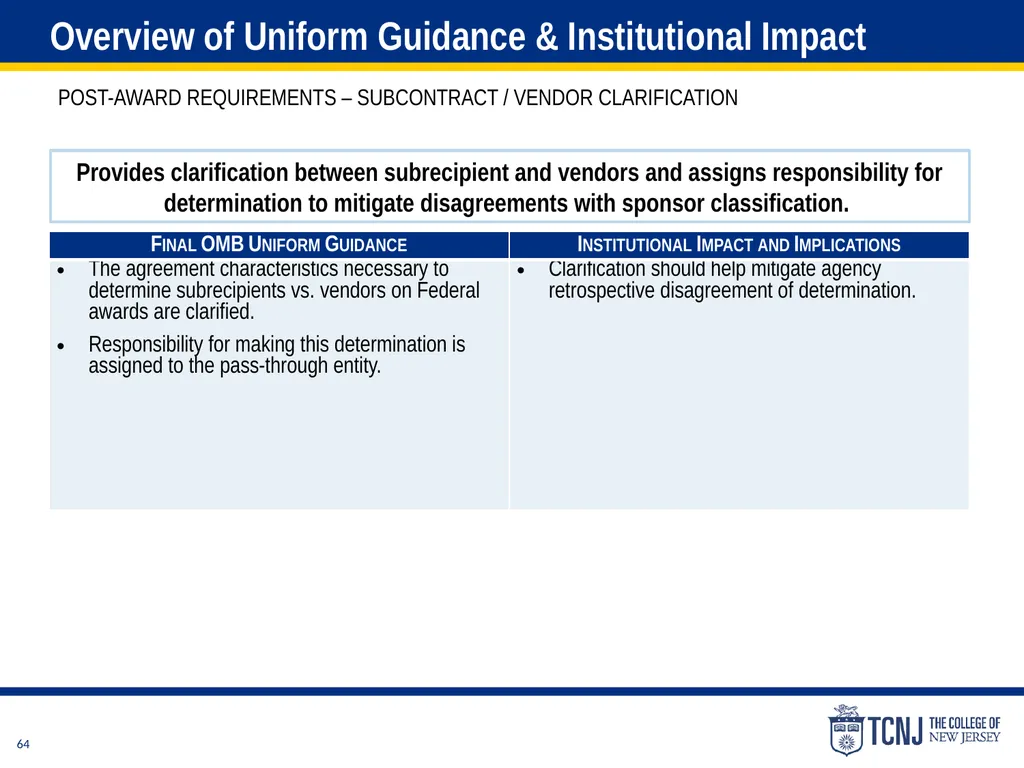
Overview of Uniform Guidance & Institutional Impact Post-award requirements – subcontract / vendor clarification Provides clarification between subrecipient and vendors and assigns responsibility for determination to mitigate disagreements with sponsor classification.<br>
65
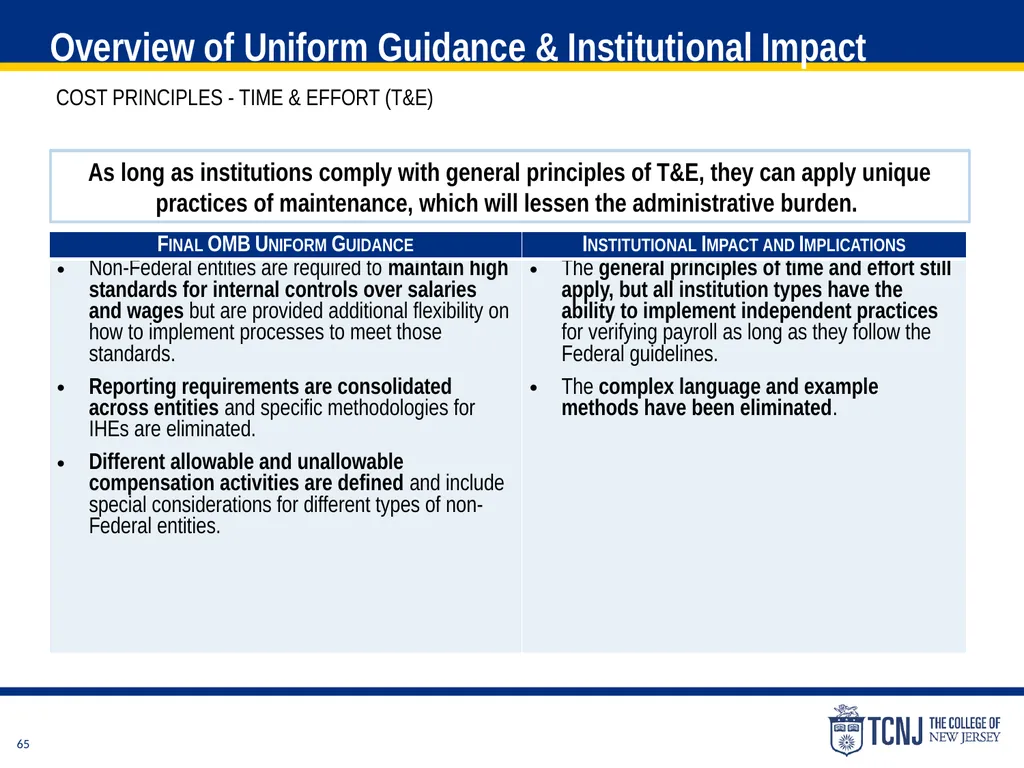
Overview of Uniform Guidance & Institutional Impact Cost principles - Time & Effort (T&E) As long as institutions comply with general principles of T&E, they can apply unique practices of maintenance, which will lessen the administrative burden.<br>
66
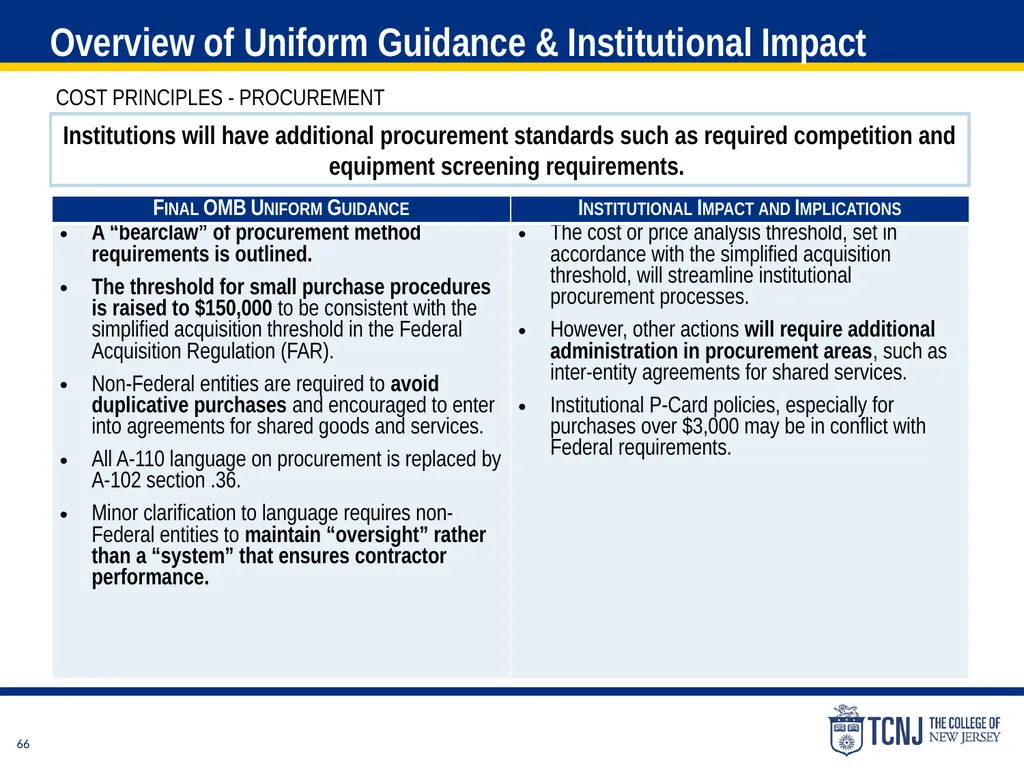
Overview of Uniform Guidance & Institutional Impact Cost principles - procurement Institutions will have additional procurement standards such as required competition and equipment screening requirements.<br>
67
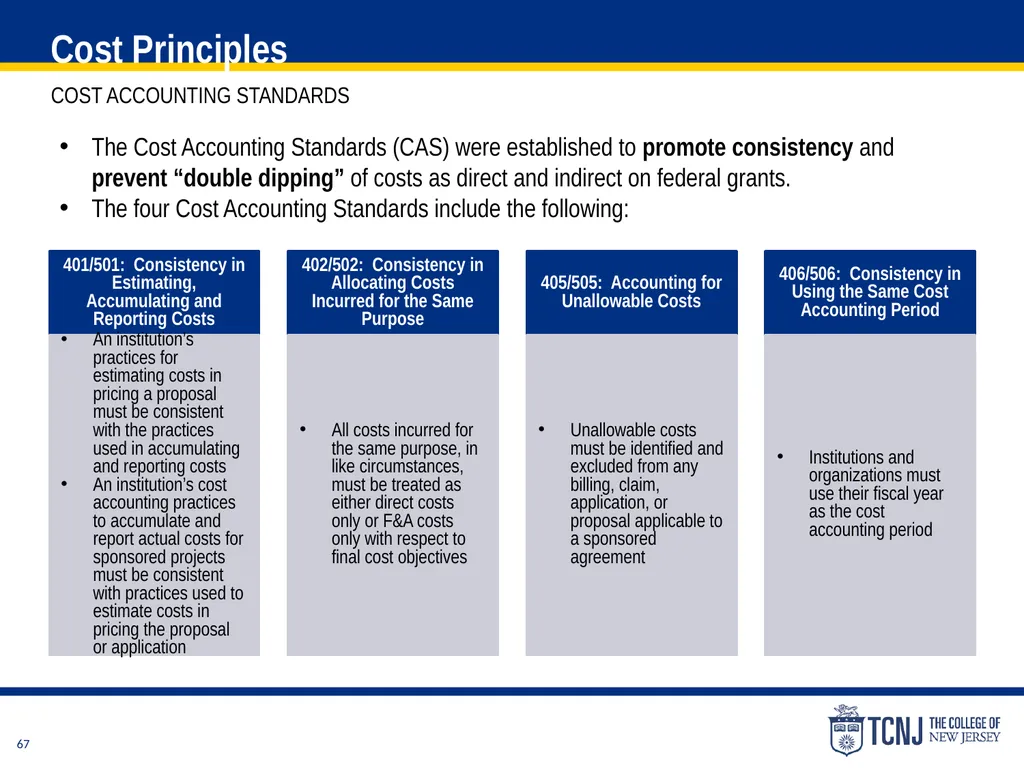
Cost accounting standards Cost Principles The Cost Accounting Standards (CAS) were established to promote consistency and prevent “double dipping” of costs as direct and indirect on federal grants.
The four Cost Accounting Standards include the following:<br>
The four Cost Accounting Standards include the following:<br>
68
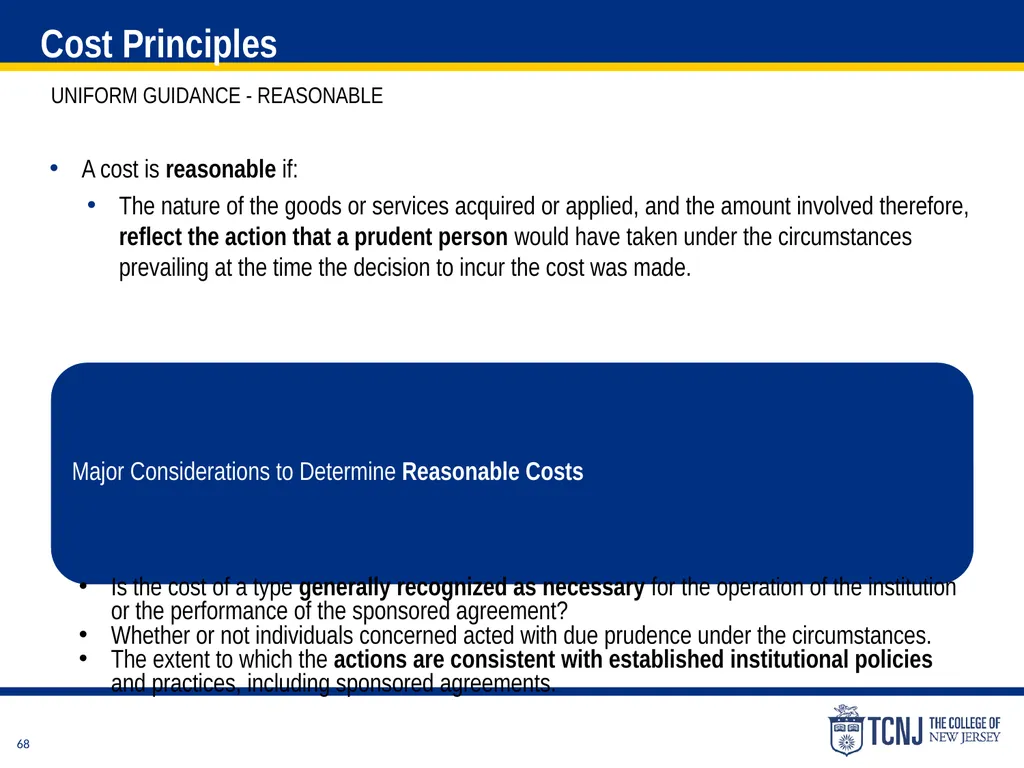
A cost is reasonable if:
The nature of the goods or services acquired or applied, and the amount involved therefore, reflect the action that a prudent person would have taken under the circumstances prevailing at the time the decision to incur the cost was made. Cost Principles Uniform Guidance - Reasonable<br>
The nature of the goods or services acquired or applied, and the amount involved therefore, reflect the action that a prudent person would have taken under the circumstances prevailing at the time the decision to incur the cost was made. Cost Principles Uniform Guidance - Reasonable<br>
69
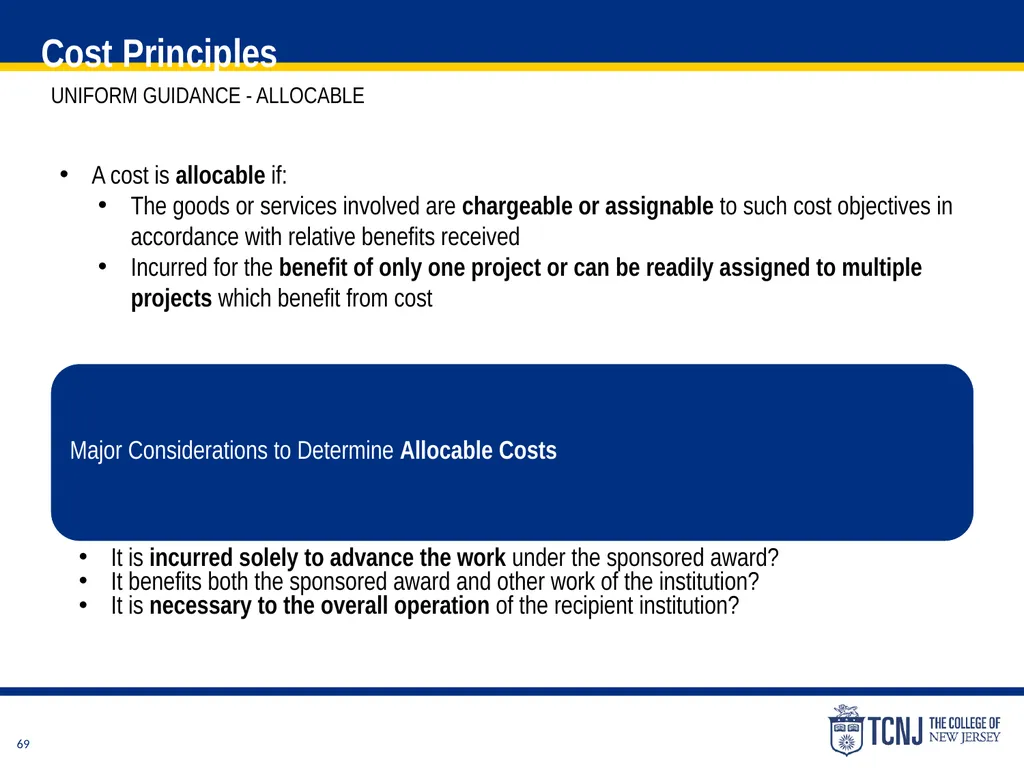
Cost Principles A cost is allocable if:
The goods or services involved are chargeable or assignable to such cost objectives in accordance with relative benefits received
Incurred for the benefit of only one project or can be readily assigned to multiple projects which benefit from cost Uniform Guidance - Allocable<br>
The goods or services involved are chargeable or assignable to such cost objectives in accordance with relative benefits received
Incurred for the benefit of only one project or can be readily assigned to multiple projects which benefit from cost Uniform Guidance - Allocable<br>
70
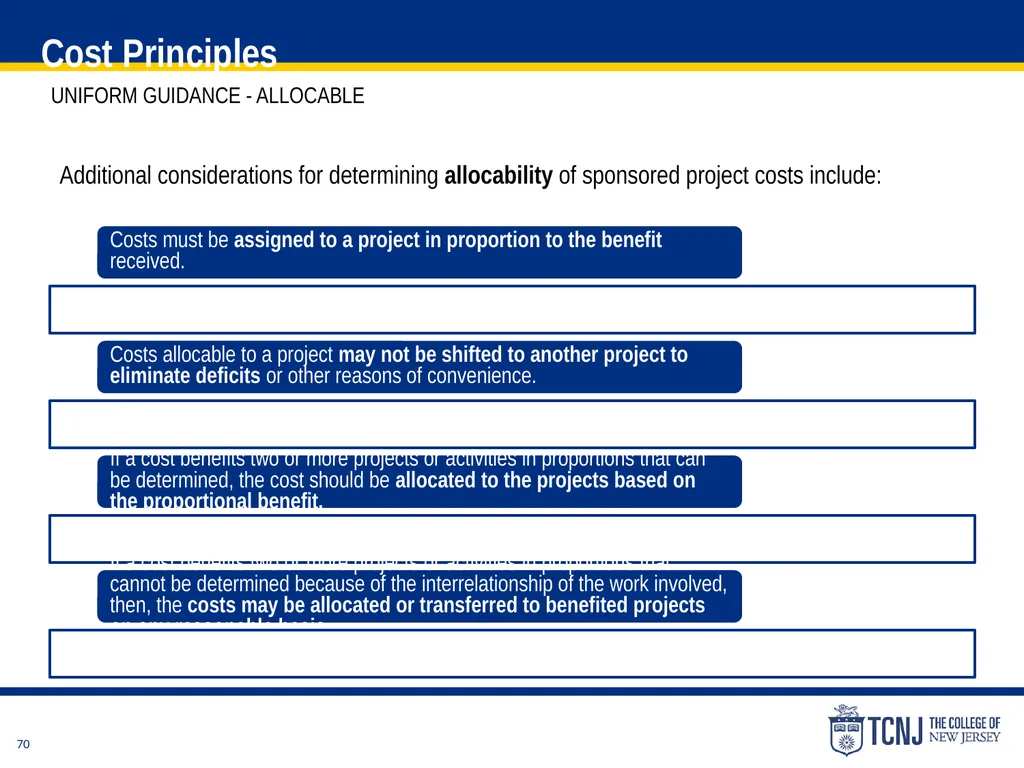
Cost Principles Additional considerations for determining allocability of sponsored project costs include: Uniform Guidance - Allocable<br>
71
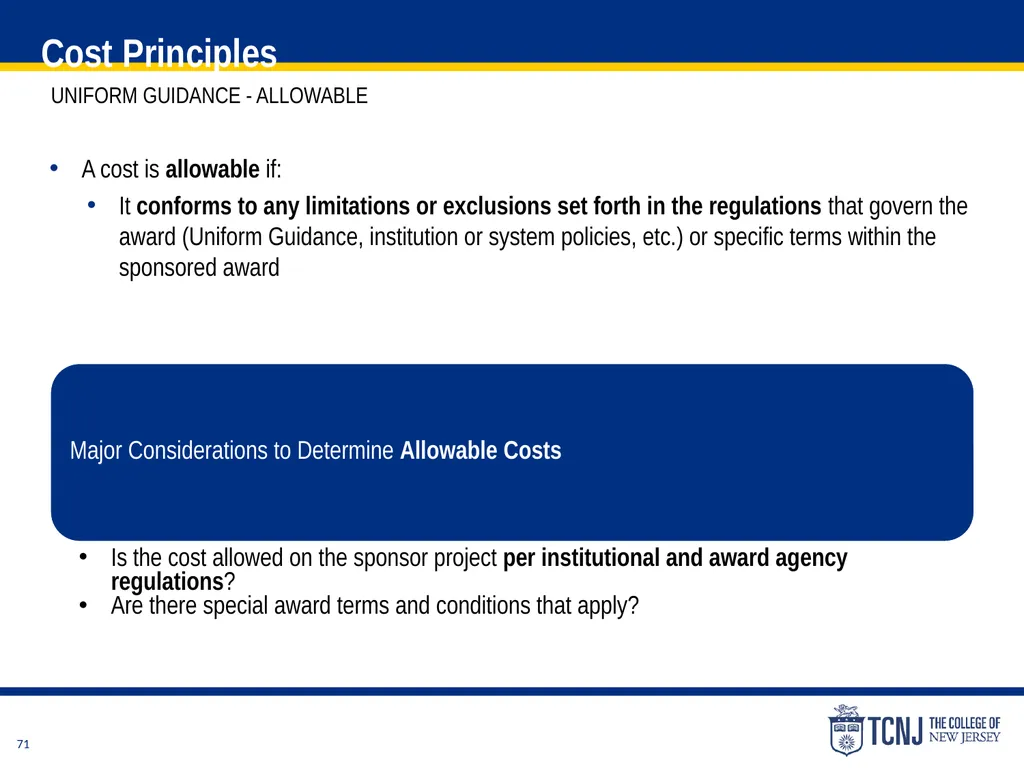
Cost Principles A cost is allowable if:
It conforms to any limitations or exclusions set forth in the regulations that govern the award (Uniform Guidance, institution or system policies, etc.) or specific terms within the sponsored award Uniform Guidance - Allowable<br>
It conforms to any limitations or exclusions set forth in the regulations that govern the award (Uniform Guidance, institution or system policies, etc.) or specific terms within the sponsored award Uniform Guidance - Allowable<br>
72
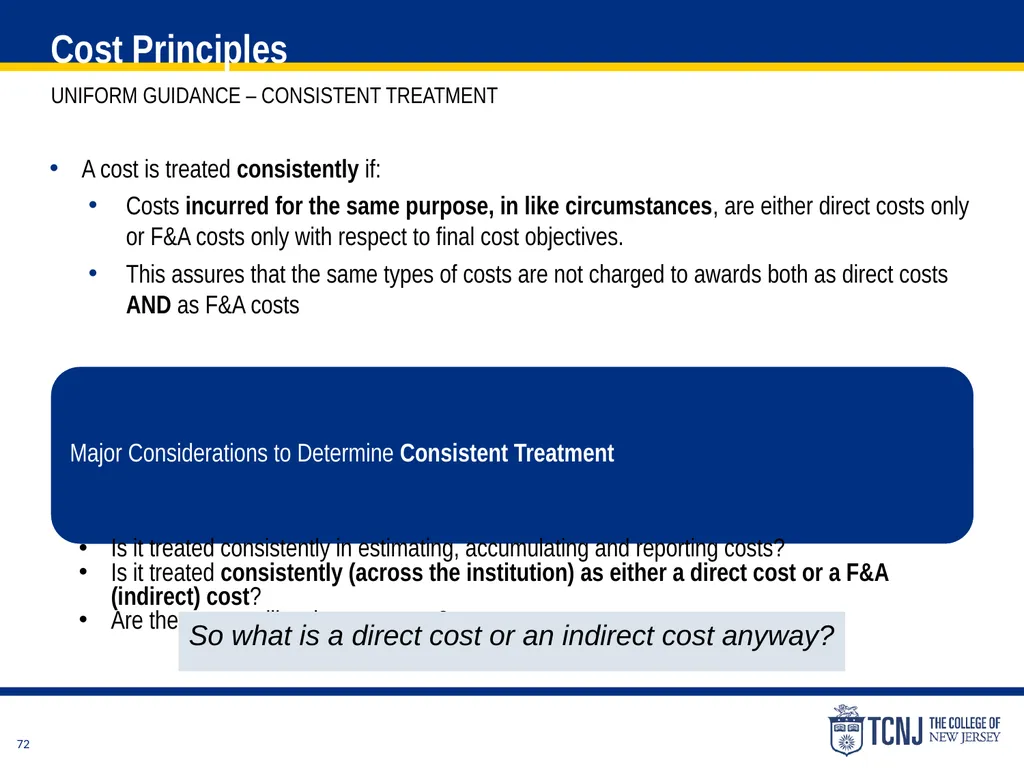
CONSISTENT (DIRECT VS. INDIRECT) A cost is treated consistently if:
Costs incurred for the same purpose, in like circumstances, are either direct costs only or F&A costs only with respect to final cost objectives.
This assures that the same types of costs are not charged to awards both as direct costs AND as F&A costs Cost Principles Uniform Guidance – Consistent Treatment So what is a direct cost or an indirect cost anyway?<br>
Costs incurred for the same purpose, in like circumstances, are either direct costs only or F&A costs only with respect to final cost objectives.
This assures that the same types of costs are not charged to awards both as direct costs AND as F&A costs Cost Principles Uniform Guidance – Consistent Treatment So what is a direct cost or an indirect cost anyway?<br>
73
Cost Principles The Challenge of Administration Costs<br>
74
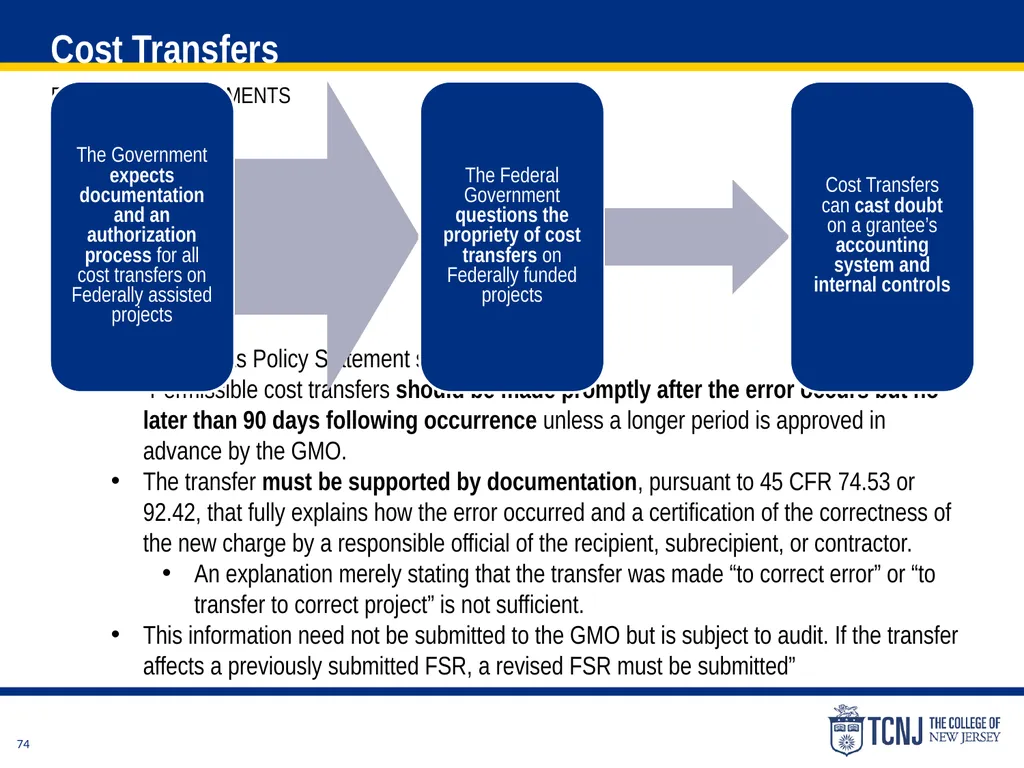
Federal Requirements Cost Transfers The HHS Grants Policy Statement states:
“Permissible cost transfers should be made promptly after the error occurs but no later than 90 days following occurrence unless a longer period is approved in advance by the GMO.
The transfer must be supported by documentation, pursuant to 45 CFR 74.53 or 92.42, that fully explains how the error occurred and a certification of the correctness of the new charge by a responsible official of the recipient, subrecipient, or contractor.
An explanation merely stating that the transfer was made “to correct error” or “to transfer to correct project” is not sufficient.
This information need not be submitted to the GMO but is subject to audit. If the transfer affects a previously submitted FSR, a revised FSR must be submitted”<br>
“Permissible cost transfers should be made promptly after the error occurs but no later than 90 days following occurrence unless a longer period is approved in advance by the GMO.
The transfer must be supported by documentation, pursuant to 45 CFR 74.53 or 92.42, that fully explains how the error occurred and a certification of the correctness of the new charge by a responsible official of the recipient, subrecipient, or contractor.
An explanation merely stating that the transfer was made “to correct error” or “to transfer to correct project” is not sufficient.
This information need not be submitted to the GMO but is subject to audit. If the transfer affects a previously submitted FSR, a revised FSR must be submitted”<br>