The United States will conquer Mexico, but it will be as the man swallows arsenicMexico will poison us. Ralph Waldo Emerson The Compromise of 1850 and Kansas-Nebraska Act Mr. Winchell APUSH Period 5 Election of 1848 Zachary Taylor (W)
"“The United States will conquer Mexico, but it" is the property of its rightful owner. Permission is granted to
download and print the materials on this website for personal, non-commercial use only, and to display it
on your personal computer provided you do not modify the materials and that you retain all copyright
notices contained in the materials. By downloading content from our website, you accept the terms of this
agreement.
Presentation Transcript
01
“The United States will conquer Mexico, but it will be as the man swallows arsenic…Mexico will poison us.”
Ralph Waldo Emerson<br>
02
The Compromise of 1850 and Kansas-Nebraska Act Mr. Winchell
APUSH Period 5<br>
03
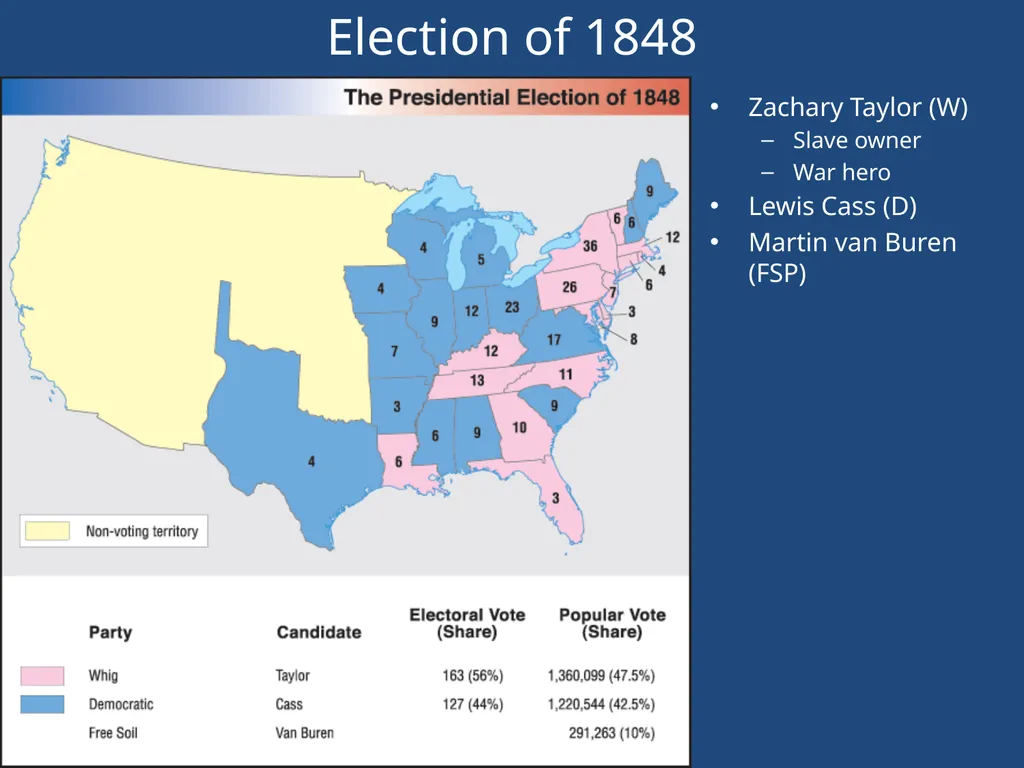
Election of 1848 Zachary Taylor (W)
Slave owner
War hero
Lewis Cass (D)
Martin van Buren (FSP)<br>
04
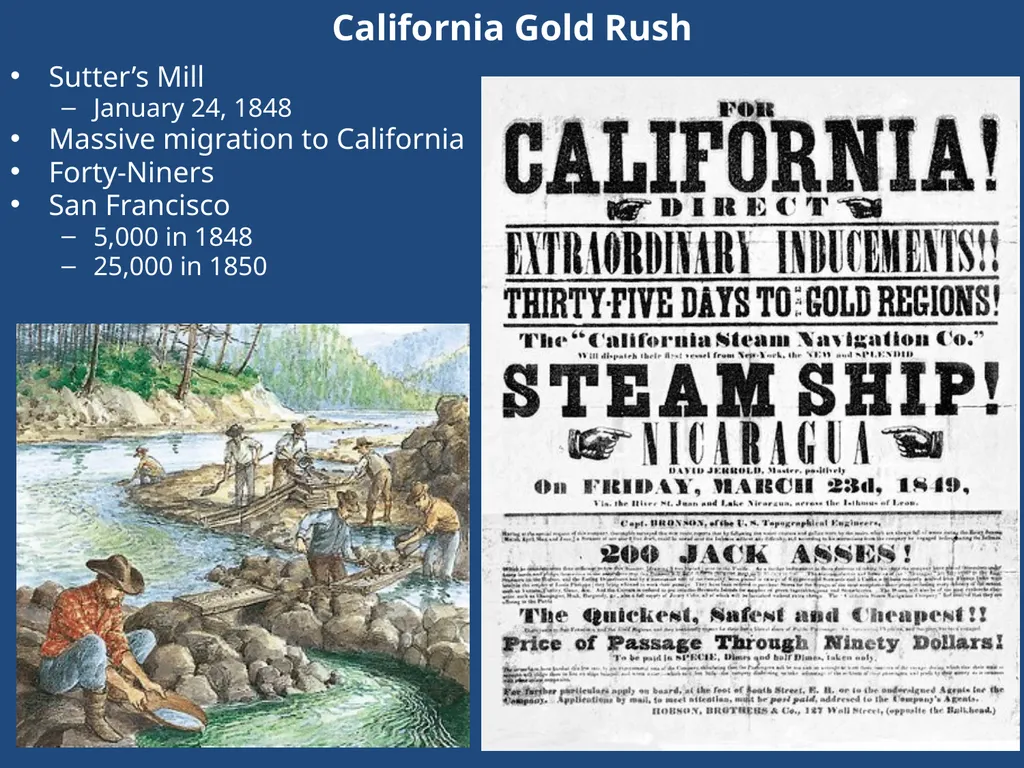
California Gold Rush Sutter’s Mill
January 24, 1848
Massive migration to California
Forty-Niners
San Francisco
5,000 in 1848
25,000 in 1850<br>
05
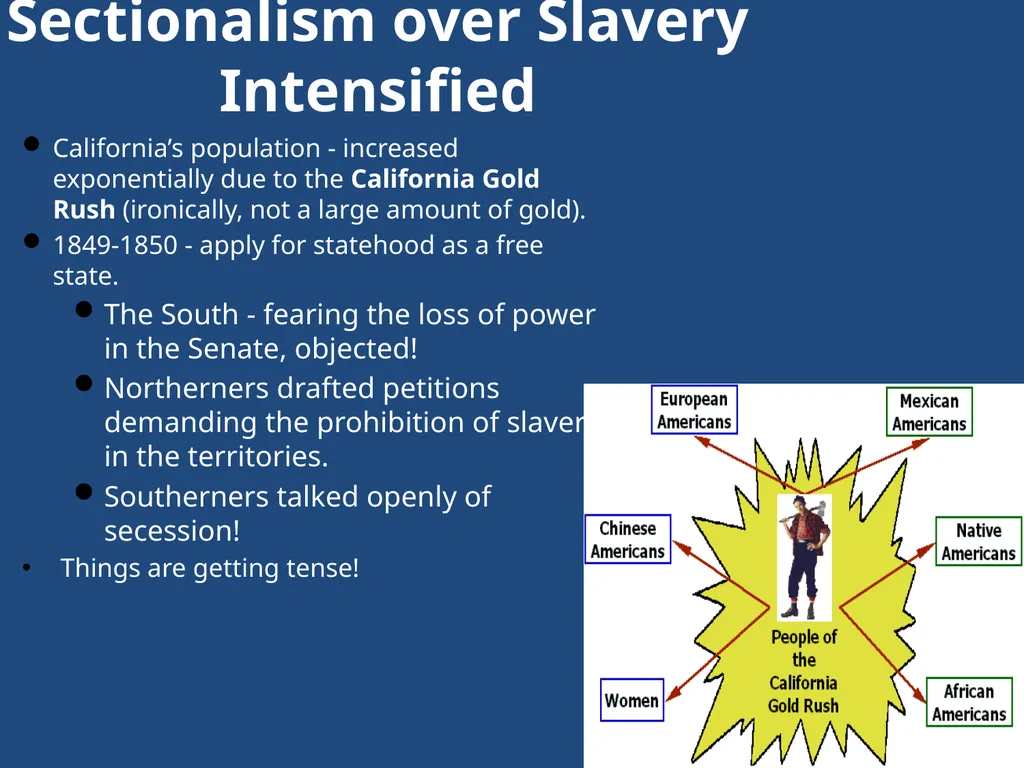
Sectionalism over Slavery Intensified California’s population - increased exponentially due to the California Gold Rush (ironically, not a large amount of gold).
1849-1850 - apply for statehood as a free state.
The South - fearing the loss of power in the Senate, objected!
Northerners drafted petitions demanding the prohibition of slavery in the territories.
Southerners talked openly of secession!
Things are getting tense!<br>
06
Sectional crisis – Senate tried to find compromise – it is a mess at this point!
Issues to Fix:
CA wants to be a state – most thought it would be slave due to most of the territory being under the 36-30 line, but people of CA and Pres. Taylor
Texas (slave state) is claiming NM lands for themselves.
Abolitionists want slavery out of DC.
South is mad at North for not enforcing the Fugitive Slave Act of 1793.
Henry Clay - presented a bill that contained:
Admission of California as a free state.
Forming territorial governments without restrictions on slavery.
Eliminate the slave trade in DC, but not slavery itself.
A more effective fugitive slave law. A Solution is Needed!<br>
07
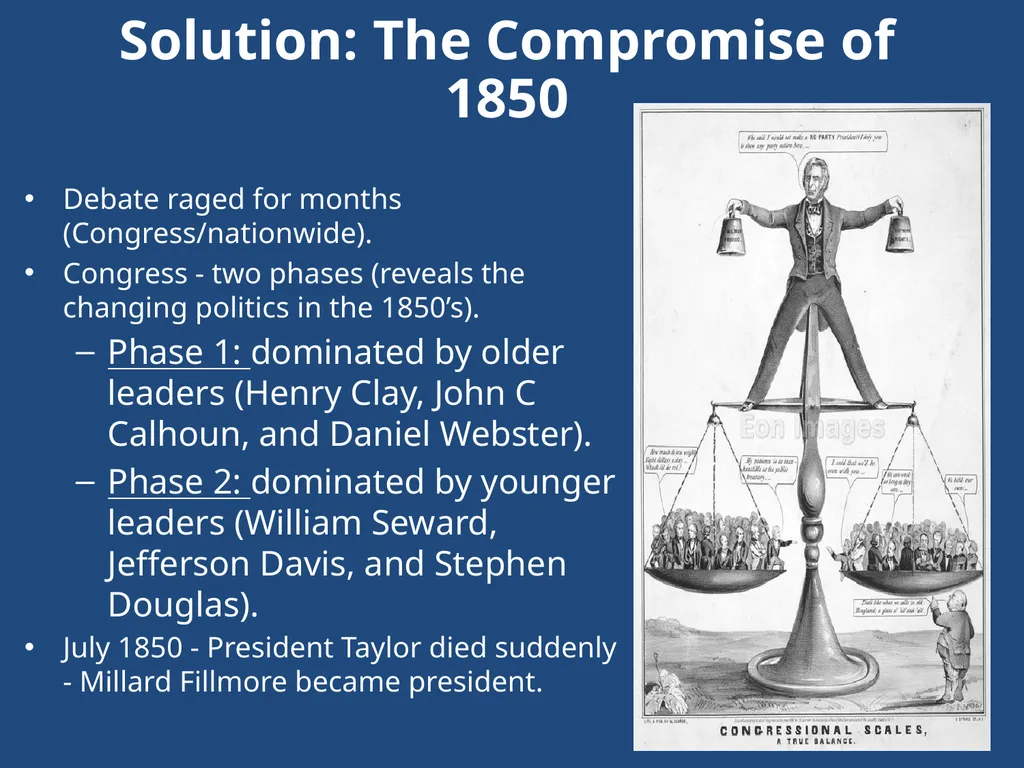
Solution: The Compromise of 1850 Debate raged for months (Congress/nationwide).
Congress - two phases (reveals the changing politics in the 1850’s).
Phase 1: dominated by older leaders (Henry Clay, John C Calhoun, and Daniel Webster).
Phase 2: dominated by younger leaders (William Seward, Jefferson Davis, and Stephen Douglas).
July 1850 - President Taylor died suddenly - Millard Fillmore became president.<br>
08
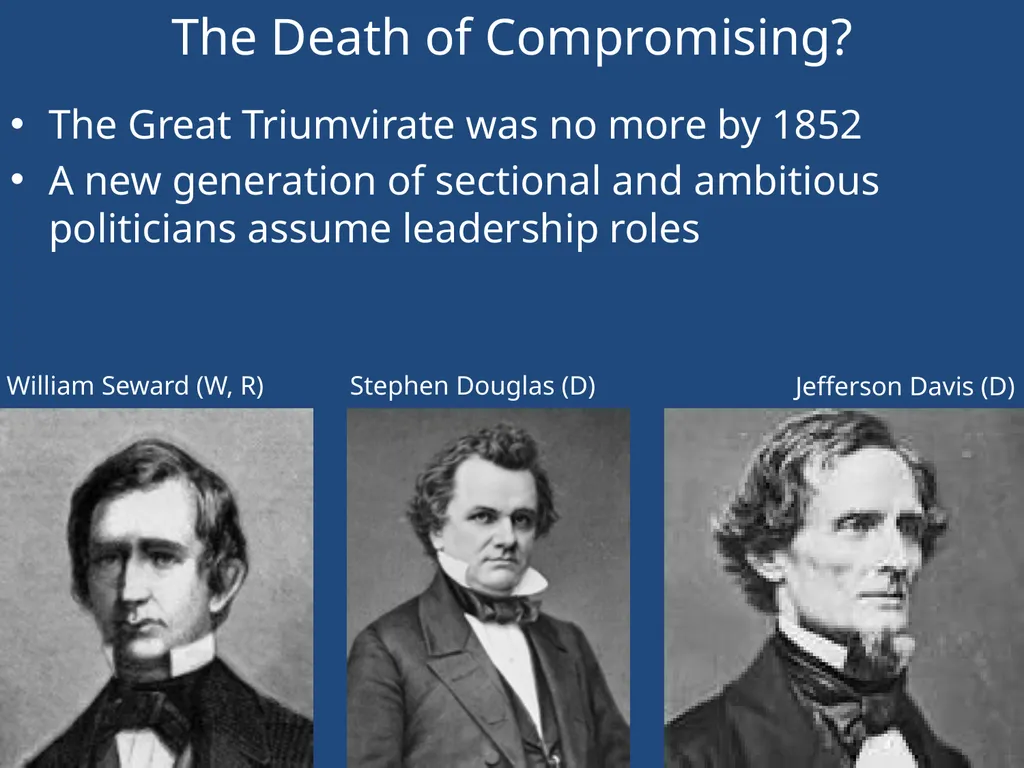
The Death of Compromising? The Great Triumvirate was no more by 1852
A new generation of sectional and ambitious politicians assume leadership roles Stephen Douglas (D) William Seward (W, R) Jefferson Davis (D)<br>
09
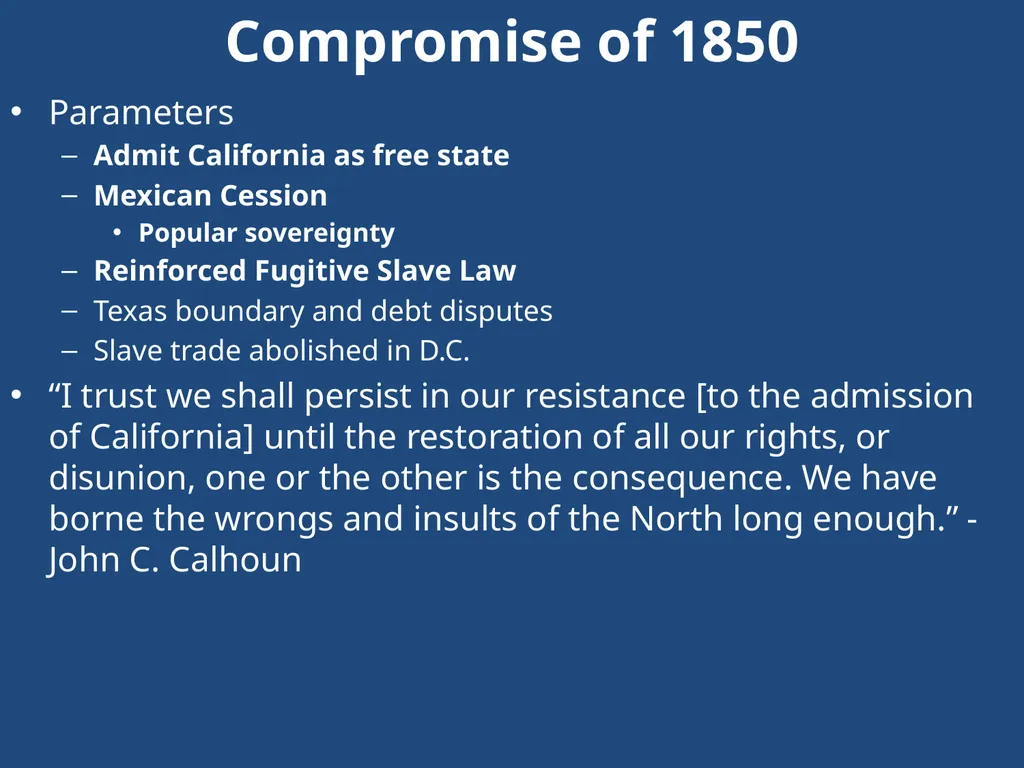
Compromise of 1850 Parameters
Admit California as free state
Mexican Cession
Popular sovereignty
Reinforced Fugitive Slave Law
Texas boundary and debt disputes
Slave trade abolished in D.C.
“I trust we shall persist in our resistance [to the admission of California] until the restoration of all our rights, or disunion, one or the other is the consequence. We have borne the wrongs and insults of the North long enough.” - John C. Calhoun<br>
10
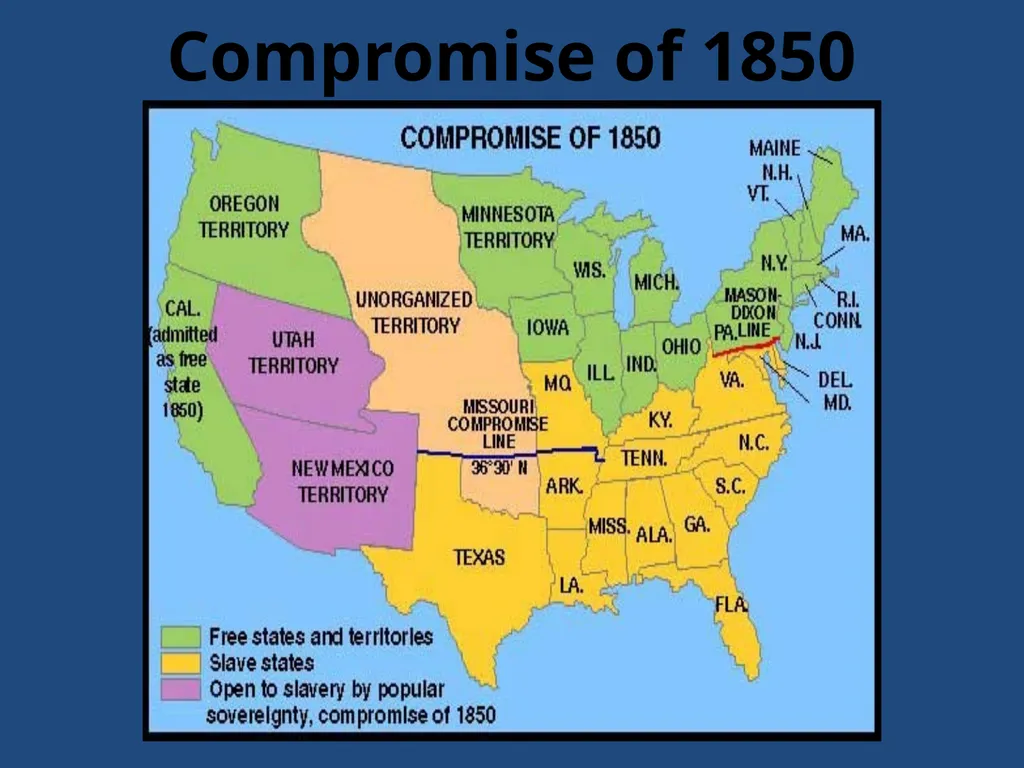
Compromise of 1850<br>
11
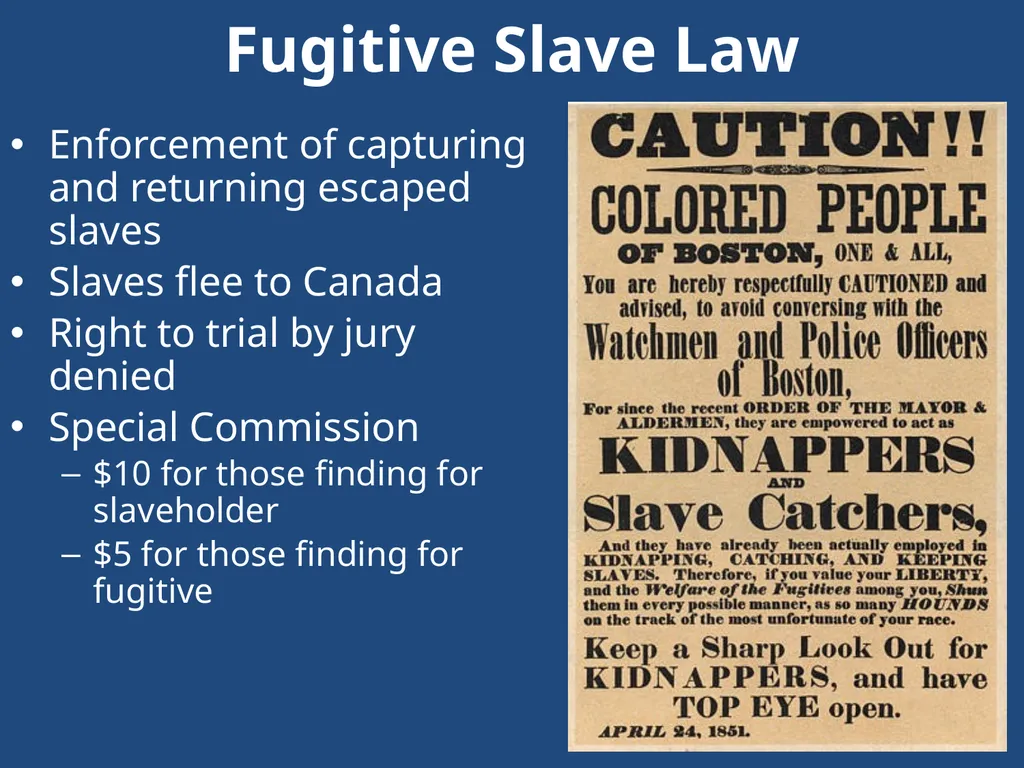
Fugitive Slave Law Enforcement of capturing and returning escaped slaves
Slaves flee to Canada
Right to trial by jury denied
Special Commission
$10 for those finding for slaveholder
$5 for those finding for fugitive<br>
12
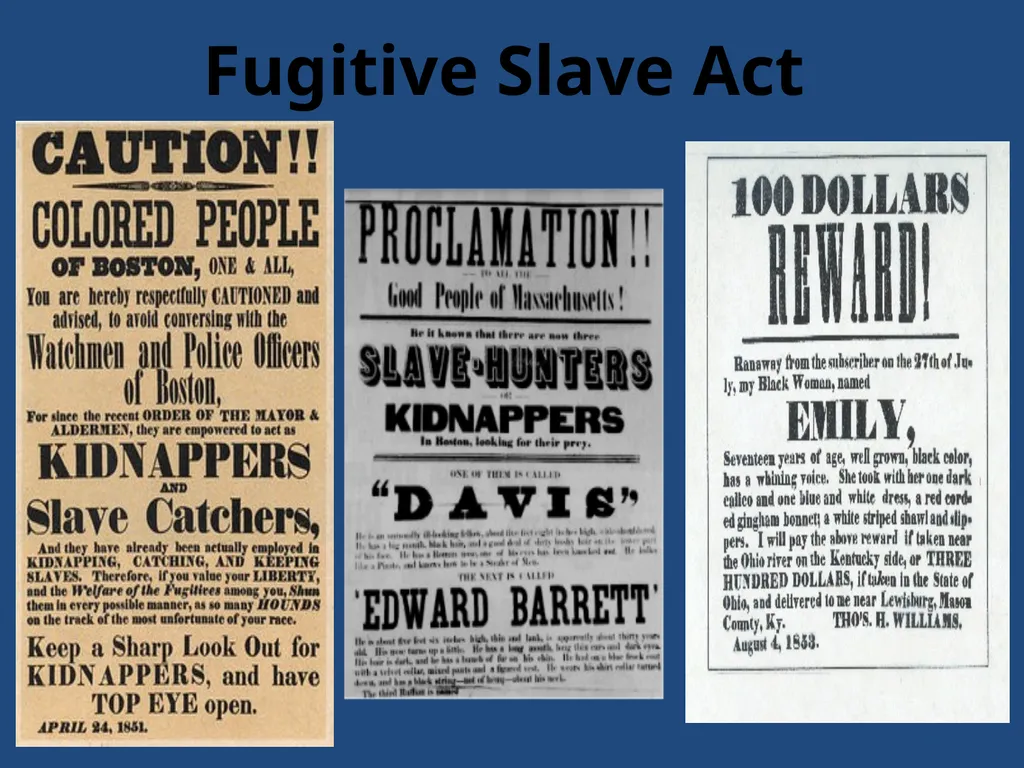
Fugitive Slave Act<br>
13
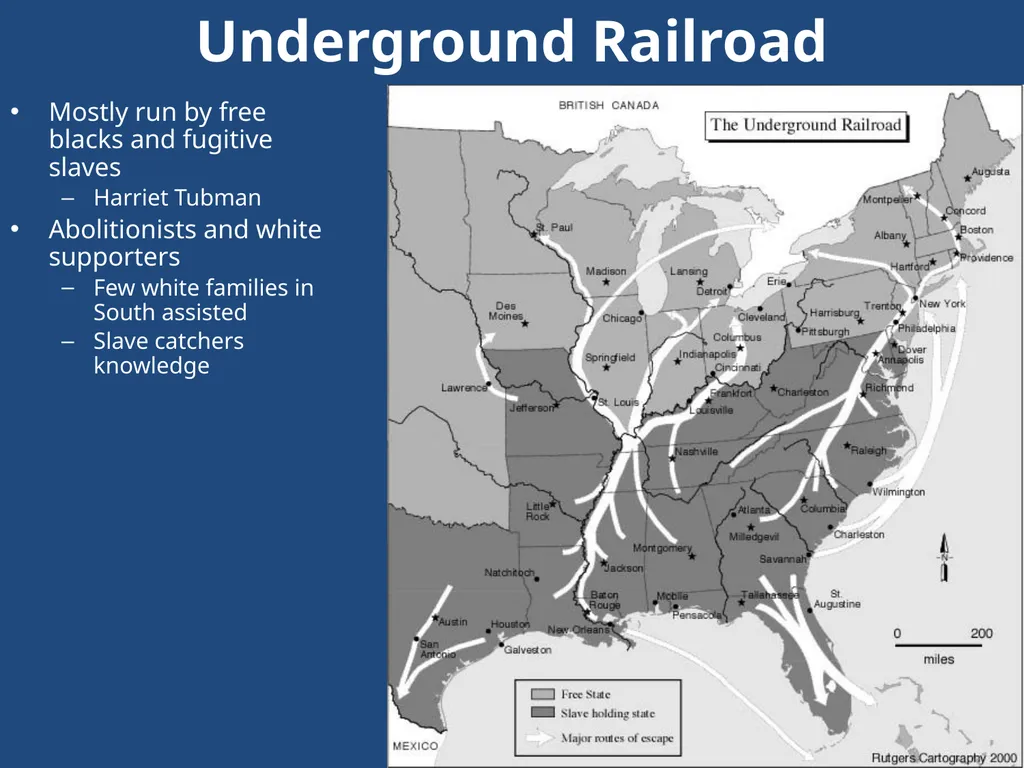
Underground Railroad Mostly run by free blacks and fugitive slaves
Harriet Tubman
Abolitionists and white supporters
Few white families in South assisted
Slave catchers knowledge<br>
14
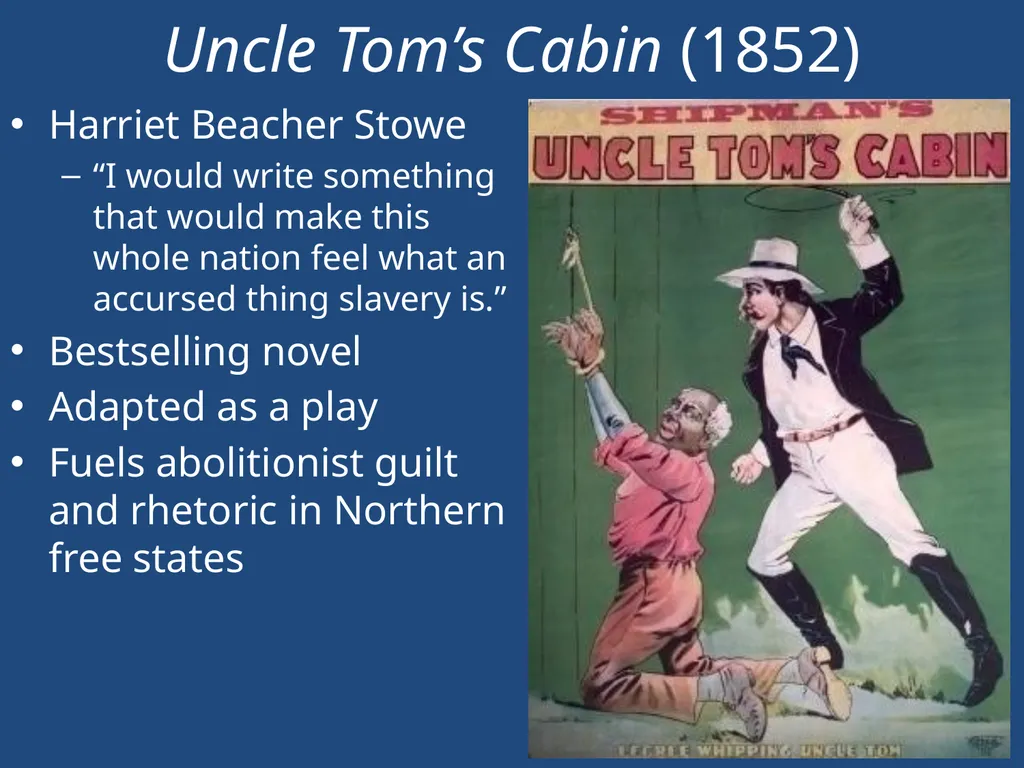
Uncle Tom’s Cabin (1852) Harriet Beacher Stowe
“I would write something that would make this whole nation feel what an accursed thing slavery is.”
Bestselling novel
Adapted as a play
Fuels abolitionist guilt and rhetoric in Northern free states<br>
15
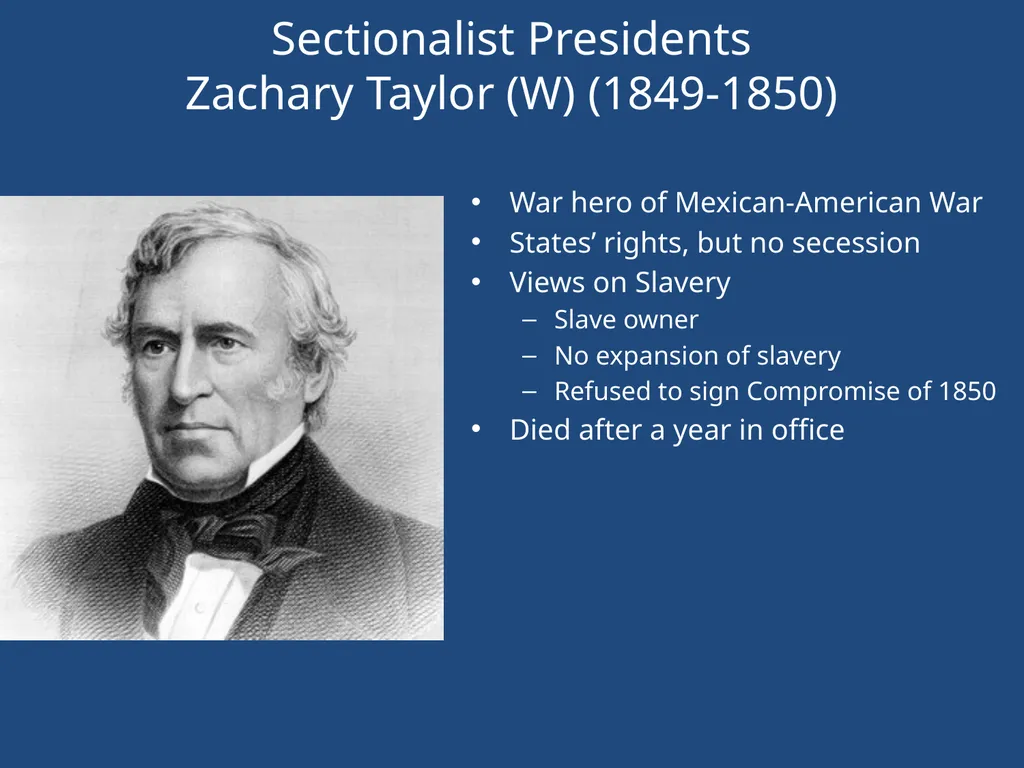
Sectionalist Presidents Zachary Taylor (W) (1849-1850) War hero of Mexican-American War
States’ rights, but no secession
Views on Slavery
Slave owner
No expansion of slavery
Refused to sign Compromise of 1850
Died after a year in office<br>
16
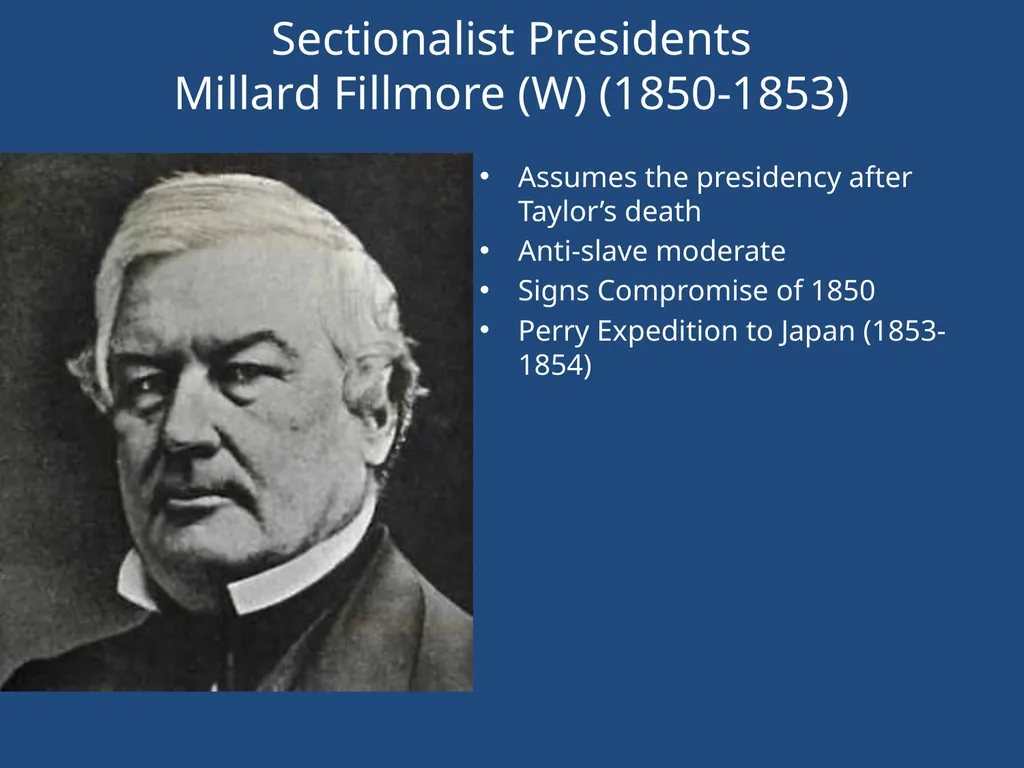
Sectionalist Presidents Millard Fillmore (W) (1850-1853) Assumes the presidency after Taylor’s death
Anti-slave moderate
Signs Compromise of 1850
Perry Expedition to Japan (1853-1854)<br>
17
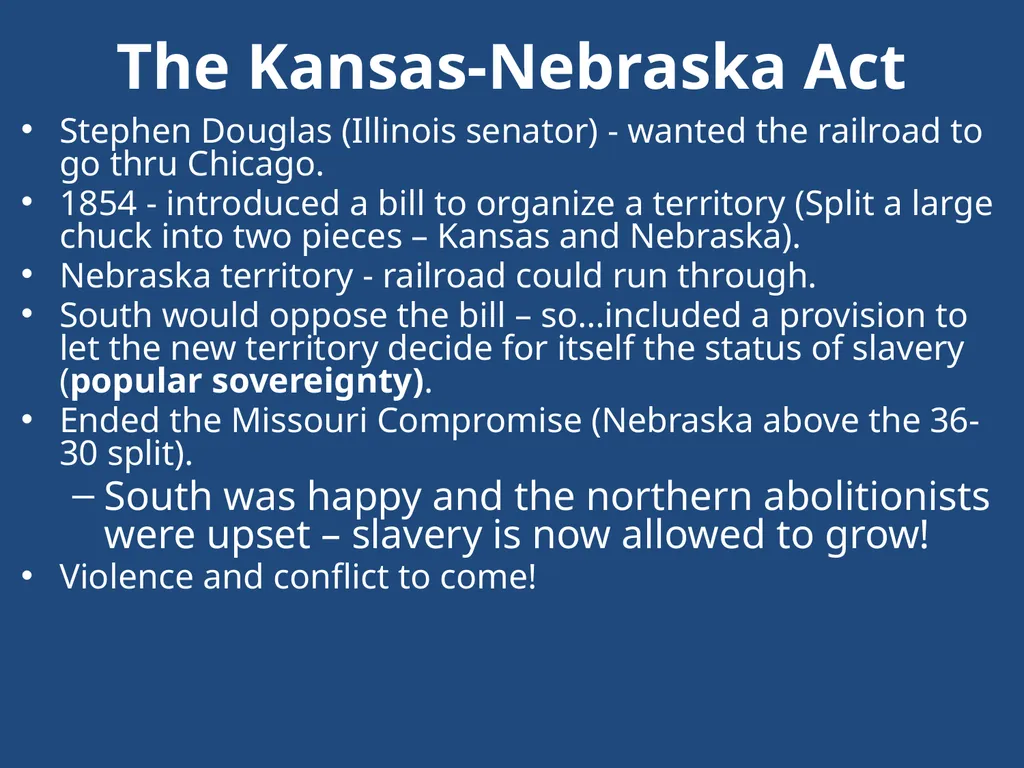
Stephen Douglas (Illinois senator) - wanted the railroad to go thru Chicago.
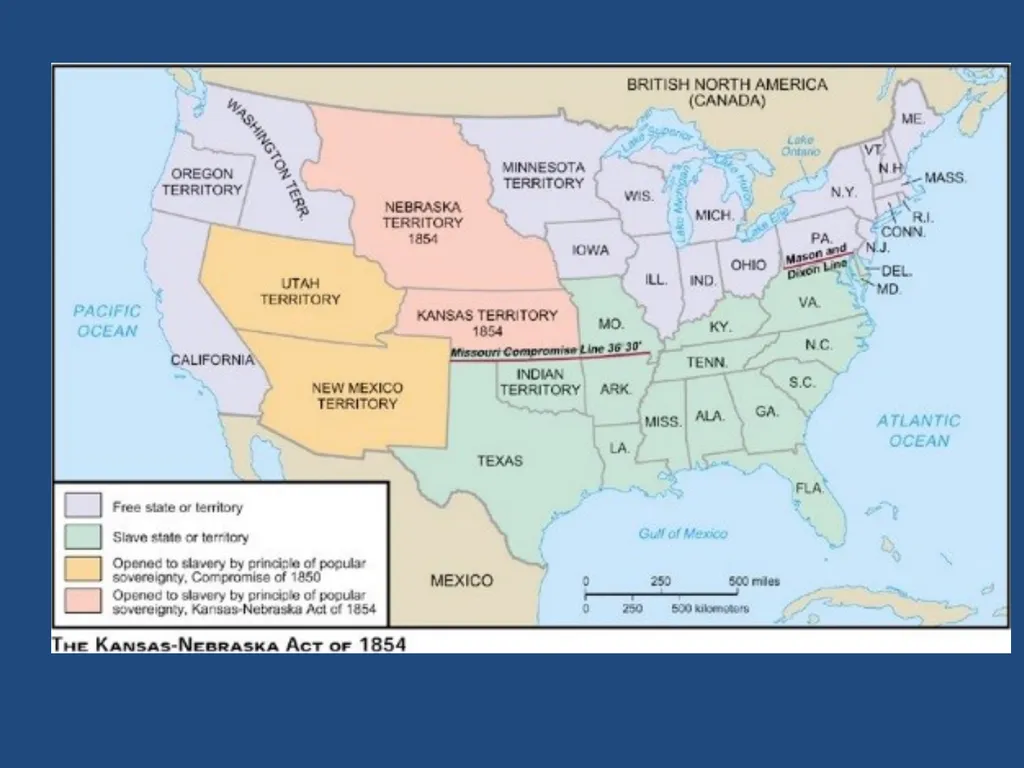
1854 - introduced a bill to organize a territory (Split a large chuck into two pieces – Kansas and Nebraska).
Nebraska territory - railroad could run through.
South would oppose the bill – so…included a provision to let the new territory decide for itself the status of slavery (popular sovereignty).
Ended the Missouri Compromise (Nebraska above the 36-30 split).
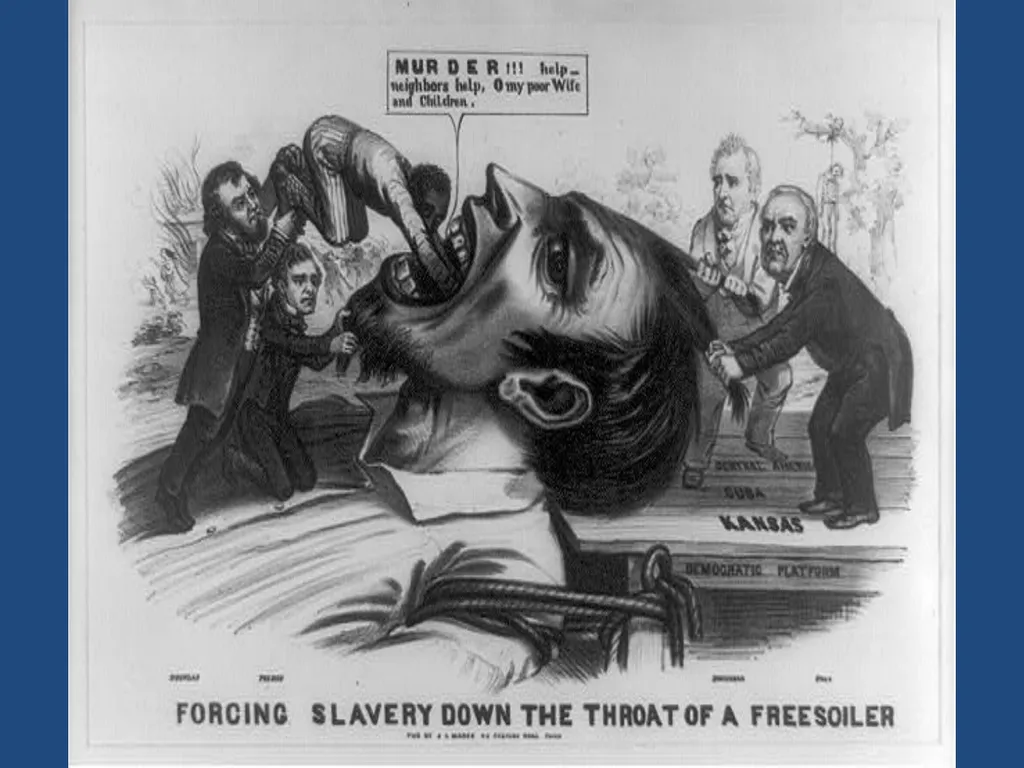
South was happy and the northern abolitionists were upset – slavery is now allowed to grow!
Violence and conflict to come! The Kansas-Nebraska Act<br>
18
“A living, creeping, lie.” "If Kansas should sink to-day, and leave a great vacant space in the earth's surface, this vexed question [of slavery] would still be among us.“
A. Lincoln<br>
19
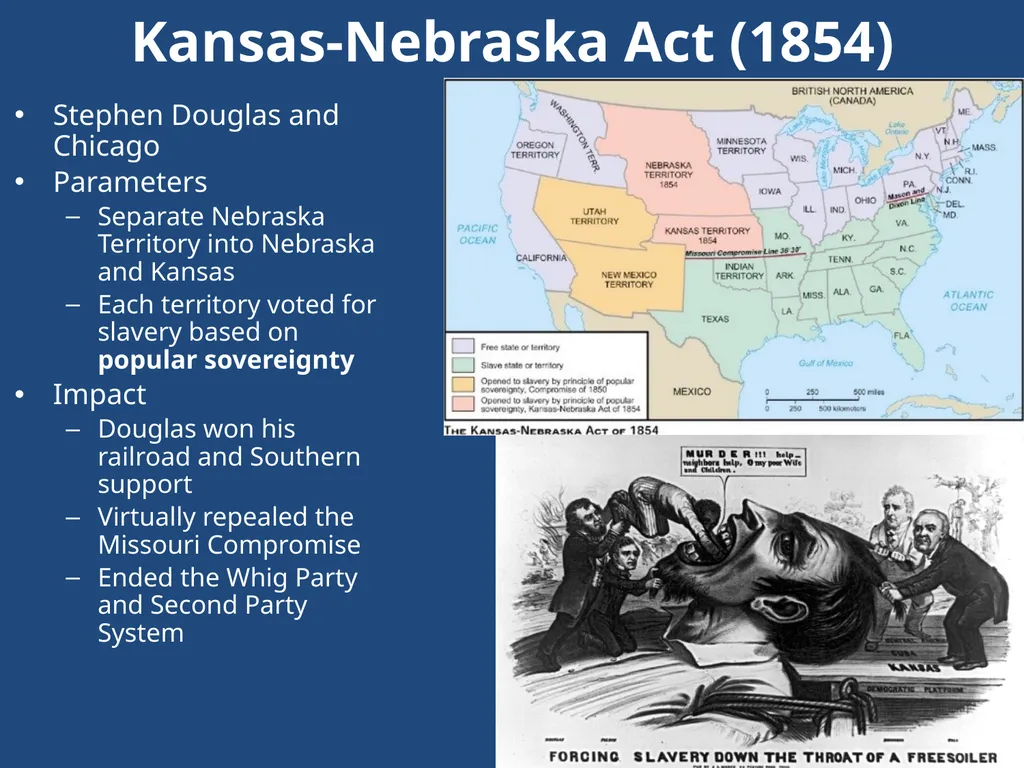
Kansas-Nebraska Act (1854) Stephen Douglas and Chicago
Parameters
Separate Nebraska Territory into Nebraska and Kansas
Each territory voted for slavery based on popular sovereignty
Impact
Douglas won his railroad and Southern support
Virtually repealed the Missouri Compromise
Ended the Whig Party and Second Party System<br>