
The White House Staff: General Observations The
DP
Published · 45 slides · 0 views

1 / 1




Description
The White House Staff: General Observations The White House Staff: General Observations The Presidency is a Highly Personalized Office The White House staff organization and operations reflect the preferences, tone, personality, and style
Related Topics
Share
Embed code
Download this presentation From Below
"The White House Staff: General Observations The" is the property of its rightful owner. Permission is granted to download and print the materials on this website for personal, non-commercial use only, and to display it on your personal computer provided you do not modify the materials and that you retain all copyright notices contained in the materials. By downloading content from our website, you accept the terms of this agreement.
Presentation Transcript
01
The White House Staff:
General Observations<br>
02
The White House Staff: General Observations The Presidency is a Highly Personalized Office
The White House staff organization and operations reflect the preferences, tone, personality, and style of the President rather than the President conforming his style to the White House staff.
Institutionalization of the White House Staff
There has been a good deal of stability with respect to the size and composition of the White House staff and the Executive Office of the President since the changes instituted in the Nixon Administration.
The White House as a Coordinating Complex
As the size and scope of government have grown, so have the roles and responsibilities of the White House staff to coordinate the large number of departments and agencies that have been created and the large number of entities in the Executive Office of the President. 2<br>
The White House staff organization and operations reflect the preferences, tone, personality, and style of the President rather than the President conforming his style to the White House staff.
Institutionalization of the White House Staff
There has been a good deal of stability with respect to the size and composition of the White House staff and the Executive Office of the President since the changes instituted in the Nixon Administration.
The White House as a Coordinating Complex
As the size and scope of government have grown, so have the roles and responsibilities of the White House staff to coordinate the large number of departments and agencies that have been created and the large number of entities in the Executive Office of the President. 2<br>
03
Essential Roles of the
White House Staff<br>
04
The President as Chief Executive Historically, presidents have had only modest sized staffs.
The Brownlow Committee, commissioned by Franklin D. Roosevelt, began its report with the memorable words, “The President needs help.”
Its report led to the creation in 1939 of the Executive Office of the President, a collection of entities designed to serve the President in providing leadership and direction to the executive branch of government.
The Bureau of the Budget, created in 1921 by the Congress to have responsibility for assisting the President in preparing a unified federal budget was originally placed in the Department of the Treasury. In 1939, it was transferred to the newly-created Executive Office of the President. 4<br>
The Brownlow Committee, commissioned by Franklin D. Roosevelt, began its report with the memorable words, “The President needs help.”
Its report led to the creation in 1939 of the Executive Office of the President, a collection of entities designed to serve the President in providing leadership and direction to the executive branch of government.
The Bureau of the Budget, created in 1921 by the Congress to have responsibility for assisting the President in preparing a unified federal budget was originally placed in the Department of the Treasury. In 1939, it was transferred to the newly-created Executive Office of the President. 4<br>
05
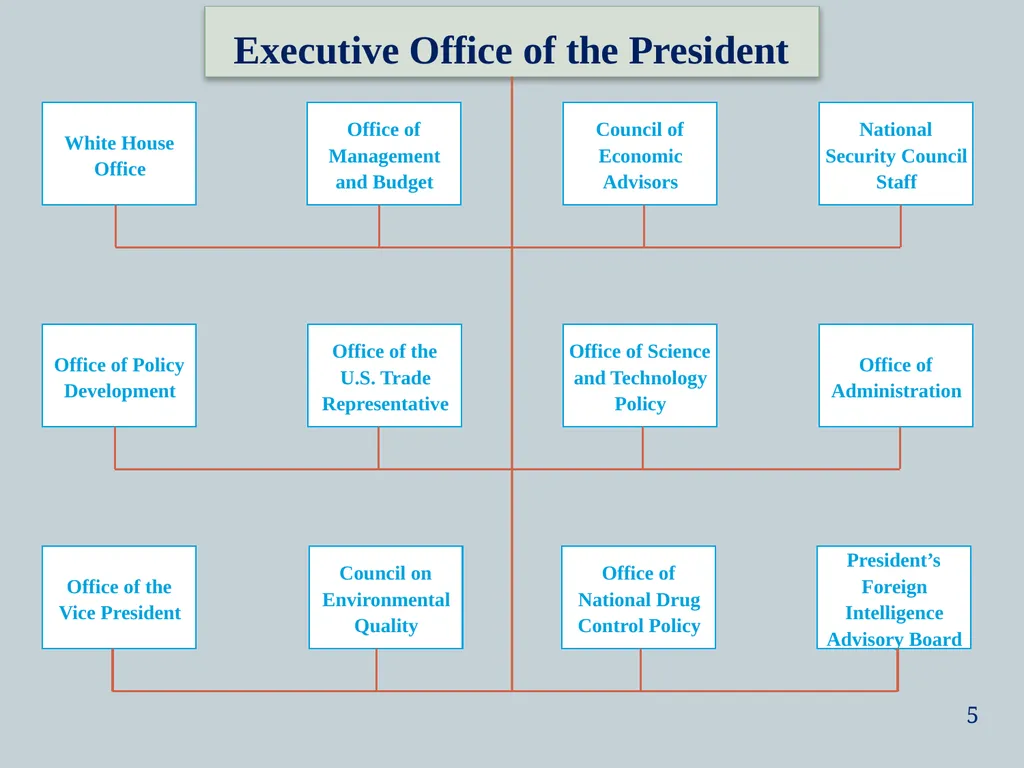
Executive Office of the President Council on Environmental Quality National Security Council Staff Office of Administration Office of the U.S. Trade Representative Office of Policy Development Office of National Drug Control Policy Office of Science and Technology Policy Council of Economic Advisors Office of the Vice President President’s Foreign Intelligence Advisory Board White House Office Office of Management and Budget 5<br>
06
Roles of the White House Staff and the
Executive Office of the President Ensure that the administration’s policies are comprehensive – that major issues are not falling between the cracks.
Ensure that the administration’s policies are coherent – that initiatives of one department are not undercutting those of other departments.
Ensure that the system for advising the president produces informed decisions.
Ensure that decisions are implemented consistent with the intent of the President. 6<br>
Ensure that the administration’s policies are coherent – that initiatives of one department are not undercutting those of other departments.
Ensure that the system for advising the president produces informed decisions.
Ensure that decisions are implemented consistent with the intent of the President. 6<br>
07
The White House Staff The White House Staff is the entity most responsible for ensuring that the administration’s policies are comprehensive and coherent, that decisions are informed, and that those decisions are successfully implemented. 7<br>
08
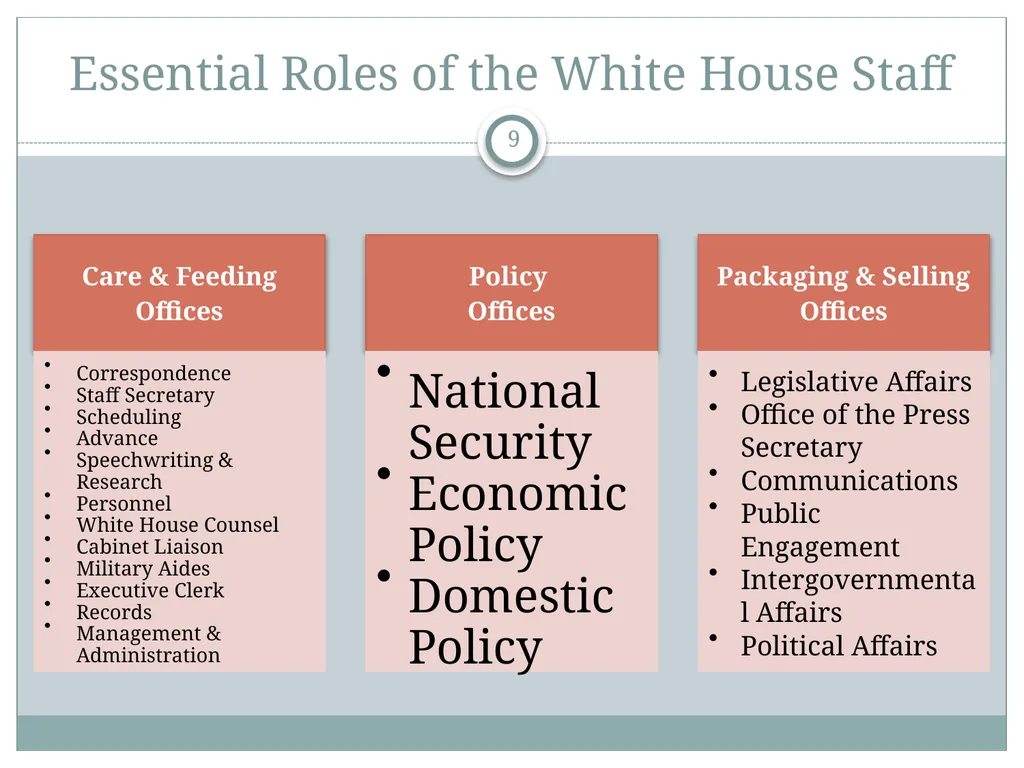
The White House Staff as a Holding Company The White House staff is similar to a holding company with a large collection of offices, each of which has its own set of:
Responsibilities
Constituents
Work Flows
It is a holding company with three main divisions. 8<br>
Responsibilities
Constituents
Work Flows
It is a holding company with three main divisions. 8<br>
09
Essential Roles of the White House Staff 9<br>
10
The Challenge of Coordination<br>
11
The Challenge of Coordination The Office of the White House Chief of Staff has increasingly taken on the responsibility for coordinating the elements of the White House staff and coordinating between the White House staff and other entities in the Executive Office of the President.
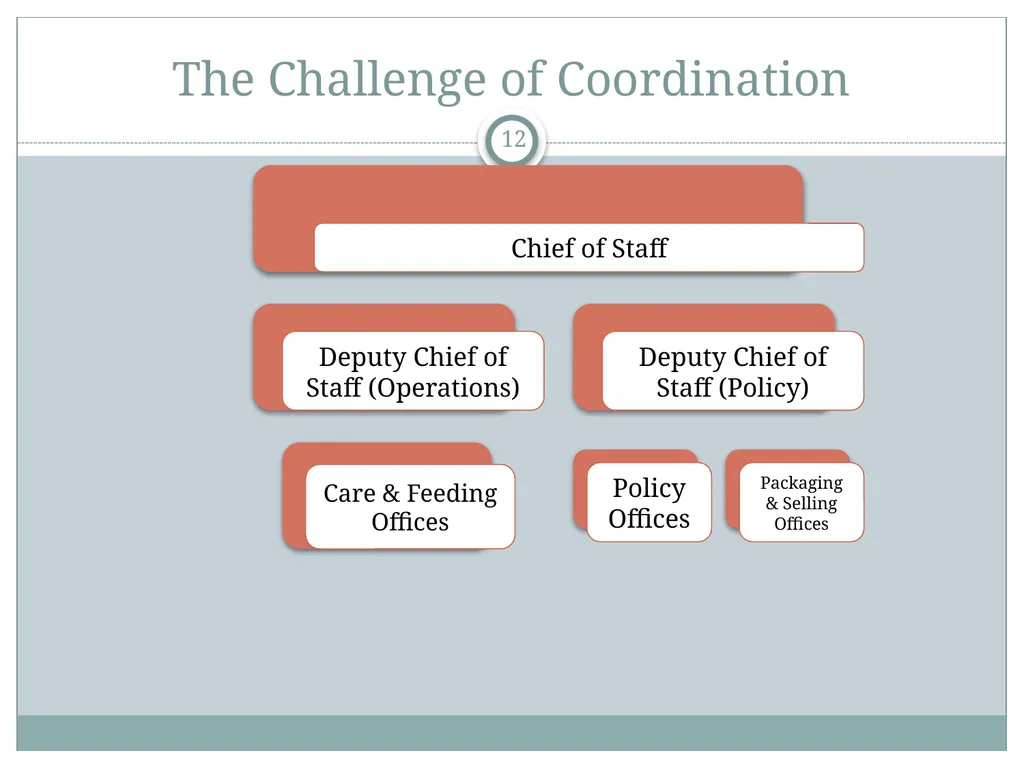
Since the 1990s, the White House Chief of Staff typically has had two deputies – one to oversee the care and feeding offices and one to coordinate the policy formulation and packaging offices. 11<br>
Since the 1990s, the White House Chief of Staff typically has had two deputies – one to oversee the care and feeding offices and one to coordinate the policy formulation and packaging offices. 11<br>
12
The Challenge of Coordination 12<br>
13
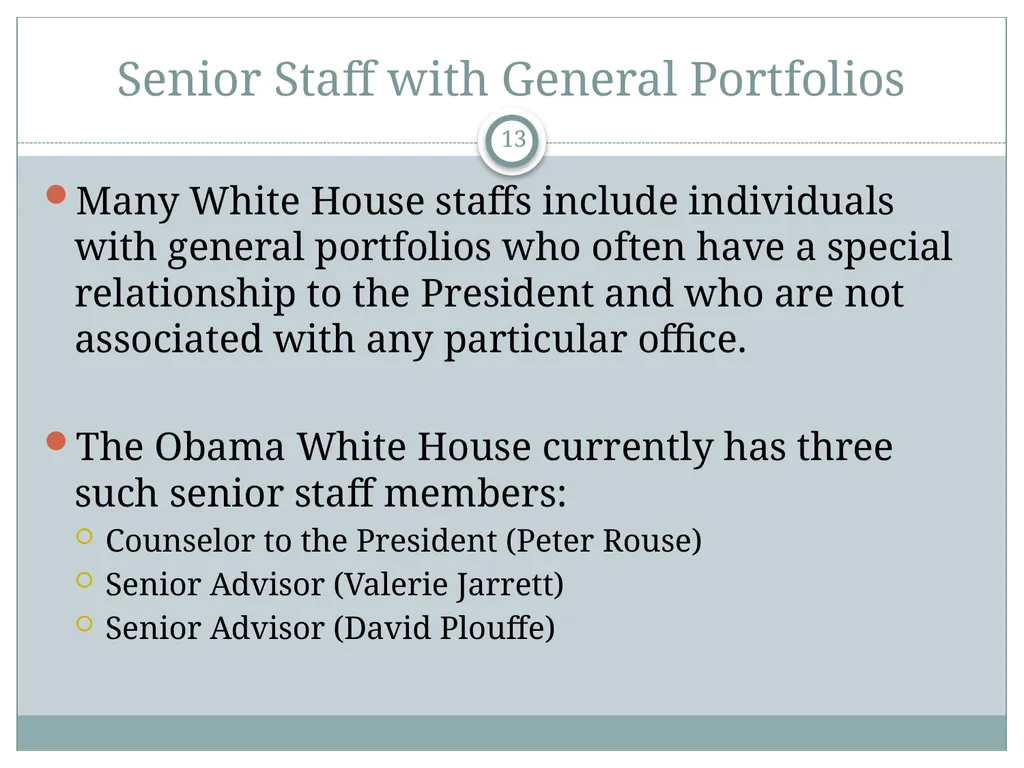
Senior Staff with General Portfolios Many White House staffs include individuals with general portfolios who often have a special relationship to the President and who are not associated with any particular office.
The Obama White House currently has three such senior staff members:
Counselor to the President (Peter Rouse)
Senior Advisor (Valerie Jarrett)
Senior Advisor (David Plouffe) 13<br>
The Obama White House currently has three such senior staff members:
Counselor to the President (Peter Rouse)
Senior Advisor (Valerie Jarrett)
Senior Advisor (David Plouffe) 13<br>
14
Roles of the White House
Chief of Staff<br>
15
Some Roles of the White House Chief of Staff Operations
Oversees efficient functioning of White House staff
Clarifies assignments and responsibilities
Facilitates vertical coordination among offices
Facilitates horizontal coordination across divisions
Counselor
Acts as an all-purpose policy and political advisor
Strategy
Oversees development of overall administration strategy
Emissary
Serves as the President’s alter ego
Serves as a legislative negotiator
Serves as an administration spokesman
The more of these roles the Chief of Staff is expected to fulfill, the greater the potential for overload. 15<br>
Oversees efficient functioning of White House staff
Clarifies assignments and responsibilities
Facilitates vertical coordination among offices
Facilitates horizontal coordination across divisions
Counselor
Acts as an all-purpose policy and political advisor
Strategy
Oversees development of overall administration strategy
Emissary
Serves as the President’s alter ego
Serves as a legislative negotiator
Serves as an administration spokesman
The more of these roles the Chief of Staff is expected to fulfill, the greater the potential for overload. 15<br>
16
White House
Chief of Staff Models<br>
17
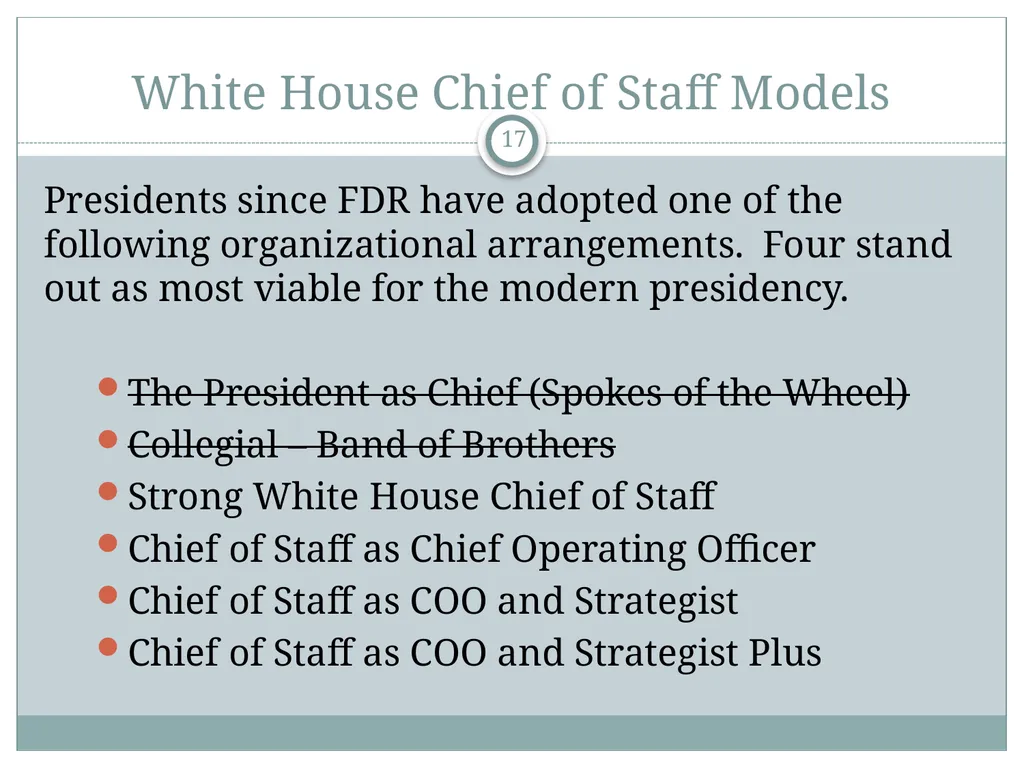
White House Chief of Staff Models Presidents since FDR have adopted one of the following organizational arrangements. Four stand out as most viable for the modern presidency.
The President as Chief (Spokes of the Wheel)
Collegial – Band of Brothers
Strong White House Chief of Staff
Chief of Staff as Chief Operating Officer
Chief of Staff as COO and Strategist
Chief of Staff as COO and Strategist Plus 17<br>
The President as Chief (Spokes of the Wheel)
Collegial – Band of Brothers
Strong White House Chief of Staff
Chief of Staff as Chief Operating Officer
Chief of Staff as COO and Strategist
Chief of Staff as COO and Strategist Plus 17<br>
18
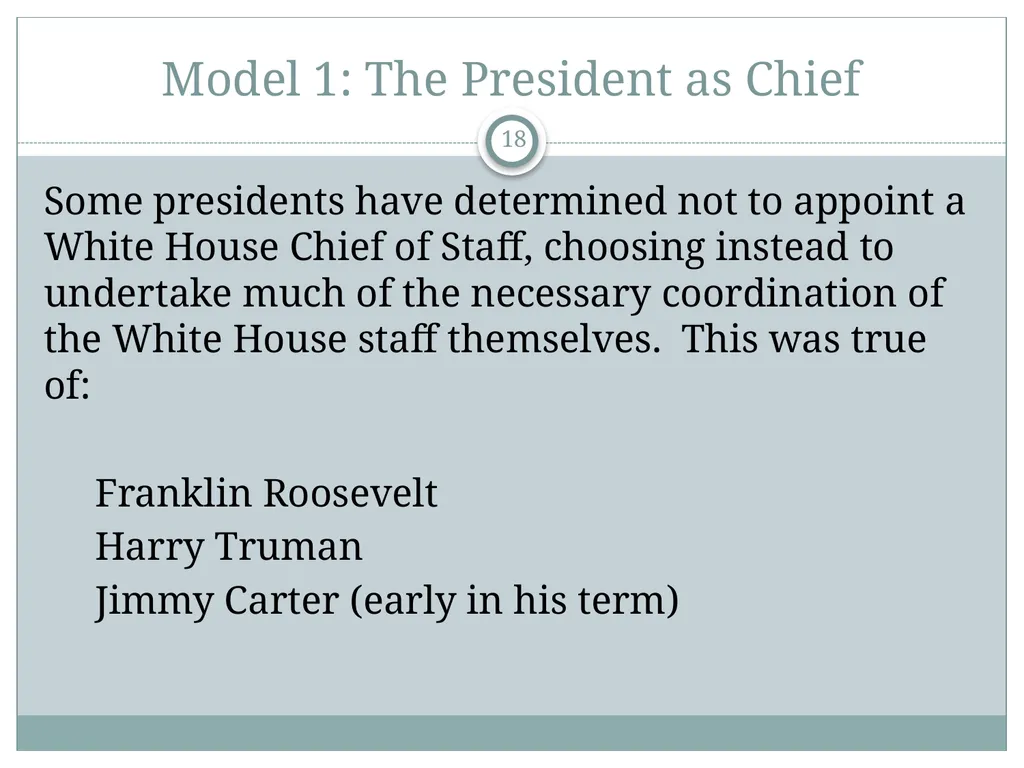
Model 1: The President as Chief Some presidents have determined not to appoint a White House Chief of Staff, choosing instead to undertake much of the necessary coordination of the White House staff themselves. This was true of:
Franklin Roosevelt
Harry Truman
Jimmy Carter (early in his term) 18<br>
Franklin Roosevelt
Harry Truman
Jimmy Carter (early in his term) 18<br>
19
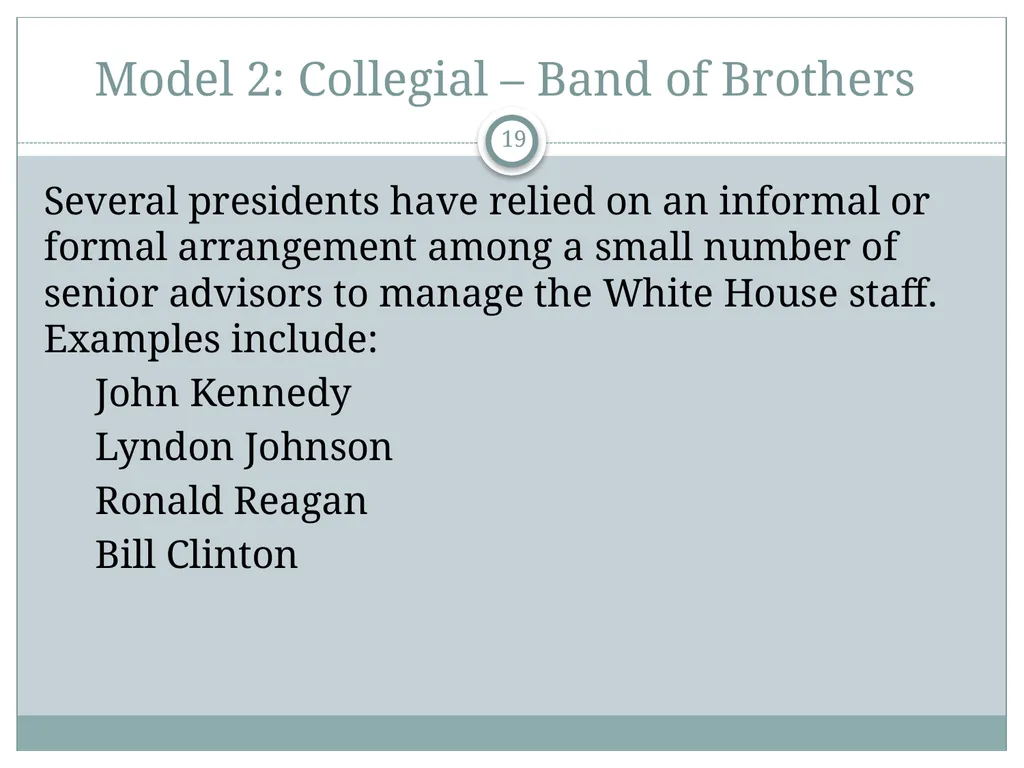
Model 2: Collegial – Band of Brothers Several presidents have relied on an informal or formal arrangement among a small number of senior advisors to manage the White House staff. Examples include:
John Kennedy
Lyndon Johnson
Ronald Reagan
Bill Clinton 19<br>
John Kennedy
Lyndon Johnson
Ronald Reagan
Bill Clinton 19<br>
20
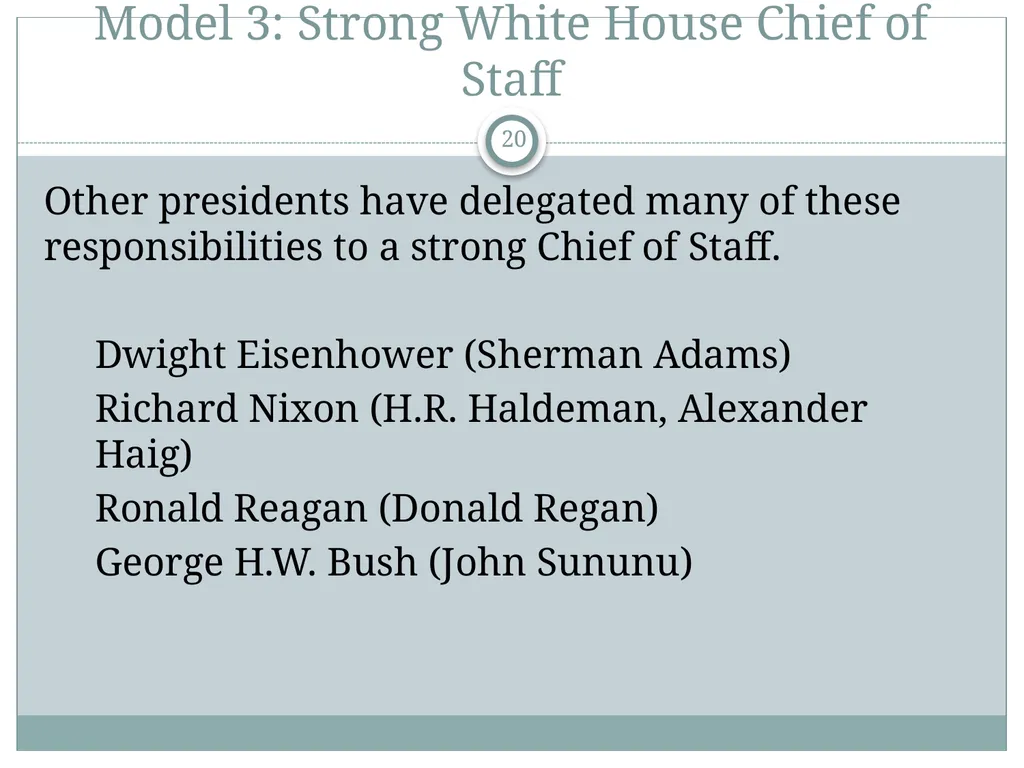
Model 3: Strong White House Chief of Staff Other presidents have delegated many of these responsibilities to a strong Chief of Staff.
Dwight Eisenhower (Sherman Adams)
Richard Nixon (H.R. Haldeman, Alexander Haig)
Ronald Reagan (Donald Regan)
George H.W. Bush (John Sununu) 20<br>
Dwight Eisenhower (Sherman Adams)
Richard Nixon (H.R. Haldeman, Alexander Haig)
Ronald Reagan (Donald Regan)
George H.W. Bush (John Sununu) 20<br>
21
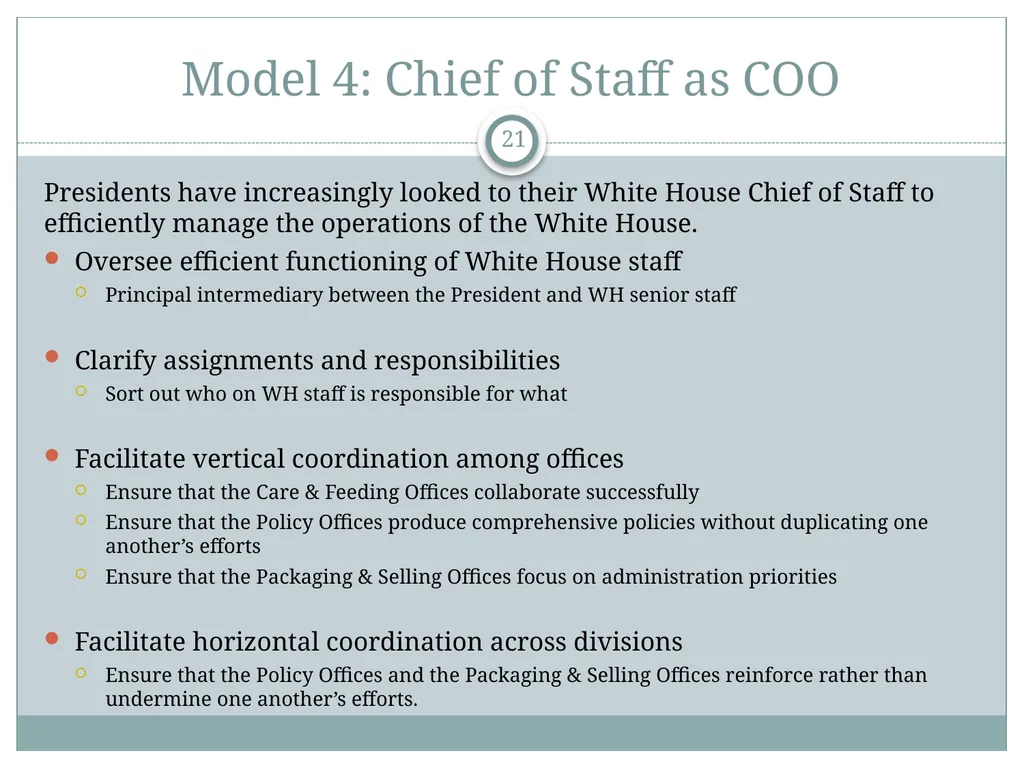
Model 4: Chief of Staff as COO Presidents have increasingly looked to their White House Chief of Staff to efficiently manage the operations of the White House.
Oversee efficient functioning of White House staff
Principal intermediary between the President and WH senior staff
Clarify assignments and responsibilities
Sort out who on WH staff is responsible for what
Facilitate vertical coordination among offices
Ensure that the Care & Feeding Offices collaborate successfully
Ensure that the Policy Offices produce comprehensive policies without duplicating one another’s efforts
Ensure that the Packaging & Selling Offices focus on administration priorities
Facilitate horizontal coordination across divisions
Ensure that the Policy Offices and the Packaging & Selling Offices reinforce rather than undermine one another’s efforts. 21<br>
Oversee efficient functioning of White House staff
Principal intermediary between the President and WH senior staff
Clarify assignments and responsibilities
Sort out who on WH staff is responsible for what
Facilitate vertical coordination among offices
Ensure that the Care & Feeding Offices collaborate successfully
Ensure that the Policy Offices produce comprehensive policies without duplicating one another’s efforts
Ensure that the Packaging & Selling Offices focus on administration priorities
Facilitate horizontal coordination across divisions
Ensure that the Policy Offices and the Packaging & Selling Offices reinforce rather than undermine one another’s efforts. 21<br>
22
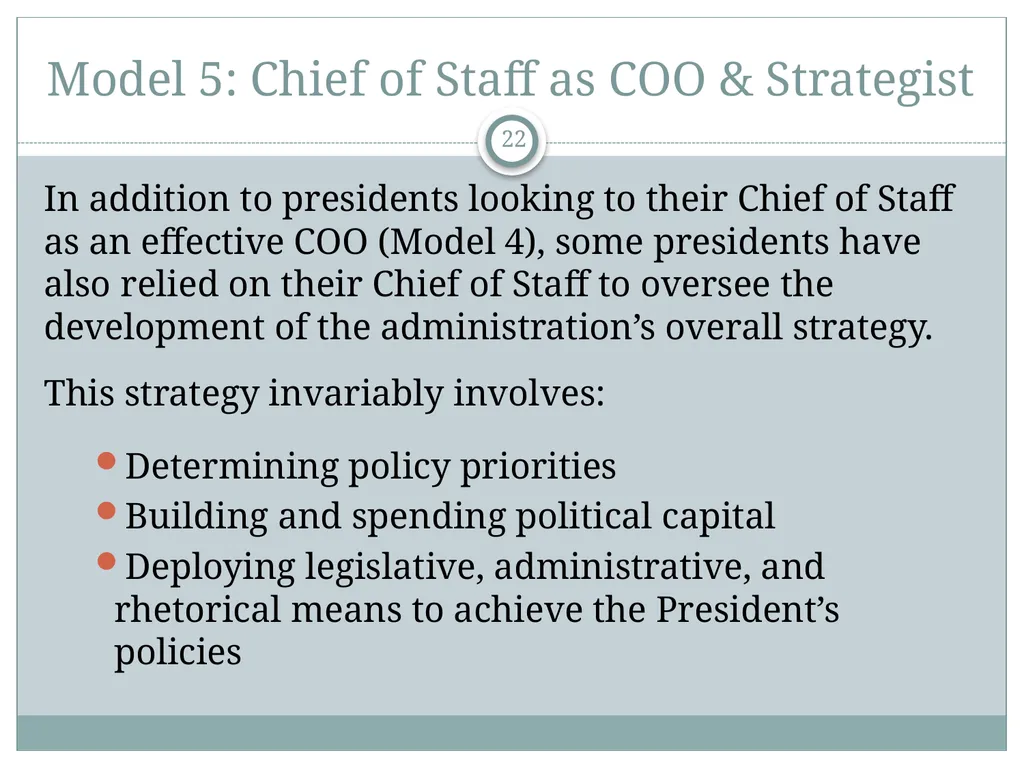
Model 5: Chief of Staff as COO & Strategist In addition to presidents looking to their Chief of Staff as an effective COO (Model 4), some presidents have also relied on their Chief of Staff to oversee the development of the administration’s overall strategy.
This strategy invariably involves:
Determining policy priorities
Building and spending political capital
Deploying legislative, administrative, and rhetorical means to achieve the President’s policies 22<br>
This strategy invariably involves:
Determining policy priorities
Building and spending political capital
Deploying legislative, administrative, and rhetorical means to achieve the President’s policies 22<br>
23
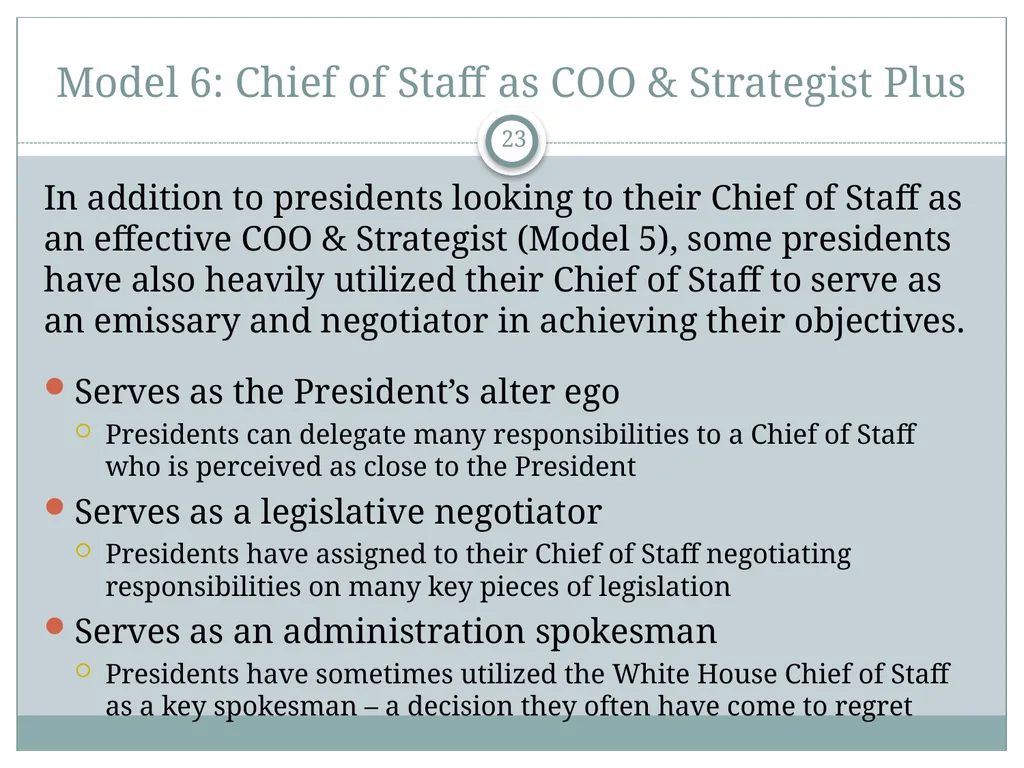
Model 6: Chief of Staff as COO & Strategist Plus In addition to presidents looking to their Chief of Staff as an effective COO & Strategist (Model 5), some presidents have also heavily utilized their Chief of Staff to serve as an emissary and negotiator in achieving their objectives.
Serves as the President’s alter ego
Presidents can delegate many responsibilities to a Chief of Staff who is perceived as close to the President
Serves as a legislative negotiator
Presidents have assigned to their Chief of Staff negotiating responsibilities on many key pieces of legislation
Serves as an administration spokesman
Presidents have sometimes utilized the White House Chief of Staff as a key spokesman – a decision they often have come to regret 23<br>
Serves as the President’s alter ego
Presidents can delegate many responsibilities to a Chief of Staff who is perceived as close to the President
Serves as a legislative negotiator
Presidents have assigned to their Chief of Staff negotiating responsibilities on many key pieces of legislation
Serves as an administration spokesman
Presidents have sometimes utilized the White House Chief of Staff as a key spokesman – a decision they often have come to regret 23<br>
24
White House – Departmental Relations<br>
25
White House – Departmental Relations Every administration has faced the issue of finding the appropriate relationship between the White House and executive departments and agencies.
Many presidents declare their enthusiasm for a form of cabinet government in which they rely heavily on cabinet secretaries as their principal lieutenants. This effort in cabinet government is usually short-lived. (Carter Administration)
Other presidents gravitate toward a dominant White House staff, leaving departments and agencies feeling neglected and sometimes ignored. (Nixon Administration)
Some presidents seek a working partnership, engaging the resources and expertise in departments and agencies while coordinating the development of policy by White House-led councils. 25<br>
Many presidents declare their enthusiasm for a form of cabinet government in which they rely heavily on cabinet secretaries as their principal lieutenants. This effort in cabinet government is usually short-lived. (Carter Administration)
Other presidents gravitate toward a dominant White House staff, leaving departments and agencies feeling neglected and sometimes ignored. (Nixon Administration)
Some presidents seek a working partnership, engaging the resources and expertise in departments and agencies while coordinating the development of policy by White House-led councils. 25<br>
26
White House P0licy Councils The idea of White House-led interagency councils was a reaction to the policy chaos of Franklin D. Roosevelt’s Administration. The first of these – established by statute in 1947 – was the National Security Council.
A central issue is how many councils to have. Too few can lead to policy overload for an individual council. Too many can contribute to confusion regarding who is responsible for what and difficulty in producing coherent policies.
Some administrations have experimented with a relatively large number. Reagan had eight different Cabinet-level policy councils during his first term.
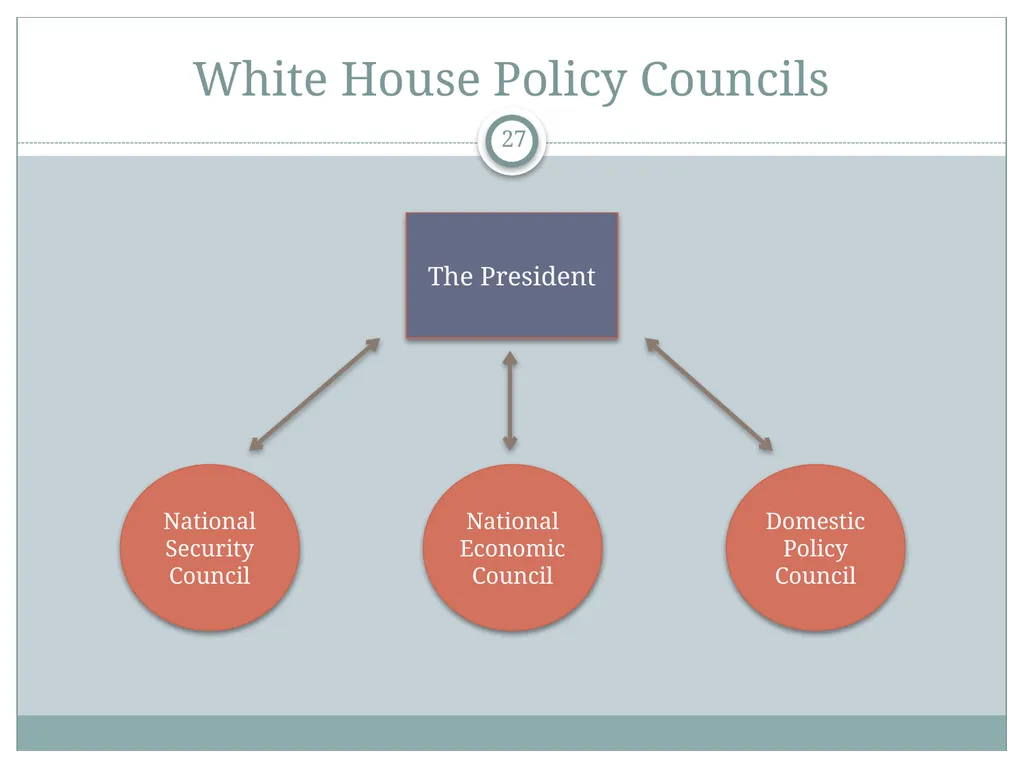
Most have settled on three – National Security Policy, Domestic Policy, and Economic Policy. For a time, George W. Bush added a fourth council dealing with Homeland Security. This was later folded into the National Security Council.
The three council model seems to work well in providing a manageable number of issues without creating overload. 26<br>
A central issue is how many councils to have. Too few can lead to policy overload for an individual council. Too many can contribute to confusion regarding who is responsible for what and difficulty in producing coherent policies.
Some administrations have experimented with a relatively large number. Reagan had eight different Cabinet-level policy councils during his first term.
Most have settled on three – National Security Policy, Domestic Policy, and Economic Policy. For a time, George W. Bush added a fourth council dealing with Homeland Security. This was later folded into the National Security Council.
The three council model seems to work well in providing a manageable number of issues without creating overload. 26<br>
27
White House Policy Councils 27 National Economic Council Domestic Policy Council National Security Council The President<br>
28
Processes for Producing Unified Policies A central objective for every president is leading a unified administration in dealing with the Congress, the press, and organized interest groups.
Achieving this unity requires careful attention to five key dimensions of the relationship between the White House and departments and agencies.
Budget, legislative clearance, and regulatory review
Policy formulation
Personnel
Legislative liaison
Press relations 28<br>
Achieving this unity requires careful attention to five key dimensions of the relationship between the White House and departments and agencies.
Budget, legislative clearance, and regulatory review
Policy formulation
Personnel
Legislative liaison
Press relations 28<br>
29
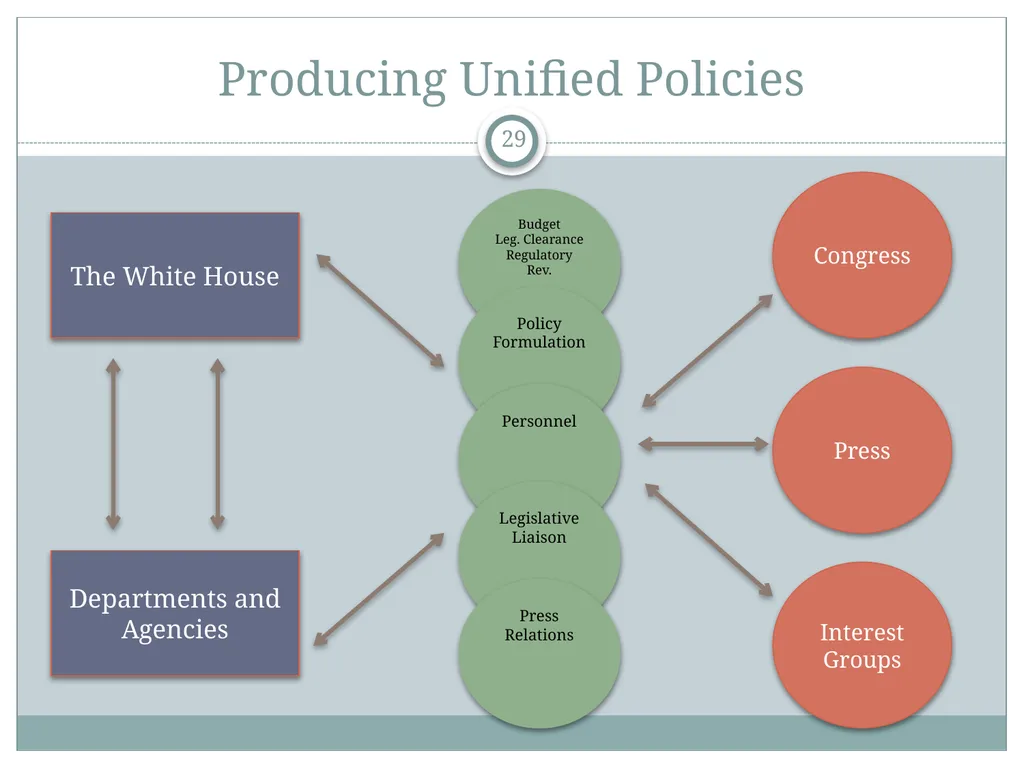
Producing Unified Policies 29 Press Congress Interest Groups The White House Departments and Agencies Budget
Leg. Clearance
Regulatory Rev. Policy Formulation Personnel Legislative Liaison Press Relations<br>
Leg. Clearance
Regulatory Rev. Policy Formulation Personnel Legislative Liaison Press Relations<br>
30
Budget, Legislative Clearance,
and Regulatory Review The Office of Management and Budget (OMB) and its predecessor the Bureau of the Budget have had responsibility for producing a unified federal budget that the president transmits to Congress.
OMB also has responsibility for legislative clearance of testimony by administration officials and legislation sent by the administration to Congress.
OMB’s regulatory review process, established by executive order, approves major regulations issued by departments and agencies. 30<br>
OMB also has responsibility for legislative clearance of testimony by administration officials and legislation sent by the administration to Congress.
OMB’s regulatory review process, established by executive order, approves major regulations issued by departments and agencies. 30<br>
31
Policy Formulation The principal vehicles for advising the president on major policy decisions are the National Security Council, the National Economic Council, and the Domestic Policy Council.
Each cabinet department or agency is represented on at least one of these councils, providing them an avenue for bringing issues to the president through a process that permits him to have the benefit of a full range of views and considerations in making an informed decision. 31<br>
Each cabinet department or agency is represented on at least one of these councils, providing them an avenue for bringing issues to the president through a process that permits him to have the benefit of a full range of views and considerations in making an informed decision. 31<br>
32
Personnel Presidential appointments are of intense interest to the White House and to departments and agencies. The appointment of ambassadors is a classic example of a frequent conflict of these interests.
Some administrations have allowed cabinet secretaries great latitude in assembling their departmental “teams.” (Carter Administration)
Other administrations have sought tight White House control in sub-cabinet level appointments.
A third approach involves establishing a working partnership in which the White House Office of Presidential Personnel and the respective department have a mutual veto. In practice, this generally works well. 32<br>
Some administrations have allowed cabinet secretaries great latitude in assembling their departmental “teams.” (Carter Administration)
Other administrations have sought tight White House control in sub-cabinet level appointments.
A third approach involves establishing a working partnership in which the White House Office of Presidential Personnel and the respective department have a mutual veto. In practice, this generally works well. 32<br>
33
Legislative Liaison The White House Office of Legislative Affairs is small relative to its counterpart in many departments.
Given the modest size of the White House legislative affairs staff, it is crucial that the departmental legislative liaison offices work closely with it.
This generally involves weekly reports and careful monitoring by the White House so that the efforts by departmental personnel reflect presidential priorities. 33<br>
Given the modest size of the White House legislative affairs staff, it is crucial that the departmental legislative liaison offices work closely with it.
This generally involves weekly reports and careful monitoring by the White House so that the efforts by departmental personnel reflect presidential priorities. 33<br>
34
Press Relations Given the intense nature of media scrutiny, it is essential that the White House Press Office and the White House Communications Office work closely and effectively with their counterparts in departments and agencies.
This is reflected in a daily conference call led by the White House Press Office with their counterparts in departments and agencies, communicating to them the “line of the day” and ensuring that the administration does not “step on” its own stories. 34<br>
This is reflected in a daily conference call led by the White House Press Office with their counterparts in departments and agencies, communicating to them the “line of the day” and ensuring that the administration does not “step on” its own stories. 34<br>
35
Legislative Strategy Group<br>
36
A Promising Institutional Innovation Administrations function best when they have a clear sense of purpose and direction, and when the President focuses his time and political capital on a limited number of key objectives.
The Reagan administration successfully used a Legislative Strategy Group (LSG) to identify priorities and to implement comprehensive strategies to achieve them. 36<br>
The Reagan administration successfully used a Legislative Strategy Group (LSG) to identify priorities and to implement comprehensive strategies to achieve them. 36<br>
37
Legislative Strategy Group: Central Purposes A legislative strategy group similar to that used during President Reagan’s first term would have three central purposes:
Establish and clarify the administration’s legislative priorities
Oversee the negotiations on key legislative initiatives
Ensure coordination between elements of the White House and departments in achieving the President’s legislative priorities. 37<br>
Establish and clarify the administration’s legislative priorities
Oversee the negotiations on key legislative initiatives
Ensure coordination between elements of the White House and departments in achieving the President’s legislative priorities. 37<br>
38
Size of the Legislative Strategy Group The LSG should bring together key officials who represent a variety of perspectives among those responsible for developing and implementing policy.
It should be small enough to meet frequently and function efficiently. It should remain flexible enough to expand when necessary to better illuminate particular issues under discussion.
In the Reagan administration, the core group varied in size from 5-6 individuals, a size that seemed to work well. 38<br>
It should be small enough to meet frequently and function efficiently. It should remain flexible enough to expand when necessary to better illuminate particular issues under discussion.
In the Reagan administration, the core group varied in size from 5-6 individuals, a size that seemed to work well. 38<br>
39
Legislative Strategy Group Membership Given that the most pressing legislative issues at the beginning of the administration will relate to economic policy and the budget, the LSG members might include:
White House Chief of Staff
The Vice President
Assistant to the President for Legislative Affairs
Director of the Office of Management and Budget
Staff Secretary or Deputy White House Chief of Staff for Policy
As appropriate, others may be added:
Relevant Cabinet members (i.e. Secretary of the Treasury for legislative strategy on tax reform)
Deputy Assistants to the President for Legislative Affairs (House and/or Senate) 39<br>
White House Chief of Staff
The Vice President
Assistant to the President for Legislative Affairs
Director of the Office of Management and Budget
Staff Secretary or Deputy White House Chief of Staff for Policy
As appropriate, others may be added:
Relevant Cabinet members (i.e. Secretary of the Treasury for legislative strategy on tax reform)
Deputy Assistants to the President for Legislative Affairs (House and/or Senate) 39<br>
40
Legislative Strategy Group
Operation & Meetings Established early in the first Reagan term, the LSG met several times a week, usually in the late afternoons in the Office of the Chief of Staff.
The Office of the Chief of Staff prepared the agendas and tasked the preparation of any papers that would be circulated at the meeting.
By far the most frequent issues discussed revolved around budget policy and economic issues. 40<br>
The Office of the Chief of Staff prepared the agendas and tasked the preparation of any papers that would be circulated at the meeting.
By far the most frequent issues discussed revolved around budget policy and economic issues. 40<br>
41
Legislative Strategy Group Chair The White House Chief of Staff is an appropriate chair for the Legislative Strategy Group:
The people responsible for implementing the decisions reached by the LSG – such as the Assistant to the President for Legislative Affairs or the OMB Director – generally report to or through the White House Chief of Staff.
The White House Chief of Staff typically is with the President multiple times each day and is well positioned to update him and get his input when needed.
The White House Chief of Staff has fewer responsibilities that require him to travel or fill assignments outside the White House. 41<br>
The people responsible for implementing the decisions reached by the LSG – such as the Assistant to the President for Legislative Affairs or the OMB Director – generally report to or through the White House Chief of Staff.
The White House Chief of Staff typically is with the President multiple times each day and is well positioned to update him and get his input when needed.
The White House Chief of Staff has fewer responsibilities that require him to travel or fill assignments outside the White House. 41<br>
42
Building an Accountable Administration Team<br>
43
Building an Accountable Administration Team 43 To be fully effective, an administration must be more than merely the sum of its parts.
Cabinet secretaries often find the reality of their role less than expected. Many feel infrequently consulted and lacking the direction and accountability that would help them contribute more to achieving the President’s objectives.<br>
Cabinet secretaries often find the reality of their role less than expected. Many feel infrequently consulted and lacking the direction and accountability that would help them contribute more to achieving the President’s objectives.<br>
44
Building an Accountable Administration Team 44 One possible way to help address this deficit would be to add cabinet operations to the portfolio of the Deputy White House Chief of Staff for Policy. This individual would have three new responsibilities:
Provide enhanced accountability for cabinet secretaries by systematically assessing the efforts of their departments in contributing to the President’s priorities and objectives;
Help mentor cabinet officers who may have little previous government experience; and
Build improved relationships by looking out for the interests of cabinet officials and helping them feel part of an administration team.
Note: This role would be distinct from that of the policy councils (NSC, NEC, DPC) which have responsibility for coordinating departments in the development of policy.<br>
Provide enhanced accountability for cabinet secretaries by systematically assessing the efforts of their departments in contributing to the President’s priorities and objectives;
Help mentor cabinet officers who may have little previous government experience; and
Build improved relationships by looking out for the interests of cabinet officials and helping them feel part of an administration team.
Note: This role would be distinct from that of the policy councils (NSC, NEC, DPC) which have responsibility for coordinating departments in the development of policy.<br>
45
Building a Working Partnership
with the Nation’s Governors 45 Administrations have varied widely in the quality of their relationships with the nation’s governors. An enhanced White House Office of Intergovernmental Relations can help build a responsive, constructive, and productive relationship.
The head of the Office of Intergovernmental Affairs would be an Assistant to the President and optimally a respected former governor who enjoys good relations with governors from both parties.
He would actively engage governors in responding to and expediting attention to their concerns.
He would serve as a conduit for their ideas regarding policy initiatives.<br>
The head of the Office of Intergovernmental Affairs would be an Assistant to the President and optimally a respected former governor who enjoys good relations with governors from both parties.
He would actively engage governors in responding to and expediting attention to their concerns.
He would serve as a conduit for their ideas regarding policy initiatives.<br>