
The Wraparound Assessment Process 1 Jessica
OM
Published · 61 slides · 0 views

1 / 1

Description
The Wraparound Assessment Process 1 Jessica Beauchamp, MSW, LCSW, SUS Sara Shaver, LMFT White Pine Consulting (715) 258-0877 infowhitepineconsulting.org www.wiwraparound.org White Pine Consulting 3-25-25 Phases of the Wraparound Process
Related Topics
Share
Embed code
Download this presentation From Below
"The Wraparound Assessment Process 1 Jessica" is the property of its rightful owner. Permission is granted to download and print the materials on this website for personal, non-commercial use only, and to display it on your personal computer provided you do not modify the materials and that you retain all copyright notices contained in the materials. By downloading content from our website, you accept the terms of this agreement.
Presentation Transcript
01
The Wraparound
Assessment Process 1 Jessica Beauchamp, MSW, LCSW, SUS
Sara Shaver, LMFT
White Pine Consulting
(715) 258-0877
info@whitepineconsulting.org
www.wiwraparound.org White Pine Consulting 3-25-25<br>
Sara Shaver, LMFT
White Pine Consulting
(715) 258-0877
info@whitepineconsulting.org
www.wiwraparound.org White Pine Consulting 3-25-25<br>
02
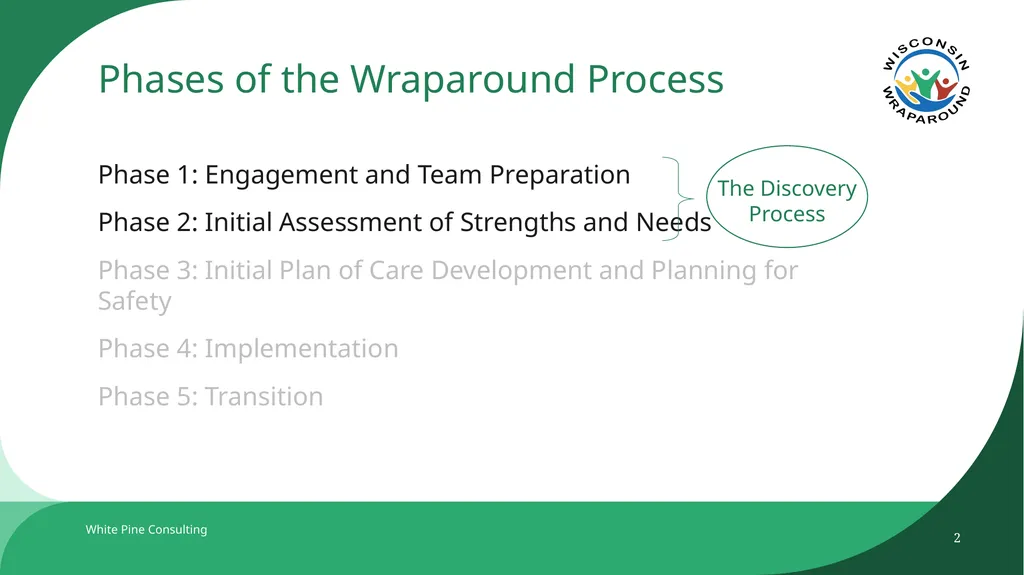
Phases of the Wraparound Process Phase 1: Engagement and Team Preparation
Phase 2: Initial Assessment of Strengths and Needs
Phase 3: Initial Plan of Care Development and Planning for Safety
Phase 4: Implementation
Phase 5: Transition 2 White Pine Consulting The Discovery Process<br>
Phase 2: Initial Assessment of Strengths and Needs
Phase 3: Initial Plan of Care Development and Planning for Safety
Phase 4: Implementation
Phase 5: Transition 2 White Pine Consulting The Discovery Process<br>
03
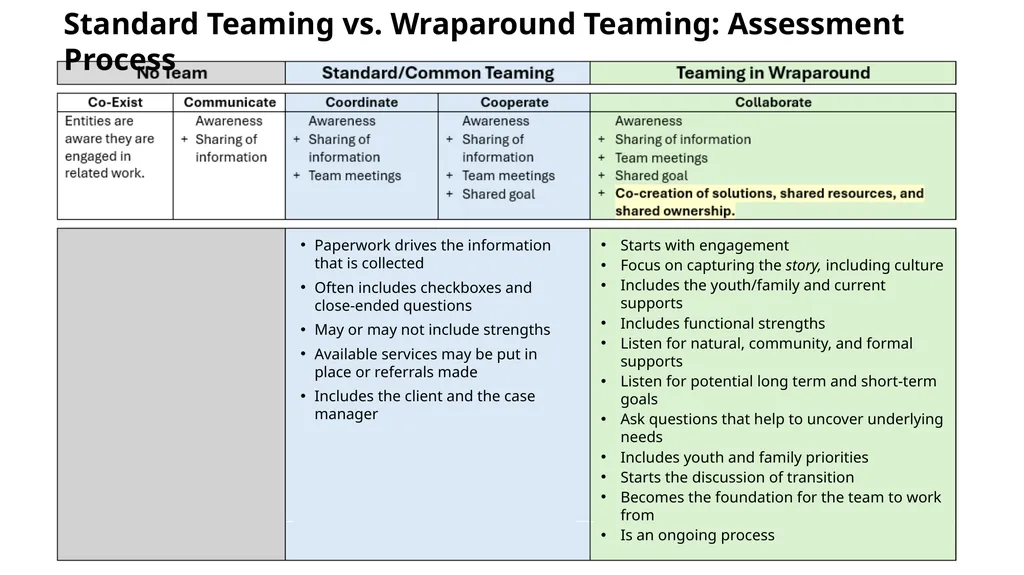
Standard Teaming vs. Wraparound Teaming: Assessment Process Paperwork drives the information that is collected
Often includes checkboxes and close-ended questions
May or may not include strengths
Available services may be put in place or referrals made
Includes the client and the case manager Starts with engagement
Focus on capturing the story, including culture
Includes the youth/family and current supports
Includes functional strengths
Listen for natural, community, and formal supports
Listen for potential long term and short-term goals
Ask questions that help to uncover underlying needs
Includes youth and family priorities
Starts the discussion of transition
Becomes the foundation for the team to work from
Is an ongoing process<br>
Often includes checkboxes and close-ended questions
May or may not include strengths
Available services may be put in place or referrals made
Includes the client and the case manager Starts with engagement
Focus on capturing the story, including culture
Includes the youth/family and current supports
Includes functional strengths
Listen for natural, community, and formal supports
Listen for potential long term and short-term goals
Ask questions that help to uncover underlying needs
Includes youth and family priorities
Starts the discussion of transition
Becomes the foundation for the team to work from
Is an ongoing process<br>
04
“People won’t care what you know
until they know that you care.” - Theodore Roosevelt 4 White Pine Consulting<br>
05
What is Engagement Establishing and maintaining the relational foundation (ongoing process)
What happens during the first few minutes of every encounter
Is readily observable and measurable
Youth and family involvement on the team and in services
Involves care coordinator/provider perspectives, decisions, and skills 5 White Pine Consulting Adapted from The Art of Engagement presentation by Scott Caldwell
9/9/20 CCS/CST Statewide Meeting<br>
What happens during the first few minutes of every encounter
Is readily observable and measurable
Youth and family involvement on the team and in services
Involves care coordinator/provider perspectives, decisions, and skills 5 White Pine Consulting Adapted from The Art of Engagement presentation by Scott Caldwell
9/9/20 CCS/CST Statewide Meeting<br>
06
What does disengagement look like? No shows for team meetings and/or services
During meetings/services:
Shut down, guarded, closed off, defensive, argumentative
Team members don’t experience supports and services as relevant, useful, or helpful
In life: stuck in status quo
The youth and family experience is dynamic and is directly
influenced by what the care coordinator says and does. 6 White Pine Consulting Adapted from The Art of Engagement presentation by Scott Caldwell
9/9/20 CCS/CST Statewide Meeting<br>
During meetings/services:
Shut down, guarded, closed off, defensive, argumentative
Team members don’t experience supports and services as relevant, useful, or helpful
In life: stuck in status quo
The youth and family experience is dynamic and is directly
influenced by what the care coordinator says and does. 6 White Pine Consulting Adapted from The Art of Engagement presentation by Scott Caldwell
9/9/20 CCS/CST Statewide Meeting<br>
07
Poll: How do you think about engagement? 7 White Pine Consulting<br>
08
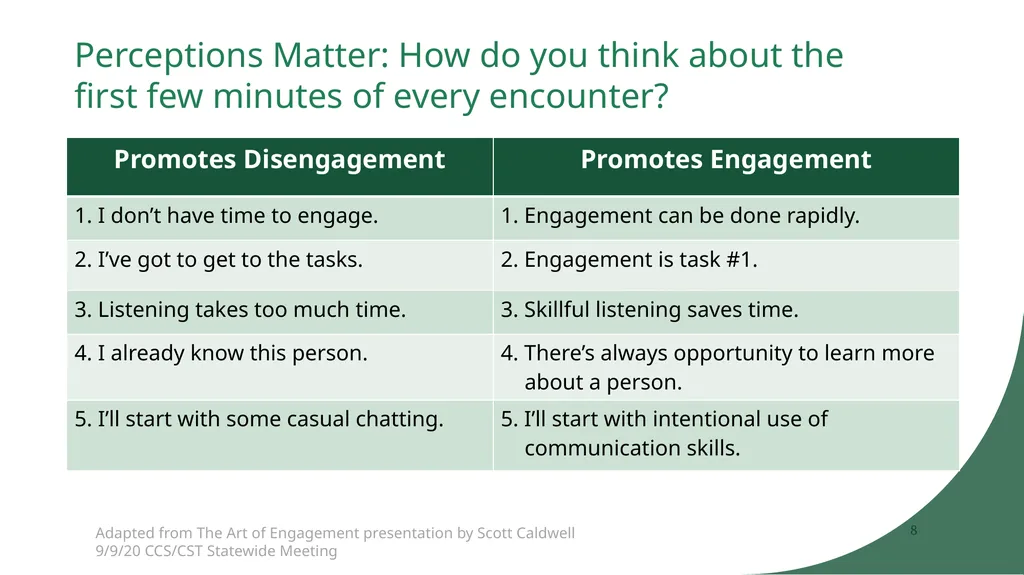
8 Perceptions Matter: How do you think about the first few minutes of every encounter? Adapted from The Art of Engagement presentation by Scott Caldwell
9/9/20 CCS/CST Statewide Meeting<br>
9/9/20 CCS/CST Statewide Meeting<br>
09
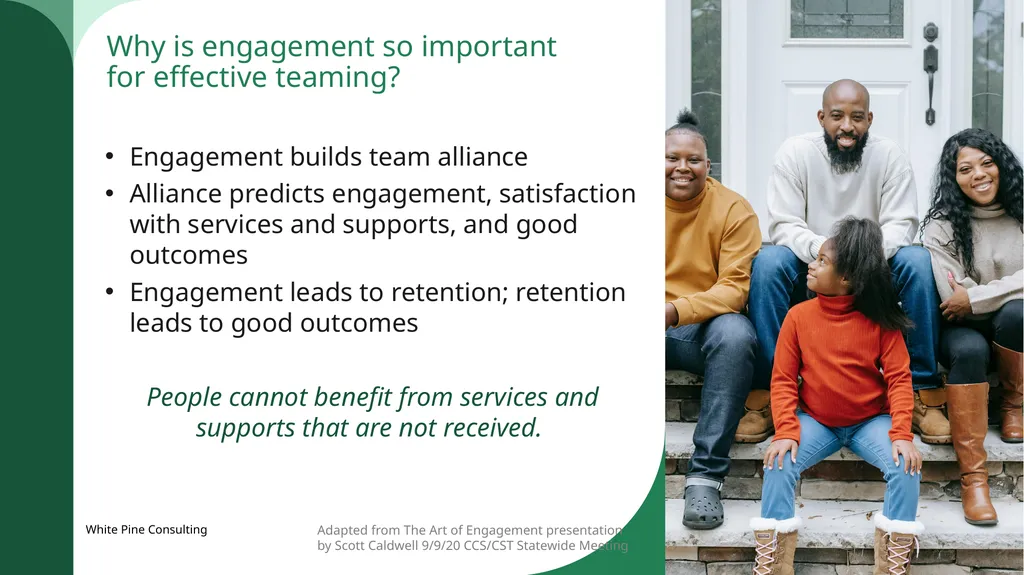
Why is engagement so important
for effective teaming? Engagement builds team alliance
Alliance predicts engagement, satisfaction with services and supports, and good outcomes
Engagement leads to retention; retention leads to good outcomes
People cannot benefit from services and supports that are not received. 9 White Pine Consulting Adapted from The Art of Engagement presentation
by Scott Caldwell 9/9/20 CCS/CST Statewide Meeting<br>
Alliance predicts engagement, satisfaction with services and supports, and good outcomes
Engagement leads to retention; retention leads to good outcomes
People cannot benefit from services and supports that are not received. 9 White Pine Consulting Adapted from The Art of Engagement presentation
by Scott Caldwell 9/9/20 CCS/CST Statewide Meeting<br>
10
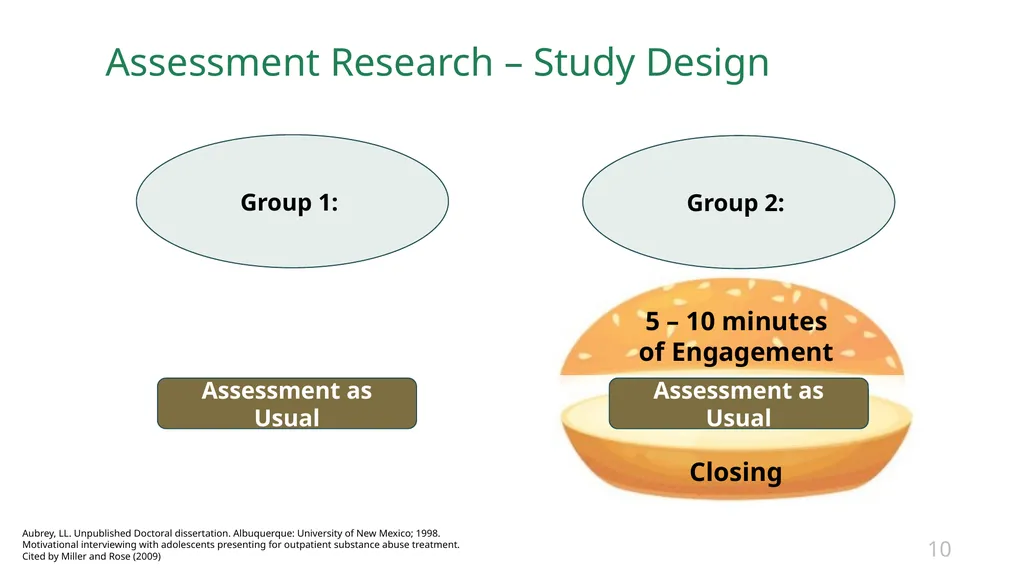
10 Aubrey, LL. Unpublished Doctoral dissertation. Albuquerque: University of New Mexico; 1998.
Motivational interviewing with adolescents presenting for outpatient substance abuse treatment.
Cited by Miller and Rose (2009) Assessment Research – Study Design<br>
Motivational interviewing with adolescents presenting for outpatient substance abuse treatment.
Cited by Miller and Rose (2009) Assessment Research – Study Design<br>
11
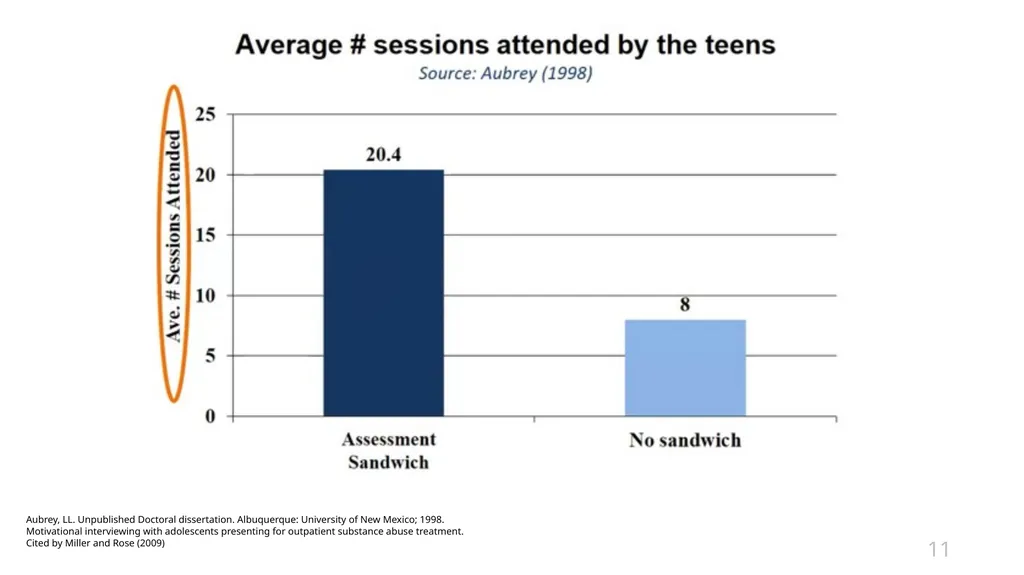
11 Aubrey, LL. Unpublished Doctoral dissertation. Albuquerque: University of New Mexico; 1998.
Motivational interviewing with adolescents presenting for outpatient substance abuse treatment.
Cited by Miller and Rose (2009)<br>
Motivational interviewing with adolescents presenting for outpatient substance abuse treatment.
Cited by Miller and Rose (2009)<br>
12
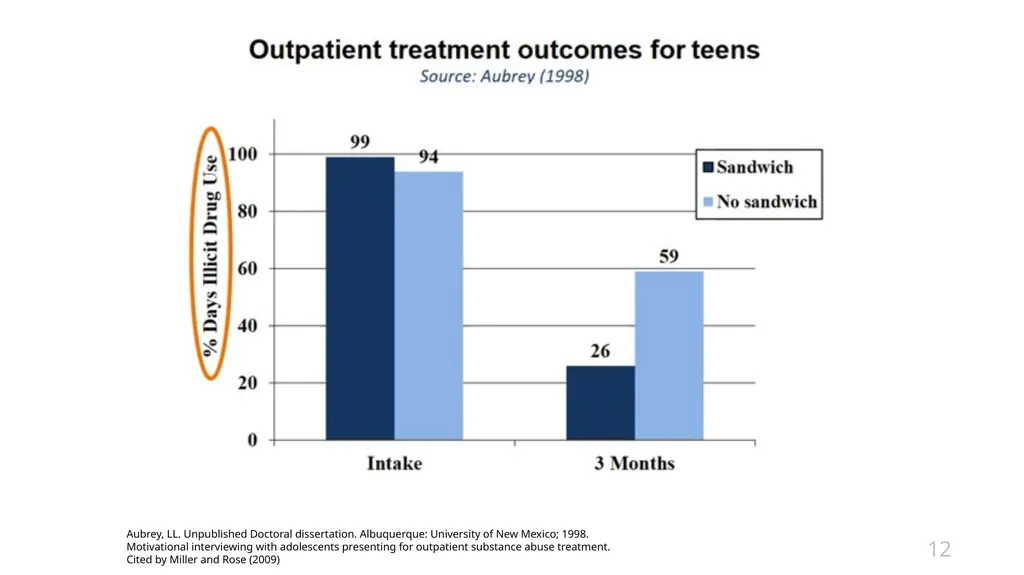
12 Aubrey, LL. Unpublished Doctoral dissertation. Albuquerque: University of New Mexico; 1998.
Motivational interviewing with adolescents presenting for outpatient substance abuse treatment.
Cited by Miller and Rose (2009)<br>
Motivational interviewing with adolescents presenting for outpatient substance abuse treatment.
Cited by Miller and Rose (2009)<br>
13
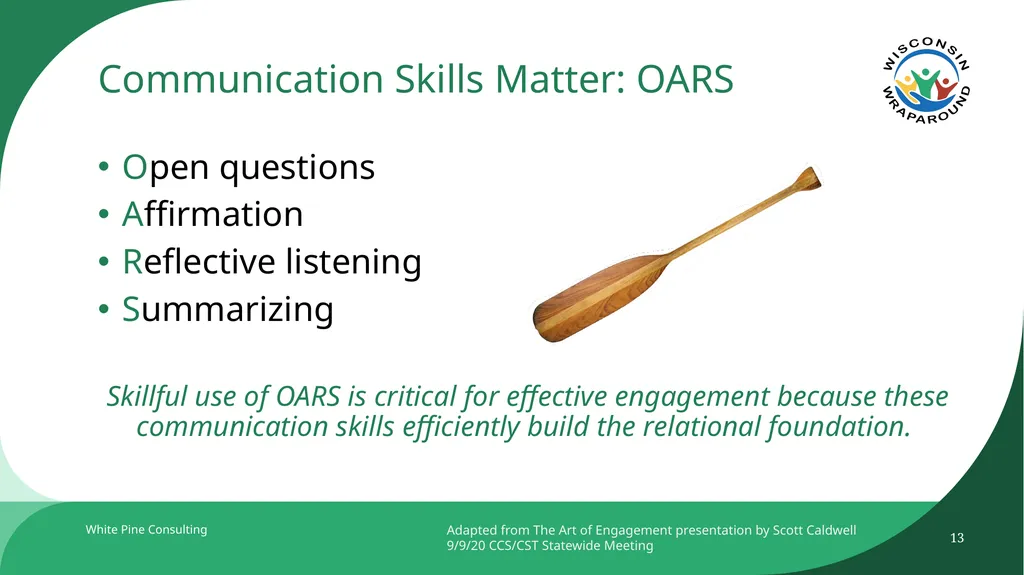
Communication Skills Matter: OARS Open questions
Affirmation
Reflective listening
Summarizing
Skillful use of OARS is critical for effective engagement because these communication skills efficiently build the relational foundation. 13 White Pine Consulting Adapted from The Art of Engagement presentation by Scott Caldwell
9/9/20 CCS/CST Statewide Meeting<br>
Affirmation
Reflective listening
Summarizing
Skillful use of OARS is critical for effective engagement because these communication skills efficiently build the relational foundation. 13 White Pine Consulting Adapted from The Art of Engagement presentation by Scott Caldwell
9/9/20 CCS/CST Statewide Meeting<br>
14
Live Role Play:
Open Questions 14 White Pine Consulting<br>
15
OARS: Open Questions Make the individual’s views, perspectives, and experiences central
Promotes initial connection and ongoing participation
Usually go from general to specific
Requires more of a response than a simple yes/no or fill in the blank
Open question starters: What…? How…? Tell me about… Describe…
What is a good example of an open question? 15 White Pine Consulting Adapted from The Art of Engagement presentation by Scott Caldwell
9/9/20 CCS/CST Statewide Meeting<br>
Promotes initial connection and ongoing participation
Usually go from general to specific
Requires more of a response than a simple yes/no or fill in the blank
Open question starters: What…? How…? Tell me about… Describe…
What is a good example of an open question? 15 White Pine Consulting Adapted from The Art of Engagement presentation by Scott Caldwell
9/9/20 CCS/CST Statewide Meeting<br>
16
OARS: Affirmation Look for strengths and positive attributes
Look for and point out small successes
Affirm specific strengths
Avoid non-specific praising
Builds confidence in one’s ability to make changes
What are some of the strengths that people bring to services? 16 White Pine Consulting Adapted from The Art of Engagement presentation by Scott Caldwell
9/9/20 CCS/CST Statewide Meeting<br>
Look for and point out small successes
Affirm specific strengths
Avoid non-specific praising
Builds confidence in one’s ability to make changes
What are some of the strengths that people bring to services? 16 White Pine Consulting Adapted from The Art of Engagement presentation by Scott Caldwell
9/9/20 CCS/CST Statewide Meeting<br>
17
Video 17 White Pine Consulting<br>
18
OARS: Reflective Listening “Reflective listening is a way of checking rather than assuming
that you know what is meant.”
(Miller and Rolinick, 2002) 18 White Pine Consulting<br>
that you know what is meant.”
(Miller and Rolinick, 2002) 18 White Pine Consulting<br>
19
OARS: Reflective Listening The most important communication skill is listening
One of the most challenging skills to learn
Demonstrates empathy, interest, and understanding
Can be useful to clarify and manage conflict
Helps explore reasons for change
Skillful listening saves time and promotes rapid engagement:
Why might this be so? 19 White Pine Consulting Adapted from The Art of Engagement presentation by Scott Caldwell
9/9/20 CCS/CST Statewide Meeting<br>
One of the most challenging skills to learn
Demonstrates empathy, interest, and understanding
Can be useful to clarify and manage conflict
Helps explore reasons for change
Skillful listening saves time and promotes rapid engagement:
Why might this be so? 19 White Pine Consulting Adapted from The Art of Engagement presentation by Scott Caldwell
9/9/20 CCS/CST Statewide Meeting<br>
20
OARS: Reflective Listening Steps to forming a reflection:
Listen carefully to what the person is saying (perspectives matter)
Make an educated guess about the person’s underlying meaning or emotion
Choose a reflection direction – should be purposeful
Share reflection as a statement, not a question 20 White Pine Consulting Adapted from The Art of Engagement presentation by Scott Caldwell
9/9/20 CCS/CST Statewide Meeting<br>
Listen carefully to what the person is saying (perspectives matter)
Make an educated guess about the person’s underlying meaning or emotion
Choose a reflection direction – should be purposeful
Share reflection as a statement, not a question 20 White Pine Consulting Adapted from The Art of Engagement presentation by Scott Caldwell
9/9/20 CCS/CST Statewide Meeting<br>
21
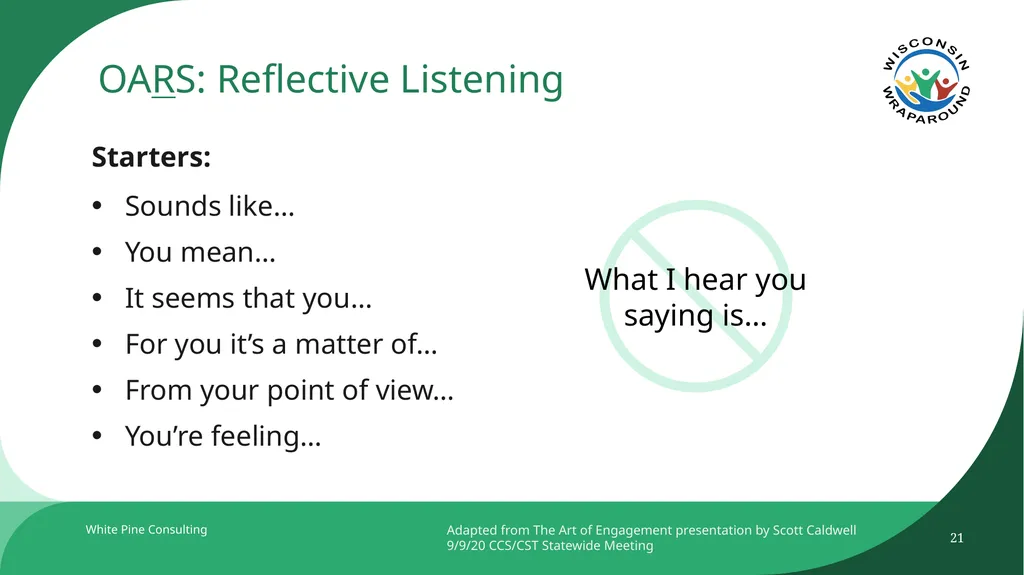
OARS: Reflective Listening Starters:
Sounds like…
You mean…
It seems that you…
For you it’s a matter of…
From your point of view…
You’re feeling… 21 White Pine Consulting Adapted from The Art of Engagement presentation by Scott Caldwell
9/9/20 CCS/CST Statewide Meeting What I hear you saying is…<br>
Sounds like…
You mean…
It seems that you…
For you it’s a matter of…
From your point of view…
You’re feeling… 21 White Pine Consulting Adapted from The Art of Engagement presentation by Scott Caldwell
9/9/20 CCS/CST Statewide Meeting What I hear you saying is…<br>
22
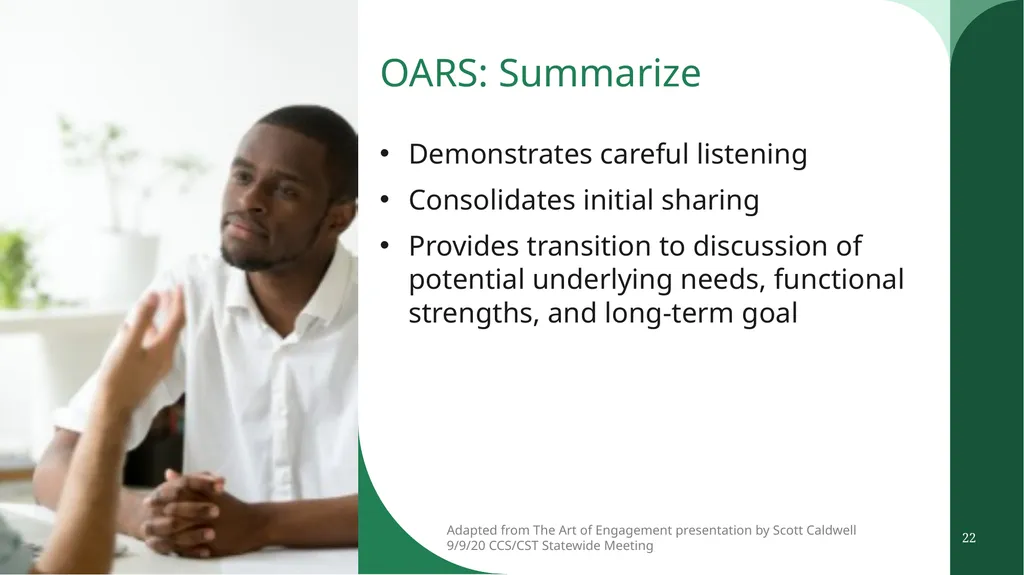
OARS: Summarize Demonstrates careful listening
Consolidates initial sharing
Provides transition to discussion of potential underlying needs, functional strengths, and long-term goal 22 Adapted from The Art of Engagement presentation by Scott Caldwell
9/9/20 CCS/CST Statewide Meeting<br>
Consolidates initial sharing
Provides transition to discussion of potential underlying needs, functional strengths, and long-term goal 22 Adapted from The Art of Engagement presentation by Scott Caldwell
9/9/20 CCS/CST Statewide Meeting<br>
23
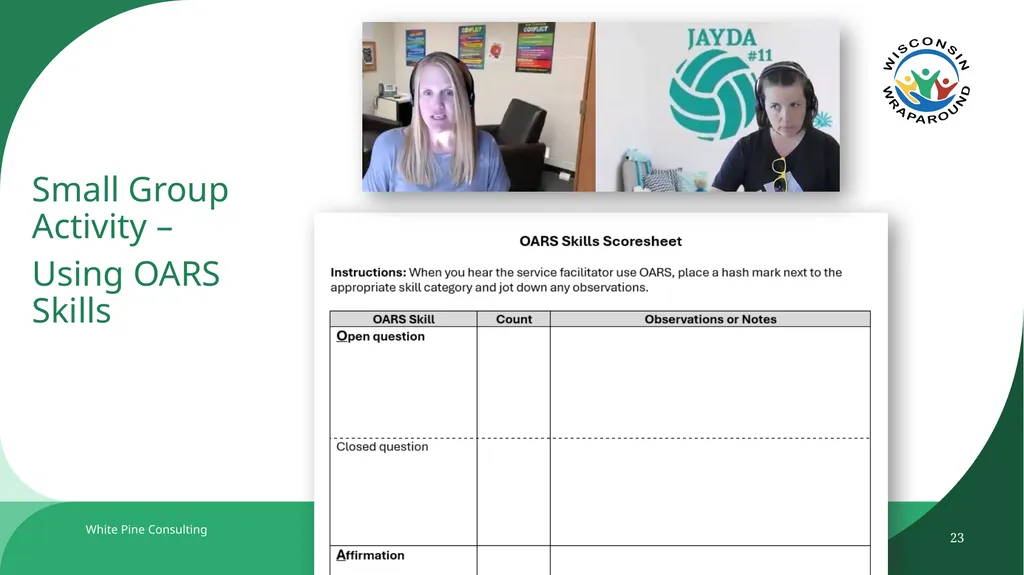
Small Group Activity –
Using OARS Skills 23 White Pine Consulting<br>
24
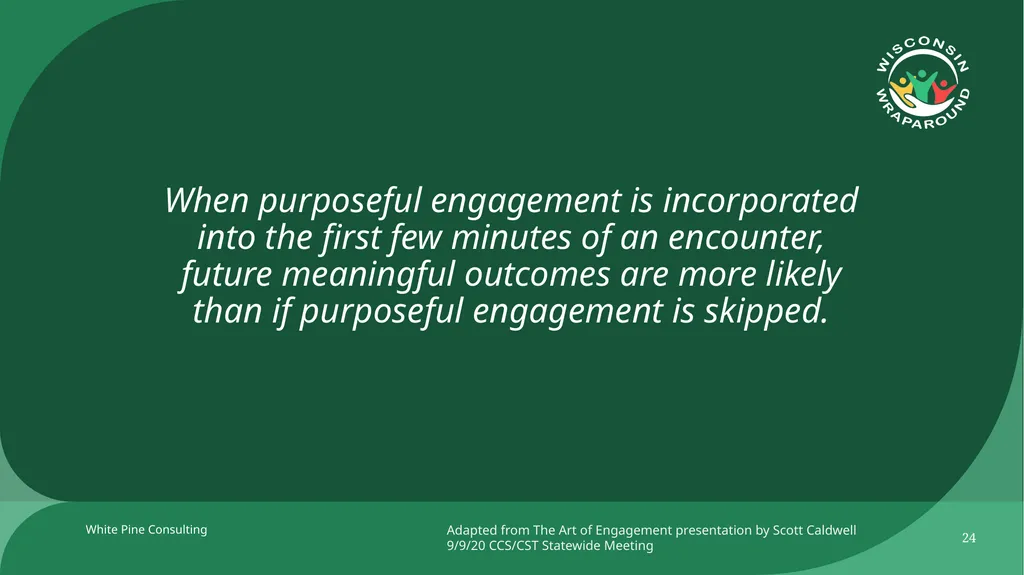
When purposeful engagement is incorporated into the first few minutes of an encounter, future meaningful outcomes are more likely than if purposeful engagement is skipped. 24 White Pine Consulting Adapted from The Art of Engagement presentation by Scott Caldwell
9/9/20 CCS/CST Statewide Meeting<br>
9/9/20 CCS/CST Statewide Meeting<br>
25
Small Group Activity 25 White Pine Consulting Reflect on the use of OARS during the assessment process.
What are the potential barriers?<br>
What are the potential barriers?<br>
26
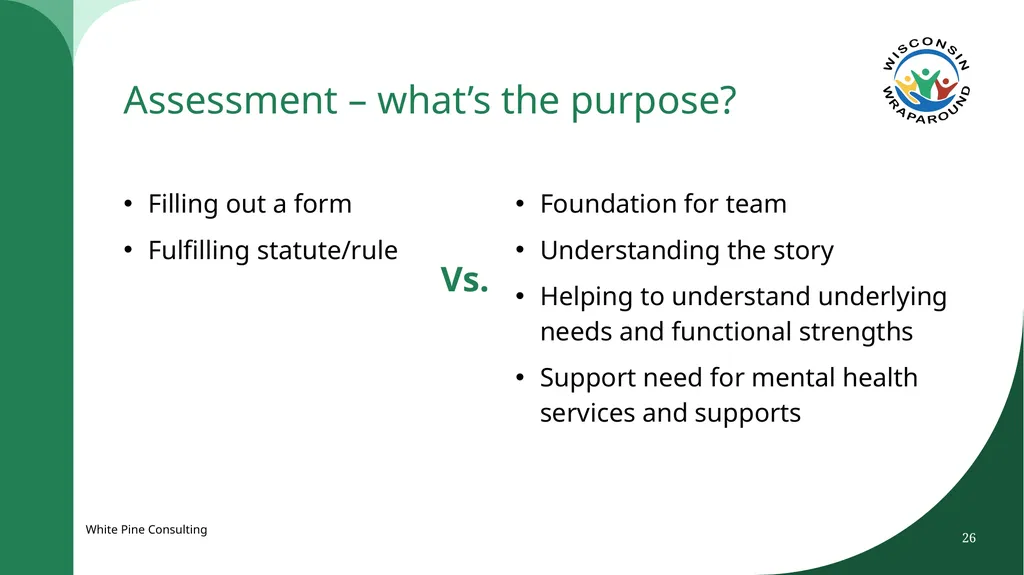
Assessment – what’s the purpose? 26 White Pine Consulting<br>
27
27 White Pine Consulting Partners in a process
vs.
Service brokers<br>
vs.
Service brokers<br>
28
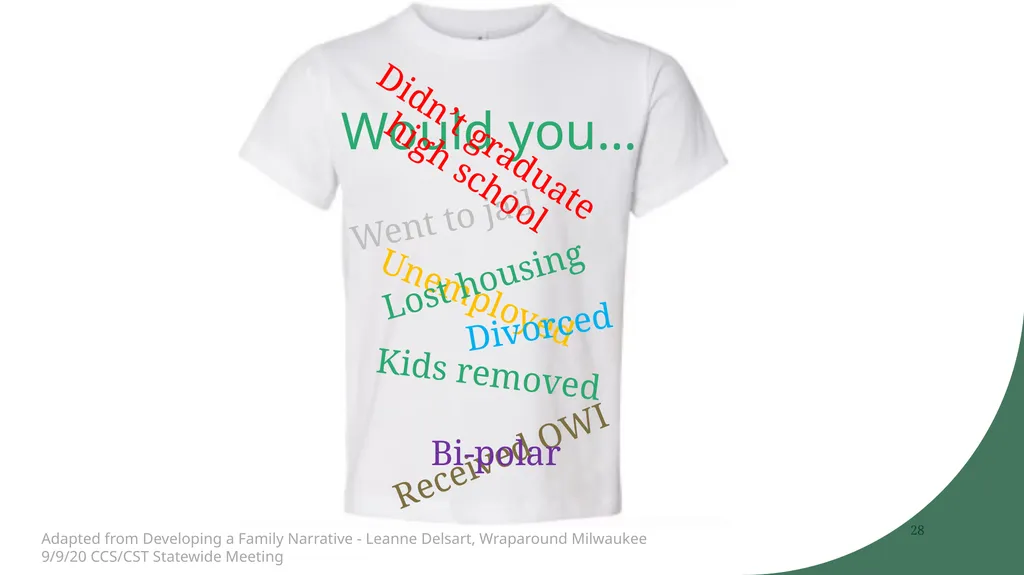
28 Would you… Unemployed Received OWI Lost housing Went to jail Kids removed Divorced Bi-polar Didn’t graduate high school Adapted from Developing a Family Narrative - Leanne Delsart, Wraparound Milwaukee
9/9/20 CCS/CST Statewide Meeting<br>
9/9/20 CCS/CST Statewide Meeting<br>
29
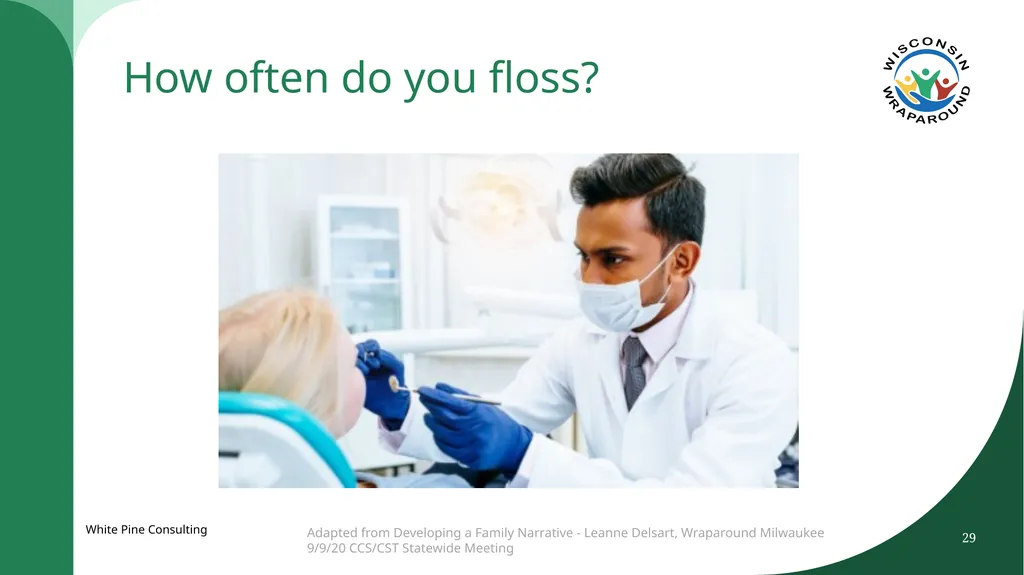
How often do you floss? 29 White Pine Consulting Adapted from Developing a Family Narrative - Leanne Delsart, Wraparound Milwaukee
9/9/20 CCS/CST Statewide Meeting<br>
9/9/20 CCS/CST Statewide Meeting<br>
30
Life Story Who would you let write your biography?
How many chapters would it be?
When would the story begin?
What would be your opening line? 30 White Pine Consulting Adapted from Developing a Family Narrative - Leanne Delsart, Wraparound Milwaukee
9/9/20 CCS/CST Statewide Meeting<br>
How many chapters would it be?
When would the story begin?
What would be your opening line? 30 White Pine Consulting Adapted from Developing a Family Narrative - Leanne Delsart, Wraparound Milwaukee
9/9/20 CCS/CST Statewide Meeting<br>
31
Documenting a Family’s Story The family is the author, we are the scribe
Use information you have available
Confirm reports with the family prior to adding information to the narrative
Reframe information to reflect a broader context and truth – dig deeper and explore with the family
Creates a robust picture of who the family is and what they have experienced, individually and collectively 31 White Pine Consulting Adapted from Developing a Family Narrative - Leanne Delsart, Wraparound Milwaukee
9/9/20 CCS/CST Statewide Meeting<br>
Use information you have available
Confirm reports with the family prior to adding information to the narrative
Reframe information to reflect a broader context and truth – dig deeper and explore with the family
Creates a robust picture of who the family is and what they have experienced, individually and collectively 31 White Pine Consulting Adapted from Developing a Family Narrative - Leanne Delsart, Wraparound Milwaukee
9/9/20 CCS/CST Statewide Meeting<br>
32
32<br>
33
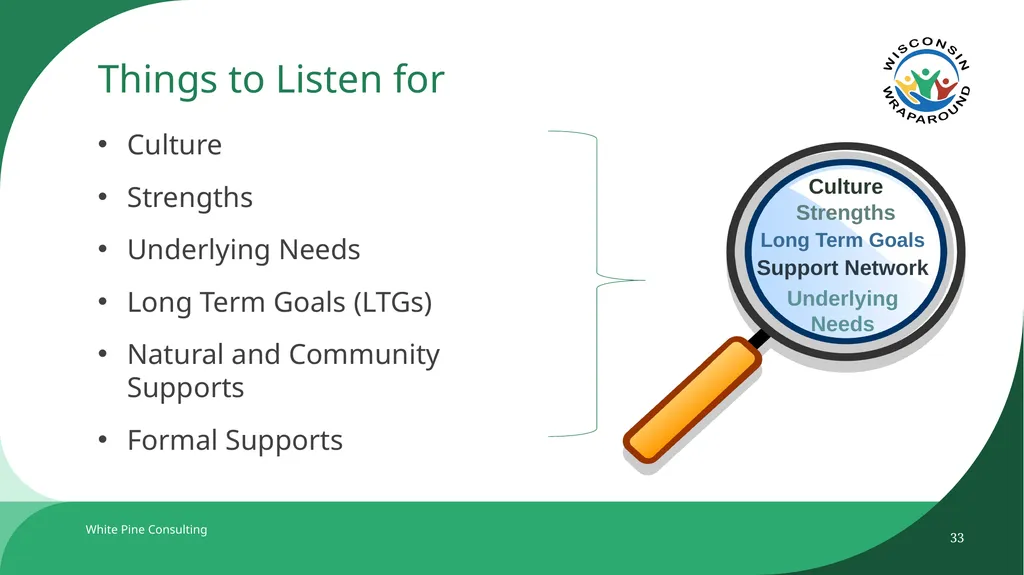
Things to Listen for Culture
Strengths
Underlying Needs
Long Term Goals (LTGs)
Natural and Community Supports
Formal Supports 33 White Pine Consulting Underlying Needs Strengths Long Term Goals Support Network Culture<br>
Strengths
Underlying Needs
Long Term Goals (LTGs)
Natural and Community Supports
Formal Supports 33 White Pine Consulting Underlying Needs Strengths Long Term Goals Support Network Culture<br>
34
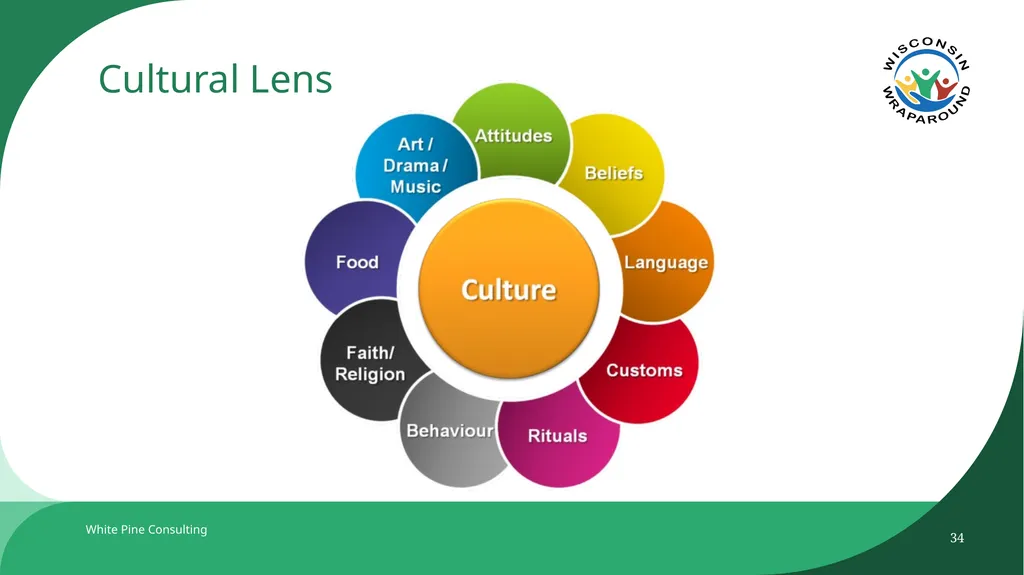
Cultural Lens 34 White Pine Consulting<br>
35
Video 35 White Pine Consulting<br>
36
Small Group Activity 36 White Pine Consulting What questions could you ask to delve into learning about others’ cultures? 320 Questions to Ask Someone From a Different Culture (upjourney.com)<br>
37
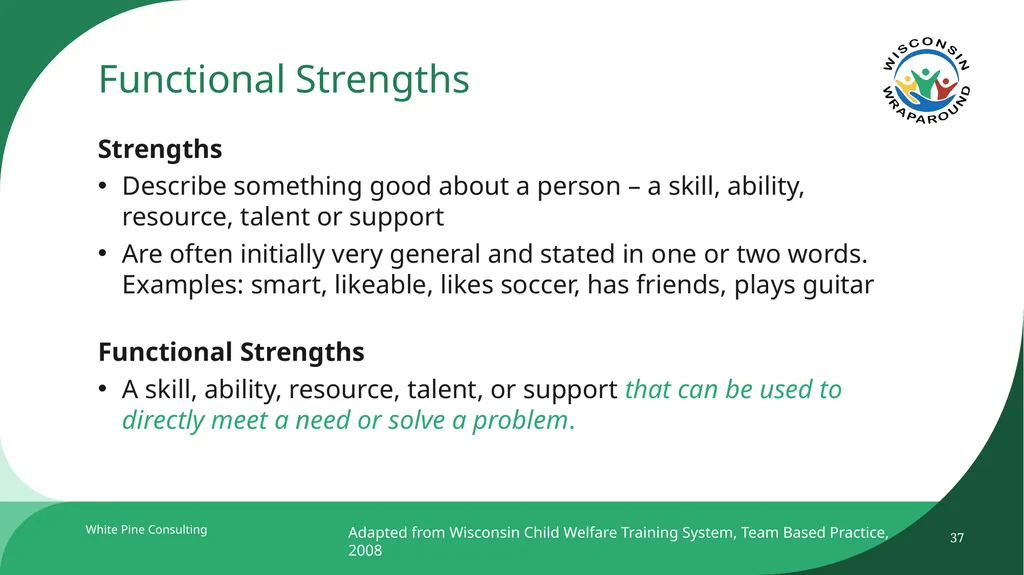
Functional Strengths Strengths
Describe something good about a person – a skill, ability, resource, talent or support
Are often initially very general and stated in one or two words. Examples: smart, likeable, likes soccer, has friends, plays guitar
Functional Strengths
A skill, ability, resource, talent, or support that can be used to directly meet a need or solve a problem. 37 White Pine Consulting Adapted from Wisconsin Child Welfare Training System, Team Based Practice, 2008<br>
Describe something good about a person – a skill, ability, resource, talent or support
Are often initially very general and stated in one or two words. Examples: smart, likeable, likes soccer, has friends, plays guitar
Functional Strengths
A skill, ability, resource, talent, or support that can be used to directly meet a need or solve a problem. 37 White Pine Consulting Adapted from Wisconsin Child Welfare Training System, Team Based Practice, 2008<br>
38
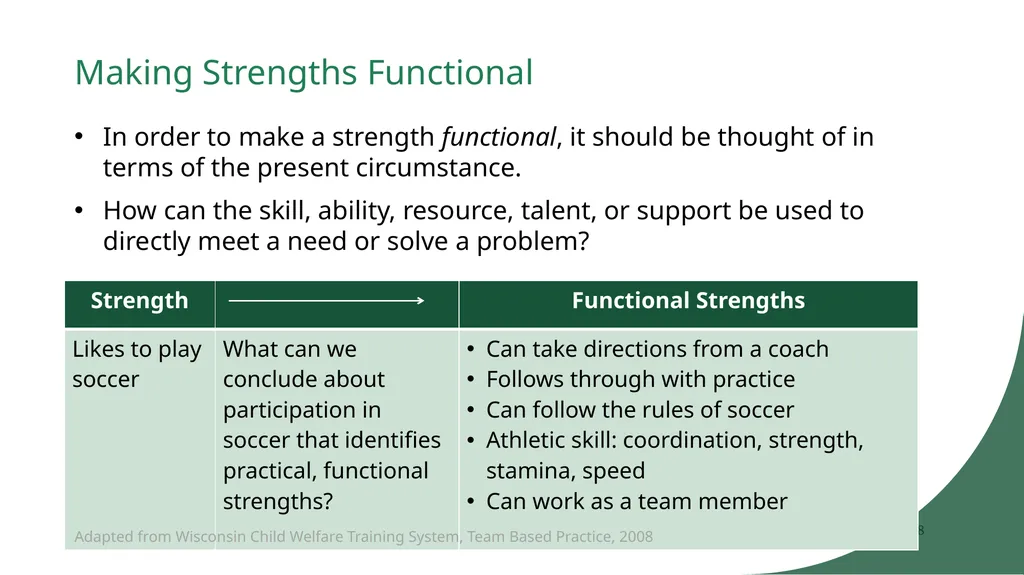
38 Making Strengths Functional Adapted from Wisconsin Child Welfare Training System, Team Based Practice, 2008 In order to make a strength functional, it should be thought of in terms of the present circumstance.
How can the skill, ability, resource, talent, or support be used to directly meet a need or solve a problem?<br>
How can the skill, ability, resource, talent, or support be used to directly meet a need or solve a problem?<br>
39
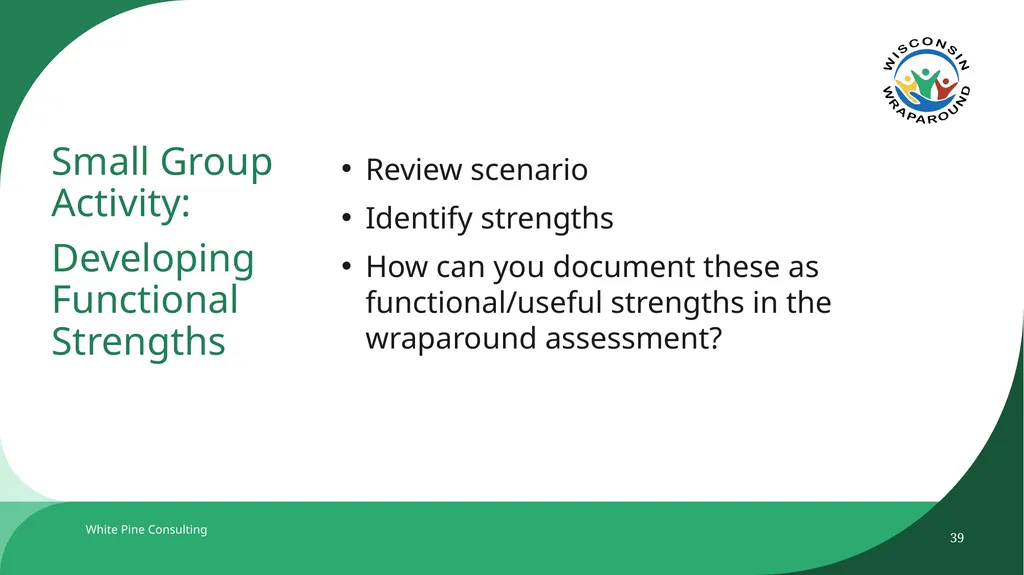
Small Group Activity:
Developing Functional Strengths 39 White Pine Consulting Review scenario
Identify strengths
How can you document these as functional/useful strengths in the wraparound assessment?<br>
Identify strengths
How can you document these as functional/useful strengths in the wraparound assessment?<br>
40
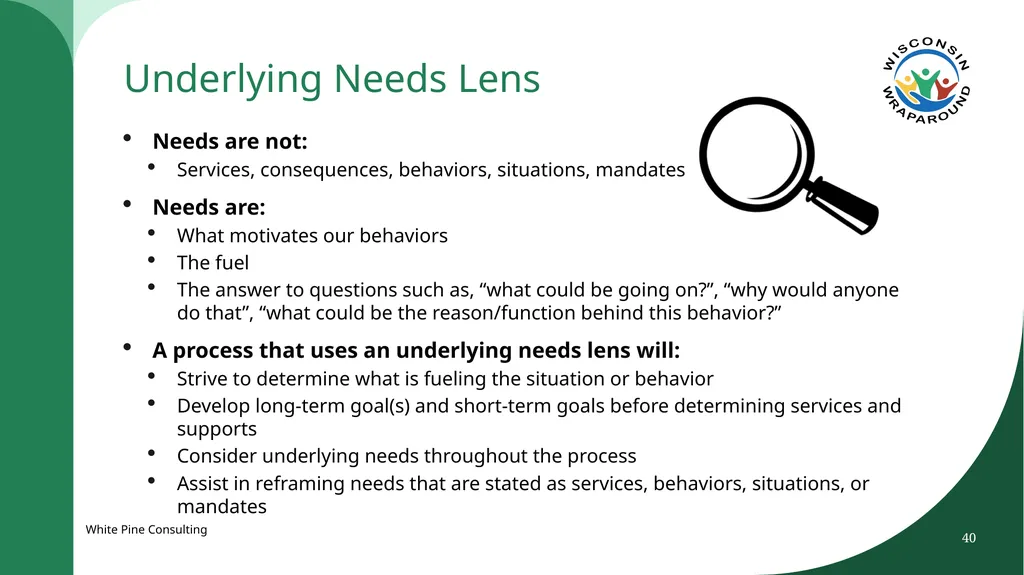
Underlying Needs Lens Needs are not:
Services, consequences, behaviors, situations, mandates
Needs are:
What motivates our behaviors
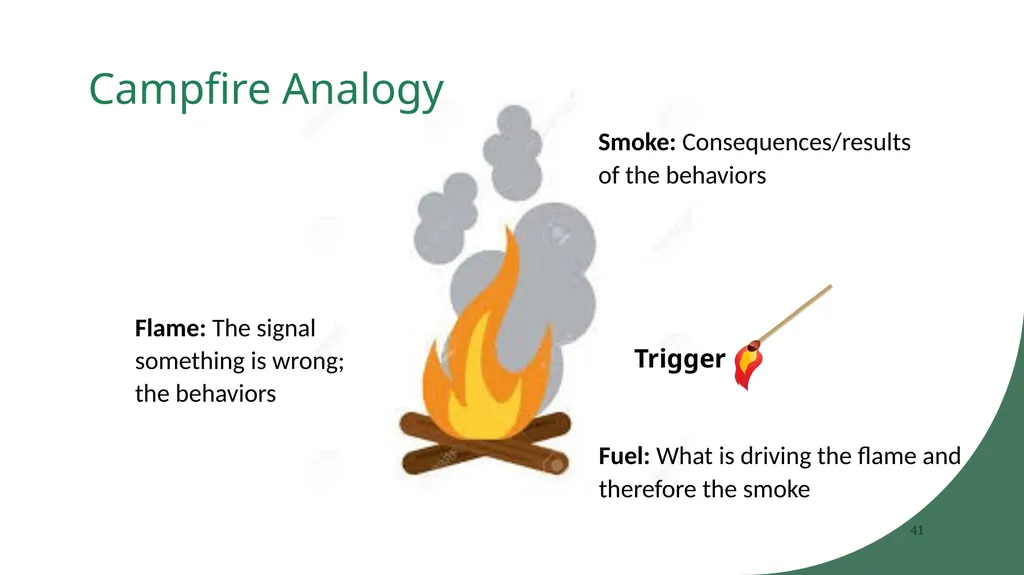
The fuel
The answer to questions such as, “what could be going on?”, “why would anyone do that”, “what could be the reason/function behind this behavior?”
A process that uses an underlying needs lens will:
Strive to determine what is fueling the situation or behavior
Develop long-term goal(s) and short-term goals before determining services and supports
Consider underlying needs throughout the process
Assist in reframing needs that are stated as services, behaviors, situations, or mandates 40 White Pine Consulting<br>
Services, consequences, behaviors, situations, mandates
Needs are:
What motivates our behaviors
The fuel
The answer to questions such as, “what could be going on?”, “why would anyone do that”, “what could be the reason/function behind this behavior?”
A process that uses an underlying needs lens will:
Strive to determine what is fueling the situation or behavior
Develop long-term goal(s) and short-term goals before determining services and supports
Consider underlying needs throughout the process
Assist in reframing needs that are stated as services, behaviors, situations, or mandates 40 White Pine Consulting<br>
41
41 Smoke: Consequences/results of the behaviors Flame: The signal something is wrong; the behaviors Fuel: What is driving the flame and therefore the smoke Trigger Campfire Analogy<br>
42
Adding Context Labeling vs. describing the behavior 42 White Pine Consulting<br>
43
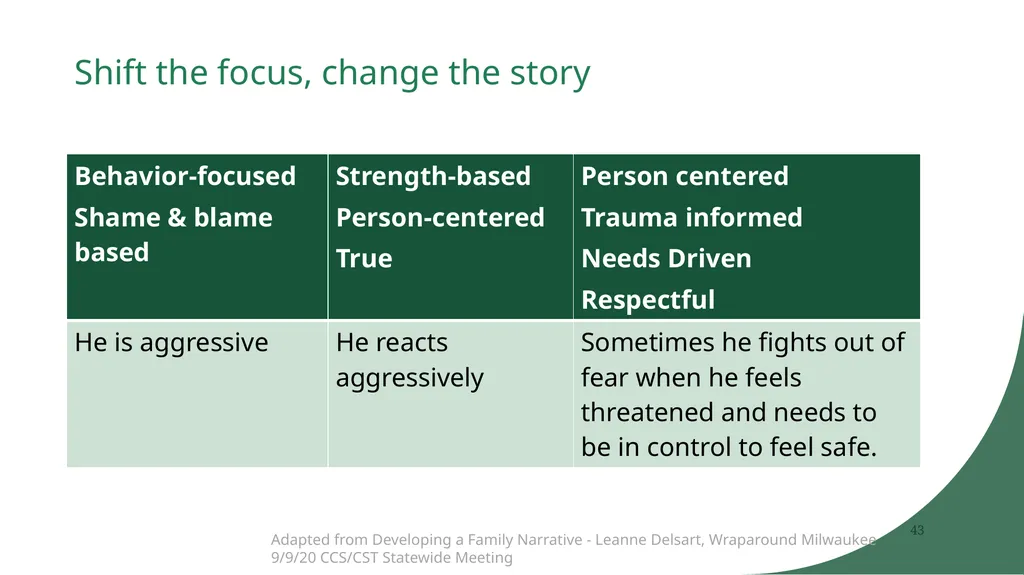
43 Shift the focus, change the story Adapted from Developing a Family Narrative - Leanne Delsart, Wraparound Milwaukee
9/9/20 CCS/CST Statewide Meeting<br>
9/9/20 CCS/CST Statewide Meeting<br>
44
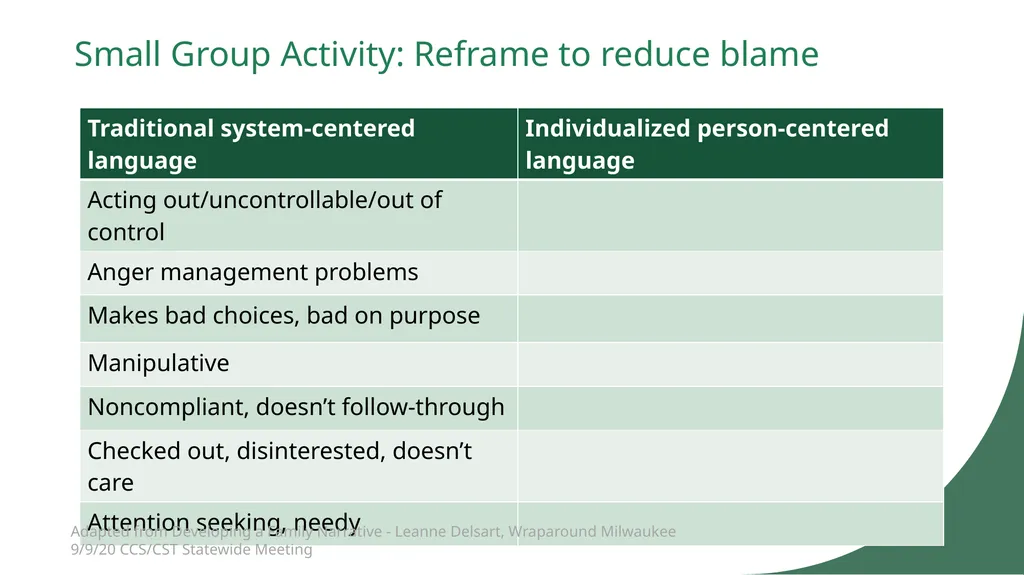
44 Small Group Activity: Reframe to reduce blame Adapted from Developing a Family Narrative - Leanne Delsart, Wraparound Milwaukee
9/9/20 CCS/CST Statewide Meeting<br>
9/9/20 CCS/CST Statewide Meeting<br>
45
Video 45 White Pine Consulting<br>
46
Long Term Goals Listen for what the long-team goals might be
What is the vision the family has for themselves and family (in wraparound and in general)?
What will be different if the wraparound process is successful? 46 White Pine Consulting Adapted from: Overview of Person-Centered Planning, DCTS 7/1/09<br>
What is the vision the family has for themselves and family (in wraparound and in general)?
What will be different if the wraparound process is successful? 46 White Pine Consulting Adapted from: Overview of Person-Centered Planning, DCTS 7/1/09<br>
47
Natural and Community Supports Who are the people in your life that you count on?
Who do you want to talk to or be with when you go through tough times?
Who do you want to share your successes with?
Examples:
Pastor
Boy scout leader
Aunt
Neighbor 47 White Pine Consulting<br>
Who do you want to talk to or be with when you go through tough times?
Who do you want to share your successes with?
Examples:
Pastor
Boy scout leader
Aunt
Neighbor 47 White Pine Consulting<br>
48
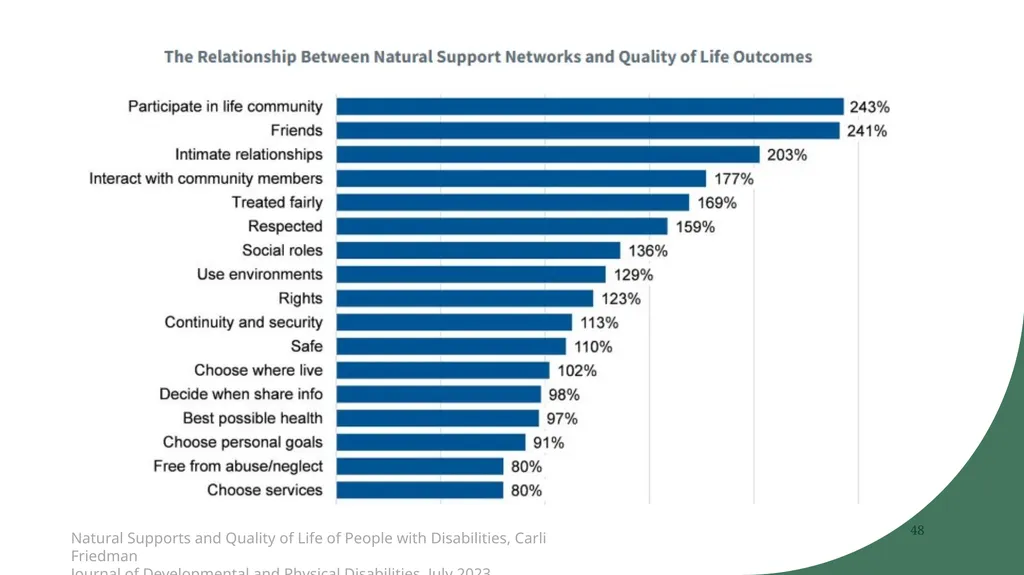
48 Natural Supports and Quality of Life of People with Disabilities, Carli Friedman
Journal of Developmental and Physical Disabilities, July 2023<br>
Journal of Developmental and Physical Disabilities, July 2023<br>
49
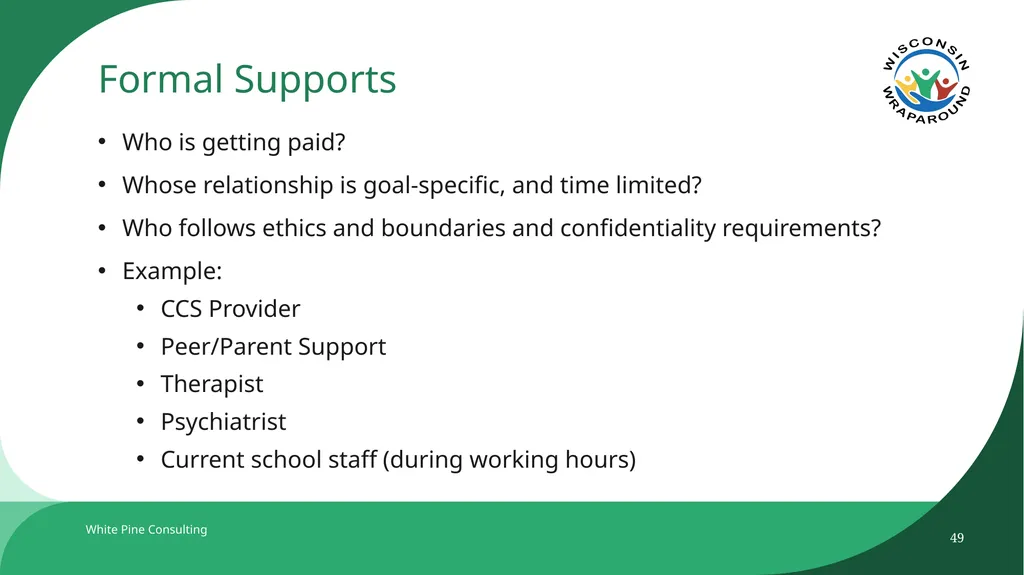
Formal Supports Who is getting paid?
Whose relationship is goal-specific, and time limited?
Who follows ethics and boundaries and confidentiality requirements?
Example:
CCS Provider
Peer/Parent Support
Therapist
Psychiatrist
Current school staff (during working hours) 49 White Pine Consulting<br>
Whose relationship is goal-specific, and time limited?
Who follows ethics and boundaries and confidentiality requirements?
Example:
CCS Provider
Peer/Parent Support
Therapist
Psychiatrist
Current school staff (during working hours) 49 White Pine Consulting<br>
50
Roles of Supports in the
Assessment Process Current providers and natural supports
Supervisor
Mental Health and Substance Use Professionals 50 White Pine Consulting<br>
Supervisor
Mental Health and Substance Use Professionals 50 White Pine Consulting<br>
51
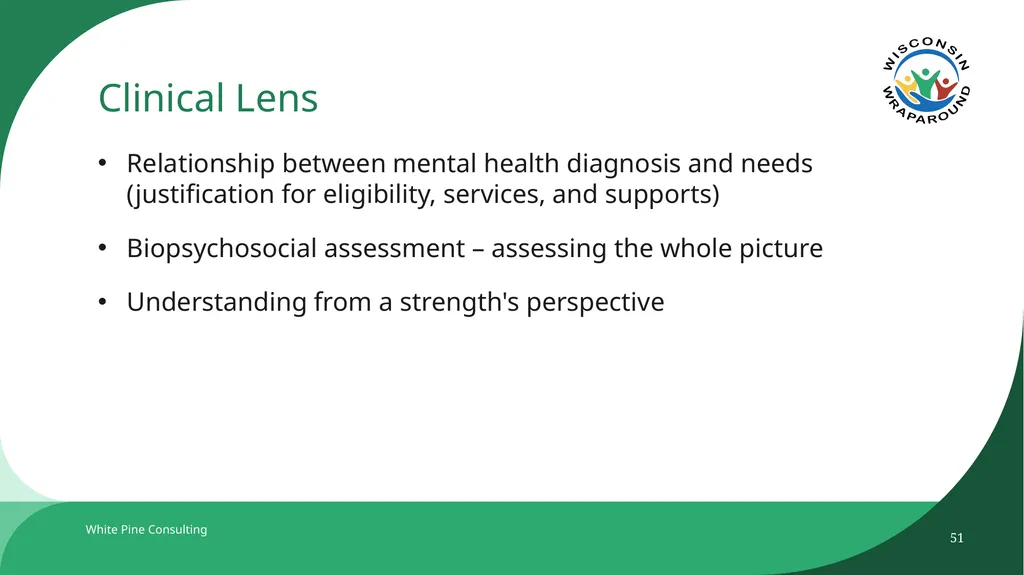
Clinical Lens Relationship between mental health diagnosis and needs (justification for eligibility, services, and supports)
Biopsychosocial assessment – assessing the whole picture
Understanding from a strength's perspective 51 White Pine Consulting<br>
Biopsychosocial assessment – assessing the whole picture
Understanding from a strength's perspective 51 White Pine Consulting<br>
52
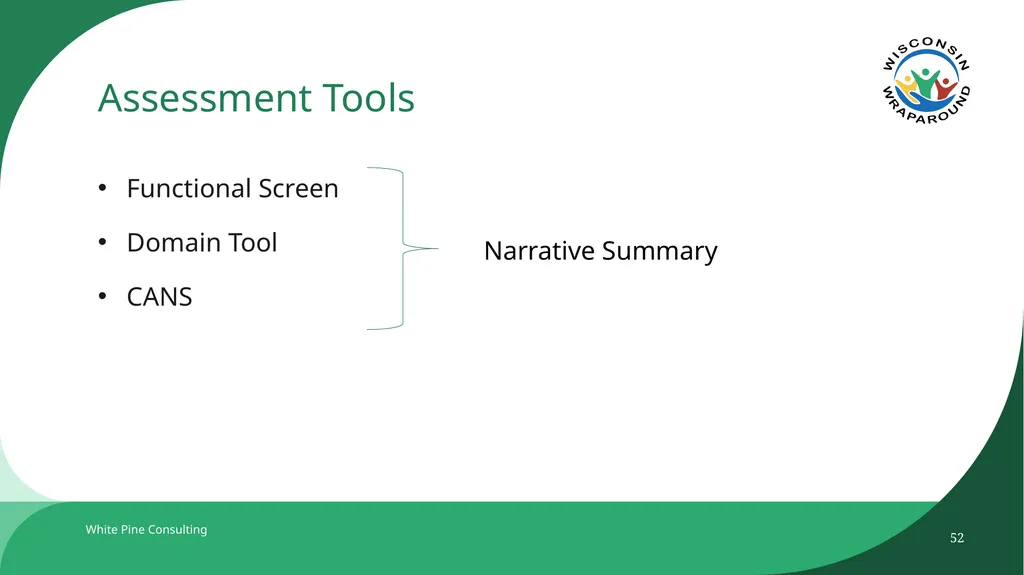
Assessment Tools Functional Screen
Domain Tool
CANS 52 White Pine Consulting Narrative Summary<br>
Domain Tool
CANS 52 White Pine Consulting Narrative Summary<br>
53
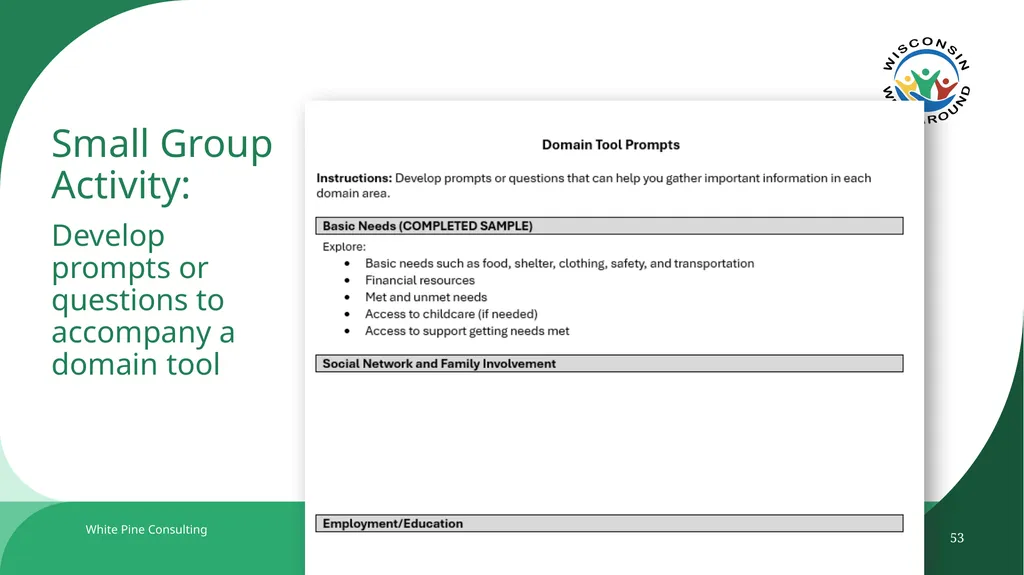
Small Group Activity:
Develop prompts or questions to accompany a domain tool 53 White Pine Consulting<br>
54
The CANS Use family story to complete the CANS
Not the assessment
Order – don’t start with Trauma
If additional information is needed, verify ratings with family 54 https://wiwraparound.org/cans/ Effectively Integrating the CANS into the Wraparound Process; NWI, NWIC, John Praed Foundation<br>
Not the assessment
Order – don’t start with Trauma
If additional information is needed, verify ratings with family 54 https://wiwraparound.org/cans/ Effectively Integrating the CANS into the Wraparound Process; NWI, NWIC, John Praed Foundation<br>
55
Using the assessment, we ask where the youth/family want to start?
What 1-3 areas do they want to begin working on as a team? 55 White Pine Consulting<br>
56
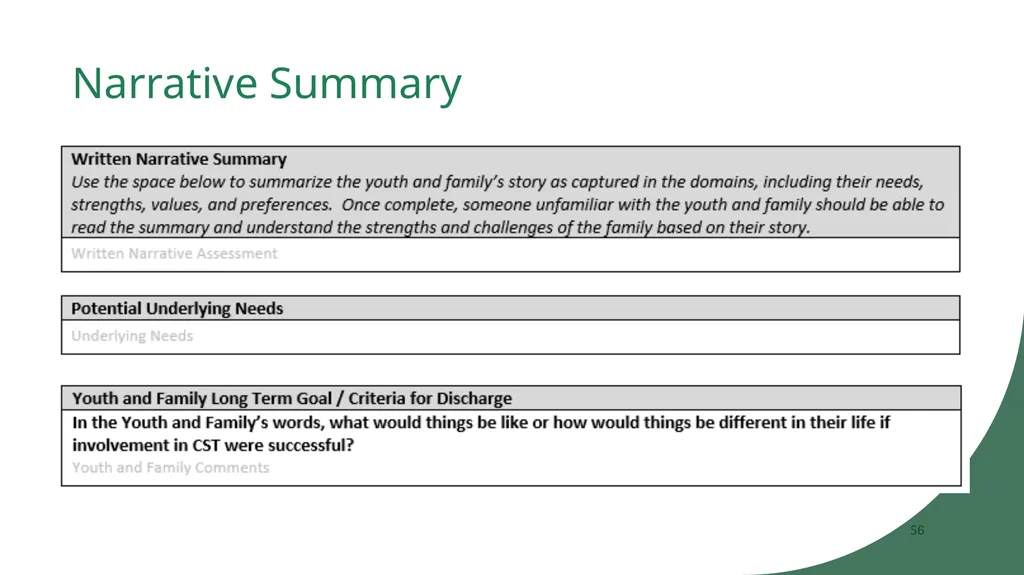
56 Narrative Summary<br>
57
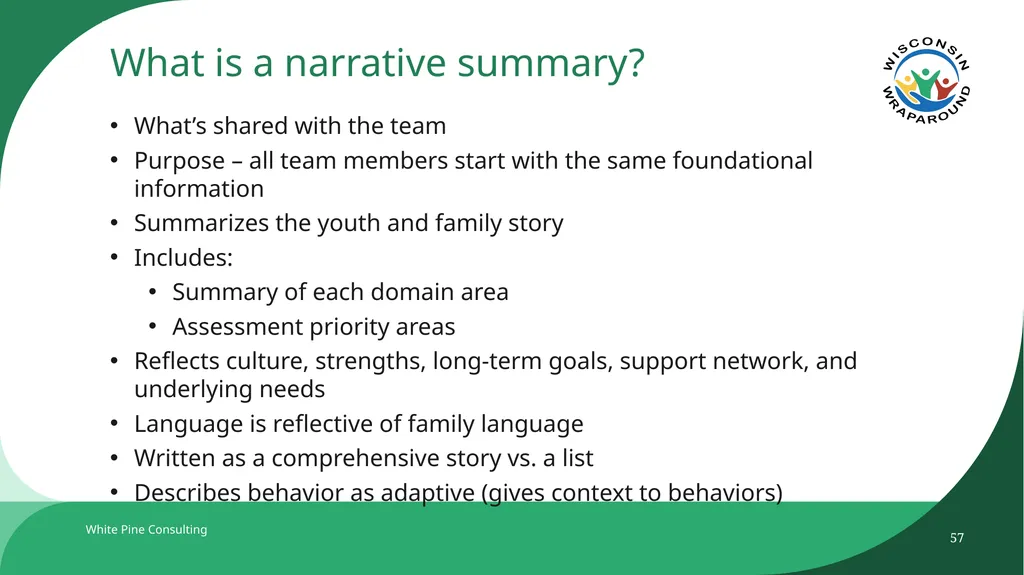
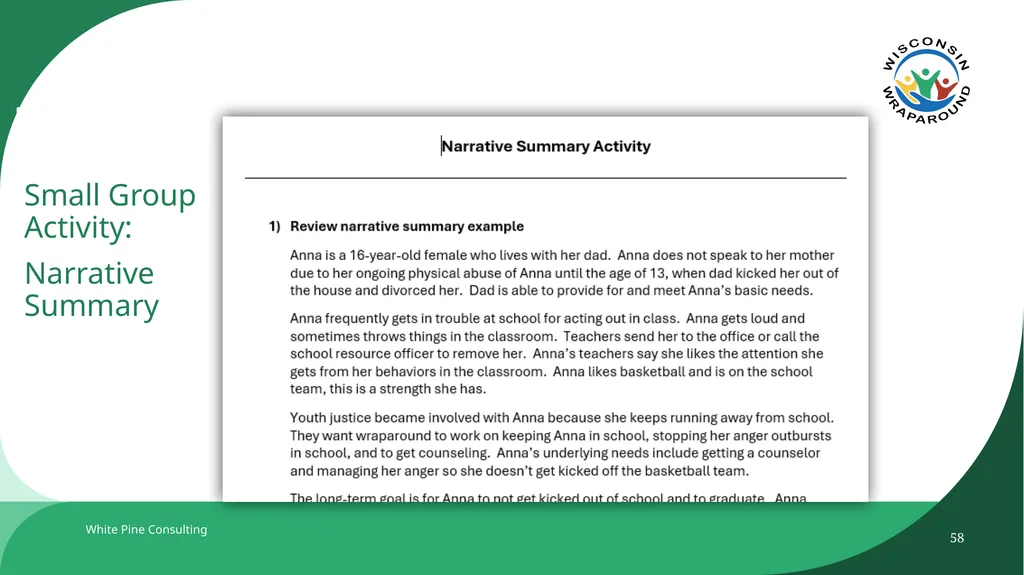
What is a narrative summary? What’s shared with the team
Purpose – all team members start with the same foundational information
Summarizes the youth and family story
Includes:
Summary of each domain area
Assessment priority areas
Reflects culture, strengths, long-term goals, support network, and underlying needs
Language is reflective of family language
Written as a comprehensive story vs. a list
Describes behavior as adaptive (gives context to behaviors) 57 White Pine Consulting<br>
Purpose – all team members start with the same foundational information
Summarizes the youth and family story
Includes:
Summary of each domain area
Assessment priority areas
Reflects culture, strengths, long-term goals, support network, and underlying needs
Language is reflective of family language
Written as a comprehensive story vs. a list
Describes behavior as adaptive (gives context to behaviors) 57 White Pine Consulting<br>
58
Small Group Activity:
Narrative Summary 58 White Pine Consulting<br>
59
59 You don’t really know someone if
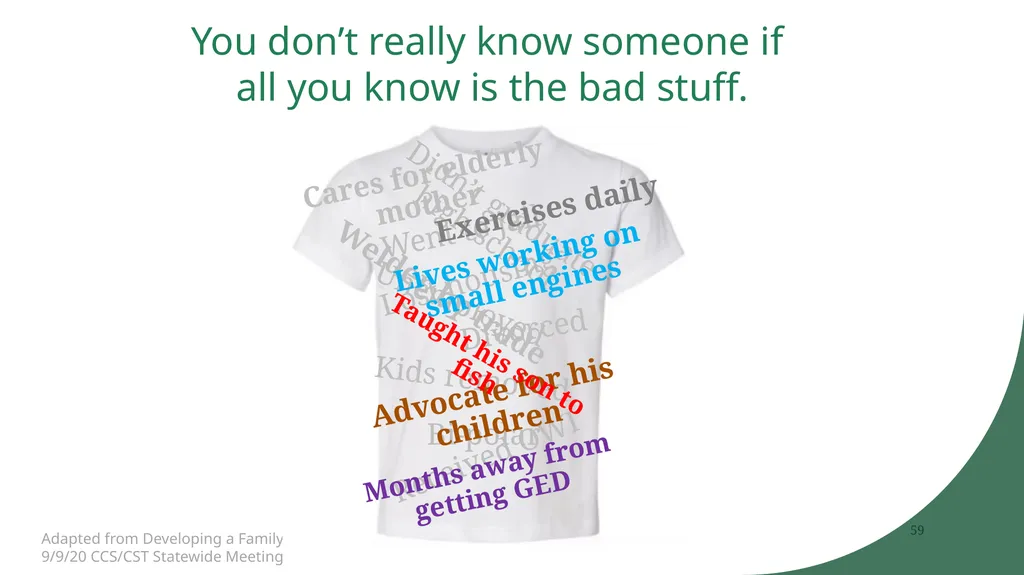
all you know is the bad stuff. Adapted from Developing a Family Narrative - Leanne Delsart, Wraparound Milwaukee
9/9/20 CCS/CST Statewide Meeting Unemployed Received OWI Lost housing Went to jail Kids removed Divorced Bi-polar Didn’t graduate high school Welder by trade Cares for elderly mother Exercises daily Months away from getting GED Advocate for his children Taught his son to fish Lives working on small engines<br>
9/9/20 CCS/CST Statewide Meeting Unemployed Received OWI Lost housing Went to jail Kids removed Divorced Bi-polar Didn’t graduate high school Welder by trade Cares for elderly mother Exercises daily Months away from getting GED Advocate for his children Taught his son to fish Lives working on small engines<br>
60
Small Group Activity 60 White Pine Consulting Discuss differences between your current assessment process and what you heard today.
What would it take to make changes?<br>
What would it take to make changes?<br>
61
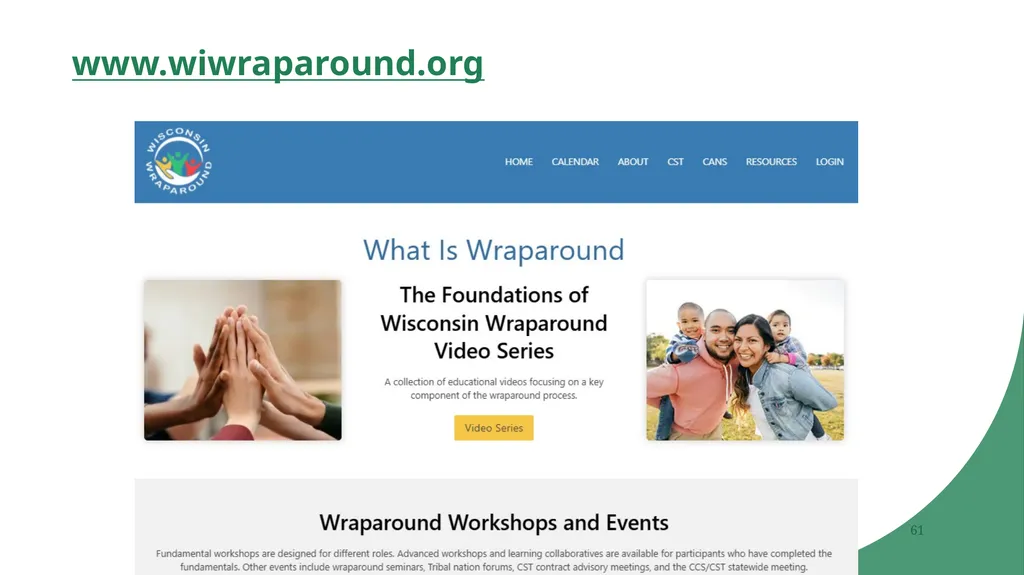
www.wiwraparound.org 61<br>