
Thematic analysis Part 1: What is thematic
TD
Published · 26 slides · 0 views

1 / 1


Description
Thematic analysis Part 1: What is thematic analysis? Presentation by Victoria Clarke Associate Professor of Qualitative and Critical Psychology, UWE Sep 2021 PowerPoint slides from the Braun, Clarke Hayfield Qualitative Methods Online
Related Topics
Share
Embed code
Download this presentation From Below
"Thematic analysis Part 1: What is thematic" is the property of its rightful owner. Permission is granted to download and print the materials on this website for personal, non-commercial use only, and to display it on your personal computer provided you do not modify the materials and that you retain all copyright notices contained in the materials. By downloading content from our website, you accept the terms of this agreement.
Presentation Transcript
01
Thematic analysis
Part 1: What is thematic analysis? Presentation by Victoria Clarke
Associate Professor of Qualitative and Critical Psychology, UWE
Sep 2021<br>
Associate Professor of Qualitative and Critical Psychology, UWE
Sep 2021<br>
02
PowerPoint slides from the Braun, Clarke & Hayfield Qualitative Methods Online Teaching & Learning Resources Collaboration (QMOTLRC)<br>
03
Topic overview Understanding the key features of thematic analysis and specifically of the Braun & Clarke reflexive approach to thematic analysis.
Understanding how to undertake a reflexive thematic analysis of qualitative data, including coding and theme generation.
Understand how to conduct a high quality thematic analysis and avoid common problems.
There are some Alerts! to highlight key points<br>
Understanding how to undertake a reflexive thematic analysis of qualitative data, including coding and theme generation.
Understand how to conduct a high quality thematic analysis and avoid common problems.
There are some Alerts! to highlight key points<br>
04
Lecture overview Part 1: What is thematic analysis?
Part 2: Thematic analysis is uniquely flexible
Part 3: Six phases of reflexive thematic analysis
Part 4: Avoiding common problems<br>
Part 2: Thematic analysis is uniquely flexible
Part 3: Six phases of reflexive thematic analysis
Part 4: Avoiding common problems<br>
05
Braun and Clarke – thematic analysis<br>
06
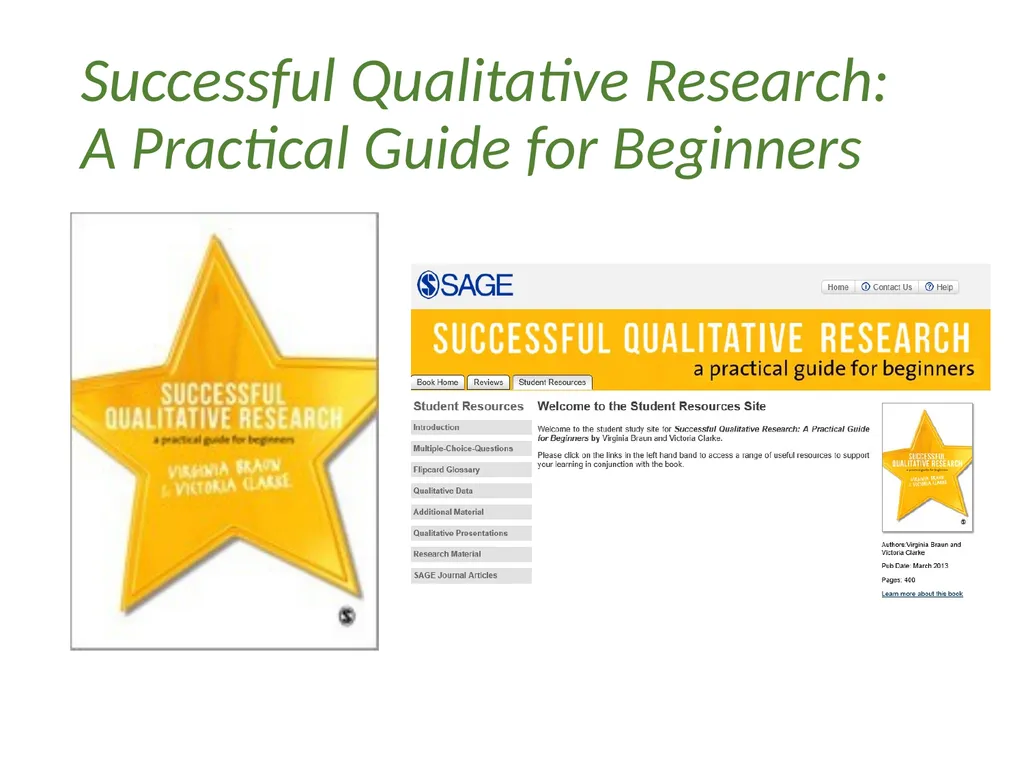
Successful Qualitative Research:
A Practical Guide for Beginners<br>
07
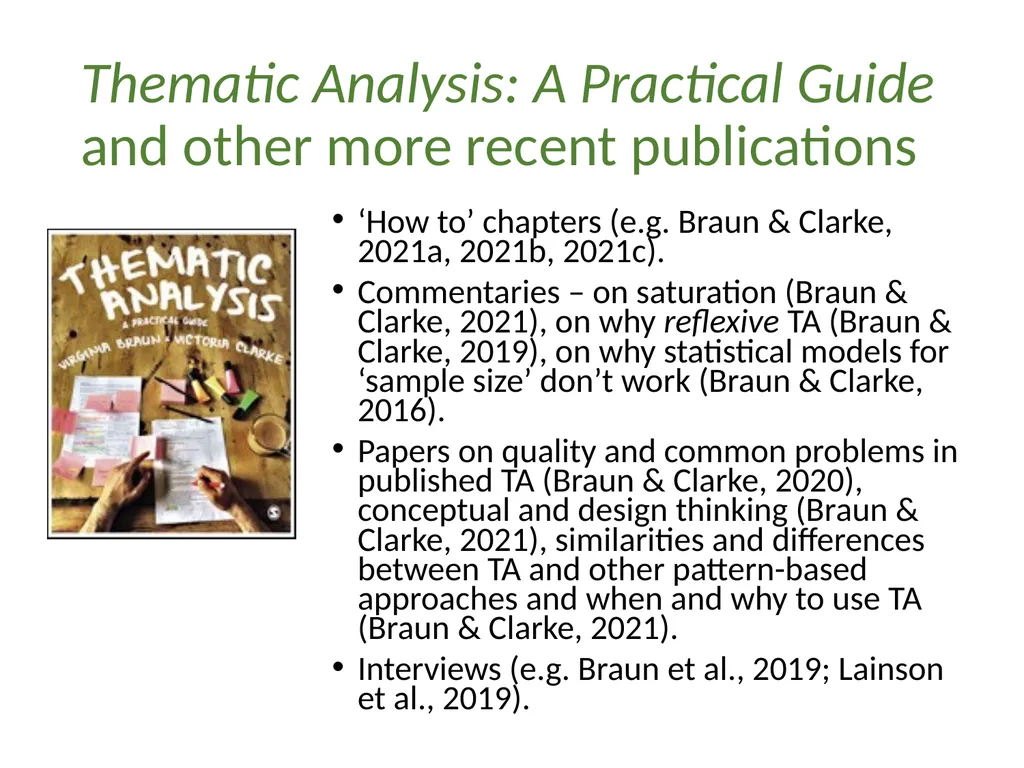
Thematic Analysis: A Practical Guide and other more recent publications ‘How to’ chapters (e.g. Braun & Clarke, 2021a, 2021b, 2021c).
Commentaries – on saturation (Braun & Clarke, 2021), on why reflexive TA (Braun & Clarke, 2019), on why statistical models for ‘sample size’ don’t work (Braun & Clarke, 2016).
Papers on quality and common problems in published TA (Braun & Clarke, 2020), conceptual and design thinking (Braun & Clarke, 2021), similarities and differences between TA and other pattern-based approaches and when and why to use TA (Braun & Clarke, 2021).
Interviews (e.g. Braun et al., 2019; Lainson et al., 2019).<br>
Commentaries – on saturation (Braun & Clarke, 2021), on why reflexive TA (Braun & Clarke, 2019), on why statistical models for ‘sample size’ don’t work (Braun & Clarke, 2016).
Papers on quality and common problems in published TA (Braun & Clarke, 2020), conceptual and design thinking (Braun & Clarke, 2021), similarities and differences between TA and other pattern-based approaches and when and why to use TA (Braun & Clarke, 2021).
Interviews (e.g. Braun et al., 2019; Lainson et al., 2019).<br>
08
Alert! 1 Don’t just rely on Braun & Clarke (2006); read other more recent publications too.
See our University of Auckland School of Psychology TA website for a full list of our publications: https://www.psych.auckland.ac.nz/en/about/our-research/research-groups/thematic-analysis.html<br>
See our University of Auckland School of Psychology TA website for a full list of our publications: https://www.psych.auckland.ac.nz/en/about/our-research/research-groups/thematic-analysis.html<br>
09
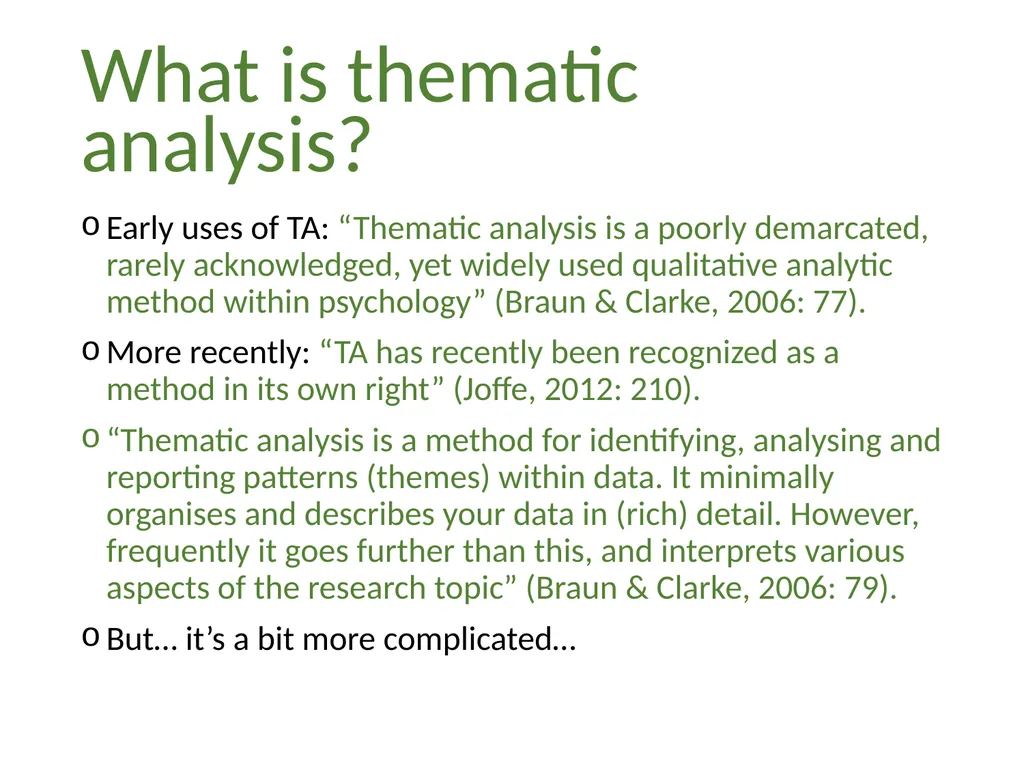
What is thematic analysis? Early uses of TA: “Thematic analysis is a poorly demarcated, rarely acknowledged, yet widely used qualitative analytic method within psychology” (Braun & Clarke, 2006: 77).
More recently: “TA has recently been recognized as a method in its own right” (Joffe, 2012: 210).
“Thematic analysis is a method for identifying, analysing and reporting patterns (themes) within data. It minimally organises and describes your data in (rich) detail. However, frequently it goes further than this, and interprets various aspects of the research topic” (Braun & Clarke, 2006: 79).
But… it’s a bit more complicated…<br>
More recently: “TA has recently been recognized as a method in its own right” (Joffe, 2012: 210).
“Thematic analysis is a method for identifying, analysing and reporting patterns (themes) within data. It minimally organises and describes your data in (rich) detail. However, frequently it goes further than this, and interprets various aspects of the research topic” (Braun & Clarke, 2006: 79).
But… it’s a bit more complicated…<br>
10
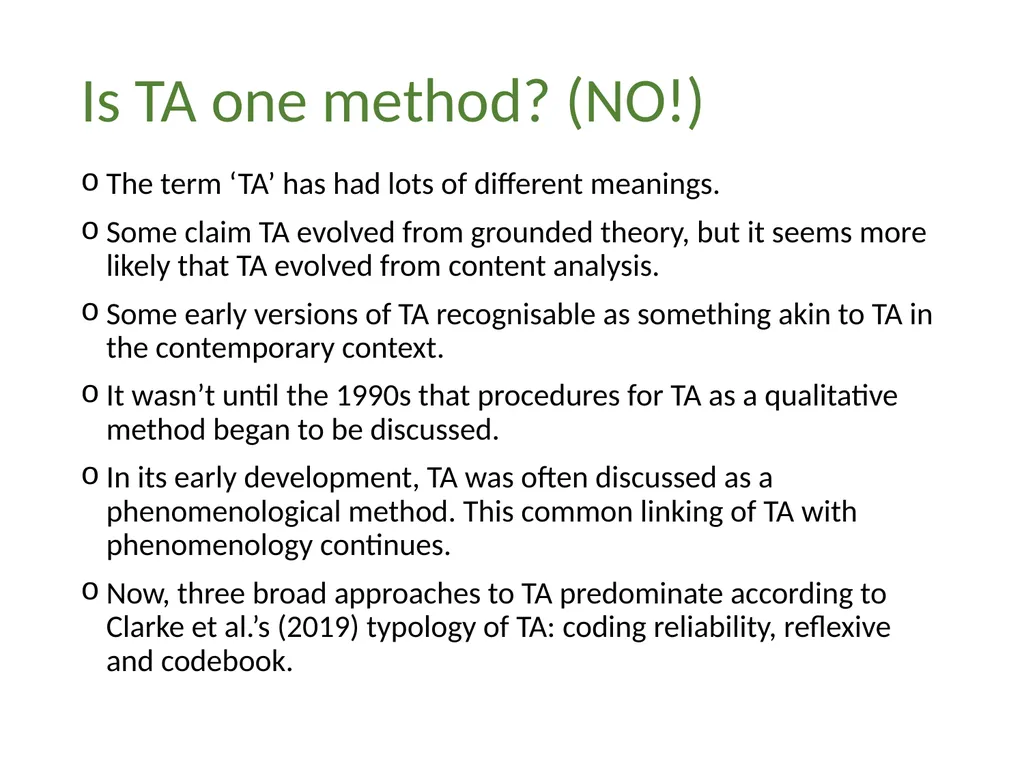
Is TA one method? (NO!) The term ‘TA’ has had lots of different meanings.
Some claim TA evolved from grounded theory, but it seems more likely that TA evolved from content analysis.
Some early versions of TA recognisable as something akin to TA in the contemporary context.
It wasn’t until the 1990s that procedures for TA as a qualitative method began to be discussed.
In its early development, TA was often discussed as a phenomenological method. This common linking of TA with phenomenology continues.
Now, three broad approaches to TA predominate according to Clarke et al.’s (2019) typology of TA: coding reliability, reflexive and codebook.<br>
Some claim TA evolved from grounded theory, but it seems more likely that TA evolved from content analysis.
Some early versions of TA recognisable as something akin to TA in the contemporary context.
It wasn’t until the 1990s that procedures for TA as a qualitative method began to be discussed.
In its early development, TA was often discussed as a phenomenological method. This common linking of TA with phenomenology continues.
Now, three broad approaches to TA predominate according to Clarke et al.’s (2019) typology of TA: coding reliability, reflexive and codebook.<br>
11
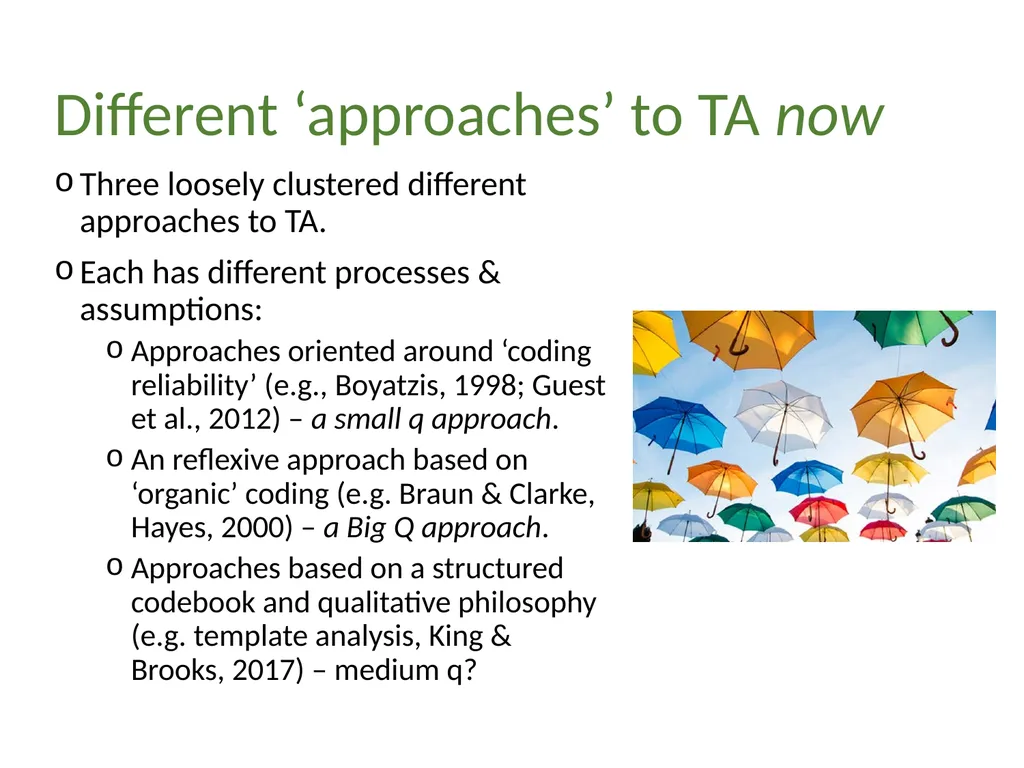
Different ‘approaches’ to TA now Three loosely clustered different approaches to TA.
Each has different processes & assumptions:
Approaches oriented around ‘coding reliability’ (e.g., Boyatzis, 1998; Guest et al., 2012) – a small q approach.
An reflexive approach based on ‘organic’ coding (e.g. Braun & Clarke, Hayes, 2000) – a Big Q approach.
Approaches based on a structured codebook and qualitative philosophy (e.g. template analysis, King & Brooks, 2017) – medium q?<br>
Each has different processes & assumptions:
Approaches oriented around ‘coding reliability’ (e.g., Boyatzis, 1998; Guest et al., 2012) – a small q approach.
An reflexive approach based on ‘organic’ coding (e.g. Braun & Clarke, Hayes, 2000) – a Big Q approach.
Approaches based on a structured codebook and qualitative philosophy (e.g. template analysis, King & Brooks, 2017) – medium q?<br>
12
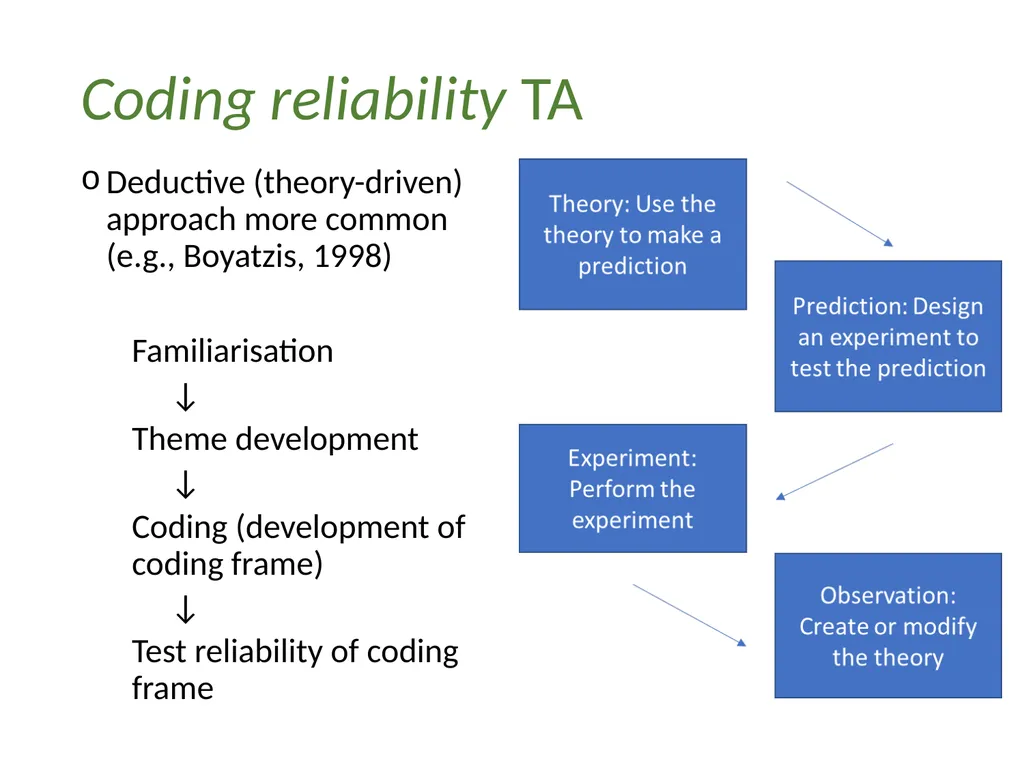
Coding reliability TA Deductive (theory-driven) approach more common (e.g., Boyatzis, 1998)
Familiarisation
↓
Theme development
↓
Coding (development of coding frame)
↓
Test reliability of coding frame<br>
Familiarisation
↓
Theme development
↓
Coding (development of coding frame)
↓
Test reliability of coding frame<br>
13
Reflexive TA Inductive (data-driven) approach more common
Familiarisation
↓
Coding (organic and subjective; one coder)
↓
Theme development (review initial themes against coded data and entire data-set; subjective and interpretive)<br>
Familiarisation
↓
Coding (organic and subjective; one coder)
↓
Theme development (review initial themes against coded data and entire data-set; subjective and interpretive)<br>
14
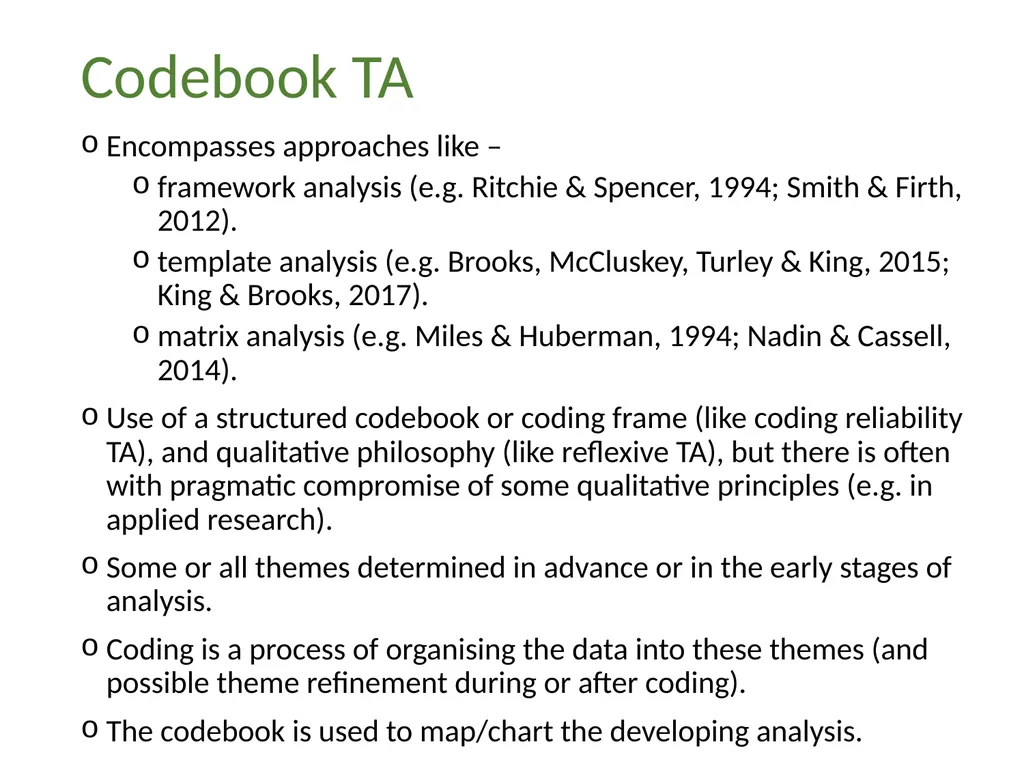
Codebook TA Encompasses approaches like –
framework analysis (e.g. Ritchie & Spencer, 1994; Smith & Firth, 2012).
template analysis (e.g. Brooks, McCluskey, Turley & King, 2015; King & Brooks, 2017).
matrix analysis (e.g. Miles & Huberman, 1994; Nadin & Cassell, 2014).
Use of a structured codebook or coding frame (like coding reliability TA), and qualitative philosophy (like reflexive TA), but there is often with pragmatic compromise of some qualitative principles (e.g. in applied research).
Some or all themes determined in advance or in the early stages of analysis.
Coding is a process of organising the data into these themes (and possible theme refinement during or after coding).
The codebook is used to map/chart the developing analysis.<br>
framework analysis (e.g. Ritchie & Spencer, 1994; Smith & Firth, 2012).
template analysis (e.g. Brooks, McCluskey, Turley & King, 2015; King & Brooks, 2017).
matrix analysis (e.g. Miles & Huberman, 1994; Nadin & Cassell, 2014).
Use of a structured codebook or coding frame (like coding reliability TA), and qualitative philosophy (like reflexive TA), but there is often with pragmatic compromise of some qualitative principles (e.g. in applied research).
Some or all themes determined in advance or in the early stages of analysis.
Coding is a process of organising the data into these themes (and possible theme refinement during or after coding).
The codebook is used to map/chart the developing analysis.<br>
15
TA – closer to a method than a methodology Most qualitative approaches are methodologies – theoretically informed frameworks for research.
Specifying guiding theoretical assumptions, suitable research questions, ideal methods of data collection and data/participant selection strategies, as well as analytic procedures.
TA as a generic approach, by contrast, is just an analytic method, but particular approaches to TA encode particular philosophical assumptions and so sit somewhere between a method and a methodology.
In reflexive TA, there’s lots of flexibility and variability… (see Part 2).<br>
Specifying guiding theoretical assumptions, suitable research questions, ideal methods of data collection and data/participant selection strategies, as well as analytic procedures.
TA as a generic approach, by contrast, is just an analytic method, but particular approaches to TA encode particular philosophical assumptions and so sit somewhere between a method and a methodology.
In reflexive TA, there’s lots of flexibility and variability… (see Part 2).<br>
16
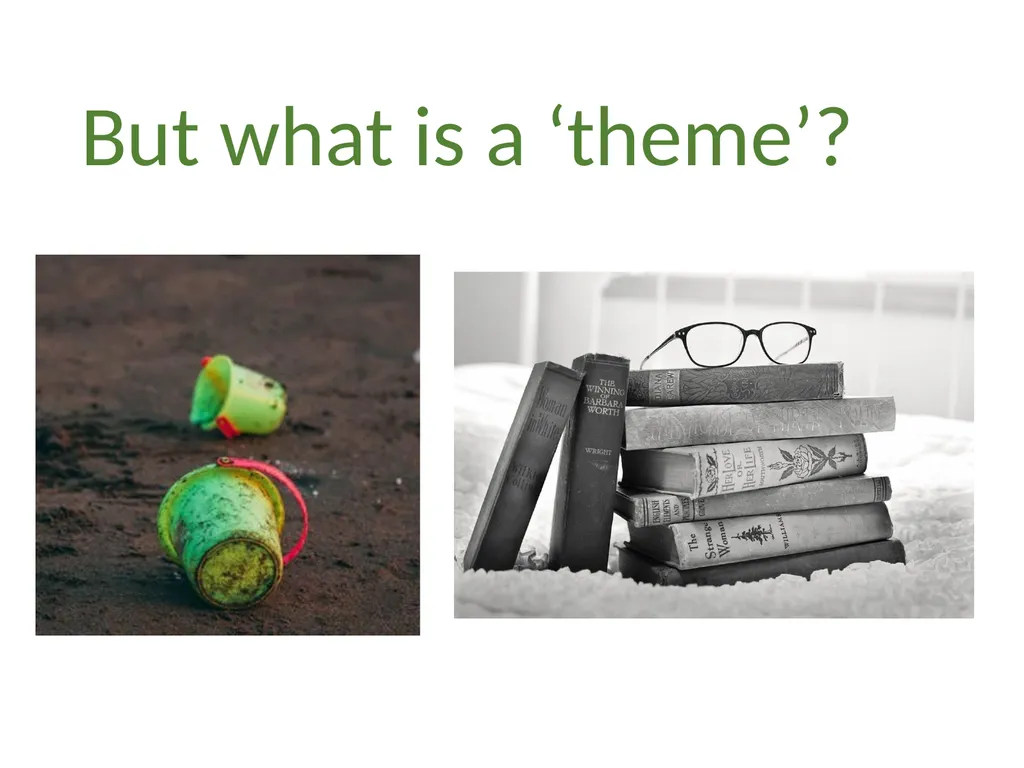
But what is a ‘theme’?<br>
17
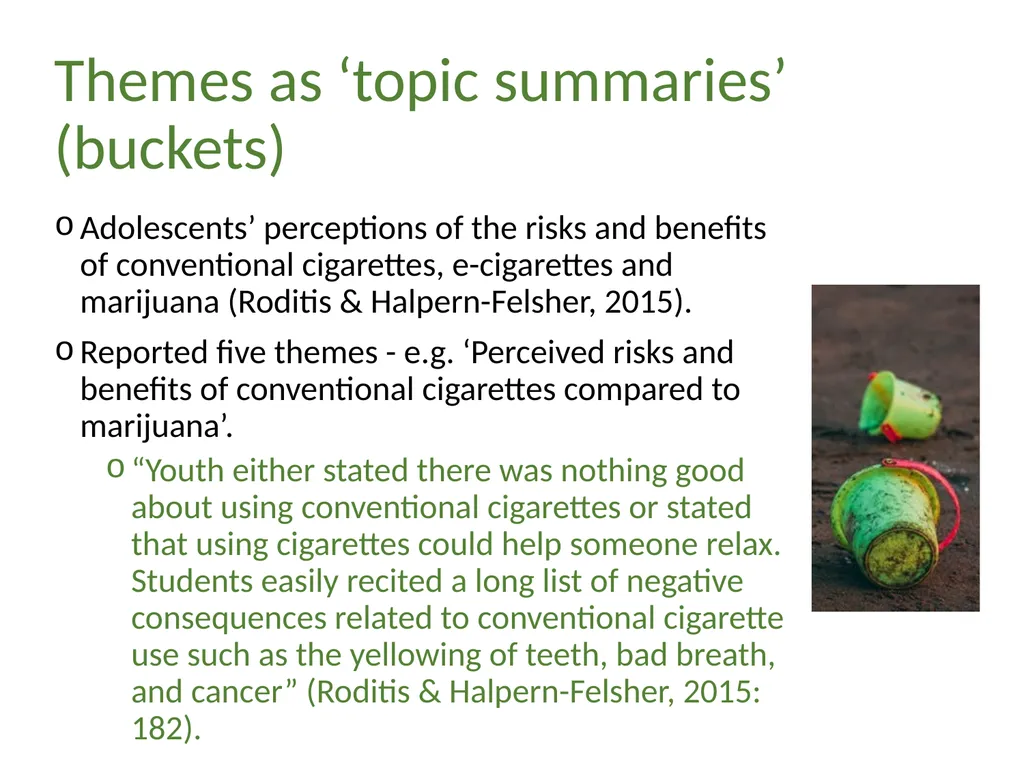
Themes as ‘topic summaries’ (buckets) Adolescents’ perceptions of the risks and benefits of conventional cigarettes, e-cigarettes and marijuana (Roditis & Halpern-Felsher, 2015).
Reported five themes - e.g. ‘Perceived risks and benefits of conventional cigarettes compared to marijuana’.
“Youth either stated there was nothing good about using conventional cigarettes or stated that using cigarettes could help someone relax. Students easily recited a long list of negative consequences related to conventional cigarette use such as the yellowing of teeth, bad breath, and cancer” (Roditis & Halpern-Felsher, 2015: 182).<br>
Reported five themes - e.g. ‘Perceived risks and benefits of conventional cigarettes compared to marijuana’.
“Youth either stated there was nothing good about using conventional cigarettes or stated that using cigarettes could help someone relax. Students easily recited a long list of negative consequences related to conventional cigarette use such as the yellowing of teeth, bad breath, and cancer” (Roditis & Halpern-Felsher, 2015: 182).<br>
18
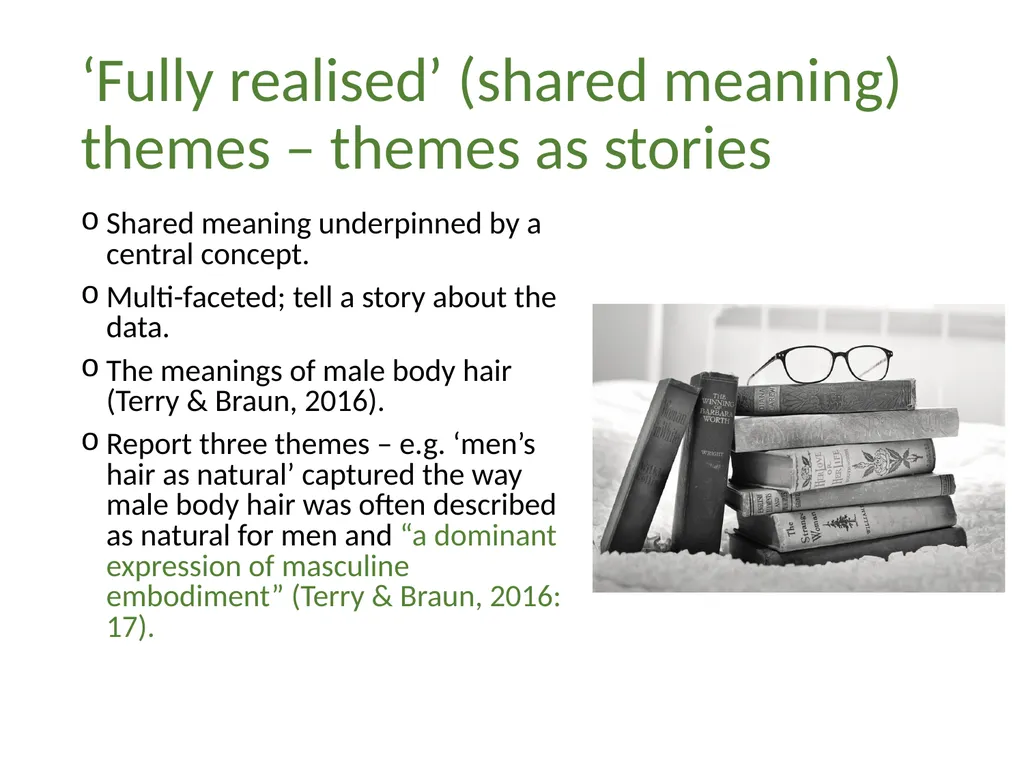
‘Fully realised’ (shared meaning) themes – themes as stories Shared meaning underpinned by a central concept.
Multi-faceted; tell a story about the data.
The meanings of male body hair (Terry & Braun, 2016).
Report three themes – e.g. ‘men’s hair as natural’ captured the way male body hair was often described as natural for men and “a dominant expression of masculine embodiment” (Terry & Braun, 2016: 17).<br>
Multi-faceted; tell a story about the data.
The meanings of male body hair (Terry & Braun, 2016).
Report three themes – e.g. ‘men’s hair as natural’ captured the way male body hair was often described as natural for men and “a dominant expression of masculine embodiment” (Terry & Braun, 2016: 17).<br>
19
Themes – Analytic input? Output? Developed early on and guide coding.
Developed later and represent the outcome of coding.<br>
Developed later and represent the outcome of coding.<br>
20
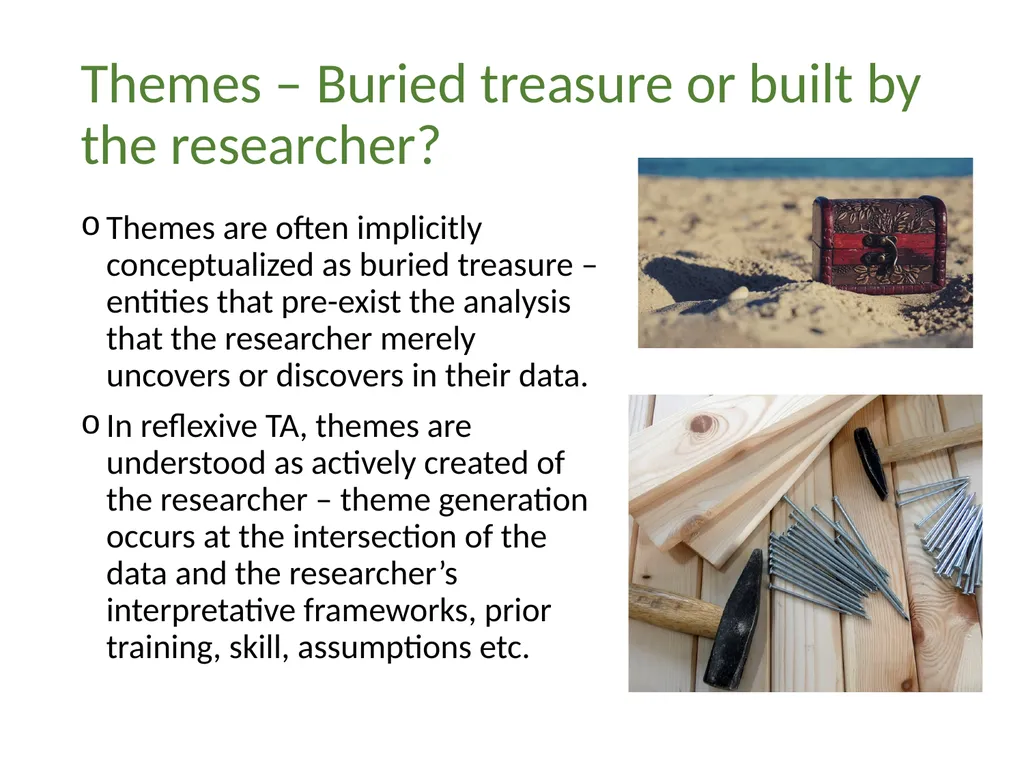
Themes – Buried treasure or built by the researcher? Themes are often implicitly conceptualized as buried treasure – entities that pre-exist the analysis that the researcher merely uncovers or discovers in their data.
In reflexive TA, themes are understood as actively created of the researcher – theme generation occurs at the intersection of the data and the researcher’s interpretative frameworks, prior training, skill, assumptions etc.<br>
In reflexive TA, themes are understood as actively created of the researcher – theme generation occurs at the intersection of the data and the researcher’s interpretative frameworks, prior training, skill, assumptions etc.<br>
21
References for part 1 – slide 1 Boyatzis, R. E. (1998). Transforming qualitative information: Thematic analysis and code development. Sage.
Braun, V., & Clarke, V. (2006). Using thematic analysis in psychology. Qualitative Research in Psychology, 3(2), 77-101.
Braun, V., & Clarke, V. (2013). Successful qualitative research: A practical guide for beginners. Sage.
Braun, V., & Clarke, V. (2016). (Mis)conceptualising themes, thematic analysis, and other problems with Fugard and Potts’ (2015) sample-size tool for thematic analysis. International Journal of Social Research Methodology, 19(6), 739-743.
Braun, V., & Clarke, V. (2019). Reflecting on reflexive thematic analysis. Qualitative Research in Sport, Exercise & Health, 11(4), 589-597.
Braun, V., Clarke, V., & Hayfield, N. (2019). “A starting point for your journey, not a map”: Nikki Hayfield in conversation with Virginia Braun and Victoria Clarke about thematic analysis. Qualitative Research in Psychology. Advance online publication.<br>
Braun, V., & Clarke, V. (2006). Using thematic analysis in psychology. Qualitative Research in Psychology, 3(2), 77-101.
Braun, V., & Clarke, V. (2013). Successful qualitative research: A practical guide for beginners. Sage.
Braun, V., & Clarke, V. (2016). (Mis)conceptualising themes, thematic analysis, and other problems with Fugard and Potts’ (2015) sample-size tool for thematic analysis. International Journal of Social Research Methodology, 19(6), 739-743.
Braun, V., & Clarke, V. (2019). Reflecting on reflexive thematic analysis. Qualitative Research in Sport, Exercise & Health, 11(4), 589-597.
Braun, V., Clarke, V., & Hayfield, N. (2019). “A starting point for your journey, not a map”: Nikki Hayfield in conversation with Virginia Braun and Victoria Clarke about thematic analysis. Qualitative Research in Psychology. Advance online publication.<br>
22
References for part 1 – slide 2 Lainson, K., Braun, V., & Clarke, V. (2019). Being both narrative practitioner and academic researcher: A reflection on what thematic analysis has to offer narratively informed research. International Journal of Narrative Therapy and Community Work, 4, 86-98.
Braun, V., & Clarke, V. (2020). One size fits all? What counts as quality practice in (reflexive) thematic analysis? Qualitative Research in Psychology, 18(3), 328-352.
Braun, V., & Clarke, V. (2021). Thematic analysis. In H. Cooper, P. M. Camic, D. L. Long, A. T. Panter, D. Rindskopf, & K. J. Sher (Eds.), APA handbook of research methods in psychology, Vol. 2: Research designs: Quantitative, qualitative, neuropsychological, and biological (2nd ed.). American Psychological Association.<br>
Braun, V., & Clarke, V. (2020). One size fits all? What counts as quality practice in (reflexive) thematic analysis? Qualitative Research in Psychology, 18(3), 328-352.
Braun, V., & Clarke, V. (2021). Thematic analysis. In H. Cooper, P. M. Camic, D. L. Long, A. T. Panter, D. Rindskopf, & K. J. Sher (Eds.), APA handbook of research methods in psychology, Vol. 2: Research designs: Quantitative, qualitative, neuropsychological, and biological (2nd ed.). American Psychological Association.<br>
23
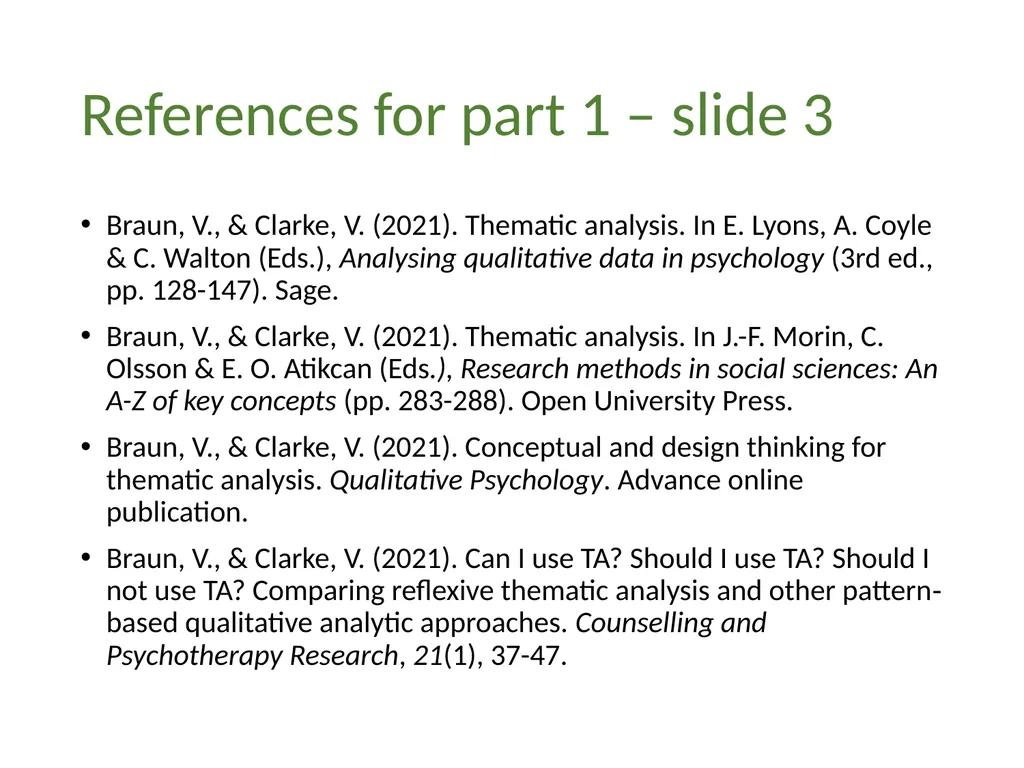
References for part 1 – slide 3 Braun, V., & Clarke, V. (2021). Thematic analysis. In E. Lyons, A. Coyle & C. Walton (Eds.), Analysing qualitative data in psychology (3rd ed., pp. 128-147). Sage.
Braun, V., & Clarke, V. (2021). Thematic analysis. In J.-F. Morin, C. Olsson & E. O. Atikcan (Eds.), Research methods in social sciences: An A-Z of key concepts (pp. 283-288). Open University Press.
Braun, V., & Clarke, V. (2021). Conceptual and design thinking for thematic analysis. Qualitative Psychology. Advance online publication.
Braun, V., & Clarke, V. (2021). Can I use TA? Should I use TA? Should I not use TA? Comparing reflexive thematic analysis and other pattern‐based qualitative analytic approaches. Counselling and Psychotherapy Research, 21(1), 37-47.<br>
Braun, V., & Clarke, V. (2021). Thematic analysis. In J.-F. Morin, C. Olsson & E. O. Atikcan (Eds.), Research methods in social sciences: An A-Z of key concepts (pp. 283-288). Open University Press.
Braun, V., & Clarke, V. (2021). Conceptual and design thinking for thematic analysis. Qualitative Psychology. Advance online publication.
Braun, V., & Clarke, V. (2021). Can I use TA? Should I use TA? Should I not use TA? Comparing reflexive thematic analysis and other pattern‐based qualitative analytic approaches. Counselling and Psychotherapy Research, 21(1), 37-47.<br>
24
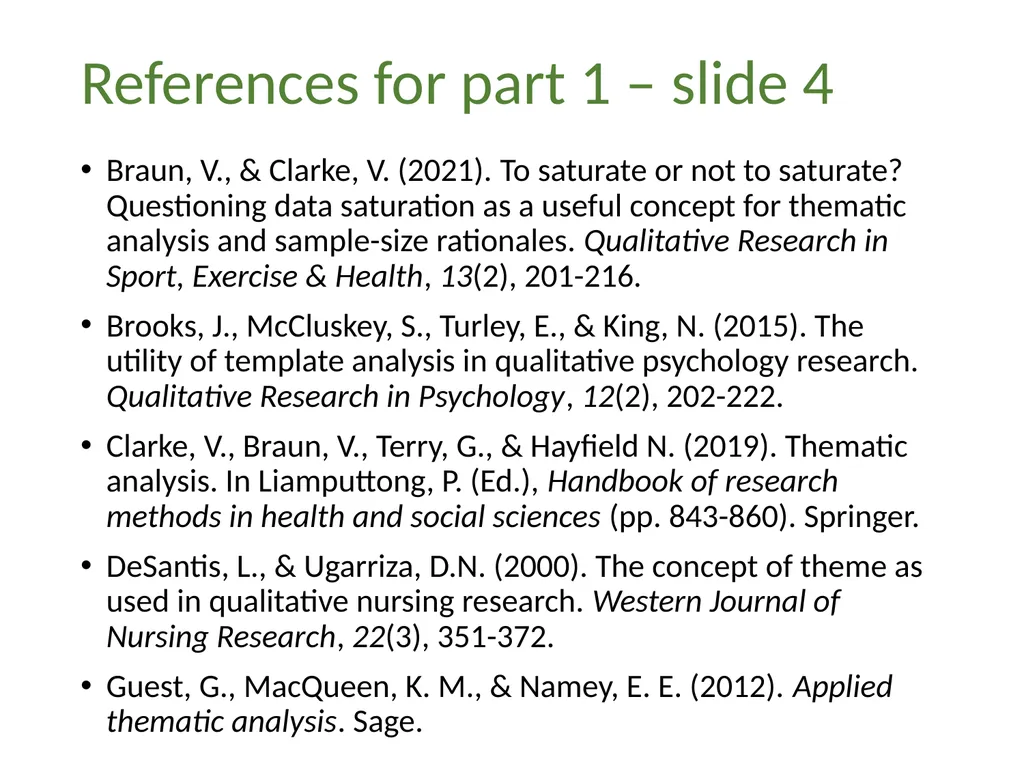
References for part 1 – slide 4 Braun, V., & Clarke, V. (2021). To saturate or not to saturate? Questioning data saturation as a useful concept for thematic analysis and sample-size rationales. Qualitative Research in Sport, Exercise & Health, 13(2), 201-216.
Brooks, J., McCluskey, S., Turley, E., & King, N. (2015). The utility of template analysis in qualitative psychology research. Qualitative Research in Psychology, 12(2), 202-222.
Clarke, V., Braun, V., Terry, G., & Hayfield N. (2019). Thematic analysis. In Liamputtong, P. (Ed.), Handbook of research methods in health and social sciences (pp. 843-860). Springer.
DeSantis, L., & Ugarriza, D.N. (2000). The concept of theme as used in qualitative nursing research. Western Journal of Nursing Research, 22(3), 351-372.
Guest, G., MacQueen, K. M., & Namey, E. E. (2012). Applied thematic analysis. Sage.<br>
Brooks, J., McCluskey, S., Turley, E., & King, N. (2015). The utility of template analysis in qualitative psychology research. Qualitative Research in Psychology, 12(2), 202-222.
Clarke, V., Braun, V., Terry, G., & Hayfield N. (2019). Thematic analysis. In Liamputtong, P. (Ed.), Handbook of research methods in health and social sciences (pp. 843-860). Springer.
DeSantis, L., & Ugarriza, D.N. (2000). The concept of theme as used in qualitative nursing research. Western Journal of Nursing Research, 22(3), 351-372.
Guest, G., MacQueen, K. M., & Namey, E. E. (2012). Applied thematic analysis. Sage.<br>
25
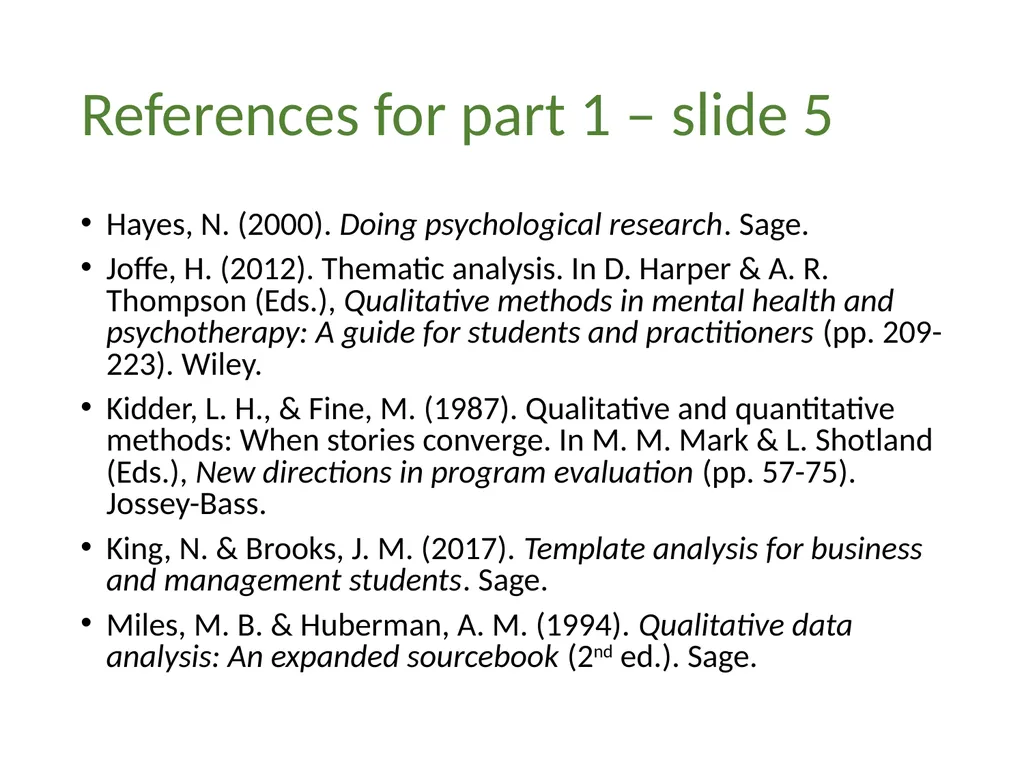
References for part 1 – slide 5 Hayes, N. (2000). Doing psychological research. Sage.
Joffe, H. (2012). Thematic analysis. In D. Harper & A. R. Thompson (Eds.), Qualitative methods in mental health and psychotherapy: A guide for students and practitioners (pp. 209-223). Wiley.
Kidder, L. H., & Fine, M. (1987). Qualitative and quantitative methods: When stories converge. In M. M. Mark & L. Shotland (Eds.), New directions in program evaluation (pp. 57-75). Jossey-Bass.
King, N. & Brooks, J. M. (2017). Template analysis for business and management students. Sage.
Miles, M. B. & Huberman, A. M. (1994). Qualitative data analysis: An expanded sourcebook (2nd ed.). Sage.<br>
Joffe, H. (2012). Thematic analysis. In D. Harper & A. R. Thompson (Eds.), Qualitative methods in mental health and psychotherapy: A guide for students and practitioners (pp. 209-223). Wiley.
Kidder, L. H., & Fine, M. (1987). Qualitative and quantitative methods: When stories converge. In M. M. Mark & L. Shotland (Eds.), New directions in program evaluation (pp. 57-75). Jossey-Bass.
King, N. & Brooks, J. M. (2017). Template analysis for business and management students. Sage.
Miles, M. B. & Huberman, A. M. (1994). Qualitative data analysis: An expanded sourcebook (2nd ed.). Sage.<br>
26
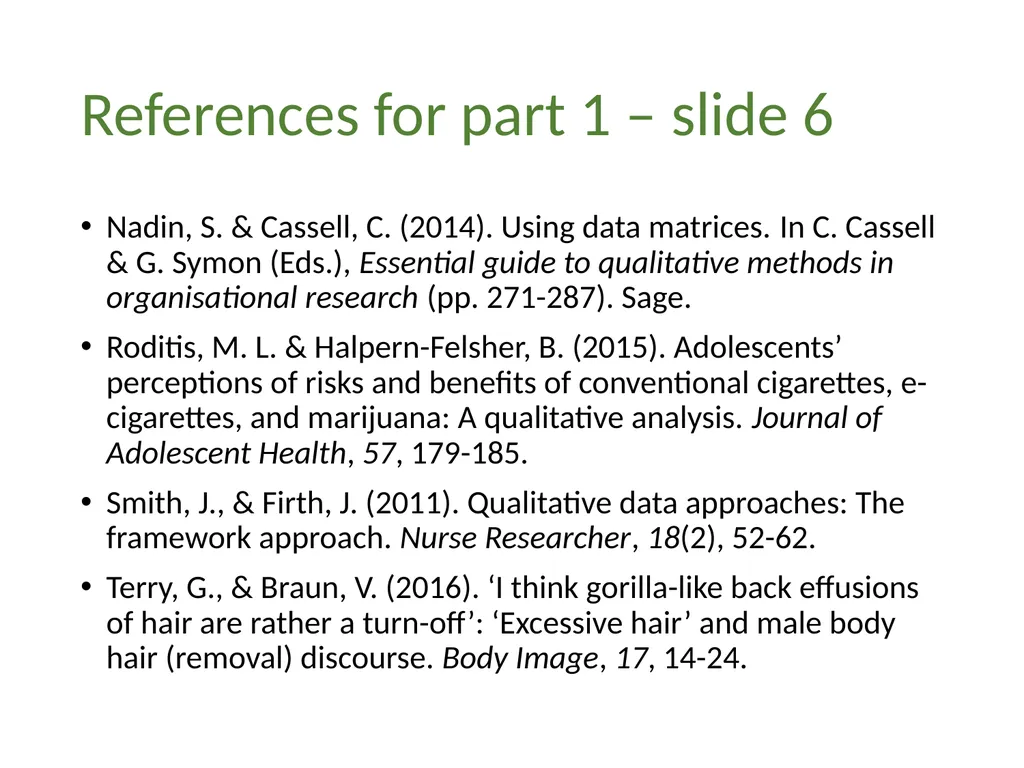
References for part 1 – slide 6 Nadin, S. & Cassell, C. (2014). Using data matrices. In C. Cassell & G. Symon (Eds.), Essential guide to qualitative methods in organisational research (pp. 271-287). Sage.
Roditis, M. L. & Halpern-Felsher, B. (2015). Adolescents’ perceptions of risks and benefits of conventional cigarettes, e-cigarettes, and marijuana: A qualitative analysis. Journal of Adolescent Health, 57, 179-185.
Smith, J., & Firth, J. (2011). Qualitative data approaches: The framework approach. Nurse Researcher, 18(2), 52-62.
Terry, G., & Braun, V. (2016). ‘I think gorilla-like back effusions of hair are rather a turn-off’: ‘Excessive hair’ and male body hair (removal) discourse. Body Image, 17, 14-24.<br>
Roditis, M. L. & Halpern-Felsher, B. (2015). Adolescents’ perceptions of risks and benefits of conventional cigarettes, e-cigarettes, and marijuana: A qualitative analysis. Journal of Adolescent Health, 57, 179-185.
Smith, J., & Firth, J. (2011). Qualitative data approaches: The framework approach. Nurse Researcher, 18(2), 52-62.
Terry, G., & Braun, V. (2016). ‘I think gorilla-like back effusions of hair are rather a turn-off’: ‘Excessive hair’ and male body hair (removal) discourse. Body Image, 17, 14-24.<br>