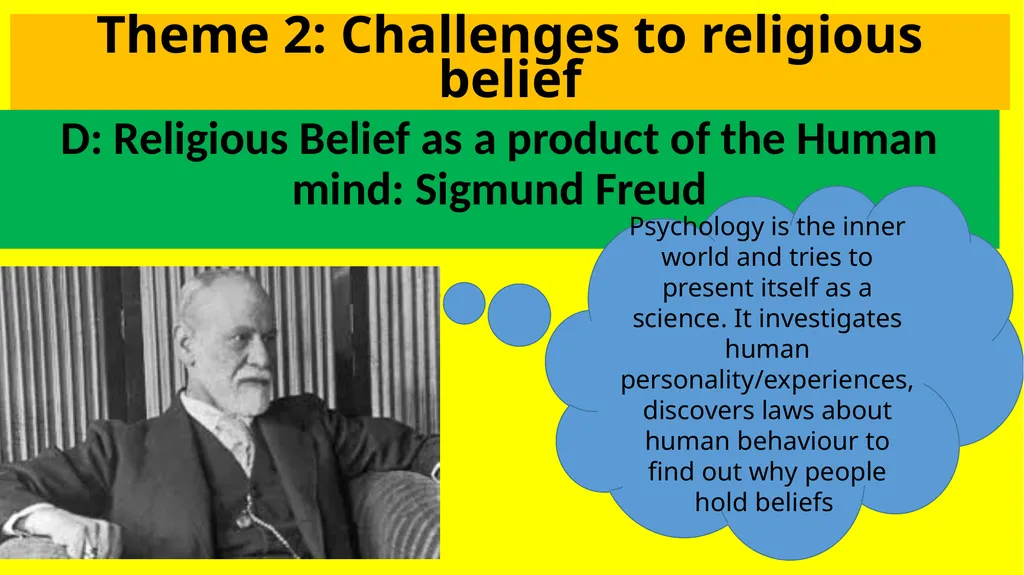
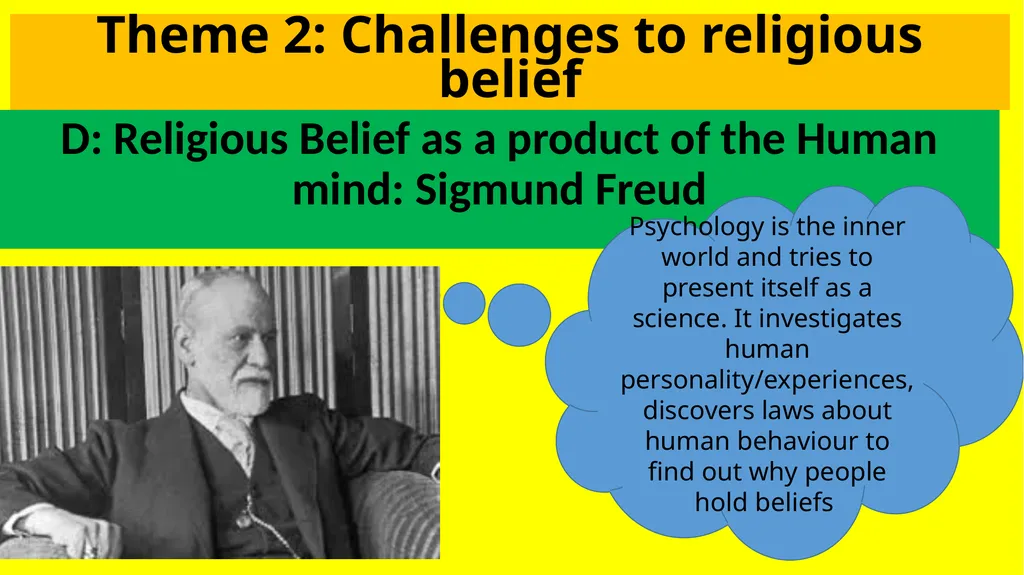
Theme 2: Challenges to religious belief D: Religious Belief as a product of the Human mind: Sigmund Freud Psychology is the inner world and tries to present itself as a science. It investigates human personalityexperiences, discovers laws
"Theme 2: Challenges to religious belief D:" is the property of its rightful owner. Permission is granted to
download and print the materials on this website for personal, non-commercial use only, and to display it
on your personal computer provided you do not modify the materials and that you retain all copyright
notices contained in the materials. By downloading content from our website, you accept the terms of this
agreement.
Presentation Transcript
01
Theme 2: Challenges to religious belief D: Religious Belief as a product of the Human mind: Sigmund Freud Psychology is the inner world and tries to present itself as a science. It investigates human personality/experiences, discovers laws about human behaviour to find out why people hold beliefs<br>
02
Religion as collective neurosis Freud believed the Psyche (personality) was divided into id, ego, superego which developed at different stages of life. The ego is the conscious self that is created by dynamic tensions and interactions between the id and the superego and has the task of reconciling conflicts demands with requirements of external reality. Moral conflicts can be in dreams and neurotic symptoms. The id is the primitive and impulsive part of our psyche which responds to our instincts The superego is the moral part of the personality which includes the conscience and ideal-ego<br>
03
Religion as collective neurosis Freud noted people who suffer from obsessional neurosis (uncontrollable obsessions that can create daily rituals) for example those who neglect repeated actions such as the rosary. But obsessional neurosis patients did not understand their meaning of their actions but religious people do understand the meaning.
For religious people this is caused by instinctual impulses (instinct that is unconscious but active in the psyche) such as guilt followed by temptation, for example doing something that God disapproves of to the religious ritual of prayer/confession/Wadu. Freud ‘religion as a universal obsessional neurosis’.
Neurotic Compulsions + Religious Rituals are found universally = Collective Neurosis<br>
04
Religion as a neurosis: the primal horde Freud 1913 Totem and Taboo: based theory on Darwin’s small ‘hordes’. The horde (alpha-male) seized women who drive off/kill rivals like Gorillas. At some time the prehistoric brothers expelled by alpha-male return to kill their father, they dominate the horde and seize the women. However the young males feel guilt and rival for the women, the brothers form a tribe and a totem took place of the father to unite the tribe. Freud took an interest Aborigines, every clan have a totem and people were not allowed to marry within the clan (avoids incest). Freud saw correlation Darwin’s primitive horde theory and totenism. The totem was literally a substitute for a father both loved and feared. The Totem was worshipped and became God. It is an inherited sense of guilt. Holy Communion, Christ replaces the father by offering atonement, The totemic meal replaced by the Holy Communion.<br>
05
Religion as a neurosis: the Oedipus complex Freud believed the sexual drive (libido) desire to have sex but body’s desire to have satisfaction (id). The father was preventing the son’s sexual desires being fulfilled, the conflict with father and feelings of guilt are hidden. Hidden psychosexual development between ages 3-6, this is the Oedipus Complex. A stage where child develops sexual identity and begins to notice the physical and social differences. According to Freud boys have a love affair with their mothers, the father is a rival for mother’s love. A child might experience anxiety , castration , weaning a boy is deprived from mother’s breast, exploring his penis and fear to lose his penis, some humans do not have a penis and interprets this as a punishment. Beliefs and practices were expressions neurotic behaviour. Both Horde and Oedipus theory desire eliminate the father and possess the mother.<br>
06
Religion as an illusion: wish fulfilment Future of an illusion (1927), yearnings based on wish fulfilment and longings of the ideal-ego aspect of the superego. Feuerbach saw God as a projection of the human mind. Religion lies in our deepest wishes desire justice, escape death; this is clear from most cultures and these desires are met by the divine.<br>
07
Religion as an illusion: a reaction against helplessness We are confronted by natural forces and feel defenceless so we have created security. Forces of nature can be a God that can be worshipped and controlled. We also struggle with internal aggression , Religion limits violence and war and religion protects the weak. Sexual drive is restricted through religious laws, Religion provides a father figure- God.<br>
08
Supporting evidence: redirection of guilt complexes The workings of the mind can be rationally explained through psychoanalysis who suffered neurosis. Freud let patients speak freely to unlock their thoughts, there was evidence Oedipus complex.
Read the case studies Daniel Paul Schreber, Little Hans and Wolf Man.
Brain activity suggest unconscious conflicts cause anxiety symptoms. Interpretations of dreams caused psychotherapy to link with phobias.<br>
09
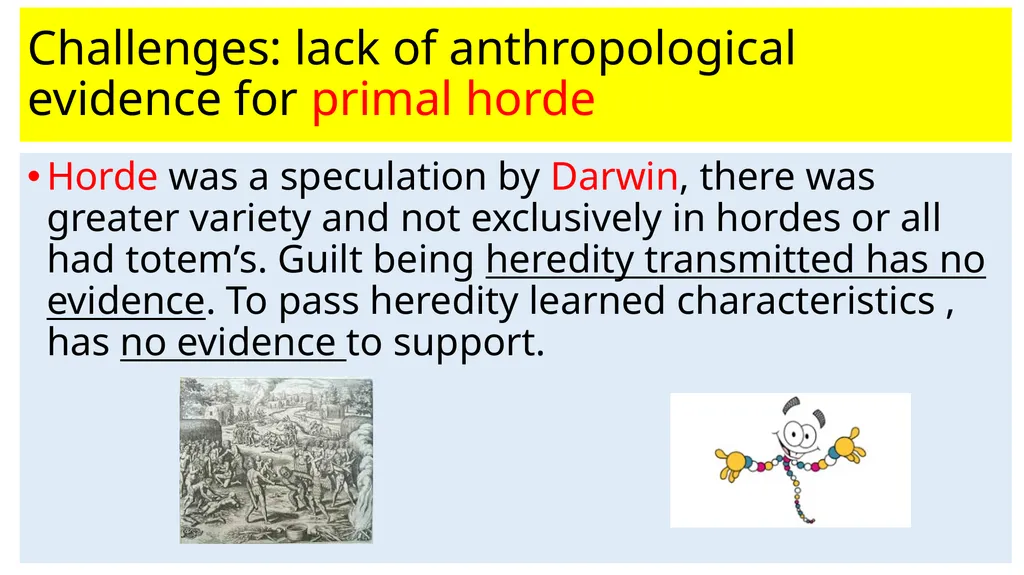
Challenges: lack of anthropological evidence for primal horde Horde was a speculation by Darwin, there was greater variety and not exclusively in hordes or all had totem’s. Guilt being heredity transmitted has no evidence. To pass heredity learned characteristics , has no evidence to support.<br>
10
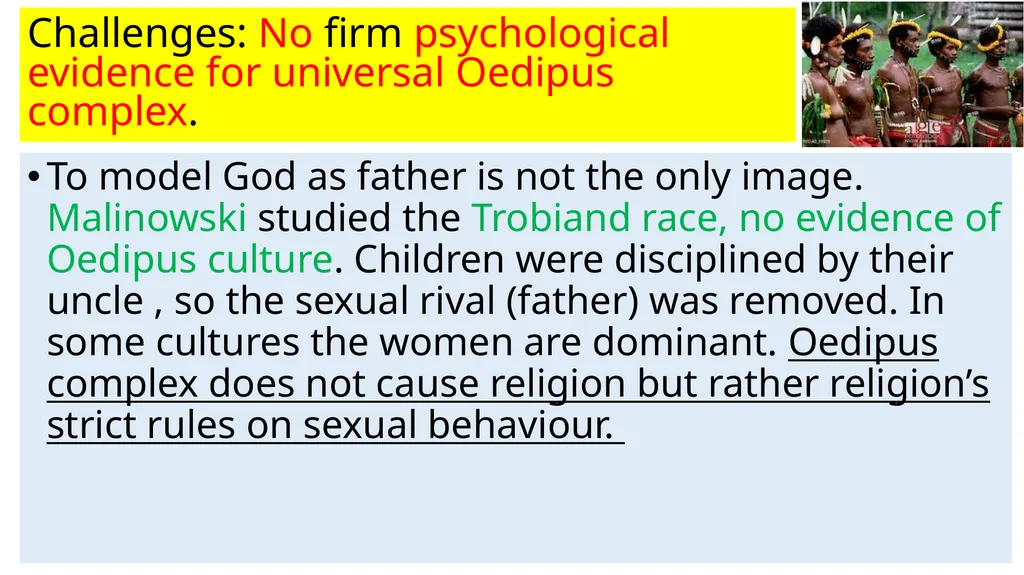
Challenges: No firm psychological evidence for universal Oedipus complex. To model God as father is not the only image. Malinowski studied the Trobiand race, no evidence of Oedipus culture. Children were disciplined by their uncle , so the sexual rival (father) was removed. In some cultures the women are dominant. Oedipus complex does not cause religion but rather religion’s strict rules on sexual behaviour.<br>
11
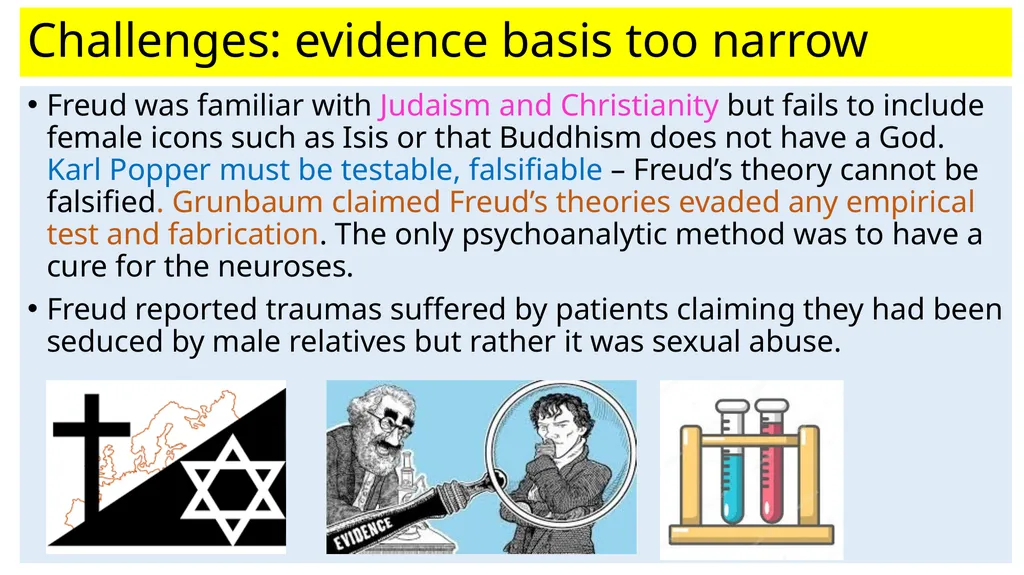
Challenges: evidence basis too narrow Freud was familiar with Judaism and Christianity but fails to include female icons such as Isis or that Buddhism does not have a God. Karl Popper must be testable, falsifiable – Freud’s theory cannot be falsified. Grunbaum claimed Freud’s theories evaded any empirical test and fabrication. The only psychoanalytic method was to have a cure for the neuroses.
Freud reported traumas suffered by patients claiming they had been seduced by male relatives but rather it was sexual abuse.<br>
12
AO2: To what extent can religious belief be considered a neurosis? Freud treating patient’s with neurosis drew attention obsessions and religion. ‘Individual religiosity’ has repetitive rituals is a ‘universal obsessional neurosis’.
Slaughter of the primal father: hordes, subconscious memory of human events for example Holy Communion for atonement.
Oedipus Complex, hated of father and incest with mother depends interpretation of religious stories.
Neurosis, case studies inner psychological conflict.
Feeling of guilt, guilty primal horde, Freud suggests religion would die out and Science will take over Darwin and Freud, there is no evidence. Hypothesis was impossible to verify and falsify.
Freud’s view on religion was based on Judaism/Christianity. Malinowski casts doubt on Oedipus complex, Hindu have female icons.
Freud sees Religion as rituals and sacred acts rather than a set of beliefs.<br>
13
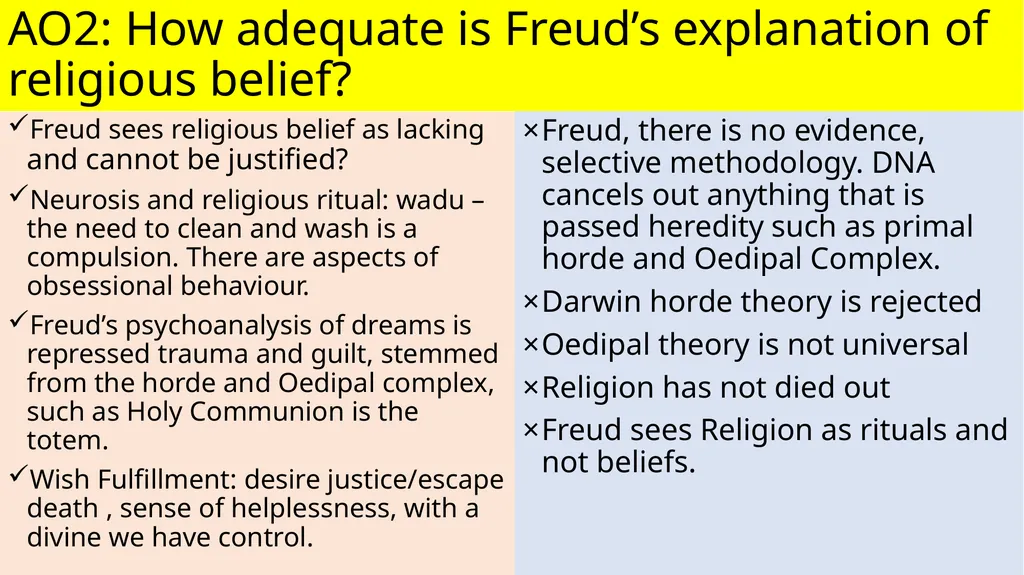
AO2: How adequate is Freud’s explanation of religious belief? Freud sees religious belief as lacking and cannot be justified?
Neurosis and religious ritual: wadu – the need to clean and wash is a compulsion. There are aspects of obsessional behaviour.
Freud’s psychoanalysis of dreams is repressed trauma and guilt, stemmed from the horde and Oedipal complex, such as Holy Communion is the totem.
Wish Fulfillment: desire justice/escape death , sense of helplessness, with a divine we have control. Freud, there is no evidence, selective methodology. DNA cancels out anything that is passed heredity such as primal horde and Oedipal Complex.
Darwin horde theory is rejected
Oedipal theory is not universal
Religion has not died out
Freud sees Religion as rituals and not beliefs.<br>