Theme 4: Religious Language F: Religious Language as a language game Ludwig Wittgensteins contribution to the debate about religious language Correspondence understanding truth realistempiricist position. Correspondence theory of truth
"Theme 4: Religious Language F: Religious Language" is the property of its rightful owner. Permission is granted to
download and print the materials on this website for personal, non-commercial use only, and to display it
on your personal computer provided you do not modify the materials and that you retain all copyright
notices contained in the materials. By downloading content from our website, you accept the terms of this
agreement.
Presentation Transcript
01
Theme 4: Religious Language F: Religious Language as a language game<br>
02
Ludwig Wittgenstein’s contribution to the debate about religious language Correspondence understanding truth = realist/empiricist position.
Correspondence theory of truth = cite an example in history , the planet is round.
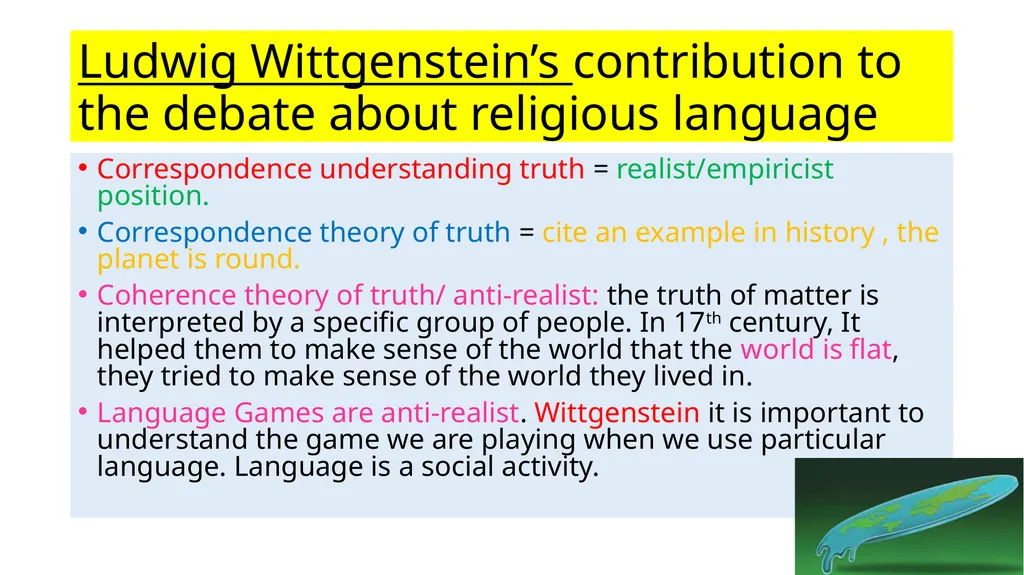
Coherence theory of truth/ anti-realist: the truth of matter is interpreted by a specific group of people. In 17th century, It helped them to make sense of the world that the world is flat, they tried to make sense of the world they lived in.
Language Games are anti-realist. Wittgenstein it is important to understand the game we are playing when we use particular language. Language is a social activity.<br>
03
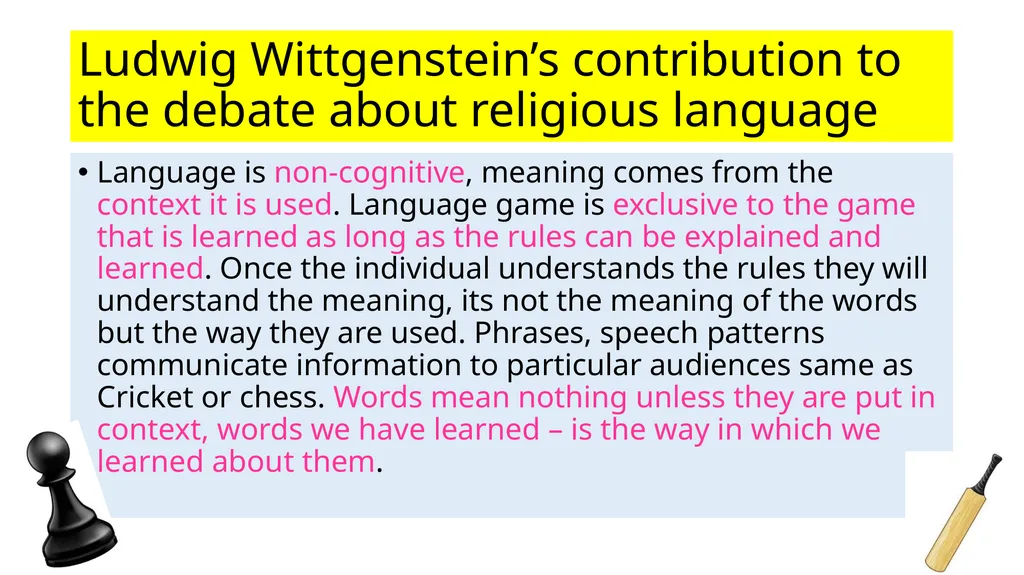
Ludwig Wittgenstein’s contribution to the debate about religious language Language is non-cognitive, meaning comes from the context it is used. Language game is exclusive to the game that is learned as long as the rules can be explained and learned. Once the individual understands the rules they will understand the meaning, its not the meaning of the words but the way they are used. Phrases, speech patterns communicate information to particular audiences same as Cricket or chess. Words mean nothing unless they are put in context, words we have learned – is the way in which we learned about them.<br>
04
Words and their Contexts Take the word “Result” and describe its meaning for the following groups.
An athlete involved in sport.
A scientist working in a medical laboratory.
A student following an exam.
Do you think that Wittgenstein is correct in arguing that we can only understand words in the context of a language game? Pick a word and in your group come up with as many meanings.<br>
05
Challenges to Wittgenstein’s theory of language games. Theists would say God exists and is objectively true. But Religious language is non Cognitive and cannot be verified.
Rhees 1959 Wittgenstein’s builders: Like Paley, Wittgenstein uses analogy. If the similarity is weak (Paley Watch and Universe) then analogy is weak.
Language should make sense to all not in a rules of a game.
It is not possible explain the concept of language to someone who has never spoken the language.
You need to know the people who play the game, you need to understand the game and people.
Each language has its own rules, Anti-realist position there would be confusion between groups, how do they communicate to each other?
If the word of God is subject to a game there is no definitive way to use the word.<br>
06
Challenges to Wittgenstein’s theory of language games. Meaningful dialogue can therefore not be established and the task of the non-religious believers in understanding the religious believer is doomed to failure. Words and phrases of religion is scrutinized in the external world.
What is you are not eager to learn the rules of the game? It might be nonsense to those outside. Language can be categorised in games is useful helping us to realise, it is inappropriate to try and understand the rules of religious language game by applying the rules of another language game.
But it brings meaning to those in the community.<br>
07
Whether the strengths of language games outweigh the weakness Reaction against Logical Positivist, defend Non-Cognitive language. Wittgenstein saw language as non-Cognitive – it has deep meaning and emotional attachments. Language game , language was unique to religious activity.
Religious believers can teach others about the rules. If there is a willingness to learn then its possible to learn the rules. But you need to understand the people and why people play the game.<br>